

IEC TS 62661-2-1:2013
(Main)Optical backplanes - Product specification - Part 2-1: Optical backplane using optical fibre circuit boards and multi-core right angle optical connectors
General Information
- Abstract
IEC/TS 62661-2-1:2013(E) gives guidelines for an optical backplane using optical fibre boards and multi-core right angle optical connectors with low bending loss multimode fibres (hereafter called low-loss RAO) to connect daughter boards to the optical backplane. Keywords: optical backplane, optical fibre boards, multi-core right angle optical connectors
- Status
- Published
- Publication Date
- 14-Aug-2013
- Technical Committee
- TC 86 - Fibre optics
- Drafting Committee
- JWG 9 - TC 86/JWG 9
- Current Stage
- PPUB - Publication issued
- Start Date
- 15-Aug-2013
- Completion Date
- 30-Nov-2013
Buy Documents
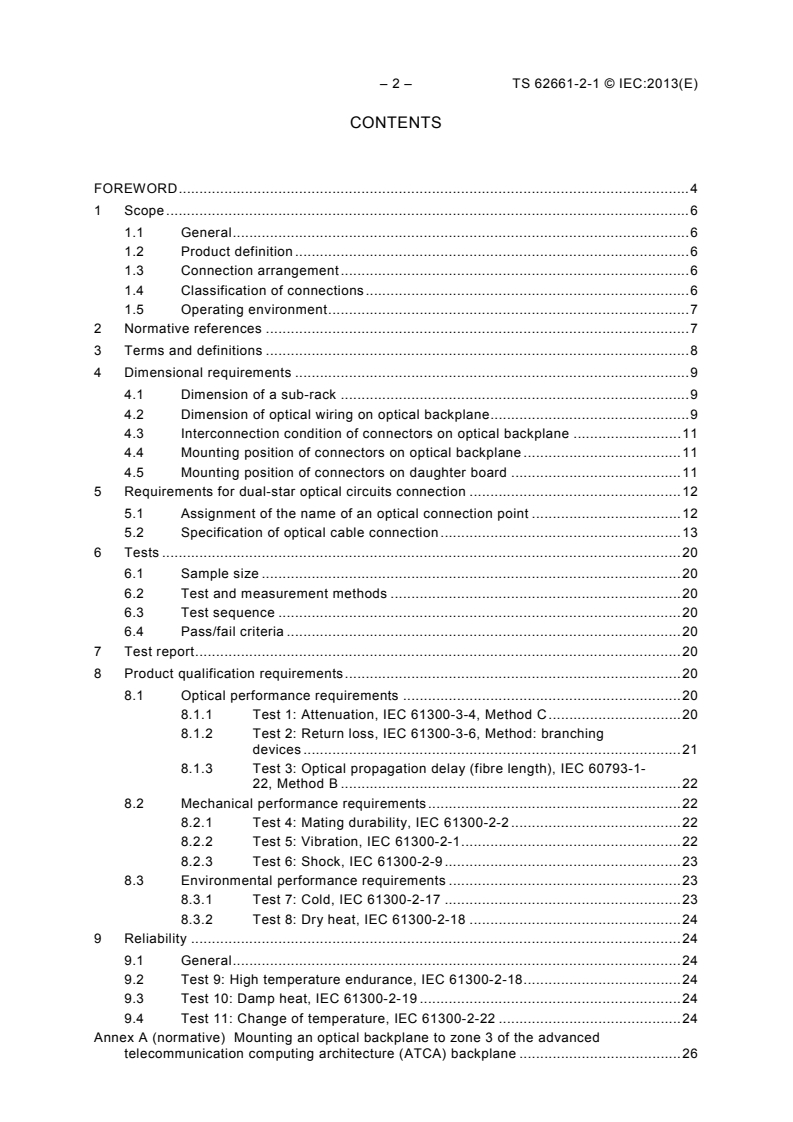
IEC TS 62661-2-1:2013 - Optical backplanes - Product specification - Part 2-1: Optical backplane using optical fibre circuit boards and multi-core right angle optical connectors Released:8/15/2013
Overview
IEC TS 62661-2-1:2013 is a technical specification published by the International Electrotechnical Commission (IEC) that provides detailed guidelines for creating and evaluating optical backplanes using optical fibre circuit boards and multi-core right angle optical connectors (RAO). This standard focuses specifically on backplanes that utilize low bending loss multimode fibres, referred to as "low-loss RAO", to achieve reliable optical connections between daughter boards and the backplane in electronic equipment assemblies.
Optical backplanes are essential infrastructures in advanced data communication and computing systems, enabling high-speed, parallel optical connections with reduced signal loss and improved reliability. IEC TS 62661-2-1 defines the functional requirements, dimensional conditions, connection arrangements, testing methods, and performance criteria for such backplanes, facilitating standardization and interoperability in fibre optic system design.
Keywords: optical backplane, optical fibre boards, multi-core right angle optical connectors, IEC standard, low-loss RAO, fibre optic connectivity.
Key Topics
Product Structure and Dimensions
- Defines the makeup of the optical backplane, detailing its integration within standard sub-rack dimensions (in line with IEC 60297-3-101).
- Specifies areas dedicated to optical wiring and optical connectors using multi-core RAO connectors.
Connection Arrangement
- Outlines the slot numbering and assignment for daughter boards, distinguishing between daughter board A (slots 1-6, 9-14) and daughter board B (central slots 7, 8).
- Describes a dual star optical connection topography for robust parallel data pathways.
Connector Specifications
- Details requirements for using compact right-angled optical board connectors as defined in Annex B.
- Addresses configuration, mounting positions, ferrule types, and reference positions for reliable alignment.
Performance and Testing
- Includes guidelines for optical, mechanical, and environmental performance:
- Optical attenuation and return loss measurements.
- Mating durability, vibration, and shock resistance.
- Thermal cycling and humidity endurance.
- Testing methods reference procedures from standards such as IEC 61300 and IEC 60793.
- Includes guidelines for optical, mechanical, and environmental performance:
Applications
Optical backplanes designed per IEC TS 62661-2-1 are critical in industries where high bandwidth, dense connectivity, and system modularity are essential. Key application areas include:
Telecommunications Equipment
- Advanced switching and routing systems where fibre optics backplanes ensure data integrity across multiple high-speed daughter boards.
Data Centers and HPC
- High-performance computing and storage arrays benefit from the low-loss, scalable interconnections offered by compliant optical backplanes.
Industrial and Embedded Systems
- Modular computing architectures in automation and control systems, where robust, reliable, and standardized optical connections reduce maintenance and increase system uptime.
The specification also supports integration with electromechanical components, making it suitable for hybrid optical-electrical backplane designs.
Related Standards
Several IEC standards and technical specifications are referenced to ensure full compatibility and proper application:
- IEC 60297-3-101: Mechanical structures for electronic equipment - subracks and plug-in units.
- IEC 61300 series: Test and measurement methods for fibre optic interconnecting devices and passive components.
- IEC 61754-25: Fibre optic connector interfaces, including RAO connector family specification.
- IEC 62496-3 / IEC 62496-3-1: Performance standards and guidance for optical circuit boards.
- IEC 60793-1-22: Optical fibres - length measurement methods.
By following IEC TS 62661-2-1 alongside these related standards, organizations can improve interoperability, enhance system reliability, and ensure compliance with international best practices in fibre optic interconnect design.
Buy Documents
IEC TS 62661-2-1:2013 - Optical backplanes - Product specification - Part 2-1: Optical backplane using optical fibre circuit boards and multi-core right angle optical connectors Released:8/15/2013
Get Certified
Connect with accredited certification bodies for this standard

ANCE
Mexican certification and testing association.

Intertek Slovenia
Intertek testing, inspection, and certification services in Slovenia.

LNE (Laboratoire National de Métrologie et d'Essais)
French national laboratory for metrology and testing.
Sponsored listings
Frequently Asked Questions
IEC TS 62661-2-1:2013 is a technical specification published by the International Electrotechnical Commission (IEC). Its full title is "Optical backplanes - Product specification - Part 2-1: Optical backplane using optical fibre circuit boards and multi-core right angle optical connectors". This standard covers: IEC/TS 62661-2-1:2013(E) gives guidelines for an optical backplane using optical fibre boards and multi-core right angle optical connectors with low bending loss multimode fibres (hereafter called low-loss RAO) to connect daughter boards to the optical backplane. Keywords: optical backplane, optical fibre boards, multi-core right angle optical connectors
IEC/TS 62661-2-1:2013(E) gives guidelines for an optical backplane using optical fibre boards and multi-core right angle optical connectors with low bending loss multimode fibres (hereafter called low-loss RAO) to connect daughter boards to the optical backplane. Keywords: optical backplane, optical fibre boards, multi-core right angle optical connectors
IEC TS 62661-2-1:2013 is classified under the following ICS (International Classification for Standards) categories: 33.180.99 - Other fibre optic equipment. The ICS classification helps identify the subject area and facilitates finding related standards.
IEC TS 62661-2-1:2013 is available in PDF format for immediate download after purchase. The document can be added to your cart and obtained through the secure checkout process. Digital delivery ensures instant access to the complete standard document.
Standards Content (Sample)
IEC/TS 62661-2-1 ®
Edition 1.0 2013-08
TECHNICAL
SPECIFICATION
colour
inside
Optical backplanes – Product specification –
Part 2-1: Optical backplane using optical fibre circuit boards and multi-core right
angle optical connectors
IEC/TS 62661-2-1:2013(E)
All rights reserved. Unless otherwise specified, no part of this publication may be reproduced or utilized in any form
or by any means, electronic or mechanical, including photocopying and microfilm, without permission in writing from
either IEC or IEC's member National Committee in the country of the requester.
If you have any questions about IEC copyright or have an enquiry about obtaining additional rights to this publication,
please contact the address below or your local IEC member National Committee for further information.
IEC Central Office Tel.: +41 22 919 02 11
3, rue de Varembé Fax: +41 22 919 03 00
CH-1211 Geneva 20 info@iec.ch
Switzerland www.iec.ch
About the IEC
The International Electrotechnical Commission (IEC) is the leading global organization that prepares and publishes
International Standards for all electrical, electronic and related technologies.
About IEC publications
The technical content of IEC publications is kept under constant review by the IEC. Please make sure that you have the
latest edition, a corrigenda or an amendment might have been published.
Useful links:
IEC publications search - www.iec.ch/searchpub Electropedia - www.electropedia.org
The advanced search enables you to find IEC publications The world's leading online dictionary of electronic and
by a variety of criteria (reference number, text, technical electrical terms containing more than 30 000 terms and
committee,…). definitions in English and French, with equivalent terms in
It also gives information on projects, replaced and additional languages. Also known as the International
withdrawn publications. Electrotechnical Vocabulary (IEV) on-line.
IEC Just Published - webstore.iec.ch/justpublished Customer Service Centre - webstore.iec.ch/csc
Stay up to date on all new IEC publications. Just Published If you wish to give us your feedback on this publication
details all new publications released. Available on-line and or need further assistance, please contact the
also once a month by email. Customer Service Centre: csc@iec.ch.
IEC/TS 62661-2-1 ®
Edition 1.0 2013-08
TECHNICAL
SPECIFICATION
colour
inside
Optical backplanes – Product specification –
Part 2-1: Optical backplane using optical fibre circuit boards and multi-core right
angle optical connectors
INTERNATIONAL
ELECTROTECHNICAL
COMMISSION
PRICE CODE
W
ICS 33.180.99 ISBN 978-2-8322-1039-0
– 2 – TS 62661-2-1 © IEC:2013(E)
CONTENTS
FOREWORD . 4
1 Scope . 6
1.1 General . 6
1.2 Product definition . 6
1.3 Connection arrangement . 6
1.4 Classification of connections . 6
1.5 Operating environment . 7
2 Normative references . 7
3 Terms and definitions . 8
4 Dimensional requirements . 9
4.1 Dimension of a sub-rack . 9
4.2 Dimension of optical wiring on optical backplane . 9
4.3 Interconnection condition of connectors on optical backplane . 11
4.4 Mounting position of connectors on optical backplane . 11
4.5 Mounting position of connectors on daughter board . 11
5 Requirements for dual-star optical circuits connection . 12
5.1 Assignment of the name of an optical connection point . 12
5.2 Specification of optical cable connection . 13
6 Tests . 20
6.1 Sample size . 20
6.2 Test and measurement methods . 20
6.3 Test sequence . 20
6.4 Pass/fail criteria . 20
7 Test report . 20
8 Product qualification requirements . 20
8.1 Optical performance requirements . 20
8.1.1 Test 1: Attenuation, IEC 61300-3-4, Method C . 20
8.1.2 Test 2: Return loss, IEC 61300-3-6, Method: branching
devices . 21
8.1.3 Test 3: Optical propagation delay (fibre length), IEC 60793-1-
22, Method B . 22
8.2 Mechanical performance requirements . 22
8.2.1 Test 4: Mating durability, IEC 61300-2-2 . 22
8.2.2 Test 5: Vibration, IEC 61300-2-1 . 22
8.2.3 Test 6: Shock, IEC 61300-2-9 . 23
8.3 Environmental performance requirements . 23
8.3.1 Test 7: Cold, IEC 61300-2-17 . 23
8.3.2 Test 8: Dry heat, IEC 61300-2-18 . 24
9 Reliability . 24
9.1 General . 24
9.2 Test 9: High temperature endurance, IEC 61300-2-18 . 24
9.3 Test 10: Damp heat, IEC 61300-2-19 . 24
9.4 Test 11: Change of temperature, IEC 61300-2-22 . 24
Annex A (normative) Mounting an optical backplane to zone 3 of the advanced
telecommunication computing architecture (ATCA) backplane . 26
TS 62661-2-1 © IEC:2013(E) – 3 –
A.1 General . 26
A.2 Dimensional condition . 26
A.2.1 Mounting position of an optical backplane . 26
A.2.2 Dimensional condition of the daughter board . 28
Annex B (normative) Specification for compact right-angled optical board (CRO)
connector . 29
B.1 General . 29
B.2 Description . 29
B.3 Interfaces . 29
Bibliography . 38
Figure 1 – Sub-rack for optical back plane . 9
Figure 2 – Area for optical wiring and positions of optical connectors on optical
backplane . 11
Figure 3 – 8 degree angle polish of ferrule . 11
Figure 4 – Hole positions of low loss RAO connectors on optical backplane . 12
Figure 5 – Hole positions to mount a RAO connector to a daughter board . 12
Figure 6 – Assignment of connection points . 13
Figure A.1 – Mounting position of optical backplane . 27
Figure A.2 – Structure of optical daughter board . 28
Figure B.1 – CRO connector configuration . 30
Figure B.2 – CRO socket connector interface. 31
Figure B.3 – CRO plug connector interface (1 of 2) . 32
Figure B.4 – Optical datum target location diagrams for 0,250 mm pitch fibre arrayed. 34
Figure B.5 – Optical datum target location diagrams for 0,125 mm pitch fibre arrayed. 35
Table 1 – Classification of ferrules . 7
Table 2 – DS192 Optical backplane . 14
Table 3 – DS384 Optical wiring backplane . 16
Table B.1 – Dimensions of the CRO socket connector interface . 36
Table B.2 – Dimensions of the CRO plug connector interface . 37
– 4 – TS 62661-2-1 © IEC:2013(E)
INTERNATIONAL ELECTROTECHNICAL COMMISSION
____________
OPTICAL BACKPLANES – PRODUCT SPECIFICATION –
Part 2-1: Optical backplane using optical fibre circuit boards
and multi-core right angle optical connectors
FOREWORD
1) The International Electrotechnical Commission (IEC) is a worldwide organization for standardization comprising
all national electrotechnical committees (IEC National Committees). The object of IEC is to promote
international co-operation on all questions concerning standardization in the electrical and electronic fields. To
this end and in addition to other activities, IEC publishes International Standards, Technical Specifications,
Technical Reports, Publicly Available Specifications (PAS) and Guides (hereafter referred to as “IEC
Publication(s)”). Their preparation is entrusted to technical committees; any IEC National Committee interested
in the subject dealt with may participate in this preparatory work. International, governmental and non-
governmental organizations liaising with the IEC also participate in this preparation. IEC collaborates closely
with the International Organization for Standardization (ISO) in accordance with conditions determined by
agreement between the two organizations.
2) The formal decisions or agreements of IEC on technical matters express, as nearly as possible, an international
consensus of opinion on the relevant subjects since each technical committee has representation from all
interested IEC National Committees.
3) IEC Publications have the form of recommendations for international use and are accepted by IEC National
Committees in that sense. While all reasonable efforts are made to ensure that the technical content of IEC
Publications is accurate, IEC cannot be held responsible for the way in which they are used or for any
misinterpretation by any end user.
4) In order to promote international uniformity, IEC National Committees undertake to apply IEC Publications
transparently to the maximum extent possible in their national and regional publications. Any divergence
between any IEC Publication and the corresponding national or regional publication shall be clearly indicated in
the latter.
5) IEC itself does not provide any attestation of conformity. Independent certification bodies provide conformity
assessment services and, in some areas, access to IEC marks of conformity. IEC is not responsible for any
services carried out by independent certification bodies.
6) All users should ensure that they have the latest edition of this publication.
7) No liability shall attach to IEC or its directors, employees, servants or agents including individual experts and
members of its technical committees and IEC National Committees for any personal injury, property damage or
other damage of any nature whatsoever, whether direct or indirect, or for costs (including legal fees) and
expenses arising out of the publication, use of, or reliance upon, this IEC Publication or any other IEC
Publications.
8) Attention is drawn to the Normative references cited in this publication. Use of the referenced publications is
indispensable for the correct application of this publication.
9) Attention is drawn to the possibility that some of the elements of this IEC Publication may be the subject of
patent rights. IEC shall not be held responsible for identifying any or all such patent rights.
The main task of IEC technical committees is to prepare International Standards. In
exceptional circumstances, a technical committee may propose the publication of a technical
specification when
• the required support cannot be obtained for the publication of an International Standard,
despite repeated efforts, or
• the subject is still under technical development or where, for any other reason, there is the
future but no immediate possibility of an agreement on an International Standard.
Technical specifications are subject to review within three years of publication to decide
whether they can be transformed into International Standards.
IEC 62661-2-1, which is a technical specification, has been prepared by IEC technical
committee 86: Fibre optics.
TS 62661-2-1 © IEC:2013(E) – 5 –
The text of this technical specification is based on the following documents:
Enquiry draft Report on voting
86/439/DTS 86/452/RVC
Full information on the voting for the approval of this technical specification can be found in
the report on voting indicated in the above table.
This publication has been drafted in accordance with the ISO/IEC Directives, Part 2.
The committee has decided that the contents of this publication will remain unchanged until
the stability date indicated on the IEC web site under "http://webstore.iec.ch" in the data
related to the specific publication. At this date, the publication will be
• transformed into an International Standard,
• reconfirmed,
• withdrawn,
• replaced by a revised edition, or
• amended.
A bilingual version of this publication may be issued at a later date.
IMPORTANT – The 'colour inside' logo on the cover page of this publication indicates
that it contains colours which are considered to be useful for the correct
understanding of its contents. Users should therefore print this document using a
colour printer.
– 6 – TS 62661-2-1 © IEC:2013(E)
OPTICAL BACKPLANES –
PRODUCT SPECIFICATION –
Part 2-1: Optical backplane using optical fibre circuit boards
and multi-core right angle optical connectors
1 Scope
1.1 General
This part of IEC 62661 gives guidelines for an optical backplane using optical fibre boards
and multi-core right angle optical connectors with low bending loss multimode fibres
(hereafter called low-loss RAO) to connect daughter boards to the optical backplane.
NOTE Low bending multimode fibres are currently under study.
1.2 Product definition
The structure of an optical backplane specified in this specification is as follows
a) The optical backplane has the structure to fit to a sub-rack specified in IEC 60297-3-101
with a height of more than 3U (44,45 mm × 3).
b) One optical backplane occupies a space of 100 mm (height) and 420 mm (width) in the
optical backplane stated in item a).
c) A multiple number of optical backplanes may be installed to a sub-rack specified in
IEC 60297-3-101 if multiple spaces specified in item b) are available, that is, a height of
44,45 mm × N (N≥5).
d) The backplane installs maximum of 14 front boards (daughter boards) with a pitch of 6HP
(30,48 mm).
e) New Type RAO connectors specified in Annex B are used in the optical backplane.
f) Multimode optical fibres are used for optical wiring in the optical backplane. More
specifically, the optical backplane is made of an optical fibre board specified in
IEC 62496-3-1 using low bending loss optical fibres.
1.3 Connection arrangement
Connection arrangement for the optical backplane is as follows:
a) The construction of optical connection specified in this document consists of using the
compact right-angled optical board connectors specified in Annex B which are mounted on
an optical backplane housed in a sub-rack specified in IEC 60297-3-101.
b) The slots are assigned the following numerical designations in this specification: the slot
on the left end is designated slot number 1, and the slot on the right end is designated slot
number 14. The daughter board located at slot 7 or slot 8 is defined as daughter board B,
while daughter boards located on any of the other slots are defined as daughter board A.
This document specifies an optical dual star connection between daughter board A and
daughter board B.
1.4 Classification of connections
Connections in this specification are classified as shown in Table 1.
TS 62661-2-1 © IEC:2013(E) – 7 –
Table 1 – Classification of ferrules
Class Total number of Optical connect- MT ferrule in the MT ferrule in the
optical cables in ions in daughter connector in slot of connector in slot of
optical backplane board A daughter board A daughter board B
DS 192 optical
96 × 2 = 192 lines 8 × 2 = 16 lines 8 core MT ferrule 12 core MT ferrule
backplane
DS 384 optical
192 × 2 = 384 lines 16 × 2 = 32 lines 16 core MT ferrule 24 core MT ferrule
backplane
The 16 core MT ferrule and the 24 core MT ferrule used on DS 384 optical backplane are
125 μm pitch high-density MT ferrules defined by Figure B.5.
1.5 Operating environment
The operating environment is specified in Table A.1 of IEC 62496-3:2011, Category C
(temperature range of –10 °C to +60 °C).
2 Normative references
The following documents, in whole or in part, are normatively referenced in this document and
are indispensable for its application. For dated references, only the edition cited applies. For
undated references, the latest edition of the referenced document (including any
amendments) applies.
IEC 60297-3-101, Mechanical structures for electronic equipment – Dimensions of mechanical
structures of the 482,6 mm (19 in) series – Part 3-101: Subracks and associated plug-in units
IEC 60793-1-22, Optical fibres – Part 1-22: Measurement methods and test procedures –
Length measurement
IEC 61300-1:2011, Fibre optic interconnecting devices and passive components – Basic test
and measurement procedures – Part 1: General and guidance
IEC 61300-2-1, Fibre optic interconnecting devices and passive components – Basic test and
measurement procedures – Part 2-1: Tests – Vibration (sinusoidal)
IEC 61300-2-2, Fibre optic interconnecting devices and passive components – Basic test and
measurement procedures – Part 2-2: Tests – Mating durability
IEC 61300-2-9, Fibre optic interconnecting devices and passive components – Basic test and
measurement procedures – Part 2-9: Tests – Shock
IEC 61300-2-17, Fibre optic interconnecting devices and passive components – Basic test
and measurement procedures – Part 2-17: Tests – Cold
IEC 61300-2-18, Fibre optic interconnecting devices and passive components – Basic test
and measurement procedures – Part 2-18: Tests – Dry heat – High temperature endurance
IEC 61300-2-19, Fibre optic interconnecting devices and passive components – Basic test
and measurement procedures – Part 2-19: Tests – Damp heat (steady state)
IEC 61300-2-22, Fibre optic interconnecting devices and passive components – Basic test
and measurement procedures – Part 2-22: Tests – Change of temperature
– 8 – TS 62661-2-1 © IEC:2013(E)
IEC 61300-3-4, Fibre optic interconnecting devices and passive components – Basic test and
measurement procedures – Part 3-4: Examinations and measurements – Attenuation
IEC 61300-3-6, Fibre optic interconnecting devices and passive components – Basic test and
measurement procedures – Part 3-6: Examinations and measurements – Return loss
IEC 61754-25, Fibre optic connector interfaces - Part 25: Type RAO connector family
IEC 62496-3:2011, Optical circuit boards – Part 3: Performance standards – General and
guidance
IEC 62496-3-1, Optical circuit boards – Part 3-1: Performance standards –Flexible optical
circuit boards using unconnectorized optical glass fibres
3 Terms and definitions
For the purposes of this document, the following terms and definitions apply.
3.1
optical backplane
optical circuit board on which optical connectors are mounted in parallel and the connectors
are mutually connected by optical waveguides, which are physical lines of optical signals such
as, but not limited to, an optical fibre, planar polymer waveguide, planar glass waveguide, and
other optical circuit boards, which are called daughter boards, are assembled on the board
vertically to construct a book-shelf like structure
Note 1 to entry: Daughter boards are mutually connected optically for the required functionality. Electrical
connectors are usually also mounted on the backplane to supply electric power, static control signals or low-speed
bus signals to daughter boards, if necessary. An optical backplane has the function of optical connections and
also mechanical support of the daughter boards.
3.2
daughter board
optical circuit board connected orthogonally to an optical backplane
Note 1 to entry: Multiple optical devices and electric/electronic devices are mounted on a daughter board, and the
devices are connected optically and/or electrically.
3.2.1
daughter board A
daughter board connected to one of slot numbers 1 through 6 and 9 through 14
3.2.2
daughter board B
daughter board connected to either slot number 7 or 8
3.3
reference position of an optical backplane
positional reference point against which to determine positions of optical fibres and
connectors installed in an optical backplane in this specification
3.4
reference position of an optical backplane to daughter board
positional reference point against which to determine positions of connectors installed in an
optical backplane for insertion of daughter boards in this specification
TS 62661-2-1 © IEC:2013(E) – 9 –
3.5
dual star optical connection
optical wiring pattern in which each daughter board A is optically connected to two daughter
boards B arranged at the centre of the backplane
3.6
slot
alignment structure in the backplane construction to hold daughter boards in the sub-rack,
formed as a groove
3.7
standard daughter board for testing
daughter board mounted with a master cord of an MT connector which has a sufficiently small
confirmed interconnection loss and a sufficiently large confirmed return loss for the evaluation
of optical characteristics of an optical backplane
3.7.1
standard daughter board A for testing
daughter board to be inserted into slot numbers1 through 6 and 9 through 14 for testing of
optical characteristics of an optical backplane
3.7.2
standard daughter board B for testing
daughter board to be inserted to slot numbers 7 and 8 for testing of optical characteristics of
an optical backplane
4 Dimensional requirements
4.1 Dimension of a sub-rack
The optical backplane is housed on the inside face of the back of a sub-rack with dimensions
shown in Figure 1. The height and width shall comply with IEC 60297-3-101 and the condition
specified in Figure 1. The depth (Dc) of the sub-rack shall be selected from the specification
given in IEC 60297-3-101.
Dimensions in millimetres
Sub-rack
>426,72
>3×44,4 =133,35
Dc
Daughter
board
6HP=6×5,08 =30,48 IEC 2121/13
Figure 1 – Sub-rack for optical back plane
4.2 Dimension of optical wiring on optical backplane
The area for optical wiring and the position of optical connectors mounted on an optical
backplane are shown in Figure 2. The reference position on an optical backplane is
determined first; the dimensions to other parts on the backplane are determined by the
distance from the reference position. The position of an optical fibre as connected to an
optical connector is defined by the connecting position of an MT ferrule of a low-loss RAO
– 10 – TS 62661-2-1 © IEC:2013(E)
connector specified by IEC 61754-25. The position of a ferrule is specified by the centre of
the ferrule.
The optical wiring pattern is formed on the optical fibre board at the connecting position
corresponding to the holes for fibres in an MT ferrule. The size of the optical fibre board is
420 mm × 100 mm. The optical wiring pattern is formed on the board avoiding the positions to
which low-loss RAO connectors are to be mounted. The positions for electric connectors are
designed based on the reference position on the optical backplane when both optical and
electric connectors are needed on the board.
Dimensions in millimetres
426,42
(3,79) -0,2
10±0,1
Px1=
Px1
30,4 Px1 Px1 Px1
Px1 Px1 Px1 Px1 Px1 Px1
Px1 Px1
A 8
01 02 03 04 05 06 07 08 09 10
11 12 13 14
B
Optical backplane reference point
Wiring area for optical fibres
10±0,1
Optical backplane reference point
Details of B
Details of A
IEC 2122/13
(6)
83,51.± 0,1
Py1
= 8
Py1 Py1
Py1
Py1 Py1
Py1
= 8
= 8
35,25 ± 0,1
<
TS 62661-2-1 © IEC:2013(E) – 11 –
Figure 2 – Area for optical wiring and positions
of optical connectors on optical backplane
4.3 Interconnection condition of connectors on optical backplane
Connectors used in the optical backplane are the low loss RAO connector specified in
Annex B. The ferrule used in the low loss RAO connector is compatible with Annex B with a
surface polished at an 8° angle. The direction of angle polish is shown in Figure 3.
Backplane board
Optical fibre
Low loss RAO
connector
MT ferrule
o
8 ± 0,1 C
Low loss RAO
connector
IEC 2123/13
Daughter board
Figure 3 – 8 degree angle polish of ferrule
4.4 Mounting position of connectors on optical backplane
Mounting condition of the low loss RAO connectors on an optical backplane is shown in
Figure 4. Positions of the holes to mount the RAO connectors are defined by the relative
distance from the reference position on the optical backplane. The area for mounting of
connectors is also defined as the area C in Figure 4. Optical fibres are not allowed to be
installed in this area. An actual example of the relation of distance from the reference point of
the optical backplane to the position of electric connectors is described in Annex A.
4.5 Mounting position of connectors on daughter board
Mounting condition of the low loss RAO connectors on a daughter board is shown in Figure 5.
The highest hole position in the mounting holes of the RAO connector to be mounted on the
highest position on the daughter board is defined as the reference position on the daughter
board. This position shall also be used as the reference position of an electrical/electronic
connector to be mounted. The distance to the edge of a daughter board is approximately
illustrated in the Figure (distance shown in the figure with parentheses). An actual example of
mounting of RAO connectors to a daughter board is given in Annex A.
– 12 – TS 62661-2-1 © IEC:2013(E)
Dimensions in millimetres
10±0,1
Px1
Px1 Px1 Px1 Px1
Px1 Px1 Px1 Px1 Px1 Px1 Px1 Px1
=
01 02 03 04 05 06 07 08 09 10
11 12 13 14
C
Reference position
of backplane
IEC 2124/13
Figure 4 – Hole positions of low loss RAO connectors on optical backplane
Dimensions in millimetres
(20,29)
Reference, daughter board
Area for RAO
connector
15,58 ± 0,1
31,16 ± 0,1
48,26 ± 0,1
63,84 ± 0,1
79,42 ± 0,1
Three holes to
mount RAO
4,38 ± 0,1
Region of a daughter board
(near a RAO connector) IEC 2125/13
Figure 5 – Hole positions to mount a RAO connector to a daughter board
5 Requirements for dual-star optical circuits connection
5.1 Assignment of the name of an optical connection point
The names of the optical connection points are assigned as illustrated in Figure 6. The name
is constructed of the following parameters in the order (1) slot number, (2) connector
mounting step, (3) MT ferrule number, (4) type of ferrule, and (5) position of fibre hole.
89,98 ± 0,1
53,03 ± 0,1
41,72 ± 0,1
4,77 ± 0,1
(36,95
(23,28
(31,16)
(17,1)
(36,95
TS 62661-2-1 © IEC:2013(E) – 13 –
Slot number: Slots are numbered 01, 02, 03, 04, etc. from left to right as viewed when facing
the insertion side of the front board.
Connector mounting step: Step is assigned as A, B, C, etc. from the top to the bottom of the
backplane
Ferrule number: Four MT ferrules housed in a RAO connector are assigned as 01, 02, 03 and
04 from the top to the bottom.
Type of ferrule: 8 core MT ferrule is called A, 12 core MT ferrule is called B, 16 core MT
ferrule is called C, and 24 core MT ferrule is called D.
Position of fibre hole: The fibre hole number in the MT ferrule is assigned as 01, 02, etc. from
the top to the bottom.
Connector mounting step Slot #
01 02 03 04 05 06 07 08 09 10 11 12
1301 14
A
B
Connection position
01 A 01 A 01
Ferrule hole position
Type of ferrule
A:8 core C:16 core
In the case of 8MT
B:12 core D:24 core
Ferrule No.
Connector mounting step
Hole #
2 Slot number
IEC 2126/13
Figure 6 – Assignment of connection points
5.2 Specification of optical cable connection
The interconnection in the backplane in this specification specifies the connection between
12 daughter boards A and the two centrally situated daughter boards B. The interconnection
for the DS 192 optical wiring backplane is given in Table 2 and for DS 384 is given in Table 3.
– 14 – TS 62661-2-1 © IEC:2013(E)
Table 2 – DS192 Optical backplane
Channel Daughter Daughter Channel Daughter Daughter Channel Daughter Daughter Channel Daughter Daughter
no. board A board B no. board A board B no. board A board B no. board A board B
1 01A01A01 07A01B01 25 04A01A01 07A03B01 49 01A02A01 08A01B01 73 04A02A01 08A03B01
2 01A01A02 07A01B02 26 04A01A02 07A03B02 50 01A02A02 08A01B02 74 04A02A02 08A03B02
3 01A01A03 07A01B03 27 04A01A03 07A03B03 51 01A02A03 08A01B03 75 04A02A03 08A03B03
4 01A01A04 07A01B04 28 04A01A04 07A03B04 52 01A02A04 08A01B04 76 04A02A04 08A03B04
5 01A01A05 07A01B05 29 04A01A05 07A03B05 53 01A02A05 08A01B05 77 04A02A05 08A03B05
6 01A01A06 07A01B06 30 04A01A06 07A03B06 54 01A02A06 08A01B06 78 04A02A06 08A03B06
7 01A01A07 07A01B07 31 04A01A07 07A03B07 55 01A02A07 08A01B07 79 04A02A07 08A03B07
8 01A01A08 07A01B08 32 04A01A08 07A03B08 56 01A02A08 08A01B08 80 04A02A08 08A03B08
9 02A01A01 07A01B09 33 05A01A01 07A03B09 57 02A02A01 08A01B09 81 05A02A01 08A03B09
10 34 58 82
02A01A02 07A01B10 05A01A02 07A03B10 02A02A02 08A01B10 05A02A02 08A03B10
11 02A01A03 07A01B11 35 05A01A03 07A03B11 59 02A02A03 08A01B11 83 05A02A03 08A03B11
12 02A01A04 07A01B12 36 05A01A04 07A03B12 60 02A02A04 08A01B12 84 05A02A04 08A03B12
13 02A01A05 07A02B01 37 05A01A05 07A04B01 61 02A02A05 08A02B01 85 05A02A05 08A04B01
14 02A01A06 07A02B02 38 05A01A06 07A04B02 62 02A02A06 08A02B02 86 05A02A06 08A04B02
15 02A01A07 07A02B03 39 05A01A07 07A04B03 63 02A02A07 08A02B03 87 05A02A07 08A04B03
16 02A01A08 07A02B04 40 05A01A08 07A04B04 64 02A02A08 08A02B04 88 05A02A08 08A04B04
17 41 65 89
03A01A01 07A02B05 06A01A01 07A04B05 03A02A01 08A02B05 06A02A01 08A04B05
18 03A01A02 07A02B06 42 06A01A02 07A04B06 66 03A02A02 08A02B06 90 06A02A02 08A04B06
19 03A01A03 07A02B07 43 06A01A03 07A04B07 67 03A02A03 08A02B07 91 06A02A03 08A04B07
20 44 68 92
03A01A04 07A02B08 06A01A04 07A04B08 03A02A04 08A02B08 06A02A04 08A04B08
21 03A01A05 07A02B09 45 06A01A05 07A04B09 69 03A02A05 08A02B09 93 06A02A05 08A04B09
22 03A01A06 07A02B10 46 06A01A06 07A04B10 70 03A02A06 08A02B10 94 06A02A06 08A04B10
23 03A01A07 07A02B11 47 06A01A07 07A04B11 71 03A02A07 08A02B11 95 06A02A07 08A04B11
24 03A01A08 07A02B12 48 06A01A08 07A04B12 72 03A02A08 08A02B12 96 06A02A08 08A04B12
97 14A01A01 07B01B01 121 11A01A01 07B03B01 145 14A02A01 08B01B01 169 11A02A01 08B03B01
TS 62661-2-1 © IEC:2013(E) – 15 –
Channel Daughter Daughter Channel Daughter Daughter Channel Daughter Daughter Channel Daughter Daughter
no. board A board B no. board A board B no. board A board B no. board A board B
98 14A01A02 07B01B02 122 11A01A02 07B03B02 146 14A02A02 08B01B02 170 11A02A02 08B03B02
99 14A01A03 07B01B03 123 11A01A03 07B03B03 147 14A02A03 08B01B03 171 11A02A03 08B03B03
100 14A01A04 07B01B04 124 11A01A04 07B03B04 148 14A02A04 08B01B04 172 11A02A04 08B03B04
101 14A01A05 07B01B05 125 11A01A05 07B03B05 149 14A02A05 08B01B05 173 11A02A05 08B03B05
102 126 150 174
14A01A06 07B01B06 11A01A06 07B03B06 14A02A06 08B01B06 11A02A06 08B03B06
103 14A01A07 07B01B07 127 11A01A07 07B03B07 151 14A02A07 08B01B07 175 11A02A07 08B03B07
104 14A01A08 07B01B08 128 11A01A08 07B03B08 152 14A02A08 08B01B08 176 11A02A08 08B03B08
105 13A01A01 07B01B09 129 10A01A01 07B03B09 153 13A02A01 08B01B09 177 10A02A01 08B03B09
106 13A01A02 07B01B10 130 10A01A02 07B03B10 154 13A02A02 08B01B10 178 10A02A02 08B03B10
107 13A01A03 07B01B11 131 10A01A03 07B03B11 155 13A02A03 08B01B11 179 10A02A03 08B03B11
108 13A01A04 07B01B12 132 10A01A04 07B03B12 156 13A02A04 08B01B12 180 10A02A04 08B03B12
109 133 157 181
13A01A05 07B02B01 10A01A05 07B04B01 13A02A05 08B02B01 10A02A05 08B03B01
110 13A01A06 07B02B02 134 10A01A06 07B04B02 158 13A02A06 08B02B02 182 10A02A06 08B03B02
111 13A01A07 07B02B03 135 10A01A07 07B04B03 159 13A02A07 08B02B03 183 10A02A07 08B03B03
112 136 160 184
13A01A08 07B02B04 10A01A08 07B04B04 13A02A08 08B02B04 10A02A08 08B03B04
113 12A01A01 07B02B05 137 09A01A01 07B04B05 161 12A02A01 08B02B05 185 09A02A01 08B03B05
114 12A01A02 07B02B06 138 09A01A02 07B04B06 162 12A02A02 08B02B06 186 09A02A02 08B03B06
115 12A01A03 07B02B07 139 09A01A03 07B04B07 163 12A02A03 08B02B07 187 09A02A03 08B03B07
116 12A01A04 07B02B08 140 09A01A04 07B04B08 164 12A02A04 08B02B08 188 09A02A04 08B03B08
117 12A01A05 07B02B09 141 09A01A05 07B04B09 165 12A02A05 08B02B09 189 09A02A05 08B03B09
118 12A01A06 07B02B10 142 09A01A06 07B04B10 166 12A02A06 08B02B10 190 09A02A06 08B03B10
119 143 167 191
12A01A07 07B02B11 09A01A07 07B04B11 12A02A07 08B02B11 09A02A07 08B03B11
120 12A01A08 07B02B12 144 09A01A08 07B04B12 168 12A02A08 08B02B12 192 09A02A08 08B03B12
– 16 – TS 62661-2-1 © IEC:2013(E)
Table 3 – DS384 Optical wiring backplane
Channel Daughter Daughter Channel Daughter Daughter Channel Daughter Daughter Channel Daughter Daughter
no. board A board B no. board A board B no. board A board B no. board A board B
1 01A01C01 07A01D01 25 02A01C09 07A02D01 49 04A01C01 07A03D01 73 05A01C09 07A04D01
2 01A01C02 07A01D02 26 02A01C10 07A02D02 50 04A01C02 07A03D02 74 05A01C10 07A04D02
3 01A01C03 07A01D03 27 02A01C11 07A02D03 51 04A01C03 07A03D03 75 05A01C11 07A04D03
4 01A01C04 07A01D04 28 02A01C12 07A02D04 52 04A01C04 07A03D04 76 05A01C12 07A04D04
5 01A01C05 07A01D05 29 02A01C13 07A02D05 53 04A01C05 07A03D05 77 05A01C13 07A04D05
6 01A01C06 07A01D06 30 02A01C14 07A02D06 54 04A01C06 07A03D06 78 05A01C14 07A04D06
7 01A01C07 07A01D07 31 02A01C15 07A02D07 55 04A01C07 07A03D07 79 05A01C15 07A04D07
8 01A01C08 07A01D08 32 02A01C16 07A02D08 56 04A01C08 07A03D08 80 05A01C16 07A04D08
9 01A01C09 07A01D09 33 03A01C01 07A02D09 57 04A01C09 07A03D09 81 06A01C01 07A04D09
10 34 58 82
01A01C10 07A01D10 03A01C02 07A02D10 04A01C10 07A03D10 06A01C02 07A04D10
11 01A01C11 07A01D11 35 03A01C03 07A02D11 59 04A01C11 07A03D11 83 06A01C03 07A04D11
12 01A01C12 07A01D12 36 03A01C04 07A02D12 60 04A01C12 07A03D12 84 06A01C04 07A04D12
13 01A01C13 07A01D13 37 03A01C05 07A02D13 61 04A01C13 07A03D13 85 06A01C05 07A04D13
14 01A01C14 07A01D14 38 03A01C06 07A02D14 62 04A01C14 07A03D14 86 06A01C06 07A04D14
15 01A01C15 07A01D15 39 03A01C07 07A02D15 63 04A01C15 07A03D15 87 06A01C07 07A04D15
16 01A01C16 07A01D16 40 03A01C08 07A02D16 64 04A01C16 07A03D16 88 06A01C08 07A04D16
17 41 65 89
02A01C01 07A01D17 03A01C09 07A02D17 05A01C01 07A03D17 06A01C09 07A04D17
18 02A01C02 07A01D18 42 03A01C10 07A02D18 66 05A01C02 07A03D18 90 06A01C10 07A04D18
19 02A01C03 07A01D19 43 03A01C11 07A02D19 67 05A01C03 07A03D19 91 06A01C11 07A04D19
20 44 68 92
02A01C04 07A01D20 03A01C12 07A02D20 05A01C04 07A03D20 06A01C12 07A04D20
21 02A01C05 07A01D21 45 03A01C13 07A02D21 69 05A01C05 07A03D21 93 06A01C13 07A04D21
22 02A01C06 07A01D22 46 03A01C14 07A02D22 70 05A01C06 07A03D22 94 06A01C14 07A04D22
23 02A01C07 07A01D23 47 03A01C15 07A02D23 71 05A01C07 07A03D23 95 06A01C15 07A04D23
24 02A01C08 07A01D24 48 03A01C16 07A02D24 72 05A01C08 07A03D24 96 06A01C16 07A04D24
97 01A02C01 08A01D01 121 02A02C09 08A02D01 145 04A02C01 08A03D01 169 05A02C09 08A04D01
TS 62661-2-1 © IEC:2013(E) – 17 –
Channel Daughter Daughter Channel Daughter Daughter Channel Daughter Daughter Channel Daughter Daughter
no. board A board B no. board A board B no. board A board B no. board A board B
98 01A02C02 08A01D02 122 02A02C10 08A02D02 146 04A02C02 08A03D02 170 05A02C10 08A04D02
99 01A02C03 08A01D03 123 02A02C11 08A02D03 147 04A02C03 08A03D03 171 05A02C11 08A04D03
100 01A02C04 08A01D04 124 02A02C12 08A02D04 148 04A02C04 08A03D04 172 05A02C12 08A04D04
101 01A02C05 08A01D05 125 02A02C13 08A02D05 149 04A02C05 08A03D05 173 05A02C13 08A04D05
102 126 150 174
01A02C06 08A01D06 02A02C14 08A02D06 04A02C06 08A03D06 05A02C14 08A04D06
103 01A02C07 08A01D07 127 02A02C15 08A02D07 151 04A02C07 08A03D07 175 05A02C15 08A04D07
104 01A02C08 08A01D08 128 02A02C16 08A02D08 152 04A02C08 08A03D08 176 05A02C16 08A04D08
105 01A02C09 08A01D09 129 03A02C01 08A02D09 153 04A02C09 08A03D09 177 06A02C01 08A04D09
106 01A02C10 08A01D10 130 03A02C02 08A02D10 154 04A02C10 08A03D10 178 06A02C02 08A04D10
107 01A02C11 08A01D11 131 03A02C03 08A02D11 155 04A02C11 08A03D11 179 06A02C03 08A04D11
108 01A02C12 08A01D12 132 03A02C04 08A02D12 156 04A02C12 08A03D12 180 06A02C04 08A04D12
109 133 157 181
01A02C13 08A01D13 03A02C05 08A02D13 04A02C13 08A03D13 06A02C05 08A04D13
110 01A02C14 08A01D14 134 03A02C06 08A02D14 158 04A02C14 08A03D14 182 06A02C06 08A04D14
111 01A02C15 08A01D15 135 03A02C07 08A02D15 159 04A02C15 08A03D15 183 06A02C07 08A04D15
112 136 160 184
01A02C16 08A01D16 03A02C08 08A02D16 04A02C16 08A03D16 06A02C08 08A04D16
113 02A02C01 08A01D17 137 03A02C09 08A02D17 161 05A02C01 08A03D17 185 06A02C09 08A04D17
114 02A02C02 08A01D18 138 03A02C10 08A02D18 162 05A02C02 08A03D18 186 06A02C10 08A04D18
115 02A02C03 08A01D19 139 03A02C11 08A02D19 163 05A02C03 08A03D19 187 06A02C11 08A04D19
116 02A02C04 08A01D20 140 03A02C12 08A02D20 164 05A02C04 08A03D20 188 06A02C12 08A04D20
117 02A02C05 08A01D21 141 03A02C13 08A02D21 165 05A02C05 08A03D21 189 06A02C13 08A04D21
118 02A02C06 08A01D22 142 03A02C14 08A02D22 166 05A02C06 08A03D22 190 06A02C14 08A04D22
119 143 167 191
02A02C07 08A01D23 03A02C15 08A02D23 05A02C07 08A03D23 06A02C15 08A04D23
120 02A02C08 08A01D24 144 03A02C16 08A02D24 168 05A02C08 08A03D24 192 06A02C16 08A04D24
193 14A01C01 07B01D01 217 13A01C09 07B02D01 241 11A01C01 07B03D01 265 10A01C09 07B04D01
194 218 242 266
14A01C02 07B01D02 13A01C10 07B02D02 11A01C02 07B03D02 10A01C10 07B04D02
195 14A01C03 07B01D03 219 13A01C11 07B02D03 243 11A01C03 07B03D03 267 10A01C11 07B04D03
196 14A01C04 07B01D04 220 13A01C12 07B02D04 244 11A01C04 07B03D04 268 10A01C12 07B04D04
– 18 – TS 62661-2-1 © IEC:2013(E)
Channel Daughter Daughter Channel Daughter Daughter Channel Daughter Daughter Channel Daughter Daughter
no. board A board B no. board A board B no. board A board B no. board A board B
197 14A01C05 07B01D05 221 13A01C13 07B02D05 245 11A01C05 07B03D05 269 10A01C13 07B04D05
198 14A01C06 07B01D06 222 13A01C14 07B02D06 246 11A01C06 07B03D06 270 10A01C14 07B04D06
199 14A01C07 07B01D07 223 13A01C15 07B02D07 247 11A01C07 07B03D07 271 10A01C15 07B04D07
200 14A01C08 07B01D08 224 13A01C16 07B02D08 248 11A01C08 07B03D08 272 10A01C16 07B04D08
201 225 249 273
14A01C09 07B01D09 12A01C01 07B02D09 11A01C09 07B03D09 09A01C01 07B04D09
202 14A01C10 07B01D10 226 12A01C02 07B02D10 250 11A01C10 07B03D10 274 09A01C02 07B04D10
203 14A01C11 07B01D11 227 12A01C03 07B02D11 251 11A01C11 07B03D11 275 09A01C03 07B04D11
204 14A01C12 07B01D12 228 12A01C04 07B02D12 252 11A01C12 07B03D12 276 09A01C04 07B04D12
205 14A01C13 07B01D13 229 12A01C05 07B02D13 253 11A01C13 07B03D13 277 09A01C05 07B04D13
206 14A01C14 07B01D14 230 12A01C06 07B02D14 254 11A01C14 07B03D14 278 09A01C06 07B04D14
207 14A01C15 07B01D15 231 12A01C07 07B02D15 255 11A01C15 07B03D15 279 09A01C07 07B04D15
208 232 256 280
14A01C16 07B01D16 12A01C08 07B02D16 11A01C16 07B03D16 09A01C08 07B04D16
209 13A01C01 07B01D17 233 12A01C09 07B02D17 257 10A01C01 07B03D17 281 09A01C09 07B04D17
210 13A01C02 07B01D18 234 12A01C10 07B02D18 258 10A01C02 07B03D18 282 09A01C10 07B04D18
211 235 259 283
13A01C03 07B01D19 12A01C11 07B02D19 10A01C03 07B03D19 09A01C11 07B04D19
212 13A01C04 07B01D20 236 12A01C12 07B02D20 260 10A01C04 07B03D20 284 09A01C12 07B04D20
213 13A01C05 07B01D21 237 12A01C13 07B02D21 261 10A01C05 07B03D21 285 09A01C13 07B04D21
214 13A01C06 07B01D22 238 12A01C14
...