


IEC 62446-2:2020
(Main)Photovoltaic (PV) systems - Requirements for testing, documentation and maintenance - Part 2: Grid connected systems - Maintenance of PV systems
General Information
- Abstract
IEC 62446-2:2020 describes basic preventive, corrective, and performance related maintenance requirements and recommendations for grid-connected PV systems. The maintenance procedures cover:
- Basic maintenance of the system components and connections for reliability, safety and fire prevention
- Measures for corrective maintenance and troubleshooting
- Worker safety
This document also addresses maintenance activities for maximizing anticipated performance such as module cleaning and upkeep of vegetation. Special considerations unique to rooftop or ground-mounted systems are summarized.
- Status
- Published
- Publication Date
- 17-Mar-2020
- Technical Committee
- TC 82 - Solar photovoltaic energy systems
- Drafting Committee
- WG 3 - TC 82/WG 3
- Current Stage
- PPUB - Publication issued
- Start Date
- 18-Mar-2020
- Completion Date
- 13-Mar-2020
Buy Documents
IEC 62446-2:2020 - Photovoltaic (PV) systems - Requirements for testing, documentation and maintenance - Part 2: Grid connected systems - Maintenance of PV systems Released:3/18/2020
Overview
IEC 62446-2:2020 is an international standard developed by the International Electrotechnical Commission (IEC) that specifies essential requirements and recommendations for testing, documentation, and maintenance of grid-connected photovoltaic (PV) systems. This Part 2 focuses specifically on the maintenance aspects of PV systems to ensure reliability, safety, performance, and longevity. It covers basic preventive and corrective maintenance procedures, worker safety protocols, as well as specialized guidance for rooftop and ground-mounted PV installations.
The standard supports operators, maintenance personnel, and system owners by providing comprehensive guidelines to maintain optimal system functionality while preventing failures, hazards, and performance degradation.
Key Topics
Preventive Maintenance
Strategies to ensure reliability and safety of PV system components and connections. This includes routine inspections, cleaning of modules to mitigate soiling, vegetation management around ground-mounted arrays, and verification of system documentation.Corrective Maintenance and Troubleshooting
Methods to detect, diagnose, and address faults or failures in system elements such as inverters, wiring, connectors, and mounting structures. The standard outlines procedures for safe shutdown and repair operations to minimize downtime and maintain system integrity.Performance-Related Maintenance
Focus on activities aimed at maximizing anticipated energy output including electrical testing, shade analysis, wiring resistance measurement, and data acquisition system validation. Performance benchmarking and record keeping are emphasized for ongoing system evaluation.Safety Considerations
Detailed worker safety guidelines including personal protective equipment, lock-out tag-out procedures, safe operation of disconnectors, and PV-specific signage. Safety is paramount during maintenance operations to avoid electrical hazards and fire risks.Documentation and Reporting
Requirements for maintaining comprehensive system documentation, operational records, maintenance logs, performance reports, and verification intervals. Proper documentation supports compliance, quality assurance, and future troubleshooting efforts.System Type Specific Guidance
Special maintenance requirements tailored to rooftop versus ground-mounted PV arrays, addressing unique environmental exposure, access constraints, and mounting system considerations.
Applications
IEC 62446-2:2020 serves as a critical reference for:
- PV System Operators and Facility Managers seeking to establish or improve maintenance programs for grid-connected solar installations.
- Maintenance Contractors and Technicians requiring standardized procedures for inspections, preventive care, and corrective repairs.
- System Designers and Engineers to incorporate maintainability features and safety measures during the planning phase.
- Certification Bodies and Regulators for evaluating maintenance compliance and safety standards in photovoltaic energy systems.
- Training Programs for educating maintenance personnel on industry-recognized best practices backed by international consensus.
By following this standard, stakeholders can enhance the longevity, safety, and energy performance of PV systems, reduce the risk of equipment failure and fire, and optimize operational efficiency.
Related Standards
- IEC 62446-1 – Requirements for testing, documenting, and commissioning of grid-connected PV systems.
- IEC 61215 – Design qualification and type approval for crystalline silicon terrestrial PV modules.
- IEC 61730 – Safety qualification for PV module construction.
- IEC 60364-7-712 – Electrical installations of buildings – requirements for solar PV systems.
- ISO 45001 – Occupational health and safety management systems, relevant for worker safety during maintenance activities.
Integration with these standards ensures a holistic approach to PV system quality, safety, and performance from design through ongoing operation and maintenance.
Keywords: IEC 62446-2, photovoltaic system maintenance, grid-connected PV systems, preventive maintenance, corrective maintenance, solar power safety, PV system testing, performance benchmarking, module cleaning, vegetation management, PV system documentation, inverter troubleshooting, electrical testing, PV system standards.
Buy Documents
IEC 62446-2:2020 - Photovoltaic (PV) systems - Requirements for testing, documentation and maintenance - Part 2: Grid connected systems - Maintenance of PV systems Released:3/18/2020
Get Certified
Connect with accredited certification bodies for this standard

DNV
DNV is an independent assurance and risk management provider.

Lloyd's Register
Lloyd's Register is a global professional services organisation specialising in engineering and technology.
DNV Energy Systems
Energy and renewable energy certification.
Sponsored listings
Frequently Asked Questions
IEC 62446-2:2020 is a standard published by the International Electrotechnical Commission (IEC). Its full title is "Photovoltaic (PV) systems - Requirements for testing, documentation and maintenance - Part 2: Grid connected systems - Maintenance of PV systems". This standard covers: IEC 62446-2:2020 describes basic preventive, corrective, and performance related maintenance requirements and recommendations for grid-connected PV systems. The maintenance procedures cover: - Basic maintenance of the system components and connections for reliability, safety and fire prevention - Measures for corrective maintenance and troubleshooting - Worker safety This document also addresses maintenance activities for maximizing anticipated performance such as module cleaning and upkeep of vegetation. Special considerations unique to rooftop or ground-mounted systems are summarized.
IEC 62446-2:2020 describes basic preventive, corrective, and performance related maintenance requirements and recommendations for grid-connected PV systems. The maintenance procedures cover: - Basic maintenance of the system components and connections for reliability, safety and fire prevention - Measures for corrective maintenance and troubleshooting - Worker safety This document also addresses maintenance activities for maximizing anticipated performance such as module cleaning and upkeep of vegetation. Special considerations unique to rooftop or ground-mounted systems are summarized.
IEC 62446-2:2020 is classified under the following ICS (International Classification for Standards) categories: 27.160 - Solar energy engineering. The ICS classification helps identify the subject area and facilitates finding related standards.
IEC 62446-2:2020 is available in PDF format for immediate download after purchase. The document can be added to your cart and obtained through the secure checkout process. Digital delivery ensures instant access to the complete standard document.
Standards Content (Sample)
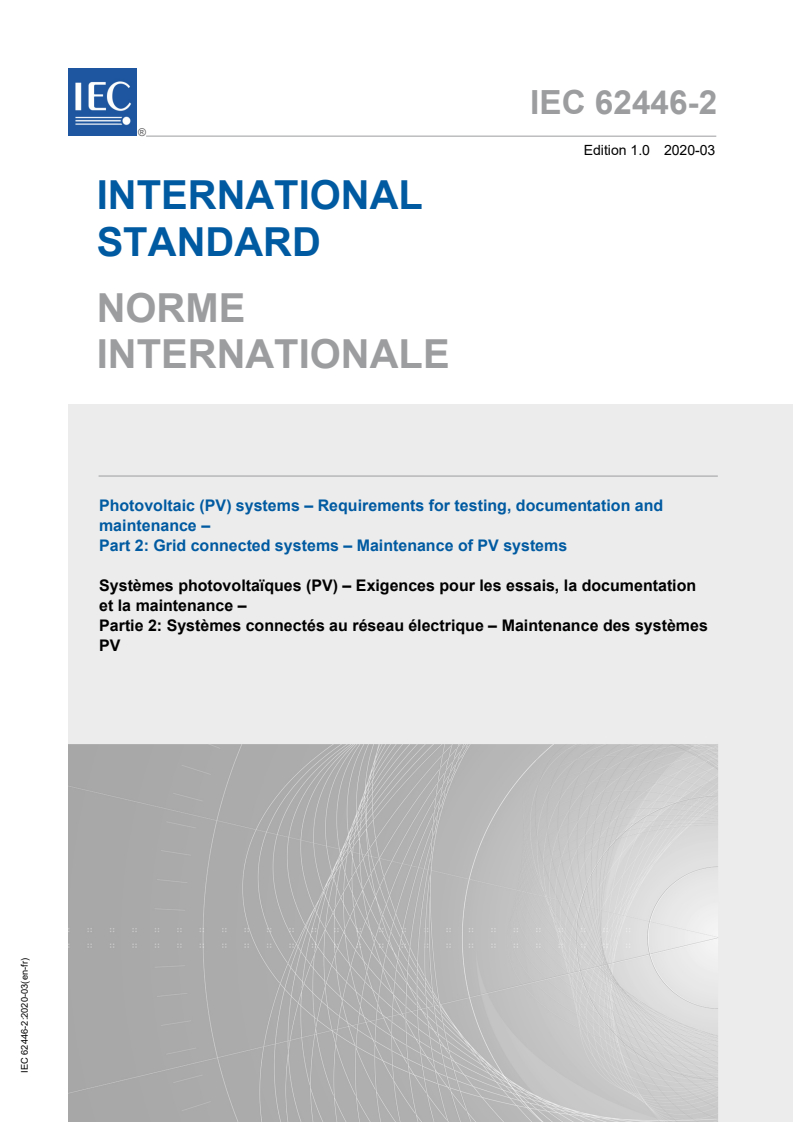
IEC 62446-2 ®
Edition 1.0 2020-03
INTERNATIONAL
STANDARD
NORME
INTERNATIONALE
Photovoltaic (PV) systems – Requirements for testing, documentation and
maintenance –
Part 2: Grid connected systems – Maintenance of PV systems
Systèmes photovoltaïques (PV) – Exigences pour les essais, la documentation
et la maintenance –
Partie 2: Systèmes connectés au réseau électrique – Maintenance des systèmes
PV
All rights reserved. Unless otherwise specified, no part of this publication may be reproduced or utilized in any form
or by any means, electronic or mechanical, including photocopying and microfilm, without permission in writing from
either IEC or IEC's member National Committee in the country of the requester. If you have any questions about IEC
copyright or have an enquiry about obtaining additional rights to this publication, please contact the address below or
your local IEC member National Committee for further information.
Droits de reproduction réservés. Sauf indication contraire, aucune partie de cette publication ne peut être reproduite
ni utilisée sous quelque forme que ce soit et par aucun procédé, électronique ou mécanique, y compris la photocopie
et les microfilms, sans l'accord écrit de l'IEC ou du Comité national de l'IEC du pays du demandeur. Si vous avez des
questions sur le copyright de l'IEC ou si vous désirez obtenir des droits supplémentaires sur cette publication, utilisez
les coordonnées ci-après ou contactez le Comité national de l'IEC de votre pays de résidence.
IEC Central Office Tel.: +41 22 919 02 11
3, rue de Varembé info@iec.ch
CH-1211 Geneva 20 www.iec.ch
Switzerland
About the IEC
The International Electrotechnical Commission (IEC) is the leading global organization that prepares and publishes
International Standards for all electrical, electronic and related technologies.
About IEC publications
The technical content of IEC publications is kept under constant review by the IEC. Please make sure that you have the
latest edition, a corrigendum or an amendment might have been published.
IEC publications search - webstore.iec.ch/advsearchform Electropedia - www.electropedia.org
The advanced search enables to find IEC publications by a The world's leading online dictionary on electrotechnology,
variety of criteria (reference number, text, technical containing more than 22 000 terminological entries in English
committee,…). It also gives information on projects, replaced and French, with equivalent terms in 16 additional languages.
and withdrawn publications. Also known as the International Electrotechnical Vocabulary
(IEV) online.
IEC Just Published - webstore.iec.ch/justpublished
Stay up to date on all new IEC publications. Just Published IEC Glossary - std.iec.ch/glossary
details all new publications released. Available online and 67 000 electrotechnical terminology entries in English and
once a month by email. French extracted from the Terms and Definitions clause of
IEC publications issued since 2002. Some entries have been
IEC Customer Service Centre - webstore.iec.ch/csc collected from earlier publications of IEC TC 37, 77, 86 and
If you wish to give us your feedback on this publication or CISPR.
need further assistance, please contact the Customer Service
Centre: sales@iec.ch.
A propos de l'IEC
La Commission Electrotechnique Internationale (IEC) est la première organisation mondiale qui élabore et publie des
Normes internationales pour tout ce qui a trait à l'électricité, à l'électronique et aux technologies apparentées.
A propos des publications IEC
Le contenu technique des publications IEC est constamment revu. Veuillez vous assurer que vous possédez l’édition la
plus récente, un corrigendum ou amendement peut avoir été publié.
Recherche de publications IEC - Electropedia - www.electropedia.org
webstore.iec.ch/advsearchform Le premier dictionnaire d'électrotechnologie en ligne au
La recherche avancée permet de trouver des publications IEC monde, avec plus de 22 000 articles terminologiques en
en utilisant différents critères (numéro de référence, texte, anglais et en français, ainsi que les termes équivalents dans
comité d’études,…). Elle donne aussi des informations sur les 16 langues additionnelles. Egalement appelé Vocabulaire
projets et les publications remplacées ou retirées. Electrotechnique International (IEV) en ligne.
IEC Just Published - webstore.iec.ch/justpublished Glossaire IEC - std.iec.ch/glossary
Restez informé sur les nouvelles publications IEC. Just 67 000 entrées terminologiques électrotechniques, en anglais
Published détaille les nouvelles publications parues. et en français, extraites des articles Termes et Définitions des
Disponible en ligne et une fois par mois par email. publications IEC parues depuis 2002. Plus certaines entrées
antérieures extraites des publications des CE 37, 77, 86 et
Service Clients - webstore.iec.ch/csc CISPR de l'IEC.
Si vous désirez nous donner des commentaires sur cette
publication ou si vous avez des questions contactez-nous:
sales@iec.ch.
IEC 62446-2 ®
Edition 1.0 2020-03
INTERNATIONAL
STANDARD
NORME
INTERNATIONALE
Photovoltaic (PV) systems – Requirements for testing, documentation and
maintenance –
Part 2: Grid connected systems – Maintenance of PV systems
Systèmes photovoltaïques (PV) – Exigences pour les essais, la documentation
et la maintenance –
Partie 2: Systèmes connectés au réseau électrique – Maintenance des systèmes
PV
INTERNATIONAL
ELECTROTECHNICAL
COMMISSION
COMMISSION
ELECTROTECHNIQUE
INTERNATIONALE
ICS 27.160 ISBN 978-2-8322-7906-9
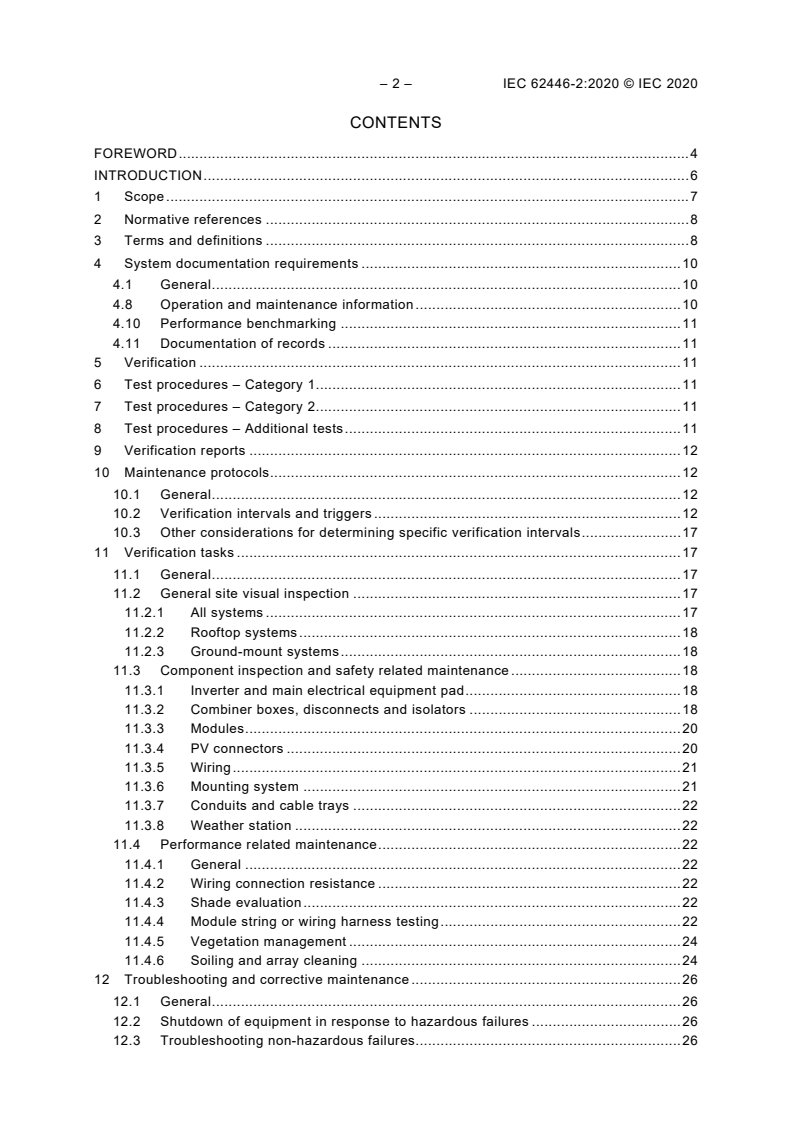
– 2 – IEC 62446-2:2020 © IEC 2020
CONTENTS
FOREWORD . 4
INTRODUCTION . 6
1 Scope . 7
2 Normative references . 8
3 Terms and definitions . 8
4 System documentation requirements . 10
4.1 General . 10
4.8 Operation and maintenance information . 10
4.10 Performance benchmarking . 11
4.11 Documentation of records . 11
5 Verification . 11
6 Test procedures – Category 1 . 11
7 Test procedures – Category 2 . 11
8 Test procedures – Additional tests . 11
9 Verification reports . 12
10 Maintenance protocols . 12
10.1 General . 12
10.2 Verification intervals and triggers . 12
10.3 Other considerations for determining specific verification intervals . 17
11 Verification tasks . 17
11.1 General . 17
11.2 General site visual inspection . 17
11.2.1 All systems . 17
11.2.2 Rooftop systems . 18
11.2.3 Ground-mount systems . 18
11.3 Component inspection and safety related maintenance . 18
11.3.1 Inverter and main electrical equipment pad . 18
11.3.2 Combiner boxes, disconnects and isolators . 18
11.3.3 Modules . 20
11.3.4 PV connectors . 20
11.3.5 Wiring . 21
11.3.6 Mounting system . 21
11.3.7 Conduits and cable trays . 22
11.3.8 Weather station . 22
11.4 Performance related maintenance . 22
11.4.1 General . 22
11.4.2 Wiring connection resistance . 22
11.4.3 Shade evaluation . 22
11.4.4 Module string or wiring harness testing . 22
11.4.5 Vegetation management . 24
11.4.6 Soiling and array cleaning . 24
12 Troubleshooting and corrective maintenance . 26
12.1 General . 26
12.2 Shutdown of equipment in response to hazardous failures . 26
12.3 Troubleshooting non-hazardous failures. 26
12.4 Troubleshooting incident or event-triggered issues . 26
12.5 Diagnosing performance related issues . 27
13 Additional procedures . 28
13.1 General . 28
13.2 Safety procedures . 28
13.2.1 General . 28
13.2.2 Safe operation of switch disconnectors . 28
13.3 Isolation procedures . 28
13.3.1 Emergency shutdown. 28
13.3.2 Non-emergency shutdown . 29
13.4 Inspection and preventive maintenance procedures . 30
13.4.1 Inverter manufacturer specific procedures . 30
13.4.2 Tracker manufacturer specific procedures . 31
13.4.3 Data acquisition system specific procedures . 31
13.5 Electrical test procedures . 32
13.5.1 Earth fault testing . 32
13.5.2 Fuse tests . 34
13.5.3 Bypass diode tests . 34
13.6 Diagnostic procedures . 35
13.6.1 Validation of data acquisition systems (DAS) . 35
13.6.2 Inverter diagnostics . 38
Annex E (normative) Safety considerations . 40
E.1 Qualified persons . 40
E.2 General safety considerations . 40
E.3 Personal protective equipment . 41
E.4 Isolation procedures . 41
E.5 Lock-out tag-out . 41
E.6 PV specific signs and labelling . 42
Annex F (informative) Example preventive maintenance schedule . 43
F.1 General . 43
F.2 Example system description . 43
Annex G (informative) PV system operations . 50
Bibliography . 51
Table 3 – Verification and maintenance tasks and basis for determining task intervals . 13
Table 4 – Common reported inverter errors . 38
Table F.1 – Preventive maintenance schedule for XYZ plant . 44
– 4 – IEC 62446-2:2020 © IEC 2020
INTERNATIONAL ELECTROTECHNICAL COMMISSION
____________
PHOTOVOLTAIC (PV) SYSTEMS –
REQUIREMENTS FOR TESTING, DOCUMENTATION AND MAINTENANCE –
Part 2: Grid connected systems – Maintenance of PV systems
FOREWORD
1) The International Electrotechnical Commission (IEC) is a worldwide organization for standardization comprising
all national electrotechnical committees (IEC National Committees). The object of IEC is to promote
international co-operation on all questions concerning standardization in the electrical and electronic fields. To
this end and in addition to other activities, IEC publishes International Standards, Technical Specifications,
Technical Reports, Publicly Available Specifications (PAS) and Guides (hereafter referred to as “IEC
Publication(s)”). Their preparation is entrusted to technical committees; any IEC National Committee interested
in the subject dealt with may participate in this preparatory work. International, governmental and non-
governmental organizations liaising with the IEC also participate in this preparation. IEC collaborates closely
with the International Organization for Standardization (ISO) in accordance with conditions determined by
agreement between the two organizations.
2) The formal decisions or agreements of IEC on technical matters express, as nearly as possible, an international
consensus of opinion on the relevant subjects since each technical committee has representation from all
interested IEC National Committees.
3) IEC Publications have the form of recommendations for international use and are accepted by IEC National
Committees in that sense. While all reasonable efforts are made to ensure that the technical content of IEC
Publications is accurate, IEC cannot be held responsible for the way in which they are used or for any
misinterpretation by any end user.
4) In order to promote international uniformity, IEC National Committees undertake to apply IEC Publications
transparently to the maximum extent possible in their national and regional publications. Any divergence
between any IEC Publication and the corresponding national or regional publication shall be clearly indicated in
the latter.
5) IEC itself does not provide any attestation of conformity. Independent certification bodies provide conformity
assessment services and, in some areas, access to IEC marks of conformity. IEC is not responsible for any
services carried out by independent certification bodies.
6) All users should ensure that they have the latest edition of this publication.
7) No liability shall attach to IEC or its directors, employees, servants or agents including individual experts and
members of its technical committees and IEC National Committees for any personal injury, property damage or
other damage of any nature whatsoever, whether direct or indirect, or for costs (including legal fees) and
expenses arising out of the publication, use of, or reliance upon, this IEC Publication or any other IEC
Publications.
8) Attention is drawn to the Normative references cited in this publication. Use of the referenced publications is
indispensable for the correct application of this publication.
9) Attention is drawn to the possibility that some of the elements of this IEC Publication may be the subject of
patent rights. IEC shall not be held responsible for identifying any or all such patent rights.
International Standard IEC 62446-2 has been prepared by IEC technical committee 82: Solar
photovoltaic energy systems.
The text of this standard is based on the following documents:
FDIS Report on voting
82/1656/FDIS 82/1676/RVD
Full information on the voting for the approval of this standard can be found in the report on
voting indicated in the above table.
This publication has been drafted in accordance with the ISO/IEC Directives, Part 2.
A list of all parts in the IEC 62446 series, published under the general title Photovoltaic (PV)
systems – Requirements for testing, documentation and maintenance, can be found on the
IEC website.
This International Standard is to be used in conjunction with IEC 62446-1:2016.
The requirements in IEC 62446-2 are to be used with the requirements in IEC 62446-1:2016,
and supplement or modify clauses in IEC 62446-1:2016. All Clauses 1 to 9 of IEC 62446-
1:2016 apply, including the applicable Annexes. When IEC 62446-2 contains clauses that add
to, modify, or replace clauses in IEC 62446-1:2016, the relevant text of IEC 62446-1:2016 is
to be applied with the required changes.
Clauses, subclauses, figures, tables and annexes additional to those in IEC 62446-1:2016 are
numbered in continuation of the sequence existing in IEC 62446-1:2016.
The committee has decided that the contents of this publication will remain unchanged until
the stability date indicated on the IEC web site under "http://webstore.iec.ch" in the data
related to the specific publication. At this date, the publication will be
• reconfirmed,
• withdrawn,
• replaced by a revised edition, or
• amended.
– 6 – IEC 62446-2:2020 © IEC 2020
INTRODUCTION
This Part 2 of IEC 62446 gives requirements and recommendations for the maintenance of PV
systems, including periodic inspections, safety and performance related preventive
maintenance, corrective maintenance and troubleshooting. Grid connected PV systems are
generally considered to be a very low maintenance means of power generation. While this is
true relative to conventional generation sources that utilize fuel and/or rotating machinery, PV
systems do require some level of preventive and corrective maintenance to perform as
anticipated over lifetimes that can exceed 20 years. The level of maintenance required or
recommended for performance can vary considerably based on the owner’s preference or
contractual obligations for power production; however, a minimum level of monitoring or
maintenance is critical for safety and reducing the risk of fire. Adherence to a minimum set of
maintenance requirements is also integral to the goals of the IECRE Conformity Assessment
system, which is intended to drive the licensing and certification of PV systems and plants
from the design to the operations stage.
PHOTOVOLTAIC (PV) SYSTEMS –
REQUIREMENTS FOR TESTING, DOCUMENTATION AND MAINTENANCE –
Part 2: Grid connected systems – Maintenance of PV systems
1 Scope
This clause of IEC 62446-1:2016 is applicable with the following exception:
Addition:
This Part 2 of IEC 62446 describes basic preventive, corrective, and performance related
maintenance requirements and recommendations for grid-connected PV systems. The
maintenance procedures cover:
• Basic maintenance of the system components and connections for reliability, safety and
fire prevention
• Measures for corrective maintenance and troubleshooting
• Worker safety
This document also addresses maintenance activities for maximizing anticipated performance
such as module cleaning and upkeep of vegetation. Special considerations unique to rooftop
or ground-mounted systems are summarized. This document does not cover off-grid systems
or systems that include batteries or other energy storage technologies; however, parts may be
applicable to the PV circuits of those systems.
This document also does not cover maintenance of medium and high voltage a.c. equipment
that are sometimes integral to larger scale systems, as those requirements are not specific to
PV systems.
Maintenance of PV systems is often lumped into the catch-all term operations and
maintenance (O&M.) This document does not address business or management operational
processes (e.g. forecasting, utility pricing incentives, etc.) or other considerations driven by
factors outside of basic system working condition, safety and performance.
The confirmation of a system’s compliance with the appropriate design and installation
standards is covered in Part 1 and takes place during initial project commissioning.
The objectives of this document are to:
• Identify a baseline set of maintenance requirements which may differ by system type
(residential, commercial, utility scale), owner, or financing requirements.
• Identify additional maintenance steps that are recommended or optional.
• Identify factors to be used to determine appropriate maintenance intervals.
• Ensure that remote diagnostic methods are allowed as means for periodic verification,
problem identification and early failure detection.
• Ensure that alternate means of achieving maintenance related requirements are allowed to
accommodate for innovation, manufacturer specific methods, evolving customer
requirements, etc.
– 8 – IEC 62446-2:2020 © IEC 2020
2 Normative references
The following documents are referred to in the text in such a way that some or all of their
content constitutes requirements of this document. For dated references, only the edition
cited applies. For undated references, the latest edition of the referenced document (including
any amendments) applies.
This clause of IEC 62446-1:2016 is applicable, with the following exception:
Addition
IEC TS 61724-2, Photovoltaic system performance – Part 2: Capacity evaluation method
IEC TS 61724-3, Photovoltaic system performance – Part 3: Energy evaluation method
IEC TS 61836:2016 , Solar photovoltaic energy systems – Terms, definitions and symbols
IEC 62020, Electrical accessories – Residual current monitors for household and similar uses
(RCMs)
IEC 62446-1:2016, Photovoltaic (PV) systems – Requirements for testing, documentation and
maintenance – Part 1: Grid connected systems – Documentation, commissioning tests and
inspection
IEC TS 62446-3:2017, Photovoltaic (PV) systems – Requirements for testing, documentation
and maintenance – Part 3: Photovoltaic modules and plants – Outdoor infrared thermography
IEC 62548, Photovoltaic (PV) arrays – Design requirements
3 Terms and definitions
For the purposes of this document, the terms and definitions given in IEC TS 61836 as well as
those in Clause 3 of IEC 62446-1:2016 are applicable, with the following additions:
ISO and IEC maintain terminological databases for use in standardization at the following
addresses:
• IEC Electropedia: available at http://www.electropedia.org/
• ISO Online browsing platform: available at http://www.iso.org/obp
Addition:
3.17
support structure
equipment (also known as “racking”) used to physically support modules or groups of modules
and position them in a fixed or moving orientation relative to the path of the sun
3.18
equipment pad
foundation typically (but not exclusively) made of concrete or cement used for mounting and
securing inverters, disconnectors, transformers, or other equipment associated with a PV
system
Note 1 to entry: Equipment pads are typically installed in ground-mount systems, or adjacent to buildings for large
rooftop systems where equipment is too large to be wall-mounted.
3.19
combiner box
junction box in which the parallel connections for PV strings, subarrays or arrays are made
3.20
qualified person
person, who has acquired, through training, qualification or experience or a combination of
these, the knowledge and skill enabling that person to perform the required task correctly
[SOURCE: IEC 62548:2016, 3.1.7 “competent person”]
3.21
PV array combiner box
junction box where PV sub-arrays are connected and which may also contain overcurrent
protection and/or switch-disconnection devices
Note 1 to entry: Small arrays generally do not contain sub-arrays but are simply made up of strings whereas large
arrays are generally made up of multiple sub-arrays.
[SOURCE: IEC 62548:2016, 3.1.36]
3.22
balance of system
in a renewable energy system, all components other than the mechanism used to harvest the
resource (such as photovoltaic panels or modules)
3.23
lockout/tagout
LOTO
safety procedure used to ensure equipment is properly de-energized and prevented from
being re-energized by a locking mechanism until service personnel deems it safe to do so
Note 1 to entry: LOTO is a practice applying to some countries. Different safety procedures, such as the “five
safety rules” of EN 50110-1 for Europe, apply in different parts of the world.
3.24
personal protective equipment
PPE
any device or appliance designed to be worn or held by an individual for protection against
one or more health and safety hazards whilst performing live working
[SOURCE: IEC 60050-651:2014, 651-23-01]
3.25
authorized personnel
persons approved or assigned by the system owner/operator to perform a specific type of duty
or duties for which they are qualified, or to be at a specific location or locations at the
installation site
3.26
wiring harness
cable assembly that aggregates the output of multiple PV string conductors along a single
main conductor. The harness may or may not include fuse components on the individual string
conductors
3.27
central inverter
inverter which has multiple sub-array or array circuits as inputs
– 10 – IEC 62446-2:2020 © IEC 2020
Note 1 to entry: Central inverters are large in capacity relative to string inverters. Typical sizes range from
100 kW to 4 MW.
3.28
module-level monitoring
MLM
device or equipment used to monitor power and voltage at the PV module level
Note 1 to entry: Some microinverters and module level d.c.to d.c. converters include such a functionality.
3.29
micro-crack
pressure or stress induced crack in a crystalline PV module cell that is not generally visible to
the naked eye
Note 1 to entry: One visible manifestation of micro-cracks is a discoloration effect known in the PV industry as
“snail trails.” Snail trails result from moisture diffusion through the micro-crack to the cell surface. Subsequent
corrosive or chemical reactions cause very noticeable discoloration along the paths of the cracks. Not all micro-
cracks result in snail trails, but all snail trails are caused by cracks or micro-cracks.
3.30
data acquisition system
DAS
system for monitoring various PV system parameters, e.g. inverter status, power output,
voltages and currents (at array, sub-array, string and/or module level), solar irradiance,
temperatures, wind speed, etc.
3.31
shutdown control
automated de-energization of targeted PV array d.c. circuits by either isolation, disconnection,
or attenuation of voltage to safe limits
Note 1 to entry: In some countries such equipment is available as “rapid shutdown” equipment for emergency
services and is activated by a.c. side system disconnection or other remote control means.
4 System documentation requirements
This clause of IEC 62446-1:2016 is applicable with the following exceptions:
4.1 General
Addition:
Additional documentation should be maintained in support of maintenance measures and
activities and should be recorded by maintenance personnel following any inspection,
maintenance or repair activity. The date, description of the activity, and any findings should
be included in the record.
4.8 Operation and maintenance information
Addition:
h) Monitoring system alarm settings.
i) Schedule of verification and maintenance intervals as determined in 10.2.
j) Evolving site-specific recommendations for periodic or follow-up testing based on findings
during maintenance activities, tests, or inspections.
k) As-built construction drawings and an accurate major components list, noting any
substitutions, damaged and/or replaced components.
l) A spare-parts list and schedule of replacement for applicable components.
m) Any site-specific recommendations for periodic monitoring and testing for novel
experimental components or sub-systems.
n) Schedule of component calibrations, including power and weather monitoring devices.
o) Certificates and dates of component calibrations, or a history of their replacement dates,
as applicable.
O&M personnel shall work with the system owner or responsible operator to locate or re-
create any missing documentation covered by this list while keeping documentation in a safe
and secured place.
Addition:
4.10 Performance benchmarking
System performance benchmarks shall be maintained from test reports conducted according
to one or more of the following:
a) Performance related clauses of IEC 62446-1:2016,
b) IEC TS 61724-2,
c) IEC TS 61724-3, and,
d) Any additional performance related testing.
The benchmarking shall be used for comparison with repeated performance checks taken
during maintenance procedures called out in IEC 62446-2. Benchmarking information should
at a minimum include parameters and information covered by the model PV array test report
provided in informative Annex C of IEC 62446-1:2016.
4.11 Documentation of records
Test data and results from the maintenance procedures detailed in Clause 9 of IEC 62446-
1:2016 shall be maintained. These records should be used for reference, trending of
performance and corrective actions, and for general record keeping in the case of warranty
claims or a change of ownership of the system.
5 Verification
This clause and the subclauses of IEC 62446-1:2016 are applicable where specifically called
out by the requirements in IEC 62446-2.
6 Test procedures – Category 1
This clause and the subclauses of IEC 62446-1:2016 are applicable where specifically called
out by the requirements in IEC 62446-2.
7 Test procedures – Category 2
This clause and the subclauses of IEC 62446-1:2016 are applicable where specifically called
out by the requirements in IEC 62446-2.
8 Test procedures – Additional tests
This clause and the subclauses of IEC 62446-1:2016 are applicable where specifically called
out by the requirements in IEC 62446-2.
– 12 – IEC 62446-2:2020 © IEC 2020
9 Verification reports
This clause of IEC 62446-1:2016 is applicable for specific instances, such as a condition for
re-sale or valuation, but is not required on a regular basis.
Addition:
10 Maintenance protocols
10.1 General
This clause describes various maintenance protocols for grid-connected PV systems. These
include:
• Periodic verification to determine, as far as reasonably practical, whether the installation
and all its constituent equipment remain in a satisfactory condition for safe use. The
periodic verification includes inspections and safety-related maintenance testing.
• Recommended periodic performance related maintenance.
• Conditional or condition-based maintenance activities, performed in response to issues or
problems detected through monitoring, inspections or testing.
• Administrative maintenance activities – those required by contracts and warranties. This
includes preventive maintenance, typically used to describe procedures carried out on a
periodic basis to support component life targets.
• Corrective maintenance procedures – the specific mitigating or restorative procedures
carried out in response to identified issues.
• Troubleshooting, including generalized measures described in this document, as well as
manufacturer specific procedures for individual equipment components.
The intention is that these protocols will be inherently flexible to:
• Allow remote diagnostic methods as means for periodic verification, problem identification
and early failure detection.
• Ensure that alternate means of achieving maintenance related requirements are allowed to
accommodate for innovation, manufacturer specific methods, evolving customer
requirements, etc.
Personnel performing inspections or maintenance of electrical equipment should be qualified
and skilled in the procedures and should follow the general guidelines described in Annex E.
10.2 Verification intervals and triggers
Based on the recommendations or warranty requirements of component manufacturers and
system integrators, it may be necessary to schedule preventive maintenance activities in
advance of detecting a failure in the field, instead of allowing parts to fail. This keeps
equipment in superior operating condition while minimizing downtime by scheduling
maintenance, ideally during non-production hours, as well as avoiding longer downtime for
unplanned repairs. For larger commercial and utility scale power plant systems it is
recommended that replacement parts for key components be stored in order to minimize
response time. Depending on the manufacturer recommendations and owner/operator
preferences, activities may include cleaning/replacing inverter filters, replacing plastic module
cable ties, cycling switches, replacing fuses, etc. Replacements made during periodic or
corrective maintenance activities shall be made with the same parts or equivalent parts that
are pre-approved by the equipment manufacturer or responsible system operator.
Periodic verification and maintenance should be performed at intervals throughout the life of a
PV system, and in response to specific triggers. These intervals can vary considerably based
on:
– Type of system (ground mount power plant, commercial, residential, etc.).
– Extent of remote monitoring capabilities.
– Contractual requirements or performance guarantees.
– Manufacturer recommended practices for maintenance of specific components.
– Site specific considerations.
– Cost benefit analyses.
NOTE Two IEC publications support the linkage between maintenance activities, system availability, and life-cycle
costs, and provide a basis for gathering data in a format to support the various metrices and analyses. See
IEC 60300-3-3 and IEC TS 63019.
This document does not specify verification or maintenance intervals given the extensive set
of factors that vary by application, site, and owner or operator obligations. However, Table 3
identifies verification tasks at the system and component level and provides guidance for
determining verification intervals. The Interval basis column describes specific examples of
issues that would justify more frequent verification intervals. For example, systems located at
sites prone to flooding or lightning storms should have more frequent inspections or
performance verification of particular components.
Table 3 also identifies the relevant clause or subclause in this document describing each of
the verification tasks or procedures. Columns “P” and “I” indicate whether the conditional
verification tasks are commonly triggered by detected performance issues (“P”), such as low
measured output, or specific incidents (I), such as faults or component failures.
Table 3 – Verification and maintenance tasks and basis for determining task intervals
Component/Task Relevant P I Interval basis
Clause/
subclause
Modules
Areas with high lightning or wind activity,
Inspect for cracks, delamination,
X nearby construction activity, aging systems (in
breakage, burn marks
case of delamination).
Products with history of micro-cracks. Sites with
Inspect for micro-cracks or "snail 11.3.3 X
snow and wind driven forces on modules, etc.
trails"
Impacts may be greater in high humidity areas.
Inspect for excessive build-up of soil Where site is susceptible to high levels of
X
or droppings soiling, bird droppings, etc.
Can be the default method for large plants (e.g.
Thermal imaging for junction box, cell using aerial imaging). Locations susceptible to
variations, internal connections, 11.3.3 X X lightning e.g. for bypass diode diagnostics,
partial operation. Seasonal bias for testing to ensure high
irradiance, e.g. summer.
Where connectors are aging or exposed to high
winds or other sources of movement or strain.
Connector checks – visual damage, Where dissimilar connector manufacturers are
11.3.4 X X
sample tightness used. For sites with atypically high use of field-
assembled connectors, or history of issues with
field-assembled connectors.
Only conditional based, unless system has
Imaging of module connectors for
history of connector problems, and arc-fault
resistive, cracked or compromised 11.3.4 X X
connection and/or sensitive ground fault
connections
detection is not included.
Array
For ground-mounted power plants following
construction or substantial maintenance
Debris or stored items under array 11.2.1 X
activities. Consider other types of debris that
comes from wind or another source.
– 14 – IEC 62446-2:2020 © IEC 2020
Component/Task Relevant P I Interval basis
Clause/
subclause
Dependent on site conditions, and whether
there is a potential impact on wiring or
Animal or pest activity under array 11.2.1
equipment. May be seasonal depending on the
animal, for example nesting in the spring.
For systems with functionally earthed arrays,
periodic tests at sites where wiring has history
IEC 62446-
Periodic insulation resistance testing X X or is susceptible to damage, or where testing
1:2016, 6.7
can be done in conjunction with periodic
inverter checks.
As needed for diagnosing performance
problems. Can be useful as preventive measure
Track shading sources against
11.4.3 X
at sites with adjacent growing trees, and/or with
baseline during commissioning
contractual performance, etc.
String or wiring harness V As needed for performance or troubleshooting;
oc
measurements for baseline or where contractual performance base lining is
11.4.4.2 X X
comparisons required.
String or wiring harness current
measurements for baseline 11.4.4.3 X X
comparisons
String or wiring harness I-V curve Alternative to string V/I checks; particularly
performance baseline comparisons, 11.4.4.4 X X useful for advanced diagnosis of string
ID failures performance.
Highly site and season dependent, if needed at
Vegetation management – cutting, all. Base on site review or first year(s)
11.4.5 X X
removing, control operation; for ensuring performance, protecting
equipment, or both.
Inverter
Useful for checking small systems, including by
Visual cues from inverter lights and
non-qualified personnel, or for troubleshooting
N/A X X
displays
Infrequent, or as part of inverter mfg specified
Inverter enclosure inspection –
11.4.1 intervals. More frequent at sites with corrosive
exterior
environments.
Infrequent, except at sites with rodent issues,
or with heavy rains, high humidity, flooding,
Inverter interior (water, dust, rodent) 11.3.1 X X
dust exposure, or history of condensation in
connecting conduits.
For troubleshooting, and/or as part of inverter
Inverter interior – torque marks, burn
mfg specified intervals. May have more
11.3.1 X X
marks on field terminals
frequent intervals in first 1-2 years.
Periodic maintenance – manufacturer As specified.
13.4.1
specified
Enclosures
Periodic checks recommended at sites with
Electrical enclosure accessibility
high exposure or access; schools, public
11.2.1
(secured)
buildings or parks, etc.
Infrequent, except at sites with corrosive
Enclosure corrosion 11.3.2.2
environments.
CBs/Switch disconnectors
Check torque marks on field 11.3.2.1 Per manufacturer/supplier recommendations.
X
terminations May only be in first year.
11.3.2.3, At sites where heavy rain or flooding occurs, or
Look for debris, signs of water X X considerable wind blown debris. Where
11.3.2.4
conduits are susceptible to high condensation.
Burn/arc discoloration on terminals, 11.3.2.1 Locations with high lightning activity, or history
X X
boards, fuse holders of similar issues.
Component/Task Relevant P I Interval basis
Clause/
subclause
11.3.2.1 Sites susceptible to wind driven dust or other
Dust deposits on contact surfaces X
...