

IEC 62442-1:2011
(Main)Energy performance of lamp controlgear - Part 1: Controlgear for fluorescent lamps - Method of measurement to determine the total input power of controlgear circuits and the efficiency of the controlgear
General Information
- Abstract
IEC 62442-1:2011 defines a measurement and calculation method of the total input power for controlgear - lamp circuits when operating with their associated fluorescent lamp(s). The calculation method for the efficiency of the lamp controlgear is also defined. This International Standard applies to electrical controlgear lamp circuits consisting only of the controlgear and the lamp(s). It is intended for use on a.c. supplies up to 1 000 V at 50 Hz or 60 Hz.
- Status
- Published
- Publication Date
- 11-Oct-2011
- Technical Committee
- SC 34C - Auxiliaries for lamps
- Drafting Committee
- WG 1 - TC 34/SC 34C/WG 1
- Current Stage
- DELPUB - Deleted Publication
- Start Date
- 03-May-2018
- Completion Date
- 28-Aug-2026
Buy Documents
IEC 62442-1:2011 - Energy performance of lamp controlgear - Part 1: Controlgear for fluorescent lamps - Method of measurement to determine the total input power of controlgear circuits and the efficiency of the controlgear Released:10/12/2011
Overview
IEC 62442-1:2011 is an international standard established by the International Electrotechnical Commission (IEC) that defines the energy performance measurement methods for lamp controlgear, specifically focusing on controlgear for fluorescent lamps. This standard provides a systematic approach to determine the total input power of controlgear circuits and calculate the efficiency of these controlgear when used with their associated fluorescent lamps.
The standard applies to electrical controlgear lamp circuits comprised solely of the controlgear and the fluorescent lamp(s), operating on alternating current (a.c.) supplies up to 1,000 V at frequencies of 50 Hz or 60 Hz. It covers a range of fluorescent lamps including linear fluorescent lamps, single-ended (compact) fluorescent lamps, and other general purpose fluorescent lamps.
Key Topics
Measurement Methodology:
IEC 62442-1:2011 specifies precise test setups and procedures to measure the total input power of controlgear-lamp circuits accurately, ensuring consistent testing across manufacturers and laboratories.Efficiency Calculation of Controlgear:
This standard defines formulas and calculation methods to determine the efficiency of electromagnetic and electronic controlgear, which is critical for assessing and improving energy consumption in lighting systems.Types of Controlgear Covered:
The scope includes both magnetic wire-wound controlgear and electronic controlgear used for fluorescent lamps, detailing specific measurement techniques for each type.Operational Conditions:
The measurements consider controlgear operating on standard a.c. supply voltages and frequencies (up to 1,000 V, 50/60 Hz), reflecting typical commercial and residential electrical environments.Exclusions:
The standard explicitly does not apply to controlgear integrated into the lamp itself, luminaires with additional optical performance factors, or controllable wire-wound magnetic controlgear.Standardized Terminology:
It provides clear definitions for terms such as nominal value, rated value, controlgear, electromagnetic controlgear, and electronic controlgear, ensuring clarity and consistency.
Applications
Lamp Controlgear Testing and Certification:
Manufacturers and testing laboratories use IEC 62442-1 for energy performance testing of lamp controlgear, supporting product certification and compliance with international energy efficiency regulations.Energy Efficiency Improvement:
By accurately measuring controlgear efficiency, lighting system designers and manufacturers can optimize energy consumption, reduce power losses, and develop more efficient lighting products.Product Development and Quality Control:
The standard serves as a reference during design, development, and production of controlgear to maintain consistent energy performance and reliability.Regulatory and Voluntary Energy Labels:
Results from IEC 62442-1 measurements can provide data for energy labeling schemes and eco-design requirements for lighting products, helping end-users make informed purchasing decisions.Compatibility Assurance with Fluorescent Lamps:
Ensures controlgear performance is tested under realistic operating conditions with fluorescent lamps, which is essential for product interoperability and stable lighting operation.
Related Standards
- IEC 60081 – Double-capped fluorescent lamps – Performance specifications.
- IEC 60901 – Single-capped fluorescent lamps – Performance requirements.
- IEC 60921:2004 – Ballasts for tubular fluorescent lamps – Performance requirements.
- IEC 60929:2011 – Electronic controlgear for tubular fluorescent lamps – Performance requirements.
- IEC 61347-2-3 – Particular requirements for a.c. and/or d.c. supplied electronic controlgear for fluorescent lamps.
- IEC 61347-2-8 – Particular requirements for ballasts for fluorescent lamps.
These related IEC standards complement IEC 62442-1 by defining performance and safety criteria for various components in fluorescent lighting systems.
By implementing IEC 62442-1:2011 standards, manufacturers and stakeholders contribute to energy-efficient lighting solutions that meet global requirements, promote sustainability, and support reduction of energy costs in residential, commercial, and industrial lighting applications.
Relations
- Effective Date
- 05-Sep-2023
Buy Documents
IEC 62442-1:2011 - Energy performance of lamp controlgear - Part 1: Controlgear for fluorescent lamps - Method of measurement to determine the total input power of controlgear circuits and the efficiency of the controlgear Released:10/12/2011
Get Certified
Connect with accredited certification bodies for this standard

IMQ S.p.A. (Certification)
Italian electrical product certification.

SLG Prüf- und Zertifizierungs GmbH
German testing and certification body.

UL Solutions
Global safety science company with testing, inspection and certification.
Sponsored listings
Frequently Asked Questions
IEC 62442-1:2011 is a standard published by the International Electrotechnical Commission (IEC). Its full title is "Energy performance of lamp controlgear - Part 1: Controlgear for fluorescent lamps - Method of measurement to determine the total input power of controlgear circuits and the efficiency of the controlgear". This standard covers: IEC 62442-1:2011 defines a measurement and calculation method of the total input power for controlgear - lamp circuits when operating with their associated fluorescent lamp(s). The calculation method for the efficiency of the lamp controlgear is also defined. This International Standard applies to electrical controlgear lamp circuits consisting only of the controlgear and the lamp(s). It is intended for use on a.c. supplies up to 1 000 V at 50 Hz or 60 Hz.
IEC 62442-1:2011 defines a measurement and calculation method of the total input power for controlgear - lamp circuits when operating with their associated fluorescent lamp(s). The calculation method for the efficiency of the lamp controlgear is also defined. This International Standard applies to electrical controlgear lamp circuits consisting only of the controlgear and the lamp(s). It is intended for use on a.c. supplies up to 1 000 V at 50 Hz or 60 Hz.
IEC 62442-1:2011 is classified under the following ICS (International Classification for Standards) categories: 29.140.99 - Other standards related to lamps. The ICS classification helps identify the subject area and facilitates finding related standards.
IEC 62442-1:2011 has the following relationships with other standards: It is inter standard links to IEC 62442-1:2018. Understanding these relationships helps ensure you are using the most current and applicable version of the standard.
IEC 62442-1:2011 is available in PDF format for immediate download after purchase. The document can be added to your cart and obtained through the secure checkout process. Digital delivery ensures instant access to the complete standard document.
Standards Content (Sample)
IEC 62442-1 ®
Edition 1.0 2011-10
INTERNATIONAL
STANDARD
NORME
INTERNATIONALE
Energy performance of lamp controlgear –
Part 1: Controlgear for fluorescent lamps – Method of measurement to determine
the total input power of controlgear circuits and the efficiency of the controlgear
Performance énergétique des appareillages de lampes –
Partie 1: Appareillages des lampes à fluorescence – Méthode de mesure pour la
détermination de la puissance d'entrée totale des circuits d'appareillage et du
rendement des appareillages
All rights reserved. Unless otherwise specified, no part of this publication may be reproduced or utilized in any form or by
any means, electronic or mechanical, including photocopying and microfilm, without permission in writing from either IEC or
IEC's member National Committee in the country of the requester.
If you have any questions about IEC copyright or have an enquiry about obtaining additional rights to this publication,
please contact the address below or your local IEC member National Committee for further information.
Droits de reproduction réservés. Sauf indication contraire, aucune partie de cette publication ne peut être reproduite
ni utilisée sous quelque forme que ce soit et par aucun procédé, électronique ou mécanique, y compris la photocopie
et les microfilms, sans l'accord écrit de la CEI ou du Comité national de la CEI du pays du demandeur.
Si vous avez des questions sur le copyright de la CEI ou si vous désirez obtenir des droits supplémentaires sur cette
publication, utilisez les coordonnées ci-après ou contactez le Comité national de la CEI de votre pays de résidence.
IEC Central Office
3, rue de Varembé
CH-1211 Geneva 20
Switzerland
Email: inmail@iec.ch
Web: www.iec.ch
About the IEC
The International Electrotechnical Commission (IEC) is the leading global organization that prepares and publishes
International Standards for all electrical, electronic and related technologies.
About IEC publications
The technical content of IEC publications is kept under constant review by the IEC. Please make sure that you have the
latest edition, a corrigenda or an amendment might have been published.
Catalogue of IEC publications: www.iec.ch/searchpub
The IEC on-line Catalogue enables you to search by a variety of criteria (reference number, text, technical committee,…).
It also gives information on projects, withdrawn and replaced publications.
IEC Just Published: www.iec.ch/online_news/justpub
Stay up to date on all new IEC publications. Just Published details twice a month all new publications released. Available
on-line and also by email.
Electropedia: www.electropedia.org
The world's leading online dictionary of electronic and electrical terms containing more than 20 000 terms and definitions
in English and French, with equivalent terms in additional languages. Also known as the International Electrotechnical
Vocabulary online.
Customer Service Centre: www.iec.ch/webstore/custserv
If you wish to give us your feedback on this publication or need further assistance, please visit the Customer Service
Centre FAQ or contact us:
Email: csc@iec.ch
Tel.: +41 22 919 02 11
Fax: +41 22 919 03 00
A propos de la CEI
La Commission Electrotechnique Internationale (CEI) est la première organisation mondiale qui élabore et publie des
normes internationales pour tout ce qui a trait à l'électricité, à l'électronique et aux technologies apparentées.
A propos des publications CEI
Le contenu technique des publications de la CEI est constamment revu. Veuillez vous assurer que vous possédez
l’édition la plus récente, un corrigendum ou amendement peut avoir été publié.
Catalogue des publications de la CEI: www.iec.ch/searchpub/cur_fut-f.htm
Le Catalogue en-ligne de la CEI vous permet d’effectuer des recherches en utilisant différents critères (numéro de référence,
texte, comité d’études,…). Il donne aussi des informations sur les projets et les publications retirées ou remplacées.
Just Published CEI: www.iec.ch/online_news/justpub
Restez informé sur les nouvelles publications de la CEI. Just Published détaille deux fois par mois les nouvelles
publications parues. Disponible en-ligne et aussi par email.
Electropedia: www.electropedia.org
Le premier dictionnaire en ligne au monde de termes électroniques et électriques. Il contient plus de 20 000 termes et
définitions en anglais et en français, ainsi que les termes équivalents dans les langues additionnelles. Egalement appelé
Vocabulaire Electrotechnique International en ligne.
Service Clients: www.iec.ch/webstore/custserv/custserv_entry-f.htm
Si vous désirez nous donner des commentaires sur cette publication ou si vous avez des questions, visitez le FAQ du
Service clients ou contactez-nous:
Email: csc@iec.ch
Tél.: +41 22 919 02 11
Fax: +41 22 919 03 00
IEC 62442-1 ®
Edition 1.0 2011-10
INTERNATIONAL
STANDARD
NORME
INTERNATIONALE
Energy performance of lamp controlgear –
Part 1: Controlgear for fluorescent lamps – Method of measurement to determine
the total input power of controlgear circuits and the efficiency of the controlgear
Performance énergétique des appareillages de lampes –
Partie 1: Appareillages des lampes à fluorescence – Méthode de mesure pour la
détermination de la puissance d'entrée totale des circuits d'appareillage et du
rendement des appareillages
INTERNATIONAL
ELECTROTECHNICAL
COMMISSION
COMMISSION
ELECTROTECHNIQUE
PRICE CODE
INTERNATIONALE
CODE PRIX R
ICS 29.140.99 ISBN 978-2-88912-718-4
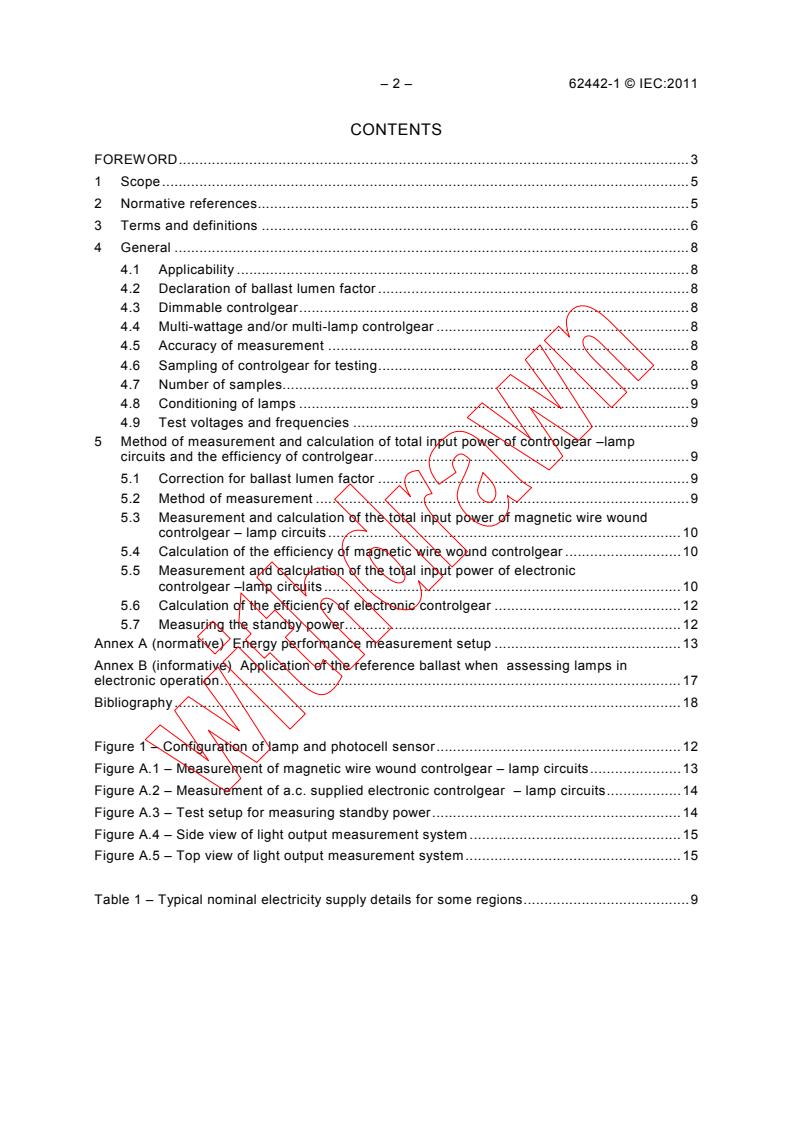
– 2 – 62442-1 © IEC:2011
CONTENTS
FOREWORD . 3
1 Scope . 5
2 Normative references. 5
3 Terms and definitions . 6
4 General . 8
4.1 Applicability . 8
4.2 Declaration of ballast lumen factor . 8
4.3 Dimmable controlgear . 8
4.4 Multi-wattage and/or multi-lamp controlgear . 8
4.5 Accuracy of measurement . 8
4.6 Sampling of controlgear for testing . 8
4.7 Number of samples. 9
4.8 Conditioning of lamps . 9
4.9 Test voltages and frequencies . 9
5 Method of measurement and calculation of total input power of controlgear –lamp
circuits and the efficiency of controlgear . 9
5.1 Correction for ballast lumen factor . 9
5.2 Method of measurement . 9
5.3 Measurement and calculation of the total input power of magnetic wire wound
controlgear – lamp circuits . 10
5.4 Calculation of the efficiency of magnetic wire wound controlgear . 10
5.5 Measurement and calculation of the total input power of electronic
controlgear –lamp circuits . 10
5.6 Calculation of the efficiency of electronic controlgear . 12
5.7 Measuring the standby power. 12
Annex A (normative) Energy performance measurement setup . 13
Annex B (informative) Application of the reference ballast when assessing lamps in
electronic operation . 17
Bibliography . 18
Figure 1 – Configuration of lamp and photocell sensor . 12
Figure A.1 – Measurement of magnetic wire wound controlgear – lamp circuits . 13
Figure A.2 – Measurement of a.c. supplied electronic controlgear – lamp circuits . 14
Figure A.3 – Test setup for measuring standby power . 14
Figure A.4 – Side view of light output measurement system . 15
Figure A.5 – Top view of light output measurement system . 15
Table 1 – Typical nominal electricity supply details for some regions . 9
62442-1 © IEC:2011 – 3 –
INTERNATIONAL ELECTROTECHNICAL COMMISSION
____________
ENERGY PERFORMANCE OF LAMP CONTROLGEAR –
Part 1: Controlgear for fluorescent lamps –
Method of measurement to determine the total input power
of controlgear circuits and the efficiency of the controlgear
FOREWORD
1) The International Electrotechnical Commission (IEC) is a worldwide organization for standardization comprising
all national electrotechnical committees (IEC National Committees). The object of IEC is to promote
international co-operation on all questions concerning standardization in the electrical and electronic fields. To
this end and in addition to other activities, IEC publishes International Standards, Technical Specifications,
Technical Reports, Publicly Available Specifications (PAS) and Guides (hereafter referred to as “IEC
Publication(s)”). Their preparation is entrusted to technical committees; any IEC National Committee interested
in the subject dealt with may participate in this preparatory work. International, governmental and non-
governmental organizations liaising with the IEC also participate in this preparation. IEC collaborates closely
with the International Organization for Standardization (ISO) in accordance with conditions determined by
agreement between the two organizations.
2) The formal decisions or agreements of IEC on technical matters express, as nearly as possible, an international
consensus of opinion on the relevant subjects since each technical committee has representation from all
interested IEC National Committees.
3) IEC Publications have the form of recommendations for international use and are accepted by IEC National
Committees in that sense. While all reasonable efforts are made to ensure that the technical content of IEC
Publications is accurate, IEC cannot be held responsible for the way in which they are used or for any
misinterpretation by any end user.
4) In order to promote international uniformity, IEC National Committees undertake to apply IEC Publications
transparently to the maximum extent possible in their national and regional publications. Any divergence
between any IEC Publication and the corresponding national or regional publication shall be clearly indicated in
the latter.
5) IEC itself does not provide any attestation of conformity. Independent certification bodies provide conformity
assessment services and, in some areas, access to IEC marks of conformity. IEC is not responsible for any
services carried out by independent certification bodies.
6) All users should ensure that they have the latest edition of this publication.
7) No liability shall attach to IEC or its directors, employees, servants or agents including individual experts and
members of its technical committees and IEC National Committees for any personal injury, property damage or
other damage of any nature whatsoever, whether direct or indirect, or for costs (including legal fees) and
expenses arising out of the publication, use of, or reliance upon, this IEC Publication or any other IEC
Publications.
8) Attention is drawn to the Normative references cited in this publication. Use of the referenced publications is
indispensable for the correct application of this publication.
9) Attention is drawn to the possibility that some of the elements of this IEC Publication may be the subject of
patent rights. IEC shall not be held responsible for identifying any or all such patent rights.
International Standard IEC 62442-1 has been prepared by subcommittee 34C: Auxiliaries for
lamps, of IEC technical committee 34: Lamps and related equipment.
The text of this standard is based on the following documents:
FDIS Report on voting
34C/987/FDIS 34C/996/RVD
Full information on the voting for the approval of this standard can be found in the report on
voting indicated in the above table.
This publication has been drafted in accordance with the ISO/IEC Directives, Part 2.
– 4 – 62442-1 © IEC:2011
A list of all parts of the IEC 62442 series, published under the general title Energy performance
of lamp controlgear, can be found on the IEC website.
This standard has been drafted in response to support classification systems for lamp
controlgear.
Consideration is being given to include in a future edition of this standard:
– Controlgear ‒ high intensity discharge (HID) lamp circuits;
– Transformer or step-down converter ‒ low voltage halogen lamp circuits;
The committee has decided that the contents of this publication will remain unchanged until the
stability date indicated on the IEC web site under "http://webstore.iec.ch" in the data related to
the specific publication. At this date, the publication will be
• reconfirmed,
• withdrawn,
• replaced by a revised edition, or
• amended.
62442-1 © IEC:2011 – 5 –
ENERGY PERFORMANCE OF LAMP CONTROLGEAR –
Part 1: Controlgear for fluorescent lamps –
Method of measurement to determine the total input power
of controlgear circuits and the efficiency of the controlgear
1 Scope
This part of IEC 62442 defines a measurement and calculation method of the total input power
for controlgear ‒ lamp circuits when operating with their associated fluorescent lamp(s). The
calculation method for the efficiency of the lamp controlgear is also defined. This International
Standard applies to electrical controlgear lamp circuits consisting only of the controlgear and
the lamp(s). It is intended for use on a.c. supplies up to 1 000 V at 50 Hz or 60 Hz.
NOTE Requirements for testing individual controlgear during production are not included.
It specifies the measurement method for the total input power and the calculation method of
the controlgear efficiency for all controlgear used for domestic and normal commercial
purposes operating with the following fluorescent lamps:
– linear fluorescent lamps;
– single-ended (compact) fluorescent lamps;
– other general purpose fluorescent lamps.
This International Standard does not apply to:
– controlgear which form an integral part of the lamp;
– controllable wire-wound magnetic controlgear;
– luminaires, which rely on additional optical performance aspects.
2 Normative references
The following referenced documents are indispensable for the application of this document. For
dated references, only the edition cited applies. For undated references, the latest edition of
the referenced document (including any amendments) applies.
IEC 60081, Double-capped fluorescent lamps – Performance specifications
IEC 60901, Single-capped fluorescent lamps – Performance requirements
IEC 60921:2004, Ballasts for tubular fluorescent lamps – Performance requirements
IEC 60929:2011, AC and/or DC-supplied electronic control gear for tubular fluorescent lamps –
Performance requirements
IEC 61347-2-3, Lamp control gear – Part 2-3: Particular requirements for a.c. and/or d.c.
supplied electronic control gear for fluorescent lamps
IEC 61347-2-8, Lamp controlgear – Part 2-8: Particular requirements for ballasts for
fluorescent lamps
– 6 – 62442-1 © IEC:2011
3 Terms and definitions
For the purposes of this document, the following terms and definitions apply.
3.1
nominal value
suitable approximate quantity value used to designate or identify a component, device or
equipment
3.2
limiting value
the greatest or smallest admissible value of one of the quantities
3.3
rated value
quantity value for specified operating conditions of a component, device or equipment
The value and conditions are specified in the relevant standard or assigned by the
manufacturer or responsible vendor
NOTE For the different kinds of operation, rated electrical values are given on the lamp data sheets as:
– rated electrical values under “electrical characteristics”, if the lamp is defined for 50 Hz / 60 Hz operation
only,
– rated electrical values under “electrical characteristics”, if the lamp is defined for high frequency (≥ 20 kHz)
operation only,
– rated electrical values and typical electrical values, if the lamp is defined simultaneously for 50 Hz / 60 Hz
operation and high frequency operation
for 50 Hz / 60 Hz operation: rated electrical values under “electrical characteristics”, and
for high frequency operation: rated electrical values under “typical lamp characteristics”.
3.4
controlgear
one or more components between the supply and one or more lamps which may serve to
transform the supply voltage, limit the current of the lamp(s) to the required value, provide
starting voltage and preheating current, prevent cold starting, correct power factor or reduce
radio interference
3.5
electromagnetic controlgear
controlgear which by means of inductance, or a combination of inductance and capacitance,
serves mainly to limit the current of the lamp(s) to the required value
Frequency of the lamp operation is the same as supply frequency.
3.6
electronic controlgear
a.c. and/or d.c. supplied to a.c. invertor including stabilizing elements for starting and operating
one or more tubular fluorescent lamps, generally at high frequency
3.7
fluorescent lamp
discharge lamp of the low pressure mercury type, in which most of the light is emitted by one or
several layers of phosphors excited by the ultra-violet radiation from the discharge
3.8
controlgear – lamp circuit
electrical circuit, or part thereof, normally built in a luminaire, consisting of the controlgear and
lamp(s)
62442-1 © IEC:2011 – 7 –
3.9
reference ballast
special ballast, either inductive for lamps for operation on a.c. mains frequencies, or resistive
for lamps for operation on high frequency
It is designed for the purpose of providing comparison standards for use in testing ballasts, for
the selection of reference lamps and for testing regular production lamps under standardized
conditions. It is essentially characterized by the fact that, at its rated frequency, it has a stable
voltage/current ratio which is relatively uninfluenced by variations in current, temperature and
magnetic surroundings, as outlined in IEC 60929.
NOTE Annex B provides details of calculating the reference ballast characteristics and the method of operation
with the reference ballast.
3.10
reference lamp
lamp selected for testing controlgear which, when associated with a reference controlgear, has
electrical characteristics which are close to the rated values or typical lamp characteristics as
stated in the relevant lamp standard
For details regarding the tolerances, see Clause B.2.
3.11
rated supply voltage of a controlgear
voltage specified by the controlgear manufacturer for a given controlgear that applies to a
given operation condition
3.12
rated power of a lamp
P
Lrated
power, expressed in watts, of a given lamp type specified by the manufacturer or the supplier,
the lamp being operated under specified conditions
3.13
ballast lumen factor
BLF
ratio of the light output of the reference lamp when the ballast under test is operated at its
rated voltage, compared with the light output of the same lamp operated with the appropriate
reference ballast supplied at its rated voltage and frequency
3.14
total input power
total power supplied to the controlgear – lamp circuit measured at rated input voltage
The rated power specified is related to a specific ballast lumen factor (BLF).
3.15
controlgear efficiency
η
controlgear
ratio between the summation of the rated lamp power(s) and the corrected to reference
conditions input power of the controlgear – lamp circuit with possible sensors, network
connections and other auxiliary loads disconnected
3.16
multi-lamp-power controlgear
controlgear designed for the operation of one lamp which could have different lamp power
3.17
multi-number-lamp controlgear
controlgear designed for the operation of more than one lamp
– 8 – 62442-1 © IEC:2011
4 General
4.1 Applicability
The measurement and calculation methods of this standard shall only be used for controlgear
which conforms to IEC 61347-2-3 or IEC 61347-2-8.
4.2 Declaration of ballast lumen factor
For every controlgear – lamp combination submitted for the test, the controlgear manufacturer
shall declare the measured ballast lumen factor. The ballast lumen factor is defined in 3.13.
Lighttest
BLF= (1)
Lightref
where
Light is the light output of reference lamp connected to reference ballast measured by
ref
photocell meter reading;
Light is the light output of the reference lamp connected to the controlgear under test
test
measured by photocell meter reading.
The declared ballast lumen factor shall be in the range of 0,925 to 1,075. A controlgear with
lower ballast lumen factor is not suitable for testing. The upper limit of 1,075 may be exceeded,
if the value for maximum lamp operation current and maximum current in any lead to cathodes
comply with the rated value in IEC 60081 and IEC 60901.
4.3 Dimmable controlgear
Sufficient cathode temperature shall be produced by the heating circuit at any possible
dimming position within the available dimming range of the controlgear as specified by the
relevant datasheet in IEC 60081 and IEC 60901.
Dimmable controlgear shall be measured at 100 % and 25 % lumen output of the operated
lamp(s).
4.4 Multi-wattage and/or multi-lamp controlgear
If a controlgear is designed for the operation of one lamp with different lamp power then the
test shall be carried out for each lamp type, the manufacturer shall declare for every lamp the
relevant BLF. The test for multi-lamp controlgear shall be carried out with all possible
combinations.
4.5 Accuracy of measurement
The accuracy of the measurements shall be in accordance with A.1.2 and A.1.7 of IEC 60929.
The total accuracy of the measurement arrangement shall be within ± 1,5 % for magnetic wire-
wound controlgear – lamp circuits and ± 2,5 %, for electronic controlgear – lamp circuits,
including the accuracy of the photometric measurement.
4.6 Sampling of controlgear for testing
Tests in this standard are type tests. The requirements and tolerances specified in this
standard are based on the testing of a type test sample submitted by the manufacturer for that
purpose. This sample should consist of units having characteristics typical of the
manufacturer’s production and be as close to the production centre point values as possible.
62442-1 © IEC:2011 – 9 –
4.7 Number of samples
One specimen shall be tested.
4.8 Conditioning of lamps
Lamps shall be handled and stabilized as described in B.1.1 of IEC 60081 and B.1.1 of
IEC 60901.
4.9 Test voltages and frequencies
Where the test voltage and frequency are not defined by national or regional requirements, the
test voltage and the test frequency shall be the nominal voltage and the nominal frequency of
the country or region for which the measurement is being determined ± 2 % (refer to Table 1).
Table 1 – Typical nominal electricity supply details for some regions
a, c
Country or region Rated voltage and frequency
Europe 230 V, 50 Hz
North America 120 V, 277 V, 60 Hz
b
Japan 100 V, 50/60 Hz
China 220 V, 50 Hz
Australia and New Zealand 230 V, 50 Hz
a
Values are for single phase only. Some single phase supply voltages can be double the
nominal voltage above (centre transformer tap). The voltage between two phases of a three-
phase system is 1,73 times single phase values (e.g. 400 V for Europe).
b
“50 Hz” is applicable for the Eastern part and “60 Hz” for the Western part, respectively.
c
“If the manufacturer advises that for a marked voltage range a discrete value shall be used
for measurement, this should be observed.
5 Method of measurement and calculation of total input power of controlgear –
lamp circuits and the efficiency of controlgear
5.1 Correction for ballast lumen factor
The total input power measured is corrected to a BLF of 0,95 for wire-wound magnetic
controlgear and of 1,00 for high frequency (HF) electronic controlgear. Additionally tolerances
of reference lamps are compensated.
5.2 Method of measurement
The measurements are carried out with the power meter connected to measure the total input
power into the controlgear – lamp circuit, using:
– for magnetic wire wound controlgear – lamp circuits:
the conditions specified in A.6.1 of IEC 60921:2004 and the test circuit of Figure A.1;
– for a.c. supplied electronic controlgear – lamp circuits:
the conditions specified in A.6.2 of IEC 60921:2004, as far as applicable, and the test
circuit of Figure A.2.
The value of the total input power (P ) is recorded when a steady state has been
tot.meas.
reached (controlgear temperature and lamp current stabilized).
– 10 – 62442-1 © IEC:2011
The measurements with the controlgear under test in the controlgear – lamp circuit are to be
made with the rated supply voltage. P of a reference lamp, in some cases, may deviate
Lrated
from the nominal value of the lamp.
5.3 Measurement and calculation of the total input power of magnetic wire wound
controlgear – lamp circuits
The measured total input power (P ) of a controlgear – lamp circuit is measured with
tot.meas.
one controlgear and a reference lamp (or the number of reference lamps the controlgear is
designed to operate). The reference lamps shall conform to Annex D of IEC 60921:2004, in
addition the lamp current shall not deviate more than 1 % of the rated lamp current.
The measured total input power (P ) is corrected to a BLF of 0,95 and corresponds to
tot.meas.
that value that would be given by the reference lamp with rated setting in order to minimize the
error caused by the variation of the characteristics of the reference lamps used.
The corrected total input power of the ballast-lamp circuit (P ) is calculated using the
tot.ref.
following equation (2):
PLref.meas.
P = P 0,95−(PLref.meas.− PLrated) (2)
tot.ref. tot.meas.
PLmeas.
where
P is the total input power of the controlgear – lamp circuit under test corrected to
tot.ref.
comparable reference conditions (in watts);
P is the measured total input power into the controlgear – lamp circuit under test (in
tot.meas.
watts);
P is the measured lamp power in the circuit with reference ballast (in watts);
Lref.meas.
P is the measured lamp power in the circuit with test controlgear (in watts);
Lmeas.
P is the rated lamp power of relevant reference lamp according to the lamp data sheet
Lrated.
(in watts).
5.4 Calculation of the efficiency of magnetic wire wound controlgear
The ballast lumen factor of 0,95 for the light output of lamps operated with magnetic wire
wound controlgear requires the calculation of the efficiency of the magnetic controlgear using
equation (3):
PLrated.
η = 0,95 (3)
controlgea r
Ptot.ref.
5.5 Measurement and calculation of the total input power of electronic controlgear –
lamp circuits
The measured total input power (P ) of a controlgear – lamp circuit is measured with
tot.meas.
one controlgear and one reference lamp (or the number of reference lamps the controlgear is
designed to operate). The reference lamps shall conform to Annex C of IEC 60929:2011, in
addition the lamp current shall not deviate more than 1 % of the rated lamp current.
The comparison between the controlgear circuit with the controlgear under test and the
controlgear – lamp circuit with reference ballast in accordance with A.6.1 or A.6.2, as far as
applicable, of IEC 60921:2004 is made with the same reference lamp using a photocell
positioned as shown in Figures A.4 and Figure A.5for measuring the light output of the lamp.
The measurements are carried out using the test circuit specified in Figure A.1.
NOTE 1 With electronic controlgear, measurements of power losses of the controlgear itself cannot be measured
accurately. Therefore, only the total input power method (measuring whole ballast-lamp circuits) can be carried out.
62442-1 © IEC:2011 – 11 –
NOTE 2 Measurement in the Ulbricht sphere is accepted as an alternative to the ones prescribed in Figure A.3
and Figure A.4. The diameter of the sphere should be at least A+200 mm. For parameter A, see Figure A.4. In case
of doubt, the measurement using photocell (Figure A.3 and Figure A.4) should serve as reference.
The high frequency lamp current should be obtained with a tolerance of ± 1 % to that specified
to the rated current in the lamp standard. At the end of this procedure, the measured high
frequency lamp power (P ) shall be within ± 2,5 % of the rated power of the lamp (see
Lref.meas.
electrical characteristics on lamp data sheets).
After reaching stable conditions (controlgear temperature and lamp current stabilized), the
measured value with the photocell is set at 100 %.
Under the same test conditions (positioning of the lamp and photocell unchanged) the
controlgear under test is connected to the lamp circuit and operated until stable conditions
again are reached.
The ratio of the light output of the lamp measured via the photocell when connected to the
controlgear under test to the light output of the lamp when connected to the reference ballast
shall be at least 92,5 %.
The total input power (P ) at the supply input of the controlgear under test is then
tot.meas.
measured.
The measured total input power (P ) into the controlgear – lamp circuit under test is
tot.meas.
corrected to a BLF of 1,00 (Light /Light ) and to minimize the error caused by the variation
ref. test
of the characteristics of the reference lamp used (P / P ). The total input power
Lrated. Lref.meas.
corrected (P ) of the controlgear – lamp circuit is calculated using the following
tot.ref.
equation (4):
PLrated. Lightref.
P = P × × (4)
tot.ref. tot.meas.
PLref.meas. Lighttest
where
P is the total input power of the controlgear – lamp circuit under test corrected to
tot.ref.
comparable reference conditions (in watts);
P is the measured total input power into the controlgear – lamp circuit under test (in
tot.meas.
watts);
P is the rated lamp or typical HF power of relevant reference lamp according to the
Lrated.
lamp data sheet (in watts);
is the measured lamp power in circuit with reference ballast (in watts);
P
Lref.meas.
Light is the light output of reference lamp connected to reference ballast measured by
ref.
photocell meter reading;
Light is the light output of the reference lamp connected to the controlgear under test
test
measured by photocell meter reading.
For comparison of the light output measurement with the reference ballast and the light output
measurement with the controlgear under test, the light output measurement shall cover the
entire lamp surface. HF operation lamps may be operated with ‘hot’ or with ‘cold’ electrodes.
This will lead to a different light contribution from the lamp ends. It is therefore important that
the light from the lamp ends and the light from the middle part of the lamp is weighed equally.
The necessary condition is that the sensor is placed at the correct distance from the lamp. This
can be achieved by placing the sensor as shown in Figure 1.
The test position of the lamps shall be in accordance with the given position in the relevant
lamp standard IEC 60081 or IEC 60901.
– 12 – 62442-1 © IEC:2011
The sensor signal X results from the luminosity Φx from the middle of the lamp, the sensor
signal X´ results from the luminosity Φx´ from the end of the lamp. The sensor signal resulting
from the luminosity of the lamp is proportional to the inverted square of the distance between
the sensor and the lamp:
X = Φx/R
X´ = Φx´/R´ R´ = R/cos α
The difference between X and X´ resulting from the difference between R and R´ shall be
minimized. When a lamp is operated with ‘cold’ electrodes the light contribution from the lamp
end will be significantly lower compared with a lamp operated with ‘hot’ electrodes over a
distance of about 2 cm.
This leads to the following result:
2 2
X´ = (Φx´/R ) cos α
cosα > 0,95
cos α > 0,975 α < 13º, tan α < 0,23
α is 13º (R=2L).
For the sensor, the angle of the incident radiation has no effect on the sensor signal strength
(within the 13º), therefore no cos α correction is used for the sensor.
When R = 2L, the error due to different contribution in light from centre of the lamp and lamp
end is maximum 0,3 %.
Figure 1 shows the relation between X, X´, R, R´, Φx and Φx´.
NOTE 3 Light output measurements can be done without assistance of an accredited laboratory.
R
Φx
X, X'
α
½ L
R'
Φx'
IEC 2240/11
Figure 1 – Configuration of lamp and photocell sensor
5.6 Calculation of the efficiency of electronic controlgear
For the calculation of the efficiency of electronic controlgear, equation (5) should be used:
PLrated. P Light
Lref.meas. test
η = = × (5)
controlgea r
Ptot.ref. P Light
tot.meas. ref.
5.7 Measuring the standby power
Standby power is measured for those controlgears which are permanently connected to the
mains where the lamps are switched off via a control signal. Other controlgear doesn’t have to
be tested. The measurement setup is described in Figure A.3.
62442-1 © IEC:2011 – 13 –
Annex A
(normative)
Energy performance measurement setup
A.1 Measurement setup for magnetic wire wound controlgear
For the measurement of the total input power of magnetic controlgear and the measurement of
the lamp power, the measurement setup of Figure A.1 should be used.
Ballast
under test
Starter
Supply
V
Reference
ballast
V
Supply
V
A
W
IEC 2241/11
Figure A.1 – Measurement of magnetic wire wound controlgear – lamp circuits
Reference lamp
– 14 – 62442-1 © IEC:2011
A.2 Measurement setup for electronic controlgear
A.2.1 Measurement of the total input power
For the measurement of the total input power of electronic controlgear, the measurement of the
lamp power and the light output the measurement setup of Figure A.2 should be used.
Ballast
Supply V
Photocell
under test
W
µA
A W
V
Supply V Reference
ballast
IEC 2242/11
Figure A.2 – Measurement of a.c. supplied electronic
controlgear – lamp circuits
A.2.2 Measuring method of standby power
The controlgear is connected as shown in Figure A.3; for multi-number-lamp controlgear, all
lamps are connected. Via the control input, a signal is given to switch the lamps off. After
visually checking whether the lamps are switched off, the input power is measured at the rated
supply voltage.
V DUT
Supply V
W
W
Control input
IEC 2243/11
Figure A.3 – Test setup for measuring standby power
Reference lamp
Reference lamp
62442-1 © IEC:2011 – 15 –
A.2.3 Light output measurement
Figure A.4 and Figure A.5 show an example for the light output measurement of fluorescent
lamps.
l a m p s
370 Lamps
100-200
Sensor
o
v
l e r
Overa f ull
m f
p u l 5 0 0
l
l e
n
g
lamp lengt t h
h
Anti-draught shield
IEC 2244/11
Dimensions in millimetres
NOTE 1 The sensors are in a box painted matt black internally to avoid reflected light. Lamps are placed
horizontally for linear double capped fluorescent lamps. For other lamps, the test position according to the relevant
lamp data sheet applies.
NOTE 2 The sensor view angle should be large enough to measure the total illuminance of the lamp(s) including
the cathodes.
NOTE 3 The distance of the sensor to the lamp(s) should be at least twice the lamp length in order to ensure that
the error, due to the different contributions of light from the centre of the lamp end, is a maximum of 0,3 %.
Figure A.4 – Side view of light output measurement system
Lamp holder
B
A A + 200
Sensor
C
IEC 2245/11
Dimensions in millimetres
A = Lamp length
B = 1/2 lamp length
C = 2x lamp length
Figure A.5 – Top view of light output measurement system
– 16 – 62442-1 © IEC:2011
Requirements for positioning in Figures A.4 and A.5:
a) Figures A.4 and Figure A.5 are used both for single and two lamp controlgear.
b) The same figures are used also for multi-number-lamp controlgear (3 or 4 lamps) with the
following provisions.
– The measuring position of the lamps is for four lamps: two lamps next to each other and
two lamps above each other.
– For three lamp controlgear, the measuring position is in the upper position, two lamps
next to each other, and in the lower position, one lamp in the centre.
The minimum distance from the light sensor to the lamp is set at least at 1 m. However the
sensor shall cover at least the lamp length plus 20 % of the lamp length.
For an amalgam lamp, care shall be taken that the reference measurements and test
measurements are always taken in the same position.
62442-1 © IEC:2011 – 17 –
Annex B
(informative)
Application of the reference ballast when
assessing lamps in electronic operation
B.1 Calculation of the reference ballast impedance
The characteristics of the high frequency reference ballast for lamps in electronic operation are
deduced from the rated lamp voltage and rated lamp current of the relevant lamp data sheet. In
order to achieve the rated values of the reference ballast, twice the rated lamp voltage is
adjusted to the high frequency power supply. The rated current value, if not given on the lamp
data sheet, should be provided by the lamp manufacturer. The value of the low inductance
serial resistor is calculated from the rated lamp voltage and the rated lamp current. Definition
3.3 should be regarded in this respect.
B.2 Method of adjusting the lamp power
The reference ballast is represented with a low inductive resistor, which is calculated according
Clause B.1 by taking into consideration definition 3.3.
After stabilization HF supply voltage is adjusted until the high frequency lamp current is within a
tolerance of ± 1 % to that specified in the lamp standard. At the end of this procedure, the
measured high frequency lamp power (P ) shall be within ± 2,5 % of the rated or typical
Lref.meas.
value.
– 18 – 62442-1 © IEC:2011
Bibliography
IEC 62442-2___, Energy performance of lamp controlgear ‒ Part 2: Controlgear for high
intensity discharge lamps (excluding fluorescent lamps) ‒ Method of measurement to
determine the efficiency of controlgear
___________
___________
Under consideration.
– 20 – 62442-1 © CEI:2011
SOMMAIRE
AVANT-PROPOS . 21
1 Domaine d’application . 23
2 Références normatives . 23
3 Termes et définitions . 24
4 Généralités . 26
4.1 Applicabilité . 26
4.2 Déclaration du facteur de flux lumineux du ballast . 26
4.3 Appareillages à intensité variable . 26
4.4 Appareillages multi-puissances et/ou multi-lampes . 27
4.5 Précision des mesures. 27
4.6 Echantillonnage des appareillages pour les essais . 27
4.7 Nombre d'échantillons . 27
4.8 Conditionnement des lampes . 27
4.9 Tensions et fréquences d'essai . 27
5 Méthode de mesure et de calcul de la puissance d'entrée totale des circuits
appareillage – lampe et du rendement des appareillages . 28
5.1 Correction pour le facteur de flux lumineux du ballast . 28
5.2 Méthode de mesure . 28
5.3 Mesure et calcul de la puissance d'entrée totale des circuits appareillage
bobiné magnétique – lampe . 28
5.4 Calcul du rendement de l'appareillage bobiné magnétique . 29
5.5 Mesure et calcul de la puissance d'entrée totale des circuits appareillage
électronique – lampe . 29
5.6 Cal
...