

IEC 63041-2:2017
(Main)Piezoelectric sensors - Part 2: Chemical and biochemical sensors
General Information
- Abstract
IEC 63041-2:2017 is applicable to piezoelectric chemical sensors mainly used in the field of biological, medical, gas and environmental sciences. It provides users with technical guidelines on biochemical sensors as well as basic knowledge of common chemical sensors.
- Status
- Published
- Publication Date
- 12-Dec-2017
- Technical Committee
- TC 49 - Piezoelectric, dielectric and electrostatic devices and associated materials for frequency control, selection and detection
- Drafting Committee
- WG 13 - TC 49/WG 13
- Current Stage
- PPUB - Publication issued
- Start Date
- 13-Dec-2017
- Completion Date
- 11-Jan-2018
Buy Documents
IEC 63041-2:2017 - Piezoelectric sensors - Part 2: Chemical and biochemical sensors Released:12/13/2017
IEC 63041-2:2017 - Piezoelectric sensors - Part 2: Chemical and biochemical sensors Released:11/13/2019
Overview
IEC 63041-2:2017 - Piezoelectric sensors – Part 2: Chemical and biochemical sensors - provides technical guidelines for the use, specification and testing of piezoelectric chemical and biochemical sensors. The standard targets sensors used primarily in biological, medical, gas and environmental sciences and complements the generic requirements in IEC 63041-1. It covers terminology, conceptual device arrangements for BAW (bulk acoustic wave) and SAW (surface acoustic wave) sensor types, and guidance on layers, performance improvement, quality and test procedures.
Key Topics
- Scope and definitions: Terms and definitions specific to chemical and biochemical piezoelectric sensors, referencing IEC vocabularies (Electropedia) and unit standards.
- Sensor types: Conceptual diagrams and descriptions for BAW resonator elements and SAW resonator and delay-line elements - showing where sensitive/receptive layers and interface layers are placed.
- Layer specifications:
- Interface layer - adhesion and compatibility between substrate/electrode and the recognition material.
- Sensitive/receptive layer (target recognition material) - selection criteria for specific gas-phase chemicals or aqueous biomolecules.
- Waveguide layer - for SAW delay-line types to improve sensitivity (e.g., shear-horizontal SAW).
- Selectivity and interference: Minimizing nonspecific and unselective reactions through material and solvent choices.
- Performance, delivery and reliability: Guidance on improved sensor performance, delivery conditions, quality and reliability expectations.
- Test, measurement and calibration: Procedures and informative Annex A content covering chemical reaction behavior in sensor cells, typical formulae for BAW (AT‑cut QCM) and SAW responses, and calibration guidance.
Applications
IEC 63041-2 is directly applicable for professionals working with:
- Environmental gas and pollutant monitoring systems
- Medical and biological assays using piezoelectric biosensors
- Laboratory research on sensor development and surface functionalization
- Industrial gas detection and odor/vapour sensor design
- Manufacturers specifying sensor elements (BAW/SAW), receptive materials and packaging
- Test laboratories and calibration services validating sensor performance
Who Should Use It
- Sensor designers and manufacturers
- System integrators and OEMs in biomedical and environmental markets
- Test and calibration laboratories
- Regulators and procurement specialists requiring standardized technical requirements
- R&D teams developing new piezoelectric chemical/biochemical sensing solutions
Related Standards
- IEC 63041-1 (Piezoelectric sensors - Part 1: Generic specifications)
- IEC 60027, IEC 60050-561 (terminology)
- IEC 60617 (graphical symbols)
- IEC 61019-1 (SAW terminology/components)
- ISO 80000-1 (quantities and units)
Keywords: IEC 63041-2, piezoelectric chemical sensors, biochemical sensors, BAW, SAW, sensitive layer, receptive layer, sensor calibration, sensor specifications.
Buy Documents
IEC 63041-2:2017 - Piezoelectric sensors - Part 2: Chemical and biochemical sensors Released:12/13/2017
IEC 63041-2:2017 - Piezoelectric sensors - Part 2: Chemical and biochemical sensors Released:11/13/2019
Frequently Asked Questions
IEC 63041-2:2017 is a standard published by the International Electrotechnical Commission (IEC). Its full title is "Piezoelectric sensors - Part 2: Chemical and biochemical sensors". This standard covers: IEC 63041-2:2017 is applicable to piezoelectric chemical sensors mainly used in the field of biological, medical, gas and environmental sciences. It provides users with technical guidelines on biochemical sensors as well as basic knowledge of common chemical sensors.
IEC 63041-2:2017 is applicable to piezoelectric chemical sensors mainly used in the field of biological, medical, gas and environmental sciences. It provides users with technical guidelines on biochemical sensors as well as basic knowledge of common chemical sensors.
IEC 63041-2:2017 is classified under the following ICS (International Classification for Standards) categories: 01 - GENERALITIES. TERMINOLOGY. STANDARDIZATION. DOCUMENTATION; 31.140 - Piezoelectric devices. The ICS classification helps identify the subject area and facilitates finding related standards.
IEC 63041-2:2017 is available in PDF format for immediate download after purchase. The document can be added to your cart and obtained through the secure checkout process. Digital delivery ensures instant access to the complete standard document.
Standards Content (Sample)
IEC 63041-2 ®
Edition 1.0 2017-12
INTERNATIONAL
STANDARD
colour
inside
Piezoelectric sensors –
Part 2: Chemical and biochemical sensors
All rights reserved. Unless otherwise specified, no part of this publication may be reproduced or utilized in any form
or by any means, electronic or mechanical, including photocopying and microfilm, without permission in writing from
either IEC or IEC's member National Committee in the country of the requester. If you have any questions about IEC
copyright or have an enquiry about obtaining additional rights to this publication, please contact the address below or
your local IEC member National Committee for further information.
IEC Central Office Tel.: +41 22 919 02 11
3, rue de Varembé Fax: +41 22 919 03 00
CH-1211 Geneva 20 info@iec.ch
Switzerland www.iec.ch
About the IEC
The International Electrotechnical Commission (IEC) is the leading global organization that prepares and publishes
International Standards for all electrical, electronic and related technologies.
About IEC publications
The technical content of IEC publications is kept under constant review by the IEC. Please make sure that you have the
latest edition, a corrigenda or an amendment might have been published.
IEC Catalogue - webstore.iec.ch/catalogue Electropedia - www.electropedia.org
The stand-alone application for consulting the entire The world's leading online dictionary of electronic and
bibliographical information on IEC International Standards, electrical terms containing 20 000 terms and definitions in
Technical Specifications, Technical Reports and other English and French, with equivalent terms in 16 additional
documents. Available for PC, Mac OS, Android Tablets and languages. Also known as the International Electrotechnical
iPad. Vocabulary (IEV) online.
IEC publications search - www.iec.ch/searchpub IEC Glossary - std.iec.ch/glossary
The advanced search enables to find IEC publications by a 65 000 electrotechnical terminology entries in English and
variety of criteria (reference number, text, technical French extracted from the Terms and Definitions clause of
committee,…). It also gives information on projects, replaced IEC publications issued since 2002. Some entries have been
and withdrawn publications. collected from earlier publications of IEC TC 37, 77, 86 and
CISPR.
IEC Just Published - webstore.iec.ch/justpublished
Stay up to date on all new IEC publications. Just Published IEC Customer Service Centre - webstore.iec.ch/csc
details all new publications released. Available online and If you wish to give us your feedback on this publication or
also once a month by email. need further assistance, please contact the Customer Service
Centre: csc@iec.ch.
IEC 63041-2 ®
Edition 1.0 2017-12
INTERNATIONAL
STANDARD
colour
inside
Piezoelectric sensors –
Part 2: Chemical and biochemical sensors
INTERNATIONAL
ELECTROTECHNICAL
COMMISSION
ICS 31.140 ISBN 978-2-8322-5144-7
– 2 – IEC 63041-2:2017 © IEC 2017
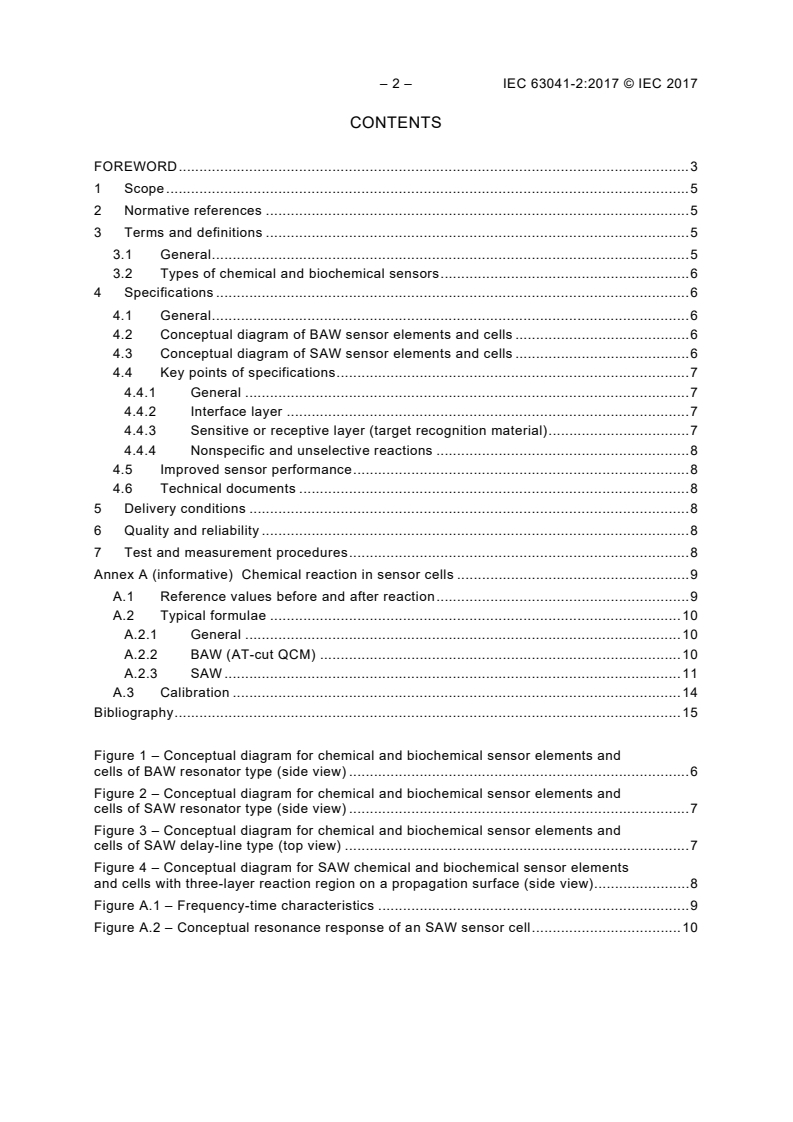
CONTENTS
FOREWORD . 3
1 Scope . 5
2 Normative references . 5
3 Terms and definitions . 5
3.1 General . 5
3.2 Types of chemical and biochemical sensors . 6
4 Specifications . 6
4.1 General . 6
4.2 Conceptual diagram of BAW sensor elements and cells . 6
4.3 Conceptual diagram of SAW sensor elements and cells . 6
4.4 Key points of specifications . 7
4.4.1 General . 7
4.4.2 Interface layer . 7
4.4.3 Sensitive or receptive layer (target recognition material) . 7
4.4.4 Nonspecific and unselective reactions . 8
4.5 Improved sensor performance . 8
4.6 Technical documents . 8
5 Delivery conditions . 8
6 Quality and reliability . 8
7 Test and measurement procedures . 8
Annex A (informative) Chemical reaction in sensor cells . 9
A.1 Reference values before and after reaction . 9
A.2 Typical formulae . 10
A.2.1 General . 10
A.2.2 BAW (AT-cut QCM) . 10
A.2.3 SAW . 11
A.3 Calibration . 14
Bibliography . 15
Figure 1 – Conceptual diagram for chemical and biochemical sensor elements and
cells of BAW resonator type (side view) . 6
Figure 2 – Conceptual diagram for chemical and biochemical sensor elements and
cells of SAW resonator type (side view) . 7
Figure 3 – Conceptual diagram for chemical and biochemical sensor elements and
cells of SAW delay-line type (top view) . 7
Figure 4 – Conceptual diagram for SAW chemical and biochemical sensor elements
and cells with three-layer reaction region on a propagation surface (side view) . 8
Figure A.1 – Frequency-time characteristics . 9
Figure A.2 – Conceptual resonance response of an SAW sensor cell . 10
INTERNATIONAL ELECTROTECHNICAL COMMISSION
____________
PIEZOELECTRIC SENSORS –
Part 2: Chemical and biochemical sensors
FOREWORD
1) The International Electrotechnical Commission (IEC) is a worldwide organization for standardization comprising
all national electrotechnical committees (IEC National Committees). The object of IEC is to promote
international co-operation on all questions concerning standardization in the electrical and electronic fields. To
this end and in addition to other activities, IEC publishes International Standards, Technical Specifications,
Technical Reports, Publicly Available Specifications (PAS) and Guides (hereafter referred to as “IEC
Publication(s)”). Their preparation is entrusted to technical committees; any IEC National Committee interested
in the subject dealt with may participate in this preparatory work. International, governmental and non-
governmental organizations liaising with the IEC also participate in this preparation. IEC collaborates closely
with the International Organization for Standardization (ISO) in accordance with conditions determined by
agreement between the two organizations.
2) The formal decisions or agreements of IEC on technical matters express, as nearly as possible, an international
consensus of opinion on the relevant subjects since each technical committee has representation from all
interested IEC National Committees.
3) IEC Publications have the form of recommendations for international use and are accepted by IEC National
Committees in that sense. While all reasonable efforts are made to ensure that the technical content of IEC
Publications is accurate, IEC cannot be held responsible for the way in which they are used or for any
misinterpretation by any end user.
4) In order to promote international uniformity, IEC National Committees undertake to apply IEC Publications
transparently to the maximum extent possible in their national and regional publications. Any divergence
between any IEC Publication and the corresponding national or regional publication shall be clearly indicated in
the latter.
5) IEC itself does not provide any attestation of conformity. Independent certification bodies provide conformity
assessment services and, in some areas, access to IEC marks of conformity. IEC is not responsible for any
services carried out by independent certification bodies.
6) All users should ensure that they have the latest edition of this publication.
7) No liability shall attach to IEC or its directors, employees, servants or agents including individual experts and
members of its technical committees and IEC National Committees for any personal injury, property damage or
other damage of any nature whatsoever, whether direct or indirect, or for costs (including legal fees) and
expenses arising out of the publication, use of, or reliance upon, this IEC Publication or any other IEC
Publications.
8) Attention is drawn to the Normative references cited in this publication. Use of the referenced publications is
indispensable for the correct application of this publication.
9) Attention is drawn to the possibility that some of the elements of this IEC Publication may be the subject of
patent rights. IEC shall not be held responsible for identifying any or all such patent rights.
International Standard IEC 63041-2 has been prepared by IEC technical committee TC 49:
Piezoelectric, dielectric and electrostatic devices and associated materials for frequency
control, selection and detection.
The text of this International Standard is based on the following documents:
CDV Report on voting
49/1221/CDV 49/1250/RVC
Full information on the voting for the approval of this International Standard can be found in
the report on voting indicated in the above table.
This document has been drafted in accordance with the ISO/IEC Directives, Part 2.
A list of all parts in the IEC 63041 series, published under the general title Piezoelectric
sensors, can be found on the IEC website.
– 4 – IEC 63041-2:2017 © IEC 2017
The committee has decided that the contents of this publication will remain unchanged until
the stability date indicated on the IEC website under "http://webstore.iec.ch" in the data
related to the specific publication. At this date, the publication will be
• reconfirmed,
• withdrawn,
• replaced by a revised edition, or
• amended.
A bilingual version of this publication may be issued at a later date.
IMPORTANT – The 'colour inside' logo on the cover page of this publication indicates
that it contains colours which are considered to be useful for the correct
understanding of its contents. Users should therefore print this document using a
colour printer.
PIEZOELECTRIC SENSORS –
Part 2: Chemical and biochemical sensors
1 Scope
This part of IEC 63041 is applicable to piezoelectric chemical sensors mainly used in the field
of biological, medical, gas and environmental sciences. It provides users with technical
guidelines on biochemical sensors as well as basic knowledge of common chemical sensors.
2 Normative references
The following documents are referred to in the text in such a way that some or all of their
content constitutes requirements of this document. For dated references, only the edition
cited applies. For undated references, the latest edition of the referenced document (including
any amendments) applies.
IEC 60027 (all parts), Letter symbols to be used in electrical technology
IEC 60050-561-:2014, International Electrotechnical Vocabulary – Part 561: Piezoelectric,
dielectric and electrostatic devices and associated materials for frequency control, selection
and detection
IEC 60617, Graphical symbols for diagrams, available at http://std.iec.ch/iec60617
IEC 63041-1, Piezoelectric sensors – Part 1: Generic specifications
ISO 80000-1:2009, Quantities and units – Part 1: General
3 Terms and definitions
3.1 General
For the purpose of this document, the following terms and definitions apply.
ISO and IEC maintain terminological databases for use in standardization at the following
addresses;
• IEC Electropedia: available at http://www.electropedia.org/
• ISO Online browsing platform: available at http://www.iso.org/obp
Units, letter symbols and terminology shall, wherever possible, be taken from the following
standards: IEC 60027, IEC 60050-561, IEC 60617, IEC 63041-1, and ISO 80000-1.
NOTE 1 In the market of chemical and biochemical sensors, the terms related in fields such as chemistry,
biochemistry, healthcare, etc. are widely used.
NOTE 2 Piezoelectric sensors covered herein are those used for the detection and measurement of either
chemical substance in the gas phase or biological molecules in aqueous media.
– 6 – IEC 63041-2:2017 © IEC 2017
3.2 Types of chemical and biochemical sensors
3.2.1
piezoelectric chemical sensor element
piezoelectric sensor component including a sensitive layer (target recognition material), which
is necessary for the practical measurement of simple non-biological molecules in quantity,
and which works and detects chemical substances mainly in the gas phase
Note 1 to entry: For example, there are odour sensors, vapour sensors, smoke sensors, etc.
[SOURCE: IEC 63041-1:2017, 3.3.1, modified – Note 1 to entry has been added.]
3.2.2
piezoelectric biochemical sensor element
piezoelectric sensor component including a receptive layer (target recognition material), which
is necessary for the practical measurement of complex biological molecules in quantity, and
which works mainly in aqueous media and detects biomolecules therein
[SOURCE: IEC 63041-1:2017, 3.3.2]
4 Specifications
4.1 General
Chemical and biochemical sensors are used in various applications, for example, in the
detection of target molecules/substances, the detection of growth, decrease, differentiation
and cohesion in cells, the detection of adsorption or absorption, the confirmation of the
competition reaction, etc. Concepts and specifications for chemical and biochemical sensors
are shown in detail in 4.2 to 4.5.
4.2 Conceptual diagram of BAW sensor elements and cells
Figure 1 shows the practical conceptual diagram for a bulk acoustic wave (BAW) sensor
element. In the figure, mounting stages and enclosures are omitted.
Target substances
Sensitive or receptive layer
Interface layer
Electrode
Piezoelectric plate
Electrode
IEC
Figure 1 – Conceptual diagram for chemical and biochemical sensor elements
and cells of BAW resonator type (side view)
4.3 Conceptual diagram of SAW sensor elements and cells
...
IEC 63041-2 ®
Edition 1.0 2017-12
INTERNATIONAL
STANDARD
NORME
INTERNATIONALE
colour
inside
Piezoelectric sensors –
Part 2: Chemical and biochemical sensors
Capteurs piézoélectriques –
Partie 2: Capteurs chimiques et biochimiques
All rights reserved. Unless otherwise specified, no part of this publication may be reproduced or utilized in any form
or by any means, electronic or mechanical, including photocopying and microfilm, without permission in writing from
either IEC or IEC's member National Committee in the country of the requester. If you have any questions about IEC
copyright or have an enquiry about obtaining additional rights to this publication, please contact the address below or
your local IEC member National Committee for further information.
Droits de reproduction réservés. Sauf indication contraire, aucune partie de cette publication ne peut être reproduite
ni utilisée sous quelque forme que ce soit et par aucun procédé, électronique ou mécanique, y compris la photocopie
et les microfilms, sans l'accord écrit de l'IEC ou du Comité national de l'IEC du pays du demandeur. Si vous avez des
questions sur le copyright de l'IEC ou si vous désirez obtenir des droits supplémentaires sur cette publication, utilisez
les coordonnées ci-après ou contactez le Comité national de l'IEC de votre pays de résidence.
IEC Central Office Tel.: +41 22 919 02 11
3, rue de Varembé info@iec.ch
CH-1211 Geneva 20 www.iec.ch
Switzerland
About the IEC
The International Electrotechnical Commission (IEC) is the leading global organization that prepares and publishes
International Standards for all electrical, electronic and related technologies.
About IEC publications
The technical content of IEC publications is kept under constant review by the IEC. Please make sure that you have the
latest edition, a corrigendum or an amendment might have been published.
IEC publications search - webstore.iec.ch/advsearchform Electropedia - www.electropedia.org
The advanced search enables to find IEC publications by a The world's leading online dictionary on electrotechnology,
variety of criteria (reference number, text, technical containing more than 22 000 terminological entries in English
committee,…). It also gives information on projects, replaced and French, with equivalent terms in 16 additional languages.
and withdrawn publications. Also known as the International Electrotechnical Vocabulary
(IEV) online.
IEC Just Published - webstore.iec.ch/justpublished
Stay up to date on all new IEC publications. Just Published IEC Glossary - std.iec.ch/glossary
details all new publications released. Available online and 67 000 electrotechnical terminology entries in English and
once a month by email. French extracted from the Terms and Definitions clause of
IEC publications issued since 2002. Some entries have been
IEC Customer Service Centre - webstore.iec.ch/csc collected from earlier publications of IEC TC 37, 77, 86 and
If you wish to give us your feedback on this publication or CISPR.
need further assistance, please contact the Customer Service
Centre: sales@iec.ch.
A propos de l'IEC
La Commission Electrotechnique Internationale (IEC) est la première organisation mondiale qui élabore et publie des
Normes internationales pour tout ce qui a trait à l'électricité, à l'électronique et aux technologies apparentées.
A propos des publications IEC
Le contenu technique des publications IEC est constamment revu. Veuillez vous assurer que vous possédez l’édition la
plus récente, un corrigendum ou amendement peut avoir été publié.
Recherche de publications IEC - Electropedia - www.electropedia.org
webstore.iec.ch/advsearchform Le premier dictionnaire d'électrotechnologie en ligne au
La recherche avancée permet de trouver des publications IEC monde, avec plus de 22 000 articles terminologiques en
en utilisant différents critères (numéro de référence, texte, anglais et en français, ainsi que les termes équivalents dans
comité d’études,…). Elle donne aussi des informations sur les 16 langues additionnelles. Egalement appelé Vocabulaire
projets et les publications remplacées ou retirées. Electrotechnique International (IEV) en ligne.
IEC Just Published - webstore.iec.ch/justpublished Glossaire IEC - std.iec.ch/glossary
Restez informé sur les nouvelles publications IEC. Just 67 000 entrées terminologiques électrotechniques, en anglais
Published détaille les nouvelles publications parues. et en français, extraites des articles Termes et Définitions des
Disponible en ligne et une fois par mois par email. publications IEC parues depuis 2002. Plus certaines entrées
antérieures extraites des publications des CE 37, 77, 86 et
Service Clients - webstore.iec.ch/csc CISPR de l'IEC.
Si vous désirez nous donner des commentaires sur cette
publication ou si vous avez des questions contactez-nous:
sales@iec.ch.
IEC 63041-2 ®
Edition 1.0 2017-12
INTERNATIONAL
STANDARD
NORME
INTERNATIONALE
colour
inside
Piezoelectric sensors –
Part 2: Chemical and biochemical sensors
Capteurs piézoélectriques –
Partie 2: Capteurs chimiques et biochimiques
INTERNATIONAL
ELECTROTECHNICAL
COMMISSION
COMMISSION
ELECTROTECHNIQUE
INTERNATIONALE
ICS 31.140 ISBN 978-2-8322-7535-1
– 2 – IEC 63041-2:2017 © IEC 2017
CONTENTS
FOREWORD . 3
1 Scope . 5
2 Normative references . 5
3 Terms and definitions . 5
3.1 General . 5
3.2 Types of chemical and biochemical sensors . 6
4 Specifications . 6
4.1 General . 6
4.2 Conceptual diagram of BAW sensor elements and cells . 6
4.3 Conceptual diagram of SAW sensor elements and cells . 6
4.4 Key points of specifications . 7
4.4.1 General . 7
4.4.2 Interface layer . 7
4.4.3 Sensitive or receptive layer (target recognition material) . 7
4.4.4 Nonspecific and unselective reactions . 8
4.5 Improved sensor performance . 8
4.6 Technical documents . 8
5 Delivery conditions . 8
6 Quality and reliability . 8
7 Test and measurement procedures . 8
Annex A (informative) Chemical reaction in sensor cells . 9
A.1 Reference values before and after reaction . 9
A.2 Typical formulae . 10
A.2.1 General . 10
A.2.2 BAW (AT-cut QCM) . 10
A.2.3 SAW . 11
A.3 Calibration . 14
Bibliography . 15
Figure 1 – Conceptual diagram for chemical and biochemical sensor elements and
cells of BAW resonator type (side view) . 6
Figure 2 – Conceptual diagram for chemical and biochemical sensor elements and
cells of SAW resonator type (side view) . 7
Figure 3 – Conceptual diagram for chemical and biochemical sensor elements and
cells of SAW delay-line type (top view) . 7
Figure 4 – Conceptual diagram for SAW chemical and biochemical sensor elements
and cells with three-layer reaction region on a propagation surface (side view) . 8
Figure A.1 – Frequency-time characteristics . 9
Figure A.2 – Conceptual resonance response of an SAW sensor cell . 10
INTERNATIONAL ELECTROTECHNICAL COMMISSION
____________
PIEZOELECTRIC SENSORS –
Part 2: Chemical and biochemical sensors
FOREWORD
1) The International Electrotechnical Commission (IEC) is a worldwide organization for standardization comprising
all national electrotechnical committees (IEC National Committees). The object of IEC is to promote
international co-operation on all questions concerning standardization in the electrical and electronic fields. To
this end and in addition to other activities, IEC publishes International Standards, Technical Specifications,
Technical Reports, Publicly Available Specifications (PAS) and Guides (hereafter referred to as “IEC
Publication(s)”). Their preparation is entrusted to technical committees; any IEC National Committee interested
in the subject dealt with may participate in this preparatory work. International, governmental and non-
governmental organizations liaising with the IEC also participate in this preparation. IEC collaborates closely
with the International Organization for Standardization (ISO) in accordance with conditions determined by
agreement between the two organizations.
2) The formal decisions or agreements of IEC on technical matters express, as nearly as possible, an international
consensus of opinion on the relevant subjects since each technical committee has representation from all
interested IEC National Committees.
3) IEC Publications have the form of recommendations for international use and are accepted by IEC National
Committees in that sense. While all reasonable efforts are made to ensure that the technical content of IEC
Publications is accurate, IEC cannot be held responsible for the way in which they are used or for any
misinterpretation by any end user.
4) In order to promote international uniformity, IEC National Committees undertake to apply IEC Publications
transparently to the maximum extent possible in their national and regional publications. Any divergence
between any IEC Publication and the corresponding national or regional publication shall be clearly indicated in
the latter.
5) IEC itself does not provide any attestation of conformity. Independent certification bodies provide conformity
assessment services and, in some areas, access to IEC marks of conformity. IEC is not responsible for any
services carried out by independent certification bodies.
6) All users should ensure that they have the latest edition of this publication.
7) No liability shall attach to IEC or its directors, employees, servants or agents including individual experts and
members of its technical committees and IEC National Committees for any personal injury, property damage or
other damage of any nature whatsoever, whether direct or indirect, or for costs (including legal fees) and
expenses arising out of the publication, use of, or reliance upon, this IEC Publication or any other IEC
Publications.
8) Attention is drawn to the Normative references cited in this publication. Use of the referenced publications is
indispensable for the correct application of this publication.
9) Attention is drawn to the possibility that some of the elements of this IEC Publication may be the subject of
patent rights. IEC shall not be held responsible for identifying any or all such patent rights.
International Standard IEC 63041-2 has been prepared by IEC technical committee TC 49:
Piezoelectric, dielectric and electrostatic devices and associated materials for frequency
control, selection and detection.
This bilingual version (2019-11) corresponds to the monolingual English version, published in
2017-12.
The text of this International Standard is based on the following documents:
CDV Report on voting
49/1221/CDV 49/1250/RVC
Full information on the voting for the approval of this International Standard can be found in
the report on voting indicated in the above table.
The French version of this standard has not been voted upon.
– 4 – IEC 63041-2:2017 © IEC 2017
This document has been drafted in accordance with the ISO/IEC Directives, Part 2.
A list of all parts in the IEC 63041 series, published under the general title Piezoelectric
sensors, can be found on the IEC website.
The committee has decided that the contents of this publication will remain unchanged until
the stability date indicated on the IEC website under "http://webstore.iec.ch" in the data
related to the specific publication. At this date, the publication will be
• reconfirmed,
• withdrawn,
• replaced by a revised edition, or
• amended.
IMPORTANT – The 'colour inside' logo on the cover page of this publication indicates
that it contains colours which are considered to be useful for the correct
understanding of its contents. Users should therefore print this document using a
colour printer.
PIEZOELECTRIC SENSORS –
Part 2: Chemical and biochemical sensors
1 Scope
This part of IEC 63041 is applicable to piezoelectric chemical sensors mainly used in the field
of biological, medical, gas and environmental sciences. It provides users with technical
guidelines on biochemical sensors as well as basic knowledge of common chemical sensors.
2 Normative references
The following documents are referred to in the text in such a way that some or all of their
content constitutes requirements of this document. For dated references, only the edition
cited applies. For undated references, the latest edition of the referenced document (including
any amendments) applies.
IEC 60027 (all parts), Letter symbols to be used in electrical technology
IEC 60050-561-:2014, International Electrotechnical Vocabulary – Part 561: Piezoelectric,
dielectric and electrostatic devices and associated materials for frequency control, selection
and detection
IEC 60617, Graphical symbols for diagrams, available at http://std.iec.ch/iec60617
IEC 63041-1, Piezoelectric sensors – Part 1: Generic specifications
ISO 80000-1:2009, Quantities and units – Part 1: General
3 Terms and definitions
3.1 General
For the purpose of this document, the following terms and definitions apply.
ISO and IEC maintain terminological databases for use in standardization at the following
addresses;
• IEC Electropedia: available at http://www.electropedia.org/
• ISO Online browsing platform: available at http://www.iso.org/obp
Units, letter symbols and terminology shall, wherever possible, be taken from the following
standards: IEC 60027, IEC 60050-561, IEC 60617, IEC 63041-1, and ISO 80000-1.
NOTE 1 In the market of chemical and biochemical sensors, the terms related in fields such as chemistry,
biochemistry, healthcare, etc. are widely used.
NOTE 2 Piezoelectric sensors covered herein are those used for the detection and measurement of either
chemical substance in the gas phase or biological molecules in aqueous media.
– 6 – IEC 63041-2:2017 © IEC 2017
3.2 Types of chemical and biochemical sensors
3.2.1
piezoelectric chemical sensor element
piezoelectric sensor component including a sensitive layer (target recognition material), which
is necessary for the practical measurement of simple non-biological molecules in quantity,
and which works and detects chemical substances mainly in the gas phase
Note 1 to entry: For example, there are odour sensors, vapour sensors, smoke sensors, etc.
[SOURCE: IEC 63041-1:2017, 3.3.1, modified – Note 1 to entry has been added.]
3.2.2
piezoelectric biochemical sensor element
piezoelectric sensor component including a receptive layer (target recognition material), which
is necessary for the practical measurement of complex biological molecules in quantity, and
which works mainly in aqueous media and detects biomolecules therein
[SOURCE: IEC 63041-1:2017, 3.3.2]
4 Specifications
4.1 General
Chemical and biochemical sensors are used in various applications, for example, in the
detection of target molecules/substances, the detection of growth, decrease, differentiation
and cohesion in cells, the detection of adsorption or absorption, the confirmation of the
competition reaction, etc. Concepts and specifications for chemical and biochemical sensors
are shown in detail in 4.2 to 4.5.
4.2 Conceptual diagram of BAW sensor elements and cells
Figure 1 shows the practical conceptual diagram for a bulk acoustic wave (BAW) sensor
element. In the figure, mounting stages and enclosures are omitted.
Target substances
Sensitive or receptive layer
Interface layer
Electrode
Piezoelectric plate
Electrode
IEC
Figure 1 – Conceptual diagram for chemical and biochemical sensor elements
and cells of BAW resonator type (side view)
4.3 Conceptual diagram of SAW sensor elements and cells
Figures 2 and 3 show the practical conceptual diagrams for two kinds of sensor elements and
cells, respectively, of surface acoustic wave (SAW) resonator and delay-line types. In the
figures, mounting stages and enclosures are omitted.
Target substances
Sensitive or receptive layer
Interface layer
Reflector IDT Reflector
Piezoelectric substrate
IEC
Figure 2 – Conceptual diagram for chemical and biochemical sensor elements
and cells of SAW resonator type (side view)
NOTE Reflector and interdigital transducer (IDT) are defined in IEC 61019-1:2004.
Target substances
Piezoelectric substrate
IDT IDT
Sensitive or receptive layer
IEC
Figure 3 – Conceptual diagram for chemical and biochemical sensor elements
and cells of SAW delay-line type (top view)
4.4 Key points of specifications
4.4.1 General
Key points of the specification are identified in Clause 5 of IEC 63041-1:2017. In addition, the
items specified in 4.4.2 to 4.4.4 should clearly be defined.
4.4.2 Interface layer
As can be seen in Figures 1 and 2, an interface layer is formed to increase the adhesion of
the sensitive or receptive layer to the electrode/substrate.
4.4.3 Sensitive or receptive layer (target recognition material)
A sensitive layer employed in chemical sensor applications or a receptive layer employed in
biochemical sensor applications should properly be selected for specific target
molecules/substances.
For BAW resonator type sensor elements and cells, the sensitive or receptive layer is formed
on the electrode of one surface (see Figure 1), whereas it is formed on the SAW propagation
surface of SAW resonator and delay-line type sensor elements and cells (see Figures 2
and 3).
– 8 – IEC 63041-2:2017 © IEC 2017
4.4.4 Nonspecific and unselective reactions
For chemical and biochemical sensor elements and cells, sensitive or receptive layers and
solvents should be selected so that nonspecific and unselective reactions may be minimized
in conjunction with target molecules/substances.
4.5 Improved sensor performance
In some situations, an acoustic waveguide layer is formed to increase the sensitivity of SAW
delay-line type chemical and biochemical sensor elements and cells.
Figure 4 shows the conceptual diagram of shear horizontal (SH)-SAW delay-line type
chemical and biochemical sensor elements and cells, where the material for the interface
layer, acoustic waveguide layer and the like should be defined in the contract.
Target substances
Sensitive or receptive layer
Waveguide layer
Interface layer
IDT
IDT
Piezoelectric substrate
IEC
Figure 4 – Conceptual diagram for SAW chemical and biochemical sensor elements
and cells with three-layer reaction region on a propagation surface (side view)
4.6 Technical documents
The following 1) and 2) should clearly be defined in the specifications in the contract to be
concluded between the manufacturer and customers.
1) When a term other than a) to d) shown below is used.
a) Limit of detection: the minimum amount or concentration detectable by sensor cells.
b) Limit of quantitation: the minimum amount or concentration detectable by sensor
modules.
c) Maximum limit of determination: the maximum analyte amount or concentration on
which quantitative analysis can be performed, also called the “maximum limit of
quantitation”.
d) Sensitivity: the dependence of the output of sensor elements and cells upon the
detected amount or concentration, i.e., the slope of a calibration curve.
2) Setting of reliability interval.
5 Delivery conditions
See Clause 7 of IEC 63041-1:2017.
6 Quality and reliability
See Clause 8 of IEC 63041-1:2017.
7 Test and measurement procedures
See Clause 9, and Annexes A and B of IEC 63041-1:2017.
Annex A
(informative)
Chemical reaction in sensor cells
A.1 Reference values before and after reaction
As shown in Figures A.1 and A.2, resonance frequency, oscillation frequency, phase, insertion
loss/gain, motional resistance, etc. of sensor cell outputs should be defined at time t as the
initial values before chemical and/or biochemical reactions occur. In a similar way, they
should be also defined at time t as final values after the reaction has completed.
For these specifications, the manufacturer and customer shall have detailed discussions, the
discrepancies shall be eliminated, and the results shall clearly be described in the contract
clause, the requirements specifications of the customer, the delivery specifications thereof or
the like, and shall be settled as one of the contracts with the customer.
The reaction shall be quantified using formulae and recorded.
Before reaction
f
After reaction
f
t
t 2
Time
IEC
Figure A.1 – Frequency-time characteristics
Frequency
– 10 – IEC 63041-2:2017 © IEC 2017
Change in frequency
Change in loss/gain
f f
2 1
Before reaction (t=t )
After reaction (t=t )
Frequency
IEC
Figure A.2 – Conceptual resonance response of an SAW sensor cell
A.2 Typical formulae
A.2.1 General
The formulae presented in A.2.2 and A.2.3 are typical examples used for chemical and
biochemical sensor cells. For these formulae, the manufacturer and customer shall have
detailed discussions, the discrepancies shall be eliminated, and the results shall be described
clearly in the contract clause.
A.2.2 BAW (AT-cut QCM)
a) Mass-loading
−7 2
(A.1)
∆f=−2,26×10 ∆mf
and
′
∆m=ρd (A.2)
where
f is the frequency;
Δm is the change in the surface mass density;
′
ρ is the density of a sensitive or receptive layer;
d is the thickness of a sensitive or receptive layer.
Δf = f − f
1 2
b) Viscosity
Relationship between viscosity and frequency deviation,
1 1
−8
∆f=−4,17×10 f (ρ′η′) −(ρη ) (A.3)
2 2
e e e
e
where
Loss/gain
ρ is the density of a reference liquid;
e
η is the viscosity of a reference liquid;
e
′
ρ is the density of a liquid to be measured;
e
′
η is the viscosity of a liquid to be measured.
e
Relationship between viscosity and resonance resistance,
A
R =(ωρη )
(A.4)
L L
r
K
where
R is the resonance resistance;
r
K is the electromechanical coupling factor;
η is the viscosity of a liquid;
L
ρ is the density of a liquid;
L
A is the electrode area;
ω is the angular frequency.
The resonance resistance R is measured based on IEC 60444-1, IEC 60444-5, or alternative
r
measurement methods.
A.2.3 SAW
A.2.3.1 Rayleigh wave sensors
a) Mass-loading
(A.5)
Δf=−(k +k )Δmf
1 2
where
k and k are the parameters depending on a piezoelectric material.
1 2
b) Acoustic electric interaction
ΔV K 1+ jε Z′(0)
0 E
= ε (A.6)
T
V 2 ′
ε − jε Z (0)
0 P E
where
V is the reference phase velocity;
is the electromechanical coupling factor;
K
is the permittivity of a free space;
ε
′ is the normalized surface acoustic impedance;
Z (0)
E
T
ε is the effective permittivity of a plate.
P
NOTE Generally, when a liquid is loaded upon the propagation surface of a Rayleigh wave, its power is radiated
from the substrate surface into the liquid as a longitudinal wave and the Rayleigh wave is attenuated by virtue of
the power lost. This means that the sensor cells employing a Rayleigh wave which is one of the SAW families can
be unable to be used in a liquid.
– 12 – IEC 63041-2:2017 © IEC 2017
A.2.3.2 SH-SAW sensors
a) Mass-loading
Δf=kΔmf (A.7)
where
k is the parameter depending on a piezoelectric material.
−8
EXAMPLE: k =−3,30×10 , for 36° Y-cut, X-propagated LiTaO
3 3
b) Viscosity
1 1
ΔV
′ ′ ′
=k f (ρη) −(ρη)
2 2 (A.8)
3 e e e e
V
0
and
1 1
∆α
′ ′ ′
= k f (ρη ) −(ρη )
2 2 (A.9)
3 e e e e
k
where
k is the wave number, which depends on a piezoelectric material;
′
k is the wave parameter, which depends on a piezoelectric material;
Δα is the attenuation.
c) Acoustic electric interaction
σ′
T
+ε(ε′−ε)(ε′ε +ε )
0 r r r 0 P
ΔV K ω
S
(A.10)
=−
V 2 2
′
0 σ
T
(′ )
+εε +ε
r 0 P
ω
and
σ′
T
′ ′
(ε −ε)(εε +ε )
2 r r r 0 p
Δα K ω
S
= (A.11)
k 2
′ 2
σ
T
′
+(εε +ε )
r 0 P
ω
where
K is the electromechanical coupling factor in reference load;
S
ε′ is the relative permittivity of a liquid;
t
′
σ is the relative conductivity of a liquid.
A.2.3.3 SH-Acoustic Plate Mode sensors
a) Mass-loading
ΔV 1
(A.12)
=− Δm
V ρ d
0 sub
or
ΔV 1
(A.13)
=− Δm
V C
0 f
where
ρ is the density of a piezoelectric material;
sub
d is the thickness of a piezoelectric material;
C is the surface mass loading sensitivity.
f
b) Viscosity
ΔV Cη ξ
f e
(A.14)
=− ⋅ Im
V 2ω 1+ jωτ
0
2 2
ω ρ ω ρ
e e
(A.15)
ξ= k − + j
μ μ
e e
and
ρ
e
τ= (A.16)
μ
e
where
τ is the relaxation time(τ=η /µ ) ;
e e
is the shear modulus of a liquid.
µ
e
c) Viscoelastic fluid
Cη
Δα ξ
f e
(A.17)
=− ⋅ Re
k 2V 1+ jωτ
0
d) Acoustic electric interaction
′
σ
T
′ ′
+ε(ε −ε)(εε +ε )
2 0 r r r 0 P
ΔV K ω
S
(A.18)
=−
V 2
σ′
0
T
+(ε′ε +ε )
r 0 P
ω
and
σ′
T
(ε′ε +ε )
r 0 P
Δα K
ω
S
(A.19)
=
k 2
′ 2
σ
T
′
+(εε +ε )
r 0 P
ω
– 14 – IEC 63041-2:2017 © IEC 2017
A.2.3.4 Lamb wave sensors
a) Mass-loading
′
ρh
(A.20)
Δf=− f
2(M+ρδ )
1 P
or
Δm
(A.21)
Δf=− f
2(M+ρδ )
1 P
b) Viscosity
1 B ρη 2
e
f= + (A.22)
λ M+ρδ 2ω
e P
and
λ V
δ = π 1−
(A.23)
P
2 V
f
where
V is the phase velocity for Lamb wave;
is sound velocity in a liquid;
V
f
M is the surface density;
B
is the actual stiffness;
η is the viscosity in a liquid.
Sensor cells employing the lowest anti-symmetrical ( A ) mode of Lamb wave have a high
sensitivity for detecting the mass density of a liquid.
This is because the phase velocity of an mode Lamb wave gets smaller than the
A
longitudinal wave velocity in a liquid when the thickness of the plate supporting a Lamb wave
is reduced to the value of the order of 0,1λ (λ is the wavelength of the mode) or less.
A
The mode Lamb wave, therefore, propagates in a liquid without losing its power caused by
A
the longitudinal wave radiation typically observed in a Rayleigh wave, and has been employed
to develop sensor cells in a liquid.
A.3 Calibration
It is recommended to compare the quantified reaction data with the result obtained by a
reference measurement system. The calibration method should be specified in the detailed
specification and / or contract.
Bibliography
IEC 60068 (all parts), Environmental testing
IEC 60122-1, Quartz crystal units of assessed quality – Part 1: Generic specification
IEC 60122-2-1, Quartz crystal units for frequency control and selection – Part 2: Guide to the
use of quartz crystal units for frequency control and selection – Section One: Quartz crystals
for microprocessor clock supply
IEC 60444-1, Measurement of quartz crystal unit parameters by zero phase technique in a pi-
network – Part 1: Basic method for the measurement of resonance frequency and resonance
resistance of quartz crystal units by zero phase technique in a pi-network
IEC 60444-5,Measurement of quartz crystal unit parameters – Part 5: Methods for the
determination of equivalent electrical parameters using automatic network analyzer
techniques and error correction
IEC 60444-9, Measurement of quartz crystal unit parameters – Part 9: Measurement of
spurious resonances of piezoelectric crystal units
IEC 60642, Piezoelectric ceramic resonators and resonator units for frequency control and
selection – Chapter I: Standard values and conditions – Chapter II: Measuring and test
conditions
IEC 60679 (all parts), Quartz crystal controlled oscillators of assessed quality
IEC 60758:2008,Synthetic quartz crystal−Specifications and guidelines for use
IEC 60862-1, Surface acoustic wave (SAW) filters of assessed quality – Part 1: Generic
specification
IEC 61019-1:2004, Surface acoustic wave (SAW) resonators – Part 1: Generic specification
IEC 61240:2016, Piezoelectric devices – Preparation of outline drawings of surface mounted
devices (SMD) for frequency control and selection – General rules
IEC 61760 (all parts), Surface mounting technology
IEC 61837 (all parts), Surface mounted piezoelectric devices for frequency control and
selection – Standard outlines and terminal lead connections
IEC TS 61994 (all parts), Piezoelectric, dielectric and electrostatic devices and associated
materials for frequency control, selection and detection – Glossary
IEC 62276:2016, Single crystal wafers for surface acoustic wave (SAW) device applications –
Specifications and measuring methods
– Part 1: Sampling
ISO 2859-1:1999, Sampling procedures for inspection by attributes
schemes indexed by acceptance quality limit (AQL) for lot-by-lot inspection
ISO 11843-1:1997, Capability of detection – Part 1: Terms and definitions
ISO 11843-2:2000, Capability of detection – Part 2: Methodology in the linear calibration case
ISO/IEC Guide 99:2007, International vocabulary of metrology – Basic and general concepts
and associated terms (VIM)
– 16 – IEC 63041-2:2017 © IEC 2017
KING, W.H. Jr. Piezoelectric sorption detector. Analytical Chemistry 36 (9), 1964, 1735-1739
SAUERBREY, G. Verwendung von Schwingquarzen zur Wägung dünner Schichten und zur
Mikrowägung. Z. Phys. 155 (2), 1959, 206
KANAZAWA, K.K. and GORDON J.G. II Anal. Chim. Acta 99: 1985, 175
NAKAMOTO, T. and MORIIZUMI, T. A Theory of a Quartz Crystal Microbalance Based upon
a Mason Equivalent Circuit. Jpn. J. Appl. Phys. 29, 1990, 963
KONDOH, J. and SHIOKAWA, S. A Liquid Sensor Based on a Shear Horizontal SAW device.
Electronics and Communications in Japan, Part 2, Vol. 76, No. 2, 1993, pp. 69-82
WOHLTJEN, H. and DESSY R. Surface acoustic wave probe for chemical analysis
introduction and instrument description. Anal. Chem., vol.51, no.9, 1979, pp.1458-1464
GOKA, S., OKABE, K., WATANABE, Y. and SEKIMOTO, H. Multimode Quartz Crystal
Microbalance. JPN. J. APPL. PHYS. Part 1, 39: 2000, 3073
MURAMATSU, H., TAMIYA, E., and Karube, I. Computation of Equivalent Circuit Parameters
of Quartz Crystal in Contact with Liquids and Study of Liquid Properties. Anal. Chem., 60,
1988, 2142-2146
NAKAMOTO, T. and MORIIZUMI, T. A Theory of a Quartz Crystal Microbalance Based upon
a Mason Equivalent Circuit. Jpn. J. Appl. Phys. 29, 1990, 963 doi:10.1143/JJAP.29.963
KUROSAWA, S., AIZAWA, H. and PARK, J-W. Quartz crystal microbalance immune-sensor
for highly sensitive 2,3,7,8 – tetrachlorodibenzo-p-dioxin detection in fly ash from municipal
solid waste incinerators. Analyst, 2005,130, 1495–1501
WAKAMATSU, S., KOYAMA, M., WATANABE, S., and KUROSAWA, S. Oscillation frequency
of QCM-biosensor on electric circuit technology for telecommunication. IEEE 2007 I.F.C.S
MARTIN B.A., WENZEL S.W. and WHITE R.M. Viscosity and Density Sensing with Ultrasonic
Plate Waves. Sensors and Actuators, A2l-A23, pp.704-708 (March1990)
COSTELLO B. J., MARTIN B.A. and WHITE R. M. Plate Waves for Biochemical
Measurements. Proc. IEEE US Symp., 1989, pp. 977-981
WENZEL S.W. and WHITE R. M. Analytic Comparison of the Sensitivities of Bulk-wave,
Surface-wave, and Flexural Plate-wave Ultrasonic gravimetric sensors. Appl. Phys. Lett., 54
(20), May 1989, pp.1976-1978
RAJENDRAN, V., KOIKE, M., HASHIMOTO, K. and YAMAGUCHI, M. Mass Density Sensor
for Liquids Using ZnO-Film/Al-Foil Lamb Wave Device. Proc. IEEE US Symp., 1992,
pp.263-268
WANG, W., LIM, C., LEE, K, and YANG, S. Wireless surface acoustic wave chemical sensor
for simultaneous measurement of CO and humidity. J. Micro/Nanolith. MEMS MOEMS,
Jul-Sep 2009, Vol. 8(3)
OGI, H., FUKUSHIMA, M., UESUGI, K., YAGI, H., GOTO, Y. and HIRAO, M. Acceleration of
deposition of Aβ1-40 peptide on ultrasonically formed Aβ1-42 nucleus studied by wireless
quartz-crystal-microbalance biosensor. Biosens. Bioelectron. 40, 2013, pp. 200-205
___________
– 18 – IEC 63041-2:2017 © IEC 2017
SOMMAIRE
AVANT-PROPOS . 19
1 Domaine d'application . 21
2 Références normatives . 21
3 Termes et définitions . 21
3.1 Généralités . 21
3.2 Types de capteurs chimiques et biochimiques. 22
4 Spécifications . 22
4.1 Généralités . 22
4.2 Schéma conceptuel des éléments et cellules de capteurs BAW . 22
4.3 Schéma conceptuel des éléments et cellules de capteurs SAW . 23
4.4 Points essentiels des spécifications . 23
4.4.1 Généralités . 23
4.4.2 Couche d'interface . 23
4.4.3 Couche sensible ou réceptive (matériau de reconnaissance cible) . 23
4.4.4 Réactions non spécifiques et non sélectives . 24
4.5 Performances améliorées du capteur . 24
4.6 Documents techniques . 24
5 Conditions de livraison . 25
6 Qualité et fiabilité . 25
7 Modes opératoires d'essais et de mesure . 25
Annexe A (informative) Réaction chimique dans les cellules de capteurs . 26
A.1 Valeurs de référence avant et après la réaction . 26
A.2 Formules classiques . 27
A.2.1 Généralités . 27
A.2.2 BAW (QCM taille AT) . 27
A.2.3 SAW . 28
A.3 Étalonnage . 31
Bibliographie . 32
Figure 1 – Schéma conceptuel d'éléments et cellules de capteurs chimiques et
biochimiques d'un type de résonateurs BAW (vue de côté) . 22
Figure 2 – Schéma conceptuel d'éléments et cellules de capteurs chimiques et
biochimiques d'un type de résonateurs SAW (vue de côté) . 23
Figure 3 – Schéma conceptuel d'éléments et cellules de capteurs chimiques et
biochimiques d'un type à ligne de retard SAW (vue de dessus) . 23
Figure 4 – Schéma conceptuel des éléments et cellules de capteurs chimiques et
biochimiques SAW avec une zone de réaction à trois couches sur une surface de
propagation (vue de côté) . 24
Figure A.1 – Caractéristiques fréquence-temps . 26
Figure A.2 – Réponse en résonance conceptuelle d'une cellule de capteur SAW . 27
COMMISSION ÉLECTROTECHNIQUE INTERNATIONALE
____________
CAPTEURS PIÉZOÉLECTRIQUES –
Partie 2: Capteurs chimiques et biochimiques
AVANT-PROPOS
1) La Commission Électrotechnique Internationale (IEC) est une organisation mondiale de normalisation
composée de l'ensemble des comités électrotechniques nationaux (Comités nationaux de l’IEC). L’IEC a pour
objet de favoriser la coopération internationale pour toutes les questions de normalisation dans les domaines
de l'électricité et de l'électronique. À cet effet, l’IEC – entre autres activités – publie des Normes internationales,
des Spécifications techniques, des Rapports techniques, des Spécifications accessibles au public (PAS) et des
Guides (ci-après dénommés "Publication(s) de l’IEC"). Leur élaboration est confiée à des comités d'études, aux
travaux desquels tout Comité national intéressé par le sujet traité peut participer. Les organisations
internationales, gouvernementales et non gouvernementales, en liaison avec l’IEC, participent également aux
travaux. L’IEC collabore étroitement avec l'Organisation Internationale de Normalisation (ISO), selon des
conditions fixées par accord entre les deux organisations.
2) Les décisions ou accords officiels de l’IEC concernant les questions techniques représentent, dans la mesure
du possible, un accord international sur les sujets étudiés, étant donné que les Comités nationaux de l’IEC
intéressés sont représentés dans chaque comité d’études.
3) Les Publications de l’IEC se présentent sous la forme de recommandations internationales et sont agréées
comme telles par les Comités nationaux de l’IEC. Tous les efforts raisonnables sont entrepris afin que l’IEC
s'assure de l'exactitude du contenu technique de ses publications; l’IEC ne peut pas être tenue responsable de
l'éventuelle mauvaise utilisation ou interprétation qui en est faite par un quelconque utilisateur final.
4) Dans le but d'encourager l'uniformité internationale, les Comités nationaux de l’IEC s'engagent, dans toute la
mesure possible, à appliquer de façon transparente les Publications de l’IEC dans leurs publications nationales
et régionales. Toutes divergences entre toutes Publications de l’IEC et toutes publications nationales ou
régionales correspondantes doivent être indiquées en termes clairs dans ces dernières.
5) L’IEC elle-même ne fournit aucune attestation de conformité. Des organismes de certification indépendants
fournissent des services d'évaluation de conformité et, dans certains secteurs, accèdent aux marques de
conformité de l’IEC. L’IEC n'est responsable d'aucun des services effectués par les organismes de certification
indépendants.
6) Tous les utilisateurs doivent s'assurer qu'ils sont en possession de la dernière édition de cette publication.
7) Aucune responsabilité ne doit être imputée à l’IEC, à ses administrateurs, employés, auxiliaires ou mandataires,
y compris ses experts particuliers et les membres de ses comités d'études et des Comités nationaux de l’IEC,
pour tout préjudice causé en cas de dommages corporels et matériels, ou de tout autre dommage de quelque
nature que ce soit, directe ou indirecte, ou pour supporter les coûts (y compris les frais de justice) et les
dépenses découlant de la publication ou de l'utilisation de cette Publication de l’IEC ou de toute autre
Publication de l’IEC, ou au crédit qui lui est accordé.
8) L'attention est attirée sur les références normatives citées dans cette publication. L'utilisation de publications
référencées est obligatoire pour une application correcte de la présente publication.
9) L’attention est attirée sur le fait que certains des éléments de la présente Publication de l’IEC peuvent faire
l’objet de droits de brevet. L’IEC ne saurait être tenue pour responsable de ne pas avoir identifié de tels droits
de brevets et de ne pas avoir signalé leur existence.
La Norme internationale IEC 63041-2 a été ét
...