

IEC 60730-2-7:2015
(Main)Automatic electrical controls - Part 2-7: Particular requirements for timers and time switches
General Information
- Abstract
IEC 60730-2-7:2015 applies to timers and time switches for household and similar use that may use electricity, gas, oil, solid fuel, solar thermal energy, etc. or a combination thereof, including heating, air conditioning and similar applications. This standard is also applicable to individual timers utilized as part of a control system or timers which are mechanically integral with multifunctional controls having non-electrical outputs. This standard does not apply to time-delay switches (TDS) within the scope of IEC 60669-2-3. This standard applies to the inherent safety, to the operating characteristics where such are associated with equipment protection and to the testing of timers used in appliances and other apparatus, electrical and non-electrical, for household and similar purposes, but also extended to industrial purposes when no dedicated product standards exist, such as that for central heating, air conditioning, process heating, etc. Timers for equipment not intended for normal household use, but which nevertheless may be used by the public, such as equipment intended to be used by laymen in shops, in light industry and on farms, are within the scope of this standard. This third edition cancels and replaces the second edition published in 2008. This third edition constitutes a technical revision. This new edition revises the compliance criteria of type 1.S and 2.S action, revises the requirements for filament lamp loads, adds requirements for abnormal operation in Annex H, removes some special requirements for single countries as well as updates the standard to IEC 60730-1:2010, fourth edition. Key words: Timers, Time Switches
This publication is to be read in conjunction with IEC 60730-1:2013.
- Status
- Published
- Publication Date
- 11-Mar-2015
- Technical Committee
- TC 72 - Automatic electrical controls
- Drafting Committee
- WG 5 - TC 72/WG 5
Buy Documents
IEC 60730-2-7:2015 - Automatic electrical controls - Part 2-7: Particular requirements for timers and time switches Released:3/12/2015
IEC 60730-2-7:2015 - Automatic electrical controls - Part 2-7: Particular requirements for timers and time switches Released:7/27/2020
Overview
IEC 60730-2-7:2015 is an international standard developed by the International Electrotechnical Commission (IEC). It specifies the particular requirements for automatic electrical controls, focusing on timers and time switches used in household and similar applications. This standard applies to devices powered by electricity, gas, oil, solid fuel, solar thermal energy, or combinations thereof. It aims to ensure the inherent safety, reliable operating characteristics, and proper testing of timers in both electrical and non-electrical equipment.
IEC 60730-2-7 supplements the general standard IEC 60730-1, providing additional specifications for timers and time switches. This includes standalone devices, timers used as part of a control system, and those mechanically integrated with multifunctional controls. It is not applicable to time-delay switches within the scope of IEC 60669-2-3.
Key Topics
- Scope and Applicability: Applies to timers and time switches for controlling household, commercial, and light industrial equipment, such as heating, air conditioning, and process heating installations.
- Types of Timers: Covers a variety of timer types, including plug-in timers, TV timers, synchronous timers, and hand-wound timers.
- Safety and Performance: Focuses on the inherent safety of timers, including their construction, protection against electric shock, insulation resistance, and moisture/dust resistance.
- Testing Requirements: Outlines detailed endurance, overload, and abnormal operation tests to verify compliance and durability.
- Special Functions: Addresses timers with special actions, such as automatic reset after power loss or resumption at the point of interruption.
Applications
IEC 60730-2-7:2015 is crucial for manufacturers, designers, and regulatory bodies involved in the production or certification of:
- Household Appliances: Timers for appliances like washing machines, ovens, and heating systems, ensuring safe operation and user protection.
- Heating and Air Conditioning: Time switches used to control central heating and air conditioning units, supporting energy efficiency and reliable scheduling.
- Commercial and Light Industrial Equipment: Timers used in shops, light industry, and agricultural applications, even if not designed for regular household use.
- Control Systems: Individual timers operating as part of broader control systems or integrated with multifunctional controls in both residential and commercial environments.
By adhering to the requirements of IEC 60730-2-7, manufacturers can ensure product conformity across global markets and meet essential safety benchmarks.
Related Standards
To provide a comprehensive approach to the design and testing of timers and time switches, IEC 60730-2-7:2015 should be used in conjunction with other relevant standards, including:
- IEC 60730-1: General requirements for automatic electrical controls for household and similar use.
- IEC 60335-1: Safety of household and similar electrical appliances.
- IEC 60669-1: General requirements for switches for household and similar fixed electrical installations.
- IEC 60669-2-3: Requirements for time-delay switches, which are excluded from IEC 60730-2-7.
These related standards help industry professionals maintain consistency, reliability, and safety in the implementation of timers and time switches worldwide.
Keywords: IEC 60730-2-7, timers, time switches, automatic electrical controls, household appliance safety, international standard, timer testing, control systems, inherent safety, reliability, product conformity.
Relations
- Effective Date
- 24-May-2024
- Effective Date
- 05-Sep-2023
Buy Documents
IEC 60730-2-7:2015 - Automatic electrical controls - Part 2-7: Particular requirements for timers and time switches Released:3/12/2015
IEC 60730-2-7:2015 - Automatic electrical controls - Part 2-7: Particular requirements for timers and time switches Released:7/27/2020
Frequently Asked Questions
IEC 60730-2-7:2015 is a standard published by the International Electrotechnical Commission (IEC). Its full title is "Automatic electrical controls - Part 2-7: Particular requirements for timers and time switches". This standard covers: IEC 60730-2-7:2015 applies to timers and time switches for household and similar use that may use electricity, gas, oil, solid fuel, solar thermal energy, etc. or a combination thereof, including heating, air conditioning and similar applications. This standard is also applicable to individual timers utilized as part of a control system or timers which are mechanically integral with multifunctional controls having non-electrical outputs. This standard does not apply to time-delay switches (TDS) within the scope of IEC 60669-2-3. This standard applies to the inherent safety, to the operating characteristics where such are associated with equipment protection and to the testing of timers used in appliances and other apparatus, electrical and non-electrical, for household and similar purposes, but also extended to industrial purposes when no dedicated product standards exist, such as that for central heating, air conditioning, process heating, etc. Timers for equipment not intended for normal household use, but which nevertheless may be used by the public, such as equipment intended to be used by laymen in shops, in light industry and on farms, are within the scope of this standard. This third edition cancels and replaces the second edition published in 2008. This third edition constitutes a technical revision. This new edition revises the compliance criteria of type 1.S and 2.S action, revises the requirements for filament lamp loads, adds requirements for abnormal operation in Annex H, removes some special requirements for single countries as well as updates the standard to IEC 60730-1:2010, fourth edition. Key words: Timers, Time Switches This publication is to be read in conjunction with IEC 60730-1:2013.
IEC 60730-2-7:2015 applies to timers and time switches for household and similar use that may use electricity, gas, oil, solid fuel, solar thermal energy, etc. or a combination thereof, including heating, air conditioning and similar applications. This standard is also applicable to individual timers utilized as part of a control system or timers which are mechanically integral with multifunctional controls having non-electrical outputs. This standard does not apply to time-delay switches (TDS) within the scope of IEC 60669-2-3. This standard applies to the inherent safety, to the operating characteristics where such are associated with equipment protection and to the testing of timers used in appliances and other apparatus, electrical and non-electrical, for household and similar purposes, but also extended to industrial purposes when no dedicated product standards exist, such as that for central heating, air conditioning, process heating, etc. Timers for equipment not intended for normal household use, but which nevertheless may be used by the public, such as equipment intended to be used by laymen in shops, in light industry and on farms, are within the scope of this standard. This third edition cancels and replaces the second edition published in 2008. This third edition constitutes a technical revision. This new edition revises the compliance criteria of type 1.S and 2.S action, revises the requirements for filament lamp loads, adds requirements for abnormal operation in Annex H, removes some special requirements for single countries as well as updates the standard to IEC 60730-1:2010, fourth edition. Key words: Timers, Time Switches This publication is to be read in conjunction with IEC 60730-1:2013.
IEC 60730-2-7:2015 is classified under the following ICS (International Classification for Standards) categories: 97.120 - Automatic controls for household use. The ICS classification helps identify the subject area and facilitates finding related standards.
IEC 60730-2-7:2015 has the following relationships with other standards: It is inter standard links to IEC 60730-2-7:2026, IEC 60730-2-7:2008. Understanding these relationships helps ensure you are using the most current and applicable version of the standard.
IEC 60730-2-7:2015 is available in PDF format for immediate download after purchase. The document can be added to your cart and obtained through the secure checkout process. Digital delivery ensures instant access to the complete standard document.
Standards Content (Sample)
IEC 60730-2-7 ®
Edition 3.0 2015-03
INTERNATIONAL
STANDARD
Automatic electrical controls –
Part 2-7: Particular requirements for timers and time switches
All rights reserved. Unless otherwise specified, no part of this publication may be reproduced or utilized in any form
or by any means, electronic or mechanical, including photocopying and microfilm, without permission in writing from
either IEC or IEC's member National Committee in the country of the requester. If you have any questions about IEC
copyright or have an enquiry about obtaining additional rights to this publication, please contact the address below or
your local IEC member National Committee for further information.
IEC Central Office Tel.: +41 22 919 02 11
3, rue de Varembé Fax: +41 22 919 03 00
CH-1211 Geneva 20 info@iec.ch
Switzerland www.iec.ch
About the IEC
The International Electrotechnical Commission (IEC) is the leading global organization that prepares and publishes
International Standards for all electrical, electronic and related technologies.
About IEC publications
The technical content of IEC publications is kept under constant review by the IEC. Please make sure that you have the
latest edition, a corrigenda or an amendment might have been published.
IEC Catalogue - webstore.iec.ch/catalogue Electropedia - www.electropedia.org
The stand-alone application for consulting the entire The world's leading online dictionary of electronic and
bibliographical information on IEC International Standards, electrical terms containing more than 30 000 terms and
Technical Specifications, Technical Reports and other definitions in English and French, with equivalent terms in 15
documents. Available for PC, Mac OS, Android Tablets and additional languages. Also known as the International
iPad. Electrotechnical Vocabulary (IEV) online.
IEC publications search - www.iec.ch/searchpub IEC Glossary - std.iec.ch/glossary
The advanced search enables to find IEC publications by a More than 60 000 electrotechnical terminology entries in
variety of criteria (reference number, text, technical English and French extracted from the Terms and Definitions
committee,…). It also gives information on projects, replaced clause of IEC publications issued since 2002. Some entries
and withdrawn publications. have been collected from earlier publications of IEC TC 37,
77, 86 and CISPR.
IEC Just Published - webstore.iec.ch/justpublished
Stay up to date on all new IEC publications. Just Published IEC Customer Service Centre - webstore.iec.ch/csc
details all new publications released. Available online and If you wish to give us your feedback on this publication or
also once a month by email. need further assistance, please contact the Customer Service
Centre: csc@iec.ch.
IEC 60730-2-7 ®
Edition 3.0 2015-03
INTERNATIONAL
STANDARD
Automatic electrical controls –
Part 2-7: Particular requirements for timers and time switches
INTERNATIONAL
ELECTROTECHNICAL
COMMISSION
ICS 97.120 ISBN 978-2-8322-2432-8
– 2 – IEC 60730-2-7:2015 © IEC 2015
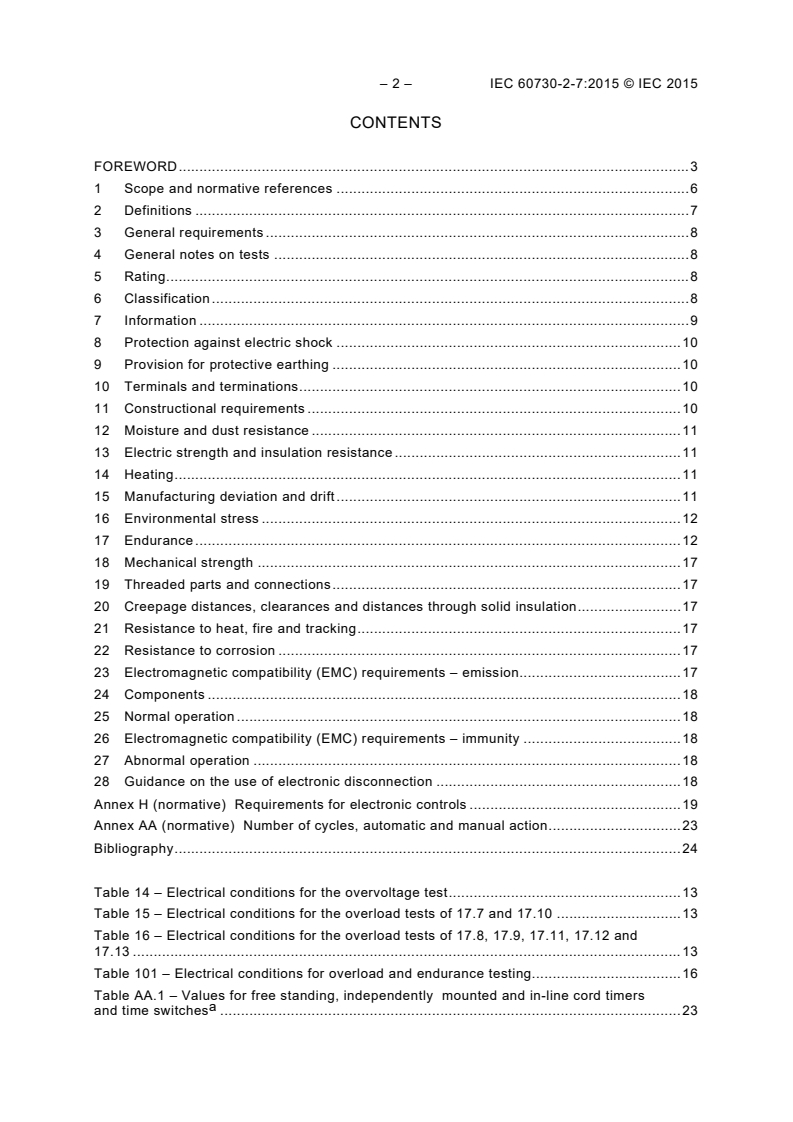
CONTENTS
FOREWORD . 3
1 Scope and normative references . 6
2 Definitions . 7
3 General requirements . 8
4 General notes on tests . 8
5 Rating. 8
6 Classification . 8
7 Information . 9
8 Protection against electric shock . 10
9 Provision for protective earthing . 10
10 Terminals and terminations . 10
11 Constructional requirements . 10
12 Moisture and dust resistance . 11
13 Electric strength and insulation resistance . 11
14 Heating . 11
15 Manufacturing deviation and drift . 11
16 Environmental stress . 12
17 Endurance . 12
18 Mechanical strength . 17
19 Threaded parts and connections . 17
20 Creepage distances, clearances and distances through solid insulation . 17
21 Resistance to heat, fire and tracking . 17
22 Resistance to corrosion . 17
23 Electromagnetic compatibility (EMC) requirements – emission . 17
24 Components . 18
25 Normal operation . 18
26 Electromagnetic compatibility (EMC) requirements – immunity . 18
27 Abnormal operation . 18
28 Guidance on the use of electronic disconnection . 18
Annex H (normative) Requirements for electronic controls . 19
Annex AA (normative) Number of cycles, automatic and manual action . 23
Bibliography . 24
Table 14 – Electrical conditions for the overvoltage test . 13
Table 15 – Electrical conditions for the overload tests of 17.7 and 17.10 . 13
Table 16 – Electrical conditions for the overload tests of 17.8, 17.9, 17.11, 17.12 and
17.13 . 13
Table 101 – Electrical conditions for overload and endurance testing. 16
Table AA.1 – Values for free standing, independently mounted and in-line cord timers
a
and time switches . 23
INTERNATIONAL ELECTROTECHNICAL COMMISSION
____________
AUTOMATIC ELECTRICAL CONTROLS –
Part 2-7: Particular requirements
for timers and time switches
FOREWORD
1) The International Electrotechnical Commission (IEC) is a worldwide organization for standardization comprising
all national electrotechnical committees (IEC National Committees). The object of IEC is to promote
international co-operation on all questions concerning standardization in the electrical and electronic fields. To
this end and in addition to other activities, IEC publishes International Standards, Technical Specifications,
Technical Reports, Publicly Available Specifications (PAS) and Guides (hereafter referred to as “IEC
Publication(s)”). Their preparation is entrusted to technical committees; any IEC National Committee interested
in the subject dealt with may participate in this preparatory work. International, governmental and non-
governmental organizations liaising with the IEC also participate in this preparation. IEC collaborates closely
with the International Organization for Standardization (ISO) in accordance with conditions determined by
agreement between the two organizations.
2) The formal decisions or agreements of IEC on technical matters express, as nearly as possible, an international
consensus of opinion on the relevant subjects since each technical committee has representation from all
interested IEC National Committees.
3) IEC Publications have the form of recommendations for international use and are accepted by IEC National
Committees in that sense. While all reasonable efforts are made to ensure that the technical content of IEC
Publications is accurate, IEC cannot be held responsible for the way in which they are used or for any
misinterpretation by any end user.
4) In order to promote international uniformity, IEC National Committees undertake to apply IEC Publications
transparently to the maximum extent possible in their national and regional publications. Any divergence
between any IEC Publication and the corresponding national or regional publication shall be clearly indicated in
the latter.
5) IEC itself does not provide any attestation of conformity. Independent certification bodies provide conformity
assessment services and, in some areas, access to IEC marks of conformity. IEC is not responsible for any
services carried out by independent certification bodies.
6) All users should ensure that they have the latest edition of this publication.
7) No liability shall attach to IEC or its directors, employees, servants or agents including individual experts and
members of its technical committees and IEC National Committees for any personal injury, property damage or
other damage of any nature whatsoever, whether direct or indirect, or for costs (including legal fees) and
expenses arising out of the publication, use of, or reliance upon, this IEC Publication or any other IEC
Publications.
8) Attention is drawn to the Normative references cited in this publication. Use of the referenced publications is
indispensable for the correct application of this publication.
9) Attention is drawn to the possibility that some of the elements of this IEC Publication may be the subject of
patent rights. IEC shall not be held responsible for identifying any or all such patent rights.
International Standard IEC 60730-2-7 has been prepared by IEC technical committee 72:
Automatic electrical controls.
This third edition cancels and replaces the second edition published in 2008. This third edition
constitutes a technical revision. This new edition revises the compliance criteria of type 1.S
and 2.S action, revises the requirements for filament lamp loads, adds requirements for
abnormal operation in Annex H, removes some special requirements for single countries as
well as updates the standard to IEC 60730-1:2010, fourth edition.
This Part 2-7 is intended to be used in conjunction with IEC 60730-1. It was established on
the basis of the fourth edition (2010) of that publication. IEC 60730-1 Ed. 5 is available, and
this part 2-7 will be aligned with that edition in the future. Consideration may be given to
future editions of, or amendments to, IEC 60730-1.
– 4 – IEC 60730-2-7:2015 © IEC 2015
The title of IEC 60730-2-7 Ed.3 has been updated to the title of IEC 60730-1 Ed.5.0. However,
IEC 60730-2-7 Ed.3.0 has not been updated in accordance with the technical requirements in
IEC 60730-1 Ed. 5.0.
This Part 2-7 supplements or modifies the corresponding clauses in IEC 60730-1 so as to
convert that publication into the IEC standard: Particular requirements for timers and time
switches.
Where this Part 2-7 states "addition", "modification" or "replacement", the relevant require-
ment, test specification or explanatory matter in Part 1 should be adapted accordingly.
Where no change is necessary, this Part 2-7 indicates that the relevant clause or subclause
applies.
In the development of a fully international standard, it has been necessary to take into
consideration the differing requirements resulting from practical experience in various parts of
the world and to recognize the variation in national electrical systems and wiring rules.
The “in some countries” notes regarding differing national practice are contained in the
following clauses and subclauses:
– 6.3.6.101
– Table 1, Notes 101 and 103
– 7.2.9
– 11.4.104
– 17.16.101.1
– 17.16.101.3
– 17.16.103.1
– Table 15, Notes 101 and 102
– Table 16, Notes 101 and 102
– 21.101
– Annex D
– H.26.11
In this publication:
1) The following print types are used:
– Requirements proper: in roman type.
– Test specifications: in italic type.
– Explanatory matter: in smaller roman type
2) Subclauses, notes, tables or figures which are additional to those in Part 1 are numbered
starting from 101, additional annexes are lettered AA, BB, etc.
The text of this standard is based on the following documents:
CDV Report on voting
72/926/CDV 72/959/RVC
Full information on the voting for the approval of this standard can be found in the report on
voting indicated in the above table.
This publication has been drafted in accordance with the ISO/IEC Directives, Part 2.
A list of all parts of the IEC 60730 series, under the general title: Automatic electrical controls,
can be found on the IEC website.
The committee has decided that the contents of this publication will remain unchanged until
the stability date indicated on the IEC website under "http://webstore.iec.ch" in the data
related to the specific publication. At this date, the publication will be
• reconfirmed,
• withdrawn,
• replaced by a revised edition, or
• amended.
A bilingual version of this publication may be issued at a later date.
– 6 – IEC 60730-2-7:2015 © IEC 2015
AUTOMATIC ELECTRICAL CONTROLS –
Part 2-7: Particular requirements
for timers and time switches
1 Scope and normative references
This clause of Part 1 is applicable except as follows:
1.1 Replacement:
In general, this part of IEC 60730 applies to timers and time switches that may use electricity,
gas, oil, solid fuel, solar thermal energy, etc. or a combination thereof, including heating, air
conditioning and similar applications.
This standard is also applicable to individual timers utilized as part of a control system or
timers which are mechanically integral with multifunctional controls having non-electrical
outputs. This standard does not apply to time-delay switches (TDS) within the scope of
IEC 60669-2-3.
NOTE 1 Throughout this standard, the word “timers” means timers and time switches, unless the type is
specifically mentioned.
NOTE 2 Devices which only indicate time or passage of time are not included.
NOTE 3 This standard does not apply to multi-functional controls having an integrated timing function which is not
capable of being tested as a separate timing device.
1.1.1 Replacement:
This standard applies to the inherent safety, to the operating characteristics where such are
associated with equipment protection and to the testing of timers used in appliances and other
apparatus, electrical and non-electrical, for household and similar purposes, but also
extended to industrial purposes when no dedicated product standards exist, such as that for
central heating, air conditioning, process heating, etc.
Timers for equipment not intended for normal household use, but which nevertheless may be
used by the public, such as equipment intended to be used by laymen in shops, in light
industry and on farms, are within the scope of this standard.
This standard is also applicable to timers for appliances within the scope of IEC 60335-1.
1.1.2 Replacement:
This standard applies to manual controls when such are electrically and/or mechanically
integral with timers.
1.4 Replacement:
This standard applies also to timers incorporating electronic devices, requirements for which
are contained in Annex H.
This standard applies also to timers using NTC or PTC thermistors, requirements for which
are contained in Part 1, Annex J.
1.5 Normative references
This subclause of Part 1 applies except as follows:
Addition:
IEC 60669-1:1998, Switches for household and similar fixed-electrical installations – Part 1:
General requirements
IEC 60669-1:1998/AMD1:1999
IEC 60669-1:1998/AMD2:2006
IEC 60695-11-10:2013, Fire hazard testing – Part 11-10: Test flames – 50 W horizontal and
vertical flame test methods
2 Definitions
This clause of Part 1 is applicable except as follows:
2.3 Definitions relating to the function of controls
Additional definition:
2.3.101
timing cycle
program including all the switching activities involved in a start-to-finish operation of a
controlled appliance
2.5 Definitions of types of control according to construction
Additional definitions:
2.5.101
plug-in timer
timer or time switch designed for direct plug-in to a socket-outlet
Note 1 to entry: The plug-in timer is equipped with conductor blades, pins or other means, protruding from the
enclosure of the control or the control body itself, to match the dimensional parameters of the socket-outlet to
which the control will be connected.
2.5.102
TV timer
control for television equipment that can be set by the user, switching very high inrush
currents of a very short duration generated by electrical power supply components and
associated electronic component parts with various electrical characteristics
Note 1 to entry: Examples are power transformers, electronic tube filaments, large electric capacitors and others
in television receivers, radio and video products.
2.5.103
synchronous timer
timer or a time switch in which the transmission is effected by a device that is time-based on
the frequency of the power supply for the prime mover or the load
2.5.104
hand-wound timer
timer or time switch in which the transmission is provided by actuation
___________
There exists a consolidated edition 3.2 (2007) that includes IEC 60669-1:2008 and its Amendments 1 and 2.
– 8 – IEC 60730-2-7:2015 © IEC 2015
3 General requirements
This clause of Part 1 is applicable.
4 General notes on tests
This clause of Part 1 is applicable.
5 Rating
This clause of Part 1 is applicable.
6 Classification
This clause of Part 1 is applicable except as follows:
6.3 According to their purpose
6.3.6 Additional subclause:
6.3.6.101 – TV timer;
NOTE In Canada and the USA, timers for use on televisions have to be declared and tested as indicated in this
standard.
6.4 According to features of automatic action
6.4.3 Additional subclauses:
6.4.3.101 – a timing action which automatically resets upon loss of the electrical supply
(Type 1.Q or 2.Q);
6.4.3.102 – a timing action which is interrupted upon loss of the electrical supply and
resumes at the point of interruption upon restoration of the electrical supply (Type 1.R or 2.R);
6.4.3.103 – a timing action of a time switch which, after interruption of the electrical supply
for any interval up to the declared period of power reserve, resumes its intended operating
sequence as if no interruption of the supply has occurred (Type 1.S or 2.S);
6.4.3.104 – a timing action with a declared running accuracy in an ambient temperature of
20 °C to 25 °C (Type 1.T or 2.T);
6.4.3.105 – a timing action in which the difference between set time and actual switching
time does not exceed the declared amount (Type 1.U or 2.U).
6.10 According to number of cycles of actuation (M) of each manual actuation
Additional subclauses:
6.10.101 – 500 cycles;
6.10.102 – 2 500 cycles;
6.10.103 – 5 000 cycles.
6.15 According to construction
Additional subclause:
6.15.101 – plug-in timer.
7 Information
This clause of Part 1 is applicable except as follows:
7.2 Methods of providing information
7.2.9 Addition:
NOTE In Germany, for Type 1.S or 2.S actions, the power reserve is to be marked on the timer by the letter "R",
followed by the duration of the power reserve, followed by the symbol indicating the time unit as follows:
minutes min
hours h
days d
years a
Table 1
Modification:
Replace the lines corresponding to items 7, 26, 27 and 28 by the following:
Information Clause or Method
subclause
6.2
7) 101)
7 The type of load controlled by each circuit 14 C
102)
26 Number of cycles of actuation (M) for each manual action 6.10 X
102)
27 Number of automatic cycles (A) for each automatic action 6.11 X
102)
28 Ageing period (Y) for Type 1.M or 2.M action 6.16 X
Add the following additional items:
Information Clause or Method
subclause
103)
101 TV timer 2.5.102 C
102 Power reserve duration 6.4.3.103 D
103 Running time for manually wound switches 11.4.103 D
6.4.3.104
104 Running accuracy and setting accuracy 6.4.3.105 X
11.4.104
– 10 – IEC 60730-2-7:2015 © IEC 2015
Add the following additional notes:
101) In Canada and the USA, timers with a tungsten-filament lamp load rating or direct current as well as
alternating current, in addition to the regular electrical information shall be marked to indicate the type of
load, type of current and rated voltage.
The marking shall be "T" for controls used with direct as well as alternating current and "L" for controls
used on alternating current only. The marking shall follow the unique type reference or the electrical
rating of the control.
102) Values for in-line cord, free-standing and independently mounted controls are given in Annex AA (see
also 17.1.3.101).
103) In Canada and the USA, a timer with a TV rating shall be marked with the manufacturer's name or
trademark, load type designation and electrical rating. The marking shall consist of "TV" followed by the
ampere rating. This rating shall follow any other electrical rating the control may have or can be a single,
stand-alone marking if the control has no additional ratings.
8 Protection against electric shock
This clause of Part 1 is applicable.
9 Provision for protective earthing
This clause of Part 1 is applicable.
10 Terminals and terminations
This clause of Part 1 is applicable.
11 Constructional requirements
This clause of Part 1 is applicable except as follows:
11.4 Actions
Additional subclauses:
11.4.101 Type 1.Q or 2.Q action
A Type 1.Q or 2.Q action shall be so designed that it resets automatically upon loss of the
electrical supply.
Compliance is checked by inspection and by test.
11.4.102 Type 1.R or 2.R action
A Type 1.R or 2.R action shall be so designed that it is interrupted upon loss of the electrical
supply and resumes at the point of interruption upon restoration of the electrical supply.
Compliance is checked by inspection and by test.
11.4.103 Type 1.S or 2.S action
A Type 1.S or 2.S action shall be so designed that, after interruption of the electrical supply
for any interval up to the declared period of power reserve, it resumes its intended operating
sequence as if no interruption of the supply has occurred.
If the energy store is charged by the supply voltage, then compliance is checked by a
functional test, carried out immediately after the operation of the timer switches into power
reserve. The previous operation in power reserve shall be the declared period of power
reserve. Charging is carried out at rated voltage for 48 h, if no other charging period is
declared.
If the running reserve is provided by a primary battery, compliance shall be verified by
calculation of the power reserve by means of the battery capacity and the measured
discharge current.
11.4.104 Type 1.T or 2.T action
A Type 1.T or 2.T action shall be so designed that its running accuracy in an ambient
temperature of 20 °C to 25 °C is as declared.
NOTE 1 In Germany, the running accuracy for time switches shall be within ±60 s per day. For the power reserve
period of synchronous time switches (Type S.T), the running accuracy shall be within ±500 s per day.
NOTE 2 In Germany, the deviation from the calculated elapsed time shall be less than 30 min per year, relative to
actual elapsed time under fluctuations of 0,85 times to 1,1 times rated voltage and ±2 % rated frequency.
Compliance is checked by inspection and by test.
11.4.105 Type 1.U or 2.U action
A Type 1.U or 2.U action shall be so designed that its setting means, dial assembly, indicating
devices and switch operating means function so that the difference between set time and
actual time shall not be more than the declared amount.
This deviation shall not be more than:
±1 min for time switches with "hour" dial;
±30 min for time switches with "24 hour" dial;
±3,5 h for time switches with "7 day" dial;
±14 h for time switches with "month" dial;
±7 days for time switches with "12 month" dial.
Compliance is checked only on time switches with hour, 24 hour and 7 day dial by three
consecutive meas
...
IEC 60730-2-7 ®
Edition 3.0 2015-03
INTERNATIONAL
STANDARD
NORME
INTERNATIONALE
Automatic electrical controls –
Part 2-7: Particular requirements for timers and time switches
Dispositifs de commande électrique automatiques –
Partie 2-7: Exigences particulières pour les minuteries et les minuteries
cycliques
All rights reserved. Unless otherwise specified, no part of this publication may be reproduced or utilized in any form
or by any means, electronic or mechanical, including photocopying and microfilm, without permission in writing from
either IEC or IEC's member National Committee in the country of the requester. If you have any questions about IEC
copyright or have an enquiry about obtaining additional rights to this publication, please contact the address below or
your local IEC member National Committee for further information.
Droits de reproduction réservés. Sauf indication contraire, aucune partie de cette publication ne peut être reproduite
ni utilisée sous quelque forme que ce soit et par aucun procédé, électronique ou mécanique, y compris la photocopie
et les microfilms, sans l'accord écrit de l'IEC ou du Comité national de l'IEC du pays du demandeur. Si vous avez des
questions sur le copyright de l'IEC ou si vous désirez obtenir des droits supplémentaires sur cette publication, utilisez
les coordonnées ci-après ou contactez le Comité national de l'IEC de votre pays de résidence.
IEC Central Office Tel.: +41 22 919 02 11
3, rue de Varembé info@iec.ch
CH-1211 Geneva 20 www.iec.ch
Switzerland
About the IEC
The International Electrotechnical Commission (IEC) is the leading global organization that prepares and publishes
International Standards for all electrical, electronic and related technologies.
About IEC publications
The technical content of IEC publications is kept under constant review by the IEC. Please make sure that you have the
latest edition, a corrigendum or an amendment might have been published.
IEC publications search - webstore.iec.ch/advsearchform Electropedia - www.electropedia.org
The advanced search enables to find IEC publications by a The world's leading online dictionary on electrotechnology,
variety of criteria (reference number, text, technical containing more than 22 000 terminological entries in English
committee,…). It also gives information on projects, replaced and French, with equivalent terms in 16 additional languages.
and withdrawn publications. Also known as the International Electrotechnical Vocabulary
(IEV) online.
IEC Just Published - webstore.iec.ch/justpublished
Stay up to date on all new IEC publications. Just Published IEC Glossary - std.iec.ch/glossary
details all new publications released. Available online and 67 000 electrotechnical terminology entries in English and
once a month by email. French extracted from the Terms and Definitions clause of
IEC publications issued since 2002. Some entries have been
IEC Customer Service Centre - webstore.iec.ch/csc collected from earlier publications of IEC TC 37, 77, 86 and
If you wish to give us your feedback on this publication or CISPR.
need further assistance, please contact the Customer Service
Centre: sales@iec.ch.
A propos de l'IEC
La Commission Electrotechnique Internationale (IEC) est la première organisation mondiale qui élabore et publie des
Normes internationales pour tout ce qui a trait à l'électricité, à l'électronique et aux technologies apparentées.
A propos des publications IEC
Le contenu technique des publications IEC est constamment revu. Veuillez vous assurer que vous possédez l’édition la
plus récente, un corrigendum ou amendement peut avoir été publié.
Recherche de publications IEC - Electropedia - www.electropedia.org
webstore.iec.ch/advsearchform Le premier dictionnaire d'électrotechnologie en ligne au
La recherche avancée permet de trouver des publications IEC monde, avec plus de 22 000 articles terminologiques en
en utilisant différents critères (numéro de référence, texte, anglais et en français, ainsi que les termes équivalents dans
comité d’études,…). Elle donne aussi des informations sur les 16 langues additionnelles. Egalement appelé Vocabulaire
projets et les publications remplacées ou retirées. Electrotechnique International (IEV) en ligne.
IEC Just Published - webstore.iec.ch/justpublished Glossaire IEC - std.iec.ch/glossary
Restez informé sur les nouvelles publications IEC. Just 67 000 entrées terminologiques électrotechniques, en anglais
Published détaille les nouvelles publications parues. et en français, extraites des articles Termes et Définitions des
Disponible en ligne et une fois par mois par email. publications IEC parues depuis 2002. Plus certaines entrées
antérieures extraites des publications des CE 37, 77, 86 et
Service Clients - webstore.iec.ch/csc CISPR de l'IEC.
Si vous désirez nous donner des commentaires sur cette
publication ou si vous avez des questions contactez-nous:
sales@iec.ch.
IEC 60730-2-7 ®
Edition 3.0 2015-03
INTERNATIONAL
STANDARD
NORME
INTERNATIONALE
Automatic electrical controls –
Part 2-7: Particular requirements for timers and time switches
Dispositifs de commande électrique automatiques –
Partie 2-7: Exigences particulières pour les minuteries et les minuteries
cycliques
INTERNATIONAL
ELECTROTECHNICAL
COMMISSION
COMMISSION
ELECTROTECHNIQUE
INTERNATIONALE
ICS 97.120 ISBN 978-2-8322-8691-3
– 2 – IEC 60730-2-7:2015 © IEC 2015
CONTENTS
FOREWORD . 3
1 Scope and normative references . 6
2 Definitions . 7
3 General requirements . 8
4 General notes on tests . 8
5 Rating. 8
6 Classification . 8
7 Information . 9
8 Protection against electric shock . 10
9 Provision for protective earthing . 10
10 Terminals and terminations . 10
11 Constructional requirements . 10
12 Moisture and dust resistance . 11
13 Electric strength and insulation resistance . 11
14 Heating . 11
15 Manufacturing deviation and drift . 11
16 Environmental stress . 12
17 Endurance . 12
18 Mechanical strength . 17
19 Threaded parts and connections . 17
20 Creepage distances, clearances and distances through solid insulation . 17
21 Resistance to heat, fire and tracking . 17
22 Resistance to corrosion . 17
23 Electromagnetic compatibility (EMC) requirements – emission . 17
24 Components . 18
25 Normal operation . 18
26 Electromagnetic compatibility (EMC) requirements – immunity . 18
27 Abnormal operation . 18
28 Guidance on the use of electronic disconnection . 18
Annex H (normative) Requirements for electronic controls . 19
Annex AA (normative) Number of cycles, automatic and manual action . 23
Bibliography . 24
Table 14 – Electrical conditions for the overvoltage test . 13
Table 15 – Electrical conditions for the overload tests of 17.7 and 17.10 . 13
Table 16 – Electrical conditions for the overload tests of 17.8, 17.9, 17.11, 17.12 and
17.13 . 13
Table 101 – Electrical conditions for overload and endurance testing. 16
Table AA.1 – Values for free standing, independently mounted and in-line cord timers
a
and time switches . 23
INTERNATIONAL ELECTROTECHNICAL COMMISSION
____________
AUTOMATIC ELECTRICAL CONTROLS –
Part 2-7: Particular requirements
for timers and time switches
FOREWORD
1) The International Electrotechnical Commission (IEC) is a worldwide organization for standardization comprising
all national electrotechnical committees (IEC National Committees). The object of IEC is to promote
international co-operation on all questions concerning standardization in the electrical and electronic fields. To
this end and in addition to other activities, IEC publishes International Standards, Technical Specifications,
Technical Reports, Publicly Available Specifications (PAS) and Guides (hereafter referred to as “IEC
Publication(s)”). Their preparation is entrusted to technical committees; any IEC National Committee interested
in the subject dealt with may participate in this preparatory work. International, governmental and non-
governmental organizations liaising with the IEC also participate in this preparation. IEC collaborates closely
with the International Organization for Standardization (ISO) in accordance with conditions determined by
agreement between the two organizations.
2) The formal decisions or agreements of IEC on technical matters express, as nearly as possible, an international
consensus of opinion on the relevant subjects since each technical committee has representation from all
interested IEC National Committees.
3) IEC Publications have the form of recommendations for international use and are accepted by IEC National
Committees in that sense. While all reasonable efforts are made to ensure that the technical content of IEC
Publications is accurate, IEC cannot be held responsible for the way in which they are used or for any
misinterpretation by any end user.
4) In order to promote international uniformity, IEC National Committees undertake to apply IEC Publications
transparently to the maximum extent possible in their national and regional publications. Any divergence
between any IEC Publication and the corresponding national or regional publication shall be clearly indicated in
the latter.
5) IEC itself does not provide any attestation of conformity. Independent certification bodies provide conformity
assessment services and, in some areas, access to IEC marks of conformity. IEC is not responsible for any
services carried out by independent certification bodies.
6) All users should ensure that they have the latest edition of this publication.
7) No liability shall attach to IEC or its directors, employees, servants or agents including individual experts and
members of its technical committees and IEC National Committees for any personal injury, property damage or
other damage of any nature whatsoever, whether direct or indirect, or for costs (including legal fees) and
expenses arising out of the publication, use of, or reliance upon, this IEC Publication or any other IEC
Publications.
8) Attention is drawn to the Normative references cited in this publication. Use of the referenced publications is
indispensable for the correct application of this publication.
9) Attention is drawn to the possibility that some of the elements of this IEC Publication may be the subject of
patent rights. IEC shall not be held responsible for identifying any or all such patent rights.
International Standard IEC 60730-2-7 has been prepared by IEC technical committee 72:
Automatic electrical controls.
This third edition cancels and replaces the second edition published in 2008. This third edition
constitutes a technical revision. This new edition revises the compliance criteria of type 1.S
and 2.S action, revises the requirements for filament lamp loads, adds requirements for
abnormal operation in Annex H, removes some special requirements for single countries as
well as updates the standard to IEC 60730-1:2010, fourth edition.
This Part 2-7 is intended to be used in conjunction with IEC 60730-1. It was established on
the basis of the fourth edition (2010) of that publication. IEC 60730-1 Ed. 5 is available, and
this part 2-7 will be aligned with that edition in the future. Consideration may be given to
future editions of, or amendments to, IEC 60730-1.
– 4 – IEC 60730-2-7:2015 © IEC 2015
The title of IEC 60730-2-7 Ed.3 has been updated to the title of IEC 60730-1 Ed.5.0. However,
IEC 60730-2-7 Ed.3.0 has not been updated in accordance with the technical requirements in
IEC 60730-1 Ed. 5.0.
This Part 2-7 supplements or modifies the corresponding clauses in IEC 60730-1 so as to
convert that publication into the IEC standard: Particular requirements for timers and time
switches.
Where this Part 2-7 states "addition", "modification" or "replacement", the relevant require-
ment, test specification or explanatory matter in Part 1 should be adapted accordingly.
Where no change is necessary, this Part 2-7 indicates that the relevant clause or subclause
applies.
In the development of a fully international standard, it has been necessary to take into
consideration the differing requirements resulting from practical experience in various parts of
the world and to recognize the variation in national electrical systems and wiring rules.
The “in some countries” notes regarding differing national practice are contained in the
following clauses and subclauses:
– 6.3.6.101
– Table 1, Notes 101 and 103
– 7.2.9
– 11.4.104
– 17.16.101.1
– 17.16.101.3
– 17.16.103.1
– Table 15, Notes 101 and 102
– Table 16, Notes 101 and 102
– 21.101
– Annex D
– H.26.11
In this publication:
1) The following print types are used:
– Requirements proper: in roman type.
– Test specifications: in italic type.
Explanatory matter: in smaller roman type
–
2) Subclauses, notes, tables or figures which are additional to those in Part 1 are numbered
starting from 101, additional annexes are lettered AA, BB, etc.
The text of this standard is based on the following documents:
CDV Report on voting
72/926/CDV 72/959/RVC
Full information on the voting for the approval of this standard can be found in the report on
voting indicated in the above table.
This publication has been drafted in accordance with the ISO/IEC Directives, Part 2.
A list of all parts of the IEC 60730 series, under the general title: Automatic electrical controls,
can be found on the IEC website.
The committee has decided that the contents of this publication will remain unchanged until
the stability date indicated on the IEC website under "http://webstore.iec.ch" in the data
related to the specific publication. At this date, the publication will be
• reconfirmed,
• withdrawn,
• replaced by a revised edition, or
• amended.
– 6 – IEC 60730-2-7:2015 © IEC 2015
AUTOMATIC ELECTRICAL CONTROLS –
Part 2-7: Particular requirements
for timers and time switches
1 Scope and normative references
This clause of Part 1 is applicable except as follows:
1.1 Replacement:
In general, this part of IEC 60730 applies to timers and time switches that may use electricity,
gas, oil, solid fuel, solar thermal energy, etc. or a combination thereof, including heating, air
conditioning and similar applications.
This standard is also applicable to individual timers utilized as part of a control system or
timers which are mechanically integral with multifunctional controls having non-electrical
outputs. This standard does not apply to time-delay switches (TDS) within the scope of
IEC 60669-2-3.
NOTE 1 Throughout this standard, the word “timers” means timers and time switches, unless the type is
specifically mentioned.
NOTE 2 Devices which only indicate time or passage of time are not included.
NOTE 3 This standard does not apply to multi-functional controls having an integrated timing function which is not
capable of being tested as a separate timing device.
1.1.1 Replacement:
This standard applies to the inherent safety, to the operating characteristics where such are
associated with equipment protection and to the testing of timers used in appliances and other
apparatus, electrical and non-electrical, for household and similar purposes, but also
extended to industrial purposes when no dedicated product standards exist, such as that for
central heating, air conditioning, process heating, etc.
Timers for equipment not intended for normal household use, but which nevertheless may be
used by the public, such as equipment intended to be used by laymen in shops, in light
industry and on farms, are within the scope of this standard.
This standard is also applicable to timers for appliances within the scope of IEC 60335-1.
1.1.2 Replacement:
This standard applies to manual controls when such are electrically and/or mechanically
integral with timers.
1.4 Replacement:
This standard applies also to timers incorporating electronic devices, requirements for which
are contained in Annex H.
This standard applies also to timers using NTC or PTC thermistors, requirements for which
are contained in Part 1, Annex J.
1.5 Normative references
This subclause of Part 1 applies except as follows:
Addition:
IEC 60669-1:1998, Switches for household and similar fixed-electrical installations – Part 1:
General requirements
IEC 60669-1:1998/AMD1:1999
IEC 60669-1:1998/AMD2:2006
IEC 60695-11-10:2013, Fire hazard testing – Part 11-10: Test flames – 50 W horizontal and
vertical flame test methods
2 Definitions
This clause of Part 1 is applicable except as follows:
2.3 Definitions relating to the function of controls
Additional definition:
2.3.101
timing cycle
program including all the switching activities involved in a start-to-finish operation of a
controlled appliance
2.5 Definitions of types of control according to construction
Additional definitions:
2.5.101
plug-in timer
timer or time switch designed for direct plug-in to a socket-outlet
Note 1 to entry: The plug-in timer is equipped with conductor blades, pins or other means, protruding from the
enclosure of the control or the control body itself, to match the dimensional parameters of the socket-outlet to
which the control will be connected.
2.5.102
TV timer
control for television equipment that can be set by the user, switching very high inrush
currents of a very short duration generated by electrical power supply components and
associated electronic component parts with various electrical characteristics
Note 1 to entry: Examples are power transformers, electronic tube filaments, large electric capacitors and others
in television receivers, radio and video products.
2.5.103
synchronous timer
timer or a time switch in which the transmission is effected by a device that is time-based on
the frequency of the power supply for the prime mover or the load
2.5.104
hand-wound timer
timer or time switch in which the transmission is provided by actuation
___________
There exists a consolidated edition 3.2 (2007) that includes IEC 60669-1:2008 and its Amendments 1 and 2.
– 8 – IEC 60730-2-7:2015 © IEC 2015
3 General requirements
This clause of Part 1 is applicable.
4 General notes on tests
This clause of Part 1 is applicable.
5 Rating
This clause of Part 1 is applicable.
6 Classification
This clause of Part 1 is applicable except as follows:
6.3 According to their purpose
6.3.6 Additional subclause:
6.3.6.101 – TV timer;
NOTE In Canada and the USA, timers for use on televisions have to be declared and tested as indicated in this
standard.
6.4 According to features of automatic action
6.4.3 Additional subclauses:
6.4.3.101 – a timing action which automatically resets upon loss of the electrical supply
(Type 1.Q or 2.Q);
6.4.3.102 – a timing action which is interrupted upon loss of the electrical supply and
resumes at the point of interruption upon restoration of the electrical supply (Type 1.R or 2.R);
6.4.3.103 – a timing action of a time switch which, after interruption of the electrical supply
for any interval up to the declared period of power reserve, resumes its intended operating
sequence as if no interruption of the supply has occurred (Type 1.S or 2.S);
6.4.3.104 – a timing action with a declared running accuracy in an ambient temperature of
20 °C to 25 °C (Type 1.T or 2.T);
6.4.3.105 – a timing action in which the difference between set time and actual switching
time does not exceed the declared amount (Type 1.U or 2.U).
6.10 According to number of cycles of actuation (M) of each manual actuation
Additional subclauses:
6.10.101 – 500 cycles;
6.10.102 – 2 500 cycles;
6.10.103 – 5 000 cycles.
6.15 According to construction
Additional subclause:
6.15.101 – plug-in timer.
7 Information
This clause of Part 1 is applicable except as follows:
7.2 Methods of providing information
7.2.9 Addition:
NOTE In Germany, for Type 1.S or 2.S actions, the power reserve is to be marked on the timer by the letter "R",
followed by the duration of the power reserve, followed by the symbol indicating the time unit as follows:
minutes min
hours h
days d
years a
Table 1
Modification:
Replace the lines corresponding to items 7, 26, 27 and 28 by the following:
Information Clause or Method
subclause
6.2
7) 101)
7 The type of load controlled by each circuit 14 C
102)
26 Number of cycles of actuation (M) for each manual action 6.10 X
102)
27 Number of automatic cycles (A) for each automatic action 6.11 X
102)
28 Ageing period (Y) for Type 1.M or 2.M action 6.16 X
Add the following additional items:
Information Clause or Method
subclause
103)
101 TV timer 2.5.102 C
102 Power reserve duration 6.4.3.103 D
103 Running time for manually wound switches 11.4.103 D
6.4.3.104
104 Running accuracy and setting accuracy 6.4.3.105 X
11.4.104
– 10 – IEC 60730-2-7:2015 © IEC 2015
Add the following additional notes:
101) In Canada and the USA, timers with a tungsten-filament lamp load rating or direct current as well as
alternating current, in addition to the regular electrical information shall be marked to indicate the type of
load, type of current and rated voltage.
The marking shall be "T" for controls used with direct as well as alternating current and "L" for controls
used on alternating current only. The marking shall follow the unique type reference or the electrical
rating of the control.
102) Values for in-line cord, free-standing and independently mounted controls are given in Annex AA (see
also 17.1.3.101).
103) In Canada and the USA, a timer with a TV rating shall be marked with the manufacturer's name or
trademark, load type designation and electrical rating. The marking shall consist of "TV" followed by the
ampere rating. This rating shall follow any other electrical rating the control may have or can be a single,
stand-alone marking if the control has no additional ratings.
8 Protection against electric shock
This clause of Part 1 is applicable.
9 Provision for protective earthing
This clause of Part 1 is applicable.
10 Terminals and terminations
This clause of Part 1 is applicable.
11 Constructional requirements
This clause of Part 1 is applicable except as follows:
11.4 Actions
Additional subclauses:
11.4.101 Type 1.Q or 2.Q action
A Type 1.Q or 2.Q action shall be so designed that it resets automatically upon loss of the
electrical supply.
Compliance is checked by inspection and by test.
11.4.102 Type 1.R or 2.R action
A Type 1.R or 2.R action shall be so designed that it is interrupted upon loss of the electrical
supply and resumes at the point of interruption upon restoration of the electrical supply.
Compliance is checked by inspection and by test.
11.4.103 Type 1.S or 2.S action
A Type 1.S or 2.S action shall be so designed that, after interruption of the electrical supply
for any interval up to the declared period of power reserve, it resumes its intended operating
sequence as if no interruption of the supply has occurred.
If the energy store is charged by the supply voltage, then compliance is checked by a
functional test, carried out immediately after the operation of the timer switches into power
reserve. The previous operation in power reserve shall be the declared period of power
reserve. Charging is carried out at rated voltage for 48 h, if no other charging period is
declared.
If the running reserve is provided by a primary battery, compliance shall be verified by
calculation of the power reserve by means of the battery capacity and the measured
discharge current.
11.4.104 Type 1.T or 2.T action
A Type 1.T or 2.T action shall be so designed that its running accuracy in an ambient
temperature of 20 °C to 25 °C is as declared.
NOTE 1 In Germany, the running accuracy for time switches shall be within ±60 s per day. For the power reserve
period of synchronous time switches (Type S.T), the running accuracy shall be within ±500 s per day.
NOTE 2 In Germany, the deviation from the calculated elapsed time shall be less than 30 min per year, relative to
actual elapsed time under fluctuations of 0,85 times to 1,1 times rated voltage and ±2 % rated frequency.
Compliance is checked by inspection and by test.
11.4.105 Type 1.U or 2.U action
A Type 1.U or 2.U action shall be so designed that its setting means, dial assembly, indicating
devices and switch operating means function so that the difference between set time and
actual time shall not be more than the declared amount.
This deviation shall not be more than:
±1 min for time switches with "hour" dial;
±30 min for time switches with "24 hour" dial;
±3,5 h for time switches with "7 day" dial;
±14 h for time switches with "month" dial;
±7 days for time switches with "12 month" dial.
Compliance is checked only on time switches with hour, 24 hour and 7 day dial by three
consecutive measurements.
12 Moisture and dust resistance
This clause of Part 1 is applicable.
13 Electric strength and insulation resistance
This clause of Part 1 is applicable.
14 Heating
This clause of Part 1 is applicable.
15 Manufacturing deviation and drift
This clause of Part 1 is applicable.
– 12 – IEC 60730-2-7:2015 © IEC 2015
16 Environmental stress
This clause of Part 1 is applicable.
17 Endurance
This clause of Part 1 is applicable except as follows:
17.1.3 Test sequence and conditions
17.1.3.3 Addition:
For manual actions which have been tested during the tests of 17.7 and 17.8, the number of
cycles of actuation is reduced by the number of cycles carried out during those tests.
If a clutch is used during the tests of 17.10 to 17.13 inclusive, care should be taken to ensure
that it does not fail due to the acceleration. If it fails or is considered liable to fail, the speeds
of actuation shall be as specified, but rest periods shall be introduced between cycles to allow
the heat dissipation which would occur during normal use.
Additional subclause:
17.1.3.101 At the end of each cycle, for timers only, an appropriate actuation shall be
performed to initiate the next cycle.
If a timer or time switch has different programs, that program which utilizes the maximum
number of contact operations shall be chosen, unless a timer with a special test program has
been submitted by the manufacturer.
If the program does not cause all the contacts to be operated, the test shall be repeated on a
new set or sets of samples operating on other programs to ensure that all contacts are tested.
These extra samples need not be tested where the design is such that the results can be
reasonably predicted from the result of the first set of samples, as could be done if the design
of all contacts were identical.
If a timer with a special test program is used, it shall be so designed that it is possible, by
carrying out the special program, to reasonably predict the test results for all specific
application programs of the timer.
In-line cord, free-standing and independently mounted controls shall be tested as follows:
– For timers declared for resistive load, the number of cycles of contact operation for each
contact of the time switch shall be A = 5 000.
The number of cycles of actuation (M) for each manual action of the time switch shall be
M = 500 (inducing 500 cycles of contact operation).
– For timers declared for resistive or inductive load, the number of cycles of contact
operation for each contact so rated shall be 5 000, consisting of a first number of cycles
A = 2 500, to be tested with a substantially resistive load as specified in Tables 14, 15 or
16 followed by a second number of cycles, A = 2 500, which shall be conducted at the
conditions specified in Tables 14, 15 or 16 for resistive or inductive load.
The number of cycles of actuation (M) for each manual action of these timers shall be
M = 500 (inducing 500 cycles of contact operation, tested under resistive load conditions).
– If the timer requires an external electrical or mechanical signal to move it from a rest
position this shall be simulated, if necessary in the manner declared by the manufacturer.
– For timers and time switches with Type 2 actions, any electrically driven prime mover shall
for at least 50 % of the test, be connected to a supply of 0,9 V , all other loads and
R
connections remaining as in 17.7.
– For timers and time switches with Type 1 actions, if there is any failure attributable to the
acceleration (such as the excessive use of a clutch), then the test is held to be invalid and
should be repeated in another manner.
17.2 Electrical conditions for the tests
Table 14 – Electrical conditions for the overvoltage test
Modification:
In the line “Declared specific load (classified 6.2.3)”, in the column “Type of circuit as
101)
classified in 6.2”, add a reference to note .
Additional footnote to Table 14:
101) For the tests of filament lamp load, the load and test of 18.2 of IEC 60669-1:1998, and for fluorescent lamp
load, the load of 19.2 of IEC 60669-1:1998 and IEC 60669-1:1998/AMD2:2006, shall be used, under the
conditions as specified in 17.6.
Table 15 – Electrical conditions for the overload tests of 17.7 and 17.10
Table 16 – Electrical conditions for the overload tests of 17.8, 17.9, 17.11, 17.12 and
17.13
Addition to the existing text of the notes to Tables 15 and 16:
For integrated and incorporated timers, except timers for filament lamp loads (17.16.101) with declared ratings of
more than 10 A, the test current for a.c. circuits and d.c. circuits shall be 1,25 I or 1,25 I for substantially resistive
R x
and inductive (non-motor) type circuits, respectively.
The substantially resistive load may consist of any convenient combination of carbon-filament lamps or resistors or
both that will cause the required current to flow through the test circuit with a power factor of 0,98 to 1,0 on a.c.
For a timer classified for substantially resistive load and tested under Tables 15 and 16, the tests of Table 16 may
be waived for an additional motor load classification if I is not less than twice I . However, the tests under
R m
Table 15 for declared motor load shall be performed.
Additional subclause:
17.2.101 A two- or more pole timer shall be tested on a single-phase or d.c. circuit according
to switch rating. In a more than two-pole timer intended to control a two-phase circuit,
adjacent poles shall be used, one pole being that nearest metal that may be grounded in
service. If the pole spacing varies, an additional test shall be made between the poles with
the smallest spacing to cover use on two-phase interconnected systems.
17.15 Not applicable.
17.16 Test for particular purpose controls
Additional subclauses:
17.16.101 Filament lamp loads
17.16.101.1 Timers classified by the manufacturer under 6.2.3, declared specific load, for a
halogen or tungsten-filament lamp load with a rating as declared according to Table 1,
requirement 7, are subjected to the test tungsten-filament lamp test of 18.2 of
IEC 60669-1:1998, with the number of contact cycles as declared by the manufacturer.
– 14 – IEC 60730-2-7:2015 © IEC 2015
Alternatively, tungsten and halogen lamp load is possible. The operating cycle shall be such
that the lamps are off for at least 55 s of each test cycle.
Timers classified for use with halogen or tungsten-filament lamp loads are tested at rated
voltage and at no less than 1,2 times the rated current.
The test is carried out by using a number of halogen or tungsten-filament lamps. If such lamps
with rated voltage equal to the rated voltage of the timer are not available, lamps with the
nearest lower voltage can be used but should not be lower than 90 % of the rated voltage of
the timer, if possible.
The test voltage shall be the rated voltage of the lamps.
The selection of the number of lamps shall be carried out giving a test current not less than
1,2 times the rated current of the timer. Number of lamps = test voltage x 1,2 x rated current /
rated power of each lamp.
The operating cycle shall be such that the lamps are off for at least 55 s of each test cycle.
The number of operations shall be as declared.
The available short-circuit current of the supply shall be at least 1 500 A.
During the test, no sustained arcing shall occur at the contacts of the samples and after the
test they shall show no damage which may impair their further use.
17.16.101.1.2 In Canada and the USA, halogen or tungsten-filament lamp load timers shall
comply with the following requirements.
17.16.101.1.2.1 A timer with a halogen or tungsten-filament lamp rating shall be tested with
a halogen or tungsten lamp load so adjusted that the normal current flow is the rated current
of the timer. The test circuit, including the generator or other source of supply for testing a
timer for a halogen or tungsten lamp rating shall have sufficient capacity to permit a current
inrush through the timer and load as follows:
– for d.c. not less than 8 times the normal current, when the circuit is closed on a 20 A load.
– for a.c. not less than 10 times the normal current, when the circuit is closed on a 20 A
load.
17.16.101.1.2.2 A halogen or tungsten-filament lamp and the supply circuit need not be
sufficient to result in the inrush current required for a 20 A load if, when tested for a lower
current rating, the available inrush current is adequate for the lower rating and testing is
limited to the lower rating as a maximum.
17.16.101.1.2.3 With reference to the requirements in 17.16.101.2.1, the circuit shall be
such that the peak value of the inrush current shall be reached within a quarter of a cycle of
the rated frequency, after the circuit is closed.
17.16.101.1.2.4 The requirements for inductive (non-motor) circuits in Tables 15 and 16 also
apply to tests for halogen or tungsten-filament lamp type circuit ratings.
17.16.101.1.2.5 If halogen or tungsten-filament lamps are used as the load for a switch
designed for use with such lamps, the load shall be made up of the smallest possible number
of lamps having standard ratings. In determining the smallest possible number of lamps
necessary, the maximum lamp size required to be used is 500 W. Lamps of higher wattage
may be used if desired. The operating cycle shall be such that the lamps are off for at least
55 s of each test cycle.
17.16.101.1.2.6 The suitability of a test circuit, including the generator or another source of
supply, for testing with halogen or tungsten-filament lamps shall be determined by means of
oscillograph studies. With reference to a rated frequency timing wave, the peak values of
inrush current as shown by oscillograms shall be reached with one quarter of a cycle.
17.16.101.1.2.7 The characteristics of a d.c. test circuit shall be judged from a number of
oscillograms (12 or more), and test equipment is acceptable if at least half the oscillograms
show the minimum acceptable or a greater current inrush factor.
17.16.101.1.2.8 The characteristics of an a.c. test circuit shall also be judged from a number
of oscillograms (12 or more). Those which indicate that the current is decreasing (that the part
of the sine wave in question is approaching the 0 point) should be sufficient to show whether
or not the capacity of the test circuit is adequate to produce the minimum acceptable current-
inrush factor based on observed peak values.
17.16.101.2 Fluorescent lamp loads
Timers classified by the manufacturer under 6.2.3 for fluorescent lamp loads with a rating as
declared according to Table 1, requirement 7 are submitted to the fluorescent lamp test of
19.2 of IEC 60669-1:1998 and IEC 60669-1:1998/AMD2:2006, with the number of contact
cycles as declared by the manufacturer.
17.16.101.3 At the request of the manufacturer, synthetic loads as described in 17.16.102
may be used.
17.16.102 Synthetic loads (alternative to 17.16.101)
17.16.102.1 A synthetic load used for testing shall be investigated as described in
17.16.102.2 to 17.16.102.5 inclusive.
17.16.102.2 The suitability of a test circuit (including the generator or other source of
supply) for testing with a synthetic load shall be determined by means of oscillograph studies.
With reference to a rated frequency timing wave, the peak values of inrush current as shown
by oscillograms shall be reached with one quarter of a cycle.
17.16.102.2.1 The characteristics of a d.c. test circuit shall be judged from a number of
oscillograms (12 or more), and test equipment is acceptable if at least half the oscillograms
show the minimum acceptable or a greater current-inrush factor.
17.16.102.2.2 The characteristics of an a.c. test circuit shall also be judged from a number
of oscillograms (12 or more). Those which indicate that the current is decreasing (that the part
of the sine wave in question is approaching the 0 point) should be sufficient to show whether
or not the capacity of the test circuit is adequate to produce the minimum acceptable current-
inrush factor based on observed peak values.
17.16.102.3 A synthetic load may consist of non-inductive resistors if they are connected
and controlled so that a portion of the resistance is shunted during the closing of the circuit
under test or if a portion of the load is cut out prior to opening the circuit. A synthetic load may
also consist of a non-inductive resistor or resistors and a capacitor in parallel, in which case
the load shall be calibrated immediately after the capacitor has been charged and discharged
in the normal manner. A combination load consisting of tungsten-filament lamps and resistors
and/or capacitors shall be considered as a synthetic load.
17.16.102.4 A synthetic load shall be calibrated against the intended load rating of the timer.
The calibration of a synthetic load shall be checked at appropriate intervals to ensure that
none of the constants of the circuit or load change with time or use.
– 16 – IEC 60730-2-7:2015 © IEC 2015
17.16.102.5 The characteristics of a synthetic load shall be such that:
– for d.c. not less than 9 with a 15 A load, 10 with a 10 A load, and 11 with a 5 A load;
– for a.c. not less than 8 times the normal current, when the circuit is closed on a 20 A load.
In addition, the current in the capacitor/resistance load or the combination load mentioned in
17.16.102.3 shall be at least half the required inrush current at one cycle at rated frequency
and no less than twice the steady-state current at 3,5 cycles at rated frequency after the
circuit is closed. The current in a straight resistance load shall be the full inrush value for a
minimum of 90 % of a cycle of the rated frequency after the switch is closed.
17.16.103 TV timers
17.16.103.1 In Canada and the USA, TV timers shall comply with the requirements of
17.16.103.1.1 to 17.16.103.1.5 inclusive.
17.16.103.1.1 A TV timer having more than one load pole shall be tested with each pole
controlling a separate load, with opposite polarity between poles.
17.16.103.1.2 The tests indicated in Table 15 and Table 16 shall be conducted with the
appropriate test current shown in Table 101 that is consistent with the switch rating or a load
as described in 17.16.102.1 to 17.16.102.5 inclusive.
The preferred rate of operation is 45°/s.
Table 101 – Electrical conditions for overload and endurance testing
Electrical overload conditions for TV timers (a.c. circuits) Electrical conditions for TV timers
for 17.2, 17.16.103.1.2, 17.7, 17.10, 17.12 (a.c. circuits) endurance testing
Minimum inrush Steady-state Steady-state Minimum inrush
Switch rating
current (peak) current (r.m.s.) current (r.m.s.) current (peak)
A A A A A
1 27 1,5 1 18
2 51 3,0 2 35
3 71 4,5
...