

IEC 62693:2013
(Main)Industrial electroheating installations - Test methods for infrared electroheating installations
General Information
- Abstract
IEC 62693:2013 specifies test procedures, conditions and methods according to which the main parameters and the main operational characteristics of industrial infrared electroheating installations are established. A limitation of the scope is that the infrared emitters have a maximum spectral emission at longer wavelengths than 780 nm in air or vacuum, and are emitting wideband continuous spectra such as by thermal radiation or high pressure arcs.
- Status
- Published
- Publication Date
- 17-Jun-2013
- Technical Committee
- TC 27 - Industrial electroheating and electromagnetic processing
- Drafting Committee
- MT 31 - TC 27/MT 31
- Current Stage
- PPUB - Publication issued
- Start Date
- 18-Jun-2013
- Completion Date
- 15-Sep-2013
Overview
IEC 62693:2013 is an international standard developed by the International Electrotechnical Commission (IEC) that defines test methods for industrial infrared electroheating installations. It specifies procedures, test conditions, and measurement techniques to establish main operating parameters and performance characteristics of these installations. The standard is applicable to industrial infrared electroheating systems where infrared emitters produce maximum spectral emissions longer than 780 nm, using wideband continuous spectra such as thermal radiation or high-pressure arcs.
This standard supports manufacturers, engineers, and users in assessing and optimizing the efficiency, energy consumption, and operational effectiveness of industrial infrared electroheating installations. It targets installations where infrared radiation is the dominant heat transfer mechanism, typically generated by Joule effect in various types of infrared emitters.
Key Topics
Scope and Applicability
The standard applies to infrared electroheating installations with emitters having peak emission wavelengths longer than 780 nm, including thermal emitters, quartz halogen lamps, molybdenum disilicide or silicon carbide elements, resistive alloys, and arc lamps. It excludes systems using lasers or LEDs as heat sources.Test Procedures and Conditions
Covers general and specific test conditions such as supply voltage variations, environmental controls, operating conditions during startup, holding, shutdown, and maintenance. Tests are designed for batch and continuous-type heating systems.Performance Measurements
Includes measuring electrical parameters, temperature, energy consumption, peak power, start-up time, and energy efficiency. Emphasis is on quantifying energy transfer efficiency to the workload, homogeneity of the processed material, infrared radiation distribution within the heating chamber, and overall installation energy efficiency.Energy Efficiency and Optimization
Provides calculations and test methods to evaluate infrared electric conversion efficiency, electroheating efficiency, and power usage efficiency. This allows manufacturers and users to optimize installations for lower energy consumption and improved operational cost-effectiveness.Standardized Definitions and Terminology
Establishes uniform terminology and performance parameters to facilitate fair comparison across different infrared electroheating installations.
Applications
Industrial Heating Processes
IEC 62693:2013 is essential for industries relying on infrared electroheating for processes such as drying, curing, baking, and material treatment where precise and efficient heat application is required.Quality Control and Certification
Manufacturers use this standard as a benchmark to test and certify infrared installations, ensuring consistent quality and performance.Energy Management
Enables energy audits and development of energy-efficient heating solutions, contributing to reduced operational costs and environmental impact.Research and Development
Provides test frameworks for development of innovative infrared heating technologies and emitter designs, aiding in the creation of more effective electroheating systems.
Related Standards
IEC 62798 – Focuses on test methods for individual infrared emitters, complementing IEC 62693 by covering emitter-level performance evaluations.
IEC 60397 – Governs test methods for ovens utilizing infrared radiation above 700 °C and may overlap when infrared heating is the primary heat transfer method.
IEC 62471:2006 & IEC 60825-1:2007 – Address safety considerations related to infrared sources such as lasers and LEDs, which are outside the scope of IEC 62693.
IEC 60519-1:2010 – Provides the spectral and frequency definitions underpinning the classification of infrared radiation used in electroheating.
Practical Value
By adhering to IEC 62693:2013, stakeholders in industrial electroheating gain:
Standardized Assessment Tools – Facilitates objective and reproducible testing allowing meaningful comparison between different installations.
Energy Efficiency Insights – Enables targeted improvements to reduce energy consumption without compromising production quality.
Enhanced Operational Reliability – Helps identify optimal operating conditions and performance thresholds to ensure stable heating processes.
Compliance and Market Access – Aligns products with internationally recognized benchmarks, supporting compliance and acceptance in global markets.
IEC 62693:2013 stands as a vital resource for optimizing infrared electroheating installations, supporting advances in industrial heating technology, and promoting sustainable energy use within electrical heating applications.
Get Certified
Connect with accredited certification bodies for this standard

DVS-ZERT GmbH
German welding certification society.

IMQ S.p.A. (Certification)
Italian electrical product certification.

SLG Prüf- und Zertifizierungs GmbH
German testing and certification body.
Sponsored listings
Frequently Asked Questions
IEC 62693:2013 is a standard published by the International Electrotechnical Commission (IEC). Its full title is "Industrial electroheating installations - Test methods for infrared electroheating installations". This standard covers: IEC 62693:2013 specifies test procedures, conditions and methods according to which the main parameters and the main operational characteristics of industrial infrared electroheating installations are established. A limitation of the scope is that the infrared emitters have a maximum spectral emission at longer wavelengths than 780 nm in air or vacuum, and are emitting wideband continuous spectra such as by thermal radiation or high pressure arcs.
IEC 62693:2013 specifies test procedures, conditions and methods according to which the main parameters and the main operational characteristics of industrial infrared electroheating installations are established. A limitation of the scope is that the infrared emitters have a maximum spectral emission at longer wavelengths than 780 nm in air or vacuum, and are emitting wideband continuous spectra such as by thermal radiation or high pressure arcs.
IEC 62693:2013 is classified under the following ICS (International Classification for Standards) categories: 01.040.29 - Electrical engineering (Vocabularies); 25.180.10 - Electric furnaces; 29.120.50 - Fuses and other overcurrent protection devices. The ICS classification helps identify the subject area and facilitates finding related standards.
IEC 62693:2013 is available in PDF format for immediate download after purchase. The document can be added to your cart and obtained through the secure checkout process. Digital delivery ensures instant access to the complete standard document.
Standards Content (Sample)
IEC 62693 ®
Edition 1.0 2013-06
INTERNATIONAL
STANDARD
NORME
INTERNATIONALE
Industrial electroheating installations – Test methods for infrared electroheating
installations
Installations électrothermiques industrielles – Méthodes d'essais relatives aux
installations électrothermiques par rayonnement infrarouge
All rights reserved. Unless otherwise specified, no part of this publication may be reproduced or utilized in any form
or by any means, electronic or mechanical, including photocopying and microfilm, without permission in writing from
either IEC or IEC's member National Committee in the country of the requester.
If you have any questions about IEC copyright or have an enquiry about obtaining additional rights to this publication,
please contact the address below or your local IEC member National Committee for further information.
Droits de reproduction réservés. Sauf indication contraire, aucune partie de cette publication ne peut être reproduite ni
utilisée sous quelque forme que ce soit et par aucun procédé, électronique ou mécanique, y compris la photocopie et les
microfilms, sans l'accord écrit de la CEI ou du Comité national de la CEI du pays du demandeur.
Si vous avez des questions sur le copyright de la CEI ou si vous désirez obtenir des droits supplémentaires sur cette
publication, utilisez les coordonnées ci-après ou contactez le Comité national de la CEI de votre pays de résidence.
IEC Central Office Tel.: +41 22 919 02 11
3, rue de Varembé Fax: +41 22 919 03 00
CH-1211 Geneva 20 info@iec.ch
Switzerland www.iec.ch
About the IEC
The International Electrotechnical Commission (IEC) is the leading global organization that prepares and publishes
International Standards for all electrical, electronic and related technologies.
About IEC publications
The technical content of IEC publications is kept under constant review by the IEC. Please make sure that you have the
latest edition, a corrigenda or an amendment might have been published.
Useful links:
IEC publications search - www.iec.ch/searchpub Electropedia - www.electropedia.org
The advanced search enables you to find IEC publications The world's leading online dictionary of electronic and
by a variety of criteria (reference number, text, technical electrical terms containing more than 30 000 terms and
committee,…). definitions in English and French, with equivalent terms in
It also gives information on projects, replaced and additional languages. Also known as the International
withdrawn publications. Electrotechnical Vocabulary (IEV) on-line.
IEC Just Published - webstore.iec.ch/justpublished Customer Service Centre - webstore.iec.ch/csc
Stay up to date on all new IEC publications. Just Published If you wish to give us your feedback on this publication
details all new publications released. Available on-line and or need further assistance, please contact the
also once a month by email. Customer Service Centre: csc@iec.ch.
A propos de la CEI
La Commission Electrotechnique Internationale (CEI) est la première organisation mondiale qui élabore et publie des
Normes internationales pour tout ce qui a trait à l'électricité, à l'électronique et aux technologies apparentées.
A propos des publications CEI
Le contenu technique des publications de la CEI est constamment revu. Veuillez vous assurer que vous possédez
l’édition la plus récente, un corrigendum ou amendement peut avoir été publié.
Liens utiles:
Recherche de publications CEI - www.iec.ch/searchpub Electropedia - www.electropedia.org
La recherche avancée vous permet de trouver des Le premier dictionnaire en ligne au monde de termes
publications CEI en utilisant différents critères (numéro de électroniques et électriques. Il contient plus de 30 000
référence, texte, comité d’études,…). termes et définitions en anglais et en français, ainsi que
Elle donne aussi des informations sur les projets et les les termes équivalents dans les langues additionnelles.
publications remplacées ou retirées. Egalement appelé Vocabulaire Electrotechnique
International (VEI) en ligne.
Just Published CEI - webstore.iec.ch/justpublished
Service Clients - webstore.iec.ch/csc
Restez informé sur les nouvelles publications de la CEI.
Just Published détaille les nouvelles publications parues. Si vous désirez nous donner des commentaires sur
Disponible en ligne et aussi une fois par mois par email. cette publication ou si vous avez des questions
contactez-nous: csc@iec.ch.
IEC 62693 ®
Edition 1.0 2013-06
INTERNATIONAL
STANDARD
NORME
INTERNATIONALE
Industrial electroheating installations – Test methods for infrared electroheating
installations
Installations électrothermiques industrielles – Méthodes d'essais relatives aux
installations électrothermiques par rayonnement infrarouge
INTERNATIONAL
ELECTROTECHNICAL
COMMISSION
COMMISSION
ELECTROTECHNIQUE
PRICE CODE
INTERNATIONALE
CODE PRIX V
ICS 25.180.10 ISBN 978-2-83220-866-3
– 2 – 62693 IEC:2013
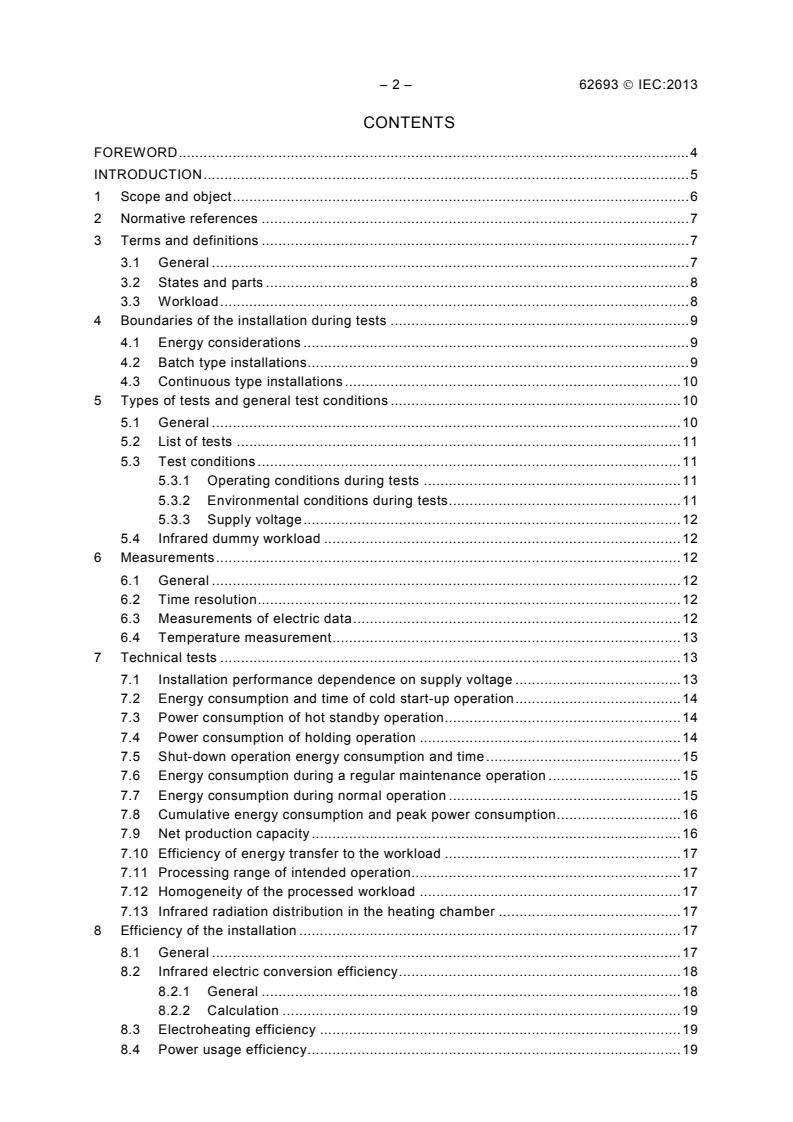
CONTENTS
FOREWORD . 4
INTRODUCTION . 5
1 Scope and object . 6
2 Normative references . 7
3 Terms and definitions . 7
3.1 General . 7
3.2 States and parts . 8
3.3 Workload . 8
4 Boundaries of the installation during tests . 9
4.1 Energy considerations . 9
4.2 Batch type installations. 9
4.3 Continuous type installations . 10
5 Types of tests and general test conditions . 10
5.1 General . 10
5.2 List of tests . 11
5.3 Test conditions . 11
5.3.1 Operating conditions during tests . 11
5.3.2 Environmental conditions during tests . 11
5.3.3 Supply voltage . 12
5.4 Infrared dummy workload . 12
6 Measurements . 12
6.1 General . 12
6.2 Time resolution. 12
6.3 Measurements of electric data . 12
6.4 Temperature measurement . 13
7 Technical tests . 13
7.1 Installation performance dependence on supply voltage . 13
7.2 Energy consumption and time of cold start-up operation . 14
7.3 Power consumption of hot standby operation . 14
7.4 Power consumption of holding operation . 14
7.5 Shut-down operation energy consumption and time . 15
7.6 Energy consumption during a regular maintenance operation . 15
7.7 Energy consumption during normal operation . 15
7.8 Cumulative energy consumption and peak power consumption . 16
7.9 Net production capacity . 16
7.10 Efficiency of energy transfer to the workload . 17
7.11 Processing range of intended operation. 17
7.12 Homogeneity of the processed workload . 17
7.13 Infrared radiation distribution in the heating chamber . 17
8 Efficiency of the installation . 17
8.1 General . 17
8.2 Infrared electric conversion efficiency . 18
8.2.1 General . 18
8.2.2 Calculation . 19
8.3 Electroheating efficiency . 19
8.4 Power usage efficiency . 19
62693 IEC:2013 – 3 –
8.5 Energy consumption of the workload . 19
Annex A (normative) Energy transfer efficiency . 21
Annex B (normative) Homogeneity of the workload . 25
Annex C (informative) Measurement of radiation distribution inside the installation . 28
Bibliography . 29
– 4 – 62693 IEC:2013
INTERNATIONAL ELECTROTECHNICAL COMMISSION
____________
INDUSTRIAL ELECTROHEATING INSTALLATIONS –
TEST METHODS FOR INFRARED ELECTROHEATING INSTALLATIONS
FOREWORD
1) The International Electrotechnical Commission (IEC) is a worldwide organization for standardization comprising
all national electrotechnical committees (IEC National Committees). The object of IEC is to promote
international co-operation on all questions concerning standardization in the electrical and electronic fields. To
this end and in addition to other activities, IEC publishes International Standards, Technical Specifications,
Technical Reports, Publicly Available Specifications (PAS) and Guides (hereafter referred to as “IEC
Publication(s)”). Their preparation is entrusted to technical committees; any IEC National Committee interested
in the subject dealt with may participate in this preparatory work. International, governmental and non-
governmental organizations liaising with the IEC also participate in this preparation. IEC collaborates closely
with the International Organization for Standardization (ISO) in accordance with conditions determined by
agreement between the two organizations.
2) The formal decisions or agreements of IEC on technical matters express, as nearly as possible, an international
consensus of opinion on the relevant subjects since each technical committee has representation from all
interested IEC National Committees.
3) IEC Publications have the form of recommendations for international use and are accepted by IEC National
Committees in that sense. While all reasonable efforts are made to ensure that the technical content of IEC
Publications is accurate, IEC cannot be held responsible for the way in which they are used or for any
misinterpretation by any end user.
4) In order to promote international uniformity, IEC National Committees undertake to apply IEC Publications
transparently to the maximum extent possible in their national and regional publications. Any divergence
between any IEC Publication and the corresponding national or regional publication shall be clearly indicated in
the latter.
5) IEC itself does not provide any attestation of conformity. Independent certification bodies provide conformity
assessment services and, in some areas, access to IEC marks of conformity. IEC is not responsible for any
services carried out by independent certification bodies.
6) All users should ensure that they have the latest edition of this publication.
7) No liability shall attach to IEC or its directors, employees, servants or agents including individual experts and
members of its technical committees and IEC National Committees for any personal injury, property damage or
other damage of any nature whatsoever, whether direct or indirect, or for costs (including legal fees) and
expenses arising out of the publication, use of, or reliance upon, this IEC Publication or any other IEC
Publications.
8) Attention is drawn to the Normative references cited in this publication. Use of the referenced publications is
indispensable for the correct application of this publication.
9) Attention is drawn to the possibility that some of the elements of this IEC Publication may be the subject of
patent rights. IEC shall not be held responsible for identifying any or all such patent rights.
International Standard IEC 62693 has been prepared by IEC technical committee 27:
Industrial electroheating and electromagnetic processing.
The text of this standard is based on the following documents:
CDV Report on voting
27/877/CDV 27/902/RVC
Full information on the voting for the approval of this standard can be found in the report on
voting indicated in the above table.
This publication has been drafted in accordance with the ISO/IEC Directives, Part 2.
62693 IEC:2013 – 5 –
INTRODUCTION
This standard on particular test methods for infrared electroheating installations is one of
TC 27 standards that describe test methods for various types of electroheating installations.
Test methods for ovens under the scope of IEC 60397 [3] are also covered in this standard
when infrared radiation is the intended heat transfer in such equipment – this is assumed to
be valid above an actual or processing temperature of 700 °C, independently of the rated
temperature of the oven.
This standard is solely concerned with tests for infrared equipment and installations. Tests
that focus on the performance of infrared emitters will be covered by IEC 62798 [11]. The
rationale for this separation is that infrared installations are usually manufactured by other
companies than infrared emitters. Still, infrared emitters are a very important and distinct part
of infrared installations and a set of tests that allow for proper comparison of different infrared
emitters will be valuable to manufacturers of infrared installations.
The major guiding principle in this standard is to define tests that can be performed with the
usual test and measuring equipment available to most kinds of companies, large or small.
The tests focus on the performance and efficiency of installations, as these are of major
interest for manufacturers and users of such installations. The tests are intended to enable a
fair comparison of installations belonging to a given class. The standard includes
considerations and tests concerned with energy efficiency, so that the tests can be used for
assessment of energy use and for energetic optimisation of installations as well.
_______________
Numbers in square brackets refer to the Bibliography.
Under consideration.
– 6 – 62693 IEC:2013
INDUSTRIAL ELECTROHEATING INSTALLATIONS –
TEST METHODS FOR INFRARED ELECTROHEATING INSTALLATIONS
1 Scope and object
This International Standard specifies test procedures, conditions and methods according to
which the main parameters and the main operational characteristics of industrial infrared
electroheating installations are established.
A limitation of the scope is that the infrared emitters have a maximum spectral emission at
longer wavelengths than 780 nm in air or vacuum, and are emitting wideband continuous
spectra such as by thermal radiation or high pressure arcs.
In industrial infrared electroheating installations, infrared radiation is usually generated by
infrared emitters and infrared radiation is significantly dominating over heat convection or heat
conduction as means of energy transfer to the workload.
IEC 60519-1:2010 defines infrared as optical radiation within the frequency range between
about 400 THz and 300 GHz. This corresponds to the wavelength range between 780 nm and
1 mm in vacuum. Industrial infrared heating usually uses infrared sources with rated
temperatures between 500 °C and 3 000 °C; the emitted radiation from these sources
dominates in the wavelength range between 780 nm and 10 µm.
Installations under the scope of this standard typically use the Joule effect for the conversion
of electric energy inside one or several sources into infrared radiation emitted onto the
workload. Such infrared emitters are especially
• thermal infrared emitters in the form of tubular, plate-like or otherwise shaped ceramics
with a resistive element inside;
• infrared quartz glass tube or halogen lamp emitters with a hot filament as a source;
• non insulated elements made from molybdenum disilicide, silicon carbide or comparable
materials;
• restive metallic heating elements made e.g. from nickel based alloys or iron-chromium-
aluminium alloys;
• wide-spectrum arc lamps.
This standard is not applicable to
• infrared installations with lasers or light-emitting diodes (LEDs) as main sources – they are
covered by IEC 62471:2006 [9], IEC 60825-1:2007 [6] and IEC/TR 60825-9:1999 [7];
• appliances for use by the general public;
• appliances for laboratory use – they are covered by IEC 61010-1:2010 [8];
• electroheating installations where resistance heated bare wires, tubes or bars are used as
heating elements, and infrared radiation is not a dominant side effect of the intended use,
covered by IEC 60519-2:2006 [5];
• infrared heating equipment with a nominal combined electrical power of the infrared
emitters of less than 250 W;
• handheld infrared equipment.
The tests are intended to be used to enable a fair comparison of the performance of
installations belonging to the same class.
62693 IEC:2013 – 7 –
Tests related to safety of the installations are defined in IEC 60519-12:2013. Tests related to
the performance of infrared electroheating emitters are specified in IEC 62798:— [11].
Therefore, this standard is applicable to ovens and furnaces with resistive heating elements if
they fall under the scope of this standard.
2 Normative references
The following documents, in whole or in part, are normatively referenced in this document and
are indispensable for its application. For dated references, only the edition cited applies. For
undated references, the latest edition of the referenced document (including any
amendments) applies.
IEC 60519-1:2010, Safety in electroheating installations – Part 1: General requirements
IEC 60519-12:2013, Safety in electroheating installations – Part 12: Particular Requirements
for infrared electroheating installations
3 Terms and definitions
For the purposes of this document, the terms and definitions of IEC 60519-12:2013 and the
following apply.
NOTE General definitions are given in the International Electrotechnical Vocabulary, IEC 60050 [2]. Terms
relating to industrial electroheating are defined in IEC 60050-841.
3.1 General
3.1.1
installation class
group within a type of installation, using the same principle for processing the workload and
the size of this as well as the production capacity
3.1.2
production capacity
measure of the production rate capability of equipment in normal operation
EXAMPLE Flow, mass or volume.
Note 1 to entry: The capacity does not refer to the volume of the working space.
3.1.3
electroheating efficiency,
ratio of the usable enthalpy increase in the workload to the electric energy supplied to it at the
location of the equipment, during a cycle of batch operation or stationary operation during a
suitable time period for measurements
[SOURCE IEC 60050-841:2004, 841-22-70, modified – The term itself has been modified and
details with respect to the kind of operation have been added.]
3.1.4
electric conversion efficiency
quotient between the available electric active power output for the transfer to the workload,
and the electric input active power from the supply network, at power settings for normal
operation
Note 1 to entry: The concept does not apply to conversion of electric energy to infrared radiation by heated
elements.
– 8 – 62693 IEC:2013
3.1.5
intended workload quality
product quality
degree to which a set of inherent characteristics of a processed workload fulfils requirements
Note 1 to entry: All workload that does not attain the intended workload quality is regarded as scrap or undergoes
rework to reach intended workload quality.
3.2 States and parts
3.2.1
cold start-up
process by which the equipment is energised into hot standby operation, from the cold state,
including all other start-up operations which enable the equipment to operate as intended
Note 1 to entry: This mode of operation applies to cases where there is a significant energy consumption needed
for obtaining a state of the equipment allowing the actual processing of the workload.
3.2.2
holding power
electric power consumption during which the workload is kept in the treatment chamber at a
specified temperature
Note 1 to entry: The temperature is typically maintained during a time intended to equalize the workload
temperature.
Note 2 to entry: This mode of operation is not applicable for certain types of electroheating equipment.
3.2.3
hot standby operation
mode of operation of the installation occurring immediately after normal operation
Note 1 to entry: This mode of operation of the installation is with its hot state remaining, without workload, and
with the means of operation ready for prompt normal operation.
3.2.4
normal operation
range of output settings with the normal workload in allowable working conditions of the
installation, as specified in the manufacturer’s documentation
3.2.5
shut-down operation
process by which the installation is de-energised safely into the cold state
3.2.6
port
entrance or exit opening in the treatment chamber or enclosure through which the workload
moves
3.2.7
means of access
all structural features of the infrared electroheating installation which can be opened or
removed without the use of a tool to provide access to the interior of the installation
3.3 Workload
3.3.1
normal workload
object intended to be processed as specified in the manufacturer’s documentation
Note 1 to entry: The workload is called “charge” in some electroheating contexts.
62693 IEC:2013 – 9 –
Note 2 to entry: The workload includes any container, holder or other device necessary for the processing and
which is directly or indirectly subjected to the output power.
3.3.2
dummy workload
artificial workload with known thermal properties, designed for accurate enthalpy increase
measurements by absorbing the available output power
3.3.3
infrared dummy workload
IDW
dummy workload intended to mimic the physical behaviour of the workload, especially its
radiation absorption behaviour, allowing for the effective measurement of specific parameters
of the process
Note 1 to entry: Example for a specific parameter is the homogeneity of processing of the surface of the workload.
Note 2 to entry: This note applies to the French language only.
4 Boundaries of the installation during tests
4.1 Energy considerations
It is necessary to define boundaries or limits of the installation with respect to equipment and
energy uses included in or excluded from considerations during tests and calculations. The
following definitions of boundaries are intended to enable fair comparisons for both batch and
continuous type installations:
a) Energy of compression or decompression of steam, air or any other gas in the process
chamber shall be included in the used and lost energy calculations of the installation.
b) Exo- or endothermic chemical energy involving any reactive gases in the processing of the
workload shall be included.
c) Energy used for cooling action by any excess reactive and/or inert gases in the processing
of the workload shall be included in the calculation of used and lost energy of the
installation.
d) Energy used for cooling of the processed workload to ambient temperature or as
preparation for further treatment as part of normal operation shall be included, but stated
separately in the calculation of used and lost energy. If a part of this thermal energy is
transferred back into the installation or process, this recycling of thermal energy shall be
reported separately, to allow comparisons with other installations in the same class but
without this feature. Thermal energy used outside the process shall not be included in
reporting.
4.2 Batch type installations
Batch type installations are characterised by a discontinuous processing. If there are means
of access, these are opened and a workload is placed inside the treatment chamber of the
installation and then undergoes normal operation. The means of access are then reopened
and the workload is removed from the treatment chamber and the installation either goes into
hot standby operation with closed means of access, or the process is restarted with another
workload.
Normal operation always includes heating and can also include one or more of the following
sub-processes:
• closing and opening of means of access;
• pressurising of the treatment chamber;
• transport of the workload – this includes for example wobbling movement during operation;
– 10 – 62693 IEC:2013
• holding the workload at a specified temperature for a specified time;
• introducing reactive or protective gases into the treatment chamber – including deposition
processes;
• free or forced cooling of the workload – for example, if cooling is necessary to avoid
damage by exposing the hot workload to ambient atmosphere.
The energy used to perform these sub-processes shall be included. The spatial boundary of
the installation with respect to the process is defined by:
a) an entrance port position where the workload is placed prior to normal operation or the
equipment which transports the workload into the treatment chamber; this equipment and
its energy use is a part of the installation;
b) an exit port position where the workload is placed after normal operation for removal, or
the equipment which moves the workload out of the treatment chamber; this equipment
and its energy use is part of the installation;
c) all equipment in between, including for example all switchgear, pumps, cooling means
necessary to operate the equipment.
NOTE In vacuum equipment, the boundary between the infrared installation and another installation is typically a
valve.
The cycle of batch operation relevant for measurement shall begin after hot standby
operation.
4.3 Continuous type installations
Continuous type installations are characterised by a continuous or semi-continuous
processing. The workload is conveyed through the treatment chamber of the installation
during normal operation. The steps of treatment occur at consecutive positions inside the
installation as the workload is transported through it – for example in roll to roll operations or
in sheet feed installations. This kind of installation usually goes into hot standby operation
when no workload is conveyed.
The normal operation always includes heating and can include one or more of the following
sub-processes which occur at separated spatial positions inside the installation:
• holding the workload at a specified temperature;
• introducing reactive or protective gases – including deposition processes;
• free or forced cooling of the workload – for example if cooling is necessary to avoid
damage by exposing the hot workload to ambient atmosphere.
The energy used to perform these processes shall be included. The boundary of the
installation is defined by
a) the entrance and exit ports;
b) all equipment in between, including for example all switchgear, pumps, cooling means
necessary for operation of the equipment.
The energy consumption of transport or roll handling in stand-alone installations is included in
the used energy. It shall be stated separately in the calculations.
5 Types of tests and general test conditions
5.1 General
No tests are defined for installations in the cold state. All such tests are safety related and are
not covered by the scope of this standard. Relevant safety related tests are described in
IEC 60519-1 and IEC 60519-12.
62693 IEC:2013 – 11 –
5.2 List of tests
The following tests shall be conducted in the hot state of the installation during commissioning
or when the installation is ready for normal operation as well as at regular intervals as
specified by the manufacturer, following maintenance or after modifications:
a) influence of supply voltage on the performance, refer to 7.1;
b) energy consumption during cold start-up operation and time needed, refer to 7.2;
c) power consumption during standby operation, refer to 7.3;
d) power consumption during holding operation, refer to 7.4;
e) energy consumption during shutting down operation and time needed, refer to 7.5;
f) energy consumption during regular maintenance operation, refer to 7.6;
g) energy consumption during normal operation, refer to 7.7;
h) energy consumption during a full operation cycle and peak power consumption, refer to
7.8;
i) production capacity, refer to 7.9;
j) efficiency of energy transfer to workload, refer to Annex A;
k) processing range of the installation to perform the intended operation, refer to 7.11;
l) homogeneity of workload processing, refer to Annex B;
m) infrared radiation distribution inside the installation, refer to Annex C.
Additional tests may be specified in the commissioning and operation manuals issued by the
manufacturer or may be agreed between the manufacturer and user.
5.3 Test conditions
5.3.1 Operating conditions during tests
Operating conditions during tests shall be in the range of normal operation conditions and
thus reflect the manufacturer’s intended use of the installation while excluding extreme usage
patterns, deliberate misuse or unauthorized modifications of the installation or its operating
parameters.
5.3.2 Environmental conditions during tests
All tests shall be performed
a) under standardised environmental conditions, at ambient temperature in the range
between 5 °C and 40 °C and air relative humidity of less than 95 %, or
b) at the point of use of the installation under the available and specified environmental
conditions there.
The environmental conditions shall not exceed those defined for the intended purpose of the
installation. All environmental conditions affecting measurement results shall be monitored
during the tests and be part of the measurement report. This includes
• air temperature and humidity near the installation;
• temperature and humidity of cooling air drawn into the installation;
• exhaust air temperature;
• temperature of the workload when entering the installation;
• moisture content of the workload when entering the installation, if applicable.
– 12 – 62693 IEC:2013
5.3.3 Supply voltage
The supply voltage shall not exceed the limits defined for the intended purpose.
NOTE Limits of variation of line voltage are set in IEC 60038 [1].
The supply voltage to the installation shall be monitored during the tests.
All measurements of specific electrical values, such as power consumption or current shall
include the data of the supply voltage.
5.4 Infrared dummy workload
The following aspects shall be considered when using an infrared dummy workload (IDW):
• in case of a planar workload, the IDW shall be planar;
• the IDW shall have the same size in batch processes or the same width in continuous
processes as the intended workload, if effects covering the full usable size of the
installation are to be tested;
• in case it is intended to process workloads with a complex shape, the IDWs shape shall
include all relevant geometrical features of the normal workload;
• for the measurement of temperature homogeneity, the IDW shall have a comparable heat
absorbing capacity, i.e. the factor of volume, density and heat capacity c ;
p
• for the measurement of evaporation homogeneity, the IDW shall be made of the same
material as the workload and be prepared with a comparable amount of evaporable
substance;
• for the measurement of crosslinking homogeneity, the IDW shall be made of the same
material as the workload.
6 Measurements
6.1 General
More than a single measurement is recommended for the tests defined in this standard. For
time resolved measurements a data logger or multi-channel electronic data acquisition system
shall be used, which automatically measures and stores the necessary data in a computer
readable format.
6.2 Time resolution
The necessary time resolution of the measuring equipment and the data saving rate of the
storage devices depends on the installation and the specific tests to be undertaken. The
measurement and storage frequency shall be so high that all relevant signal variations are
recorded.
6.3 Measurements of electric data
6.3.1 All equipment for voltage measurement shall be of class 2.0 or better. The measuring
equipment for a.c. current shall be able to show true rms independently of the waveform.
6.3.2 All equipment for current measurement shall be of class 2.0 or better. The current
measuring equipment for a.c. current shall be able to measure true rms independently of the
waveform.
6.3.3 All equipment for energy consumption measurement shall be of class 2.0 or better.
The measuring equipment shall be able to measure active and reactive energy independently
of the waveform.
62693 IEC:2013 – 13 –
6.3.4 All equipment for power consumption measurement shall be of class 2.0 or better.
The measuring equipment shall be able to measure active and reactive power independently
of the waveform.
6.3.5 Measurements of all electric values, which are part of a test of energy or power use
of the installation shall be performed at the power inlet to the installation.
6.3.6 Measurements of all electric values, which are part of a test of energy or power use
of the infrared emitters of the installation, shall be performed at the power outlet of the
switchgear connected to the emitters; transformers, capacitor circuits or comparable devices
necessary to drive the emitter are part of the switchgear.
6.3.7 Measurements of all electric values, which are part of a test of energy or power use
of auxiliary equipment, shall be performed at the respective power outlet of the switchgear
connected to that equipment.
6.3.8 Specific access points may be installed during manufacturing of the installation.
Measuring equipment may be part of the switchgear; its energy use is considered as part of
the energy use of the switchgear.
6.4 Temperature measurement
The kind of equipment used for temperature measurement depends for example on the task,
temperature range, available information on the surfaces being measured, and accessibility.
Contacting thermocouples are simple to use and reliable. They provide reliable and exact
results if an intimate and non detachable contact to a surface of an object with high mass and
good thermal conduction to the thermocouple is possible.
Pyrometers and infrared cameras summarised as thermographic methods may be used for all
surfaces at elevated temperature, when the emissivity of the surface is well known and when
the surface is considered as lambertian – i.e. following a cosine law of angular emissivity. The
used value of emissivity, the measurement wavelength and the presumed error of emissivity
shall be included in all measurement reports.
The relative measurement error for all temperature measurements in compliance with this
standard shall not exceed 5 % of the temperature of the measured value stated in °C.
Measurement accuracy shall be included in the measurement report.
NOTE The German VDI/VDE 3511 series [19 – 26] provides information on best practices for temperature
measurement in industry.
7 Technical tests
7.1 Installation performance dependence on supply voltage
The actual supply voltage or its variation influences the performance of the infrared
electroheating installation, if the infrared emitters operate on this directly or via fixed
transformers. This effect can be even larger, if the actual supply voltage or the declared
supply voltage differs from the rated supply voltage.
The variation of power consumption of individual infrared emitters with their applied working
voltage depends on the type of emitter. This data may be supplied by the manufacturer of the
emitter and the variation of power consumption with its actual working voltage
• shall either be calculated using this data,
– 14 – 62693 IEC:2013
• or may be measured by tracking the supply voltage of the installation and the power
consumption of the installation or the emitters over a long period and at otherwise
constant settings of the installation.
NOTE The future standard on infrared emitter tests [11] will consider the measurement of variation of power
consumption depending on voltage.
Variation of power with the actual working voltage affects other parameters of the installation
as well – for example wall temperature, processing time, heating up time.
The actual supply voltage can affect the results of all tests as well; it shall be part of the test
report.
7.2 Energy consumption and time of cold start-up operation
The following applies for the measurement of cold start-up time and energy consumption for
installations that by intent need to perform this operation prior to normal operation.
a) The installation shall be heated up from ambient conditions as stated in 5.3.2.
b) The installation is operated without a workload, if applicable.
c) Any preheating of the treatment chamber or zone to arrive at a state as close as
reasonable to hot standby operation is carried out, if applicable.
d) The cold start-up total electric energy consumption and time are measured.
Cold start-up energy consumption can be measured for
• the complete infrared installation;
• the infrared emitters only;
• the auxiliary equipment only.
If the installation is intended to be heated up safely with workload only, this shall be
considered.
7.3 Power consumption of hot standby operation
The following applies for the measurement of hot standby power consumption:
a) The installation is operated without workload, if applicable.
b) Conditions of hot standby operation are maintained.
c) The total energy consumption during hot standby and duration of hot standby are
measured.
Hot standby power can be measured for
• the complete infrared installation;
• the infrared emitters only;
• the auxiliary equipment only.
7.4 Power consumption of holding operation
The holding feature of an installation is usually needed to achieve workload temperature
equilibration after the process proper and does not exist in some types of installations.
NOTE The major difference between hot standby and holding is that the workload is present in the latter case and
can emit radiation, or supply convective or conductive energy to its ambient. This is usually compensated by
variation of the external energy supply to maintain the workload temperature.
The following applies for the measurement of the power consumption during temperature
holding operation with workload:
62693 IEC:2013 – 15 –
a) The test is applicable if holding is part of normal operation.
b) The installation is operated with a heated up workload.
c) The temperature of the workload is kept constant, using particular control settings for this
purpose.
d) The total energy consumption during holding and the holding time are measured.
Holding power can be measured for
• the complete infrared installation;
• the infrared emitters only;
• the auxiliary equipment only.
7.5 Shut-down operation energy consumption and time
The following applies for the measurement of energy consumption during shut-down
operation, if applicable:
a) The installation is shut down as specified by the manufacturer.
b) The total energy consumption during shut-down and the shut-down time are measured.
Shut-down power consumption can be measured for
• the complete infrared installation;
• the infrared emitters only – if applicable;
• the auxiliary equipment only.
7.6 Energy consumption during a regular maintenance operation
The following applies for the measurement of maintenance energy consumption and time, if
applicable:
a) Maintenance of the installation is performed as specified by the manufacturer.
b) The total energy consumption during the maintenance operation and time for maintenance
are measured.
Maintenance power consumption can be measured for
• the complete infrared installation;
• the infrared emitters only;
• the auxiliary equipment only;
• the specific maintenance equipment only.
7.7 Energy consumption during normal operation
All measurements of the electric energy consumption shall reflect specific consumption by
defined parts of the installation during a defined time period or a specified operation. The
following shall be reported, if applicable:
a) The energy consumption of a batch type installation during one cycle; this may be
measured and averaged over a defined number of cycles. The number of cycles and
variation of energy consumption shall be recorded in the test report.
b
...
SLOVENSKI SIST IEC 60050(448)
prva izdaja
STANDARD
september 1999
Mednarodni elektrotehniški slovar -�3RJODYMH������=Dª�LWD�
elektroenergetskega sistema (enakovreden IEC 60050(448):1995)
International Electrotechnical Vocabulary - Chapter 448: Power system
protection
Vocabulaire Electrotechnique International - Chapitre 448: Protection des
réseaux d'énergie
Internationales Elektrotechnisches Wörterbuch - Kapitel 448:
Energienetz-Selektivschutz
5HIHUHQ�QD�ªWHYLOND
ICS 01.040.29; 29.120.50 SIST IEC 60050(448):1998 (sl)
Nadaljevanje na straneh od 2 do 43
© 6WDQGDUG�MH�]DOR�LO�LQ�L]GDO�8UDG�5HSXEOLNH�6ORYHQLMH�]D�VWDQGDUGL]DFLMR�LQ�PHURVORYMH�SUL�0LQLVWUVWYX�]D�]QDQRVW�LQ�WHKQRORJLMR�
5D]PQR�HYDQMH�DOL�NRSLUDQMH�FHORWH�DOL�GHORY�WHJD�VWDQGDUGD�QL�GRYROMHQR�
SIST IEC 60050(448) : 1999
UVOD
Standard SIST IEC 60050(448), Mednarodni elektrotehniški slovar -� 3RJODYMH� ����� =Dª�LWD�
elektroenergetskega sistema, prva izdaja, 1998, ima status slovenskega standarda in je enakovreden
mednarodnemu standardu IEC 60050(448):1995 (en), International Electrotechnical Vocabulary -
Chapter 448: Power system protection, 1995-12.
NACIONALNI PREDGOVOR
0HGQDURGQL�VWDQGDUG�,(&�����������������MH�SULSUDYLO�WHKQL�QL�RGERU�0HGQDURGQH�HO
ektrotehniške
komisije IEC/TC 1 Terminologija.
Slovenski standard SIST IEC 60050(448):1998 je prevod mednarodnega standarda
IEC 60050(448):1995. V primeru spora glede besedila slovenskega prevoda v tem standardu je
RGOR�LOHQ� L]YLUQL� PHGQDURGQL� VWDQGDUG�� 6ORYHQVNR� L]GDMR� VWDQGDUGD� MH� SULSUDYLO� WHKQL�QL� RGERU�
USM/TC Terminologija.
2GOR�LWHY�]D�SUHY]HP�WHJD�VWDQGDUGD�SR�PHWRGL�SUHYRGD�MH�GQH�����-11-���VSUHMHO�WHKQL�QL�RGERU�
USM/TC Terminologija.
Ta slovenski standard je dne 1999-09-06 odobril direktor USM.
OSNOVA ZA IZDAJO
- Prevod standarda IEC 60050(448):1995
SIST IEC 60050(448) : 1999
VSEBINA Stran
Podpoglavje 448-11: Splošni izrazi.4
Podpoglavje 448-����=DQHVOMLYRVW�]Dª�LWH.9
Podpoglavje 448-13: Okvare v elektroenergetskem sistemu .11
Podpoglavje 448-����=Dª�LWD .13
Podpoglavje 448-15:�=Dª�LWD�V�WHOHNRPXQLNDFLMVNR�SRYH]DYR.18
Podpoglavje 448-16: Avtomatska krmilna oprema .22
Abecedni seznam slovenskih izrazov .35
Abecedni seznam angleških izrazov.37
Abecedni seznam francoskih izrazov .40
Abecedni seznam nemških izrazov .42
SIST IEC 60050(448) : 1999
3RJODYMH������=Dª�LWD�HOHNWURHQHUJHWVNHJD�VLVWHPD
Podpoglavje 448-11: Splošni izrazi
Zap. št. ,]UD]�Y�VORYHQª�LQL Definicija
,]UD]�Y�DQJOHª�LQL
,]UD]�Y�IUDQFRª�LQL
,]UD]�Y�QHPª�LQL
�L Postopki za odkrivanje okvar ali drugih nenor-
448-11-01 − zaš ta
− protection malnih stanj v elektroenergetskem sistemu, od-
− protection klop okvar, kon�Dnje nenormalnih stanj, za�H-
− Selektivschutz tek signalizacij in spro�Ltev ukazov.
Opombe: 1. Izraz "zaš�Lta" je skupen izraz za zaš�Ltno
opremo in zaš�LWne sisteme.
2. Izraz "zaš�Lta" se lahko uporablja za opis
zaš�Lte celotnega elektroenergetskega siste-
ma ali za zaš�Lto posameznih elektroener-
getskih naprav, na primer transformator-
�L �L
ska zaš ta, daljnovodna zaš ta, generator-
ska zaš�Lta.
3. Zaš�Lta ne vklju�Xje elektroenergetskih na-
prav, predvidenih za omejevanje prenapeto-
sti v elektroenergetskem sistemu, vklju�Xje
pa naprave za nadzor napetosti in odstopa-
nje frekvence, avtomatsko stikanje reaktor-
jev, naprav za razbremenjevanje itd.
�LW Merilni rele, ki je sam ali v kombinaciji z drugimi
448-11-02 − zaš ni rele
− protection relay; protective relay releji del zaš�LWne opreme.
(USA)
− relais de protection
− Schutzrelais
JD�DOL�YH��]Dª�LW
448-11-03 − zaš�LWna oprema Oprema, ki ima ene nih relejev
− protection equipment; relay LQ���H�MH�SRtrebno, tudi loJL�ne elemente za
system (USA) opravljaQMH�HQH�DOL�YH��VSHcificiranih zaš�LWnih
funkcij.
− dispositif de protection
− Schutzeinrichtung
Opomba: Zaš�LWna oprema je del zaš�LWnega sistema.
Primeri: DiVWDQ�na zaš�LWna oprema, faznopri-
merjalna zaš�LWna oprema (enofazna primerjal-
na oprema je del faznoprimerjalnega zaš�LWne-
ga sistema na enem koncu voda).
SIST IEC 60050(448) : 1999
,]UD]�Y�VORYHQª�LQL
Zap. št. Definicija
,]UD]�Y�DQJOHª�LQL
,]UD]�Y�IUDQFRª�LQL
,]UD]�Y�QHPª�LQL
448-11-04 − zaš�LWni sistem RazporediWHY� HQH� DOL� YH�� ]Dª�LWnih oprem in
drugih naprav za opravljaQMH�HQH�DOL�YH��VSHcifi-
− protection system
− système de protection ciranih zaš�LWnih funkcij.
− Schutzsystem
Opombi: 1. Zaš�LWni sistem vklju�XMH�HQR�DOL�YH��]Dª�LW-
nih oprem, merilne transformatorMH��R�L�H-
nje, izklopne tokokroge, poPR�no napajanje
in tudi komunikacijske sisteme, kjer je pred-
videno. OdviVQR�RG�QD�LQD�GHORYDQMD�]Dª�LW-
nega sistema lahko sistem vklju�Xje en ko-
nec ali vse konce zaš�Ltenega odseND�LQ���H�
je mogo�H��RSUHmo za avtomatski ponovni
vklop.
2. Odklopniki so izklju�Hni.
448-11-05 − zaš�Lteni odsek ’HO�RPUH�ja elektroenergetskega sistema ali to-
kokrog znoWUDM�RPUH�ja, za katerega je uporab-
− protected section
− section protégée ljeQD�SRVHEHM�GROR�ena zaš�Lta.
− geschützter Abschnitt
�L Sposobnost zaš�Lte, da ugotovi okvarjeni odsek
448-11-06 − selektivnost zaš te
− selectivity of protection oziroma okvarjeno fazo (faze) elektroenerget-
− sélectivité d'une protection skega sistema.
− Selektivität des Selektivschut-
zes
Sposobnost zaš�Lte, da ugotovi okvarjeni odsek
448-11-07 − odsekovna selektivnost
�L elektroenergetskega sistema.
zaš te
− section selectivity of protection
− sélectivité de section d'une pro-
tection
− Abschnittselektivität des
Selektivschutzes
448-11-08 − fazna selektivnost zaš�Lte Sposobnost zaš�ite, da ugotovi okvarjeno fazo
− phase selectivity of protection (faze) v elektroenergetskem sistemu.
− sélectivité de phase d'une
protection
− Außenleiterselektivität des
Selektivschutzes
448-11-09 − absolutno selektivna zaš�Lta Zaš�Lta, katere delovanje in odsekovna selek-
tivnost sta odvisna od primerjave elekWUL�nih ve-
− unit protection
− protection à sélectivité absolue li�LQ�QD�YVDkem koncu zaš�Ltenega odseka.
de section
Opomba: V ZDA izraz "unit protection" ozna�Xje zaš�L-
− Selektivschutz mit absoluter
to elekWUL�nega generatorja.
Selektivität
�L Zaš�Lta, katere delovanje in odsekovna selek-
448-11-10 − relativno selektivna zaš ta
− non-unit protection tivnost sta odvisna od meritve elekWUL�nih veli�LQ�
z merilnimi releji na enem koncu zaš�Ltenega
− protection à sélectivité relative
de section odseka in v nekaterih primerih od izmenjave lo-
− Selektivschutz mit relativer JL�nih signalov med posameznimi konci.
Selektivität
Opomba: Odsekovna selektivnost relativno selektivne
zaš�Lte je odvisna od njene nastavitve, po-
sebHM��Dsovne.
SIST IEC 60050(448) : 1999
,]UD]�Y�VORYHQª�LQL
Zap. št. Definicija
,]UD]�Y�DQJOHª�LQL
,]UD]�Y�IUDQFRª�LQL
,]UD]�Y�QHPª�LQL
448-11-11 − zaš�Lta s fazno diskriminacijo Zaš�Lta, najYH�krat absolutno selektivna zaš�L-
ta, ki je fazno selektivna.
− phase segregated protection;
segregated phase protection
(USA)
− protection à discrimination de
phase
− leiterselektiver Schutz
448-11-12 − zaš�Lta brez fazne diskrimi- Zaš�Lta, najYH�krat absolutno selektivna zaš�L-
nacije ta, ki ni fazno selektivna.
− non-phase segregated
Opomba: Zaš�Lta brez fazne diskriminacije uporablja
protection
najYH�krat poPR�ne naprave za tvorjenje
− protection sans discrimination
enofaznih veli�LQ, ki predstavljajo vse tri faze
de phase
elektroenergetskega sistema (npr.
− nicht leiterselektiver Schutz seštevalni transformatorji, filtri za simeWUL�ne
dele).
448-11-13 − glavna zaš�Lta Zaš�Lta, ki se najprej spro�L pri odklopu okvare
− main protection; primary protec- ali pri kon�Dnju nenormalnega stanja v elek-
troenergetskem sistemu.
tion (USA)
− protection principale
Opomba: =D�GROR�HQR�QDpravo v elektroenergetskem
− Hauptschutz
objektu sta lahko predvideni dve ali ceOR�YH��
glavnih zaš�LW�
448-11-14 − (priklju�Hna) rezervna Zaš�Lta, ki naj deluMH���H�RNvara v elektro-
energetskem sistemu ni bila odklopljeQD�DOL��H�
zaš�Lta
nenormalno stanje ni bilo ugotovljeQR�Y�GROR�H-
− backup protection
− protection de secours QHP��Dsu, ker je odpovedala ali ni bila sposob-
na delovati druga zaš�Lta, ali zaradi izostalega
− Reserveschutz
izklopa ustreznega odklopnika.
Opomba: V ZDA angleški izraz "backup protection"
ozna�Xje izvedbo zaš�Lte, ki deluje neodvi-
sno od specificiranih naprav sistema glavne
zaš�Lte. Priklju�Hna rezervna zaš�Lta lahko
podvaja glavno zaš�Lto ali pa je vgrajena
zato, da deluMH���H�RGpove glavna zaš�Lta ali
�H�Wa za�Dsno ni priklju�Hna.
Rezervna zaš�Lta, ki je vzbujana z istih merilnih
448-11-15 − lokalna rezervna zaš�Lta polja
− circuit local backup protection transformatorjev kot glavna zaš�Lta ali z meril-
− protection de secours locale de nih transformatorjev, ki so v istem polju, kot je
glavna zaš�Lta.
cellule
− örtlicher Reserveschutz (im
Opomba: V ZDA se izraz "circuit local backup protec-
Feld)
tion" uporablja tudi kot alternativni izraz za
"breaker failure protection".
448-11-16 − lokalna rezervna zaš�Lta po- Rezervna zaš�Lta, ki je vzbujana z merilnih
transformatorjev znotraj iste postaje kot ustrez-
staje
na glavna zaš�Lta, vendar ne v istem polju kot
− substation local backup
protection glavna zaš�Lta.
− protection de secours locale de
poste
− örtlicher Reserveschutz (in der
Station)
SIST IEC 60050(448) : 1999
,]UD]�Y�VORYHQª�LQL
Zap. št. Definicija
,]UD]�Y�DQJOHª�LQL
,]UD]�Y�IUDQFRª�LQL
,]UD]�Y�QHPª�LQL
448-11-17 − daljinska rezervna zaš�Lta Rezervna zaš�Lta v postaji, ki je oddaljena od
postaje, v kateri je ustrezna glavna zaš�Lta.
− remote backup protection
− protection de secours éloignée
− Fern-Reserveschutz
�L Zaš�Lta, ki v primeru, da odpove ustrezni od-
448-11-18 − zaš ta pri odpovedi
klopnik, z izklopom ostalih odklopnikov izklopi
odklopnika
− circuit-breaker failure prote- tok okvare v sistemu.
ction; breaker failure protection
(USA)
− protection contre la défaillance
d'un disjoncteur
− Schaltversager-Selektivschutz
448-11-19 − (nepriklju�Hna) rezervna Zaš�Lta, ki normalno ni v obratovanju, vendar
se lahko priklju�L�Y�REUDtovanje, da nadomesti
zaš�Lta
− standby protection drugo zaš�Lto.
− protection de réserve
− Bereitschaftsschutz
448-11-20 − trenutna zaš�Lta Zaš�Lta brez namerQH��Dsovne zakasnitve.
− instantaneous protection
− protection instantanée
− unverzögerter Selektivschutz
448-11-21 − zakasnjena zaš�Lta Zaš�Lta z namerQR��Dsovno zakasnitvijo.
− - delayed protection; time-
delayed protection (USA)
− protection temporisée
− verzögerter Selektivschutz
448-11-22 − smerna zaš�Lta Zaš�Lta, na�Utovana tako, da deluje samo pri
okvari, ki le�L�Y�HQL�VPHri od relejQH�WR�ke.
− directional protection
− protection directionnelle
− Richtungsschutz
448-11-23 − doseg zaš�Lte ObPR�je, za katerega se predpostavlja, da je
− reach of protection zaš�Lteno, medtem ko zunaj njega relativno se-
lektivna zaš�Lta ne deluje.
− portée d'une protection
− Reichweite des Schutzes
448-11-24 − prekrivanje zaš�Lte Odsek, zaš�LWHQ�]�YH��]Dª�Ltami, ki so uporab-
ljene za zaš�Lto razOL�nih naprav primarnega ob-
− overlap of protection
− recouvrement de protection jekta.
− Selektivschutzüberlappung
Tok, enak vsoti faznih tokov.
448-11-25 − residualni tok (za zaš�Lto)
− residual current (for protection)
− courant résiduel (pour une
protection)
− Summenstromstärke (für Selek-
tivschutz)
448-11-26 − residualna napetost (za zaš�L- Napetost, enaka vsoti faznih napetosti.
to)
Opomba: Izraz fazna napetost ozna�Xje napetost med
− residual voltage (for protection)
fazo in zemljo.
− tension résiduelle (pour une
protection)
− Verlagerungsspannung (für Se-
lektivschutz)
SIST IEC 60050(448) : 1999
,]UD]�Y�VORYHQª�LQL
Zap. št. Definicija
,]UD]�Y�DQJOHª�LQL
,]UD]�Y�IUDQFRª�LQL
,]UD]�Y�QHPª�LQL
448-11-27 − direktni sestavni del (refe- Eden izmed treh simeWUL�nih sestavnih delov, ki
obstaja v simeWUL�nem(ih) in nesimeWUL�nem(ih)
UHQ�ne faze trifaznega sistema)
− positive (sequence) component trifaznem(ih) sistemu(ih) s sinusnimi veli�Lnami
(of a three-phase system) in je definiran z naslednjim matemaWL�nim izra-
zom:
− composante directe (d'un
système triphasé)
− Mitkomponente (eines Dreipha-
X=+XaX+aX /3
()
1 LL12 L3
sensystems)
kjer a pomeni operator premika fazorja za 120°,
X , X in X so skupni izrazi za obravnavane
L1 L2 L3
fazne veli�LQH���Uka X pa ozna�Xje fazor toka ali
napetosti sistema.
448-11-28 − inverzni sestavni del Eden izmed treh simeWUL�nih sestavnih delov, ki
�UHIHUHQ�QH�IDze trifaznega si- obstaja le v nesimeWUL�nem trifaznem sistemu s
stema) sinusnimi veli�Lnami in je definiran z naslednjim
matemaWL�nim izrazom:
− negative (sequence) compo-
nent (of a three-phase system)
− composante inverse (d'un
X=+13/XaX+aX
()
2 LL1 23L
système triphasé)
− Gegenkomponente (eines
kjer a pomeni operator premika fazorja za 120°,
Dreiphasensystems)
X , X in X so skupni izrazi za obravnavane
L1 L2 L3
fazne veli�LQH���Uka X pa ozna�Xje fazor toka ali
napetosti sistema.
448-11-29 − homopolarni sestavni del (re- Eden izmed treh simeWUL�nih sestavnih delov, ki
obstaja le v nesimeWUL�nem trifaznem sistemu s
feUHQ�ne faze trifaznega siste-
ma) sinusnimi veli�inami in je definiran z naslednjim
WL�
− zero (sequence) component (of matema nim izrazom:
a three-phase system)
− composante homopolaire (d'un
X=+XX +X /3
()
0 LL12 L3
système triphasé)
− Nullkomponente (eines
kjer so X , X in X skupni izrazi za obravna-
L1 L2 L3
Dreiphasensystems)
vane fazne veli�LQH���Uka X pa ozna�Xje fazor
toka ali napetosti v sistemu.
448-11-30 − vklopni tok Tranzientni tok, povezan z vzbujanjem transfor-
− inrush current matorjev, kablov, dušilk itd.
− courant d'appel
− Einschaltstrom
448-11-31 − izklop Izklop odklopniND�]�UR�nim ali avtomatskim kr-
miljenjem ali z zaš�LWno napravo.
− tripping
− déclenchement
− Ausschalten
448-11-32 − funkcijski izklop Avtomatski izklop odklopnika(ov) po izklopu
− operational tripping drugih odklopnikov kot posledica okvare v elek-
troenergetskem sistemu, ki prepre�L�QHza�Hle-
− déclenchement fonctionnel
− betriebliches Ausschalten na sistemska stanja, kot so prenapetost, preo-
bremenitev, nestabilnost sistema itd.
SIST IEC 60050(448) : 1999
Podpoglavje 448-12: ZanesljiYRVW�]Dª�ite
Zap. št. ,]UD]�Y�VORYHQª�LQL Definicija
IzUD]�Y�DQJOHª�LQL
,]UD]�Y�IUDQFRª�LQL
,]UD]�Y�QHPª�LQL
448-12-01 − pravilno delovaQMH�]Dª�Lte Spro�Ltev izklopnih signalov ali drugih ukazov,
− correct operation of protection; ki jih na predvideni na�LQ�VSUR�L�]Dª�Lta kot od-
correct operation of relay ziv na okvaro ali na drugo nenormalnost v elek-
troenergetskem sistemu.
system (USA)
− fonctionnement correct d'une
protection
− fehlerfreie Funktion des
Selektivschutzes
448-12-02 − nepravilno delovanje zaš�Lte Odpoved delovaQMD�DOL�QH�HOHQR�GHlovanje.
− incorrect operation of pro-
tection; incorrect operation of Glej sliki 1 in 2.
relay system (USA)
− fonctionnement incorrect d'une
protection
−
fehlerhafte Funktion des
Selektivschutzes
448-12-03 − QH�HOHQR�GHlovanje Delovanje zaš�Lte, kadar v elektroenergetskem
sistemu ni okvare ali druge nenormalnosti.
zaš�Lte
− unwanted operation of
protection
− fonctionnement intempestif
d'une protection
− ungewollte Überfunktion des
Selektivschutzes
448-12-04 − odpoved zaš�Lte Izpad delovanja zaš�Lte, ki bi morala delovati,
vendar ni delovala.
- failure to operate of protec-
tion; failure to trip (USA)
− défaillance de fonctionnement
d'une protection
− Unterfunktion des
Selektivschutzes
448-12-05 − zanesljivost zaš�Lte Verjetnost, da bo zaš�Lta opravila predvideno
− reliability of protection; reliability funkcijo v danih pogojih in v daQHP��Dsovnem
intervalu.
of relay system (USA)
− fiabilité d'une protection
Opomba: Predvidena funkcija zaš�Lte je delovati, ka-
− Funktionssicherheit des
dar se to zahteva, in nedelovati, kadar se to
Selektivschutzes
ne zahteva.
Glej sliko 1.
448-12-06 − sigurnost zaš�Lte Verjetnost, da zaš�Lta v danih pogojih in v da-
− security of protection; security QHP��Dsovnem intervalu ne bo delovala po ne-
potrebnem.
of relay system (USA)
− sécurité d'une protection
− Selektivschutz-Sicherheit Glej sliko 1.
�L Verjetnost, da zaš�Lta ne bo zatajila v danih po-
448-12-07 − zagotovljivost zaš te
− - dependability of protection; gojih in v daQHP��Dsovnem intervalu.
dependability of relay system
(USA) Glej sliko 1.
− sûreté de fonctionnement d'une
protection
− Selektivschutz-Zuverlässigkeit
SIST IEC 60050(448) : 1999
,]UD]�Y�VORYHQª�LQL
Zap. št. Definicija
UD]�Y�DQJOHª�LQL
Iz
,]UD]�Y�IUDQFRª�LQL
,]UD]�Y�QHPª�LQL
448-12-08 − redundanca ObVWRM�YH��NRW�HQHga sredstva za izvršitev po-
− redundancy trebne funkcije.
− redondance
− Redundanz
448-12-09 − odpoved zaš�LWne naprave Nepravilno delovanje zaš�Lte zaradi okvare v
− hardware failure elementu zaš�Lte.
− défaillance matérielle
Opomba: Ta vrsta odpovedi se normalno odkrije pri
− Gerätefehler
rednem vzdr�Hvanju zaš�Lte.
Glej sliko 2.
448-12-10 − osnovna odpoved Nepravilno delovanje zaš�Lte zaradi okvare pri
− principle failure na�Utovanju, snovanju, nastavitvi ali uporabi
zaš�Lte.
− défaillance de principe
− Prinzipfehler
Opombi: 1. Odpovedi te vrste normalno ni mogo�H�RG-
kriti pri rednem vzdr�Hvanju.
2. Odpoved, vezana na programsko opremo v
digitalnem releju, se ozna�Xje kot osnovna
odpoved.
Glej sliko 2.
448-12-11 − avtomaWL�na nadzorna Funkcija, ki navadno poteka znotraj zaš�LWne
funkcija opreme in je namenjena avtomaWL�nemu odkri-
vanju okvar v zaš�LWni opremi in zunaj nje.
− automatic supervision function;
self-checking function (USA)
− fonction de surveillance
automatique
− automatische Überwachung
448-12-12 − avtomaWL�na javljalna Funkcija, ki opravlja avtomaWL�ni nadzor, ne da
bi vplivaOD�QD�]Dª�LWno funkcijo v zaš�LWni napra-
funkcija
− automatic monitor function; vi.
self-monitoring function (USA)
− fonction de contrôle
automatique
− automatische Kontrolle
WL� AvtomaWL�na nadzorna funkcija, ki opravlja pre-
448-12-13 − avtoma na preskuševalna
skušanje po izpadu normalnega obratovanja
funkcija
�L YH�
− - automatic test function; celotne zaš te ali njenega dela, naj krat z
blokiranjem izklopa, kar vpliva na zaš�LWno funk-
self-testing function (USA)
− fonction d'essai automatique cijo v zaš�LWni napravi.
− automatische Prüfung
DogoGHN��NL�PX�VOHGL�QH�HOHQ�L]klop odklopnika
448-12-14 − nepotrebni izklop
− non-power system fault tripping; kot rezultat okvare, ki ni nastala zaradi okvare v
false tripping (USA) elektroenergetskem sistemu, npr. ne�HOHQR�GH-
− déclenchement non imputable à lovanje zaš�Lte, ki ni povezano z okvaro v elek-
un défaut dans le réseau troenergetskem sistemu, ali izklop
odklopnika zaradi odpovedi v delovanju sekun-
d'énergie
− ungewollte netzfehlzustandsu- darne opreme ali izklop odklopnika zaradi �OR-
nabhängige Ausschaltung veške napake.
SIST IEC 60050(448) : 1999
Podpoglavje 448-13: Okvare v elektroenergetskem sistemu
Zap. št. ,]UD]�Y�VORYHQª�LQL Definicija
,]UD]�Y�DQJOHª�LQL
I]UD]�Y�IUDQFRª�LQL
,]UD]�Y�QHPª�LQL
448-13-01 − nenormalno stanje elektro- ElekWUL�no obratovalno stanje elektroenerget-
skega sistema, pri katerem so vrednosti elek-
energetskega sistema
− power system abnormality WUL�nih veli�LQ��QSU��QDpeWRVW��WRN��PR���IUHNven-
ca in stabilnost, zunaj obsega normalnih vred-
− situation anormale d'un réseau
nosti.
d'énergie
− Netzanomalie
448-13-02 − okvara v elektroenergetskem Nenormalno stanje elektroenergetskega siste-
ma, ki je posledica okvare v primarnem siste-
sistemu
− power system fault mu, v napravi ali opremi elektroenergetskega
objekta, kar navadno zahteva takojšnjo lo�Ltev
− défaut dans un réseau d'éner-
okvarjenega tokokroga, naprave, opreme ali
gie
− Netzfehlzustand objekta od elektroenergetskega sistema z izklo-
pom ustreznih odklopnikov.
Opomba: Okvare v elektroenergetskem sistemu so
lahNR�SUH�ne, serijske ali kombinirane.
Glej sliko 3.
448-13-03 − notranja okvara Okvara v elektroenergetskem sistemu, ki je
znotraj zaš�Ltenega odseka.
− internal fault
− défaut interne
− interner Netzfehlzustand
448-13-04 zunanja okvara Okvara v elektroenergetskem sistemu, ki je zu-
−
− external fault naj zaš�Ltenega odseka.
− défaut externe
− externer Netzfehlzustand
448-13-05 − SUH�na okvara Okvara, za katero je zna�LOno, da te�H�WRN�
GROR�HQH�IUHNvence med dvePD�DOL�YH��IDzami
− shunt fault; short-circuit fault
(USA) ali med fazo (fazami) in zemljo.
− défaut shunt
− Kurzschluß
448-13-06 − serijska okvara Okvara, pri kateri impedance vseh treh faz med
− series fault sabo niso enake in najYH�krat nastane zaradi
− défaut série prekinitve ene ali dveh faz.
− Leiterbruch
Opomba: =QD�LOHQ�SULmer je prikazan na sliki 3.
448-13-07 − kombinirana okvara So�Dsen poMDY�SUH�ne in serijske okvare.
− combination fault
− défaut combiné
− kombinierter Fehlzustand
448-13-08 − visokouporovna okvara 3UH�na okvara z visoko upornostjo na mestu
− high resistance fault okvare.
− défaut très résistant
− hochohmiger Kurzschluß
448-13-09 − okvara med dvema trifaznima 3UH�ni okvari, ki nastopita so�Dsno med dvema
tokokrogoma vzporednima tokokrogoma (npr. daljnovodoma)
na isti geografski lokaciji.
− double-circuit fault
− défaut sur deux circuits parallè-
les Glej sliko 3.
− Doppelleitungskurzschluß
SIST IEC 60050(448) : 1999
,]UD]�Y�VORYHQª�LQL
Zap. št. Definicija
,]UD]�Y�DQJOHª�LQL
I]UD]�Y�IUDQFRª�LQL
,]UD]�Y�QHPª�LQL
448-13-10 − medsistemska okvara Okvara, pri kateri sta udele�Hna sistema z dve-
− intersystem fault ma razOL�nima nazivnima napetostma.
− défaut entre réseaux
Opomba: V ZDA je izraz "intersystem fault" poimeno-
− Doppelnetz-Fehlzustand
van "cross-country fault".
GL� Okvara, ki jo posredno ali neposredno povzro�L�
448-13-11 − posle na okvara
− consequential fault druga okvara.
− défaut consécutif
− Folgefehlzustand
448-13-12 − razvijajo�D�VH�RNvara Izolacijska okvaUD��NL�VH�]D�ne z okvaro faza-
zemlja (ali faza-faza) in se razvije v dvofazno ali
(604-02-25 − developing fault; evolving fault
(USA) trifazno okvaro.
MOD)
− défaut évolutif
− sich ausweitender Kurzschluß
448-13-13 − tok zunanje okvare Tok, ki je nastal zaradi okvare v elektroenerget-
− through fault current skem sistemu zunaj odseka, zaš�Ltenega z da-
− courant de défaut traversant no zaš�Lto, in ki te�H�VNRzi zaš�Lteni odsek.
− Durchgangsstrom (bei äußerem
Fehlzustand)
448-13-14 − trajanje do prekinitve toka �Dsovni interval od za�HWka okvare do konca
okvare odklopneJD��Dsa odklopnika.
− fault current interruption time;
Opomba: �DV�GR�SUHkinitve okvare sestoji iz obrato-
interruption time (USA)
valneJD��Dsa zaš�Lte in izklopneJD��Dsa od-
− durée avant interruption d'un
klopnika.
courant de défaut
− Kurtzschlußstrom-
Glej sliko 11.
-Ausschaltdauer
�Dsovni interval med za�HWkom okvare in od-
448-13-15 − trajanje do odklopa okvare
− fault clearance time; clearing ti- klopom okvare.
me (USA)
Opomba: To je najdaljªL��DV�WUDjanja do prekinitve toka
− durée d'élimination d'un défaut
okvare posameznih odklopnikov, ki prekinijo
− Fehlerbeseitigungsdauer
tok okvare na poškodovanem delu naprave.
Glej sliko 11.
448-13-16 − "cross-country" okvara Okvara, ki vklju�Xje vodniNH�GYHK�DOL�YH��HOHN-
WUL�nih tokokrogov.
− cross-country fault (USA)
− .
− Mehrfad-Fehlzustand
SIST IEC 60050(448) : 1999
Podpoglavje 448-����=Dª�ita
Zap. št. ,]UD]�Y�VORYHQª�LQL Definicija
,]UD]�Y�DQJOHª�LQL
,]UD]�Y�IUDQFRª�LQL
,]UD]�Y�QHPª�LQL
448-14-01 − diVWDQ�na zaš�Lta Relativno selektivna zaš�Lta, katere delovanje
− distance protection; distance re- in selektivnost sta odvisna od lokalne meritve
lay (USA) elekWUL�nih veli�LQ��NDU�MH�RVnova za dolo�Ltev
vrednosti razdalje do mesta okvare in za pri-
− protection de distance
− Distanzschutz merjavo z nastavljenimi obPR�ji.
448-14-02 − obPR�ja relativno selektivne Dosegi, ki jih imajo merilni elementi relativno
selektivne zaš�Lte, navadno diVWDQ�ne zaš�Lte,
zaš�Lte
− zones of non-unit protection; v elektroenergetskem sistemu.
zones of protection (USA)
Opomba: Relativno selektivna zaš�Lta, ve�Lnoma di-
− zones d'une protection à sélec-
VWDQ�na zaš�Lta, ima pogosto na voljo dve,
tivité relative de section
WUL�DOL�YH��REmo�LM��3RQDvadi so razvrš�Hna
− Stufen des Selektivschutzes mit
tako, da najkrajše obPR�je s trenutnim delo-
vanjem ustreza malo manjši impedanci, kot
relativer Selektivität
je impedanca zaš�Ltenega odseka. ObPR�ja
z daljšim dosegom pa so zaradi selektivnosti
�Dsovno zakasnjena.
448-14-03 diVWDQ�na zaš�Lta brez pre- DiVWDQ�na zaš�Lta, ki ima za vsako vrsto med-
−
klapljanja faznih in faznih okvar in za vsako merilno ob-
− full distance protection PR�je lo�Hne merilne elemente.
− protection de distance multi-
chaîne
− Volldistanzschutz
448-14-04 diVWDQ�na zaš�Lta s preklap- DiVWDQ�na zaš�Lta z enim merilnim elementom
−
ljanjem za vse vrste okvar oziroma za vsa obPR�ja.
− switched distance protection
− protection de distance à com-
mutation
− Distanzschutz mit Auswahl-
schaltung
448-14-05 − skrajšani doseg Stanje zaš�Lte, navadno diVWDQ�ne zaš�Lte, pri
− underreach; underreaching pro- katerem nastavitev najkrajšega obPR�ja ustre-
za dosegu, ki je krajši od zaš�Ltenega odseka.
tection (USA)
− portée réduite
− Unterreichweite
448-14-06 − naSD�no skrajšani doseg Stanje delovanja zaš�Lte, navadno diVWDQ�ne
− erroneous underreaching zaš�Lte, pri katerem doseg zaš�Lte zaradi meril-
nih napak ustreza dosegu, ki je krajši od na-
− fausse réduction de portée
− fehlerhafte Unterreichweite stavljenega obPR�ja.
448-14-07 − podaljšani doseg Stanje zaš�Lte, navadno diVWDQ�ne zaš�Lte, pri
katerem nastavitev najkrajšega obPR�ja ustre-
− overreach; overreaching pro-
tection (USA) za dosegu, ki je daljši od zaš�Ltenega obPR�ja.
− portée étendue
− Überreichweite
448-14-08 − naSD�no podaljšani doseg Stanje delovanja zaš�Lte, navadno diVWDQ�ne
zaš�Lte, pri katerem doseg zaš�Lte zaradi meril-
− erroneous overreaching
− fausse extension de portée nih napak ustreza dosegu, ki je daljši od na-
− fehlerhafte Überreichweite stavljenega obPR�ja.
SIST IEC 60050(448) : 1999
,]UD]�Y�VORYHQª�LQL
Zap. št. Definicija
,]UD]�Y�DQJOHª�LQL
,]UD]�Y�IUDQFRª�LQL
,]UD]�Y�QHPª�LQL
448-14-09 − dopustna zaš�Lta Zaš�Lta, navadno diVWDQ�na zaš�Lta, pri kateri
− permissive protection sprejem dovoljenega signala dovoli izklop lokal-
− protection à autorisation ne zaš�Lte.
− Selektivschutz mit Freigabe
448-14-10 − blokirna zaš�Lta Zaš�Lta, navadno diVWDQ�na zaš�Lta, pri kateri
− blocking protection sprejem blokirnega signala blokira izklop lokal-
ne zaš�Lte.
− protection à verrouillage
− Selektivschutz mit Sperrung
448-14-11 − impedanca okvare Impedanca, nastala med okvarjenim vodnikom
− fault impedance in zemljo ali med okvarjenimi faznimi vodniki.
− impédance de défaut
− Kurzschlußimpedanz; Fehlerim-
pedanz
448-14-12 − transferna impedanca Nadomestna impedanca med dvePD�WR�kama
RPUH�ja, ki predstavlja vse vzporedne poti med
− transfer impedance
− impédance de transfert tema dvePD�WR�kama.
− Transfer-Impedanz
Za posamezno mesto okvare impedanca v na-
448-14-13 − impedanca vira
− source impedance domestnem tokokroJX�PHG�WR�ko, kjer je nape-
tost priklju�Hna na merilni rele, in mestom pri-
− impédance de source
− Quellenimpedanz NOMX�ka lastne izvorne napetosti, ki povzro�D�WRN�
okvare v tem tokokrogu.
448-14-14 − sistemsko impeGDQ�no Za dano merilno mesto razmerje med impedan-
razmerje co vira in impedanco zaš�Ltenega obPR�ja,
ponavadi na enem koncu voda.
− system impedance ratio; source
impedance ratio (USA)
− rapport d'impédance du
réseau
− Impedanzverhältnis
448-14-15 − bremenska impedanca Za dano merilno mesto razmerje med fazno na-
petostjo in faznim tokom med prenosom mo�L��
− load impedance
− impédance de charge vendar v elektroenergetskem sistemu ne sme
− Lastimpedanz biti okvare.
Y]GRO� UHQ� �L Zaš�Lta, katere delovanje in selektivnost sta od-
448-14-16 − no dife na zaš ta
− longitudinal differential protec- visni od primerjave amplitud ali primerjave faz
in amplitud tokov na koncih zaš�Ltenega odse-
tion; line differential protection
(USA) ka.
− protection différentielle longitu-
dinale
− Längsdifferentialschutz
448-14-17 − SUH�na difeUHQ�na zaš�Lta Zaš�Lta, uporabljena v vzporedno povezanih to-
− transverse differential protec- kokrogih, katere delovanje je odvisno od ne-
tion uravnote�Hne porazdelitve tokov med temi to-
kokrogi.
− protection différentielle trans-
versale
− Querdifferentialschutz
�L Zaš�Lta, katere delovanje in selektivnost sta od-
448-14-18 − fazno primerjalna zaš ta
− phase comparison protection visna od primerjave faznih tokov na vsakem
− protection à comparaison de koncu zaš�Ltenega odseka.
phases
− Phasenvergleichsschutz
SIST IEC 60050(448) : 1999
,]UD]�Y�VORYHQª�LQL
Zap. št. Definicija
,]UD]�Y�DQJOHª�LQL
,]UD]�Y�IUDQFRª�LQL
,]UD]�Y�QHPª�LQL
448-14-19 − polnovalna fazno primerjalna Fazno primerjalna zaš�Lta, pri kateri je primerja-
va opravljena dvakrat v periodi, in sicer obakrat
zaš�Lta
− full-wave phase comparison v pozitivni in negativni polperiodi.
protection; dual-comparer
phase comparison protection
(USA)
− protection à comparaison de
phases pleine onde
− Phasenvergleichsschutz mit
Messung in jeder Halbwelle
448-14-20 − polvalna fazno primerjalna Fazno primerjalna zaš�Lta, pri kateri je primerja-
]Dª�Lta va opravljena le enkrat v periodi, in sicer v pozi-
tivni ali negativni polperiodi.
− half-wave phase comparison
protection; single-comparer
phase comparison protection
(USA)
− protection à comparaison de
phases demi-onde
− Phasenvergleichsschutz mit
Messung in jeder zweiten Halb-
welle
�L Zaš�Lta, katere vhodna vzbujalna veli�Lna je tok,
448-14-21 − okrovna zaš ta
− frame leakage protection; case ki te�H�Y�WRkokroJX�PHG�WR�ko ozemljitve okro-
va dolo�Hne naprave v zaš�Ltenem odseku in
ground protection (USA); frame
ground protection (USA) zemljo.
− protection de masse
Primer: Okrovna zaš�Lta transformatorskega
− Gestell-Erdschlußschutz;
Kessel-Erdschlußschutz kotla.
448-14-22 − visokoimpeGDQ�na difeUHQ�- Tokovno difeUHQ�na zaš�Lta s tokovno difeUHQ�-
nim relejem, katerega impedanca je visoka v
na zaš�Lta
− high impedance differential pro- primerjavi z impedanco sekundarnega tokokro-
ga nasi�Hnega tokovnega transformatorja.
tection
− protection différentielle à haute
impédance
− hochohmiger Differentialschutz
GDQ� UHQ� Tokovno difeUHQ�na zaš�Lta s tokovno difeUHQ�-
448-14-23 − nizkoimpe na dife na
zaš�Lta nim relejem, katerega impedanca ni visoka v
primerjavi z impedanco sekundarnega tokokro-
− low impedance differential pro-
ga nasi�Hnega tokovnega transformatorja.
tection
− protection différentielle à basse
impédance
− - niederohmiger Differential-
schutz
Selektivni del ve�REPR�ne zbiralQL�ne zaš�Lte,
448-14-24 − diskriminacijsko obPR�je
− discriminating zone ki nadzira tokove, ki te�Hjo v posamezni odsek
− zone de discrimination zbiralk ali iz njega.
− abschnittsbezogene
Sammelschienenschutz-
Meßschaltung
SIST IEC 60050(448) : 1999
,]UD]�Y�VORYHQª�LQL
Zap. št. Definicija
,]UD]�Y�DQJOHª�LQL
,]UD]�Y�IUDQFRª�LQL
,]UD]�Y�QHPª�LQL
448-14-25 − širše diskriminacijsko NeselektivQL�GHO�YH�stopenjske zbiralQL�ne zaš-
�Lte, ki nadzira tokove na priNOMX�kih celotne po-
obPR�je
− check zone staje.
− zone de contrôle globale
Opomba: Izklop zbiralQL�ne zaš�Lte je pogojen z delo-
− anlagenbezogene
vanjem zaš�Lte širšega diskriminacijskega in
Sammelschienenschutz-
zaš�Lte diskriminacijskega obPR�ja.
Meßschaltung
�L Zaš�Lta, ki naj deluje, ko tok prese�H�YQDprej
448-14-26 − nadtokovna zaš ta (ne: preto-
kovna zaš�Lta) dolo�Hno vrednost.
− overcurrent protection
− protection à maximum de
courant
− Überstromschutz
448-14-27 − medfazno-okvarna zaš�Lta Zaš�Lta, ki naj deluje v primeru medfaznih okvar
− phase-fault protection v elektroenergetVNHP�RPUH�ju.
− protection de défaut entre
phases
− Kurzschlußschutz für mehr-
polige Fehler
448-14-28 − zemeljskoVWL�na zaš�Lta Zaš�Lta, ki naj deluje v primeru zemeljskih sti-
kov v elektroenergetVNHP�RPUH�ju.
− earth-fault protection; ground
fault protection (USA)
− protection de défaut à la terre
− Erdkurzschlußschutz
448-14-29 − zemeljskoVWL�na difeUHQ�na Zaš�Lta, v kateri se residualni tok iz treh faznih
tokovnih transformatorjev primerja z residual-
]Dª�Lta
nim tokom iz treh drugih tokovnih transformator-
− restricted earth-fault protection;
ground differential protection jev, ali, kar je pogosteje, s tokom enega tokov-
nega transformatorja, ki je med zvezdiš�HP�QD-
(USA)
− protection différentielle de prave in ozemljitvijo.
défaut à la terre
Opomba: Izraz se uporablja tudi za zaš�Lto, ko je
− Nullstromdifferentialschutz
�H�]Dª�L
zvezdiš tenega objekta neozemljeno
in v zvezdiš�X�QL�WRkovnih transformatorjev.
GLª� �L Tokovna zaš�Lta v ozemljitvi zvezdiš�D�WUDQVfor-
448-14-30 − zvez na tokovna zaš ta
− neutral current protection; matorjev, reaktorjev ali generatorjev.
ground overcurrent protection
(USA)
− protection de courant de point
neutre
− Überstromschutz im Neutral
448-14-31 − preobremenitvena zaš�Lta Zaš�Lta, ki naj deluje pri preobremenitvi na zaš-
�itenem odseku.
− overload protection
− protection de surcharge
− Überlastschutz
�L Zaš�Lta, ki naj deluje, ko napeWRVW�Y�RPUH�ju
448-14-32 − prenapetostna zaš ta
− overvoltage protection prese�H�YQDprej dolo�Hno vrednost.
− protection à maximum de
tension
− Überspannungsschutz
SIST IEC 60050(448) : 1999
,]UD]�Y�VORYHQª�LQL
Zap. št. Definicija
,]UD]�Y�DQJOHª�LQL
,]UD]�Y�IUDQFRª�LQL
,]UD]�Y�QHPª�LQL
448-14-33 − podnapetostna zaš�Lta Zaš�Lta, ki naj deluje, ko napeWRVW�Y�RPUH�ju pa-
− undervoltage protection de pod vnaprej dolo�Hno vrednost.
− protection à minimum de ten-
sion
− Unterspannungsschutz
448-14-34 − zvezGLª�na prenapetostna Zaš�Lta, ki naj deluje, ko napetost med zvezdiš-
�HP�LQ�]HPljo prese�H�YQDprej dolo�Hno vred-
zaš�Lta
− - neutral displacement pro- nost.
tec-tion; neutral overvoltage
protection (USA)
− protection de déplacement du
point neutre
− Verlagerungsspannungsschutz
448-14-35 − zaš�Lta pri izpadu iz Zaš�Lta, ki naj deluje na za�HWku izpada iz sin-
sinhronizma hronizma v elektroenergetskem sistemu in naj
bi prepre�LOD�QMHgovo razširitev.
− loss-of-synchronism protection;
out-of-step protection (USA)
− protection de perte de synchro-
nisme
− Außertrittfallschutz
448-14-36 − razbremenitvena zaš�Lta Zaš�Lta, ki naj zmanjša obremenitev sistema pri
− load-shedding protection nenormalnem stanju, kot je na primer zni�Dnje
− protection de délestage frekvence.
− Lastabwurfschutz
448-14-37 − zaš�Lta pri izpadu napetosti Zaš�Lta, ki naj izklopi eneJD�DOL�YH��RGNORSnikov,
− loss-of-voltage protection �H�SULde do izpada napetosti v energetskem si-
stemu, ponavadi zato, da pripravi sistem za ob-
− protection à manque de
tension novitev.
− Spannungsausfallschutz
�L Zaš�Lta, katere delovanje je odvisno od meritve
448-14-38 − zaš ta s primerjavo
SRWXMR�LK�YDlov amplitude oziroma polaritete potujo�LK�YDlov na-
petosti in toka, ki se pojavijo ob za�HWku okvare
− travelling wave protection
v elektroenergetskem sistemu.
− protection à onde de
propagation
− Wanderwellenschutz
�L Zaš�Lta, katere delovanje je odvisno od meritve
448-14-39 − zaš ta s superponiranimi
sestavnimi deli ali primerjave izlo�Hnih superponiranih veli�LQ��
SUL��Hmer je pomembna razlika med ustreznimi
− superimposed component
vrednostmi toka, napetosti itd. pred okvaro in
protection
− protection à composantes med njo.
superposées
− Überlagerungskomponenten-
schutz
SIST IEC 60050(448) : 1999
Podpoglavje 448-15: Zaª�ita s telekomunikacijsko povezavo
Zap. št. ,]UD]�Y�VORYHQª�LQL Definicija
,]UD]�Y�DQJOHª�LQL
,]UD]�Y�IUDQFRª�LQL
,]UD]�Y�QHPª�LQL
448-15-01 − zaš�Lta s telekomunikacijsko Zaš�Lta, ki zahteva telekomunikacijsko poveza-
�L
povezavo vo med posameznimi konci zaš tenega odseka
v elektroenergetskem sistemu.
− protection using telecommu-
nication; pilot protection (USA)
Glej sliko 4.
− protection à liaison de transmis-
sion
− Schutzsystem mit Informa-
tionsübertragung
448-15-02 − relativno selektivna zaš�Lta s Relativno selektivna zaš�Lta, pri kateri se tele-
telekomunikacijsko povezavo komunikacijsko prenašajo signali za dovoljeni
izklop ali daljinski izklop eneJD�DOL�YH��RGdalje-
− non-unit protection using tele-
nih odklopnikov pri notranji okvari ali signali za
communication; directional
comparison protection (USA) blokiranje izklopa pri zunanji okvari.
− protection à sélectivité relative
de section et à liaison de Glej slike od 5 do 10.
transmission
− Schutzsystem mit relativer Se-
lektivität und Informationsüber-
tragung
448-15-03 absolutno selektivna zaš�Lta Absolutno selektivna zaš�Lta, pri kateri se tele-
−
s telekomunikacijsko komunikacijsko z enega konca zaš�Ltenega od-
seka prenašajo veli�Lne elektroenergetskega si-
povezavo
stema, v analogni ali digitalni obliki, za primerja-
− unit protection using telecom-
munication vo na drugem ali drugih koncih vodov.
− protection à sélectivité absolue
de section et à liaison de
transmission
− Schutzsystem mit absoluter
Selektivität und Informa-
tionsübertragung
448-15-04 − zaš�Lta s telekomunikacijsko Zaš�Lta s telekomunikacijsko povezavo, ki upo-
rablja kovinVNH��LFH�
�L�no povezavo
− pilot wire protection
− protection à fils pilotes
− Schutzsystem mit Hilfsadern
448-15-05 − zaš�Lta z nosilno frekYHQ�no Zaš�Lta s telekomunikacijsko nosilno frekYHQ�-
povezavo po energetskem no povezavo po energetskem vodu.
vodu
− power-line-carrier protection;
carrier-pilot protection (USA)
− protection à liaison par courant
porteur sur ligne d'énergie
− Schutzsystem mit TFH (Träger-
frequenzübertragung auf
Hochspannungsleitungen)
448-15-06 − zaš�Lta s povezavo z usmer- Zaš�Lta s telekomunikacijsko povezavo, ki ima
usmerjeno zvezo za prenos informacij.
jeno zvezo
− microwave link protection; mi-
crowave-pilot protection (USA)
− protection à faisceau hertzien
− Schutzsystem mit Richtfunk
SIST IEC 60050(448) : 1999
,]UD]�Y�VORYHQª�LQL
Zap. št. Definicija
,]UD]�Y�DQJOHª�LQL
,]UD]�Y�IUDQFRª�LQL
,]UD]�Y�QHPª�LQL
448-15-07 − zaš�Lta z opWL�no povezavo Zaš�Lta s telekomunikacijsko povezavo, ki ima
opWL�no povezavo za prenos informacij.
− optical link protection
− protection à liaison optique
− Schutzsystem mit
Lichtwellenleiter
448-15-08 − daljinski izklop Izklop enega ali ve��RGklopnikov s signali, ki jih
− intertripping; transfer tripping spro�L�]Dª�Lta na oddaljenem koncu, neodvisno
(USA) od stanja lokalne zaš�Lte.
− télédéclenchement
− unmittelbare Fernauslösung
448-15-09 − funkcijski daljinski izklop Avtomatski daljinski izklop eneJD�DOL�YH��RG-
− operational intertripping klopnikov, ki sledi izklopu drugih odklopnikov po
HQL�DOL�YH��RNvarah v elektroenergetskem siste-
− télédéclenchement fonctionnel
− betriebliche unmittelbare mu, da bi se prepre�LOR�QH�Hleno stanje siste-
Fernauslösung ma, kot je pojav prenapetosti, preobremenitve,
nestabilnosti sistema itd.
448-15-10 − zaš�Lta s primerjavo smeri Telekomunikacijsko povezana zaš�Lta s podalj-
− directional comparison protec- šanim dosegom, ki navadno ni diVWDQ�na zaš�L-
tion ta, pri kateri se na osnovi meritve faznih kotov
na vsakem koncu zaš�Ltenega odseka primerja-
− protection à comparaison direc-
tionnelle jo relativni obratovalni pogoji z lokalno nape-
− Richtungsvergleich- tostMR�DOL�UHIHUHQ�QLP�WRkom.
-Schutzsystem
Opomba: V ZDA se izraz "zaš�Lta s primerjavo smeri"
uporablja za vsako relativno selektivno zaš-
�Lto s telekomunikacijsko povezavo, z ali
brez diVWDQ�ne zaš�Lte s podaljšanim ali
skrajšanim dosegom.
448-15-11 − dopustna zaš�Lta s skrajša- Telekomunikacijsko povezana, navadno
GLVWDQ�na zaš�Lta s funkcijo zaš�Lte s skrajša-
nim dosegom
− permissive underreach protec- nim dosegom na vsakem koncu zaš�Ltenega
odseka, ki pošlje signal le takrat, ko okvaro od-
tion (PUP); permissive under-
krije zaš�Lta s skrajšanim dosegom. Sprejem
reaching transfer trip protection
(PUTT) (USA) signala na drugem koncu spro�L�L]NORS�OH���H�MH�
lokalna dopustna zaš�Lta na drugem koncu zaz-
− protection à portée réduite et à
autorisation nala okvaro.
− Selektivschutz mit Unterreich-
Glej sliko 5.
weite und Freigabe
448-15-12 − zaš�Lta s skrajšanim dose- Telekomunikacijsko povezana, navadno
gom in daljinskim izklopom GLVWDQ�na zaš�Lta s funkcijo zaš�Lte s skrajša-
nim dosegom na vsakem koncu zaš�Ltenega
− intertripping underreach protec-
tion (IUP); direct underreaching odseka, ki pošlje signal le, ko okvaro odkrije
transfer trip protection (DUTT) zaš�Lta s skrajšanim dosegom. Sprejem signala
na drugem koncu spro�L�L]klop neodvisno od lo-
(USA)
− protection à portée réduite et à kalne zaš�Lte.
télédéclenchement
− Selektivschutz mit Unterreich- Glej sliko 6.
weite und unmittelbarer Fer-
nauslösung
SIST IEC 60050(448) : 1999
,]UD]�Y�VORYHQª�LQL
Zap. št. Definicija
,]UD]�Y�DQJOHª�LQL
,]UD]�Y�IUDQFRª�LQL
,]UD]�Y�QHPª�LQL
448-15-13 − pospešena zaš�Lta s skrajša- Telekomunikacijsko povezana, navadno
GLVWDQ�na zaš�Lta s funkcijo zaš�Lte s skrajša-
nim dosegom
nim dosegom na vsakem koncu zaš�Ltenega
− accelerated underreach protec-
tion (AUP) odseka, ki pošlje signal le, ko okvaro odkrije
zaš�Lta s skrajšanim dosegom. Sprejem signala
− protection à portée réduite et à
accélération de stade na drugem koncu dovoli naslednjo meritev s
podaljšanim dosegom, da spro�L�L]klop.
− Selektivschutz mit Unterreich-
weite und Staffelzeitverkürzung
Glej sliko 7.
448-15-14 − blokirna zaš�Lta s podaljša- Telekomunikacijsko povezana, navadno
nim dosegom distDQ�na zaš�Lta s funkcijo zaš�Lte s podaljša-
nim dosegom na vsakem koncu zaš�Ltenega
− blocking overreach protection
(BOP); blocking directional odseka
...