

IEC SRD 63460:2025
(Main)Architecture and use-cases for EVs to provide grid support functions
General Information
- Abstract
IEC SRD 63460:2025 The scope of this document is the assessment of how Electric Vehicles (EVs) may (or must) act as Distributed Energy Resources (DER) when they are interconnected to the electric power system through a charging station. Although clearly the main purpose for EV interconnection to the grid is to charge their batteries, EVs are capable of providing grid support functions while interconnected, and in some situations, may be mandated or incentivized to do so. This document provides Use Cases as examples of how EVs might provide such DER functionality, based on the grid support functions defined in IEC 61850-7-420, IEEE 1547:2018, and EN 50549.
- Status
- Published
- Publication Date
- 29-Jan-2025
- Technical Committee
- SyC Smart Energy - Smart Energy
- Drafting Committee
- JWG 3 - SyC Smart Energy/JWG 3
- Current Stage
- PPUB - Publication issued
- Start Date
- 30-Jan-2025
- Completion Date
- 31-Jan-2025
Overview
IEC SRD 63460:2025 defines architectures and practical use cases for Electric Vehicles (EVs) acting as Distributed Energy Resources (DER) when connected via a charging station. While acknowledging that the main purpose of EV interconnection is battery charging, the document assesses how EVs can provide grid support functions (active/reactive power control, volt-watt, frequency response, ride-through, peak limiting, coordinated charge/discharge, V2G/V2H) and when those functions may be mandated or incentivized. SRD 63460 maps EV roles, system architectures and interfaces to existing grid-function models such as IEC 61850-7-420, IEEE 1547:2018 and EN 50549, and provides structured use-case narratives, sequence diagrams and business-case analysis.
Key Topics
- EV-as-DER architecture: conceptual system views showing EVs, charging stations, aggregators, DSOs and transmission operators within the DER environment.
- DER functions applicable to EVs: list and descriptions of grid support capabilities (volt-watt, watt-var, frequency-watt, synthetic inertia, limit active power import/export, ride-through).
- Use cases and business cases: detailed operational examples (e.g., peak power limiting, coordinated charging/discharging, V2G, frequency response) with scenarios and interaction flows.
- Communication and information models: mapping of EV roles and interfaces to standards-based models (IEC 61850 family, SGAM concepts) and protocols relevant to e‑mobility.
- Architectures survey: review of historical and current EV system architectures and standards landscapes (IEC 63110, IEC TR 61850‑90‑8, IEC SRD 63268, ISO 15118, OCPP).
- Testing, gaps and next steps: identification of gaps in standards, testing needs for EV-as-DER, and recommendations for future work.
Applications - Who Uses This Standard
- Utilities and Transmission Operators: to design grid services using EV fleets for balancing, frequency response and voltage support.
- Distribution System Operators (DSOs): for distribution-level use cases such as congestion management, peak shaving and local voltage control.
- Aggregators and Market Operators: to define service offerings, market interfaces and contract requirements for aggregated EV capacity.
- EV OEMs and Charging-Station Manufacturers: to align product architectures and communication interfaces to provide compliant DER functions.
- Standards developers, testing labs and policymakers: to identify gaps, testing needs and regulatory implications of mandated or incentivized EV grid services.
Related Standards
- IEC 61850-7-420 (DER information models)
- IEEE 1547:2018 (interconnection and interoperability of DER)
- EN 50549 (requirements for generation connected to distribution networks)
- IEC 63110, ISO 15118, OCPP, IEC TR 61850‑90‑8, and other IEC e‑mobility references cited in SRD 63460.
Keywords: EV-as-DER, vehicle-to-grid, V2G, V2H, charging station, grid support functions, IEC 63460, DER architecture, volt-watt, frequency response.
Get Certified
Connect with accredited certification bodies for this standard

TÜV Rheinland
TÜV Rheinland is a leading international provider of technical services.

TÜV SÜD
TÜV SÜD is a trusted partner of choice for safety, security and sustainability solutions.

DEKRA Certification Inc.
DEKRA US certification services.
Sponsored listings
Frequently Asked Questions
IEC SRD 63460:2025 is a standardization document published by the International Electrotechnical Commission (IEC). Its full title is "Architecture and use-cases for EVs to provide grid support functions". This standard covers: IEC SRD 63460:2025 The scope of this document is the assessment of how Electric Vehicles (EVs) may (or must) act as Distributed Energy Resources (DER) when they are interconnected to the electric power system through a charging station. Although clearly the main purpose for EV interconnection to the grid is to charge their batteries, EVs are capable of providing grid support functions while interconnected, and in some situations, may be mandated or incentivized to do so. This document provides Use Cases as examples of how EVs might provide such DER functionality, based on the grid support functions defined in IEC 61850-7-420, IEEE 1547:2018, and EN 50549.
IEC SRD 63460:2025 The scope of this document is the assessment of how Electric Vehicles (EVs) may (or must) act as Distributed Energy Resources (DER) when they are interconnected to the electric power system through a charging station. Although clearly the main purpose for EV interconnection to the grid is to charge their batteries, EVs are capable of providing grid support functions while interconnected, and in some situations, may be mandated or incentivized to do so. This document provides Use Cases as examples of how EVs might provide such DER functionality, based on the grid support functions defined in IEC 61850-7-420, IEEE 1547:2018, and EN 50549.
IEC SRD 63460:2025 is classified under the following ICS (International Classification for Standards) categories: 43.120 - Electric road vehicles. The ICS classification helps identify the subject area and facilitates finding related standards.
IEC SRD 63460:2025 is available in PDF format for immediate download after purchase. The document can be added to your cart and obtained through the secure checkout process. Digital delivery ensures instant access to the complete standard document.
Standards Content (Sample)
IEC SRD 63460 ®
Edition 1.0 2025-01
SYSTEMS REFERENCE
DELIVERABLE
Architecture and use-cases for EVs to provide grid support functions
All rights reserved. Unless otherwise specified, no part of this publication may be reproduced or utilized in any form
or by any means, electronic or mechanical, including photocopying and microfilm, without permission in writing from
either IEC or IEC's member National Committee in the country of the requester. If you have any questions about IEC
copyright or have an enquiry about obtaining additional rights to this publication, please contact the address below or
your local IEC member National Committee for further information.
IEC Secretariat Tel.: +41 22 919 02 11
3, rue de Varembé info@iec.ch
CH-1211 Geneva 20 www.iec.ch
Switzerland
About the IEC
The International Electrotechnical Commission (IEC) is the leading global organization that prepares and publishes
International Standards for all electrical, electronic and related technologies.
About IEC publications
The technical content of IEC publications is kept under constant review by the IEC. Please make sure that you have the
latest edition, a corrigendum or an amendment might have been published.
IEC publications search - webstore.iec.ch/advsearchform IEC Products & Services Portal - products.iec.ch
The advanced search enables to find IEC publications by a Discover our powerful search engine and read freely all the
variety of criteria (reference number, text, technical publications previews, graphical symbols and the glossary.
committee, …). It also gives information on projects, replaced With a subscription you will always have access to up to date
and withdrawn publications. content tailored to your needs.
IEC Just Published - webstore.iec.ch/justpublished
Electropedia - www.electropedia.org
Stay up to date on all new IEC publications. Just Published
The world's leading online dictionary on electrotechnology,
details all new publications released. Available online and once
containing more than 22 500 terminological entries in English
a month by email.
and French, with equivalent terms in 25 additional languages.
Also known as the International Electrotechnical Vocabulary
IEC Customer Service Centre - webstore.iec.ch/csc
(IEV) online.
If you wish to give us your feedback on this publication or need
further assistance, please contact the Customer Service
Centre: sales@iec.ch.
IEC SRD 63460 ®
Edition 1.0 2025-01
SYSTEMS REFERENCE
DELIVERABLE
Architecture and use-cases for EVs to provide grid support functions
INTERNATIONAL
ELECTROTECHNICAL
COMMISSION
ICS 43.120 ISBN 978-2-8327-0138-6
– 2 – IEC SRD 63460:2025 © IEC 2025
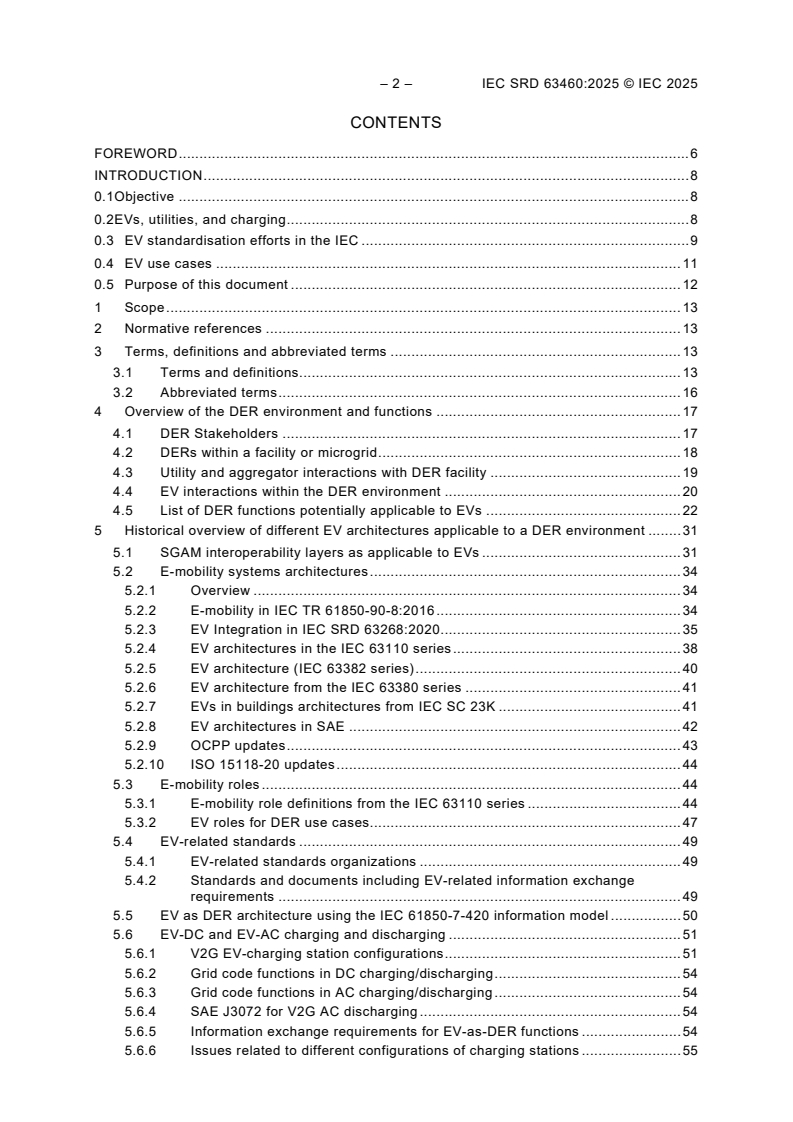
CONTENTS
FOREWORD . 6
INTRODUCTION . 8
0.1Objective . 8
0.2EVs, utilities, and charging . 8
0.3 EV standardisation efforts in the IEC . 9
0.4 EV use cases . 11
0.5 Purpose of this document . 12
1 Scope . 13
2 Normative references . 13
3 Terms, definitions and abbreviated terms . 13
3.1 Terms and definitions. 13
3.2 Abbreviated terms . 16
4 Overview of the DER environment and functions . 17
4.1 DER Stakeholders . 17
4.2 DERs within a facility or microgrid . 18
4.3 Utility and aggregator interactions with DER facility . 19
4.4 EV interactions within the DER environment . 20
4.5 List of DER functions potentially applicable to EVs . 22
5 Historical overview of different EV architectures applicable to a DER environment . 31
5.1 SGAM interoperability layers as applicable to EVs . 31
5.2 E-mobility systems architectures . 34
5.2.1 Overview . 34
5.2.2 E-mobility in IEC TR 61850-90-8:2016 . 34
5.2.3 EV Integration in IEC SRD 63268:2020 . 35
5.2.4 EV architectures in the IEC 63110 series . 38
5.2.5 EV architecture (IEC 63382 series) . 40
5.2.6 EV architecture from the IEC 63380 series . 41
5.2.7 EVs in buildings architectures from IEC SC 23K . 41
5.2.8 EV architectures in SAE . 42
5.2.9 OCPP updates . 43
5.2.10 ISO 15118-20 updates . 44
5.3 E-mobility roles . 44
5.3.1 E-mobility role definitions from the IEC 63110 series . 44
5.3.2 EV roles for DER use cases. 47
5.4 EV-related standards . 49
5.4.1 EV-related standards organizations . 49
5.4.2 Standards and documents including EV-related information exchange
requirements . 49
5.5 EV as DER architecture using the IEC 61850-7-420 information model . 50
5.6 EV-DC and EV-AC charging and discharging . 51
5.6.1 V2G EV-charging station configurations . 51
5.6.2 Grid code functions in DC charging/discharging . 54
5.6.3 Grid code functions in AC charging/discharging . 54
5.6.4 SAE J3072 for V2G AC discharging . 54
5.6.5 Information exchange requirements for EV-as-DER functions . 54
5.6.6 Issues related to different configurations of charging stations . 55
6 EV-as-DER business cases . 55
6.1 Business cases versus use cases . 55
6.2 Transmission EV-as-DER business cases for balancing authorities and
transmission utilities . 56
6.2.1 General . 56
6.2.2 Business case: fault-induced delayed voltage recovery (FIDVR) . 56
6.2.3 Business case: steady-state consumption control . 56
6.2.4 Business case: power factor management . 56
6.2.5 Business case: frequency response (active power-frequency control) . 57
6.2.6 Business case: underfrequency load shedding. 57
6.2.7 Business case: ride-through performance: remaining connected during
grid disturbances . 57
6.3 Distribution EV-as-DER business cases for MV and LV grid support . 58
6.3.1 General . 58
6.3.2 Business case: manage potential overload situations via EV peak power
limiting . 58
6.3.3 Business case: provide benefits to EV owners via vehicle-to-home
(V2H) . 58
6.3.4 Business case: provide benefits to the grid via vehicle-to-grid (V2G) . 59
6.3.5 Business case: improve grid efficiency through coordinated charge/
discharge of EVs . 59
6.3.6 Business case: provide voltage support via volt-watt response by EVs . 59
6.3.7 Business case: provide reactive power support via watt-var function . 59
6.3.8 Business case: help meet export and/or import limits via the limit active
power export/import function . 59
7 EV-as-DER use cases . 59
7.1 General . 59
7.1.1 Overview . 59
7.1.2 Use case E1: EV peak power limiting on demand . 60
7.1.3 Use case E4: volt-watt response by EVs . 60
7.1.4 Use case E8: coordinated charge/discharge of EVs . 60
7.1.5 Use case E9: V2G EV as DER . 60
7.1.6 Use case E12: watt-var function . 61
7.1.7 Use case E15: limit active power export function . 61
7.2 Use case: limit active power import operational function . 61
7.2.1 Name of use case . 61
7.2.2 Version management . 61
7.2.3 Scope and objectives of use case . 61
7.2.4 Narrative of the use case . 61
7.2.5 Scenario steps . 62
7.2.6 Use case diagrams – Sequence diagram . 62
7.3 Use cases: frequency-active power (frequency-watt) operational functions . 63
7.3.1 Overview of frequency-active power (frequency-watt) operational
functions . 63
7.3.2 Use case: frequency-active power as FSM operational function . 66
7.3.3 Use case: frequency droop or "primary frequency response" operational
function . 68
7.3.4 Use case: secondary frequency response (AGC) operational function . 69
7.3.5 Use case: tertiary or spinning reserve frequency response operational
function . 70
7.3.6 Use case: synthetic Inertia operational function . 70
– 4 – IEC SRD 63460:2025 © IEC 2025
7.4 Use cases: ride-through operational functions for charging stations . 72
7.4.1 Use case: frequency ride-through operational functions for charging
stations. 72
7.4.2 Use case: voltage ride-through operational functions for charging
stations. 73
8 Gaps of EV-as-DER in IEC e-mobility standards . 73
8.1 Overview of EV-as-DER gaps . 73
8.2 EV-as-DER-related standards, inclusion of V2G and/or V1G as controllable
load . 75
8.2.1 EV-as-DER in standards defining DER functional requirements . 75
8.2.2 EV-as-DER in communication standards . 75
8.2.3 EV-as-DER OEM telematics . 75
8.3 Balancing authority and/or transmission utility business and use cases . 75
8.4 Distribution system operator business and use cases . 76
8.5 IEC 61850 and/or CIM information model requirements for each use case . 77
8.6 EV-as-DER protocols . 77
8.7 Testing of EV-as-DER stationary equipment . 77
8.8 Testing/Attestation of EVs to meet EV-as-DER requirements . 77
9 Next steps . 77
Bibliography . 78
Figure 1 – EV as DER architecture within the larger grid environment . 10
Figure 2 – IEC Standards for EV grid support and charging management . 11
Figure 3 – Illustrations of ECP, PoC, PCC, RPA, local EPS, and area EPS . 14
Figure 4 – Key DER stakeholders . 18
Figure 5 – DER within a facility: residence, campus, or plant, potentially as a microgrid,
with flexibility market . 19
Figure 6 – Utility and aggregator interactions with DER facilities or directly with DERs . 20
Figure 7 – DER architecture with a focus on charging stations . 21
Figure 8 – Smart grid architecture model (SGAM) . 31
Figure 9 – GWAC Stack and SGAM . 33
Figure 10 – Core communication protocols and information models for EV-as-DER . 33
Figure 11 – E-mobility SGAM view (out of date) . 34
Figure 12 – EV-related IEC 61850-90-8 data objects . 35
Figure 13 – Addition interfaces to support EV mapped to the SGAM communication
layer (in case of H&B) . 36
Figure 14 – Marketplace interfaces mapped to the SGAM information layer . 37
Figure 15 – IEC entities involved in supporting marketplace interfaces . 38
Figure 16 – E-mobility standards landscape within the IEC . 39
Figure 17 – Message flow between IEC TC 69 standards (not including TC 57
standards) . 39
Figure 18 – Information flow between actors based on the IEC 61850-7-420
information model . 40
Figure 19 – IEC 63382 diagram of actors and IEC standards responsible for the
communications . 40
Figure 20 – EV architecture in the IEC 63380 series . 41
Figure 21 – EVs in buildings architecture from IEC SC 23K . 42
Figure 22 – SAE PEV standards for communication, interoperability, and security . 43
Figure 23 – OCPP topology for DER control via the charging point operator (CPO) . 43
Figure 24 – EV roles (actors) identified in the IEC 63110 series . 44
Figure 25 – Example of scope of key roles . 45
Figure 26 – Roles for charging stations applicable to a DER environment . 48
Figure 27 – Communication protocols associated with EV roles in a DER environment . 49
Figure 28 – EV as DER architecture . 51
Figure 29 – Overview of charging configuration with DC bus, with DC/DC charging . 52
Figure 30 – Extract of charging configuration with AC bus, EVSE inverter conversion
AC to DC, and DC charging . 52
Figure 31 – Extract of charging configuration with AC bus, EVSE pass-through of AC,
and AC charging with EV inverter . 53
Figure 32 – Extract of charging configuration with no bus, EVSE pass-through of AC,
and AC charging with EV inverter . 53
Figure 33 – Extract of charging configuration with no bus, EVSE inverter conversion
AC to DC, and DC charging of EV . 54
Figure 34 – Active power limiting sequence diagram . 63
Figure 35 – For zone 1 frequency sensitivity, potential use of WMax or WRef to
determine the gradient . 64
Figure 36 – Frequency-active power constrained by static boundary: DER to remain
within the boundaries of frequency-active power curves . 65
Figure 37 – Sequence diagram: frequency-watt sensitivity operational function for EV-
DC . 67
Figure 38 – Sequence diagram: frequency-watt sensitivity operational function for EV-
AC . 68
Figure 39 – Frequency droop typical curve . 69
Figure 40 – Sequence diagram: frequency ride-through grid code function for charging
stations . 73
Figure 41 – Diagram of EV-as-DER gaps . 74
Table 1 – DER functions for EV environment: roles and information exchanges . 22
Table 2 – Roles applicable to EVs in a DER environment. 45
Table 3 – EV charging station configurations . 51
– 6 – IEC SRD 63460:2025 © IEC 2025
INTERNATIONAL ELECTROTECHNICAL COMMISSION
____________
ARCHITECTURE AND USE-CASES FOR EVS
TO PROVIDE GRID SUPPORT FUNCTIONS
FOREWORD
1) The International Electrotechnical Commission (IEC) is a worldwide organization for standardization comprising
all national electrotechnical committees (IEC National Committees). The object of IEC is to promote international
co-operation on all questions concerning standardization in the electrical and electronic fields. To this end and
in addition to other activities, IEC publishes International Standards, Technical Specifications, Technical Reports,
Publicly Available Specifications (PAS) and Guides (hereafter referred to as "IEC Publication(s)"). Their
preparation is entrusted to technical committees; any IEC National Committee interested in the subject dealt with
may participate in this preparatory work. International, governmental and non-governmental organizations liaising
with the IEC also participate in this preparation. IEC collaborates closely with the International Organization for
Standardization (ISO) in accordance with conditions determined by agreement between the two organizations.
2) The formal decisions or agreements of IEC on technical matters express, as nearly as possible, an international
consensus of opinion on the relevant subjects since each technical committee has representation from all
interested IEC National Committees.
3) IEC Publications have the form of recommendations for international use and are accepted by IEC National
Committees in that sense. While all reasonable efforts are made to ensure that the technical content of IEC
Publications is accurate, IEC cannot be held responsible for the way in which they are used or for any
misinterpretation by any end user.
4) In order to promote international uniformity, IEC National Committees undertake to apply IEC Publications
transparently to the maximum extent possible in their national and regional publications. Any divergence between
any IEC Publication and the corresponding national or regional publication shall be clearly indicated in the latter.
5) IEC itself does not provide any attestation of conformity. Independent certification bodies provide conformity
assessment services and, in some areas, access to IEC marks of conformity. IEC is not responsible for any
services carried out by independent certification bodies.
6) All users should ensure that they have the latest edition of this publication.
7) No liability shall attach to IEC or its directors, employees, servants or agents including individual experts and
members of its technical committees and IEC National Committees for any personal injury, property damage or
other damage of any nature whatsoever, whether direct or indirect, or for costs (including legal fees) and
expenses arising out of the publication, use of, or reliance upon, this IEC Publication or any other IEC
Publications.
8) Attention is drawn to the Normative references cited in this publication. Use of the referenced publications is
indispensable for the correct application of this publication.
9) IEC draws attention to the possibility that the implementation of this document may involve the use of (a)
patent(s). IEC takes no position concerning the evidence, validity or applicability of any claimed patent rights in
respect thereof. As of the date of publication of this document, IEC had not received notice of (a) patent(s), which
may be required to implement this document. However, implementers are cautioned that this may not represent
the latest information, which may be obtained from the patent database available at https://patents.iec.ch. IEC
shall not be held responsible for identifying any or all such patent rights.
IEC SRD 63460 has been prepared by IEC system committee Smart energy. It is a System
Reference Document (SRD)
The text of this System Reference Document is based on the following documents:
Draft Report on voting
SyCSmartEnergy/287/DTS SyCSmartEnergy/288/RVDTS
Full information on the voting for its approval can be found in the report on voting indicated in
the above table.
The language used for the development of this System Reference Document is English.
This document was drafted in accordance with ISO/IEC Directives, Part 2, and developed in
accordance with ISO/IEC Directives, Part 1 and ISO/IEC Directives, IEC Supplement, available
at www.iec.ch/members_experts/refdocs. The main document types developed by IEC are
described in greater detail at www.iec.ch/publications.
The committee has decided that the contents of this document will remain unchanged until the
stability date indicated on the IEC website under webstore.iec.ch in the data related to the
specific document. At this date, the document will be
• reconfirmed,
• withdrawn, or
• revised.
– 8 – IEC SRD 63460:2025 © IEC 2025
INTRODUCTION
0.1 Objective
When electric vehicles (EVs) are interconnected to the electric power system, they are capable
of providing grid support functions similar to other distributed energy resources (DER),
particularly energy storage units, while still not impacting any more than necessary their primary
purpose of charging their batteries in a timely manner. In aggregate, such as in fleets, in
community aggregations, or in microgrids, EVs can not only benefit grid operations, but, if not
managed well, cause grid problems.
This document provides various use cases as examples of how EVs might be used as DERs.
Since regulations, EVs, charging stations, and power systems are vastly different across the
world, this document does not attempt to define any specific mechanism for EVs to provide
DER grid support functions, but rather draws on IEC 61850-7-420 that defines the data models
for most of the DER grid support functions, including those described in electric power
TM
requirements in IEEE Std 1547 -2018 and EN 50549.
It is expected that IEC 61850-7-420 will utilize these use cases to develop EV-specific data
models for "EV as DER" as needed, and that other standards such as the IEC 63110,
ISO 15118, and the IEC 63382 series will be revised or will otherwise accommodate the results
of these "EV as DER" requirements.
Clearly contractual arrangements will need to be made with all relevant stakeholders on which
EVs, under what conditions, with which functions, and when permitted. However, those
contractual arrangements are outside the scope of this document, which addresses only the
technical aspects of EVs as DER.
Cybersecurity for EVs as DER is important but is not in the scope of this document.
0.2 EVs, utilities, and charging
Utilities everywhere are concerned that the charging load for electric vehicles (EVs) will greatly
increase the load on the power grids. In many places, the charging load could exceed the
existing demand during peak hours from residential consumers. As more electric vehicle
charging points are deployed, it becomes increasingly important to manage flexibility of both
the power levels and the time of charging.
The concept adopted in the past has been that EV charging would be managed by charging
stations similar to gas stations, but today it is clear that EV drivers often charge at home and
use phone applications, cloud-based systems, and remote service providers to manage their
charging. Although charging stations are still important, they are no longer the only way EVs
are charged. This shift is also complicating the design of the EV standards.
In addition, the idea that EVs could be used to support the power grid used to be regarded as
strange, technically difficult, and not likely to be supported by EV owners. That idea, too, has
been overtaken by events, as more and more EV manufacturers are including the ability to
discharge and many pilot projects have shown that "vehicle-to-home" would be very desirable
by customers, and "vehicle-to-grid" would be very popular with EV fleets and charging stations
if they want to take part in market operations. In some regions, such as California, if the EVs
are capable of discharging, they are included in the definition of Distributed Energy Resources.
___________
Under preparation.
Two primary groups of use cases have been identified: those concerned with the market aspects
of charging, and those concerned with the grid services related to the impact of charging on the
power system. A few use cases address vehicle-to-grid. Figure 2 illustrates the IEC standards
used for EV grid support and market-related charging management.
For many years, academic papers have proposed using EV batteries as a form of energy
storage that can provide services to the power grid even if only charging. But now there are
many research and pilot projects around the world that are deploying some form of bidirectional
flow of energy (charging and discharging), either as vehicle-to-grid (V2G) or vehicle-to-home
(V2H), with EVs able to sell power to the main grid and even support the energy management
of microgrids. One of the driving ideas behind these projects is to provide a means of storing
energy in the EV from variable renewable resources, like solar and wind, for use at other times.
This implies that EVs can actually be viewed as just one type of distributed energy resources
(DER).
0.3 EV standardisation efforts in the IEC
Within the IEC, various committees and working groups are collaborating to define standards
and guidance on how these new types of EV-related equipment should be integrated into power
systems. There are several technical groups that are concerned with the physical and safety
aspects of different types of equipment and others that look at how the different types of
EV-related equipment are integrated into the power system.
However, integrating EVs into power systems so that they do not overload the grid and can
actually support grid reliability, requires understanding the electric utility perspective. Figure 1
shows the big picture with various types of systems relevant to DERs and EVs.
– 10 – IEC SRD 63460:2025 © IEC 2025
Hierarchical DER System Five-Level Architecture, Mapped to the Smart Grid Architecture Model (SGAM)
Level 5: Market Interactions
Flexibility and Demand Response
Transmission Energy
Distribution Energy Market
Retail Energy Market
Market
Information and
Market
Communications
Technology (ICT)
Level 4: DSO: Distribution Utility
Distribution
Level 4: ISO/RTO/TSO
Operational Analysis and Control Level 3: Third Parties
Management
Balancing Authority
for Grid Management
System (DMS)
Plant-Level
Flexibility Operator
(FO)
Geographic Contractual
Balancing Plant Control
Outage
Information Aggregator DER &
Agreements with DER System
Authority for
Management Enterprise
System (GIS) Systems, Facilities, Load Management
Frequency
System (OMS)
System (ADMS)
Management and Aggregators Microgrid DERMS
(mDERMS)
Original Equipment
Utility WAN/LAN Manufacturer (OEM)
Transmission Facility DER and
Energy Load Energy
Management Charging Station Management
Transmission
DER
System (EMS) DER Management Management (FDERMS)
Bus Load
Communications System (CSMS)
System (Utility
Model (TBLM)
Capabilities
DERMS) Customer Energy
SCADA Operation
SCADA DERMS Management
(CEM)
System Integrity
Level 2: Facilities with DERs
Protection
and/or IBRs
Scheme
Facilities Site WAN/LAN
Station
Building/Area #2 DER
Building/Area #1 DER Charging Station Facilities
Energy Management Energy Management Management System (CSMS) Load
Systems Systems
Resource Management (RM) Management
Level 1: Autonomous
Distribution
Field
cyber-physical DER Charging Station
Substation
Energy Storage PV Wind Fossil Fuel Load
systems Controller (CSC) &
Controller Controller Controller Controller Controllers
EVSEs
Integrated
Protection
Battery/Thermal Wind Diesel GenSet Facilities
Scheme
Local EPS PV Panels Electric Vehicles
Storage Turbine or Gas Turbine Site Loads
Protection
Utility Grid
Process
PoC PoC PoC PoC PoC PoC
Meter at
Area EPS
PCC or POI
Local EPS
Transmission Distribution
Distributed Energy Resources (DER) / Customer Premises
Reproduced with the permission of Xanthus Consulting International
Figure 1 – EV as DER architecture within the larger grid environment
The IEC has many different groups addressing aspects of EVs and their charging from the grid.
For the physical aspects, IEC TC 8 and its subcommittees work on the overall system aspects
of electricity supply systems, and IEC TC 120 is responsible for standardization in the field of
grid integrated energy storage systems. IEC TC 69 prepares publications related to electrical
power/energy transfer systems for electrically propelled road vehicles, including some physical
charger connection standards such as IEC 61851. TC 69 has also worked with the ISO to
develop charging communication protocols such as the ISO 15118 series and has established
joint working groups with other TCs to manage the higher-level charging infrastructure with use
cases and communication protocols, currently developing the IEC 63110 series and the
IEC 63382 series.
IEC TC 57 has that utility perspective and has developed sophisticated communication and
automation standards for power systems control equipment and control centre systems. These
standards include IEC 61850 for substations, distribution automation, and more recently DER.
The common information model (CIM), covered in IEC 61968, the IEC 61970 series, IEC 62325,
is focused on grid management applications and market interactions. In addition, IEC TC 65
has developed some standards describing energy management systems for industrial sites and
IEC SC 23K is working on standards for energy management within residential and commercial
premises. Complementing these energy standards is IEC TC13 who provides metering
standards.
Figure 2 illustrates the different communication standards being applied in the EV domain.
Electric Vehicles (EV) as Distributed Energy Resources (DER)
Purple = Grid Support Data Model Standard
Blue = Charging Management Use Cases
Green = Communication Protocol Standards
61850 DM = 61850-7-420 Data Model
{Market}
{Utility}
Incentives of EV grid support functions, over
Flexibility Operator (FO)
Balancing Authority or Transmission
Energy Services Marketplace
any selected protocol
System Operator (TSO)
Incentives
OpenADR 3.0 63882
Incentives
Incentives {Third Party}
{Utility} {Third Party}
Distribution System Operator Aggregator or C harging Station Original Equipment
(DSO) Manufacturer ( OEM)
Management System (CSMS)
61850 DM
61850 DM 63110/OCPP
Proprietary
Proprietary
61850 DM
{Facility}
61850 DM
Plant Energy Management System
Customer Energy Management (CEM)
Lo cal C harging Station Managem ent System
61850 DM
61850 DM 63380/63110/OCPP
{Electric Vehicle Applicatio n}
{Charging Controllers}
Electric Vehicle Application
Charging Station Controller (CSC)
IEC 61850 protocol
(EVA)
IEEE 1815.2 ( DN P3)
61850 DM Proprietary
IEEE 2030.5
Modbus
{Charging Controller Units}
SAE J3072 for V2G AC
Electric Vehicle Servic e Equ ip ment Proprietary
(EVSE) for charging and discharging
with DC and AC connections
61850 DM 15118-20
{DER Units}
Photovoltaic system
Proprietary
Stationary storage {Electric Vehicle}
{Electric Vehicle User}
Diesel generator Electric Vehicle (EV), V1G, V2X,
Electric Vehicle User (EVU)
Controllable loads
with AC and DC connections
Reproduced with the permission of Xanthus Consulting International
Figure 2 – IEC Standards for EV grid support and charging management
0.4 EV use cases
Many use cases have been developed that focus on the pricing and timing of energy
management of charging electric vehicles. Typically, these energy management systems are
concerned with optimising the cost of the energy used to charge the vehicles. These use cases
rarely address the grid needs of distribution system operators who might need to impose
constraints on the grid if the charging loads become too high. However, there is increasing
awareness that these grid requirements also need to be take into account as more and more
utility customers switch to electric vehicles. This dynamic juxtaposition of growing need for EV
charging versus the strain that this charging puts on the grid is an area of growing concern
around the world and will require sophisticated and flexible information and communication
technologies. Different countries and regions will necessarily involve different business models,
but all will need to reflect the challenges posed by such a shift in electrification requirements.
Other use cases and information models, developed more from the grid integration and grid
management perspectives, have been developed related to the functions that distributed energy
resources (DER) can provide. In particular, these use cases identify how these generation and
storage systems can help manage grid voltage and frequency and can even ride through
abnormal conditions to possibly avoid power outages. The information models were based on
national grid codes originally developed for the integration of bulk generation resources, but
now they have been extended to cover smaller distributed energy resources and battery
storage. Thus, most of the use case development has already been done – they just need to be
expanded to electric vehicle charging – and discharging – systems, thus converting EVs as
uncontrolled loads to EVs-as-DERs.
– 12 – IEC SRD 63460:2025 © IEC 2025
0.5 Purpose of this document
This document describes the architecture and use-cases for EVs to provide grid support
functions, or more familiarly called "EV-as-DER". Most of this document will be concerned with
identifying realistic EV charging and discharging configurations, and the communication and
control between the various actors, grid system operators, aggregators, premises energy
management, and EV charging systems. The results from this document will hopefully help to
take the grid-support capabilities of EVs into account as other standards are developed.
ARCHITECTURE AND USE-CASES FOR EVS
TO PROVIDE GRID SUPPORT FUNCTIONS
1 Scope
The scope of this document is the assessment of how electric vehicles (EVs) can act as
distributed energy resources (DER) when they are interconnected to the electric power system
for charging or discharging, whether in the home, in an office complex, in shopping centres, or
in EV charging stations. Although clearly the main purpose for EV interconnection to the grid is
to charge their batteries, EVs can provide grid support functions while interconnected, and in
some situations, can be mandated or incentivized to do so.
This document provides use cases as examples of how EVs might provide such DER
functionality, based on the grid support functions defined in IEC 61850-7-420,
IEEE Std 1547:2018, and EN 50549.
2 Normative references
The following documents are referred to in the text in such a way that some or all of their content
constitutes requirements of this document. For dated references, only the edition cited applies.
For undated references, the latest edition of the referenced document (including any
amendments) applies.
IEEE Std 1547-2018, IEEE Standard for interconnection and interoperability of distributed
energy resources with associated electric power systems interfaces
IEEE Std 2800-2022, IEEE Standard for interconnection and interoperability of inverter-based
resources (IBRs) interconnecting with associated transmission electric power systems
3 Terms, definitions and abbreviated terms
3.1 Terms and definitions
TM
For the purposes of this document, the terms and definitions given in IEEE Std 1547 and
TM
IEEE Std 2800 apply.
ISO and IEC maintain terminological databases for use in standardization at the following
addresses:
• IEC Electropedia: available at http://www.electropedia.org/
• ISO Online browsing platform: available at http://www.iso.org/obp
NOTE See Figure 3 for an illustration of some of the terms.
– 14 – IEC SRD 63460:2025 © IEC 2025
Voltage, Watts, Vars, PF, Frequency
Measurements from Referenced ECP
ESS
PV
External RPA
Autonomous
PoC Functions with
Building #1 Local EPS
RPA at the PCC
Area Electric Power System (EPS)
(Utility Grid)
Controllable
Load
PV+
CHP
ESS
Point of Common
Local Electric Power
Coupling (PCC)
System (EPS)
ESS PV
Functions with
RPA at the PCC
Generation
Load Following
IEEE 1815.2 (DNP3),
Utility or Aggregator
Following
Facility DER IEEE 2030.5,
IEC 61850
ADMS/DERMS
Management System
Building #2 Local EPS
Establishes export and
Manages all DER and
import limits and
Loads within the Facility
requirements for the Facility
Uncontrollable
= Electrical Connection Point (ECP)
EVSE
Load
+ EV = Point of Connection (PoC) for DER (Type of ECP)
= Point of Common Coupling (PCC) for Facility (Type of ECP)
PV = Photovoltaic System
= Power system measurements from Referenced Point of Applicability (RPA)
ESS = Energy Storage System
= Settings and control commands
EV = Electric Vehicle
Reproduced with the permission of Xanthus Consulting International
Figure 3 – Illustrations of ECP, PoC, PCC, RPA, local EPS, and area EPS
3.1.1
area electric power system
area EPS
EPS that serves local EPSs
3.1.2
business case
description of business objectives or purposes that could be provided through regulations,
procedures, and/or technology
Note 1 to entry: Typically, business cases stay at a high level to focus on what or why a process is needed, but not
how that pro
...