

IEC 61249-2-52:2025
(Main)Materials for printed boards and other interconnecting structures - Part 2-52: Reinforced base materials clad and unclad - Thermosetting hydrocarbon resin system, woven E-glass reinforced laminate sheets of defined flammability (vertical burning test), copper-clad
General Information
- Abstract
IEC 61249-2-52:2025 gives requirements for properties of the thermosetting hydrocarbon resin system, woven E-glass reinforced laminate sheets of defined flammability (vertical burning test), copper-clad in thicknesses of 0,05 mm up to 3,20 mm.
- Status
- Published
- Publication Date
- 15-Sep-2025
- Technical Committee
- TC 91 - Electronics assembly technology
- Drafting Committee
- WG 4 - TC 91/WG 4
- Current Stage
- PPUB - Publication issued
- Start Date
- 16-Sep-2025
- Completion Date
- 22-Oct-2025
Buy Documents
IEC 61249-2-52:2025 - Materials for printed boards and other interconnecting structures - Part 2-52: Reinforced base materials clad and unclad - Thermosetting hydrocarbon resin system, woven E-glass reinforced laminate sheets of defined flammability (vertical burning test), copper-clad Released:9/16/2025
IEC 61249-2-52:2025 - Matériaux pour circuits imprimés et autres structures d’interconnexion - Partie 2-52: Matériaux de base renforcés, métallisés et non métallisés - Feuilles stratifiées renforcées en tissu de verre de type E avec systeme de résines d'hydrocarbure thermodurcissables, d’inflammabilité définie (essai de combustion verticale), plaquées cuivre Released:9/16/2025
IEC 61249-2-52:2025 - Materials for printed boards and other interconnecting structures - Part 2-52: Reinforced base materials clad and unclad - Thermosetting hydrocarbon resin system, woven E-glass reinforced laminate sheets of defined flammability (vertical burning test), copper-clad Released:9/16/2025
Overview
IEC 61249-2-52:2025 specifies requirements for thermosetting hydrocarbon resin system, woven E‑glass reinforced laminate sheets with defined flammability (vertical burning test), copper‑clad and supplied unclad, in thicknesses from 0.05 mm to 3.20 mm. Part of the IEC 61249 series for materials used in printed boards and other interconnecting structures, this standard defines material composition, performance tests, inspection and documentation needed to ensure reliable printed circuit board (PCB) base materials.
Key topics and requirements
The standard covers both material construction and measurable performance characteristics, including:
- Materials and construction: resin system, metal foil (copper‑clad), and woven E‑glass reinforcement.
- Electrical properties: standardized test methods and tabulated electrical performance expectations for PCB base materials.
- Non‑electrical properties: appearance, laminate thickness tolerances, bow & twist, peel strength (copper bond), thermal stress, solderability, punching and machining suitability, and dimensional stability.
- Mechanical and thermal properties: flexural strength, glass transition temperature (Tg) and cure factor, decomposition temperature, time to delamination (TMA), Z‑axis and X/Y‑axis expansion, and thermal conductivity.
- Flammability: defined criteria based on the vertical burning test to classify material behavior under fire conditions.
- Durability tests: water absorption, measling (visual defects), surface finish criteria and thermal aging behaviors.
- Quality assurance and inspection: qualification inspection, conformance inspection plans, sampling, judgment rules, certificate of conformance, and safety data sheet (SDS) requirements.
- Logistics and traceability: internal marking, packaging, marking, sheet/cut panel sizes and ordering information.
Applications and who uses it
IEC 61249-2-52:2025 is directly applicable to stakeholders in the electronics supply chain:
- PCB laminate and copper‑clad manufacturers - to define product specifications and quality control.
- PCB fabricators and assemblers - to select materials that meet solderability, dimensional and thermal requirements.
- OEMs in consumer electronics, automotive, aerospace and industrial sectors - to ensure material safety (flammability) and reliability.
- Procurement, quality and compliance engineers - for supplier qualification, incoming inspection and regulatory documentation.
- R&D and materials engineers - to compare laminate formulations and to design PCBs for thermal/mechanical performance.
Related standards
- IEC 61189‑2 (test methods for electrical materials and printed boards) - normative test references.
- IEC 61249‑5‑1 (sectional specification set for conductive materials) - related materials guidance.
- Other parts of the IEC 61249 series for broader materials and construction requirements.
Keywords: IEC 61249-2-52:2025, copper-clad laminate, thermosetting hydrocarbon resin, woven E-glass, vertical burning test, PCB base material, flammability, Tg, Z-axis expansion, solderability.
Buy Documents
IEC 61249-2-52:2025 - Materials for printed boards and other interconnecting structures - Part 2-52: Reinforced base materials clad and unclad - Thermosetting hydrocarbon resin system, woven E-glass reinforced laminate sheets of defined flammability (vertical burning test), copper-clad Released:9/16/2025
IEC 61249-2-52:2025 - Matériaux pour circuits imprimés et autres structures d’interconnexion - Partie 2-52: Matériaux de base renforcés, métallisés et non métallisés - Feuilles stratifiées renforcées en tissu de verre de type E avec systeme de résines d'hydrocarbure thermodurcissables, d’inflammabilité définie (essai de combustion verticale), plaquées cuivre Released:9/16/2025
IEC 61249-2-52:2025 - Materials for printed boards and other interconnecting structures - Part 2-52: Reinforced base materials clad and unclad - Thermosetting hydrocarbon resin system, woven E-glass reinforced laminate sheets of defined flammability (vertical burning test), copper-clad Released:9/16/2025
Frequently Asked Questions
IEC 61249-2-52:2025 is a standard published by the International Electrotechnical Commission (IEC). Its full title is "Materials for printed boards and other interconnecting structures - Part 2-52: Reinforced base materials clad and unclad - Thermosetting hydrocarbon resin system, woven E-glass reinforced laminate sheets of defined flammability (vertical burning test), copper-clad". This standard covers: IEC 61249-2-52:2025 gives requirements for properties of the thermosetting hydrocarbon resin system, woven E-glass reinforced laminate sheets of defined flammability (vertical burning test), copper-clad in thicknesses of 0,05 mm up to 3,20 mm.
IEC 61249-2-52:2025 gives requirements for properties of the thermosetting hydrocarbon resin system, woven E-glass reinforced laminate sheets of defined flammability (vertical burning test), copper-clad in thicknesses of 0,05 mm up to 3,20 mm.
IEC 61249-2-52:2025 is classified under the following ICS (International Classification for Standards) categories: 31.180 - Printed circuits and boards. The ICS classification helps identify the subject area and facilitates finding related standards.
IEC 61249-2-52:2025 is available in PDF format for immediate download after purchase. The document can be added to your cart and obtained through the secure checkout process. Digital delivery ensures instant access to the complete standard document.
Standards Content (Sample)
IEC 61249-2-52 ®
Edition 1.0 2025-09
INTERNATIONAL
STANDARD
Materials for printed boards and other interconnecting structures -
Part 2-52: Reinforced base materials clad and unclad - Thermosetting
hydrocarbon resin system, woven E-glass reinforced laminate sheets of defined
flammability (vertical burning test), copper-clad
ICS 31.180 ISBN 978-2-8327-0724-1
All rights reserved. Unless otherwise specified, no part of this publication may be reproduced or utilized in any form or
by any means, electronic or mechanical, including photocopying and microfilm, without permission in writing from either
IEC or IEC's member National Committee in the country of the requester. If you have any questions about IEC copyright
or have an enquiry about obtaining additional rights to this publication, please contact the address below or your local
IEC member National Committee for further information.
IEC Secretariat Tel.: +41 22 919 02 11
3, rue de Varembé info@iec.ch
CH-1211 Geneva 20 www.iec.ch
Switzerland
About the IEC
The International Electrotechnical Commission (IEC) is the leading global organization that prepares and publishes
International Standards for all electrical, electronic and related technologies.
About IEC publications
The technical content of IEC publications is kept under constant review by the IEC. Please make sure that you have the
latest edition, a corrigendum or an amendment might have been published.
IEC publications search - IEC Products & Services Portal - products.iec.ch
webstore.iec.ch/advsearchform Discover our powerful search engine and read freely all the
The advanced search enables to find IEC publications by a
publications previews, graphical symbols and the glossary.
variety of criteria (reference number, text, technical With a subscription you will always have access to up to date
committee, …). It also gives information on projects, content tailored to your needs.
replaced and withdrawn publications.
Electropedia - www.electropedia.org
IEC Just Published - webstore.iec.ch/justpublished The world's leading online dictionary on electrotechnology,
Stay up to date on all new IEC publications. Just Published containing more than 22 500 terminological entries in English
details all new publications released. Available online and and French, with equivalent terms in 25 additional languages.
once a month by email. Also known as the International Electrotechnical Vocabulary
(IEV) online.
IEC Customer Service Centre - webstore.iec.ch/csc
If you wish to give us your feedback on this publication or
need further assistance, please contact the Customer
Service Centre: sales@iec.ch.
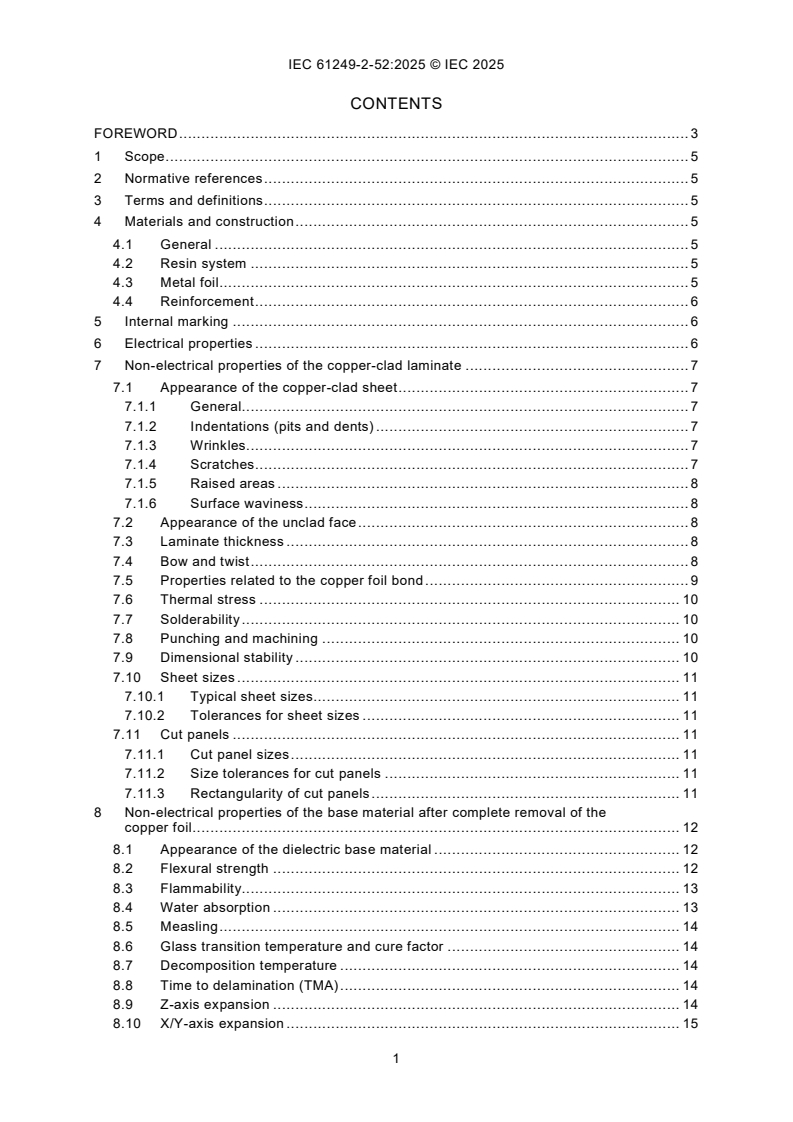
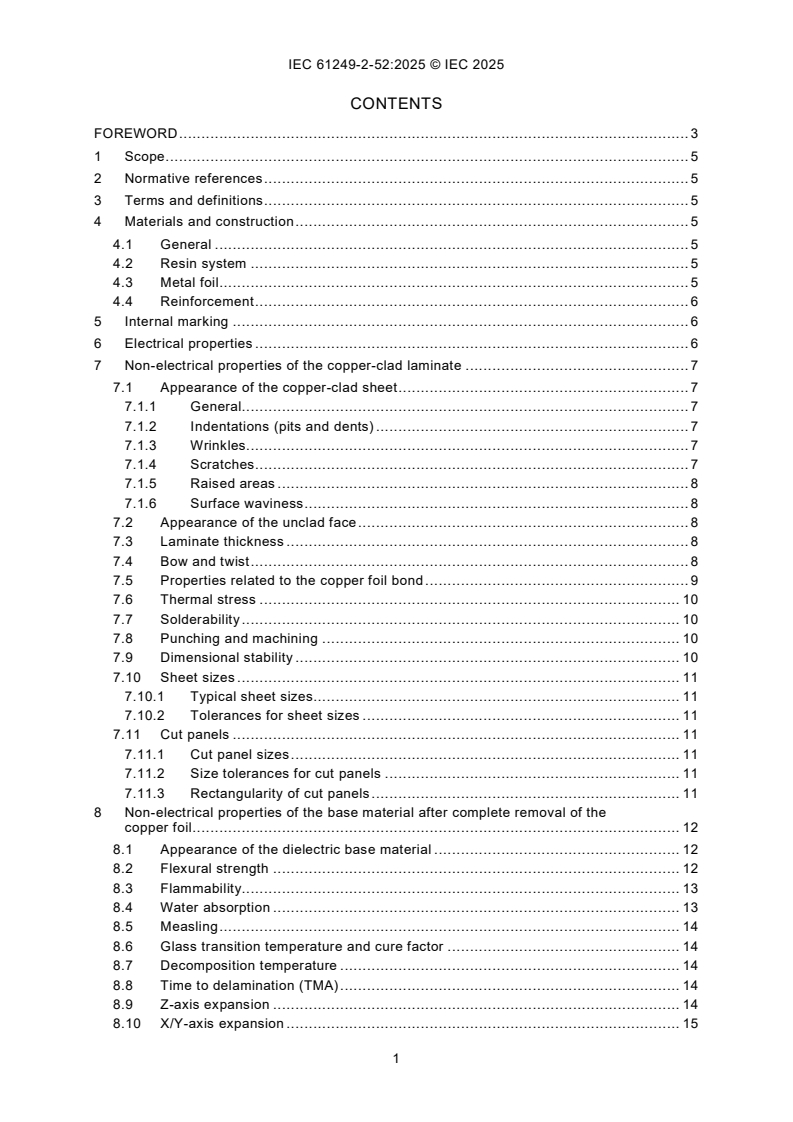
CONTENTS
FOREWORD . 3
1 Scope . 5
2 Normative references . 5
3 Terms and definitions . 5
4 Materials and construction . 5
4.1 General . 5
4.2 Resin system . 5
4.3 Metal foil . 5
4.4 Reinforcement . 6
5 Internal marking . 6
6 Electrical properties . 6
7 Non-electrical properties of the copper-clad laminate . 7
7.1 Appearance of the copper-clad sheet . 7
7.1.1 General. 7
7.1.2 Indentations (pits and dents) . 7
7.1.3 Wrinkles . 7
7.1.4 Scratches . 7
7.1.5 Raised areas . 8
7.1.6 Surface waviness . 8
7.2 Appearance of the unclad face . 8
7.3 Laminate thickness . 8
7.4 Bow and twist . 8
7.5 Properties related to the copper foil bond . 9
7.6 Thermal stress . 10
7.7 Solderability . 10
7.8 Punching and machining . 10
7.9 Dimensional stability . 10
7.10 Sheet sizes . 11
7.10.1 Typical sheet sizes. 11
7.10.2 Tolerances for sheet sizes . 11
7.11 Cut panels . 11
7.11.1 Cut panel sizes . 11
7.11.2 Size tolerances for cut panels . 11
7.11.3 Rectangularity of cut panels . 11
8 Non-electrical properties of the base material after complete removal of the
copper foil . 12
8.1 Appearance of the dielectric base material . 12
8.2 Flexural strength . 12
8.3 Flammability. 13
8.4 Water absorption . 13
8.5 Measling . 14
8.6 Glass transition temperature and cure factor . 14
8.7 Decomposition temperature . 14
8.8 Time to delamination (TMA) . 14
8.9 Z-axis expansion . 14
8.10 X/Y-axis expansion . 15
8.11 Thermal conductivity . 15
9 Quality assurance . 15
9.1 Quality system. 15
9.2 Responsibility for inspection . 15
9.3 Qualification inspection . 15
9.3.1 General. 15
9.3.2 Sampling plan. 15
9.3.3 Frequency . 15
9.3.4 Judgment rules . 16
9.4 Quality conformance inspection . 17
9.4.1 General. 17
9.4.2 Inspection lot . 17
9.4.3 Test of Group A . 17
9.4.4 Test of Group B . 17
9.4.5 Test of Group C . 17
9.4.6 Judgment Rules . 17
9.4.7 Rejected lots . 17
9.5 Certificate of conformance . 17
9.6 Safety data sheet . 17
10 Packaging and marking . 18
11 Ordering information . 18
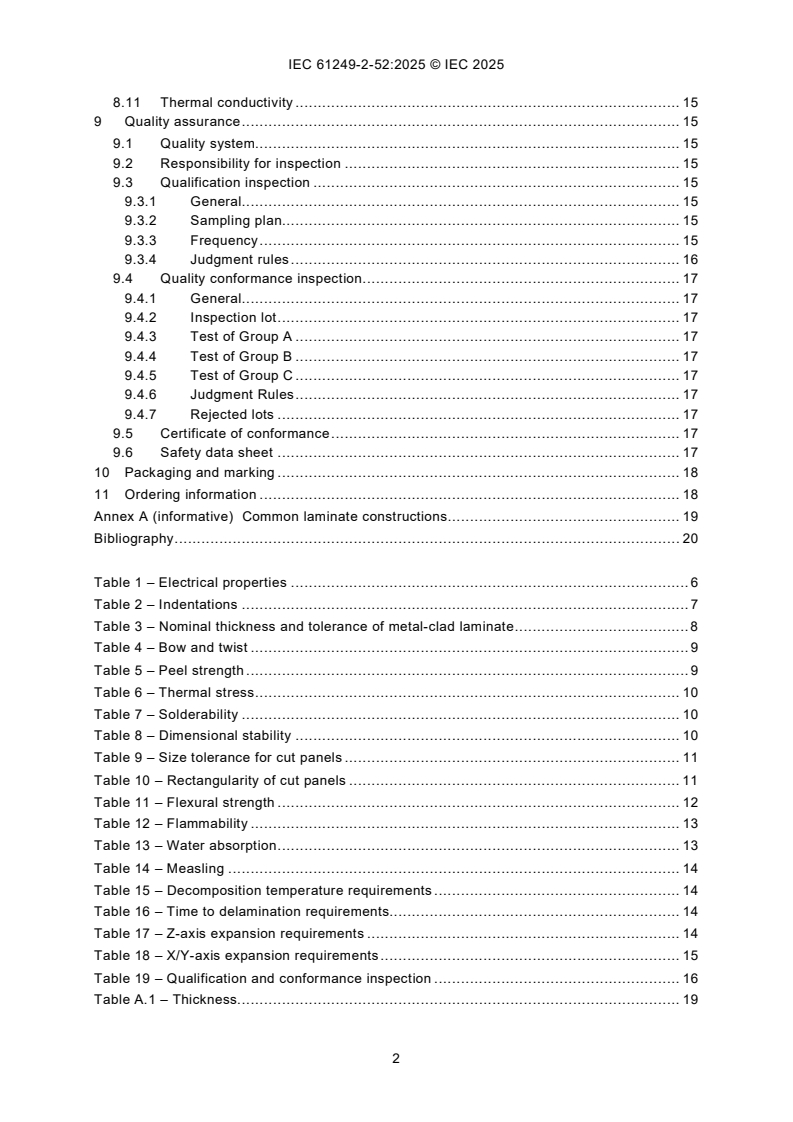
Annex A (informative) Common laminate constructions. 19
Bibliography . 20
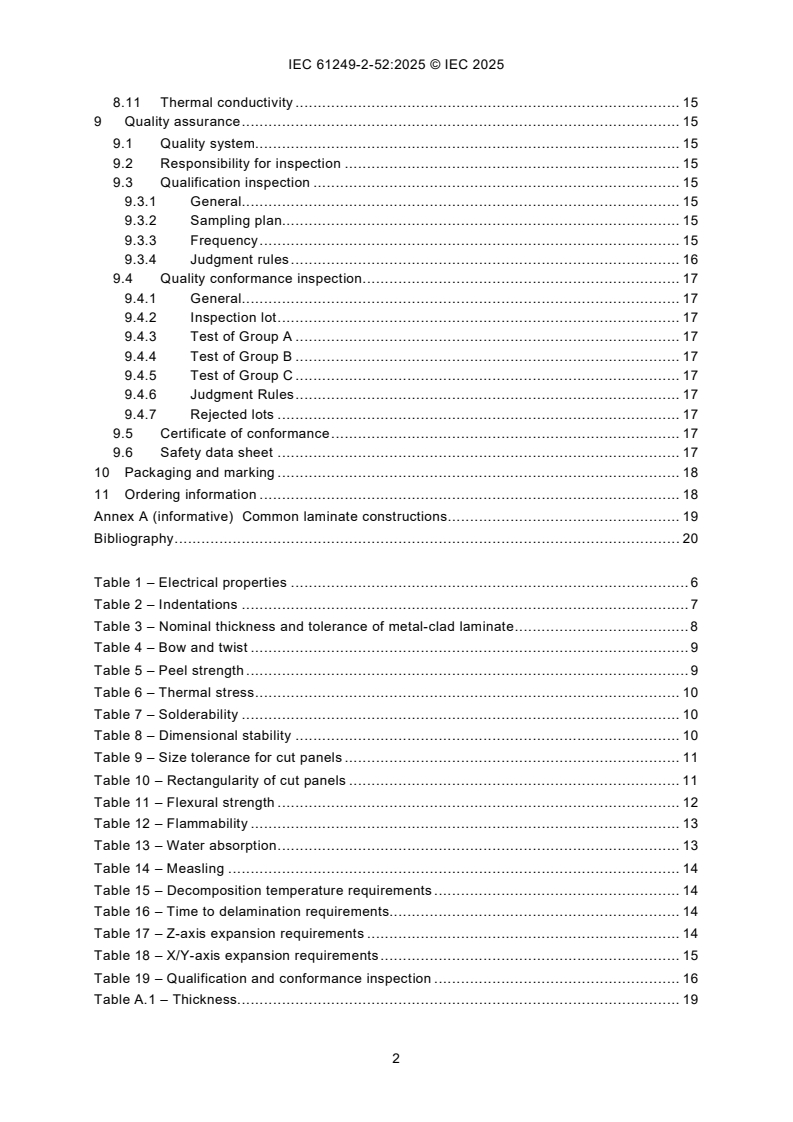
Table 1 – Electrical properties . 6
Table 2 – Indentations . 7
Table 3 – Nominal thickness and tolerance of metal-clad laminate . 8
Table 4 – Bow and twist . 9
Table 5 – Peel strength . 9
Table 6 – Thermal stress . 10
Table 7 – Solderability . 10
Table 8 – Dimensional stability . 10
Table 9 – Size tolerance for cut panels . 11
Table 10 – Rectangularity of cut panels . 11
Table 11 – Flexural strength . 12
Table 12 – Flammability . 13
Table 13 – Water absorption . 13
Table 14 – Measling . 14
Table 15 – Decomposition temperature requirements . 14
Table 16 – Time to delamination requirements. 14
Table 17 – Z-axis expansion requirements . 14
Table 18 – X/Y-axis expansion requirements . 15
Table 19 – Qualification and conformance inspection . 16
Table A.1 – Thickness. 19
INTERNATIONAL ELECTROTECHNICAL COMMISSION
____________
Materials for printed boards and other interconnecting structures -
Part 2-52: Reinforced base materials clad and unclad - Thermosetting
hydrocarbon resin system, woven E-glass reinforced laminate sheets of
defined flammability (vertical burning test), copper-clad
FOREWORD
1) The International Electrotechnical Commission (IEC) is a worldwide organization for standardization comprising
all national electrotechnical committees (IEC National Committees). The object of IEC is to promote international
co-operation on all questions concerning standardization in the electrical and electronic fields. To this end and
in addition to other activities, IEC publishes International Standards, Technical Specifications, Technical Reports,
Publicly Available Specifications (PAS) and Guides (hereafter referred to as "IEC Publication(s) "). Their
preparation is entrusted to technical committees; any IEC National Committee interested in the subject dealt with
may participate in this preparatory work. International, governmental and non-governmental organizations liaising
with the IEC also participate in this preparation. IEC collaborates closely with the International Organization for
Standardization (ISO) in accordance with conditions determined by agreement between the two organizations.
2) The formal decisions or agreements of IEC on technical matters express, as nearly as possible, an international
consensus of opinion on the relevant subjects since each technical committee has representation from all
interested IEC National Committees.
3) IEC Publications have the form of recommendations for international use and are accepted by IEC National
Committees in that sense. While all reasonable efforts are made to ensure that the technical content of IEC
Publications is accurate, IEC cannot be held responsible for the way in which they are used or for any
misinterpretation by any end user.
4) In order to promote international uniformity, IEC National Committees undertake to apply IEC Publications
transparently to the maximum extent possible in their national and regional publications. Any divergence between
any IEC Publication and the corresponding national or regional publication shall be clearly indicated in the latter.
5) IEC itself does not provide any attestation of conformity. Independent certification bodies provide conformity
assessment services and, in some areas, access to IEC marks of conformity. IEC is not responsible for any
services carried out by independent certification bodies.
6) All users should ensure that they have the latest edition of this publication.
7) No liability shall attach to IEC or its directors, employees, servants or agents including individual experts and
members of its technical committees and IEC National Committees for any personal injury, property damage or
other damage of any nature whatsoever, whether direct or indirect, or for costs (including legal fees) and
expenses arising out of the publication, use of, or reliance upon, this IEC Publication or any other IEC
Publications.
8) Attention is drawn to the Normative references cited in this publication. Use of the referenced publications is
indispensable for the correct application of this publication.
9) IEC draws attention to the possibility that the implementation of this document may involve the use of (a)
patent(s). IEC takes no position concerning the evidence, validity or applicability of any claimed patent rights in
respect thereof. As of the date of publication of this document, IEC had not received notice of (a) patent(s), which
may be required to implement this document. However, implementers are cautioned that this may not represent
the latest information, which may be obtained from the patent database available at https://patents.iec.ch. IEC
shall not be held responsible for identifying any or all such patent rights.
IEC 61249-2-52 has been prepared by IEC technical committee 91: Electronics assembly
technology. It is an International Standard.
The text of this International Standard is based on the following documents:
Draft Report on voting
91/1977/CDV 91/2043/RVC
Full information on the voting for its approval can be found in the report on voting indicated in
the above table.
The language used for the development of this International Standard is English.
A list of all parts in the IEC 61249 series, published under the general title Materials for printed
boards and other interconnecting structures, can be found on the IEC website.
This document was drafted in accordance with ISO/IEC Directives, Part 2, and developed in
accordance with ISO/IEC Directives, Part 1 and ISO/IEC Directives, IEC Supplement, available
at www.iec.ch/members_experts/refdocs. The main document types developed by IEC are
described in greater detail at www.iec.ch/publications.
The committee has decided that the contents of this document will remain unchanged until the
stability date indicated on the IEC website under webstore.iec.ch in the data related to the
specific document. At this date, the document will be
– reconfirmed,
– withdrawn, or
– revised.
1 Scope
This part of IEC 61249 gives requirements for properties of the thermosetting hydrocarbon resin
system, woven E-glass reinforced laminate sheets of defined flammability (vertical burning test),
copper-clad in thicknesses of 0,05 mm up to 3,20 mm.
2 Normative references
The following documents are referred to in the text in such a way that some or all of their content
constitutes requirements of this document. For dated references, only the edition cited applies.
For undated references, the latest edition of the referenced document (including any
amendments) applies.
IEC 61189-2:2006, Test methods for electrical materials, printed boards and other
interconnection structures and assemblies - Part 2: Test methods for materials for
interconnection structures
IEC 61249-5-1, Materials for interconnection structures - Part 5: Sectional specification set for
conductive foils and films with and without coatings - Section 1: Copper foils (for the
manufacture of copper-clad base materials)
IEC 61249-6-3, Materials for printed boards and other interconnecting structures - Part 6-3:
Sectional specification set for reinforcement materials - Specification for finished fabric woven
from "E " glass for printed boards
ISO 11014:2009, Safety data sheet for chemical products - Content and order of sections
3 Terms and definitions
No terms and definitions are listed in this document.
ISO and IEC maintain terminology databases for use in standardization at the following
addresses:
– IEC Electropedia: available at https://www.electropedia.org/
– ISO Online browsing platform: available at https://www.iso.org/obp
4 Materials and construction
4.1 General
The sheet consists of an insulating base with metal-foil bonded to one side or both.
4.2 Resin system
The primary resin is polyolefin resin or its modification, copolymers, derivatives. Filler and
accessory ingredients may be added to improve performance.
4.3 Metal foil
Copper as specified in IEC 61249-5-1, copper foil (for the manufacture of copper-clad materials).
The preferred foils are electrodeposited of defined ductility.
4.4 Reinforcement
Woven E-glass as specified in IEC 61249-6-3, woven E-glass fabric (for the manufacture of
prepreg and copper clad materials). Low permittivity E-glass may be used to improve dielectric
performance.
5 Internal marking
Not specified.
6 Electrical properties
The requirements for electrical properties are shown in Table 1.
Table 1 – Electrical properties
Test method
Property Requirements
IEC 61189-2
Surface resistance after damp heat while in
2E03 ≥ 10 000 MΩ
the humidity chamber (optional)
Surface resistance after damp heat and
2E03 ≥ 50 000 MΩ
recovery
Volume resistivity after damp heat while in
2E04 ≥ 5 000 MΩ m
the humidity chamber (optional)
Volume resistivity after damp heat and
2E04 ≥ 10 000 MΩ m
recovery
Type A: ≤ 2,75
a
IPC-TM650-2.5.5.5 Type B: > 2,75 ≤ 6,0
Permittivity at 10 GHz, as received
Type C: > 6,0
a
IEC 61189-2-721 As agreed upon by user and supplier
Permittivity at 10 GHz, as received
Dissipation factor at 10 GHz, as
IEC 61189-2-721 ≤ 0,005
received
Thermal coefficient of permittivity absolute
IEC 61189-2-721 ≤ 600 ppm/°C
value at 10 GHz, − 40 °C~ 150 °C
Electric strength (only for material
2E02 ≥ 30 kV/mm
thicknesses < 0,5 mm)
Arc resistance (only for material thicknesses
2E14 ≥ 60 s
≥ 0,5 mm thickness)
Dielectric breakdown (only for material
2E15 ≥ 40 kV
thicknesses ≥ 0,5 mm thickness)
Surface resistance at 125 °C 2E03 ≥ 1 000 MΩ
Volume resistivity at 125 °C 2E03 ≥ 1 000 MΩ m
a
Dielectric Permittivity Tolerance can be chosen as the following tolerance:
a) ± 0,02;
b) ± 0,04;
c) ± 0,05;
d) ± 0,25;
e) ± 0,50.
To be agreed upon by user and supplier.
7 Non-electrical properties of the copper-clad laminate
7.1 Appearance of the copper-clad sheet
7.1.1 General
The cop
...
IEC 61249-2-52 ®
Edition 1.0 2025-09
NORME
INTERNATIONALE
Matériaux pour circuits imprimés et autres structures d’interconnexion -
Partie 2-52: Matériaux de base renforcés, métallisés et non métallisés - Feuilles
stratifiées renforcées en tissu de verre de type E avec système de résines
d'hydrocarbure thermodurcissables, d’inflammabilité définie (essai de
combustion verticale), plaquées cuivre
ICS 31.180 ISBN 978-2-8327-0724-1
Droits de reproduction réservés. Sauf indication contraire, aucune partie de cette publication ne peut être reproduite ni
utilisée sous quelque forme que ce soit et par aucun procédé, électronique ou mécanique, y compris la photocopie et
les microfilms, sans l'accord écrit de l'IEC ou du Comité national de l'IEC du pays du demandeur. Si vous avez des
questions sur le copyright de l'IEC ou si vous désirez obtenir des droits supplémentaires sur cette publication, utilisez
les coordonnées ci-après ou contactez le Comité national de l'IEC de votre pays de résidence.
IEC Secretariat Tel.: +41 22 919 02 11
3, rue de Varembé info@iec.ch
CH-1211 Geneva 20 www.iec.ch
Switzerland
A propos de l'IEC
La Commission Electrotechnique Internationale (IEC) est la première organisation mondiale qui élabore et publie des
Normes internationales pour tout ce qui a trait à l'électricité, à l'électronique et aux technologies apparentées.
A propos des publications IEC
Le contenu technique des publications IEC est constamment revu. Veuillez vous assurer que vous possédez l’édition la
plus récente, un corrigendum ou amendement peut avoir été publié.
Recherche de publications IEC - IEC Products & Services Portal - products.iec.ch
webstore.iec.ch/advsearchform Découvrez notre puissant moteur de recherche et consultez
La recherche avancée permet de trouver des publications gratuitement tous les aperçus des publications, symboles
IEC en utilisant différents critères (numéro de référence, graphiques et le glossaire. Avec un abonnement, vous aurez
texte, comité d’études, …). Elle donne aussi des toujours accès à un contenu à jour adapté à vos besoins.
informations sur les projets et les publications remplacées
ou retirées. Electropedia - www.electropedia.org
Le premier dictionnaire d'électrotechnologie en ligne au
IEC Just Published - webstore.iec.ch/justpublished monde, avec plus de 22 500 articles terminologiques en
Restez informé sur les nouvelles publications IEC. Just anglais et en français, ainsi que les termes équivalents
Published détaille les nouvelles publications parues. dans 25 langues additionnelles. Egalement appelé
Disponible en ligne et une fois par mois par email. Vocabulaire Electrotechnique International (IEV) en ligne.
Service Clients - webstore.iec.ch/csc
Si vous désirez nous donner des commentaires sur cette
publication ou si vous avez des questions contactez-
nous: sales@iec.ch.
SOMMAIRE
AVANT-PROPOS . 3
1 Domaine d’application . 5
2 Références normatives . 5
3 Termes et définitions. 5
4 Matériaux et construction . 5
4.1 Généralités . 5
4.2 Système de résine . 5
4.3 Feuille métallique . 6
4.4 Renforcement. 6
5 Marquage intérieur. 6
6 Propriétés électriques . 6
7 Propriétés non électriques du stratifié plaqué cuivre . 7
7.1 Apparence de la feuille plaquée cuivre . 7
7.1.1 Généralités . 7
7.1.2 Indentations (trous et creux) . 7
7.1.3 Rides . 7
7.1.4 Éraflures . 7
7.1.5 Zones surélevées . 8
7.1.6 Ondulation superficielle . 8
7.2 Apparence de la face non métallisée . 8
7.3 Épaisseur du stratifié . 8
7.4 Courbure et vrillage . 8
7.5 Propriétés relatives à l’adhérence de la feuille de cuivre . 9
7.6 Contrainte thermique. 10
7.7 Brasabilité . 10
7.8 Poinçonnage et usinage . 10
7.9 Stabilité dimensionnelle. 10
7.10 Dimensions de feuille . 11
7.10.1 Dimensions de feuille types. 11
7.10.2 Tolérances sur les dimensions de feuille . 11
7.11 Panneaux découpés. 11
7.11.1 Dimensions des panneaux découpés . 11
7.11.2 Tolérance sur les dimensions des panneaux découpés . 11
7.11.3 Rectangularité des panneaux découpés . 11
8 Propriétés non électriques du matériau de base après retrait complet de la feuille
de cuivre. 12
8.1 Apparence du matériau diélectrique de base . 12
8.2 Résistance à la flexion . 12
8.3 Inflammabilité . 13
8.4 Absorption d’eau . 13
8.5 Points de couleur claire . 14
8.6 Température de transition vitreuse et facteur de traitement . 14
8.7 Température de décomposition . 14
8.8 Décollement interlaminaire dans le temps (TMA, Time To Delamination) . 14
8.9 Dilatation suivant l’axe Z . 15
8.10 Dilatation suivant l’axe X/Y . 15
8.11 Conductivité thermique . 15
9 Assurance qualité . 15
9.1 Système qualité . 15
9.2 Responsabilité des contrôles . 15
9.3 Contrôle de qualification . 15
9.3.1 Généralités . 15
9.3.2 Plan d’échantillonnage . 16
9.3.3 Fréquence . 16
9.3.4 Règles de jugement . 17
9.4 Contrôle de conformité de la qualité . 17
9.4.1 Généralités . 17
9.4.2 Lot de contrôle . 17
9.4.3 Essai du Groupe A . 17
9.4.4 Essai du Groupe B . 17
9.4.5 Essai du Groupe C . 17
9.4.6 Règles de jugement . 17
9.4.7 Lots rejetés . 18
9.5 Certificat de conformité . 18
9.6 Fiche technique de sécurité . 18
10 Emballage et marquage . 18
11 Informations de commande . 19
Annexe A (informative) Constructions courantes de stratifié . 20
Bibliographie . 21
Tableau 1 – Propriétés électriques . 6
Tableau 2 – Indentations . 7
Tableau 3 – Épaisseur nominale et tolérance du stratifié métallisé . 8
Tableau 4 – Courbure et vrillage . 9
Tableau 5 – Résistance au pelage . 9
Tableau 6 – Contrainte thermique . 10
Tableau 7 – Brasabilité . 10
Tableau 8 – Stabilité dimensionnelle . 10
Tableau 9 – Tolérances sur les dimensions des panneaux découpés . 11
Tableau 10 – Rectangularité des panneaux découpés . 12
Tableau 11 – Résistance à la flexion . 13
Tableau 12 – Inflammabilité . 13
Tableau 13 – Absorption d’eau . 14
Tableau 14 – Points de couleur clair . 14
Tableau 15 – Exigences de température de décomposition . 14
Tableau 16 – Exigences de décollement interlaminaire dans le temps . 15
Tableau 17 – Exigences de dilatation suivant l’axe Z . 15
Tableau 18 – Exigences de dilatation suivant l’axe X/Y . 15
Tableau 19 – Contrôle de qualification et de conformité . 16
Tableau A.1 – Épaisseur . 20
COMMISSION ÉLECTROTECHNIQUE INTERNATIONALE
____________
Matériaux pour circuits imprimés et autres structures d’interconnexion -
Partie 2-52: Matériaux de base renforcés, métallisés et non métallisés -
Feuilles stratifiées renforcées en tissu de verre de type E avec système de
résines d'hydrocarbure thermodurcissables, d’inflammabilité définie
(essai de combustion verticale), plaquées cuivre
AVANT-PROPOS
1) La Commission Électrotechnique Internationale (IEC) est une organisation mondiale de normalisation composée
de l’ensemble des comités électrotechniques nationaux (Comités nationaux de l’IEC). L’IEC a pour objet de
favoriser la coopération internationale pour toutes les questions de normalisation dans les domaines de
l’électricité et de l’électronique. À cet effet, l’IEC – entre autres activités – publie des Normes internationales,
des Spécifications techniques, des Rapports techniques, des Spécifications accessibles au public (PAS) et des
Guides (ci-après dénommés "Publication(s) de l’IEC"). Leur élaboration est confiée à des comités d’études, aux
travaux desquels tout Comité national intéressé par le sujet traité peut participer. Les organisations
internationales, gouvernementales et non gouvernementales, en liaison avec l’IEC, participent également aux
travaux. L’IEC collabore étroitement avec l’Organisation Internationale de Normalisation (ISO), selon des
conditions fixées par accord entre les deux organisations.
2) Les décisions ou accords officiels de l’IEC concernant les questions techniques représentent, dans la mesure du
possible, un accord international sur les sujets étudiés, étant donné que les Comités nationaux de l’IEC intéressés
sont représentés dans chaque comité d’études.
3) Les Publications de l’IEC se présentent sous la forme de recommandations internationales et sont agréées
comme telles par les Comités nationaux de l’IEC. Tous les efforts raisonnables sont entrepris afin que l’IEC
s’assure de l’exactitude du contenu technique de ses publications; l’IEC ne peut pas être tenue responsable de
l’éventuelle mauvaise utilisation ou interprétation qui en est faite par un quelconque utilisateur final.
4) Dans le but d’encourager l’uniformité internationale, les Comités nationaux de l’IEC s’engagent, dans toute la
mesure possible, à appliquer de façon transparente les Publications de l’IEC dans leurs publications nationales
et régionales. Toutes divergences entre toutes Publications de l’IEC et toutes publications nationales ou
régionales correspondantes doivent être indiquées en termes clairs dans ces dernières.
5) L’IEC elle-même ne fournit aucune attestation de conformité. Des organismes de certification indépendants
fournissent des services d’évaluation de conformité et, dans certains secteurs, accèdent aux marques de
conformité de l’IEC. L’IEC n’est responsable d’aucun des services effectués par les organismes de certification
indépendants.
6) Tous les utilisateurs doivent s’assurer qu’ils sont en possession de la dernière édition de cette publication.
7) Aucune responsabilité ne doit être imputée à l’IEC, à ses administrateurs, employés, auxiliaires ou mandataires,
y compris ses experts particuliers et les membres de ses comités d’études et des Comités nationaux de l’IEC,
pour tout préjudice causé en cas de dommages corporels et matériels, ou de tout autre dommage de quelque
nature que ce soit, directe ou indirecte, ou pour supporter les coûts (y compris les frais de justice) et les dépenses
découlant de la publication ou de l’utilisation de cette Publication de l’IEC ou de toute autre Publication de l’IEC,
ou au crédit qui lui est accordé.
8) L’attention est attirée sur les références normatives citées dans cette publication. L’utilisation de publications
référencées est obligatoire pour une application correcte de la présente publication.
9) L'IEC attire l'attention sur le fait que la mise en application du présent document peut entraîner l'utilisation d'un
ou de plusieurs brevets. L'IEC ne prend pas position quant à la preuve, à la validité et à l'applicabilité de tout
droit de brevet revendiqué à cet égard. À la date de publication du présent document, l'IEC n'avait pas reçu
notification qu'un ou plusieurs brevets pouvaient être nécessaires à sa mise en application. Toutefois, il y a lieu
d'avertir les responsables de la mise en application du présent document que des informations plus récentes
sont susceptibles de figurer dans la base de données de brevets, disponible à l'adresse https://patents.iec.ch.
L'IEC ne saurait être tenue pour responsable de ne pas avoir identifié de tels droits de brevets.
L'IEC 61249-2-52 a été établie par le comité d’études 91 de l’IEC: Techniques d'assemblage
des composants électroniques.
Le texte de cette Norme internationale est issu des documents suivants:
Projet Rapport de vote
91/1977/CDV 91/2043/RVC
Le rapport de vote indiqué dans le tableau ci-dessus donne toute information sur le vote ayant
abouti à son approbation.
La langue employée pour l'élaboration de cette Norme internationale est l'anglais.
Une liste de toutes les parties de la série IEC 61249, publiées sous le titre général Matériaux
pour circuits imprimés et autres structures d'interconnexion, se trouve sur le site web de l'IEC.
Ce document a été rédigé selon les Directives ISO/IEC, Partie 2, il a été développé selon les
Directives ISO/IEC, Partie 1 et les Directives ISO/IEC, Supplément IEC, disponibles sous
www.iec.ch/members_experts/refdocs. Les principaux types de documents développés par
l'IEC sont décrits plus en détail sous www.iec.ch/standardsdev/publications.
Le comité a décidé que le contenu de ce document ne sera pas modifié avant la date de stabilité
indiquée sur le site web de l'IEC sous webstore.iec.ch dans les données relatives au document
recherché. À cette date, le document sera
– reconduit,
– supprimé, ou
– révisé.
1 Domaine d’application
La présente partie de l’IEC 61249 fournit les exigences relatives aux propriétés des feuilles
stratifiées renforcées en tissu de verre de type E avec système de résines d'hydrocarbure
thermodurcissables, d’inflammabilité définie (essai de combustion verticale), plaquées cuivre
en épaisseurs de 0,05 mm à 3,20 mm.
2 Références normatives
Les documents suivants sont cités dans le texte de sorte qu’ils constituent, pour tout ou partie
de leur contenu, des exigences du présent document. Pour les références datées, seule
l’édition citée s’applique. Pour les références non datées, la dernière édition du document de
référence s’applique (y compris les éventuels amendements).
IEC 61189-2:2006, Test methods for electrical materials, printed boards and other
interconnection structures and assemblies - Part 2: Test methods for materials and other
interconnection structures (disponible en anglais seulement)
IEC 61249-5-1, Matériaux pour les structures d'interconnexion - Partie 5: Collection de
spécifications intermédiaires pour feuilles et films conducteurs avec ou sans revêtement -
Section 1: Feuilles de cuivre (pour la fabrication de matériaux de base plaqués cuivre)
IEC 61249-6-3, Matériaux pour circuits imprimés et autres structures d’interconnexion -
Partie 6-3: Ensemble de spécifications intermédiaires pour matériaux de renfort - Spécification
des tissus finis en verre "E" pour circuits imprimés
ISO 11014:2009, Safety data sheet for chemical products - Content and order of sections
(disponible en anglais seulement)
3 Termes et définitions
Aucun terme n’est défini dans le présent document.
L’ISO et l’IEC tiennent à jour des bases de données terminologiques destinées à être utilisées
en normalisation, consultables aux adresses suivantes:
– IEC Electropedia: disponible à l’adresse https://www.electropedia.org/
– ISO Online browsing platform: disponible à l’adresse https://www.iso.org/obp
4 Matériaux et construction
4.1 Généralités
La feuille se compose d’une base isolante avec une feuille de métal collée sur un côté ou sur
les deux.
4.2 Système de résine
La résine primaire est une résine polyoléfine ou sa modification, ses copolymères, ses dérivés.
Il est admis d'ajouter une charge et des ingrédients accessoires pour améliorer les
performances.
4.3 Feuille métallique
Cuivre tel que spécifié dans l’IEC 61249-5-1, feuille de cuivre (pour la fabrication de matériaux
plaqués cuivre). Les feuilles préférentielles sont déposées par électrolyse et présentent une
ductilité définie.
4.4 Renforcement
Tissu de verre de type E tel que spécifié dans l’IEC 61249-6-3, tissu de verre E tissé (pour la
fabrication de matériaux préimprégnés et plaqués cuivre). Il est admis d'utiliser le verre de
type E à faible permittivité pour améliorer la performance diélectrique.
5 Marquage intérieur
Non spécifié.
6 Propriétés électriques
Les exigences relatives aux propriétés électriques sont données dans le Tableau 1.
Tableau 1 – Propriétés électriques
Méthode d’essai citée
Propriété Exigences
de l’IEC 61189-2
Résistance superficielle après chaleur humide
2E03 ≥ 10 000 MΩ
dans la chambre d’essai en humidité (facultative)
Résistance superficielle après chaleur humide et
2E03 ≥ 50 000 MΩ
récupération
Résistivité transversale après chaleur humide
2E04 ≥ 5 000 MΩ m
dans la chambre d’essai en humidité (facultative)
Résistivité transversale après chaleur humide et
2E04 ≥ 10 000 MΩ m
récupération
Type A: ≤ 2,75
a
IPC-TM650-2.5.5.5 Type B: > 2,75, ≤ 6,0
Permittivité à 10 GHz, à l’état de réception
Type C: > 6,0
À convenir entre l’utilisateur
a
IEC 61189-2-721
Permittivité à 10 GHz, à l’état de réception
et le fournisseur
Facteur de dissipation à 10 GHz, à l’état de
IEC 61189-2-721 ≤ 0 005
réception
Coefficient thermique de la valeur de la
IEC 61189-2-721 ≤ 600 ppm/°C
permittivité absolue à 10 GHz, –40 °C à 150 °C
Rigidité diélectrique (uniquement pour les
2E02 ≥ 30 kV/mm
matériaux d’épaisseur < 0,5 mm)
Résistance à l’arc (uniquement pour les matériaux
2E14 ≥ 60 s
d’épaisseur ≥ 0,5 mm)
Rupture diélectrique (uniquement pour les
2E15 ≥ 40 kV
matériaux d’épaisseur ≥ 0,5 mm)
Résistance superficielle à 125 °C 2E03 ≥ 1 000 MΩ
Résistivité transversale à 125 °C 2E03 ≥ 1 000 MΩ m
a
La tolérance de permittivité diélectrique peut être choisie comme la tolérance suivante: a) ± 0,02;
b) ± 0,04;
c) ± 0,05;
d) ± 0,25;
e) ± 0,50.
À convenir entre l’utilisateur et le fournisseur.
7 Propriétés non électriques du stratifié plaqué cuivre
7.1 Apparence de la feuille plaquée cuivre
7.1.1 Généralités
La face plaquée de cuivre doit être dans l’ensemble exempte de défauts susceptibles d’avoir
un impact sur l’aptitude du matériau à être utilisé pour l’usage prévu.
Pour les défauts spécifiques suivants, les exigences indiquées doivent s’appliquer lorsque le
contrôle est effectué conformément à l’IEC 61189-2, méthode 2M18.
7.1.2 Indentations (trous et creux)
La taille d’une indentation, généralement la longueur, doit être déterminée et une valeur
ponctuelle doit lui être attribuée pour être utilisée comme mesure de la qualité, voir Tableau 2.
Tableau 2 – Indentations
Taille Valeur ponctuelle pour chaque
indentation
mm
0,13 à 0,25 1
0,26 à 0,50 2
0,51 à 0,75 4
0,76 à 1,00 7
Supérieure à 1,00 30
Le nombre total de points pour toute zone de 300 mm × 300 mm doit être calculé pour
déterminer la classe d’indentation du matériau:
classe A 29 au maximum,
classe B 17 au maximum,
classe C 5 au maximum,
classe D 0,
classe X à convenir entre l’utilisateur et le fournisseur.
La classe d’indentation du matériau exigée doit être spécifiée dans le bon de commande. La
classe d’indentation A s’applique, sauf spécification contraire.
7.1.3 Rides
La surface du cuivre ne doit pas présenter de rides.
7.1.4 Éraflures
Les éraflures d’une profondeur supérieure à 20 % de l’épaisseur nominale de la feuille ne sont
pas admises.
Les éraflures dont la profondeur est inférieure à 5 % de l’épaisseur nominale de la f
...
IEC 61249-2-52 ®
Edition 1.0 2025-09
INTERNATIONAL
STANDARD
NORME
INTERNATIONALE
Materials for printed boards and other interconnecting structures -
Part 2-52: Reinforced base materials clad and unclad - Thermosetting
hydrocarbon resin system, woven E-glass reinforced laminate sheets of defined
flammability (vertical burning test), copper-clad
Matériaux pour circuits imprimés et autres structures d’interconnexion -
Partie 2-52: Matériaux de base renforcés, métallisés et non métallisés - Feuilles
stratifiées renforcées en tissu de verre de type E avec système de résines
d'hydrocarbure thermodurcissables, d’inflammabilité définie (essai de
combustion verticale), plaquées cuivre
ICS 31.180 ISBN 978-2-8327-0724-1
All rights reserved. Unless otherwise specified, no part of this publication may be reproduced or utilized in any form or
by any means, electronic or mechanical, including photocopying and microfilm, without permission in writing from either
IEC or IEC's member National Committee in the country of the requester. If you have any questions about IEC copyright
or have an enquiry about obtaining additional rights to this publication, please contact the address below or your local
IEC member National Committee for further information.
Droits de reproduction réservés. Sauf indication contraire, aucune partie de cette publication ne peut être reproduite ni
utilisée sous quelque forme que ce soit et par aucun procédé, électronique ou mécanique, y compris la photocopie et
les microfilms, sans l'accord écrit de l'IEC ou du Comité national de l'IEC du pays du demandeur. Si vous avez des
questions sur le copyright de l'IEC ou si vous désirez obtenir des droits supplémentaires sur cette publication, utilisez
les coordonnées ci-après ou contactez le Comité national de l'IEC de votre pays de résidence.
IEC Secretariat Tel.: +41 22 919 02 11
3, rue de Varembé info@iec.ch
CH-1211 Geneva 20 www.iec.ch
Switzerland
About the IEC
The International Electrotechnical Commission (IEC) is the leading global organization that prepares and publishes
International Standards for all electrical, electronic and related technologies.
About IEC publications
The technical content of IEC publications is kept under constant review by the IEC. Please make sure that you have the
latest edition, a corrigendum or an amendment might have been published.
IEC publications search - IEC Products & Services Portal - products.iec.ch
webstore.iec.ch/advsearchform Discover our powerful search engine and read freely all the
The advanced search enables to find IEC publications by a publications previews, graphical symbols and the glossary.
variety of criteria (reference number, text, technical With a subscription you will always have access to up to date
committee, …). It also gives information on projects, content tailored to your needs.
replaced and withdrawn publications.
Electropedia - www.electropedia.org
IEC Just Published - webstore.iec.ch/justpublished The world's leading online dictionary on electrotechnology,
Stay up to date on all new IEC publications. Just Published containing more than 22 500 terminological entries in English
details all new publications released. Available online and and French, with equivalent terms in 25 additional languages.
once a month by email. Also known as the International Electrotechnical Vocabulary
(IEV) online.
IEC Customer Service Centre - webstore.iec.ch/csc
If you wish to give us your feedback on this publication or
need further assistance, please contact the Customer
Service Centre: sales@iec.ch.
A propos de l'IEC
La Commission Electrotechnique Internationale (IEC) est la première organisation mondiale qui élabore et publie des
Normes internationales pour tout ce qui a trait à l'électricité, à l'électronique et aux technologies apparentées.
A propos des publications IEC
Le contenu technique des publications IEC est constamment revu. Veuillez vous assurer que vous possédez l’édition la
plus récente, un corrigendum ou amendement peut avoir été publié.
Recherche de publications IEC - IEC Products & Services Portal - products.iec.ch
webstore.iec.ch/advsearchform Découvrez notre puissant moteur de recherche et consultez
La recherche avancée permet de trouver des publications gratuitement tous les aperçus des publications, symboles
IEC en utilisant différents critères (numéro de référence, graphiques et le glossaire. Avec un abonnement, vous aurez
texte, comité d’études, …). Elle donne aussi des toujours accès à un contenu à jour adapté à vos besoins.
informations sur les projets et les publications remplacées
ou retirées. Electropedia - www.electropedia.org
Le premier dictionnaire d'électrotechnologie en ligne au
IEC Just Published - webstore.iec.ch/justpublished monde, avec plus de 22 500 articles terminologiques en
Restez informé sur les nouvelles publications IEC. Just anglais et en français, ainsi que les termes équivalents
Published détaille les nouvelles publications parues. dans 25 langues additionnelles. Egalement appelé
Disponible en ligne et une fois par mois par email. Vocabulaire Electrotechnique International (IEV) en ligne.
Service Clients - webstore.iec.ch/csc
Si vous désirez nous donner des commentaires sur cette
publication ou si vous avez des questions contactez-
nous: sales@iec.ch.
CONTENTS
FOREWORD . 3
1 Scope . 5
2 Normative references . 5
3 Terms and definitions . 5
4 Materials and construction . 5
4.1 General . 5
4.2 Resin system . 5
4.3 Metal foil . 5
4.4 Reinforcement . 6
5 Internal marking . 6
6 Electrical properties . 6
7 Non-electrical properties of the copper-clad laminate . 7
7.1 Appearance of the copper-clad sheet . 7
7.1.1 General. 7
7.1.2 Indentations (pits and dents) . 7
7.1.3 Wrinkles . 7
7.1.4 Scratches . 7
7.1.5 Raised areas . 8
7.1.6 Surface waviness . 8
7.2 Appearance of the unclad face . 8
7.3 Laminate thickness . 8
7.4 Bow and twist . 8
7.5 Properties related to the copper foil bond . 9
7.6 Thermal stress . 10
7.7 Solderability . 10
7.8 Punching and machining . 10
7.9 Dimensional stability . 10
7.10 Sheet sizes . 11
7.10.1 Typical sheet sizes. 11
7.10.2 Tolerances for sheet sizes . 11
7.11 Cut panels . 11
7.11.1 Cut panel sizes . 11
7.11.2 Size tolerances for cut panels . 11
7.11.3 Rectangularity of cut panels . 11
8 Non-electrical properties of the base material after complete removal of the
copper foil . 12
8.1 Appearance of the dielectric base material . 12
8.2 Flexural strength . 12
8.3 Flammability. 13
8.4 Water absorption . 13
8.5 Measling . 14
8.6 Glass transition temperature and cure factor . 14
8.7 Decomposition temperature . 14
8.8 Time to delamination (TMA) . 14
8.9 Z-axis expansion . 14
8.10 X/Y-axis expansion . 15
8.11 Thermal conductivity . 15
9 Quality assurance . 15
9.1 Quality system. 15
9.2 Responsibility for inspection . 15
9.3 Qualification inspection . 15
9.3.1 General. 15
9.3.2 Sampling plan. 15
9.3.3 Frequency . 15
9.3.4 Judgment rules . 16
9.4 Quality conformance inspection . 17
9.4.1 General. 17
9.4.2 Inspection lot . 17
9.4.3 Test of Group A . 17
9.4.4 Test of Group B . 17
9.4.5 Test of Group C . 17
9.4.6 Judgment Rules . 17
9.4.7 Rejected lots . 17
9.5 Certificate of conformance . 17
9.6 Safety data sheet . 17
10 Packaging and marking . 18
11 Ordering information . 18
Annex A (informative) Common laminate constructions. 19
Bibliography . 20
Table 1 – Electrical properties . 6
Table 2 – Indentations . 7
Table 3 – Nominal thickness and tolerance of metal-clad laminate . 8
Table 4 – Bow and twist . 9
Table 5 – Peel strength . 9
Table 6 – Thermal stress . 10
Table 7 – Solderability . 10
Table 8 – Dimensional stability . 10
Table 9 – Size tolerance for cut panels . 11
Table 10 – Rectangularity of cut panels . 11
Table 11 – Flexural strength . 12
Table 12 – Flammability . 13
Table 13 – Water absorption . 13
Table 14 – Measling . 14
Table 15 – Decomposition temperature requirements . 14
Table 16 – Time to delamination requirements. 14
Table 17 – Z-axis expansion requirements . 14
Table 18 – X/Y-axis expansion requirements . 15
Table 19 – Qualification and conformance inspection . 16
Table A.1 – Thickness. 19
INTERNATIONAL ELECTROTECHNICAL COMMISSION
____________
Materials for printed boards and other interconnecting structures -
Part 2-52: Reinforced base materials clad and unclad - Thermosetting
hydrocarbon resin system, woven E-glass reinforced laminate sheets of
defined flammability (vertical burning test), copper-clad
FOREWORD
1) The International Electrotechnical Commission (IEC) is a worldwide organization for standardization comprising
all national electrotechnical committees (IEC National Committees). The object of IEC is to promote international
co-operation on all questions concerning standardization in the electrical and electronic fields. To this end and
in addition to other activities, IEC publishes International Standards, Technical Specifications, Technical Reports,
Publicly Available Specifications (PAS) and Guides (hereafter referred to as "IEC Publication(s) "). Their
preparation is entrusted to technical committees; any IEC National Committee interested in the subject dealt with
may participate in this preparatory work. International, governmental and non-governmental organizations liaising
with the IEC also participate in this preparation. IEC collaborates closely with the International Organization for
Standardization (ISO) in accordance with conditions determined by agreement between the two organizations.
2) The formal decisions or agreements of IEC on technical matters express, as nearly as possible, an international
consensus of opinion on the relevant subjects since each technical committee has representation from all
interested IEC National Committees.
3) IEC Publications have the form of recommendations for international use and are accepted by IEC National
Committees in that sense. While all reasonable efforts are made to ensure that the technical content of IEC
Publications is accurate, IEC cannot be held responsible for the way in which they are used or for any
misinterpretation by any end user.
4) In order to promote international uniformity, IEC National Committees undertake to apply IEC Publications
transparently to the maximum extent possible in their national and regional publications. Any divergence between
any IEC Publication and the corresponding national or regional publication shall be clearly indicated in the latter.
5) IEC itself does not provide any attestation of conformity. Independent certification bodies provide conformity
assessment services and, in some areas, access to IEC marks of conformity. IEC is not responsible for any
services carried out by independent certification bodies.
6) All users should ensure that they have the latest edition of this publication.
7) No liability shall attach to IEC or its directors, employees, servants or agents including individual experts and
members of its technical committees and IEC National Committees for any personal injury, property damage or
other damage of any nature whatsoever, whether direct or indirect, or for costs (including legal fees) and
expenses arising out of the publication, use of, or reliance upon, this IEC Publication or any other IEC
Publications.
8) Attention is drawn to the Normative references cited in this publication. Use of the referenced publications is
indispensable for the correct application of this publication.
9) IEC draws attention to the possibility that the implementation of this document may involve the use of (a)
patent(s). IEC takes no position concerning the evidence, validity or applicability of any claimed patent rights in
respect thereof. As of the date of publication of this document, IEC had not received notice of (a) patent(s), which
may be required to implement this document. However, implementers are cautioned that this may not represent
the latest information, which may be obtained from the patent database available at https://patents.iec.ch. IEC
shall not be held responsible for identifying any or all such patent rights.
IEC 61249-2-52 has been prepared by IEC technical committee 91: Electronics assembly
technology. It is an International Standard.
The text of this International Standard is based on the following documents:
Draft Report on voting
91/1977/CDV 91/2043/RVC
Full information on the voting for its approval can be found in the report on voting indicated in
the above table.
The language used for the development of this International Standard is English.
A list of all parts in the IEC 61249 series, published under the general title Materials for printed
boards and other interconnecting structures, can be found on the IEC website.
This document was drafted in accordance with ISO/IEC Directives, Part 2, and developed in
accordance with ISO/IEC Directives, Part 1 and ISO/IEC Directives, IEC Supplement, available
at www.iec.ch/members_experts/refdocs. The main document types developed by IEC are
described in greater detail at www.iec.ch/publications.
The committee has decided that the contents of this document will remain unchanged until the
stability date indicated on the IEC website under webstore.iec.ch in the data related to the
specific document. At this date, the document will be
– reconfirmed,
– withdrawn, or
– revised.
1 Scope
This part of IEC 61249 gives requirements for properties of the thermosetting hydrocarbon resin
system, woven E-glass reinforced laminate sheets of defined flammability (vertical burning test),
copper-clad in thicknesses of 0,05 mm up to 3,20 mm.
2 Normative references
The following documents are referred to in the text in such a way that some or all of their content
constitutes requirements of this document. For dated references, only the edition cited applies.
For undated references, the latest edition of the referenced document (including any
amendments) applies.
IEC 61189-2:2006, Test methods for electrical materials, printed boards and other
interconnection structures and assemblies - Part 2: Test methods for materials for
interconnection structures
IEC 61249-5-1, Materials for interconnection structures - Part 5: Sectional specification set for
conductive foils and films with and without coatings - Section 1: Copper foils (for the
manufacture of copper-clad base materials)
IEC 61249-6-3, Materials for printed boards and other interconnecting structures - Part 6-3:
Sectional specification set for reinforcement materials - Specification for finished fabric woven
from "E " glass for printed boards
ISO 11014:2009, Safety data sheet for chemical products - Content and order of sections
3 Terms and definitions
No terms and definitions are listed in this document.
ISO and IEC maintain terminology databases for use in standardization at the following
addresses:
– IEC Electropedia: available at https://www.electropedia.org/
– ISO Online browsing platform: available at https://www.iso.org/obp
4 Materials and construction
4.1 General
The sheet consists of an insulating base with metal-foil bonded to one side or both.
4.2 Resin system
The primary resin is polyolefin resin or its modification, copolymers, derivatives. Filler and
accessory ingredients may be added to improve performance.
4.3 Metal foil
Copper as specified in IEC 61249-5-1, copper foil (for the manufacture of copper-clad materials).
The preferred foils are electrodeposited of defined ductility.
4.4 Reinforcement
Woven E-glass as specified in IEC 61249-6-3, woven E-glass fabric (for the manufacture of
prepreg and copper clad materials). Low permittivity E-glass may be used to improve dielectric
performance.
5 Internal marking
Not specified.
6 Electrical properties
The requirements for electrical properties are shown in Table 1.
Table 1 – Electrical properties
Test method
Property Requirements
IEC 61189-2
Surface resistance after damp heat while in
2E03 ≥ 10 000 MΩ
the humidity chamber (optional)
Surface resistance after damp heat and
2E03 ≥ 50 000 MΩ
recovery
Volume resistivity after damp heat while in
2E04 ≥ 5 000 MΩ m
the humidity chamber (optional)
Volume resistivity after damp heat and
2E04 ≥ 10 000 MΩ m
recovery
Type A: ≤ 2,75
a
IPC-TM650-2.5.5.5 Type B: > 2,75 ≤ 6,0
Permittivity at 10 GHz, as received
Type C: > 6,0
a
IEC 61189-2-721 As agreed upon by user and supplier
Permittivity at 10 GHz, as received
Dissipation factor at 10 GHz, as
IEC 61189-2-721 ≤ 0,005
received
Thermal coefficient of permittivity absolute
IEC 61189-2-721 ≤ 600 ppm/°C
value at 10 GHz, − 40 °C~ 150 °C
Electric strength (only for material
2E02 ≥ 30 kV/mm
thicknesses < 0,5 mm)
Arc resistance (only for material thicknesses
2E14 ≥ 60 s
≥ 0,5 mm thickness)
Dielectric breakdown (only for material
2E15 ≥ 40 kV
thicknesses ≥ 0,5 mm thickness)
Surface resistance at 125 °C 2E03 ≥ 1 000 MΩ
Volume resistivity at 125 °C 2E03 ≥ 1 000 MΩ m
a
Dielectric Permittivity Tolerance can be chosen as the following tolerance:
a) ± 0,02;
b) ± 0,04;
c) ± 0,05;
d) ± 0,25;
e) ± 0,50.
To be agreed upon by user and supplier.
7 Non-electrical properties of the copper-clad laminate
7.1 Appearance of the copper-clad sheet
7.1.1 General
The copper-clad face shall be substantially free from defects that may have an impact on the
material’s fitness for use for the intended purpose.
For the following specific defects, the requirements given shall apply when inspection is carried
out in accordance with IEC 61189-2, method 2M18.
7.1.2 Indentations (pits and dents)
The size of an indentation, usually the length, shall be determined and given a point value to
be used as a measure of the quality, see Table 2.
Table 2 – Indentations
Size Point value for each indentation
mm
0,13 to 0,25 1
0,26 to 0,50 2
0,51 to 0,75 4
0,76 to 1,00 7
Over 1,00 30
The total point count for any 300 mm × 300 mm area shall be calculated to determine the
indentation class of the material.
Class A 29 maximum
Class B 17 maximum
Class C 5 maximum
Class D 0
Class X To be agreed upon by user and supplier
The required indentation class of material shall be specified in the purchase order. Indentation
Class A applies unless otherwise specified.
7.1.3 Wrinkles
There shall be no wrinkles in the copper surface.
7.1.4 Scratches
Scratches deeper than 20 % of the nominal thickness of the foil thickness are not allowed.
Scratches with a depth less than 5 % of the nominal thickness of the foil shall not be counted.
Scratches with a depth between 5 % and 20 % of the nominal thickness of the foil are permitted
to a total length of 100 mm for a 300 mm × 300 mm area.
7.1.5 Raised areas
Raised areas are usually impressions caused by defects in the press plates used during
manufacture but may also be caused by blisters or inclusions of foreign particles under the foil.
Raised areas caused by blisters or inclusions are not permitted.
Raised areas caused by impressions of defects in press plates are permitted to the following
extent:
Class A and X material Maximum height 15 μm and maximum length 15 mm
Class B and C material Maximum height 8 μm and maximum length 15 mm
Class D material Maximum height 5 μm and maximum length15 mm
7.1.6 Surface waviness
When examined in accordance to test method 2M12 of IEC 61189-2, the surface waviness in
both the machine and crossmachine direction shall not exceed 7 μm.
7.2 Appearance of the unclad face
Insulation substrate is not allowed to affect the use of pitting, holes, lack of glue, white spots,
loose and foreign impurities (including cured resin particles), the colour should be uniform, allow
a small amount of colour irregular changes.
7.3 Laminate thickness
If the copper-clad laminate is tested in accordance with test method 2D01 of IEC 61189-2, the
thickness shall not depart from the nominal thickness by more than the appropriate value shown
in Table 3. The fine tolerances shall apply unless the other tolerances are ordered.
Table 3 – Nominal thickness and tolerance of metal-clad laminate
Nominal thickness excluding metal Tolerance requirements
foil
± mm
mm
Coarse Fine Extra fine
≥ 0,05 ≤ 0,10 0,020 0,015 0,010
> 0,10 ≤ 0,15 0,025 0,020 0,015
> 0,15 ≤ 0,30 0,040 0,025 0,020
> 0,30 ≤ 0,50 0,050 0,040 0,030
> 0,50 ≤ 0,80 0,065 0,050 0,040
0,050 0,040
> 0,80 ≤ 1,00 0,075
> 1,00 ≤ 1,70 0,090 0,050 0,040
> 1,70 ≤ 2,60 0,100 0,075 0,065
> 2,60 ≤ 3,20 0,125 0,090 0,075
7.4 Bow and twist
When the copper-clad laminate is tested in accordance with test method 2M01of IEC 61189-2,
the bow and twist shall not exceed the values given in Table 4.
Table 4 – Bow and twist
Property Test method Nominal Panel Requirements
thickness dimension
IEC 61189-2 %
longest side
mm
Copper foil on Copper foil on
mm
one side both sides
a
2M01 ≥ 0,8 ≤ 1,3 ≤ 350 ≤ 2,0 ≤ 1,5
Bow and twist
> 350 ≤ 500 ≤ 1,8 ≤ 1,3
> 500 ≤ 1,5 ≤ 1,0
> 1,3 ≤ 1,7 ≤ 350 ≤ 1,5 ≤ 1,0
> 350 ≤ 500 ≤ 1,3 ≤ 0,8
> 500 ≤ 1,0 ≤ 0,5
> 1,7 ≤ 3,2 ≤ 350 ≤ 1,0 ≤ 0,5
> 350 ≤ 500 ≤ 0,8 ≤ 0,4
> 500 ≤ 0,5 ≤ 0,3
a
The requirements for bow and twist apply only to one sided copper-clad laminates with maximum foil thickness
of 105 μm (915 g/m ) and double-sided, copper-clad laminates with maximum foil thickness difference of
70 μm (610 g/m ).
Requirements for laminates with copper foil configurations which are not defined in Table 4 shall be agreed upon
by user and supplier.
7.5 Properties related to the copper foil bond
Peel strength requirements are shown in Table 5.
Table 5 – Peel strength
Property Test method Requirements
IEC 61189-2
Thickness of the copper foil
18 μm 35 μm ≥ 70 μm
2 2 2
(152 g/m ) (305 g/m ) (≥ 610 g/m )
Peel strength as received 2M13 ≥ 0,54 N/mm ≥ 0,54 N/mm ≥ 0,54 N/mm
No blistering or delamination
Peel strength after heat 2M14 ≥ 0,54 N/mm ≥ 0,54 N/mm ≥ 0,54 N/mm
shock of 20 s
No blistering or delamination
Peel strength after 2M06 ≥ 0,54 N/mm ≥ 0,54 N/mm ≥ 0,54 N/mm
exposure to solvent
No blistering or delamination
vapour
Peel strength at high 2M17 ≥ 0,35 N/mm ≥ 0,35 N/mm ≥ 0,35 N/mm
temperature,
Temperature 125 °C
a
(optional)
a
In case of difficulty due to breakage of the foil or reading range of the force measuring device, the measurement
of peel strength at high temperature may be carried out using conductor widths of more than 3 mm.
7.6 Thermal stress
Thermal stress requirements are shown in Table 6.
Table 6 – Thermal stress
Property Test method Requirements
Blistering stress IEC 61189 2C05 No blistering or delamination
after heat shock
of 20 s at 288 °C
7.7 Solderability
Solderability requirements are shown in Table 7.
Table 7 – Solderability
Property Test method Requirements
Solderability 2MXX The wetted part should not be less than 95 %
of the area of the copper foil, and the
maximum 5 % part allows semi-wetted
dispersion
7.8 Punching and machining
The laminate shall, in accordance with the manufacturer's recommendations, be capable of
being punched, sheared or drilled. Delamination at the edges due to the shearing process is
permissible, provided that the depth of delamination is not larger than the thickness of the base
material. Delamination at the edges of drilled holes due to the drilling process is not permissible.
7.9 Dimensional stability
When specimens are tested in accordance with IEC 61189-2, Method 2X02, the observed
tolerance shall be as specified in Table 8. The nominal dimensional stability value shall be
agreed upon between user and supplier. The tolerance range around the agreed upon nominal
value shall be Class B, unless otherwise specified on the purchase order.
The choice of the glass fabrics in the construction of the laminate has a significant impact on
dimensional stability. Examples of typical constructions used in printed board applications can
be found in Annex A. Annex A is not a construction requirement table but is presented for
engineering information only.
Table 8 – Dimensional stability
Property Test method Class Tolerances
IEC 61189-2 ppm
Dimensional stability 2X02 A ± 600
B ± 400
C ± 200
X As agreed upon between
user and supplier
7.10 Sheet sizes
7.10.1 Typical sheet sizes
Sheet sizes are matters of agreement between purchaser and supplier. However, the
recommended sizes are listed below:
– 915 mm × 1 220 mm;
– 1 000 mm × 1 000 mm;
– 1 000 mm × 1 200 mm;
– 1 065 mm × 1 155 mm;
– 1 065 mm × 1 280 mm.
7.10.2 Tolerances for sheet sizes
+20
The size of sheet delivered by the supplier shall not deviate by more than mm from the
−0
ordered size.
7.11 Cut panels
7.11.1 Cut panel sizes
Cut panel sizes shall be, when delivered, in accordance with the purchaser’s specification.
7.11.2 Size tolerances for cut panels
For panels cut to size according to the purchaser’s specification, the tolerances shown in
Table 9 for length and width shall apply. Tolerances indicated as normal shall be in effect unless
otherwise specified in the purchasing specification.
Table 9 – Size tolerance for cut panels
Panel size Tolerances
mm mm
Normal Close
≤ 300 ± 2,0 ± 0,5
> 300 ≤ 600 ± 2,0 ± 0,8
> 600 ± 2,0 ± 1,6
NOTE The specified tolerances include all deviations caused by cutting the panels.
7.11.3 Rectangularity of cut panels
For panels cut to size according to the purchaser’s specification, the requirements shown in
Table 10 for rectangularity shall apply. Tolerance indicated as normal shall be in effect unless
otherwise specified in the purchasing specification.
Table 10 – Rectangularity of cut panels
Property Test method Requirements
IEC 61189-2 mm/m
Normal Close
Rectangularity of cut
2M23 ≤ 3 ≤ 2
panels
8 Non-electrical properties of the base material after complete removal of the
copper foil
8.1 Appearance of the dielectric base material
The etched specimens shall be inspected to verify that no surface or subsurface imperfections
of the dielectric material exceed those shown below. The specimens shall be inspected using
an optical aid apparatus which provides a minimum magnification of 4 X.
Referee inspection shall be conducted at 10 X magnification. Lighting conditions of inspection
shall be appropriate to the material under inspection or as agreed upon between user and
supplier.
Surface and subsurface imperfections (such as weave texture, resin starvation, voids, foreign
inclusions) shall be acceptable, provided that the imperfections meet the following:
– the reinforcement fibres are not cut or exposed;
– the foreign inclusions are not conductive. Metallic inclusions are not acceptable;
– the imperfections do not propagate as a result of thermal stress;
– the foreign inclusions are translucent;
– opaque foreign fibres are less than 15 mm in length and average no more than two
occurrence per 300 mm × 300 mm area;
– opaque foreign inclusions other than fibres shall not exceed 0,50 mm. Opaque foreign
inclusions less than 0,15 mm shall not be counted. Opaque foreign inclusions between
0,50 mm and 0,15 mm shall average no more than two spots per 300 mm × 300 mm area;
– voids (sealed voids or surface voids) have a longest dimension less than 0,075 mm and
there should not be more than three voids in a 3,5 mm diameter circle.
8.2 Flexural strength
When the laminate is tested in accordance with IEC 61189-2, method 2M20, the flexural
strength shall be as shown in Table 11.
Table 11 – Flexural strength
Property Test method Requirements
IEC 61189-2
Flexural strength: 2M20
Length direction
≥ 100 N/mm
Cross-direction
Not specified
(applicable to specimens
≥ 1,0 mm in nominal
thickness)
Flexural strength:
Elevated temperature (150 °C)
Length direction
Not specified
(applicable to specimens
≥ 1,0 mm in nominal
thickness)
8.3 Flammability
When the laminate is tested in accordance with method 2C06 of IEC 61189-2, the flammability
shall be as shown in Table 12, or subject to agreement between purchaser and supplier.
The performance labelled V-0 shall be in effect, unless otherwise noted on the purchase order.
Table 12 – Flammability
Property Test method Requirements
IEC 61189-2
Designation
V-0 V-1
Flammability 2C06
Flaming combustion time after each application of ≤ 10 s ≤ 30 s
the flame for each test specimen
Total flaming combustion time for the 10 flame ≤ 50 s ≤ 250 s
applications for each set of five specimens
Glowing combustion time after the second ≤ 30 s ≤ 60 s
removal of the test flame
Flaming or glowing combustion up to the holding None None
clamp
Dripping flaming particles that ignite the tissue None None
paper
8.4 Water absorption
When the laminate is tested in accordance with IEC 61189-2, method 2N02, the maximum water
absorption shall be as shown in Table 13.
Table 13 – Water absorption
Property Test method Thickness Requirements
IEC 61189-2 mm %
Water absorption 2N02 ≥ 0,05 < 0,20 < 2,00
≥ 0,20 < 0,30 < 1,50
≥ 0,30 < 0,40 < 1,20
≥ 0,40 < 0,50 < 1,00
≥ 0,50 < 0,60 < 0,80
≥ 0,60 < 0,80 < 0,70
≥ 0,80 < 1,20 < 0,50
≥ 1,20 < 1,60 < 0,40
≥ 1,60 < 2,00 < 0,25
≥ 2,00 < 3,20 < 0,20
8.5 Measling
When the laminate is tested in accordance with IEC 61189-2, method 2N01, the presence of
measles allowed shall be as shown in Table 14.
Table 14 – Measling
Property Test method Requirements
IEC 61189-2
Measling 2N01 No measling on three specimens. If one out of three
specimens fails, the test has to be repeated.
No measling on three specimens of the second test is
permitted.
No blistering or delamination on any of the three
specimens is permitted.
8.6 Glass transition temperature and cure factor
Not applicable.
8.7 Decomposition temperature
The requirements for decomposition temperature are found in Table 15.
Table 15 – Decomposition temperature requirements
Test method Test method Requirements
Decomposition temperature IEC 61189-2-807 ≥ 350 °C
(5 % weight loss from 50 °C)
8.8 Time to delamination (TMA)
The requirements for time to delamination are found in Table 16.
Table 16 – Time to delamination requirements
Property Test method Requirements
Time to delamination IEC 61189-2-804 ≥ 15 min
T288 (at 288 °C)
8.9 Z-axis expansion
The requirements for Z-axis expansion are stated in Table 17.
Table 17 – Z-axis expansion requirements
Property Test method Requirements
Z-axis from 30 °C to IEC 61189-2-803 ≤ 100 ppm/°C
260 °C
8.10 X/Y-axis expansion
The requirements for X/Y-Axis expansion are stated in Table 18.
Table 18 – X/Y-axis expansion requirements
Property Test method Requirements
X/Y-axis from 30 °C to IEC 61189-2-806 ≤ 40 ppm/°C
260 °C
8.11 Thermal conductivity
The requirements for thermal conductivity are to be agreed upon by user and supplier.
9 Quality assurance
9.1 Quality system
The supplier shall operate a quality system to support quality conformance inspection.
The supplier shall operate a management system for environmental control to support
environmental considerations.
9.2 Responsibility for inspection
The supplier is responsible for all inspections of the manufactured material. The purchaser or
an appointed third party may audit this inspection.
9.3 Qualification inspection
9.3.1 General
Laminates furnished under this specification shall be qualified. Qualification testing shall be
performed to demonstrate the manufacturer’s ability to meet the requirements of this document.
The list of the normal qualification tests can be found in Table 19. The manufacturer shall retain
a data file which supports the claim that the materials meet this specification and shall be readily
available for review upon request.
9.3.2 Sampling plan
A piece of sample should be taken from each type of product applied for identification in normal
production.
9.3.3 Frequency
A qualification inspection of each type of product shall be conducted once. The inspection items
of the qualification inspection shall be in accordance with the provisions of Table 19 or the
relevant product standards. When the raw material of the product or the production process has
a major change, it should be conducted qualification inspection once again.
Table 19 – Qualification and conformance inspection
Conformance testing
Test method
Qualification
Property
Group Conformance
testing
IEC 61189-2
frequency
Peel strength after thermal shock 2M14 Yes B Lot
Peel strength at 125 °C 2M17 Yes C Quarterly
Peel strength after solvent vapour 2M06 Yes C Quarterly
Peel strength as received 2M14 Yes C Quarterly
Dimensional stability 2X02 Yes C Monthly
Flexural strength 2M20 Yes C Annually
Flammability 2C06 Yes C Monthly
Thermal conductivity XXX Yes C Annually
Thermal stress, unetched 2C05 Yes B Lot
Solderability 2MXX Yes
Decomposition temperature IEC 61189-2-807 Yes C Annually
Time to delamination (TMA) IEC 61189-2-804 Yes C Quarterly
Z-axis expansion IEC 61189-2-803 Yes C Quarterly
X/Y-axis expansion IEC 61189-2-806 Yes C Quarterly
Permittivity at 10 GHz, as received IEC 61189-2-721 Yes C Lot
Dissipation factor at 10 GHz, as IEC 61189-2-721 Yes C Lot
received
Thermal coefficient of Permittivity IEC 61189-2-721 Yes
at 10 GHz, − 40 °C ~ 150 °C
Surface resistance after damp heat 2E03 Yes C Annually
and recovery
Surface resistance after damp heat 2E04 Yes C Annually
and recovery
Arc resistance 2E14 Yes C Annually
Dielectric breakdown 2E15 Yes C Quarterly
Electric strength 2E11 Yes C Quarterly
Water absorption 2N02 Yes C Quarterly
Bow and twist 2M01 Yes B Lot
Surface waviness 2M12 Yes
Appearance of the dielectric base See 8.1 Yes B Lot
material
Appearance of the copper-clad
sheet, Appearance of the unclad 2M18 Yes A All
face
Thickness 2D01 Yes A All
Sheet sizes, Cut panel sizes See 7.10, 7.11 No B Lot
Rectangularity of cut panels 2M23 No B Lot
9.3.4 Judgment rules
If there is one item or more unqualified, it will be judged as unqualified.
9.4 Quality conformance inspection
9.4.1 General
Unless otherwise specified, quality conformance inspection shall be carried out in accordance
with Table 19. Customer requests for additional tests shall be stated in the purchase order.
9.4.2 Inspection lot
An inspection lot consists of all copper clad sheets of the same (same lot or equivalent) material,
produced in the same process and under the basically same conditions for a single inspection.
9.4.3 Test of Group A
Group A inspection item is the properties indicated as "All " in Table 19.
9.4.4 Test of Group B
The test items of group B are shown in the test items marked as lot in Table 19. A copper clad
laminate is randomly selected from the test lot that has passed the Group A inspection.
9.4.5 Test of Group C
Group C inspection shall be the inspection items indicated in Table 19 with a period of one
month or longer, and the inspection frequency shall be as specified in the quality system or as
specified in Table 19. Samples of Group C shall be randomly selected from lots that pass the
test of Group B, and two samples shall be randomly selected during the test period.
9.4.6 Judgment Rules
The number of unqualified in group B and group C is zero. Any sample to be tested shall be
qualified.
9.4.7 Rejected lots
If an insp
...