

IEC 61243-2:1995
(Main)Live working - Voltage detectors - Part 2: Resistive type to be used for voltages of 1 kV to 36 kV a.c.
General Information
- Abstract
Is applicable to portable voltage detectors with or without a built-in power source to be used on electrical systems for voltages of 1 kV to 36 kV a.c., and frequencies from 15 Hz to 60 Hz. This part applies only to resistive voltage detectors used in contact with the part to be tested, as a single unit or as a separate device completed by an adaptable insulating pole covered in IEC 60855 or IEC 61235. Other types of voltage detectors are not covered by this part of standard.Capacitive voltage detectros are covered in IEC 61243-1.
- Status
- Published
- Publication Date
- 24-Jun-2002
- Technical Committee
- TC 78 - Live working
- Drafting Committee
- WG 14 - TC 78/WG 14
- Current Stage
- PPUB - Publication issued
- Start Date
- 11-Oct-1995
- Completion Date
- 31-Dec-1995
Buy Documents
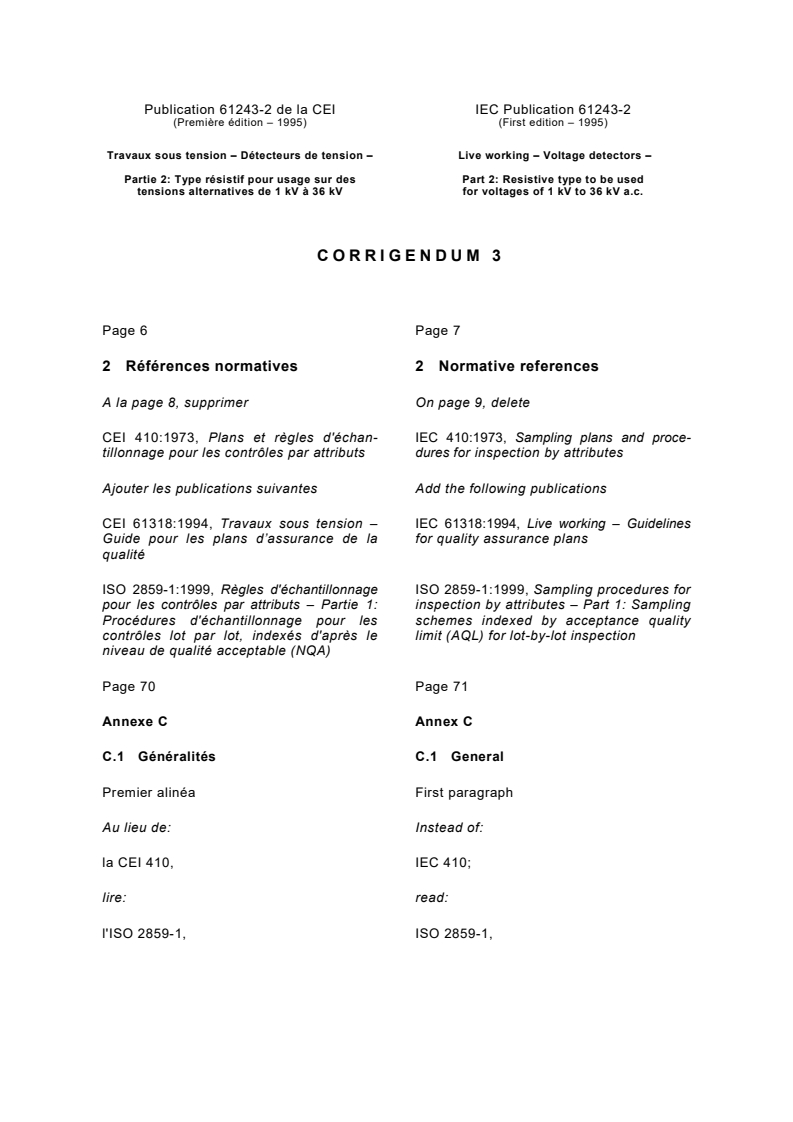


IEC 61243-2:1995/COR3:2000 - Corrigendum 3 - Live working - Voltage detectors - Part 2: Resistive type to be used for voltages of 1 kV to 36 kV a.c. Released:3/21/2000
IEC 61243-2:1995+AMD1:1999+AMD2:2002 CSV - Live working - Voltage detectors - Part 2: Resistive type to be used for voltages of 1 kV to 36 kV a.c. Released:6/25/2002
IEC 61243-2:1995+AMD1:1999 CSV - Live working - Voltage detectors - Part 2: Resistive type to be used for voltages of 1 kV to 36 kV a.c. Released:3/30/2000
Overview
IEC 61243-2:1995 is an international standard published by the International Electrotechnical Commission (IEC) that specifies requirements for resistive voltage detectors used for live working on alternating current (a.c.) electrical systems with voltages ranging from 1 kV to 36 kV. This standard covers portable resistive voltage detectors, with or without a built-in power source, suitable for frequencies between 15 Hz and 60 Hz. These detectors can be used either as standalone units or combined with insulating poles compliant with IEC 60855 or IEC 61235.
This part of IEC 61243 specifically deals with resistive type voltage detectors that operate through direct contact with the conductive part under test. Capacitive voltage detectors are governed separately by IEC 61243-1. The standard aims to ensure safety, reliability, and performance during live electrical work involving medium-voltage systems.
Key Topics
Scope and Application
Applicable to resistive voltage detectors for electrical systems within 1 kV to 36 kV a.c., accommodating a wide range of industrial and utility environments with variable system frequencies from 15 Hz to 60 Hz.Functional Requirements
Details on detector performance including sensitivity, reliability, response time, and clear indication methods (visual and audible signals) ensuring the detection of presence or absence of voltage.Electrical and Mechanical Requirements
Specifications for electrical insulation, dielectric strength, interference immunity, mechanical robustness, and durability needed to withstand harsh working conditions.Testing Procedures
Comprehensive test plans covering functional, electrical, and mechanical tests to verify compliance and detect faults. Includes mechanical shock tests, climatic resistance cycling, and tests for magnetic field influence.Markings and Instructions
Clear guidelines on marking detectors with type designation, rated voltage, manufacturer details, and safe usage instructions for end-users.Quality Assurance and Sampling
Procedures for production testing, sampling methods, defect classification, and ongoing quality control ensuring consistent compliance and product reliability.
Applications
IEC 61243-2 compliant resistive voltage detectors are widely used in:
Live Working on Medium-Voltage Networks
Field engineers use these detectors to safely verify the presence or absence of voltage during live maintenance or emergency repair work on power distribution networks ranging from 1 kV up to 36 kV.Electrical Utilities and Power Generation Plants
Facilities that operate medium and high-voltage equipment rely on these detectors to ensure safe isolation and testing procedures.Industrial Electrical Maintenance
Maintenance teams in heavy industry apply these standards-compliant devices for effective and safe voltage detection during equipment inspections or troubleshooting.Personnel Safety Assurance
By following IEC 61243-2 standards, organizations reduce the risk of electric shock or accidents due to undetected voltage presence, promoting safer live working environments.
Related Standards
- IEC 61243-1: Voltage detectors of capacitive type for voltages from 1 kV to 36 kV a.c.
- IEC 60855: Portable insulated poles for live working.
- IEC 61235: Insulating link sticks for live working.
- IEC 61010-1: General safety requirements for electrical equipment for measurement, control, and laboratory use.
Using IEC 61243-2 together with related standards ensures comprehensive safety and operational protocols for electrical live working, focusing on medium voltage systems and resistive voltage detection technologies.
By adhering to IEC 61243-2, manufacturers and users of resistive voltage detectors can ensure optimized device performance, safety compliance, and reliable voltage detection, empowering secure live working practices in electrical power systems.
Relations
- Effective Date
- 10-Feb-2026
- Effective Date
- 10-Feb-2026
- Effective Date
- 05-Sep-2023
- Effective Date
- 05-Sep-2023
- Effective Date
- 05-Sep-2023
- Effective Date
- 05-Sep-2023
Buy Documents
IEC 61243-2:1995/COR3:2000 - Corrigendum 3 - Live working - Voltage detectors - Part 2: Resistive type to be used for voltages of 1 kV to 36 kV a.c. Released:3/21/2000
IEC 61243-2:1995+AMD1:1999+AMD2:2002 CSV - Live working - Voltage detectors - Part 2: Resistive type to be used for voltages of 1 kV to 36 kV a.c. Released:6/25/2002
IEC 61243-2:1995+AMD1:1999 CSV - Live working - Voltage detectors - Part 2: Resistive type to be used for voltages of 1 kV to 36 kV a.c. Released:3/30/2000
Get Certified
Connect with accredited certification bodies for this standard

IMQ S.p.A. (Certification)
Italian electrical product certification.

SLG Prüf- und Zertifizierungs GmbH
German testing and certification body.

UL Solutions
Global safety science company with testing, inspection and certification.
Sponsored listings
Frequently Asked Questions
IEC 61243-2:1995 is a standard published by the International Electrotechnical Commission (IEC). Its full title is "Live working - Voltage detectors - Part 2: Resistive type to be used for voltages of 1 kV to 36 kV a.c.". This standard covers: Is applicable to portable voltage detectors with or without a built-in power source to be used on electrical systems for voltages of 1 kV to 36 kV a.c., and frequencies from 15 Hz to 60 Hz. This part applies only to resistive voltage detectors used in contact with the part to be tested, as a single unit or as a separate device completed by an adaptable insulating pole covered in IEC 60855 or IEC 61235. Other types of voltage detectors are not covered by this part of standard.Capacitive voltage detectros are covered in IEC 61243-1.
Is applicable to portable voltage detectors with or without a built-in power source to be used on electrical systems for voltages of 1 kV to 36 kV a.c., and frequencies from 15 Hz to 60 Hz. This part applies only to resistive voltage detectors used in contact with the part to be tested, as a single unit or as a separate device completed by an adaptable insulating pole covered in IEC 60855 or IEC 61235. Other types of voltage detectors are not covered by this part of standard.Capacitive voltage detectros are covered in IEC 61243-1.
IEC 61243-2:1995 is classified under the following ICS (International Classification for Standards) categories: 13.260 - Protection against electric shock. Live working; 29.240.20 - Power transmission and distribution lines; 29.260.99 - Other electrical equipment for working in special conditions. The ICS classification helps identify the subject area and facilitates finding related standards.
IEC 61243-2:1995 has the following relationships with other standards: It is inter standard links to EN 61958:2001, EN 62271-206:2011, IEC 61243-2:1995/AMD1:1999, IEC 61243-2:1995/AMD2:2002, IEC 61243-2:1995/COR2:1999, IEC 61243-2:1995/COR1:1996. Understanding these relationships helps ensure you are using the most current and applicable version of the standard.
IEC 61243-2:1995 is available in PDF format for immediate download after purchase. The document can be added to your cart and obtained through the secure checkout process. Digital delivery ensures instant access to the complete standard document.
Standards Content (Sample)
Publication 61243-2 de la CEI IEC Publication 61243-2
(Première édition – 1995) (First edition – 1995)
Travaux sous tension – Détecteurs de tension – Live working – Voltage detectors –
Partie 2: Type résistif pour usage sur des Part 2: Resistive type to be used
tensions alternatives de 1 kV à 36 kV for voltages of 1 kV to 36 kV a.c.
CORRIGENDUM 3
Page 6 Page 7
2 Références normatives 2 Normative references
A la page 8, supprimer On page 9, delete
CEI 410:1973, Plans et règles d'échan- IEC 410:1973, Sampling plans and proce-
tillonnage pour les contrôles par attributs dures for inspection by attributes
Ajouter les publications suivantes Add the following publications
CEI 61318:1994, Travaux sous tension – IEC 61318:1994, Live working – Guidelines
Guide pour les plans d’assurance de la for quality assurance plans
qualité
ISO 2859-1:1999, Règles d'échantillonnage ISO 2859-1:1999, Sampling procedures f
...
IEC 61243-2 ®
Edition 1.2 2002-06
CONSOLIDATED VERSION
INTERNATIONAL
STANDARD
NORME
INTERNATIONALE
Live working – Voltage detectors –
Part 2: Resistive type to be used for voltages of 1 kV to 36 kV a.c.
Travaux sous tension – Détecteurs de tension –
Partie 2: Type résistif pour usage sur des tensions alternatives de 1 kV à 36 kV
IEC 61243-3:1995-10+AMD1:1999-10+AMD2:2002-05 CSV(en-fr)
All rights reserved. Unless otherwise specified, no part of this publication may be reproduced or utilized in any form
or by any means, electronic or mechanical, including photocopying and microfilm, without permission in writing from
either IEC or IEC's member National Committee in the country of the requester. If you have any questions about IEC
copyright or have an enquiry about obtaining additional rights to this publication, please contact the address below or
your local IEC member National Committee for further information.
Droits de reproduction réservés. Sauf indication contraire, aucune partie de cette publication ne peut être reproduite
ni utilisée sous quelque forme que ce soit et par aucun procédé, électronique ou mécanique, y compris la photocopie
et les microfilms, sans l'accord écrit de l'IEC ou du Comité national de l'IEC du pays du demandeur. Si vous avez des
questions sur le copyright de l'IEC ou si vous désirez obtenir des droits supplémentaires sur cette publication, utilisez
les coordonnées ci-après ou contactez le Comité national de l'IEC de votre pays de résidence.
IEC Central Office Tel.: +41 22 919 02 11
3, rue de Varembé Fax: +41 22 919 03 00
CH-1211 Geneva 20 info@iec.ch
Switzerland www.iec.ch
About the IEC
The International Electrotechnical Commission (IEC) is the leading global organization that prepares and publishes
International Standards for all electrical, electronic and related technologies.
About IEC publications
The technical content of IEC publications is kept under constant review by the IEC. Please make sure that you have the
latest edition, a corrigenda or an amendment might have been published.
IEC Catalogue - webstore.iec.ch/catalogue Electropedia - www.electropedia.org
The stand-alone application for consulting the entire The world's leading online dictionary of electronic and
bibliographical information on IEC International Standards, electrical terms containing 20 000 terms and definitions in
Technical Specifications, Technical Reports and other English and French, with equivalent terms in 15 additional
documents. Available for PC, Mac OS, Android Tablets and languages. Also known as the International Electrotechnical
iPad. Vocabulary (IEV) online.
IEC publications search - www.iec.ch/searchpub IEC Glossary - std.iec.ch/glossary
The advanced search enables to find IEC publications by a 65 000 electrotechnical terminology entries in English and
variety of criteria (reference number, text, technical French extracted from the Terms and Definitions clause of
committee,…). It also gives information on projects, replaced IEC publications issued since 2002. Some entries have been
and withdrawn publications. collected from earlier publications of IEC TC 37, 77, 86 and
CISPR.
IEC Just Published - webstore.iec.ch/justpublished
Stay up to date on all new IEC publications. Just Published IEC Customer Service Centre - webstore.iec.ch/csc
details all new publications released. Available online and If you wish to give us your feedback on this publication or
also once a month by email. need further assistance, please contact the Customer Service
Centre: csc@iec.ch.
A propos de l'IEC
La Commission Electrotechnique Internationale (IEC) est la première organisation mondiale qui élabore et publie des
Normes internationales pour tout ce qui a trait à l'électricité, à l'électronique et aux technologies apparentées.
A propos des publications IEC
Le contenu technique des publications IEC est constamment revu. Veuillez vous assurer que vous possédez l’édition la
plus récente, un corrigendum ou amendement peut avoir été publié.
Catalogue IEC - webstore.iec.ch/catalogue Electropedia - www.electropedia.org
Application autonome pour consulter tous les renseignements
Le premier dictionnaire en ligne de termes électroniques et
bibliographiques sur les Normes internationales,
électriques. Il contient 20 000 termes et définitions en anglais
Spécifications techniques, Rapports techniques et autres
et en français, ainsi que les termes équivalents dans 15
documents de l'IEC. Disponible pour PC, Mac OS, tablettes
langues additionnelles. Egalement appelé Vocabulaire
Android et iPad.
Electrotechnique International (IEV) en ligne.
Recherche de publications IEC - www.iec.ch/searchpub
Glossaire IEC - std.iec.ch/glossary
La recherche avancée permet de trouver des publications IEC
65 000 entrées terminologiques électrotechniques, en anglais
en utilisant différents critères (numéro de référence, texte,
et en français, extraites des articles Termes et Définitions des
comité d’études,…). Elle donne aussi des informations sur les
publications IEC parues depuis 2002. Plus certaines entrées
projets et les publications remplacées ou retirées.
antérieures extraites des publications des CE 37, 77, 86 et
CISPR de l'IEC.
IEC Just Published - webstore.iec.ch/justpublished
Restez informé sur les nouvelles publications IEC. Just Service Clients - webstore.iec.ch/csc
Published détaille les nouvelles publications parues. Si vous désirez nous donner des commentaires sur cette
Disponible en ligne et aussi une fois par mois par email. publication ou si vous avez des questions contactez-nous:
csc@iec.ch.
IEC 61243-2 ®
Edition 1.2 2002-06
CONSOLIDATED VERSION
INTERNATIONAL
STANDARD
NORME
INTERNATIONALE
Live working – Voltage detectors –
Part 2: Resistive type to be used for voltages of 1 kV to 36 kV a.c.
Travaux sous tension – Détecteurs de tension –
Partie 2: Type résistif pour usage sur des tensions alternatives de 1 kV à 36 kV
INTERNATIONAL
ELECTROTECHNICAL
COMMISSION
COMMISSION
ELECTROTECHNIQUE
INTERNATIONALE
ICS 13.260; 29.240; 29.260.99 ISBN 2-8318-6361-9
– 2 – 61243-2 © CEI:1995+A1:1999+A2:2002
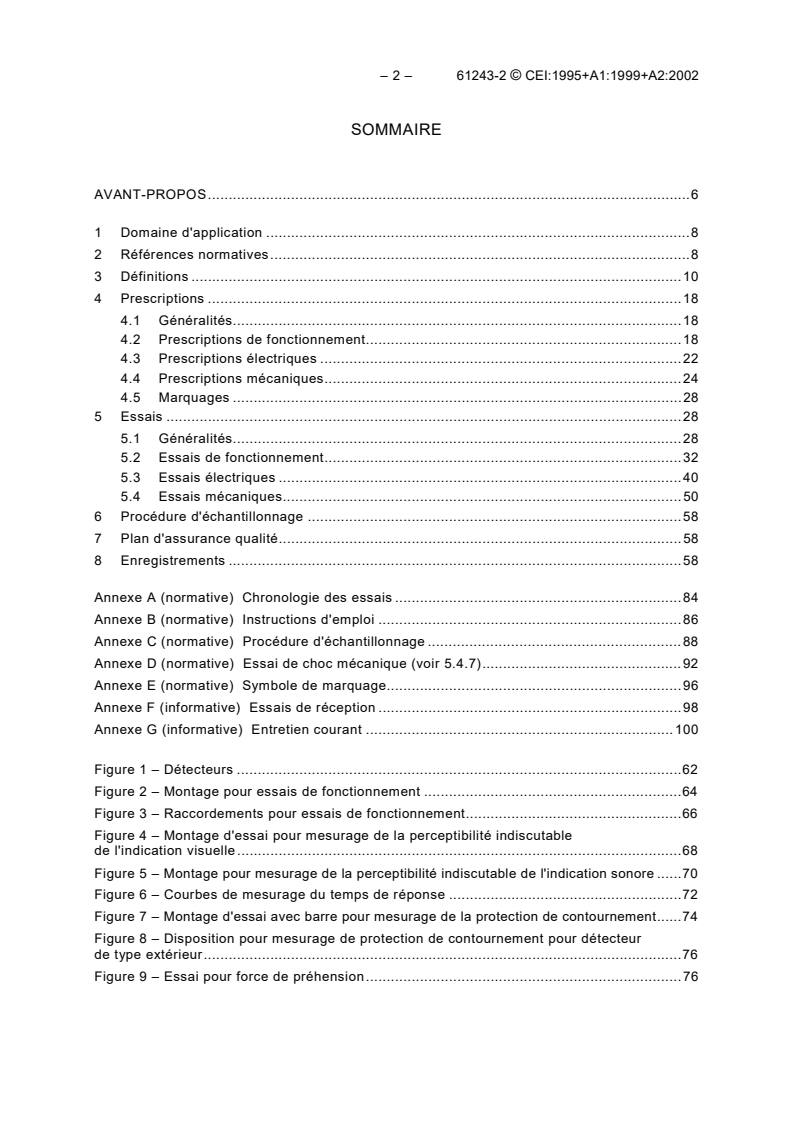
SOMMAIRE
AVANT-PROPOS.6
1 Domaine d'application .8
2 Références normatives.8
3 Définitions .10
4 Prescriptions .18
4.1 Généralités.18
4.2 Prescriptions de fonctionnement.18
4.3 Prescriptions électriques .22
4.4 Prescriptions mécaniques.24
4.5 Marquages .28
5 Essais .28
5.1 Généralités.28
5.2 Essais de fonctionnement.32
5.3 Essais électriques .40
5.4 Essais mécaniques.50
6 Procédure d'échantillonnage .58
7 Plan d'assurance qualité.58
8 Enregistrements .58
Annexe A (normative) Chronologie des essais .84
Annexe B (normative) Instructions d'emploi .86
Annexe C (normative) Procédure d'échantillonnage .88
Annexe D (normative) Essai de choc mécanique (voir 5.4.7).92
Annexe E (normative) Symbole de marquage.96
Annexe F (informative) Essais de réception .98
Annexe G (informative) Entretien courant .100
Figure 1 – Détecteurs .62
Figure 2 – Montage pour essais de fonctionnement .64
Figure 3 – Raccordements pour essais de fonctionnement.66
Figure 4 – Montage d'essai pour mesurage de la perceptibilité indiscutable
de l'indication visuelle.68
Figure 5 – Montage pour mesurage de la perceptibilité indiscutable de l'indication sonore .70
Figure 6 – Courbes de mesurage du temps de réponse .72
Figure 7 – Montage d'essai avec barre pour mesurage de la protection de contournement.74
Figure 8 – Disposition pour mesurage de protection de contournement pour détecteur
de type extérieur.76
Figure 9 – Essai pour force de préhension.76
61243-2 © IEC:1995+A1:1999+A2:2002 – 3 –
CONTENTS
FOREWORD.7
1 Scope.9
2 Normative references .9
3 Definitions .11
4 Requirements .19
4.1 General .19
4.2 Functional requirements .19
4.3 Electrical requirements.23
4.4 Mechanical requirements.25
4.5 Markings .29
5 Tests .29
5.1 General .29
5.2 Functional tests.33
5.3 Electrical tests.41
5.4 Mechanical tests .51
6 Sampling procedure .59
7 Quality assurance plan .59
8 Records.59
Annex A (normative) Chronology of tests .85
Annex B (normative) Instructions for use .87
Annex C (normative) Sampling procedure .89
Annex D (normative) Mechanical shock test (see 5.4.7) .93
Annex E (normative) Symbol for marking .97
Annex F (informative) Acceptance tests .99
Annex G (informative) In-service care .101
Figure 1 – Detectors .63
Figure 2 – Set-up for functional tests .65
Figure 3 – Circuit connections for functional tests .67
Figure 4 – Test set-up for measurement of clear perceptibility of visual indication.69
Figure 5 – Test set-up for measurement of clear perceptibility of audible indication .71
Figure 6 – Curves of measurement of response time .73
Figure 7 – Test set-up with bars for test of protection against bridging .75
Figure 8 – Arrangement for testing bridging protection of outdoor type detector.77
Figure 9 – Test for grip force.77
– 4 – 61243-2 © CEI:1995+A1:1999+A2:2002
Figure 10 – Courbe de cycle d'essai pour résistance climatique.78
Figure 11 – Montage d'essai pour rigidité diélectrique pour boîtier indicateur
et élément résistif .78
Figure 12 – Montage d'essai pour l'influence d'un champ magnétique perturbateur.80
Figure 13 – Montage d'essai pour la solidité du conducteur de terre et des liaisons .82
Figure D.1 – Détails du pendule pour l'essai de choc mécanique .94
Figure E.1 – Symbole de marquage .96
Tableau 1 – Catégories climatiques .22
Tableau 2 – Longueur maximale de la partie nue de l'électrode de contact .26
Tableau 3 – Ecartements étroits pour essais de protection de contournement .46
Tableau A.1 – Ordre séquentiel pour exécuter les essais.84
Tableau C.1 – Classification des défauts .88
Tableau C.2 – Plan d'échantillonnage pour défauts majeurs .90
Tableau C.3 – Plan d'échantillonnage pour défauts mineurs .90
61243-2 © IEC:1995+A1:1999+A2:2002 – 5 –
Figure 10 – Curve of test cycle for climatic resistance.79
Figure 11 – Test set-up for dielectric strength for indicator housing and resistive element .79
Figure 12 – Test set-up for the influence of magnetic interference field.81
Figure 13 – Test set-up for the robustness of the earth lead and connections .83
Figure D.1 – Details of pendulum for shock test .95
Figure E.1 – Symbol for marking.97
Table 1 – Climatic categories.23
Table 2 – Maximum length of bare portion of contact electrode.27
Table 3 – Narrow point spacings for testing of protection against bridging .47
Table A.1 – Sequential order for performing tests .85
Table C.1 – Classification of defects .89
Table C.2 – Sampling plan for major defects.91
Table C.3 – Sampling plan for minor defects.91
– 6 – 61243-2 © CEI:1995+A1:1999+A2:2002
COMMISSION ÉLECTROTECHNIQUE INTERNATIONALE
____________
TRAVAUX SOUS TENSION – DÉTECTEURS DE TENSION –
Partie 2: Type résistif pour usage sur des tensions alternatives
de 1 kV à 36 kV
AVANT-PROPOS
1) La CEI (Commission Electrotechnique Internationale) est une organisation mondiale de normalisation
composée de l'ensemble des comités électrotechniques nationaux (Comités nationaux de la CEI). La CEI a
pour objet de favoriser la coopération internationale pour toutes les questions de normalisation dans les
domaines de l'électricité et de l'électronique. A cet effet, la CEI, entre autres activités, publie des Normes
internationales. Leur élaboration est confiée à des comités d'études, aux travaux desquels tout Comité national
intéressé par le sujet traité peut participer. Les organisations internationales, gouvernementales et non
gouvernementales, en liaison avec la CEI, participent également aux travaux. La CEI collabore étroitement
avec l'Organisation Internationale de Normalisation (ISO), selon des conditions fixées par accord entre les
deux organisations.
2) Les décisions ou accords officiels de la CEI concernant les questions techniques représentent, dans la mesure
du possible, un accord international sur les sujets étudiés, étant donné que les Comités nationaux intéressés
sont représentés dans chaque comité d’études.
3) Les documents produits se présentent sous la forme de recommandations internationales. Ils sont publiés
comme normes, spécifications techniques, rapports techniques ou guides et agréés comme tels par les
Comités nationaux.
4) Dans le but d'encourager l'unification internationale, les Comités nationaux de la CEI s'engagent à appliquer de
façon transparente, dans toute la mesure possible, les Normes internationales de la CEI dans leurs normes
nationales et régionales. Toute divergence entre la norme de la CEI et la norme nationale ou régionale
correspondante doit être indiquée en termes clairs dans cette dernière.
5) La CEI n’a fixé aucune procédure concernant le marquage comme indication d’approbation et sa responsabilité
n’est pas engagée quand un matériel est déclaré conforme à l’une de ses normes.
6) L’attention est attirée sur le fait que certains des éléments de la présente Norme internationale peuvent faire
l’objet de droits de propriété intellectuelle ou de droits analogues. La CEI ne saurait être tenue pour
responsable de ne pas avoir identifié de tels droits de propriété et de ne pas avoir signalé leur existence.
Cette version consolidée de la Norme IEC officielle et de ses amendements a été
préparée pour la commodité de l'utilisateur.
La CEI 61243-2 édition 1.2 contient la première édition (1995) [documents 78/164+164A/
FDIS et 78/181/RVD], ses corrigenda de juin 1996, de juillet 1999 et de mars 2000, son
amendement 1 (1999) [documents 78/288/FDIS et 78/294/RVD] et son amendement 2
(2002) [documents 78/431/FDIS et 78/452/RVD].
Une ligne verticale dans la marge indique où la publication de base a été modifiée par
les amendements 1 et 2.
Le contenu des corrigenda a été pris en considération dans cet exemplaire.
La Norme internationale CEI 61243-2 a été établie par le comité d'études 78 de la CEI: Outils
pour travaux sous tension.
Les annexes A, B, C, D et E font partie intégrante de cette norme.
Les annexes F et G sont données uniquement à titre d'information.
Le comité a décidé que le contenu de la publication de base et de ses amendements ne sera
pas modifié avant 2008. A cette date, la publication sera
• reconduite;
• supprimée;
• remplacée par une édition révisée, ou
• amendée.
61243-2 © IEC:1995+A1:1999+A2:2002 – 7 –
INTERNATIONAL ELECTROTECHNICAL COMMISSION
____________
LIVE WORKING – VOLTAGE DETECTORS –
Part 2: Resistive type to be used for voltages of 1 kV to 36 kV a.c.
FOREWORD
1) The IEC (International Electrotechnical Commission) is a worldwide organization for standardization comprising
all national electrotechnical committees (IEC National Committees). The object of the IEC is to promote
international co-operation on all questions concerning standardization in the electrical and electronic fields. To
this end and in addition to other activities, the IEC publishes International Standards. Their preparation is
entrusted to technical committees; any IEC National Committee interested in the subject dealt with may
participate in this preparatory work. International, governmental and non-governmental organizations liaising
with the IEC also participate in this preparation. The IEC collaborates closely with the International
Organization for Standardization (ISO) in accordance with conditions determined by agreement between the
two organizations.
2) The formal decisions or agreements of the IEC on technical matters express, as nearly as possible, an
international consensus of opinion on the relevant subjects since each technical committee has representation
from all interested National Committees.
3) The documents produced have the form of recommendations for international use and are published in the form
of standards, technical specifications, technical reports or guides and they are accepted by the National
Committees in that sense.
4) In order to promote international unification, IEC National Committees undertake to apply IEC International
Standards transparently to the maximum extent possible in their national and regional standards. Any
divergence between the IEC Standard and the corresponding national or regional standard shall be clearly
indicated in the latter.
5) The IEC provides no marking procedure to indicate its approval and cannot be rendered responsible for any
equipment declared to be in conformity with one of its standards.
6) Attention is drawn to the possibility that some of the elements of this International Standard may be the subject
of patent rights. The IEC shall not be held responsible for identifying any or all such patent rights.
This consolidated version of the official IEC Standard and its amendments has been
prepared for user convenience.
IEC 61243-2 edition 1.2 contains the first edition (1995) [documents 78/164+164A/FDIS
and 78/181/RVD], its corrigenda June 1996, July 1999 and March 2000, its amendment 1
(1999) [documents 78/288/FDIS and 78/294/RVD] and its amendment 2 (2002) [documents
78/431/FDIS and 78/452/RVD].
A vertical line in the margin shows where the base publication has been modified by
amendments 1 and 2.
The contents of the corrigenda have been included in this copy.
International Standard IEC 61243-2 has been prepared by IEC technical committee 78: Tools
for live working.
Annexes A, B, C, D and E form an integral part of this standard.
Annexes F and G are for information only.
The committee has decided that the contents of the base publication and its amendments will
remain unchanged until 2008. At this date, the publication will be
• reconfirmed;
• withdrawn;
• replaced by a revised edition, or
• amended.
– 8 – 61243-2 © CEI:1995+A1:1999+A2:2002
TRAVAUX SOUS TENSION – DÉTECTEURS DE TENSION –
Partie 2: Type résistif pour usage sur des tensions alternatives
de 1 kV à 36 kV
1 Domaine d'application
La présente partie de la CEI 61243 est applicable aux détecteurs de tension portatifs avec ou
sans alimentation incorporée pour utilisation sur réseaux électriques de tensions alternatives
de 1 kV à 36 kV, et de fréquences de 15 Hz à 60 Hz.
Cette partie s'applique uniquement aux détecteurs de tension résistifs utilisés en contact avec
la pièce à essayer, en une seule partie ou en dispositif séparé complété par une perche
isolante adaptable conforme à la CEI 60855 ou à la CEI 61235. Les autres types de
détecteurs de tension ne sont pas couverts par cette partie de la norme. Les détecteurs de
tension capacitifs sont couverts par la CEI 61243-1.
La limite supérieure de tension est en accord avec les essais décrits dans la présente partie
de la CEI 61243.
Quelques restrictions quant à leur utilisation sont applicables en cas d'appareillage de
connexion monté en usine et sur réseau aérien de voie ferrée électrifiée (voir annexe B).
NOTE 1 Sauf spécification contraire, toutes les tensions définies dans cette norme se réfèrent aux tensions entre
phases des réseaux triphasés. Les détecteurs résistifs peuvent être utilisés sur des réseaux autres que triphasés,
mais la tension applicable entre phases ou entre phase et terre doit être utilisée pour déterminer la tension de
service.
NOTE 2 Bien que cette norme ne couvre pas les détecteurs de tension c.c., certains détecteurs peuvent répondre
à une tension continue.
2 Références normatives
Les documents de référence suivants sont indispensables pour l'application du présent
document. Pour les références datées, seule l'édition citée s'applique. Pour les références
non datées, la dernière édition du document de référence s'applique (y compris les éventuels
amendements).
CEI 60050(151):1978, Vocabulaire Electrotechnique International (VEI) – Chapitre 151:
Dispositifs électriques et magnétiques
CEI 60050(601):1985, Vocabulaire Electrotechnique International (VEI) – Chapitre 601:
Production, transport et distribution de l'énergie électrique - Généralités
CEI 60060-1:1989, Techniques des essais à haute tension – Partie 1: Définitions et
prescriptions générales relatives aux essais
CEI 60068-1:1988, Essais d'environnement – Partie 1: Généralités et guide
Amendement 1 (1992)
CEI 60068-2-6:1982, Essais d'environnement – Deuxième partie: Essais – Essai Fc et guide:
Vibrations (sinusoïdales)
CEI 60068-2-14:1984, Essais d'environnement – Deuxième partie: Essais – Essai N:
Variations de température
61243-2 © IEC:1995+A1:1999+A2:2002 – 9 –
LIVE WORKING – VOLTAGE DETECTORS –
Part 2: Resistive type to be used for voltages of 1 kV to 36 kV a.c.
1 Scope
This part of IEC 61243 is applicable to portable voltage detectors with or without a built-in
power source to be used on electrical systems for voltages of 1 kV to 36 kV a.c., and
frequencies from 15 Hz to 60 Hz.
This part applies only to resistive voltage detectors used in contact with the part to be tested,
as a single unit or as a separate device completed by an adaptable insulating pole covered in
IEC 60855 or IEC 61235. Other types of voltage detectors are not covered by this part of
standard. Capacitive voltage detectors are covered in IEC 61243-1.
The upper voltage limit is in accordance with the tests described in this part of IEC 61243.
Some restrictions on their use are applicable in the case of factory-assembled switchgear and
on overhead systems of electrified railways (see annex B).
NOTE 1 Except when otherwise specified, all the voltages defined in this standard refer to phase-to-phase
voltages of three-phase systems. Resistive detectors may be used in other than three-phase systems, but the
applicable phase-to-phase or phase-to-earth (ground) voltage shall be used to determine the operating voltage.
NOTE 2 Although this standard does not cover d.c. voltage detectors, some detectors may respond to d.c.
voltage.
2 Normative references
The following referenced documents are indispensable for the application of this document.
For dated references, only the edition cited applies. For undated references, the latest edition
of the referenced document (including any amendments) applies.
IEC 60050(151):1978, International Electrotechnical Vocabulary (IEV) – Chapter 151: Elec-
trical and magnetic devices
IEC 60050(601):1985, International Electrotechnical Vocabulary (IEV) – Chapter 601:
Generation, transmission and distribution of electricity – General
IEC 60060-1:1989, High-voltage test techniques – Part 1: General definitions and test
requirements
IEC 60068-1:1988, Environmental testing – Part 1: General and guidance
Amendment 1 (1992)
IEC 60068-2-6:1982, Environmental testing – Part 2: Tests – Test Fc and guidance: Vibration
(sinusoidal)
IEC 60068-2-14:1984, Environmental testing – Part 2: Tests – Test N: Change of temperature
– 10 – 61243-2 © CEI:1995+A1:1999+A2:2002
CEI 60068-2-32:1975, Essais d'environnement – Deuxième partie: Essais – Essai Ed: Chute libre
Amendement 2 (1990)
CEI 60071-1:1993, Coordination de l'isolement - Partie 1: Définitions, principes et règles
CEI 60417 (toutes les parties), Symboles graphiques utilisables sur le matériel
CEI 60651:1979, Sonomètres
Amendement 1 (1993)
CEI 60855:1985, Tubes isolants remplis de mousse et tiges isolantes pleines pour travaux
sous tension
CEI 61235:1993, Travaux sous tension – Tubes creux isolants pour travaux électriques
CEI 61318:1994, Travaux sous tension – Guide pour les plans d'assurance de la qualité
ISO 2859-1:1999, Règles d'échantillonnage pour les contrôles par attributs – Partie 1:
Procédures d'échantillonnage pour les contrôles lot par lot, indexés d'après le niveau de
qualité acceptable (NQA)
ISO 3745:1977, Acoustique – Détermination des niveaux de puissance acoustique émis par le
sources de bruit – Méthodes de laboratoire pour salles anéchoïque et semi-anéchoïque
ISO 8402:1986, Qualité – Vocabulaire
ISO 9000:1987, Normes pour la gestion de la qualité et l'assurance de la qualité – Lignes
directrices pour la sélection et l'utilisation
ISO 9002:1987: Systèmes qualité – Modèles pour l'assurance de la qualité en production et
installation
ISO 9004:1987, Gestion de la qualité et éléments de système qualité – Lignes directrices
CIE 15.2:1986, Colorimétrie
3 Définitions
Pour les besoins de la présente partie de la CEI 61243, les définitions suivantes s'appliquent.
3.1
embout
partie permettant l'assemblage du détecteur
3.2
accessoires
articles utilisés pour allonger la poignée ou l'électrode de contact, pour améliorer l'efficacité
de l'électrode de contact ou permettre à l'électrode de contact d'atteindre la pièce d'instal-
lation à vérifier
3.3
électrode de contact
partie conductrice qui établit la connexion électrique avec la pièce à vérifier
61243-2 © IEC:1995+A1:1999+A2:2002 – 11 –
IEC 60068-2-32:1975, Environmental testing – Part 2: Tests – Test Ed: Free fall
Amendment 2 (1990)
IEC 60071-1:1993, Insulation co-ordination – Part 1: Definitions, principles and rules
IEC 60417 (all parts), Graphical symbols for use on equipment
IEC 60651:1979, Sound level meters
Amendment 1 (1993)
IEC 60855:1985, Insulating foam-filled tubes and solid rods for live working
IEC 61235:1993, Live working – Insulating hollow tubes for electrical purposes
IEC 61318:1994, Live working – Guidelines for quality assurance plans
ISO 2859-1:1999, Sampling procedures for inspection by attributes – Part 1: Sampling
schemes indexed by acceptance quality limit (AQL) for lot-by-lot inspection
ISO 3745:1977, Acoustics – Determination of sound power levels of noise sources – Precision
methods for anechoic and semi-anechoic rooms
ISO 8402:1986, Quality – Vocabulary
ISO 9000:1987, Quality management and quality assurance standards – Guidelines for
selection and use
ISO 9002:1987: Quality systems – Model for quality assurance in production and installation
ISO 9004:1987, Quality management and quality system elements – Guidelines
ICI 15.2:1986, Colorimetry
3 Definitions
For the purposes of this part of IEC 61243, the following definitions apply.
3.1
adaptor
part allowing the assembly of the detector
3.2
accessories
items used to lengthen the handle or the contact electrode, to improve the efficiency of the
contact electrode or to enable the contact electrode to reach the part to be tested
3.3
contact electrode
conductive part which makes the electrical connection to the part to be tested.
– 12 – 61243-2 © CEI:1995+A1:1999+A2:2002
3.4
allonge d'électrode de contact
section conductrice extérieurement isolée entre l'élément résistif et l'électrode de contact,
prévue pour obtenir la position exacte de l'indicateur par rapport à la pièce à vérifier
3.5
détecteur de tension
dispositif portable utilisé pour détecter la présence ou l'absence de la tension de service de la
pièce à vérifier
3.6
détecteur capacitif
dispositif dont le fonctionnement est basé sur le courant passant à travers la capacité de fuite
à la terre
3.7
détecteur résistif (détecteur)
dispositif dont le fonctionnement est basé sur le courant passant à travers une résistance
située dans l'élément résistif, et une connexion galvanique à la terre. Les détecteurs résistifs
sont de deux types:
– un dispositif d'une seule pièce comprenant ou non un élément isolant, avec ou sans allonge
d'électrode de contact, et
– un dispositif séparé complété par une perche isolante adaptable, avec ou sans allonge
d'électrode de contact
3.8
élément isolant
section de matériau isolant qui fournit à l'utilisateur une distance et une isolation adéquates
3.9
élément résistif
élément qui contient la résistance de limitation du courant et des parties conductrices
3.10
dispositif de contrôle
dispositif intégré ou non, au moyen duquel le fonctionnement du détecteur peut être vérifié
par l'utilisateur
3.11
conducteur de terre
conducteur qui relie le détecteur à la terre. Il inclut une cosse ou pince de terre
3.12
indicateur
partie du détecteur qui indique la présence ou l'absence de la tension de service à l'électrode
de contact
3.13
indication indiscutable
détection et indication sans ambiguïté de l'état de tension sur l'électrode de contact
61243-2 © IEC:1995+A1:1999+A2:2002 – 13 –
3.4
contact electrode extension
externally insulated conductive section between the resistive element and the contact
electrode, intended to achieve the correct position of the indicator relative to the part to be
tested
3.5
voltage detector
a portable device used to detect the presence or the absence of the operating voltage of part
to be tested
3.6
capacitive detector
device whose operation is based on the current passing through the stray capacitance to
earth (ground)
3.7
resistive detector (detector)
device whose operation is based on the current passing through a resistor located in the
resistive element, and a galvanic connection to earth (ground). Resistive detectors are of two
types:
– a single unit including or not an insulating element, with or without contact electrode
extension, and
– a separate unit completed with an adaptable insulating pole, with or without contact
electrode extension
3.8
insulating element
section of insulating material which provides adequate distance and insulation to the user
3.9
resistive element
element which contains the current-limiting resistor and conductive parts
3.10
testing element
built-in or external device, by means of which the functioning of the detector can be checked
by the user
3.11
earth lead
lead that connects the detector to earth (ground). It includes an earth clip or clamp
3.12
indicator
part of the detector which indicates the presence or absence of the operating voltage at the
contact electrode
3.13
clear indication
unambiguous detection and indication of the voltage state at the contact electrode
– 14 – 61243-2 © CEI:1995+A1:1999+A2:2002
3.14
perche isolante
perche faite en matériau isolant
3.15
champ perturbateur
champ électrique pouvant affecter l'indication. Il peut résulter de la pièce à vérifier ou d'autres
composants voisins et être en n'importe quelle relation de phase
Les cas extrêmes pour les essais sont les suivants:
– Un champ perturbateur en phase existe quand une petite variation de potentiel dans la
direction de l'axe du détecteur entraîne une indication incorrecte. Ceci provient des
dimensions et/ou de la configuration de la pièce de l'installation à vérifier (ou de parties
adjacentes de l'installation ayant des tensions en phase).
– Un champ perturbateur en opposition de phase existe quand une forte variation de potentiel
dans la direction de l'axe du détecteur entraîne une indication incorrecte. Ceci provient des
parties adjacentes de l'installation ayant des tensions en opposition de phase.
3.16
tension perturbatrice
tension captée inductivement ou capacitivement par la pièce à vérifier
3.17
garde-main
garde physique distinctive séparant la poignée de l'élément résistif ou isolant
NOTE Son but est d'empêcher la mains de glisser et venir au contact de l'élément résistif ou isolant.
3.18
marque limite
emplacement distinctif ou marque indiquant à l'utilisateur la limite physique jusqu'où le
détecteur peut être inséré entre des pièces sous tension ou peut les toucher
3.19
perceptibilité indiscutable
cas où l'indication est perceptible sans erreur par l'utilisateur sous des conditions spécifiques
d'environnement quand le détecteur est dans sa position de fonctionnement
3.20
protection de contournement
protection contre l'amorçage ou le claquage, quand l'isolement entre les parties de
l'installation à vérifier, à différents potentiels, est diminué par la présence du détecteur
3.21
état de veille
état dans lequel le détecteur est prêt à fonctionner à la tension de seuil sans commutation
manuelle
3.22
temps de réponse
intervalle de temps entre le changement rapide de l'état de tension sur l'électrode de contact
et l'indication indiscutable correspondante
3.23
type intérieur
détecteur conçu pour être utilisé dans des conditions sèches, normalement à l'intérieur
61243-2 © IEC:1995+A1:1999+A2:2002 – 15 –
3.14
insulating pole
pole made of insulating material
3.15
interference field
electric field which may affect the indication. It may result from the part to be tested or other
adjacent components and may have any phase relationship.
The extreme cases for the tests are:
– An in-phase interference field exists when a small change of potential in the direction of the
detector axis results in an incorrect indication. This occurs as a result of the dimensions
and/or configuration of the part of installation to be tested (or of adjacent parts of
installation having voltages in the same phase).
– An interference field in phase opposition exists when a strong change of potential in the
direction of the detector axis results in an incorrect indication. This occurs as a result of the
adjacent parts of the installation having voltages in phase opposition.
3.16
interference voltage
voltage picked up inductively or capacitively by the part to be tested
3.17
hand guard
distinctive physical guard separating the handle from the resistive or insulating element
NOTE Its purpose is to prevent the hand from slipping and passing into contact with the resistive or the insulating
element.
3.18
limit mark
distinctive location or mark to indicate to the user the physical limit to which the detector may
be inserted between live components or may touch them
3.19
clear perceptibility
case when the indication is unmistakably discernible by the user under specific environmental
conditions when the detector is in its operating position
3.20
protection against bridging
protection against flashover or breakdown, when the insulation between the parts of
installation to be tested, at different potentials, is reduced by the presence of the detector
3.21
stand-by state
state at which the detector is ready to work at the threshold voltage without manual switching
"ON"
3.22
response time
time delay between sudden change of the voltage state on the contact electrode and the
associated clear indication
3.23
indoor type
detector designed for use in dry conditions, normally indoors
– 16 – 61243-2 © CEI:1995+A1:1999+A2:2002
3.24
type extérieur
détecteur conçu pour être utilisé dans des conditions humides soit à l'intérieur soit à l'extérieur
3.25
tension assignée (U )
r
valeur de la tension fixée généralement par le fabricant et le client, à laquelle certaines
spécifications de fonctionnement font référence
La tension assignée du détecteur est la tension choisie dans le tableau 2, colonne 1, de la
CEI 60071-1, laquelle devrait être égale soit à la tension nominale (ou la plus haute tension
nominale de sa plage de tensions nominales) soit à la valeur de tension immédiatement
supérieure indiquée dans ces tableaux.
3.26
tension de seuil (U )
t
tension minimale requise entre la pièce sous tension et la terre pour donner une indication
indiscutable correspondant aux conditions spécifiques définies dans l'essai correspondant.
NOTE La tension de seuil, telle que définie dans cette norme, se rapporte à des conditions spécifiques d'essai. Il
convient que les utilisateurs soient conscients que la tension de seuil prescrite pour leur exploitation en réseau
demande à être rapportée aux conditions d'essai dans cette norme.
Définitions VEI
3.27
tension nominale (U )
n
valeur arrondie appropriée de la tension utilisée pour identifier un réseau ou une installation
[VEI 601-01-21, modifié]
La tension nominale du détecteur est le paramètre associé à son indication indiscutable. Un
détecteur peut avoir plus d'une tension nominale ou une plage de tensions nominales. Les
valeurs limites de la plage de tensions nominales sont désignées par U min. et U max.
n n
3.28
essai de réception
essai contractuel ayant pour objet de prouver au client que le dispositif répond à certaines
conditions de sa spécification [VEI 151-04-20]
3.29
essai de maintenance
essai effectué périodiquement sur un dispositif ou un équipement et destiné à vérifier que ses
caractéristiques de fonctionnement se maintiennent dans des limites spécifiées, après avoir
procédé, le cas échéant, aux ajustements nécessaires [VEI 151-04-22]
3.30
essai individuel de série
essai auquel est soumis chaque dispositif au cours ou en fin de fabrication pour vérifier qu'il
satisfait à des critères définis [VEI 151-04-16]
3.31
essai (de série) sur prélèvement
essai effectué sur un certain nombre de dispositifs prélevés au hasard dans un lot
[VEI 151-04-17]
3.32
essai de type
essai effectué sur un
...
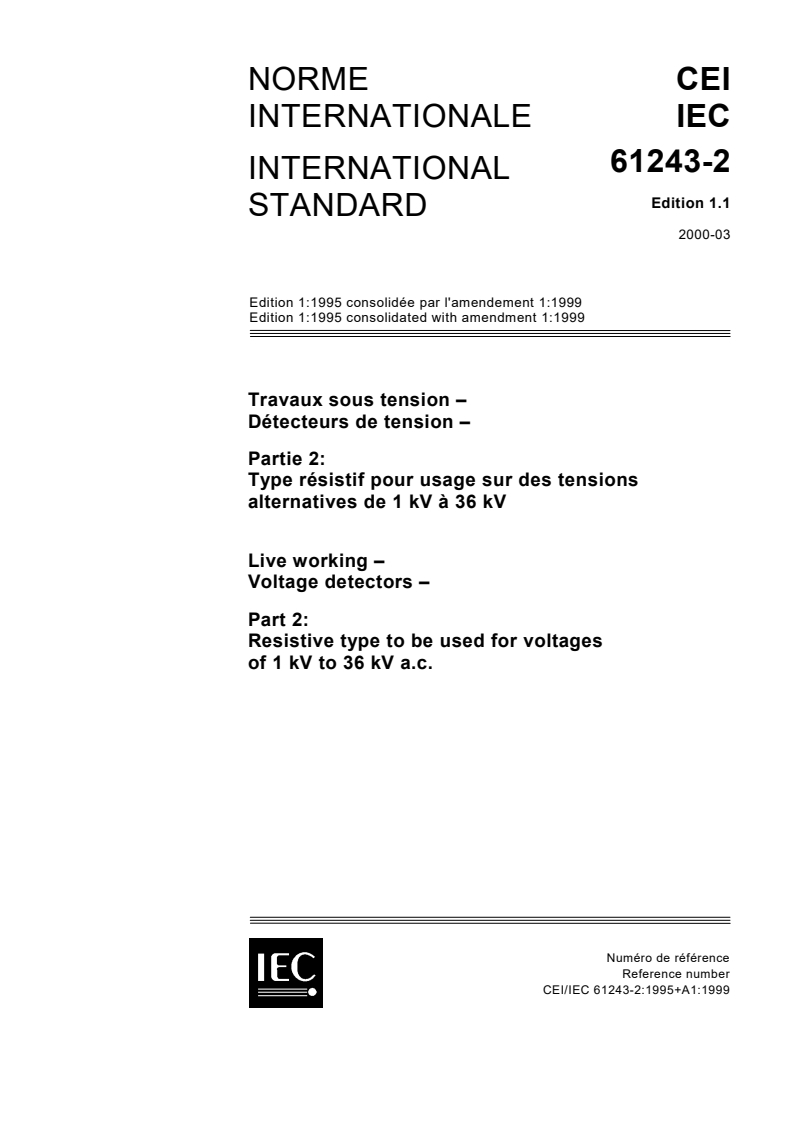
NORME CEI
INTERNATIONALE IEC
61243-2
INTERNATIONAL
Edition 1.1
STANDARD
2000-03
Edition 1:1995 consolidée par l'amendement 1:1999
Edition 1:1995 consolidated with amendment 1:1999
Travaux sous tension –
Détecteurs de tension –
Partie 2:
Type résistif pour usage sur des tensions
alternatives de 1 kV à 36 kV
Live working –
Voltage detectors –
Part 2:
Resistive type to be used for voltages
of 1 kV to 36 kV a.c.
Numéro de référence
Reference number
CEI/IEC 61243-2:1995+A1:1999
Numéros des publications Numbering
Depuis le 1er janvier 1997, les publications de la CEI As from 1 January 1997 all IEC publications are
sont numérotées à partir de 60000. issued with a designation in the 60000 series.
Publications consolidées Consolidated publications
Les versions consolidées de certaines publications de Consolidated versions of some IEC publications
la CEI incorporant les amendements sont disponibles. including amendments are available. For example,
Par exemple, les numéros d’édition 1.0, 1.1 et 1.2 edition numbers 1.0, 1.1 and 1.2 refer, respectively, to
indiquent respectivement la publication de base, la the base publication, the base publication incor-
publication de base incorporant l’amendement 1, et la porating amendment 1 and the base publication
publication de base incorporant les amendements 1 incorporating amendments 1 and 2.
et 2.
Validité de la présente publication Validity of this publication
Le contenu technique des publications de la CEI est The technical content of IEC publications is kept
constamment revu par la CEI afin qu'il reflète l'état under constant review by the IEC, thus ensuring that
actuel de la technique. the content reflects current technology.
Des renseignements relatifs à la date de reconfir- Information relating to the date of the reconfirmation
mation de la publication sont disponibles dans le of the publication is available in the IEC catalogue.
Catalogue de la CEI.
Les renseignements relatifs à des questions à l’étude et Information on the subjects under consideration and
des travaux en cours entrepris par le comité technique work in progress undertaken by the technical
qui a établi cette publication, ainsi que la liste des committee which has prepared this publication, as well
publications établies, se trouvent dans les documents ci- as the list of publications issued, is to be found at the
dessous: following IEC sources:
• «Site web» de la CEI* • IEC web site*
• Catalogue des publications de la CEI • Catalogue of IEC publications
Publié annuellement et mis à jour Published yearly with regular updates
régulièrement (On-line catalogue)*
(Catalogue en ligne)*
• Bulletin de la CEI
• IEC Bulletin
Disponible à la fois au «site web» de la CEI*
Available both at the IEC web site* and
et comme périodique imprimé
as a printed periodical
Terminologie, symboles graphiques
Terminology, graphical and letter
et littéraux
symbols
En ce qui concerne la terminologie générale, le lecteur
For general terminology, readers are referred to
se reportera à la CEI 60050: Vocabulaire Electro-
IEC 60050: International Electrotechnical Vocabulary
technique International (VEI).
(IEV).
Pour les symboles graphiques, les symboles littéraux
For graphical symbols, and letter symbols and signs
et les signes d'usage général approuvés par la CEI, le
approved by the IEC for general use, readers are
lecteur consultera la CEI 60027: Symboles littéraux à
referred to publications IEC 60027: Letter symbols to
utiliser en électrotechnique, la CEI 60417: Symboles
be used in electrical technology, IEC 60417: Graphical
graphiques utilisables sur le matériel. Index, relevé et
symbols for use on equipment. Index, survey and
compilation des feuilles individuelles, et la CEI 60617:
compilation of the single sheets and IEC 60617:
Symboles graphiques pour schémas.
Graphical symbols for diagrams.
* Voir adresse «site web» sur la page de titre.
* See web site address on title page.
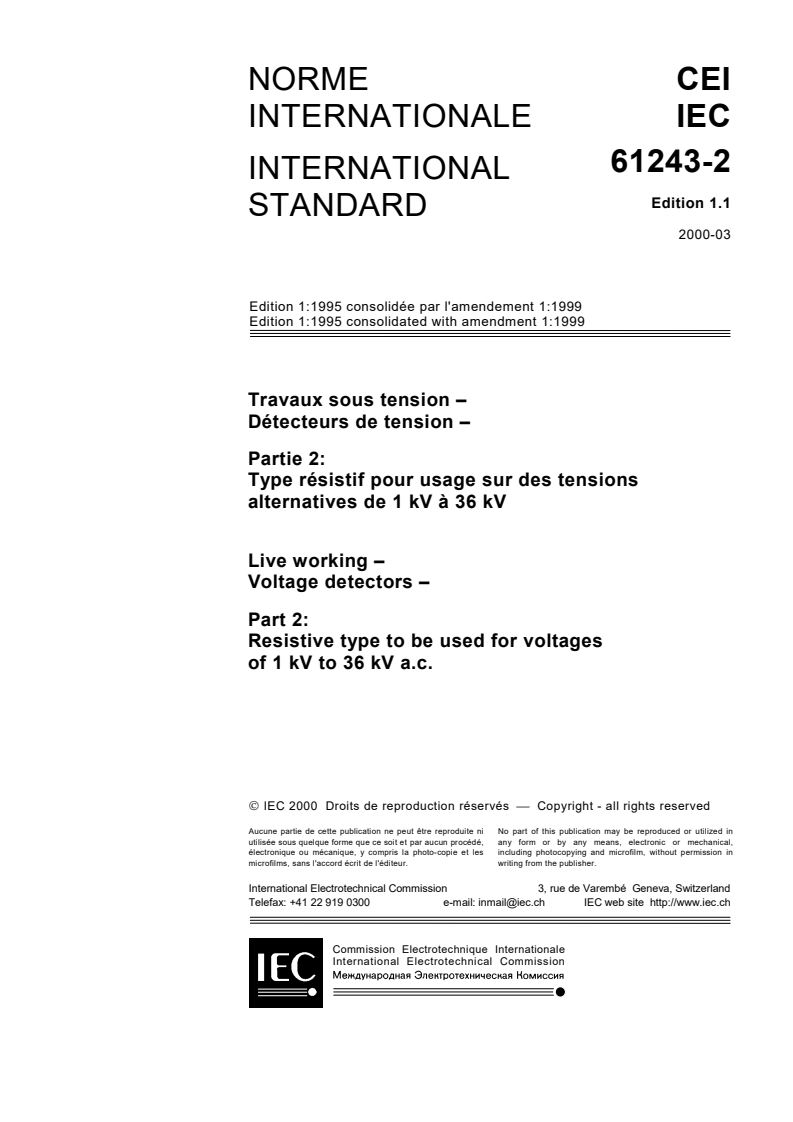
NORME CEI
INTERNATIONALE IEC
61243-2
INTERNATIONAL
Edition 1.1
STANDARD
2000-03
Edition 1:1995 consolidée par l'amendement 1:1999
Edition 1:1995 consolidated with amendment 1:1999
Travaux sous tension –
Détecteurs de tension –
Partie 2:
Type résistif pour usage sur des tensions
alternatives de 1 kV à 36 kV
Live working –
Voltage detectors –
Part 2:
Resistive type to be used for voltages
of 1 kV to 36 kV a.c.
IEC 2000 Droits de reproduction réservés Copyright - all rights reserved
Aucune partie de cette publication ne peut être reproduite ni No part of this publication may be reproduced or utilized in
utilisée sous quelque forme que ce soit et par aucun procédé, any form or by any means, electronic or mechanical,
électronique ou mécanique, y compris la photo-copie et les including photocopying and microfilm, without permission in
microfilms, sans l'accord écrit de l'éditeur. writing from the publisher.
International Electrotechnical Commission 3, rue de Varembé Geneva, Switzerland
Telefax: +41 22 919 0300 e-mail: inmail@iec.ch IEC web site http://www.iec.ch
CODE PRIX
Commission Electrotechnique Internationale
PRICE CODE CM
International Electrotechnical Commission
Pour prix, voir catalogue en vigueur
For price, see current catalogue
– 2 – 61243-2 © CEI:1995+A1:1999
SOMMAIRE
Pages
AVANT-PROPOS . 6
Articles
1 Domaine d'application. 8
2 Références normatives . 8
3 Définitions. 10
4 Prescriptions.18
4.1 Généralités . 18
4.2 Prescriptions de fonctionnement . 18
4.3 Prescriptions électriques. 22
4.4 Prescriptions mécaniques . 24
4.5 Marquages. 28
5 Essais. 28
5.1 Généralités . 28
5.2 Essais de fonctionnement . 32
5.3 Essais électriques. 40
5.4 Essais mécaniques . 52
6 Procédure d'échantillonnage . 58
7 Plan d'assurance qualité . 58
8 Enregistrements. 60
Annexe A (normative) Chronologie des essais. 86
Annexe B (normative) Instructions d'emploi. 88
Annexe C (normative) Procédure d'échantillonnage. 90
Annexe D (normative) Essai de choc mécanique (voir 5.4.7) . 94
Annexe E (normative) Symbole de marquage . 98
Annexe F (informative) Essais de réception. 100
Annexe G (informative) Entretien courant. 102
Figure 1 – Détecteurs.64
Figure 2 – Montage pour essais de fonctionnement. 66
Figure 3 – Raccordements pour essais de fonctionnement . 68
Figure 4 – Montage d'essai pour mesurage de la perceptibilité indiscutable de l'indication
visuelle. 70
Figure 5 – Montage pour mesurage de la perceptibilité indiscutable de l'indication sonore . 72
Figure 6 – Courbes de mesurage du temps de réponse. 74
Figure 7 – Montage d'essai avec barre pour mesurage de la protection de contournement. 76
Figure 8 – Disposition pour mesurage de protection de contournement pour détecteur
de type extérieur . . 78
Figure 9 –Essai pour force de préhension . 78
61243-2 © IEC:1995+A1:1999 – 3 –
CONTENTS
Page
FOREWORD . 7
Clause
1 Scope . 9
2 Normative references. 9
3 Definitions. 11
4 Requirements . 19
4.1 General. 19
4.2 Functional requirements . 19
4.3 Electrical requirements . 23
4.4 Mechanical requirements . 25
4.5 Markings. 29
5 Tests . 29
5.1 General. 29
5.2 Functional tests . 33
5.3 Electrical tests . 41
5.4 Mechanical tests . 53
6 Sampling procedure . 59
7 Quality assurance plan. 59
8 Records . 61
Annex A (normative) Chronology of tests. 87
Annex B (normative) Instructions for use . 89
Annex C (normative) Sampling procedure . 91
Annex D (normative) Mechanical shock test (see 5.4.7) . 95
Annex E (normative) Symbol for marking. 99
Annex F (informative) Acceptance tests . 101
Annex G (informative) In-service care . 103
Figure 1 – Detectors. 65
Figure 2 – Set-up for functional tests. 67
Figure 3 – Circuit connections for functional tests . 69
Figure 4 – Test set-up for measurement of clear perceptibility of visual indication . 71
Figure 5 – Test set-up for measurement of clear perceptibility of audible indication. 73
Figure 6 – Curves of measurement of response time. 75
Figure 7 – Test set-up with bars for test of protection against bridging. 77
Figure 8 – Arrangement for testing bridging protection of outdoor type detector . 79
Figure 9 – Test for grip force . 79
– 4 – 61243-2 © CEI:1995+A1:1999
Figure 10 – Courbe de cycle d'essai pour résistance climatique . 80
Figure 11 – Montage d'essai pour rigidité diélectrique pour boîtier indicateur et élément
résistif . 80
Figure 12 – Montage d'essai pour l'influence d'un champ magnétique perturbateur . 82
Figure 13 – Montage d'essai pour la solidité du conducteur de terre et des liaisons . 84
Figure D.1 –Détails du pendule pour l'essai de choc mécanique. 96
Figure E.1 – Symbole de marquage. 98
Tableau 1 – Catégories climatiques. 22
Tableau 2 – Longueur maximale de la partie nue de l'électrode de contact. 26
Tableau 3 – Ecartements étroits pour essais de protection de contournement . 46
Tableau A.1 – Ordre séquentiel pour exécuter les essais . 86
Tableau C.1 – Classification des défauts. 90
Tableau C.2 – Plan d'échantillonnage pour défauts majeurs. 92
Tableau C.3 – Plan d'échantillonnage pour défauts mineurs. 92
61243-2 © IEC:1995+A1:1999 – 5 –
Figure 10 – Curve of test cycle for climatic resistance . 81
Figure 11 – Test set-up for dielectric strength for indicator housing and resistive element . 81
Figure 12 – Test set-up for the influence of magnetic interference field . 83
Figure 13 – Test set-up for the robustness of the earth lead and connections. 85
Figure D.1 – Details of pendulum for shock test . 97
Figure E.1 – Symbol for marking . 99
Table 1 – Climatic categories . 23
Table 2 – Maximum length of bare portion of contact electrode . 27
Table 3 – Narrow point spacings for testing of protection against bridging. 47
Table A.1 – Sequential order for performing tests. 87
Table C.1 – Classification of defects . 91
Table C.2 – Sampling plan for major defects . 93
Table C.3 – Sampling plan for minor defects . 93
– 6 – 61243-2 © CEI:1995+A1:1999
COMMISSION ÉLECTROTECHNIQUE INTERNATIONALE
___________
TRAVAUX SOUS TENSION – DÉTECTEURS DE TENSION –
Partie 2: Type résistif pour usage sur des tensions alternatives
de 1 kV à 36 kV
AVANT-PROPOS
1) La CEI (Commission Électrotechnique Internationale) est une organisation mondiale de normalisation
composée de l'ensemble des comités électrotechniques nationaux (Comités nationaux de la CEI). La CEI a
pour objet de favoriser la coopération internationale pour toutes les questions de normalisation dans les
domaines de l'électricité et de l'électronique. A cet effet, la CEI, entre autres activités, publie des Normes
internationales. Leur élaboration est confiée à des comités d'études, aux travaux desquels tout Comité national
intéressé par le sujet traité peut participer. Les organisations internationales, gouvernementales et non
gouvernementales, en liaison avec la CEI, participent également aux travaux. La CEI collabore étroitement
avec l'Organisation Internationale de Normalisation (ISO), selon des conditions fixées par accord entre les
deux organisations.
2) Les décisions ou accords officiels de la CEI concernant les questions techniques représentent, dans la mesure
du possible, un accord international sur les sujets étudiés, étant donné que les Comités nationaux intéressés
sont représentés dans chaque comité d’études.
3) Les documents produits se présentent sous la forme de recommandations internationales. Ils sont publiés
comme normes, spécifications techniques, rapports techniques ou guides et agréés comme tels par les
Comités nationaux.
4) Dans le but d'encourager l'unification internationale, les Comités nationaux de la CEI s'engagent à appliquer de
façon transparente, dans toute la mesure possible, les Normes internationales de la CEI dans leurs normes
nationales et régionales. Toute divergence entre la norme de la CEI et la norme nationale ou régionale
correspondante doit être indiquée en termes clairs dans cette dernière.
5) La CEI n’a fixé aucune procédure concernant le marquage comme indication d’approbation et sa responsabilité
n’est pas engagée quand un matériel est déclaré conforme à l’une de ses normes.
6) L’attention est attirée sur le fait que certains des éléments de la présente Norme internationale peuvent faire
l’objet de droits de propriété intellectuelle ou de droits analogues. La CEI ne saurait être tenue pour
responsable de ne pas avoir identifié de tels droits de propriété et de ne pas avoir signalé leur existence.
La Norme internationale CEI 61243-2 a été établie par le comité d'études 78 de la CEI: Outils
pour travaux sous tension.
La présente version consolidée de la CEI 61243-2 est issue de la première édition (1995)
[documents 78/164+164A/FDIS et 78/181/RVD], des corrigenda de juin 1996, de juillet 1999
et de mars 2000 et de son amendement 1 (1999) [documents 78/288/FDIS et 78/294/RVD].
Elle porte le numéro d'édition 1.1.
Une ligne verticale dans la marge indique où la publication de base a été modifiée par
l'amendement 1.
Le contenu des corrigenda a été pris en considération dans cet exemplaire.
Les annexes A, B, C, D et E font partie intégrante de cette norme.
Les annexes F et G sont données uniquement à titre d'information.
61243-2 © IEC:1995+A1:1999 – 7 –
INTERNATIONAL ELECTROTECHNICAL COMMISSION
___________
LIVE WORKING – VOLTAGE DETECTORS –
Part 2: Resistive type to be used for voltages of 1 kV to 36 kV a.c.
FOREWORD
1) The IEC (International Electrotechnical Commission) is a worldwide organization for standardization comprising
all national electrotechnical committees (IEC National Committees). The object of the IEC is to promote
international co-operation on all questions concerning standardization in the electrical and electronic fields. To
this end and in addition to other activities, the IEC publishes International Standards. Their preparation is
entrusted to technical committees; any IEC National Committee interested in the subject dealt with may
participate in this preparatory work. International, governmental and non-governmental organizations liaising
with the IEC also participate in this preparation. The IEC collaborates closely with the International
Organization for Standardization (ISO) in accordance with conditions determined by agreement between the
two organizations.
2) The formal decisions or agreements of the IEC on technical matters express, as nearly as possible, an
international consensus of opinion on the relevant subjects since each technical committee has representation
from all interested National Committees.
3) The documents produced have the form of recommendations for international use and are published in the form
of standards, technical specifications, technical reports or guides and they are accepted by the National
Committees in that sense.
4) In order to promote international unification, IEC National Committees undertake to apply IEC International
Standards transparently to the maximum extent possible in their national and regional standards. Any
divergence between the IEC Standard and the corresponding national or regional standard shall be clearly
indicated in the latter.
5) The IEC provides no marking procedure to indicate its approval and cannot be rendered responsible for any
equipment declared to be in conformity with one of its standards.
6) Attention is drawn to the possibility that some of the elements of this International Standard may be the subject
of patent rights. The IEC shall not be held responsible for identifying any or all such patent rights.
International Standard IEC 61243-2 has been prepared by IEC technical committee 78:
Tools for live working.
This consolidated version of IEC 61243-2 is based on the first edition (1995) [documents
78/164+164A/FDIS and 78/181/RVD], its corrigenda June 1996, July 1999 and March 2000
and its amendment 1 (1999) [documents 78/288/FDIS and 78/294/RVD].
It bears the edition number 1.1.
A vertical line in the margin shows where the base publication has been modified by
amendment 1.
The contents of the corrigenda have been included in this copy.
Annexes A, B, C, D and E form an integral part of this standard.
Annexes F and G are for information only.
– 8 – 61243-2 © CEI:1995+A1:1999
TRAVAUX SOUS TENSION – DÉTECTEURS DE TENSION –
Partie 2: Type résistif pour usage sur des tensions alternatives
de 1 kV à 36 kV
1 Domaine d'application
La présente partie de la CEI 61243 est applicable aux détecteurs de tension portatifs avec ou
sans alimentation incorporée pour utilisation sur réseaux électriques de tensions alternatives
de 1 kV à 36 kV, et de fréquences de 15 Hz à 60 Hz.
Cette partie s'applique uniquement aux détecteurs de tension résistifs utilisés en contact avec
la pièce à essayer, en une seule partie ou en dispositif séparé complété par une perche
isolante adaptable conforme à la CEI 60855 ou à la CEI 61235. Les autres types de
détecteurs de tension ne sont pas couverts par cette partie de la norme. Les détecteurs de
tension capacitifs sont couverts par la CEI 61243-1.
La limite supérieure de tension est en accord avec les essais décrits dans la présente partie
de la CEI 61243.
Quelques restrictions quant à leur utilisation sont applicables en cas d'appareillage de
connexion monté en usine et sur réseau aérien de voie ferrée électrifiée (voir annexe B).
NOTE 1 Sauf spécification contraire, toutes les tensions définies dans cette norme se réfèrent aux tensions entre
phases des réseaux triphasés. Les détecteurs résistifs peuvent être utilisés sur des réseaux autres que triphasés,
mais la tension applicable entre phases ou entre phase et terre doit être utilisée pour déterminer la tension de
service.
NOTE 2 Bien que cette norme ne couvre pas les détecteurs de tension c.c., certains détecteurs peuvent répondre
à une tension continue.
2 Références normatives
Les documents normatifs suivants contiennent des dispositions qui, par suite de la référence
qui y est faite, constituent des dispositions valables pour la présente partie de la CEI 61243.
Pour les références datées, les amendements ultérieurs ou les révisions de ces publications
ne s’appliquent pas. Toutefois, les parties prenantes aux accords fondés sur la présente
partie de la CEI 61243 sont invitées à rechercher la possibilité d'appliquer les éditions les
plus récentes des documents normatifs indiqués ci-après. Pour les références non datées, la
dernière édition du document normatif en référence s’applique. Les membres de la CEI et de
l'ISO possèdent le registre des Normes internationales en vigueur.
CEI 60050(151):1978, Vocabulaire Electrotechnique International (VEI) – Chapitre 151:
Dispositifs électriques et magnétiques
CEI 60050(601):1985, Vocabulaire Electrotechnique International (VEI) – Chapitre 601:
Production, transport et distribution de l'énergie électrique - Généralités
CEI 60060-1:1989, Techniques des essais à haute tension – Partie 1: Définitions et
prescriptions générales relatives aux essais
CEI 60068-1:1988, Essais d'environnement – Partie 1: Généralités et guide
Amendement 1 (1992)
61243-2 © IEC:1995+A1:1999 – 9 –
LIVE WORKING – VOLTAGE DETECTORS –
Part 2: Resistive type to be used for voltages of 1 kV to 36 kV a.c.
1 Scope
This part of IEC 61243 is applicable to portable voltage detectors with or without a built-in
power source to be used on electrical systems for voltages of 1 kV to 36 kV a.c., and
frequencies from 15 Hz to 60 Hz.
This part applies only to resistive voltage detectors used in contact with the part to be tested,
as a single unit or as a separate device completed by an adaptable insulating pole covered in
IEC 60855 or IEC 61235. Other types of voltage detectors are not covered by this part of
standard. Capacitive voltage detectors are covered in IEC 61243-1.
The upper voltage limit is in accordance with the tests described in this part of IEC 61243.
Some restrictions on their use are applicable in the case of factory-assembled switchgear and
on overhead systems of electrified railways (see annex B).
NOTE 1 Except when otherwise specified, all the voltages defined in this standard refer to phase-to-phase
voltages of three-phase systems. Resistive detectors may be used in other than three-phase systems, but the
applicable phase-to-phase or phase-to-earth (ground) voltage shall be used to determine the operating voltage.
NOTE 2 Although this standard does not cover d.c. voltage detectors, some detectors may respond to d.c.
voltage.
2 Normative references
The following normative documents contain provisions which, through reference in this text,
constitute provisions of this part of IEC 61243. For dated references, subsequent
amendments to, or revisions of, any of these publications do not apply. However, parties to
agreements based on this part of IEC 61243 are encouraged to investigate the possibility of
applying the most recent editions of the normative documents indicated below. For undated
references, the latest edition of the normative document referred to applies. Members of IEC
and ISO maintain registers of currently valid International Standards.
International Electrotechnical Vocabulary (IEV) – Chapter 151: Elec-
IEC 60050(151):1978,
trical and magnetic devices
IEC 60050(601):1985, International Electrotechnical Vocabulary (IEV) – Chapter 601:
Generation, transmission and distribution of electricity – General
High-voltage test techniques – Part 1: General definitions and test
IEC 60060-1:1989,
requirements
IEC 60068-1:1988, Environmental testing – Part 1: General and guidance
Amendment 1 (1992)
– 10 – 61243-2 © CEI:1995+A1:1999
CEI 60068-2-6:1982, Essais d'environnement – Deuxième partie: Essais – Essai Fc et guide:
Vibrations (sinusoïdales)
CEI 60068-2-14:1984, Essais d'environnement – Deuxième partie: Essais – Essai N:
Variations de température
CEI 60068-2-32:1975, Essais d'environnement – Deuxième partie: Essais – Essai Ed: Chute
libre
Amendement 2 (1990)
CEI 60071-1:1993, Coordination de l'isolement - Partie 1: Définitions, principes et règles
CEI 60651:1979, Sonomètres
Amendement n° 1 (1993)
CEI 60855:1985, Tubes isolants remplis de mousse et tiges isolantes pleines pour travaux
sous tension
CEI 61235:1993, Travaux sous tension – Tubes creux isolants pour travaux électriques
CEI 61318:1994, Travaux sous tension – Guide pour les plans d'assurance de la qualité
ISO 2859-1:1999, Règles d'échantillonnage pour les contrôles par attributs – Partie 1:
Procédures d'échantillonnage pour les contrôles lot par lot, indexés d'après le niveau de
qualité acceptable (NQA)
ISO 3745:1977, Acoustique – Détermination des niveaux de puissance acoustique émis par le
sources de bruit – Méthodes de laboratoire pour salles anéchoïque et semi-anéchoïque
ISO 8402:1986, Qualité – Vocabulaire
ISO 9000:1987, Normes pour la gestion de la qualité et l'assurance de la qualité – Lignes
directrices pour la sélection et l'utilisation
ISO 9002:1987: Systèmes qualité – Modèles pour l'assurance de la qualité en production et
installation
ISO 9004:1987, Gestion de la qualité et éléments de système qualité – Lignes directrices
CIE 15.2:1986, Colorimétrie
3 Définitions
Pour les besoins de la présente partie de la CEI 61243, les définitions suivantes s'appliquent.
3.1
embout
partie permettant l'assemblage du détecteur
3.2
accessoires
articles utilisés pour allonger la poignée ou l'électrode de contact, pour améliorer l'efficacité
de l'électrode de contact ou permettre à l'électrode de contact d'atteindre la pièce
d'installation à vérifier
61243-2 © IEC:1995+A1:1999 – 11 –
IEC 60068-2-6:1982, Environmental testing – Part 2: Tests – Test Fc and guidance: Vibration
(sinusoidal)
IEC 60068-2-14:1984, Environmental testing – Part 2: Tests – Test N: Change of temperature
Environmental testing – Part 2: Tests – Test Ed: Free fall
IEC 60068-2-32:1975,
Amendment 2 (1990)
Insulation co-ordination – Part 1: Definitions, principles and rules
IEC 60071-1:1993,
IEC 60651:1979, Sound level meters
Amendment 1 (1993)
IEC 60855:1985, Insulating foam-filled tubes and solid rods for live working
Live working – Insulating hollow tubes for electrical purposes
IEC 61235:1993,
IEC 61318:1994, Live working – Guidelines for quality assurance plans
Sampling procedures for inspection by attributes – Part 1: Sampling
ISO 2859-1:1999,
schemes indexed by acceptance quality limit (AQL) for lot-by-lot inspection
Acoustics – Determination of sound power levels of noise sources – Precision
ISO 3745:1977,
methods for anechoic and semi-anechoic rooms
Quality – Vocabulary
ISO 8402:1986,
ISO 9000:1987, Quality management and quality assurance standards – Guidelines for
selection and use
ISO 9002:1987: Quality systems – Model for quality assurance in production and installation
Quality management and quality system elements – Guidelines
ISO 9004:1987,
ICI 15.2:1986, Colorimetry
3 Definitions
For the purposes of this part of IEC 61243, the following definitions apply.
3.1
adaptor
part allowing the assembly of the detector
3.2
accessories
items used to lengthen the handle or the contact electrode, to improve the efficiency of the
contact electrode or to enable the contact electrode to reach the part to be tested
– 12 – 61243-2 © CEI:1995+A1:1999
3.3
électrode de contact
partie conductrice qui établit la connexion électrique avec la pièce à vérifier
3.4
allonge d'électrode de contact
section conductrice extérieurement isolée entre l'élément résistif et l'électrode de contact,
prévue pour obtenir la position exacte de l'indicateur par rapport à la pièce à vérifier
3.5
détecteur de tension
dispositif portable utilisé pour détecter la présence ou l'absence de la tension de service de la
pièce à vérifier
3.6
détecteur capacitif
dispositif dont le fonctionnement est basé sur le courant passant à travers la capacité de fuite
à la terre
3.7
détecteur résistif (détecteur)
dispositif dont le fonctionnement est basé sur le courant passant à travers une résistance
située dans l'élément résistif, et une connexion galvanique à la terre. Les détecteurs résistifs
sont de deux types:
– un dispositif d'une seule pièce comprenant ou non un élément isolant, avec ou sans allonge
d'électrode de contact, et
– un dispositif séparé complété par une perche isolante adaptable, avec ou sans allonge
d'électrode de contact
3.8
élément isolant
section de matériau isolant qui fournit à l'utilisateur une distance et une isolation adéquates
3.9
élément résistif
élément qui contient la résistance de limitation du courant et des parties conductrices
3.10
dispositif de contrôle
dispositif intégré ou non, au moyen duquel le fonctionnement du détecteur peut être vérifié
par l'utilisateur
3.11
conducteur de terre
conducteur qui relie le détecteur à la terre. Il inclut une cosse ou pince de terre
3.12
indicateur
partie du détecteur qui indique la présence ou l'absence de la tension de service à l'électrode
de contact
3.13
indication indiscutable
détection et indication sans ambiguïté de l'état de tension sur l'électrode de contact
61243-2 © IEC:1995+A1:1999 – 13 –
3.3
contact electrode
conductive part which makes the electrical connection to the part to be tested.
3.4
contact electrode extension
externally insulated conductive section between the resistive element and the contact
electrode, intended to achieve the correct position of the indicator relative to the part to be
tested
3.5
voltage detector
a portable device used to detect the presence or the absence of the operating voltage of part
to be tested
3.6
capacitive detector
device whose operation is based on the current passing through the stray capacitance to
earth (ground)
3.7
resistive detector (detector)
device whose operation is based on the current passing through a resistor located in the
resistive element, and a galvanic connection to earth (ground). Resistive detectors are of two
types:
– a single unit including or not an insulating element, with or without contact electrode
extension, and
– a separate unit completed with an adaptable insulating pole, with or without contact
electrode extension
3.8
insulating element
section of insulating material which provides adequate distance and insulation to the user
3.9
resistive element
element which contains the current-limiting resistor and conductive parts
3.10
testing element
built-in or external device, by means of which the functioning of the detector can be checked
by the user
3.11
earth lead
lead that connects the detector to earth (ground). It includes an earth clip or clamp
3.12
indicator
part of the detector which indicates the presence or absence of the operating voltage at the
contact electrode
3.13
clear indication
unambiguous detection and indication of the voltage state at the contact electrode
– 14 – 61243-2 © CEI:1995+A1:1999
3.14
perche isolante
perche faite en matériau isolant
3.15
champ perturbateur
champ électrique pouvant affecter l'indication. Il peut résulter de la pièce à vérifier ou d'autres
composants voisins et être en n'importe quelle relation de phase
Les cas extrêmes pour les essais sont les suivants:
– Un champ perturbateur en phase existe quand une petite variation de potentiel dans la
direction de l'axe du détecteur entraîne une indication incorrecte. Ceci provient des
dimensions et/ou de la configuration de la pièce de l'installation à vérifier (ou de parties
adjacentes de l'installation ayant des tensions en phase).
– Un champ perturbateur en opposition de phase existe quand une forte variation de potentiel
dans la direction de l'axe du détecteur entraîne une indication incorrecte. Ceci provient des
parties adjacentes de l'installation ayant des tensions en opposition de phase.
3.16
tension perturbatrice
tension captée inductivement ou capacitivement par la pièce à vérifier
3.17
garde-main
garde physique distinctive séparant la poignée de l'élément résistif ou isolant
NOTE Son but est d'empêcher la mains de glisser et venir au contact de l'élément résistif ou isolant.
3.18
marque limite
emplacement distinctif ou marque indiquant à l'utilisateur la limite physique jusqu'où le
détecteur peut être inséré entre des pièces sous tension ou peut les toucher
3.19
perceptibilité indiscutable
cas où l'indication est perceptible sans erreur par l'utilisateur sous des conditions spécifiques
d'environnement quand le détecteur est dans sa position de fonctionnement
3.20
protection de contournement
protection contre l'amorçage ou le claquage, quand l'isolement entre les parties de
l'installation à vérifier, à différents potentiels, est diminué par la présence du détecteur
3.21
état de veille
état dans lequel le détecteur est prêt à fonctionner à la tension de seuil sans commutation
manuelle
3.22
temps de réponse
intervalle de temps entre le changement rapide de l'état de tension sur l'électrode de contact
et l'indication indiscutable correspondante
3.23
type intérieur
détecteur conçu pour être utilisé dans des conditions sèches, normalement à l'intérieur
61243-2 © IEC:1995+A1:1999 – 15 –
3.14
insulating pole
pole made of insulating material
3.15
interference field
electric field which may affect the indication. It may result from the part to be tested or other
adjacent components and may have any phase relationship.
The extreme cases for the tests are:
– An in-phase interference field exists when a small change of potential in the direction of the
detector axis results in an incorrect indication. This occurs as a result of the dimensions
and/or configuration of the part of installation to be tested (or of adjacent parts of
installation having voltages in the same phase).
– An interference field in phase opposition exists when a strong change of potential in the
direction of the detector axis results in an incorrect indication. This occurs as a result of the
adjacent parts of the installation having voltages in phase opposition.
3.16
interference voltage
voltage picked up inductively or capacitively by the part to be tested
3.17
hand guard
distinctive physical guard separating the handle from the resistive or insulating element
NOTE Its purpose is to prevent the hand from slipping and passing into contact with the resistive or the insulating
element.
3.18
limit mark
distinctive location or mark to indicate to the user the physical limit to which the detector may
be inserted between live components or may touch them
3.19
clear perceptibility
case when the indication is unmistakably discernible by the user under specific environmental
conditions when the detector is in its operating position
3.20
protection against bridging
protection against flashover or breakdown, when the insulation between the parts of
installation to be tested, at different potentials, is reduced by the presence of the detector
3.21
stand-by state
state at which the detector is ready to work at the threshold voltage without manual switching
"ON"
3.22
response time
time delay between sudden change of the voltage state on the contact electrode and the
associated clear indication
3.23
indoor type
detector designed for use in dry conditions, normally indoors
– 16 – 61243-2 © CEI:1995+A1:1999
3.24
type extérieur
détecteur conçu pour être utilisé dans des conditions humides soit à l'intérieur soit à
l'extérieur
3.25
tension assignée (U )
r
valeur de la tension fixée généralement par le fabricant et le client, à laquelle certaines
spécifications de fonctionnement font référence
La tension assignée du détecteur est la tension choisie dans le tableau 2, colonne 1, de la
CEI 60071-1, laquelle devrait être égale soit à la tension nominale (ou la plus haute tension
nominale de sa plage de tensions nominales) soit à la valeur de tension immédiatement
supérieure indiquée dans ces tableaux.
3.26
tension de seuil (U )
t
tension minimale requise entre la pièce sous tension et la terre pour donner une indication
indiscutable correspondant aux conditions spécifiques définies dans l'essai correspondant.
NOTE La tension de seuil, telle que définie dans cette norme, se rapporte à des conditions spécifiques d'essai. Il
convient que les utilisateurs soient conscients que la tension de seuil prescrite pour leur exploitation en réseau
demande à être rapportée aux conditions d'essai dans cette norme.
Définitions VEI
3.27
tension nominale (U )
n
valeur arrondie appropriée de la tension utilisée pour identifier un réseau ou une installation
[VEI 601-01-21, modifié]
La tension nominale du détecteur est le paramètre associé à son indication indiscutable. Un
détecteur peut avoir plus d'une tension nominale ou une plage de tensions nominales. Les
valeurs limites de la plage de tensions nominales sont désignées par U min. et U max.
n n
3.28
essai de réception
essai contractuel ayant pour objet de prouver au client que le dispositif répond à certaines
conditions de sa spécification [VEI 151-04-20]
3.29
essai de maintenance
essai effectué périodiquement sur un dispositif ou un équipement et destiné à vérifier que ses
caractéristiques de fonctionnement se maintiennent dans des limites spécifiées, après avoir
procédé, le cas échéant, aux ajustements nécessaires [VEI 151-04-22]
3.30
essai individuel de série
essai auquel est soumis chaque dispositif au cours ou en fin de fabrication pour vérifier qu'il
satisfait à des critères définis [VEI 151-04-16]
3.31
essai (de série) sur prélèvement
essai effectué sur un certain nombre de dispositifs prélevés au hasard dans un lot
[VEI 151-04-17]
3.32
essai de type
essai effectué sur un ou plusieurs dispositifs réalisés selon une conception donnée pour
vérifier que cette conception répond à certaines spécifications [VEI 151-04-15]
61243-2 © IEC:1995+A1:1999 – 17 –
3.24
outdoor type
detector designed for use in wet conditions either indoors or outdoors
3.26
rated voltage (U )
r
value of voltage generally agreed upon by manufacturer and customer, to which certain
operating specifications are referred
The rated voltage of the detector is the voltage selected from IEC 60071-1, table 2, column 1,
which should either be equal to the nominal voltage (or the highest nominal voltage of its
nominal voltage range), or the next higher voltage selected from those tables.
3.26
threshold voltage (U )
t
minimum voltage between the live part and earth (ground) required to give a clear indication
corresponding to specific conditions as defined in the corresponding test
NOTE Threshold voltage, as defined in this standard is related to specific conditions of test. Users should be
aware that their requirements for threshold voltage for field operation need to be related to the test conditions in
the standard.
IEV definitions
3.27
nominal voltage (U )
n
suitable approximate value of voltage used to identify a system or device [IEV 601-01-21,
modified]
Nominal voltage of the detector is the parameter associated with its clear indication.
A detector may have more than one nominal voltage, or a nominal voltage range. Limit values
of the nominal voltage range are named U min. and U max.
n n
3.28
acceptance test
contractual test to prove to the customer that the device meets certain
...