

IEC 61850-7-1:2011
(Main)Communication networks and systems for power utility automation - Part 7-1: Basic communication structure - Principles and models
General Information
- Abstract
IEC 61850-7-1:2011 introduces the modelling methods, communication principles, and information models that are used in the various parts of the IEC 61850-7 series. The purpose is to provide - from a conceptual point of view - assistance to understand the basic modelling concepts and description methods for:
- substation-specific information models for power utility automation systems,
- device functions used for power utility automation purposes, and
- communication systems to provide interoperability within power utility facilities. Compared to the first edition, this second edition introduces:
- the model for statistical and historical statistical data,
- the concepts of proxies, gateways, LD hierarchy and LN inputs,
- the model for time synchronisation,
- the concepts behind different testing facilities,
- the extended logging function. It also clarifies certain items.
- Status
- Published
- Publication Date
- 30-Aug-2020
- Technical Committee
- TC 57 - Power systems management and associated information exchange
- Drafting Committee
- WG 10 - TC 57/WG 10
- Current Stage
- PPUB - Publication issued
- Start Date
- 15-Jul-2011
- Completion Date
- 15-Jul-2011
Buy Documents
IEC 61850-7-1:2011+AMD1:2020 CSV - Communication networks and systems for power utility automation - Part 7-1: Basic communication structure - Principles and models
IEC 61850-7-1:2011 - Communication networks and systems for power utility automation - Part 7-1: Basic communication structure - Principles and models Released:7/15/2011
Overview - IEC 61850-7-1:2011 (Principles and models)
IEC 61850-7-1 defines the basic communication structure, modelling methods and principles used across the IEC 61850 family for power utility automation. It provides a conceptual framework to describe:
- substation-specific information models,
- device functions for power utility automation, and
- communication systems that enable interoperability within substations and power facilities.
Edition 2 (consolidated with Amend.1) extends the first edition by introducing models for statistical and historical data, time synchronisation, proxies/gateways and logical device (LD) hierarchy, logical node (LN) inputs, testing facilities, and an extended logging function - all aimed at improving device modelling and reliable communications.
Key topics and technical requirements
- Information modelling: Logical nodes (LNs), common data classes and composition rules that define semantic data for protection, control and monitoring.
- Device and logical device models: Structure, nameplate data, LD hierarchy and proxies/gateways for virtualisation and device integration.
- Communication principles and services: Abstract Communication Service Interface (ACSI), client-server interactions, and mapping guidance to concrete protocols.
- Data types and namespaces: Specification of namespaces, versioning rules and extension policies to maintain compatibility across standards and implementations.
- Time synchronisation: Conceptual model for time alignment of measurements and events.
- Statistical & historical data modelling: Models for statistical and historical statistical information used in trending, reporting and diagnostics.
- Testing, logging and engineering: Concepts for test signals, simulation, extended logging and use of Substation Configuration Language (SCL) for configuration and engineering.
- Annexes with practical mapping: Includes mapping examples (e.g., IEC 61850-8-1), GOOSE/SMV subscription configuration and engineering workflows.
Applications and practical value
- Provides the conceptual backbone for designing interoperable substation automation systems and integrating Intelligent Electronic Devices (IEDs).
- Guides OEMs and system integrators on how to model device functions, data semantics and communication services for protection, control and monitoring.
- Supports utilities in establishing consistent engineering practices, SCL-based configuration, reliable time-synchronised measurements, logging and testing strategies.
- Enables vendors to implement compatible client-server and event-based messaging (e.g., GOOSE/SMV mappings) while preserving semantics across products.
Who uses this standard
- Power utilities and transmission/distribution operators
- IED and substation equipment manufacturers (OEMs)
- System integrators and engineering contractors
- Test laboratories and certification bodies
- Standards committees and product designers focused on substation interoperability
Related standards
- IEC 61850 series (especially IEC 61850-7-2, -7-3, -7-4 for class refinements)
- IEC 61850-8-1 and IEC 61850-9-x mapping documents
- Substation Configuration Language (SCL) guidance and Annex F mapping examples
Keywords: IEC 61850-7-1, IEC 61850, power utility automation, substation automation, logical nodes, information models, time synchronisation, proxies, gateways, SCL, GOOSE, SMV.
Relations
- Effective Date
- 05-Sep-2023
- Effective Date
- 05-Sep-2023
Buy Documents
IEC 61850-7-1:2011+AMD1:2020 CSV - Communication networks and systems for power utility automation - Part 7-1: Basic communication structure - Principles and models
IEC 61850-7-1:2011 - Communication networks and systems for power utility automation - Part 7-1: Basic communication structure - Principles and models Released:7/15/2011
Get Certified
Connect with accredited certification bodies for this standard

ANCE
Mexican certification and testing association.

Intertek Slovenia
Intertek testing, inspection, and certification services in Slovenia.

LNE (Laboratoire National de Métrologie et d'Essais)
French national laboratory for metrology and testing.
Sponsored listings
Frequently Asked Questions
IEC 61850-7-1:2011 is a standard published by the International Electrotechnical Commission (IEC). Its full title is "Communication networks and systems for power utility automation - Part 7-1: Basic communication structure - Principles and models". This standard covers: IEC 61850-7-1:2011 introduces the modelling methods, communication principles, and information models that are used in the various parts of the IEC 61850-7 series. The purpose is to provide - from a conceptual point of view - assistance to understand the basic modelling concepts and description methods for: - substation-specific information models for power utility automation systems, - device functions used for power utility automation purposes, and - communication systems to provide interoperability within power utility facilities. Compared to the first edition, this second edition introduces: - the model for statistical and historical statistical data, - the concepts of proxies, gateways, LD hierarchy and LN inputs, - the model for time synchronisation, - the concepts behind different testing facilities, - the extended logging function. It also clarifies certain items.
IEC 61850-7-1:2011 introduces the modelling methods, communication principles, and information models that are used in the various parts of the IEC 61850-7 series. The purpose is to provide - from a conceptual point of view - assistance to understand the basic modelling concepts and description methods for: - substation-specific information models for power utility automation systems, - device functions used for power utility automation purposes, and - communication systems to provide interoperability within power utility facilities. Compared to the first edition, this second edition introduces: - the model for statistical and historical statistical data, - the concepts of proxies, gateways, LD hierarchy and LN inputs, - the model for time synchronisation, - the concepts behind different testing facilities, - the extended logging function. It also clarifies certain items.
IEC 61850-7-1:2011 is classified under the following ICS (International Classification for Standards) categories: 33.200 - Telecontrol. Telemetering. The ICS classification helps identify the subject area and facilitates finding related standards.
IEC 61850-7-1:2011 has the following relationships with other standards: It is inter standard links to IEC 61850-7-1:2011/AMD1:2020, IEC 61850-7-1:2003. Understanding these relationships helps ensure you are using the most current and applicable version of the standard.
IEC 61850-7-1:2011 is available in PDF format for immediate download after purchase. The document can be added to your cart and obtained through the secure checkout process. Digital delivery ensures instant access to the complete standard document.
Standards Content (Sample)
IEC 61850-7-1 ®
Edition 2.1 2020-08
CONSOLIDATED VERSION
INTERNATIONAL
STANDARD
colour
inside
Communication networks and systems for power utility automation –
Part 7-1: Basic communication structure – Principles and models
All rights reserved. Unless otherwise specified, no part of this publication may be reproduced or utilized in any form
or by any means, electronic or mechanical, including photocopying and microfilm, without permission in writing from
either IEC or IEC's member National Committee in the country of the requester. If you have any questions about IEC
copyright or have an enquiry about obtaining additional rights to this publication, please contact the address below or
your local IEC member National Committee for further information.
IEC Central Office Tel.: +41 22 919 02 11
3, rue de Varembé info@iec.ch
CH-1211 Geneva 20 www.iec.ch
Switzerland
About the IEC
The International Electrotechnical Commission (IEC) is the leading global organization that prepares and publishes
International Standards for all electrical, electronic and related technologies.
About IEC publications
The technical content of IEC publications is kept under constant review by the IEC. Please make sure that you have the
latest edition, a corrigendum or an amendment might have been published.
IEC publications search - webstore.iec.ch/advsearchform Electropedia - www.electropedia.org
The advanced search enables to find IEC publications by a The world's leading online dictionary on electrotechnology,
variety of criteria (reference number, text, technical containing more than 22 000 terminological entries in English
committee,…). It also gives information on projects, replaced and French, with equivalent terms in 16 additional languages.
and withdrawn publications. Also known as the International Electrotechnical Vocabulary
(IEV) online.
IEC Just Published - webstore.iec.ch/justpublished
Stay up to date on all new IEC publications. Just Published IEC Glossary - std.iec.ch/glossary
details all new publications released. Available online and 67 000 electrotechnical terminology entries in English and
once a month by email. French extracted from the Terms and definitions clause of
IEC publications issued between 2002 and 2015. Some
IEC Customer Service Centre - webstore.iec.ch/csc entries have been collected from earlier publications of IEC
If you wish to give us your feedback on this publication or TC 37, 77, 86 and CISPR.
need further assistance, please contact the Customer Service
Centre: sales@iec.ch.
IEC 61850-7-1 ®
Edition 2.1 2020-08
CONSOLIDATED VERSION
INTERNATIONAL
STANDARD
colour
inside
Communication networks and systems for power utility automation –
Part 7-1: Basic communication structure – Principles and models
INTERNATIONAL
ELECTROTECHNICAL
COMMISSION
ICS 33.200 ISBN 978-2-8322-8823-8
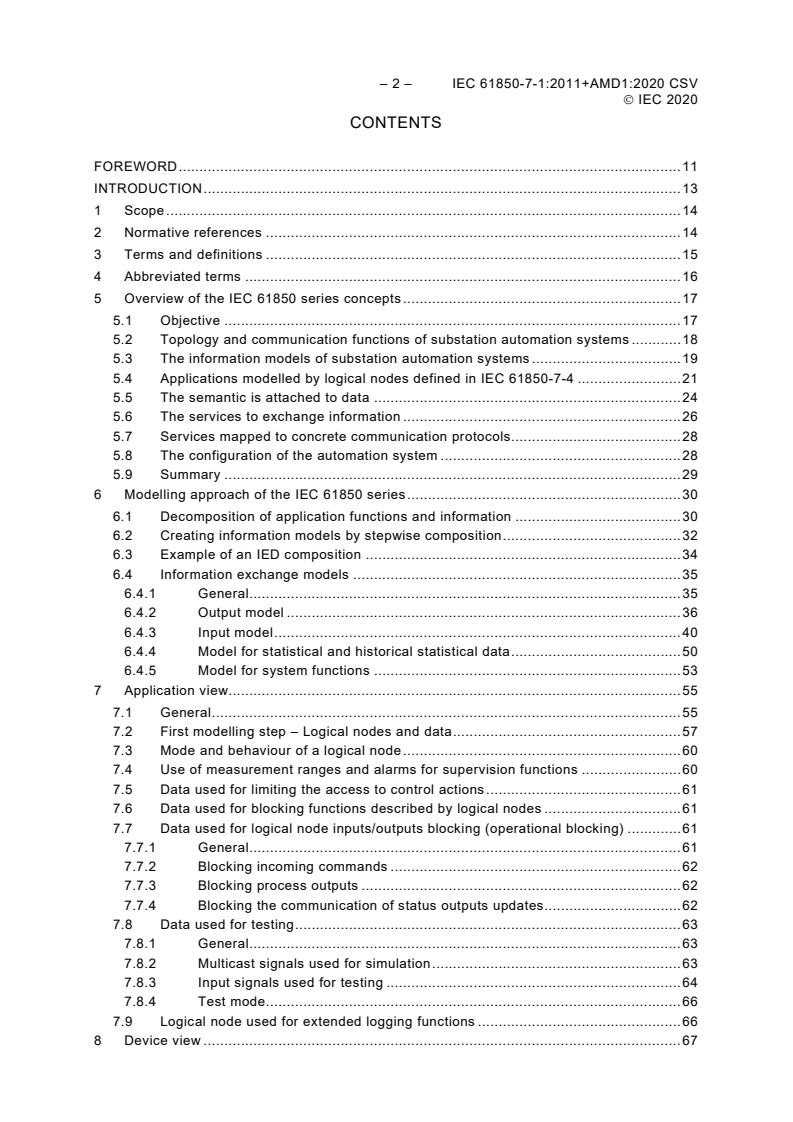
– 2 – IEC 61850-7-1:2011+AMD1:2020 CSV
IEC 2020
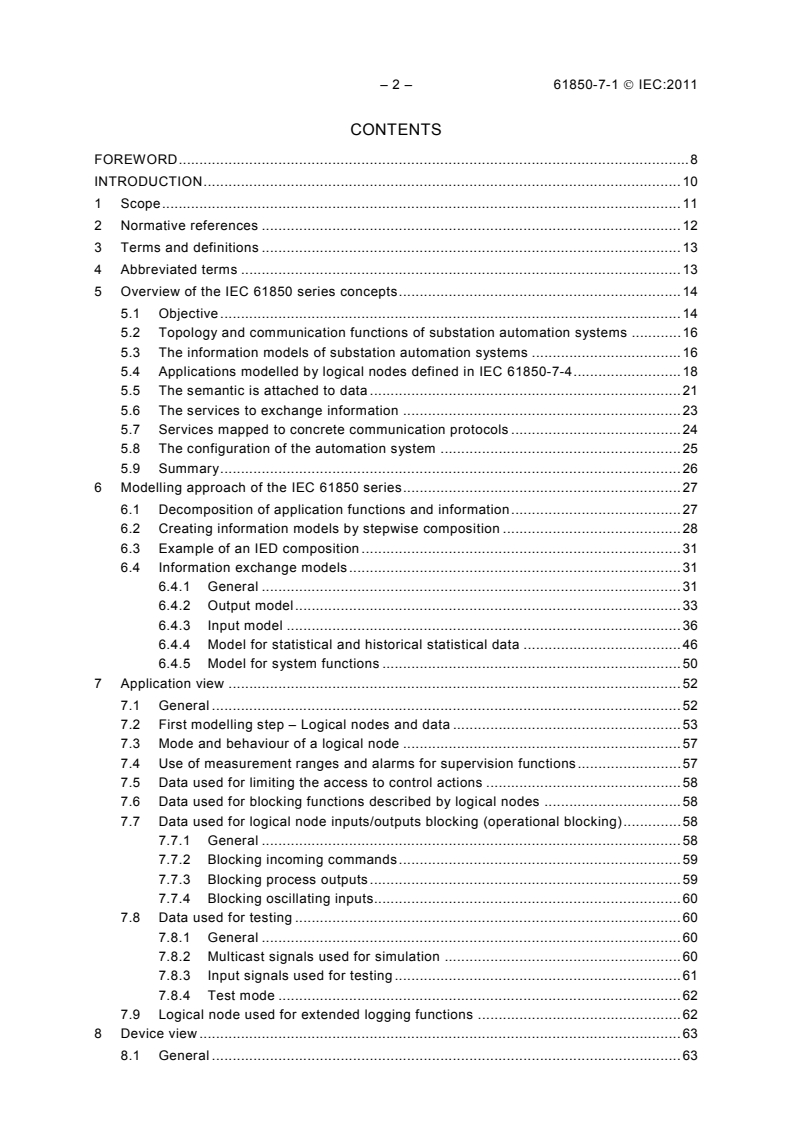
CONTENTS
FOREWORD . 11
INTRODUCTION . 13
1 Scope . 14
2 Normative references . 14
3 Terms and definitions . 15
4 Abbreviated terms . 16
5 Overview of the IEC 61850 series concepts . 17
5.1 Objective . 17
5.2 Topology and communication functions of substation automation systems . 18
5.3 The information models of substation automation systems . 19
5.4 Applications modelled by logical nodes defined in IEC 61850-7-4 . 21
5.5 The semantic is attached to data . 24
5.6 The services to exchange information . 26
5.7 Services mapped to concrete communication protocols. 28
5.8 The configuration of the automation system . 28
5.9 Summary . 29
6 Modelling approach of the IEC 61850 series . 30
6.1 Decomposition of application functions and information . 30
6.2 Creating information models by stepwise composition . 32
6.3 Example of an IED composition . 34
6.4 Information exchange models . 35
6.4.1 General. 35
6.4.2 Output model . 36
6.4.3 Input model . 40
6.4.4 Model for statistical and historical statistical data . 50
6.4.5 Model for system functions . 53
7 Application view. 55
7.1 General . 55
7.2 First modelling step – Logical nodes and data . 57
7.3 Mode and behaviour of a logical node . 60
7.4 Use of measurement ranges and alarms for supervision functions . 60
7.5 Data used for limiting the access to control actions . 61
7.6 Data used for blocking functions described by logical nodes . 61
7.7 Data used for logical node inputs/outputs blocking (operational blocking) . 61
7.7.1 General. 61
7.7.2 Blocking incoming commands . 62
7.7.3 Blocking process outputs . 62
7.7.4 Blocking the communication of status outputs updates . 62
7.8 Data used for testing . 63
7.8.1 General. 63
7.8.2 Multicast signals used for simulation . 63
7.8.3 Input signals used for testing . 64
7.8.4 Test mode. 66
7.9 Logical node used for extended logging functions . 66
8 Device view . 67
IEC 2020
8.1 General . 67
8.2 Second modelling step – logical device model . 68
8.2.1 The logical device concept . 68
8.2.2 The device nameplate . 69
8.2.3 Gateways and proxies . 70
8.2.4 Logical devices for monitoring external device health. 74
8.2.5 Logical devices management hierarchy . 74
9 Communication view . 76
9.1 General . 76
9.2 The service models of the IEC 61850 series . 76
9.3 The virtualisation . 78
9.4 Basic information exchange mechanisms . 79
9.5 The client-server building blocks . 81
9.5.1 Server . 81
9.5.2 Client-server roles . 82
9.6 Logical nodes communicate with logical nodes . 83
9.7 Interfaces inside and between devices . 84
10 Where physical devices, application models and communication meet. 85
11 Relationships between IEC 61850-7-2, IEC 61850-7-3 and IEC 61850-7-4 . 86
11.1 Refinements of class definitions . 86
11.2 Example 1 – Logical node and data object class . 87
11.3 Example 2 – Relationship of IEC 61850-7-2, IEC 61850-7-3, and IEC 61850-7-4 . 91
12 Formal specification method . 93
12.1 Notation of ACSI classes . 93
12.2 Class modelling . 93
12.2.1 Overview . 93
12.2.2 Common data class . 95
12.2.3 Logical node class . 99
12.3 Service parameters tables . 101
12.4 Referencing instances . 102
13 Namespaces . 105
13.1 General . 105
13.2 Namespaces defined in the IEC 61850-7-x series . 106
13.3 Namespaces dependencies . 110
13.3.1 General. 110
13.3.2 Basic namespaces dependencies . 110
13.3.3 Other namespaces dependencies . 112
13.4 Specification of namespaces . 113
13.5 Attributes for references to namespaces . 113
13.5.1 General. 113
13.5.2 Attribute for logical device namespace (ldNs) . 114
13.5.3 Attribute for logical device basic namespace (LLN0.NamPlt.lnNs) . 114
13.5.4 Attribute for logical node namespace (lnNs) . 115
13.5.5 Attribute for data namespace (dataNs) . 115
13.5.6 Attribute for common data class namespace (cdcNs) . 115
13.5.7 Attribute for naming a common data class name (cdcName) . 115
13.6 Deprecation of namespaces . 116
14 Common rules for new version of classes and for extension of object classes . 116
– 4 – IEC 61850-7-1:2011+AMD1:2020 CSV
IEC 2020
14.1 General . 116
14.2 Basic rules . 116
14.2.1 General. 116
14.2.2 Use of optional information . 119
14.2.3 General rules for enumerations types and enumeration-based data
objects and attributes. 119
14.3 Rules for extensions within private namespace . 119
14.3.1 Rules for LN classes . 119
14.3.2 New LN classes . 120
14.3.3 Rules for Common Data Classes . 120
14.3.4 Rules for enumeration types and enumeration-based data objects and
attributes . 121
14.4 Extensions made within product standard namespaces . 121
14.5 Extensions made within transitional namespaces . 121
14.6 Extensions made within basic and domain namespaces . 121
14.7 Multiple instances of LN classes for dedicated and complex functions . 122
14.7.1 Example for time overcurrent . 122
14.7.2 Example for PDIS . 122
14.7.3 Example for power transformer . 122
14.7.4 Example for auxiliary network . 122
14.8 Specialisation of data by use of number extensions . 123
14.9 Examples for new LNs . 123
14.10 Example for new Data . 123
15 Compatibility between different versions of the standard . 124
Annex A (informative) Overview of logical nodes and data . 125
A.1 Compatible logical node classes and data classes (IEC 61850-7-4) . 125
A.1.1 List of LN groups (IEC 61850-7-4) . 125
A.1.2 LN classes (IEC 61850-7-4) . 125
A.1.3 Data object classes (IEC 61850-7-4) . 125
A.2 Common data class specifications (IEC 61850-7-3) . 125
Annex B (informative) Allocation of data to logical nodes . 127
Annex C (informative) Use of the substation configuration language (SCL) . 130
C.1 General . 130
C.2 SCL and options in logical nodes . 130
C.3 SCL and options in data . 131
Annex D (xxx) . 132
Annex E (informative) Relation between logical nodes and PICOMs . 133
Annex F (informative) Mapping the ACSI to real communication systems . 134
F.1 General . 134
F.1.1 Mapping example (IEC 61850-8-1) . 136
Annex G (normative) LGOS/LSVS engineering . 142
G.1 General . 142
G.2 LGOS/LSVS engineering by the ICT . 143
G.3 LGOS/LSVS engineering by the SCT . 144
Annex H (normative) GOOSE/SMV Subscription Configuration . 146
H.1 General . 146
H.2 SCT supplied input binding workflow . 147
H.3 ICT supplied input binding (for later binding) . 148
IEC 2020
Annex I (informative) Specification of namespaces for Edition 3 . 149
I.1 Namespaces dependencies . 149
I.1.1 General. 149
I.1.2 Namespaces dependencies . 149
I.2 Example 2 – Standardized data objects used in standardized LNs . 150
I.3 Example 3 – Edition 2 device: standardized data object introduced in
IEC61850-7-4:2007B . 151
I.4 Example 4 – Edition 2 device: standardized LN introduced in IEC61850-7-
4:2007B . 152
I.5 Example 5 – Edition 1 device: Logical nodes in technical reports . 153
I.6 Example 6- Edition 2.1 device: Logical nodes in technical reports defining
new CDCs . 155
I.7 Example 7- Edition 2.1 device: devices for product family standards . 156
I.8 Example 8 – Standardized logical nodes introduced by other domain
applications . 157
I.9 Example 9 – Standardized logical nodes introduced by other domain
applications than moved to IEC 61850-7-4 . 159
Annex J (normative) Use case scenarios examples for clarifying the common rules of
Clause 14 . 162
J.1 General . 162
J.2 Example 1 – Private LN using standardized DOs . 162
J.3 Example 2 – Standardized data objects used in standardized LNs . 163
J.4 Example 3 – Edition 2 device: standardized data object introduced in
IEC61850-7-4:2007B . 163
J.5 Example 4 – Edition 2 device: standardized LN introduced in IEC61850-7-
4:2007B . 164
J.6 Example 5 – Edition 1 device: Logical nodes in technical reports . 165
J.7 Example 6- Edition 2.1 device: Logical nodes in technical reports defining
new CDCs . 167
J.8 Example 7- Edition 2.1 device: devices for product family standards . 168
J.9 Example 8 – Standardized logical nodes introduced by other domain
applications . 169
J.10 Example 9 – Standardized logical nodes introduced by other domain
applications than moved to IEC 61850-7-4 . 171
Annex K (normative) General requirements and recommendations regarding
compatibility issues between different versions of IEC 61850 . 174
K.1 Overview. 174
K.1.1 General. 174
K.1.2 Definitions (to go to part 2): . 174
K.1.3 Introduction to compatibility discussion . 175
K.1.4 Assumptions . 175
K.1.5 Generic rules . 176
K.1.6 Overview on use cases . 177
K.2 Use cases related to the data model . 181
K.2.1 Use case 1: Add new type . 181
K.2.2 Use case 2: Add new FC . 181
K.2.3 Use case 3: Extend CDC with elements of existing types and FCs . 182
K.2.4 Use case 4: Add a new DataObject (DO) based on new CDCs . 183
K.2.5 Use case 5: Add a new DO based on existing CDCs . 184
K.2.6 Use case 6: Rename a DO . 184
K.2.7 Use case 7: Rename a DA, subDO or subDA . 184
– 6 – IEC 61850-7-1:2011+AMD1:2020 CSV
IEC 2020
K.2.8 Use case 8: Deprecation of a FC . 185
K.2.9 Use case 9: Deprecation of a DA . 186
K.2.10 Use case 10: Removal of a DA . 186
K.2.11 Use case 11: Deprecation of a DO . 187
K.2.12 Use case 12: Use a weaker presence condition . 187
K.2.13 Use case 13: Use a stronger presence condition . 188
K.2.14 Use case 14: Extend Enumeration List with an enumerated value . 188
K.2.15 Use case 15: Modification of an Enumerated value . 189
K.2.16 Use case 16: Deprecation of an Enumerated value . 190
K.2.17 Use case 17: Extension of a PACKED LIST . 190
K.2.18 Use case 18: Extend Name Length . 190
K.3 Use cases related to the services l . 191
K.3.1 Use case 30: Add new type . 191
K.3.2 Use case 31: Using new control block class . 192
K.3.3 Use case 32: Using new services . 192
K.3.4 Use case 33: Extending control block class with an attribute of existing
type . 193
K.3.5 Use case 34: Rename a service parameter not associated with a
control block attribute . 193
K.3.6 Use case 35: Removing / Deprecating Control Block Classes . 193
K.3.7 Use case 36: Using a stronger presence condition . 194
Bibliography . 195
Figure 1 – Relations between modelling and mapping parts of the IEC 61850 series . 17
Figure 2 – Sample substation automation topology . 19
Figure 3 – Modelling approach (conceptual) . 20
Figure 4 – Logical node information categories . 23
Figure 5 – Build-up of devices (principle) . 23
Figure 6 – Position information depicted as a tree (conceptual) . 24
Figure 7 – Service excerpt . 27
Figure 8 – Example of communication mapping . 28
Figure 9 – Summary . 30
Figure 10 – Decomposition and composition process (conceptual) . 31
Figure 11 – XCBR1 information depicted as a tree . 33
Figure 12 – Example of IED composition . 35
Figure 13 – Output and input model (principle). 36
Figure 14 – Output model (step 1) (conceptual) . 37
Figure 15 – Output model (step 2) (conceptual) . 38
Figure 16 – GSE output model (conceptual) . 38
Figure 17 – Setting data (conceptual) . 39
Figure 18 – Input model for analogue values (step 1) (conceptual) . 41
Figure 19 – Range and deadbanded value (conceptual) . 42
Figure 20 – Input model for analogue values (step 2) (conceptual) . 43
Figure 21 – Reporting and logging model (conceptual) . 44
Figure 22 – Data set members and reporting . 45
Figure 23 – Buffered report control block (conceptual) . 46
IEC 2020
Figure 24 – Buffer time . 47
Figure 25 – Data set members and inclusion-bitstring . 48
Figure 26 – Log control block (conceptual) . 48
Figure 27 – Peer-to-peer data value publishing model (conceptual) . 49
Figure 28 – Conceptual model of statistical and historical statistical data (1) . 51
Figure 29 – Conceptual model of statistical and historical statistical data (2) . 53
Figure 30 – Concept of the service tracking model – Example: control service tracking . 55
Figure 31 – Real world devices . 56
Figure 32 – Logical nodes and data (IEC 61850-7-2) . 57
Figure 33 – Simple example of modelling . 58
Figure 34 – Basic building blocks . 58
Figure 35 – Logical nodes and PICOM . 59
Figure 36 – Logical nodes connected (outside view in IEC 61850-7-x series) . 59
Figure 37 – Mode and behaviour data (IEC 61850-7-4) . 60
Figure 38 – Data used for limiting the access to control actions (IEC 61850-7-4) . 61
Figure 39 – Data used for logical node inputs/outputs blocking (IEC 61850-7-4) . 62
Figure 40 – Data used for receiving simulation signals . 63
Figure 80 – GOOSE subscription supervision state machine . 64
Figure 81 – SV subscription supervision state machine . 64
Figure 41 – Example of input signals used for testing . 65
Figure 42 – Test mode example . 66
Figure 43 – Logical node used for extended logging functions (GLOG) . 67
Figure 44 – Logical device building block . 68
Figure 45 – Logical devices and LLN0/LPHD . 69
Figure 46 – The common data class DPL . 70
Figure 47 – Logical devices in proxies or gateways . 72
Figure 79 – Logical devices in proxies or gateways (functional naming) . 73
Figure 48 – Logical devices for monitoring external device health . 74
Figure 49 – Logical devices management hierarchy . 75
Figure 50 – ACSI communication methods . 77
Figure 51 – Virtualisation . 79
Figure 52 – Virtualisation and usage . 79
Figure 53 – Information flow and modelling . 80
Figure 54 – Application of the GSE model . 80
Figure 55 – Server building blocks . 81
Figure 56 – Interaction between application process and application layer
(client/server) . 82
Figure 57 – Example for a service . 82
Figure 58 – Client/server and logical nodes . 82
Figure 59 – Client and server roles . 83
Figure 60 – Logical nodes communicate with logical nodes . 84
Figure 61 – Interfaces inside and between devices . 85
Figure 62 – Component hierarchy of different views (excerpt) . 86
– 8 – IEC 61850-7-1:2011+AMD1:2020 CSV
IEC 2020
Figure 63 – Refinement of the DATA class . 87
Figure 64 – Instances of a Data object class (conceptual) . 91
Figure 65 – Relation between parts of the IEC 61850 series . 92
Figure 66 – Abstract data model example for IEC 61850-7-x . 94
Figure 67 – Relation of TrgOp and Reporting . 99
Figure 68 – Sequence diagram . 102
Figure 69 – References. 102
Figure 70 – Use of FCD and FCDA . 103
Figure 71 – Object names and object reference . 105
Figure 72 – Definition of names and semantics . 106
Figure 73 – Name space as class repository . 107
Figure 74 – All instances derived from classes in a single name space . 108
Figure 75 – Instances derived from multiple namespaces . 109
Figure 76 – Inherited namespaces . 109
Figure 77 – Basic namespaces dependencies . 111
Figure 78 – Other namespaces dependencies. 112
Figure 78 – Basic extension rules diagram . 117
Figure B.1 – Example for control and protection LNs combined in one physical device . 127
Figure B.2 – Merging unit and sampled value exchange (topology) . 128
Figure B.3 – Merging unit and sampled value exchange (data) . 128
Figure C.1 – Application of SCL for LNs (conceptual) . 130
Figure C.2 – Application of SCL for data (conceptual) . 131
Figure E.1 – Exchanged data between subfunctions (logical nodes) . 133
Figure E.2 – Relationship between PICOMS and client/server model . 133
Figure F.1 – ACSI mapping to an application layer . 134
Figure F.2 – ACSI mappings (conceptual) . 135
Figure F.3 – ACSI mapping to communication stacks/profiles . 136
Figure F.4 – Mapping to MMS (conceptual) . 136
Figure F.5 – Mapping approach . 137
Figure F.6 – Mapping detail of mapping to a MMS named variable . 138
Figure F.7 – Example of MMS named variable (process values) . 138
Figure F.8 – Use of MMS named variables and named variable list . 139
Figure F.9 – MMS information report message . 140
Figure F.10 – Mapping example . 141
Figure G.1 – LGOS/LSVS engineering . 143
Figure G.2 – LGOS/LSVS engineering by ICT . 144
Figure G.3 – LGOS/LSVS engineering by the SCT . 145
Figure H.1 – GOOSE/SMV subscription engineering workflow. 146
Figure H.2 – SCT supplied input binding . 147
Figure H.3 – ICT supplied input binding (for later binding) . 148
Figure I.1 – Private LN using standardized DOs (Edition 2) . 150
Figure I.2 –Standardized data objects used in standardized LNs . 151
IEC 2020
Figure I.3 – Edition 2 device: standardized data object introduced in IEC61850-7-
4:2007B . 152
Figure I.4 – Edition 2 device: standardized LN introduced in IEC61850-7-4:2007B . 153
Figure I.5 – Edition 1 device: Logical nodes in technical reports . 154
Figure I.6 – Edition 2 device: Logical nodes in technical reports . 155
Figure I.7 – Edition 2.1 device: Logical nodes in technical reports defining new CDCs . 156
Figure I.8 – Edition 2.1 device: standardized LNs extended by other domains . 157
Figure I.9 – Edition 2 device: standardized LN introduced in IEC 61850-7-420:2009 . 158
Figure I.10 – Edition 2.1 device: standardized LN introduced in IEC 61850-7-420:2015 . 159
Figure I.11 – Edition 2 device: standardized LN moved from introduced in IEC 61850-
7-420:2009 to IEC 61850-7-4:2007 . 160
Figure I.12 – Edition 2.1 device: standardized LN moved from introduced in
IEC 61850-7-420:2009 to IEC 61850-7-4:2007 . 161
Figure J.1 – Private LN using standardized DOs (Edition 2) . 162
Figure J.2 –Standardized data objects used in standardized LNs . 163
Figure J.3 – Edition 2 device: standardized data object introduced in IEC61850-7-
4:2007B . 164
Figure J.4 – Edition 2 device: standardized LN introduced in IEC61850-7-4:2007B . 165
Figure J.5 – Edition 1 device: Logical nodes in technical reports . 166
Figure J.6 – Edition 2 device: Logical nodes in technical reports . 167
Figure J.7 – Edition 2.1 device: Logical nodes in technical reports defining new CDCs . 168
Figure J.8 – Edition 2.1 device: standardized LNs extended by other domains . 169
Figure J.9 – Edition 2 device: standardized LN introduced in IEC 61850-7-420:2009 . 170
Figure J.10 – Edition 2.1 device: standardized LN introduced in IEC 61850-7-420:2015 . 171
Figure J.11 – Edition 2 device: standardized LN moved from introduced in IEC 61850-
7-420:2009 to IEC 61850-7-4:2007 . 172
Figure J.12 – Edition 2.1 device: standardized LN moved from introduced in
IEC 61850-7-420:2009 to IEC 61850-7-4:2007 . 173
Table 1 – LN groups . 21
Table 2 – Logical node class XCBR (conceptual) . 32
Table 3 – Excerpt of integer status setting . 40
Table 4 – Comparison of the data access methods . 45
Table 5 – ACSI models and services . 77
Table 6 – Logical node circuit breaker. 88
Table 7 – Controllable double point (DPC) . 90
Table 8 – ACSI class definition . 93
Table 9 – Single point status common data class (SPS) . 95
Table 10 – Quality components attribute definition . 96
Table 16 – Attributes of DetailQual . 97
Table 11– Functional constraints (excerpt) . 98
Table 12– Trigger option . 98
Table 13 – GenLogicalNodeClass definition . 100
Table 14 – Excerpt of logical node name plate common data class (LPL).
...
IEC 61850-7-1 ®
Edition 2.0 2011-07
INTERNATIONAL
STANDARD
NORME
INTERNATIONALE
colour
inside
Communication networks and systems for power utility automation –
Part 7-1: Basic communication structure – Principles and models
Réseaux et systèmes de communication pour l'automatisation des systèmes
électriques –
Partie 7-1: Structure de communication de base – Principes et modèles
All rights reserved. Unless otherwise specified, no part of this publication may be reproduced or utilized in any form or by
any means, electronic or mechanical, including photocopying and microfilm, without permission in writing from either IEC or
IEC's member National Committee in the country of the requester.
If you have any questions about IEC copyright or have an enquiry about obtaining additional rights to this publication,
please contact the address below or your local IEC member National Committee for further information.
Droits de reproduction réservés. Sauf indication contraire, aucune partie de cette publication ne peut être reproduite
ni utilisée sous quelque forme que ce soit et par aucun procédé, électronique ou mécanique, y compris la photocopie
et les microfilms, sans l'accord écrit de la CEI ou du Comité national de la CEI du pays du demandeur.
Si vous avez des questions sur le copyright de la CEI ou si vous désirez obtenir des droits supplémentaires sur cette
publication, utilisez les coordonnées ci-après ou contactez le Comité national de la CEI de votre pays de résidence.
IEC Central Office
3, rue de Varembé
CH-1211 Geneva 20
Switzerland
Email: inmail@iec.ch
Web: www.iec.ch
About the IEC
The International Electrotechnical Commission (IEC) is the leading global organization that prepares and publishes
International Standards for all electrical, electronic and related technologies.
About IEC publications
The technical content of IEC publications is kept under constant review by the IEC. Please make sure that you have the
latest edition, a corrigenda or an amendment might have been published.
Catalogue of IEC publications: www.iec.ch/searchpub
The IEC on-line Catalogue enables you to search by a variety of criteria (reference number, text, technical committee,…).
It also gives information on projects, withdrawn and replaced publications.
IEC Just Published: www.iec.ch/online_news/justpub
Stay up to date on all new IEC publications. Just Published details twice a month all new publications released. Available
on-line and also by email.
Electropedia: www.electropedia.org
The world's leading online dictionary of electronic and electrical terms containing more than 20 000 terms and definitions
in English and French, with equivalent terms in additional languages. Also known as the International Electrotechnical
Vocabulary online.
Customer Service Centre: www.iec.ch/webstore/custserv
If you wish to give us your feedback on this publication or need further assistance, please visit the Customer Service
Centre FAQ or contact us:
Email: csc@iec.ch
Tel.: +41 22 919 02 11
Fax: +41 22 919 03 00
A propos de la CEI
La Commission Electrotechnique Internationale (CEI) est la première organisation mondiale qui élabore et publie des
normes internationales pour tout ce qui a trait à l'électricité, à l'électronique et aux technologies apparentées.
A propos des publications CEI
Le contenu technique des publications de la CEI est constamment revu. Veuillez vous assurer que vous possédez
l’édition la plus récente, un corrigendum ou amendement peut avoir été publié.
Catalogue des publications de la CEI: www.iec.ch/searchpub/cur_fut-f.htm
Le Catalogue en-ligne de la CEI vous permet d’effectuer des recherches en utilisant différents critères (numéro de référence,
texte, comité d’études,…). Il donne aussi des informations sur les projets et les publications retirées ou remplacées.
Just Published CEI: www.iec.ch/online_news/justpub
Restez informé sur les nouvelles publications de la CEI. Just Published détaille deux fois par mois les nouvelles
publications parues. Disponible en-ligne et aussi par email.
Electropedia: www.electropedia.org
Le premier dictionnaire en ligne au monde de termes électroniques et électriques. Il contient plus de 20 000 termes et
définitions en anglais et en français, ainsi que les termes équivalents dans les langues additionnelles. Egalement appelé
Vocabulaire Electrotechnique International en ligne.
Service Clients: www.iec.ch/webstore/custserv/custserv_entry-f.htm
Si vous désirez nous donner des commentaires sur cette publication ou si vous avez des questions, visitez le FAQ du
Service clients ou contactez-nous:
Email: csc@iec.ch
Tél.: +41 22 919 02 11
Fax: +41 22 919 03 00
IEC 61850-7-1 ®
Edition 2.0 2011-07
INTERNATIONAL
STANDARD
NORME
INTERNATIONALE
colour
inside
Communication networks and systems for power utility automation –
Part 7-1: Basic communication structure – Principles and models
Réseaux et systèmes de communication pour l'automatisation des systèmes
électriques –
Partie 7-1: Structure de communication de base – Principes et modèles
INTERNATIONAL
ELECTROTECHNICAL
COMMISSION
COMMISSION
ELECTROTECHNIQUE
PRICE CODE
INTERNATIONALE
CODE PRIX XG
ICS 33.200 ISBN 978-2-88912-555-5
– 2 – 61850-7-1 IEC:2011
CONTENTS
FOREWORD . 8
INTRODUCTION . 10
1 Scope . 11
2 Normative references . 12
3 Terms and definitions . 13
4 Abbreviated terms . 13
5 Overview of the IEC 61850 series concepts . 14
5.1 Objective . 14
5.2 Topology and communication functions of substation automation systems . 16
5.3 The information models of substation automation systems . 16
5.4 Applications modelled by logical nodes defined in IEC 61850-7-4 . 18
5.5 The semantic is attached to data . 21
5.6 The services to exchange information . 23
5.7 Services mapped to concrete communication protocols . 24
5.8 The configuration of the automation system . 25
5.9 Summary . 26
6 Modelling approach of the IEC 61850 series . 27
6.1 Decomposition of application functions and information . 27
6.2 Creating information models by stepwise composition . 28
6.3 Example of an IED composition . 31
6.4 Information exchange models . 31
6.4.1 General . 31
6.4.2 Output model . 33
6.4.3 Input model . 36
6.4.4 Model for statistical and historical statistical data . 46
6.4.5 Model for system functions . 50
7 Application view . 52
7.1 General . 52
7.2 First modelling step – Logical nodes and data . 53
7.3 Mode and behaviour of a logical node . 57
7.4 Use of measurement ranges and alarms for supervision functions . 57
7.5 Data used for limiting the access to control actions . 58
7.6 Data used for blocking functions described by logical nodes . 58
7.7 Data used for logical node inputs/outputs blocking (operational blocking) . 58
7.7.1 General . 58
7.7.2 Blocking incoming commands . 59
7.7.3 Blocking process outputs . 59
7.7.4 Blocking oscillating inputs. 60
7.8 Data used for testing . 60
7.8.1 General . 60
7.8.2 Multicast signals used for simulation . 60
7.8.3 Input signals used for testing . 61
7.8.4 Test mode . 62
7.9 Logical node used for extended logging functions . 62
8 Device view . 63
8.1 General . 63
61850-7-1 IEC:2011 – 3 –
8.2 Second modelling step – logical device model . 64
8.2.1 The logical device concept . 64
8.2.2 The device nameplate . 65
8.2.3 Gateways and proxies . 66
8.2.4 Logical devices for monitoring external device health . 67
8.2.5 Logical devices management hierarchy . 68
9 Communication view . 70
9.1 General . 70
9.2 The service models of the IEC 61850 series . 70
9.3 The virtualisation . 72
9.4 Basic information exchange mechanisms . 73
9.5 The client-server building blocks . 75
9.5.1 Server . 75
9.5.2 Client-server roles . 76
9.6 Logical nodes communicate with logical nodes . 77
9.7 Interfaces inside and between devices . 78
10 Where physical devices, application models and communication meet . 79
11 Relationships between IEC 61850-7-2, IEC 61850-7-3 and IEC 61850-7-4 . 80
11.1 Refinements of class definitions . 80
11.2 Example 1 – Logical node and data class . 81
11.3 Example 2 – Relationship of IEC 61850-7-2, IEC 61850-7-3, and IEC 61850-7-4 . 85
12 Formal specification method . 86
12.1 Notation of ACSI classes . 86
12.2 Class modelling . 87
12.2.1 Overview . 87
12.2.2 Common data class . 88
12.2.3 Logical node class . 91
12.3 Service tables . 92
12.4 Referencing instances . 93
13 Name spaces . 96
13.1 General . 96
13.2 Name spaces defined in the IEC 61850-7-x series . 97
13.3 Specification of name spaces . 101
13.3.1 General . 101
13.3.2 Specification . 101
13.4 Attributes for references to name spaces . 102
13.4.1 General . 102
13.4.2 Attribute for logical device name space (ldNs) . 103
13.4.3 Attribute for logical node name space (lnNs). 103
13.4.4 Attribute for data name space (dataNs) . 104
13.4.5 Attribute for common data class name space (cdcNs) . 104
14 Common rules for new version of classes and for extension of classes. 104
14.1 General . 104
14.2 Basic rules . 104
14.3 Rules for LN classes . 105
14.3.1 Use of standardized LN classes . 105
14.3.2 Extensions to standardized LN classes made by third parties . 106
14.3.3 New LN classes . 106
– 4 – 61850-7-1 IEC:2011
14.3.4 New versions of standardized LN classes made by name space
owners . 107
14.4 Rules for common data classes and control block classes . 107
14.4.1 New common data classes and control block classes . 107
14.4.2 New versions of standardized common data classes . 107
14.4.3 New versions of control block classes. 107
14.5 Multiple instances of LN classes for dedicated and complex functions . 108
14.5.1 Example for time overcurrent . 108
14.5.2 Example for PDIS . 108
14.5.3 Example for power transformer . 108
14.5.4 Example for auxiliary network . 108
14.6 Specialisation of data by use of number extensions . 109
14.7 Examples for new LNs . 109
14.8 Example for new Data . 109
Annex A (informative) Overview of logical nodes and data . 110
Annex B (informative) Allocation of data to logical nodes . 113
Annex C (informative) Use of the substation configuration language (SCL) . 116
Annex D (informative) Applying the LN concept to options for future extensions . 118
Annex E (informative) Relation between logical nodes and PICOMs . 123
Annex F (informative) Mapping the ACSI to real communication systems . 124
Bibliography . 132
Figure 1 – Relations between modelling and mapping parts of the IEC 61850 series . 14
Figure 2 – Sample substation automation topology . 16
Figure 3 – Modelling approach (conceptual) . 17
Figure 4 – Logical node information categories . 20
Figure 5 – Build-up of devices (principle) . 20
Figure 6 – Position information depicted as a tree (conceptual) . 21
Figure 7 – Service excerpt . 23
Figure 8 – Example of communication mapping . 25
Figure 9 – Summary . 26
Figure 10 – Decomposition and composition process (conceptual) . 27
Figure 11 – XCBR1 information depicted as a tree . 30
Figure 12 – Example of IED composition . 31
Figure 13 – Output and input model (principle) . 32
Figure 14 – Output model (step 1) (conceptual) . 33
Figure 15 – Output model (step 2) (conceptual) . 34
Figure 16 – GSE output model (conceptual) . 34
Figure 17 – Setting data (conceptual) . 35
Figure 18 – Input model for analogue values (step 1) (conceptual) . 37
Figure 19 – Range and deadbanded value (conceptual) . 38
Figure 20 – Input model for analogue values (step 2) (conceptual) . 39
Figure 21 – Reporting and logging model (conceptual). 40
Figure 22 – Data set members and reporting . 41
Figure 23 – Buffered report control block (conceptual) . 42
61850-7-1 IEC:2011 – 5 –
Figure 24 – Buffer time . 43
Figure 25 – Data set members and inclusion-bitstring . 44
Figure 26 – Log control block (conceptual). 44
Figure 27 – Peer-to-peer data value publishing model (conceptual) . 45
Figure 28 – Conceptual model of statistical and historical statistical data (1) . 47
Figure 29 – Conceptual model of statistical and historical statistical data (2) . 49
Figure 30 – Concept of the service tracking model – Example: control service tracking . 51
Figure 31 – Real world devices . 52
Figure 32 – Logical nodes and data (IEC 61850-7-2) . 53
Figure 33 – Simple example of modelling . 55
Figure 34 – Basic building blocks . 55
Figure 35 – Logical nodes and PICOM . 56
Figure 36 – Logical nodes connected (outside view in IEC 61850-7-x series) . 56
Figure 37 – Mode and behaviour data (IEC 61850-7-4) . 57
Figure 38 – Data used for limiting the access to control actions (IEC 61850-7-4) . 58
Figure 39 – Data used for logical node inputs/outputs blocking (IEC 61850-7-4) . 59
Figure 40 – Data used for receiving simulation signals . 60
Figure 41 – Example of input signals used for testing . 61
Figure 42 – Test mode example . 62
Figure 43 – Logical node used for extended logging functions (GLOG) . 63
Figure 44 – Logical device building block . 64
Figure 45 – Logical devices and LLN0/LPHD . 65
Figure 46 – The common data class DPL . 66
Figure 47 – Logical devices in proxies or gateways . 67
Figure 48 – Logical devices for monitoring external device health . 68
Figure 49 – Logical devices management hierarchy . 69
Figure 50 – ACSI communication methods . 71
Figure 51 – Virtualisation . 73
Figure 52 – Virtualisation and usage . 73
Figure 53 – Information flow and modelling . 74
Figure 54 – Application of the GSE model . 74
Figure 55 – Server building blocks . 75
Figure 56 – Interaction between application process and application layer
(client/server) . 76
Figure 57 – Example for a service . 76
Figure 58 – Client/server and logical nodes . 77
Figure 59 – Client and server roles . 77
Figure 60 – Logical nodes communicate with logical nodes . 78
Figure 61 – Interfaces inside and between devices . 79
Figure 62 – Component hierarchy of different views (excerpt) . 80
Figure 63 – Refinement of the DATA class . 81
Figure 64 – Instances of a DATA class (conceptual) . 84
Figure 65 – Relation between parts of the IEC 61850 series . 85
– 6 – 61850-7-1 IEC:2011
Figure 66 – Abstract data model example for IEC 61850-7-x . 87
Figure 67 – Relation of TrgOp and Reporting . 90
Figure 68 – Sequence diagram . 92
Figure 69 – References . 93
Figure 70 – Use of FCD and FCDA . 94
Figure 71 – Object names and object reference . 95
Figure 72 – Definition of names and semantics . 96
Figure 73 – One name with two meanings . 97
Figure 74 – Name space as class repository . 98
Figure 75 – All instances derived from classes in a single name space . 99
Figure 76 – Instances derived from multiple name spaces . 100
Figure 77 – Inherited name spaces . 100
Figure 78 – Basic extension rules diagram . 105
Figure B.1 – Example for control and protection LNs combined in one physical device . 113
Figure B.2 – Merging unit and sampled value exchange (topology) . 114
Figure B.3 – Merging unit and sampled value exchange (data) . 114
Figure C.1 – Application of SCL for LNs (conceptual) . 116
Figure C.2 – Application of SCL for data (conceptual) . 117
Figure D.1 – Seamless communication (simplified) . 118
Figure D.2 – Example for new logical nodes . 119
Figure D.3 – Example for control center view and mapping to substation view . 121
Figure E.1 – Exchanged data between subfunctions (logical nodes) . 123
Figure E.2 – Relationship between PICOMS and client/server model . 123
Figure F.1 – ACSI mapping to an application layer . 124
Figure F.2 – ACSI mappings (conceptual) . 125
Figure F.3 – ACSI mapping to communication stacks/profiles . 126
Figure F.4 – Mapping to MMS (conceptual) . 126
Figure F.5 – Mapping approach . 127
Figure F.6 – Mapping detail of mapping to a MMS named variable . 128
Figure F.7 – Example of MMS named variable (process values) . 128
Figure F.8 – Use of MMS named variables and named variable list . 129
Figure F.9 – MMS information report message . 130
Figure F.10 – Mapping example . 131
Table 1 – LN groups . 18
Table 2 – Logical node class XCBR (conceptual) . 29
Table 3 – Excerpt of integer status setting . 36
Table 4 – Comparison of the data access methods . 41
Table 5 – ACSI models and services . 71
Table 6 – Logical node circuit breaker . 82
Table 7 – Controllable double point (DPC) . 83
Table 8 – ACSI class definition . 86
Table 9 – Single point status common data class (SPS) . 88
61850-7-1 IEC:2011 – 7 –
Table 10 – Quality components attribute definition . 89
Table 11 – Basic status information template (excerpt) . 89
Table 12 – Trigger option . 90
Table 13 – GenLogicalNodeClass definition . 91
Table 14 – Excerpt of logical node name plate common data class (LPL) . 103
Table 15 – Excerpt of common data class . 103
Table A.1 – Excerpt of data classes for measurands . 111
Table A.2 – List of common data classes (excerpt) . 112
– 8 – 61850-7-1 IEC:2011
INTERNATIONAL ELECTROTECHNICAL COMMISSION
____________
COMMUNICATION NETWORKS AND
SYSTEMS FOR POWER UTILITY AUTOMATION –
Part 7-1: Basic communication structure –
Principles and models
FOREWORD
1) The International Electrotechnical Commission (IEC) is a worldwide organization for standardization comprising
all national electrotechnical committees (IEC National Committees). The object of IEC is to promote
international co-operation on all questions concerning standardization in the electrical and electronic fields. To
this end and in addition to other activities, IEC publishes International Standards, Technical Specifications,
Technical Reports, Publicly Available Specifications (PAS) and Guides (hereafter referred to as “IEC
Publication(s)”). Their preparation is entrusted to technical committees; any IEC National Committee interested
in the subject dealt with may participate in this preparatory work. International, governmental and non-
governmental organizations liaising with the IEC also participate in this preparation. IEC collaborates closely
with the International Organization for Standardization (ISO) in accordance with conditions determined by
agreement between the two organizations.
2) The formal decisions or agreements of IEC on technical matters express, as nearly as possible, an international
consensus of opinion on the relevant subjects since each technical committee has representation from all
interested IEC National Committees.
3) IEC Publications have the form of recommendations for international use and are accepted by IEC National
Committees in that sense. While all reasonable efforts are made to ensure that the technical content of IEC
Publications is accurate, IEC cannot be held responsible for the way in which they are used or for any
misinterpretation by any end user.
4) In order to promote international uniformity, IEC National Committees undertake to apply IEC Publications
transparently to the maximum extent possible in their national and regional publications. Any divergence
between any IEC Publication and the corresponding national or regional publication shall be clearly indicated in
the latter.
5) IEC itself does not provide any attestation of conformity. Independent certification bodies provide conformity
assessment services and, in some areas, access to IEC marks of conformity. IEC is not responsible for any
services carried out by independent certification bodies.
6) All users should ensure that they have the latest edition of this publication.
7) No liability shall attach to IEC or its directors, employees, servants or agents including individual experts and
members of its technical committees and IEC National Committees for any personal injury, property damage or
other damage of any nature whatsoever, whether direct or indirect, or for costs (including legal fees) and
expenses arising out of the publication, use of, or reliance upon, this IEC Publication or any other IEC
Publications.
8) Attention is drawn to the normative references cited in this publication. Use of the referenced publications is
indispensable for the correct application of this publication.
9) Attention is drawn to the possibility that some of the elements of this IEC Publication may be the subject of
patent rights. IEC shall not be held responsible for identifying any or all such patent rights.
International Standard IEC 61850-7-1 has been prepared by IEC technical committee 57:
Power systems management and associated information exchange.
The text of this document is based on the following documents:
FDIS Report on voting
57/1121/FDIS 57/1145/RVD
Full information on the voting for the approval of this standard can be found in the report on
voting indicated in the above table.
This second edition cancels and replaces the first edition published in 2003. This second
edition constitutes a technical revision.
61850-7-1 IEC:2011 – 9 –
Compared to the first edition, this second edition introduces:
• the model for statistical and historical statistical data,
• the concepts of proxies, gateways, LD hierarchy and LN inputs,
• the model for time synchronisation,
• the concepts behind different testing facilities,
• the extended logging function.
It also clarifies the following points:
• the use of numbers for data extension,
• the use of name spaces,
• the mode and behaviour of a logical node,
• the use of range and deadbanded values,
• the access to control actions and others.
This publication has been drafted in accordance with the ISO/IEC Directives, Part 2.
A list of all parts of the IEC 61850 series, under the general title: Communication networks
and systems for power utility automation can be found on the IEC website.
The committee has decided that the contents of this publication will remain unchanged until
the stability date indicated on the IEC web site under "http://webstore.iec.ch" in the data
related to the specific publication. At this date, the publication will be
• reconfirmed,
• withdrawn,
• replaced by a revised edition, or
• amended.
IMPORTANT – The 'colour inside' logo on the cover page of this publication indicates
that it contains colours which are considered to be useful for the correct
understanding of its contents. Users should therefore print this document using a
colour printer.
– 10 – 61850-7-1 IEC:2011
INTRODUCTION
This part of the IEC 61850 series provides an overview of the architecture for communication
and interactions between systems for power utility automation such as protection devices,
breakers, transformers, substation hosts etc.
This document is part of a set of specifications which details a layered communication
architecture for power utility automation. This architecture has been chosen to provide
abstract definitions of classes (representing hierarchical information models) and services
such that the specifications are independent of specific protocol stacks, implementations, and
operating systems.
The goal of the IEC 61850 series is to provide interoperability between the IEDs from different
suppliers or, more precisely, between functions to be performed by systems for power utility
automation but residing in equipment (physical devices) from different suppliers. Interoperable
functions may be those functions that represent interfaces to the process (for example, circuit
breakers) or substation automation functions such as protection functions. This part of the
IEC 61850 series uses simple examples of functions to describe the concepts and methods
applied in the IEC 61850 series.
This part of the IEC 61850 series describes the relationships between other parts of the
IEC 61850 series. Finally this part defines how interoperability is reached.
NOTE Interchangeability is the ability to replace a device from the same vendor, or from different vendors,
utilising the same communication interface and as a minimum, providing the same functionality, with no impact on
the rest of the system. If differences in functionality are accepted, the exchange may also require some changes
somewhere else in the system. Interchangeability implies a standardisation of functions and, in a strong sense, of
devices which are outside the scope of this standard. Interchangeability is outside the scope, but it will be
supported following this standard for interoperability.
This part of the IEC 61850 series is intended for all stakeholders of standardised
communication and standardised systems in the utility industry. It provides an overview of and
an introduction to IEC 61850-7-4, IEC 61850-7-3, IEC 61850-7-2, IEC 61850-6, and
IEC 61850-8-1.
61850-7-1 IEC:2011 – 11 –
COMMUNICATION NETWORKS AND
SYSTEMS FOR POWER UTILITY AUTOMATION –
Part 7-1: Basic communication structure –
Principles and models
1 Scope
This part of the IEC 61850 series introduces the modelling methods, communication
principles, and information models that are used in the various parts of the IEC 61850-7-x
series. The purpose of this part of the IEC 61850 series is to provide – from a conceptual
point of view – assistance to understand the basic modelling concepts and description
methods for:
– substation-specific information models for power utility automation systems,
– device functions used for power utility automation purposes, and
– communication systems to provide interoperability within power utility facilities.
Furthermore, this part of the IEC 61850 series provides explanations and provides detailed
requirements relating to the relation between IEC 61850-7-4, IEC 61850-7-3, IEC 61850-7-2
and IEC 61850-5. This part explains how the abstract services and models of the
IEC 61850-7-x series are mapped to concrete communication protocols as defined in
IEC 61850-8-1.
The concepts and models provided in this part of the IEC 61850 series may also be applied to
describe information models and functions for:
– hydroelectric power plants,
– substation to substation information exchange,
– information exchange for distributed automation,
– substation to control centre information exchange,
– information exchange for metering,
– condition monitoring and diagnosis, and
– information exchange with engineering systems for device configuration.
NOTE 1 This part of IEC 61850 uses examples and excerpts from other parts of the IEC 61850 series. These
excerpts are used to explain concepts and methods. These examples and excerpts are informative in this part of
IEC 61850.
NOTE 2 Examples in this part use names of classes (e.g. XCBR for a class of a logical node) defined in
IEC 61850-7-4, IEC 61850-7-3, and service names defined in IEC 61850-7-2. The normative names are defined in
IEC 61850-7-4, IEC 61850-7-3, and IEC 61850-7-2 only.
NOTE 3 This part of IEC 61850 does not provide a comprehensive tutorial. It is recommended that this part be
read first – in conjunction with IEC 61850-7-4, IEC 61850-7-3, and IEC 61850-7-2. In addition, it is recommended
that IEC 61850-1 and IEC 61850-5 also be read.
NOTE 4 This part of IEC 61850 does not discuss implementation issues.
– 12 – 61850-7-1 IEC:2011
2 Normative references
The following referenced documents are indispensable for the application of this document.
For dated references, only the edition cited applies. For undated references, the latest edition
of the referenced document (including any amendments) applies.
IEC 61850-2, Communication networks and systems in substations – Part 2: Glossary
IEC 61850-3, Communication networks and systems in substations – Part 3: General
requirements
IEC 61850-4, Communication networks and systems for power utility automation – Part 4:
System and project management
IEC 61850-5, Communication networks and systems in substations – Part 5: Communication
requirements for functions and device models
IEC 61850-6, Communication networks and systems for power utility automation – Part 6:
Configuration description language for communication in electrical substations related to IEDs
IEC 61850-7-2, Communication networks and systems for power utility automation – Part 7-2:
Basic information and communication structure – Abstract communication service interface
(ACSI)
IEC 61850-7-3, Communication networks and systems for power utility automation – Part 7-3:
Basic communication structure – Common data classes
IEC 61850-7-4, Communication networks and systems for power utility automation – Part 7-4:
Basic communication structure – Compatible logical node classes and data object classes
IEC 61850-8-1, Communication networks and systems for power utility automation – Part 8-1:
Specific Communica
...