

IEC TS 60204-34:2016
(Main)Safety of machinery - Electrical equipment of machines - Part 34: Requirements for machine tools
General Information
- Abstract
IEC TS 60204-34:2016(E) applies to electrical, electronic and programmable electronic equipment and systems of machine tools not portable by hand while working, including a group of machines working together in a co-ordinated manner. In this part of IEC 60204, machine tools means all machines for the working of metal, wood, plastics and stone, operating by forming or removal of material.
- Status
- Published
- Publication Date
- 08-Aug-2016
- Technical Committee
- TC 44 - Safety of machinery - Electrotechnical aspects
- Drafting Committee
- MT 60204-34 - TC 44/MT 60204-34
- Current Stage
- PPUB - Publication issued
- Start Date
- 09-Aug-2016
- Completion Date
- 31-Aug-2016
Overview
IEC TS 60204-34:2016 - Safety of machinery: Electrical equipment of machines - Part 34: Requirements for machine tools is a Technical Specification from the IEC 60204 series that supplements IEC 60204-1 with requirements specific to machine tools (turning, milling, grinding, machining centres, EDM, laser processing machines, presses, saws, etc.). It applies to electrical, electronic and programmable electronic equipment of machine tools that are not hand-portable during operation and covers single machines and coordinated groups of machines. Power circuits where electrical energy is used directly as the working tool are excluded.
This document is intended to be used together with IEC 60204-1 and contains additional definitions, application guidance and informative annexes addressing EMC, numerical control, graphical symbols, reference designations, wiring examples and component-related standards.
Key topics and technical requirements
Key technical topics and clause references include:
- General requirements and scope (clauses 1–4) - how Part 34 supplements Part 1
- Incoming supply terminations, disconnecting and switching (clause 5)
- Protection against electric shock and protection of equipment (clauses 6–7)
- Equipotential bonding and earthing (clause 8)
- Control circuits and control functions including safety-related controls, SIL/PL considerations (clause 9; Table 2 lists SIL and PL)
- Operator interface and machine-mounted controls (clause 10) - layout, indicators and meanings (colours for indicator lights)
- Controlgear location, enclosures, wiring practices and cable conductors (clauses 11–13)
- Electric motors and associated equipment; socket-outlets and lighting (clauses 14–15)
- Marking, warning signs, reference designations and technical documentation (clauses 16–17)
- Verification and testing (clause 18)
- Informative annexes: AA (EMC), BB (numerical control), CC (graphical symbols), DD (reference designations), EE (example wiring/diagrams), FF (related component standards)
Practical applications and users
Who uses IEC TS 60204-34:
- Machine tool designers and OEMs for safe electrical design and documentation
- Control-system integrators and electrical engineers implementing CNC/NC systems
- Functional safety engineers assessing SIL/PL requirements for safety functions
- Maintenance teams and safety managers maintaining compliance and performing verification
- Test laboratories and conformity assessors using the verification/testing guidance
- Technical writers and documentation teams preparing electrical diagrams and manuals
Practical uses:
- Designing compliant control panels, wiring and operator interfaces
- Performing risk reduction measures and selecting safety-related components
- Preparing technical documentation, electrical schematics and verification records
- Ensuring EMC, interlocks and numerical control systems meet machine-tool-specific needs
Related standards
- IEC 60204-1 (General requirements)
- IEC 60825-1 / IEC 60825-4 (Laser product safety)
- ISO 14119 (Interlocking devices)
- Refer to annex FF for additional component-level standards and cross-references
Keywords: IEC TS 60204-34, machine tools, electrical equipment, safety of machinery, electrical safety, CNC, numerical control, SIL, PL, equipotential bonding, wiring practices.
Get Certified
Connect with accredited certification bodies for this standard

DVS-ZERT GmbH
German welding certification society.
CARES (UK Certification Authority for Reinforcing Steels)
UK certification for reinforcing steels and construction.
CIS Institut d.o.o.
Personal Protective Equipment (PPE) certification body. Notified Body NB-2890 for EU Regulation 2016/425 PPE.
Sponsored listings
Frequently Asked Questions
IEC TS 60204-34:2016 is a technical specification published by the International Electrotechnical Commission (IEC). Its full title is "Safety of machinery - Electrical equipment of machines - Part 34: Requirements for machine tools". This standard covers: IEC TS 60204-34:2016(E) applies to electrical, electronic and programmable electronic equipment and systems of machine tools not portable by hand while working, including a group of machines working together in a co-ordinated manner. In this part of IEC 60204, machine tools means all machines for the working of metal, wood, plastics and stone, operating by forming or removal of material.
IEC TS 60204-34:2016(E) applies to electrical, electronic and programmable electronic equipment and systems of machine tools not portable by hand while working, including a group of machines working together in a co-ordinated manner. In this part of IEC 60204, machine tools means all machines for the working of metal, wood, plastics and stone, operating by forming or removal of material.
IEC TS 60204-34:2016 is classified under the following ICS (International Classification for Standards) categories: 13.110 - Safety of machinery; 25.060.99 - Other machine tool systems. The ICS classification helps identify the subject area and facilitates finding related standards.
IEC TS 60204-34:2016 is available in PDF format for immediate download after purchase. The document can be added to your cart and obtained through the secure checkout process. Digital delivery ensures instant access to the complete standard document.
Standards Content (Sample)
IEC TS 60204-34 ®
Edition 1.0 2016-08
TECHNICAL
SPECIFICATION
Safety of machinery – Electrical equipment of machines –
Part 34: Requirements for machine tools
All rights reserved. Unless otherwise specified, no part of this publication may be reproduced or utilized in any form
or by any means, electronic or mechanical, including photocopying and microfilm, without permission in writing from
either IEC or IEC's member National Committee in the country of the requester. If you have any questions about IEC
copyright or have an enquiry about obtaining additional rights to this publication, please contact the address below or
your local IEC member National Committee for further information.
IEC Central Office Tel.: +41 22 919 02 11
3, rue de Varembé Fax: +41 22 919 03 00
CH-1211 Geneva 20 info@iec.ch
Switzerland www.iec.ch
About the IEC
The International Electrotechnical Commission (IEC) is the leading global organization that prepares and publishes
International Standards for all electrical, electronic and related technologies.
About IEC publications
The technical content of IEC publications is kept under constant review by the IEC. Please make sure that you have the
latest edition, a corrigenda or an amendment might have been published.
IEC Catalogue - webstore.iec.ch/catalogue Electropedia - www.electropedia.org
The stand-alone application for consulting the entire The world's leading online dictionary of electronic and
bibliographical information on IEC International Standards, electrical terms containing 20 000 terms and definitions in
Technical Specifications, Technical Reports and other English and French, with equivalent terms in 15 additional
documents. Available for PC, Mac OS, Android Tablets and languages. Also known as the International Electrotechnical
iPad. Vocabulary (IEV) online.
IEC publications search - www.iec.ch/searchpub IEC Glossary - std.iec.ch/glossary
The advanced search enables to find IEC publications by a 65 000 electrotechnical terminology entries in English and
variety of criteria (reference number, text, technical French extracted from the Terms and Definitions clause of
committee,…). It also gives information on projects, replaced IEC publications issued since 2002. Some entries have been
and withdrawn publications. collected from earlier publications of IEC TC 37, 77, 86 and
CISPR.
IEC Just Published - webstore.iec.ch/justpublished
Stay up to date on all new IEC publications. Just Published IEC Customer Service Centre - webstore.iec.ch/csc
details all new publications released. Available online and If you wish to give us your feedback on this publication or
also once a month by email. need further assistance, please contact the Customer Service
Centre: csc@iec.ch.
IEC TS 60204-34 ®
Edition 1.0 2016-08
TECHNICAL
SPECIFICATION
Safety of machinery – Electrical equipment of machines –
Part 34: Requirements for machine tools
INTERNATIONAL
ELECTROTECHNICAL
COMMISSION
ICS 13.110; 25.060.99 ISBN 978-2-8322-3570-6
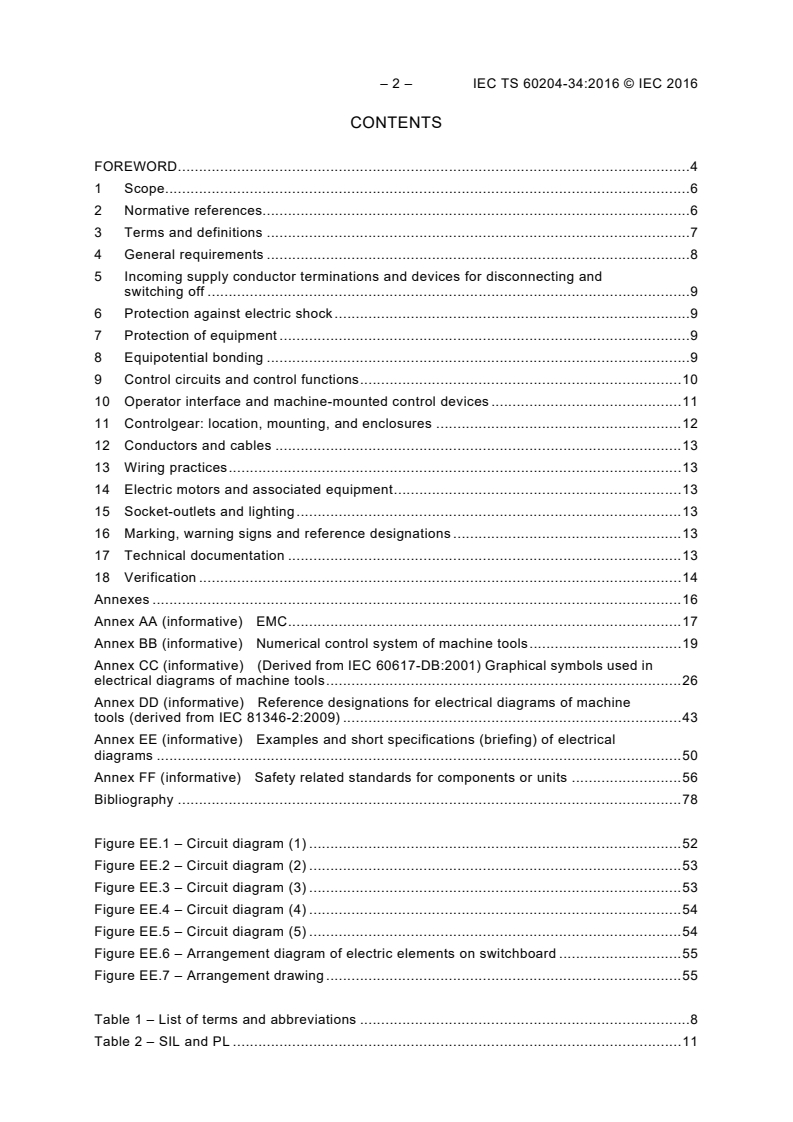
– 2 – IEC TS 60204-34:2016 © IEC 2016
CONTENTS
FOREWORD . 4
1 Scope . 6
2 Normative references. 6
3 Terms and definitions . 7
4 General requirements . 8
5 Incoming supply conductor terminations and devices for disconnecting and
switching off . 9
6 Protection against electric shock . 9
7 Protection of equipment . 9
8 Equipotential bonding . 9
9 Control circuits and control functions . 10
10 Operator interface and machine-mounted control devices . 11
11 Controlgear: location, mounting, and enclosures . 12
12 Conductors and cables . 13
13 Wiring practices . 13
14 Electric motors and associated equipment . 13
15 Socket-outlets and lighting . 13
16 Marking, warning signs and reference designations . 13
17 Technical documentation . 13
18 Verification . 14
Annexes . 16
Annex AA (informative) EMC . 17
Annex BB (informative) Numerical control system of machine tools . 19
Annex CC (informative) (Derived from IEC 60617-DB:2001) Graphical symbols used in
electrical diagrams of machine tools . 26
Annex DD (informative) Reference designations for electrical diagrams of machine
tools (derived from IEC 81346-2:2009) . 43
Annex EE (informative) Examples and short specifications (briefing) of electrical
diagrams . 50
Annex FF (informative) Safety related standards for components or units . 56
Bibliography . 78
Figure EE.1 – Circuit diagram (1) . 52
Figure EE.2 – Circuit diagram (2) . 53
Figure EE.3 – Circuit diagram (3) . 53
Figure EE.4 – Circuit diagram (4) . 54
Figure EE.5 – Circuit diagram (5) . 54
Figure EE.6 – Arrangement diagram of electric elements on switchboard . 55
Figure EE.7 – Arrangement drawing . 55
Table 1 – List of terms and abbreviations . 8
Table 2 – SIL and PL . 11
Table 4 – Colours for indicator lights and their meanings with respect to the condition of
the machine . 12
Table BB.1 – Test overview. 24
Table CC.1 – Graphical symbols for electrical equipment of machines (derived from
IEC 60617-DB) (1 of 13) . 27
Table CC.2 – Graphical symbols for electrical equipment of machines (created symbols
by this part) (1 of 3) . 40
Table DD.1 – Classes of objects according to their intended purpose or task (1 of 6) . 44
Table FF.1 – Standards related to components or units (1 of 22). 56
– 4 – IEC TS 60204-34:2016 © IEC 2016
INTERNATIONAL ELECTROTECHNICAL COMMISSION
____________
SAFETY OF MACHINERY –
ELECTRICAL EQUIPMENT OF MACHINES –
Part 34:Requirements for machine tools
FOREWORD
1) The International Electrotechnical Commission (IEC) is a worldwide organization for standardization comprising
all national electrotechnical committees (IEC National Committees). The object of IEC is to promote international
co-operation on all questions concerning standardization in the electrical and electronic fields. To this end and in
addition to other activities, IEC publishes International Standards, Technical Specifications, Technical Reports,
Publicly Available Specifications (PAS) and Guides (hereafter referred to as “IEC Publication(s)”). Their
preparation is entrusted to technical committees; any IEC National Committee interested in the subject dealt with
may participate in this preparatory work. International, governmental and non-governmental organizations liaising
with the IEC also participate in this preparation. IEC collaborates closely with the International Organization for
Standardization (ISO) in accordance with conditions determined by agreement between the two organizations.
2) The formal decisions or agreements of IEC on technical matters express, as nearly as possible, an international
consensus of opinion on the relevant subjects since each technical committee has representation from all
interested IEC National Committees.
3) IEC Publications have the form of recommendations for international use and are accepted by IEC National
Committees in that sense. While all reasonable efforts are made to ensure that the technical content of IEC
Publications is accurate, IEC cannot be held responsible for the way in which they are used or for any
misinterpretation by any end user.
4) In order to promote international uniformity, IEC National Committees undertake to apply IEC Publications
transparently to the maximum extent possible in their national and regional publications. Any divergence between
any IEC Publication and the corresponding national or regional publication shall be clearly indicated in the latter.
5) IEC itself does not provide any attestation of conformity. Independent certification bodies provide conformity
assessment services and, in some areas, access to IEC marks of conformity. IEC is not responsible for any
services carried out by independent certification bodies.
6) All users should ensure that they have the latest edition of this publication.
7) No liability shall attach to IEC or its directors, employees, servants or agents including individual experts and
members of its technical committees and IEC National Committees for any personal injury, property damage or
other damage of any nature whatsoever, whether direct or indirect, or for costs (including legal fees) and expenses
arising out of the publication, use of, or reliance upon, this IEC Publication or any other IEC Publications.
8) Attention is drawn to the Normative references cited in this publication. Use of the referenced publications is
indispensable for the correct application of this publication.
9) Attention is drawn to the possibility that some of the elements of this IEC Publication may be the subject of patent
rights. IEC shall not be held responsible for identifying any or all such patent rights.
The main task of IEC technical committees is to prepare International Standards. In exceptional
circumstances, a technical committee may propose the publication of a technical specification
when
• the required support cannot be obtained for the publication of an International Standard,
despite repeated efforts, or
• the subject is still under technical development or where, for any other reason, there is the
future but no immediate possibility of an agreement on an International Standard.
Technical specifications are subject to review within three years of publication to decide whether
they can be transformed into International Standards.
IEC TS 60204-34, which is a technical specification, has been prepared by IEC technical
committee 44: Safety of machinery – Electrotechnical aspects.
The text of this technical specification is based on the following documents:
Enquiry draft Report on voting
44/735/DTS 44/748/RVC
Full information on the voting for the approval of this technical specification can be found in the
report on voting indicated in the above table.
This publication has been drafted in accordance with the ISO/IEC Directives, Part 2.
This part of IEC 60204 is intended to be used in conjunction with IEC 60204-1:— .
This part supplements or modifies the corresponding clauses in IEC 60204-1.
The numbering system is based on IEC 60204-31:2013. Where a particular clause or subclause
of Part 1 is not mentioned in this Part 34, that clause or subclause applies as far as is reasonable.
Where this part states "addition", "modification" or "replacement", the relevant text, notes,
figures, and tables in Part 1 are to be adapted accordingly.
Annexes which are additional to those in part 1 are lettered AA, BB, CC, DD, EE and FF.
A list of all parts in the IEC 60204 series, published under the general title Safety of machinery
– Electrical equipment of machines, can be found on the IEC website.
A bilingual version of this publication may be issued at a later date.
___________
Stage at the time of publication: IEC/FDIS 60204-1:2016.
– 6 – IEC TS 60204-34:2016 © IEC 2016
SAFETY OF MACHINERY –
ELECTRICAL EQUIPMENT OF MACHINES –
Part 34:Requirements for machine tools
1 Scope
This clause of IEC 60204-1 is applicable except as follows:
Replacement:
This part of IEC 60204 applies to electrical, electronic and programmable electronic equipment
and systems of machine tools not portable by hand while working, including a group of machines
working together in a co-ordinated manner.
In this part of IEC 60204, machine tools means all machines for the working of metal, wood,
plastics and stone, operating by forming or removal of material. The following list includes
examples of machine tools but not limited to:
– Turning machines (i.e. manually controlled turning machines without numerical control,
manually controlled turning machines with limited numerically controlled capability,
numerically controlled turning machines and turning centres, single– or multi-spindle
automatic turning machines);
– Milling machines(including boring machines);
– Machining centres;
– Planing machines;
– Drilling machines;
– Grinding machines;
– Laser processing machines;
– Electro Discharge Machines(EDM) (except their power circuit for discharge);
– Sawing machines for cold metal;
– Guillotine shears;
– Hydraulic press brakes;
– Mechanical (or hydraulic, pneumatic) presses.
Power circuits where electrical energy is directly used as a working tool are excluded from this
part of IEC 60204.
In addition to this document, the applicable C-standard for the machines listed in the examples
can be referred for more information.
2 Normative references
This clause of IEC 60204-1 is applicable except as follows:
Additional references:
IEC 60204-1:—, Safety of machinery – Electrical equipment of machines – Part 1: General
requirements
IEC 60825-1, Safety of laser products – Part 1: Equipment classification and requirements
IEC 60825-4, Safety of laser products – Part 4: Laser guards
ISO 14119, Safety of machinery – Interlocking devices associated with guards – Principles for
design and selection
3 Terms and definitions
This clause of IEC 60204-1 is applicable except as follows:
Additional definitions:
3.101
machine tool
MT
machine, not portable as a whole during its operation, driven by an external electrical energy
source and intended to work material in the solid state, with material removal (cutting processes
as turning, milling, grinding, drilling, machining…) or without material removal (forming
processes such as bending, forging, etc.)
Note 1 to entry: The machine tool is normally equipped with a power supply, an electrical and electronic assembly for
power and control and one or more power drive systems for the movement of elements or parts.
[SOURCE: EN 50370-1:2005, 3.1, modified — “typically metal products” has been changed to
“work material”. The last sentence has been changed to NOTE 1 to entry.]
3.102
numerical control
NC
automatic control of process performed by a device that makes use of numerical data introduced
while the operation is in progress
[SOURCE: ISO 2806:1994, 2.1.1]
3.103
computerized numerical control
CNC
realization of NC(3.102) using a computer to control the machine functions
[SOURCE: ISO 2806:1994, 2.1.2]
3.104
safety integrity level
SIL
discrete level (one out of a possible three), corresponding to a range of safety integrity values,
where safety integrity level 3 has the highest level of safety integrity and safety integrity level 1
has the lowest
[SOURCE: IEC 61508-4:2010, 3.5.6, modified — The words "one out of a possible four" have
been replaced by " one out of a possible three" and the words "safety integrity level 4" have been
replaced by "safety integrity level 3".]
3.105
type test
test made on one or more equipment representative of the production in order to confirm that
the design fulfils certain specifications
– 8 – IEC TS 60204-34:2016 © IEC 2016
[SOURCE: IEC 60050-151:2001, 151-16-16, modified — The word "conformity" has been
removed before "test made…", the word "items" has been replaced by "equipment" and the text
from "in order to" has been added.]
3.106
performance level
PL
discrete level used to specify the ability of safety-related parts of control systems to perform a
safety function under foreseeable conditions
[SOURCE: ISO 13849-1:2015, 3.1.23]
3.1000 Abbreviated terms
This subclause of IEC 60204-1 is applicable except as follows:
The abbreviations listed in Table 1 below are used in this Technical Specification.
Table 1 – List of terms and abbreviations
AC Alternating Current
CNC Computerized Numerical Control
CPU Central Processing Unit
DC Direct Current
EDM Electro Discharge Machines
EMC Electromagnetic Compatibility
ESPE Electro-Sensitive Protective Equipment
I/O Input / Output
IP Ingress Protection
LED Light-Emitting Diode
MT Machine Tool
NC Numerical Control
PELV Protective Extra-Low Voltage
PL Performance Level
PWB Printed Wiring Board
RAM Random Access Memory
RCD Residual Current Device
SELV safety Extra-Low Voltage
SIL Safety Integrity Level
4 General requirements
This clause of IEC 60204-1 is applicable except as follows:
4.4.2 Electromagnetic compatibility (EMC)
Addition:
NOTE 2 Additional guidance can be found in Annex AA.
4.4.3 Ambient air temperature
Addition:
Manufacturer of machine tools could specify a lower minimum and/or a higher maximum ambient
air temperatures according to application of the equipment of machine tools.
4.4.5 Altitude
Addition:
NOTE More information about the insulation coordination at the altitudes more than 1 000 m can be found in
IEC 60664-1.
4.4.7 Ionizing and non-ionizing radiation
Addition:
Laser processing machines can generate laser radiation. Laser class according to IEC 60825-1
shall be stated and laser hazard label which correspond to the laser class need to be affixed, and
laser hazards shall be minimised according to IEC 60825-1 and IEC 60825-4. IEC 60825-4
specifies requirements for laser guards.
NOTE Further requirements on industrial laser equipment can be found in IEC 60519-12. Further information can be
found in ISO 11553-1.
5 Incoming supply conductor terminations and devices for disconnecting and
switching off
This clause of IEC 60204-1 is applicable except as follows:
5.1 Incoming supply conductor terminations
Addition:
Add after the first sentence of the first paragraph:
When a machine tool needs to use several electrical cabinets, it is recommended that the main
power supply is connected to the main power switch of one single electrical cabinet. If other
cabinets need a power supply, it is recommended that they connect to the main power switch of
this one single electrical cabinet.
For machinery, where two or more incoming supplies are provided, see Clause 5 of
IEC 60204-1:—.
6 Protection against electric shock
This clause of IEC 60204-1 is applicable
7 Protection of equipment
This clause of IEC 60204-1 is applicable
8 Equipotential bonding
This clause of IEC 60204-1 is applicable except as follows:
– 10 – IEC TS 60204-34:2016 © IEC 2016
8.2.3 Continuity of the protective bonding circuit
Addition:
It shall be assured that the bed and the electrical cabinet of a machine tool have continuity to the
protective bonding circuit.
9 Control circuits and control functions
Addition:
See Annex BB for numerical control system of machine tools.
9.1.2 Control circuit voltages
Addition:
Add after the final paragraph:
It is recommended that the control circuit voltage be one of the following but not limited to:
– 6/24/48/100/110/120/200/220/230 V (AC);
– 5/6/12/24/48/110/220 V (DC);
9.2.3.5 Operating modes
Addition:
Add after the final paragraph:
Numerical control machine tools usually have many operating modes, for example manual mode,
automatic mode, setting mode, service mode, etc.
Mode selector shall ensure that only one mode is active at anytime. The parts of the control
system provided for mode selector shall be assigned to a suitable PL of ISO 13849-1 or SIL of
IEC 62061. Required PL or SIL should be selected by risk assessment or in accordance with
relevant type-C standards, e.g. ISO 23125.
9.3 Protective interlocks
Addition:
Add a new subclause:
9.3.7 Interlocking guards with guard locking
If hazardous situations still exist after removal of power, an interlocking guard with guard locking
(see also ISO 14119) shall be provided, fulfilling a suitable PL of ISO 13849-1 or SIL of
IEC 62061. Required PL or SIL should be selected by risk assessment or in accordance with
relevant type-C standards, e.g. ISO 23125.
9.4 Control functions in the event of failure
Addition:
Add a new subclause:
9.4.4 Levels of functional safety
Functional safety is part of the overall safety that depends on a system or equipment operating
correctly in response to its inputs.
For the purposes of ISO 13849, the ability of safety-related parts to perform a safety function is
expressed through the determination of the performance level (PL).
According to IEC 62061 and IEC 61508, the ability of safety-related control systems to perform
a safety function is given through a SIL. Table 2 displays the relationship between the two
concepts (PLs and SILs). See Annex A of ISO 13849-1:2006 for determination of required
performance level (PLs); a SIL example of a methodology is given in Annex A of IEC 62061:2005,
IEC 62061:2005/AMD1:2012 and IEC 62061:2005/AMD2:2015.
Detailed information to implement functional safety is given in ISO 13849-1, IEC 62061,
IEC 61508, IEC 61131-6.
Table 2 – SIL and PL
Safety integrity level Probability of dangerous failures Performance level
per hour (i/h)
SIL PL
(IEC 61508-1 or IEC 62061,
for information)
continuous mode of operation
-5 -4
– ≥10 to <10 a
-6 -5
SIL1 b
≥3 × 10 to <10
-6 -6
SIL1 c
≥10 to <3 × 10
-7 -6
SIL2 ≥10 to <10 d
-8 -7
SIL3 e
≥10 to <10
NOTE Table 2 is based on ISO 13849-1, IEC 61508-1 and IEC 62061.
10 Operator interface and machine-mounted control devices
This clause of IEC 60204-1 is applicable except as follows:
10.3.2 Colours
Modification:
Add an example in the last line, last column of Table 4, as follows:
– 12 – IEC TS 60204-34:2016 © IEC 2016
Table 4 – Colours for indicator lights and
their meanings with respect to the condition of the machine
Colour Meaning Explanation Action by operator
RED Emergency Hazardous condition Immediate action to deal with hazardous
condition (for example switching off the
machine supply, being alert to the
hazardous condition and staying clear of
the machine)
YELLOW Abnormal Abnormal condition Monitoring and/or intervention (for
Impending critical condition example by re-establishing the intended
function)
BLUE Mandatory Indication of a condition that requires Mandatory action
action by the operator
GREEN Normal Normal condition Optional
WHITE Neutral Other conditions; may be used Monitoring (e.g. power indicating)
whenever doubt exists about the
application of RED, YELLOW, GREEN,
BLUE
10.6 Start devices
Addition:
For example, the start pushbutton can be of the recessed or flush type or protected by a cover.
11 Controlgear: location, mounting, and enclosures
This clause of IEC 60204-1 is applicable except as follows:
11.2.3 Heating effects
Addition:
Where heat dissipation of the housing of the enclosure is not sufficient to keep the temperature
inside under the limits of the components, means for temperature control shall be provided, for
example:
– Forced circulation of the air inside the enclosure
– Forced ventilation
– Forced ventilation with air conditioning
– Local cooling (coolant circulation, peltier element, etc.)
Where the risk of condensation of water exists, heating elements should be provided.
11.3 Degrees of protection
Replacement:
Replace the third indent of NOTE 2 as follows:
– Enclosure used to endure the environment with water and/or dust invasion from IP54
all directions
– Enclosure used to endure the environment with water invasion from above IP43
– Enclosure used to endure the environment without water droplets IP32
11.4 Enclosures, doors and openings
Addition:
Add after the final dashed indent of the last paragraph:
A pocket to accommodate electrical drawing and/or manuals should be attached where
practicable.
12 Conductors and cables
This clause of IEC 60204-1 is applicable
13 Wiring practices
This clause of IEC 60204-1 is applicable
14 Electric motors and associated equipment
This clause of IEC 60204-1 is applicable
15 Socket-outlets and lighting
This clause of IEC 60204-1 is applicable
16 Marking, warning signs and reference designations
This clause of IEC 60204-1 is applicable
17 Technical documentation
This clause of IEC 60204-1 is applicable except as follows:
17.1 General
Addition:
Add after the first paragraph:
See Annex CC for Graphical symbols for machine tools.
See Annex DD for reference designations for electrical diagrams of machine tools.
See Annex EE for electrical diagrams for machine tools.
17.2 Information related to the electrical equipment
Addition:
Add after the first indent of 17.2 e):
– 14 – IEC TS 60204-34:2016 © IEC 2016
• function menu and function description for auxiliary code M (CNC), if implemented in the
CNC (computerized numerical control);
NOTE 1 “Function menu” is a list of typical work piece processing programs (CNC).
NOTE 2 “Auxiliary code M” is a command used in NC that initiates discrete functions of machine or control system
(ISO 2806:1994 2.6.2, modified).
• table for parameters of macro function and/or set values (CNC), if necessary for using the
machine.
NOTE 3 Macro function is a subroutine used in machine program for numerical control of machines. It has capability
to handle a parameter.
18 Verification
Modification:
18.1 is replaced and, 18.8, 18.9 and 18.10 are new subclauses added.
18.1 General
Replacement:
The extent of verification will be given in the dedicated product standard for a particular machine.
Where there is no dedicated product standard for the machine, the verifications shall always
include the items a), b), c), h) and i) and may include one or more of the items d), e), f), g), j) and
k):
a) verification that the electrical equipment complies with its technical documentation;
b) verification of continuity of the protective bonding circuit (see Test 1 of 18.2.2 of
IEC 60204-1:—);
c) in case of fault protection by automatic disconnection of supply, conditions for protection by
automatic disconnection shall be verified according to IEC 60204-1:—, 18.2;
d) insulation resistance test (see IEC 60204-1:—, 18.3);
e) voltage test (see IEC 60204-1:—, 18.4);
f) protection against residual voltage (see IEC 60204-1:—, 18.5);
g) verification that the relevant requirements of IEC 60204-1:—, 8.2.6 are met;
h) functional tests (see IEC 60204-1:—, 18.6).
i) visual inspection (see 18.8)
j) idle tests (see 18.9);
k) load tests (see 18.10).
When these tests are performed, it is recommended that they follow the sequence listed above.
When the electrical equipment is modified, the requirements stated in IEC 60204-1:—, 18.7
shall apply.
For verifications that include measurement, measuring equipment in accordance with the
IEC 61557 series is applicable.
The results of the verification shall be documented.
Additional subclauses:
18.8 Visual inspection
Electrical equipment of machine tool shall be inspected to verify that:
– the selection and adjustment of overload protecting devices is correct;
– protection by enclosures described in IEC 60204-1:—, 6.2.2 is applied;
– emergency stop devices are easily accessible;
– each electrical component is correctly installed (e.g. fasteners, secured);
– each termination is connected securely;
– the colour of each button, signal lamp, and cursor buttons comply with the requirements of
IEC 60204-1:—, 10.2, 10.3;
– switching capacity of contactor is greater than or equal to rated load current;
– cable routing, cable support and cable type are correct, and terminations/cores/cables are
not subject to over tensile stress, small cable bending radius, excessive lengths or sharp
edges.
18.9 Idle tests
Electrical equipment of machine tool shall be running without load to verify:
– the complete electrical equipments of machine tool are working properly on integrated
machine;
– action sequence is correct;
– functions are complete and correct, and each safety protection measure is effective and
reliable (guard interlocking, emergency stop, enabling device, etc.).
Idle tests should be executed for each single individual specimen of a machine tool.
18.10 Load tests
Load test shall be executed in the prototype testing or in product type testing.
Electrical equipment of machine tool shall be run continuously until stable temperature is
reached at load and conditions specified by manufacturers to verify proper operation (e.g.
over-temperature protection).
Verify that the temperature of all electrical equipment of machine tool does not exceed any
specified temperature for the components.
– 16 – IEC TS 60204-34:2016 © IEC 2016
Annexes
The annexes of part 1 are applicable except as follows:
Addition:
Annex AA
(informative)
EMC
AA.0 General
Annex AA gives guidance for the proper usage of EN 50370-1 and EN 50370-2, which provide
information specifically for machine tools.
NOTE 1 The generic EMC standards IEC 61000-6-1 or IEC 61000-6-2 and IEC 61000-6-3 or IEC 61000-6-4 provide
general EMC emission and immunity limits (see also IEC 60204-1:—, 4.4.2).
NOTE 2 Relevant product standards can specify additional EMC requirements (e.g. IEC 61800-3 for power drive
systems).
Annex AA is not applicable to EDM.
If the machine tool contains no electromagnetically relevant components, no tests are required.
Annex AA is provided for general guidance. It should be noted that the actual requirements in
the latest edition of the referenced standard can be different and should be complied with.
AA.1 System configuration
A basic configuration may consist of (see Figure 1 “System configuration and example of ports”
of EN 50370-1:2005)
– An electrical feeding section;
– Control and protection circuits and equipment;
– One or more basic power conditioning units (example: drive modules) performing control
and/or conversion of electrical energy;
– One or more actuators and their associated transducers;
– Control and sequencing systems such as NC-controllers, programmable controllers and their
associated peripherals, programming and debugging tools, test equipment and
human-machine interfaces (parts (e.g. HMI panel) which are not permanent parts of the CNC
system should not cause malfunction of the CNC system when establishing communication
(see also 9.2.3 of IEC 60204-1:—));
– Peripherals (transducer(s), operator station, emergency stop devices, etc.);
– The structure and the moving parts driven by the actuator(s).
AA.2 Test approach
NOTE The following text is derived from Clause 4 of EN 50370-1:2005.
Type testing of a finished product is the normal method for conformity assessment against the
requirements of a standard, but complete testing of an entire machine tool at a conventional
EMC test site is only technically possible and economically feasible for a limited number of
machines. A distinction should be drawn between type-testable machines and machines which,
because of the weight, dimensions, operation or unreasonable testing costs and testing delay,
cannot be type-tested as a whole at a conventional EMC test site.
Furthermore, it is necessary to take single-piece production and the multitude of types into
account as well as expansions and modifications.
– 18 – IEC TS 60204-34:2016 © IEC 2016
Distinctions should be drawn between the following cases and should be taken into account:
– Type-testable machines;
– Machines which are not type-testable;
– Multitude of types;
– Modifications, additions and expansions.
Each testing procedure for conformity assessment is based on one or a combination of various
tests:
– Type test at the EMC test site;
– Visual inspection of entire machine tool;
– Additional tests on entire machine tool.
AA.3 Emission
The electrical disturbances generated by the electrical equipment of machine tools should not
exceed the levels specified in Table “type test requirements” in Annex A of EN 50370-1:2005.
Emission measurements should be performed in accordance with CISPR 11 and CISPR 16.
NOTE The machine tool builder does not need to repeat measurements on an EMC compliant module as declared by
its manufacturer.
AA.4 Immunity
AA.4.1 General
Where electronic equipment is used, it should be designed to withstand at least values specified
in Table A.1 “Machine tools immunity tests – Enclosure port”, Table A.2 “Machine tools immunity
tests – Ports for signal ports”, Table A.3 “Machine tools immunity tests – DC input and output
power ports”, Table A.4 “Machine tools immunity tests – AC input and output power ports” and
Table A.5 “Machine tools immunity tests – Functional earth port” in Annex A of
EN 50370-2:2003.
AA.4.2 Performance criteria
The assessment of performance degradation used during and/or at the conclusion of the tests,
should be simple, but at the same time give adequate proof that the essential functions of the
machine tool are operative. The performance criteria should be used to check the performance
of a machine tool or modules against external disturbances.
Since machine tools and their modules represent a very broad and inhomogeneous group of
products, a precise definition of performance criteria cannot be given.
Nevertheless a functional description and a definition of performance criteria and monitoring
methods, during or as a consequence of the EMC testing, should be specified by the
manufacturer and included in the test report, based on the general criteria and examples of
malfunctioning contained in Table 2 “Performance criteria definition” of EN 50370-2:2003, which
cannot be considered exhaustive.
It is the responsibility of the manufacturer to define the representative parameters for each
specific performance and the permissible degradation of performance or loss of function of the
machine tool or the module(s). Table AA.7 classifies the effects of a given disturbance into three
performance criteria: A, B and C, each of which defines a specified level of performance.
NOTE Alternatively, IEC 61000-6-2:2005, Clause 4, criterion A) or B) can be used.
Annex BB
(informative)
Numerical control system of machine tools
BB.1 General
The purpose of Annex BB is to explain requirements and related tests for the numerical control
system of machine tools.
Annex BB applies to any numerical control systems of machine tools.
If safety of machine tools is realized by safety related part of Numerical control system, the
Numerical control system should comply with the safety requirements of relevant
IEC/ISO standards.
Function definition of all numerical control systems should be in accordance with ISO 2806.
Coordinate axis and motion direction should be in accordance with ISO 841.
Data format for positioning, line motion and contouring control systems should be in accordance
with ISO 6983-1.
A numerical control system consists of numerical controller, power drive system, PLC, sensors,
etc. A detailed component list with relevant standards (e.g. amongst others IEC 61800-5-1 for
safety requirements for power drive system, IEC 60034-1 for motors, IEC 61010-2-201 or
IEC 61131-2 for PLC) is given in Annex FF. Annex BB is provided for general guidance. It
should be taken into consideration that the actual requirements in the latest edition of the
relevant standards can be different and should be complied with.
BB.2 Function
BB.2.2 Digital I/Os
Digital I/Os should comply with the requirements of IEC 61131-2 or IEC 61010-2-201 as
appropriate.
BB.2.3 Analogue I/Os
Analogue I/Os should comply with the requirements of IEC 61131-2 or IEC 61010-2-201 as
appropriate.
BB.2.4 Communication interface
Type tests according to IEC 61131-2 or IEC 61010-2-201 as appropriate should be applied to
communication interface and modules communication links where applicable.
BB.2.5 Fieldbus interface
Fieldbus interface should be designed and mounted in accordance with relevant parts of
IEC 61158 and IEC 61784-3.
– 20 – IEC TS 60204-34:2016 © IEC 2016
BB.2.7 Human-machine interface
Control panel should be selected, mounted, and identified or coded in accordance with
IEC 61310 and IEC 60447. Control device and indicator lights colours should comply with
Clause 10 of IEC 60204-1:—.
BB.2.10 Peripherals
Insertion/withdrawal of removable units should be verified.
Connectors for the peripherals should be coded to prevent improper connection, or the NC
system should be designed to guarantee that no malfunction occurs if a connection is improper.
NC system should have a means to verify the version of program to be executed. And it may be
done with peripherals.
If online modification of the application programme and/or the modes of operation of the NC
system by a peripheral is possible (i.e. when the NC system is in active control of a machine or
industrial process), then
– the peripheral should automatically give clear warnings equivalent to "during online
modification, programme display may differ from application programme, control of the
machine/ process may be interrupted during . ms, etc.", as applicable.
– the peripheral should ask the operator "Do you really want to carry out this action?" or some
similar words and execute the command only after a positive reply has been given by the
operator.
– it should be possible to upload the new application programme to the manufacturer's
supplied data media and verify, online, that the record is functionally equivalent to it; and
– means should be provided to prevent unauthorized use of these functions (hardware or
software, e.g. key switch, electronic password).
BB.2.11 NC system self-tests and diagnostics
NC systems should include functions for self-tests and diagnostics. The following functions
should be considered:
– a means for monitoring the application programs (e.g. watchdog timer, etc.);
– a means for memory integrity check (i.e. ECC, etc.);
– a means to check that the power supplies do not exceed the voltage and current limits
allowed by the hardware design;
– a means to monitor the status of the NC system. It should be capable of operating an alarm
(i.e. digital PLC output).
Remote input/output stations should be capable of operating an alarm (for example, through a
digital output module) in the event of loss of power or loss of normal communication with the NC
and go to a predetermined state.
BB.3 Protection against electric shock, thermal, and energy hazards
BB.3.1 General
For protection against electric shock, thermal, and energy hazards, NC systems should comply
with relevant standards (see Annex FF).
BB.3.2 Fault conditions
NC systems should have capability to avoid operating modes or sequences that can cause a
fault condition or component failure leading to a hazard, unless other measures to prevent the
hazard are provided by the installation. Protection against thermal hazards and electric shock is
maintained in single fault conditions and normal conditions.
BB.3.3 Protection against electric shock
BB.3.3.1 General
NC systems should include basic protection (protection against direct contact) and fault
protection (protection against indirect contact).
For example, IEC 61800-5-1 shows the necessary means and consideration for the protection
as follows:
For basic protection:
– Insulation of live parts;
– Enclosures and barriers;
– Using DVC A (decisive voltage class A);
– protective impedance;
– limited voltages;
For fault protection:
– Insulation between live parts and accessible conductive parts;
– Protective bonding circuit;
– Protective class II;
Consideration of the following influences for insulation:
– Pollution degree (see BB.3.3.2);
– Overvoltage category (see BB.3.3.2);
– Supply earthing system;
– Insulation voltage;
– Location of insulation;
– Type
...