

IEC 60670-1:2002/AMD1:2011
(Amendment)Amendment 1 - Boxes and enclosures for electrical accessories for household and similar fixed electrical installations - Part 1: General requirements
General Information
- Abstract
- Status
- Published
- Publication Date
- 07-Mar-2011
- Technical Committee
- SC 23B - Plugs, socket-outlets and switches
- Drafting Committee
- MT 5 - TC 23/SC 23B/MT 5
- Current Stage
- DELPUB - Deleted Publication
- Start Date
- 10-Mar-2015
- Completion Date
- 28-Aug-2026
Buy Documents
IEC 60670-1:2002/AMD1:2011 - Amendment 1 - Boxes and enclosures for electrical accessories for household and similar fixed electrical installations - Part 1: General requirements Released:3/8/2011
Overview
IEC 60670-1:2002/AMD1:2011 is the Amendment 1 to the international standard concerning boxes and enclosures for electrical accessories used in household and similar fixed electrical installations. This amendment provides updated general requirements that enhance the safety, construction, and functionality of electrical enclosures, ensuring compliance with evolving industry demands and regulatory requirements.
The International Electrotechnical Commission (IEC), a global leader in developing electrical standards, maintains this publication to promote uniformity and safety across electrical installations worldwide. This amendment to IEC 60670-1 focuses on improving the design and testing of boxes and enclosures to protect users and electrical components in domestic and analogous fixed installation environments.
Key Topics
Box and Enclosure Construction
The amendment mandates that boxes and enclosures be manufactured without sharp edges or burrs to prevent wire damage and ensure safety during installation. Inner and outer surfaces must be smooth, free from peeling, scaling, or flaking, and compliant through rigorous inspection.Protection Against Electric Shock
Boxes and enclosures shall be designed so live parts are not accessible once properly assembled, equipped, and installed. This is verified through probe testing in accordance with IEC 61032, ensuring no penetration into internal volumes that protects end-users from electric shock.Earthing Provisions
Enclosures with exposed conductive parts must provide low resistance earthing means or provisions for it. The continuation of earthing is verified via specific current and resistance tests, ensuring effective grounding and safety. Additionally, thread durability for earthing terminals is tested by torque application to guarantee secure connections.Fixing and Mounting
Detailed requirements for the fixation of lids, covers, and cover plates are specified for both screw and non-screw type fixings, including those operable by tool or key. There are also classifications for boxes based on their fixing accessories, such as screws or claws.Cable Access and Retention
Amendments include new definitions for cable glands and blanking plugs, ensuring these components provide proper sealing and strain relief where cables enter enclosures. Cable inlets must allow easy installation without damaging flexible cables.Markings and Documentation
Requirements for durable markings on boxes and enclosures are reinforced, enabling clear identification while taking into account country-specific exceptions (e.g., UK). Markings help installers and inspectors verify compliance and facilitate maintenance.
Applications
Residential Electrical Installations
The standard is crucial for manufacturers and installers of electrical boxes and enclosures used in homes, ensuring products meet safety and performance benchmarks for household electrical systems.Fixed Installation Accessories
Electrical accessories such as switches, sockets, and distribution units for fixed installations rely on compliant boxes for mounting and protection, enhancing the longevity and safety of electrical networks.Electrical Accessory Manufacturing
Provides manufacturers with updated design and testing criteria to develop compliant products compatible with international safety requirements, helping reduce liability and improve market acceptance.Safety Regulation Compliance
Electrical safety inspectors use this standard as a reference to verify that installations meet international safety requirements and that enclosures protect users from hazards such as electric shock and fire.
Related Standards
IEC 61032 – Protection of persons by enclosures – Probes for verification; relevant for the testing methodology used against electric shock accessibility.
IEC 62444:2010 – Cable glands for electrical installations; referenced for cable entry and sealing components associated with boxes and enclosures.
IEC 60670-2 – Particular requirements for enclosures for flush mounting, a likely complementary standard for detailed enclosure specifications.
IEC 60529 – Degrees of protection provided by enclosures (IP Code), often referenced to classify enclosures by dust and water ingress resistance.
By adhering to the updated IEC 60670-1 Amendment 1, stakeholders benefit from enhanced electrical safety standards, higher product quality, and clearer guidance on the construction and testing of electrical accessory boxes and enclosures designed for household and similar fixed electrical installations.
Relations
- Effective Date
- 05-Sep-2023
- Effective Date
- 05-Sep-2023
Buy Documents
IEC 60670-1:2002/AMD1:2011 - Amendment 1 - Boxes and enclosures for electrical accessories for household and similar fixed electrical installations - Part 1: General requirements Released:3/8/2011
Get Certified
Connect with accredited certification bodies for this standard

IMQ S.p.A. (Certification)
Italian electrical product certification.

SLG Prüf- und Zertifizierungs GmbH
German testing and certification body.

UL Solutions
Global safety science company with testing, inspection and certification.
Sponsored listings
Frequently Asked Questions
IEC 60670-1:2002/AMD1:2011 is a standard published by the International Electrotechnical Commission (IEC). Its full title is "Amendment 1 - Boxes and enclosures for electrical accessories for household and similar fixed electrical installations - Part 1: General requirements". This standard covers: Amendment 1 - Boxes and enclosures for electrical accessories for household and similar fixed electrical installations - Part 1: General requirements
Amendment 1 - Boxes and enclosures for electrical accessories for household and similar fixed electrical installations - Part 1: General requirements
IEC 60670-1:2002/AMD1:2011 is classified under the following ICS (International Classification for Standards) categories: 29.120.10 - Conduits for electrical purposes. The ICS classification helps identify the subject area and facilitates finding related standards.
IEC 60670-1:2002/AMD1:2011 has the following relationships with other standards: It is inter standard links to IEC 60670-1:2002, IEC 60670-1:2015. Understanding these relationships helps ensure you are using the most current and applicable version of the standard.
IEC 60670-1:2002/AMD1:2011 is available in PDF format for immediate download after purchase. The document can be added to your cart and obtained through the secure checkout process. Digital delivery ensures instant access to the complete standard document.
Standards Content (Sample)
IEC 60670-1 ®
Edition 1.0 2011-03
INTERNATIONAL
STANDARD
NORME
INTERNATIONALE
AMENDMENT 1
AMENDEMENT 1
Boxes and enclosures for electrical accessories for household and similar fixed
electrical installations –
Part 1: General requirements
Boîtes et enveloppes pour appareillage électrique pour installations électriques
fixes pour usages domestiques et analogues –
Partie 1: Règles générales
IEC 60670-1:2002/A1:2011
All rights reserved. Unless otherwise specified, no part of this publication may be reproduced or utilized in any form or by
any means, electronic or mechanical, including photocopying and microfilm, without permission in writing from either IEC or
IEC's member National Committee in the country of the requester.
If you have any questions about IEC copyright or have an enquiry about obtaining additional rights to this publication,
please contact the address below or your local IEC member National Committee for further information.
Droits de reproduction réservés. Sauf indication contraire, aucune partie de cette publication ne peut être reproduite
ni utilisée sous quelque forme que ce soit et par aucun procédé, électronique ou mécanique, y compris la photocopie
et les microfilms, sans l'accord écrit de la CEI ou du Comité national de la CEI du pays du demandeur.
Si vous avez des questions sur le copyright de la CEI ou si vous désirez obtenir des droits supplémentaires sur cette
publication, utilisez les coordonnées ci-après ou contactez le Comité national de la CEI de votre pays de résidence.
IEC Central Office
3, rue de Varembé
CH-1211 Geneva 20
Switzerland
Email: inmail@iec.ch
Web: www.iec.ch
About the IEC
The International Electrotechnical Commission (IEC) is the leading global organization that prepares and publishes
International Standards for all electrical, electronic and related technologies.
About IEC publications
The technical content of IEC publications is kept under constant review by the IEC. Please make sure that you have the
latest edition, a corrigenda or an amendment might have been published.
Catalogue of IEC publications: www.iec.ch/searchpub
The IEC on-line Catalogue enables you to search by a variety of criteria (reference number, text, technical committee,…).
It also gives information on projects, withdrawn and replaced publications.
IEC Just Published: www.iec.ch/online_news/justpub
Stay up to date on all new IEC publications. Just Published details twice a month all new publications released. Available
on-line and also by email.
Electropedia: www.electropedia.org
The world's leading online dictionary of electronic and electrical terms containing more than 20 000 terms and definitions
in English and French, with equivalent terms in additional languages. Also known as the International Electrotechnical
Vocabulary online.
Customer Service Centre: www.iec.ch/webstore/custserv
If you wish to give us your feedback on this publication or need further assistance, please visit the Customer Service
Centre FAQ or contact us:
Email: csc@iec.ch
Tel.: +41 22 919 02 11
Fax: +41 22 919 03 00
A propos de la CEI
La Commission Electrotechnique Internationale (CEI) est la première organisation mondiale qui élabore et publie des
normes internationales pour tout ce qui a trait à l'électricité, à l'électronique et aux technologies apparentées.
A propos des publications CEI
Le contenu technique des publications de la CEI est constamment revu. Veuillez vous assurer que vous possédez
l’édition la plus récente, un corrigendum ou amendement peut avoir été publié.
Catalogue des publications de la CEI: www.iec.ch/searchpub/cur_fut-f.htm
Le Catalogue en-ligne de la CEI vous permet d’effectuer des recherches en utilisant différents critères (numéro de référence,
texte, comité d’études,…). Il donne aussi des informations sur les projets et les publications retirées ou remplacées.
Just Published CEI: www.iec.ch/online_news/justpub
Restez informé sur les nouvelles publications de la CEI. Just Published détaille deux fois par mois les nouvelles
publications parues. Disponible en-ligne et aussi par email.
Electropedia: www.electropedia.org
Le premier dictionnaire en ligne au monde de termes électroniques et électriques. Il contient plus de 20 000 termes et
définitions en anglais et en français, ainsi que les termes équivalents dans les langues additionnelles. Egalement appelé
Vocabulaire Electrotechnique International en ligne.
Service Clients: www.iec.ch/webstore/custserv/custserv_entry-f.htm
Si vous désirez nous donner des commentaires sur cette publication ou si vous avez des questions, visitez le FAQ du
Service clients ou contactez-nous:
Email: csc@iec.ch
Tél.: +41 22 919 02 11
Fax: +41 22 919 03 00
IEC 60670-1 ®
Edition 1.0 2011-03
INTERNATIONAL
STANDARD
NORME
INTERNATIONALE
AMENDMENT 1
AMENDEMENT 1
Boxes and enclosures for electrical accessories for household and similar fixed
electrical installations –
Part 1: General requirements
Boîtes et enveloppes pour appareillage électrique pour installations électriques
fixes pour usages domestiques et analogues –
Partie 1: Règles générales
INTERNATIONAL
ELECTROTECHNICAL
COMMISSION
COMMISSION
ELECTROTECHNIQUE
INTERNATIONALE PRICE CODE
T
CODE PRIX
ICS 29.120.10 ISBN 978-2-88912-390-2
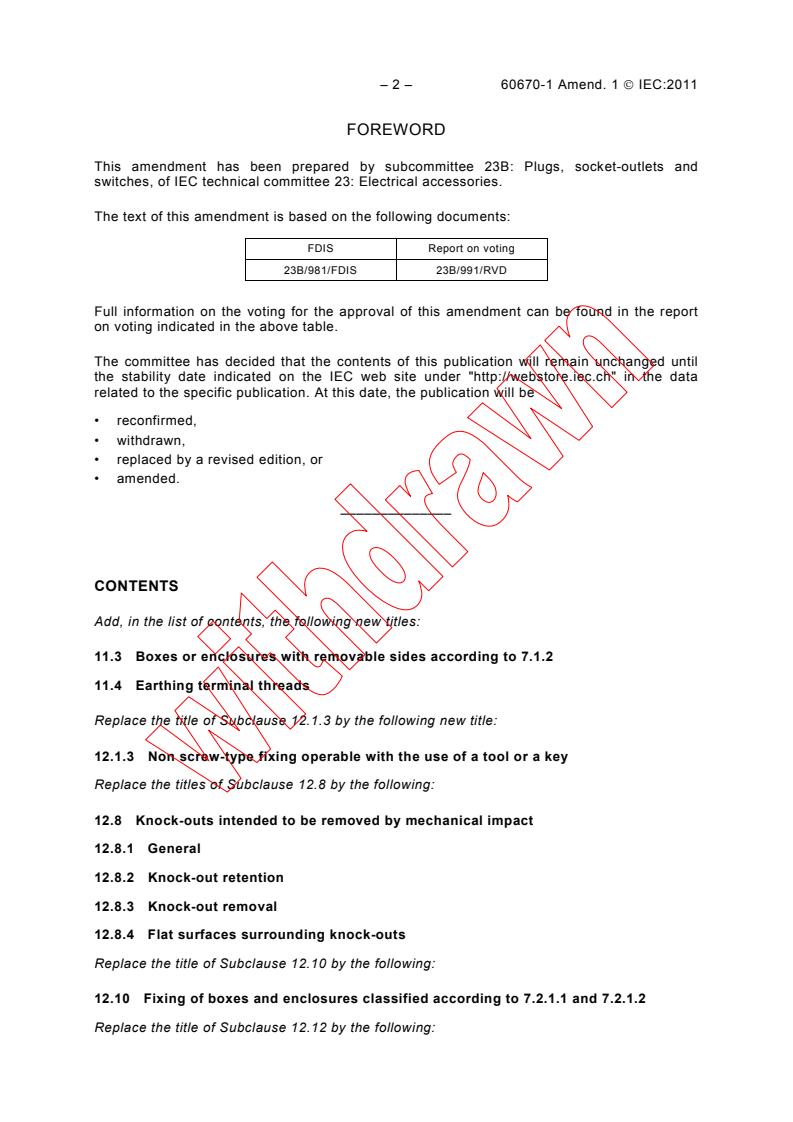
– 2 – 60670-1 Amend. 1 IEC:2011
FOREWORD
This amendment has been prepared by subcommittee 23B: Plugs, socket-outlets and
switches, of IEC technical committee 23: Electrical accessories.
The text of this amendment is based on the following documents:
FDIS Report on voting
23B/981/FDIS 23B/991/RVD
Full information on the voting for the approval of this amendment can be found in the report
on voting indicated in the above table.
The committee has decided that the contents of this publication will remain unchanged until
the stability date indicated on the IEC web site under "http://webstore.iec.ch" in the data
related to the specific publication. At this date, the publication will be
• reconfirmed,
• withdrawn,
• replaced by a revised edition, or
• amended.
______________
CONTENTS
Add, in the list of contents, the following new titles:
11.3 Boxes or enclosures with removable sides according to 7.1.2
11.4 Earthing terminal threads
Replace the title of Subclause 12.1.3 by the following new title:
12.1.3 Non screw-type fixing operable with the use of a tool or a key
Replace the titles of Subclause 12.8 by the following:
12.8 Knock-outs intended to be removed by mechanical impact
12.8.1 General
12.8.2 Knock-out retention
12.8.3 Knock-out removal
12.8.4 Flat surfaces surrounding knock-outs
Replace the title of Subclause 12.10 by the following:
12.10 Fixing of boxes and enclosures classified according to 7.2.1.1 and 7.2.1.2
Replace the title of Subclause 12.12 by the following:
60670-1 Amend. 1 IEC:2011 – 3 –
12.12 Fixing of boxes and enclosures classified according to 7.7.2
Add the following new titles:
12.15 Internal volume of boxes and enclosures
16.3.1 Mechanical strength
16.3.2 Parts of insulating material necessary to retain parts of the earthing circuit
Replace the title of Figure 4 by the following:
Figure 4 – Volume measurement (see 12.15)
Replace the title of Figure 5 by the following:
Figure 5 – Test wall (see 13.3.2)
Replace the title of Figure 7 by the following:
Figure 7 – Mounting block for flush type boxes and enclosures in order to apply blows
on the rear surface (See 15.3)
Replace the title of Figure 9 by the following:
Figure 9 – Height of fall for blows for part A ( See 15.3)
Replace the title of Figure 19 by the following:
Figure 19 – Test according to 12.12.3
Add the following new titles:
Figure 22 – Example of mounting block for boxes to be embedded in masonry (flush
type and semi-flush type) according to 12.10
Figure 23 – Example of the fixing of the auxiliary device mounted on a specimen
according to 12.10
Figure 24 – Example of test apparatus for the test according to 12.10
Figure 25 – Example of the protected volume (See 13.3.4)
Figure 26 – Demonstration of the non-penetration of the internal volume
2 Normative references
Add the following new reference:
IEC 62444:2010, Cable glands for electrical installations
– 4 – 60670-1 Amend. 1 IEC:2011
3 Definitions
3.10
cable gland
Replace the definition of 3.10 by the following:
a device designed to permit the entry of a cable, flexible cable or insulated conductor into an
enclosure, and which provides sealing and retention. It may also provide other functions such
as earthing, bonding, insulation, cable guarding, strain relief or a combination of these
Add the following new definition after Definition 3.19:
3.20
blanking-plug
a blanking-plug is a component used to close an open inlet or an open knock out
Table 1 – Classification of boxes and enclosures
Add the following new row after the row concerning 7.7:
7.8 The provision for fixing 7.8.1 Boxes supplied with
accessories to boxes screws
7.8.2 Boxes intended to receive
screws
7.8.3 Boxes intended to receive
claws
7.8.4 Boxes intended to receive
other means
8 Marking
8.1
Move item e) after the third paragraph, before the paragraph commencing with “The following
information.”.
Add the following NOTE after 8.1 e):
NOTE In the following country the marking of the type reference is not used: UK.
Replace the reference to 12.12.5 in 8.1i) by 12.15.
8.2
Replace NOTE 1 by the following:
NOTE 1Marking made by moulding, pressing or engraving is considered durable and is therefore not subjected to
this test.
10 Protection against electric shock
Replace the existing text by the following:
60670-1 Amend. 1 IEC:2011 – 5 –
Boxes and enclosures shall be so designed that, when they are assembled, equipped and
installed as for normal use in accordance with the manufacturer's instructions, live parts are
not accessible.
Where enclosures are supplied without a cover, cover-plate or an accessory they are tested
with the appropriate parts fitted according to the information given in the manufacturer's
instructions.
Compliance is checked by inspection and in case of doubt by the following test.
Enclosures shall be tested with test probe 11 according to IEC 61032 applied for 1 min with a
force of 20 N, and the test probe shall not penetrate in the internal volume of the enclosure,
as shown in Figure 26.
Tests shall be carried out on parts which are accessible after installation.
In addition, all enclosures according to 7.1.1 and 7.1.3 with parts made of thermoplastic or
elastomeric material shall be subjected for 1 min to a force applied through the tip of test
probe 11 of IEC 61032 but at an ambient temperature of (35 ± 2) °C, the enclosure being at
this temperature.
The probe is applied to all places except membranes or the like, where yielding of insulating
material could impair the safety, with a force of 75 N.
11 Provision for earthing
Replace Subclauses 11.1 and 11.2 by the following:
11.1 Boxes and enclosures with exposed conductive parts
Boxes and enclosures with exposed conductive parts shall be provided with an earthing
means of low resistance or have provision for the fitting of such an earthing means. For the
purpose of this requirement, small screws and the like, for fixing bases, covers or coverplates,
etc. isolated from live parts, are not considered as exposed conductive parts.
The earthing means or the provision for the fitting of such an earthing means shall be located
so that:
– the means is readily accessible through the open face of the box, and
– the removal of an accessory mounted in the box does not disturb the continuity of the
earthing circuit, and
– the means is not part of a removable cover, back, or side of the box or enclosure.
Compliance is checked by inspection.
Exposed conductive parts of covers or cover-plates shall be connected through a low
resistance connection to the earthing means when fitted as for normal use.
Compliance is checked by the following test.
A current derived from an a.c. source having a no-load voltage not exceeding 12 V and equal
to (25 ± 1) A is passed between the earthing terminal and each exposed conductive part in
turn. The voltage drop between the earthing terminal and each of the exposed conductive
parts is measured, and the resistance calculated from the current and this voltage drop.
In no case shall the resistance exceed 0,05 Ω.
– 6 – 60670-1 Amend. 1 IEC:2011
NOTE 1 Care should be taken that the contact resistance between the tip of the measuring probe and the
exposed conductive part under test does not influence the test results.
NOTE 2 In insulating boxes and enclosures having an IP degree higher than IPX0, provisions can be made for the
addition of means for the effective continuity of the earthing conductor, when more than one inlet is provided.
11.2 Boxes and enclosures of insulating material classified according to 7.7.2
Boxes and enclosures of insulating material shall be provided with a minimum of one earthing
strap having one screw terminal for earthing purposes with a connecting capacity of at least
4 mm . The design of the earthing strap shall ensure that the metal mounting yokes of
accessories mounted inside the box and metallic covers mounted on the box are connected to
the earthing conductors (see Figure 2).
Compliance is checked by inspection.
The earthing strap shall be securely fastened to the box or enclosure.
Compliance is checked by the test in 16.3.2.
Add the following new Subclauses 11.3 and 11.4 after Subclause 11.2:
11.3 Boxes or enclosures with removable sides according to 7.1.2
A box or enclosure classified according to 7.1.2 that has removable sides shall be constructed
so that the electrical bond between separable parts includes at least one threaded screw
connection.
Compliance is checked by inspection.
11.4 Earthing terminal threads
The threads of the earthing terminal delivered with or integrated in boxes and enclosures shall
not be stripped when the torque shown in the relevant column of Table 4 is applied.
Compliance is checked by inspection and by the following test.
The screws are tightened and loosened 5 times.
The test is made by using a suitable screwdriver or an appropriate tool applying a torque as
indicated in Table 4.
If a screw has a hexagonal head with a slot, only the test with the screwdriver is made, with
the relevant torque given in column II of Table 4.
Greater values of torque may be used if so stated by the manufacturer, when the relevant
information is provided.
Column I applies to screws which cannot be tightened by means of a screwdriver with a blade
wider than the nominal diameter of the thread of the screw.
Column II applies to other screws which are tightened by means of a screwdriver.
Column III applies to screws and nuts which are tightened by means other than a screwdriver.
Column IV applies to screws which are tightened by means of a square blade screwdriver.
60670-1 Amend. 1 IEC:2011 – 7 –
During the test, there shall be no damage, such as breakage of screw or damage to the head
slot (rendering the use of the appropriate screwdriver impossible) or to the threads or to the
enclosure impairing the further use of the fixing means. The screws shall not be tightened in
jerks.
12 Construction
Add the following new text at the beginning of Clause 12:
Boxes and enclosures shall be constructed without sharp edges. Burrs shall be removed from
mould lines of interior surfaces so that there are no sharp edges or undue obstructions to the
passage of wiring or coupling of parts in the intended use of the product.
The inner and outer surfaces of a box or cover shall not be subject to peeling, scaling or
flaking and shall be smooth and free from blisters, cracks, and other defects.
Compliance is checked by inspection.
12.1 Lids, covers or cover-plates or parts of them
Replace the first paragraph by the following:
Lids, covers, or cover-plates or parts of them, such as protective membranes, which are
intended to ensure protection against electric shock, shall be held in place effectively.
12.1.1 Screw-type fixing
Replace Subclause 12.1.1 by the following:
A box or enclosure intended to accept a lid, cover, or cover plate by means of screw fixing
shall be provided with means to accommodate the intended screws.
For lids, covers or cover plates whose fixing is of the screw type, compliance is checked by
inspection.
Table 2
Replace Table 2 by the following:
– 8 – 60670-1 Amend. 1 IEC:2011
Table 2 – Forces to be applied to covers, cover-plates or actuating members
whose fixing is not dependent on screws
Force to be applied
N
Accessibility with the test finger after
Enclosures complying Enclosures not complying
removal of lids, covers or cover-plates
with 12.1.2.3 and 12.1.2.4 with 12.1.2.3 and 12.1.2.4
or parts of them
shall not shall come shall not shall come
come off off* come off off*
To live parts 40 120 80 120
To non-earthed conductive parts separated from
10 120 20 120
live parts by basic insulation
To insulating parts, or earthed conductive parts, or
conductive parts separated from live parts by
10 120 10 120
double or reinforced insulation or live parts of
SELV ≤ 25 V a.c. or 60 V d.c.
* These columns do not apply for 12.1.3.
12.1.3 Other fixings
Replace Subclause 12.1.3 by the following:
12.1.3 Non screw-type fixing operable with the use of a tool or a key
For lids, covers or cover-plates whose fixing is not dependent on screws and whose removal
is obtained by using a tool and/or a key, in accordance with the manufacturer's instructions,
compliance is checked by the same tests of 12.1.2 except that the lids, covers or coverplates,
or parts of them need not come off when applying a force not exceeding 120 N in directions
perpendicular to the mounting/supporting surface.
12.3 Mounting of enclosures
Replace the second paragraph of Subclause 12.3 by the following:
Enclosures of insulating material shall be constructed in such a way that any conductive parts
of fixing means inside the box or enclosure intended to be used for mounting the enclosure
are surrounded by insulation which projects above the top of the fixing means by an amount
of not less than 10 % of the maximum width of the cavity for the fixing means.
12.4 Boxes and enclosures with inlets for flexible cables
Replace Subclause 12.4 by the following:
Inlets (outlets) provided in boxes and enclosures classified according to 7.3.2 shall be so
designed and constructed that the flexible cables can be easily introduced, and will not
damage the flexible cable where it enters the box or enclosure impairing its further use.
Compliance is checked by manual test.
12.5 Boxes and enclosures with inlets for applications other than flexible cables
Replace the first dashed text of the first paragraph of Subclause 12.5 by the following:
– a conduit or suitable fitting connecting it to the box or enclosure, and/or
12.7 Boxes and enclosures with cable retention means
60670-1 Amend. 1 IEC:2011 – 9 –
Add the following NOTE after the first paragraph of Subclause 12.7:
NOTE In the following countries a cable retention is required for boxes and enclosures for hollow walls due to
installation practices: DE.
Add the following text after the second paragraph of Subclause 12.7:
For boxes and enclosures classified according to 7.5.2 or 7.5.3, the test shall be carried out at
(–15 ± 2) ºC and (–25 ± 2) ºC respectively.
12.8 Knock-outs inlets (outlets) intended to be removed by mechanical impact
Replace Subclause 12.8 by the following:
12.8 Knock-outs intended to be removed by mechanical impact
12.8.1 General
It shall be possible to remove knock-outs intended to be removed by mechanical impact
without damaging the box.
For knock-outs for cables, chips or burrs are not accepted.
For knock-outs for conduits and/or for use with a grommet or a membrane, chips and burrs
are disregarded.
In order to close an open knock-out in a box or an enclosure classified according to 7.1.2 a
blanking-plug can be used.
This blanking-plug used without a locknut:
– shall not become dislodged or damaged, and
– its effectiveness shall not be impaired, and
– it shall fulfil all requirements for knock-outs.
This requirement does not apply to a blanking-plug which assembles by threading into a
threaded inlet.
Compliance is checked by inspection and by the tests as specified in 12.8.2 and 12.8.3.
12.8.2 Knock-out retention
For boxes and enclosures having knock-outs that
– do not provide access to live parts and are accessible after installation, a force of
(30 ± 1) N shall be applied to a knock-out for (15 ± 1) s,
± 1) N shall be applied
– provide direct access to live parts after installation, a force of (40
to a knock-out for (60 ± 1) s,
by means of a 6 mm diameter mandrel with a flat end.
The force is to be applied without a blow in a direction perpendicular to the plane of the
knock-out and at a point most likely to cause movement.
When the box is provided with a multi-stage knock-out, the force shall be applied to the
smallest knock-out.
– 10 – 60670-1 Amend. 1 IEC:2011
The knock-out shall remain in place and the degree of protection of the box or enclosure shall
be unchanged when measured 1 h after the force has been removed.
12.8.3 Knock-out removal
The knock-outs shall be removed by means of a tool, as stated by the manufacturer. The side
edge of a screwdriver may be run along the edge of the knock-out opening once to remove
any fragile tabs remaining along the edge.
For boxes or enclosures according to 7.1.1 or 7.1.3 the test is repeated with one previously
untested box or enclosure which has been conditioned for 5 h ± 10 min in air maintained at
the minimum temperature during installation as specified according to 7.5. Immediately
following this conditioning, the knock-out is to be removed as above.
For a box or enclosure employing multi-stage knock-outs, there shall be no displacement of a
larger stage when a smaller stage is removed.
After the test, there shall be no sharp edges, except for knock-outs for conduits and/or for use
with a grommet or a membrane, and the box and enclosure shall not be damaged.
12.8.4 Flat surfaces surrounding knock-outs
Knock-outs in boxes and enclosures shall be located in flat surfaces to permit grommets,
glands or fittings to be seated fully against these surfaces when installed as intended.
Projections or indentations in the flat surface area shall be prohibited, however holes shall be
allowed. The flat surface areas of adjacent knock-outs that partially or wholly overlap meet
the intent of this requirement.
Compliance is checked by inspection and by measurement according to the appropriate
national standard sheet, if any.
12.9 Screw fixings
Replace the two first paragraphs of Subclause 12.9 by the following:
Fixing means for lids, covers, cover plates, accessories, terminals, connecting devices, strain
reliefs, etc. effected by screws shall be so designed and constructed that these means
withstand the mechanical stresses occurring during installation and normal use.
Screws or other fixing means made from insulating material similar to screws without
standardized thread which have to be tightened by any tool for fixing covers shall be tested
according to the manufacturer’s instructions.
NOTE In the following country flush-type boxes shall have metal inserts and be provided with metal screws having
ISO metric thread: NL.
Thread-forming and thread-cutting screws intended only for mechanical assembly may be
used provided they are supplied together with one of the pieces with which they are intended
to be assembled.
12.10 Fixing of boxes and accessories
Replace Subclause 12.10 by the following:
60670-1 Amend. 1 IEC:2011 – 11 –
12.10 Fixing of boxes and enclosures classified according to 7.2.1.1 and 7.2.1.2
Flush type boxes and enclosures other than for hollow walls, and as otherwise indicated
below, shall be provided with fixing means for their suitable attachment to the wall. Screws
intended to fix the box or enclosure to the building structure need not be supplied with the box
or enclosure but can be provided by the installer according to the manufacturer’s instructions.
Separately supplied fixing means for a box or enclosure shall comply with the requirements
for the fixing means of the box or enclosure with which they are intended to be used and shall
include a means for fixing to the box or enclosure.
Screws, additional mechanical supports or design features, which prevent the displacement of
the box or the enclosure, are considered to be adequate fixing means.
Compliance is checked by inspection.
Boxes and enclosures not fulfilling at least one of the above requirements and having an
internal volume less than 400 cm³, shall be tested as follows.
The internal volume of the box or enclosure shall be checked by inspection or by the test in
12.15.
For boxes and parts of enclosures to be embedded in masonry the specimen is mounted into
the mounting block shown in Figure 22 and fixed according to the manufacturer’s instructions.
The gap between the main external profile of the specimen and the internal profile of the
receptacle shall be at least 20 mm and for parts that project from the main profile never less
than 10 mm. The block is filled by the material specified in the manufacture’s instructions, or
by plaster where the manufacturer’s instructions do not specify the material.
The assembly is kept at ambient temperature for (10 + 1/0) days.
The auxiliary device described in Figure 23 is mounted on the specimen and the screws are
tightened with a torque equal to two thirds of the applicable torque given in Table 4.
The assembly is then fixed to the mounting plate (A) of an apparatus shown in Figure 24, so
that the axes of the screws are normal to the mounting plane.
± 0,1) N, and
The total weight of the device including the principal weight (PW) shall be (72
the supplementary weight (SW) shall be (8 ± 0,1) N.
The supplementary weight (SW) and the principal weight (PW) are introduced on the axis of
the device and fixed by the carrier (C) (see Figure 24).
The supplementary weight shall fall from a height of 50 mm onto the principal weight 10 times.
After the test the specimen shall not have been displaced by more than 0,5 mm from the
mounting block.
12.11 Boxes and enclosures classified according to 7.7.1
Replace Subclause 12.11 by the following:
Boxes and enclosures for hollow walls or the like classified according to 7.7.1 shall have
suitable means for fixing the box or the enclosure to hollow walls or the like.
– 12 – 60670-1 Amend. 1 IEC:2011
The fixing means shall not rely on the cable management system.
Compliance is checked by the following test.
A specimen of the box or enclosure is mounted in a test wall in accordance with the
manufacturer’s instructions. Where the manufacturer's instructions are not specific regarding
the type of wall, a sheet of plywood (10 ± 1) mm thick, 500 mm wide and 500 mm high shall
be used.
a) Checking pull and torque
A lever shall be fixed with the fixing means for accessories or covers to the specimen, as
shown in Figure 18.
This lever is loaded for one minute with a force F1 as shown in Figure 18a in such a way
that a torque of 3 Nm is applied to the box and simultaneously with a force F2 as shown in
Figure 18b of 100 N applied on the main axis of the box perpendicular to the mounting
surface.
After this test, the specimens shall show no damage impairing their further use and the
displacement of the lever shall be no more than 2°.
b) Checking displacement
The end of the lever is subjected for 1 min to a force F3 in such a way that a torque of
3 Nm is applied to the box as shown in Figure 18c.
After the test, the edge of the box shall not have been displaced by more than 1 mm in
comparison to the mounting surface.
12.12 Boxes and enclosure classified according to 7.7.2
Replace the title of Subclause 12.12 by the following:
12.12 Fixing of boxes and enclosures classified according to 7.7.2
Replace the first paragraph of Subclause 12.12 by the following:
Boxes and enclosures for hollow walls or the like classified according to 7.7.2 shall have
suitable means for fixing the box or the enclosure to hollow walls or the like.
The fixing means shall not rely on the cable management system.
Compliance is checked by the tests in Subclauses 12.12.1, 12.12.2, 12.12.3 or 12.12.5 as
applicable.
12.12.1 Boxes intended for mounting to a wood structural member of a wall
Replace the first paragraph of Subclause 12.12.1 by the following:
The box shall be mounted as in normal use to a (38 mm × 90 mm) wood structural member of
any convenient length so that the plane of the front of the box is in vertical position.
12.12.2 Boxes intended for mounting to a wood structural member of a ceiling
Replace the first paragraph of Subclause 12.12.2 by the following:
The box shall be mounted as in normal use to a (38 mm x 190 mm) wood structural member
of any convenient length so that the plane of the front of the box is in vertical position.
12.12.3 Boxes intended for mounting to a steel-stud structural member of a wall
60670-1 Amend. 1 IEC:2011 – 13 –
Replace the fourth paragraph of Subclause 12.12.3 by the following:
Application of the force and measurement of the displacement are shown in Figure 19.
12.12.4 Internal volume of boxes and enclosures classified according to 7.7.2
Replace Subclause 12.12.4 by the following:
For boxes, enclosures, raised covers and box extensions classified according to 7.7.2, the
declared internal volume of a box, enclosure, raised cover or box extension shall be verified.
A box or enclosure provided with a partition shall have the volume of each partitioned section
verified.
Compliance is checked by the test of 12.15.
Add, after Subclause 12.12.4, the following:
12.12.5 Boxes intended for mounting in a finished structure
The supporting means of a box intended for installation in a finished structure shall not crack
or break nor shall the face of the box be permanently displaced more than 3,2 mm from the
plane of the face of the test surface when measured 1 minute after the test load is removed.
NOTE In a finished structure, structural framing members are not typically accessible for mounting and supporting
boxes or enclosures flush or semi-flush in hollow walls.
Compliance is checked by the following test:
Six boxes intended for use in walls or eight boxes intended for use in ceilings shall be
installed in a 9,5 mm thick plywood sheet reinforced with a support 152 mm from one edge of
the opening for the boxes, or in a finished surface in accordance with the manufacturer’s
instructions.
Screws for the box supporting means shall be tightened in accordance with the
manufacturer’s instructions. In the absence of instructions, screws shall be tightened in
accordance with column 4 of Table 4. A screw that strips before being tightened to the torque
specified shall not override more than once.
Following installation, a force of 222 N shall be applied for 5 min consecutively to each of two
boxes in a direction normal to the plane of the face of the test surface along the centerline of
the box, and tending to push the box into the opening. The same force is to be applied to
each of two previously untested boxes in a direction tending to pull the box out of the
opening. Following this test, the screw shall be capable of being removed by a screwdriver.
Two additional samples of a box secured so that the plane of the front of the box is vertical,
shall be subjected to a force of 222 N applied for 5 min suspended from the lower rear corner
of the outer back edge of the box.
Table 5 – Torque test values for cable glands
Replace Table 5 by the following:
– 14 – 60670-1 Amend. 1 IEC:2011
Torque
Diameter of test rod
Nm
mm
Metal glands Glands of insulating material
Up to and including 8 4,0 2,5
Over 8 up to and including 14 6,3 3,8
Over 14 up to and including 20 7,5 5,0
Over 20 10,0 7,5
12.14 Boxes and enclosures with inlets (outlets) for conduits or spouts (hubs)
Add, after the first paragraph of Subclause 12.14, the following:
Boxes and enclosures classified according to 7.4.3 shall withstand the tests of subclauses
12.14.1 and 12.14.2.
Add, after Subclause 12.14, the following:
12.15 Internal volume of boxes and enclosures
When referred to in the standard, the declared internal volume of the box or enclosure, each
partitioned section of a box or enclosure, raised covers and box extensions shall be measured
in the following manner:
a) all internal screws, clamps, etc, shall be removed except earthing terminals and assembly
screws;
b) any projections such as a cover or flush-mounting ears that extend beyond the normal
edge of the box or enclosure shall be ground flush with the edge;
c) all knock-outs shall be left as punched and shall be sealed externally;
d) all openings shall be plugged with modelling clay, putty, wax, or other material(s) and shall
be filled flush with the internal surface;
e) the box, enclosure, or raised covers shall be covered with a flat plate of any convenient
transparent material not more than 3,2 mm thick. In the centre of the plate a hole with a
nominal diameter of 13 mm shall be provided (see Figure 4). If necessary, the gap
between the box, enclosure or raised cover and the plate shall be sealed with the material
used to seal the other openings;
f) using any convenient graduated cylinder or measuring flask filled with water at room
temperature, the box, enclosure, or raised cover shall be filled without overflowing. The
difference in the volume of water in the measuring cylinder measured before and after the
filling of the box, enclosure or raised cover indicates the volume of the box.
The volume of a side pocket provided to increase the volume of a box or enclosure shall be
calculated using a depth-of-pocket not more than the smallest dimension of the opening into
that side pocket.
13 Resistance to ageing, protection against ingress of solid objects and
against harmful ingress of water
13.1.1 Replace the word “seals” by the word “glands” in the first paragraph.
Replace the 4th paragraph of Subclause 13.1.1 by the following:
Boxes and enclosures of insulating or composite material without provision for glands,
grommets, or membranes are assembled according to the manufacturer's instructions.
60670-1 Amend. 1 IEC:2011 – 15 –
13.1.2 Add the words “, blanking plug” after the word “grommets” each time it occurs in
Subclause 13.1.2 (eight times).
13.1.3 Replace the first paragraph of Subclause 13.1.3 by the following:
13.1.3 Grommets and entry membranes in inlet openings of boxes and enclosures classified
according to 7.5.2 and 7.5.3 shall be so designed and made of such material that the
introduction of the cables and conduits is permitted when ambient temperature is low.
th th
Replace the 5 and 6 paragraphs of Subclause 13.1.3 by the following:
Immediately after conditioning, while the boxes and enclosures are still cold and in the
refrigerator, it shall be possible to pierce any blind grommets and entry membranes and to
introduce cables and conduits of the maximum diameter intended, the cables and conduits
having been submitted to the same conditioning as the boxes and enclosures.
After the test, the grommets or entry membranes shall show no harmful deformation, cracks
or similar damage which would lead to non-compliance with this standard.
Add the words “, blanking plug” after the word “grommet” each time it occurs in Subclause
13.1.3 (four times).
13.2 Add the following NOTE after the first paragraph of Subclause 13.2:
NOTE In the following countries a minimum protection degree of IP30 is required for boxes and enclosures for
hollow walls due to installation practices: DE
13.3.3 Replace the last paragraph of Subclause 13.3.3 by the following:
After the test, the specimens shall withstand an electric strength test specified in 14.3 which
shall be started within 5 min of the completion of the test according to this subclause.
13.3.4 Replace Subclause 13.3.4 by the following:
13.3.4 Ingress of water is verified by the use of dry absorbent paper positioned to occupy
the base area of the protected volume.
NOTE 1 The base is always the bottom of the protected area when installed.
Unless it is decided otherwise by the manufacturer the protected volume shall correspond to
the total internal space of the box reduced by 5 % on each face of the box, i.e. 10 % on each
dimension of the enclosure (See Figure 25).
Vp = 0,9 L × 0,9 D × 0,9 H
Where
Vp is the protected volume;
L is the length;
D is the depth;
H is height.
NOTE 2 In case of a round box the protected volume is equal to Vp =0,9 H × π(0,9 × d) / 4.
NOTE 3 In order to construct the protected volume in absorbent paper the manufacturer should provide for the
test a specimen where the absorbent paper is suspended by reliable suspension means.
– 16 – 60670-1 Amend. 1 IEC:2011
For doors or covers a strip of paper, bent to form a 90° angle profile, is attached to the cover
or lid in the lowest position in order to protrude inside the box until it reaches the internal
protected volume of the box (See Figure 25).
If the enclosure could have more than one position of installation the test shall be carried out
in all case of installation.
Immediately after the test, the indicator paper shall still be dry.
14.2 Replace the Note to Subclause 14.2 by the following requirement:
The term “body” includes all accessible metal parts, metal foil in contact with the outer surface
of accessible external parts of insulating material, fixing screws of bases or covers and
external assembly screws.
15 Mechanical strength
Replace the third dashed item of Clause 15 by the following:
– for boxes and enclosures classified according to 7.2.2, 7.2.3.2 and parts of flush and
semi-flush boxes and enclosures which are intended to be accessible after the completion
of the building process, by the test of 15.3.
Delete the Note to Clause 15.
15.1 Impact test at low temperature
Delete the first two paragraphs of Subclause 15.1.
15.2 Compression test
15.2.1 Delete the first two paragraphs of Subclause 15.2.1.
15.3 Impact test for boxes and enclosures
Replace the first paragraph of Subclause 15.3 by the following:
The specimens are checked by applying blows by means of the pendulum hammer test
apparatus as described in IEC 60068-2-75 (test EHA), with an equivalent mass of 250 g.
Replace the second paragraph of Subclause 15.3 by the following::
For boxes classified according to 7.5.2 and 7.5.3, this test shall be performed at the following
temperature:
– (–15 ± 2) °C for types as classified according to 7.5.2;
– (–25 ± 2) °C for types as classified according to 7.5.3.
The specimen shall be maintained at the specified temperature for 2 h ± 15 min
Replace the third bullet in the last set of bulleted items in Subclause 15.3 by the following:
• Accessories and equipment complying with the other relevant standards.
Delete the fifth paragraph from the end of the subclause (The blows shall not be applied
within 10 mm of knock-outs.)
60670-1 Amend. 1 IEC:2011 – 17 –
Replace the last paragraph of Subclause 15.3 by the following:
There shall be no cracks passing through the material which are visible to normal or corrected
vision without magnification. Surface cracks in fibre-reinforced mouldings and small
indentations are ignored.
Table 8 – Height of fall for impact test
Replace Table 8 by the following:
Height of fall Parts of enclosures to be subjected
mm to the impact
80 A
120 B
160 C
200 D
240 E
320 F
400 G
NOTE The tolerance on the value of the height of fall is 1 %.
16 Resistance to heat
Replace Subclause 16.3 by the following:
16.3 Boxes and enclosures of insulating materials classified according to 7.7.2
16.3.1 Mechanical strength
Boxes and enclosures of insulating material(s) classified according to 7.7.2 shall have
adequate mechanical strength at high temperature.
Compliance is checked by the following test.
A specimen of a box of each type and size involved, each having at least two threaded or
unthreaded holes shall be tested.
A rigid crossbar (Figure 20) shall be secured across the face of each box with the size and
type of screws normally provided by the box or wiring device manufacturer. The screws shall
be secured in the threaded or unthreaded holes located at the face of the box by applying a
torque according to the relevant column of Table 4.
A total force of 180 N, including the force exerted by the crossbar and any associated
suspension means, shall be applied to the face of the box.
The boxes and enclosures shall be mounted, with the open face downward, in an
air-circulating oven for 24 h at the following temperatures:
− (80 ± 2) °C for boxes and enclosures classified according to 7.7.2.1;
− (105 ± 2) °C for boxes and enclosures classified according to 7.7.2.2.
The box shall be supported at its open face by a flat plate that does not obstruct the test load
support bracket.
– 18 – 60670-1 Amend. 1 IEC:2011
After the oven ageing, the assembly shall be allowed to cool down to approximately ambient
temperature in the oven, with the power switched off and the door opened.
The screws securing the crossbar to the box shall not have pulled out more than 6,3 mm. The
screws shall be able to be removed by a screwdriver using a torque not exceeding 2,3 Nm.
16.3.2 Parts of insulating material necessary to retain parts of the earthing circuit
Parts of insulating material necessary to retain the earthing strap described in 11.2 shall be
subjected to a pull test before and after ageing. After each test, the earthing strap shall not
become detached from the specimen.
Compliance is checked by the following tests.
The test shall be conducted on one specimen in the condition as delivered and on one
specimen after it has been conditioned in an air-circulating oven for 168 h at 90 °C and then
cooled to room temperature.
The test strap shown in Figure 3 shall be attached to the earthing strap by placing the slotted
end under the earthing terminal screw. The threads of the earthing terminal shall not be
stripped when the torque shown in the relevant column of Table 4 is applied.
For testing of the conditioned sample the test strap shall be attached prior to the conditioning.
With the specimen secured, a force of 45 N shall be applied to the test strap for 5 min in the
direction perpendicular to the open face of the specimen.
The force shall be applied without jerks. If a tensile machine is used, a jaw separation speed
of 10mm/min shall be applied.
18 Resistance of insulating material to abnormal heat and fire
Add, after the table:
A current-carrying part or a part of the earthing circuit retained by a mechanical means is
considered to be retained in position. The use of grease or the like is not considered to be
mechanical means.
External conductors cannot be considered as retaining the current-carrying parts.
In case of doubt, to determine whether an insula
...