

IEC 61587-2:2011
(Main)Mechanical structures for electronic equipment - Tests for IEC 60917 and 60297 - Part 2: Seismic tests for cabinets and racks
General Information
- Abstract
IEC 61587-2:2011 specifies seismic tests for cabinets and racks accommodated with IEC 60917 and 60297 series. It applies, in whole or in part, only to the mechanical structures of cabinets and racks for electronic equipment according to the above cited series of standards, while it does not apply to the electronic equipment or systems deemed to be installed within these mechanical structures. This standard does not apply either to a cabinet or a rack having an anti-seismic isolation structure, either external or internal. This standard aims to provide test conditions and criteria that constitute a reference to evaluate the ability of the mechanical structure of the cabinets or racks to acceptably withstand specified seismic intensities. For this purpose, this standard specifies test specimen conditions, such as dimensions (i.e. height, width and depth) of the cabinet and the rack, load distribution, structural test condition and the RRS (required response spectra) of single-axis or tri-axis acceleration as the seismic test wave condition. The single-axis or tri-axis acceleration is selectable. The second edition of this standard replaces the first edition published in 2000 and constitutes a technical revision. The main technical changes with regard to the previous edition are as follows:
Edition 1.0 specified the test condition with one size of the cabinet, and one load distribution. The specified acceleration condition for the test specimen was single-axis and one of the RRS (required response spectra) specified in the standard was selected. The test was aimed to obtain the reference for the structural strength of the enclosure against the specified seismic intensity. Earthquakes are actually random phenomena that are much more carefully simulated by tri-axial simultaneous operation. The demand of tri-axial excitation has emerged as a more accurate representation of an earthquake.
- Status
- Published
- Publication Date
- 24-Aug-2011
- Technical Committee
- SC 48D - Mechanical structures for electrical and electronic equipment
- Drafting Committee
- WG 2 - TC 48/SC 48D/WG 2
- Current Stage
- PPUB - Publication issued
- Start Date
- 25-Aug-2011
- Completion Date
- 15-Sep-2011
Overview
IEC 61587-2:2011 is an international standard published by the International Electrotechnical Commission (IEC) that specifies seismic testing requirements for mechanical structures of electronic equipment cabinets and racks. This standard applies to the mechanical structures conforming to IEC 60917 and IEC 60297 series and focuses exclusively on their ability to withstand seismic events. It does not cover the electronic components installed inside nor cabinets or racks featuring anti-seismic isolation systems.
The key purpose of IEC 61587-2:2011 is to define consistent test conditions, including specimen setup, loading schemes, and seismic excitations (single-axis or tri-axis acceleration), to evaluate the structural integrity of cabinets and racks exposed to earthquakes. This second edition advances testing methodologies by introducing tri-axial excitation to better simulate real earthquake conditions, offering more accurate assessments compared to the previous single-axis focus.
Key Topics
- Scope and Application
Applies to mechanical structures of cabinets and racks as per IEC 60917 and IEC 60297. Excludes electronic systems and anti-seismic isolation structures. - Test Specimen Setup
Cabinets/racks are loaded with dummy plug-in units distributed through their height, replicating realistic installation conditions. Physical dimensions (height, width, depth) and load distribution are standardized for testing. - Seismic Test Methods
- Single-Axis Acceleration: Traditional method involving vibration along one axis.
- Tri-Axial Acceleration: Introduced in Edition 2.0 for simultaneous vibration along three axes, simulating actual seismic wave randomness.
- Required Response Spectra (RRS)
Specifies seismic wave acceleration spectra with defined damping ratios (typically 2% or 3%), used as reference for generating test vibrations for single or tri-axial testing. - Assessment Criteria
Post-test evaluation of structural performance to confirm whether the cabinet or rack withstands prescribed seismic intensities without unacceptable damage or failure. - Exclusions
Does not cover seismic testing of internal electronic devices or systems, nor structures with built-in seismic isolation devices.
Applications
IEC 61587-2:2011 is essential for manufacturers, test laboratories, and engineers involved in the design, certification, and validation of electronic equipment enclosures intended for seismic zones. Practical applications include:
- Assessing reliability and safety of 19-inch racks and modular cabinets used in telecommunications, data centers, industrial electronics, and control systems under earthquake loading conditions.
- Supporting compliance verification and conformity assessment processes for electronic equipment mechanical structures.
- Guiding the design of rugged and seismic-resistant enclosures to minimize operational disruptions and equipment damage during seismic events.
- Providing a benchmark for structural testing under standardized seismic waveforms, including both simplified single-axis and more representative tri-axial excitations.
- Enabling customized testing scenarios by adjusting cabinet size, load distribution, and seismic intensity to meet specific project requirements beyond the reference setup.
Related Standards
- IEC 60917 Series: Modular mechanical structures for electronic equipment-standardizes dimensions and design requirements for plug-in units and subracks.
- IEC 60297 Series: Specifies mechanical dimensions, particularly the 19-inch rack series for electronic equipment enclosures.
- IEC 60068 Environmental Testing Series: Including parts covering vibration tests-IEC 60068-2-6 (sinusoidal vibration), IEC 60068-2-47 (specimen mounting), IEC 60068-2-57 (time-history vibration)-which provide methodology references for seismic test execution.
- IEC 60068-3-3: Provides guidance on seismic testing methods specifically for equipment, supporting the understanding and application of IEC 61587-2.
By adhering to IEC 61587-2:2011, stakeholders ensure that the mechanical structures of cabinets and racks used in seismic-prone areas are validated against rigorous testing protocols, enhancing safety, reliability, and operational continuity of critical electronic systems during earthquakes. This standard is vital for achieving international harmonization in seismic testing practices for electronic equipment housings.
Relations
- Effective Date
- 05-Sep-2023
Frequently Asked Questions
IEC 61587-2:2011 is a standard published by the International Electrotechnical Commission (IEC). Its full title is "Mechanical structures for electronic equipment - Tests for IEC 60917 and 60297 - Part 2: Seismic tests for cabinets and racks". This standard covers: IEC 61587-2:2011 specifies seismic tests for cabinets and racks accommodated with IEC 60917 and 60297 series. It applies, in whole or in part, only to the mechanical structures of cabinets and racks for electronic equipment according to the above cited series of standards, while it does not apply to the electronic equipment or systems deemed to be installed within these mechanical structures. This standard does not apply either to a cabinet or a rack having an anti-seismic isolation structure, either external or internal. This standard aims to provide test conditions and criteria that constitute a reference to evaluate the ability of the mechanical structure of the cabinets or racks to acceptably withstand specified seismic intensities. For this purpose, this standard specifies test specimen conditions, such as dimensions (i.e. height, width and depth) of the cabinet and the rack, load distribution, structural test condition and the RRS (required response spectra) of single-axis or tri-axis acceleration as the seismic test wave condition. The single-axis or tri-axis acceleration is selectable. The second edition of this standard replaces the first edition published in 2000 and constitutes a technical revision. The main technical changes with regard to the previous edition are as follows: Edition 1.0 specified the test condition with one size of the cabinet, and one load distribution. The specified acceleration condition for the test specimen was single-axis and one of the RRS (required response spectra) specified in the standard was selected. The test was aimed to obtain the reference for the structural strength of the enclosure against the specified seismic intensity. Earthquakes are actually random phenomena that are much more carefully simulated by tri-axial simultaneous operation. The demand of tri-axial excitation has emerged as a more accurate representation of an earthquake.
IEC 61587-2:2011 specifies seismic tests for cabinets and racks accommodated with IEC 60917 and 60297 series. It applies, in whole or in part, only to the mechanical structures of cabinets and racks for electronic equipment according to the above cited series of standards, while it does not apply to the electronic equipment or systems deemed to be installed within these mechanical structures. This standard does not apply either to a cabinet or a rack having an anti-seismic isolation structure, either external or internal. This standard aims to provide test conditions and criteria that constitute a reference to evaluate the ability of the mechanical structure of the cabinets or racks to acceptably withstand specified seismic intensities. For this purpose, this standard specifies test specimen conditions, such as dimensions (i.e. height, width and depth) of the cabinet and the rack, load distribution, structural test condition and the RRS (required response spectra) of single-axis or tri-axis acceleration as the seismic test wave condition. The single-axis or tri-axis acceleration is selectable. The second edition of this standard replaces the first edition published in 2000 and constitutes a technical revision. The main technical changes with regard to the previous edition are as follows: Edition 1.0 specified the test condition with one size of the cabinet, and one load distribution. The specified acceleration condition for the test specimen was single-axis and one of the RRS (required response spectra) specified in the standard was selected. The test was aimed to obtain the reference for the structural strength of the enclosure against the specified seismic intensity. Earthquakes are actually random phenomena that are much more carefully simulated by tri-axial simultaneous operation. The demand of tri-axial excitation has emerged as a more accurate representation of an earthquake.
IEC 61587-2:2011 is classified under the following ICS (International Classification for Standards) categories: 31.240 - Mechanical structures for electronic equipment. The ICS classification helps identify the subject area and facilitates finding related standards.
IEC 61587-2:2011 has the following relationships with other standards: It is inter standard links to IEC 61587-2:2000. Understanding these relationships helps ensure you are using the most current and applicable version of the standard.
IEC 61587-2:2011 is available in PDF format for immediate download after purchase. The document can be added to your cart and obtained through the secure checkout process. Digital delivery ensures instant access to the complete standard document.
Standards Content (Sample)
IEC 61587-2 ®
Edition 2.0 2011-08
INTERNATIONAL
STANDARD
NORME
INTERNATIONALE
Mechanical structures for electronic equipment – Tests for IEC 60917 and
IEC 60297 –
Part 2: Seismic tests for cabinets and racks
Structures mécaniques pour équipements électroniques – Essais pour la
CEI 60917 et la CEI 60297 –
Partie 2: Essais sismiques pour baies et bâtis
All rights reserved. Unless otherwise specified, no part of this publication may be reproduced or utilized in any form or by
any means, electronic or mechanical, including photocopying and microfilm, without permission in writing from either IEC or
IEC's member National Committee in the country of the requester.
If you have any questions about IEC copyright or have an enquiry about obtaining additional rights to this publication,
please contact the address below or your local IEC member National Committee for further information.
Droits de reproduction réservés. Sauf indication contraire, aucune partie de cette publication ne peut être reproduite
ni utilisée sous quelque forme que ce soit et par aucun procédé, électronique ou mécanique, y compris la photocopie
et les microfilms, sans l'accord écrit de la CEI ou du Comité national de la CEI du pays du demandeur.
Si vous avez des questions sur le copyright de la CEI ou si vous désirez obtenir des droits supplémentaires sur cette
publication, utilisez les coordonnées ci-après ou contactez le Comité national de la CEI de votre pays de résidence.
IEC Central Office
3, rue de Varembé
CH-1211 Geneva 20
Switzerland
Email: inmail@iec.ch
Web: www.iec.ch
About the IEC
The International Electrotechnical Commission (IEC) is the leading global organization that prepares and publishes
International Standards for all electrical, electronic and related technologies.
About IEC publications
The technical content of IEC publications is kept under constant review by the IEC. Please make sure that you have the
latest edition, a corrigenda or an amendment might have been published.
Catalogue of IEC publications: www.iec.ch/searchpub
The IEC on-line Catalogue enables you to search by a variety of criteria (reference number, text, technical committee,…).
It also gives information on projects, withdrawn and replaced publications.
IEC Just Published: www.iec.ch/online_news/justpub
Stay up to date on all new IEC publications. Just Published details twice a month all new publications released. Available
on-line and also by email.
Electropedia: www.electropedia.org
The world's leading online dictionary of electronic and electrical terms containing more than 20 000 terms and definitions
in English and French, with equivalent terms in additional languages. Also known as the International Electrotechnical
Vocabulary online.
Customer Service Centre: www.iec.ch/webstore/custserv
If you wish to give us your feedback on this publication or need further assistance, please visit the Customer Service
Centre FAQ or contact us:
Email: csc@iec.ch
Tel.: +41 22 919 02 11
Fax: +41 22 919 03 00
A propos de la CEI
La Commission Electrotechnique Internationale (CEI) est la première organisation mondiale qui élabore et publie des
normes internationales pour tout ce qui a trait à l'électricité, à l'électronique et aux technologies apparentées.
A propos des publications CEI
Le contenu technique des publications de la CEI est constamment revu. Veuillez vous assurer que vous possédez
l’édition la plus récente, un corrigendum ou amendement peut avoir été publié.
Catalogue des publications de la CEI: www.iec.ch/searchpub/cur_fut-f.htm
Le Catalogue en-ligne de la CEI vous permet d’effectuer des recherches en utilisant différents critères (numéro de référence,
texte, comité d’études,…). Il donne aussi des informations sur les projets et les publications retirées ou remplacées.
Just Published CEI: www.iec.ch/online_news/justpub
Restez informé sur les nouvelles publications de la CEI. Just Published détaille deux fois par mois les nouvelles
publications parues. Disponible en-ligne et aussi par email.
Electropedia: www.electropedia.org
Le premier dictionnaire en ligne au monde de termes électroniques et électriques. Il contient plus de 20 000 termes et
définitions en anglais et en français, ainsi que les termes équivalents dans les langues additionnelles. Egalement appelé
Vocabulaire Electrotechnique International en ligne.
Service Clients: www.iec.ch/webstore/custserv/custserv_entry-f.htm
Si vous désirez nous donner des commentaires sur cette publication ou si vous avez des questions, visitez le FAQ du
Service clients ou contactez-nous:
Email: csc@iec.ch
Tél.: +41 22 919 02 11
Fax: +41 22 919 03 00
IEC 61587-2 ®
Edition 2.0 2011-08
INTERNATIONAL
STANDARD
NORME
INTERNATIONALE
Mechanical structures for electronic equipment – Tests for IEC 60917 and
IEC 60297 –
Part 2: Seismic tests for cabinets and racks
Structures mécaniques pour équipements électroniques – Essais pour la
CEI 60917 et la CEI 60297 –
Partie 2: Essais sismiques pour baies et bâtis
INTERNATIONAL
ELECTROTECHNICAL
COMMISSION
COMMISSION
ELECTROTECHNIQUE
PRICE CODE
INTERNATIONALE
CODE PRIX N
ICS 31.240 ISBN 978-2-88912-624-8
– 2 – 61587-2 © IEC:2011
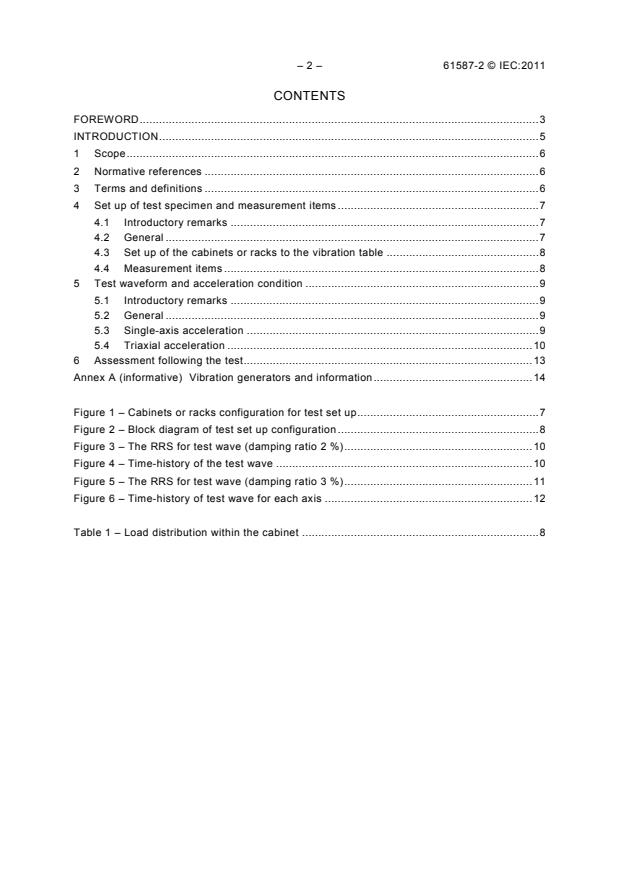
CONTENTS
FOREWORD . 3
INTRODUCTION . 5
1 Scope . 6
2 Normative references . 6
3 Terms and definitions . 6
4 Set up of test specimen and measurement items . 7
4.1 Introductory remarks . 7
4.2 General . 7
4.3 Set up of the cabinets or racks to the vibration table . 8
4.4 Measurement items . 8
5 Test waveform and acceleration condition . 9
5.1 Introductory remarks . 9
5.2 General . 9
5.3 Single-axis acceleration . 9
5.4 Triaxial acceleration . 10
6 Assessment following the test. 13
Annex A (informative) Vibration generators and information . 14
Figure 1 – Cabinets or racks configuration for test set up . 7
Figure 2 – Block diagram of test set up configuration . 8
Figure 3 – The RRS for test wave (damping ratio 2 %) . 10
Figure 4 – Time-history of the test wave . 10
Figure 5 – The RRS for test wave (damping ratio 3 %) . 11
Figure 6 – Time-history of test wave for each axis . 12
Table 1 – Load distribution within the cabinet . 8
61587-2 © IEC:2011 – 3 –
INTERNATIONAL ELECTROTECHNICAL COMMISSION
____________
MECHANICAL STRUCTURES FOR ELECTRONIC EQUIPMENT –
TESTS FOR IEC 60917 AND IEC 60297 –
Part 2: Seismic tests for cabinets and racks
FOREWORD
1) The International Electrotechnical Commission (IEC) is a worldwide organization for standardization comprising
all national electrotechnical committees (IEC National Committees). The object of IEC is to promote
international co-operation on all questions concerning standardization in the electrical and electronic fields. To
this end and in addition to other activities, IEC publishes International Standards, Technical Specifications,
Technical Reports, Publicly Available Specifications (PAS) and Guides (hereafter referred to as “IEC
Publication(s)”). Their preparation is entrusted to technical committees; any IEC National Committee interested
in the subject dealt with may participate in this preparatory work. International, governmental and non-
governmental organizations liaising with the IEC also participate in this preparation. IEC collaborates closely
with the International Organization for Standardization (ISO) in accordance with conditions determined by
agreement between the two organizations.
2) The formal decisions or agreements of IEC on technical matters express, as nearly as possible, an international
consensus of opinion on the relevant subjects since each technical committee has representation from all
interested IEC National Committees.
3) IEC Publications have the form of recommendations for international use and are accepted by IEC National
Committees in that sense. While all reasonable efforts are made to ensure that the technical content of IEC
Publications is accurate, IEC cannot be held responsible for the way in which they are used or for any
misinterpretation by any end user.
4) In order to promote international uniformity, IEC National Committees undertake to apply IEC Publications
transparently to the maximum extent possible in their national and regional publications. Any divergence
between any IEC Publication and the corresponding national or regional publication shall be clearly indicated in
the latter.
5) IEC itself does not provide any attestation of conformity. Independent certification bodies provide conformity
assessment services and, in some areas, access to IEC marks of conformity. IEC is not responsible for any
services carried out by independent certification bodies.
6) All users should ensure that they have the latest edition of this publication.
7) No liability shall attach to IEC or its directors, employees, servants or agents including individual experts and
members of its technical committees and IEC National Committees for any personal injury, property damage or
other damage of any nature whatsoever, whether direct or indirect, or for costs (including legal fees) and
expenses arising out of the publication, use of, or reliance upon, this IEC Publication or any other IEC
Publications.
8) Attention is drawn to the Normative references cited in this publication. Use of the referenced publications is
indispensable for the correct application of this publication.
9) Attention is drawn to the possibility that some of the elements of this IEC Publication may be the subject of
patent rights. IEC shall not be held responsible for identifying any or all such patent rights.
International Standard IEC 61587-2 has been prepared by subcommittee 48D: Mechanical
structures for electronic equipment, of IEC technical committee 48: Electromechanical
components and mechanical structures for electronic equipment.
The second edition of this standard replaces the first edition issued in 2000 and constitutes a
technical revision.
The main technical changes with regard to the previous edition are as follows:
Edition 1.0 specified the test condition with one size of the cabinet, and one load distribution.
The specified acceleration condition for the test specimen was single-axis and one of the RRS
(required response spectra) specified in the standard was selected. The test was aimed to
obtain the reference for the structural strength of the enclosure against the specified seismic
intensity. Earthquakes are actually random phenomena that are much more carefully
simulated by tri-axial simultaneous operation. The demand of tri-axial excitation has emerged
as a more accurate representation of an earthquake.
– 4 – 61587-2 © IEC:2011
The text of this standard is based on the following documents:
FDIS Report on voting
48D/471/FDIS 48D/486/RVD
Full information on the voting for the approval of this standard can be found in the report on
voting indicated in the above table.
This publication has been drafted in accordance with the ISO/IEC Directives, Part 2.
A list of all parts of IEC 61587 series, under the general title: Mechanical structures for
electronic equipment – Tests for IEC 60917 and IEC 60297, can be found on the IEC website.
The committee has decided that the contents of this publication will remain unchanged until
the stability date indicated on the IEC web site under "http://webstore.iec.ch" in the data
related to the specific publication. At this date, the publication will be
• reconfirmed,
• withdrawn,
• replaced by a revised edition, or
• amended.
61587-2 © IEC:2011 – 5 –
INTRODUCTION
Edition 1.0 of this standard specified the seismic test for the cabinets or racks according to
IEC 60297 and IEC 60917. The specified test applied to the structure of the enclosure and did
not apply to the whole system.
Edition 1.0 specified the test condition with one size of the cabinet, and one load distribution.
The specified acceleration condition for the test specimen was single-axis and one of the RRS
(required response spectra) specified in the standard was selected. The test was aimed to
obtain the reference for the structural strength of the enclosure against the specified seismic
intensity.
The electronic system consists of two or more subracks. Two or more plug-in units that
perform signal processing are installed in each subrack. The size, i.e.: height, width and
depth, and the weight of each subrack may vary for each electronic system. So, various types
of cabinets or racks to equip the electronic system are currently demanded. Therefore, many
types of cabinets or racks are required to install the equipment.
Earthquakes are actually random phenomena that are much more carefully simulated by tri-
axial simultaneous operation. The demand of tri-axial excitation has emerged as a more
accurate representation of an earthquake.
Edition 2.0 of this standard has been reviewed in consideration of these demanded
conditions. However, it is impossible to perform the seismic test under all of the cabinet or
rack conditions. The aim of this standard is then to evaluate the reference of the cabinet or
rack structure with a common examination method. The seismic test is therefore assumed to
be performed on one set of cabinet dimensional conditions (i.e. height, width and depth) and
one set of load distribution conditions in the cabinet. The input acceleration for the test
specimen is assumed to be selected and applied either single-axial or tri-axial. Single-axis
acceleration was already specified in Edition 1.0 of this standard. Therefore, the RRS
(required response spectra) for tri-axial acceleration have been added. According to this
standard, the examination should be performed in the same manner, so as to obtain a
reference for the evaluation of the structural strength of the tested cabinet or rack.
The user who requests an individual structural cabinet or rack condition, such as a different
cabinet size or a different load distribution in the cabinet, and requests different seismic
acceleration intensity, can perform the test by changing the corresponding condition specified
in this standard. In this case, the test result is treated as an individual evaluation, not to be
taken as a reference.
– 6 – 61587-2 © IEC:2011
MECHANICAL STRUCTURES FOR ELECTRONIC EQUIPMENT –
TESTS FOR IEC 60917 AND IEC 60297 –
Part 2: Seismic tests for cabinets and racks
1 Scope
This part of IEC 61587 specifies seismic tests for cabinets and racks accommodated with
IEC 60917 and 60297 series. It applies, in whole or in part, only to the mechanical structures
of cabinets and racks for electronic equipment according to the above cited series of
standards, while it does not apply to the electronic equipment or systems deemed to be
installed within these mechanical structures. This standard does not apply either to a cabinet
or a rack having an anti-seismic isolation structure, either external or internal.
This standard aims to provide test conditions and criteria that constitute a reference to
evaluate the ability of the mechanical structure of the cabinets or racks to acceptably
withstand specified seismic intensities. For this purpose, this standard specifies test specimen
conditions, such as dimensions (i.e. height, width and depth) of the cabinet and the rack,
load distribution, structural test condition and the RRS (required response spectra) of single-
axis or tri-axis acceleration as the seismic test wave condition. The single-axis or tri-axis
acceleration is selectable.
2 Normative references
The following referenced documents are indispensable for the application of this document.
For dated references, only the edition cited applies. For undated references, the latest edition
of the referenced document (including any amendments) applies.
IEC 60068-2-6: Environmental testing – Part 2-6: Tests – Test Fc: Vibration (sinusoidal)
IEC 60068-2-47: Environmental testing – Part 2-47: Tests – Mounting of specimens for
vibration, impact and similar dynamic tests
IEC 60068-2-57: Environmental testing – Part 2-57: Tests – Test Ff: Vibration – Time-history
method
IEC 60068-3-3: Environmental testing – Part 3: Guidance – Seismic test methods for
equipments
IEC 60297 (all parts): Mechanical structures for electronic equipment – Dimensions of
mechanical structures of the 482,6 mm (19 in) series
IEC 60917, (all parts): Modular order for the development of mechanical structures for
electronic equipment practices
3 Terms and definitions
For the purposes of this document, the terms and definitions given in IEC 60068-2-6,
IEC 60068-3-3, IEC 60068-2-47 and IEC 60068-2-57 apply.
61587-2 © IEC:2011 – 7 –
4 Set up of test specimen and measurement items
4.1 Introductory remarks
The seismic test of the cabinets or the racks shall be performed under loaded condition.
4.2 General
The cabinets or racks under the test shall be loaded in a distributed manner throughout the
height of the cabinets or racks with dummy plug-in units similar to a practical subrack
application.
The cabinets or racks to be tested shall be loaded as shown in Figure 1 and Table 1. This is
the condition to be taken as reference.
Cabinets or racks equipped with front/rear doors, and/or side panels may gain structural
contribution from their installation. The test report shall state whether the tested cabinets or
racks were tested with or without doors and panels. Cabinets or racks to be deployed in the
field by the user without doors and/or side panels will require cabinets or racks to be tested
without doors and/or side panels.
Dummy load M3
Dummy load M5
5 x A
D = 600 max.
To be attached to the front
and rear verticals
D
A
2 000
Dummy load M4
To be attached to the
bottom
Z
Y
IEC 1777/11
X
Dimensions in millimetres
Figure 1 – Cabinets or racks configuration for test set up
– 8 – 61587-2 © IEC:2011
Table 1 – Load distribution within the cabinet
Cabinets A M3 M4 M5 Total load
according (mm) (kg) (kg) (kg) (kg)
IEC 60297-3-100 265,9 90 60 250
25 × 4 positions
IEC 60917-2-1 250 90 60 250
25 × 4 positions
4.3 Set up of the cabinets or racks to the vibration table
Mounting condition is referred to IEC 60068-2-6, in which there is reference to
IEC 60068-2-47.
The loaded cabinets or racks for the test may be mounted to the vibration table without using
interfaces such as concrete anchors, however the securing of the cabinet/rack to vibration
table shall use similar size and number of hold-down devices in accordance with the intended
bolt-down positions of field installed units. If a specific cabinet mounting condition is required,
the test should be performed with agreement between user and manufacture. If there are
several bolt-down patterns for fixing the cabinets or racks to the vibration table, the test shall
be performed under the worst bolt-down condition, that is, the largest stress works to the
bolts. For the block diagram of the test set-up configuration, see Figure 2.
Displacement
Cabinet or rack
transducer
Acceleration
Motor and actuator
Waveform generator monitor
Vibration table
and controller
IEC 1778/11
Figure 2 – Block diagram of test set up configuration
4.4 Measurement items
These items shall be measured and reported.
a) Measure the critical frequency and the damping ratio of the loaded cabinets or racks for
test with the sweeping sinusoidal or the random wave before and after the seismic test.
b) Measure the acceleration of the vibration table during the test.
c) Measure the accelerations of horizontal and vertical directions at the top, bottom, and
center of the cabinets or racks.
d) Measure the horizontal displacement of the top of the cabinet or rack at the attachment
point to the vibration table.
61587-2 © IEC:2011 – 9 –
5 Test waveform and acceleration condition
5.1 Introductory remarks
The parameters such as time history, zero period acceleration, damping ratio and severities
(frequency range, required response spectrum, acceleration axis) are referred to
IEC 60068-3-3 and 60068-2-57.
5.2 General
The test shall be performed as follows.
a) The test wave for the seismic test shall be a synthesized waveform.
b) The test shall be implemented with single-axis or tri-axial condition defined below, and
which method actually applied shall be recorded.
c) The duration of the strong part of the time history is defined as from the time when the
plot first reaches 25 % of the maximum value to the time when it falls for the last time to
the 25 % level.
d) The test response spectrum (TRS) shall equal or exceed the required response spectrum
(RRS) as shown in Figure 3 (for single axis) and Figure 5 (for tri-axes). The damping ratio
of 3 % or 2 % is applied to evaluate the TRS and RRS, and is not applied to the frequency
range less than 0,5 Hz and more than 50 Hz. The value of g, i.e., standard acceleration
.
due to the earth, is rounded up to the nearest whole number, that is 10 m/s
e) The test waveform shall be made to satisfy the RRS.
f) It is acceptable that the TRS is lower than RRS partially at the frequency range of lower
than half or larger than two-times of the 1st natural frequency, but shall not exceed 20 %
of RRS.
g) If TRS does not satisfy the RRS with the limitation of the displacement of the vibration
table, TRS shall equal or exceed the frequency range equal or larger than 1Hz.
5.3 Single-axis acceleration
a) Accelerate each axis of the vibration table independently.
b) The acceleration of the vibration table is measured during the test as shown 4.3 b).
c) The duration of the strong part of the time history shall be equal or more than 18 s.
d) The zero period acceleration of input test wave shall be 16 m/s .
e) The time-history of the test wave is shown in Figure 4.
– 10 – 61587-2 © IEC:2011
0,1 1 10 100
00.1.1 11 1010 100100
Frequency (Hz)
FFrreequequencncyy HHzz
IEC 1779/11
Figure 3 – The RRS for test wave (damping ratio 2 %)
17,5
17.17.55
15,0
15.0
15.0
12,5
12.12.55
10,0
10.0
10.0
7,5
7.5
7.5
5,0
5.0
5.0
2,5
2.5
2.5
0,0
0.0
0.0
–2,5
- 2.5
- 2.5
–5,0
-- 55.0.0
–7,5
- 7.5
- 7.5
–10,0
- 10.0
- 10.0
–12,5
- 12.5
- 12.5
––155,,00
- 15.0
- 15.0
-–17.17,55
- 17.5
0,00 4,00 8,00 12,00 16,00 20,00 24,00 28,00 32,00
0.00 4.00 8.00 12.00 16.00 20.00 24.00 28.00 32.00
0.00 4.00 8.00 12.00 16.00 20.00 24.00 28.00 32.00
Time (s)
Time sec.
Time sec.
IEC 1780/11
Figure 4 – Time-history of the test wave
5.4 Triaxial acceleration
a) Accelerate the vibration table to three axes, i.e., width, depth, and up and down directions
of the cabinets or racks, simultaneously.
b) Acceleration of individual axis is different from each other. The acceleration of the
vibration table is measured during the test as indicated in 4.3 b).
c) The duration of the strong part of the time-history shall be equal or more than 30 s.
d) The required maximum acceleration (zero period acceleration) for input test wave shall be
2 2
12 m/s for horizontal and 6 m/s for up-and-down. The RRS is shown in Figure 5.
e) Examples of time-histories for each axis are shown in Figure 6.
Acceleration (m/s ) 22
AAcccceelleerratatiionon m/m/ss
AAccAcccelelcelerereraaatttiiionoon n ( mm/m//s )ss
61587-2 © IEC:2011 – 11 –
0,1 1 10 100
0.1 1 10 100
Frequency (Hz)
Frequency Hz
IEC 1781/11
a) Horizontal
0,1 1 10 100
0.1 1 10 100
Frequency (Hz)
Frequency Hz
IEC 1782/11
b) Up-and-down
Figure 5 – The RRS for test wave (damping ratio 3 %)
2 2
Acceleration (m/s ) Acceleration (m/s )
2 2
Acceleration m/ s
Acceleration m/ s
– 12 – 61587-2 © IEC:2011
–4
-4
–8
-8
–12
- 12
0 10 20 30 40
0 10 20 30 40
Time (s)
sec
Time s
IEC 1783/11
a) longitude
–4
-4
–8
-8
–12
- 12
10 20 30 40
0 10 20 30 40
Time (s)
sec
Time s
IEC 1784/11
b) latitude
–2
-2
–4
-4
–6
-6
–8
-8
0 10 20 30 40
0 10 20 30 40
Time (s)
sec
Time s
IEC 1785/11
c) vertical
Figure 6 – Time-history of test wave for each axis
2 2 2
Acceleration (m/s ) Acceleration (m/s ) Acceleration (m/s )
2 2 2
Acceleration m/ s Acceleration m/ s Acceleration m/ s
61587-2 © IEC:2011 – 13 –
6 Assessment following the test
a) There is no permanent deformation to the cabinets or racks exceeding 6 mm or buckling
of any component.
b) There is no crack or break to the structural parts by visual inspection.
c) The displacement of the upper part of the cabinets or racks while the test shall not exceed
75 mm.
d) Subracks or plug-in units installed in the cabinets or racks remain in their installed
position.
e) Doors shall operate as intend
...