

IEC 61850-7-410:2007
(Main)Communication networks and systems for power utility automation - Part 7-410: Hydroelectric power plants - Communication for monitoring and control
General Information
- Abstract
IEC 61850-7-410:2007 specifies the additional common data classes, logical nodes and data objects required for the use of IEC 61850 in a hydropower plant. The Logical Nodes and Data Objects (DO) defined in this part of IEC 61850 belong to the following fields of use:
- electrical functions;
- mechanical functions;
- hydrological functions;
- sensors.
- Status
- Published
- Publication Date
- 09-Aug-2007
- Technical Committee
- TC 57 - Power systems management and associated information exchange
- Drafting Committee
- WG 18 - TC 57/WG 18
- Current Stage
- DELPUB - Deleted Publication
- Start Date
- 30-Oct-2012
- Completion Date
- 28-Aug-2026
Buy Documents
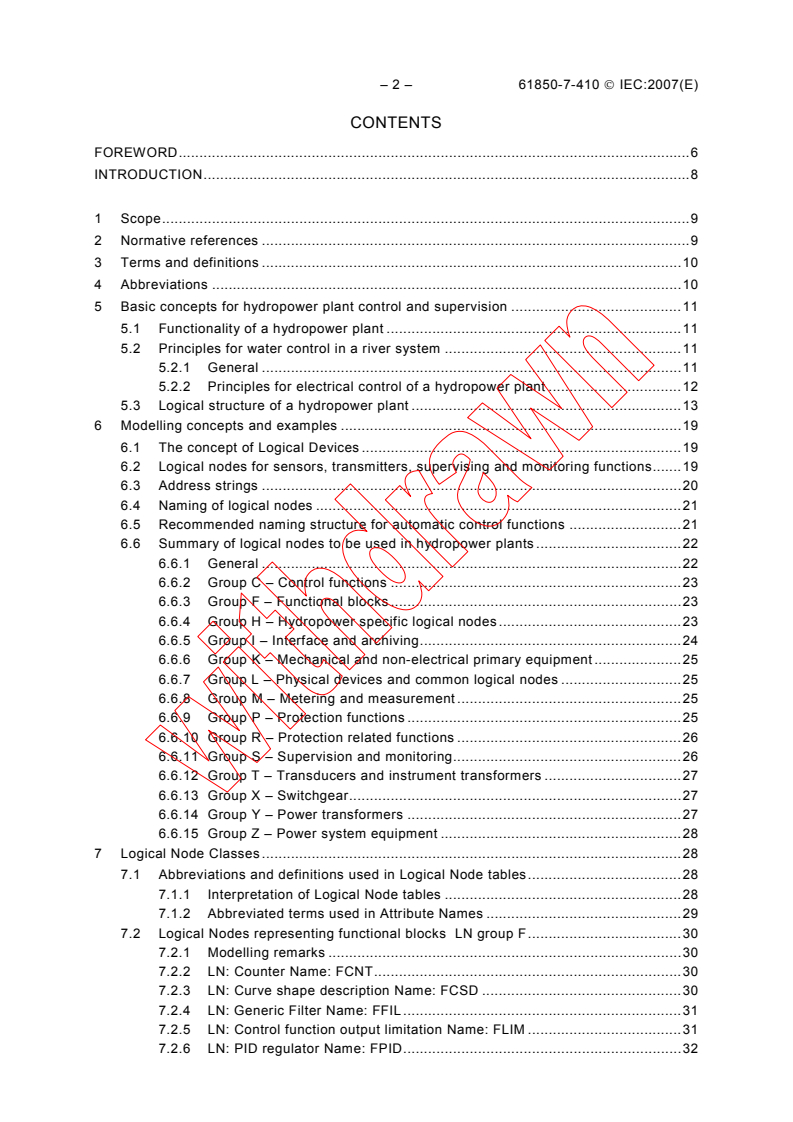
IEC 61850-7-410:2007 - Communication networks and systems for power utility automation - Part 7-410: Hydroelectric power plants - Communication for monitoring and control Released:8/10/2007

IEC 61850-7-410:2007 - Communication networks and systems for power utility automation - Part 7-410: Hydroelectric power plants - Communication for monitoring and control Released:8/10/2007
Overview
IEC 61850-7-410:2007 is a part of the IEC 61850 family focused on communication for monitoring and control in hydroelectric power plants. It specifies the additional common data classes, Logical Nodes (LN) and Data Objects (DO) that are required to apply IEC 61850 data modelling and communication services specifically to hydropower plants. The standard covers electrical, mechanical, hydrological and sensor-related functions used for automation, supervision, protection and control of hydropower assets.
Key Topics and Requirements
- Hydropower-specific Logical Nodes: Defines LN groups tailored to hydropower (examples include dam, gate, turbine/unit, water level and leakage supervision).
- Common Data Classes and Data Objects: Adds plant-specific DOs and data name semantics needed for consistent data exchange.
- Modelling concepts: Guidance on Logical Devices, naming conventions and address strings to ensure interoperable object modelling across vendors.
- Functional groups: Includes LNs for control and regulation (PID, set-point, ramp), metering and hydrological information (flow, level), mechanical equipment (valves, pumps, bearings), sensors and instrument transformers.
- Data semantics and attribute definitions: Clear definitions of data attributes to support unambiguous interpretation by SCADA, DMS and protection/control devices.
- Algorithms and examples: Annexes include algorithmic examples and curve representations used in control functions (e.g., gate position vs flow, PID/ramp examples).
Applications and Practical Value
- Ensures interoperability between control systems, protection relays, governors, and SCADA/HMI systems in hydroelectric plants.
- Enables standardized modelling of water control, reservoir management, gate and intake automation, and turbine-generator monitoring.
- Supports engineering tasks: system design, device configuration, testing, and integration of third‑party equipment from different vendors.
- Useful for implementing IEC 61850-based digital substations within generating plants, enabling real-time monitoring, alarm handling and closed-loop control.
Who Should Use This Standard
- Utility automation engineers and system integrators working on hydropower plant automation.
- OEMs of governors, excitation systems, sensors and plant control equipment.
- Protection and control engineers, SCADA/HMI developers, and standards compliance teams aiming to deploy IEC 61850 in hydro facilities.
- Asset managers and consultants specifying interoperable digital communication and data models for hydro plants.
Related Standards
- Part of the IEC 61850 series (communication networks and systems for power utility automation). Use together with core IEC 61850 parts that define services, mappings and conformance for complete implementations.
Keywords: IEC 61850-7-410, hydropower, hydroelectric power plant communication, logical nodes, sensors, monitoring and control, power utility automation.
Relations
- Effective Date
- 05-Sep-2023
Buy Documents
IEC 61850-7-410:2007 - Communication networks and systems for power utility automation - Part 7-410: Hydroelectric power plants - Communication for monitoring and control Released:8/10/2007
IEC 61850-7-410:2007 - Communication networks and systems for power utility automation - Part 7-410: Hydroelectric power plants - Communication for monitoring and control Released:8/10/2007
Get Certified
Connect with accredited certification bodies for this standard

ANCE
Mexican certification and testing association.

Intertek Slovenia
Intertek testing, inspection, and certification services in Slovenia.

LNE (Laboratoire National de Métrologie et d'Essais)
French national laboratory for metrology and testing.
Sponsored listings
Frequently Asked Questions
IEC 61850-7-410:2007 is a standard published by the International Electrotechnical Commission (IEC). Its full title is "Communication networks and systems for power utility automation - Part 7-410: Hydroelectric power plants - Communication for monitoring and control". This standard covers: IEC 61850-7-410:2007 specifies the additional common data classes, logical nodes and data objects required for the use of IEC 61850 in a hydropower plant. The Logical Nodes and Data Objects (DO) defined in this part of IEC 61850 belong to the following fields of use: - electrical functions; - mechanical functions; - hydrological functions; - sensors.
IEC 61850-7-410:2007 specifies the additional common data classes, logical nodes and data objects required for the use of IEC 61850 in a hydropower plant. The Logical Nodes and Data Objects (DO) defined in this part of IEC 61850 belong to the following fields of use: - electrical functions; - mechanical functions; - hydrological functions; - sensors.
IEC 61850-7-410:2007 is classified under the following ICS (International Classification for Standards) categories: 33.200 - Telecontrol. Telemetering. The ICS classification helps identify the subject area and facilitates finding related standards.
IEC 61850-7-410:2007 has the following relationships with other standards: It is inter standard links to IEC 61850-7-410:2012. Understanding these relationships helps ensure you are using the most current and applicable version of the standard.
IEC 61850-7-410:2007 is available in PDF format for immediate download after purchase. The document can be added to your cart and obtained through the secure checkout process. Digital delivery ensures instant access to the complete standard document.
Standards Content (Sample)
IEC 61850-7-410
Edition 1.0 2007-08
INTERNATIONAL
STANDARD
Communication networks and systems for power utility automation –
Part 7-410: Hydroelectric power plants – Communication for monitoring and
control
All rights reserved. Unless otherwise specified, no part of this publication may be reproduced or utilized in any form
or by any means, electronic or mechanical, including photocopying and microfilm, without permission in writing from
either IEC or IEC's member National Committee in the country of the requester.
If you have any questions about IEC copyright or have an enquiry about obtaining additional rights to this publication,
please contact the address below or your local IEC member National Committee for further information.
IEC Central Office
3, rue de Varembé
CH-1211 Geneva 20
Switzerland
Email: inmail@iec.ch
Web: www.iec.ch
About the IEC
The International Electrotechnical Commission (IEC) is the leading global organization that prepares and publishes
International Standards for all electrical, electronic and related technologies.
About IEC publications
The technical content of IEC publications is kept under constant review by the IEC. Please make sure that you have the
latest edition, a corrigenda or an amendment might have been published.
ƒ Catalogue of IEC publications: www.iec.ch/searchpub
The IEC on-line Catalogue enables you to search by a variety of criteria (reference number, text, technical committee,…).
It also gives information on projects, withdrawn and replaced publications.
ƒ IEC Just Published: www.iec.ch/online_news/justpub
Stay up to date on all new IEC publications. Just Published details twice a month all new publications released. Available
on-line and also by email.
ƒ Electropedia: www.electropedia.org
The world's leading online dictionary of electronic and electrical terms containing more than 20 000 terms and definitions
in English and French, with equivalent terms in additional languages. Also known as the International Electrotechnical
Vocabulary online.
ƒ Customer Service Centre: www.iec.ch/webstore/custserv
If you wish to give us your feedback on this publication or need further assistance, please visit the Customer Service
Centre FAQ or contact us:
Email: csc@iec.ch
Tel.: +41 22 919 02 11
Fax: +41 22 919 03 00
IEC 61850-7-410
Edition 1.0 2007-08
INTERNATIONAL
STANDARD
Communication networks and systems for power utility automation –
Part 7-410: Hydroelectric power plants – Communication for monitoring and
control
INTERNATIONAL
ELECTROTECHNICAL
COMMISSION
PRICE CODE
XC
ICS 33.200 ISBN 2-8318-9254-6
– 2 – 61850-7-410 © IEC:2007(E)
CONTENTS
FOREWORD.6
INTRODUCTION.8
1 Scope.9
2 Normative references .9
3 Terms and definitions .10
4 Abbreviations .10
5 Basic concepts for hydropower plant control and supervision .11
5.1 Functionality of a hydropower plant .11
5.2 Principles for water control in a river system .11
5.2.1 General .11
5.2.2 Principles for electrical control of a hydropower plant .12
5.3 Logical structure of a hydropower plant .13
6 Modelling concepts and examples .19
6.1 The concept of Logical Devices .19
6.2 Logical nodes for sensors, transmitters, supervising and monitoring functions.19
6.3 Address strings .20
6.4 Naming of logical nodes .21
6.5 Recommended naming structure for automatic control functions .21
6.6 Summary of logical nodes to be used in hydropower plants .22
6.6.1 General .22
6.6.2 Group C – Control functions .23
6.6.3 Group F – Functional blocks .23
6.6.4 Group H – Hydropower specific logical nodes.23
6.6.5 Group I – Interface and archiving.24
6.6.6 Group K – Mechanical and non-electrical primary equipment.25
6.6.7 Group L – Physical devices and common logical nodes .25
6.6.8 Group M – Metering and measurement .25
6.6.9 Group P – Protection functions .25
6.6.10 Group R – Protection related functions .26
6.6.11 Group S – Supervision and monitoring.26
6.6.12 Group T – Transducers and instrument transformers .27
6.6.13 Group X – Switchgear.27
6.6.14 Group Y – Power transformers .27
6.6.15 Group Z – Power system equipment .28
7 Logical Node Classes .28
7.1 Abbreviations and definitions used in Logical Node tables.28
7.1.1 Interpretation of Logical Node tables .28
7.1.2 Abbreviated terms used in Attribute Names .29
7.2 Logical Nodes representing functional blocks LN group F.30
7.2.1 Modelling remarks .30
7.2.2 LN: Counter Name: FCNT.30
7.2.3 LN: Curve shape description Name: FCSD .30
7.2.4 LN: Generic Filter Name: FFIL.31
7.2.5 LN: Control function output limitation Name: FLIM .31
7.2.6 LN: PID regulator Name: FPID.32
61850-7-410 © IEC:2007(E) – 3 –
7.2.7 LN: Ramp function Name: FRMP .33
7.2.8 LN: Set-point control function Name: FSPT.34
7.2.9 LN: Action at over threshold Name: FXOT .35
7.2.10 LN: Action at under threshold Name: FXUT .35
7.3 Hydropower specific Logical Nodes LN group H .36
7.3.1 Modelling remarks .36
7.3.2 LN: Turbine – generator shaft bearing Name: HBRG .36
7.3.3 LN: Combinator Name: HCOM.36
7.3.4 LN: Hydropower dam Name: HDAM .37
7.3.5 LN: Dam leakage supervision Name: HDLS .37
7.3.6 LN: Gate position indicator Name: HGPI.37
7.3.7 LN: Dam gate Name: HGTE.38
7.3.8 LN: Intake gate Name: HITG.38
7.3.9 LN: Joint control Name: HJCL.39
7.3.10 LN: Leakage supervision Name: HLKG .40
7.3.11 LN: Water level indicator Name: HLVL.40
7.3.12 LN: Mechanical brake Name: HMBR .41
7.3.13 LN: Needle control Name: HNDL .41
7.3.14 LN: Water net head data Name: HNHD.41
7.3.15 LN: Dam over-topping protection Name: HOTP.42
7.3.16 LN: Hydropower/water reservoir Name: HRES .42
7.3.17 LN: Hydropower unit sequencer Name: HSEQ .43
7.3.18 LN: Speed monitoring Name: HSPD .43
7.3.19 LN: Hydropower unit Name: HUNT .44
7.3.20 LN: Water control Name: HWCL .45
7.4 Logical Nodes for interface and archiving LN group I.45
7.4.1 Modelling remarks .45
7.4.2 LN: Safety alarm function Name: ISAF.46
7.5 Logical Nodes for mechanical and non-electric primary equipment LN group
K .46
7.5.1 Modelling remarks .46
7.5.2 LN: Fan Name: KFAN .46
7.5.3 LN: Filter Name: KFIL.47
7.5.4 LN: Pump Name: KPMP.47
7.5.5 LN: Tank Name: KTNK .48
7.5.6 LN: Valve control Name: KVLV .48
7.6 Logical Nodes for metering and measurement LN group M.49
7.6.1 Modelling remarks .49
7.6.2 LN: Environmental information Name: MENV.49
7.6.3 LN: Hydrological information Name: MHYD.49
7.6.4 LN: DC measurement Name: MMDC.50
7.6.5 LN: Meteorological information Name: MMET .50
7.7 Logical Nodes for protection functions LN group P .51
7.7.1 Modelling remarks .51
7.7.2 LN: Rotor protection Name: PRTR.52
7.7.3 LN: Thyristor protection Name: PTHF .52
7.8 Logical nodes for protection related functions LN Group R .52
7.8.1 Modelling remarks .52
7.8.2 LN: synchronising or synchro-check device Name: RSYN.52
– 4 – 61850-7-410 © IEC:2007(E)
7.9 Logical Nodes for supervision and monitoring LN group S .54
7.9.1 Modelling remarks .54
7.9.2 LN: temperature supervision Name: STMP .54
7.9.3 LN: vibration supervision Name: SVBR.54
7.10 Logical Nodes for instrument transformers and sensors LN group T .55
7.10.1 Modelling remarks .55
7.10.2 LN: Angle sensor Name: TANG .55
7.10.3 LN: Axial displacement sensor Name: TAXD.55
7.10.4 LN: Distance sensor Name: TDST .56
7.10.5 LN: Flow sensor Name: TFLW .56
7.10.6 LN: Frequency sensor Name: TFRQ .56
7.10.7 LN: Humidity sensor Name: THUM .57
7.10.8 LN: Level sensor Name: TLEV.57
7.10.9 LN: Magnetic field sensor Name: TMGF .57
7.10.10 LN: Movement sensor Name: TMVM.57
7.10.11 LN: Position indicator Name: TPOS .58
7.10.12 LN: Pressure sensor Name: TPRS.58
7.10.13 LN: Rotation transmitter Name: TRTN .58
7.10.14 LN: Sound pressure sensor Name: TSND .59
7.10.15 LN: Temperature sensor Name: TTMP.59
7.10.16 LN: Mechanical tension /stress sensor Name: TTNS.59
7.10.17 LN: Vibration sensor Name: TVBR.60
7.10.18 LN: Water pH sensor Name: TWPH .60
7.11 Logical Nodes for power system equipment LN group Z .60
7.11.1 Modelling remarks .60
7.11.2 LN: Neutral resistor Name: ZRES .60
7.11.3 LN: Semiconductor rectifier controller Name: ZSCR.61
7.11.4 LN: Synchronous machine Name: ZSMC .61
8 Data name semantics .63
9 Common data classes .76
9.1 General .76
9.2 Device ownership and operator (DOO) .76
9.3 Maintenance and operational tag (TAG) .76
9.4 Operational restriction (RST).77
10 Data attribute semantics.77
Annex A (informative) Algorithms used in logical nodes for automatic control .80
Bibliography.86
Figure 1 – Structure of a hydropower plant .11
Figure 2 – Principles for the joint control function.13
Figure 3 – Water control functions .14
Figure 4 – Water flow control of a turbine.15
Figure 5 – Typical turbine control system.16
Figure 6 – Excitation system .17
Figure 7 – Electrical protections of a generating unit.18
61850-7-410 © IEC:2007(E) – 5 –
Figure 8 – Conceptual use of transmitters.19
Figure 9 – Logical Device Name .20
Figure 10 – Example of naming structure, in a pumped storage plant, based on
IEC 61346-1 .20
Figure A.1 – Example of curve based on an indexed gate position providing water flow .80
Figure A.2 – Example of curve based on an indexed guide vane position (x axis) vs net
head (y axis) giving an interpolated Runner Blade position (Z axis) .81
Figure A.3 – Example of a proportional-integral-derivate controller .82
Figure A.4 – Example of a Power stabilisation system .83
Figure A.5 – Example of a ramp generator.83
Figure A.6 – Example of an interface with a set-point algorithm .84
Figure A.7 – Example of a physical connection to a set-point device.85
Table 1 – Example of Logical Device over-current protection .19
Table 2 – recommended LN prefixes.22
Table 3 – Logical nodes for control functions .23
Table 4 – Logical nodes representing functional blocks.23
Table 5 – Hydropower specific logical nodes.23
Table 6 – Logical nodes for interface and archiving .24
Table 7 – Logical nodes for mechanical and non-electric primary equipment.25
Table 8 – Logical nodes for physical devices and common LN .25
Table 9 – Logical nodes for metering and measurement .25
Table 10 – Logical nodes for protections.26
Table 11 – Logical nodes for protection related functions.26
Table 12 – Logical nodes for supervision and monitoring .26
Table 13 – Logical nodes for sensors.27
Table 14 – Logical nodes for switchgear .27
Table 15 – Logical nodes for power transformers.27
Table 16 – Logical nodes for power system equipment .28
Table 17 – Interpretation of Logical Node tables .28
Table 18 – Conditional attributes in FPID.32
Table 19 – Description of data .63
Table 20 – Semantics of data attributes .78
– 6 – 61850-7-410 © IEC:2007(E)
INTERNATIONAL ELECTROTECHNICAL COMMISSION
_____________________
COMMUNICATION NETWORKS AND SYSTEMS
FOR POWER UTILITY AUTOMATION –
Part 7-410: Hydroelectric power plants –
Communication for monitoring and control
FOREWORD
1) The International Electrotechnical Commission (IEC) is a worldwide organization for standardization comprising
all national electrotechnical committees (IEC National Committees). The object of IEC is to promote
international co-operation on all questions concerning standardization in the electrical and electronic fields. To
this end and in addition to other activities, IEC publishes International Standards, Technical Specifications,
Technical Reports, Publicly Available Specifications (PAS) and Guides (hereafter referred to as “IEC
Publication(s)”). Their preparation is entrusted to technical committees; any IEC National Committee interested
in the subject dealt with may participate in this preparatory work. International, governmental and non-
governmental organizations liaising with the IEC also participate in this preparation. IEC collaborates closely
with the International Organization for Standardization (ISO) in accordance with conditions determined by
agreement between the two organizations.
2) The formal decisions or agreements of IEC on technical matters express, as nearly as possible, an international
consensus of opinion on the relevant subjects since each technical committee has representation from all
interested IEC National Committees.
3) IEC Publications have the form of recommendations for international use and are accepted by IEC National
Committees in that sense. While all reasonable efforts are made to ensure that the technical content of IEC
Publications is accurate, IEC cannot be held responsible for the way in which they are used or for any
misinterpretation by any end user.
4) In order to promote international uniformity, IEC National Committees undertake to apply IEC Publications
transparently to the maximum extent possible in their national and regional publications. Any divergence
between any IEC Publication and the corresponding national or regional publication shall be clearly indicated in
the latter.
5) IEC provides no marking procedure to indicate its approval and cannot be rendered responsible for any
equipment declared to be in conformity with an IEC Publication.
6) All users should ensure that they have the latest edition of this publication.
7) No liability shall attach to IEC or its directors, employees, servants or agents including individual experts and
members of its technical committees and IEC National Committees for any personal injury, property damage or
other damage of any nature whatsoever, whether direct or indirect, or for costs (including legal fees) and
expenses arising out of the publication, use of, or reliance upon, this IEC Publication or any other IEC
Publications.
8) Attention is drawn to the Normative references cited in this publication. Use of the referenced publications is
indispensable for the correct application of this publication.
9) Attention is drawn to the possibility that some of the elements of this IEC Publication may be the subject of
patent rights. IEC shall not be held responsible for identifying any or all such patent rights.
International Standard IEC 61850-410 has been prepared by IEC technical committee 57:
Power systems management and associated information exchange.
It has been decided to amend the general title of the IEC 61850 series to Communication
networks and systems for power utility automation. Henceforth, new editions within the
IEC 61850 series will adopt this new general title.
The text of this standard is based on the following documents:
FDIS Report on voting
57/886/FDIS 57/905/RVD
Full information on the voting for the approval of this standard can be found in the report on
voting indicated in the above table.
61850-7-410 © IEC:2007(E) – 7 –
This publication has been drafted in accordance with the ISO/IEC Directives, Part 2.
A list of all parts of the IEC 61850 series, under the general title Communication networks and
systems for power utility automation, can be found on the IEC website.
The committee has decided that the contents of this publication will remain unchanged until
the maintenance result date indicated on the IEC web site under "http://webstore.iec.ch" in
the data related to the specific publication. At this date, the publication will be
• reconfirmed,
• withdrawn,
• replaced by a revised edition, or
• amended.
A bilingual version of this publication may be issued at a later date.
– 8 – 61850-7-410 © IEC:2007(E)
INTRODUCTION
The present standard includes all additional logical nodes, not included in IEC 61850-7-
4:2003, required to represent the complete control and monitoring system of a hydropower
plant.
Most of the Logical Nodes in IEC 61850-7-410 that are of general use, Logical Nodes the
names of which do not start with the letter “H”, will be transferred to the future Edition 2 of
IEC 61850-7-4. In the same manner, all Common Data Classes specified in IEC 61850-7-410
will be transferred to future Edition 2 of IEC 61850-7-3.
Once future Editions 2 of IEC 61850-7-3 and IEC 61850-7-4 are published, IEC 61850-7-410
will be revised to include only those Logical Nodes that are specific to hydropower use.
Before Edition 2 of IEC 61850-7-410 is published, there will be a period where the Common
Data Class (CDC) and Logical Node (LN) specifications will overlap with IEC 61850-7-3
(future Edition 2) and IEC 61850-7-4 (future Edition 2). During this time, the specifications in
IEC 61850-7-3 (future Edition 2) and IEC 61850-7-4 (future Edition 2) will apply.
61850-7-410 © IEC:2007(E) – 9 –
COMMUNICATION NETWORKS AND SYSTEMS
FOR POWER UTILITY AUTOMATION –
Part 7-410: Hydroelectric power plants –
Communication for monitoring and control
1 Scope
IEC 61850-7-410 is part of the IEC 61850 series. This part of IEC 61850 specifies the
additional common data classes, logical nodes and data objects required for the use of
IEC 61850 in a hydropower plant.
The Logical Nodes and Data Objects defined in this part of IEC 61850 belong to the following
fields of use:
• Electrical functions. This group includes LN and DO used for various control functions,
essentially related to the excitation of the generator. New LN and DO defined within this
group are not specific to hydropower plants; they are more or less general for all types of
larger power plants.
• Mechanical functions. This group includes functions related to the turbine and
associated equipment. The specifications of this document are intended for hydropower
plants, modifications might be required for application to other types of generating plants.
Some more generic functions are though defined under Logical Node group K.
• Hydrological functions. This group of functions includes objects related to water flow,
control and management of reservoirs and dams. Although specific for hydropower plants,
the LN and DO defined here can also be used for other types of utility water management
systems.
• Sensors. A power plant will need sensors providing measurements of other than electrical
data. With a few exceptions, such sensors are of general nature and not specific for
hydropower plants.
NOTE All Logical Nodes with names not starting with the letter “H” will be included in a future edition 2 of
IEC 61850-7-4. When that document is published, the Logical Nodes in IEC 61850-7-4 (Edition 2) will take
precedence over Logical Nodes with the same name in this part IEC 61850-7-410.
2 Normative references
The following referenced documents are indispensable for the application of this document.
For dated references, only the edition cited applies. For undated references, the latest edition
of the referenced document (including any amendments) applies:
IEC 61850-2, Communication networks and systems in substations – Part 2: Glossary
IEC 61850-5, Communication networks and systems in substations – Part 5: Communication
requirements for functions and device models
IEC 61850-6, Communication networks and systems in substations – Part 6: Configuration
description language for communication in electrical substations related to IEDs
IEC 61850-7-2:2003, Communication networks and systems in substations – Part 7-2: Basic
communication structure for substation and feeder equipment – Abstract communication
services interface (ACSI)
– 10 – 61850-7-410 © IEC:2007(E)
IEC 61850-7-3:2003, Communication networks and systems in substations – Part 7-3: Basic
communication structure for substation and feeder equipment – Common data classes
IEC 61850-7-4:2003, Communication networks and systems in substations – Part 7-4: Basic
communication structure for substation and feeder equipment – Compatible logical node
classes
3 Terms and definitions
For the purposes of this document, the terms and definitions given in IEC 61850-2 apply.
4 Abbreviations
In general, the abbreviations defined in IEC 61850-2 apply. The following abbreviations are
repeated here for convenience.
ASG Analogue setting
BSC Binary controlled step position information
CDC Common data class
CIM Common information model (reference to IEC 61970-301)
CMV Complex measured value
DO Data object
DPC Double point control
DPL Device name-plate
DPS Double point status information
HMI Human machine interface
IED Intelligent electronic device
INC Controllable integer status
ING Integer status setting
INS Integer status
LD Logical device
LN Logical node
MV Measured value
PD Physical device
PID Proportional – Integrating – Derivative regulator
SAV Sampled analogue value
SMV Sampled measured value
SPC Single point control
SPS Single point status
61850-7-410 © IEC:2007(E) – 11 –
WYE Phase to ground related measured values of a three-phase system
5 Basic concepts for hydropower plant control and supervision
5.1 Functionality of a hydropower plant
Figure 1 below is based on the substation structure described in IEC 61850-6. A typical power
plant will include a “substation” part that will be identical to what is described in the
IEC 61850 series. The generating units with their related equipment are added to the basic
structure.
A generating unit does consist of a turbine – generator set with auxiliary equipment and
supporting functions. Generator transformers can be referenced as normal substation
transformers; there is not always any one-to-one connection between generating units and
transformers.
The dam is a different case. There is always one dam associated with a hydropower plant.
There are however reservoirs that are not related to any specific power plant as well as there
are power plants from which more than one dam are being controlled. While all other objects
can be addressed through the power plant, dams might have to be addressed directly.
River system
Unit (generating unit) Logical system
Dam / reservoir
Hydro station Function (common) Sub-function Equipment
Transformer
Voltage level Bay
IEC 1340/07
Figure 1 – Structure of a hydropower plant
There is, however, no standardised way of arranging overall control functions, the structure
will depend on whether the plant is manned or remote operated, as well as traditions within
the utility that owns the plant. In order to cover most arrangements, some of the Logical
Nodes defined in this part of IEC 61850 more or less overlap. This will allow the user to
arrange Logical Devices by selecting the most appropriate Logical Nodes that suits the actual
design and methods of operation of the plant. Other Logical Nodes are very small, in order to
provide simple building blocks that will allow as much freedom as possible in arranging the
control system.
Some control functions do work more or less autonomously after being started and stopped by
the start/stop sequencer. Such functions include the cooling system for the generator and the
lubrication oil system for the bearings.
5.2 Principles for water control in a river system
5.2.1 General
The water control of river systems and hydropower plants can follow different strategies,
depending on the external requirements put on the operation of the system.
– 12 – 61850-7-410 © IEC:2007(E)
a) Water flow control
In this type of control, the power production is roughly adapted to the water flow that is
available at the moment. The rate of flow is the controlled while the water level is allowed to
vary between high and low alarm levels in the dams. The dams are classified after the time
over which the inflow and outflow shall add up (daily, weekly etc.).
b) Water level control
In some locations, there are strict limits imposed on the allowed variation of the water level of
the dam. This might be due to maritime shipping or by other environmental requirements. In
this case, the upper water level of the dam is the overriding concern, power production is
adjusted by the water level control function to provide correct flow to maintain the water level.
c) Cascade control
In rivers with more than one power plant, the overall water flow in the river is coordinated
between plants to ensure an optimal use of the water. Each individual plant can be operated
according to the water level model or the water flow model as best suited, depending on the
capacity of the local dam and allowed variation in water levels. The coordination is normally
done at dispatch centre level, but power plants often have feed-forward functions that will
automatically notify the next plant downstream if there is a sudden change of water flow.
Power plants with more than one generating unit and/or more than one dam gate, can be
provided with a joint control function that controls the total water flow through the plant as well
as the water level control.
5.2.2 Principles for electrical control of a hydropower plant
A power plant can be operated in different modes: active power production mode or
condenser mode. The generator can be used as a pure synchronous condenser, without any
active power production and with the runner spinning in air.
In a pumped storage plant, there is a motor mode for the generator. A generator in a pumped
storage plant can also be used for voltage control in a synchronous condenser mode, in this
case, normally with an empty turbine chamber.
The following steady states are defined for the unit:
a) Excited, not connected – Field current is applied and a voltage is generated, the generator
is however not connected to any load, there is no significant stator current.
b) Synchronised – The generator is synchronised to an external network. This is the normal
status of an operating generator.
c) Synchronised in condenser mode – The generator is synchronised. However it does not
primarily produce active power. In condenser mode, it will produce or consume reactive
power, in generation- or pump-direction (for pumped storage), it consumes active power.
d) Island operation mode – The external network has been separated and the power plant
shall control the frequency.
e) Local supply mode – In the case of a larger disturbance of the external network, one or
more generators in a power plant can be set at a minimum production to provide power for
local supply only. This type of operation is common in thermal power plants to shorten the
start-up time once the network is restored, but can also be used in hydropower plants for
practical reasons.
61850-7-410 © IEC:2007(E) – 13 –
5.3 Logical structure of a hydropower plant
Different devices handle active and reactive power control. The turbine governor provides the
active power control by regulating the water flow through the turbine and thus the pole angle
between the rotating magnetic flux and the rotor. The excitation system provides the reactive
power control by regulating the voltage of the generator. The magnetic flux shall correspond
to the shaft torque to keep the generator synchronised to the grid.
Active power set-point
Water flow set-point
Water level set-point
Power production
From metering
Joint power plant
control
Dam gate Governor
control control
Calculated Calculated
Upper water water flow water flow
level
Lower water
level
Figure 2 – Principles for the joint control function
Figure 2 shows an example of an arrangement including a joint control function. The set-
points will be issued from a dispatch centre and could be one of three optional values.
Therefore, the type of set-point that will be used depends on the water control mode that is
used for the plant.
– 14 – 61850-7-410 © IEC:2007(E)
HDAM
Water flow set-point
Water
HWCL
control
function
Water level set-point
Calculated
HDLS
water flow
Level /
opening
FCSD
relation curve
Overflow
HOTP
protection
HLVL
Upper water Gate position
HGPI
level
Dam gate
position
HGTE
M
controller
MMET
MHYD
IEC 1342/07
Figure 3 – Water control functions
Figure 3 is a typical example of water control functions of a dam. The overall water control of
a hydropower plant will also include the water running through turbines. The overtopping
protection (HOTP) is a safety function, acting independent of other control functions that will
override normal spillway gate controls.
In the case of a reservoir without any power production, this water control function will get the
set-points from a dispatch centre; in the case of a power plant it will be normally the joint
control function that sets the values. The set-point will be either water level or water flow set-
points.
The total water flow is the sum of flows through turbines and gates. The overall flow control
shall also consider the flow through turbines. The turbine control system can, due to this, be
provided with different set-points for the control:
• Water flow set-point. The control system will base the regulation on the given water flow
level and try to optimise the production.
• Active power set-point. The control system will try to meet the active power, the water flow
will be reported back to the overall water control system.
Penstock
61850-7-410 © IEC:2007(E) – 15 –
• Active power control with speed droop. This is the mode when the unit is contributing to
the network frequency control. The active power set-point is balanced over the speed
droop setting to obtain the desired power/frequency amplification.
• Frequency set-point. in the case of an islanded system or a power plant in peak load duty,
the active power will be controlled to exactly meet the demand. This control mode is also
used during start-up of the unit, up to the point when the generator is synchronised. Water
flow will be reported.
Intake gate Water flow set-point
Net head
calculation
Water level at intake
Turbine
water flow
control
Water flow
Guide vane control
Lower water level
Under-pressure
Main inlet
valve
Tailrace
IEC 1343/07
Figure 4 – Water flow control of a turbine
Figure 4 shows an example of water flow control of a turbine. Direct measurement of the
water flow, as indicated in the figure, is less common. The flow is normally calculated, using
the net head, the opening angle of the guide vanes and a correlation curve.
Main inlet valves to shut off the turbine chamber are used for pumped storage plants and
power plants with high penstocks.
It is important to differentiate between the water levels of the dam and at the intake. Due to
the intake design or if the turbine is running close to rated power, the water level at the intake
might be considerably lower than the average for the dam.
– 16 – 61850-7-410 © IEC:2007(E)
The measurement of under-pressure below the turbine chamber is a safety measure, to
ensure that the operation of the guide vanes does not cause any dangerous conditions in the
tail-race part.
Water flow set-point
Active power set-
point
W_FPID
Frequency set-point
W_FSPT
W_FCSD
Opening limitation
HLVL
Spd_FPID
Calculated
net head
Spd_FSPT
HLVL
Governor
control
Lim_FPID
KTNK
Tank
Lim_FSPT
TPRS
Guide vane
position
High pressure
controller
Gv_FPID
oil system
Gv_FSPT
Servo motor
Guide
vane
ring
Position Gv_TPOS
indicator
Rb_HCOM
Combinator
setting
curves
Rb_FCSD
Runner blade
Rb_FPID
position
controller
Rb_FSPT
Position Rb_TPOS
indicator
IEC 1344/07
Figure 5 – Typical turbine control system
Figure 5 above shows an example of a turbine control system for a Kaplan turbine with
moveable runner blades.
The frequency set-point and any opening (maximum power) limitation set-point are most likely
to be given by dispatch centre (or locally).
61850-7-410 © IEC:2007(E) – 17 –
The active power set-point can be given by dispatch centre, but in the case of overriding
water control functions, it is given by the joint control function (HJCL). The water control set-
point is almost always provided by the joint control function.
Power
VAr_FPI
regulator
Pf_FPID
Selector and Selector and V_FSPT
tracking tracking
MMXU
V_FLIM
Limiter PSS V_FRMP
V_FFIL
Voltage
regulator
V_FPID
Field current
A_FSPT
regulator
A_FPID
FXOT
Fan
~
STMP Thyristor
contr.
ZSCR
control
=
TTMP
PTHC
M
MMDC
ZSMC
Alarm
handling
CALH
G
~
CSWI
De-
IEC 1345/07
Figure 6 – Excitation system
Figure 6 shows an example of the excitation system for a generator. There are a number of
different design principles for excitation systems; the figure does, however, include the most
common functions. The synchronisation device can be included in the excitation system, in
the turbine governor system, or it can be a separate device not being part of either.
– 18 – 61850-7-410 © IEC:2007(E)
3Id>
PDIF
PTOF
f>
PTUF
f<
U/f > PVPH
U> PTOV
Φ < PDUP
PDOP
P ←
Z< PDIS
3I> PIOC
PTOC
~
3I> PIOC
PTOC
=
I
...
IEC 61850-7-410 ®
Edition 1.0 2007-08
INTERNATIONAL
STANDARD
NORME
INTERNATIONALE
colour
inside
Communication networks and systems for power utility automation –
Part 7-410: Hydroelectric power plants – Communication for monitoring and
control
Réseaux et systèmes de communication pour l'automatisation des systèmes
électriques –
Partie 7-410: Centrales hydroélectriques – Communication pour contrôle et
commande
All rights reserved. Unless otherwise specified, no part of this publication may be reproduced or utilized in any form or by
any means, electronic or mechanical, including photocopying and microfilm, without permission in writing from either IEC or
IEC's member National Committee in the country of the requester.
If you have any questions about IEC copyright or have an enquiry about obtaining additional rights to this publication,
please contact the address below or your local IEC member National Committee for further information.
Droits de reproduction réservés. Sauf indication contraire, aucune partie de cette publication ne peut être reproduite
ni utilisée sous quelque forme que ce soit et par aucun procédé, électronique ou mécanique, y compris la photocopie
et les microfilms, sans l'accord écrit de la CEI ou du Comité national de la CEI du pays du demandeur.
Si vous avez des questions sur le copyright de la CEI ou si vous désirez obtenir des droits supplémentaires sur cette
publication, utilisez les coordonnées ci-après ou contactez le Comité national de la CEI de votre pays de résidence.
IEC Central Office
3, rue de Varembé
CH-1211 Geneva 20
Switzerland
Email: inmail@iec.ch
Web: www.iec.ch
About the IEC
The International Electrotechnical Commission (IEC) is the leading global organization that prepares and publishes
International Standards for all electrical, electronic and related technologies.
About IEC publications
The technical content of IEC publications is kept under constant review by the IEC. Please make sure that you have the
latest edition, a corrigenda or an amendment might have been published.
Catalogue of IEC publications: www.iec.ch/searchpub
The IEC on-line Catalogue enables you to search by a variety of criteria (reference number, text, technical committee,…).
It also gives information on projects, withdrawn and replaced publications.
IEC Just Published: www.iec.ch/online_news/justpub
Stay up to date on all new IEC publications. Just Published details twice a month all new publications released. Available
on-line and also by email.
Electropedia: www.electropedia.org
The world's leading online dictionary of electronic and electrical terms containing more than 20 000 terms and definitions
in English and French, with equivalent terms in additional languages. Also known as the International Electrotechnical
Vocabulary online.
Customer Service Centre: www.iec.ch/webstore/custserv
If you wish to give us your feedback on this publication or need further assistance, please visit the Customer Service
Centre FAQ or contact us:
Email: csc@iec.ch
Tel.: +41 22 919 02 11
Fax: +41 22 919 03 00
A propos de la CEI
La Commission Electrotechnique Internationale (CEI) est la première organisation mondiale qui élabore et publie des
normes internationales pour tout ce qui a trait à l'électricité, à l'électronique et aux technologies apparentées.
A propos des publications CEI
Le contenu technique des publications de la CEI est constamment revu. Veuillez vous assurer que vous possédez
l’édition la plus récente, un corrigendum ou amendement peut avoir été publié.
Catalogue des publications de la CEI: www.iec.ch/searchpub/cur_fut-f.htm
Le Catalogue en-ligne de la CEI vous permet d’effectuer des recherches en utilisant différents critères (numéro de référence,
texte, comité d’études,…). Il donne aussi des informations sur les projets et les publications retirées ou remplacées.
Just Published CEI: www.iec.ch/online_news/justpub
Restez informé sur les nouvelles publications de la CEI. Just Published détaille deux fois par mois les nouvelles
publications parues. Disponible en-ligne et aussi par email.
Electropedia: www.electropedia.org
Le premier dictionnaire en ligne au monde de termes électroniques et électriques. Il contient plus de 20 000 termes et
définitions en anglais et en français, ainsi que les termes équivalents dans les langues additionnelles. Egalement appelé
Vocabulaire Electrotechnique International en ligne.
Service Clients: www.iec.ch/webstore/custserv/custserv_entry-f.htm
Si vous désirez nous donner des commentaires sur cette publication ou si vous avez des questions, visitez le FAQ du
Service clients ou contactez-nous:
Email: csc@iec.ch
Tél.: +41 22 919 02 11
Fax: +41 22 919 03 00
IEC 61850-7-410 ®
Edition 1.0 2007-08
INTERNATIONAL
STANDARD
NORME
INTERNATIONALE
colour
inside
Communication networks and systems for power utility automation –
Part 7-410: Hydroelectric power plants – Communication for monitoring and
control
Réseaux et systèmes de communication pour l'automatisation des systèmes
électriques –
Partie 7-410: Centrales hydroélectriques – Communication pour contrôle et
commande
INTERNATIONAL
ELECTROTECHNICAL
COMMISSION
COMMISSION
ELECTROTECHNIQUE
PRICE CODE
INTERNATIONALE
CODE PRIX XC
ICS 33.200 ISBN 978-2-88912-589-0
– 2 – 61850-7-410 IEC:2007
CONTENTS
FOREWORD . 6
INTRODUCTION . 8
1 Scope . 9
2 Normative references . 9
3 Terms and definitions . 10
4 Abbreviations . 10
5 Basic concepts for hydropower plant control and supervision . 11
5.1 Functionality of a hydropower plant . 11
5.2 Principles for water control in a river system . 11
5.2.1 General . 11
5.2.2 Principles for electrical control of a hydropower plant . 12
5.3 Logical structure of a hydropower plant . 13
6 Modelling concepts and examples . 19
6.1 The concept of Logical Devices . 19
6.2 Logical nodes for sensors, transmitters, supervising and monitoring functions . 19
6.3 Address strings . 20
6.4 Naming of logical nodes . 21
6.5 Recommended naming structure for automatic control functions . 21
6.6 Summary of logical nodes to be used in hydropower plants . 22
6.6.1 General . 22
6.6.2 Group C – Control functions . 23
6.6.3 Group F – Functional blocks . 23
6.6.4 Group H – Hydropower specific logical nodes . 23
6.6.5 Group I – Interface and archiving . 24
6.6.6 Group K – Mechanical and non-electrical primary equipment . 25
6.6.7 Group L – Physical devices and common logical nodes . 25
6.6.8 Group M – Metering and measurement . 25
6.6.9 Group P – Protection functions . 25
6.6.10 Group R – Protection related functions . 26
6.6.11 Group S – Supervision and monitoring . 26
6.6.12 Group T – Transducers and instrument transformers . 27
6.6.13 Group X – Switchgear . 27
6.6.14 Group Y – Power transformers . 27
6.6.15 Group Z – Power system equipment . 28
7 Logical Node Classes . 28
7.1 Abbreviations and definitions used in Logical Node tables . 28
7.1.1 Interpretation of Logical Node tables . 28
7.1.2 Abbreviated terms used in Attribute Names . 29
7.2 Logical Nodes representing functional blocks LN group F . 30
7.2.1 Modelling remarks . 30
7.2.2 LN: Counter Name: FCNT . 30
7.2.3 LN: Curve shape description Name: FCSD . 30
7.2.4 LN: Generic Filter Name: FFIL . 31
7.2.5 LN: Control function output limitation Name: FLIM . 31
7.2.6 LN: PID regulator Name: FPID . 32
61850-7-410 IEC:2007 – 3 –
7.2.7 LN: Ramp function Name: FRMP . 33
7.2.8 LN: Set-point control function Name: FSPT. 34
7.2.9 LN: Action at over threshold Name: FXOT . 35
7.2.10 LN: Action at under threshold Name: FXUT . 35
7.3 Hydropower specific Logical Nodes LN group H . 36
7.3.1 Modelling remarks . 36
7.3.2 LN: Turbine – generator shaft bearing Name: HBRG . 36
7.3.3 LN: Combinator Name: HCOM . 36
7.3.4 LN: Hydropower dam Name: HDAM . 37
7.3.5 LN: Dam leakage supervision Name: HDLS . 37
7.3.6 LN: Gate position indicator Name: HGPI . 37
7.3.7 LN: Dam gate Name: HGTE . 38
7.3.8 LN: Intake gate Name: HITG . 38
7.3.9 LN: Joint control Name: HJCL. 39
7.3.10 LN: Leakage supervision Name: HLKG . 40
7.3.11 LN: Water level indicator Name: HLVL . 40
7.3.12 LN: Mechanical brake Name: HMBR . 41
7.3.13 LN: Needle control Name: HNDL . 41
7.3.14 LN: Water net head data Name: HNHD . 41
7.3.15 LN: Dam over-topping protection Name: HOTP . 42
7.3.16 LN: Hydropower/water reservoir Name: HRES . 42
7.3.17 LN: Hydropower unit sequencer Name: HSEQ . 43
7.3.18 LN: Speed monitoring Name: HSPD . 43
7.3.19 LN: Hydropower unit Name: HUNT . 44
7.3.20 LN: Water control Name: HWCL . 45
7.4 Logical Nodes for interface and archiving LN group I . 45
7.4.1 Modelling remarks . 45
7.4.2 LN: Safety alarm function Name: ISAF . 46
7.5 Logical Nodes for mechanical and non-electric primary equipment LN group K. 46
7.5.1 Modelling remarks . 46
7.5.2 LN: Fan Name: KFAN . 46
7.5.3 LN: Filter Name: KFIL . 47
7.5.4 LN: Pump Name: KPMP. 47
7.5.5 LN: Tank Name: KTNK . 48
7.5.6 LN: Valve control Name: KVLV . 48
7.6 Logical Nodes for metering and measurement LN group M . 49
7.6.1 Modelling remarks . 49
7.6.2 LN: Environmental information Name: MENV . 49
7.6.3 LN: Hydrological information Name: MHYD . 49
7.6.4 LN: DC measurement Name: MMDC . 50
7.6.5 LN: Meteorological information Name: MMET . 50
7.7 Logical Nodes for protection functions LN group P . 51
7.7.1 Modelling remarks . 51
7.7.2 LN: Rotor protection Name: PRTR . 52
7.7.3 LN: Thyristor protection Name: PTHF . 52
7.8 Logical nodes for protection related functions LN Group R . 52
7.8.1 Modelling remarks . 52
7.8.2 LN: synchronising or synchro-check device Name: RSYN . 52
7.9 Logical Nodes for supervision and monitoring LN group S . 54
– 4 – 61850-7-410 IEC:2007
7.9.1 Modelling remarks . 54
7.9.2 LN: temperature supervision Name: STMP . 54
7.9.3 LN: vibration supervision Name: SVBR . 54
7.10 Logical Nodes for instrument transformers and sensors LN group T . 55
7.10.1 Modelling remarks . 55
7.10.2 LN: Angle sensor Name: TANG . 55
7.10.3 LN: Axial displacement sensor Name: TAXD . 55
7.10.4 LN: Distance sensor Name: TDST . 56
7.10.5 LN: Flow sensor Name: TFLW . 56
7.10.6 LN: Frequency sensor Name: TFRQ . 56
7.10.7 LN: Humidity sensor Name: THUM . 57
7.10.8 LN: Level sensor Name: TLEV . 57
7.10.9 LN: Magnetic field sensor Name: TMGF . 57
7.10.10 LN: Movement sensor Name: TMVM . 57
7.10.11 LN: Position indicator Name: TPOS . 58
7.10.12 LN: Pressure sensor Name: TPRS . 58
7.10.13 LN: Rotation transmitter Name: TRTN . 58
7.10.14 LN: Sound pressure sensor Name: TSND . 59
7.10.15 LN: Temperature sensor Name: TTMP . 59
7.10.16 LN: Mechanical tension /stress sensor Name: TTNS . 59
7.10.17 LN: Vibration sensor Name: TVBR . 60
7.10.18 LN: Water pH sensor Name: TWPH . 60
7.11 Logical Nodes for power system equipment LN group Z . 60
7.11.1 Modelling remarks . 60
7.11.2 LN: Neutral resistor Name: ZRES . 60
7.11.3 LN: Semiconductor rectifier controller Name: ZSCR . 61
7.11.4 LN: Synchronous machine Name: ZSMC . 61
8 Data name semantics . 63
9 Common data classes . 76
9.1 General . 76
9.2 Device ownership and operator (DOO) . 76
9.3 Maintenance and operational tag (TAG) . 76
9.4 Operational restriction (RST) . 77
10 Data attribute semantics . 77
Annex A (informative) Algorithms used in logical nodes for automatic control . 80
Bibliography . 86
Figure 1 – Structure of a hydropower plant . 11
Figure 2 – Principles for the joint control function . 13
Figure 3 – Water control functions . 14
Figure 4 – Water flow control of a turbine. 15
Figure 5 – Typical turbine control system . 16
Figure 6 – Excitation system . 17
Figure 7 – Electrical protections of a generating unit . 18
Figure 8 – Conceptual use of transmitters . 19
Figure 9 – Logical Device Name . 20
61850-7-410 IEC:2007 – 5 –
Figure 10 – Example of naming structure, in a pumped storage plant, based on
IEC 61346-1 . 20
Figure A.1 – Example of curve based on an indexed gate position providing water flow . 80
Figure A.2 – Example of curve based on an indexed guide vane position (x axis) vs net
head (y axis) giving an interpolated Runner Blade position (Z axis) . 81
Figure A.3 – Example of a proportional-integral-derivate controller . 82
Figure A.4 – Example of a Power stabilisation system . 83
Figure A.5 – Example of a ramp generator . 83
Figure A.6 – Example of an interface with a set-point algorithm . 84
Figure A.7 – Example of a physical connection to a set-point device . 85
Table 1 – Example of Logical Device over-current protection . 19
Table 2 – recommended LN prefixes . 22
Table 3 – Logical nodes for control functions . 23
Table 4 – Logical nodes representing functional blocks. 23
Table 5 – Hydropower specific logical nodes . 23
Table 6 – Logical nodes for interface and archiving . 24
Table 7 – Logical nodes for mechanical and non-electric primary equipment. 25
Table 8 – Logical nodes for physical devices and common LN . 25
Table 9 – Logical nodes for metering and measurement . 25
Table 10 – Logical nodes for protections . 26
Table 11 – Logical nodes for protection related functions . 26
Table 12 – Logical nodes for supervision and monitoring . 26
Table 13 – Logical nodes for sensors . 27
Table 14 – Logical nodes for switchgear . 27
Table 15 – Logical nodes for power transformers . 27
Table 16 – Logical nodes for power system equipment . 28
Table 17 – Interpretation of Logical Node tables . 28
Table 18 – Conditional attributes in FPID . 32
Table 19 – Description of data . 63
Table 20 – Semantics of data attributes . 78
– 6 – 61850-7-410 IEC:2007
INTERNATIONAL ELECTROTECHNICAL COMMISSION
______________
COMMUNICATION NETWORKS AND SYSTEMS
FOR POWER UTILITY AUTOMATION –
Part 7-410: Hydroelectric power plants –
Communication for monitoring and control
FOREWORD
1) The International Electrotechnical Commission (IEC) is a worldwide organization for standardization comprising
all national electrotechnical committees (IEC National Committees). The object of IEC is to promote
international co-operation on all questions concerning standardization in the electrical and electronic fields. To
this end and in addition to other activities, IEC publishes International Standards, Technical Specifications,
Technical Reports, Publicly Available Specifications (PAS) and Guides (hereafter referred to as “IEC
Publication(s)”). Their preparation is entrusted to technical committees; any IEC National Committee interested
in the subject dealt with may participate in this preparatory work. International, governmental and non-
governmental organizations liaising with the IEC also participate in this preparation. IEC collaborates closely
with the International Organization for Standardization (ISO) in accordance with conditions determined by
agreement between the two organizations.
2) The formal decisions or agreements of IEC on technical matters express, as nearly as possible, an international
consensus of opinion on the relevant subjects since each technical committee has representation from all
interested IEC National Committees.
3) IEC Publications have the form of recommendations for international use and are accepted by IEC National
Committees in that sense. While all reasonable efforts are made to ensure that the technical content of IEC
Publications is accurate, IEC cannot be held responsible for the way in which they are used or for any
misinterpretation by any end user.
4) In order to promote international uniformity, IEC National Committees undertake to apply IEC Publications
transparently to the maximum extent possible in their national and regional publications. Any divergence
between any IEC Publication and the corresponding national or regional publication shall be clearly indicated in
the latter.
5) IEC provides no marking procedure to indicate its approval and cannot be rendered responsible for any
equipment declared to be in conformity with an IEC Publication.
6) All users should ensure that they have the latest edition of this publication.
7) No liability shall attach to IEC or its directors, employees, servants or agents including individual experts and
members of its technical committees and IEC National Committees for any personal injury, property damage or
other damage of any nature whatsoever, whether direct or indirect, or for costs (including legal fees) and
expenses arising out of the publication, use of, or reliance upon, this IEC Publication or any other IEC
Publications.
8) Attention is drawn to the Normative references cited in this publication. Use of the referenced publications is
indispensable for the correct application of this publication.
9) Attention is drawn to the possibility that some of the elements of this IEC Publication may be the subject of
patent rights. IEC shall not be held responsible for identifying any or all such patent rights.
International Standard IEC 61850-7-410 has been prepared by IEC technical committee 57:
Power systems management and associated information exchange.
It has been decided to amend the general title of the IEC 61850 series to Communication
networks and systems for power utility automation. Henceforth, new editions within the
IEC 61850 series will adopt this new general title.
This bilingual version (2013-01) corresponds to the English version, published in 2007-08.
61850-7-410 IEC:2007 – 7 –
The text of this standard is based on the following documents:
FDIS Report on voting
57/886/FDIS 57/905/RVD
Full information on the voting for the approval of this standard can be found in the report on
voting indicated in the above table.
The French version of this standard has not been voted upon.
This publication has been drafted in accordance with the ISO/IEC Directives, Part 2.
A list of all parts of the IEC 61850 series, under the general title Communication networks and
systems for power utility automation, can be found on the IEC website.
The committee has decided that the contents of this publication will remain unchanged until
the maintenance result date indicated on the IEC web site under "http://webstore.iec.ch" in
the data related to the specific publication. At this date, the publication will be
• reconfirmed,
• withdrawn,
• replaced by a revised edition, or
• amended.
IMPORTANT – The 'colour inside' logo on the cover page of this publication indicates
that it contains colours which are considered to be useful for the correct
understanding of its contents. Users should therefore print this document using a
colour printer.
– 8 – 61850-7-410 IEC:2007
INTRODUCTION
The present standard includes all additional logical nodes, not included in IEC 61850-7-
4:2003, required to represent the complete control and monitoring system of a hydropower
plant.
Most of the Logical Nodes in IEC 61850-7-410 that are of general use, Logical Nodes the
names of which do not start with the letter “H”, will be transferred to the future Edition 2 of
IEC 61850-7-4. In the same manner, all Common Data Classes specified in IEC 61850-7-410
will be transferred to future Edition 2 of IEC 61850-7-3.
Once future Editions 2 of IEC 61850-7-3 and IEC 61850-7-4 are published, IEC 61850-7-410
will be revised to include only those Logical Nodes that are specific to hydropower use.
Before Edition 2 of IEC 61850-7-410 is published, there will be a period where the Common
Data Class (CDC) and Logical Node (LN) specifications will overlap with IEC 61850-7-3
(future Edition 2) and IEC 61850-7-4 (future Edition 2). During this time, the specifications in
IEC 61850-7-3 (future Edition 2) and IEC 61850-7-4 (future Edition 2) will apply.
61850-7-410 IEC:2007 – 9 –
COMMUNICATION NETWORKS AND SYSTEMS
FOR POWER UTILITY AUTOMATION –
Part 7-410: Hydroelectric power plants –
Communication for monitoring and control
1 Scope
IEC 61850-7-410 is part of the IEC 61850 series. This part of IEC 61850 specifies the
additional common data classes, logical nodes and data objects required for the use of
IEC 61850 in a hydropower plant.
The Logical Nodes and Data Objects (DO) defined in this part of IEC 61850 belong to the
following fields of use:
• Electrical functions. This group includes LN and DO used for various control functions,
essentially related to the excitation of the generator. New LN and DO defined within this
group are not specific to hydropower plants; they are more or less general for all types of
larger power plants.
• Mechanical functions. This group includes functions related to the turbine and
associated equipment. The specifications of this document are intended for hydropower
plants, modifications might be required for application to other types of generating plants.
Some more generic functions are though defined under Logical Node group K.
• Hydrological functions. This group of functions includes objects related to water flow,
control and management of reservoirs and dams. Although specific for hydropower plants,
the LN and DO defined here can also be used for other types of utility water management
systems.
• Sensors. A power plant will need sensors providing measurements of other than electrical
data. With a few exceptions, such sensors are of general nature and not specific for
hydropower plants.
NOTE All Logical Nodes with names not starting with the letter “H” will be included in a future edition 2 of
IEC 61850-7-4. When that document is published, the Logical Nodes in IEC 61850-7-4 (Edition 2) will take
precedence over Logical Nodes with the same name in this part IEC 61850-7-410.
2 Normative references
The following referenced documents are indispensable for the application of this document.
For dated references, only the edition cited applies. For undated references, the latest edition
of the referenced document (including any amendments) applies:
IEC 61850-2, Communication networks and systems in substations – Part 2: Glossary
IEC 61850-5, Communication networks and systems in substations – Part 5: Communication
requirements for functions and device models
IEC 61850-6, Communication networks and systems in substations – Part 6: Configuration
description language for communication in electrical substations related to IEDs
IEC 61850-7-2:2003, Communication networks and systems in substations – Part 7-2: Basic
communication structure for substation and feeder equipment – Abstract communication
services interface (ACSI)
– 10 – 61850-7-410 IEC:2007
IEC 61850-7-3:2003, Communication networks and systems in substations – Part 7-3: Basic
communication structure for substation and feeder equipment – Common data classes
IEC 61850-7-4:2003, Communication networks and systems in substations – Part 7-4: Basic
communication structure for substation and feeder equipment – Compatible logical node
classes
3 Terms and definitions
For the purposes of this document, the terms and definitions given in IEC 61850-2 apply.
4 Abbreviations
In general, the abbreviations defined in IEC 61850-2 apply. The following abbreviations are
repeated here for convenience.
ASG Analogue setting
BSC Binary controlled step position information
CDC Common data class
CIM Common information model (reference to IEC 61970-301)
CMV Complex measured value
DO Data object
DPC Double point control
DPL Device name-plate
DPS Double point status information
HMI Human machine interface
IED Intelligent electronic device
INC Controllable integer status
ING Integer status setting
INS Integer status
LD Logical device
LN Logical node
MV Measured value
PD Physical device
PID Proportional – Integrating – Derivative regulator
SAV Sampled analogue value
SMV Sampled measured value
SPC Single point control
SPS Single point status
61850-7-410 IEC:2007 – 11 –
WYE Phase to ground related measured values of a three-phase system
5 Basic concepts for hydropower plant control and supervision
5.1 Functionality of a hydropower plant
Figure 1 is based on the substation structure described in IEC 61850-6. A typical power plant
will include a “substation” part that will be identical to what is described in the IEC 61850
series. The generating units with their related equipment are added to the basic structure.
A generating unit does consist of a turbine-generator set with auxiliary equipment and
supporting functions. Generator transformers can be referenced as normal substation
transformers; there is not always any one-to-one connection between generating units and
transformers.
The dam is a different case. There is always one dam associated with a hydropower plant.
There are however reservoirs that are not related to any specific power plant as well as there
are power plants from which more than one dam are being controlled. While all other objects
can be addressed through the power plant, dams might have to be addressed directly.
River system
Unit (generating unit) Logical system
Dam / reservoir
Hydro station Function (common) Sub-function Equipment
Transformer
Voltage level Bay
IEC 1340/07
Figure 1 – Structure of a hydropower plant
There is, however, no standardised way of arranging overall control functions. The structure
will depend on whether the plant is manned or remote operated, as well as traditions within
the utility that owns the plant. In order to cover most arrangements, some of the Logical
Nodes defined in this part of IEC 61850 more or less overlap. This will allow the user to
arrange Logical Devices by selecting the most appropriate Logical Nodes that suit the actual
design and methods of operation of the plant. Other Logical Nodes are very small, in order to
provide simple building blocks that will allow as much freedom as possible in arranging the
control system.
Some control functions do work more or less autonomously after being started and stopped by
the start/stop sequencer. Such functions include the cooling system for the generator and the
lubrication oil system for the bearings.
5.2 Principles for water control in a river system
5.2.1 General
The water control of river systems and hydropower plants can follow different strategies,
depending on the external requirements put on the operation of the system.
– 12 – 61850-7-410 IEC:2007
a) Water flow control
In this type of control, the power production is roughly adapted to the water flow that is
available at the moment. The rate of flow is the controlled while the water level is allowed to
vary between high and low alarm levels in the dams. The dams are classified after the time
over which the inflow and outflow shall add up (daily, weekly etc.).
b) Water level control
In some locations, there are strict limits imposed on the allowed variation of the water level of
the dam. This might be due to maritime shipping or by other environmental requirements. In
this case, the upper water level of the dam is the overriding concern, power production is
adjusted by the water level control function to provide correct flow to maintain the water level.
c) Cascade control
In rivers with more than one power plant, the overall water flow in the river is coordinated
between plants to ensure an optimal use of the water. Each individual plant can be operated
according to the water level model or the water flow model as best suited, depending on the
capacity of the local dam and allowed variation in water levels. The coordination is normally
done at dispatch centre level, but power plants often have feed-forward functions that will
automatically notify the next plant downstream if there is a sudden change of water flow.
Power plants with more than one generating unit and/or more than one dam gate, can be
provided with a joint control function that controls the total water flow through the plant as well
as the water level control.
5.2.2 Principles for electrical control of a hydropower plant
A power plant can be operated in different modes: active power production mode or
condenser mode. The generator can be used as a pure synchronous condenser, without any
active power production and with the runner spinning in air.
In a pumped storage plant, there is a motor mode for the generator. A generator in a pumped
storage plant can also be used for voltage control in a synchronous condenser mode, in this
case, normally with an empty turbine chamber.
The following steady states are defined for the unit:
a) Excited, not connected – Field current is applied and a voltage is generated, the generator
is however not connected to any load, there is no significant stator current.
b) Synchronised – The generator is synchronised to an external network. This is the normal
status of an operating generator.
c) Synchronised in condenser mode – The generator is synchronised. However it does not
primarily produce active power. In condenser mode, it will produce or consume reactive
power, in generation- or pump-direction (for pumped storage), it consumes active power.
d) Island operation mode – The external network has been separated and the power plant
shall control the frequency.
e) Local supply mode – In the case of a larger disturbance of the external network, one or
more generators in a power plant can be set at a minimum production to provide power for
local supply only. This type of operation is common in thermal power plants to shorten the
start-up time once the network is restored, but can also be used in hydropower plants for
practical reasons.
61850-7-410 IEC:2007 – 13 –
5.3 Logical structure of a hydropower plant
Different devices handle active and reactive power control. The turbine governor provides the
active power control by regulating the water flow through the turbine and thus the pole angle
between the rotating magnetic flux and the rotor. The excitation system provides the reactive
power control by regulating the voltage of the generator. The magnetic flux shall correspond
to the shaft torque to keep the generator synchronised to the grid.
Active power set-point
Water flow set-point
Water level set-point
Power production
from metering
Joint power plant
control
Dam gate Governor
control control
Calculated Calculated
Upper water water flow water flow
level
Lower water
level
IEC 1341/07
Figure 2 – Principles for the joint control function
Figure 2 shows an example of an arrangement including a joint control function. The set-
points will be issued from a dispatch centre and could be one of three optional values.
Therefore, the type of set-point that will be used depends on the water control mode that is
used for the plant.
– 14 – 61850-7-410 IEC:2007
HDAM
Water flow set-point
Water
HWCL
control
function
Water level set-point
Calculated
HDLS
water flow
Level /
opening
FCSD
relation curve
Overflow
HOTP
protection
HLVL
Upper water Gate position
HGPI
level
Dam gate
position
HGTE
M
controller
MMET
MHYD
IEC 1342/07
Figure 3 – Water control functions
Figure 3 is a typical example of water control functions of a dam. The overall water control of
a hydropower plant will also include the water running through turbines. The overtopping
protection (HOTP) is a safety function, acting independent of other control functions that will
override normal spillway gate controls.
In the case of a reservoir without any power production, this water control function will get the
set-points from a dispatch centre; in the case of a power plant it will be normally the joint
control function that sets the values. The set-point will be either water level or water flow set-
points.
The total water flow is the sum of flows through turbines and gates. The overall flow control
shall also consider the flow through turbines. The turbine control system can, due to this, be
provided with different set-points for the control:
• Water flow set-point. The control system will base the regulation on the given water flow
level and try to optimise the production.
• Active power set-point. The control system will try to meet the active power, the water flow
will be reported back to the overall water control system.
Penstock
61850-7-410 IEC:2007 – 15 –
• Active power control with speed droop. This is the mode when the unit is contributing to
the network frequency control. The active power set-point is balanced over the speed
droop setting to obtain the desired power/frequency amplification.
• Frequency set-point. in the case of an islanded system or a power plant in peak load duty,
the active power will be controlled to exactly meet the demand. This control mode is also
used during start-up of the unit, up to the point when the generator is synchronised. Water
flow will be reported.
Intake gate Water flow set-point
Net head
calculation
Water level at intake
Turbine
water flow
control
Water flow
Guide vane control
Lower water level
Under-pressure
Main inlet
valve
Tailrace
IEC 1343/07
Figure 4 – Water flow control of a turbine
Figure 4 shows an example of water flow control of a turbine. Direct measurement of the
water flow, as indicated in the figure, is less common. The flow is normally calculated, using
the net head, the opening angle of the guide vanes and a correlation curve.
Main i
...