

IEC 62715-5-1:2017
(Main)Flexible display devices - Part 5-1: Measuring methods of optical performance
General Information
- Abstract
IEC 62715-5-1:2017(E) specifies the standard measuring conditions and measuring methods for determining the optical performance of flexible displays in the dark or under ambient illumination. This document mainly applies to display modules that are bendable about one axis. The display is measured in a static mechanical state. The measuring methods apply to monochrome or colour displays with a single radius of curvature of 35 mm or greater.
- Status
- Published
- Publication Date
- 18-May-2017
- Technical Committee
- TC 110 - Electronic displays
- Drafting Committee
- WG 8 - TC 110/WG 8
- Current Stage
- PPUB - Publication issued
- Start Date
- 19-May-2017
- Completion Date
- 16-Jun-2017
Overview
IEC 62715-5-1:2017 - Flexible display devices: Part 5-1 Measuring methods of optical performance defines standardized conditions and methods to measure the optical performance of flexible displays. The standard applies to bendable display modules that are bendable about a single axis, measured in a static mechanical state, and having a single radius of curvature of 35 mm or greater. It covers measurements performed in a dark room and under ambient illumination for both monochrome and colour displays.
Key topics and technical requirements
The standard specifies measurement setups, equipment and procedures for assessing optical parameters. Key topics include:
- Standard measuring conditions
- Environmental and setup conditions for reproducible testing
- Standard ambient illumination spectra and geometries
- Measuring equipment and configurations
- Display mounting for uniformity and viewing-direction tests
- Light measuring devices (photometers, colorimeters, spectroradiometers)
- Light source configurations: hemispherical diffuse, directed, ring illumination
- Dark-room optical measurements
- Luminance and luminance uniformity (screen-centre and field uniformity)
- Contrast ratio and its measurement
- Chromaticity, colour uniformity, and colour gamut area
- Peak white correlated colour temperature (CCT)
- Viewing-direction dependence of luminance and colour
- Cross-talk behavior with display in bent state
- Ambient-light optical measurements
- Reflection measurements and specular/diffuse effects
- Ambient contrast ratio and methods to evaluate display visibility under illumination
- Ambient display colour and ambient colour gamut volume, including calculation procedures for gamut volume in CIELAB space
- Reporting and evaluation
- Defined measurement positions, test patterns and reporting formats for consistent comparison
Practical applications
IEC 62715-5-1 is designed to ensure consistent, repeatable optical characterization of flexible/bendable displays. Typical uses:
- Product validation and acceptance testing for flexible OLED, e-paper, and other bendable modules
- R&D performance benchmarking during design and materials selection
- Quality assurance in manufacturing to verify luminance, colour and uniformity targets
- Comparative testing for procurement specifications and certification labs
- Visibility and ergonomics assessment for devices used in ambient lighting
Who should use this standard
- Display manufacturers and module integrators
- Optical test laboratories and certification bodies
- OEMs developing foldable or curved consumer electronics (phones, wearables, automotive displays)
- QA engineers, product managers and procurement specialists specifying optical performance
Related standards (if applicable)
- Other parts of the IEC 62715 series covering mechanical, electrical or reliability aspects of flexible displays
- National or international display measurement guidelines and CIE recommendations for colour and photometric testing
Keywords: IEC 62715-5-1, flexible display devices, measuring methods of optical performance, luminance uniformity, contrast ratio, chromaticity, ambient illumination, viewing direction, colour gamut volume.
Frequently Asked Questions
IEC 62715-5-1:2017 is a standard published by the International Electrotechnical Commission (IEC). Its full title is "Flexible display devices - Part 5-1: Measuring methods of optical performance". This standard covers: IEC 62715-5-1:2017(E) specifies the standard measuring conditions and measuring methods for determining the optical performance of flexible displays in the dark or under ambient illumination. This document mainly applies to display modules that are bendable about one axis. The display is measured in a static mechanical state. The measuring methods apply to monochrome or colour displays with a single radius of curvature of 35 mm or greater.
IEC 62715-5-1:2017(E) specifies the standard measuring conditions and measuring methods for determining the optical performance of flexible displays in the dark or under ambient illumination. This document mainly applies to display modules that are bendable about one axis. The display is measured in a static mechanical state. The measuring methods apply to monochrome or colour displays with a single radius of curvature of 35 mm or greater.
IEC 62715-5-1:2017 is classified under the following ICS (International Classification for Standards) categories: 31.120 - Electronic display devices. The ICS classification helps identify the subject area and facilitates finding related standards.
IEC 62715-5-1:2017 is available in PDF format for immediate download after purchase. The document can be added to your cart and obtained through the secure checkout process. Digital delivery ensures instant access to the complete standard document.
Standards Content (Sample)
IEC 62715-5-1 ®
Edition 1.0 2017-05
INTERNATIONAL
STANDARD
colour
inside
Flexible display devices –
Part 5-1: Measuring methods of optical performance
All rights reserved. Unless otherwise specified, no part of this publication may be reproduced or utilized in any form
or by any means, electronic or mechanical, including photocopying and microfilm, without permission in writing from
either IEC or IEC's member National Committee in the country of the requester. If you have any questions about IEC
copyright or have an enquiry about obtaining additional rights to this publication, please contact the address below or
your local IEC member National Committee for further information.
IEC Central Office Tel.: +41 22 919 02 11
3, rue de Varembé Fax: +41 22 919 03 00
CH-1211 Geneva 20 info@iec.ch
Switzerland www.iec.ch
About the IEC
The International Electrotechnical Commission (IEC) is the leading global organization that prepares and publishes
International Standards for all electrical, electronic and related technologies.
About IEC publications
The technical content of IEC publications is kept under constant review by the IEC. Please make sure that you have the
latest edition, a corrigenda or an amendment might have been published.
IEC Catalogue - webstore.iec.ch/catalogue Electropedia - www.electropedia.org
The stand-alone application for consulting the entire The world's leading online dictionary of electronic and
bibliographical information on IEC International Standards, electrical terms containing 20 000 terms and definitions in
Technical Specifications, Technical Reports and other English and French, with equivalent terms in 16 additional
documents. Available for PC, Mac OS, Android Tablets and languages. Also known as the International Electrotechnical
iPad. Vocabulary (IEV) online.
IEC publications search - www.iec.ch/searchpub IEC Glossary - std.iec.ch/glossary
The advanced search enables to find IEC publications by a 65 000 electrotechnical terminology entries in English and
variety of criteria (reference number, text, technical French extracted from the Terms and Definitions clause of
committee,…). It also gives information on projects, replaced IEC publications issued since 2002. Some entries have been
and withdrawn publications. collected from earlier publications of IEC TC 37, 77, 86 and
CISPR.
IEC Just Published - webstore.iec.ch/justpublished
Stay up to date on all new IEC publications. Just Published IEC Customer Service Centre - webstore.iec.ch/csc
details all new publications released. Available online and If you wish to give us your feedback on this publication or
also once a month by email. need further assistance, please contact the Customer Service
Centre: csc@iec.ch.
IEC 62715-5-1 ®
Edition 1.0 2017-05
INTERNATIONAL
STANDARD
colour
inside
Flexible display devices –
Part 5-1: Measuring methods of optical performance
INTERNATIONAL
ELECTROTECHNICAL
COMMISSION
ICS 31.120 ISBN 978-2-8322-4354-1
– 2 – IEC 62715-5-1:2017 IEC 2017
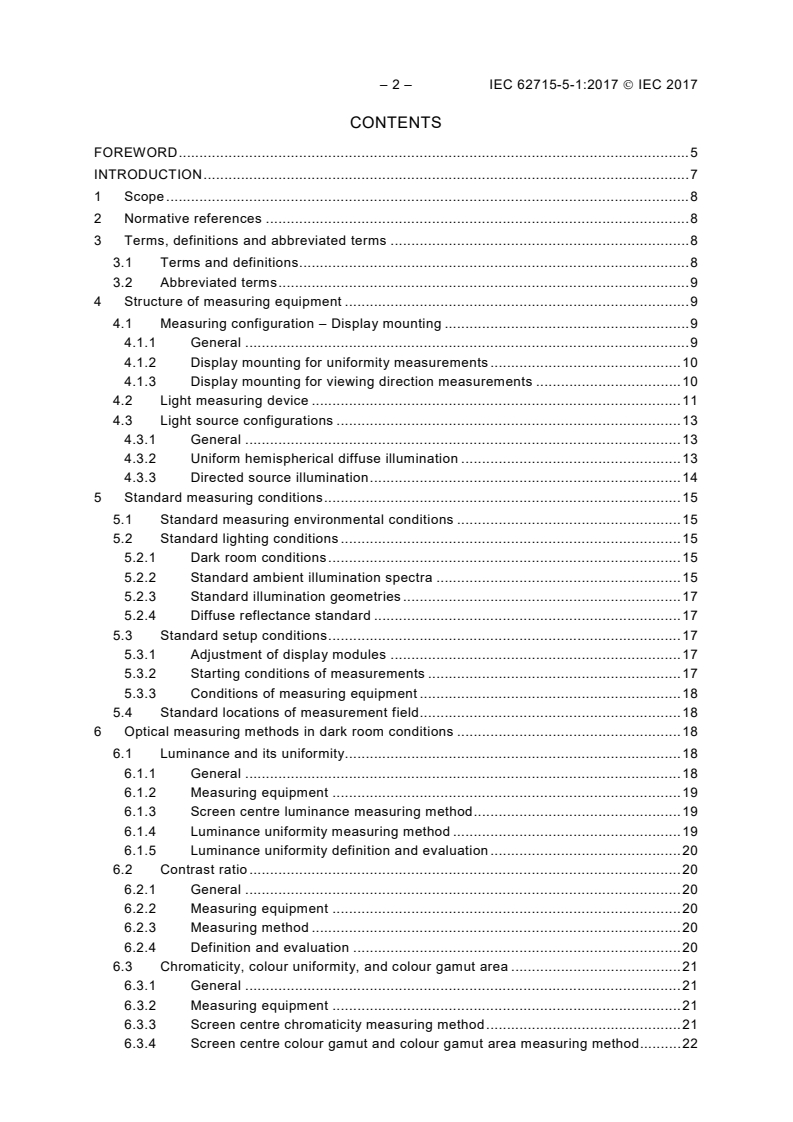
CONTENTS
FOREWORD . 5
INTRODUCTION . 7
1 Scope . 8
2 Normative references . 8
3 Terms, definitions and abbreviated terms . 8
3.1 Terms and definitions . 8
3.2 Abbreviated terms . 9
4 Structure of measuring equipment . 9
4.1 Measuring configuration – Display mounting . 9
4.1.1 General . 9
4.1.2 Display mounting for uniformity measurements . 10
4.1.3 Display mounting for viewing direction measurements . 10
4.2 Light measuring device . 11
4.3 Light source configurations . 13
4.3.1 General . 13
4.3.2 Uniform hemispherical diffuse illumination . 13
4.3.3 Directed source illumination . 14
5 Standard measuring conditions . 15
5.1 Standard measuring environmental conditions . 15
5.2 Standard lighting conditions . 15
5.2.1 Dark room conditions . 15
5.2.2 Standard ambient illumination spectra . 15
5.2.3 Standard illumination geometries . 17
5.2.4 Diffuse reflectance standard . 17
5.3 Standard setup conditions . 17
5.3.1 Adjustment of display modules . 17
5.3.2 Starting conditions of measurements . 17
5.3.3 Conditions of measuring equipment . 18
5.4 Standard locations of measurement field. 18
6 Optical measuring methods in dark room conditions . 18
6.1 Luminance and its uniformity. 18
6.1.1 General . 18
6.1.2 Measuring equipment . 19
6.1.3 Screen centre luminance measuring method . 19
6.1.4 Luminance uniformity measuring method . 19
6.1.5 Luminance uniformity definition and evaluation . 20
6.2 Contrast ratio . 20
6.2.1 General . 20
6.2.2 Measuring equipment . 20
6.2.3 Measuring method . 20
6.2.4 Definition and evaluation . 20
6.3 Chromaticity, colour uniformity, and colour gamut area . 21
6.3.1 General . 21
6.3.2 Measuring equipment . 21
6.3.3 Screen centre chromaticity measuring method . 21
6.3.4 Screen centre colour gamut and colour gamut area measuring method . 22
6.3.5 Colour uniformity measuring method . 24
6.4 Peak white field correlated colour temperature . 25
6.4.1 General . 25
6.4.2 Measuring equipment . 25
6.4.3 Measuring method . 25
6.5 Viewing direction dependence . 25
6.5.1 General . 25
6.5.2 Measuring equipment . 25
6.5.3 Measuring method . 26
6.5.4 Definition and evaluation . 27
6.6 Cross-talk with display in bent state . 28
6.6.1 General . 28
6.6.2 Measuring equipment . 28
6.6.3 Measuring method . 29
7 Optical measuring method under ambient illumination . 31
7.1 Reflection measurements . 31
7.1.1 General . 31
7.1.2 Measuring conditions . 32
7.2 Ambient contrast ratio . 35
7.2.1 General . 35
7.2.2 Measuring conditions . 36
7.2.3 Measuring method . 36
7.3 Ambient display colour . 36
7.3.1 General . 36
7.3.2 Measuring conditions . 37
7.3.3 Measuring method . 37
7.4 Ambient colour gamut volume . 38
7.4.1 General . 38
7.4.2 Measuring conditions . 38
7.4.3 Measuring method . 38
7.4.4 Reporting . 40
Annex A (informative) Calculation method of ambient colour gamut volume . 42
A.1 Purpose . 42
A.2 Procedure for calculating the colour gamut volume . 42
A.3 Surface subdivision method for CIELAB gamut volume calculation . 44
A.3.1 Purpose . 44
A.3.2 Assumptions . 44
A.3.3 Algorithm . 44
A.3.4 Software example execution . 45
Bibliography . 49
Figure 1 – Example of the coordinate system used for a convex display of a constant
radius of curvature about the y-axis . 10
Figure 2 – Top view example of how a convex display can be rotated within the
measurement field . 10
Figure 3 – Top view example of display mount that rotates in the x-z plane for viewing
direction measurements . 11
Figure 4 – Optical characteristics of a spot photometer, colorimeter, or
spectroradiometer . 12
– 4 – IEC 62715-5-1:2017 IEC 2017
Figure 5 – Example of the relationship between measurement field diameter and
inclinations angles . 13
Figure 6 – Example of reflection measurement geometries for spherical illumination . 14
Figure 7 – Example of convex display illuminated by a directed light source . 14
Figure 8 – Example of convex display illuminated by a ring light source . 15
Figure 9 – Standard measurement positions . 18
Figure 10 – Test pattern used for 4 % area window measurements . 19
Figure 11 – Examples of the colour gamut as represented in two common chromaticity
diagrams . 23
Figure 12 – Example of contrast ratio dependence on viewing direction . 27
Figure 13 – Cross-talk pattern with diagonal 4 % white window boxes on grey
background . 29
Figure 14 – Cross-talk pattern with diagonal 4 % black window boxes on grey
background . 30
Figure 15 – Cross-talk pattern with perpendicular 4 % white window boxes on grey
background . 30
Figure 16 – Cross-talk pattern with perpendicular 4 % black window boxes on grey
background . 31
Figure 17 – Example of the range in colours produced by a display . 40
Figure A.1 – Analysis flow chart for calculating the colour gamut volume . 42
Figure A.2 – Graphical representation of the colour gamut volume for sRGB in the
CIELAB colour space . 43
Table 1 – Input signals for CIELAB, CIE 1931 and CIE 1976 UCS colour gamut
measurements . 22
Table 2 – Example of CIE 1976 UCS chromaticity non-uniformity . 24
Table 3 – Example format used for reporting viewing direction performance . 28
Table 4 – Eigenvalues M and M for CIE daylight Illuminants D50 and D75 . 33
1 2
Table 5 – An example of minimum colours required for gamut volume calculation of a
3-primary 8-bit display . 39
Table 6 – Measured tristimulus values for the minimum set of colours . 41
Table 7 – Calculated white point in the dark room and ambient illumination conditions . 41
Table 8 – Colour gamut volume in the CIELAB colour space . 41
Table A.1 – Tristimulus values of the sRGB primary colours . 43
Table A.2 – Example of sRGB colour set represented in the CIELAB colour space . 43
Table A.3 – Example of sRGB colour gamut volume in the CIELAB colour space . 44
INTERNATIONAL ELECTROTECHNICAL COMMISSION
____________
FLEXIBLE DISPLAY DEVICES –
Part 5-1: Measuring methods of optical performance
FOREWORD
1) The International Electrotechnical Commission (IEC) is a worldwide organization for standardization comprising
all national electrotechnical committees (IEC National Committees). The object of IEC is to promote
international co-operation on all questions concerning standardization in the electrical and electronic fields. To
this end and in addition to other activities, IEC publishes International Standards, Technical Specifications,
Technical Reports, Publicly Available Specifications (PAS) and Guides (hereafter referred to as “IEC
Publication(s)”). Their preparation is entrusted to technical committees; any IEC National Committee interested
in the subject dealt with may participate in this preparatory work. International, governmental and non-
governmental organizations liaising with the IEC also participate in this preparation. IEC collaborates closely
with the International Organization for Standardization (ISO) in accordance with conditions determined by
agreement between the two organizations.
2) The formal decisions or agreements of IEC on technical matters express, as nearly as possible, an international
consensus of opinion on the relevant subjects since each technical committee has representation from all
interested IEC National Committees.
3) IEC Publications have the form of recommendations for international use and are accepted by IEC National
Committees in that sense. While all reasonable efforts are made to ensure that the technical content of IEC
Publications is accurate, IEC cannot be held responsible for the way in which they are used or for any
misinterpretation by any end user.
4) In order to promote international uniformity, IEC National Committees undertake to apply IEC Publications
transparently to the maximum extent possible in their national and regional publications. Any divergence
between any IEC Publication and the corresponding national or regional publication shall be clearly indicated in
the latter.
5) IEC itself does not provide any attestation of conformity. Independent certification bodies provide conformity
assessment services and, in some areas, access to IEC marks of conformity. IEC is not responsible for any
services carried out by independent certification bodies.
6) All users should ensure that they have the latest edition of this publication.
7) No liability shall attach to IEC or its directors, employees, servants or agents including individual experts and
members of its technical committees and IEC National Committees for any personal injury, property damage or
other damage of any nature whatsoever, whether direct or indirect, or for costs (including legal fees) and
expenses arising out of the publication, use of, or reliance upon, this IEC Publication or any other IEC
Publications.
8) Attention is drawn to the Normative references cited in this publication. Use of the referenced publications is
indispensable for the correct application of this publication.
9) Attention is drawn to the possibility that some of the elements of this IEC Publication may be the subject of
patent rights. IEC shall not be held responsible for identifying any or all such patent rights.
International Standard IEC 62715-5-1 has been prepared by IEC technical committee 110:
Electronic display devices.
The text of this International Standard is based on the following documents:
FDIS Report on voting
110/859/FDIS 110/870/RVD
Full information on the voting for the approval of this International Standard can be found in
the report on voting indicated in the above table.
This document has been drafted in accordance with the ISO/IEC Directives, Part 2.
A list of all parts of the IEC 62715 series, published under the general title Flexible display
devices, can be found on the IEC website.
– 6 – IEC 62715-5-1:2017 IEC 2017
The committee has decided that the contents of this document will remain unchanged until the
stability date indicated on the IEC website under "http://webstore.iec.ch" in the data related to
the specific document. At this date, the document will be
• reconfirmed,
• withdrawn,
• replaced by a revised edition, or
• amended.
A bilingual version of this publication may be issued at a later date.
IMPORTANT – The 'colour inside' logo on the cover page of this publication indicates
that it contains colours which are considered to be useful for the correct
understanding of its contents. Users should therefore print this document using a
colour printer.
INTRODUCTION
This part of IEC 62715 was designed for the standardization of measuring methods and
detailed setup conditions that are used to characterize the optical performance of flexible
display devices.
The surface conditions and shape of flexible displays can change depending on the
application. For example, a smart watch may have a fixed convex display, a cell phone or TV
a fixed concave display, and a bendable display may have either a concave or convex shape
with a variable radius of curvature. Up to now, all of these displays would usually be
characterized in their flat state. However, since it is possible that mechanical stress induced
by bending the display can change its optical characteristics, the display should be measured
in its designed bent state. This ensures that the display’s optical performance is
representative of its intended application. This document specifies the necessary conditions
and methods to measure the optical performance of a display in a bent state.
– 8 – IEC 62715-5-1:2017 IEC 2017
FLEXIBLE DISPLAY DEVICES –
Part 5-1: Measuring methods of optical performance
1 Scope
This part of IEC 62715 specifies the standard measuring conditions and measuring methods
for determining the optical performance of flexible displays in the dark or under ambient
illumination. This document mainly applies to display modules that are bendable about one
axis. The display is measured in a static mechanical state. The measuring methods apply to
monochrome or colour displays with a single radius of curvature of 35 mm or greater.
2 Normative references
The following documents are referred to in the text in such a way that some or all of their
content constitutes requirements of this document. For dated references, only the edition
cited applies. For undated references, the latest edition of the referenced document (including
any amendments) applies.
IEC 60050-845, International Electrotechnical Vocabulary – Part 845: Lighting (available at
)
IEC 61966-2-1, Multimedia systems and equipment – Colour measurement and management
– Part 2-1: Colour management – Default RGB colour space – sRGB
IEC 62715-1-1, Flexible display devices – Part 1-1: Terminology and letter symbols
IEC 62341-6-2:2015, Organic light emitting diode (OLED) displays – Part 6-2: Measuring
methods of visual quality and ambient performance
IEC 62679-3-1:2014, Electronic paper displays – Part 3-1: Optical measuring methods
IEC TR 62728, Display technologies – LCD, PDP and OLED – Overview and explanation of
differences in terminology
CIE 15:2004, Colorimetry
3 Terms, definitions and abbreviated terms
3.1 Terms and definitions
For the purposes of this document, the terms and definitions given in IEC 62715-1-1 and IEC
TR 62728 apply.
ISO and IEC maintain terminological databases for use in standardization at the following
addresses:
• IEC Electropedia: available at http://www.electropedia.org/
• ISO Online browsing platform: available at http://www.iso.org/obp
3.2 Abbreviated terms
CCT correlated colour temperature
CIE Commission Internationale de l’Eclairage (International Commission on
Illumination)
CIELAB CIE 1976 (L*a*b*) colour space
DUT device under test
ILU integrated lighting unit (e.g. a front light in a reflective display)
LMD light measuring device
PL photoluminescence
RGB red, green, blue
sRGB standard RGB colour space as defined in IEC 61966-2-1
4 Structure of measuring equipment
4.1 Measuring configuration – Display mounting
4.1.1 General
The fixture used to mount a curved display plays a critical role in obtaining accurate and
reproducible results.[1,2] The display mount should be designed to accommodate the
specific bendable, foldable and/or curved characteristics of the flexible display in its intended
use configuration. The mount should be capable of maintaining the intended shape of the
display and locate it in the required measurement position and viewing direction. For curved
displays, these measuring methods only apply for displays that have a constant radius of
curvature about a single axis (e.g. cylindrical shape). Figure 1 illustrates the coordinate
system for a convex display that is curved about the y-axis. The origin of the coordinate
system is positioned at the imaging surface of the display and centred on the screen. The
same coordinate system applies for a concave display with the image rendering surface
facing the positive z-axis.
For flat displays, the image rendering plane is aligned in the x-y plane. A foldable display that
contains flat areas connected by a narrow region with a short radius of curvature shall be
measured in the flat areas, and treated as a flat display.
Unless otherwise specified, the optical axis of the LMD shall be aligned to within 1° of the
display surface normal at the centre of the measurement field in order to minimize the
alignment error introduced by the display curvature. For spot type LMDs, the retro-reflection
of the LMD can be used to obtain this alignment. Otherwise, an alignment laser can be used
to ensure that the LMD optical axis passes through a curved display’s centre of curvature.
The methods also assume that the rotation stages and mechanical mounting have sufficient
accuracy and stability to maintain a < 1° tolerance for any rotational or tilt motions.
___________
Numbers in square brackets refer to the Bibliography.
– 10 – IEC 62715-5-1:2017 IEC 2017
y
r
x
z
IEC
NOTE The origin is centred on the screen which is curved with a constant radius r at the surface of the imaging
plane.
Figure 1 – Example of the coordinate system used for a convex display of a
constant radius of curvature about the y-axis
4.1.2 Display mounting for uniformity measurements
For flat displays, the display uniformity is generally measured by translating the LMD parallel
to the screen and measuring the display characteristics at different screen locations.
However, for convex or concave displays, the display mounting shall allow the display to be
rotated about its centre of curvature while ensuring that the imaging plane always passes
through the y-axis at the origin. This is illustrated in Figure 2 for the case of a convex display.
The same motion shall be used for concave displays. Figure 2 illustrates how lateral locations
, P , and P can be rotated into the LMD measurement field. This display rotation allows
P
0 1 2
the display uniformity to be measured at a constant viewing direction. Alternatively, the LMD
can be mounted on a goniometer that rotates about the display’s centre of curvature.
r
P P
1 2
x
P , P , P
0 1 2
z
LMD
IEC
NOTE Figure 2 shows how a convex display which is curved with a constant radius r can be rotated about its
centre of curvature to align different display locations in the x-z plane within the measurement field.
Figure 2 – Top view example of how a convex display
can be rotated within the measurement field
4.1.3 Display mounting for viewing direction measurements
Viewing direction measurements on curved displays require the exact alignment of the LMD
and the display.[1] The centre of the LMD measurement field is usually aligned perpendicular
to the display surface. Alignment accuracy to within ±1° is recommended in order to minimize
the alignment error introduced by the display curvature. It should be the same with the flat
conditions. For the coordinate system defined in Figure 1, the LMD optical axis would pass
through a curved display’s centre of curvature. When measuring the viewing dependence of a
curved display, the display mount would need to rotate about a point on the display surface at
the centre of the measurement field in the x-z plane (as shown in Figure 3), or rotate in the y-z
plane. The same motion would be required for a flat display. Alternatively, the LMD can be
mounted on a goniometer that rotates about the same point on the display surface at the
centre of the measurement field (the origin in the coordinate system defined in Figure 1).
x
θ
d
z
θ
d
z
LMD
IEC
NOTE These figures show how the display mount rotates about the surface of a convex or flat display for viewing
direction measurements.
Figure 3 – Top view example of display mount that rotates in the x-z plane
for viewing direction measurements
4.2 Light measuring device
It is generally assumed that the LMD will be a spot photometer, colorimeter, or
spectroradiometer. The optical characteristics of these instruments are illustrated in Figure 4.
The LMDs often have a selectable measurement-field angle (sometimes called the
measurement aperture) that for a given measuring distance defines the measuring field on the
display surface. The measurement-field angle shall be no greater than 2°. The measuring
distance from the LMD to the display surface is nominally 0,5 m. This combination of
measuring-field angle and distance usually satisfies the recommendation that the
measurement field contain at least 500 pixels. However, for curved displays, if the
measurement field becomes larger (or the radius of curvature becomes smaller), then the
LMD samples light from the display surface over a larger range of inclination angles ∆θ . The
d
range of inclination angles sampled by the LMD is given by:
c
(1)
Δθ = arcsin
d
2r
c
where c is the diameter of the measurement field and r is the display radius of curvature.
c
Figure 5 provides an example of how the range of inclination angles can vary for a given
measurement field on displays with a 35 mm and 45 mm radius of curvature. In this example,
the range of measurement fields that contain at least 500 pixels is identified by the shaded
region under the curves. Figure 5 also includes an example of the measurement fields that
can be obtained by a commercial spectroradiometer at a 0,5 m measurement distance as
identified by its measurement-field angles (LMD aperture).
In general, it is desirable to minimize ∆θ in order to avoid averaging over a large range of
d
viewing directions during the measurement. For this reason, the range of inclination angles
– 12 – IEC 62715-5-1:2017 IEC 2017
shall be ∆θ < 5°. In the example illustrated in Figure 5, the LMD with the 1° measurement-
d
field angle would subtend a measurement field that has ∆θ < 5° for the 45 mm radius of
d
curvature display, but ∆θ > 5° for the 35 mm radius of curvature display. However, if the LMD
d
measurement distance is reduced to 0,4 m for the 35 mm radius of curvature display, then ∆θ
d
would also fall below 5°.
Another method to reduce the range of display inclination angles is to reduce the
measurement-field angle of the LMD. But as the example in Figure 5 suggests, the smaller
measurement-field angles produce measurement fields that may not sample the
recommended > 500 display pixels. This may be mitigated for the 0,2° measurement-field
angle example in Figure 5 by increasing the measuring distance. However, the combination of
smaller measurement-field angle and longer measuring distance tends to produce noisier
data, and could result in reproducibility problems. But if it can be demonstrated that the
smaller measurement-field angles at shorter measuring distances give the same results as for
LMD configurations that do contain at least 500 pixels, then the smaller measurement-field
angles are acceptable.
Angular field
of view
Angular
aperture
Measurement
field
Measurement-field angle
IEC
Figure 4 – Optical characteristics of a spot photometer, colorimeter,
or spectroradiometer
Field of view
Acceptance area
35 mm radius
45 mm radius 2°
∆θ
d
LMD aperture
1°
LMD
0,2° > 500 pixels sampling
2 0,1°
0 5 10 15 20
Measurement field diameter (mm)
IEC
NOTE 1 Figure 5 shows the relationship between the measurement field diameter and the range of inclinations
angles captured within the measurement field for a given display radius of curvature.
NOTE 2 The shadowed area highlights the region where > 500 pixels are sampled for a given measurement field
angle (dashed line).
Figure 5 – Example of the relationship between measurement
field diameter and inclinations angles
4.3 Light source configurations
4.3.1 General
Light sources will be used to simulate the display performance under typical indoor or outdoor
ambient lighting environments. These environments generally contain a combination of
directed and uniform hemispherical diffuse light sources. Subclauses 4.3.2 and 4.3.3 define
how these sources will be configured when evaluating the performance of curved displays
under simulated indoor and outdoor illumination conditions. Flat displays will follow the same
general configuration, without the need to consider the orientation of the display’s bending
axis.
4.3.2 Uniform hemispherical diffuse illumination
Uniform hemispherical diffuse illumination is generally realized by using an integrating
sphere. For large displays, and displays with a large radius of curvature, the display may be
placed against the sample port of a sampling sphere and the measurement area should be
within the uniform illumination area of the display (see Figure 6, configuration B). However, if
the display is too small to fill the sample port of a sampling sphere, or the curvature of a
concave display is smaller than the curvature of the sampling sphere, then the display shall
be placed in the centre of an integrating sphere (see Figure 6, configuration A). In either
configuration, the long axis of the curved display (y-axis) shall be in the plane of incidence of
the LMD and tilted 8° to 10° from the LMD optical axis. When using an integrating sphere, the
reflection standard should be placed adjacent to the display and in the same plane as the
display measurement area. Best practices for sphere design and measurements shall be
followed. [3,4]
Inclination angular range (deg.)
– 14 – IEC 62715-5-1:2017 IEC 2017
Light Detector port
Specular
source
point
θ = 8° to 10°
R
Baffle
θ θ
R R
Display
LamLampp
Reflectance
standard
10°
Baffle
8°
Sample
port
Display
Light
measuring
device IEC
IEC
Configuration A (top view) – Configuration B (side view) –
Integrating sphere sampling sphere
Figure 6 – Example of reflection measurement geometries
for spherical illumination
4.3.3 Directed source illumination
Directed source measurements are particularly sensitive to illumination area distortion and
unintended beam focusing from curved displays. Therefore, display measurements with
directed illumination shall use the configuration illustrated in Figure 7. The LMD and light
source optical axis shall lie in the y-z plane centred through the origin. Alternatively, for a
small convex display, a ring light centred above and/or below the measurement field can be
used to illuminate the measurement field at a nominal 45° inclination angle
(see Figure 8).[1,2] The LMD measurement area shall be centred and lie within the
illumination area. The ring light illumination shown in Figure 8 fulfils two conditions: the ring
light inclination is 45°, and the illuminance (or spectral irradiance) does not change with
orientation along the circumference of the cylinder.
y
Display
LMD
z
45°
Light source
IEC
Figure 7 – Example of convex display illuminated by a directed light source
Ring light
45°
LMD
IEC
Figure 8 – Example of convex display illuminated by a ring light source
5 Standard measuring conditions
5.1 Standard measuring environmental conditions
Electro-optical measurements and visual inspection shall be carried out under the standard
environmental conditions as follows:
– temperature of 25 C ± 3 ºC,
– relative humidity of 25 % to 85 %,
– pressure of 86 kPa to 106 kPa.
When different environmental conditions are used, they shall be noted in the visual inspection
or test report.
5.2 Standard lighting conditions
5.2.1 Dark room conditions
The luminance contribution from the background illumination reflected off the test display
shall be < 0,01 cd/m or less than 1/20 of the display’s black state luminance, whichever is
lower. If these conditions are not satisfied, then background subtraction is required and it
shall be noted in the test report. In addition, if the sensitivity of the LMD is inadequate to
measure at these low levels, then the lower limit of the LMD shall be noted in the test report.
Unless stated otherwise, the standard lighting conditions shall be the dark room conditions.
5.2.2 Standard ambient illumination spectra
The following illumination conditions are specified for the optical measurements of emissive
and reflective displays under indoor or outdoor illumination conditions. A combination of two
illumination geometries is generally used to simulate ambient indoor illumination, or outdoor
daylight illumination under a clear sky.[4,5] Uniform hemispherical diffuse illumination will be
used to simulate the background lighting in a room with the directed light source such as a
luminaire in a room occluded, or the hemispherical skylight incident on the display, with the sun
occluded. A directed light source in a dark room will simulate the effect of directed illumination
on a display by a luminaire in a room, or from direct sunlight.
The following illumination conditions, which are consistent with OLED and electronic paper
displays (IEC 62341-6-2 and IEC 62679-3-1) shall be used to simulate indoor and outdoor
display viewing environments:
a) Indoor room illumination conditions:
1) Uniform hemispherical diffuse illumination
Use spectrally smooth broadband light source to photometrically approximate CIE
Standard Illuminant A, CIE Standard Illuminant D65, or CIE Illuminant D50 as defined
– 16 – IEC 62715-5-1:2017 IEC 2017
in CIE 15:2004. Better accuracy can be obtained by performing spectral
measurements. For spectral measurements, if it can be demonstrated that the display
does not exhibit significant photoluminescence (PL) (<1 % PL, see IEC 62341-6-
2:2015, Annex A) for the selected reference source spectra, then a spectrally smooth
broadband source (such as an approximation to CIE Standard Illuminant A) may be
used to measure the spectral reflectance. A measurement of the spectral reflectance
using a broad light source (such as Illuminant A) enables the indoor photopic and
colour characteristics to be calculated later for the desired reference spectra (for
example CIE Illuminant D65). The performance characteristics shall be calculated
using 60 lx of uniform hemispherical illumination (with specular included) incident on
the display surface for a typical TV viewing room, and 300 lx for an indoor reading
environment.[6] The actual hemispherical diffuse reflectance measurement may
require higher illumination levels for better measurement accuracy. The results are
then scaled to the required illumination levels.
2) Directed illumination
The same source spectra shall be used as with hemispherical diffuse illumination. The
indoor room photopic and colour display characteristics shall be calculated using
directed illumination of 200 lx incident on the display surface for an indoor reading
environment with the display in the vertical orientation. The actual reflectance factor
measurement may require higher illumination levels for better measurement accuracy.
The results are then scaled to the required illumination levels. The directed source shall be
45° above the surface normal (θ = 45°).
s
Other illumination levels may be used in addition to those defined above for calculating
the display characteristics under indoor illumination conditions.
b) Outdoor daylight illumination conditions:
1) Uniform hemispherical diffuse illumination
Use spectrally smooth broadband light source to photometrically approximate skylight
with the spectral distribution of CIE Illuminant D75.[7] Additional CIE daylight
illuminants (such as D65) may also be used, depending on the intended application.
Better accuracy can be obtained by performing spectral measurements. For spectral
measurements, the spectral reflectance factor measurements can be made using a
spectrally smooth broadband source (such as an approximation to CIE Standard
Illuminant A). Skylight photopic and colour metrics can be calculated later for the CIE
D75 Illuminant spectra. The skylight photopic and colour characteristics shall be
calculated using 15 000 lx of hemispherical diffuse illumination (with specular included)
incident on a display surface in a vertical orientation.[7,8] The actual hemispherical
diffuse reflectance factor measurement may be taken at lower i
...