

IEC 63155:2020
(Main)Guidelines for the measurement method of power durability for surface acoustic wave (SAW) and bulk acoustic wave (BAW) devices in radio frequency (RF) applications
General Information
- Abstract
IEC 63155:2020 defines the measurement method for the determination of the durability of radio frequency (RF) surface acoustic wave (SAW) and bulk acoustic wave (BAW) devices, such as filters and duplexers, with respect to high power RF signals, which are used in telecommunications, measuring equipment, radar systems and consumer products. RF BAW devices include two types: those based on the film bulk acoustic resonator (FBAR) technology and those based on the solidly mounted resonator (SMR) technology.
This document includes basic properties of failure of RF SAW/BAW devices, and guidelines to set up the measurement system and to establish the procedure to estimate the time to failure (TF). Since TF is mainly governed by the RF power applied in the devices, discussions are focused on the power durability.
It is not the aim of this document to explain the theory, or to attempt to cover all the eventualities which can arise in practical circumstances. This document draws attention to some of the more fundamental questions which will need to be considered by the user before he/she places an order for an RF SAW/BAW device for a new application. Such a procedure will be the user's means of preventing unsatisfactory performance related to premature device failure resulting from high-power exposure of RF SAW/BAW devices.
- Status
- Published
- Publication Date
- 23-Apr-2020
- Technical Committee
- TC 49 - Piezoelectric, dielectric and electrostatic devices and associated materials for frequency control, selection and detection
- Drafting Committee
- WG 10 - TC 49/WG 10
- Current Stage
- PPUB - Publication issued
- Start Date
- 24-Apr-2020
- Completion Date
- 29-May-2020
Buy Documents
IEC 63155:2020 - Guidelines for the measurement method of power durability for surface acoustic wave (SAW) and bulk acoustic wave (BAW) devices in radio frequency (RF) applications Released:4/24/2020
Overview
IEC 63155:2020, titled Guidelines for the measurement method of power durability for surface acoustic wave (SAW) and bulk acoustic wave (BAW) devices in radio frequency (RF) applications, provides authoritative methods for evaluating the durability of RF SAW and BAW devices under high power conditions. Developed by the International Electrotechnical Commission (IEC), this international standard addresses the durability challenges critical to telecommunications, radar, measurement instruments, and consumer electronics that utilize such devices.
RF SAW and BAW technologies-especially those based on Film Bulk Acoustic Resonator (FBAR) and Solidly Mounted Resonator (SMR) types-play a central role in RF filtering and duplexing components due to their compact size, stability, and reliability. However, their performance is highly dependent on power handling capabilities. IEC 63155:2020 focuses on measuring and estimating the time to failure (TF) of these devices when exposed to high RF power levels, ensuring optimal device reliability and longevity.
Key Topics
Device Power Durability Testing
The standard outlines a systematic approach for setting up measurement systems to conduct durability testing of SAW/BAW devices at high RF power inputs, reflecting real-world operating conditions.Failure Mechanisms
IEC 63155 discusses underlying failure causes like acoustomigration (electrode metal damage due to acoustic vibrations), thermal effects (self-heating and thermal runaway), and other degradation processes that impact device lifetime.Accelerated Lifetime Testing and Modelling
It provides guidance on accelerated life testing to predict long-term durability by extrapolating measurements made at elevated power and temperature levels using models such as the Arrhenius equation and inverse power laws.Measurement Setup and Procedure
The guideline details the configuration of test setups for both single filter devices and duplexers, including methods for monitoring RF filter response during testing to accurately assess degradation and failure time.Time to Failure (TF) Estimation
Clear procedures to estimate device lifespan under specified environmental and power conditions are presented, focusing on factors that have practical implications for users and manufacturers.
Applications
Telecommunications
Ensuring reliability of SAW/BAW filters and duplexers in mobile and base station radios, where devices routinely handle high RF power and require predictable lifespans.Radar Systems
Durability testing of RF acoustic wave components used in radar transmitters and receivers to guarantee stable operation under demanding power loads.Measurement Equipment
Validation of RF components in test instruments, where precise and reliable filter performance over time is critical to measurement accuracy.Consumer Electronics
Applying power durability guidelines to enhance the robustness of RF filters in wireless devices such as smartphones and IoT products.
Related Standards
IEC 62575-1:2015
Provides definitions and technical specifications related to BAW devices, complementing durability measurements defined in IEC 63155.Additional RF Acoustic Wave Device Standards
Related IEC standards focus on performance testing, characterization, and reliability requirements for RF surface and bulk acoustic wave technologies used in frequency control and signal conditioning.
Keywords: IEC 63155:2020, power durability, RF SAW devices, RF BAW devices, FBAR, SMR, time to failure, accelerated lifetime testing, acoustic wave filters, RF duplexers, telecommunications, radar systems, measurement equipment, RF reliability standards.
Buy Documents
IEC 63155:2020 - Guidelines for the measurement method of power durability for surface acoustic wave (SAW) and bulk acoustic wave (BAW) devices in radio frequency (RF) applications Released:4/24/2020
Frequently Asked Questions
IEC 63155:2020 is a standard published by the International Electrotechnical Commission (IEC). Its full title is "Guidelines for the measurement method of power durability for surface acoustic wave (SAW) and bulk acoustic wave (BAW) devices in radio frequency (RF) applications". This standard covers: IEC 63155:2020 defines the measurement method for the determination of the durability of radio frequency (RF) surface acoustic wave (SAW) and bulk acoustic wave (BAW) devices, such as filters and duplexers, with respect to high power RF signals, which are used in telecommunications, measuring equipment, radar systems and consumer products. RF BAW devices include two types: those based on the film bulk acoustic resonator (FBAR) technology and those based on the solidly mounted resonator (SMR) technology. This document includes basic properties of failure of RF SAW/BAW devices, and guidelines to set up the measurement system and to establish the procedure to estimate the time to failure (TF). Since TF is mainly governed by the RF power applied in the devices, discussions are focused on the power durability. It is not the aim of this document to explain the theory, or to attempt to cover all the eventualities which can arise in practical circumstances. This document draws attention to some of the more fundamental questions which will need to be considered by the user before he/she places an order for an RF SAW/BAW device for a new application. Such a procedure will be the user's means of preventing unsatisfactory performance related to premature device failure resulting from high-power exposure of RF SAW/BAW devices.
IEC 63155:2020 defines the measurement method for the determination of the durability of radio frequency (RF) surface acoustic wave (SAW) and bulk acoustic wave (BAW) devices, such as filters and duplexers, with respect to high power RF signals, which are used in telecommunications, measuring equipment, radar systems and consumer products. RF BAW devices include two types: those based on the film bulk acoustic resonator (FBAR) technology and those based on the solidly mounted resonator (SMR) technology. This document includes basic properties of failure of RF SAW/BAW devices, and guidelines to set up the measurement system and to establish the procedure to estimate the time to failure (TF). Since TF is mainly governed by the RF power applied in the devices, discussions are focused on the power durability. It is not the aim of this document to explain the theory, or to attempt to cover all the eventualities which can arise in practical circumstances. This document draws attention to some of the more fundamental questions which will need to be considered by the user before he/she places an order for an RF SAW/BAW device for a new application. Such a procedure will be the user's means of preventing unsatisfactory performance related to premature device failure resulting from high-power exposure of RF SAW/BAW devices.
IEC 63155:2020 is classified under the following ICS (International Classification for Standards) categories: 31.140 - Piezoelectric devices. The ICS classification helps identify the subject area and facilitates finding related standards.
IEC 63155:2020 is available in PDF format for immediate download after purchase. The document can be added to your cart and obtained through the secure checkout process. Digital delivery ensures instant access to the complete standard document.
Standards Content (Sample)
IEC 63155 ®
Edition 1.0 2020-04
INTERNATIONAL
STANDARD
NORME
INTERNATIONALE
colour
inside
Guidelines for the measurement method of power durability for surface acoustic
wave (SAW) and bulk acoustic wave (BAW) devices in radio frequency (RF)
applications
Lignes directrices relatives à la méthode de mesure de la durabilité de
puissance des appareils à ondes acoustiques de surface (OAS) et des appareils
à ondes acoustiques de volume (OAV) dans les applications de radiofréquence
(RF)
All rights reserved. Unless otherwise specified, no part of this publication may be reproduced or utilized in any form
or by any means, electronic or mechanical, including photocopying and microfilm, without permission in writing from
either IEC or IEC's member National Committee in the country of the requester. If you have any questions about IEC
copyright or have an enquiry about obtaining additional rights to this publication, please contact the address below or
your local IEC member National Committee for further information.
Droits de reproduction réservés. Sauf indication contraire, aucune partie de cette publication ne peut être reproduite
ni utilisée sous quelque forme que ce soit et par aucun procédé, électronique ou mécanique, y compris la photocopie
et les microfilms, sans l'accord écrit de l'IEC ou du Comité national de l'IEC du pays du demandeur. Si vous avez des
questions sur le copyright de l'IEC ou si vous désirez obtenir des droits supplémentaires sur cette publication, utilisez
les coordonnées ci-après ou contactez le Comité national de l'IEC de votre pays de résidence.
IEC Central Office Tel.: +41 22 919 02 11
3, rue de Varembé info@iec.ch
CH-1211 Geneva 20 www.iec.ch
Switzerland
About the IEC
The International Electrotechnical Commission (IEC) is the leading global organization that prepares and publishes
International Standards for all electrical, electronic and related technologies.
About IEC publications
The technical content of IEC publications is kept under constant review by the IEC. Please make sure that you have the
latest edition, a corrigendum or an amendment might have been published.
IEC publications search - webstore.iec.ch/advsearchform Electropedia - www.electropedia.org
The advanced search enables to find IEC publications by a The world's leading online dictionary on electrotechnology,
variety of criteria (reference number, text, technical containing more than 22 000 terminological entries in English
committee,…). It also gives information on projects, replaced and French, with equivalent terms in 16 additional languages.
and withdrawn publications. Also known as the International Electrotechnical Vocabulary
(IEV) online.
IEC Just Published - webstore.iec.ch/justpublished
Stay up to date on all new IEC publications. Just Published IEC Glossary - std.iec.ch/glossary
details all new publications released. Available online and 67 000 electrotechnical terminology entries in English and
once a month by email. French extracted from the Terms and Definitions clause of
IEC publications issued since 2002. Some entries have been
IEC Customer Service Centre - webstore.iec.ch/csc collected from earlier publications of IEC TC 37, 77, 86 and
If you wish to give us your feedback on this publication or CISPR.
need further assistance, please contact the Customer Service
Centre: sales@iec.ch.
A propos de l'IEC
La Commission Electrotechnique Internationale (IEC) est la première organisation mondiale qui élabore et publie des
Normes internationales pour tout ce qui a trait à l'électricité, à l'électronique et aux technologies apparentées.
A propos des publications IEC
Le contenu technique des publications IEC est constamment revu. Veuillez vous assurer que vous possédez l’édition la
plus récente, un corrigendum ou amendement peut avoir été publié.
Recherche de publications IEC - Electropedia - www.electropedia.org
webstore.iec.ch/advsearchform Le premier dictionnaire d'électrotechnologie en ligne au
La recherche avancée permet de trouver des publications IEC monde, avec plus de 22 000 articles terminologiques en
en utilisant différents critères (numéro de référence, texte, anglais et en français, ainsi que les termes équivalents dans
comité d’études,…). Elle donne aussi des informations sur les 16 langues additionnelles. Egalement appelé Vocabulaire
projets et les publications remplacées ou retirées. Electrotechnique International (IEV) en ligne.
IEC Just Published - webstore.iec.ch/justpublished Glossaire IEC - std.iec.ch/glossary
Restez informé sur les nouvelles publications IEC. Just 67 000 entrées terminologiques électrotechniques, en anglais
Published détaille les nouvelles publications parues. et en français, extraites des articles Termes et Définitions des
Disponible en ligne et une fois par mois par email. publications IEC parues depuis 2002. Plus certaines entrées
antérieures extraites des publications des CE 37, 77, 86 et
Service Clients - webstore.iec.ch/csc CISPR de l'IEC.
Si vous désirez nous donner des commentaires sur cette
publication ou si vous avez des questions contactez-nous:
sales@iec.ch.
IEC 63155 ®
Edition 1.0 2020-04
INTERNATIONAL
STANDARD
NORME
INTERNATIONALE
colour
inside
Guidelines for the measurement method of power durability for surface acoustic
wave (SAW) and bulk acoustic wave (BAW) devices in radio frequency (RF)
applications
Lignes directrices relatives à la méthode de mesure de la durabilité de
puissance des appareils à ondes acoustiques de surface (OAS) et des appareils
à ondes acoustiques de volume (OAV) dans les applications de radiofréquence
(RF)
INTERNATIONAL
ELECTROTECHNICAL
COMMISSION
COMMISSION
ELECTROTECHNIQUE
INTERNATIONALE
ICS 31.140 ISBN 978-2-8322-8253-3
– 2 – IEC 63155:2020 © IEC 2020
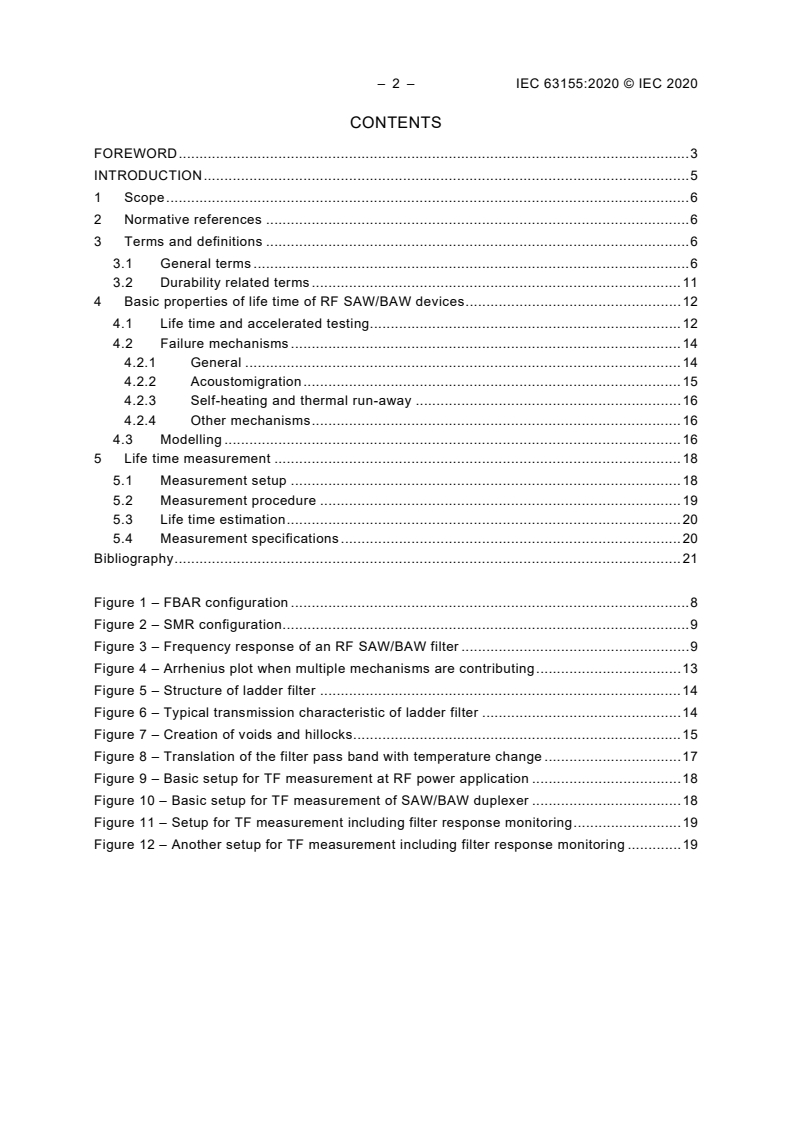
CONTENTS
FOREWORD . 3
INTRODUCTION . 5
1 Scope . 6
2 Normative references . 6
3 Terms and definitions . 6
3.1 General terms . 6
3.2 Durability related terms . 11
4 Basic properties of life time of RF SAW/BAW devices . 12
4.1 Life time and accelerated testing. 12
4.2 Failure mechanisms . 14
4.2.1 General . 14
4.2.2 Acoustomigration . 15
4.2.3 Self-heating and thermal run-away . 16
4.2.4 Other mechanisms . 16
4.3 Modelling . 16
5 Life time measurement . 18
5.1 Measurement setup . 18
5.2 Measurement procedure . 19
5.3 Life time estimation . 20
5.4 Measurement specifications . 20
Bibliography . 21
Figure 1 – FBAR configuration . 8
Figure 2 – SMR configuration . 9
Figure 3 – Frequency response of an RF SAW/BAW filter . 9
Figure 4 – Arrhenius plot when multiple mechanisms are contributing . 13
Figure 5 – Structure of ladder filter . 14
Figure 6 – Typical transmission characteristic of ladder filter . 14
Figure 7 – Creation of voids and hillocks . 15
Figure 8 – Translation of the filter pass band with temperature change . 17
Figure 9 – Basic setup for TF measurement at RF power application . 18
Figure 10 – Basic setup for TF measurement of SAW/BAW duplexer . 18
Figure 11 – Setup for TF measurement including filter response monitoring . 19
Figure 12 – Another setup for TF measurement including filter response monitoring . 19
INTERNATIONAL ELECTROTECHNICAL COMMISSION
____________
GUIDELINES FOR THE MEASUREMENT METHOD OF
POWER DURABILITY FOR SURFACE ACOUSTIC WAVE (SAW)
AND BULK ACOUSTIC WAVE (BAW) DEVICES IN
RADIO FREQUENCY (RF) APPLICATIONS
FOREWORD
1) The International Electrotechnical Commission (IEC) is a worldwide organization for standardization comprising
all national electrotechnical committees (IEC National Committees). The object of IEC is to promote
international co-operation on all questions concerning standardization in the electrical and electronic fields. To
this end and in addition to other activities, IEC publishes International Standards, Technical Specifications,
Technical Reports, Publicly Available Specifications (PAS) and Guides (hereafter referred to as "IEC
Publication(s)"). Their preparation is entrusted to technical committees; any IEC National Committee interested
in the subject dealt with may participate in this preparatory work. International, governmental and non-
governmental organizations liaising with the IEC also participate in this preparation. IEC collaborates closely
with the International Organization for Standardization (ISO) in accordance with conditions determined by
agreement between the two organizations.
2) The formal decisions or agreements of IEC on technical matters express, as nearly as possible, an international
consensus of opinion on the relevant subjects since each technical committee has representation from all
interested IEC National Committees.
3) IEC Publications have the form of recommendations for international use and are accepted by IEC National
Committees in that sense. While all reasonable efforts are made to ensure that the technical content of IEC
Publications is accurate, IEC cannot be held responsible for the way in which they are used or for any
misinterpretation by any end user.
4) In order to promote international uniformity, IEC National Committees undertake to apply IEC Publications
transparently to the maximum extent possible in their national and regional publications. Any divergence
between any IEC Publication and the corresponding national or regional publication shall be clearly indicated in
the latter.
5) IEC itself does not provide any attestation of conformity. Independent certification bodies provide conformity
assessment services and, in some areas, access to IEC marks of conformity. IEC is not responsible for any
services carried out by independent certification bodies.
6) All users should ensure that they have the latest edition of this publication.
7) No liability shall attach to IEC or its directors, employees, servants or agents including individual experts and
members of its technical committees and IEC National Committees for any personal injury, property damage or
other damage of any nature whatsoever, whether direct or indirect, or for costs (including legal fees) and
expenses arising out of the publication, use of, or reliance upon, this IEC Publication or any other IEC
Publications.
8) Attention is drawn to the Normative references cited in this publication. Use of the referenced publications is
indispensable for the correct application of this publication.
9) Attention is drawn to the possibility that some of the elements of this IEC Publication may be the subject of
patent rights. IEC shall not be held responsible for identifying any or all such patent rights.
International Standard IEC 63155 has been prepared by IEC technical committee 49:
Piezoelectric, dielectric and electrostatic devices and associated materials for frequency
control, selection and detection.
The text of this International Standard is based on the following documents:
FDIS Report on voting
49/1339/FDIS 49/1342/RVD
Full information on the voting for the approval of this International Standard can be found in
the report on voting indicated in the above table.
This document has been drafted in accordance with the ISO/IEC Directives, Part 2.
– 4 – IEC 63155:2020 © IEC 2020
The committee has decided that the contents of this document will remain unchanged until the
stability date indicated on the IEC website under "http://webstore.iec.ch" in the data related to
the specific document. At this date, the document will be
• reconfirmed,
• withdrawn,
• replaced by a revised edition, or
• amended.
IMPORTANT – The 'colour inside' logo on the cover page of this publication indicates
that it contains colours which are considered to be useful for the correct
understanding of its contents. Users should therefore print this document using a
colour printer.
INTRODUCTION
Radio frequency (RF) surface acoustic wave (SAW) and bulk acoustic wave (BAW) devices
are now widely used in various communication systems owing to their features such as small
size, light weight, little or no need for tuning, high stability and high reliability.
One of the most important applications of the devices is the antenna duplexer in mobile
communication devices which separates incoming receiving (Rx) signals from base-stations
and outgoing transmitting (Tx) signals in the frequency domain. It is known that acoustic
vibration can accelerate destruction of electrode metals in the inter-digital transducers (IDTs)
employed, which results in device failure. Thus, the device life time (time to failure, TF) is
dependent on not only the chip temperature but also on input power level and frequency of
the applied radio frequency signal. It should be noted that chip temperature can be somewhat
different from the environmental temperature because the input power level of Tx signals in
the above-mentioned applications is about 1 W at maximum, and heat generation due to
power consumption is not negligible.
The requisite TF of the SAW/BAW duplexers is usually specified by input power level,
exposure frequency range and environmental temperature. Nevertheless, TF measurement
under given specifications is not realistic because the requisite TF is too long (could be up to
many years). Accelerated life time testing is applied to shorten the TF. TF is measured in
more severe situations, namely at higher power and/or higher ambient temperature. TF under
given specifications is estimated by extrapolation based on the Arrhenius model including the
inverse power law. Although the model explains the variation of the TF with respect to input
power level and temperature well, the parameters appearing in the model need to be
determined experimentally, and its procedures have not been well established. Therefore,
measurement methods will be specifically established for TF estimation of RF SAW/BAW
devices.
This document has been compiled in response to a generally expressed desire on the part of
both users and manufacturers for general information on testing condition guidance of RF
SAW/BAW filters, so that the filters may be used to their best advantage. To this end, general
and fundamental characteristics have been explained in this document.
– 6 – IEC 63155:2020 © IEC 2020
GUIDELINES FOR THE MEASUREMENT METHOD OF
POWER DURABILITY FOR SURFACE ACOUSTIC WAVE (SAW)
AND BULK ACOUSTIC WAVE (BAW) DEVICES IN
RADIO FREQUENCY (RF) APPLICATIONS
1 Scope
This document defines the measurement method for the determination of the durability of
radio frequency (RF) surface acoustic wave (SAW) and bulk acoustic wave (BAW) devices,
such as filters and duplexers, with respect to high power RF signals, which are used in
telecommunications, measuring equipment, radar systems and consumer products. RF BAW
devices include two types: those based on the film bulk acoustic resonator (FBAR) technology
and those based on the solidly mounted resonator (SMR) technology.
This document includes basic properties of failure of RF SAW/BAW devices, and guidelines to
set up the measurement system and to establish the procedure to estimate the time to failure
(TF). Since TF is mainly governed by the RF power applied in the devices, discussions are
focused on the power durability.
It is not the aim of this document to explain the theory, or to attempt to cover all the
eventualities which can arise in practical circumstances. This document draws attention to
some of the more fundamental questions which will need to be considered by the user before
he/she places an order for an RF SAW/BAW device for a new application. Such a procedure
will be the user's means of preventing unsatisfactory performance related to premature device
failure resulting from high-power exposure of RF SAW/BAW devices.
2 Normative references
There are no normative references in this document.
3 Terms and definitions
3.1 General terms
3.1.1
BAW
bulk acoustic wave
acoustic wave, propagating between the top and bottom surface of a piezoelectric structure
and then traversing the entire thickness of the piezoelectric bulk
Note 1 to entry: The wave is excited by metal electrodes attached to both sides of the piezoelectric layer.
[SOURCE: IEC 62575-1:2015, 3.1.1]
3.1.2
BAW filter
bulk acoustic wave filter
filter characterised by a bulk acoustic wave which is usually generated by a pair of electrodes
and propagates along a thin film thickness direction
[SOURCE: IEC 62575-1:2015, 3.1.2]
3.1.3
cut-off frequency
frequency of the pass band at which the relative attenuation reaches a specified value
[SOURCE: IEC 60862-1:2015, 3.1.2.4, modified – The reference to Figure 1 has been
deleted.]
3.1.4
duplexer
device used in the frequency division duplex system, which enables the system to receive and
transmit signal through a common antenna simultaneously
[SOURCE: IEC 62761:2014, 3.1.5]
3.1.5
film bulk acoustic resonator
FBAR
thin film BAW resonator consisting of a piezoelectric layer sandwiched between two electrode
layers with stress-free top and bottom surfaces supported mechanically at the edge on a
substrate with cavity structure as shown in Figure 1 or membrane structure as an example
Note 1 to entry: This note applies to the French language only.
[SOURCE: IEC 62575-1:2015, 3.1.3, modified – Figure 1 c) has been added.]
– 8 – IEC 63155:2020 © IEC 2020
a) Back-side etched
b) Front-side etched
c) Sacrificial-layer etched
Figure 1 – FBAR configuration
3.1.6
solidly mounted resonator
SMR
BAW resonator, supporting the electrode/piezoelectric layer/electrode structure by a
sequence of additional thin films of alternately low and high acoustic impedance Z with
a
quarter wavelength layer, and these layers act as acoustic reflectors and decouple the
resonator acoustically from the substrate as shown in Figure 2 as an example
Note 1 to entry: This note applies to the French language only.
[SOURCE: IEC 62575-1:2015, 3.1.4]
Figure 2 – SMR configuration
3.1.7
response characteristic
SEE: Figure 3
Figure 3 – Frequency response of an RF SAW/BAW filter
3.1.8
input impedance
impedance presented by the filter/duplexer to the signal source when the output is terminated
by a specified load impedance
[SOURCE: IEC 62604-1:2015, 3.1.2.22, modified – "duplexer" has been replaced by
"filter/duplexer".]
3.1.9
input level
power, voltage or current value applied to the input port of a filter/duplexer
[SOURCE: IEC 62604-1:2015, 3.1.2.19, modified – "duplexer" has been replaced by
"filter/duplexer".]
– 10 – IEC 63155:2020 © IEC 2020
3.1.10
insertion attenuation
logarithmic ratio of the power delivered directly to the load impedance before insertion of the
filter/duplexer to the power delivered to the load impedance after insertion of the
filter/duplexer
[SOURCE: IEC 62604-1:2015, 3.1.2.2, modified – "duplexer" has been replaced by
"filter/duplexer".]
3.1.11
operating temperature range
range of temperatures, over which the SAW/BAW filter/duplexer will function while maintaining
its specified characteristics within specified tolerances
[SOURCE: IEC 62575-1:2015, 3.1.16, modified – "BAW filter" has been replaced by
"SAW/BAW filter/duplexer".]
3.1.12
output impedance
impedance presented by the filter/duplexer to the load when the input is terminated by a
specified source impedance
[SOURCE: IEC 62604-1:2015, 3.1.2.23, modified – "duplexer" has been replaced by
"filter/duplexer".]
3.1.13
output level
power, voltage or current value delivered to the load circuit
[SOURCE: IEC 62604-1:2015, 3.1.2.20]
3.1.14
pass band
band of frequencies in which the relative attenuation is equal to or less than a specified value
[SOURCE: IEC 62604-1:2015, 3.1.2.5]
3.1.15
pass bandwidth
separation of frequencies between which the relative attenuation is equal to or less than a
specified value
[SOURCE: IEC 62604-1:2015, 3.1.2.6]
3.1.16
reflectivity
dimensionless measure of the degree of mismatch between two impedances Z and Z :
a b
ZZ−
a b
,
ZZ+
a b
where Z and Z represent, respectively, the input and source impedance or the output and
a b
load impedance
Note 1 to entry: The absolute value of reflectivity is called the reflection coefficient.
[SOURCE: IEC 62604-1:2015, 3.1.2.17]
3.1.17
Rx filter
filter used in a receiver part to eliminate unnecessary/unwanted signals
Note 1 to entry: The Rx filter is a basic part of a duplexer.
[SOURCE: IEC 62604-1:2015, 3.1.3.4, modified – "RX" has been replaced by "Rx" in the term,
"/unwanted" has been added to the definition and Note 2 to entry has been omitted.]
3.1.18
SAW filter
filter characterised by one or more surface acoustic wave transmission line or resonant
elements, where the surface acoustic wave is usually generated by an interdigital transducer
and propagates along a material surface
[SOURCE: IEC 62604-1:2015, 3.1.1.2, modified – The term "surface acoustic wave filter" has
been omitted.]
3.1.19
stop band
band of frequencies in which the relative attenuation is equal to or greater than a specified
value
3.1.20
SAW
surface acoustic wave
acoustic wave, propagating along a surface of an elastic material, whose amplitude decays
exponentially with the depth
[SOURCE: IEC 60862-1:2015, 3.1.1.1]
3.1.21
Tx filter
filter used in a transmitter part to eliminate unnecessary/unwanted signals
Note 1 to entry: This is a basic part of a duplexer.
[SOURCE: IEC 62604-1:2015, 3.1.3.3, modified – "TX" has been replaced by "Tx" in the term,
"/unwanted" has been added to the definition and Note 2 to entry has been omitted.]
3.2 Durability related terms
3.2.1
accelerated life time testing
testing strategy whereby the engineer extrapolates a product's failure behaviour at normal
conditions from life data obtained at accelerated stress levels
Note 1 to entry: Since products fail more quickly at higher stress levels, this sort of strategy allows the engineer
to obtain reliability information about a product (e.g., mean life, probability of failure at a specific time, etc.) in a
shorter time.
3.2.2
acceleration factor
ratio of the product's life at the used stress level to its life at an accelerated stress level
Note 1 to entry: For example, if the product has a life of 100 h at the used stress level, and it is being tested at an
accelerated stress level which reduces its life to 50 h, then the acceleration factor is 2.
– 12 – IEC 63155:2020 © IEC 2020
3.2.3
Arrhenius model
model used in accelerated life time testing to establish a relationship between absolute
temperature and reliability
Note 1 to entry: It was originally developed by Swedish chemist Svante Arrhenius to define the relationship
between temperature and the rates of chemical reaction.
Note 2 to entry: Additional mathematical models are available to describe a product's life-stress relationship,
which is how stress levels affect the reliability of a product.
3.2.4
inverse power law
accelerated life time testing model commonly used when the accelerating factor is a single,
non-thermal stress (e.g. power, vibration, voltage or temperature cycling)
3.2.5
stress
factor which causes failure: operation and storage temperatures, humidity, incident power,
ultraviolet irradiation, and mechanical shock are examples
3.2.6
stress testing
testing strategy whereby units are tested at stresses higher than those that would be
encountered during normal operating conditions, usually to induce failures
4 Basic properties of life time of RF SAW/BAW devices
4.1 Life time and accelerated testing
Many SAW/BAW devices are required to fulfil the component specification for a certain
number of years under normal operating conditions. Failure is defined as a situation in which
performance becomes worse than that given in the specification.
For this purpose, we need to estimate TF under the toughest situations encountered in normal
operating conditions. Since it is not acceptable for engineers to spend many years on TF
estimation, a strategy called "accelerated life time testing" is widely adopted. In this strategy,
TF at normal conditions is estimated by extrapolation from TF data obtained at tougher
operating conditions, or accelerated stress levels in the terminology of reliability engineering.
Since products will fail more quickly, this strategy allows us to obtain information on the
reliability of the products in a shorter period of time.
There are many possible failure mechanisms, such as oxidization, cracking, leakage, and
peeling off, and there are many possible locations where failure occurs.
When one failure mechanism is dominant, TF is known to exhibit the following dependence on
the absolute temperature T
E
TF = aexp , (1)
kT
where a is a factor discussed later, k is the Boltzmann constant and E is a parameter which
varies with the failure mechanism. This dependence is the same as that for chemical reaction,
and it is called the Arrhenius equation and E is referred to the activation energy. Taking the
logarithm for both sides, equation (1) can be rewritten as
E
log TF + log a (2)
ee
kT
−1
Thus, plotting log TF against T gives a straight line, and its gradient and y-intercept are
e
given by E/k and log a, respectively. This plot is called the Arrhenius plot.
e
When multiple mechanisms are contributing, the Arrhenius plot can draw a polygonal line as
shown in Figure 4. This is because different mechanisms possess different activation energies,
and failure is triggered from the weakest point, which can vary with temperature.
Figure 4 – Arrhenius plot when multiple mechanisms are contributing
The factor a is dependent on other stresses such as electrical power applied, humidity, and, in
many cases, its dependence on each stress x follows the inverse power law given by
−β
a = αx , (3)
where α and β are constants. The combination of equations (1) and (3) gives
E
−β
TF =αx exp , (4)
kT
and its logarithm form is given by
E
log TF=logαβ−+log x . (5)
e ee
kT
Thus, we can estimate α and β from the log-log plot between TF and x under a fixed T. When
multiple mechanisms are contributing, the log-log plot may be a polygonal line.
It should be noted that stresses such as applied electrical power may affect T due to heat up
by power dissipation. This means T should be controlled or known for determining the life-time
model even when T is not chosen as a parameter for the acceleration.
=
– 14 – IEC 63155:2020 © IEC 2020
4.2 Failure mechanisms
4.2.1 General
A ladder type arrangement shown in Figure 5 is commonly used as a configuration of RF
SAW/BAW filters for high power applications.
Each resonator possesses two types of resonances: series resonance (or simply resonance)
where the electrical impedance becomes extremely low and parallel resonance (or
anti-resonance) where the impedance becomes extremely high. The frequency giving the
anti-resonance f (called the anti-resonance frequency) is a little higher than that giving the
a
resonance f (called the resonance frequency). Fractional difference between f and f is
r r a
primarily determined by strength of piezoelectricity.
When the f of resonators R in series arms, f , is set close to the f of resonators in parallel
r s rs a
arms R , f , the transmission response shown in Figure 6 can be obtained. On the other
p ap
hand, notches appear at the f of R , f and the f of R , f . Cascading multiple stages is
a s as r p rp
necessary to achieve sufficient out-of-band rejection, which compromises other performances,
such as insertion attenuation and fractional pass band width.
The Q factor of resonators determines the insertion attenuation and steepness of the pass
band edges.
Figure 5 – Structure of ladder filter
Figure 6 – Typical transmission characteristic of ladder filter
It is known that TF is dependent on the frequency at which the RF power is applied. That is,
RF SAW/BAW devices are relatively robust when the power is applied near the filter's centre
frequency. On the other hand, TF becomes considerably shorter when the power is applied
near the pass band edges. It is also known that R near the input port is commonly destroyed
p
when the power is given near the lower pass band edge while R near the input port is
s
commonly destroyed when the power is given near the upper pass band edge.
These facts indicate that TF is not governed by RF voltage and current, but by stored RF
energy or RF power consumption in the resonators, or by acoustic stress and its location
within the structure, both longitudinal and transversal. This is because RF voltage and current
given to R and R , respectively, take maxima near the centre frequency.
p s
It should be noted that when spurious resonance(s) exist in the pass band, they may trigger
the device failure and shorten the TF when the RF power is given near these spurious
resonances. Even if they seem insignificant in the transmission response, their influence can
be obvious especially when the group delay becomes large locally, near the spurious
resonance. This is an indicator of an increase in the energy stored in a resonator.
4.2.2 Acoustomigration
It is known that electrode surface is roughed up after exposure to high RF power. This
behaviour is very similar to a phenomenon called the electromigration, which occurs in
integrated circuits. The electromigration is caused by:
a) the mechanical impact of electron momenta to electrode metal grains,
b) the translation (migration) of electrons toward the direction of electron flow, and
c) the voids that will be created at the upper stream side, while hillocks will be created at the
lower stream side as shown in Figure 7.
Figure 7 – Creation of voids and hillocks
In RF SAW/BAW devices, this phenomenon is caused by mechanical vibration. Thus, this
phenomenon is called the acoustomigration. It is known that the acoustomigration occurs
where mechanical stresses are large.
Electrode deformation will cause scattering of acoustic waves and an increase in the
electrode resistance. This, subsequently, will result in a degradation of device performance,
such as increased insertion attenuation or reduced bandwidth.
Common approaches to reduce this deformation and therefore increase the TF are, for
example, as follows.
• The most important approach to control and reduce this phenomenon is to choose
appropriate electrode materials and structures. Because low electric resistivity is also
required, aluminium (Al) based compounds are widely used. Adding copper enhances
binding strength among grains, and adding scandium and magnesium enhances yield
strength σ of grains.
• Use of multi-layered structures is also common. This makes the grain size D small, and
results in enhancement of σ as indicated by the Hall-Petch equation given below:
−0,5
σ = σ + k × D , (6)
0 i
where σ and k are constants.
i
It is known that the activation energy for Al is about 0,4 eV when the grain boundary is
responsible for the failure, while it is about 1,4 eV when the grain itself is responsible.
– 16 – IEC 63155:2020 © IEC 2020
• Use of new electrode materials such as copper and single-crystal aluminium is also being
investigated.
• Series connection of multiple resonators is also a measure widely used. When the number
of series-connected resonators is n, the impedance of each resonator is reduced by n to
obtain the same impedance. Since the impedance of a resonator is inversely proportional
to the electrode area, we can reduce the power density by n with an increase of each
resonator area by n. A downside is that the total resonator area will also be increased to at
least n times the original.
4.2.3 Self-heating and thermal run-away
The impact of electrode degradation, which occurs gradually, is usually observed in a change
in frequency location as well as an increased insertion attenuation. Increase in acoustic and
electrical losses causes rising chip temperature, which accelerates the degradation. Thus,
when the insertion attenuation reaches a certain level, positive feedback between the
self-heating and degradation will destroy electrodes quickly until power consumption becomes
negligible.
In many cases, RF SAW/BAW filters exhibit a negative temperature coefficient of frequency
(TCF). This means when high power is given at a frequency f near the upper edge of the
d
pass band, temperature increase caused by the increased loss will shift the pass band to the
lower frequency side, and result in further increase in the insertion attenuation at f . This
d
effect will shorten the life time of the device. In contrast, when f is set near the lower edge of
d
the pass band, the self-heating will lengthen the life time.
In any case, self-heating has a significant impact on time to failure (TF). Thus, thermal design
of heat resistance should be minimized from the SAW/BAW chip to the package.
4.2.4 Other mechanisms
There are many other possible failure mechanisms such as mechanical or chemical
degradation of bonding, package and sealing. Even when their effects are negligible under
normal operating conditions, they can be significant under the acceleration testing. For
example, when extremely high RF power is applied, the SAW/BAW chip can be destroyed
quickly due to an imposed high temperature gradient or high electric field. This means the
failure mechanism can be changed according to the peak-to-average power ratio (PAPR)
when modulated signals are used.
This also means that the amount of stress acceleration shall be set so that the dominant
failure mechanism does not change. Microscopic inspection is useful to check how the device
under test (DUT) was broken.
4.3 Modelling
The most severe stress for commercial RF SAW/BAW devices is electrical power P. In many
cases, the TF of RF SAW/BAW devices follows the model given in equation (4) and its
logarithmic form given in equation (5).
Thus, we can estimate α and β from the log-log plot between TF and P under a fixed T. Then
using determined α and β, we can estimate TF under normal operating conditions.
There are several key points for the determination of α and β.
1) Stress acceleration shall be set so as not to cause changes in the failure mechanism. This
can be verified by the continuous variation of TF with respect to the stress.
2) P shall be specified, such as (a) incident power at the input port, or (b) transmitted power
at the output port. In addition, impedance of peripheral circuits such as power amplifier
(PA) and power detector (PD) shall be specified. In general, the incident power is chosen
as a parameter.
3) The signal port to which RF power is applied shall be specified. This is because chip
design of RF SAW/BAW filters is asymmetric in general, and TF changes according to the
port where the RF power is applied.
4) Τ is the chip temperature instead of the ambient one Τ . The difference between Τ and Τ
e e
is not negligible. Thus, appropriate means shall be provided to estimate Τ from Τ for
e
determination of α and β.
A direct way to carry out this estimation is to integrate a temperature sensor on the chip
surface. Variation of the filter response can also be used to sense the chip temperature. In
the latter case, some particular response shall be chosen, such as resonance and cut-off
which is insensitive to parasitic impedance elements. The temperature dependence of the
chip should be evaluated in advance.
5) Preferably Τ instead of Τ shall be kept constant during the power acceleration testing. In
e
addition, Τ shall be determined and considered to determine the life-time model
equation (4) or (5).
The chip temperature T used here is an abstraction. It should correspond to the local
temperature at the weakest SAW/BAW structure taken from simulations or measurements
(e.g., infrared microscopy) or, in a simplified approach it should correspond to the mean
chip temperature.
6) The RF power shall be applied at a frequency f where TF is expected to be the shortest
t
under the normal operating condition. TF changes significantly with the frequency and its
incorrect setting can result in change of the failure mechanism.
7) Frequently, a continuous wave (CW) signal is applied. For customer applications, other
signals may be more relevant and may be chosen to be, for example, an LTE signal (or
just a set of resource blocks of it) in the case of a mobile phone system. In the case of
non-CW signals, care shall be taken to define the kind of signal with sufficient detail.
8) Excess variation of the filter response shall be compensated in the temperature
acceleration test. Owing to nonzero TCF, the pass band of the DUT translates according
to temperature to the lower or higher frequency side as shown in Figure 8. Thus, RF
power shall be applied at a frequency f′ where f is expected to be located in the
t t
translated pass band. A simple way is by (a) measuring the filter response in various
temperatures, (b) modelling the variation of the filter response with the temperature, and
(c) determining f′ based on the model and temperature. Steps (a) and (b) are performed
t
in advance, and (c) is done during the stress test.
Furthermore, the insertion attenuation increases with T, excluding the pass band shift.
This effect shall be taken into account when the reduction of the output power is chosen
as the failure criterion.
Figure 8 – Translation of the filter pass band with temperature change
– 18 – IEC 63155:2020 © IEC 2020
5 Life time measurement
5.1 Measurement setup
A basic setup for the TF measurement is shown in Figure 9. An RF signal generated by a
signal generator (SG) is amplified by a power amplifier (PA), and its output is incident to the
DUT. The DUT output is monitored by an RF power meter (PM). We can detect the DUT
failure by abrupt decrease of the output power. Since the PA power gain changes with
temperature, the PA shall be heated up for a while prior to the measurement. The DUT is
placed in a thermostatic chamber (TSC) to set either the temperature of the chip surface or of
the environment as a parameter. The TF is considered reached when either the measured
insertion attenuation, i.e. the difference between PM reading and PA output level, or the
frequency shift of the transfer characteristics exceeds certain component specifications or
application limits. Note that since the frequency shift may not be detectable by this setup, it
should be modified as shown in Figure 11 or Figure 12 to be able to monitor the DUT
frequency response during the TF measurement.
Figure 9 – Basic setup for TF measurement at RF power application
If adding external impedance element(s) is requested in the DUT specification, they shall be
given according to the specification. These elements shall be durable enough for the
undergoing stress test.
Figure 10 shows the setup when a SAW/BAW duplexer is used as a DUT. RF power is applied
to the transmitter (Tx) port while the output is monitored at the antenna (Ant) port. The
receiver (Rx) port shall be terminated by an appropriate terminator R .
Figure 10 – Basic setup for TF measurement of SAW/BAW duplexer
Figure 11 shows a more practical setup for the TF measurement. Another RF signal emitted
by a vector network analyzer (VNA) is incident to the DUT, and its output is detected by the
VNA. Directional couplers (DRC) 2 and 3 are used to combine the signal with and separate it
from the high RF power for the TF measurement. DRC1 is given to monitor the incident RF
power using the PM2. This setup allows us to measure the filter response during high power
application. Leakage of the RF high power to the VNA shall be below an upper limit for
incident RF power defined in the VNA specification. The coupling strength of DRCs, defined
by transmission between main and secondary paths, shall be chosen to limit the leakage, a
downside of which is the deterioration of the signal-to-noise ratio (SNR) of the VNA
measurement. The TF is determined by frequent evaluation of the device's transmission
characteristic by the VNA, and is considered reached when relevant specifica
...