

IEC TS 61800-8:2010
(Main)Adjustable speed electrical power drive systems - Part 8: Specification of voltage on the power interface
General Information
- Abstract
IEC/TS 61800-8:2010(E) gives the guidelines for the determination of voltage on the power interface of power drive systems (PDS's).
- Status
- Published
- Publication Date
- 30-May-2010
- Technical Committee
- SC 22G - Adjustable speed electric power drive systems (PDS)
- Drafting Committee
- WG 11 - TC 22/SC 22G/WG 11
- Current Stage
- PPUB - Publication issued
- Start Date
- 31-May-2010
- Completion Date
- 31-Aug-2010
Overview
IEC TS 61800-8:2010 is a Technical Specification from the IEC that provides guidelines for determining the voltage on the power interface of adjustable speed electrical power drive systems (PDS). It defines a system-level approach to evaluate voltages that appear at the interface between the drive (converter/inverter/filter) and the power supply or motor, helping manufacturers, integrators and engineers assess compatibility, stress on insulation and electromagnetic behaviour.
Key topics and technical requirements
The standard covers technical topics organized by drive section and modelling approach. Major subjects include:
- System approach and terminology - definitions, overview of PDS and modelling conventions.
- Two-port modelling - amplifying and adding elements to represent how sections affect interface voltages.
- Differential mode and common mode voltages - characterization and separate modelling for both modes.
- Line section (power supply) - TN/IT/TT grounding types and their influence on interface voltages.
- Input converter (rectifier/DC link) - origins of DC link voltages, reference potentials and effects of diode/active rectifiers.
- Output converter (inverter) - inverter topologies (two-level, three-level, N-level), output waveform shape, dv/dt, rise time and repetition rate considerations.
- Filter section - filter topologies (sine-wave, dv/dt, EMI filters, output chokes) and their effect on differential and common mode voltages.
- Cabling between converter and motor - cable characteristics and resulting voltage parameters at motor terminals.
- Calculation guidelines and installation examples - methods to compute expected voltages on the power interface and practical installation guidance.
- Annexes and figures - supporting diagrams, inverter voltage examples and filter performance data.
Practical applications
IEC TS 61800-8:2010 is used to:
- Assess voltage stress on motor insulation and drive components at the power interface.
- Specify dv/dt compatibility and required filtering for inverter-fed motors.
- Inform grounding and cabling choices to manage common-mode and differential voltages.
- Support EMC mitigation and selection of EMI filters or output chokes.
- Provide calculation methods for system integrators and test laboratories to predict interface voltages before installation.
Who should use it
- Drive and motor manufacturers (design and compliance teams)
- System integrators and electrical contractors (installation design)
- OEMs specifying drive interfaces for machines
- Test labs and certification bodies (voltage and EMC assessment)
- Electrical engineers responsible for motor-drive compatibility and reliability
Related standards
- Other parts of the IEC 61800 series (adjustable speed electrical power drive systems)
- EMC and motor insulation standards used alongside TS 61800-8 for complete compliance and safety assessments
Keywords: IEC TS 61800-8:2010, adjustable speed drive, power interface voltage, common mode, differential mode, inverter dv/dt, EMI filter, grounding, converter, motor terminals.
Relations
- Effective Date
- 10-Feb-2026
- Effective Date
- 10-Feb-2026
- Effective Date
- 10-Feb-2026
- Effective Date
- 10-Feb-2026
Get Certified
Connect with accredited certification bodies for this standard

IMQ S.p.A. (Certification)
Italian electrical product certification.

SLG Prüf- und Zertifizierungs GmbH
German testing and certification body.

UL Solutions
Global safety science company with testing, inspection and certification.
Sponsored listings
Frequently Asked Questions
IEC TS 61800-8:2010 is a technical specification published by the International Electrotechnical Commission (IEC). Its full title is "Adjustable speed electrical power drive systems - Part 8: Specification of voltage on the power interface". This standard covers: IEC/TS 61800-8:2010(E) gives the guidelines for the determination of voltage on the power interface of power drive systems (PDS's).
IEC/TS 61800-8:2010(E) gives the guidelines for the determination of voltage on the power interface of power drive systems (PDS's).
IEC TS 61800-8:2010 is classified under the following ICS (International Classification for Standards) categories: 29.160.30 - Motors; 29.200 - Rectifiers. Convertors. Stabilized power supply. The ICS classification helps identify the subject area and facilitates finding related standards.
IEC TS 61800-8:2010 has the following relationships with other standards: It is inter standard links to CLC IEC/TS 60034-25:2024, EN IEC 61800-2:2021, EN 61800-9-2:2017, EN 60034-18-41:2014. Understanding these relationships helps ensure you are using the most current and applicable version of the standard.
IEC TS 61800-8:2010 is available in PDF format for immediate download after purchase. The document can be added to your cart and obtained through the secure checkout process. Digital delivery ensures instant access to the complete standard document.
Standards Content (Sample)
IEC/TS 61800-8 ®
Edition 1.0 2010-05
TECHNICAL
SPECIFICATION
colour
inside
Adjustable speed electrical power drive systems –
Part 8: Specification of voltage on the power interface
IEC/TS 61800-8:2010(E)
All rights reserved. Unless otherwise specified, no part of this publication may be reproduced or utilized in any form or by
any means, electronic or mechanical, including photocopying and microfilm, without permission in writing from either IEC or
IEC's member National Committee in the country of the requester.
If you have any questions about IEC copyright or have an enquiry about obtaining additional rights to this publication,
please contact the address below or your local IEC member National Committee for further information.
Droits de reproduction réservés. Sauf indication contraire, aucune partie de cette publication ne peut être reproduite
ni utilisée sous quelque forme que ce soit et par aucun procédé, électronique ou mécanique, y compris la photocopie
et les microfilms, sans l'accord écrit de la CEI ou du Comité national de la CEI du pays du demandeur.
Si vous avez des questions sur le copyright de la CEI ou si vous désirez obtenir des droits supplémentaires sur cette
publication, utilisez les coordonnées ci-après ou contactez le Comité national de la CEI de votre pays de résidence.
IEC Central Office
3, rue de Varembé
CH-1211 Geneva 20
Switzerland
Email: inmail@iec.ch
Web: www.iec.ch
About IEC publications
The technical content of IEC publications is kept under constant review by the IEC. Please make sure that you have the
latest edition, a corrigenda or an amendment might have been published.
ƒ Catalogue of IEC publications: www.iec.ch/searchpub
The IEC on-line Catalogue enables you to search by a variety of criteria (reference number, text, technical committee,…).
It also gives information on projects, withdrawn and replaced publications.
ƒ IEC Just Published: www.iec.ch/online_news/justpub
Stay up to date on all new IEC publications. Just Published details twice a month all new publications released. Available
on-line and also by email.
ƒ Electropedia: www.electropedia.org
The world's leading online dictionary of electronic and electrical terms containing more than 20 000 terms and definitions
in English and French, with equivalent terms in additional languages. Also known as the International Electrotechnical
Vocabulary online.
ƒ Customer Service Centre: www.iec.ch/webstore/custserv
If you wish to give us your feedback on this publication or need further assistance, please visit the Customer Service
Centre FAQ or contact us:
Email: csc@iec.ch
Tel.: +41 22 919 02 11
Fax: +41 22 919 03 00
IEC/TS 61800-8 ®
Edition 1.0 2010-05
TECHNICAL
SPECIFICATION
colour
inside
Adjustable speed electrical power drive systems –
Part 8: Specification of voltage on the power interface
INTERNATIONAL
ELECTROTECHNICAL
COMMISSION
PRICE CODE
XB
ICS 29.160.30; 29.200 ISBN 978-2-88910-991-3
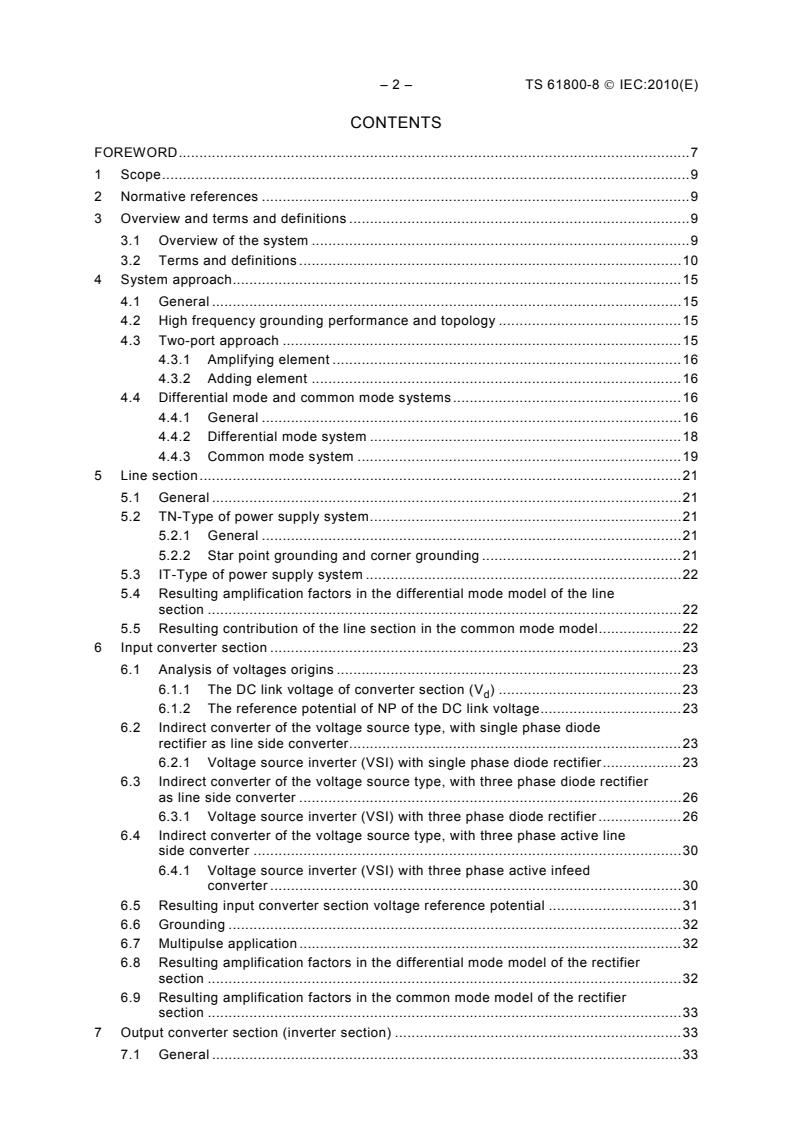
– 2 – TS 61800-8 © IEC:2010(E)
CONTENTS
FOREWORD.7
1 Scope.9
2 Normative references .9
3 Overview and terms and definitions .9
3.1 Overview of the system .9
3.2 Terms and definitions .10
4 System approach.15
4.1 General .15
4.2 High frequency grounding performance and topology .15
4.3 Two-port approach .15
4.3.1 Amplifying element .16
4.3.2 Adding element .16
4.4 Differential mode and common mode systems.16
4.4.1 General .16
4.4.2 Differential mode system .18
4.4.3 Common mode system .19
5 Line section.21
5.1 General .21
5.2 TN-Type of power supply system.21
5.2.1 General .21
5.2.2 Star point grounding and corner grounding .21
5.3 IT-Type of power supply system .22
5.4 Resulting amplification factors in the differential mode model of the line
section .22
5.5 Resulting contribution of the line section in the common mode model.22
6 Input converter section .23
6.1 Analysis of voltages origins .23
6.1.1 The DC link voltage of converter section (V ) .23
d
6.1.2 The reference potential of NP of the DC link voltage.23
6.2 Indirect converter of the voltage source type, with single phase diode
rectifier as line side converter.
6.2.1 Voltage source inverter (VSI) with single phase diode rectifier.23
6.3 Indirect converter of the voltage source type, with three phase diode rectifier
as line side converter .26
6.3.1 Voltage source inverter (VSI) with three phase diode rectifier .26
6.4 Indirect converter of the voltage source type, with three phase active line
side converter .
6.4.1 Voltage source inverter (VSI) with three phase active infeed
converter .30
6.5 Resulting input converter section voltage reference potential .31
6.6 Grounding .32
6.7 Multipulse application.32
6.8 Resulting amplification factors in the differential mode model of the rectifier
section .32
6.9 Resulting amplification factors in the common mode model of the rectifier
section .33
7 Output converter section (inverter section) .33
7.1 General .33
TS 61800-8 © IEC:2010(E) – 3 –
7.2 Input value for the inverter section .33
7.3 Description of different inverter topologies.33
7.3.1 Two level inverter .34
7.3.2 Three level inverter.34
7.3.3 N-level inverter .35
7.4 Output voltage waveform depending on the topology.37
7.4.1 General .37
7.4.2 Peak voltages of the output .38
7.5 Rise time of the output voltages .38
7.6 Compatibility values for the dv/dt.39
7.6.1 General .39
7.6.2 Voltage steps .39
7.6.3 Multistep approach .40
7.7 Repetition rate.41
7.8 Grounding .41
7.9 Resulting amplification effect in the differential mode model of the inverter
section .42
7.10 Resulting additive effect in the common mode model of the inverter section.42
7.11 Resulting relevant dynamic parameters of pulsed common mode and
differential mode voltages .42
8 Filter section .42
8.1 General purpose of filtering .42
8.2 Differential mode and common mode voltage system .43
8.3 Filter topologies.43
8.3.1 General .43
8.3.2 Sine wave filter.44
8.3.3 dV/dt filter.45
8.3.4 High frequency EMI filters .46
8.3.5 Output choke .46
8.4 Resulting amplification effect in the differential mode model after the filter
section .47
8.5 Resulting additive effect in the common mode model after the filter section.47
9 Cabling section between converter output terminals and motor terminals .48
9.1 General .48
9.2 Cabling.49
9.3 Resulting parameters after cabling section .49
10 Calculation guidelines for the voltages on the power interface according to the
section models .50
11 Installation and example.52
11.1 General .52
11.2 Example .52
Annex A (Different types of power supply systems).56
Annex B (Inverter Voltages) .61
Annex C (Output Filter Performance) .62
Bibliography.63
Figure 1 – Definition of the installation and its content .10
Figure 2 – Voltage impulse wave shape parameters in case of the two level inverter
where rise time t = t – t .13
ri 90 10
– 4 – TS 61800-8 © IEC:2010(E)
Figure 3 – Example of typical voltage curves and parameters of a two level inverter
versus time at the motor terminals (phase to phase voltage).13
Figure 4 – Example of typical voltage curves and parameters of a three level inverter
versus time at the motor terminals (phase to phase voltage).14
Figure 5 – Voltage source inverter (VSI) drive system with motor.15
Figure 6 – Amplifying two-port element .16
Figure 7 – Adding two-port element .16
Figure 8 – Differential mode and common mode voltage system .17
Figure 9 – Voltages in the differential mode system .17
Figure 10 – Block diagram of two-port elements to achieve the motor terminal voltage
in the differential mode model .18
Figure 11 – Equivalent circuit diagram for calculation of the differential mode voltage .18
Figure 12 – Block diagram of two-port elements to achieve the motor terminal voltage
in the common mode model .19
Figure 13 – Equivalent circuit diagram for calculation of the common mode voltage.20
Figure 14 – TN-S power supply system left: k = 0, right: k = 1/ SQR 3 .22
C0 C0
Figure 15 – Typical configuration of a voltage source inverter with single phase diode
rectifier supplied by L and N from a TN or TT supply system.24
Figure 16 – Typical configuration of a voltage source inverter with single phase diode
rectifier supplied by L1 and L2 from an IT supply system .24
Figure 17 – Typical configuration of a voltage source inverter with single phase diode
rectifier supplied by L1 and L2 from a TN or TT supply system .25
Figure 18 – Typical DC voltage V of single phase diode rectifier without breaking
d
mode. BR is the bleeder resistor to discharge the capacitor.26
Figure 19 – Typical configuration of a voltage source inverter with three phase diode
rectifier .27
Figure 20 – Voltage source with three phase diode rectifier supplied by a TN or TT
supply system.27
Figure 21 – Voltage source with three phase diode rectifier supplied by an IT supply
system .28
Figure 22 – Voltage source with three phase diode rectifier supplied from a delta
grounded supply system .28
Figure 23 – Typical relation of the DC link voltage versus load of the three phase
diode rectifier without braking mode.29
Figure 24 – Typical configuration of a VSI with three phase active infeed converter.30
Figure 25 – Voltage source with three phase active infeed supplied by a TN or TT
supply system.30
Figure 26 – Voltage source with three phase active infeed supplied by a IT supply
system .31
Figure 27 – Topology of a N=2 level voltage source inverter .34
Figure 28 – Topology of a N=3 level voltage source inverter (neutral point clamped) .34
Figure 29 – Topology of a N=3 level voltage source inverter (floating symmetrical
capacitor) .35
Figure 30 – Topology of a three level voltage source inverter (multi DC link),
n = 1. The voltages V are of the same value. .36
dcmult dx
Figure 31 – Topology of an N-level voltage source inverter (multi DC link), n = 2.37
dcmult
Figure 32 – Basic filter topology.44
Figure 33 – Topology of a differential mode sine wave filter .45
TS 61800-8 © IEC:2010(E) – 5 –
Figure 34 – Topology of a common mode sine wave filter .45
Figure 35 – EMI filter topology .46
Figure 36 – Topology of the output choke .47
Figure 37 – Example of converter output voltage and motor terminal voltage with
200 m motor cable .48
Figure 38 – Differential mode equivalent circuit.51
Figure 39 – Common Mode Equivalent Circuit.52
Figure 40 – Resulting phase to ground voltage at the motor terminals for the calculated
example under worst case conditions.54
Figure 41 – Resulting phase to phase voltage at the motor terminals for the calculated
example under worst case conditions.54
Figure 42 – Example of a simulated phase to ground and phase to phase voltages at
the motor terminals (same topology as calculated example, TN- supply system, 50 Hz
output frequency, no filters, 150 m of cabling distance, type NYCWY, grounding
impedance about 1 mΩ).55
Figure A.1 – TN-S system.56
Figure A.2 – TN-C-S power supply system – Neutral and protective functions combined
in a single conductor as part of the system TN-C power supply system – Neutral and
protective functions combined in a single conductor throughout the system .57
Figure A.3 – TT power supply system .57
Figure A.4 – IT power supply system .58
Figure A.5 – Example of stray capacitors to ground potential in an installation.58
Figure A.6 – Example of a parasitic circuit in a TN type of system earthing.59
Figure A.7 – Example of a parasitic current flow in an IT type of system earthing .60
Table 1 – Amplification factors in the differential mode model of the line section.22
Table 2 – Factors in the common mode model of the line section.22
Table 3 – Maximum values for the potentials of single phase supplied converters at no
load conditions (without DC braking mode) .26
Table 4 – Maximum values for the potentials of three phase supplied converters at no
load conditions (without DC braking mode) .29
Table 5 – Typical range of values for the reference potentials of the DC link voltage,
the DC-link voltages themselves and the grounding potentials in relation to supply
voltage as “per unit value” for different kinds of input converters sections.32
Table 6 – Amplification factors in the differential mode model of the rectifier section .33
Table 7 – Amplification factors in the common mode model of the rectifier section.33
Table 8 – Number of levels in case of floating symmetrical capacitor multi level .35
Table 9 – Number of levels in case of multi DC link inverter.37
Table 10 – Peak values of the output voltage waveform.38
Table 11 – Typical ranges of expected dv/dt at the semiconductor terminals.39
Table 12 – Example for a single voltage step in a three level topology.39
Table 13 – Expected voltage step heights for single switching steps of an n level
inverter .40
Table 14 – Example for multi steps in a three level topology .40
Table 15 – Biggest possible voltage step size for multi steps .40
Table 16 – Repetition rate of the different voltages depending on the pulse frequency.41
Table 17 – Relation between f and f .41
P SW
– 6 – TS 61800-8 © IEC:2010(E)
Table 18 – Resulting amplification factors in the differential mode model.42
Table 19 – Resulting additive effect (amplification factors) in the common mode model .42
Table 20 – Resulting dynamic parameters of pulsed common mode and differential
mode voltages .42
Table 21 – Typical Resulting Differential Mode Filter Section Parameters for different
kinds of differential mode filter topologies .47
Table 22 – Typical Resulting Common mode Filter Section Parameters for different
kinds of common mode filter topologies .47
Table 23 – Resulting reflection coefficients for different motor frame sizes .49
Table 24 – Typical resulting cabling section parameters for different kinds of cabling
topologies .50
Table 25 – Result of amplification factors and additive effects according to the example
configuration and using the models of chapters 5 to 9.53
Table B.1 – Typical harmonic content of the inverter voltage waveform (Total distortion
ratio – see IEC 61800-3 for definition).61
Table C.1 – Comparison of the performance of differential mode filters.62
Table C.2 – Comparison of the performance of common mode filters .62
TS 61800-8 © IEC:2010(E) – 7 –
INTERNATIONAL ELECTROTECHNICAL COMMISSION
____________
ADJUSTABLE SPEED ELECTRICAL POWER DRIVE SYSTEMS –
Part 8: Specification of voltage on the power interface
FOREWORD
1) The International Electrotechnical Commission (IEC) is a worldwide organization for standardization comprising
all national electrotechnical committees (IEC National Committees). The object of IEC is to promote
international co-operation on all questions concerning standardization in the electrical and electronic fields. To
this end and in addition to other activities, IEC publishes International Standards, Technical Specifications,
Technical Reports, Publicly Available Specifications (PAS) and Guides (hereafter referred to as “IEC
Publication(s)”). Their preparation is entrusted to technical committees; any IEC National Committee interested
in the subject dealt with may participate in this preparatory work. International, governmental and non-
governmental organizations liaising with the IEC also participate in this preparation. IEC collaborates closely
with the International Organization for Standardization (ISO) in accordance with conditions determined by
agreement between the two organizations.
2) The formal decisions or agreements of IEC on technical matters express, as nearly as possible, an international
consensus of opinion on the relevant subjects since each technical committee has representation from all
interested IEC National Committees.
3) IEC Publications have the form of recommendations for international use and are accepted by IEC National
Committees in that sense. While all reasonable efforts are made to ensure that the technical content of IEC
Publications is accurate, IEC cannot be held responsible for the way in which they are used or for any
misinterpretation by any end user.
4) In order to promote international uniformity, IEC National Committees undertake to apply IEC Publications
transparently to the maximum extent possible in their national and regional publications. Any divergence
between any IEC Publication and the corresponding national or regional publication shall be clearly indicated in
the latter.
5) IEC itself does not provide any attestation of conformity. Independent certification bodies provide conformity
assessment services and, in some areas, access to IEC marks of conformity. IEC is not responsible for any
services carried out by independent certification bodies.
6) All users should ensure that they have the latest edition of this publication.
7) No liability shall attach to IEC or its directors, employees, servants or agents including individual experts and
members of its technical committees and IEC National Committees for any personal injury, property damage or
other damage of any nature whatsoever, whether direct or indirect, or for costs (including legal fees) and
expenses arising out of the publication, use of, or reliance upon, this IEC Publication or any other IEC
Publications.
8) Attention is drawn to the Normative references cited in this publication. Use of the referenced publications is
indispensable for the correct application of this publication.
9) Attention is drawn to the possibility that some of the elements of this IEC Publication may be the subject of
patent rights. IEC shall not be held responsible for identifying any or all such patent rights.
The main task of IEC technical committees is to prepare International Standards. In
exceptional circumstances, a technical committee may propose the publication of a technical
specification when:
• the required support cannot be obtained for the publication of an International Standard,
despite repeated efforts, or when
• the subject is still under technical development or where, for any other reason, there is the
future but no immediate possibility of an agreement on an International Standard.
Technical specifications are subject to review within three years of publication to decide
whether they can be transformed into International Standards.
IEC 61800-8, is a technical specification, which has been prepared by subcommittee SC 22G:
Adjustable speed electric drive systems incorporating semiconductor power converters, of IEC
technical committee TC 22: Power electronic systems and equipment.
– 8 – TS 61800-8 © IEC:2010(E)
The text of this technical specification is based on the following documents:
Enquiry draft Report on voting
22G/207/DTS 22G/215/RVC
Full information on the voting for the approval of this technical specification can be found in
the report on voting indicated in the above table.
This publication has been drafted in accordance with the ISO/IEC Directives, Part 2.
A list of all parts of IEC 61800 series, under the general title Adjustable speed electrical
power drive systems can be found on the IEC website.
The committee has decided that the contents of this publication will remain unchanged until
the stability date indicated on the IEC web site under "http://webstore.iec.ch" in the data
related to the specific publication. At this date, the publication will be
• transformed into an International standard,
• reconfirmed,
• withdrawn,
• replaced by a revised edition, or
• amended.
A bilingual version of this publication may be issued at a later date.
IMPORTANT – The “colour inside” logo on the cover page of this publication indicates
that it contains colours which are considered to be useful for the correct understanding
of its contents. Users should therefore print this publication using a colour printer.
TS 61800-8 © IEC:2010(E) – 9 –
ADJUSTABLE SPEED ELECTRICAL POWER DRIVE SYSTEMS –
Part 8: Specification of voltage on the power interface
1 Scope
This part of IEC 61800 gives the guidelines for the determination of voltage on the power
interface of power drive systems (PDS’s).
NOTE The power interface, as defined in the IEC 61800 series, is the electrical connection used for the
transmission of the electrical power between the converter and the motor(s) of the PDS.
The guidelines are established for the determination of the phase to phase voltages and the
phase to ground voltages at the converter and at the motor terminals.
These guidelines are limited in the first issue of this document to the following topologies with
three phase output
• indirect converter of the voltage source type, with single phase diode rectifier as line side
converter;
• indirect converter of the voltage source type, with three phase diode rectifier as line side
converter;
• indirect converter of the voltage source type, with three phase active line side converter.
All specified inverters in this issue are of the pulse width modulation type, where the
individual output voltage pulses are varied according to the actual demand of voltage versus
time integral.
Other topologies are excluded of the scope of this International Specification.
Safety aspects are excluded from this Specification and are stated in IEC 61800-5 series.
EMC aspects are excluded from this Specification and are stated in IEC 61800-3.
2 Normative references
The following referenced documents are indispensable for the application of this document.
For dated references, only the edition cited applies. For undated references, the latest edition
of the referenced document (including any amendments) applies.
IEC 61000-2-4, Electromagnetic compatibility (EMC) – Part 2-4: Environment – Compatibility
levels in industrial plants for low-frequency conducted disturbances
3 Overview and terms and definitions
3.1 Overview of the system
A power drive system (PDS) consists of a motor and a complete drive module (CDM). It does
not include the equipment driven by the motor. The CDM consists of a basic drive module
(BDM) and its possible extensions such as the feeding section or some auxiliaries (e.g.
ventilation). The BDM contains converter, control and self-protection functions. Figure 1
shows the boundary between the PDS and the rest of the installation and/or manufacturing
process. If the PDS has its own dedicated transformer, this transformer is included as a part
of the CDM.
– 10 – TS 61800-8 © IEC:2010(E)
For this document the following agreement for all symbols is set, that:
– the index "head" means the peak value and
– the index "star" means bipolar value.
For a given drive topology, the voltage waveform patterns between the later defined sections
are in principal constant as shape (including peak values), while their amplitudes depend on
the suited operating voltages, assumed as reference values in each section.
Depending on the considered section interface and on the nature of the examined voltages
(differential or common mode quantities), the reference voltages between sections are
average DC or RMS fundamental AC quantities.
The actual voltage values shown between sections in the differential mode model and in the
common mode model are evaluated as peak values: they are obtained starting from the
corresponding reference values, multiplied by suited factors including the effect of the
overvoltage phenomena.
Installation or part of installation
Power Drive System (PDS)
CDM (Complete Drive Module)
System control and sequencing
BDM (Basic Drive Module)
Control
converter
and protection
Feeding section
Field supply
dynamic braking
Auxiliaries, others .
Motor and sensors
Driven equipment
IEC 1281/10
Figure 1 – Definition of the installation and its content
3.2 Terms and definitions
For the purposes of this part of the document, the following terms and definitions apply.
3.2.1
power interface
connections needed for the distribution of electrical power within the PDS
[IEC 61800-3:2004, 3.3.11]
3.2.2
two-port network
two-port network (or four-terminal network, or quadripole) is an electrical circuit or device with
two pairs of terminals
TS 61800-8 © IEC:2010(E) – 11 –
3.2.3
converter reference point
NP
NP is the reference point of the converter (V + V ) / 2. The converter reference point can
D+ D-
be dedicated for the different topologies. The voltage from NP to ground is generally a
common mode voltage
3.2.4
DC link
power DC circuit linking the input converter and the output converter of an indirect converter,
consisting of capacitors and/or reactors to reduce DC voltage and/or DC current ripple
3.2.5
DC link voltages
V V V
d, d+, d-
DC link voltage of the converter section. V means the positive potential; V means the
d+ d-
negative potential
3.2.6
f
filter resonance frequency
3.2.7
f
fundamental frequency of the inverter output voltage
3.2.8
f
P
pulse frequency of the phase
3.2.9
f
S
fundamental frequency of the supply voltage system
3.2.10
f
sw
switching frequency of each semiconductor active device
3.2.11
ideal ground
ideal ground is the earth reference point of the installation
3.2.12
k
Cμ
amplifying factors of the related section in the common mode model (peak values)
3.2.13
k
Dν
amplifying factors of the related sections in the differential mode model (peak values)
3.2.14
number of levels N
number of levels N is equal to the number of possible voltages of the output phase to NP-
Potential
3.2.15
n
dcmult
number of DC links per phase of the multi DC link inverter topology
– 12 – TS 61800-8 © IEC:2010(E)
3.2.16
system star point
SP
SP is the reference point of the inverter output. The system star point can be dedicated at
different system points. It is used to define the common mode voltage of a three phase
system against ideal ground
3.2.17
rise time
t
r
rise time of the voltage is defined between 10 % to 90 % of the voltage transient peak equal
to t -t (see Figure 2)
90 10
3.2.18
overshoot voltage
V
B
amount of voltage that exceeds the steady state value of a voltage step "V " (see Figure 2)
step
3.2.19
grounding potential
V
Gi
reference potential to ground at the individual section i sometimes the phrase "earth potential"
or "earthing" may be used in the same content.
3.2.20
V
PP
phase to phase voltage
3.2.21
V
PNP
phase to NP voltage at the inverter output
3.2.22
V
PSP
phase to star point voltage at the inverter output
3.2.23
V
PG, motor
phase to ground voltage at the motor terminals.
3.2.24
V
PP, motor
phase to phase voltage at the motor terminals
3.2.25
ˆ
V
PP
peak value of the phase to phase voltage:
ˆ
V = V + V (example for the two level case)
PP step B
3.2.26
ˆ
V *
PP
peak value between two bipolar peak voltages
3.2.27
ˆ
V *
PP_ fp
peak value of the phase to phase voltage including two times the over voltage spike
TS 61800-8 © IEC:2010(E) – 13 –
3.2.28
V
S
phase to phase supply voltage (feeding voltage) of the converter. This voltage is used in this
document to normalize the peak voltages and the DC link voltage as “per unit values” and
includes all tolerances according to IEC 61000-2-4
3.2.29
V
SN
nominal phase to phase supply voltage (feeding voltage) of the converter, the secondary
voltage of the input transformer without tolerances
3.2.30
V
step
difference between steady state voltage values before and after a switching transition (see
Figure 2)
IEC 1282/10
Figure 2 – Voltage impulse wave shape parameters in case of the two level inverter
where rise time t = t – t
ri 90 10
VV
PPPP
VV
1/1/ff
BB
PP
VV
PP*PP*
VV
ststeepp
tt
VV **
PP-fPP-fpp
t t
rr
VV
PPPP
IEC 1283/10
1 /1 / ff
Figure 3 – Example of typical voltage curves and parameters of a two level inverter
versus time at the motor terminals (phase to phase voltage)
– 14 – TS 61800-8 © IEC:2010(E)
IEC 1284/10
Figure 4 – Example of typical voltage curves and parameters of a three level inverter
versus time at the motor terminals (phase to phase voltage)
3.2.31
V
step_PP
V of the phase to phase voltage V
step PP
3.2.32
V
step_PNP
V of the phase to NP voltage V
step PNP
3.2.33
V
step_PSP
V of the phase to SP voltage V
step PSP
3.2.34
V
step_Gi
V of the common mode voltage V
step Gi
TS 61800-8 © IEC:2010(E) – 15 –
4 System approach
4.1 General
CDM Complete Drive Module
Line
Inverter
V
d+
Section with
transformer
Input
Filter
Motor
V
d
Filter Cable
Rectifier
and
NP
Filter
DC
Reactor
V
d-
V
G4
V
G0
V
G3
V
G1
V
G2
Grounding impedances
Ideal
ground
IEC 1285/10
Figure 5 – Voltage source inverter (VSI) drive system with motor
The voltage source type drive system (see Figure 5) essentially consists of the following
elements: line section, line side filter (if needed), line-side rectifier, DC reactor (if needed),
DC capacitor bank in the DC link, self commutated motor-side converter output filter (if
needed), cable system between converter and motor and finally a motor.
4.2 High frequency grounding performance and topology
The PE connection using cables belongs to the so called low frequency based grounding. To
specify the dynamic voltage behaviour in the system approach, the high frequency grounding
performance and topology is of interest.
The grounding potentials V to V of the different sections in a real installation are shown
G0 G4
in Figure 5. They may be different as far as the grounding impedances are different and they
are expected to be high frequency based potentials (if earthing wiring is of poor performance),
although they might be of the same value in respect to low frequency based grounding.
– Single point grounding topology provides poor high frequency grounding performance.
The high frequency based grounding potentials V to V may contain additional
G0 G4
parasitic voltage fractions.
– Multi point or mesh type grounding topology provides excellent high frequency grounding
performance. The high frequency based grounding potentials V to V will not contain
G0 G4
additional parasitic voltage fractions.
4.3 Two-port approach
For the description of the resulting voltage waveforms at the motor terminals the two-port
approach is of advantage.
There are basically two kinds of two-port elements which allow separating the system into two
superposing parts:
– 16 – TS 61800-8 © IEC:2010(E)
– The amplifying elements in the differential mode model
– The adding elements in the common mode model
4.3.1 Amplifying element
IEC 1286/10
Figure 6 – Amplifying two-port element
In Figure 6, an amplifying element is shown. In this case, the output voltage of the two port
can be calculated as follows:
V = k ×V (1)
out in
4.3.2 Adding element
V
V
out
in
V
add
IEC 1287/10
Figure 7 – Adding two-port element
In case of adding elements according to Figure 7, the output voltage of the two-port can be
calculated as:
V =V +V (2)
out add in
The relations per element between output voltages V and input voltages V in main
out in
parameters of chapter 4 like peak voltages, rise times, will lead to an approach for the
behaviour of the whole network of line section, converter input, converter output, output filter,
cabling, motor input. Grounding conditions may affect or distort the voltage relations and will
be covered as a horizontal item of the different grounding potentials.
4.4 Differential mode and common mode systems
4.4.1 General
In signal theory, it is a widely used procedure to separate an existing system into a common
mode and a differential mode system. In the differential mode system, all signals that occur
between the conductors are included. In the common mode system, all signals that occur in
all conductors identically and refer to ground are included.
In a PDS, this separation can be shown at the example of an inverter output section (see
Figure 8):
TS 61800-8 © IEC:2010(E) – 17 –
V
d+
NP
M
V
U
V
V
V
W
Z
Z Z
V
WD
V
VD
V
UD
V
d-
SP
V
G2
Ideal
gro
...