

IEC 62477-1:2012/AMD1:2016
(Amendment)Amendment 1 - Safety requirements for power electronic converter systems and equipment - Part 1: General
General Information
- Abstract
- Status
- Published
- Publication Date
- 27-Jul-2016
- Technical Committee
- TC 22 - Power electronic systems and equipment
- Drafting Committee
- MT 9 - TC 22/MT 9
- Current Stage
- DELPUB - Deleted Publication
- Start Date
- 20-May-2022
- Completion Date
- 28-Aug-2026
Overview
IEC 62477-1:2012/AMD1:2016 is the first amendment to the international standard IEC 62477-1, which specifies safety requirements for power electronic converter systems (PECS) and equipment. Developed by the IEC Technical Committee TC22, this amendment provides updated definitions, testing protocols, and requirements for assessing the safe operation of power electronic converters under fault and abnormal conditions.
This amendment focuses on general safety guidelines applicable to a wide range of power electronic converters used in electrical systems worldwide. Emphasizing protection from electrical faults, short circuits, and related thermal and electromagnetic hazards, IEC 62477-1:2012/AMD1:2016 supports safer design, installation, and maintenance of PECS.
Key Topics
Prospective Short-Circuit Current (I_cp): Defines the root mean square (r.m.s.) value of current that would flow during a short circuit at the supply terminals of the PECS.
Conditional Short-Circuit Current (I_cc): Represents the minimum short-circuit current declared by the PECS manufacturer under specific conditions, including the use of particular short-circuit protective devices.
Current-Limiting Protective Devices: Protective elements such as fuses or circuit breakers that limit fault currents to reduce damage risk.
Minimum Required Prospective Short-Circuit Current (I_cp,mr): The minimum fault current necessary to ensure safe interruption by protective devices.
Peak Withstand Current (I_pk): The maximum peak short-circuit current a PECS can carry without damage.
Short Time Withstand Current (I_cw): The current rating defining how long a PECS can withstand short-circuit currents without failure.
Short-Circuit Protective Devices (SCPD) and Overcurrent Protective Devices (OCPD): Devices intended to interrupt the circuit under fault conditions to prevent damage or hazards.
Fault and Abnormal Conditions: Detailed requirements for testing PECS components such as insulation systems, ports, and mechanical supports to resist electromagnetic forces and thermal hazards during faults.
Test Methods and Compliance Criteria: Procedures for conducting short time withstand current tests on sample PECS units, specifying testing durations, current values, and evaluation of physical damage or loss of mechanical integrity.
Information for Selection and Marking: Requirements for manufacturers to provide detailed and clear information on electrical ratings, protection ratings, and applicable short-circuit current values to enable proper specification and safe application.
Applications
IEC 62477-1:2012/AMD1:2016 is essential for manufacturers, designers, testing laboratories, and safety regulators involved with:
Power Conversion Equipment: Including inverters, rectifiers, and variable frequency drives that are critical in renewable energy systems, industrial automation, traction, and power distribution.
Electrical Safety in Industrial and Commercial Installations: Ensuring power electronic converters can safely handle fault conditions without endangering equipment or personnel.
Coordination of Short-Circuit Protection: Helping to define compatibility between PECS devices and external protective devices, ensuring fault currents are interrupted safely and effectively.
Product Certification and Compliance Testing: Providing updated testing protocols to verify short-circuit withstand capabilities, mechanical robustness, and insulation integrity.
Global Market Distribution: Compliance with IEC standards like IEC 62477-1 facilitates international acceptance and harmonization of power converter safety requirements.
Related Standards
To complement IEC 62477-1:2012/AMD1:2016, professionals should also consider:
IEC 61439-1: Low-voltage switchgear and controlgear assemblies – definitions and requirements related to short-circuit currents.
IEC 60050-441 & IEC 60050-826: International Electrotechnical Vocabulary entries defining terms related to protective devices and electrical safety.
IEC 60947-6-1: Standard detailing requirements for electrical switching devices, relevant to power circuit breakers used in PECS.
IEC TR 60725: Technical report providing typical fault current calculations for public electrical supply networks.
IEC 61439 Series: For general low-voltage switchgear and controlgear assemblies which share concepts on short-circuit withstand capabilities.
Keywords: IEC 62477-1 amendment, power electronic converter systems, PECS safety standards, short-circuit current ratings, conditional short-circuit current, peak withstand current, short time withstand current, current-limiting protective devices, overcurrent protection, short-circuit protective devices, power converter safety testing, IEC TC22, electrical safety standards, fault current testing, electrical equipment compliance.
Relations
- Effective Date
- 05-Sep-2023
- Effective Date
- 05-Sep-2023
Get Certified
Connect with accredited certification bodies for this standard

IMQ S.p.A. (Certification)
Italian electrical product certification.

SLG Prüf- und Zertifizierungs GmbH
German testing and certification body.

UL Solutions
Global safety science company with testing, inspection and certification.
Sponsored listings
Frequently Asked Questions
IEC 62477-1:2012/AMD1:2016 is a standard published by the International Electrotechnical Commission (IEC). Its full title is "Amendment 1 - Safety requirements for power electronic converter systems and equipment - Part 1: General". This standard covers: Amendment 1 - Safety requirements for power electronic converter systems and equipment - Part 1: General
Amendment 1 - Safety requirements for power electronic converter systems and equipment - Part 1: General
IEC 62477-1:2012/AMD1:2016 is classified under the following ICS (International Classification for Standards) categories: 01 - GENERALITIES. TERMINOLOGY. STANDARDIZATION. DOCUMENTATION; 29.200 - Rectifiers. Convertors. Stabilized power supply. The ICS classification helps identify the subject area and facilitates finding related standards.
IEC 62477-1:2012/AMD1:2016 has the following relationships with other standards: It is inter standard links to IEC 62477-1:2012, IEC 62477-1:2022. Understanding these relationships helps ensure you are using the most current and applicable version of the standard.
IEC 62477-1:2012/AMD1:2016 is available in PDF format for immediate download after purchase. The document can be added to your cart and obtained through the secure checkout process. Digital delivery ensures instant access to the complete standard document.
Standards Content (Sample)
IEC 62477-1 ®
Edition 1.0 2016-07
INTERNATIONAL
STANDARD
NORME
INTERNATIONALE
G ROUP SAFETY PUBLICATION
PU BLICATION GROUPÉE DE SÉCURITÉ
AMENDMENT 1
AMENDEMENT 1
Safety requirements for power electronic converter systems and equipment –
Part 1: General
Exigences de sécurité applicables aux systèmes et matériels électroniques de
conversion de puissance –
Partie 1: Généralités
IEC 62477-1:2012-07/AMD1:2016-07(en-fr)
All rights reserved. Unless otherwise specified, no part of this publication may be reproduced or utilized in any form
or by any means, electronic or mechanical, including photocopying and microfilm, without permission in writing from
either IEC or IEC's member National Committee in the country of the requester. If you have any questions about IEC
copyright or have an enquiry about obtaining additional rights to this publication, please contact the address below or
your local IEC member National Committee for further information.
Droits de reproduction réservés. Sauf indication contraire, aucune partie de cette publication ne peut être reproduite
ni utilisée sous quelque forme que ce soit et par aucun procédé, électronique ou mécanique, y compris la photocopie
et les microfilms, sans l'accord écrit de l'IEC ou du Comité national de l'IEC du pays du demandeur. Si vous avez des
questions sur le copyright de l'IEC ou si vous désirez obtenir des droits supplémentaires sur cette publication, utilisez
les coordonnées ci-après ou contactez le Comité national de l'IEC de votre pays de résidence.
IEC Central Office Tel.: +41 22 919 02 11
3, rue de Varembé Fax: +41 22 919 03 00
CH-1211 Geneva 20 info@iec.ch
Switzerland www.iec.ch
About the IEC
The International Electrotechnical Commission (IEC) is the leading global organization that prepares and publishes
International Standards for all electrical, electronic and related technologies.
About IEC publications
The technical content of IEC publications is kept under constant review by the IEC. Please make sure that you have the
latest edition, a corrigenda or an amendment might have been published.
IEC Catalogue - webstore.iec.ch/catalogue Electropedia - www.electropedia.org
The stand-alone application for consulting the entire The world's leading online dictionary of electronic and
bibliographical information on IEC International Standards, electrical terms containing 20 000 terms and definitions in
Technical Specifications, Technical Reports and other English and French, with equivalent terms in 15 additional
documents. Available for PC, Mac OS, Android Tablets and languages. Also known as the International Electrotechnical
iPad. Vocabulary (IEV) online.
IEC publications search - www.iec.ch/searchpub IEC Glossary - std.iec.ch/glossary
The advanced search enables to find IEC publications by a 65 000 electrotechnical terminology entries in English and
variety of criteria (reference number, text, technical French extracted from the Terms and Definitions clause of
committee,…). It also gives information on projects, replaced IEC publications issued since 2002. Some entries have been
and withdrawn publications. collected from earlier publications of IEC TC 37, 77, 86 and
CISPR.
IEC Just Published - webstore.iec.ch/justpublished
Stay up to date on all new IEC publications. Just Published IEC Customer Service Centre - webstore.iec.ch/csc
details all new publications released. Available online and If you wish to give us your feedback on this publication or
also once a month by email. need further assistance, please contact the Customer Service
Centre: csc@iec.ch.
A propos de l'IEC
La Commission Electrotechnique Internationale (IEC) est la première organisation mondiale qui élabore et publie des
Normes internationales pour tout ce qui a trait à l'électricité, à l'électronique et aux technologies apparentées.
A propos des publications IEC
Le contenu technique des publications IEC est constamment revu. Veuillez vous assurer que vous possédez l’édition la
plus récente, un corrigendum ou amendement peut avoir été publié.
Catalogue IEC - webstore.iec.ch/catalogue Electropedia - www.electropedia.org
Application autonome pour consulter tous les renseignements
Le premier dictionnaire en ligne de termes électroniques et
bibliographiques sur les Normes internationales,
électriques. Il contient 20 000 termes et définitions en anglais
Spécifications techniques, Rapports techniques et autres
et en français, ainsi que les termes équivalents dans 15
documents de l'IEC. Disponible pour PC, Mac OS, tablettes
langues additionnelles. Egalement appelé Vocabulaire
Android et iPad.
Electrotechnique International (IEV) en ligne.
Recherche de publications IEC - www.iec.ch/searchpub
Glossaire IEC - std.iec.ch/glossary
La recherche avancée permet de trouver des publications IEC 65 000 entrées terminologiques électrotechniques, en anglais
en utilisant différents critères (numéro de référence, texte, et en français, extraites des articles Termes et Définitions des
comité d’études,…). Elle donne aussi des informations sur les publications IEC parues depuis 2002. Plus certaines entrées
projets et les publications remplacées ou retirées. antérieures extraites des publications des CE 37, 77, 86 et
CISPR de l'IEC.
IEC Just Published - webstore.iec.ch/justpublished
Service Clients - webstore.iec.ch/csc
Restez informé sur les nouvelles publications IEC. Just
Published détaille les nouvelles publications parues. Si vous désirez nous donner des commentaires sur cette
Disponible en ligne et aussi une fois par mois par email. publication ou si vous avez des questions contactez-nous:
csc@iec.ch.
IEC 62477-1 ®
Edition 1.0 2016-07
INTERNATIONAL
STANDARD
NORME
INTERNATIONALE
G ROUP SAFETY PUBLICATION
PU BLICATION GROUPÉE DE SÉCURITÉ
AMENDMENT 1
AMENDEMENT 1
Safety requirements for power electronic converter systems and equipment –
Part 1: General
Exigences de sécurité applicables aux systèmes et matériels électroniques de
conversion de puissance –
Partie 1: Généralités
INTERNATIONAL
ELECTROTECHNICAL
COMMISSION
COMMISSION
ELECTROTECHNIQUE
INTERNATIONALE
ICS 29.200 ISBN 978-2-8322-3526-3
– 2 – IEC 62477-1:2012/AMD1:2016
© IEC 2016
FOREWORD
This amendment has been prepared by the IEC technical committee TC22: Power electronic
systems and equipment.
The text of this amendment is based on the following documents:
FDIS Report on voting
22/270A/FDIS 22/274/RVD
Full information on the voting for the approval of this amendment can be found in the report
on voting indicated in the above table.
The committee has decided that the contents of this amendment and the base publication will
remain unchanged until the stability date indicated on the IEC website under
"http://webstore.iec.ch" in the data related to the specific publication. At this date, the
publication will be
• reconfirmed,
• withdrawn,
• replaced by a revised edition, or
• amended.
_____________
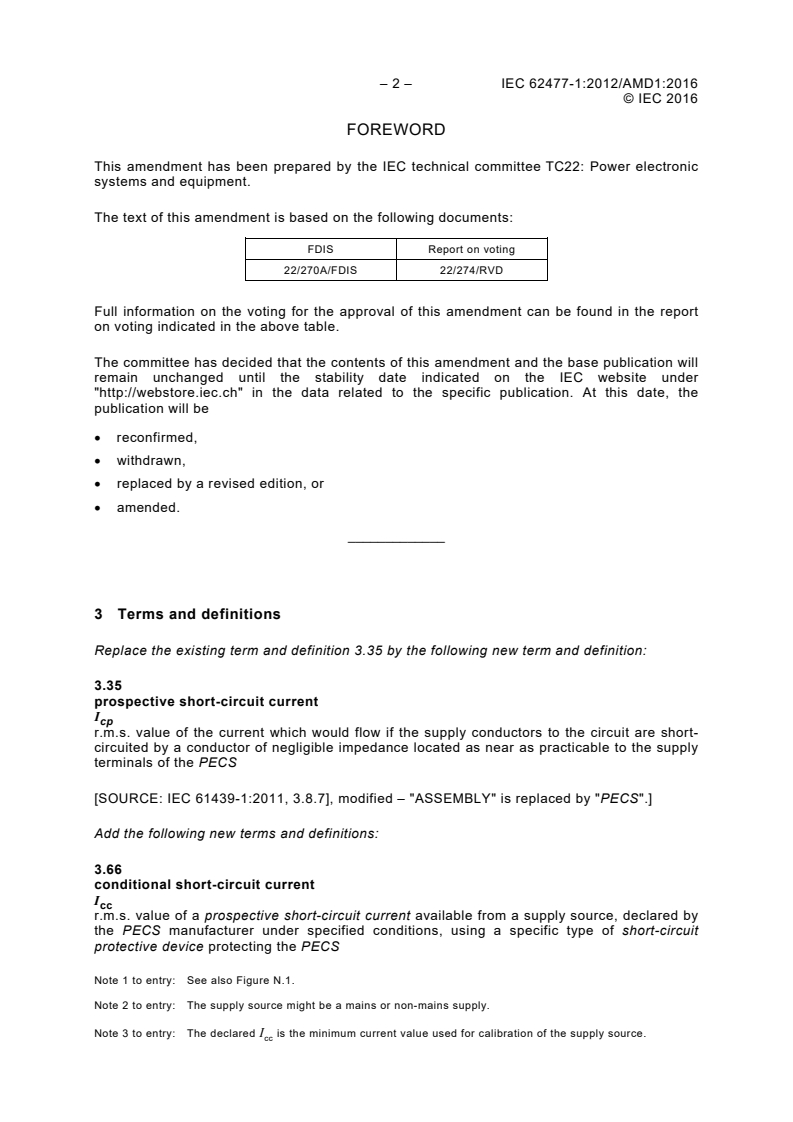
3 Terms and definitions
Replace the existing term and definition 3.35 by the following new term and definition:
3.35
prospective short-circuit current
I
cp
r.m.s. value of the current which would flow if the supply conductors to the circuit are short-
circuited by a conductor of negligible impedance located as near as practicable to the supply
terminals of the PECS
[SOURCE: IEC 61439-1:2011, 3.8.7], modified – "ASSEMBLY" is replaced by "PECS".]
Add the following new terms and definitions:
3.66
conditional short-circuit current
I
cc
r.m.s. value of a prospective short-circuit current available from a supply source, declared by
the PECS manufacturer under specified conditions, using a specific type of short-circuit
protective device protecting the PECS
Note 1 to entry: See also Figure N.1.
Note 2 to entry: The supply source might be a mains or non-mains supply.
Note 3 to entry: The declared I is the minimum current value used for calibration of the supply source.
cc
© IEC 2016
[SOURCE: IEC 61439-1: 2011. 3.8.10.4], modified – The definition is modified to fit to the use
of PECS applications.]
3.67
current-limiting protective device
protective element that, during its operation and specified current range, limits the current to
a substantially lower value than the peak value of the prospective current
Note 1 to entry: A current-limiting device is normally a current-limiting fuse or a current-limiting circuit breaker.
See IEC 60050-441:1984, 441-18-10.
3.68
minimum required prospective short-circuit current
I
cp,mr
r.m.s.value of a minimum short-circuit current, which is needed to be available from a supply
source in order to ensure safe interruption of the fault, and which is declared by the PECS
manufacturer and tested under specified conditions, using a specific type of short-circuit
protective device protecting the PECS.
3.69
overcurrent protective device
OCPD
device provided to interrupt an electric circuit in case the current in the electric circuit
exceeds a predetermined value for a specified duration
[SOURCE: IEC 60050-826:2004 826-14-14, modified – "conductor" deleted]
3.70
peak withstand current
I
pk
value of peak short-circuit current, declared by the PECS manufacturer, that can be carried
without damage under specified conditions, defined in terms of current and time
Note 1 to entry: For the purpose of this standard, I refers to the initial asymmetric peak value of the prospective
pk
test current.
Note 2 to entry: Time may be specified as the number of successive cycles at 50 Hz or 60 Hz.
[SOURCE: IEC 61439-1:2011, 3.8.10.2, modified – The definition is modified to fit to the use
of PECS application.]
3.71
short-circuit protective device
SCPD
device intended to protect a circuit or parts of a circuit against short-circuit currents by
interrupting them
Note 1 to entry: A short-circuit protective device is suitable for protection against short-circuit only, not for
protection against overload. An OCPD may also incorporate the function of a SCPD.
[SOURCE: IEC 61439-1:2011, 3.1.11, modified – Note added]
3.72
short time withstand current
I
cw
r.m.s. value of short time current, declared by the PECS manufacturer, that can be withstood
under specified conditions, defined in terms of current and time
– 4 – IEC 62477-1:2012/AMD1:2016
© IEC 2016
[SOURCE: IEC 61439-1:2011, 3.8.10.3, modified – "rated" removed from the term and
"ASSEMBLY" replaced by "PECS”]
4.2 Fault and abnormal conditions
Add, after the second paragraph, the following new paragraph:
Components in 4.2 also include insulation systems, ports, etc.
Add, at the end of the bullet list, the following new bullet:
• electromagnetic force and thermal hazard according to 4.3.
4.3.1 General
Add, after the first paragraph, the following new paragraph:
To ensure proper coordination with short-circuit protective devices and the available
prospective short-circuit current, the PECS manufacturer shall specify and test for each
mains supply input port of the PECS:
• conditional short-circuit current (I ) according to 4.3.2.2, or
cc
• rated short time withstand current (I ) according to 4.3.5.
cw
Individual mains supply ports of a PECS shall have specific short-circuit ratings of either I
cc
or I , or of both.
cw
in 4.3.5
Only in case where compliance does not rely on the characteristic of SCPD, the I
cw
can apply.
In case an output port is connected or intended to be connected to the input mains supply
port, the output port shall also be specified with an I or I rating (e.g. bypass between
cc cw
input mains supply port and output port).
For marking see 6.2.
See Annex N for further information.
4.3.2.2 Input ports short-circuit withstand current
Replace the title and text as follows:
4.3.2.2 Specification of the rated conditional short-circuit current (I ) on input ports
cc
In case the PECS manufacturer selects the conditional short-circuit current (I ) rating
cc
according to 4.3.1, the following shall be specified:
• conditional short-circuit current (I ),
cc
• characteristics of the short-circuit protective device, and
• minimum required prospective short-circuit current (I ).
cp,mr
Compliance is shown, through evaluation according to 4.2 to determine the appropriate
combination of testing according to 5.2.4.4, 5.2.4.6 and 5.2.3.11.3 in order to evaluate single
fault and abnormal conditions, including insulation faults.
If it is shown by analysis that the result of one test is representative of the worst case, less
severe combinations need not be tested.
© IEC 2016
Add, after 4.3.4, the following new clause:
4.3.5 Input ports short time withstand current, I
cw
In case the PECS manufacturer selects the short time withstand current (I ) rating according
cw
to 4.3.1, the following shall be specified:
• rated short time withstand current (I ),
cw
• associated duration, and
• rated peak withstand current (I ).
pk
Compliance is shown, through evaluation according to 4.2 to determine the appropriate
combination of testing according to 5.2.3.11.3 and 5.2.4.10 in order to evaluate single fault
and abnormal conditions, including insulation faults.
If it is shown by analysis that the result of one test is representative of the worst case, less
severe combinations need not be tested.
5.2.4.2 Pass criteria
Add, after the last bullet point, the following new bullet points:
• components, e.g. busbar supports, used for the mounting of live parts shall not break
away from their initial position,
• no conductor shall get pulled out of its terminal connector.
Add, in Table 22 under "Abnormal operation tests", the following new test:
X 4.3.5 5.2.4.10
Short time withstand current (I ) test
cw
Add, after 5.2.4.9.4, the following new subclause:
5.2.4.10 Short time withstand current (I ) test (type test)
cw
5.2.4.10.1 General
As required in 4.3.5, the short time withstand current test shall be performed as a type test to
verify the safety of the PECS.
Short-circuits are applied in the PECS at locations based on the evaluation in 4.2 so that
terminals and other parts in the fault current path are being exposed to the short-circuit
current.
5.2.4.10.2 Short time withstand current test method
The input mains supply port terminals shall be provided with a cable with a cross-section as
specified for the installation.
If a switching device is used to initiate the short-circuit or switch the power to the PECS, it
shall not limit the test current.
– 6 – IEC 62477-1:2012/AMD1:2016
© IEC 2016
The complete length of the cable (forth and back) shall be approximately 2 m, unless this
length is insufficient, in which case the length shall be as short as practical to perform the
test.
The testing shall include individual tests for each input mains supply port. The worst case
combination of terminals (including neutral and earth) shall be subjected to a short-circuit
test. Analysis may be used to reduce the number of tests, if it is shown that the results of one
terminal combination are representative of the anticipated results of another combination.
The PECS can be tested un-energized and not operating as intended prior to the short-circuit
withstand test, if it can be shown that the test result is not affected.
A new sample may be used for each short-circuit test.
Table 37 lists the a.c. current test method as a minimum requirement for PECS.
Requirements for d.c. current are under consideration.
If the specified I value is higher than listed in Table 37, the recommended test current is:
cp
16 kA, 20 kA, 25 kA, 35 kA, 50 kA, 65 kA, 85 kA, 100 kA.
Depending on the characteristics of the PECS, the actual values observed during the test
may be different from those listed in Table 37, in which case the observed values shall be
used for the declaration of I .
cw
Table 37 – A.c. short time withstand current test, minimum PECS requirements
a
Rated PECS Prospective test current Initial asymmetric Minimum
e
input current peak current ratio duration of
(r.m.s.) Typical
(r.m.s.) (I /I ) prospective test
e pk cw
power factor f, g
current
b
A A (cycles 50 Hz to
60 Hz)
c d
1 000 0,95
I ≤ 16 1,42 1,5
3 000 0,9
16 < I ≤ 75 6 000 0,7 1,53 1,5
10 000 0,5 1,70 1,5
75 < I ≤ 400
400 < I ≤ 500 10 000 0,5 1,70 3,0
0,5 – 0,3 × (I − 500) / 2 000 (0,5 I + 3 150) / 2 000
20 × I or 50 kA
3,0
500 < I whichever is or 0,2 whichever is the or 2,2
the lower higher whichever is the lower
a
Prospective test current, in the context of this standard, shall be understood as prospective short-circuit
current (I ) – refer to 3.70.
cp
b
Values compatible with Table 4 of IEC 60947-6-1:2005 and IEC 60947-6-1:2005/AMD1:2013.
c
Pluggable PECS only.
d
The typical fault current of public supply networks rated 75 A and below and intended to supply equipment
with a rated current of 16 A or below can be calculated from the reference impedances in IEC TR 60725:
2012: phase conductor 0,24 + j0,15 Ω and neutral conductor 0,16 + j0,10 Ω. For 230 V/400 V supplies, this
results in typical fault currents of 0,5 kA (230 V) and 0,7 kA (400 V).
e
From Table 16 of IEC 60947-1:2007.
f
In case a lower duration is wanted, the I according to 4.3.2.2 can be specifed.
cc
g
To ensure global compatibility with external SCPD to clear the fault in the specified duration, a higher
minimum duration should be considered and specified in which case this specified time shall be used for the
test. See also IEC 61439-1:2011, 5.3.4.
© IEC 2016
5.2.4.10.3 Compliance criteria
As a result of the short time withstand current (I ) test, the PECS shall comply with the
cw
compliance criteria of 5.2.4.2.
6.2 Information for selection
Replace the existing bullet list by the following new bullet list:
• the name or trademark of the manufacturer, supplier or importer;
• catalogue number or equivalent;
• electrical ratings for each power port:
– maximum nominal input voltage;
– maximum nominal output voltage;
– maximum nominal output current or nominal output power rating;
– maximum nominal input current rms for dimensioning overload protective elements
and wiring;
– number of phases (e.g. 3 a.c.);
– nominal frequency range (e.g. 50 Hz to 60 Hz);
– protective class (I, II, III);
• the type of electrical supply system (e.g. TN, IT) to which the PECS may be connected;
• short-circuit current rating(s) in terms of:
– conditional short-circuit current (I ) and minimum required prospective short-circuit
cc
current I and the characteristics of the short-circuit protective device according to
cp,mr
clause 4.3.2.2, or
– rated short time withstand current (I ), duration and the rated peak withstand current
cw
(I ) according to 4.3.5.
pk
• output short-circuit current in accordance with 4.3.2.3;
• supply requirements of the load (if applicable);
• liquid coolant type and design pressure for liquid cooled PECS;
• IP rating for enclosure;
• operating and storage environment;
• reference(s) to relevant standard(s) for manufacture, test, or use;
• reference to instructions for installation, use and maintenance.
– 8 – IEC 62477-1:2012/AMD1:2016
© IEC 2016
Add the following new Annex N:
Annex N
(informative)
Guidance regarding short-circuit current
N.1 General
The purpose of Annex N is to provide further in depth informative background pertaining to
short-circuit rating of the input and output as specified in 4.3, which needs to be considered
during single fault and abnormal conditions as specified in 4.2.
Internal short-circuits in a PECS, either through component failure or through human error,
can lead to significant equipment damage and immediate potential danger based on the high
prospective short-circuit current that can flow when the PECS is connected to an a.c. or d.c.
mains supply.
The damage in a circuit exposed to a high prospective short-circuit current is mainly due to
the very high level of mechanical stress, generated by the magnetic field and by the extreme
thermal rise in the circuit and in its components.
The single fault and abnormal analysis, specified in 4.2, relies heavily on the internal design
of the PECS as well as on some external parameters.
While the internal design is in full control of the manufacturer, the external parameters
depend on the circuit characteristics of the installation. Especially, the prospective short-
circuit current of the installation is of importance and needs to be taken into account for each
installation.
The prospective short-circuit current of the installation indicates the amount of energy
available from the installation during a failure in the product. Without any limiting devices, the
available energy will increase with higher prospective short-circuit current, and the risk of
fire, mechanical hazard, electrical shock or other hazard (see 4.2) will increase during a
failure.
One of the following two options for short-circuit ratings is to be specified for each input
mains supply port of a PECS (see also 4.3.1).
Option 1 as specified in 4.3.2.2:
• conditional short-circuit current (I );
cc
• minimum required prospective short-circuit current I ;
cp,mr
• characteristics or type of the short-circuit protective device.
Option 2 as specified in 4.3.5:
• rated short time withstand current (I );
cw
• associated duration (ms);
• rated peak withstand current (I ).
pk
The prospective short-circuit current is characterised by two parameters:
• the peak current which is the maximum current, which potentially flows during a short-
circuit of negligible impedance;
© IEC 2016
• the electrical energy (I t) generated by the r.m.s. current (I ) together with the duration
r.m.s.
(ms, s) of the short-circuit.
The effect of the peak current and I t is mainly related to the following two physical risks.
• Hazardous mechanical forces due to the generated magnetic fields caused by the short-
circuit current, which might cause mechanical damage to busbars, enclosure and
reduction of clearance and creepage distances. The mechanical force is proportional to
the square of instantaneous short-circuit current.
NOTE Further information about the mechanical effect of the short-circuit current can be found in
IEC 60865-1.
• Hazardous energy inside components leading to dramatic overheating/explosions of
components, arc faults and conductive ionization of the air, which might lead to fire,
reduction of clearance and creepage distances and destruction of the enclosure. The
thermal impact, i.e. heating of conductors, is proportional to the square of r.m.s. value of
the short-circuit current.
N.2 Coordination of short-circuit current
N.2.1 General
To ensure that the PECS and the components will be able to operate safely under the
available short-circuit current during a failure, the PECS and other installation components
need to be designed and specified for the prospective short-circuit current at the point where
it is installed.
For the calculation of the prospective short-circuit currents in three-phase a.c. systems the
IEC 60909 series provides guidance. The consequences of the short-circuit are dealt with in
the IEC 60865 series.
N.2.2 Conditional short-circuit current (I ) and minimum required prospective
cc
short-circuit current (I )
cp, mr
N.2.2.1 General
The conditional short-circuit current (I ) rating is defined in 4.3.2.2.
cc
N.2.2.2 Conditional short-circuit current (I )
cc
By specifying the I , the protection of the PECS depends on the characteristics of the short-
cc
circuit protective device (e.g. fuse or circuit breaker).
In order to reduce the fault current energy and peak current and limit the damage of the
PECS and avoid a hazard, a current-limiting device may be used. As shown in Figure N.1,
both the I t and the peak current is limited dramatically due to the current-limiting
characteristic of the protective device. Consequently, the damage is significantly reduced and
the risk of a hazard is reduced significantly. See Clause N.3 for more information.
– 10 – IEC 62477-1:2012/AMD1:2016
© IEC 2016
Peak current without using
a current-limiting device
(I )
pk
Peak current with a
current-limiting device (I )
pk
Energy released during S/C
using a current limiting
device (I t)
Time
IEC
Figure N.1 – Example of short-circuit current curve under specification of I
cc
Coordination of the PECS with the specified upstream SCPD is typically performed by the
installer, to ensure that the SCPD will be able to interrupt the fault current in a safe manner
in case of a short-circuit.
N.2.2.3 Minimum required prospective short-circuit current (I )
cp,mr
Depending on the characteristic of the short-circuit protective device, a minimum current
during a failure is needed to ensure a proper operation of the short-circuit protective device.
While the maximum prospective short-circuit current results in the highest fault current, but
ensures the shortest operating time of the short-circuit protective device, the minimum
prospective short-circuit current results in a lower fault current, but a significantly longer
operation time and consequently an increasing I t during the fault.
The manufacturer should be able to show that the PECS and the specified SCPD have been
successfully tested with the specified minimum required prospective short-circuit current.
A manufacturer can specify a maximum and minimum required prospective short current
anywhere within the trip curves of the SCPD. However, this selection impacts the operation of
the SCPD and the amount of energy released during a fault.
To ensure a sufficiently low I t value and a quick operation of the SCPD, it is recommended
to select a minimum required prospective short-circuit current in the instananeous tripping or
in the current-limiting area of the characteristics of a selected SCPD. See Figure N.2 and
Figure N.3.
Current
© IEC 2016
Overload
tripping area
Instantanous
tripping area
Current
IEC
Figure N.2 – Example of tripping characteristic of a circuit breaker
(kA)
Threshold of current
limiting characteristic
Maximum short-circuit
current rating of
overcurrent protective
Current limiting area of
device
overcurrent protective
device
(kA)
Available short-circuit current of the
installation
IEC
Figure N.3 – Example of tripping characteristic of a current-limiting fuse
The test to show compliance with the minimum required prospective short-circuit current may
be waived if risk analysis can demonstrate that the peak current and the I t values are below
the values from the test with the maximum prospective short-circuit current.
N.2.3 Short time withstand current (I )
cw
The short-circuit rating is expressed as explained in 4.3.5, and Figure N.4 shows a typical
waveform.
Peak let-through current
Time
– 12 – IEC 62477-1:2012/AMD1:2016
© IEC 2016
When the application requires a high fault current capability on the output port of the PECS
(e.g. for clearing a fault at the output side of the PECS), a suitable input I rating is needed.
cw
Coordination of the PECS and the installation is necessary, to ensure that the upstream
protective device of the installation will be able to interrupt the short-circuit current safely.
See Clause N.3 for more information.
The specification of the short time withstand current I is the most flexible rating, but also
cw
the hardest achievable solution, as it requires that the PECS has to be able to handle not
only a higher energy level (I t) but also a very high peak current.
Peak current during Energy released during
short-circuit short-circuit (I t)
RMS
current during
short-circuit
Time
IEC
Figure N.4 – Example of short-circuit current curve under specification of I
cw
Information about short-circuit currents in three-phase a.c. systems is available in
IEC 60909-0:2016.
N.3 Guidance for specification of short-circuit current and short-circuit
protective device
N.3.1 General
For the installations where the PECS is installed, the short-circuit protection is coordinated to
ensure a safe interruption of a short-circuit inside the PECS.
The following overview is included for clarification for the manufacturer to create their
specification:
• prospective short-circuit current (I );
cp
• rated short time withstand current (I );
cw
• conditional short-circuit current (I );
cc
• minimum required prospective short-circuit current (I );
cp,mr
• short-circuit protective device.
In case the PECS is specified with a conditional short-circuit current (I ) and a specified
cc
short-circuit protective device, it is ensured that:
Current
© IEC 2016
• the available prospective short-circuit current of the installation has to be between the
maximum and minimum required prospective short-circuit current value of the PECS,
• the short-circuit rating of the protective device has to be equal to or greater than the
prospective short-circuit current of the installation at the terminals of the short-circuit
protective device,
• a short-circuit protective device which meets the current characteristic is specified by the
PECS manufacturer, or
• a specific short-circuit protective device, specified by the PECS manufacturer, is installed
in front of the PECS.
In case the PECS is specified with a short time withstand current (I ), peak withstand
cw
current (I ) and duration rating, it has to be ensured that:
pk
• the rated short time withstand current (I ) of the PECS has to be equal to or greater than
cw
the prospective short-circuit current r.m.s. of the installation at the terminals of PECS,
• the peak withstand current (I ) of the PECS has to be equal to or greater than the
pk
prospective short-circuit peak current of the installation at the terminals of PECS, and
• the maximum time for which the I is specified for the PECS has to be equal to or longer
cw
than the maximum operating time of the short-circuit protective device located upstream
of the PECS.
The available prospective short-circuit current, I , from the mains supply is set to 50 kA in
cp
the examples showed in N.3.2 and N.3.5. Another level could have been chosen and would
have worked as well.
The examples are not intended to show how a typical installation is made, nor do they show
the position or numbers of breakers, switches, fuses between the mains supply and the
PECS.
None of the examples are calculated and real solutions. The different current levels,
durations and devices are only selected for the purpose of explanation.
N.3.2 Example 1: Two or more PECS with different ratings
Figure N.5 provides some general guidance on how to apply I , I and duration or I and
cw pk cc
short-circuit protective device for two or more PECS with ports installed in the same
installation.
– 14 – IEC 62477-1:2012/AMD1:2016
© IEC 2016
SCPD: 800 A fuse, type xx
I = 50 kA
cp
I = 50 kA
cc
I = 12 kA
cp,mr
Device = 800 A fuse,
type xx
SCPD: installer selected circuit breaker
I = 50 kA
cw
I /I = 2,1
pk cw
I-duration = 60 ms
IEC
Figure N.5 – Two PECS with different specifications
PECS 1 has an I rating. In this example, a fuse with a specified current rating and
cc
characteristic (800 A, type xx) is used for the PECS 1, but also a circuit breaker might be
specified by the manufacturer. The specified short-circuit protective device can be made
available as a part of the PECS or can be a part the installer needs to purchase according to
the manufacturer I declaration.
cc
PECS 2 has an I rating. In the installation, any type of short-circuit protective device can be
cw
used as long as it does not exceed all specified I ratings (r.m.s. current, peak current ratio,
cw
I /I and duration). In this example, a circuit breaker is used for the PECS 2, but also a
pk cw
fuse might be used.
N.3.3 Specification of I
cc
PECS 1 is specified with an I declaration (I value, I , device) (see Clause N.1,
cc r.m.s cp,mr
Option1).
• I = 50 kA
cc
• I = 12 kA
cp,mr
• device = 800 A fuse (manufacturer data, type, characteristic)
The I declaration is based on the use of a specific short-circuit protective device (in this
cc
example, a 800 A fuse) which is required to be installed in front of PECS 1. The manufacturer
has verified by test (see Clause N.4), that the PECS can withstand the rated conditional
short-circuit current (I ), for the total operation time (clearing time) of the short-circuit
cc
protective device under specified conditions.
In this example, the specified condition is that
• the limitation of the prospective short-circuit current is 50 kA. This limitation is a
manufacturer decision. The use of a short-circuit protective device could be approved for
much higher I , however it is a manufacturer decision to select the applicable I level
cp cp
for the design and the subsequent test;
• this I rating is now identical to the maximum allowable prospective short-circuit current,
cc
which the installed PECS and short-circuit protective device may be exposed to in an
installation.
As the operating time and current limitation characteristic depends on the applied prospective
short-circuit current (I ), it is necessary to determine the minimum required prospective
cp
short-circuit current (I ). This is to ensure the expected behavior of the short-circuit
cp,mr
protective device and to verify that this situation will not have any severe consequences for
the PECS, as the opening time of the short-circuit protective device will increase with lower
© IEC 2016
prospective short-circuit current of the mains supply. The minimum required prospective
short-circuit current, I , is also verified by test (see Clause N.4).
cp,mr
The device which the I is based on should be specified by the characteristics of the short-
cc
circuit protective device.
NOTE The characteristic of the protective device can also include specific manufacturer part numbers in case
needed for the compliance of I .
cc
N.3.4 Specification of I
cw
As an example in Figure N.3, PECS 2 is specified by an I declaration (I value, duration,
cw r.m.s
I ) (see Clause N.1, Option 2).
pk
• short time withstand current = 50 kA
• associated duration= 60 ms
• peak withstand current ratio, I /I = 2,1
pk cw
Based on the application intended for the PECS, the PECS manufacturer selects the required
values from Table 37.
The PECS manufacturer has verified by test that the PECS can withstand the rated short time
withstand current (I ) for the specified duration and with a specified rated peak withstand
cw
current (I ).
pk
The specified I is equal to or higher than the available prospective short-circuit current (I )
cw cp
at the terminals of PECS 2.
NOTE The system integrator can choose an appropriate short-circuit protective device based on their declared
rating.
N.3.5 Example 2: One PECS with more than one rating
Figure N.6 provides some general guidance on how to specify I I and duration or I and
cw, pk cc
short-circuit protective device for one PECS with two ports installed in the same installation.
SCPD: 1 200 A MCCB
I = 50 kA
cp
Port 1
I = 50 kA
cc
I = 10 kA
cp, mr
Device = 1 200 A MCCB
PECS 3
I = 50 kA
cp
I = 50 kA
Port 2 cc
I = 15 kA
cp, mr
Device = 1 500 A aR fuse
IEC
Key
MCCB molded case circuit breaker
Figure N.6 – One PECS with different specification for each input mains supply port
– 16 – IEC 62477-1:2012/AMD1:2016
© IEC 2016
PECS 3 has two sets of input mains supply ports, port 1 and port 2, and the design and
approval is based on an I declaration for both. This is a manufacturer decision, and a
cc
solution combining an I declaration on one port and a I declaration on the other port is
cc cw
also allowed.
Port 1:
I declaration (r.m.s. value, I , device)
cc cp,mr
• I = 50 kA
cc
• I = 10 kA
cp,mr
• Device = 1 200A MCCB (manufacturer data, type, characteristic)
The declarations and considerations behind the work are similar to the example of PECS 1.
The I declaration is based on the use of a short-circuit protective device, a 1 200 A MCCB,
cc
which is required to be installed in front of PECS 3.
Port 2:
I declaration (r.m.s. value, I , device)
cc cp,mr
• I = 50 kA
cc
• I = 15 kA
cp,mr
• device = 1 500 A aR fuse (manufacturer data, type, characteristic)
The I declaration is based on the use of a short-circuit protective device, in this example a
cc
1 500 A aR fuse, which is included/incorporated in the PECS, but the considerations are
similar to those explained for PECS 1.
N.3.6 Additional explanation on terms, definitions and specifications
N.3.6 provides some additional information about used parameters:
• prospective short-circuit current (I ), and
cp
• mains supply characteristics
used as design parameters to determine required level of I or I of the PECS.
cw cc
Short time withstand current (I )
cw
• Design parameter and solution for the PECS, where the level (kA) is selected by the
manufacturer based on the PECS application.
• The selected level (I ) is used in test lab, where the test generator is calibrated to
cw r.m.s.
the selected level for I testing, to simulate a maximum available prospective short-
cw
circuit current at the input of the mains supply port.
Peak withstand current (I )
pk
• Design parameter selected by the manufacturer based on the PECS application.
• The selected peak current (I ) or ratio (I /I ) is used in test lab, where the test
pk pk cw
generator is calibrated to the selected level for I and I testing.
cw cc
Duration for I
cw
• Design parameter (time) selected by the manufacturer based on the PECS application.
• The selected duration is used in test lab, where the test generator is adjusted and
calibrated to deliver the requested current and peak for the selected duration.
© IEC 2016
Conditional short-circuit current (I )
cc
• Design parameter where the solution is selected by the manufacturer based on the PECS
application and selected device.
) is used in test lab, where the test generator is calibrated to
• The selected level (I
cc r.m.s
the selected level for I testing, to simulate a maximum available prospective short-
cc
circuit current at the input of the mains supply port.
)
Minimum required prospective short-circuit current (I
cp,mr
• Design parameter selected by the manufacturer.
• Derived consequence of the selected short-circuit protective device and the available
prospective short-circuit current.
• The selected level (I ) is used in test lab, where the test generator is calibrated to the
cp,mr
selected level for I testing, to simulate a minimum available prospective short-circuit
cp,mr
current at the input of the port.
N.4 Short-circuit rating and single fault conditions testing
N.4.1 General
As mentioned in Clause N.1, the PECS has to be able to fail safely under the specified
maximum and minimum short-circuit current. This includes the following tests:
• conduct output short-circuit test according to 5.2.4.4;
• conduct protective equipotential bonding short-circuit withstand test according to
5.2.3.11.3;
• conduct breakdown of component tests according to 5.2.4.6;
• conduct short time withstand current (I ) test according to 5.2.4.10.
cw
See Figure N.7
– 18 – IEC 62477-1:2012/AMD1:2016
© IEC 2016
IEC
a
Acceptance criteria for I according to 5.2.4.2
cc
b
Acceptance criteria for I according to 5.2.4.10
cw
c
Not applicable when I is used
cw
Figure N.7 – Flowchart for classification of I or I
cc cw
© IEC 2016
N.4.2 Exemption from short time withstand current testing
N.4.2.1 General
Product committees can consider if special exceptions are applicable for their products
considering specific application. Following expections may be used in their evaluation.
Exemptions from short time withstand current testing applies to:
• PECS with declared I or I not exceeding 10 kA;
cw cc
• PECS protected by current-limiting devices having a cut-off current not exceeding 17 kA
with the maximum allowable prospective short-circuit current at the terminals of the
incoming circuit of the PECS;
• PECS intended to be supplied from transformers whose rated power does not exceed
10 kVA per phase for a rated secondary voltage of not less than 110 V, or 1,6 kVA per
phase for a rated secondary voltage less than 110 V, and whose short-circuit impedance
is not less than 4 %;
• PECS variants of a more onerous PECS tested compliant with the test requirements
prescribed in 5.2.4.10.1;
For guidance on how to determine when a PECS is a variant of a more onerous PECS, refer
to 10.11.3 and Table 13 (check list) or 10.11.4 (calculation) of IEC 61439-1:2011.
The exemption conditions above align Amendment 1 of this standard with 10.11.2 of
IEC 61439-1:2011 that should be considered.
N.4.2.2 Special consideration
In case where the fault current path includes semiconductor devices, the above exceptions
might not be valid (see Clause N.1).
The compliance of criteria 5.2.4.10.3 requires that the PECS and its components should
remain safe during and after the test. A reduction of the functionality (e.g. PECS can become
fully non-functional) is permissible.
N.5 Guideline for short-circuit analysis
The short-circuit analysis considers, but not limited to, the following:
• I t breakdown ratings of conductors and components;
• identification of fault current path and impedance in the equipment;
• possibility and extent of cascading failures;
• nature of failure with respect to physical location (e.g. proximity to other critical
components, barriers, clearances, creepage distances, vent openings);
• identification of all energy sources (mains, capacitors, motor, etc.) in the circuit;
• for main supply, consider power circuit configuration and grounding (wye, delta, IT, etc.);
• enclosure (size, material, structure, openings, etc.);
• types and ratings of the overcurrent protective devices specified to be used with the
PECS;
• specified linearity of current-limiting components (external and internal) with respect to
available fault current;
• effect of multiple ratings of the PECS (relationship of power rating and voltage);
– 20 – IEC 62477-1:2012/AMD1:2016
© IEC 2016
• variation in components within PECS family;
• maximum variation of mains impedance, frequency, voltage with respect to
specified/published product applications (use of transformer, line reactor etc.).
Testing may be necessary to validate the portion of the analysis.
Bibliography
Add the following references:
IEC TR 60725:2012, Consideration of reference impedances and public supply network
impedances for use
...