

IEC 61643-22:2015
(Main)Low-voltage surge protective devices - Part 22: Surge protective devices connected to telecommunications and signalling networks - Selection and application principles
General Information
- Abstract
IEC 61643-22:2015 describes the principles for the selection, operation, location and coordination of SPDs connected to telecommunication and signalling networks with nominal system voltages up to 1 000 V r.m.s. a.c. and 1 500 V d.c. This standard also addresses SPDs that incorporate protection for signalling lines and power lines in the same enclosure (so called multiservice SPDs). This second edition cancels and replaces the first edition published in 2004. This edition constitutes a technical revision. This edition includes the following significant technical changes with respect to the previous edition:
- Update the use of multiservice SPDs (Article 8);
- Comparison between SPD classification of IEC 61643-11 and IEC 61643-21 (7.3.3);
- Consideration of new transmission systems as PoE (Annex F);
- EMC requirements of SPDs (Annex G);
- Maintenance cycles of SPDs (Annex I). Keywords: SPD, surge protective devices
- Status
- Published
- Publication Date
- 24-Jun-2015
- Technical Committee
- SC 37A - Low-voltage surge protective devices
- Drafting Committee
- WG 4 - TC 37/SC 37A/WG 4
- Current Stage
- PPUB - Publication issued
- Start Date
- 25-Jun-2015
- Completion Date
- 15-Jul-2015
Buy Documents
IEC 61643-22:2015 - Low-voltage surge protective devices - Part 22: Surge protective devices connected to telecommunications and signalling networks - Selection and application principles Released:6/25/2015
Overview
IEC 61643-22:2015 is an international standard that defines selection and application principles for low-voltage surge protective devices (SPDs) used in telecommunications and signalling networks. It focuses on SPDs designed for systems with nominal voltages up to 1,000 V r.m.s. AC and 1,500 V DC. This edition updates and replaces the 2004 version, introducing technical revisions to address evolving technologies such as multiservice SPDs, Power over Ethernet (PoE), and electromagnetic compatibility (EMC) requirements. The standard provides essential guidance for ensuring reliable SPD integration, protection, and maintenance in complex telecommunication infrastructures.
Key Topics
Scope and System Voltage Limits
Applicable to SPDs connected in telecommunication and signalling networks with nominal voltages up to 1,000 V AC and 1,500 V DC.SPD Technologies Overview
Detailed descriptions of voltage-limiting and current-limiting components including metal oxide varistors (MOV), gas discharge tubes (GDT), silicon semiconductors, thyristor surge suppressors, and switching components.Selection Parameters and Testing
Guidance on selecting SPDs based on environmental conditions (temperature, humidity, altitude), normal and abnormal service conditions, and electrical parameters as per IEC 61643-21.Risk Management Procedures
Comprehensive strategies for assessing and mitigating risks related to lightning discharges and power line faults within telecommunication and signalling networks.Application and Coordination
Principles for proper SPD application, installation considerations, selection criteria, and coordination between multiple devices to ensure system-wide protection.Multiservice SPDs
Explanation on devices incorporating protection for both signalling and power lines within the same enclosure, with updated use cases and application guidelines.Power over Ethernet (PoE) Protection
Special considerations for new transmission technologies such as PoE, including withstand capabilities and SPD coordination to handle surge conversion modes.Electromagnetic Compatibility (EMC)
Annex providing EMC requirements to minimize electromagnetic interference caused by SPDs, ensuring compliance with immunity and emission standards.Maintenance and Inspection
Recommendations for maintenance cycles, periodic visual inspections, complete examinations, and responsibility allocation to ensure SPD operational integrity over time.
Applications
IEC 61643-22:2015 is critical for engineers, system designers, and technicians involved in:
- Designing resilient telecommunication and signalling networks requiring surge protection.
- Selecting SPDs for low-voltage environments with both AC and DC power sources.
- Integrating multiservice surge protective devices to protect combined power and signal lines.
- Protecting Ethernet and PoE systems against transient overvoltages while maintaining data integrity.
- Managing risks from lightning strikes and power line faults through proper SPD implementation.
- Coordinating multiple SPDs within complex installations to avoid protection conflicts and maintain system uptime.
- Ensuring ongoing system reliability via structured SPD maintenance programs consistent with international best practices.
- Complying with global electrical and electronic standards to enhance safety and minimize downtime.
Related Standards
- IEC 61643-11: Low-voltage surge protective devices - General requirements and tests for SPDs in power distribution systems.
- IEC 61643-21: Surge protective devices connected to telecommunications and signalling networks - Performance requirements and testing.
- IEC 62305-2: Protection against lightning - Risk management guidelines essential for SPD risk assessments.
- ITU-T K.44: Recommendations on internal port definitions relevant to telecommunications equipment.
By harmonizing IEC 61643-22 with these related standards, organizations can implement comprehensive surge protection strategies that optimize safety, equipment longevity, and service continuity in telecommunication and signalling infrastructure.
Keywords: IEC 61643-22, surge protective devices, SPDs, telecommunications networks, low-voltage protection, multiservice SPDs, Power over Ethernet, PoE surge protection, electromagnetic compatibility, SPD maintenance, telecommunication surge protection, signalling network safety, IEC standards.
Relations
- Effective Date
- 05-Sep-2023
Buy Documents
IEC 61643-22:2015 - Low-voltage surge protective devices - Part 22: Surge protective devices connected to telecommunications and signalling networks - Selection and application principles Released:6/25/2015
Get Certified
Connect with accredited certification bodies for this standard

IMQ S.p.A. (Certification)
Italian electrical product certification.

SLG Prüf- und Zertifizierungs GmbH
German testing and certification body.

UL Solutions
Global safety science company with testing, inspection and certification.
Sponsored listings
Frequently Asked Questions
IEC 61643-22:2015 is a standard published by the International Electrotechnical Commission (IEC). Its full title is "Low-voltage surge protective devices - Part 22: Surge protective devices connected to telecommunications and signalling networks - Selection and application principles". This standard covers: IEC 61643-22:2015 describes the principles for the selection, operation, location and coordination of SPDs connected to telecommunication and signalling networks with nominal system voltages up to 1 000 V r.m.s. a.c. and 1 500 V d.c. This standard also addresses SPDs that incorporate protection for signalling lines and power lines in the same enclosure (so called multiservice SPDs). This second edition cancels and replaces the first edition published in 2004. This edition constitutes a technical revision. This edition includes the following significant technical changes with respect to the previous edition: - Update the use of multiservice SPDs (Article 8); - Comparison between SPD classification of IEC 61643-11 and IEC 61643-21 (7.3.3); - Consideration of new transmission systems as PoE (Annex F); - EMC requirements of SPDs (Annex G); - Maintenance cycles of SPDs (Annex I). Keywords: SPD, surge protective devices
IEC 61643-22:2015 describes the principles for the selection, operation, location and coordination of SPDs connected to telecommunication and signalling networks with nominal system voltages up to 1 000 V r.m.s. a.c. and 1 500 V d.c. This standard also addresses SPDs that incorporate protection for signalling lines and power lines in the same enclosure (so called multiservice SPDs). This second edition cancels and replaces the first edition published in 2004. This edition constitutes a technical revision. This edition includes the following significant technical changes with respect to the previous edition: - Update the use of multiservice SPDs (Article 8); - Comparison between SPD classification of IEC 61643-11 and IEC 61643-21 (7.3.3); - Consideration of new transmission systems as PoE (Annex F); - EMC requirements of SPDs (Annex G); - Maintenance cycles of SPDs (Annex I). Keywords: SPD, surge protective devices
IEC 61643-22:2015 is classified under the following ICS (International Classification for Standards) categories: 29.240.01 - Power transmission and distribution networks in general; 29.240.10 - Substations. Surge arresters. The ICS classification helps identify the subject area and facilitates finding related standards.
IEC 61643-22:2015 has the following relationships with other standards: It is inter standard links to IEC 61643-22:2004. Understanding these relationships helps ensure you are using the most current and applicable version of the standard.
IEC 61643-22:2015 is available in PDF format for immediate download after purchase. The document can be added to your cart and obtained through the secure checkout process. Digital delivery ensures instant access to the complete standard document.
Standards Content (Sample)
IEC 61643-22 ®
Edition 2.0 2015-06
INTERNATIONAL
STANDARD
NORME
INTERNATIONALE
colour
inside
Low-voltage surge protective devices –
Part 22: Surge protective devices connected to telecommunications and
signalling networks – Selection and application principles
Parafoudres basse tension –
Partie 22: Parafoudres connectés aux réseaux de signaux et de
télécommunications – Principes de choix et d'application
All rights reserved. Unless otherwise specified, no part of this publication may be reproduced or utilized in any form
or by any means, electronic or mechanical, including photocopying and microfilm, without permission in writing from
either IEC or IEC's member National Committee in the country of the requester. If you have any questions about IEC
copyright or have an enquiry about obtaining additional rights to this publication, please contact the address below or
your local IEC member National Committee for further information.
Droits de reproduction réservés. Sauf indication contraire, aucune partie de cette publication ne peut être reproduite
ni utilisée sous quelque forme que ce soit et par aucun procédé, électronique ou mécanique, y compris la photocopie
et les microfilms, sans l'accord écrit de l'IEC ou du Comité national de l'IEC du pays du demandeur. Si vous avez des
questions sur le copyright de l'IEC ou si vous désirez obtenir des droits supplémentaires sur cette publication, utilisez
les coordonnées ci-après ou contactez le Comité national de l'IEC de votre pays de résidence.
IEC Central Office Tel.: +41 22 919 02 11
3, rue de Varembé Fax: +41 22 919 03 00
CH-1211 Geneva 20 info@iec.ch
Switzerland www.iec.ch
About the IEC
The International Electrotechnical Commission (IEC) is the leading global organization that prepares and publishes
International Standards for all electrical, electronic and related technologies.
About IEC publications
The technical content of IEC publications is kept under constant review by the IEC. Please make sure that you have the
latest edition, a corrigenda or an amendment might have been published.
IEC Catalogue - webstore.iec.ch/catalogue Electropedia - www.electropedia.org
The stand-alone application for consulting the entire The world's leading online dictionary of electronic and
bibliographical information on IEC International Standards, electrical terms containing more than 30 000 terms and
Technical Specifications, Technical Reports and other definitions in English and French, with equivalent terms in 15
documents. Available for PC, Mac OS, Android Tablets and additional languages. Also known as the International
iPad. Electrotechnical Vocabulary (IEV) online.
IEC publications search - www.iec.ch/searchpub IEC Glossary - std.iec.ch/glossary
The advanced search enables to find IEC publications by a More than 60 000 electrotechnical terminology entries in
variety of criteria (reference number, text, technical English and French extracted from the Terms and Definitions
committee,…). It also gives information on projects, replaced clause of IEC publications issued since 2002. Some entries
and withdrawn publications. have been collected from earlier publications of IEC TC 37,
77, 86 and CISPR.
IEC Just Published - webstore.iec.ch/justpublished
Stay up to date on all new IEC publications. Just Published IEC Customer Service Centre - webstore.iec.ch/csc
details all new publications released. Available online and If you wish to give us your feedback on this publication or
also once a month by email. need further assistance, please contact the Customer Service
Centre: csc@iec.ch.
A propos de l'IEC
La Commission Electrotechnique Internationale (IEC) est la première organisation mondiale qui élabore et publie des
Normes internationales pour tout ce qui a trait à l'électricité, à l'électronique et aux technologies apparentées.
A propos des publications IEC
Le contenu technique des publications IEC est constamment revu. Veuillez vous assurer que vous possédez l’édition la
plus récente, un corrigendum ou amendement peut avoir été publié.
Catalogue IEC - webstore.iec.ch/catalogue Electropedia - www.electropedia.org
Application autonome pour consulter tous les renseignements
Le premier dictionnaire en ligne de termes électroniques et
bibliographiques sur les Normes internationales,
électriques. Il contient plus de 30 000 termes et définitions en
Spécifications techniques, Rapports techniques et autres
anglais et en français, ainsi que les termes équivalents dans
documents de l'IEC. Disponible pour PC, Mac OS, tablettes
15 langues additionnelles. Egalement appelé Vocabulaire
Android et iPad.
Electrotechnique International (IEV) en ligne.
Recherche de publications IEC - www.iec.ch/searchpub
Glossaire IEC - std.iec.ch/glossary
La recherche avancée permet de trouver des publications IEC Plus de 60 000 entrées terminologiques électrotechniques, en
en utilisant différents critères (numéro de référence, texte, anglais et en français, extraites des articles Termes et
comité d’études,…). Elle donne aussi des informations sur les Définitions des publications IEC parues depuis 2002. Plus
projets et les publications remplacées ou retirées. certaines entrées antérieures extraites des publications des
CE 37, 77, 86 et CISPR de l'IEC.
IEC Just Published - webstore.iec.ch/justpublished
Service Clients - webstore.iec.ch/csc
Restez informé sur les nouvelles publications IEC. Just
Published détaille les nouvelles publications parues. Si vous désirez nous donner des commentaires sur cette
Disponible en ligne et aussi une fois par mois par email. publication ou si vous avez des questions contactez-nous:
csc@iec.ch.
IEC 61643-22 ®
Edition 2.0 2015-06
INTERNATIONAL
STANDARD
NORME
INTERNATIONALE
colour
inside
Low-voltage surge protective devices –
Part 22: Surge protective devices connected to telecommunications and
signalling networks – Selection and application principles
Parafoudres basse tension –
Partie 22: Parafoudres connectés aux réseaux de signaux et de
télécommunications – Principes de choix et d'application
INTERNATIONAL
ELECTROTECHNICAL
COMMISSION
COMMISSION
ELECTROTECHNIQUE
INTERNATIONALE
ICS 29.240.01; 29.240.10 ISBN 978-2-8322-2750-3
– 2 – IEC 61643-22:2015 IEC 2015
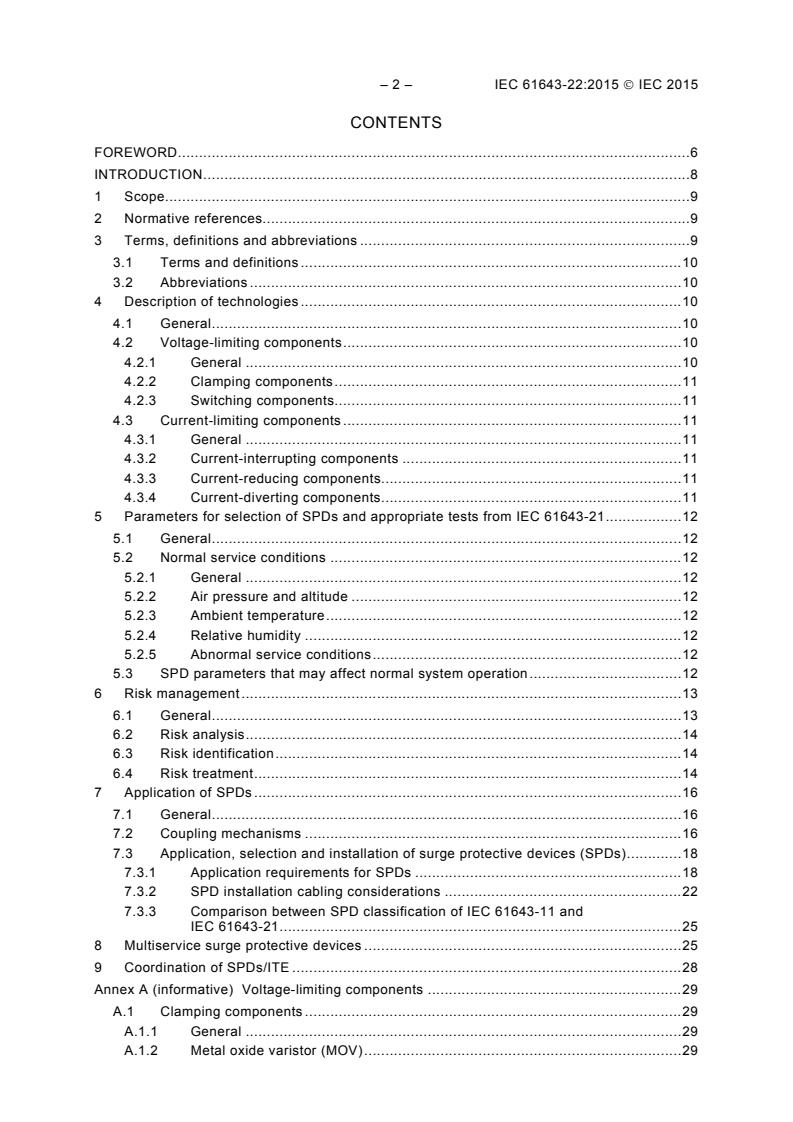
CONTENTS
FOREWORD . 6
INTRODUCTION . 8
1 Scope . 9
2 Normative references. 9
3 Terms, definitions and abbreviations . 9
3.1 Terms and definitions . 10
3.2 Abbreviations . 10
4 Description of technologies . 10
4.1 General . 10
4.2 Voltage-limiting components . 10
4.2.1 General . 10
4.2.2 Clamping components . 11
4.2.3 Switching components. 11
4.3 Current-limiting components . 11
4.3.1 General . 11
4.3.2 Current-interrupting components . 11
4.3.3 Current-reducing components. 11
4.3.4 Current-diverting components . 11
5 Parameters for selection of SPDs and appropriate tests from IEC 61643-21 . 12
5.1 General . 12
5.2 Normal service conditions . 12
5.2.1 General . 12
5.2.2 Air pressure and altitude . 12
5.2.3 Ambient temperature . 12
5.2.4 Relative humidity . 12
5.2.5 Abnormal service conditions . 12
5.3 SPD parameters that may affect normal system operation . 12
6 Risk management . 13
6.1 General . 13
6.2 Risk analysis . 14
6.3 Risk identification . 14
6.4 Risk treatment . 14
7 Application of SPDs . 16
7.1 General . 16
7.2 Coupling mechanisms . 16
7.3 Application, selection and installation of surge protective devices (SPDs) . 18
7.3.1 Application requirements for SPDs . 18
7.3.2 SPD installation cabling considerations . 22
7.3.3 Comparison between SPD classification of IEC 61643-11 and
IEC 61643-21 . 25
8 Multiservice surge protective devices . 25
9 Coordination of SPDs/ITE . 28
Annex A (informative) Voltage-limiting components . 29
A.1 Clamping components . 29
A.1.1 General . 29
A.1.2 Metal oxide varistor (MOV) . 29
A.1.3 Silicon semi-conductors . 29
A.2 Switching components . 31
A.2.1 General . 31
A.2.2 Gas discharge tube (GDT) . 31
A.2.3 Air gaps . 31
A.2.4 Thyristor surge suppressor (TSS) – Fixed voltage types (self-gating) . 32
A.2.5 Thyristor surge suppressor (TSS) – Gated types . 32
Annex B (informative) Current-limiting components . 33
B.1 General . 33
B.2 Non-resetting current limiters . 33
B.2.1 General . 33
B.2.2 Series current-interrupting components . 33
B.2.3 Shunt current-diverting limiters . 34
B.3 Self-resetting current limiters . 36
B.3.1 General . 36
B.3.2 Series current-reducing components . 36
B.3.3 Shunt current-diverting components . 38
Annex C (informative) Risk management . 39
C.1 Risk due to lightning discharges . 39
C.1.1 Risk assessment . 39
C.1.2 Risk analysis. 39
C.1.3 Risk treatment . 41
C.2 Risk due to power line faults . 42
C.2.1 General . 42
C.2.2 AC power systems . 42
C.2.3 DC power systems . 42
Annex D (informative) Transmission characteristics related to IT systems . 44
D.1 General . 44
D.2 Telecommunications systems . 44
D.3 Signalling, measurement and control systems . 45
D.4 Cable TV systems . 45
Annex E (informative) Coordination of SPDs/ITE . 46
E.1 General . 46
E.2 Determination of U and I . 46
IN IN
E.3 Determine the output protective voltage and current waveforms for SPD1 . 47
E.4 Compare SPD1 and SPD2 values . 47
E.5 Necessity of verification of the coordination by testing . 48
Annex F (informative) Protection of Ethernet systems . 49
F.1 Power over Ethernet (PoE) . 49
F.2 Withstand capabilities and SPD coordination . 50
F.3 Common mode to differential mode surge conversion by switching devices . 50
F.3.1 General . 50
F.3.2 Differential mode voltage reduction by inter-wire protection . 51
F.3.3 Differential mode voltage reduction by single switching element . 52
Annex G (informative) EMC impact of SPDs . 54
G.1 General . 54
G.2 Electromagnetic immunity . 54
G.3 Electromagnetic emission . 54
– 4 – IEC 61643-22:2015 IEC 2015
Annex H (informative) Definition of internal port (Source: ITU-T K.44) . 55
Annex I (informative) Maintenance of SPDs for Information Technology . 56
I.1 General requirements . 56
I.2 Maintenance responsibilities . 56
I.3 Maintenance of SPDs . 56
I.3.1 General . 56
I.3.2 Visual inspection . 57
I.3.3 Complete inspection . 57
I.3.4 Examining periods . 57
Annex J (informative) Earth potential rise (EPR) . 59
J.1 General . 59
J.2 Causes of EPR . 59
J.3 Influence of soil resistivity . 59
J.4 Fibre optics . 59
Annex K (informative) References and examples of risk management based on
IEC 62305-2 . 60
Bibliography . 61
Figure 1 – SPD installation in telecommunications and signalling networks . 15
Figure 2 – Measurement and Control network (MCR) . 15
Figure 3 – Coupling mechanisms . 17
Figure 4 – Example of a configuration of the lightning protection concept . 19
Figure 5 – Example of a configuration according to the zones (Figure 4) . 20
Figure 6 – Example of protection measures against common-mode voltages and
differential mode voltages of the data (f) and supply voltage input (g) of an ITE . 21
Figure 7 – Influence of voltages U and U on protection level U caused by
L1 L2 P
inductance of the leads . 22
Figure 8 – Removal of the voltages U and U from the protector unit by connecting
L1 L2
leads to a common point . 23
Figure 9 – Necessary installation conditions of a three, five or multi-terminal SPD with
an ITE for minimizing the interference influences on the protection level . 24
Figure 10 – Individual SPDs . 26
Figure 11 – MSPD with PE connection option . 26
Figure 12 – MSPD with transient bonding SPCs to PE terminals . 27
Figure 13 – Coordination of two SPDs . 28
Figure A.1 – Behaviour of clamping components . 29
Figure A.2 – Behaviour of switching components . 31
Figure B.1 – Behaviour of current interrupting components . 33
Figure B.2 – Behaviour of current-diverting component . 34
Figure B.3 – Thermally operated (heat coil) three-terminal shunt current limiter . 35
Figure B.4 – Behaviour of current-reducing components (thermally operated type) . 36
Figure B.5 – Thermally operated (PTC thermistor) two-terminal series current limiting
component . 37
Figure B.6 – Two-terminal series electronic current limiting component . 38
Figure B.7 – Electronic (gated bidirectional thyristor) three-terminal shunt current
limiting component . 38
Figure C.1 – Risk evaluation procedure . 41
Figure E.1 – Coordination verification process . 47
Figure F.1 – PoE powering modes . 49
Figure F.2 – Common mode to differential mode surge conversion by asynchronous
SPD operation . 50
Figure F.3 – Differential surge generated by asynchronous SPD operation on a
longitudinal surge . 51
Figure F.4 – SPD circuit with inter-wire protection to limit the differential surge . 51
Figure F.5 – Differential surge voltage limited by inter-wire protection . 52
Figure F.6 – SPD using a single switching element and a steering diode bridge . 52
Figure F.7 – Differential surge voltage reduced by single switching element and
steering diode bridge . 53
Table 1 – Responsibility for managing the protective measures . 14
Table 2 – Coupling mechanisms . 18
Table 3 – Selection aid for rating SPDs for the use in (zone) interfaces according to
IEC 62305-1 . 20
Table 4 – Relationship between SPD classification of IEC 61643-21 and IEC 61643-11 . 25
Table 5 – Relationship between LPZ and the requested test categories of MSPDs . 27
Table C.1 – AC overhead power systems . 42
Table C.2 – AC underground electric cables . 42
Table C.3 – DC overhead power systems . 43
Table C.4 – DC underground electric cables . 43
Table D.1 – Transmission characteristics for telecommunications systems in access
networks . 44
Table D.2 – Transmission characteristics of IT systems in customer premises . 45
Table D.3 – Transmission characteristics of cable TV systems . 45
Table F.1 – Comparison of Type 1 (PoE) and Type 2 PoE+) powering values . 49
Table I.1 – Maximum period between inspections of lightning protective measures
covered by IEC 62305-3 . 57
Table I.2 – Maximum period between inspections of lightning protective measures
covered by ITU-T K.69 [28] . 58
– 6 – IEC 61643-22:2015 IEC 2015
INTERNATIONAL ELECTROTECHNICAL COMMISSION
_____________
LOW-VOLTAGE SURGE PROTECTIVE DEVICES –
Part 22: Surge protective devices connected to
telecommunications and signalling networks –
Selection and application principles
FOREWORD
1) The International Electrotechnical Commission (IEC) is a worldwide organization for standardization comprising
all national electrotechnical committees (IEC National Committees). The object of IEC is to promote
international co-operation on all questions concerning standardization in the electrical and electronic fields. To
this end and in addition to other activities, IEC publishes International Standards, Technical Specifications,
Technical Reports, Publicly Available Specifications (PAS) and Guides (hereafter referred to as “IEC
Publication(s)”). Their preparation is entrusted to technical committees; any IEC National Committee interested
in the subject dealt with may participate in this preparatory work. International, governmental and non-
governmental organizations liaising with the IEC also participate in this preparation. IEC collaborates closely
with the International Organization for Standardization (ISO) in accordance with conditions determined by
agreement between the two organizations.
2) The formal decisions or agreements of IEC on technical matters express, as nearly as possible, an international
consensus of opinion on the relevant subjects since each technical committee has representation from all
interested IEC National Committees.
3) IEC Publications have the form of recommendations for international use and are accepted by IEC National
Committees in that sense. While all reasonable efforts are made to ensure that the technical content of IEC
Publications is accurate, IEC cannot be held responsible for the way in which they are used or for any
misinterpretation by any end user.
4) In order to promote international uniformity, IEC National Committees undertake to apply IEC Publications
transparently to the maximum extent possible in their national and regional publications. Any divergence
between any IEC Publication and the corresponding national or regional publication shall be clearly indicated in
the latter.
5) IEC itself does not provide any attestation of conformity. Independent certification bodies provide conformity
assessment services and, in some areas, access to IEC marks of conformity. IEC is not responsible for any
services carried out by independent certification bodies.
6) All users should ensure that they have the latest edition of this publication.
7) No liability shall attach to IEC or its directors, employees, servants or agents including individual experts and
members of its technical committees and IEC National Committees for any personal injury, property damage or
other damage of any nature whatsoever, whether direct or indirect, or for costs (including legal fees) and
expenses arising out of the publication, use of, or reliance upon, this IEC Publication or any other IEC
Publications.
8) Attention is drawn to the Normative references cited in this publication. Use of the referenced publications is
indispensable for the correct application of this publication.
9) Attention is drawn to the possibility that some of the elements of this IEC Publication may be the subject of
patent rights. IEC shall not be held responsible for identifying any or all such patent rights.
International Standard IEC 61643-22 has been prepared by subcommittee 37A: Low-voltage
surge protective devices, of IEC technical committee 37: Surge arresters.
This second edition cancels and replaces the first edition published in 2004. This edition
constitutes a technical revision.
This edition includes the following significant technical changes with respect to the previous
edition:
a) Update the use of multiservice SPDs (Article 8)
b) Comparison between SPD classification of IEC 61643-11 and IEC 61643-21 (7.3.3)
c) Consideration of new transmission systems as PoE (Annex F)
d) EMC requirements of SPDs (Annex G)
e) Maintenance cycles of SPDs (Annex I)
The text of this standard is based on the following documents:
FDIS Report on voting
37A/273/FDIS 37A/277/RVD
Full information on the voting for the approval of this amendment can be found in the report
on voting indicated in the above table.
A list of all parts in the IEC 61643 series, published under the general title Low-voltage surge
protector devices, can be found on the IEC website.
The committee has decided that the contents of this amendment and the base publication will
remain unchanged until the stability date indicated on the IEC web site under
"http://webstore.iec.ch" in the data related to the specific publication. At this date, the
publication will be
• reconfirmed,
• withdrawn,
• replaced by a revised edition, or
• amended.
IMPORTANT – The 'colour inside' logo on the cover page of this publication indicates
that it contains colours which are considered to be useful for the correct
understanding of its contents. Users should therefore print this document using a
colour printer.
– 8 – IEC 61643-22:2015 IEC 2015
INTRODUCTION
This International Standard is a guide for the application of SPDs to telecommunications and
signalling lines and those SPDs which have telecom or signalling SPDs in the same enclosure
with power line SPDs (so called multiservice SPDs). Definitions, requirements and test
methods are given in IEC 61643-21. The decision to use SPDs is based on an analysis of the
risks that are seen by the network or system under consideration. Because
telecommunications and signalling systems may depend on long lengths of wire, either buried
or aerial, the exposure to overvoltages from lightning, power line faults and power line/load
switching, can be significant. If these lines are unprotected, the resultant risk to information
technology equipment (ITE) can also be significant. Other factors that may influence the
decision to use SPDs are local regulators and insurance stipulations. This standard provides
indications for evaluating the need for SPDs, the selection, installation and dimensioning of
SPDs and for achieving coordination between SPDs and between SPDs and ITE installed on
telecommunication and signal lines.
Coordination of SPDs assures that a proper interaction between them, as well as between an
SPD and the ITE to be protected will be realized. Coordination requires that the voltage
protection level, U , and let-through current, I , of the initial SPD does not exceed the
p p
resistibility of subsequent SPDs or the ITE.
In general, the SPD closest to the source of the impinging surge diverts most of the surge: a
downstream SPD will divert the remaining or residual surge. The coordination of SPDs in a
system is affected by the operation of the SPDs and the equipment to be protected as well as
the characteristics of the system to which the SPDs are connected.
The following variables should be reviewed when attempting to attain proper coordination:
• waveshape of the impinging surge (impulse or AC);
• ability of the equipment to withstand an overvoltage/overcurrent without damage;
• installation, e.g. distance between SPDs and between SPDs and ITE;
• SPD voltage-protection levels.
The performance of an SPD and its coordination with other SPDs can be affected by exposure
to previous transients. This is especially true for transients which approach the limit of the
capacity of the SPD. If there is considerable doubt concerning the number and severity of the
surges handled by the SPDs under consideration, it is suggested that SPDs with higher
capabilities be used.
One of the direct effects of poor coordination may be bypassing of the SPD closest to the
surge source, with the result that the following SPD will be forced to handle the entire surge.
This can result in damage to that SPD.
Lack of proper coordination can also lead to equipment damage and, in severe cases, may
lead to a fire hazard.
There are several technologies used in the design of the SPDs covered in this standard.
These are explained in the main text and also in informative Annexes A and B.
LOW-VOLTAGE SURGE PROTECTIVE DEVICES –
Part 22: Surge protective devices connected to
telecommunications and signalling networks –
Selection and application principles
1 Scope
This part of IEC 61643 describes the principles for the selection, operation, location and
coordination of SPDs connected to telecommunication and signalling networks with nominal
system voltages up to 1 000 V r.m.s. a.c. and 1 500 V d.c.
This standard also addresses SPDs that incorporate protection for signalling lines and power
lines in the same enclosure (so called multiservice SPDs).
2 Normative references
The following documents, in whole or in part, are normatively referenced in this document and
are indispensable for its application. For dated references, only the edition cited applies. For
undated references, the latest edition of the referenced document (including any
amendments) applies.
IEC 61643-21:2012, Low voltage surge protective devices – Part 21: Surge protective devices
connected to telecommunications and signalling networks – Performance requirements and
testing methods
IEC 61643-11, Low-voltage surge protective devices – Part 11: Surge protective devices
connected to low-voltage power systems – Requirements and test methods
IEC 61643-12, Low-voltage surge protective devices – Part 12: Surge protective devices
connected to low-voltage power distribution systems – Selection and application principles
IEC 62305-1:2010, Protection against lightning – Part 1: General principles
IEC 62305-2:2010, Protection against lightning – Part 2: Risk management
IEC 62305-3:2010, Protection against lightning – Part 3: Physical damage to structures and
life hazard
IEC 62305-4:2010, Protection against lightning – Part 4: Electrical and electronic systems
within structures
IEC 61000-4-5, Electromagnetic compatibility (EMC) – Part 4-5: Testing and measurement
techniques – Surge immunity test
3 Terms, definitions and abbreviations
For the purposes of this document, the following terms, definitions and abbreviations apply.
– 10 – IEC 61643-22:2015 IEC 2015
3.1 Terms and definitions
3.1.1
resistibility
ability of telecommunication equipment or installations to withstand, in general, without
damage, the effects of overvoltages or overcurrents, up to a certain specified extent, and in
accordance with a specified criterion
Note 1 to entry: This definition is derived from ITU-T K.44 [24] .
3.1.2
multiservice surge protective device
MSPD
surge protective device providing protection for two or more services such as power,
telecommunications and signalling in a single enclosure in which a reference bond is provided
between services during surge conditions
3.2 Abbreviations
MSPD Multiservice Surge Protective Device
POTS Plain Old Telephone Service
VDSL Very High Speed Digital Subscriber Line
ADSL Asymmetric Digital Subscriber Line
PoE Power over Ethernet
4 Description of technologies
4.1 General
The following is a short description of various surge protection component technologies. More
details are available in Annexes A and B.
4.2 Voltage-limiting components
4.2.1 General
These shunt-connected SPD components are non-linear elements that limit overvoltages that
exceed a given voltage by providing a low impedance path to divert currents. The continuous
operating voltage (U ), of the SPD is chosen to be greater than the maximum peak system
c
voltage in normal operation. At the maximum system operating voltage, the SPD’s leakage
current shall not interfere with normal system operation.
Multiple components may be used to form assemblies. Connecting voltage-limiting surge
protective components in series may results in higher voltage protection levels. Parallel
component connection may increase the surge current capability of the assembly. For
example, switching components will not share current, however clamping components may.
Some technologies, e.g. metal oxide varistors, have voltage-current characteristics that are
inherently symmetrical for positive and negative voltage polarities. Such components are
classified as symmetrical bi-directional. Components having positive and negative current-
voltage characteristics with the same basic shape, but with significantly different
characteristic values are classified as asymmetrical bi-directional.
Other technologies, e.g. PN semi-conductor components, typically have symmetrical voltage-
current characteristics.
________________
Numbers in square brackets refer to the Bibliography.
4.2.2 Clamping components
These SPD components have continuous voltage-current characteristics. Generally, this will
mean that the protected equipment will be exposed to a voltage above the SPD’s threshold
level for most of the voltage impulse duration. As a result, these SPD components will
dissipate substantial energy during the overvoltage.
4.2.3 Switching components
These SPD components have a discontinuous current-voltage characteristic. At a designed
voltage, they switch to a low-voltage state. In this low-voltage state, the energy absorbed is
low compared to that of other SPDs that ”clamp” the voltage at a specific protection level.
As a result of this switching action, protected equipment will be subjected to a voltage above
the normal system voltage for only a very short time. If the system’s operating voltage and
current exceed the reset characteristics of the switching-type component, these components
remain in the conducting state. Appropriate SPD selection and circuit design will allow the
SPD to recover to a high resistance state under normal system voltage and currents.
4.3 Current-limiting components
4.3.1 General
To limit an overcurrent, the protection componenthas to stop or reduce the current flowing to
the protected load. There are three possible methods: interruption, reduction or diversion. The
majority of the technologies used for overcurrent protection are thermally activated, resulting
in relatively slow response operating times. Until the overcurrent protection operates, the
load, and possibly the SPDs, have to be capable of withstanding the surge.
4.3.2 Current-interrupting components
These components open the circuit path for the surge current to the SPD or ITE, (see Figure
B.1). Sudden opening of a current-carrying circuit usually results in arcing, particularly if the
current is at its peak. This arcing has to be controlled to prevent a safety hazard. After
interruption, maintenance is required to restore service. One example of a current-interrupting
component is a fuse.
4.3.3 Current-reducing components
These components reduce the current flow by effectively inserting a large series resistance
with the load (see Figure B.4). An example of a current-reducing type used for this action is a
self-heating positive temperature coefficient (PTC) thermistor. Overcurrents cause resistive
heating of the PTC thermistor. When the thermistor’s temperature exceeds its threshold
temperature (typically 120 °C), this causes the thermistor resistance to change from Ohms to
hundreds of kilo-Ohms, thereby reducing the current. The lower current, after changing to a
high resistance, maintains the PTC thermistor's temperature, forcing the PTC thermistor to
remain in the high resistance state. A thermistor dissipation of typically about 1 W is needed
to maintain the temperature, e.g. 5 mA from a 200 V a.c. overvoltage. After the surge, the
PTC thermistor cools and returns to a low resistance value (resets). Current reducing
Electronic Current Limiters (see B.3.1.2) operate when the current exceeds a predetermined
threshold and respond to lightning surges as well as a.c.
4.3.4 Current-diverting components
Current-diverting components effectively create a low impedance path in parallel with the load
(see Figure B.2). Activation occurs due to temperature rise of the voltage-limiting type or load
current sensing. Although the load is protected, the surge current in the network feed is the
same or greater. After operation, maintenance may be required to restore service.
– 12 – IEC 61643-22:2015 IEC 2015
5 Parameters for selection of SPDs and appropriate tests from IEC 61643-21
5.1 General
This clause discusses the parameters of SPDs and their relevance to the operation of the
SPDs and the normal operation of the networks to which they are connected. These
parameter values can be used to form the basis for comparison amongst SPDs and also to
provide guidance in their selection for signalling and power systems. Values for these
parameters are available from SPD manufacturers and suppliers. Verification of the values, or
obtaining them when not provided by suppliers, shall be performed using the tests and
methods described in IEC 61643-21.
5.2 Normal service conditions
5.2.1 General
The SPD parameters shall be suitable for the intended environment.
5.2.2 Air pressure and altitude
Air pressure is 80 kPa to 106 kPa. These values represent an altitude of +2 000 m to –500m
respectively.
5.2.3 Ambient temperature
Ambient temperature falls within the following ranges:
• normal range: -5 °C to + 40 °C
NOTE 1 This range normally addresses SPDs for indoor use. This corresponds to code AB4 in IEC 60364-5-51
[51].
• extended range: -40 °C t o +70 °C
NOTE 2 This range normally addres
...