

IEC 61937-3:2017
(Main)Digital audio - Interface for non-linear PCM encoded audio bitstreams applying IEC 60958 - Part 3: Non-linear PCM bitstreams according to the AC-3 and enhanced AC-3 formats
General Information
- Abstract
IEC 61937-3:2017 describes the method used to convey non-linear PCM bitstreams encoded according to the AC-3 and enhanced AC-3 formats. This third edition of IEC 61937-3 cancels and replaces the second edition published in 2007. This edition constitutes a technical revision.
This edition includes the following significant technical changes with respect to the previous edition:
a) removal of support for enhanced AC-3 bitstreams with a sampling frequency of 32 kHz;
b) updates to normative and informative references;
c) clarification of pause data-burst usage for enhanced AC-3 bitstreams.
- Status
- Published
- Publication Date
- 21-Sep-2020
- Technical Committee
- TA 20 - Analogue and digital audio
- Drafting Committee
- MT 61937-3 - TC 100/MT 61937-3
- Current Stage
- PPUB - Publication issued
- Start Date
- 28-Jul-2017
- Completion Date
- 04-Aug-2017
Buy Documents
IEC 61937-3:2017 - Digital audio - Interface for non-linear PCM encoded audio bitstreams applying IEC 60958 - Part 3: Non-linear PCM bitstreams according to the AC-3 and enhanced AC-3 formats Released:7/28/2017

IEC 61937-3:2017+AMD1:2020 CSV - Digital audio - Interface for non-linear PCM encoded audio bitstreams applying IEC 60958 - Part 3: Non-linear PCM bitstreams according to the AC-3 and enhanced AC-3 formats Released:9/22/2020
IEC 61937-3:2017 RLV - Digital audio - Interface for non-linear PCM encoded audio bitstreams applying IEC 60958 - Part 3: Non-linear PCM bitstreams according to the AC-3 and enhanced AC-3 formats Released:7/28/2017
Overview
IEC 61937-3:2017 is Part 3 of the IEC 61937 series and specifies how to carry non‑linear PCM encoded audio bitstreams formatted as AC‑3 and enhanced AC‑3 (E‑AC‑3) over a digital audio interface that applies IEC 60958. This third edition supersedes the 2007 edition and is a technical revision that, among other changes, removes support for E‑AC‑3 at 32 kHz, updates references, and clarifies pause data‑burst behavior for enhanced AC‑3.
Key topics and technical requirements
- Purpose: Defines mapping of AC‑3 / enhanced AC‑3 syncframes into IEC 61937 data‑bursts and the associated control information (burst‑info).
- Burst‑info: A 16‑bit header field that identifies the data type (AC‑3 vs E‑AC‑3), repetition period and other data‑type dependent info required by receivers to recognize and process bursts.
- Data‑burst structure: Each audio data‑burst contains a burst preamble and a burst‑payload carrying one complete AC‑3 or E‑AC‑3 syncframe. An AC‑3 syncframe represents 1 536 samples per encoded channel.
- Reference point (R): The reference point for an AC‑3 data‑burst is defined as the IEC 60958 frame located two‑thirds of the way through the burst‑payload (rounded to the nearest 32‑bit word boundary).
- Pause data‑bursts: Recommended repetition periods are specified to maintain link integrity during gaps. For example, the recommended pause repetition is 3 IEC 60958 frames for AC‑3 and 4 IEC 60958 frames for enhanced AC‑3.
- Latency and synchronization: The standard specifies how to calculate decoder latency and instructs transmitters to use the specified latency values to schedule bursts for picture/audio synchronization. For AC‑3, the decoder latency is defined as one AC‑3 block time (256 PCM samples; e.g., 5.33 ms at 48 kHz).
- Compatibility and constraints: The edition removes E‑AC‑3 support at 32 kHz and updates normative/informative references to align with current codec and interface specifications.
Practical applications and users
- Engineers and system architects designing or integrating digital audio interfaces for consumer AV equipment (AV receivers, set‑top boxes, soundbars).
- Firmware and driver developers implementing IEC 61937 packetization, burst scheduling, and decoder synchronization for AC‑3/E‑AC‑3 passthrough.
- Test and QA teams validating compliance of digital outputs, synchronization of audio/video, and interoperability between IEC 60958 transport layers and AC‑3/E‑AC‑3 decoders.
- Broadcast, streaming and home theater manufacturers ensuring correct transmission of compressed multichannel audio over S/PDIF or similar IEC 60958‑based links.
Related standards
- IEC 61937‑1 (General mapping rules for non‑linear PCM bitstreams)
- IEC 61937‑2 (Burst‑info)
- IEC 60958 (Digital audio interface format / S/PDIF)
- ETSI TS 102 366 (AC‑3 and enhanced AC‑3 bitstream specification)
- ATSC A/52 (AC‑3/ Dolby Digital specification)
Keywords: IEC 61937-3, AC-3, enhanced AC-3, E-AC-3, digital audio interface, IEC 60958, non-linear PCM, data-burst, burst-info, decoding latency, syncframe.
Relations
- Effective Date
- 05-Sep-2023
- Effective Date
- 05-Sep-2023
Buy Documents
IEC 61937-3:2017 - Digital audio - Interface for non-linear PCM encoded audio bitstreams applying IEC 60958 - Part 3: Non-linear PCM bitstreams according to the AC-3 and enhanced AC-3 formats Released:7/28/2017
IEC 61937-3:2017+AMD1:2020 CSV - Digital audio - Interface for non-linear PCM encoded audio bitstreams applying IEC 60958 - Part 3: Non-linear PCM bitstreams according to the AC-3 and enhanced AC-3 formats Released:9/22/2020
IEC 61937-3:2017 RLV - Digital audio - Interface for non-linear PCM encoded audio bitstreams applying IEC 60958 - Part 3: Non-linear PCM bitstreams according to the AC-3 and enhanced AC-3 formats Released:7/28/2017
Get Certified
Connect with accredited certification bodies for this standard

ANCE
Mexican certification and testing association.

Intertek Slovenia
Intertek testing, inspection, and certification services in Slovenia.

LNE (Laboratoire National de Métrologie et d'Essais)
French national laboratory for metrology and testing.
Sponsored listings
Frequently Asked Questions
IEC 61937-3:2017 is a standard published by the International Electrotechnical Commission (IEC). Its full title is "Digital audio - Interface for non-linear PCM encoded audio bitstreams applying IEC 60958 - Part 3: Non-linear PCM bitstreams according to the AC-3 and enhanced AC-3 formats". This standard covers: IEC 61937-3:2017 describes the method used to convey non-linear PCM bitstreams encoded according to the AC-3 and enhanced AC-3 formats. This third edition of IEC 61937-3 cancels and replaces the second edition published in 2007. This edition constitutes a technical revision. This edition includes the following significant technical changes with respect to the previous edition: a) removal of support for enhanced AC-3 bitstreams with a sampling frequency of 32 kHz; b) updates to normative and informative references; c) clarification of pause data-burst usage for enhanced AC-3 bitstreams.
IEC 61937-3:2017 describes the method used to convey non-linear PCM bitstreams encoded according to the AC-3 and enhanced AC-3 formats. This third edition of IEC 61937-3 cancels and replaces the second edition published in 2007. This edition constitutes a technical revision. This edition includes the following significant technical changes with respect to the previous edition: a) removal of support for enhanced AC-3 bitstreams with a sampling frequency of 32 kHz; b) updates to normative and informative references; c) clarification of pause data-burst usage for enhanced AC-3 bitstreams.
IEC 61937-3:2017 is classified under the following ICS (International Classification for Standards) categories: 33.160.30 - Audio systems. The ICS classification helps identify the subject area and facilitates finding related standards.
IEC 61937-3:2017 has the following relationships with other standards: It is inter standard links to IEC 61937-3:2017/AMD1:2020, IEC 61937-3:2007. Understanding these relationships helps ensure you are using the most current and applicable version of the standard.
IEC 61937-3:2017 is available in PDF format for immediate download after purchase. The document can be added to your cart and obtained through the secure checkout process. Digital delivery ensures instant access to the complete standard document.
Standards Content (Sample)
IEC 61937-3 ®
Edition 3.0 2017-07
INTERNATIONAL
STANDARD
Digital audio – Interface for non-linear PCM encoded audio bitstreams applying
IEC 60958 –
Part 3: Non-linear PCM bitstreams according to the AC-3 and enhanced
AC-3 formats
All rights reserved. Unless otherwise specified, no part of this publication may be reproduced or utilized in any form
or by any means, electronic or mechanical, including photocopying and microfilm, without permission in writing from
either IEC or IEC's member National Committee in the country of the requester. If you have any questions about IEC
copyright or have an enquiry about obtaining additional rights to this publication, please contact the address below or
your local IEC member National Committee for further information.
IEC Central Office Tel.: +41 22 919 02 11
3, rue de Varembé Fax: +41 22 919 03 00
CH-1211 Geneva 20 info@iec.ch
Switzerland www.iec.ch
About the IEC
The International Electrotechnical Commission (IEC) is the leading global organization that prepares and publishes
International Standards for all electrical, electronic and related technologies.
About IEC publications
The technical content of IEC publications is kept under constant review by the IEC. Please make sure that you have the
latest edition, a corrigenda or an amendment might have been published.
IEC Catalogue - webstore.iec.ch/catalogue Electropedia - www.electropedia.org
The stand-alone application for consulting the entire The world's leading online dictionary of electronic and
bibliographical information on IEC International Standards, electrical terms containing 20 000 terms and definitions in
Technical Specifications, Technical Reports and other English and French, with equivalent terms in 16 additional
documents. Available for PC, Mac OS, Android Tablets and languages. Also known as the International Electrotechnical
iPad. Vocabulary (IEV) online.
IEC publications search - www.iec.ch/searchpub IEC Glossary - std.iec.ch/glossary
The advanced search enables to find IEC publications by a 65 000 electrotechnical terminology entries in English and
variety of criteria (reference number, text, technical French extracted from the Terms and Definitions clause of
committee,…). It also gives information on projects, replaced IEC publications issued since 2002. Some entries have been
and withdrawn publications. collected from earlier publications of IEC TC 37, 77, 86 and
CISPR.
IEC Just Published - webstore.iec.ch/justpublished
Stay up to date on all new IEC publications. Just Published IEC Customer Service Centre - webstore.iec.ch/csc
details all new publications released. Available online and If you wish to give us your feedback on this publication or
also once a month by email. need further assistance, please contact the Customer Service
Centre: csc@iec.ch.
IEC 61937-3 ®
Edition 3.0 2017-07
INTERNATIONAL
STANDARD
Digital audio – Interface for non-linear PCM encoded audio bitstreams applying
IEC 60958 –
Part 3: Non-linear PCM bitstreams according to the AC-3 and enhanced
AC-3 formats
INTERNATIONAL
ELECTROTECHNICAL
COMMISSION
ICS 33.160.30 ISBN 978-2-8322-4557-6
– 2 – IEC 61937-3:2017 © IEC 2017
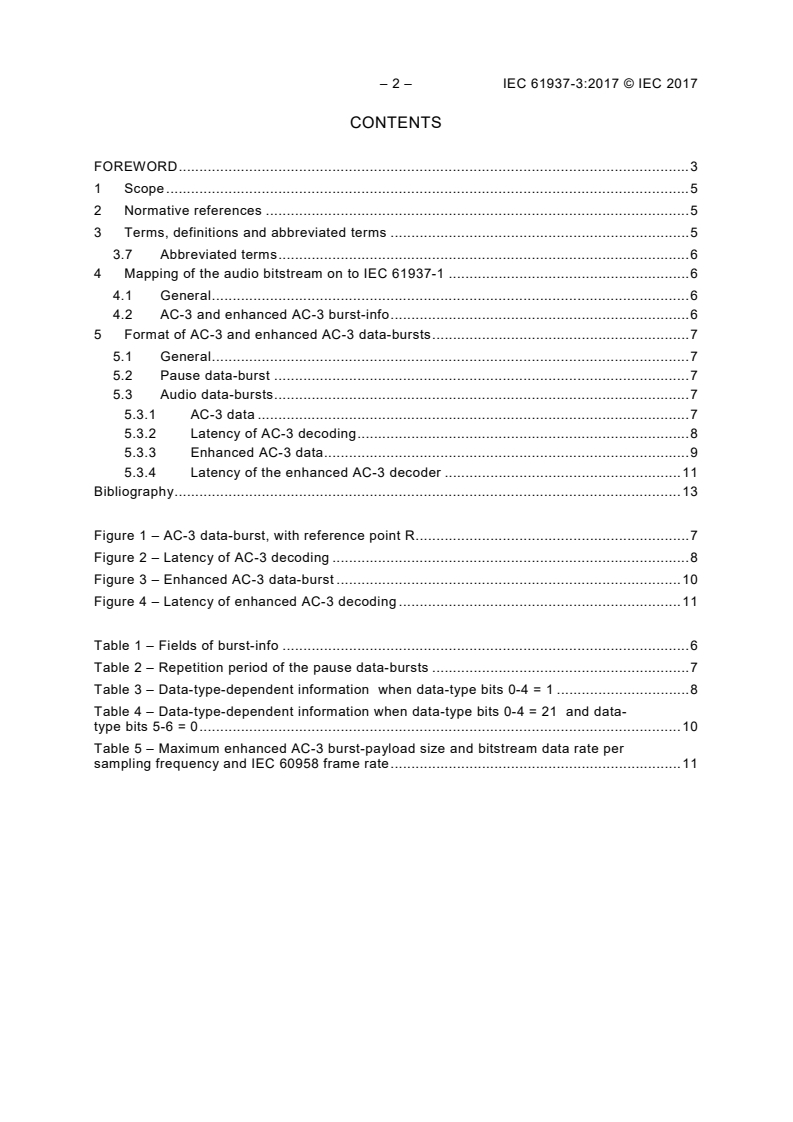
CONTENTS
FOREWORD . 3
1 Scope . 5
2 Normative references . 5
3 Terms, definitions and abbreviated terms . 5
3.7 Abbreviated terms . 6
4 Mapping of the audio bitstream on to IEC 61937-1 . 6
4.1 General . 6
4.2 AC-3 and enhanced AC-3 burst-info . 6
5 Format of AC-3 and enhanced AC-3 data-bursts . 7
5.1 General . 7
5.2 Pause data-burst . 7
5.3 Audio data-bursts . 7
5.3.1 AC-3 data . 7
5.3.2 Latency of AC-3 decoding . 8
5.3.3 Enhanced AC-3 data . 9
5.3.4 Latency of the enhanced AC-3 decoder . 11
Bibliography . 13
Figure 1 – AC-3 data-burst, with reference point R. 7
Figure 2 – Latency of AC-3 decoding . 8
Figure 3 – Enhanced AC-3 data-burst . 10
Figure 4 – Latency of enhanced AC-3 decoding . 11
Table 1 – Fields of burst-info . 6
Table 2 – Repetition period of the pause data-bursts . 7
Table 3 – Data-type-dependent information when data-type bits 0-4 = 1 . 8
Table 4 – Data-type-dependent information when data-type bits 0-4 = 21 and data-
type bits 5-6 = 0 . 10
Table 5 – Maximum enhanced AC-3 burst-payload size and bitstream data rate per
sampling frequency and IEC 60958 frame rate . 11
INTERNATIONAL ELECTROTECHNICAL COMMISSION
____________
DIGITAL AUDIO –
INTERFACE FOR NON-LINEAR PCM ENCODED AUDIO BITSTREAMS
APPLYING IEC 60958 –
Part 3: Non-linear PCM bitstreams according to the AC-3 and
enhanced AC-3 formats
FOREWORD
1) The International Electrotechnical Commission (IEC) is a worldwide organization for standardization comprising
all national electrotechnical committees (IEC National Committees). The object of IEC is to promote
international co-operation on all questions concerning standardization in the electrical and electronic fields. To
this end and in addition to other activities, IEC publishes International Standards, Technical Specifications,
Technical Reports, Publicly Available Specifications (PAS) and Guides (hereafter referred to as “IEC
Publication(s)”). Their preparation is entrusted to technical committees; any IEC National Committee interested
in the subject dealt with may participate in this preparatory work. International, governmental and non-
governmental organizations liaising with the IEC also participate in this preparation. IEC collaborates closely
with the International Organization for Standardization (ISO) in accordance with conditions determined by
agreement between the two organizations.
2) The formal decisions or agreements of IEC on technical matters express, as nearly as possible, an international
consensus of opinion on the relevant subjects since each technical committee has representation from all
interested IEC National Committees.
3) IEC Publications have the form of recommendations for international use and are accepted by IEC National
Committees in that sense. While all reasonable efforts are made to ensure that the technical content of IEC
Publications is accurate, IEC cannot be held responsible for the way in which they are used or for any
misinterpretation by any end user.
4) In order to promote international uniformity, IEC National Committees undertake to apply IEC Publications
transparently to the maximum extent possible in their national and regional publications. Any divergence
between any IEC Publication and the corresponding national or regional publication shall be clearly indicated in
the latter.
5) IEC itself does not provide any attestation of conformity. Independent certification bodies provide conformity
assessment services and, in some areas, access to IEC marks of conformity. IEC is not responsible for any
services carried out by independent certification bodies.
6) All users should ensure that they have the latest edition of this publication.
7) No liability shall attach to IEC or its directors, employees, servants or agents including individual experts and
members of its technical committees and IEC National Committees for any personal injury, property damage or
other damage of any nature whatsoever, whether direct or indirect, or for costs (including legal fees) and
expenses arising out of the publication, use of, or reliance upon, this IEC Publication or any other IEC
Publications.
8) Attention is drawn to the Normative references cited in this publication. Use of the referenced publications is
indispensable for the correct application of this publication.
9) Attention is drawn to the possibility that some of the elements of this IEC Publication may be the subject of
patent rights. IEC shall not be held responsible for identifying any or all such patent rights.
International Standard IEC 61937-3 has been prepared by subcommittee technical area 4:
Digital system interfaces and protocols, of IEC technical committee 100: Audio, video and
multimedia systems and equipment.
This third edition of IEC 61937-3 cancels and replaces the second edition published in 2007.
This edition constitutes a technical revision.
This edition includes the following significant technical changes with respect to the previous
edition:
a) removal of support for enhanced AC-3 bitstreams with a sampling frequency of 32 kHz;
b) updates to normative and informative references;
c) clarification of pause data-burst usage for enhanced AC-3 bitstreams.
– 4 – IEC 61937-3:2017 © IEC 2017
The text of this International Standard is based on the following documents:
CDV Report on voting
100/2720/CDV 100/2934/RVC
Full information on the voting for the approval of this International Standard can be found in
the report on voting indicated in the above table.
This document has been drafted in accordance with the ISO/IEC Directives, Part 2.
A list of all parts in the IEC 61973 series, published under the general title Digital audio –
Interface for non-linear PCM encoded audio bitstreams applying IEC 60958, can be found on
the IEC website.
The committee has decided that the contents of this document will remain unchanged until the
stability date indicated on the IEC website under "http://webstore.iec.ch" in the data related to
the specific document. At this date, the document will be
• reconfirmed,
• withdrawn,
• replaced by a revised edition, or
• amended.
A bilingual version of this publication may be issued at a later date.
DIGITAL AUDIO –
INTERFACE FOR NON-LINEAR PCM ENCODED AUDIO BITSTREAMS
APPLYING IEC 60958 –
Part 3: Non-linear PCM bitstreams according to the AC-3 and
enhanced AC-3 formats
1 Scope
This part of IEC 61937 describes the method used to convey non-linear PCM bitstreams
encoded according to the AC-3 and enhanced AC-3 formats.
2 Normative references
The following documents are referred to in the text in such a way that some or all of their
content constitutes requirements of this document. For dated references, only the edition
cited applies. For undated references, the latest edition of the referenced document (including
any amendments) applies.
IEC 61937-1:2007, Digital audio interface for non-linear PCM encoded audio bit streams
applying IEC 60958 – Part 1: General
IEC 61937-1:2007/AMD1:2011, Digital audio interface for non-linear PCM encoded audio bit
streams applying IEC 60958 – Part 1: General
IEC 61937-2, Digital audio interface for non-linear PCM encoded audio bit streams applying
IEC 60958 – Part 2: Burst-info
ETSI TS 102 366, Digital Audio Compression (AC-3, Enhanced AC-3) Standard
3 Terms, definitions and abbreviated terms
For the purposes of this document, the following terms and definitions apply.
ISO and IEC maintain terminological databases for use in standardization at the following
addresses:
• IEC Electropedia: available at http://www.electropedia.org/
• ISO Online browsing platform: available at http://www.iso.org/obp
3.1
block identification flag
flag used to indicate that the first audio block of an enhanced AC-3 syncframe with a stream
type value of two formed the first audio block in the AC-3 syncframe from which it was
converted
3.2
converter synchronization flag
flag used for synchronization by a device that converts an enhanced AC-3 bitstream to a
bitstream compliant with an AC-3 decoder and indicates that the first block in this enhanced
AC-3 syncframe will form the first block of the AC-3 syncframe output by the conversion
process
– 6 – IEC 61937-3:2017 © IEC 2017
3.3
latency
delay time of an external audio decoder to decode an AC-3 or enhanced AC-3 data-burst,
defined as the sum of two values: the receiving delay time and the decoding delay time
3.4
stream type
parameter of an enhanced AC-3 syncframe identifying the type of substream of which the
syncframe is a part
Note 1 to entry: An enhanced AC-3 bitstream is constructed from one or more substreams, with each substream
being constructed from a sequence of syncframes.
3.5
substream identification
parameter of an enhanced AC-3 syncframe which, in conjunction with the stream type
parameter, identifies the substream in the bitstream of which the syncframe is a part
3.6
syncframe
minimum portion of the AC-3 or enhanced AC-3 audio serial bitstream capable of being fully
decoded, also known as a synchronization frame
3.7 Abbreviated terms
ATSC Advanced Television Systems Committee
ETSI European Telecommunications Standards Institute
4 Mapping of the audio bitstream on to IEC 61937-1
4.1 General
The coding of the bitstream and data-burst is in accordance with IEC 61937-1,
IEC 61937-1:2007/AMD1:2011 and IEC 61937-2, including field names such as "Pc", "Pa" and
"R".
4.2 AC-3 and enhanced AC-3 burst-info
The 16-bit burst-info contains information about the data that will be found in the data-burst
(see Table 1).
Table 1 – Fields of burst-info
Bits of Data-type Data-type Contents Reference Repetition period of data-burst measured in
Pc bits 0-4 bits 5-6 point R
IEC 60958 frames
0 to 6 1 0 AC-3 R-AC-3 1 536
1 to 3 Reserved
2 to 20 According to IEC 61937
21 0 Enhanced AC-3 Bit 0 of Pa 6 144
1 to 3 According to IEC 61937
22 to 31 According to IEC 61937
7 to 15 According to IEC 61937
5 Format of AC-3 and enhanced AC-3 data-bursts
5.1 General
This clause specifies the audio data-bursts AC-3 and enhanced AC-3. Specific properties
such as reference points, repetition periods, the method of filling stream gaps and decoding
latency are specified.
The decoding latency (or delay), indicated for the data-type bits 0-4, should be used by the
transmitter to schedule data-bursts as necessary to establish synchronization between picture
and decoded audio.
5.2 Pause data-burst
Pause data-bursts for AC-3 and enhanced AC-3 are given in Table 2.
Table 2 – Repetition period of the pause data-bursts
Data-type bits 0-4 of audio data-burst Repetition period of pause data-burst
Mandatory Recommended
AC-3 - 3 IEC 60958 frames
Enhanced AC-3 - 4 IEC 60958 frames
5.3 Audio data-bursts
5.3.1 AC-3 data
The AC-3 bitstream consists of a sequence of AC-3 syncframes. The data-type bits 0-4 of an
AC 3 data-burst is 1. An AC-3 syncframe represents 1 536 samples of each encoded audio
channel (left, centre, etc.). The data-burst is headed with a burst-preamble followed by the
burst-payload. The burst-payload of each data-burst of AC-3 data shall c
...
IEC 61937-3 ®
Edition 3.1 2020-09
CONSOLIDATED VERSION
INTERNATIONAL
STANDARD
colour
inside
Digital audio – Interface for non-linear PCM encoded audio bitstreams applying
IEC 60958 –
Part 3: Non-linear PCM bitstreams according to the AC-3 and enhanced
AC-3 formats
All rights reserved. Unless otherwise specified, no part of this publication may be reproduced or utilized in any form
or by any means, electronic or mechanical, including photocopying and microfilm, without permission in writing from
either IEC or IEC's member National Committee in the country of the requester. If you have any questions about IEC
copyright or have an enquiry about obtaining additional rights to this publication, please contact the address below or
your local IEC member National Committee for further information.
IEC Central Office Tel.: +41 22 919 02 11
3, rue de Varembé info@iec.ch
CH-1211 Geneva 20 www.iec.ch
Switzerland
About the IEC
The International Electrotechnical Commission (IEC) is the leading global organization that prepares and publishes
International Standards for all electrical, electronic and related technologies.
About IEC publications
The technical content of IEC publications is kept under constant review by the IEC. Please make sure that you have the
latest edition, a corrigendum or an amendment might have been published.
IEC publications search - webstore.iec.ch/advsearchform Electropedia - www.electropedia.org
The advanced search enables to find IEC publications by a The world's leading online dictionary on electrotechnology,
variety of criteria (reference number, text, technical containing more than 22 000 terminological entries in English
committee,…). It also gives information on projects, replaced and French, with equivalent terms in 16 additional languages.
and withdrawn publications. Also known as the International Electrotechnical Vocabulary
(IEV) online.
IEC Just Published - webstore.iec.ch/justpublished
Stay up to date on all new IEC publications. Just Published IEC Glossary - std.iec.ch/glossary
details all new publications released. Available online and 67 000 electrotechnical terminology entries in English and
once a month by email. French extracted from the Terms and definitions clause of
IEC publications issued between 2002 and 2015. Some
IEC Customer Service Centre - webstore.iec.ch/csc entries have been collected from earlier publications of IEC
If you wish to give us your feedback on this publication or TC 37, 77, 86 and CISPR.
need further assistance, please contact the Customer Service
Centre: sales@iec.ch.
IEC 61937-3 ®
Edition 3.1 2020-09
CONSOLIDATED VERSION
INTERNATIONAL
STANDARD
colour
inside
Digital audio – Interface for non-linear PCM encoded audio bitstreams applying
IEC 60958 –
Part 3: Non-linear PCM bitstreams according to the AC-3 and enhanced
AC-3 formats
INTERNATIONAL
ELECTROTECHNICAL
COMMISSION
ICS 33.160.30 ISBN 978-2-8322-8910-5
IEC 61937-3 ®
Edition 3.1 2020-09
CONSOLIDATED VERSION
REDLINE VERSION
colour
inside
Digital audio – Interface for non-linear PCM encoded audio bitstreams applying
IEC 60958 –
Part 3: Non-linear PCM bitstreams according to the AC-3 and enhanced
AC-3 formats
– 2 – IEC 61937-3:2017+AMD1:2020 CSV
© IEC 2020
CONTENTS
FOREWORD . 3
1 Scope . 6
2 Normative references . 6
3 Terms, definitions and abbreviated terms . 6
3.7 Abbreviated terms . 7
4 Mapping of the audio bitstream on to IEC 61937-1 . 7
4.1 General . 7
4.2 AC-3 and enhanced AC-3 burst-info . 7
5 Format of AC-3 and enhanced AC-3 data-bursts . 8
5.1 General . 8
5.2 Pause data-burst . 8
5.3 Audio data-bursts . 8
5.3.1 AC-3 data . 8
5.3.2 Latency of AC-3 decoding . 9
5.3.3 Enhanced AC-3 data . 10
5.3.4 Latency of the enhanced AC-3 decoder . 12
Bibliography . 14
Figure 1 – AC-3 data-burst, with reference point R. 8
Figure 2 – Latency of AC-3 decoding . 9
Figure 3 – Enhanced AC-3 data-burst . 11
Figure 4 – Latency of enhanced AC-3 decoding . 12
Table 1 – Fields of burst-info . 7
Table 2 – Repetition period of the pause data-bursts . 8
Table 3 – Data-type-dependent information when data-type bits 0-4 = 1 . 9
Table 4 – Data-type-dependent information when data-type bits 0-4 = 21 and data-
type bits 5-6 = 0 . 11
Table 5 – Maximum enhanced AC-3 burst-payload size and bitstream data rate per
sampling frequency and IEC 60958 frame rate . 12
© IEC 2020
INTERNATIONAL ELECTROTECHNICAL COMMISSION
____________
DIGITAL AUDIO –
INTERFACE FOR NON-LINEAR PCM ENCODED AUDIO BITSTREAMS
APPLYING IEC 60958 –
Part 3: Non-linear PCM bitstreams according to the AC-3 and
enhanced AC-3 formats
FOREWORD
1) The International Electrotechnical Commission (IEC) is a worldwide organization for standardization comprising
all national electrotechnical committees (IEC National Committees). The object of IEC is to promote
international co-operation on all questions concerning standardization in the electrical and electronic fields. To
this end and in addition to other activities, IEC publishes International Standards, Technical Specifications,
Technical Reports, Publicly Available Specifications (PAS) and Guides (hereafter referred to as “IEC
Publication(s)”). Their preparation is entrusted to technical committees; any IEC National Committee interested
in the subject dealt with may participate in this preparatory work. International, governmental and non-
governmental organizations liaising with the IEC also participate in this preparation. IEC collaborates closely
with the International Organization for Standardization (ISO) in accordance with conditions determined by
agreement between the two organizations.
2) The formal decisions or agreements of IEC on technical matters express, as nearly as possible, an international
consensus of opinion on the relevant subjects since each technical committee has representation from all
interested IEC National Committees.
3) IEC Publications have the form of recommendations for international use and are accepted by IEC National
Committees in that sense. While all reasonable efforts are made to ensure that the technical content of IEC
Publications is accurate, IEC cannot be held responsible for the way in which they are used or for any
misinterpretation by any end user.
4) In order to promote international uniformity, IEC National Committees undertake to apply IEC Publications
transparently to the maximum extent possible in their national and regional publications. Any divergence
between any IEC Publication and the corresponding national or regional publication shall be clearly indicated in
the latter.
5) IEC itself does not provide any attestation of conformity. Independent certification bodies provide conformity
assessment services and, in some areas, access to IEC marks of conformity. IEC is not responsible for any
services carried out by independent certification bodies.
6) All users should ensure that they have the latest edition of this publication.
7) No liability shall attach to IEC or its directors, employees, servants or agents including individual experts and
members of its technical committees and IEC National Committees for any personal injury, property damage or
other damage of any nature whatsoever, whether direct or indirect, or for costs (including legal fees) and
expenses arising out of the publication, use of, or reliance upon, this IEC Publication or any other IEC
Publications.
8) Attention is drawn to the Normative references cited in this publication. Use of the referenced publications is
indispensable for the correct application of this publication.
9) Attention is drawn to the possibility that some of the elements of this IEC Publication may be the subject of
patent rights. IEC shall not be held responsible for identifying any or all such patent rights.
This consolidated version of the official IEC Standard and its amendment has been
prepared for user convenience.
IEC 61937-3 edition 3.1 contains the third edition (2017-07) [documents 100/2720/CDV
and 100/2934/RVC] and its amendment 1 (2020-09) [documents 100/3392/CDV and
100/3456/RVC].
In this Redline version, a vertical line in the margin shows where the technical content
is modified by amendment 1. Additions are in green text, deletions are in strikethrough
red text. A separate Final version with all changes accepted is available in this
publication.
– 4 – IEC 61937-3:2017+AMD1:2020 CSV
© IEC 2020
International Standard IEC 61937-3 has been prepared by subcommittee technical area 4:
Digital system interfaces and protocols, of IEC technical committee 100: Audio, video and
multimedia systems and equipment.
This third edition constitutes a technical revision.
This edition includes the following significant technical changes with respect to the previous
edition:
a) removal of support for enhanced AC-3 bitstreams with a sampling frequency of 32 kHz;
b) updates to normative and informative references;
c) clarification of pause data-burst usage for enhanced AC-3 bitstreams.
This document has been drafted in accordance with the ISO/IEC Directives, Part 2.
A list of all parts in the IEC 61973 series, published under the general title Digital audio –
Interface for non-linear PCM encoded audio bitstreams applying IEC 60958, can be found on
the IEC website.
The committee has decided that the contents of the base publication and its amendment will
remain unchanged until the stability date indicated on the IEC web site under
"http://webstore.iec.ch" in the data related to the specific publication. At this date, the
publication will be
• reconfirmed,
• withdrawn,
• replaced by a revised edition, or
• amended.
IMPORTANT – The 'colour inside' logo on the cover page of this publication indicates
that it contains colours which are considered to be useful for the correct
understanding of its contents. Users should therefore print this document using a
colour printer.
© IEC 2020
INTRODUCTION to Amendment 1
This amendment to 61937-3:2017 is necessary to remove the last paragraph from the
Enhanced AC-3 provisions that does not apply to Enhanced AC-3. It only applies to AC-3 and
was inadvertantly copied when Enhanced AC-3 was authored.
– 6 – IEC 61937-3:2017+AMD1:2020 CSV
© IEC 2020
DIGITAL AUDIO –
INTERFACE FOR NON-LINEAR PCM ENCODED AUDIO BITSTREAMS
APPLYING IEC 60958 –
Part 3: Non-linear PCM bitstreams according to the AC-3 and
enhanced AC-3 formats
1 Scope
This part of IEC 61937 describes the method used to convey non-linear PCM bitstreams
encoded according to the AC-3 and enhanced AC-3 formats.
2 Normative references
The following documents are referred to in the text in such a way that some or all of their
content constitutes requirements of this document. For dated references, only the edition
cited applies. For undated references, the latest edition of the referenced document (including
any amendments) applies.
IEC 61937-1:2007, Digital audio interface for non-linear PCM encoded audio bit streams
applying IEC 60958 – Part 1: General
IEC 61937-1:2007/AMD1:2011, Digital audio interface for non-linear PCM encoded audio bit
streams applying IEC 60958 – Part 1: General
IEC 61937-2, Digital audio interface for non-linear PCM encoded audio bit streams applying
IEC 60958 – Part 2: Burst-info
ETSI TS 102 366, Digital Audio Compression (AC-3, Enhanced AC-3) Standard
3 Terms, definitions and abbreviated terms
For the purposes of this document, the following terms and definitions apply.
ISO and IEC maintain terminological databases for use in standardization at the following
addresses:
• IEC Electropedia: available at http://www.electropedia.org/
• ISO Online browsing platform: available at http://www.iso.org/obp
3.1
block identification flag
flag used to indicate that the first audio block of an enhanced AC-3 syncframe with a stream
type value of two formed the first audio block in the AC-3 syncframe from which it was
converted
3.2
converter synchronization flag
flag used for synchronization by a device that converts an enhanced AC-3 bitstream to a
bitstream compliant with an AC-3 decoder and indicates that the first block in this enhanced
AC-3 syncframe will form the first block of the AC-3 syncframe output by the conversion
process
© IEC 2020
3.3
latency
delay time of an external audio decoder to decode an AC-3 or enhanced AC-3 data-burst,
defined as the sum of two values: the receiving delay time and the decoding delay time
3.4
stream type
parameter of an enhanced AC-3 syncframe identifying the type of substream of which the
syncframe is a part
Note 1 to entry: An enhanced AC-3 bitstream is constructed from one or more substreams, with each substream
being constructed from a sequence of syncframes.
3.5
substream identification
parameter of an enhanced AC-3 syncframe which, in conjunction with the stream type
parameter, identifies the substream in the bitstream of which the syncframe is a part
3.6
syncframe
minimum portion of the AC-3 or enhanced AC-3 audio serial bitstream capable of being fully
decoded, also known as a synchronization frame
3.7 Abbreviated terms
ATSC Advanced Television Systems Committee
ETSI European Telecommunications Standards Institute
4 Mapping of the audio bitstream on to IEC 61937-1
4.1 General
The coding of the bitstream and data-burst is in accordance with IEC 61937-1,
IEC 61937-1:2007/AMD1:2011 and IEC 61937-2, including field names such as "Pc", "Pa" and
"R".
4.2 AC-3 and enhanced AC-3 burst-info
The 16-bit burst-info contains information about the data that will be found in the data-burst
(see Table 1).
Table 1 – Fields of burst-info
Bits of Data-type Data-type Contents Reference Repetition period of data-burst measured in
Pc bits 0-4 bits 5-6 point R
IEC 60958 frames
0 to 6 1 0 AC-3 R-AC-3 1 536
1 to 3 Reserved
2 to 20 According to IEC 61937
21 0 Enhanced AC-3 Bit 0 of Pa 6 144
1 to 3 According to IEC 61937
22 to 31 According to IEC 61937
7 to 15 According to IEC 61937
– 8 – IEC 61937-3:2017+AMD1:2020 CSV
© IEC 2020
5 Format of AC-3 and enhanced AC-3 data-bursts
5.1 General
This clause specifies the audio data-bursts AC-3 and enhanced AC-3. Specific properties
such as reference points, repetition periods, the method of filling stream gaps and decoding
latency are specified.
The decoding latency (or delay), indicated for the data-type bits 0-4, should be used by the
transmitter to schedule data-bursts as necessary to establish synchronization between picture
and decoded audio.
5.2 Pause data-burst
Pause data-bursts for AC-3 and enhanced AC-3 are given in Table 2.
Table 2 – Repetition period of the pause data-bursts
Data-type bits 0-4 of audio data-burst Repetition period of pause data-burst
Mandatory Recommended
AC-3 - 3 IEC 60958 frames
Enhanced AC-3 - 4 IEC 60958 frames
5.3 Audio data-bursts
5.3.1 AC-3 data
The AC-3 bitstream consists of a sequence of AC-3 syncframes. The data-type bits 0-4 of an
AC 3 data-burst is 1. An AC-3 syncframe represents 1 536 samples of each encoded audio
channel (left, centre, etc.). The data-burst is headed with a burst-preamble followed by the
burst-payload. The burst-payload of each data-burst of AC-3 data shall contain one complete
AC-3 syncframe. Figure 1 shows the structure of the AC-3 data-burst.
The length of the AC-3 data-burst will depend on the encoded bit rate (which determines the
AC-3 syncframe size). The AC-3 bitstream is specified in ETSI TS 102 366 (see also
ATSC A/52:2012).
Pa Pb Pc Pd AC-3 burst-payload Pa Pb Pc Pd AC-3 burst-payload
R-AC-3 R-AC-3
Stuffing AC-3 frame
AC-3 frame
Regular rate of the AC-3 syncframes
Repetition period of the burst
IEC
Figure 1 – AC-3 data-burst, with reference point R
The data-type-dependent info for bits 0-4 of AC-3 is given in Table 3.
© IEC 2020
Table 3 – Data-type-dependent information
when data-type bits 0-4 = 1
Bits of Pc Data-type bits 0-4 Contents
LSB.MSB dependent, bit number
LSB…MSB
8 to 10 0 to 2 Value of ‘bsmod’ parameter in AC-3 elementary stream
11, 12 3 and 4 Reserved
The data-bursts containing AC-3 syncframes shall occur at a regular rate, with the reference
point of each AC-3 data-burst beginning (except in the case of a gap) 1 536 frames
(IEC 60958 frames) after the reference point of the preceding AC-3 data-burst (of the same
bitstream number).
The reference point of an AC-3 data-burst (R-AC-3) is the IEC 60958 frame that occurs two-
thirds of the way through the AC-3 burst-payload. The definition of the two-thirds value is the
closest integer to the value of the AC-3 syncframe size measured in 32-bit words multiplied by
the value 2/3, or:
2 2
× AC3syncframesize= rint( × AC3syncframesize32)
3 3
where:
• AC3syncframesize is "AC-3 syncframe size";
• AC3syncframesize32 is "AC-3 syncframe size in 32-bit words";
• rint() rounds to the nearest integer.
5.3.2 Latency of AC-3 decoding
The latency of an AC-3 decoder which receives the signal is specified, with respect to the
reference point of the AC-3 burst, to be equal to one AC-3 block time, which is equal to the
time occupied by 256 PCM samples at the encoded sampling frequency (5,33 ms for 48 kHz
sampling frequency; see Figure 2).
Pa Pb Pc Pd AC-3 burst-payload Pa Pb Pc Pd AC-3 burst-payload
R-AC-3 R-AC-3
Stuffing
AC-3 frame AC-3 frame
Regular rate of the AC-3 syncframes
Latency of the AC-3 decoder
IEC
Figure 2 – Latency of AC-3 decoding
It is recommended that pause data-bursts be used to fill stream gaps in the AC-3 bitstream,
as described in IEC 61937-1, and that pause data-bursts be transmitted with a repetition
period of three IEC 60958 frames, except when other repetition periods are necessary to fill
the precise stream gap length (which may not be a multiple of three IEC 60958 frames), or to
meet the requirement on burst spacing (see IEC 61937-1:2007, 6.3.3).
– 10 – IEC 61937-3:2017+AMD1:2020 CSV
© IEC 2020
When a stream gap in an AC-3 stream is filled by a sequence of pause data-bursts, the Pa of
the first pause data-burst shall be located one data-burst repetition period following the Pa of
the previous AC-3 syncframe. It is recommended that the sequence(s) of pause data-bursts
which fill the stream gap should continue from this point up to (as close as possible
considering the three IEC 60958 frame length of the pause data-burst) the Pa of the first AC-3
data-burst which follows the stream gap.
The gap length parameter contained in the pause data-burst is intended to be interpreted by
the AC-3 decoder as an indication of the number of decoded PCM samples which are missing
(due to the resulting audio gap). If the sizes of the AC-3 syncframes before and after the
stream gap are not equal (due to a bit rate change in the interrupted AC-3 bitstream), this
value may differ from the actual number of sampling periods of the audio contained in the
stream gap due to the definition of the AC-3 burst reference points.
Some AC-3 decoders may be capable of "concealing" audio gaps. The indication of the audio
gap length (gap-length) which may be included in the payload of the pause data-burst allows
the decoder to know how long an audio gap will need to be concealed, and thus allow the
decoder to optimize the concealment process for the actual audio gap length. AC-3 decoders
will most easily conceal audio gaps that have a length equal to an integral multiple of 256
samples. Thus, audio gaps of lengths 256, 512, 768, etc. sampling periods of the audio are
strongly preferred, and transmitters should provide stream gaps that represent audio gaps
with this granularity.
It is possible that an audio gap in an AC-3 stream is carried over this interface without there
also being a stream gap. This can happen when the audio gap length is small and there is a
bit rate change in the interrupted AC-3 bit stream, and the bit rate following the gap is larger
than the bit rate prior to the gap. Because of the definition of the reference point of the AC-3
data-burst, it is possible for the Pa of the first burst following a bitstream interruption to be
less than one data-burst repetition period of the audio following the Pa of the burst preceding
the gap, while the reference point of the first burst following the bit stream interruption is more
than one data-burst repetition period of the audio after the reference point of the burst
preceding the gap. When this case occurs, since there is no stream gap to fill with pause
bursts, there is no need to send any pause bursts. The audio decoder will never be starved
for data and can calculate the length of the audio gap based on the reference points of the
received AC-3 bursts.
5.3.3 Enhanced AC-3 data
An enhanced AC-3 bitstream is constructed from one or more substreams, with each
substream being constructed from a sequence of enhanced AC-3 syncframes. An enhanced
AC-3 syncframe is constructed from blocks of audio data, each block representing 256
samples of audio of each encoded audio channel (left, centre, etc.). An enhanced AC-3
syncframe can consist of one, two, three, or six blocks of audio data. The number of blocks
per enhanced AC-3 syncframe is the same for all substreams present in the bitstream and is
constant for the duration of the bitstream.
The data-burst is headed with a burst-preamble, followed by the burst-payload. The data-type
bits 0-4 of an enhanced AC-3 data-burst is 21, and the data-type bits 5-6 is 0. When
enhanced AC-3 data is being transmitted, the transmission device shall ensure that both the
data-type bits 0-4 and data-type bits 5-6 values are set correctly. Additionally, the receiving
device shall utilize both the data-type bits 0-4 and data-type bits 5-6 values to ensure that the
content of the data-burst is correctly identified as enhanced AC-3. The structure of the
enhanced AC-3 data-burst is shown in Figure 3.
The enhanced AC-3 burst-payload shall always contain six blocks of coded audio data,
representing 1 536 samples of PCM audio at the encoded sampling frequency, from every
substream present in the bitstream. The transmission device shall ensure that the enhanced
AC-3 burst-payload is constructed only from complete enhanced AC-3 syncframes. It is
prohibited to transmit a single enhanced AC-3 syncframe using multiple data-bursts.
© IEC 2020
The transmission device shall ensure that the first enhanced AC-3 syncframe in the burst-
payload is the syncframe that has a stream type value of zero or two, and a substream
identification value of zero. When the enhanced AC-3 bitstream is constructed from
syncframes that consist of six blocks of audio data, one syncframe from every substream
present in the bitstream shall be included in the burst-payload.
When the enhanced AC-3 bitstream is constructed from syncframes that consist of less than
six blocks of audio, the transmission device shall ensure that the burst-payload contains the
number of enhanced AC-3 syncframes required to deliver six blocks of audio data from every
substream in the bitstream. For example, when the bitstream is constructed from syncframes
that consist of two blocks of audio data, the burst-payload shall contain three enhanced AC-3
syncframes from every substream in the bitstream. Additionally, when the number of blocks
per syncframe is less than six, the transmission device shall ensure that when the first
substream in the bitstream has a stream type value of zero, the first syncframe in the burst-
payload shall be the syncframe where the converter synchronization flag is set to one. When
the first substream in the bitstream has a stream type value of two, the first syncframe in the
burst-payload shall be the syncframe where the block identification flag is set to one.
The length of the enhanced AC-3 data-burst will depend on the encoded bit rate (which
determines the enhanced AC-3 syncframe size). The enhanced AC 3 bitstream is specified in
ETSI TS 102 366 (see also ATSC A/52:2012).
Enhanced AC-3 Enhanced AC-3
Pa Pb Pc Pd Pa Pb Pc Pd
burst-payload burst-payload
bit 0 of Pa bit 0 of Pa
Enhanced AC-3
Enhanced AC-3
syncframe(s) Stuffing Stuffing
syncframe(s)
Regular rate of Enhanced AC-3 data-bursts
Repetition period of the burst
IEC
Figure 3 – Enhanced AC-3 data-burst
The data-type-dependent information for bits 0-4 for enhanced AC-3 is given in Table 4.
Table 4 – Data-type-dependent information when data-type bits 0-4 = 21
and data-type bits 5-6 = 0
Bits of Pc Data-type bits 0-4 Contents
LSB…MSB dependent, bit
number
LSB…MSB
8-10 0-2 Value of ‘bsmod’ parameter in independent substream 0 of the enhanced
AC-3 elementary stream. If the ‘bsmod’ parameter is not present in the
enhanced AC-3 elementary stream, these bits shall be set to ‘0’
11, 12 3-4 Reserved
The reference point of an enhanced AC-3 data-burst is bit 0 of Pa. The data-bursts containing
enhanced AC-3 syncframes shall occur at a regular rate. The units of burst-length shall be in
bytes.
When enhanced AC-3 streams are conveyed via the IEC 61937 interface, the IEC 60958
frame rate shall always be four times the sampling frequency of the enhanced AC-3 bitstream,
and the repetition period of the enhanced AC-3 data-burst shall be 6 144 frames (IEC 60958
frames). Table 5 shows the relationship between the frame repetition period and the
– 12 – IEC 61937-3:2017+AMD1:2020 CSV
© IEC 2020
IEC 60958 frame rate, and the maximum burst-payload size and maximum data rate for the
enhanced AC-3 bitstream.
Table 5 – Maximum enhanced AC-3 burst-payload size and bitstream data rate per
sampling frequency and IEC 60958 frame rate
Encoded IEC 60958 Data-burst repetition Burst duration Maximum burst- Maximum
sampling frame rate period payload size data rate
frequency
kHz kHz IEC 60958 frames ms bytes kbit/s
44,1 176,4 6 144 34,83 24 560 5 641
48 192 6 144 32 24 560 6 140
The maximum burst-payload sizes and data rates shown in Table 5 assume a provision for
two IEC 60958 frames for padding between data-bursts.
5.3.4 Latency of the enhanced AC-3 decoder
The latency of an enhanced AC-3 decoder is defined as the sum of the receiving delay time
and decoding delay time.
The receiving delay time is the time taken to receive the complete enhanced AC-3 burst-
payload and is dependent on the encoded bitrate of the enhanced AC-3 bitstream. For the
purposes of maintaining synchronization (for example, with video), it is recommended that a
constant value of receiving delay time be assumed. This value is calculated on the basis of
the maximum possible size of an enhanced AC-3 burst-payload and is equal to the time
occupied by 6 142 frames (IEC 60958 frames) at the IEC 60958 frame rate.
The decoding delay time is equal to the time occupied by 1 792 PCM samples at the encoded
sampling frequency or 7 168 frames (IEC 60958 frames) at the IEC 60958 frame rate. See
Figure 4.
Enhanced AC-3 Enhanced AC-3 Enhanced AC-3
Pa Pb Pc Pd Pa Pb Pc Pd Pa Pb Pc Pd
burst-payload burst-payload burst-payload
bit 0 of Pa bit 0 of Pa bit 0 of Pa Enhanced AC-3
Enhanced AC-3
Enhanced AC-3
syncframe(s)
Stuffing syncframe(s) Stuffing
syncframe(s)
Regular rate of Enhanced AC-3 data-bursts
Repetition period of the data-burst
Latency of Enhanced AC-3 decoder
IEC
Figure 4 – Latency of enhanced AC-3 decoding
It is recommended that pause data-bursts be used to fill stream gaps in the enhanced AC-3
bitstream, as described in IEC 61937-1, and that pause data-bursts be transmitted with a
repetition period of four IEC 60958 frames, except when other repetition periods are
necessary to fill the precise stream gap length (which may not be a multiple of four IEC 60958
frames), or to meet the requirement on burst spacing (see IEC 61937-1:2007, 6.3.3).
When a stream gap in an enhanced AC-3 stream is filled by a sequence of pause data-bursts,
the Pa of the first pause data-burst shall be located one data-burst repetition period following
the Pa of the previous enhanced AC-3 data-burst. It is recommended that the sequence(s) of
pause data-bursts which fill the stream gap should continue from this point up to (as close as
possible considering the four IEC 60958 frame lengths of the pause data-burst) the Pa of the
first enhanced AC-3 data-burst which follows the stream gap.
© IEC 2020
The gap length parameter contained in the pause data-burst is intended to be interpreted by
the enhanced AC-3 decoder as an indication of the number of decoded PCM samples which
are missing (due to the resulting audio gap). The gap length parameter indicates the gap
length measured in IEC 60958 frames at the IEC 60958 frame rate. As the frame rate of the
IEC 60958 interface is always four times the sampling frequency of the coded audio stream
when delivering enhanced AC-3 data, the value of the gap-length parameter is four times the
number of PCM audio samples which would be missing in the decoded output signal. For
example, a gap-length value of "4" would indicate that one sample is missing in the decoded
output signal.
If the sizes of the enhanced AC-3 syncframes before and after the stream gap are not equal
(due to a bit rate change in the interrupted enhanced AC-3 bitstream), the number of audio
sampling periods indicated by the gap-length parameter may differ from the actual number of
sampling periods of the audio contained in the stream gap due to the definition of the
enhanced AC-3 burst reference points.
Some enhanced AC-3 decoders may be capable of "concealing" audio gaps. The indication of
the audio gap length (gap-length), which may be included in the payload of the pause data-
burst, allows the decoder to know how long an audio gap will need to be concealed and, thus,
to optimize the concealment process for the actual audio gap length. Enhanced AC-3
decoders will most easily conceal audio gaps that have a length equal to an integral multiple
of 256 decoded output samples. Thus, audio gap-length values of 1 024, 2 048, 3 072, etc.
IEC 60958 frames are strongly preferred, and transmitters should provide stream gaps that
represent audio gaps with this granularity.
It is possible that an audio gap in an enhanced AC-3 stream is carried over this interface
without there also being a stream gap. This can happen when the audio gap length is small,
there is a bit rate change in the interrupted enhanced AC-3 bit stream, and the bit rate
following the gap is larger than the bit rate prior to the gap. Because of the definition of the
reference point of the enhanced AC-3 data-burst, it is possible for the Pa of the first data-
burst following a bitstream interruption to be less than one data-burst repetition period
following the Pa of the data-burst preceding the gap, while the reference point of the first
data-burst following the bitstream interruption is more than one data-burst repetition period
after the reference point of the data-burst preceding the gap. When this case occurs, since
there is no stream gap to fill with pause bursts, there is no need to send any pause bursts.
The audio decoder will never be starved for data and can calculate the length of the audio gap
based on the reference points of the received enhanced AC-3 data-bursts.
– 14 – IEC 61937-3:2017+AMD1:2020 CSV
© IEC 2020
Bibliography
ATSC Standard A/52:2012, Digital Audio Compression (AC-3, E-AC-3) Standard,
http://www.atsc.org.
High-Definition Multimedia Interface Specification Version 1.4 and later, available from HDMI
Licensing, LLC, http://www.hdmi.org
Technical Bulletin – Dolby® Digital Plus and HDMI, available under license from Dolby
Laboratories Licensing Corporation, http://www.dolby.com
___________
___________
HDMI, the HDMI logo and High-Definition Multimedia Interface are trademarks or registered trademarks of
HDMI Licensing LLC. This information is given for the convenience of users of this document and does not
constitute an endorsement by IEC of the product named.
Dolby is a registered trademark of Dolby Laboratories. This information is given for the convenience of users of
this document and does not constitute an endorsement by IEC of the product named.
IEC 61937-3 ®
Edition 3.1 2020-09
CONSOLIDATED VERSION
FINAL VERSION
Digital audio – Interface for non-linear PCM encoded audio bitstreams applying
IEC 60958 –
Part 3: Non-linear PCM bitstreams according to the AC-3 and enhanced
AC-3 formats
– 2 – IEC 61937-3:2017+AMD1:2020 CSV
© IEC 2020
CONTENTS
FOREWORD . 3
1 Scope . 6
2 Normative references . 6
3 Terms, definitions and abbreviated terms . 6
3.7 Abbreviated terms . 7
4 Mapping of the audio bitstream on to IEC 61937-1 . 7
4.1 General . 7
4.2 AC-3 and enhanced AC-3 burst-info . 7
5 Format of AC-3 and enhanced AC-3 data-bursts . 8
5.1 General . 8
5.2 Pause data-burst . 8
5.3 Audio data-bursts . 8
5.3.1 AC-3 data . 8
5.3.2 Latency of AC-3 decoding . 9
5.3.3 Enhanced AC-3 data . 10
5.3.4 Latency of the enhanced AC-3 decoder . 12
Bibliography . 14
Figure 1 – AC-3 data-burst, with reference point R. 8
Figure 2 – Latency of AC-3 decoding . 9
Figure 3 – Enhanced AC-3 data-burst . 11
Figure 4 – Latency of enhanced AC-3 decoding . 12
Table 1 – Fields of burst-info . 7
Table 2 – Repetition period of the pause data-bursts . 8
Table 3 – Data-type-dependent information when data-type bits 0-4 = 1 . 9
Table 4 – Data-type-dependent information when data-type bits 0-4 = 21 and data-
type bits 5-6 = 0 . 11
Table 5 – Maximum enhanced AC-3 burst-payload size and bitstream data rate per
sampling frequency and IEC 60958 frame rate . 12
© IEC 2020
INTERNATIONAL ELECTROTECHNICAL COMMISSION
____________
DIGITAL AUDIO –
INTERFACE FOR NON-LINEAR PCM ENCODED AUDIO BITSTREAMS
APPLYING IEC 60958 –
Part 3: Non-linear PCM bitstreams according to the AC-3 and
enhanced AC-3 formats
FOREWORD
1) The International Electrotechnical Commission (IEC) is a worldwide organization for standardization comprising
all national electrotechnical committees (IEC National Committees). The object of IEC is to promote
international co-operation on all questions concerning standardization in the electrical and electronic fields. To
this end and in addition to other activities, IEC publishes International Standards, Technical Specifications,
Technical Reports, Publicly Available Specifications (PAS) and Guides (hereafter referred to as “IEC
Publication(s)”). Their preparation is entrusted to technical committees; any IEC National Committee interested
in the subject dealt with may participate in this preparatory work. International, governmental and non-
governmental organizations liaising with the IEC also participate in this preparation. IEC collaborates closely
with the International Organization for Standardization (ISO) in accordance with conditions determined by
agreement between the two organizations.
2) The formal decisions or agreements of IEC on technical matters express, as nearly as possible, an international
consensus of opinion on the relevant subjects since each technical committee has representation from all
interested IEC National Committees.
3) IEC Publications have the form of recommendations for international use and are accepted by IEC National
Committees in that sense. While all reasonable efforts are made to ensure that the technical content of IEC
Publications is accurate, IEC cannot be held responsible for the way in which they are used or for any
misinterpretation by any end user.
4) In order to promote international uniformity, IEC National Committees undertake to apply IEC Publications
transparently to the maximum extent possible in their national and regional publications. Any divergence
between any IEC Publication and the corresponding national or regional publication shall be clearly indicated in
the latter.
5) IEC itself does not provide any attestation of conformity. Independent certification bodies provide conformity
assessment services and, in some areas, access to IEC marks of conformity. IEC is not responsible for any
services carried out by independent certification bodies.
6) All users should ensure that they have the latest edition of this publication.
7) No liability shall attach to IEC or its directors, employees, servants or agents including individual experts and
members of its technical committees and IEC National Committees for any personal injury, property damage or
other damage of any nature whatsoever, whether direct or indirect, or for costs (including legal fees) and
expenses arising out of the publication, use of, or reliance upon, this IEC Publication or any other IEC
Publications.
8) Attention is drawn to the Normative references cited in this publication. Use of the referenced publications is
indispensable for the correct application of this publication.
9) Attention is drawn to the possibility that some of the elements of this IEC Publication may be the subject of
patent rights. IEC shall not be held responsible for identifying any or all such patent rights.
This consolidated version of the official IEC Standard and its amendment has been
prepared for user convenience.
IEC 61937-3 edition 3.1 contains the third edition (2017-07) [documents 100/2720/CDV
and 100/2934/RVC] and its amendment 1 (2020-09) [documents 100/3392/CDV and
100/3456/RVC].
This Final version does not show where the technical content is modified by
amendment 1. A separate Redline version with all changes highlighted is available in
this publication.
– 4 – IEC 61937-3:2017+AMD1:2020 CSV
© IEC 2020
International Standard IEC 61937-3 has been prepared by subcommittee technical area 4:
Digital system interfaces and protocols, of IEC technical committee 100: Audio, video and
multimedia systems and equipment.
This third edition constitutes a technical revision.
This edition includes the following significant technical changes with respect to the previous
edition:
a) removal of support for enhanced AC-3 bitstreams with a sampling frequency of 32 kHz;
b) updates to normative and informative references;
c) clarification of pause data-burst usage for enhanced AC-3 bitstreams.
This document has been drafted in accordance with the ISO/IEC Di
...
IEC 61937-3 ®
Edition 3.0 2017-07
REDLINE VERSION
INTERNATIONAL
STANDARD
colour
inside
Digital audio – Interface for non-linear PCM encoded audio bitstreams applying
IEC 60958 –
Part 3: Non-linear PCM bitstreams according to the AC-3 and enhanced
AC-3 formats
All rights reserved. Unless otherwise specified, no part of this publication may be reproduced or utilized in any form
or by any means, electronic or mechanical, including photocopying and microfilm, without permission in writing from
either IEC or IEC's member National Committee in the country of the requester. If you have any questions about IEC
copyright or have an enquiry about obtaining additional rights to this publication, please contact the address below or
your local IEC member National Committee for further information.
IEC Central Office Tel.: +41 22 919 02 11
3, rue de Varembé Fax: +41 22 919 03 00
CH-1211 Geneva 20 info@iec.ch
Switzerland www.iec.ch
About the IEC
The International Electrotechnical Commission (IEC) is the leading global organization that prepares and publishes
International Standards for all electrical, electronic and related technologies.
About IEC publications
The technical content of IEC publications is kept under constant review by the IEC. Please make sure that you have the
latest edition, a corrigenda or an amendment might have been published.
IEC Catalogue - webstore.iec.ch/catalogue Electropedia - www.electropedia.org
The stand-alone application for consulting the entire The world's leading online dictionary of electronic and
bibliographical information on IEC International Standards, electrical terms containing 20 000 terms and definitions in
Technical Specifications, Technical Reports and other English and French, with equivalent terms in 16 additional
documents. Available for PC, Mac OS, Android Tablets and languages. Also known as the International Electrotechnical
iPad. Vocabulary (IEV) online.
IEC publications search - www.iec.ch/searchpub IEC Glossary - std.iec.ch/glossary
The advanced search enables to find IEC publications by a 65 000 electrotechnical terminology entries in English and
variety of criteria (reference number, text, technical French extracted from the Terms and Definitions clause of
committee,…). It also gives information on projects, replaced IEC publications issued since 2002. Some entries have been
and withdrawn publications. collected from earlier publications of IEC TC 37, 77, 86 and
CISPR.
IEC Just Published - webstore.iec.ch/justpublished
Stay up to date on all new IEC publications. Just Published IEC Customer Service Centre - webstore.iec.ch/csc
details all new publications released. Available online and If you wish to give us your feedback on this publication or
also once a month by email. need further assistance, please contact the Customer Service
Centre: csc@iec.ch.
IEC 61937-3 ®
Edition 3.0 2017-07
REDLINE VERSION
INTERNATIONAL
STANDARD
colour
inside
Digital audio – Interface for non-linear PCM encoded audio bitstreams applying
IEC 60958 –
Part 3: Non-linear PCM bitstreams according to the AC-3 and enhanced
AC-3 formats
INTERNATIONAL
ELECTROTECHNICAL
COMMISSION
ICS 33.160.30 ISBN 978-2-8322-4677-1
– 2 – IEC 61937-3:2017 RLV © IEC 2017
CONTENTS
FOREWORD . 3
1 Scope . 5
2 Normative references . 5
3 Terms, definitions and abbreviated terms . 5
3.7 Abbreviated terms . 6
4 Mapping of the audio bitstream on to IEC 61937-1 . 6
4.1 General . 6
4.2 AC-3 and enhanced AC-3 burst-info . 6
5 Format of AC-3 and enhanced AC-3 data-bursts . 7
5.1 General . 7
5.2 Pause data-burst . 7
5.3 Audio data-bursts . 8
5.3.1 AC-3 data . 8
5.3.2 Latency of AC-3 decoding . 9
5.3.3 Enhanced AC-3 data . 10
5.3.4 Latency of the enhanced AC-3 decoder . 12
Bibliography . 14
Figure 1 – AC-3 data-burst, with reference point R. 8
Figure 2 – Latency of AC-3 decoding . 9
Figure 3 – Enhanced AC-3 data-burst . 11
Figure 4 – Latency of enhanced AC-3 decoding . 12
Table 1 – Fields of burst-info . 7
Table 2 – Repetition period of the pause data-bursts . 7
Table 3 – Data-type-dependent information when data-type bits 0-4= 1 . 8
Table 4 – Data-type-dependent information when data-type bits 0-4 = 21 and data-
type bits 5-6 = 0 . 11
Table 5 – Frame repetition period and maximum data rate for enhanced AC-3
bitstreams .
Table 5 – Maximum enhanced AC-3 burst-payload size and bitstream data rate per
sampling frequency and IEC 60958 frame rate . 12
INTERNATIONAL ELECTROTECHNICAL COMMISSION
____________
DIGITAL AUDIO –
INTERFACE FOR NON-LINEAR PCM ENCODED AUDIO BITSTREAMS
APPLYING IEC 60958 –
Part 3: Non-linear PCM bitstreams according to the AC-3 and
enhanced AC-3 formats
FOREWORD
1) The International Electrotechnical Commission (IEC) is a worldwide organization for standardization comprising
all national electrotechnical committees (IEC National Committees). The object of IEC is to promote
international co-operation on all questions concerning standardization in the electrical and electronic fields. To
this end and in addition to other activities, IEC publishes International Standards, Technical Specifications,
Technical Reports, Publicly Available Specifications (PAS) and Guides (hereafter referred to as “IEC
Publication(s)”). Their preparation is entrusted to technical committees; any IEC National Committee interested
in the subject dealt with may participate in this preparatory work. International, governmental and non-
governmental organizations liaising with the IEC also participate in this preparation. IEC collaborates closely
with the International Organization for Standardization (ISO) in accordance with conditions determined by
agreement between the two organizations.
2) The formal decisions or agreements of IEC on technical matters express, as nearly as possible, an international
consensus of opinion on the relevant subjects since each technical committee has representation from all
interested IEC National Committees.
3) IEC Publications have the form of recommendations for international use and are accepted by IEC National
Committees in that sense. While all reasonable efforts are made to ensure that the technical content of IEC
Publications is accurate, IEC cannot be held responsible for the way in which they are used or for any
misinterpretation by any end user.
4) In order to promote international uniformity, IEC National Committees undertake to apply IEC Publications
transparently to the maximum extent possible in their national and regional publications. Any divergence
between any IEC Publication and the corresponding national or regional publication shall be clearly indicated in
the latter.
5) IEC itself does not provide any attestation of conformity. Independent certification bodies provide conformity
assessment services and, in some areas, access to IEC marks of conformity. IEC is not responsible for any
services carried out by independent certification bodies.
6) All users should ensure that they have the latest edition of this publication.
7) No liability shall attach to IEC or its directors, employees, servants or agents including individual experts and
members of its technical committees and IEC National Committees for any personal injury, property damage or
other damage of any nature whatsoever, whether direct or indirect, or for costs (including legal fees) and
expenses arising out of the publication, use of, or reliance upon, this IEC Publication or any other IEC
Publications.
8) Attention is drawn to the Normative references cited in this publication. Use of the referenced publications is
indispensable for the correct application of this publication.
9) Attention is drawn to the possibility that some of the elements of this IEC Publication may be the subject of
patent rights. IEC shall not be held responsible for identifying any or all such patent rights.
This redline version of the official IEC Standard allows the user to identify the changes
made to the previous edition. A vertical bar appears in the margin wherever a change
has been made. Additions are in green text, deletions are in strikethrough red text.
– 4 – IEC 61937-3:2017 RLV © IEC 2017
International Standard IEC 61937-3 has been prepared by subcommittee technical area 4:
Digital system interfaces and protocols, of IEC technical committee 100: Audio, video and
multimedia systems and equipment.
This third edition of IEC 61937-3 cancels and replaces the second edition published in 2007.
This edition constitutes a technical revision.
This edition includes the following significant technical changes with respect to the previous
edition:
a) removal of support for enhanced AC-3 bitstreams with a sampling frequency of 32 kHz;
b) updates to normative and informative references;
c) clarification of pause data-burst usage for enhanced AC-3 bitstreams.
The text of this International Standard is based on the following documents:
CDV Report on voting
100/2720/CDV 100/2934/RVC
Full information on the voting for the approval of this International Standard can be found in
the report on voting indicated in the above table.
This document has been drafted in accordance with the ISO/IEC Directives, Part 2.
A list of all parts in the IEC 61973 series, published under the general title Digital audio –
Interface for non-linear PCM encoded audio bitstreams applying IEC 60958, can be found on
the IEC website.
The committee has decided that the contents of this document will remain unchanged until the
stability date indicated on the IEC website under "http://webstore.iec.ch" in the data related to
the specific document. At this date, the document will be
• reconfirmed,
• withdrawn,
• replaced by a revised edition, or
• amended.
A bilingual version of this publication may be issued at a later date.
IMPORTANT – The “colour inside” logo on the cover page of this publication indicates
that it contains colours which are considered to be useful for the correct understanding
of its contents. Users should therefore print this publication using a colour printer.
DIGITAL AUDIO –
INTERFACE FOR NON-LINEAR PCM ENCODED AUDIO BITSTREAMS
APPLYING IEC 60958 –
Part 3: Non-linear PCM bitstreams according to the AC-3 and
enhanced AC-3 formats
1 Scope
This part of IEC 61937 describes the method used to convey non-linear PCM bitstreams
encoded according to the AC-3 and enhanced AC-3 formats.
2 Normative references
The following documents are referred to in the text in such a way that some or all of their
content constitutes requirements of this document. For dated references, only the edition
cited applies. For undated references, the latest edition of the referenced document (including
any amendments) applies.
IEC 60958 (all parts), Digital audio interface
IEC 61937-1:2007, Digital audio interface for non-linear PCM encoded audio bit streams
applying IEC 60958 – Part 1: General
IEC 61937-1:2007/AMD1:2011, Digital audio interface for non-linear PCM encoded audio bit
streams applying IEC 60958 – Part 1: General
IEC 61937-2:2007, Digital audio interface for non-linear PCM encoded audio bit streams
applying IEC 60958 – Part 2: Burst-info
ATSC Standard A/52B, Digital Audio Compression (AC-3, E-AC-3), Rev. B
ETSI TS 102 366, Digital Audio Compression (AC-3, Enhanced AC-3) Standard
3 Terms, definitions and abbreviated terms
For the purposes of this document, the following terms and definitions and abbreviations
apply.
ISO and IEC maintain terminological databases for use in standardization at the following
addresses:
• IEC Electropedia: available at http://www.electropedia.org/
• ISO Online browsing platform: available at http://www.iso.org/obp
– 6 – IEC 61937-3:2017 RLV © IEC 2017
3.1
block identification flag
if the stream type value of an enhanced AC-3 substream is two, indicating that the bitstream
has been converted from an AC-3 bitstream, this bit is set to 1 to indicate that the first block
in this enhanced AC-3 frame was the first block in the original standard AC-3 frame
flag used to indicate that the first audio block of an enhanced AC-3 syncframe with a stream
type value of two formed the first audio block in the AC-3 syncframe from which it was
converted
3.2
converter synchronization flag
flag used for synchronization by a device that converts an enhanced AC-3 bitstream to a
bitstream compliant with an AC-3 decoder and indicates that the first block in this enhanced
AC-3 syncframe will form the first block of the AC-3 syncframe output by the conversion
process
3.3
latency
delay time of an external audio decoder to decode an AC-3 or enhanced AC-3 data burst,
defined as the sum of two values: the receiving delay time and the decoding delay time
3.4
stream type
parameter of an enhanced AC-3 syncframe identifying the type of substream of which the
syncframe is a part
Note 1 to entry: An enhanced AC-3 bitstream is constructed from one or more substreams, with each substream
being constructed from a sequence of syncframes.
3.5
substream identification
substream identification parameter of an enhanced AC-3 syncframe which, in conjunction with
the stream type parameter, identifies the substream in the bitstream of which the enhanced
AC-3 syncframe is a part
3.6
syncframe
minimum portion of the AC-3 or enhanced AC-3 audio serial bitstream capable of being fully
decoded, also known as a synchronization frame
3.7 Abbreviated terms
ATSC Advanced Television Standards Systems Committee
ETSI European Telecommunications Standards Institute
IEC International Electrotechnical Commission
ISO/IEC MPEG Moving Pictures Expert Group, a joint committee of ISO and IEC
4 Mapping of the audio bitstream on to IEC 61937-1
4.1 General
The coding of the bitstream and data-burst is in accordance with IEC 61937-1,
IEC 61937-1:2007/AMD1:2011 and IEC 61937-2, including field names such as "Pc", "Pa" and
"R".
4.2 AC-3 and enhanced AC-3 burst-info
The 16-bit burst-info contains information about the data that will be found in the data-burst
(see Table 1).
Table 1 – Fields of burst-info
Data- Sub- Contents Reference Repetition period of
type data- point R data-burst measured in
type IEC 60958 frames
Value of
Pc bits Value of
0-4 Pc bits
5-6
1 0 AC-3 R-AC-3 1 536
21 0 Enhanced AC-3 Bit 0 of Pa 6 144
1-3 Reserved Reserved Reserved
Bits of Data-type Data-type Contents Reference Repetition period of data-burst measured in
Pc bits 0-4 bits 5-6 point R
IEC 60958 frames
0 to 6 1 0 AC-3 R-AC-3 1 536
1 to 3 Reserved
2 to 20 According to IEC 61937
21 0 Enhanced AC-3 Bit 0 of Pa 6 144
1 to 3 According to IEC 61937
22 to 31 According to IEC 61937
7 to 15 According to IEC 61937
5 Format of AC-3 and enhanced AC-3 data-bursts
5.1 General
This clause specifies the audio data-bursts AC-3 and enhanced AC-3. Specific properties
such as reference points, repetition periods, the method of filling stream gaps and decoding
latency are specified.
The decoding latency (or delay), indicated for the data-type bits 0-4, should be used by the
transmitter to schedule data-bursts as necessary to establish synchronization between picture
and decoded audio.
5.2 Pause data-burst
Pause data-bursts for AC-3 and enhanced AC-3 are given in Table 2.
Table 2 – Repetition period of the pause data-bursts
Data-type bits 0-4 of audio data-burst Repetition period of pause data-burst
Mandatory Recommended
AC-3 - 3 IEC 60958 frames
Enhanced AC-3 - 4 IEC 60958 frames
– 8 – IEC 61937-3:2017 RLV © IEC 2017
5.3 Audio data-bursts
5.3.1 AC-3 data
The AC-3 bitstream consists of a sequence of AC-3 syncframes. The data-type bits 0-4 of an
AC 3 data-burst is 1. An AC-3 syncframe represents 1 536 samples of each encoded audio
channel (left, centre, etc.). The data-burst is headed with a burst-preamble followed by the
burst-payload. The burst-payload of each data-burst of AC-3 data shall contain one complete
AC-3 syncframe. Figure 1 shows the structure of the AC-3 data-burst.
The length of the AC-3 data-burst will depend on the encoded bit rate (which determines the
AC-3 syncframe length size). The specification for the AC-3 bitstream may be found in ATSC
Standard A52/B or The AC-3 bitstream is specified in ETSI TS 102 366 (see also
ATSC A/52:2012).
Pa Pb Pc Pd AC-3 burst-payload Pa Pb Pc Pd AC-3 burst-payload
R-AC-3 R-AC-3
Stuffing AC-3 frame
AC-3 frame
Regular rate of the AC-3 syncframes
Repetition period of the burst
IEC
Figure 1 – AC-3 data-burst, with reference point R
The data-type-dependent info for bits 0-4 of AC-3 is given in Table 3.
Table 3 – Data-type-dependent information
when data-type bits 0-4 = 1
Bits of Pc Data-type bits 0-4 Contents
LSB.MSB dependent, bit number
LSB…MSB
8 to 10 0 to 2 Value of ‘bsmod’ parameter in AC-3 elementary stream
11, 12 3 and 4 Reserved
The data-bursts containing AC-3 syncframes shall occur at a regular rate, with the reference
point of each AC-3 data-burst beginning (except in the case of a gap) 1 536 sampling periods
of the audio frames (IEC 60958 frames) after the reference point of the preceding AC-3 data-
burst (of the same bitstream number).
The reference point of an AC-3 data-burst (R-AC-3) is the IEC 60958 frame that occurs two-
thirds of the way through the AC-3 burst-payload. The definition of the two-thirds value is the
closest integer to the value of the AC-3 syncframe size measured in 32-bit words multiplied by
the value 2/3, or:
2/3 frame size = int (0,5 + (2/3) × (frame size in 32-bit words))
2 2
× AC3syncframesize = rint( × AC3syncframesize32)
3 3
where:
• AC3syncframesize is "AC-3 syncframe size";
• AC3syncframesize32 is "AC-3 syncframe size in 32-bit words";
• rint() rounds to the nearest integer.
5.3.2 Latency of AC-3 decoding
The latency of an AC-3 decoder which receives the signal is specified, with respect to the
reference point of the AC-3 burst, to be equal to one AC-3 block time, which is equal to the
time occupied by 256 PCM samples at the encoded sampling frequency (5,33 ms for 48 kHz
sampling frequency; see Figure 2).
Pa Pb Pc Pd AC-3 burst-payload Pa Pb Pc Pd AC-3 burst-payload
R-AC-3 R-AC-3
Stuffing
AC-3 frame AC-3 frame
Regular rate of the AC-3 syncframes
Latency of the AC-3 decoder
IEC
Figure 2 – Latency of AC-3 decoding
It is recommended that pause data-bursts be used to fill stream gaps in the AC-3 bitstream,
as described in IEC 61937-1, and that pause data-bursts be transmitted with a repetition
period of three IEC 60958 frames, except when other repetition periods are necessary to fill
the precise stream gap length (which may not be a multiple of three IEC 60958 frames), or to
meet the requirement on burst spacing (see IEC 61937-1:2007, 6.3.3).
When a stream gap in an AC-3 stream is filled by a sequence of pause data-bursts, the Pa of
the first pause data-burst shall be located one frame data-burst repetition period following the
Pa of the previous AC-3 syncframe. It is recommended that the sequence(s) of pause data-
bursts which fill the stream gap should continue from this point up to (as close as possible
considering the three IEC 60958 frame length of the pause data-burst) the Pa of the first AC-3
data-burst which follows the stream gap.
The gap length parameter contained in the pause data-burst is intended to be interpreted by
the AC-3 decoder as an indication of the number of decoded PCM samples which are missing
(due to the resulting audio gap). If the sizes of the AC-3 syncframes before and after the
stream gap are not equal (due to a bit rate change in the interrupted AC-3 bitstream), this
value may differ from the actual number of sampling periods of the audio contained in the
stream gap due to the definition of the AC-3 burst reference points.
Some AC-3 decoders may be capable of "concealing" audio gaps. The indication of the audio
gap length (gap-length) which may be included in the payload of the pause data-burst allows
the decoder to know how long an audio gap will need to be concealed, and thus allow the
decoder to optimize the concealment process for the actual audio gap length. AC-3 decoders
will most easily conceal audio gaps that have a length equal to an integral multiple of 256
– 10 – IEC 61937-3:2017 RLV © IEC 2017
samples. Thus, audio gaps of lengths 256, 512, 768, etc. sampling periods of the audio are
strongly preferred, and transmitters should provide stream gaps that represent audio gaps
with this granularity.
It is possible that an audio gap in an AC-3 stream is carried over this interface without there
also being a stream gap. This can happen when the audio gap length is small and there is a
bit rate change in the interrupted AC-3 bit stream, and the bit rate following the gap is larger
than the bit rate prior to the gap. Because of the definition of the reference point of the AC-3
data-burst, it is possible for the Pa of the first burst following a bitstream interruption to be
less than frame one data-burst repetition period of the audio following the Pa of the burst
preceding the gap, while the reference point of the first burst following the bit stream
interruption is more than one frame data-burst repetition period of the audio after the
reference point of the burst preceding the gap. When this case occurs, since there is no
stream gap to fill with pause bursts, there is no need to send any pause bursts. The audio
decoder will never be starved for data and can calculate the length of the audio gap based on
the reference points of the received AC-3 bursts.
5.3.3 Enhanced AC-3 data
An enhanced AC-3 bitstream is constructed from one or more substreams, with each
substream being constructed from a sequence of enhanced AC-3 syncframes. An enhanced
AC-3 syncframe is constructed from blocks of audio data, each block representing 256
samples of audio of each encoded audio channel (left, centre, etc.). An enhanced AC-3
syncframe can consist of one, two, three, or six blocks of audio data. The number of blocks
per enhanced AC-3 syncframe is the same for all substreams present in the bitstream and is
constant for the duration of the bitstream.
The data-burst is headed with a burst-preamble, followed by the burst-payload. The data-type
bits 0-4 of an enhanced AC-3 data-burst is 21, and the sub-data-type bits 5-6 is 0. When
enhanced AC-3 data is being transmitted, the transmission device shall ensure that both the
data-type bits 0-4 and sub-data-type bits 5-6 values are set correctly. Additionally, the
receiving device shall utilize both the data-type bits 0-4 and sub-data-type bits 5-6 values to
ensure that the content of the data-burst is correctly identified as enhanced AC-3. The
structure of the enhanced AC-3 data-burst is shown in Figure 3.
The enhanced AC-3 burst-payload shall always contain six blocks of coded audio data,
representing 1 536 samples of PCM audio at the encoded sampling frequency, from each of
the every substreams present in the bitstream. The transmission device shall ensure that the
enhanced AC-3 burst-payload is constructed only from complete enhanced AC-3 syncframes.
It is prohibited to transmit a single enhanced AC-3 syncframe using multiple data-bursts.
The transmission device shall ensure that the first enhanced AC-3 syncframe in the burst-
payload is the syncframe that has a stream type value of zero or two, and a substream
identification value of zero. When the enhanced AC-3 bitstream is constructed from
syncframes that consist of six blocks of audio data, one syncframe from each every
substream present in the bitstream shall be included in the burst-payload.
When the enhanced AC-3 bitstream is constructed from syncframes that consist of less than
six blocks of audio, the transmission device shall ensure that the burst-payload contains the
number of enhanced AC-3 syncframes required to deliver six blocks of audio data from each
every substream in the bitstream. For example, when the bitstream is constructed from
syncframes that consist of two blocks of audio data, the burst-payload shall contain three
enhanced AC-3 syncframes from each every substream in the bitstream. Additionally, when
the number of blocks per syncframe is less than six, the transmission device shall ensure that
when the first substream in the bitstream has a stream type value of zero, the first syncframe
in the burst-payload shall be the syncframe where the converter synchronization flag is set to
one. When the first substream in the bitstream has a stream type value of two, the first
syncframe in the burst-payload shall be the syncframe where the block identification flag is
set to one.
The length of the enhanced AC-3 data-burst will depend on the encoded bit rate (which
determines the enhanced AC-3 syncframe length size). The specification for the enhanced AC
3 bitstream may be found in ATSC Standard A/52B or The enhanced AC 3 bitstream is
specified in ETSI TS 102 366 (see also ATSC A/52:2012).
Enhanced AC-3 Enhanced AC-3
Pa Pb Pc Pd Pa Pb Pc Pd
burst-payload burst-payload
bit 0 of Pa bit 0 of Pa
Enhanced AC-3
Enhanced AC-3
syncframe(s)
Stuffing syncframe(s) Stuffing
Regular rate of Enhanced AC-3 data-bursts
Repetition period of the burst
IEC
Figure 3 – Enhanced AC-3 data-burst
The maximum size of an enhanced AC-3 burst-payload is 24 560 bytes.
The data-type-dependent information for bits 0-4 for enhanced AC-3 is given in Table 4.
Table 4 – Data-type-dependent information when data-type bits 0-4 = 21
and data-type bits 5-6 = 0
Bits of Pc Data-type bits 0-4 Contents
LSB…MSB dependent, bit
number
LSB…MSB
8-10 0-2 Value of ‘bsmod’ parameter in independent substream 0 of the enhanced
AC-3 elementary stream. If the ‘bsmod’ parameter is not present in the
enhanced AC-3 elementary stream, these bits shall be set to ‘0’
11, 12 3-4 Reserved
The reference point of an enhanced AC-3 data-burst is bit 0 of Pa. The data-bursts containing
enhanced AC-3 syncframes shall occur at a regular rate. The units of burst-length shall be in
bytes.
When enhanced AC-3 streams are conveyed via the IEC 61937 interface, the IEC 60958
frame rate shall always be four times the sample rate sampling frequency of the enhanced
AC-3 bitstream, and the repetition period of the enhanced AC-3 data-burst shall be 6 144
sample periods frames (IEC 60958 frames). Table 5 shows the relationship between the frame
repetition period and the IEC 60958 frame rate, and the maximum available burst-payload
size and maximum data rate for the enhanced AC-3 bitstream.
Table 5 – Frame repetition period and maximum data rate
for enhanced AC-3 bitstreams
Encoded sample IEC 60958 frame Burst Maximum data
Frame repetition
rate rate duration rate
period
kHz kHz ms kbit/s
6 144 32 128 48 4 093
6 144 44,1 176,4 34,83 5 641
6 144 48 192 32 6 140
– 12 – IEC 61937-3:2017 RLV © IEC 2017
Table 5 – Maximum enhanced AC-3 burst-payload size and bitstream data rate per
sampling frequency and IEC 60958 frame rate
Encoded IEC 60958 Data-burst repetition Burst duration Maximum burst- Maximum
sampling frame rate period payload size data rate
frequency
kHz kHz IEC 60958 frames ms bytes kbit/s
44,1 176,4 6 144 34,83 24 560 5 641
48 192 6 144 32 24 560 6 140
The maximum burst-payload sizes and data rates shown in Table 5 assume a provision for
two IEC 60958 frames for padding between data-bursts.
5.3.4 Latency of the enhanced AC-3 decoder
The latency of an enhanced AC-3 decoder is defined as the sum of the receiving delay time
and decoding delay time.
The receiving delay time is the time taken to receive the complete enhanced AC-3 burst-
payload and is dependent on the encoded bitrate of the enhanced AC-3 bitstream. For the
purposes of maintaining synchronization (for example, with video), it is recommended that a
constant value of receiving delay time be assumed. This value is calculated on the basis of
the maximum possible size of an enhanced AC-3 burst-payload and is equal to the time
occupied by 6 142 frames (IEC 60958 frames) at the IEC 60958 frame rate.
The decoding delay time is equal to the time occupied by 1 792 PCM samples at the encoded
sampling frequency or 7 168 frames (IEC 60958 frames) at the IEC 60958 frame rate. See
Figure 4.
Enhanced AC-3 Enhanced AC-3 Enhanced AC-3
Pa Pb Pc Pd Pa Pb Pc Pd Pa Pb Pc Pd
burst-payload burst-payload burst-payload
bit 0 of Pa bit 0 of Pa bit 0 of Pa Enhanced AC-3
Enhanced AC-3
Enhanced AC-3
syncframe(s)
Stuffing syncframe(s) Stuffing
syncframe(s)
Regular rate of Enhanced AC-3 data-bursts
Repetition period of the data-burst
Latency of Enhanced AC-3 decoder
IEC
Figure 4 – Latency of enhanced AC-3 decoding
It is recommended that pause data-bursts be used to fill stream gaps in the enhanced AC-3
bitstream, as described in IEC 61937-1, and that pause data-bursts be transmitted with a
repetition period of four IEC 60958 frames, except when other repetition periods are
necessary to fill the precise stream gap length (which may not be a multiple of four IEC 60958
frames), or to meet the requirement on burst spacing (see IEC 61937-1:2007, 6.3.3).
When a stream gap in an enhanced AC-3 stream is filled by a sequence of pause data-bursts,
the Pa of the first pause data-burst shall be located one frame data-burst repetition period
following the Pa of the previous enhanced AC-3 frame data-burst. It is recommended that the
sequence(s) of pause data-bursts which fill the stream gap should continue from this point up
to (as close as possible considering the four IEC 60958 frame lengths of the pause data-
burst) the Pa of the first enhanced AC-3 data-burst which follows the stream gap.
The gap length parameter contained in the pause data-burst is intended to be interpreted by
the enhanced AC-3 decoder as an indication of the number of decoded PCM samples which
are missing (due to the resulting audio gap). The gap length parameter indicates the gap
length measured in IEC 60958 frames at the IEC 60958 clock frame rate. As the clock frame
rate of the IEC 60958 interface is always four times the sampling rate frequency of the coded
audio stream when delivering enhanced AC-3 data, the value of the gap-length parameter is
four times the number of PCM audio samples which would be missing in the decoded output
signal. For example, a gap-length value of "4" would indicate that one sample is missing in
the decoded output signal.
If the sizes of the enhanced AC-3 syncframes before and after the stream gap are not equal
(due to a bit rate change in the interrupted enhanced AC-3 bitstream), the number of audio
sampling periods indicated by the gap-length parameter may differ from the actual number of
sampling periods of the audio contained in the stream gap due to the definition of the
enhanced AC-3 burst reference points.
Some enhanced AC-3 decoders may be capable of "concealing" audio gaps. The indication of
the audio gap length (gap-length), which may be included in the payload of the pause data-
burst, allows the decoder to know how long an audio gap will need to be concealed and, thus,
to optimize the concealment process for the actual audio gap length. Enhanced AC-3
decoders will most easily conceal audio gaps that have a length equal to an integral multiple
of 256 decoded output samples. Thus, audio gap-length values of 1 024, 2 048, 3 072, etc.
IEC 60958 frames are strongly preferred, and transmitters should provide stream gaps that
represent audio gaps with this granularity.
It is possible that an audio gap in an enhanced AC-3 stream is carried over this interface
without there also being a stream gap. This can happen when the audio gap length is small,
there is a bit rate change in the interrupted enhanced AC-3 bit stream, and the bit rate
following the gap is larger than the bit rate prior to the gap. Because of the definition of the
reference point of the enhanced AC-3 data-burst, it is possible for the Pa of the first data-
burst following a bitstream interruption to be less than frame one data-burst repetition period
of the audio following the Pa of the data-burst preceding the gap, while the reference point of
the first data-burst following the bitstream interruption is more than one frame data-burst
repetition period of the audio after the reference point of the data-burst preceding the gap.
When this case occurs, since there is no stream gap to fill with pause bursts, there is no need
to send any pause bursts. The audio decoder will never be starved for data and can calculate
the length of the audio gap based on the reference points of the received enhanced AC-3
data-bursts.
– 14 – IEC 61937-3:2017 RLV © IEC 2017
Bibliography
ATSC Standard A/52:2012, Digital Audio Compression (AC-3, E-AC-3) Standard,
http://www.atsc.org.
High-Definition Multimedia Interface Specification Version 1.4 and later, available from HDMI
Licensing, LLC, http://www.hdmi.org
Technical Bulletin – Dolby® Digital Plus Transmission over the HDMI™ Interface has served
as a reference for the specification of the related data-type and other parts of IEC 61937.
Technical Bulletin – Dolby® Digital Plus and HDMI, available under license from Dolby
Laboratories Licensing Corporation, http://www.dolby.com
This document is available under license from Dolby Laboratories Licensing Corporation.
Dolby is a registered trademark of Dolby Laboratories. HDMI, the HDMI logo and High-
Definition Multimedia Interface are trademarks or registered trademarks of HDMI Licensing
LLC.
___________
___________
HDMI, the HDMI logo and High-Definition Multimedia Interface are trademarks or registered trademarks of
HDMI Licensing LLC. This information is given for the convenience of users of this document and does not
constitute an endorsement by IEC of the product named.
Dolby is a registered trademark of Dolby Laboratories. This information is given for the convenience of users of
this document and does not constitute an endorsement by IEC of the product named.
IEC 61937-3 ®
Edition 3.0 2017-07
INTERNATIONAL
STANDARD
Digital audio – Interface for non-linear PCM encoded audio bitstreams applying
IEC 60958 –
Part 3: Non-linear PCM bitstreams according to the AC-3 and enhanced
AC-3 formats
– 2 – IEC 61937-3:2017 © IEC 2017
CONTENTS
FOREWORD . 3
1 Scope . 5
2 Normative references . 5
3 Terms, definitions and abbreviated terms . 5
3.7 Abbreviated terms . 6
4 Mapping of the audio bitstream on to IEC 61937-1 . 6
4.1 General . 6
4.2 AC-3 and enhanced AC-3 burst-info . 6
5 Format of AC-3 and enhanced AC-3 data-bursts . 7
5.1 General . 7
5.2 Pause data-burst . 7
5.3 Audio data-bursts . 7
5.3.1 AC-3 data . 7
5.3.2 Latency of AC-3 decoding . 8
5.3.3 Enhanced AC-3 data . 9
5.3.4 Latency of the enhanced AC-3 decoder . 11
Bibliography . 13
Figure 1 – AC-3 data-burst, with reference point R. 7
Figure 2 – Latency of AC-3 decoding . 8
Figure 3 – Enhanced AC-3 data-burst . 10
Figure 4 – Latency of enhanced AC-3 decoding . 11
Table 1 – Fields of burst-info . 6
Table 2 – Repetition period of the pause data-bursts . 7
Table 3 – Data-type-dependent information when data-type bits 0-4 = 1 . 8
Table 4 – Data-type-dependent information when data-type bits 0-4 = 21 and data-
type bits 5-6 = 0 . 10
Table 5 – Maximum enhanced AC-3 burst-payload size and bitstream data rate per
sampling frequency and IEC 60958 frame rate . 11
INTERNATIONAL ELECTROTECHNICAL COMMISSION
____________
DIGITAL AUDIO –
INTERFACE FOR NON-LINEAR PCM ENCODED AUDIO BITSTREAMS
APPLYING IEC 60958 –
Part 3: Non-linear PCM bitstreams according to the AC-3 and
enhanced AC-3 formats
FOREWORD
1) The International Electrotechnical Commission (IEC) is a worldwide organization for standardization comprising
all national electrotechnical committees (IEC National Committees). The object of IEC is to promote
international co-operation on all questions concerning standardization in the electrical and electronic fields. To
this end and in addition to other activities, IEC publishes International Standards, Technical Specifications,
Technical Reports, Publicly Available Specifications (PAS) and Guides (hereafter referred to as “IEC
Publication(s)”). Their preparation is entrusted to technical committees; any IEC National Committee interested
in the subject dealt with may participate in this preparatory work. International, governmental and non-
governmental organizations liaising with the IEC also participate in this preparation. IEC collaborates closely
with the International Organization for Standardization (ISO) in accordance with conditions determined by
agreement between the two organizations.
2) The formal decisions or agreements of IEC on technical matters express, as nearly as possible, an international
consensus of opinion on the relevant subjects since each technical committee has representation from all
interested IEC National Committees.
3) IEC Publications have the form of recommendations for international use and are accepted by IEC National
Committees in that sense. While all reasonable efforts are made to ensure that the technical content of IEC
Publications is accurate, IEC cannot be held responsible for the way in which they are used or for any
misinterpretation by any end user.
4) In order to promote international uniformity, IEC National Committees undertake to apply IEC Publications
transparently to the maximum extent possible in their national and regional publications. Any divergence
between any IEC Publication and the corresponding national or regional publication shall be clearly indicated in
the latter.
5) IEC itself does not provide any attestation of conformity. Independent certification bodies provide conformity
assessment services and, in some areas, access to IEC marks of conformity. IEC is not responsible for any
services carried out by independent certification bodies.
6) All users should ensure that they have the latest edition of this publication.
7) No liability shall attach to IEC or its directors, employees, servants or agents including individual experts and
members of its technical committees and IEC National Committees for any personal injury, property damage or
other dam
...