

IEC 61340-5-3:2022
(Main)Electrostatics - Part 5-3: Protection of electronic devices from electrostatic phenomena - Properties and requirements classification for packaging intended for electrostatic discharge sensitive devices
General Information
- Abstract
IEC 61340-5-3:2022 defines the ESD protective packaging properties required to protect ESD sensitive devices (ESDSs) through all phases of production, rework and maintenance, transport and storage. Test methods are referenced to evaluate packaging and packaging materials for these product and material properties. Performance limits are provided.
This document does not address protection from electromagnetic interference (EMI), electromagnetic pulsing (EMP) or protection of electrically initiated explosive materials or devices.
This edition includes the following significant technical changes with respect to the previous edition:
a) reference to IEC 61340-4-10 was removed;
b) material resistance property "electrostatic field shielding" was removed;
c) the requirement for electrostatic discharge shielding was changed from 50 nJ to 20 nJ;
d) Table 1 – footnote "b" was changed to mention the two-point probe in IEC 61340-2-3;
e) "shall be marked" was changed to "should be marked" in 7.2.2 and 7.2.3;
f) Table 3 – the classification symbol and the primary function code F was removed;
g) Table A.2 – references to IEC TS 61340-5-4 [2] and IEC TR 61340-5-5 [3] were added;
h) Annex C – guidance regarding electric field shielding was added;
i) Annex D – low charging material property was added.
- Status
- Published
- Publication Date
- 26-Apr-2022
- Technical Committee
- TC 101 - Electrostatics
- Drafting Committee
- MT 11 - TC 101/MT 11
- Current Stage
- PPUB - Publication issued
- Start Date
- 27-Apr-2022
- Completion Date
- 13-May-2022
Buy Documents
REDLINE IEC 61340-5-3:2022 CMV - Electrostatics - Part 5-3: Protection of electronic devices from electrostatic phenomena - Properties and requirements classification for packaging intended for electrostatic discharge sensitive devices Released:4/27/2022
IEC 61340-5-3:2022 - Electrostatics - Part 5-3: Protection of electronic devices from electrostatic phenomena - Properties and requirements classification for packaging intended for electrostatic discharge sensitive devices Released:4/27/2022
Overview - IEC 61340-5-3:2022 (ESD packaging)
IEC 61340-5-3:2022 is an international standard that defines properties, classification and performance requirements for ESD protective packaging used to protect electrostatic discharge sensitive devices (ESDSs) during production, rework/maintenance, transport and storage. The standard references test methods to evaluate packaging materials and provides performance limits for packaging intended to prevent electrostatic damage. It explicitly excludes protection from EMI/EMP and electrically initiated explosive devices.
Key topics and technical requirements
- Scope and purpose: Specifies packaging material properties and classification criteria required to maintain device safety across all supply‑chain phases.
- Material resistance properties: Defines how conductive, dissipative and insulating materials are classified and tested (references include IEC 61340-2-3).
- Electrostatic discharge shielding: Sets performance limits and test methods for shielding packaging (see IEC 61340-4-8 for bag testing). Notably, the shielding energy requirement was tightened in this edition from 50 nJ to 20 nJ.
- Marking and traceability: Guidance on packaging classification symbols, marking and traceability - language softened in this edition from “shall be marked” to “should be marked.”
- New/changed content:
- Removal of the “electrostatic field shielding” material resistance property.
- Addition of annexes providing guidance on electric field shielding (Annex C) and a low charging material property (Annex D).
- Updated references to related technical reports and specifications (e.g., IEC TS 61340-5-4, IEC TR 61340-5-5).
- Test references and tables: The standard includes tables listing applicable test methods and performance limits for qualification and verification of packaging.
Practical applications - who uses this standard
IEC 61340-5-3:2022 is used by:
- Electronics manufacturers and contract manufacturers to specify ESD packaging requirements.
- Packaging designers and material suppliers for product development and material selection.
- Quality, ESD program and supply‑chain engineers for supplier qualification, incoming inspection and audit criteria.
- Test laboratories and conformity assessors for verifying packaging performance against referenced test methods. Typical uses include selecting shielding bags and dissipative materials, defining acceptance criteria, labeling packaging, and establishing periodic verification programs.
Related standards
- IEC 61340 series (electrostatics)
- IEC 61340-2-3 (resistivity test methods)
- IEC 61340-4-8 (ESD shielding - bags)
- IEC TS 61340-5-4, IEC TR 61340-5-5 (related guidance and technical specifications)
Keywords: IEC 61340-5-3:2022, ESD packaging, electrostatic discharge, ESDS, ESD protective packaging, electrostatic shielding, low charging materials.
Relations
- Effective Date
- 05-Sep-2023
Buy Documents
REDLINE IEC 61340-5-3:2022 CMV - Electrostatics - Part 5-3: Protection of electronic devices from electrostatic phenomena - Properties and requirements classification for packaging intended for electrostatic discharge sensitive devices Released:4/27/2022
IEC 61340-5-3:2022 - Electrostatics - Part 5-3: Protection of electronic devices from electrostatic phenomena - Properties and requirements classification for packaging intended for electrostatic discharge sensitive devices Released:4/27/2022
Get Certified
Connect with accredited certification bodies for this standard

IMQ S.p.A. (Certification)
Italian electrical product certification.

SLG Prüf- und Zertifizierungs GmbH
German testing and certification body.

UL Solutions
Global safety science company with testing, inspection and certification.
Sponsored listings
Frequently Asked Questions
IEC 61340-5-3:2022 is a standard published by the International Electrotechnical Commission (IEC). Its full title is "Electrostatics - Part 5-3: Protection of electronic devices from electrostatic phenomena - Properties and requirements classification for packaging intended for electrostatic discharge sensitive devices". This standard covers: IEC 61340-5-3:2022 defines the ESD protective packaging properties required to protect ESD sensitive devices (ESDSs) through all phases of production, rework and maintenance, transport and storage. Test methods are referenced to evaluate packaging and packaging materials for these product and material properties. Performance limits are provided. This document does not address protection from electromagnetic interference (EMI), electromagnetic pulsing (EMP) or protection of electrically initiated explosive materials or devices. This edition includes the following significant technical changes with respect to the previous edition: a) reference to IEC 61340-4-10 was removed; b) material resistance property "electrostatic field shielding" was removed; c) the requirement for electrostatic discharge shielding was changed from 50 nJ to 20 nJ; d) Table 1 – footnote "b" was changed to mention the two-point probe in IEC 61340-2-3; e) "shall be marked" was changed to "should be marked" in 7.2.2 and 7.2.3; f) Table 3 – the classification symbol and the primary function code F was removed; g) Table A.2 – references to IEC TS 61340-5-4 [2] and IEC TR 61340-5-5 [3] were added; h) Annex C – guidance regarding electric field shielding was added; i) Annex D – low charging material property was added.
IEC 61340-5-3:2022 defines the ESD protective packaging properties required to protect ESD sensitive devices (ESDSs) through all phases of production, rework and maintenance, transport and storage. Test methods are referenced to evaluate packaging and packaging materials for these product and material properties. Performance limits are provided. This document does not address protection from electromagnetic interference (EMI), electromagnetic pulsing (EMP) or protection of electrically initiated explosive materials or devices. This edition includes the following significant technical changes with respect to the previous edition: a) reference to IEC 61340-4-10 was removed; b) material resistance property "electrostatic field shielding" was removed; c) the requirement for electrostatic discharge shielding was changed from 50 nJ to 20 nJ; d) Table 1 – footnote "b" was changed to mention the two-point probe in IEC 61340-2-3; e) "shall be marked" was changed to "should be marked" in 7.2.2 and 7.2.3; f) Table 3 – the classification symbol and the primary function code F was removed; g) Table A.2 – references to IEC TS 61340-5-4 [2] and IEC TR 61340-5-5 [3] were added; h) Annex C – guidance regarding electric field shielding was added; i) Annex D – low charging material property was added.
IEC 61340-5-3:2022 is classified under the following ICS (International Classification for Standards) categories: 17.220.99 - Other standards related to electricity and magnetism; 29.020 - Electrical engineering in general. The ICS classification helps identify the subject area and facilitates finding related standards.
IEC 61340-5-3:2022 has the following relationships with other standards: It is inter standard links to IEC 61340-5-3:2015. Understanding these relationships helps ensure you are using the most current and applicable version of the standard.
IEC 61340-5-3:2022 is available in PDF format for immediate download after purchase. The document can be added to your cart and obtained through the secure checkout process. Digital delivery ensures instant access to the complete standard document.
Standards Content (Sample)
IEC 61340-5-3 ®
Edition 3.0 2022-04
COMMENTED VERSION
INTERNATIONAL
STANDARD
colour
inside
Electrostatics –
Part 5-3: Protection of electronic devices from electrostatic phenomena –
Properties and requirements classification for packaging intended for
electrostatic discharge sensitive devices
All rights reserved. Unless otherwise specified, no part of this publication may be reproduced or utilized in any form
or by any means, electronic or mechanical, including photocopying and microfilm, without permission in writing from
either IEC or IEC's member National Committee in the country of the requester. If you have any questions about IEC
copyright or have an enquiry about obtaining additional rights to this publication, please contact the address below or
your local IEC member National Committee for further information.
IEC Secretariat Tel.: +41 22 919 02 11
3, rue de Varembé info@iec.ch
CH-1211 Geneva 20 www.iec.ch
Switzerland
About the IEC
The International Electrotechnical Commission (IEC) is the leading global organization that prepares and publishes
International Standards for all electrical, electronic and related technologies.
About IEC publications
The technical content of IEC publications is kept under constant review by the IEC. Please make sure that you have the
latest edition, a corrigendum or an amendment might have been published.
IEC publications search - webstore.iec.ch/advsearchform IEC Products & Services Portal - products.iec.ch
The advanced search enables to find IEC publications by a Discover our powerful search engine and read freely all the
variety of criteria (reference number, text, technical publications previews. With a subscription you will always
committee, …). It also gives information on projects, replaced have access to up to date content tailored to your needs.
and withdrawn publications.
Electropedia - www.electropedia.org
IEC Just Published - webstore.iec.ch/justpublished
The world's leading online dictionary on electrotechnology,
Stay up to date on all new IEC publications. Just Published
containing more than 22 300 terminological entries in English
details all new publications released. Available online and
and French, with equivalent terms in 19 additional languages.
once a month by email.
Also known as the International Electrotechnical Vocabulary
(IEV) online.
IEC Customer Service Centre - webstore.iec.ch/csc
If you wish to give us your feedback on this publication or
need further assistance, please contact the Customer Service
Centre: sales@iec.ch.
IEC 61340-5-3 ®
Edition 3.0 2022-04
COMMENTED VERSION
INTERNATIONAL
STANDARD
colour
inside
Electrostatics –
Part 5-3: Protection of electronic devices from electrostatic phenomena –
Properties and requirements classification for packaging intended for
electrostatic discharge sensitive devices
INTERNATIONAL
ELECTROTECHNICAL
COMMISSION
ICS 17.220.99; 29.020 ISBN 978-2-8322-4962-8
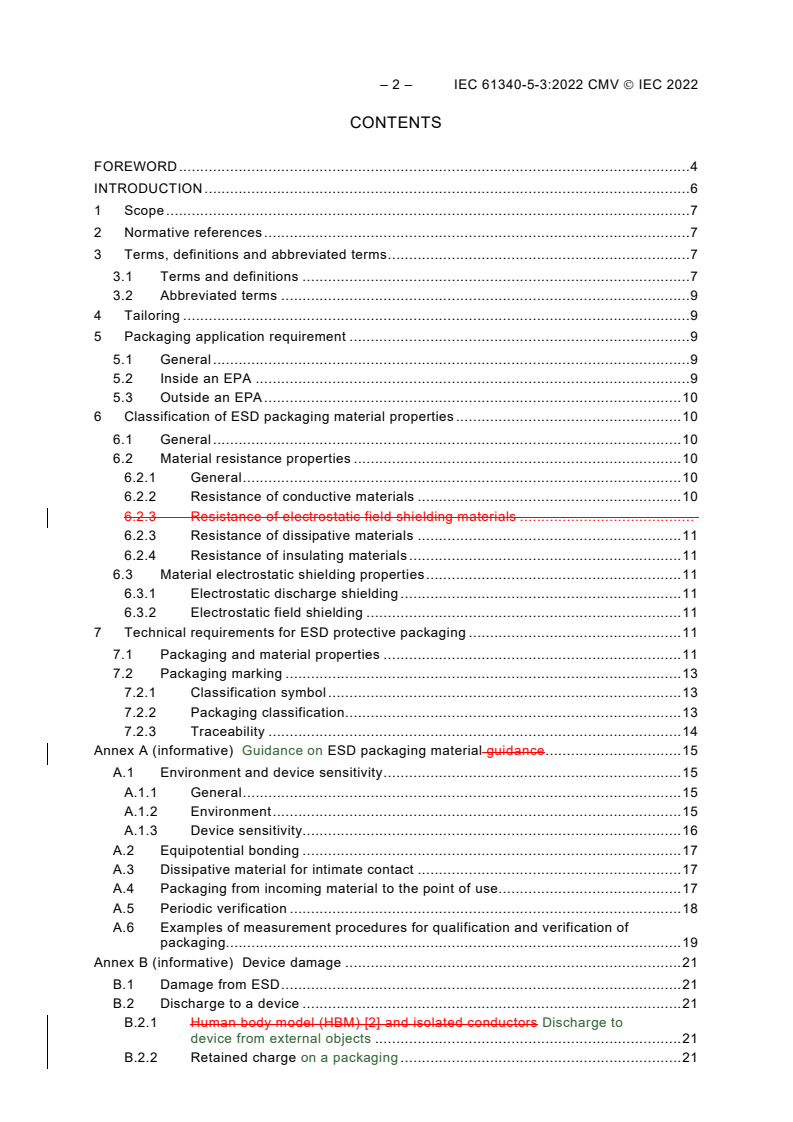
– 2 – IEC 61340-5-3:2022 CMV IEC 2022
CONTENTS
FOREWORD .4
INTRODUCTION .6
1 Scope .7
2 Normative references .7
3 Terms, definitions and abbreviated terms .7
3.1 Terms and definitions .7
3.2 Abbreviated terms .9
4 Tailoring .9
5 Packaging application requirement .9
5.1 General .9
5.2 Inside an EPA .9
5.3 Outside an EPA . 10
6 Classification of ESD packaging material properties . 10
6.1 General . 10
6.2 Material resistance properties . 10
6.2.1 General . 10
6.2.2 Resistance of conductive materials . 10
6.2.3 Resistance of electrostatic field shielding materials .
6.2.3 Resistance of dissipative materials . 11
6.2.4 Resistance of insulating materials . 11
6.3 Material electrostatic shielding properties . 11
6.3.1 Electrostatic discharge shielding . 11
6.3.2 Electrostatic field shielding . 11
7 Technical requirements for ESD protective packaging . 11
7.1 Packaging and material properties . 11
7.2 Packaging marking . 13
7.2.1 Classification symbol . 13
7.2.2 Packaging classification . 13
7.2.3 Traceability . 14
Annex A (informative) Guidance on ESD packaging material guidance . 15
A.1 Environment and device sensitivity . 15
A.1.1 General . 15
A.1.2 Environment . 15
A.1.3 Device sensitivity . 16
A.2 Equipotential bonding . 17
A.3 Dissipative material for intimate contact . 17
A.4 Packaging from incoming material to the point of use . 17
A.5 Periodic verification . 18
A.6 Examples of measurement procedures for qualification and verification of
packaging. 19
Annex B (informative) Device damage . 21
B.1 Damage from ESD . 21
B.2 Discharge to a device . 21
B.2.1 Human body model (HBM) [2] and isolated conductors Discharge to
device from external objects . 21
B.2.2 Retained charge on a packaging . 21
B.3 Discharge from a floating device (CDM) . 21
B.3.1 Charged device model (CDM) Discharges from devices in an electric field. 21
B.3.2 Tribo-electrification Discharges from tribo-electrified devices . 21
Annex C (informative) Guidance on electric field shielding . 22
Annex D (informative) Low charging material property . 23
Bibliography . 24
List of comments . 25
Figure 1 – Example of packaging label (*Primary function code) . 13
Figure A.1 – Examples of EPA configurations . 16
Figure A.2 – Application of ESD protective packaging . 18
Table 1 – Test methods for electrostatic protective packaging . 12
Table 2 – Test methods and requirements for electrostatic discharge shielding
packaging . 13
Table 3 – Primary function code/ and ESD classification symbol . 14
Table A.1 – Packaging characteristics for environmental consideration . 15
Table A.2 – Examples of qualification and verification of packaging . 19
– 4 – IEC 61340-5-3:2022 CMV IEC 2022
INTERNATIONAL ELECTROTECHNICAL COMMISSION
____________
ELECTROSTATICS –
Part 5-3: Protection of electronic devices from electrostatic phenomena –
Properties and requirements classification for packaging intended for
electrostatic discharge sensitive devices
FOREWORD
1) The International Electrotechnical Commission (IEC) is a worldwide organization for standardization comprising
all national electrotechnical committees (IEC National Committees). The object of IEC is to promote international
co-operation on all questions concerning standardization in the electrical and electronic fields. To this end and
in addition to other activities, IEC publishes International Standards, Technical Specifications, Technical Reports,
Publicly Available Specifications (PAS) and Guides (hereafter referred to as “IEC Publication(s)”). Their
preparation is entrusted to technical committees; any IEC National Committee interested in the subject dealt with
may participate in this preparatory work. International, governmental and non-governmental organizations liaising
with the IEC also participate in this preparation. IEC collaborates closely with the International Organization for
Standardization (ISO) in accordance with conditions determined by agreement between the two organizations.
2) The formal decisions or agreements of IEC on technical matters express, as nearly as possible, an international
consensus of opinion on the relevant subjects since each technical committee has representation from all
interested IEC National Committees.
3) IEC Publications have the form of recommendations for international use and are accepted by IEC National
Committees in that sense. While all reasonable efforts are made to ensure that the technical content of IEC
Publications is accurate, IEC cannot be held responsible for the way in which they are used or for any
misinterpretation by any end user.
4) In order to promote international uniformity, IEC National Committees undertake to apply IEC Publications
transparently to the maximum extent possible in their national and regional publications. Any divergence between
any IEC Publication and the corresponding national or regional publication shall be clearly indicated in the latter.
5) IEC itself does not provide any attestation of conformity. Independent certification bodies provide conformity
assessment services and, in some areas, access to IEC marks of conformity. IEC is not responsible for any
services carried out by independent certification bodies.
6) All users should ensure that they have the latest edition of this publication.
7) No liability shall attach to IEC or its directors, employees, servants or agents including individual experts and
members of its technical committees and IEC National Committees for any personal injury, property damage or
other damage of any nature whatsoever, whether direct or indirect, or for costs (including legal fees) and
expenses arising out of the publication, use of, or reliance upon, this IEC Publication or any other IEC
Publications.
8) Attention is drawn to the Normative references cited in this publication. Use of the referenced publications is
indispensable for the correct application of this publication.
9) Attention is drawn to the possibility that some of the elements of this IEC Publication may be the subject of patent
rights. IEC shall not be held responsible for identifying any or all such patent rights.
This commented version (CMV) of the official standard IEC 61340-5-3:2022 edition 3.0
allows the user to identify the changes made to the previous IEC 61340-5-3:2015 edition
2.0. Futhermore, comments from IEC TC 101 experts are provided to explain the reasons
of the most relevant changes.
A vertical bar appears in the margin wherever a change has been made. Additions are in
green text, deletions are in strikethrough red text. Experts' comments are identified by a
blue-background number. Mouse over a number to display a pop-up note with the
comment.
This publication contains the CMV and the official standard. The full list of comments is
available at the end of the CMV.
IEC 61340-5-3 has been prepared by IEC technical committee 101: Electrostatics. It is an
International Standard.
This third edition cancels and replaces the second edition published in 2015. This edition
constitutes a technical revision.
This edition includes the following significant technical changes with respect to the previous
edition:
1 2
a) reference to IEC 61340-4-10 [1] was removed;
b) material resistance property "electrostatic field shielding" was removed;
c) the requirement for electrostatic discharge shielding was changed from 50 nJ to 20 nJ;
d) Table 1 – footnote "b" was changed to mention the two-point probe in IEC 61340-2-3;
e) "shall be marked" was changed to "should be marked" in 7.2.2 and 7.2.3;
f) Table 3 – the classification symbol and the primary function code F was removed;
g) Table A.2 – references to IEC TS 61340-5-4 [2] and IEC TR 61340-5-5 [3] were added;
h) Annex C – guidance regarding electric field shielding was added;
i) Annex D – low charging material property was added.
The text of this International Standard is based on the following documents:
Draft Report on voting
101/649/FDIS 101/660/RVD
Full information on the voting for its approval can be found in the report on voting indicated in
the above table.
The language used for the development of this International Standard is English.
This document was drafted in accordance with ISO/IEC Directives, Part 2, and developed in
accordance with ISO/IEC Directives, Part 1 and ISO/IEC Directives, IEC Supplement, available
at www.iec.ch/members_experts/refdocs. The main document types developed by IEC are
described in greater detail at www.iec.ch/standardsdev/publications.
A list of all parts in the IEC 61340 series, published under the general title Electrostatics, can
be found on the IEC website.
The committee has decided that the contents of this document will remain unchanged until the
stability date indicated on the IEC website under webstore.iec.ch in the data related to the
specific document. At this date, the document will be
• reconfirmed,
• withdrawn,
• replaced by a revised edition, or
• amended.
IMPORTANT – The 'colour inside' logo on the cover page of this publication indicates that it
contains colours which are considered to be useful for the correct understanding of its
contents. Users should therefore print this document using a colour printer.
_____________
Withdrawn.
Numbers in square brackets refer to the bibliography.
– 6 – IEC 61340-5-3:2022 CMV IEC 2022
INTRODUCTION
Packaging is necessary to protect electrostatic discharge sensitive devices (ESDSs) from static
electricity and electrostatic discharge (ESD) damage as well as 1 physical and environmental
damage during manufacture, transportation and storage.
ELECTROSTATICS –
Part 5-3: Protection of electronic devices from electrostatic phenomena –
Properties and requirements classification for packaging intended for
electrostatic discharge sensitive devices
1 Scope
This part of IEC 61340 defines the ESD protective packaging properties needed required to
protect electrostatic discharge ESD sensitive devices (ESDSs) through all phases of production,
rework/ and maintenance, transport and storage. Test methods are referenced to evaluate
packaging and packaging materials for these product and material properties. Performance
limits are provided.
This document does not address protection from electromagnetic interference (EMI),
electromagnetic pulsing (EMP) or protection of volatile materials electrically initiated explosive
materials or devices 2.
2 Normative references
The following documents are referred to in the text in such a way that some or all of their content
constitutes requirements of this document. For dated references, only the edition cited applies.
For undated references, the latest edition of the referenced document (including any
amendments) applies.
IEC 61340-2-3, Electrostatics – Part 2-3: Methods of test for determining the resistance and
resistivity of solid planar materials used to avoid electrostatic charge accumulation
IEC 61340-4-8, Electrostatics – Part 4-8: Standard test methods for specific applications –
Electrostatic discharge shielding – Bags
IEC 61340-4-10, Electrostatics – Part 4-10: Standard test methods for specific applications –
Two-point resistance measurement 3
IEC 60417, Graphical symbols for use on equipment (available at http://www.graphical-
symbols.info/equipment) 4
3 Terms, definitions and abbreviated terms
3.1 Terms and definitions
For the purposes of this document, the following terms and definitions apply.
ISO and IEC maintain terminological databases for use in standardization at the following
addresses:
• IEC Electropedia: available at http://www.electropedia.org/
• ISO Online browsing platform: available at http://www.iso.org/obp
_____________
At the time of writing, it is proposed withdrawing IEC 61340-4-10: 2012 and incorporating the test method into
the next edition of IEC 61340-2-3.
– 8 – IEC 61340-5-3:2022 CMV IEC 2022
3.1.1
electrostatic discharge
ESD
rapid transfer of charge between bodies at different electrostatic potentials
Note 1 to entry: This note applies to the French language only.
3.1.2
electrostatic discharge ESD sensitive device
ESDS
sensitive device, integrated circuit or assembly that may can be damaged by electrostatic fields
or electrostatic discharge
Note 1 to entry: This note applies to the French language only.
Note 1 to entry: See Clause B.2 and Clause B.3 in Annex B.
3.1.3
ESD protected area
EPA
area in which an ESDS can be handled with acceptable risk of damage caused by electrostatic
discharge or fields
SEE: Figure A.1 in Annex A.
3.1.4
unprotected area
UPA
area outside an EPA
Note 1 to entry: This note applies to the French language only.
SEE: Figure A.1 in Annex A.
3.1.5
intimate packaging
material which makes contact with an ESDS
3.1.6
proximity packaging
material not making contact with an ESDS and which is used to enclose one or more devices
3.1.7
secondary packaging
material used primarily to give additional physical protection to the outside of proximity package
packaging
3.1.8
volume resistance
R
V
ratio of a DC voltage (V) applied between two electrodes placed on two (opposite) surfaces of
a specimen and the current (A) between the electrodes
Note 1 to entry: Volume resistance is expressed in Ω.
3.1.9
point-to-point resistance
R
p-p
ratio of a DC voltage (V) applied between two electrodes on a surface of a specimen and the
current (A) between the electrodes
Note 1 to entry: The electrode configuration for point-to-point resistance measurements is usually a pair of circular
faced electrodes with a defined distance apart.
Note 2 to entry: Point-to-point resistance is expressed in Ω.
3.1.10
surface resistance
R
S
ratio of a DC voltage (V) applied between two electrodes in a defined configuration on a surface
of a specimen and the current (A) between the electrodes
Note 1 to entry: The electrode configuration for surface resistance measurement is usually a pair of parallel
rectangular electrodes or a pair of circular concentric electrodes.
Note 2 to entry: Surface resistance is expressed in Ω.
3.2 Abbreviated terms
CDM charged device model
EMI electromagnetic interference
EMP electromagnetic pulsing
EPA ESD protected area
ESD electrostatic discharge
ESDS electrostatic discharge sensitive device
HBM human body model
MM Machine model 5
UPA unprotected area
4 Tailoring
This document, or portions thereof, may does not necessarily apply to all applications. Tailoring
is accomplished by evaluating the applicability of each requirement for the specific application.
Upon completion of the evaluation, requirements may be added, modified or deleted.
Tailoring decisions, including rationale, shall be documented.
5 Packaging application requirement
5.1 General
Transportation and storage of ESDSs require packaging that provides protection from
electrostatic hazards (for example from an electrostatic discharge). Within an EPA in which all
ESD risks are well controlled, it is possible that ESD protective packaging may will not be
necessary.
5.2 Inside an EPA
Packaging used within an EPA shall consist of dissipative or conductive materials for intimate
contact.
Items sensitive to <100 V human body model (HBM) may need additional protection depending
on application and program plan requirements.
Additional protection can be necessary for items sensitive to < 100 V for HBM, < 200 V for CDM
and < 35 V for isolated conductors, depending on application and program plan requirements. 6
NOTE Dissipative materials are preferred for intimate packaging in situations where charged device model (CDM)
damage is a concern.
– 10 – IEC 61340-5-3:2022 CMV IEC 2022
5.3 Outside an EPA
Transportation and storage of sensitive products outside of an EPA shall require be done in
packaging that provides both
a) dissipative or conductive materials for intimate contact,
b) a structure that provides electrostatic discharge shielding.
If electrostatic field shielding materials are used to provide discharge shielding, a material that
provides a barrier to current flow should be used in combination with the electrostatic field
shielding material.
NOTE Dissipative materials are preferred for intimate packaging in situations where charged device model (CDM)
damage is a concern.
6 Classification of ESD packaging material properties
6.1 General
Materials and packages packaging that are useful in preventing damage to ESD sensitive
electronic devices exhibit certain properties. These properties include:
a) resistance properties:
– conductive;
– dissipative;
b) shielding properties:
– electrostatic discharge;
– electrostatic field;
c) low charging properties:
See Annex D. 7
6.2 Material resistance properties
6.2.1 General
Most standard packaging materials are electrically insulating and insulating materials retain
charge. Making the package packaging less insulating provides a path for the charge to
dissipate from the package packaging to a material at a lower potential.
Specific ranges of resistance are useful for different purposes. Packaging can be classified by
these resistance ranges of the material used in its construction.
6.2.2 Resistance of conductive materials
Conductive materials may can be surface conductive, volume conductive or both.
a) Surface conductive materials
Surface conductive materials shall have a surface resistance of < 1 × 10 Ω.
b) Volume conductive materials
Volume conductive materials shall have a volume resistance of < 1 × 10 Ω .
NOTE The thickness of the material might can have a significant influence on the measured value of volume
resistance.
6.2.3 Resistance of electrostatic field shielding materials 8
Within the conductive materials classification, electrostatic field shielding materials shall have
3 3
a homogeneous layer with a surface resistance of <1 × 10 Ω or a volume resistance of <1 × 10
Ω.
Other methods may also define the electrostatic field shielding classification.
NOTE These resistance values do not necessarily imply EMI/EMP shielding.
6.2.3 Resistance of dissipative materials
Dissipative materials may can be surface dissipative, volume dissipative or both.
a) Surface dissipative materials
4 11
Surface dissipative materials shall have a surface resistance ≥ 1 × 10 and < 1 × 10 Ω.
b) Volume dissipative materials
4 11
Volume dissipative materials shall have a volume resistance ≥ 1 × 10 and < 1 × 10 Ω.
NOTE The thickness of the material might can have a significant influence on the measured value of volume
resistance.
6.2.4 Resistance of insulating materials
Electrostatic insulating materials may can be surface insulating, volume insulating or both.
a) Surface insulating materials
Electrostatic surface insulating materials have a surface resistance ≥ 1 × 10 Ω.
b) Volume insulating materials
Electrostatic volume insulating materials have a volume resistance ≥ 1 × 10 Ω.
6.3 Material electrostatic shielding properties
NOTE Electrostatic shielding materials protect packaged sensitive electronic items ESDSs from the effects of
electrostatic discharges and fields that are external to the package packaging.
6.3.1 Electrostatic discharge shielding
Electrostatic discharge shielding packaging is capable of attenuating an electrostatic discharge.
The calculated energy allowed inside a static an electrostatic discharge shielding bag shall be
less than 50 20 nJ 9 when tested according to IEC 61340-4-8 or equivalent test method
modified to accommodate the product.
6.3.2 Electrostatic field shielding
Electrostatic field shielding packaging is capable of attenuating an electrostatic field.
NOTE Classified field-shielding materials can allow current flow through their volume.
See Annex C.
7 Technical requirements for ESD protective packaging
7.1 Packaging and material properties
Table 1 and Table 2 provide test methods for determining material classifications for finished
packages packaging and materials. When possible, testing shall be performed on the finished
package packaging. When testing cannot be performed on a finished package packaging, the
– 12 – IEC 61340-5-3:2022 CMV IEC 2022
material classification shall be defined by the bulk material used for the production of the final
package packaging.
Other probes (electrodes) may be used providing the results correlate with the specified probes
(electrodes). In case of dispute, the probe (electrode) assemblies specified in IEC 61340-2-3
shall be used. 10
Table 1 – Test methods for electrostatic protective packaging
Material
a
Method description Limits
Test method
classification
e 4
Surface R Surface resistance
IEC 61340-2-3 < 1 × 10 Ω
S
conductive
b,e 4 c
IEC 61340-2-3 R Point-to-point resistance < 1 × 10 Ω
p-p
4 c
b
<1 × 10 Ω
IEC 61340-4-10 11
R Point-to-point resistance
p-p
e 4 d
Volume R Volume resistance
IEC 61340-2-3 < 1 × 10 Ω
V
conductive
e 3
Electrostatic R Surface resistance
IEC 61340-2-3 <1 × 10 Ω
S
field
e 3 d
IEC 61340-2-3 R Volume resistance <1 × 10 Ω
shielding 12
V
e 4 11
Surface R Surface resistance
IEC 61340-2-3 ≥ 1 × 10 to < 1 × 10 Ω
S
dissipative
b,e 4 11 c
IEC 61340-2-3 R Point-to-point resistance ≥ 1 × 10 to < 1 × 10 Ω
p-p
4 11 c
b
≥1 × 10 to <1 × 10 Ω
IEC 61340-4-10
R Point-to-point resistance
p-p
e 4 11 d
Volume R Volume resistance
IEC 61340-2-3 ≥ 1 × 10 to < 1 × 10 Ω
V
dissipative
e 11
Surface R Surface resistance
IEC 61340-2-3 ≥ 1 × 10 Ω
S
insulating
b b,e 11 c
IEC 61340-4-10 IEC 61340-2-3 ≥ 1 × 10 Ω
R Point-to-point resistance
p-p
e 11 d
Volume R Volume resistance
IEC 61340-2-3 ≥ 1 × 10 Ω
V
insulating
a
For product qualification of packaging materials, the environmental conditions for preconditioning and testing shall
be 23 °C ± 2 °C and 12 % ± 3 % relative humidity. The preconditioning before the measurement shall be ≥ 48 h.
b
IEC 61340-4-10 describes the R point-to-point resistance measurement with a twopoint probe.
p-p
IEC 61340-2-3 describes all three test methods R , R and R .
S V p-p
IEC 61340-2-3 describes point-to-point resistance measurements using two 2,5 kg electrodes. It also describes a
two-point probe for point-to-point resistance measurements for non-planar materials and products with small
structures. Either of these two test methods may be used. 13
c
The results of a measurement of R according to IEC 61340-2-3 or IEC 61340-4-10 can be different compared to
p-p
the results of a measurement of R according to IEC 61340-2-3 due to the usage of different probes.
S
d
The thickness of the material might can have a significant influence on the values of a measured volume resistance.
The requirement is the same despite the thickness of the material.
e
IEC 61340-2-3 describes test methods for the determination of the electrical resistance and resistivity of solid
4 12
materials in the range from 10 Ω to 10 Ω, and refers to other standards for measurements outside this range.
However, it is possible that the other test methods referred to may will not be appropriate for measuring packaging
materials or products. Therefore, for the purposes stated in this table, any of the concentric ring probe electrodes
specified in IEC 61340-2-3 shall be used. The instrumentation used shall be able to measure to below 10 Ω; it is
acceptable for the open circuit voltage or voltage under load of the instrumentation used to be less than 10 V.
Table 2 – Test methods and requirements for electrostatic
discharge shielding packaging
Packaging system
Other ESD shielding
Shielding bags
packaging design
Test method IEC 61340-4-8 User defined
Requirement – intimate packaging shall be dissipative or conductive
Energy < 50 20 nJ 14
– a barrier layer or a defined air gap attenuating ESD energy
a
shall be included
a
No component of the packaging system shall cause ESD risk when taken within an EPA.
7.2 Packaging marking
7.2.1 Classification symbol
ESD protective packaging shall should 15 be marked with the ESD classification symbol given
in IEC 60417-6202:2013-06 [4] and as shown in Figure 1 or in accordance with customer
contracts, purchase orders, drawings or other documentation.
IEC 60417-6202:2013-06
Figure 1 – Example of packaging label (*Primary function code)
7.2.2 Packaging classification
The primary function code shall should be marked below the ESD classification symbol given in
IEC 60417-6202:2013-06 [4] and as shown in Table 3:
S electrostatic discharge shielding;
F electrostatic field shielding;
C electrostatic conductive;
D electrostatic dissipative.
– 14 – IEC 61340-5-3:2022 CMV IEC 2022
Table 3 – Primary function code/ and ESD classification symbol
*
Primary function ESD classification symbol
Primary function code
S Electrostatic discharge shielding
F Electrostatic field shielding 16
IEC
C Electrostatic conductive
D Electrostatic dissipative
7.2.3 Traceability
Packaging shall should be marked supplied with information that allows traceability to the
packaging manufacturer and to the manufacturer's date/ and lot code information.
The date/lot code shall allow traceability to quality control information pertaining to the
manufacture of the specific lot of packaging. 17
Annex A
(informative)
Guidance on ESD packaging material guidance
A.1 Environment and device sensitivity
A.1.1 General
Environment and device sensitivity are two primary considerations for selecting ESD packaging
materials.
A.1.2 Environment
Since the threat to a sensitive item is usually undetermined when the item is outside an ESD
protected area (EPA), electrostatic sensitive devices (ESDS) should be placed in ESD
protective packaging whenever the item is in an unprotected area (UPA) an EPA, the ESDS
should be placed in ESD protective packaging whenever the item is in a UPA – see Table A.1.
Table A.1 – Packaging characteristics for environmental consideration
EPA UPA
Item to be
packed
Intimate Proximity Intimate Proximity
Electrostatic Electrostatic As for inside EPA and As for inside EPA and
conductive or electrostatic discharge
ESDS conductive electrostatic
a b c
dissipative
or dissipative discharge shielding shielding
a
For battery operated ESDSs, the selection of the material or the design of the packaging should ensure that
the battery does not become discharged.
b
Electrostatic discharge shielding property is only needed required when proximity packaging is not electrostatic
discharge shielding.
c
Electrostatic discharge shielding property is only required when intimate packaging is not electrostatic
discharge shielding.
– 16 – IEC 61340-5-3:2022 CMV IEC 2022
Figure A.1 – Examples of EPA configurations
A.1.3 Device sensitivity
If the sensitivity of the ESDS is unknown and the device is being shipped outside of the EPA, it
should be packaged using an electrostatic discharge shielding structure that also provides
protection against electrostatic fields (see Annex C).
However, if the sensitivity of the ESDS is known and the ESD threat environment is well
understood, the protection level of the packaging may be reduced.
A.2 Equipotential bonding
While not always recognized as being a packaging consideration, equipotential bonding, or the
shunting of leads, can be an effective method to mitigate damage. By placing a conductive
shunt across device leads or card connectors, the various parts of the item share the same
electrical potential. While not necessarily at ground potential, the fact that parts of the item
share the same potential means that damaging current will not flow between them. Shunting
has limitations. Energy from direct discharge and electric fields may can impact the item in a
manner that does not allow the energy to equalize through the shunt, but instead through the
device. ESD protective packaging that offers other protective properties is usually used in
conjunction with shunting devices.
A.3 Dissipative material for intimate contact
To avoid rapid discharge of charged ESDSs due to contact with conductive surfaces leading to
charged device ESD risk, dissipative materials are preferred.
A.4 Packaging from incoming material to the point of use
Figure A.1 Figure A.2 shows a simplified layout of a generic electronic packaging application.
Each area has the recommended ESD packaging material properties noted. As discussed in
A.1.3, if the item sensitivity and threats are documented, the level of protective packaging can
be reduced after confirming packaging functionality.
NOTE This layout shows an "islands of protection" approach to ESD safeguards. Many manufacturing processes
employ a "total factory" approach, where the entire factory is a safeguarded area – see Figure A.1.
– 18 – IEC 61340-5-3:2022 CMV IEC 2022
Figure A.2 – Application of ESD protective packaging
A.5 Periodic verification
The static control properties of some packaging materials can deteriorate with time and use.
Periodic verification of static control properties should be considered for re-used materials and
for packaging that has been kept in store but not used. 18
A.6 Examples of measurement procedures for qualification and verification of
packaging
Table A.2 – Examples of qualification and verification of packaging
Packaging Product Compliance
Test method 19
Test method
a
item verification
qualification
Bags IEC 61340-2-3 R IEC TS 61340-5-4 [2] R
S S
Inside and outside Inside and outside
layers surfaces layers surfaces
R
V
Inside layers to
metal plate
b
IEC 61340-4-8 Not applicable
Energy bag test
Tote boxes IEC 61340-2-3 R IEC TS 61340-5-4 [2] R
S p-p
Inside and outside Inside and outside
surfaces surfaces
R
p-p
Inside and outside
surfaces
R
V
Inside surface to
metal plate
Foams IEC 61340-2-3 R IEC TS 61340-5-4 [2] R
S p-p
Top and bottom Top and bottom
surface surfaces
R
V
Top surface to metal
plate
Carrier tapes IEC 61340-4-10 R IEC TS 61340-5-4 [2] R
p-p p-p
c
IEC 61340-2-3
Inside cavities Inside cavities
Cavity to cavity
R
V
Cavity to metal plate
Thermoformed IEC 61340-4-10 R IEC TS 61340-5-4 [2] R
p-p p-p
c
and injection
IEC 61340-2-3
Inside cavities Inside cavities
moulded trays
Cavity to cavity
R
V
Cavity to metal plate
Corrugated IEC 61340-2-3 R IEC TS 61340-5-4 [2] R
S S
cardboard
Inside and outside Inside and outside
layers surfaces layers surfaces
R R
p-p p-p
Inside and outside Inside and outside
surfaces surfaces
R
V
Inside layers
surfaces to metal
plate
– 20 – IEC 61340-5-3:2022 CMV IEC 2022
a
For product qualification, the environmental conditions for testing should be 23 °C ± 2 °C and 12 % ± 3 %
relative humidity.
b
Only relevant applicable if it is necessary for an ESD discharge shielding bag needs to be qualified.
c
It may can happen that the two-point probe described in IEC 61340-4-10 IEC 61340-2-3 does not fit inside the
cavities. Other test methods outside the current scope of this document may then be needed to be used to
measure the packaging limits be used to determine compliance with the resistance limits in such cases. See
IEC TR 61340-5-5 [3] for guidance.
The compliance verification plan according to IEC 61340-5-1 [5] should document the method
used to verify the limits according to the material classification in Table A.2.
IEC TR 61340-5-5 [3] can be used as a guideline for packaging materials such as embossed
carrier tapes, trays, tubes (stick magazines), rails and others in backend line processing and
parts handling where test methods described in this document are inadequate.
Annex B
(informative)
Device damage
B.1 Damage from ESD
Damage to devices usually occurs in one of two situations:
– electrostatic discharge to a device;
– electrostatic discharge from a charged device.
This distinction is important for packaging considerations because different properties are
required to manage each situation. The source of the static electricity needs to be considered
and then the path the charge travels to damage the device.
B.2 Discharge to a device
B.2.1 Human body model (HBM) [2] and isolated conductors Discharge to device
from external objects
Common items that discharge to packaged devices include the human body and conductive
objects used to handle packages packaged devices, like conveyors, carts and vehicles. Tribo-
electrification is usually the charge source.
Since the discharge must pass through the package packaging to reach the device, the package
packaging can be used to protect the device from an ESD event external to the package
packaging.
B.2.2 Retained charge on a packaging
The package Packaging can gain charge from ESD or tribo-electrification. Where the package
packaging exterior is isolated from the package packaging interior and therefore the device, it
is possible for charge on the package packaging to discharge to the device as it is removed
from the package packaging.
B.3 Discharge from a floating device (CDM)
B.3.1 Charged device model (CDM) Discharges from devices in an electric field
If a device is momentarily grounded in the presence of an electric field emanating from an
electrostatically charged item, a discharge occurs and the device retains a charge of opposite
polarity. When the device contacts an object with a different potential, like a grounded hand
removing the device from a package packaging, an electrostatic discharge occurs. Since the
electric field passes through the package packaging, the package packaging can be used to
protect the device from a field that is external to the package packaging. The package may
packaging can also isolate the device from ground.
B.3.2 Tribo-electrification Discharges from tribo-electrified devices
As a device and package packaging move in relation to each other, charge can accumulate on
the package packaging and on the device. When the charged device contacts an object with a
different potential, an electrostatic discharge occurs.
Guidance on tribo-electrification test methods and discharge evaluation methods is given in
IEC TR 61340-5-5 [3].
– 22 – IEC 61340-5-3:2022 CMV IEC 2022
Annex C
(informative)
Guidance on electric field shielding 20
Exposing an electronic device to a changing electric field can allow an induced current to flow
through the electronic device without actually grounding the device. Incorporating the concept
of electrostatic field shielding helps to reduce the risk of device damage through this mechanism
during transport and storage activities.
While the risk of damage from exposure to changing electric fields is considered low in the
practical sense, it is known that high impedance voltage sensitive circuits can be damaged in
this way. Providing a means to attenuate electric fields on the exterior of a packaging or
container provides protection against this.
The susceptibility of circuits to electrostatic fields and the criteria for materials required for
protection are not well understood at this time.
Where this document does not provide a test method or requirements for electrostatic field
shielding, the user should determine whether or not their intended packaging configuration
provide
...
IEC 61340-5-3 ®
Edition 3.0 2022-04
INTERNATIONAL
STANDARD
NORME
INTERNATIONALE
Electrostatics –
Part 5-3: Protection of electronic devices from electrostatic phenomena –
Properties and requirements classification for packaging intended for
electrostatic discharge sensitive devices
Électrostatique –
Partie 5-3: Protection des dispositifs électroniques contre les phénomènes
électrostatiques – Classification des propriétés et des exigences relatives à
l'emballage destiné aux dispositifs sensibles aux décharges électrostatiques
All rights reserved. Unless otherwise specified, no part of this publication may be reproduced or utilized in any form
or by any means, electronic or mechanical, including photocopying and microfilm, without permission in writing from
either IEC or IEC's member National Committee in the country of the requester. If you have any questions about IEC
copyright or have an enquiry about obtaining additional rights to this publication, please contact the address below or
your local IEC member National Committee for further information.
Droits de reproduction réservés. Sauf indication contraire, aucune partie de cette publication ne peut être reproduite
ni utilisée sous quelque forme que ce soit et par aucun procédé, électronique ou mécanique, y compris la photocopie
et les microfilms, sans l'accord écrit de l'IEC ou du Comité national de l'IEC du pays du demandeur. Si vous avez des
questions sur le copyright de l'IEC ou si vous désirez obtenir des droits supplémentaires sur cette publication, utilisez
les coordonnées ci-après ou contactez le Comité national de l'IEC de votre pays de résidence.
IEC Secretariat Tel.: +41 22 919 02 11
3, rue de Varembé info@iec.ch
CH-1211 Geneva 20 www.iec.ch
Switzerland
About the IEC
The International Electrotechnical Commission (IEC) is the leading global organization that prepares and publishes
International Standards for all electrical, electronic and related technologies.
About IEC publications
The technical content of IEC publications is kept under constant review by the IEC. Please make sure that you have the
latest edition, a corrigendum or an amendment might have been published.
IEC publications search - webstore.iec.ch/advsearchform IEC Products & Services Portal - products.iec.ch
The advanced search enables to find IEC publications by a Discover our powerful search engine and read freely all the
variety of criteria (reference number, text, technical publications previews. With a subscription you will always
committee, …). It also gives information on projects, replaced have access to up to date content tailored to your needs.
and withdrawn publications.
Electropedia - www.electropedia.org
IEC Just Published - webstore.iec.ch/justpublished
The world's leading online dictionary on electrotechnology,
Stay up to date on all new IEC publications. Just Published
containing more than 22 300 terminological entries in English
details all new publications released. Available online and
and French, with equivalent terms in 19 additional languages.
once a month by email.
Also known as the International Electrotechnical Vocabulary
(IEV) online.
IEC Customer Service Centre - webstore.iec.ch/csc
If you wish to give us your feedback on this publication or
need further assistance, please contact the Customer Service
Centre: sales@iec.ch.
A propos de l'IEC
La Commission Electrotechnique Internationale (IEC) est la première organisation mondiale qui élabore et publie des
Normes internationales pour tout ce qui a trait à l'électricité, à l'électronique et aux technologies apparentées.
A propos des publications IEC
Le contenu technique des publications IEC est constamment revu. Veuillez vous assurer que vous possédez l’édition la
plus récente, un corrigendum ou amendement peut avoir été publié.
Recherche de publications IEC - IEC Products & Services Portal - products.iec.ch
webstore.iec.ch/advsearchform Découvrez notre puissant moteur de recherche et consultez
La recherche avancée permet de trouver des publications IEC gratuitement tous les aperçus des publications. Avec un
en utilisant différents critères (numéro de référence, texte, abonnement, vous aurez toujours accès à un contenu à jour
comité d’études, …). Elle donne aussi des informations sur adapté à vos besoins.
les projets et les publications remplacées ou retirées.
Electropedia - www.electropedia.org
IEC Just Published - webstore.iec.ch/justpublished
Le premier dictionnaire d'électrotechnologie en ligne au
Restez informé sur les nouvelles publications IEC. Just
monde, avec plus de 22 300 articles terminologiques en
Published détaille les nouvelles publications parues.
anglais et en français, ainsi que les termes équivalents dans
Disponible en ligne et une fois par mois par email.
19 langues additionnelles. Egalement appelé Vocabulaire
Electrotechnique International (IEV) en ligne.
Service Clients - webstore.iec.ch/csc
Si vous désirez nous donner des commentaires sur cette
publication ou si vous avez des questions contactez-nous:
sales@iec.ch.
IEC 61340-5-3 ®
Edition 3.0 2022-04
INTERNATIONAL
STANDARD
NORME
INTERNATIONALE
Electrostatics –
Part 5-3: Protection of electronic devices from electrostatic phenomena –
Properties and requirements classification for packaging intended for
electrostatic discharge sensitive devices
Électrostatique –
Partie 5-3: Protection des dispositifs électroniques contre les phénomènes
électrostatiques – Classification des propriétés et des exigences relatives à
l'emballage destiné aux dispositifs sensibles aux décharges électrostatiques
INTERNATIONAL
ELECTROTECHNICAL
COMMISSION
COMMISSION
ELECTROTECHNIQUE
INTERNATIONALE
ICS 17.220.99; 29.020 ISBN 978-2-8322-1100-5
– 2 – IEC 61340-5-3:2022 IEC 2022
CONTENTS
FOREWORD . 4
INTRODUCTION . 6
1 Scope . 7
2 Normative references . 7
3 Terms, definitions and abbreviated terms . 7
3.1 Terms and definitions . 7
3.2 Abbreviated terms . 9
4 Tailoring . 9
5 Packaging application requirement . 9
5.1 General . 9
5.2 Inside an EPA . 9
5.3 Outside an EPA . 9
6 Classification of ESD packaging material properties . 10
6.1 General . 10
6.2 Material resistance properties . 10
6.2.1 General . 10
6.2.2 Resistance of conductive materials . 10
6.2.3 Resistance of dissipative materials . 10
6.2.4 Resistance of insulating materials. 11
6.3 Material electrostatic shielding properties . 11
6.3.1 Electrostatic discharge shielding . 11
6.3.2 Electrostatic field shielding . 11
7 Technical requirements for ESD protective packaging . 11
7.1 Packaging and material properties . 11
7.2 Packaging marking . 12
7.2.1 Classification symbol . 12
7.2.2 Packaging classification. 13
7.2.3 Traceability . 13
Annex A (informative) Guidance on ESD packaging material . 14
A.1 Environment and device sensitivity . 14
A.1.1 General . 14
A.1.2 Environment . 14
A.1.3 Device sensitivity . 15
A.2 Equipotential bonding . 16
A.3 Dissipative material for intimate contact . 16
A.4 Packaging from incoming material to the point of use . 16
A.5 Periodic verification . 17
A.6 Examples of measurement procedures for qualification and verification of
packaging . 18
Annex B (informative) Device damage . 20
B.1 Damage from ESD . 20
B.2 Discharge to a device . 20
B.2.1 Discharge to device from external objects . 20
B.2.2 Retained charge on a packaging . 20
B.3 Discharge from a floating device (CDM) . 20
B.3.1 Discharges from devices in an electric field . 20
B.3.2 Discharges from tribo-electrified devices . 20
Annex C (informative) Guidance on electric field shielding . 21
Annex D (informative) Low charging material property . 22
Bibliography . 23
Figure 1 – Example of packaging label (*Primary function code) . 13
Figure A.1 – Examples of EPA configurations . 15
Figure A.2 – Application of ESD protective packaging . 17
Table 1 – Test methods for electrostatic protective packaging . 12
Table 2 – Test methods and requirements for electrostatic discharge shielding
packaging . 12
Table 3 – Primary function code and ESD classification symbol . 13
Table A.1 – Packaging characteristics for environmental consideration . 14
Table A.2 – Examples of qualification and verification of packaging . 18
– 4 – IEC 61340-5-3:2022 IEC 2022
INTERNATIONAL ELECTROTECHNICAL COMMISSION
____________
ELECTROSTATICS –
Part 5-3: Protection of electronic devices from electrostatic phenomena –
Properties and requirements classification for packaging intended for
electrostatic discharge sensitive devices
FOREWORD
1) The International Electrotechnical Commission (IEC) is a worldwide organization for standardization comprising
all national electrotechnical committees (IEC National Committees). The object of IEC is to promote international
co-operation on all questions concerning standardization in the electrical and electronic fields. To this end and
in addition to other activities, IEC publishes International Standards, Technical Specifications, Technical Reports,
Publicly Available Specifications (PAS) and Guides (hereafter referred to as “IEC Publication(s)”). Their
preparation is entrusted to technical committees; any IEC National Committee interested in the subject dealt with
may participate in this preparatory work. International, governmental and non-governmental organizations liaising
with the IEC also participate in this preparation. IEC collaborates closely with the International Organization for
Standardization (ISO) in accordance with conditions determined by agreement between the two organizations.
2) The formal decisions or agreements of IEC on technical matters express, as nearly as possible, an international
consensus of opinion on the relevant subjects since each technical committee has representation from all
interested IEC National Committees.
3) IEC Publications have the form of recommendations for international use and are accepted by IEC National
Committees in that sense. While all reasonable efforts are made to ensure that the technical content of IEC
Publications is accurate, IEC cannot be held responsible for the way in which they are used or for any
misinterpretation by any end user.
4) In order to promote international uniformity, IEC National Committees undertake to apply IEC Publications
transparently to the maximum extent possible in their national and regional publications. Any divergence between
any IEC Publication and the corresponding national or regional publication shall be clearly indicated in the latter.
5) IEC itself does not provide any attestation of conformity. Independent certification bodies provide conformity
assessment services and, in some areas, access to IEC marks of conformity. IEC is not responsible for any
services carried out by independent certification bodies.
6) All users should ensure that they have the latest edition of this publication.
7) No liability shall attach to IEC or its directors, employees, servants or agents including individual experts and
members of its technical committees and IEC National Committees for any personal injury, property damage or
other damage of any nature whatsoever, whether direct or indirect, or for costs (including legal fees) and
expenses arising out of the publication, use of, or reliance upon, this IEC Publication or any other IEC
Publications.
8) Attention is drawn to the Normative references cited in this publication. Use of the referenced publications is
indispensable for the correct application of this publication.
9) Attention is drawn to the possibility that some of the elements of this IEC Publication may be the subject of patent
rights. IEC shall not be held responsible for identifying any or all such patent rights.
IEC 61340-5-3 has been prepared by IEC technical committee 101: Electrostatics. It is an
International Standard.
This third edition cancels and replaces the second edition published in 2015. This edition
constitutes a technical revision.
This edition includes the following significant technical changes with respect to the previous
edition:
1 2
a) reference to IEC 61340-4-10 [1] was removed;
b) material resistance property "electrostatic field shielding" was removed;
_____________
Withdrawn.
Numbers in square brackets refer to the bibliography.
c) the requirement for electrostatic discharge shielding was changed from 50 nJ to 20 nJ;
d) Table 1 – footnote "b" was changed to mention the two-point probe in IEC 61340-2-3;
e) "shall be marked" was changed to "should be marked" in 7.2.2 and 7.2.3;
f) Table 3 – the classification symbol and the primary function code F was removed;
g) Table A.2 – references to IEC TS 61340-5-4 [2] and IEC TR 61340-5-5 [3] were added;
h) Annex C – guidance regarding electric field shielding was added;
i) Annex D – low charging material property was added.
The text of this International Standard is based on the following documents:
Draft Report on voting
101/649/FDIS 101/660/RVD
Full information on the voting for its approval can be found in the report on voting indicated in
the above table.
The language used for the development of this International Standard is English.
This document was drafted in accordance with ISO/IEC Directives, Part 2, and developed in
accordance with ISO/IEC Directives, Part 1 and ISO/IEC Directives, IEC Supplement, available
at www.iec.ch/members_experts/refdocs. The main document types developed by IEC are
described in greater detail at www.iec.ch/standardsdev/publications.
A list of all parts in the IEC 61340 series, published under the general title Electrostatics, can
be found on the IEC website.
The committee has decided that the contents of this document will remain unchanged until the
stability date indicated on the IEC website under webstore.iec.ch in the data related to the
specific document. At this date, the document will be
• reconfirmed,
• withdrawn,
• replaced by a revised edition, or
• amended.
– 6 – IEC 61340-5-3:2022 IEC 2022
INTRODUCTION
Packaging is necessary to protect electrostatic discharge sensitive devices (ESDSs) from static
electricity and electrostatic discharge (ESD) damage as well as physical and environmental
damage during manufacture, transportation and storage.
ELECTROSTATICS –
Part 5-3: Protection of electronic devices from electrostatic phenomena –
Properties and requirements classification for packaging intended for
electrostatic discharge sensitive devices
1 Scope
This part of IEC 61340 defines the ESD protective packaging properties required to protect ESD
sensitive devices (ESDSs) through all phases of production, rework and maintenance, transport
and storage. Test methods are referenced to evaluate packaging and packaging materials for
these product and material properties. Performance limits are provided.
This document does not address protection from electromagnetic interference (EMI),
electromagnetic pulsing (EMP) or protection of electrically initiated explosive materials or
devices.
2 Normative references
The following documents are referred to in the text in such a way that some or all of their content
constitutes requirements of this document. For dated references, only the edition cited applies.
For undated references, the latest edition of the referenced document (including any
amendments) applies.
IEC 61340-2-3, Electrostatics – Part 2-3: Methods of test for determining the resistance and
resistivity of solid materials used to avoid electrostatic charge accumulation
IEC 61340-4-8, Electrostatics – Part 4-8: Standard test methods for specific applications –
Electrostatic discharge shielding – Bags
3 Terms, definitions and abbreviated terms
3.1 Terms and definitions
For the purposes of this document, the following terms and definitions apply.
ISO and IEC maintain terminological databases for use in standardization at the following
addresses:
• IEC Electropedia: available at http://www.electropedia.org/
• ISO Online browsing platform: available at http://www.iso.org/obp
3.1.1
electrostatic discharge
ESD
rapid transfer of charge between bodies at different electrostatic potentials
– 8 – IEC 61340-5-3:2022 IEC 2022
3.1.2
ESD sensitive device
ESDS
sensitive device, integrated circuit or assembly that can be damaged by electrostatic fields or
electrostatic discharge
Note 1 to entry: See Clause B.2 and Clause B.3 in Annex B.
3.1.3
ESD protected area
EPA
area in which an ESDS can be handled with acceptable risk of damage caused by electrostatic
discharge or fields
SEE: Figure A.1 in Annex A.
3.1.4
unprotected area
UPA
area outside an EPA
SEE: Figure A.1 in Annex A.
3.1.5
intimate packaging
material which makes contact with an ESDS
3.1.6
proximity packaging
material not making contact with an ESDS and which is used to enclose one or more devices
3.1.7
secondary packaging
material used primarily to give additional physical protection to the outside of proximity
packaging
3.1.8
volume resistance
R
V
ratio of a DC voltage (V) applied between two electrodes placed on two (opposite) surfaces of
a specimen and the current (A) between the electrodes
Note 1 to entry: Volume resistance is expressed in Ω.
3.1.9
point-to-point resistance
R
p-p
ratio of a DC voltage (V) applied between two electrodes on a surface of a specimen and the
current (A) between the electrodes
Note 1 to entry: The electrode configuration for point-to-point resistance measurements is usually a pair of circular
faced electrodes with a defined distance apart.
Note 2 to entry: Point-to-point resistance is expressed in Ω.
3.1.10
surface resistance
R
S
ratio of a DC voltage (V) applied between two electrodes in a defined configuration on a surface
of a specimen and the current (A) between the electrodes
Note 1 to entry: The electrode configuration for surface resistance measurement is usually a pair of parallel
rectangular electrodes or a pair of circular concentric electrodes.
Note 2 to entry: Surface resistance is expressed in Ω.
3.2 Abbreviated terms
CDM charged device model
EMI electromagnetic interference
EMP electromagnetic pulsing
EPA ESD protected area
ESD electrostatic discharge
ESDS electrostatic discharge sensitive device
HBM human body model
UPA unprotected area
4 Tailoring
This document, or portions thereof, does not necessarily apply to all applications. Tailoring is
accomplished by evaluating the applicability of each requirement for the specific application.
Upon completion of the evaluation, requirements may be added, modified or deleted.
Tailoring decisions, including rationale, shall be documented.
5 Packaging application requirement
5.1 General
Transportation and storage of ESDSs require packaging that provides protection from
electrostatic hazards (for example from an electrostatic discharge). Within an EPA in which all
ESD risks are well controlled, it is possible that ESD protective packaging will not be necessary.
5.2 Inside an EPA
Packaging used within an EPA shall consist of dissipative or conductive materials for intimate
contact.
Additional protection can be necessary for items sensitive to < 100 V for HBM, < 200 V for CDM
and < 35 V for isolated conductors, depending on application and program plan requirements.
NOTE Dissipative materials are preferred for intimate packaging in situations where charged device model (CDM)
damage is a concern.
5.3 Outside an EPA
Transportation and storage of sensitive products outside of an EPA shall be done in packaging
that provides both
a) dissipative or conductive materials for intimate contact,
b) a structure that provides electrostatic discharge shielding.
– 10 – IEC 61340-5-3:2022 IEC 2022
If electrostatic field shielding materials are used to provide discharge shielding, a material that
provides a barrier to current flow should be used in combination with the electrostatic field
shielding material.
NOTE Dissipative materials are preferred for intimate packaging in situations where charged device model (CDM)
damage is a concern.
6 Classification of ESD packaging material properties
6.1 General
Materials and packaging that are useful in preventing damage to ESD sensitive devices exhibit
certain properties. These properties include:
a) resistance properties:
– conductive;
– dissipative;
b) shielding properties:
– electrostatic discharge;
– electrostatic field;
c) low charging properties:
See Annex D.
6.2 Material resistance properties
6.2.1 General
Most standard packaging materials are electrically insulating and insulating materials retain
charge. Making the packaging less insulating provides a path for the charge to dissipate from
the packaging to a material at a lower potential.
Specific ranges of resistance are useful for different purposes. Packaging can be classified by
these resistance ranges of the material used in its construction.
6.2.2 Resistance of conductive materials
Conductive materials can be surface conductive, volume conductive or both.
a) Surface conductive materials
Surface conductive materials shall have a surface resistance of < 1 × 10 Ω.
b) Volume conductive materials
Volume conductive materials shall have a volume resistance of < 1 × 10 Ω.
NOTE The thickness of the material can have a significant influence on the measured value of volume resistance.
6.2.3 Resistance of dissipative materials
Dissipative materials can be surface dissipative, volume dissipative or both.
a) Surface dissipative materials
4 11
Surface dissipative materials shall have a surface resistance ≥ 1 × 10 and < 1 × 10 Ω.
b) Volume dissipative materials
4 11
Volume dissipative materials shall have a volume resistance ≥ 1 × 10 and < 1 × 10 Ω.
NOTE The thickness of the material can have a significant influence on the measured value of volume resistance.
6.2.4 Resistance of insulating materials
Electrostatic insulating materials can be surface insulating, volume insulating or both.
a) Surface insulating materials
Electrostatic surface insulating materials have a surface resistance ≥ 1 × 10 Ω.
b) Volume insulating materials
Electrostatic volume insulating materials have a volume resistance ≥ 1 × 10 Ω.
6.3 Material electrostatic shielding properties
NOTE Electrostatic shielding materials protect packaged ESDSs from the effects of electrostatic discharges and
fields that are external to the packaging.
6.3.1 Electrostatic discharge shielding
Electrostatic discharge shielding packaging is capable of attenuating an electrostatic discharge.
The calculated energy allowed inside an electrostatic discharge shielding bag shall be less than
20 nJ when tested according to IEC 61340-4-8 or equivalent test method modified to
accommodate the product.
6.3.2 Electrostatic field shielding
Electrostatic field shielding packaging is capable of attenuating an electrostatic field.
See Annex C.
7 Technical requirements for ESD protective packaging
7.1 Packaging and material properties
Table 1 and Table 2 provide test methods for determining material classifications for finished
packaging and materials. When possible, testing shall be performed on the finished packaging.
When testing cannot be performed on a finished packaging, the material classification shall be
defined by the bulk material used for the production of the final packaging.
Other probes (electrodes) may be used providing the results correlate with the specified probes
(electrodes). In case of dispute, the probe (electrode) assemblies specified in IEC 61340-2-3
shall be used.
– 12 – IEC 61340-5-3:2022 IEC 2022
Table 1 – Test methods for electrostatic protective packaging
Material
a
Test method Method description Limits
classification
e 4
Surface conductive R Surface resistance
IEC 61340-2-3 < 1 × 10 Ω
S
b,e 4 c
IEC 61340-2-3 R Point-to-point < 1 × 10 Ω
p-p
resistance
e 4 d
Volume conductive R Volume resistance
IEC 61340-2-3 < 1 × 10 Ω
V
e 4 11
Surface dissipative R Surface resistance
IEC 61340-2-3 ≥ 1 × 10 to < 1 × 10 Ω
S
b,e 4 11 c
IEC 61340-2-3 R Point-to-point ≥ 1 × 10 to < 1 × 10 Ω
p-p
resistance
e 4 11 d
Volume dissipative R Volume resistance
IEC 61340-2-3 ≥ 1 × 10 to < 1 × 10 Ω
V
e 11
Surface insulating R Surface resistance
IEC 61340-2-3 ≥ 1 × 10 Ω
S
b,e 11 c
IEC 61340-2-3 R Point-to-point ≥ 1 × 10 Ω
p-p
resistance
e 11 d
Volume insulating R Volume resistance
IEC 61340-2-3 ≥ 1 × 10 Ω
V
a
For product qualification of packaging materials, the environmental conditions for preconditioning and testing
shall be 23 °C ± 2 °C and 12 % ± 3 % relative humidity. The preconditioning before the measurement shall be
≥ 48 h.
b
IEC 61340-2-3 describes point-to-point resistance measurements using two 2,5 kg electrodes. It also describes
a two-point probe for point-to-point resistance measurements for non-planar materials and products with small
structures. Either of these two test methods may be used.
c
The results of a measurement of R according to IEC 61340-2-3 can be different compared to the results of a
p-p
measurement of R according to IEC 61340-2-3 due to the usage of different probes.
S
d
The thickness of the material can have a significant influence on the values of a measured volume resistance.
The requirement is the same despite the thickness of the material.
e
IEC 61340-2-3 describes test methods for the determination of the electrical resistance and resistivity of solid
4 12
materials in the range from 10 Ω to 10 Ω, and refers to other standards for measurements outside this range.
However, it is possible that the other test methods referred to will not be appropriate for measuring packaging
materials or products. Therefore, for the purposes stated in this table, any of the electrodes specified in
IEC 61340-2-3 shall be used. The instrumentation used shall be able to measure to below 10 Ω; it is acceptable
for the open circuit voltage or voltage under load of the instrumentation used to be less than 10 V.
Table 2 – Test methods and requirements for electrostatic
discharge shielding packaging
Packaging system
Other ESD shielding
Shielding bags
packaging design
Test method IEC 61340-4-8 User defined
Requirement Energy < 20 nJ – intimate packaging shall be dissipative or conductive
– a barrier layer or a defined air gap attenuating ESD energy
a
shall be included
a
No component of the packaging system shall cause ESD risk when taken within an EPA.
7.2 Packaging marking
7.2.1 Classification symbol
ESD protective packaging should be marked with the ESD classification symbol given in
IEC 60417-6202:2013-06 [4] and as shown in Figure 1 or in accordance with customer
contracts, purchase orders, drawings or other documentation.
IEC 60417-6202:2013-06
Figure 1 – Example of packaging label (*Primary function code)
7.2.2 Packaging classification
The primary function code should be marked below the ESD classification symbol given in
IEC 60417-6202:2013-06 [4] and as shown in Table 3:
S electrostatic discharge shielding;
C electrostatic conductive;
D electrostatic dissipative.
Table 3 – Primary function code and ESD classification symbol
*
Primary function ESD classification symbol
Primary function code
S Electrostatic discharge shielding
C Electrostatic conductive
D Electrostatic dissipative
7.2.3 Traceability
Packaging should be supplied with information that allows traceability to the packaging
manufacturer and to the manufacturer's date and lot code information.
– 14 – IEC 61340-5-3:2022 IEC 2022
Annex A
(informative)
Guidance on ESD packaging material
A.1 Environment and device sensitivity
A.1.1 General
Environment and device sensitivity are two primary considerations for selecting ESD packaging
materials.
A.1.2 Environment
Since the threat to a sensitive item is usually undetermined when the item is outside an EPA,
the ESDS should be placed in ESD protective packaging whenever the item is in a UPA – see
Table A.1.
Table A.1 – Packaging characteristics for environmental consideration
EPA UPA
Item to be
packed
Intimate Proximity Intimate Proximity
Electrostatic Electrostatic As for inside EPA and As for inside EPA and
ESDS conductive conductive or electrostatic electrostatic discharge
a b c
dissipative
or dissipative discharge shielding shielding
a
For battery operated ESDSs, the selection of the material or the design of the packaging should ensure that
the battery does not become discharged.
b
Electrostatic discharge shielding property is only required when proximity packaging is not electrostatic
discharge shielding.
c
Electrostatic discharge shielding property is only required when intimate packaging is not electrostatic
discharge shielding.
Figure A.1 – Examples of EPA configurations
A.1.3 Device sensitivity
If the sensitivity of the ESDS is unknown and the device is being shipped outside of the EPA, it
should be packaged using an electrostatic discharge shielding structure that also provides
protection against electrostatic fields (see Annex C).
However, if the sensitivity of the ESDS is known and the ESD threat environment is well
understood, the protection level of the packaging may be reduced.
– 16 – IEC 61340-5-3:2022 IEC 2022
A.2 Equipotential bonding
While not always recognized as being a packaging consideration, equipotential bonding, or the
shunting of leads, can be an effective method to mitigate damage. By placing a conductive
shunt across device leads or card connectors, the various parts of the item share the same
electrical potential. While not necessarily at ground potential, the fact that parts of the item
share the same potential means that damaging current will not flow between them. Shunting
has limitations. Energy from direct discharge and electric fields can impact the item in a manner
that does not allow the energy to equalize through the shunt, but instead through the device.
ESD protective packaging that offers other protective properties is usually used in conjunction
with shunting devices.
A.3 Dissipative material for intimate contact
To avoid rapid discharge of charged ESDSs due to contact with conductive surfaces leading to
charged device ESD risk, dissipative materials are preferred.
A.4 Packaging from incoming material to the point of use
Figure A.2 shows a simplified layout of a generic electronic packaging application. Each area
has the recommended ESD packaging material properties noted. As discussed in A.1.3, if the
item sensitivity and threats are documented, the level of protective packaging can be reduced
after confirming packaging functionality.
NOTE This layout shows an "islands of protection" approach to ESD safeguards. Many manufacturing processes
employ a "total factory" approach, where the entire factory is a safeguarded area – see Figure A.1.
Figure A.2 – Application of ESD protective packaging
A.5 Periodic verification
The static control properties of some packaging materials can deteriorate with time and use.
Periodic verification of static control properties should be considered for re-used materials and
for packaging that has been kept in store but not used.
– 18 – IEC 61340-5-3:2022 IEC 2022
A.6 Examples of measurement procedures for qualification and verification of
packaging
Table A.2 – Examples of qualification and verification of packaging
Product Test method
Packaging Compliance
Test method
a
item verification
qualification
R R
Bags IEC 61340-2-3 IEC TS 61340-5-4 [2]
S S
Inside and outside Inside and outside
surfaces surfaces
R
V
Inside layers to
metal plate
b
IEC 61340-4-8 Not applicable
Energy bag test
Tote boxes IEC 61340-2-3 R IEC TS 61340-5-4 [2] R
p-p p-p
Inside and outside Inside and outside
surfaces surfaces
R
V
Inside surface to
metal plate
Foams IEC 61340-2-3 R IEC TS 61340-5-4 [2] R
S p-p
Top and bottom Top and bottom
surface surfaces
R
V
Top surface to metal
plate
c
R
Carrier tapes R IEC TS 61340-5-4 [2]
IEC 61340-2-3
p-p p-p
Inside cavities Inside cavities
Cavity to cavity
R
V
Cavity to metal plate
c
Thermoformed R IEC TS 61340-5-4 [2] R
IEC 61340-2-3
p-p p-p
and injection
Inside cavities Inside cavities
moulded trays
Cavity to cavity
R
V
Cavity to metal plate
Corrugated IEC 61340-2-3 R IEC TS 61340-5-4 [2] R
S S
cardboard
Inside and outside Inside and outside
surfaces surfaces
R R
p-p p-p
Inside and outside Inside and outside
surfaces surfaces
R
V
Inside surfaces to
metal plate
a
For product qualification, the environmental conditions for testing should be 23 °C ± 2 °C and 12 % ± 3 %
relative humidity.
b
Only applicable if it is necessary for an ESD discharge shielding bag to be qualified.
c
It can happen that the two-point probe described in IEC 61340-2-3 does not fit inside the cavities. Other test
methods outside the current scope of this document may be used to determine compliance with the resistance
limits in such cases. See IEC TR 61340-5-5 [3] for guidance.
The compliance verification plan according to IEC 61340-5-1 [5] should document the method
used to verify the limits according to the material classification in Table A.2.
IEC TR 61340-5-5 [3] can be used as a guideline for packaging materials such as embossed
carrier tapes, trays, tubes (stick magazines), rails and others in backend line processing and
parts handling where test methods described in this document are inadequate.
– 20 – IEC 61340-5-3:2022 IEC 2022
Annex B
(informative)
Device damage
B.1 Damage from ESD
Damage to devices usually occurs in one of two situations:
– electrostatic discharge to a device;
– electrostatic discharge from a charged device.
This distinction is important for packaging considerations because different properties are
required to manage each situation. The source of the static electricity needs to be considered
and then the path the charge travels to damage the device.
B.2 Discharge to a device
B.2.1 Discharge to device from external objects
Common items that discharge to packaged devices include the human body and conductive
objects used to handle packaged devices, like conveyors, carts and vehicles. Tribo-
electrification is usually the charge source.
Since the discharge must pass through the packaging to reach the device, the packaging can
be used to protect the device from an ESD event external to the packaging.
B.2.2 Retained charge on a packaging
Packaging can gain charge from ESD or tribo-electrification. Where the packaging exterior is
isolated from the packaging interior and therefore the device, it is possible for charge on the
packaging to discharge to the device as it is removed from the packaging.
B.3 Discharge from a floating device (CDM)
B.3.1 Discharges from devices in an electric field
If a device is momentarily grounded in the presence of an electric field emanating from an
electrostatically charged item, a discharge occurs and the device retains a charge of opposite
polarity. When the device contacts an object with a different potential, like a grounded hand
removing the device from packaging, an electrostatic discharge occurs. Since the electric field
passes through the packaging, the packaging can be used to protect the device from a field that
is external to the packaging. The packaging can also isolate the device from ground.
B.3.2 Discharges from tribo-electrified devices
As a device and packaging move in relation to each other, charge can accumulate on the
packaging and on the device. When the charged device contacts an object with a different
potential, an electrostatic discharge occurs.
Guidance on tribo-electrification test methods and discharge evaluation methods is given in
IEC TR 61340-5-5 [3].
Annex C
(informative)
Guidance on electric field shielding
Exposing an electronic device to a changing electric field can allow an induced current to flow
through the electronic device without actually grounding the device. Incorporating the concept
of electrostatic field shielding helps to reduce the risk of device damage through this mechanism
during transport and storage activities.
While the risk of damage from exposure to changing electric fields is considered low in the
practical sense, it is known that high impedance voltage sensitive circuits can be damaged in
this way. Providing a means to attenuate electric fields on the exterior of a packaging or
container provides protection against this.
The susceptibility of circuits to electrostatic fields and the criteria for materials required for
protection are not well understood at this time.
Where this document does not provide a test method or requirements for electrostatic field
shielding, the user should determine whether or not their intended packaging configuration
provides attenuation of changing electrostatic field strength at the position in the packaging
where sensitive items are contained.
– 22 – IEC 61340-5-3:2022 IEC 2022
Annex D
(informative)
Low charging material property
Requirements for low charging are not specified in this document at this time, because the
measurement is strongly dependent on the application. However, it can be an important
consideration for packaging material selection. Users of packaging materials are encouraged
to determine the extent that the packaging materials that are selected will charge in the end
use environment.
However, the charging is strongly dependent on the material combination and its surface
structure properties. Low charging behaviour is not necessarily predicted by surface or volume
resistance measurements. Low charging materials are not necessarily dissipative (although
many are).
Guidance on measuring chargeability is given in IEC TR 61340-2-2 [6].
...