

IEC 60974-14:2018
(Main)Arc welding equipment - Part 14: Calibration, validation and consistency testing
General Information
- Abstract
IEC 60974-14:2018 specifies requirements for the verification of arc welding and external monitoring equipment. This document also serves for practical implementation of the verification procedure for arc welding equipment.
This document can be applied at the time of installation and any other times or intervals the user deems appropriate to ensure the equipment is capable of operating to the manufacturer’s specification or other specifications deemed applicable by the user.
The contents of the corrigendum of January 2022 have been included in this copy.
- Status
- Published
- Publication Date
- 18-Oct-2018
- Technical Committee
- TC 26 - Electric welding
- Drafting Committee
- WG 1 - TC 26/WG 1
- Current Stage
- PPUB - Publication issued
- Start Date
- 19-Oct-2018
- Completion Date
- 19-Oct-2018
Buy Documents
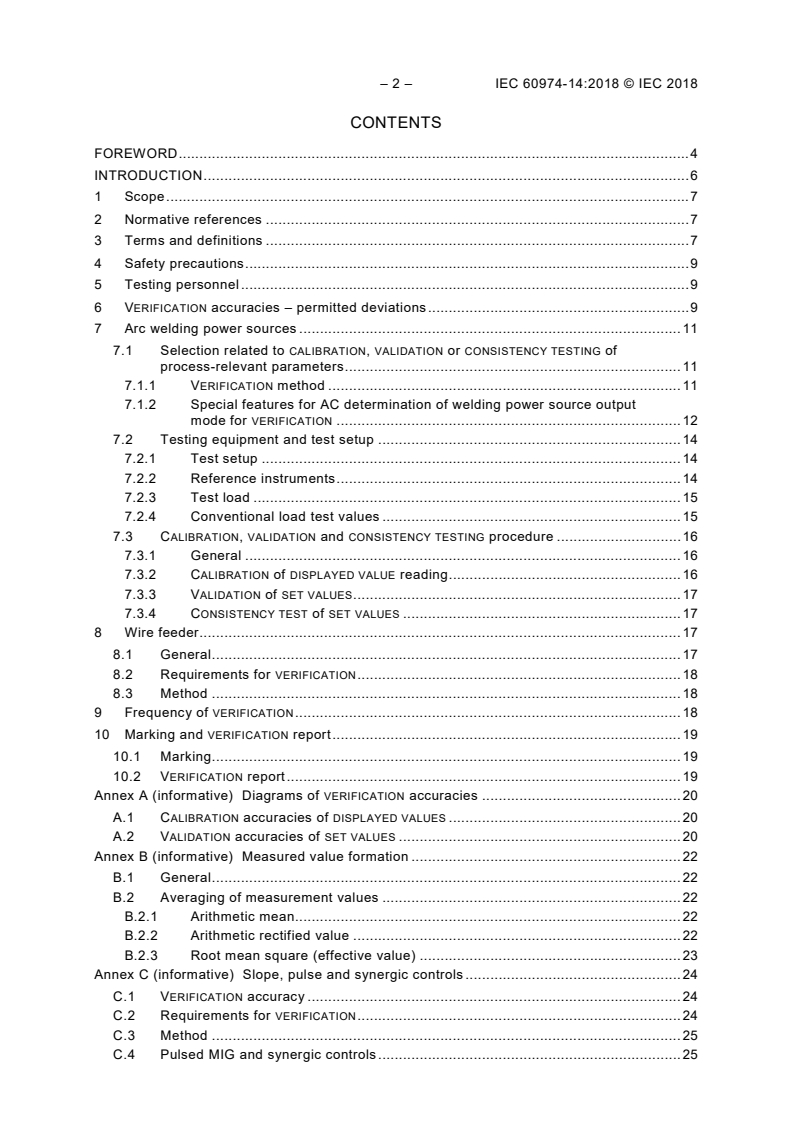
IEC 60974-14:2018 - Arc welding equipment - Part 14: Calibration, validation and consistency testing Released:10/19/2018
IEC 60974-14:2018 - Arc welding equipment - Part 14: Calibration, validation and consistency testing Released:10/19/2018
Overview
IEC 60974-14:2018 - Arc welding equipment, Part 14 - defines requirements and practical procedures for the calibration, validation and consistency testing (collectively “verification”) of arc welding and external monitoring equipment. Applicable at installation and at user-determined intervals, this standard verifies that welding power sources, wire feeders and monitoring instruments operate to manufacturer specifications or other user-defined requirements. The January 2022 corrigendum is included in this edition.
Key Topics and Requirements
- Verification scope and exclusions: Applies to arc welding equipment and external monitoring; excludes plasma cutting/gouging systems, arc-striking/stabilizing devices and equipment designed per IEC 60974-6.
- Verification types:
- Calibration of displayed values (internal instrument readings).
- Validation of set values (operator-set parameters).
- Consistency testing to confirm repeatability of set values.
- Measurement accuracy and permitted deviations: Defines verification accuracies, tolerances and diagrammatic guidance for acceptable deviations.
- Test setup and reference instruments: Requirements for test loads, reference meters and appropriate filtering/signal conditioning when measuring welding outputs.
- Device-specific guidance: Procedures and precautions for power sources, wire feeders, pulsed/synergic controls and TIG equipment.
- Personnel and safety: Competency requirements for testing personnel and safety precautions during verification.
- Documentation and marking: Reporting format, sample verification reports and marking requirements for verified equipment.
- Informative annexes provide diagrams, measured-value formation, test methods for slope/pulse/synergic controls, TIG precautions and sample reports.
Practical Applications
- Establishing a verification program during equipment commissioning and periodic maintenance.
- Supporting quality management for welding processes by ensuring accurate instrument readings, reproducible set values and consistent welding performance.
- Guiding service shops and manufacturers in creating or benchmarking factory and field verification procedures.
- Providing test procedures for calibration labs, maintenance teams and quality engineers responsible for welding equipment performance.
Who Should Use This Standard
- Welding engineers and quality managers implementing welding process control.
- Maintenance and service personnel performing calibration and verification of welding power sources and wire feeders.
- Manufacturers developing verification procedures or documentation for equipment handover.
- Certification and calibration laboratories that test arc welding equipment.
Related Standards
- IEC 60974 series (general arc welding equipment standards)
- IEC 60974-1 (welding power sources)
- ISO 17662 (welding quality - supplementary verification guidance)
Keywords: IEC 60974-14, arc welding equipment, calibration, validation, consistency testing, verification, welding power source, wire feeder, welding equipment verification.
Relations
- Effective Date
- 05-Sep-2023
Buy Documents
IEC 60974-14:2018 - Arc welding equipment - Part 14: Calibration, validation and consistency testing Released:10/19/2018
IEC 60974-14:2018 - Arc welding equipment - Part 14: Calibration, validation and consistency testing Released:10/19/2018
Get Certified
Connect with accredited certification bodies for this standard

DVS-ZERT GmbH
German welding certification society.

ANCE
Mexican certification and testing association.
CARES (UK Certification Authority for Reinforcing Steels)
UK certification for reinforcing steels and construction.
Sponsored listings
Frequently Asked Questions
IEC 60974-14:2018 is a standard published by the International Electrotechnical Commission (IEC). Its full title is "Arc welding equipment - Part 14: Calibration, validation and consistency testing". This standard covers: IEC 60974-14:2018 specifies requirements for the verification of arc welding and external monitoring equipment. This document also serves for practical implementation of the verification procedure for arc welding equipment. This document can be applied at the time of installation and any other times or intervals the user deems appropriate to ensure the equipment is capable of operating to the manufacturer’s specification or other specifications deemed applicable by the user. The contents of the corrigendum of January 2022 have been included in this copy.
IEC 60974-14:2018 specifies requirements for the verification of arc welding and external monitoring equipment. This document also serves for practical implementation of the verification procedure for arc welding equipment. This document can be applied at the time of installation and any other times or intervals the user deems appropriate to ensure the equipment is capable of operating to the manufacturer’s specification or other specifications deemed applicable by the user. The contents of the corrigendum of January 2022 have been included in this copy.
IEC 60974-14:2018 is classified under the following ICS (International Classification for Standards) categories: 25.160.30 - Welding equipment; 33.160.50 - Accessories. The ICS classification helps identify the subject area and facilitates finding related standards.
IEC 60974-14:2018 has the following relationships with other standards: It is inter standard links to IEC 60974-14:2018/COR1:2022. Understanding these relationships helps ensure you are using the most current and applicable version of the standard.
IEC 60974-14:2018 is available in PDF format for immediate download after purchase. The document can be added to your cart and obtained through the secure checkout process. Digital delivery ensures instant access to the complete standard document.
Standards Content (Sample)
IEC 60974-14 ®
Edition 1.0 2018-10
INTERNATIONAL
STANDARD
Arc welding equipment –
Part 14: Calibration, validation and consistency testing
All rights reserved. Unless otherwise specified, no part of this publication may be reproduced or utilized in any form
or by any means, electronic or mechanical, including photocopying and microfilm, without permission in writing from
either IEC or IEC's member National Committee in the country of the requester. If you have any questions about IEC
copyright or have an enquiry about obtaining additional rights to this publication, please contact the address below or
your local IEC member National Committee for further information.
IEC Central Office Tel.: +41 22 919 02 11
3, rue de Varembé info@iec.ch
CH-1211 Geneva 20 www.iec.ch
Switzerland
About the IEC
The International Electrotechnical Commission (IEC) is the leading global organization that prepares and publishes
International Standards for all electrical, electronic and related technologies.
About IEC publications
The technical content of IEC publications is kept under constant review by the IEC. Please make sure that you have the
latest edition, a corrigenda or an amendment might have been published.
IEC Catalogue - webstore.iec.ch/catalogue Electropedia - www.electropedia.org
The stand-alone application for consulting the entire The world's leading online dictionary of electronic and
bibliographical information on IEC International Standards, electrical terms containing 21 000 terms and definitions in
Technical Specifications, Technical Reports and other English and French, with equivalent terms in 16 additional
documents. Available for PC, Mac OS, Android Tablets and languages. Also known as the International Electrotechnical
iPad. Vocabulary (IEV) online.
IEC publications search - webstore.iec.ch/advsearchform IEC Glossary - std.iec.ch/glossary
The advanced search enables to find IEC publications by a 67 000 electrotechnical terminology entries in English and
variety of criteria (reference number, text, technical French extracted from the Terms and Definitions clause of
committee,…). It also gives information on projects, replaced IEC publications issued since 2002. Some entries have been
and withdrawn publications. collected from earlier publications of IEC TC 37, 77, 86 and
CISPR.
IEC Just Published - webstore.iec.ch/justpublished
Stay up to date on all new IEC publications. Just Published IEC Customer Service Centre - webstore.iec.ch/csc
details all new publications released. Available online and If you wish to give us your feedback on this publication or
also once a month by email. need further assistance, please contact the Customer Service
Centre: sales@iec.ch.
IEC 60974-14 ®
Edition 1.0 2018-10
INTERNATIONAL
STANDARD
Arc welding equipment –
Part 14: Calibration, validation and consistency testing
INTERNATIONAL
ELECTROTECHNICAL
COMMISSION
ICS 25.160.30 ISBN 978-2-8322-6165-1
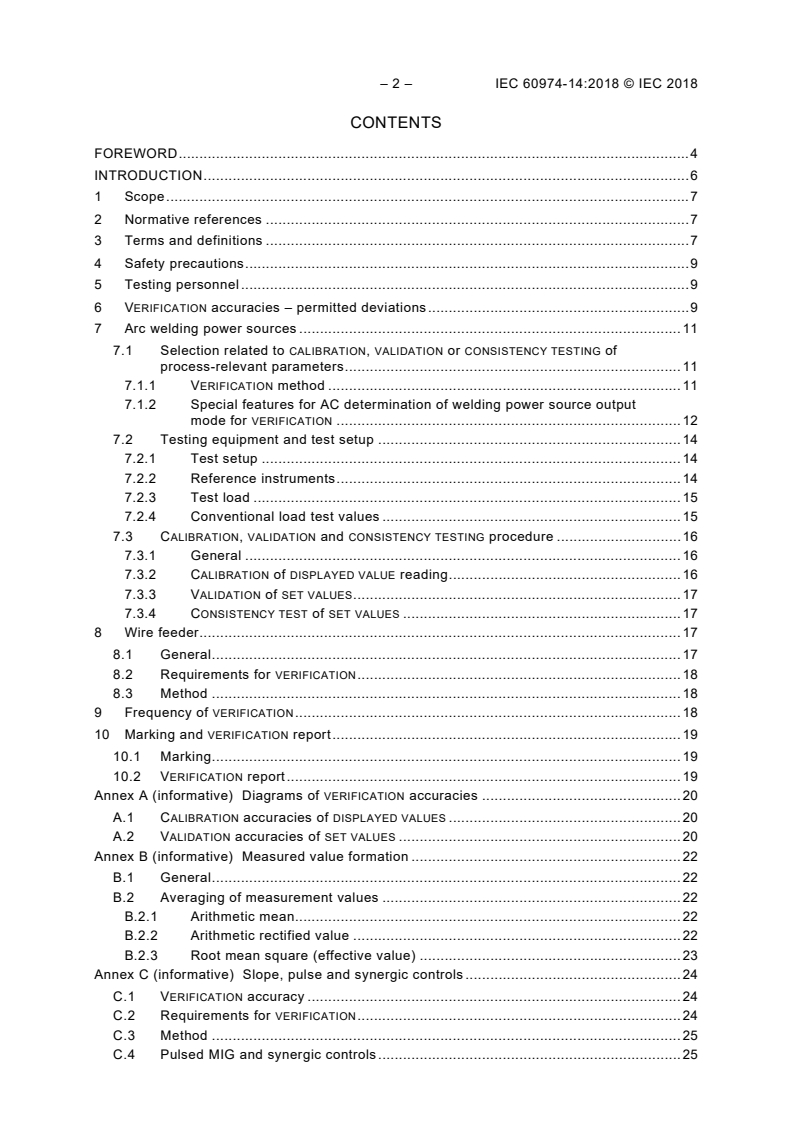
– 2 – IEC 60974-14:2018 © IEC 2018
CONTENTS
FOREWORD . 4
INTRODUCTION . 6
1 Scope . 7
2 Normative references . 7
3 Terms and definitions . 7
4 Safety precautions . 9
5 Testing personnel . 9
6 VERIFICATION accuracies – permitted deviations . 9
7 Arc welding power sources . 11
7.1 Selection related to CALIBRATION, VALIDATION or CONSISTENCY TESTING of
process-relevant parameters . 11
7.1.1 VERIFICATION method . 11
7.1.2 Special features for AC determination of welding power source output
mode for VERIFICATION . 12
7.2 Testing equipment and test setup . 14
7.2.1 Test setup . 14
7.2.2 Reference instruments . 14
7.2.3 Test load . 15
7.2.4 Conventional load test values . 15
7.3 CALIBRATION, VALIDATION and CONSISTENCY TESTING procedure . 16
7.3.1 General . 16
7.3.2 CALIBRATION of DISPLAYED VALUE reading . 16
7.3.3 VALIDATION of SET VALUES . 17
7.3.4 CONSISTENCY TEST of SET VALUES . 17
8 Wire feeder . 17
8.1 General . 17
8.2 Requirements for VERIFICATION . 18
8.3 Method . 18
9 Frequency of VERIFICATION . 18
10 Marking and VERIFICATION report . 19
10.1 Marking . 19
10.2 VERIFICATION report . 19
Annex A (informative) Diagrams of VERIFICATION accuracies . 20
A.1 CALIBRATION accuracies of DISPLAYED VALUES . 20
A.2 VALIDATION accuracies of SET VALUES . 20
Annex B (informative) Measured value formation . 22
B.1 General . 22
B.2 Averaging of measurement values . 22
B.2.1 Arithmetic mean. 22
B.2.2 Arithmetic rectified value . 22
B.2.3 Root mean square (effective value) . 23
Annex C (informative) Slope, pulse and synergic controls . 24
C.1 VERIFICATION accuracy . 24
C.2 Requirements for VERIFICATION . 24
C.3 Method . 25
C.4 Pulsed MIG and synergic controls . 25
Annex D (informative) Precautions to be taken with TIG welding equipment. 26
Annex E (informative) Samples of VERIFICATION reports. 27
E.1 Sample of CALIBRATION report . 27
E.2 Sample of VALIDATION report . 28
E.3 Sample of CONSISTENCY TEST report . 29
Bibliography . 30
Figure 1 – Determination of VERIFICATION method. 12
Figure 2 – Determination of VERIFICATION based on power source type . 13
Figure 3 – Test setup example . 14
Figure 4 – Example 10 kHz filter with reference voltmeter . 15
Figure A.1 – Diagrams of CALIBRATION accuracies . 20
Figure A.2 – Diagrams of VALIDATION accuracies . 21
Table 1 – CALIBRATION accuracies of DISPLAYED VALUES . 10
Table 2 – VALIDATION accuracies of SET VALUES . 10
– 4 – IEC 60974-14:2018 © IEC 2018
INTERNATIONAL ELECTROTECHNICAL COMMISSION
____________
ARC WELDING EQUIPMENT –
Part 14: CALIBRATION, VALIDATION and CONSISTENCY TESTING
FOREWORD
1) The International Electrotechnical Commission (IEC) is a worldwide organization for standardization comprising
all national electrotechnical committees (IEC National Committees). The object of IEC is to promote
international co-operation on all questions concerning standardization in the electrical and electronic fields. To
this end and in addition to other activities, IEC publishes International Standards, Technical Specifications,
Technical Reports, Publicly Available Specifications (PAS) and Guides (hereafter referred to as “IEC
Publication(s)”). Their preparation is entrusted to technical committees; any IEC National Committee interested
in the subject dealt with may participate in this preparatory work. International, governmental and non-
governmental organizations liaising with the IEC also participate in this preparation. IEC collaborates closely
with the International Organization for Standardization (ISO) in accordance with conditions determined by
agreement between the two organizations.
2) The formal decisions or agreements of IEC on technical matters express, as nearly as possible, an international
consensus of opinion on the relevant subjects since each technical committee has representation from all
interested IEC National Committees.
3) IEC Publications have the form of recommendations for international use and are accepted by IEC National
Committees in that sense. While all reasonable efforts are made to ensure that the technical content of IEC
Publications is accurate, IEC cannot be held responsible for the way in which they are used or for any
misinterpretation by any end user.
4) In order to promote international uniformity, IEC National Committees undertake to apply IEC Publications
transparently to the maximum extent possible in their national and regional publications. Any divergence
between any IEC Publication and the corresponding national or regional publication shall be clearly indicated in
the latter.
5) IEC itself does not provide any attestation of conformity. Independent certification bodies provide conformity
assessment services and, in some areas, access to IEC marks of conformity. IEC is not responsible for any
services carried out by independent certification bodies.
6) All users should ensure that they have the latest edition of this publication.
7) No liability shall attach to IEC or its directors, employees, servants or agents including individual experts and
members of its technical committees and IEC National Committees for any personal injury, property damage or
other damage of any nature whatsoever, whether direct or indirect, or for costs (including legal fees) and
expenses arising out of the publication, use of, or reliance upon, this IEC Publication or any other IEC
Publications.
8) Attention is drawn to the Normative references cited in this publication. Use of the referenced publications is
indispensable for the correct application of this publication.
9) Attention is drawn to the possibility that some of the elements of this IEC Publication may be the subject of
patent rights. IEC shall not be held responsible for identifying any or all such patent rights.
International Standard IEC 60974-14 has been prepared by IEC technical committee TC 26:
Electric welding.
The text of this International Standard is based on the following documents:
FDIS Report on voting
26/661/FDIS 26/666/RVD
Full information on the voting for the approval of this International Standard can be found in
the report on voting indicated in the above table.
This document has been drafted in accordance with the ISO/IEC Directives, Part 2.
In this standard, the following print types are used:
– terms used throughout this standard which have been defined in clause 3: SMALL ROMAN
CAPITALS.
A list of all parts of the IEC 60974 series can be found, under the general title Arc welding
equipment, on the IEC website.
The committee has decided that the contents of this document will remain unchanged until the
stability date indicated on the IEC website under "http://webstore.iec.ch" in the data related to
the specific document. At this date, the document will be
• reconfirmed,
• withdrawn,
• replaced by a revised edition, or
• amended.
A bilingual version of this publication may be issued at a later date.
– 6 – IEC 60974-14:2018 © IEC 2018
INTRODUCTION
This document is the first international edition for CALIBRATION, VALIDATION and CONSISTENCY
TESTING of arc welding equipment. It is based on the European Standard EN 50504:2008 and
will replace it. A brief history helps to understand the origin and development of this
document.
In Great Britain, BS 7570:1992, Code of practice for the validation of arc welding equipment,
was published and it became the equivalent European pre-standard ENV 50184:1996
(withdrawn).
The revised second edition of BS 7570 was published in 2000 and was later replaced by the
equivalent EN 50504:2008.
For quality management in the field of welding, this document should be used in conjunction
with ISO 17662.
The significant changes in respect to EN 50504:2008 are the following:
– terms VERIFICATION and VALIDATION aligned to ISO/IEC Guide 99:2007;
– wire feed equipment moved from the annex to main part of the document;
– new preferred requirement for digital instrument CALIBRATION with fixed tolerance values;
– flow charts for determination of VERIFICATION methods and sample reports added;
– EN 50504:2008 Annex E Validation of ancillary components in a welding system and
Annex F Voltage drops in the welding circuit deleted.
ARC WELDING EQUIPMENT –
Part 14: CALIBRATION, VALIDATION and CONSISTENCY TESTING
1 Scope
This part of IEC 60974 specifies requirements for the VERIFICATION of arc welding and external
monitoring equipment. This document also serves for practical implementation of the
VERIFICATION procedure for arc welding equipment.
This document can be applied at the time of installation and any other times or intervals the
user deems appropriate to ensure the equipment is capable of operating to the manufacturer’s
specification or other specifications deemed applicable by the user.
This document is not applicable to
– plasma systems used for cutting and gouging;
– arc striking and stabilizing devices;
– arc welding equipment designed in accordance with IEC 60974-6.
NOTE 1 Other components in welding systems such as for example robots, turning devices, gas consoles, etc.
also have influence on the welding result and can be verified, if necessary. Additional information can be found in
ISO 17662.
NOTE 2 Periodic inspection and testing for arc welding equipment is covered in IEC 60974-4.
This document is applicable for the user, service shop or manufacturer. It can be used
– stand alone;
– in conjunction with manufacturer’s instructions; or
– as the basis for an equivalent VERIFICATION procedure written by the manufacturer for
specific equipment.
2 Normative references
The following documents are referred to in the text in such a way that some or all of their
content constitutes requirements of this document. For dated references, only the edition
cited applies. For undated references, the latest edition of the referenced document (including
any amendments) applies.
IEC 60974-1:2017, Arc welding equipment – Part 1: Welding power sources
3 Terms and definitions
For the purposes of this document, the following terms and definitions apply.
ISO and IEC maintain terminological databases for use in standardization at the following
addresses:
• IEC Electropedia: available at http://www.electropedia.org/
• ISO Online browsing platform: available at http://www.iso.org/obp
– 8 – IEC 60974-14:2018 © IEC 2018
3.1
displayed value
measured value by internal instrument and shown at the equipment
Note 1 to entry: In some cases, the same display can be used for both SET VALUES and measured values. In such
cases the DISPLAYED VALUE is usually visible during welding.
3.2
set value
value chosen and set by the operator or by an automatic system
[SOURCE: IEC 60050-811:2017, 811-11-34, modified – Reference to motor vehicle and
driver removed.]
3.3
reference value
measurement value obtained by the reference instrument and used as a basis for comparison
with values of the same kind
3.4
expert
competent person
skilled person
person who can judge the work assigned and recognize possible hazards on the basis of
professional training, knowledge, experience and knowledge of the relevant equipment
Note 1 to entry: Several years of practice in the relevant technical field can be taken into consideration in
assessment of professional training.
[SOURCE: IEC 60050-851:2008, 851-11-10]
3.5
verification
operations for the purpose of demonstrating that an item of welding equipment or a welding
system conforms to the operating parameters for that welding equipment or system
3.6
calibration
set of operations which establishes, by reference to standards, the relationship which exists,
under specified conditions, between a DISPLAYED VALUE and a REFERENCE VALUE
[SOURCE: IEC 60050-311:2001, 311-01-09, modified – Notes removed and terms
"DISPLAYED VALUE" and "REFERENCE VALUE" used.]
3.7
validation
operations for the purpose of demonstrating that a SET VALUE meets the REFERENCE VALUE
(within specified limits)
3.8
consistency test
test to determine the repeatability of the equipment output over a period of time
3.9
standard grade
equipment verified to meet the accuracy for indication and meters required by IEC 60974-1 or
IEC 60974-5
3.10
precision grade
equipment verified to a higher level of accuracy for indication and meters than required by
IEC 60974-1 or IEC 60974-5
4 Safety precautions
VERIFICATION requirements and procedures for power sources depend on the type of welding
power source, i.e. whether these are power sources with "drooping characteristic" or with "flat
characteristic".
NOTE Drooping characteristic is related to MMA/TIG welding (typically constant current) and flat characteristic is
related to MIG/MAG/FCAW welding (typically constant voltage).
The output of a power source with flat characteristic should not be short-circuited, because a
very high current can result. A load resistance shall be used.
Care should be taken that testing instruments are not damaged. See Annex D.
For tungsten inert gas (TIG) equipment, the arc striking and stabilizing device shall be
switched off or be deactivated by other means. See Annex D.
If verifying with an arc, follow all local and national safety regulation and safety precautions
specified by the manufacturer.
5 Testing personnel
Welding equipment shall be tested by an EXPERT with suitable qualifications, corresponding
experience and sufficient training in welding and measurement technology, with knowledge of
electrical hazards that may occur and the required protective measures.
6 VERIFICATION accuracies – permitted deviations
For welding equipment that measures and displays current, voltage and/or wire feed speed
(DISPLAYED VALUE), the CALIBRATION accuracies given in Table 1 shall be used for the tests.
Current and voltage CALIBRATION are performed according to 7.3.2. For wire feed speed,
instructions in 8.3 apply.
– 10 – IEC 60974-14:2018 © IEC 2018
Table 1 – CALIBRATION accuracies of DISPLAYED VALUES
Measurement Type of STANDARD PRECISION Reference
measuring GRADE GRADE
instrument
Analog ± 2,5 % ± 1 % from upper range value of instrument
Current
of highest rated value for welding current
Digital ± 2,5 % ± 1 %
according to rating plate
Analog ± 2,5 % ± 1 % from upper range value of instrument
± 1,5 V ± 0,6 V preferred method
Voltage
or or or
Digital
± 2,5 % ± 1 % of rated no-load voltage (U ) or according
to manufacturer's specifications
of maximum setting
± 2,5 %
below 25 % of maximum setting
Analog or
± 10 % of REFERENCE VALUE
Digital
between 25 % and 100 % of maximum
setting
Wire feed
speed
of maximum setting
± 2,5 %
below 40 % of maximum setting
Analog or
of REFERENCE VALUE
Digital
± 6,25 %
between 40 % and 100 % of maximum
setting
For welding equipment that uses SET VALUES for current, voltage and/or wire feed speed
classified in physical units (e.g. V, A) VALIDATION accuracies given in Table 2 shall be used for
the tests. Current and voltage VALIDATION are performed according to 7.3.3. For wire feed
speed instructions in 8.3 apply.
NOTE For example a manual metal arc (MMA) typically has only a current SET VALUE.
Table 2 – VALIDATION accuracies of SET VALUES
SET VALUE Grade Accuracy Reference VALIDATION range
± 2,5 % of highest SET VALUE below 25 % of highest SET VALUE
Standard
± 10 % of REFERENCE VALUE 25 % to 100 % of highest SET VALUE
Current
± 1 % of highest SET VALUE below 40 % of highest SET VALUE
Precision
± 2,5 % of REFERENCE VALUE 40 % to 100 % of highest SET VALUE
± 2,5 % of highest SET VALUE below 25 % of highest SET VALUE
Standard
± 10 % of REFERENCE VALUE 25 % to 100 % of highest SET VALUE
Voltage
± 2 % of highest SET VALUE below 40 % of highest SET VALUE
Precision
± 5 % of REFERENCE VALUE 40 % to 100 % of highest SET VALUE
± 2,5 % of highest setting below 25 % of highest setting
Standard
± 10 % of REFERENCE VALUE between 25 % and 100 % of highest
setting
Wire feed
speed
± 2,5 % of highest setting below 40 % of highest setting
Precision
± 6,25 % of REFERENCE VALUE between 40 % and 100 % of highest
setting
See Annex A for diagrams of VERIFICATION accuracies established in Table 1 and Table 2.
7 Arc welding power sources
7.1 Selection related to CALIBRATION, VALIDATION or CONSISTENCY TESTING of process-
relevant parameters
7.1.1 VERIFICATION method
Key parameters shall be verified. In general, these include current, voltage and wire feed
speed.
The current wave shape shall be considered (see C.1). VERIFICATION is preferred in DC mode.
Consult manufacturer for further specifications.
NOTE 1 Key parameters can be listed in a welding procedure specification (WPS).
Depending on the design of the welding equipment to be tested, either CALIBRATION,
VALIDATION or CONSISTENCY TESTING shall be carried out (see Figure 1).
The DISPLAYED VALUE and REFERENCE VALUE measurements shall be taken at the same time or
in a steady state output condition.
NOTE 2 The selection of voltage or current control mode helps to achieve steady state output conditions. Some
welding power sources have control functions that can influence the measurements. Consult relevant manual or
manufacturer.
– 12 – IEC 60974-14:2018 © IEC 2018
Consult with the user to determine the parameters (e.g.
WPS) to be verified and the required accuracy grade.
Test each required and available parameter.
These are in general: current, voltage and wire feed speed
yes
DISPLAYED
calibrate DISPLAYED VALUE
7.3.2 CALIBRATION
VALUE
(against REFERENCE VALUE)
available?
no
SET VALUE yes
validate SET VALUE
7.3.3 VALIDATION
in absolute
(against REFERENCE VALUE)
scaling?
no
yes
SET VALUE
check consistency of SET VALUE
7.3.4 CONSISTENCY
in arbitrary
TEST
(against REFERENCE VALUE)
units?
no
VERIFICATION not possible document all results
IEC
Figure 1 – Determination of VERIFICATION method
NOTE 3 Minimum requirements are shown. For equipment with a DISPLAYED VALUE, it is sufficient to perform
CALIBRATION since the measured value is the most important VERIFICATION method. The user can perform additional
VERIFICATION such as VALIDATION and CONSISTENCY TESTING.
7.1.2 Special features for AC determination of welding power source output mode for
VERIFICATION
For power sources capable of AC and DC output modes, it is sufficient to verify them in DC
mode (see Figure 2).
Determination of VERIFICATION
procedure
type of only AC
only DC
welding power welding power
welding power
source source
source
AC and DC welding power
source or polarity switching
devices
specify
Is a single DC
no
DC+ and DC-
polarity sufficient
for
for
VERIFICATION
VERIFICATION?
yes
specify
DC+ or DC-
for
VERIFICATION
VERIFICATION in DC mode VERIFICATION in AC mode
IEC
Figure 2 – Determination of VERIFICATION based on power source type
When verifying a pure AC power source, the aim is to identify the reproducibility of the output
values of the AC power source under equal conditions (e.g. characteristic, voltage supply,
load).
If it is determined for an AC and DC welding power source by the WPS requirements that
VERIFICATION in AC mode is still necessary, refer to Annex B and Clause C.1 for additional
information.
– 14 – IEC 60974-14:2018 © IEC 2018
7.2 Testing equipment and test setup
7.2.1 Test setup
Key
a SET VALUE 1 voltage
b DISPLAYED VALUE 2 current
c REFERENCE VALUE 3 wire feed speed
d conventional load or arc load
Figure 3 – Test setup example
Measure the load voltage (U ) at the welding power source welding circuit connections (see
Figure 3) or according to manufacturer’s specifications. For welding power sources that are
provided with permanently connected welding cables, measure the load voltage at the exit
point of the power source enclosure.
Alternate test configuration may be specified by the manufacturer or user.
NOTE IEC 60974-9 provides information o
...
IEC 60974-14 ®
Edition 1.0 2018-10
INTERNATIONAL
STANDARD
NORME
INTERNATIONALE
Arc welding equipment –
Part 14: Calibration, validation and consistency testing
Matériel de soudage à l'arc –
Partie 14: Etalonnage, validation et essais de consistance
All rights reserved. Unless otherwise specified, no part of this publication may be reproduced or utilized in any form
or by any means, electronic or mechanical, including photocopying and microfilm, without permission in writing from
either IEC or IEC's member National Committee in the country of the requester. If you have any questions about IEC
copyright or have an enquiry about obtaining additional rights to this publication, please contact the address below or
your local IEC member National Committee for further information.
Droits de reproduction réservés. Sauf indication contraire, aucune partie de cette publication ne peut être reproduite
ni utilisée sous quelque forme que ce soit et par aucun procédé, électronique ou mécanique, y compris la photocopie
et les microfilms, sans l'accord écrit de l'IEC ou du Comité national de l'IEC du pays du demandeur. Si vous avez des
questions sur le copyright de l'IEC ou si vous désirez obtenir des droits supplémentaires sur cette publication, utilisez
les coordonnées ci-après ou contactez le Comité national de l'IEC de votre pays de résidence.
IEC Central Office Tel.: +41 22 919 02 11
3, rue de Varembé info@iec.ch
CH-1211 Geneva 20 www.iec.ch
Switzerland
About the IEC
The International Electrotechnical Commission (IEC) is the leading global organization that prepares and publishes
International Standards for all electrical, electronic and related technologies.
About IEC publications
The technical content of IEC publications is kept under constant review by the IEC. Please make sure that you have the
latest edition, a corrigendum or an amendment might have been published.
IEC publications search - webstore.iec.ch/advsearchform Electropedia - www.electropedia.org
The advanced search enables to find IEC publications by a The world's leading online dictionary on electrotechnology,
variety of criteria (reference number, text, technical containing more than 22 000 terminological entries in English
committee,…). It also gives information on projects, replaced and French, with equivalent terms in 16 additional languages.
and withdrawn publications. Also known as the International Electrotechnical Vocabulary
(IEV) online.
IEC Just Published - webstore.iec.ch/justpublished
Stay up to date on all new IEC publications. Just Published IEC Glossary - std.iec.ch/glossary
details all new publications released. Available online and 67 000 electrotechnical terminology entries in English and
once a month by email. French extracted from the Terms and Definitions clause of
IEC publications issued since 2002. Some entries have been
IEC Customer Service Centre - webstore.iec.ch/csc collected from earlier publications of IEC TC 37, 77, 86 and
If you wish to give us your feedback on this publication or CISPR.
need further assistance, please contact the Customer Service
Centre: sales@iec.ch.
A propos de l'IEC
La Commission Electrotechnique Internationale (IEC) est la première organisation mondiale qui élabore et publie des
Normes internationales pour tout ce qui a trait à l'électricité, à l'électronique et aux technologies apparentées.
A propos des publications IEC
Le contenu technique des publications IEC est constamment revu. Veuillez vous assurer que vous possédez l’édition la
plus récente, un corrigendum ou amendement peut avoir été publié.
Recherche de publications IEC - Electropedia - www.electropedia.org
webstore.iec.ch/advsearchform Le premier dictionnaire d'électrotechnologie en ligne au
La recherche avancée permet de trouver des publications IEC monde, avec plus de 22 000 articles terminologiques en
en utilisant différents critères (numéro de référence, texte, anglais et en français, ainsi que les termes équivalents dans
comité d’études,…). Elle donne aussi des informations sur les 16 langues additionnelles. Egalement appelé Vocabulaire
projets et les publications remplacées ou retirées. Electrotechnique International (IEV) en ligne.
IEC Just Published - webstore.iec.ch/justpublished Glossaire IEC - std.iec.ch/glossary
Restez informé sur les nouvelles publications IEC. Just 67 000 entrées terminologiques électrotechniques, en anglais
Published détaille les nouvelles publications parues. et en français, extraites des articles Termes et Définitions des
Disponible en ligne et une fois par mois par email. publications IEC parues depuis 2002. Plus certaines entrées
antérieures extraites des publications des CE 37, 77, 86 et
Service Clients - webstore.iec.ch/csc CISPR de l'IEC.
Si vous désirez nous donner des commentaires sur cette
publication ou si vous avez des questions contactez-nous:
sales@iec.ch.
IEC 60974-14 ®
Edition 1.0 2018-10
INTERNATIONAL
STANDARD
NORME
INTERNATIONALE
Arc welding equipment –
Part 14: Calibration, validation and consistency testing
Matériel de soudage à l'arc –
Partie 14: Etalonnage, validation et essais de consistance
INTERNATIONAL
ELECTROTECHNICAL
COMMISSION
COMMISSION
ELECTROTECHNIQUE
INTERNATIONALE
ICS 25.160.30 ISBN 978-2-8322-8380-6
– 2 – IEC 60974-14:2018 © IEC 2018
CONTENTS
FOREWORD . 4
INTRODUCTION . 6
1 Scope . 7
2 Normative references . 7
3 Terms and definitions . 7
4 Safety precautions . 9
5 Testing personnel . 9
6 VERIFICATION accuracies – permitted deviations . 9
7 Arc welding power sources . 11
7.1 Selection related to CALIBRATION, VALIDATION or CONSISTENCY TESTING of
process-relevant parameters . 11
7.1.1 VERIFICATION method . 11
7.1.2 Special features for AC determination of welding power source output
mode for VERIFICATION . 12
7.2 Testing equipment and test setup . 14
7.2.1 Test setup . 14
7.2.2 Reference instruments . 14
7.2.3 Test load . 15
7.2.4 Conventional load test values . 15
7.3 CALIBRATION, VALIDATION and CONSISTENCY TESTING procedure . 16
7.3.1 General . 16
7.3.2 CALIBRATION of DISPLAYED VALUE reading . 16
7.3.3 VALIDATION of SET VALUES . 17
7.3.4 CONSISTENCY TEST of SET VALUES . 17
8 Wire feeder . 17
8.1 General . 17
8.2 Requirements for VERIFICATION . 18
8.3 Method . 18
9 Frequency of VERIFICATION . 18
10 Marking and VERIFICATION report . 19
10.1 Marking . 19
10.2 VERIFICATION report . 19
Annex A (informative) Diagrams of VERIFICATION accuracies . 20
A.1 CALIBRATION accuracies of DISPLAYED VALUES . 20
A.2 VALIDATION accuracies of SET VALUES . 20
Annex B (informative) Measured value formation . 22
B.1 General . 22
B.2 Averaging of measurement values . 22
B.2.1 Arithmetic mean. 22
B.2.2 Arithmetic rectified value . 22
B.2.3 Root mean square (effective value) . 23
Annex C (informative) Slope, pulse and synergic controls . 24
C.1 VERIFICATION accuracy . 24
C.2 Requirements for VERIFICATION . 24
C.3 Method . 25
C.4 Pulsed MIG and synergic controls . 25
Annex D (informative) Precautions to be taken with TIG welding equipment. 26
Annex E (informative) Samples of VERIFICATION reports. 27
E.1 Sample of CALIBRATION report . 27
E.2 Sample of VALIDATION report . 28
E.3 Sample of CONSISTENCY TEST report . 29
Bibliography . 30
Figure 1 – Determination of VERIFICATION method. 12
Figure 2 – Determination of VERIFICATION based on power source type . 13
Figure 3 – Test setup example . 14
Figure 4 – Example 10 kHz filter with reference voltmeter . 15
Figure A.1 – Diagrams of CALIBRATION accuracies . 20
Figure A.2 – Diagrams of VALIDATION accuracies . 21
Table 1 – CALIBRATION accuracies of DISPLAYED VALUES . 10
Table 2 – VALIDATION accuracies of SET VALUES . 10
– 4 – IEC 60974-14:2018 © IEC 2018
INTERNATIONAL ELECTROTECHNICAL COMMISSION
____________
ARC WELDING EQUIPMENT –
Part 14: CALIBRATION, VALIDATION and CONSISTENCY TESTING
FOREWORD
1) The International Electrotechnical Commission (IEC) is a worldwide organization for standardization comprising
all national electrotechnical committees (IEC National Committees). The object of IEC is to promote
international co-operation on all questions concerning standardization in the electrical and electronic fields. To
this end and in addition to other activities, IEC publishes International Standards, Technical Specifications,
Technical Reports, Publicly Available Specifications (PAS) and Guides (hereafter referred to as “IEC
Publication(s)”). Their preparation is entrusted to technical committees; any IEC National Committee interested
in the subject dealt with may participate in this preparatory work. International, governmental and non-
governmental organizations liaising with the IEC also participate in this preparation. IEC collaborates closely
with the International Organization for Standardization (ISO) in accordance with conditions determined by
agreement between the two organizations.
2) The formal decisions or agreements of IEC on technical matters express, as nearly as possible, an international
consensus of opinion on the relevant subjects since each technical committee has representation from all
interested IEC National Committees.
3) IEC Publications have the form of recommendations for international use and are accepted by IEC National
Committees in that sense. While all reasonable efforts are made to ensure that the technical content of IEC
Publications is accurate, IEC cannot be held responsible for the way in which they are used or for any
misinterpretation by any end user.
4) In order to promote international uniformity, IEC National Committees undertake to apply IEC Publications
transparently to the maximum extent possible in their national and regional publications. Any divergence
between any IEC Publication and the corresponding national or regional publication shall be clearly indicated in
the latter.
5) IEC itself does not provide any attestation of conformity. Independent certification bodies provide conformity
assessment services and, in some areas, access to IEC marks of conformity. IEC is not responsible for any
services carried out by independent certification bodies.
6) All users should ensure that they have the latest edition of this publication.
7) No liability shall attach to IEC or its directors, employees, servants or agents including individual experts and
members of its technical committees and IEC National Committees for any personal injury, property damage or
other damage of any nature whatsoever, whether direct or indirect, or for costs (including legal fees) and
expenses arising out of the publication, use of, or reliance upon, this IEC Publication or any other IEC
Publications.
8) Attention is drawn to the Normative references cited in this publication. Use of the referenced publications is
indispensable for the correct application of this publication.
9) Attention is drawn to the possibility that some of the elements of this IEC Publication may be the subject of
patent rights. IEC shall not be held responsible for identifying any or all such patent rights.
International Standard IEC 60974-14 has been prepared by IEC technical committee TC 26:
Electric welding.
The text of this International Standard is based on the following documents:
FDIS Report on voting
26/661/FDIS 26/666/RVD
Full information on the voting for the approval of this International Standard can be found in
the report on voting indicated in the above table.
This document has been drafted in accordance with the ISO/IEC Directives, Part 2.
In this standard, the following print types are used:
– terms used throughout this standard which have been defined in clause 3: SMALL ROMAN
CAPITALS.
A list of all parts of the IEC 60974 series can be found, under the general title Arc welding
equipment, on the IEC website.
The committee has decided that the contents of this document will remain unchanged until the
stability date indicated on the IEC website under "http://webstore.iec.ch" in the data related to
the specific document. At this date, the document will be
• reconfirmed,
• withdrawn,
• replaced by a revised edition, or
• amended.
– 6 – IEC 60974-14:2018 © IEC 2018
INTRODUCTION
This document is the first international edition for CALIBRATION, VALIDATION and CONSISTENCY
TESTING of arc welding equipment. It is based on the European Standard EN 50504:2008 and
will replace it. A brief history helps to understand the origin and development of this
document.
In Great Britain, BS 7570:1992, Code of practice for the validation of arc welding equipment,
was published and it became the equivalent European pre-standard ENV 50184:1996
(withdrawn).
The revised second edition of BS 7570 was published in 2000 and was later replaced by the
equivalent EN 50504:2008.
For quality management in the field of welding, this document should be used in conjunction
with ISO 17662.
The significant changes in respect to EN 50504:2008 are the following:
– terms VERIFICATION and VALIDATION aligned to ISO/IEC Guide 99:2007;
– wire feed equipment moved from the annex to main part of the document;
– new preferred requirement for digital instrument CALIBRATION with fixed tolerance values;
– flow charts for determination of VERIFICATION methods and sample reports added;
– EN 50504:2008 Annex E Validation of ancillary components in a welding system and
Annex F Voltage drops in the welding circuit deleted.
ARC WELDING EQUIPMENT –
Part 14: CALIBRATION, VALIDATION and CONSISTENCY TESTING
1 Scope
This part of IEC 60974 specifies requirements for the VERIFICATION of arc welding and external
monitoring equipment. This document also serves for practical implementation of the
VERIFICATION procedure for arc welding equipment.
This document can be applied at the time of installation and any other times or intervals the
user deems appropriate to ensure the equipment is capable of operating to the manufacturer’s
specification or other specifications deemed applicable by the user.
This document is not applicable to
– plasma systems used for cutting and gouging;
– arc striking and stabilizing devices;
– arc welding equipment designed in accordance with IEC 60974-6.
NOTE 1 Other components in welding systems such as for example robots, turning devices, gas consoles, etc.
also have influence on the welding result and can be verified, if necessary. Additional information can be found in
ISO 17662.
NOTE 2 Periodic inspection and testing for arc welding equipment is covered in IEC 60974-4.
This document is applicable for the user, service shop or manufacturer. It can be used
– stand alone;
– in conjunction with manufacturer’s instructions; or
– as the basis for an equivalent VERIFICATION procedure written by the manufacturer for
specific equipment.
2 Normative references
The following documents are referred to in the text in such a way that some or all of their
content constitutes requirements of this document. For dated references, only the edition
cited applies. For undated references, the latest edition of the referenced document (including
any amendments) applies.
IEC 60974-1:2017, Arc welding equipment – Part 1: Welding power sources
3 Terms and definitions
For the purposes of this document, the following terms and definitions apply.
ISO and IEC maintain terminological databases for use in standardization at the following
addresses:
• IEC Electropedia: available at http://www.electropedia.org/
• ISO Online browsing platform: available at http://www.iso.org/obp
– 8 – IEC 60974-14:2018 © IEC 2018
3.1
displayed value
measured value by internal instrument and shown at the equipment
Note 1 to entry: In some cases, the same display can be used for both SET VALUES and measured values. In such
cases the DISPLAYED VALUE is usually visible during welding.
3.2
set value
value chosen and set by the operator or by an automatic system
[SOURCE: IEC 60050-811:2017, 811-11-34, modified – Reference to motor vehicle and
driver removed.]
3.3
reference value
measurement value obtained by the reference instrument and used as a basis for comparison
with values of the same kind
3.4
expert
competent person
skilled person
person who can judge the work assigned and recognize possible hazards on the basis of
professional training, knowledge, experience and knowledge of the relevant equipment
Note 1 to entry: Several years of practice in the relevant technical field can be taken into consideration in
assessment of professional training.
[SOURCE: IEC 60050-851:2008, 851-11-10]
3.5
verification
operations for the purpose of demonstrating that an item of welding equipment or a welding
system conforms to the operating parameters for that welding equipment or system
3.6
calibration
set of operations which establishes, by reference to standards, the relationship which exists,
under specified conditions, between a DISPLAYED VALUE and a REFERENCE VALUE
[SOURCE: IEC 60050-311:2001, 311-01-09, modified – Notes removed and terms
"DISPLAYED VALUE" and "REFERENCE VALUE" used.]
3.7
validation
operations for the purpose of demonstrating that a SET VALUE meets the REFERENCE VALUE
(within specified limits)
3.8
consistency test
test to determine the repeatability of the equipment output over a period of time
3.9
standard grade
equipment verified to meet the accuracy for indication and meters required by IEC 60974-1 or
IEC 60974-5
3.10
precision grade
equipment verified to a higher level of accuracy for indication and meters than required by
IEC 60974-1 or IEC 60974-5
4 Safety precautions
VERIFICATION requirements and procedures for power sources depend on the type of welding
power source, i.e. whether these are power sources with "drooping characteristic" or with "flat
characteristic".
NOTE Drooping characteristic is related to MMA/TIG welding (typically constant current) and flat characteristic is
related to MIG/MAG/FCAW welding (typically constant voltage).
The output of a power source with flat characteristic should not be short-circuited, because a
very high current can result. A load resistance shall be used.
Care should be taken that testing instruments are not damaged. See Annex D.
For tungsten inert gas (TIG) equipment, the arc striking and stabilizing device shall be
switched off or be deactivated by other means. See Annex D.
If verifying with an arc, follow all local and national safety regulation and safety precautions
specified by the manufacturer.
5 Testing personnel
Welding equipment shall be tested by an EXPERT with suitable qualifications, corresponding
experience and sufficient training in welding and measurement technology, with knowledge of
electrical hazards that may occur and the required protective measures.
6 VERIFICATION accuracies – permitted deviations
For welding equipment that measures and displays current, voltage and/or wire feed speed
(DISPLAYED VALUE), the CALIBRATION accuracies given in Table 1 shall be used for the tests.
Current and voltage CALIBRATION are performed according to 7.3.2. For wire feed speed,
instructions in 8.3 apply.
– 10 – IEC 60974-14:2018 © IEC 2018
Table 1 – CALIBRATION accuracies of DISPLAYED VALUES
Measurement Type of STANDARD PRECISION Reference
measuring GRADE GRADE
instrument
Analog ± 2,5 % ± 1 % from upper range value of instrument
Current
of highest rated value for welding current
Digital ± 2,5 % ± 1 %
according to rating plate
Analog ± 2,5 % ± 1 % from upper range value of instrument
± 1,5 V ± 0,6 V preferred method
Voltage
or or or
Digital
± 2,5 % ± 1 % of rated no-load voltage (U ) or according
to manufacturer's specifications
of maximum setting
± 2,5 %
below 25 % of maximum setting
Analog or
± 10 % of REFERENCE VALUE
Digital
between 25 % and 100 % of maximum
setting
Wire feed
speed
of maximum setting
± 2,5 %
below 40 % of maximum setting
Analog or
of REFERENCE VALUE
Digital
± 6,25 %
between 40 % and 100 % of maximum
setting
For welding equipment that uses SET VALUES for current, voltage and/or wire feed speed
classified in physical units (e.g. V, A) VALIDATION accuracies given in Table 2 shall be used for
the tests. Current and voltage VALIDATION are performed according to 7.3.3. For wire feed
speed instructions in 8.3 apply.
NOTE For example a manual metal arc (MMA) typically has only a current SET VALUE.
Table 2 – VALIDATION accuracies of SET VALUES
SET VALUE Grade Accuracy Reference VALIDATION range
± 2,5 % of highest SET VALUE below 25 % of highest SET VALUE
Standard
± 10 % of REFERENCE VALUE 25 % to 100 % of highest SET VALUE
Current
± 1 % of highest SET VALUE below 40 % of highest SET VALUE
Precision
± 2,5 % of REFERENCE VALUE 40 % to 100 % of highest SET VALUE
± 2,5 % of highest SET VALUE below 25 % of highest SET VALUE
Standard
± 10 % of REFERENCE VALUE 25 % to 100 % of highest SET VALUE
Voltage
± 2 % of highest SET VALUE below 40 % of highest SET VALUE
Precision
± 5 % of REFERENCE VALUE 40 % to 100 % of highest SET VALUE
± 2,5 % of highest setting below 25 % of highest setting
Standard
± 10 % of REFERENCE VALUE between 25 % and 100 % of highest
setting
Wire feed
speed
± 2,5 % of highest setting below 40 % of highest setting
Precision
± 6,25 % of REFERENCE VALUE between 40 % and 100 % of highest
setting
See Annex A for diagrams of VERIFICATION accuracies established in Table 1 and Table 2.
7 Arc welding power sources
7.1 Selection related to CALIBRATION, VALIDATION or CONSISTENCY TESTING of process-
relevant parameters
7.1.1 VERIFICATION method
Key parameters shall be verified. In general, these include current, voltage and wire feed
speed.
The current wave shape shall be considered (see C.1). VERIFICATION is preferred in DC mode.
Consult manufacturer for further specifications.
NOTE 1 Key parameters can be listed in a welding procedure specification (WPS).
Depending on the design of the welding equipment to be tested, either CALIBRATION,
VALIDATION or CONSISTENCY TESTING shall be carried out (see Figure 1).
The DISPLAYED VALUE and REFERENCE VALUE measurements shall be taken at the same time or
in a steady state output condition.
NOTE 2 The selection of voltage or current control mode helps to achieve steady state output conditions. Some
welding power sources have control functions that can influence the measurements. Consult relevant manual or
manufacturer.
– 12 – IEC 60974-14:2018 © IEC 2018
Consult with the user to determine the parameters (e.g.
WPS) to be verified and the required accuracy grade.
Test each required and available parameter.
These are in general: current, voltage and wire feed speed
yes
DISPLAYED
calibrate DISPLAYED VALUE
7.3.2 CALIBRATION
VALUE
(against REFERENCE VALUE)
available?
no
SET VALUE yes
validate SET VALUE
7.3.3 VALIDATION
in absolute
(against REFERENCE VALUE)
scaling?
no
yes
SET VALUE
check consistency of SET VALUE
7.3.4 CONSISTENCY
in arbitrary
TEST
(against REFERENCE VALUE)
units?
no
VERIFICATION not possible document all results
IEC
Figure 1 – Determination of VERIFICATION method
NOTE 3 Minimum requirements are shown. For equipment with a DISPLAYED VALUE, it is sufficient to perform
CALIBRATION since the measured value is the most important VERIFICATION method. The user can perform additional
VERIFICATION such as VALIDATION and CONSISTENCY TESTING.
7.1.2 Special features for AC determination of welding power source output mode for
VERIFICATION
For power sources capable of AC and DC output modes, it is sufficient to verify them in DC
mode (see Figure 2).
Determination of VERIFICATION
procedure
type of only AC
only DC
welding power welding power
welding power
source source
source
AC and DC welding power
source or polarity switching
devices
specify
Is a single DC
no
DC+ and DC-
polarity sufficient
for
for
VERIFICATION
VERIFICATION?
yes
specify
DC+ or DC-
for
VERIFICATION
VERIFICATION in DC mode VERIFICATION in AC mode
IEC
Figure 2 – Determination of VERIFICATION based on power source type
When verifying a pure AC power source, the aim is to identify the reproducibility of the output
values of the AC power source under equal conditions (e.g. characteristic, voltage supply,
load).
If it is determined for an AC and DC welding power source by the WPS requirements that
VERIFICATION in AC mode is still necessary, refer to Annex B and Clause C.1 for additional
information.
– 14 – IEC 60974-14:2018 © IEC 2018
7.2 Testing equipment and test setup
7.2.1 Test setup
Key
a SET VALUE 1 voltage
b DISPLAYED VALUE 2 current
c REFERENCE VALUE 3 wire feed speed
d conventional load or arc load
Figure 3 – Test setup example
Measure the load voltage (U ) at the welding power source welding circuit connections (see
Figure 3) or according to manufacturer’s specifications. For welding power sources that are
provided with permanently connected welding cables, measure the load voltage at the exit
point of the power source enclosure.
Alternate test configuration may be specified by the manufacturer or user.
NOTE IEC 60974-9 provides information on sufficiently dimensioned cables.
7.2.2 Reference instruments
Reference instruments shall meet the following requirements:
a) be calibrated according to standards traceable to a national standard;
b) have at least 2,5 times the accuracy than that required for the VERIFICATION accuracy;
NOTE 1 For example to calibrate the DISPLAYED VALUE to an accuracy of 2,5 %, the reference instrument
minimum required accuracy is 1 %.
NOTE 2 ISO 22514-7 can be used to validate measuring systems and a measurement process in order to
state whether a given measurement process can satisfy the requirements for a specific measurement task.
c) U measurements for inverters shall use a low pass filter for signal smoothing having a
cut-off frequency not more than 10 kHz or as recommended by the manufacturer. The filter
characteristic can be incorporated within the voltmeter or a separate filter may be used. If
a separate filter is used, then the attenuation caused by the filter shall be factored into the
reference measurement.
NOTE 3 The filter and voltmeter configuration shown in Figure 4 will result in a 0,08 % signal reduction.
R
V
U C
IEC
Key
V Reference voltmeter with R (7,87 ±1 %) kΩ
10 MΩ input impedance
C (2 ± 5 %) nF
Figure 4 – Example 10 kHz filter with reference voltmeter
Reference instruments shall use the same measurement procedure as that for the equipment
under test (EUT) (Arithmetical mean, rectified value or RMS value, see Annex B).
7.2.3 Test load
The power source shall be loaded with a conventional load in accordance with IEC 60974-1
depending on the process.
An alternative method for CALIBRATION of a TIG power source, is to use a stable welding
condition with mechanically held torch.
The required conventional load for a specific working point shall be calculated using the
formulae given in 7.2.4.
The load voltage and current should be within 10 % of the conventional load test values.
NOTE Consider the power rating and temperature stability of the load.
7.2.4 Conventional load test values
7.2.4.1 Manual metal arc welding with covered electrodes
I up to 600 A: U = (20 + 0,04 I ) V
2 2 2
I over 600 A: U = 44 V
2 2
7.2.4.2 Tungsten inert gas
I up to 600 A: U = (10 + 0,04 I ) V
2 2 2
I over 600 A: U = 34 V
2 2
7.2.4.3 Metal inert/active gas and flux cored arc welding
I up to 600 A: U = (14 + 0,05 I ) V
2 2 2
I above 600 A: U = 44 V
2 2
7.2.4.4 Submerged arc welding
I up to 600 A: U = (20 + 0,04 I ) V
2 2 2
I over 600 A: U = 44 V
2 2
– 16 – IEC 60974-14:2018 © IEC 2018
7.2.4.5 Plasma welding
I up to 600 A: U = (25 + 0,04 I ) V
2 2 2
I over 600 A: U = 49 V
2 2
7.3 CALIBRATION, VALIDATION and CONSISTENCY TESTING procedure
7.3.1 General
It is recommended to test the equipment in accordance with IEC 60974-4 to ensure safe
operation before performing a VERIFICATION procedure.
NOTE 1 Observe proper connections and setting of the measurement instrument to prevent damage.
Select measurement points in respect of the setting range of the equipment. The rating plate
can be used as reference.
Select one of the following VERIFICATION ranges:
a) the full setting range of the power source or range of DISPLAYED VALUE instrument;
NOTE 2 For digital voltage and current meters the maximum value of the range is given by the rated no-load
voltage and maximum rated welding current, respectively, of the power source.
b) a partial range of the setting range of the power source (or DISPLAYED VALUE instrument);
c) selected points over the range of the control or meter.
Options b) or c) require agreement with the manufacturer, customer or user prior to the
VERIFICATION being carried out.
The ambient temperature shall be measured and recorded and the nominal rated supply
voltage shall be recorded.
For engine driven power sources, check the rated load speed and no-load speed to ensure
that the power source meets the rated values.
Perform the measurements at the minimum setting, the maximum setting and three other
points nominally equally spaced between minimum and maximum, over the full or partial
range. Alternatively, make the measurements at the selected points as given above.
During measurement, the output values of the EUT shall be stable.
Tests shall be carried out at an ambient temperature of (25 ± 10) °C.
7.3.2 CALIBRATION of DISPLAYED VALUE reading
Procedure:
1) Setting of measurement points
2) Read DISPLAYED VALUES and REFERENCE VALUES at the same time or in a steady state
CALIBRATION report is given in
output condition and record them. A sample for a
Clause E.1. During each measurement, it is recommended to read the value three times at
short intervals and to calculate the resulting arithmetic average.
3) Evaluation:
a) Differences of indicated DISPLAYED VALUES and REFERENCE VALUES present the absolute
error.
b) Calculation of permissible deviations according to Table 1.
c) The EUT is considered as ”passed“, when the measurements or resulting arithmetic
averages do not exceed the limit values.
d) The result shall be documented.
7.3.3 VALIDATION of SET VALUES
Procedure:
1) Setting of SET VALUES and setting of load according to 7.2 such as to ensure that the
working point is on the conventional load characteristic.
REFERENCE VALUES and record them. A sample of a VALIDATION report is given in
2) Read
Clause E.2. During each measurement, it is recommended to read the value three times at
short intervals and to calculate the resulting arithmetic average.
3) Evaluation:
a) differences of SET VALUES and REFERENCE VALUES present the absolute deviations;
b) calculation of permissible deviations according to Table 2;
c) the EUT is considered as "passed", when the measurements or resulting arithmetic
averages do not exceed the limit values;
d) the result shall be documented.
7.3.4 CONSISTENCY TEST of SET VALUES
A CONSISTENCY TEST shall be performed on controls which are scaled in arbitrary units.
During the characterization required at the beginning, absolute values are assigned to the
control positions as initial values. Results from subsequent tests are compared with the initial
values in order to determine the consistency of the output.
Values given in Table 2 shall be used for accuracy of the CONSISTENCY TEST.
Procedure:
1) Verify that the SET VALUE and the load are the same as during the characterization.
2) Read REFERENCE VALUES and record them. A sample of a report is given in Clause E.3.
During each measurement, it is recommended to read the value three times at short
intervals and to calculate the resulting arithmetic average.
3) Evaluation:
a) Differences of REFERENCE VALUES between characterization and ongoing testing
present the absolute deviations.
b) Calculation of permissible deviations according to Table 2.
c) The EUT is considered as "passed", when the measurements or resulting arithmetic
averages do not exceed the limit values.
d) The result shall be documented.
8 Wire feeder
8.1 General
Wire feed equipment includes all systems designed to feed filler wire or consumable
continuous electrodes. However, if VERIFICATION of wire feed equipment is possible, the wire
feed rate shall conform to the accuracy given in Table 1 and Table 2.
– 18 – IEC 60974-14:2018 © IEC 2018
8.2 Requirements for VERIFICATION
The following two basic types of wire feeders are used in welding:
a) wire feeders for consumable electrode processes, e.g. MIG welding, submerged arc
welding;
b) wire feeders for additional filler wire, e.g. cold wire TIG welding, hot wire TIG welding.
The type of wire feeder affects the VERIFICATION requirements.
In some cases the speed control may be scaled with arbitrary units and the wire feeder fitted
with a wire feed speed meter. In this case the meter shall be calibrated.
Some MIG welding wire feeders may be interlocked with the power source preventing normal
wire feed operation without an arc. If the interlock cannot be overridden then the power
source shall be energized with an arc to verify the wire feeder.
8.3 Method
Starting with the minimum output setting, energize and stabilize the wire feeder and then take
a reading. Repeat this procedure for each of the measurement points up to the maximum.
The following methods may be used:
a) use a measurement system consisting of a pulse generator and a pulse counter that can
clip onto or press against the filler wire and measure the wire feed speed directly in
conjunction with an indicating instrument;
b) measure the time in seconds for approximately 1 m of wire to be delivered from the
welding torch or nozzle with a stopwatch or an electronic timer at the VERIFICATION points
selected. Measure the wire length with a steel rule to 1 mm. Calculate the wire feed
speed;
c) perform speed measurement at drive and calculate the wire feed speed where
manufacturer has provided information on the performance and where it is ensured that
the wire does not slip.
Use method a) for measurements in PRECISION GRADE.
Do not use method b) when an arc is used. Consider that the wire or drive can be energized
during the measurement operation.
At each VERIFICATION point record the following:
– wire feeder setting; or
– the wire feed speed meter reading;
– REFERENCE VALUE of wire feed speed.
9 Frequency of VERIFICATION
A VERIFICATION interval of 12 months is recommended.
A time period of 3 months is recommended between characterization and first CONSISTENCY
TEST.
It may be necessary to conduct CALIBRATION or VALIDATION at more frequent intervals,
depending upon the recommendation of the manufacturer, the requirements of the user, or
where there is reason to believe that the performance of the equipment may have
deteriorated. VERIFICATION shall be carried out after any repair or any process capable of
influencing the output values or the DISPLAYED VALUES of the measurement instruments.
10 Marking and VERIFICATION report
10.1 Marking
VERIFICATION, the equipment shall be marked with a VERIFICATION
After finishing a successful
label indicating the following:
a) "PASSED";
b) information "PRECISION GRADE", if applicable;
c) date of issue and / or expiry date of VERIFICATION label;
d) name of organisation issuing the VERIFICATION label;
e) unique identification of equipment.
10.2 VERIFICATION report
A VERIFICATION report shall be issued after testing indicating whether the equipment has
passed the test or not.
The VERIFICATION report shall contain the following information, if applicable:
a) name and address of VERIFICATION organisation;
b) type of equipment tested e.g. power source or wire feeder;
c) manufacturer and model of equipment tested;
d) serial or asset number of equipment tested;
e) ambient temperature;
f) supply voltage;
g) the equipment function under test, e.g. current control, as well as mode of equipment
(characteristic) as specified by the welding supervisor if applicable;
h) reference instrument description and CALIBRATION information (CALIBRATION date or due
date and serial number);
i) VERIFICATION accuracy, i.e. standard or precision;
j) type of VERIFICATION, i.e. CALIBRATION, VALIDATION or CONSISTENCY TEST;
k) VERIFICATION range;
l) measurement results;
m) additional information or deviations from standard procedures;
n) VERIFICATION result, e.g. passed or failed;
o) date of issue and / or expiry date of VERIFICATION;
p) signature of test personnel;
q) mark of VERIFICATION organisation.
– 20 – IEC 60974-14:2018 © IEC 2018
Annex A
(informative)
Diagrams of VERIFICATION accuracies
A.1 CALIBRATION accuracies of DISPLAYED VALUES
Figure A.1 shows VERIFICATION accuracies established in Table 1.
Figure A.1 – Diagrams of CALIBRATION accuracies
A.2 VALIDATION accuracies of SET VALUES
Figure A.2 show VERIFICATION accuracies established in Table 2.
Figure A.2 – Diagrams of VALIDATION accuracies
– 22 – IEC 60974-14:2018 © IEC 2018
Annex B
(informative)
Measured value formation
B.1 General
The arithmetic mean is used to calculate the measurement value for signal sequences having
no zero-crossing. For signals having a zero-crossing, the arithmetic rectified value is used to
calculate the measurement value.
Averaging of measurement values is performed as arithmetic mean for direct current
sequences and indicated as arithmetic rectified value for alternating current sequences.
B.2 Averaging of measurement values
B.2.1 Arithmetic mean
Formula for determining the arithmetic mean for the quantity U:
Exact mathematic definitio
...