

IEC TR 61131-4:2004
(Main)Programmable controllers - Part 4: User guidelines
General Information
- Abstract
introduces the end-users of Programmable Controller (PLC) to the IEC 61131 series, and to assist the end-users in their selection and specification of their PLC equipment according to the IEC 61131 series. This user guideline has as its main audience PLC end-users.
- Status
- Published
- Publication Date
- 25-Jul-2004
- Technical Committee
- SC 65B - Measurement and control devices
- Drafting Committee
- WG 7 - TC 65/SC 65B/WG 7
- Current Stage
- PPUB - Publication issued
- Start Date
- 26-Jul-2004
- Completion Date
- 15-Aug-2004
Overview
IEC TR 61131-4:2004 is a Technical Report from the International Electrotechnical Commission that provides user guidelines for Programmable Logic Controllers (PLCs). Intended primarily for PLC end-users, it introduces the IEC 61131 series and helps users select, specify and apply PLC equipment in line with the IEC 61131 family. This second edition (2004) collates practical guidance on installation, safety, conformity and programming practice without redefining normative product requirements.
Key topics
- Scope and purpose
- Guidance to end-users on selecting and specifying PLCs according to the IEC 61131 series.
- Installation and site considerations
- Environmental conditions, field wiring and earthing recommendations.
- Electromagnetic compatibility (EMC) installation rules and immunity zones.
- Functional safety
- How to use PLCs in safety-related systems (SRS), integration strategies and requirements.
- Guidance on safety integrity levels (SIL) in demand and continuous modes and how PLCs contribute to risk reduction.
- Conformity and certification
- Overview of conformity, declarations of conformity, CE-marking considerations and transitional/regulatory aspects across jurisdictions.
- Programming and software guidance
- Practical advice on using IEC 61131-3 languages and examples: Ladder Diagram (LD), Function Block Diagram (FBD), Structured Text (ST), Instruction List (IL) and Sequential Function Chart (SFC).
- Use of user-defined function blocks (DFBs), program structure and language implementation tips.
- Informative annexes
- Annex A: Overviews of IEC 61131 parts (1, 2, 3, 5, 7).
- Annex B: Conformity, CE-marking and certification guidance.
- Annex C: Programming examples, structure and best practices.
Applications and practical value
- Helps engineers, maintenance teams and procurement specialists make informed PLC selection decisions that meet operational, safety and regulatory needs.
- Provides installers and integrators with practical installation and EMC guidelines to improve reliability.
- Assists safety engineers in integrating PLCs into safety-related systems, aligning PLC use with functional safety approaches and SIL considerations.
- Supports software developers and control engineers with real-world programming examples and architecture recommendations to increase maintainability and reuse.
Who should use this report
- Plant engineers, automation specialists, safety engineers, procurement officers and system integrators responsible for PLC selection, installation, certification and programming.
Related standards
- IEC 61131 series (particularly IEC 61131-1, -2, -3), plus parts addressing communication, safety and supplementary topics referenced in Annex A.
Keywords: IEC TR 61131-4, PLC user guidelines, IEC 61131 series, programmable controller, PLC selection, functional safety, EMC, PLC programming (LD, FBD, ST, IL, SFC), CE-marking, conformity.
Relations
- Effective Date
- 10-Feb-2026
- Effective Date
- 10-Feb-2026
- Effective Date
- 10-Feb-2026
Get Certified
Connect with accredited certification bodies for this standard

BSI Group
BSI (British Standards Institution) is the business standards company that helps organizations make excellence a habit.

DVS-ZERT GmbH
German welding certification society.
CARES (UK Certification Authority for Reinforcing Steels)
UK certification for reinforcing steels and construction.
Sponsored listings
Frequently Asked Questions
IEC TR 61131-4:2004 is a technical report published by the International Electrotechnical Commission (IEC). Its full title is "Programmable controllers - Part 4: User guidelines". This standard covers: introduces the end-users of Programmable Controller (PLC) to the IEC 61131 series, and to assist the end-users in their selection and specification of their PLC equipment according to the IEC 61131 series. This user guideline has as its main audience PLC end-users.
introduces the end-users of Programmable Controller (PLC) to the IEC 61131 series, and to assist the end-users in their selection and specification of their PLC equipment according to the IEC 61131 series. This user guideline has as its main audience PLC end-users.
IEC TR 61131-4:2004 is classified under the following ICS (International Classification for Standards) categories: 25.040.40 - Industrial process measurement and control; 35.240.50 - IT applications in industry. The ICS classification helps identify the subject area and facilitates finding related standards.
IEC TR 61131-4:2004 has the following relationships with other standards: It is inter standard links to EN 61131-2:2007, EN 61131-6:2012, EN IEC 61131-2:2025. Understanding these relationships helps ensure you are using the most current and applicable version of the standard.
IEC TR 61131-4:2004 is available in PDF format for immediate download after purchase. The document can be added to your cart and obtained through the secure checkout process. Digital delivery ensures instant access to the complete standard document.
Standards Content (Sample)
TECHNICAL IEC
REPORT TR 61131-4
Second edition
2004-07
Programmable controllers –
Part 4:
User guidelines
Reference number
IEC/TR 61131-4:2004(E)
Publication numbering
As from 1 January 1997 all IEC publications are issued with a designation in the
60000 series. For example, IEC 34-1 is now referred to as IEC 60034-1.
Consolidated editions
The IEC is now publishing consolidated versions of its publications. For example,
edition numbers 1.0, 1.1 and 1.2 refer, respectively, to the base publication, the
base publication incorporating amendment 1 and the base publication incorporating
amendments 1 and 2.
Further information on IEC publications
The technical content of IEC publications is kept under constant review by the IEC,
thus ensuring that the content reflects current technology. Information relating to
this publication, including its validity, is available in the IEC Catalogue of
publications (see below) in addition to new editions, amendments and corrigenda.
Information on the subjects under consideration and work in progress undertaken
by the technical committee which has prepared this publication, as well as the list
of publications issued, is also available from the following:
• IEC Web Site (www.iec.ch)
• Catalogue of IEC publications
The on-line catalogue on the IEC web site (www.iec.ch/searchpub) enables you to
search by a variety of criteria including text searches, technical committees
and date of publication. On-line information is also available on recently issued
publications, withdrawn and replaced publications, as well as corrigenda.
• IEC Just Published
This summary of recently issued publications (www.iec.ch/online_news/ justpub)
is also available by email. Please contact the Customer Service Centre (see
below) for further information.
• Customer Service Centre
If you have any questions regarding this publication or need further assistance,
please contact the Customer Service Centre:
Email: custserv@iec.ch
Tel: +41 22 919 02 11
Fax: +41 22 919 03 00
TECHNICAL IEC
REPORT TR 61131-4
Second edition
2004-07
Programmable controllers –
Part 4:
User guidelines
© IEC 2004 ⎯ Copyright - all rights reserved
No part of this publication may be reproduced or utilized in any form or by any means, electronic or
mechanical, including photocopying and microfilm, without permission in writing from the publisher.
International Electrotechnical Commission, 3, rue de Varembé, PO Box 131, CH-1211 Geneva 20, Switzerland
Telephone: +41 22 919 02 11 Telefax: +41 22 919 03 00 E-mail: inmail@iec.ch Web: www.iec.ch
PRICE CODE
Commission Electrotechnique Internationale XF
International Electrotechnical Commission
ɆɟɠɞɭɧɚɪɨɞɧɚɹɗɥɟɤɬɪɨɬɟɯɧɢɱɟɫɤɚɹɄɨɦɢɫɫɢɹ
For price, see current catalogue
– 2 – TR 61131-4 © IEC:2004(E)
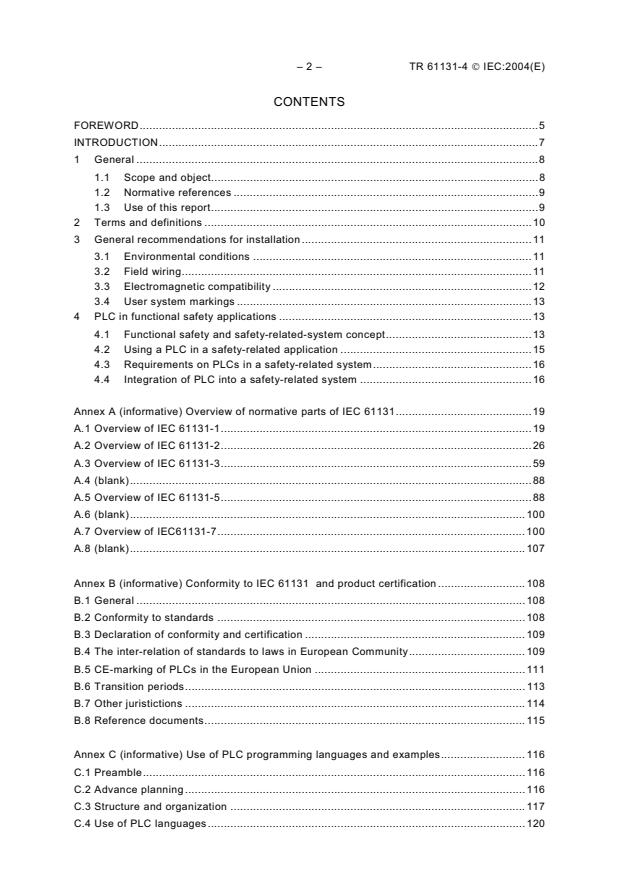
CONTENTS
FOREWORD.5
INTRODUCTION.7
1 General .8
1.1 Scope and object.8
1.2 Normative references .9
1.3 Use of this report.9
2 Terms and definitions .10
3 General recommendations for installation.11
3.1 Environmental conditions .11
3.2 Field wiring.11
3.3 Electromagnetic compatibility .12
3.4 User system markings .13
4 PLC in functional safety applications .13
4.1 Functional safety and safety-related-system concept.13
4.2 Using a PLC in a safety-related application .15
4.3 Requirements on PLCs in a safety-related system.16
4.4 Integration of PLC into a safety-related system .16
Annex A (informative) Overview of normative parts of IEC 61131.19
A.1 Overview of IEC 61131-1.19
A.2 Overview of IEC 61131-2.26
A.3 Overview of IEC 61131-3.59
A.4 (blank).88
A.5 Overview of IEC 61131-5.88
A.6 (blank).100
A.7 Overview of IEC61131-7.100
A.8 (blank).107
Annex B (informative) Conformity to IEC 61131 and product certification .108
B.1 General .108
B.2 Conformity to standards .108
B.3 Declaration of conformity and certification .109
B.4 The inter-relation of standards to laws in European Community.109
B.5 CE-marking of PLCs in the European Union .111
B.6 Transition periods.113
B.7 Other juristictions . 114
B.8 Reference documents.115
Annex C (informative) Use of PLC programming languages and examples.116
C.1 Preamble.116
C.2 Advance planning .116
C.3 Structure and organization .117
C.4 Use of PLC languages.120
TR 61131-4 © IEC:2004(E) – 3 –
C.5 User Defined Function Block (DFB) .127
C.6 Language implementation.130
Figure 1 – Object of user guidelines.8
Figure 2 – SRS in risk reduction concept .14
Figure 3 – Event tree analysis for deployment of SRS.18
Figure A.1 – Basic functional structure of a PLC system .21
Figure A.2 – PLC hardware model .22
Figure A.3 – Typical interface/port diagram of a PLC system .23
Figure A.4 – Type test EUT configuration.32
Figure A.5 – Digital I/O parameters.35
Figure A.6 – Immunity zones.46
Figure A.7 – Programmable Controller System (PLC system).59
Figure A.8 – Software model.62
Figure A.9 – Combination of programmable controller language elements .64
Figure A.10 – Examples of function usage .69
Figure A.11 – Function block instantiation examples.70
Figure A.12 – Sequential function chart .71
Figure A.13 – Function block and program declarations for configuration example.79
Figure A.14 – The four programming languages.82
Figure A.15 – Boolean OR examples .86
Figure A.16 – Programming elements of Function Block Diagram language .87
Figure A.17 – Top-down and bottom-up programming .88
Figure A.18 – Scope of IEC 61131-5.88
Figure A.19 – Relationship of the communication model to IEC 61131-2 and IEC 61131-3 .90
Figure A.20 – Programmable controller communication model .91
Figure A.21 – Example of communication control in FBD language .99
Figure A.22 – Example of a fuzzy control in FBD program.101
Figure A.23 – Example of ramp curve membership functions .102
Figure A.24 – Defuzzification program block .102
Figure A.25 – Example of singleton terms.102
Figure C.1 – Program structure overview .118
Figure C.2 – Program structure with detail .119
Figure C.3 – The structured program plan for brewing process automation with various
languages.121
Figure C.4 – Example of a program in IL language.122
Figure C.5 – Example of a program in ST language .123
Figure C.6 – Example of a control program in LD language.124
Figure C.7 – An example of a control program in FBD language .125
Figure C.8 – A control program in SFC .126
Figure C.9 – A DFB for valve control.127
Figure C.10 – DFB for valve actuation .128
Figure C.11 – DFB for alarm actuation .129
– 4 – TR 61131-4 © IEC:2004(E)
Table 1 – Environmental conditions .11
Table 2 – Installation rules: earthing measures .12
Table 3 – Installation rules: EMC .12
Table 4 – SIL of demand mode safety functions.14
Table 5 – SIL of continuous mode safety functions .14
Table A.1 – Summary of programmable functions .24
Table A.2 – General conditions for tests .32
Table A.3 – Operating ambient air temperature of PLC systems .33
Table A.4 – Emission limits.45
Table A.5 – Criteria to prove the performance of a PLC-system against EMC
disturbances .47
Table A.6 – Voltage drops and interruptions .47
Table A.7 – Shock protection requirements for open and enclosed equipment .50
Table A.8 – Temperature limits .52
Table A.9 – Data type declaration features .67
Table A.10 – Location and size prefix features for directly represented variables.67
Table A.11 – Variable usage.68
Table A.12 – Examples of function block I/O variable usage .70
Table A.13 – Step features .72
Table A.14 – Transition and transition conditions .73
Table A.15 – Declaration of action .75
Table A.16 – Step/action association .77
Table A.17 – Action block features.78
Table A.18 – Configuration and resource declaration features .79
Table A.19 – Examples of configuration and resource declaration features .80
Table A.20 – Operators of Instruction List language.83
Table A.21 – Operators of the ST language .84
Table A.22 – ST language statements: .84
Table A.23 – Status presenting entities.92
Table A.24 – PLC summary status .93
Table A.25 – Status of I/O subsystem .94
Table A.26 – Status of processing unit.94
Table A.27 – PLC application functions.95
Table A.28 – Meaning of value of I/O state .97
Table A.29 – List of communication function blocks .98
Table A.30 – Semantic of communication function block parameters.98
Table A.31 – Defuzzification methods .103
Table A.32 – Priority of rule block operators .103
Table A.33 – Fuzzy logic control basic level language elements .105
Table A.34 – Fuzzy logic control extension level language elements (optional) .105
Table A.35 – Fuzzy logic control data check list.106
TR 61131-4 © IEC:2004(E) – 5 –
INTERNATIONAL ELECTROTECHNICAL COMMISSION
____________
PROGRAMMABLE CONTROLLERS –
Part 4 – User guidelines
FOREWORD
1) The International Electrotechnical Commission (IEC) is a worldwide organization for standardization comprising
all national electrotechnical committees (IEC National Committees). The object of IEC is to promote
international co-operation on all questions concerning standardization in the electrical and electronic fields. To
this end and in addition to other activities, IEC publishes International Standards, Technical Specifications,
Technical Reports, Publicly Available Specifications (PAS) and Guides (hereafter referred to as “IEC
Publication(s)”). Their preparation is entrusted to technical committees; any IEC National Committee interested
in the subject dealt with may participate in this preparatory work. International, governmental and non-
governmental organizations liaising with the IEC also participate in this preparation. IEC collaborates closely
with the International Organization for Standardization (ISO) in accordance with conditions determined by
agreement between the two organizations.
2) The formal decisions or agreements of IEC on technical matters express, as nearly as possible, an international
consensus of opinion on the relevant subjects since each technical committee has representation from all
interested IEC National Committees.
3) IEC Publications have the form of recommendations for international use and are accepted by IEC National
Committees in that sense. While all reasonable efforts are made to ensure that the technical content of IEC
Publications is accurate, IEC cannot be held responsible for the way in which they are used or for any
misinterpretation by any end user.
4) In order to promote international uniformity, IEC National Committees undertake to apply IEC Publications
transparently to the maximum extent possible in their national and regional publications. Any divergence
between any IEC Publication and the corresponding national or regional publication shall be clearly indicated in
the latter.
5) IEC provides no marking procedure to indicate its approval and cannot be rendered responsible for any
equipment declared to be in conformity with an IEC Publication.
6) All users should ensure that they have the latest edition of this publication.
7) No liability shall attach to IEC or its directors, employees, servants or agents including individual experts and
members of its technical committees and IEC National Committees for any personal injury, property damage or
other damage of any nature whatsoever, whether direct or indirect, or for costs (including legal fees) and
expenses arising out of the publication, use of, or reliance upon, this IEC Publication or any other IEC
Publications.
8) Attention is drawn to the Normative references cited in this publication. Use of the referenced publications is
indispensable for the correct application of this publication.
9) Attention is drawn to the possibility that some of the elements of this IEC Publication may be the subject of
patent rights. IEC shall not be held responsible for identifying any or all such patent rights.
The main task of IEC technical committees is to prepare International Standards. However, a
technical committee may propose the publication of a technical report when it has collected
data of a different kind from that which is normally published as an International Standard, for
example "state of the art".
This part of the International Standard IEC 61131 has been prepared by subcommittee 65B:
Devices, of IEC Technical Committee 65: Industrial-process measurement and control.
This second edition cancels and replaces the first edition published in 1995. It constitutes a
technical revision.
This second edition of IEC 61131-4 differs extensively from the first edition. The first edition,
IEC 61131-4:1995, initiated some twenty years ago, was mainly tutorial in nature. The present
revision aims to provide an engineering overview of the IEC 61131 series for the end-user of
PLC equipment who may not be expected to delve into the details of the extensive product
standard that is IEC 61131.
– 6 – TR 61131-4 © IEC:2004(E)
The purpose of this revision is therefore to assist the end-users of PLCs to make efficient and
effective use of the IEC 61131 series, and to realise the benefit of IEC standard compliant
programmable controllers. This revised Technical Report serves as a quick reference and
roadmap. Many of the IEC 61131 parts have gone through their maintenance cycle revisions.
This revision of IEC 61131-4 is based on the latest revisions available.
The text of this technical report is based on the following documents:
Enquiry draft Report on voting
65B/508A/DTR 65B/527/RVC
Full information on the voting for the approval of this technical report can be found in the
report on voting indicated in the above table.
This publication has been drafted in accordance with the ISO/IEC Directives, Part 2.
IEC 61131 consists of the following parts, under the general title: Programmable controllers
Part 1: General information
Part 2: Equipment requirements and tests
Part 3: Programming languages
Part 4: User guidelines
Part 5: Communications
Part 7: Fuzzy control programming
Part 8: Guidelines for the application and implementation of programming languages
The committee has decided that the contents of this publication will remain unchanged until
the maintenance result date indicated on the IEC web site under "http://webstore.iec.ch" in
the data related to the specific publication. At this date, the publication will be
• reconfirmed;
• withdrawn;
• replaced by a revised edition, or
• amended.
A bilingual version of this Technical Report may be issued at a later date.
TR 61131-4 © IEC:2004(E) – 7 –
INTRODUCTION
This part of IEC 61131 constitutes the fourth part of a series of standards on programmable
controllers and the associated peripherals and should be read in conjunction with the other
parts of the series.
Where a conflict exists between this and other IEC standards (except basic safety standards),
the provisions of this standard should be considered to govern in the area of programmable
controllers and their associated peripherals.
Terms of general use are defined in IEC 61131-1. More specific terms are defined in each
part.
– 8 – TR 61131-4 © IEC:2004(E)
PROGRAMMABLE CONTROLLERS –
Part 4: User guidelines
1 General
1.1 Scope and object
The object of this Technical report is to introduce the end-users of Programmable Controller
(PLC) to the IEC 61131 series, and to assist the end-users in their selection and specification
of their PLC equipment according to the IEC 61131 series. This user guideline has as its main
audience PLC end-users.
PLCs, their application program and their associated peripherals are considered as
components of a control system. Therefore, PLC users should take note that this standard
does not deal with the automated system in which the PLC and PLC system is but one
component. However, when applying this user guideline, an overall system architecture
evaluation is recommended. Functional safety of the overall automated system is beyond the
scope of this standard.
An objective of this user guideline is to facilitate communication between the PLC user and
PLC supplier according to the specifications of the IEC 61131 series that applies to PLCs and
their associated peripherals. This information exchange is illustrated in Figure 1.
SUPPLIER /----------- USER ------------\
PLC
User's own Plant
manufacturer
system engineering
including:
engineering including:
Information Information
including:
–seller of the
flow per Per flow per
–production
PLIEC 61131 IC system EC 61131
–third party engineering
series
system
–software
–maintenance
engineer
developer
engineering
IEC 1025/04
Figure 1 – Object of user guidelines
TR 61131-4 © IEC:2004(E) – 9 –
As depicted in Figure 1, the users consist of system integrators and end-users. The
manufacturer of PLC is required by the IEC 61131 series to furnish appropriate product
information to the user. Optionally, the user supplies operational requirements and
specifications to the manufacturer in order to receive suitable products and services from the
manufacturer. One objective of this Technical Report is therefore to assist in this
communication, especially from the end-user's perspective. Accordingly, this Technical Report
does not detail all the requirements of each and every part of the IEC 61131 series, such as
conformance tests. The user should refer to the individual parts of the standard when needed.
1.2 Normative references
The following referenced documents are indispensable for the application of this document.
For dated references, only the edition cited applies. For undated references, the latest edition
of the referenced document (including any amendments) applies.
IEC 61131-1: Programmable controllers – Part 1: General information
IEC 61131-2: Programmable controllers – Part 2: Equipment requirements and tests
IEC 61131-3: Programmable controllers – Part 3: Programming languages
IEC 61131-5: Programmable controllers – Part 5: Communications
IEC 61131-7: Programmable controllers – Part 7: Fuzzy control programming
IEC 61131-8: Programmable controllers – Part 8: Guidelines for the application and
implementation of programming languages
1.3 Use of this report
A PLC application starts with the user's system analysis and specification. Inquiries and
discussions (and suggestions/recommendations) with the manufacturer necessitate the use of
a mutually agreed language for interactive information exchange as in Figure 1. The user can
use this report as a basis and/or to supplement any in-house system design rules. The user
can then specify the equipment and software requirements according to the relevant parts in
the IEC 61131 series. In this user guideline, introductions and briefings of various parts of the
IEC 61131 series are presented in Annex A according to the divisions in the IEC 61131 series.
For example, Clause A.1 covers IEC 61131-1, Clause A.2 covers IEC 61131-2, etc.
This Technical Report presents only those specifications for which the user may have an
immediate need for reference. It is not a complete summary of the whole IEC 61131 series.
– 10 – TR 61131-4 © IEC:2004(E)
2 Terms and definitions
For the purposes of this part of IEC 61131, the following terms and definitions, as well as
those given in IEC 61131-1, apply.
2.1
application program (user program)
logical assembly of all the programming language elements and constructs necessary for the
intended signal processing required for the control of a machine or process by a PLC system
2.2
automated system
control system beyond the scope of IEC 61131 in which PLC systems are incorporated by or
for the user, but which also contains other components including their application programs
2.3
operator (human)
person commanding and monitoring a machine or process through an HMI connected to the
PLC. The operator does not change the PLC hardware configuration, software or the
application program. A PLC is not intended for use by untrained personnel. The operator is
assumed to be aware of the general hazards in an industrial environment.
2.4
programmable controller
digitally operating electronic system, designed for use in an industrial environment, which
uses a programmable memory for the internal storage of user-oriented instructions to
implement specific functions (such as logic, sequencing, timing, counting and arithmetic) to
control, through digital or analogue inputs and outputs, various types of machines or
processes.
NOTE In the first edition of the IEC 61131 series, the acronym “PC” was used for Programmable Controller.
However, usage of the earlier acronym PLC has been persisted with the majority of industries. After consultation,
IEC Subcommittee 65B WG7 recommended that the more widely accepted acronym PLC be used, starting with all
new editions of the IEC 61131 standard.
2.5
programmable controller system
user-assembled configuration, consisting of a programmable controller and associated
peripherals that is necessary for the intended automated system. It consists of units
interconnected by cables or plug-in connections for permanent installation and by cables or
other means for portable and transportable peripherals.
2.6
service personnel
person changing or repairing the PLC hardware configuration or the application programme.
The service person may also install software updates provided by the manufacturer. They are
assumed to be trained in the programming and operation of the PLC equipment and its use.
They are persons having the appropriate technical training and experience necessary to be
aware of hazards – in particular, electrical hazards – to which they are exposed in performing
a task and of measures to minimize danger to themselves or to other persons or to the
equipment.
TR 61131-4 © IEC:2004(E) – 11 –
3 General recommendations for installation
The installation procedure should fulfil the requirements given by documents, which are
prepared during the system selection/engineering/application phase. Not all site conditions
can be recognized at the PLC selection phase. During installation, it is important to update all
engineering and application documents according to how the PLC equipment is assembled or
modified on site.
3.1 Environmental conditions
The user should ensure that care is taken concerning temperature, contaminants, shock,
vibration and electromagnetic influence. Refer to IEC 61131-2 for specific environmental
requirements. Table 1 describes environmental conditions to be evaluated during installation.
Table 1 – Environmental conditions
Criteria Comments and considerations
Temperature Check for possible influence of steady or temporary heat sources:
- space heater
- solar heat
- hot goods passing by
Contaminants Moisture, corrosive gases, liquids and conductive dust can affect the function of a
PLC system. Therefore, check:
- use of adequate enclosures in compliance with international/national codes
- compliance with manufacturer's installation instructions
- degradation of thermal efficiency caused by dust
Shock and vibration Check for possible effects on site:
- engines
- compressors
- transfer lines
- presses, hammers
- vehicles
Electromagnetic interference Check electromagnetic interference from various sources on site:
- motors
- switch gears, thyristors
- radio-controlled equipment
- welding equipment
- electrical arcs
- switched power supplies
- power converters/inverters
3.2 Field wiring
Proper field wiring practices are of prime importance to the application of PLCs. The installer
needs to follow the manufacturer's wiring instructions and applicable local regulations.
Two earthing/grounding requirements need to be fulfilled during installation: protective earth
(safety grounding) and functional earth (signal ground reference).
Protective earthing requires the solid connection (e.g., low impedance connection, including
star washers, welding, soldering, etc.) of inactive metal parts to an equipotential metallic grid
(frames, chassis, cabinets). The grid needs to be connected to protective earth in accordance
with local and national codes.
Functional earthing needs to be installed as the low impedance network of signal ground
reference lines. It should be a network separate from protective earthing.
Protective and functional earth networks may be interconnected via wires or other low
impedance paths. Such interconnections or lack thereof may be required by applicable
local/national codes, or due to noise reduction requirements, depending on the type of
controlled process/equipment. Table 2 describes installation rules of earthing measures.
– 12 – TR 61131-4 © IEC:2004(E)
Table 2 – Installation rules: earthing measures
Criteria Reference Comments and considerations
Protective - Provide sufficient conductor cross-section for connections to earth.
earthing
- Doors should have electrical connections according to local and national
codes.
- Verify connections are tight and resistant to vibration and corrosion.
Functional - Usually functional ground reference is connected only at a single point to
earthing earth. When more than one connection to earth is made, care should be
taken to avoid ground loop interference. Such multipoint earth connections
must be made to an equipotential grid.
- Protective earth conductors may be suitable for functional grounding. Such
practice can be determined on site by measurement at 50 Hz/60 Hz and at
frequencies above signal frequency. Such quality may be improved by
specially installed electrodes or, possibly, earthed conductive building
structures.
- If a direct connection of the signal ground reference conductor of the PLC to
earth is not possible, the connection may be made via a suitable capacitor.
The capacitor should correspond to the rated insulation voltage of the PLC
circuit, and should have good high-frequency properties. Static charging can
be prevented by the use of a high ohm value resistor for discharge.
- There should be no discontinuities on ground circuits, such as could be
introduced by terminals and sockets.
Caution – protective earthing is intended to reduce the risk of electric shock hazard. Under no circumstances
should the protective earth be disconnected from the PLC. Functional earth connections may be temporarily
disconnected for servicing and/or maintenance as required.
3.3 Electromagnetic compatibility
A number of common installation practices have been found to minimise EMC related
problems. Some of these are listed in Table 3
Table 3 – Installation rules: EMC
Criteria Reference Comments and considerations
Mains - Mains conductors should be separately installed from other PLC wiring, i.e.,
cable spacings of 10 cm or more from signal cables.
- Unavoidable crossing should be at right angles.
- Use of mains' filters on the cabinet feed-ins may be required.
- Transient suppressor at mains' entrance may be required.
Input/output - Separation of the field wiring from internal I/O cabling and from bus lines.
- Care must be taken not to compromise isolation of circuits (e.g., by optical
separation) between I/O field wiring and internal PLC system.
- Filtering of susceptible I/O cables may be required.
- Use of shielded cables with low inductance cable shields (low-level signals).
- Earthing measurement in each individual case must be determined on site.
- Shield may be connected to functional ground or protective earth.
- Electrical contacts in series with inductive loads require special attention for
voltage surge and stored energy.
Noise sources Noise damping at emission sources with noise suppressers such as:
- Separate cables for input, outputs, and power circuits.
- Minimise the total length of wiring.
- Use of manufacturer recommended cables and leads.
Analogue and - Use of shielded wires.
other noise-
- Use of twisted-pair wiring.
sensitive circuits
Routing Interference voltage or current noise can enter PLCs where connections are
made, as well as the power supply connections. The wiring which extends
between the PLC and these control devices should be properly routed to
minimize induced noise on these wires.
TR 61131-4 © IEC:2004(E) – 13 –
3.4 User system markings
User system markings of components (sensors, actuators, cables, distribution-boards,
enclosures, modules, etc.) should be done in accordance with the installation drawings and
applicable codes.
Special care needs to be taken on markings of wiring. Each and every field wire should be
identified with a marking corresponding to drawing. Alteration from the drawing should be
noted on the same drawing immediately.
Care needs to be taken to ensure the following:
– markings need to be indelible;
– adequate sizes of letters and signs;
– fuse location, type, rating need to be clearly marked;
– visibility of markings; and
– conformity with installation drawings according to revision of final documents.
4 PLC in functional safety applications
When PLCs are required to perform safety functions, it is necessary that special measures be
taken to avoid and limit dangerous failures of the functional-safety-related system. Detailed
requirements for Safety-Related System (SRS) are contained in IEC 61508 and in emerging
sector implementation standards such as the IEC 61511 series. The purpose of this Clause is to
provide an overview of some of the functional safety issues that will need to be addressed. It is not
intended to provide definitive or detailed guidance for implementation.
4.1 Functional safety and safety-related-system concept
Functional safety, as defined in IEC 61508, refers to the ability of a SRS to carry out the
functions necessary to achieve a safe state for the Equipment Under Control (EUC) or to
maintain a safe state for the EUC. In this definition, the main subject is focused on the ability
of a safety-related system to do what it is required to do.
“Safety” refers to freedom from unacceptable risk. It follows that there are acceptable risks.
The level of risks may be categorized as “broadly acceptable”, “tolerable” where further risk
reduction is impracticable (the As Low As Reasonably Practical, ALARP, principle) and, the
“intolerable” where risks cannot be justified, except in extraordinary circumstances. Risk level
is assessed as a combination of “Consequence of hazardous event” and “Frequency of
hazardous event”.
The task of a SRS is to reduce the risk to a tolerable level or lower as prescribed by the
control system designer. This risk-reduction model is depicted in Figure 2.
NOTE 1 The IEC 61131 series does not deal with the functional safety or other safety aspects of the overall
automated system. Safety considerations for the overall automated system are beyond the scope of this standard.
NOTE 2 The IEC 61131 series does not contain a part on functional safety. At the preparation of this part of IEC
61131, a sector standard for PLC and similar equipment is under consideration.
NOTE 3 Safety, as covered in IEC 61131-2, refers to prevention of electric shock and fire hazards.
– 14 – TR 61131-4 © IEC:2004(E)
Actual Tolerable risk Inherit risk of EUC (including
remaining level the addition of protective
risk features)
Low EUC RISK LEVEL High
Risk reduction achieved Risk
by SRS #2 (e.g. PLC reduction
used at SIL 4, 3, or 2 as achieved
specified) by SRS #1
IEC 1026/04
Figure 2 – SRS in risk reduction concept
Each SRS is assigned Safety Functions and is to fulfil the safety functions with a prescribed
Safety Integrity Level (SIL) requirement. IEC 61508 categorises SIL in four levels as listed in
Table 4 for Demand Mode and in Table 5 for Continuous Mode.
Table 4 – SIL of demand mode safety functions
SIL Average probability of failure to perform the
safety function on demand (PFD)
–5 –4
4 ≥ 10 to < 10
–4 –3
≥ 10 to < 10
–3 –2
≥ 10 to < 10
–2 –1
≥ 10 to < 10
Table 5 – SIL of continuous mode safety functions
SIL Probability of a dangerous failure of the
safety function (per hour)
–9 –8
≥ 10 to < 10
–8 –7
≥ 10 to < 10
–7 –6
≥ 10 to < 10
–6 –5
1 ≥ 10 to < 10
Note that Table 5 can also be used for Demand Mode safety functions when the demand rate
is high compared with the proof test frequency of the safety function. Typically, when the
demand rate is higher than twice the proof test frequency, then it is reasonable to specify the
safety function in terms of probability of failure per hour using Table 5.
The international standard for safety instrumented system for the process industry is the
IEC 61511 series. In the IEC 61511 series, the safety instrumented system (SIS) includes all
components and subsystems necessary to carry out the safety instrumented function, from
sensor(s) to actuator(s).
TR 61131-4 © IEC:2004(E) – 15 –
For the machine sector, IEC 62061 is in preparation. This standard is being harmonized with
international standard ISO 13849-1 (EN 954-1). The Safety-Related Part (SRP) which carries
out safety functions is viewed as a component of the total control system. The ability of SRP
to fulfil a safety function is described as Performance Levels (PL). Performance Levels PL-a,
PL-b, PL-c, PL-d, and PL-e correspond to the “average probability of a dangerous failure per
–4 –8
hour” ranging from 10 to 10 . The required PL (for a SRP) is determined on risk
parameters of “Severity of injury”, “Frequency and/or exposure time to the hazard” and
“Probability of avoiding the hazard”. Each of these parameters is categorized as high or low.
PL-a describes risks lower than SIL1. PL-b and c approximately correspond to SIL1. PL-d
corresponds to SIL2 and PL-e corresponds to SIL3. A SRP is then specified as one of five
categories: Basic, 1, 2, 3, and 4.
4.2 Using a PLC in a safety-related application
When applying a PLC in a safety-related application (that is, an application where a failure of
the SRS to carry out its intended safety function could lead to injury, loss of life or damage to
health), then it will be necessary to take into account the likelihood of dangerous failure due
to random hardware faults. It will also be necessary to address the possibility of systematic
faults in hardware and software.
Notice that safety-related applications should not be confused with basic control applications
where there are other measures, such as safety interlocks, which provide protection in the
event of such failure.
In safety-related applications, a PLC will usually form only one part of a programmable
electronic safety-related system. The other parts, or subsystems, of the SRS include switches
and/or sensors as input devices and contactors and/or valves as output actuators.
4.2.1 Safety functions
In order to determine the particular requirements for a PLC used in a safety-related
application, it is first necessary to
...