

IEC TS 60870-6-602:2001
(Main)Telecontrol equipment and systems - Part 6-602: Telecontrol protocols compatible with ISO standards and ITU-T recommendations - TASE transport profiles
General Information
- Abstract
Is a technical specification describing the transport profiles for the IEC 60870-6 series over WAN with reference to international standardized profiles used by distributed SCADA/EMS applications in control centres, power plants and substations.
This publication is of high relevance for Smart Grid.
- Status
- Published
- Publication Date
- 25-Apr-2001
- Technical Committee
- TC 57 - Power systems management and associated information exchange
- Drafting Committee
- WG 7 - TC 57/WG 7
- Current Stage
- PPUB - Publication issued
- Start Date
- 26-Apr-2001
- Completion Date
- 15-Mar-2001
Buy Documents
IEC TS 60870-6-602:2001 - Telecontrol equipment and systems - Part 6-602: Telecontrol protocols compatible with ISO standards and ITU-T recommendations - TASE transport profiles Released:4/26/2001
Overview
IEC TS 60870-6-602:2001 is a technical specification in the IEC 60870-6 series that defines TASE transport profiles for telecontrol over wide area networks (WANs). It documents transport-layer profiles and WAN subnetwork access options used by distributed SCADA/EMS applications in control centres, power plants and substations. The specification is especially relevant to Smart Grid deployments seeking interoperable telecontrol between control systems and field sites.
Key topics
- Scope and architecture: Part of the Telecontrol Communication Architecture (TCA); describes WAN subnetwork access, reference points and an architectural model for end systems.
- Transport profiles: Defines a set of transport-level profiles (T‑profiles and L‑profiles) to map TASE application services onto standard network services - including connection-mode and connectionless-mode network services.
- Standardized mappings: References and leverages ISO/IEC and ITU‑T profiles such as CLNP (connectionless), X.25 (connection-mode), TP4, RFC1006 and profiles for frame relay and LAN access.
- Relaying and subnetwork access: Guidance on relaying connectionless network services (CLNP) and connection-mode services (ITU X.25), and on permanent vs. virtual access to packet networks.
- Normative references: Cites core OSI/transport/network standards (e.g., ISO/IEC 8072, 8073, 8348, 8473) and relevant ISPs and IEC 60870‑6 family documents (TASE.1/TASE.2 functional and protocol definitions).
Practical applications
- Interoperability planning: Helps utilities and suppliers choose interoperable transport profiles when deploying TASE.1/TASE.2 over WANs.
- System design for SCADA/EMS: Used by system architects to map telecontrol application services to appropriate WAN technologies (X.25, CLNP, frame relay, TCP/IP-capable environments).
- Vendor implementation: Reference for firmware/software developers implementing transport-layer conformance for telecontrol equipment and end systems.
- Migration and integration: Assists integrators planning migration paths or mixed-network deployments in substations, power plants and control centres - important for Smart Grid modernization.
Who should use it
- Utility communication engineers and architects
- SCADA/EMS system designers and integrators
- Protocol implementers and equipment vendors
- Standards teams assessing telecontrol WAN options and compliance
Related standards
- IEC 60870-6-501 / -502 / -503 / -601 / -701 / -702 (TASE functional and protocol parts)
- ISO/IEC 8072, 8073, 8348, 8473 (OSI transport/network)
- ITU‑T X.25 and related ISP profiles (TB/TC/TD/TE, TA series)
Keywords: IEC TS 60870-6-602:2001, TASE transport profiles, telecontrol, IEC 60870-6, SCADA, EMS, WAN transport, CLNP, X.25, TP4, Smart Grid.
Buy Documents
IEC TS 60870-6-602:2001 - Telecontrol equipment and systems - Part 6-602: Telecontrol protocols compatible with ISO standards and ITU-T recommendations - TASE transport profiles Released:4/26/2001
Get Certified
Connect with accredited certification bodies for this standard

ANCE
Mexican certification and testing association.

Intertek Slovenia
Intertek testing, inspection, and certification services in Slovenia.

LNE (Laboratoire National de Métrologie et d'Essais)
French national laboratory for metrology and testing.
Sponsored listings
Frequently Asked Questions
IEC TS 60870-6-602:2001 is a technical specification published by the International Electrotechnical Commission (IEC). Its full title is "Telecontrol equipment and systems - Part 6-602: Telecontrol protocols compatible with ISO standards and ITU-T recommendations - TASE transport profiles". This standard covers: Is a technical specification describing the transport profiles for the IEC 60870-6 series over WAN with reference to international standardized profiles used by distributed SCADA/EMS applications in control centres, power plants and substations. This publication is of high relevance for Smart Grid.
Is a technical specification describing the transport profiles for the IEC 60870-6 series over WAN with reference to international standardized profiles used by distributed SCADA/EMS applications in control centres, power plants and substations. This publication is of high relevance for Smart Grid.
IEC TS 60870-6-602:2001 is classified under the following ICS (International Classification for Standards) categories: 33.200 - Telecontrol. Telemetering. The ICS classification helps identify the subject area and facilitates finding related standards.
IEC TS 60870-6-602:2001 is available in PDF format for immediate download after purchase. The document can be added to your cart and obtained through the secure checkout process. Digital delivery ensures instant access to the complete standard document.
Standards Content (Sample)
TECHNICAL IEC
SPECIFICATION
TS 60870-6-602
First edition
2001-04
Telecontrol equipment and systems –
Part 6-602:
Telecontrol protocols compatible with
ISO standards and ITU-T recommendations –
TASE transport profiles
Matériels et systèmes de téléconduite –
Partie 6-602:
Protocoles de téléconduite compatibles avec
les normes ISO et les recommandations de l'UIT-T –
Profils TASE de transport
Reference number
IEC/TS 60870-6-602:2001(E)
Publication numbering
As from 1 January 1997 all IEC publications are issued with a designation in the
60000 series. For example, IEC 34-1 is now referred to as IEC 60034-1.
Consolidated editions
The IEC is now publishing consolidated versions of its publications. For example,
edition numbers 1.0, 1.1 and 1.2 refer, respectively, to the base publication, the
base publication incorporating amendment 1 and the base publication incorporating
amendments 1 and 2.
Further information on IEC publications
The technical content of IEC publications is kept under constant review by the IEC,
thus ensuring that the content reflects current technology. Information relating to
this publication, including its validity, is available in the IEC Catalogue of
publications (see below) in addition to new editions, amendments and corrigenda.
Information on the subjects under consideration and work in progress undertaken
by the technical committee which has prepared this publication, as well as the list
of publications issued, is also available from the following:
• IEC Web Site (www.iec.ch)
• Catalogue of IEC publications
The on-line catalogue on the IEC web site (www.iec.ch/catlg-e.htm) enables
you to search by a variety of criteria including text searches, technical
committees and date of publication. On-line information is also available on
recently issued publications, withdrawn and replaced publications, as well as
corrigenda.
• IEC Just Published
This summary of recently issued publications (www.iec.ch/JP.htm) is also
available by email. Please contact the Customer Service Centre (see below) for
further information.
• Customer Service Centre
If you have any questions regarding this publication or need further assistance,
please contact the Customer Service Centre:
Email: custserv@iec.ch
Tel: +41 22 919 02 11
Fax: +41 22 919 03 00
TECHNICAL IEC
SPECIFICATION
TS 60870-6-602
First edition
2001-04
Telecontrol equipment and systems –
Part 6-602:
Telecontrol protocols compatible with
ISO standards and ITU-T recommendations –
TASE transport profiles
Matériels et systèmes de téléconduite –
Partie 6-602:
Protocoles de téléconduite compatibles avec
les normes ISO et les recommandations de l'UIT-T –
Profils TASE de transport
IEC 2001 Copyright - all rights reserved
No part of this publication may be reproduced or utilized in any form or by any means, electronic or
mechanical, including photocopying and microfilm, without permission in writing from the publisher.
International Electrotechnical Commission 3, rue de Varembé Geneva, Switzerland
Telefax: +41 22 919 0300 e-mail: inmail@iec.ch IEC web site http://www.iec.ch
Commission Electrotechnique Internationale
PRICE CODE
U
International Electrotechnical Commission
For price, see current catalogue
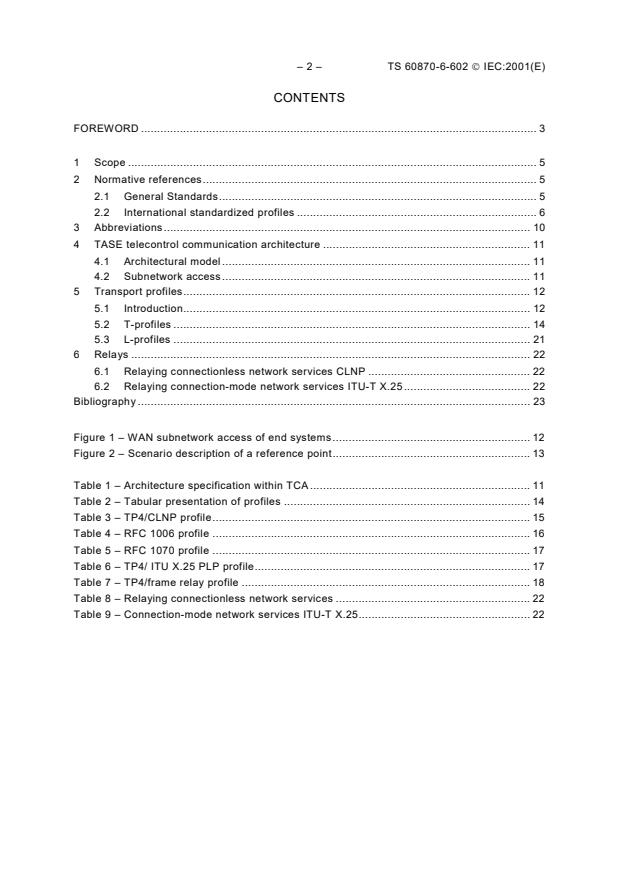
– 2 – TS 60870-6-602 IEC:2001(E)
CONTENTS
FOREWORD . 3
1 Scope . 5
2 Normative references. 5
2.1 General Standards. 5
2.2 International standardized profiles . 6
3 Abbreviations. 10
4 TASE telecontrol communication architecture . 11
4.1 Architectural model . 11
4.2 Subnetwork access. 11
5 Transport profiles. 12
5.1 Introduction. 12
5.2 T-profiles . 14
5.3 L-profiles . 21
6 Relays . 22
6.1 Relaying connectionless network services CLNP . 22
6.2 Relaying connection-mode network services ITU-T X.25. 22
Bibliography . 23
Figure 1 – WAN subnetwork access of end systems. 12
Figure 2 – Scenario description of a reference point. 13
Table 1 – Architecture specification within TCA . 11
Table 2 – Tabular presentation of profiles . 14
Table 3 – TP4/CLNP profile. 15
Table 4 – RFC 1006 profile . 16
Table 5 – RFC 1070 profile . 17
Table 6 – TP4/ ITU X.25 PLP profile. 17
Table 7 – TP4/frame relay profile . 18
Table 8 – Relaying connectionless network services . 22
Table 9 – Connection-mode network services ITU-T X.25. 22
TS 60870-6-602 IEC:2001(E) – 3 –
INTERNATIONAL ELECTROTECHNICAL COMMISSION
____________
TELECONTROL EQUIPMENT AND SYSTEMS –
Part 6-602: Telecontrol protocols compatible with ISO standards
and ITU-T recommendations – TASE transport profiles
FOREWORD
1) The IEC (International Electrotechnical Commission) is a worldwide organization for standardization comprising
all national electrotechnical committees (IEC National Committees). The object of the IEC is to promote
international co-operation on all questions concerning standardization in the electrical and electronic fields. To
this end and in addition to other activities, the IEC publishes International Standards. Their preparation is
entrusted to technical committees; any IEC National Committee interested in the subject dealt with may
participate in this preparatory work. International, governmental and non-governmental organizations liaising
with the IEC also participate in this preparation. The IEC collaborates closely with the International
Organization for Standardization (ISO) in accordance with conditions determined by agreement between the
two organizations.
2) The formal decisions or agreements of the IEC on technical matters express, as nearly as possible, an
international consensus of opinion on the relevant subjects since each technical committee has representation
from all interested National Committees.
3) The documents produced have the form of recommendations for international use and are published in the form
of standards, technical specifications, technical reports or guides and they are accepted by the National
Committees in that sense.
4) In order to promote international unification, IEC National Committees undertake to apply IEC International
Standards transparently to the maximum extent possible in their national and regional standards. Any
divergence between the IEC Standard and the corresponding national or regional standard shall be clearly
indicated in the latter.
5) The IEC provides no marking procedure to indicate its approval and cannot be rendered responsible for any
equipment declared to be in conformity with one of its standards.
6) Attention is drawn to the possibility that some of the elements of this technical specification may be the subject
of patent rights. The IEC shall not be held responsible for identifying any or all such patent rights.
The main task of IEC technical committees is to prepare International Standards. In
exceptional circumstances, a technical committee may propose the publication of a technical
specification when
the required support cannot be obtained for the publication of an International Standard,
despite repeated efforts, or
the subject is still under technical development or where, for any other reason, there is the
future but no immediate possibility of an agreement on an International Standard.
IEC 60870-6-602, which is a technical specification, has been prepared by IEC technical
committee 57: Power system control and associated communications.
The text of this technical specification is based on the following documents:
Enquiry draft Report on voting
57/466/CDV 57/502/RVC
Full information on the voting for the approval of this technical specification can be found in
the report on voting indicated in the above table.
This publication has been drafted in accordance with the ISO/IEC Directives, Part 3.
– 4 – TS 60870-6-602 IEC:2001(E)
The committee has decided that the contents of this publication will remain unchanged until
2004. At this date, the publication will be
• transformed into an International Standard;
• reconfirmed;
• withdrawn;
• replaced by a revised edition, or
• amended.
A bilingual version of this publication may be issued at a later date.
TS 60870-6-602 IEC:2001(E) – 5 –
TELECONTROL EQUIPMENT AND SYSTEMS –
Part 6-602: Telecontrol protocols compatible with ISO standards
and ITU-T recommendations – TASE transport profiles
1 Scope
This part of IEC 60870, which is a technical specification, describes the transport profiles for
the IEC 60870-6 series over WAN with reference to international standardized profiles (ISPs)
used by distributed SCADA/EMS applications in control centres, power plants and
substations. The transport profiles use virtually any standard or de facto standard (including
TCP/IP) connection-mode and connectionless-mode network services over any type of
transmission media.
These profiles are part of the telecontrol communication architecture (TCA).
2 Normative references
The following normative documents contain provisions which, through reference in this text,
constitute provisions of this technical specification. For dated references, subsequent
amendments to, or revisions of, any of these publications do not apply. However, parties to
agreements based on this technical specification are encouraged to investigate the possibility
of applying the most recent editions of the normative documents indicated below. For undated
references, the latest edition of the normative document referred to applies. Members of IEC
and ISO maintain registers of currently valid International Standards.
2.1 General Standards
ISO/IEC 8072:1996, Information technology – Open systems interconnection – Transport
service definition
ISO/IEC 8073:1997, Information technology – Open Systems Interconnection – Protocol for
providing the connection-mode transport service
ISO/IEC 8348:1996, Information technology – Open Systems Interconnection – Network
Service Definition
ISO/IEC 8473 (all parts), Information technology – Protocol for providing the connectionless-
mode network service
ISO/IEC 8878:1992, Information technology – Telecommunications and information exchange
between systems – Use of X.25 to provide the OSI Connection-mode Network Service
ISO/IEC TR 8802 (all parts), Information technology – Telecommunications and information
exchange between systems – Local and metropolitan area networks – Specific requirements
ISO/IEC 9574:1992, Information technology – Provision of the OSI connection-mode network
service by packet mode terminal equipment to an integrated services digital network
ISO/IEC TR 9577:1999, Information technology – Protocol identification in the network layer
ITU-T Recommendation X.121:2000, International numbering plan for public data networks
– 6 – TS 60870-6-602 IEC:2001(E)
2.2 International standardized profiles
This subclause lists all current ISPs which may be implemented in telecontrol systems. For
SCADA/EMS the TASE profiles IEC 60870-6-701 (TASE.1) and IEC 60870-6-702 (TASE.2)
apply.
IEC 60870-6-501:1995, Telecontrol equipment and systems – Part 6: Telecontrol protocols
compatible with ISO standards and ITU-T recommendations – Section 501: TASE.1 Service
definitions
IEC 60870-6-502:1995, Telecontrol equipment and systems – Part 6: Telecontrol protocols
compatible with ISO standards and ITU-T recommendations – Section 502: TASE.1 Protocol
definitions
IEC 60870-6-503:1997, Telecontrol equipment and systems – Part 6: Telecontrol protocols
compatible with ISO standards and ITU-T recommendations – Section 503: TASE.2 Services
and protocol
IEC 60870-6-601:1994, Telecontrol equipment and systems – Part 6: Telecontrol protocols
compatible with ISO standards and ITU-T recommendations – Section 601: Functional profile
for providing the connection-oriented transport service in an end system connected via
permanent access to a packet switched data network
IEC 60870-6-701:1998, Telecontrol equipment and systems – Part 6-701: Telecontrol
protocols compatible with ISO standards and ITU-T recommendations – Functional profile for
providing the TASE.1 application service in end systems
IEC 60870-6-702:1998, Telecontrol equipment and systems – Part 6-702: Telecontrol
protocols compatible with ISO standards and ITU-T recommendations – Functional profile for
providing the TASE.2 application service in end systems
IEC 60870-6-802:1997, Telecontrol equipment and systems – Part 6: Telecontrol protocols
compatible with ISO standards and ITU-T recommendations – Section 802: TASE.2 Object
models
2.2.1 Transport profiles
2.2.1.1 TA-profiles: CO transport over CL network services (CLNP)
ISO/IEC ISP 10608-1:1992, Information technology – International Standardized Profile
TAnnnn – Connection-mode Transport Service over Connectionless-mode Network Service –
Part 1: General overview and subnetwork-independent requirements
ISO/IEC ISP 10608-2:1992, Information technology – International Standardized Profile
TAnnnn – Connection-mode Transport Service over Connectionless-mode Network Service –
Part 2: TA51 profile including subnetwork-dependent requirements for CSMA/CD Local Area
Networks
ISO/IEC ISP 10608-4:1994, Information technology – International Standardized Profile
TAnnnn – Connection-mode Transport Service over Connectionless-mode Network Service –
Part 4: Definition of profile TA53, operation over a Token Ring LAN subnetwork
ISO/IEC ISP 10608-5:1992, Information technology – International Standardized Profile
TAnnnn – Connection-mode Transport Service over Connectionless-mode Network Service –
Part 5: TA1111/TA1121 profiles including subnetwork-dependent requirements for X.25
packet-switched data networks using virtual calls
TS 60870-6-602 IEC:2001(E) – 7 –
ISO/IEC ISP 10608-6:1995, Information technology – International Standardized Profile
TAnnnn – Connection-mode Transport Service over Connectionless-mode Network Service –
Part 6: Definition of profile TA54, operation over an FDDI LAN subnetwork
ISO/IEC ISP 10608-12:1996, Information technology – International Standardized Profile
TAnnnn – Connection-mode Transport Service over Connectionless-mode Network Service –
Part 12: MAC sublayer and physical layer dependent requirements for a CSMA/CD LAN
subnetwork
ISO/IEC ISP 10608-13:1994, Information technology – International Standardized Profile
TAnnnn – Connection-mode Transport Service over Connectionless-mode Network Service –
Part 13: MAC sublayer and physical layer dependent requirements for a token ring LAN
subnetwork
ISO/IEC ISP 10608-14:1995, Information technology – International Standardized Profile
TAnnnn – Connection-mode Transport Service over Connectionless-mode Network Service –
Part 14: MAC, PHY and PMD sublayer dependent and Station management requirements over
an FDDI LAN subnetwork
2.2.1.2 TB/C/D/E-profiles: CO transport over CO network services (ITU X.25)
ISO/IEC ISP 10609-1:1992, Information technology – International Standardized Profiles TB,
TC, TD and TE – Connection-mode Transport Service over connection-mode Network Service
– Part 1: Subnetwork-type independent requirements for Group TB
ISO/IEC ISP 10609-5:1992, Information technology – International Standardized Profiles TB,
TC, TD and TE – Connection-mode Transport Service over connection-mode Network Service
– Part 5: Definition of profiles TB1111/TB1121 [virtual call]
ISO/IEC ISP 10609-9:1992, Information technology – International Standardized Profiles TB,
TC, TD and TE – Connection-mode Transport Service over connection-mode Network Service
– Part 9: Subnetwork-type dependent requirements for Network Layer, Data Link Layer and
Physical Layer concerning permanent access to a packet switched data network using virtual
calls
ISO/IEC ISP 10609-10:1994, Information technology – International Standardized Profiles TB,
TC, TD and TE – Connection-mode Transport Service over connection-mode Network Service
– Part 10: LAN subnetwork-dependent, media independent requirements
ISO/IEC ISP 10609-11:1994, Information technology – International Standardized Profiles TB,
TC, TD and TE – Connection-mode Transport Service over connection-mode Network Service
– Part 11: CSMA/CD subnetwork-dependent media-dependent requirements
ISO/IEC ISP 10609-12:1994, Information technology – International Standardized Profiles TB,
TC, TD and TE – Connection-mode Transport Service over connection-mode Network Service
– Part 12: Definition of profile TC51, provision of the OSI connection-mode Transport Service
using the OSI connection-mode Network Service in an End System attached to a CSMA/CD
LAN
ISO/IEC ISP 10609-14:1994, Information technology – International Standardized Profiles TB,
TC, TD and TE – Connection-mode Transport Service over connection-mode Network Service
– Part 14: Definition of profile TC53, provision of the OSI connection-mode Transport Service
using the OSI connection-mode Network Service in an End System attached to a token ring
LAN
– 8 – TS 60870-6-602 IEC:2001(E)
ISO/IEC ISP 10609-15:1996, Information technology – International Standardized Profiles TB,
TC, TD and TE – Connection-mode Transport Service over connection-mode Network Service
– Part 15: Definition of profile TC54, provision of the OSI connection-mode Transport Service
using the OSI connection-mode Network Service in an End System attached to an FDDI LAN
ISO/IEC ISP 10609-20:1995, Information technology – International Standardized Profiles TB,
TC, TD and TE – Connection-mode Transport Service over connection-mode Network Service
– Part 20: Overview of the generalized multi-part ISP structure for TC and TD group profiles
for OSI usage of ISDN
ISO/IEC ISP 10609-21:1995, Information technology – International Standardized Profiles TB,
TC, TD and TE – Connection-mode Transport Service over connection-mode Network Service
– Part 21: Subnetwork-type dependent requirements for network layer and data link layer for
ISDN B-channel X.25 DTE to DTE operation
ISO/IEC ISP 10609-22:1995, Information technology – International Standardized Profiles TB,
TC, TD and TE – Connection-mode Transport Service over connection-mode Network Service
– Part 22: Subnetwork type dependent requirements for network layer and data link layer for
ISDN B-channel X.25 DTE to DCE operation
ISO/IEC ISP 10609-23:1995, Information technology – International Standardized Profiles TB,
TC, TD and TE – Connection-mode Transport Service over connection-mode Network Service
– Part 23: Subnetwork-type dependent requirements for network layer and data link layer for
data transfer concerning a packet switched mode integrated services digital network using
virtual calls: B-channel access case
ISO/IEC ISP 10609-24:1995, Information technology – International Standardized Profiles TB,
TC, TD and TE – Connection-mode Transport Service over connection-mode Network Service
– Part 24: Subnetwork-type dependent requirements for network layer and data link layer for
data transfer concerning a packet switched mode integrated services digital network using
virtual calls: D-channel access case
ISO/IEC ISP 10609-25:1995, Information technology – International Standardized Profiles TB,
TC, TD and TE – Connection-mode Transport Service over connection-mode Network Service
– Part 25: Subnetwork-type dependent requirements for Q.931 circuit-switched operation
ISO/IEC ISP 10609-26:1995, Information technology – International Standardized Profiles TB,
TC, TD and TE – Connection-mode Transport Service over connection-mode Network Service
– Part 26: Subnetwork-type dependent requirements for network layer for a call control
procedures concerning the outgoing call of a packet switched mode Integrated services digital
network in case b using virtual calls
ISO/IEC ISP 10609-27:1995, Information technology – International Standardized Profiles TB,
TC, TD and TE – Connection-mode Transport Service over connection-mode Network Service
– Part 27: Subnetwork-type dependent requirements for network layer for a call control
procedures concerning the incoming call of a packet switched mode Integrated services
digital network in case b using virtual calls
ISO/IEC ISP 10609-28:1995, Information technology – International Standardized Profiles TB,
TC, TD and TE – Connection-mode Transport Service over connection-mode Network Service
– Part 28: Subnetwork-type dependent requirements for data link layer for end systems
attached to an ISDN subnetwork
TS 60870-6-602 IEC:2001(E) – 9 –
ISO/IEC ISP 10609-30:1995, Information technology – International Standardized Profiles TB,
TC, TD and TE – Connection-mode Transport Service over connection-mode Network Service
– Part 30: Definition of profile TC1131
ISO/IEC ISP 10609-31:1995, Information technology – International Standardized Profiles TB,
TC, TD and TE – Connection-mode Transport Service over connection-mode Network Service
– Part 31: Definition of profile TC1231
ISO/IEC ISP 10609-32:1995, Information technology – International Standardized Profiles TB,
TC, TD and TE – Connection-mode Transport Service over connection-mode Network Service
– Part 32: Definition of profile TC4111
ISO/IEC ISP 10609-33:1995, Information technology – International Standardized Profiles TB,
TC, TD and TE – Connection-mode Transport Service over connection-mode Network Service
– Part 33: Definition of profile TC4211
ISO/IEC ISP 10609-34:1995, Information technology – International Standardized Profiles TB,
TC, TD and TE – Connection-mode Transport Service over connection-mode Network Service
– Part 34: Definition of profile TC43111
ISO/IEC ISP 10609-35:1995, Information technology – International Standardized Profiles TB,
TC, TD and TE – Connection-mode Transport Service over connection-mode Network Service
– Part 35: Definition of profile TC43112
ISO/IEC ISP 10609-36:1995, Information technology – International Standardized Profiles TB,
TC, TD and TE – Connection-mode Transport Service over connection-mode Network Service
– Part 36: Definition of profile TC43211
ISO/IEC ISP 10609-37:1995, Information technology – International Standardized Profiles TB,
TC, TD and TE – Connection-mode Transport Service over connection-mode Network Service
– Part 37: Definition of profile TC43212
ISO/IEC ISP 10609-38:1995, Information technology – International Standardized Profiles TB,
TC, TD and TE – Connection-mode Transport Service over connection-mode Network Service
– Part 38: Definition of profile TC4331
ISO/IEC ISP 10609-40:1995, Information technology – International Standardized Profiles TB,
TC, TD and TE – Connection-mode Transport Service over connection-mode Network Service
– Part 40: Definition of profile TD1131
ISO/IEC ISP 10609-41:1995, Information technology – International Standardized Profiles TB,
TC, TD and TE – Connection-mode Transport Service over connection-mode Network Service
– Part 41: Definition of profile TD1231
ISO/IEC ISP 10609-42:1995, Information technology – International Standardized Profiles TB,
TC, TD and TE – Connection-mode Transport Service over connection-mode Network Service
– Part 42: Definition of profile TD4111
ISO/IEC ISP 10609-43:1995, Information technology – International Standardized Profiles TB,
TC, TD and TE – Connection-mode Transport Service over connection-mode Network Service
– Part 43: Definition of profile TD4211
– 10 – TS 60870-6-602 IEC:2001(E)
ISO/IEC ISP 10609-44:1995, Information technology – International Standardized Profiles TB,
TC, TD and TE – Connection-mode Transport Service over connection-mode Network Service
– Part 44: Definition of profile TD43111
ISO/IEC ISP 10609-45:1995, Information technology – International Standardized Profiles TB,
TC, TD and TE – Connection-mode Transport Service over connection-mode Network Service
– Part 45: Definition of profile TD43112
ISO/IEC ISP 10609-46:1995, Information technology – International Standardized Profiles TB,
TC, TD and TE – Connection-mode Transport Service over connection-mode Network Service
– Part 46: Definition of profile TD43211
ISO/IEC ISP 10609-47:1995, Information technology – International Standardized Profiles TB,
TC, TD and TE – Connection-mode Transport Service over connection-mode Network Service
– Part 47: Definition of profile TD43212
ISO/IEC ISP 10609-48:1995, Information technology – International Standardized Profiles TB,
TC, TD and TE – Connection-mode Transport Service over connection-mode Network Service
– Part 48: Definition of profile TD4331
3 Abbreviations
ATM: Asynchronous transfer mode
CL: Connectionless-mode
CLNS: Connectionless-mode network service
CLNP: Connectionless-mode network protocol
CO: Connection-mode
CONS: Connection-mode network service
COTS: Connection-mode transport service
CSMA/CD: Carrier sense, multiple access/collision detection
DCE: Data communication equipment
DTE: Data terminal equipment
ES: End system
FDDI: Fibre distributed data interface
ISDN: Integrated services digital network
IS: Intermediate system
ISP: International standardized profile
LAN: Local area network
NDPU: Network data protocol unit
PICS: Protocol implementation conformance statement
R-Profile: Relay profile
T-Profile: Transport profile (providing connection-mode transport service)
TASE: Telecontrol application service element
TCA: Telecontrol communication architecture
TS 60870-6-602 IEC:2001(E) – 11 –
4 TASE telecontrol communication architecture
In this chapter, the TASE telecontrol communication architecture is described briefly to show
that the transport profiles are part of the overall architecture.
4.1 Architectural model
The TASE communication architecture is based on international standards of the IEC 60870-6
series and is illustrated in the tables below to give an overview.
The architecture specification within TCA shown in the table below provides wide area
subnetwork alternatives and a variety of network services. The combination of these protocols
allows the architecture to provide a peer-to-peer communications infrastructure for distributed
computing throughout a utility and between control centres of utilities.
Table 1 – Architecture specification within TCA
Layer CO TASE.1 architecture CO TASE.2 architecture
IEC 60870-6 IEC 60870-6
Application IEC 60870-6-501/502 TASE.1 IEC 60870-6-503/802 TASE.2
ISO 9072-1/2 ROSE ISO 9506 MMS
ISO 8650 ACSE ISO 8650 ACSE
... ...
Presentation ISO 8823/8825 BER
Session ISO 8327
Transport ISO 8072/8073 class 4, 2, 0 or
RFC 1006/TCP (with IP)
Network ISO 8348 Add.1/8473 CLNP or
ITU-T X.25 PLP ISO 8208 or
Frame Relay or
RFC 791 IP
Data Link ISO 8802.2 LLC1 or ISO 7776 LAPB or LLC2/ISDN
ISO 8802.X MAC or
ISO 9314 FDDI MAC
Physical media, X.21, X.21bis, .
4.2 Subnetwork access
Within OSI, end systems have access to subnetworks consisting of a single subnetwork (LAN)
or multiple subnetworks. In the case of different subnetworks, interworking of end systems
means end-to-end operation across a single subnetwork, or across multiple subnetworks
linked by means of network (or lower) layer relays.
For TCA three types of WAN subnetwork access of end systems (ES) are identified:
– 12 – TS 60870-6-602 IEC:2001(E)
End system
Local subnetwork
(LAN)
Gateway
A B C
Telecontrol subnetwork
(WAN)
IEC 439/01
Figure 1 – WAN subnetwork access of end systems
4.2.1 Access type A
This type is used for end systems with 3-layer architecture which can communicate over one
subnetwork (LAN), but because of a missing network layer it needs a gateway to access the
WAN subnetwork (router network). An example of this is simple substation field devices on a
substation bus which communicate with the control center over a substation host with routing
capability.
4.2.2 Access type B
This type is used for end systems with 7-layer architecture which can communicate over
multiple subnetworks using the network layer. Examples of this are TASE end systems in
control centres, substations, power plants and 7-layer field devices in substations which
communicate over the stations bus directly with the control center.
4.2.3 Access type C
This type is used for end systems with 7-layer architecture which can communicate over
multiple subnetworks and interconnect directly to the WAN subnetwork. Examples are RTUs
and single TASE end systems connected directly to the WAN router.
4.2.4 Multiprotocol access
Note that with today’s multiprotocol routers, it is possible for an end system for all three
access types to interconnect with a WAN subnetwork of any type (ISO 8473 CLNP, ITU-T
X.25/ISO 8208, frame relay, IP, ISDN, .) with only one network access protocol, the router
working as a relay. This solution allows to move the burden of relaying from the end system to
the router.
5 Transport profiles
5.1 Introduction
The TASE architecture specifies the use of existing protocols with particular sets of
parameters and options called “profiles” and which apply to a reference point where the
reference end system is interconnected to one subnetwork or multiple subnetwork. In the
most simple case, this can be a leased line.
TS 60870-6-602 IEC:2001(E) – 13 –
Reference Reference
end system end system
Reference point oOne or multiple subnetworks
with ISP or leased line
IEC 440/01
Figure 2 – Scenario description of a reference point
The architecture is described in terms of three kinds of these profiles: F-profiles (application
formats), A-profiles spanning the upper three layers (application, presentation and session);
T-profiles, the middle two layers (transport and network); and L-profiles, the lower two layers
(data Link and physical).
Profiles of protocol stacks follow the structure defined in
ISO/IEC/TR 10000-1,
ISO/IEC/TR 10000-2 and
ISO/IEC/TR 10000-3.
In order to decouple representation of information or objects from communication protocols,
and application-related protocol from subnetwork types, OSI and OSI-related profiles are
divided into the following classes:
T-transport profiles providing connection-mode transport service;
U-transport profiles providing connectionless-mode transport services;
R-relay profiles;
A-application profiles requiring connection-mode transport services;
B-application profiles requiring connectionless-mode transport profiles;
F-interchange format and representation profiles.
Transport profiles of class T and U specify how the two modes of OSI transport service are
provided over the two modes of OSI network service, and over specific subnetwork types,
such as individual types of LANs, PSDNs, etc. In this way, they isolate the A/B-profiles from
the network technology.
R-profiles specify relay functions needed to enable systems using different T- or U-profiles to
interwork. Relays between T- and U-profiles are not provided.
Profiles are identified by GXYabcd where G is the profile group (T, U, R, A, B, F), XY are
letters indicating the subdivision of a group, and numbers abcd indicate a further subdivision.
The transport profiles are specified in multi-part ISPs. One part, series TX, specifies the
subnetwork-type independent requirements for group profiles, another the subnetwork-type
dependent profile abcd, and finally one part subnetwork-type dependent requirements for OSI
layer 1 to 3 including the physical interface.
International Standardized Profiles are published as ISO/IEC ISPs. The document ISO/IEC
JTC 1/SGF N 100 accompanies the TR ISO/IEC TR 10000 series and serves as a dictionary
of ISPs and profiles.
– 14 – TS 60870-6-602 IEC:2001(E)
Within the concept of taxonomy of profiles, T- or U-sets build groups that are compatible in the
sense that a system implementing one profile from the group and another system implementing a
profile from the same group can be expected to interwork, according to OSI, to some minimal
level which is determined by the mandatory features of the profiles in the group.
In this specification over WAN, only CO A- and T-profiles are used. The network services can
be CO or CL. This simplifies the architecture and number of combinations considerably. Note
that the current standardization of the IEC utility substation bus may also include CL B- and
U-profiles in cases in which the station bus is directly interconnected to the control center
over a router network.
The transport profiles of the TCA use OSI TP4 over a variety of connection-mode network
services (ISO 8348/ISO 8206 (ITU X.25 PLP), frame relay) and connectionless-mode network
services (ISO 8348/ISO 8473) and protocols and OSI TP0 over TCP/IP with RFC 1006. Note
that the functionality of the last solution despite TP0 is equivalent to TP4.
Although the use of transport classes TP2 and TP0 are not excluded, TP4 should be preferred
for data integrity reasons. HDLC and LAPB in layer 2 have well-known integrity deficits and
with the use of TP4 the overall integrity conforms with integrity class I2 (see IEC 60870-1-4
–6
and IEC 60870-5-1) for bit error rates higher than 10 .
For L-profiles there are no restrictions including ATM over adaptation layers. For LAN,
ISO 8802-2 LLC1 should be used.
Throughout this specification, a uniform tabular presentation of profiles will be used as
follows:
Table 2 – Tabular presentation of profiles
T-profile Profile group 1 Profile group n
Transport layer Standard Standard
Network layer Standard Standard
Data link layer Standard Standard
Physical layer Standard Standard
R-profile Profile group 1 Profile group n
Relay Standard Standard
5.2 T-profiles
Within the OSI taxonomy of transport profiles, group TA and TB profiles are used. For both TA
and TB within the TCA, the transport classes 4, 2, and 0 have to be implemented. This
provides full interworking between TA and TB profile groups. The identifier for the profile in
the lower layers is of the form YXabcd where abcd is the structured numerical identifier
indicating the subnetwork type supported in this profile.
The T-profiles use different types of subnetwork. Subnetwork types of interest for telecontrol
are (numbers indicate subdivision indications abcd):
1 Packed switched data network (PSDN)
11 Permanent access to a PSDN
12 PSTN leased line
13 Digital data circuit/CSDN leased line
14 Switched access to a PSDN
15 PSTN case
16 CSDN case
17 ISDN B-channel case
TS 60870-6-602 IEC:2001(E) – 15 –
2 Digital data circuit
3 Leased service
4 Dial-up service
2 Analogue telephone circuit
3 Leased service
4 Dial-up service
2 Integrated services digital network (ISDN)
4111 Semi-permanent service B-channel X.25 DTE to DTE operation
4211 Circuit-mode service B-channel X.25 DTE to DTE operation
41 Packet-mode service
42 D-channel access
43 B-channel semi-permanent access
2 Local area networks
3 CSMA/CD
4 Token bus
5 Token ring
6FDDI.
Fourth number, if any, indicates 1 for virtual call (VC) and 2 for permanent access (PVC).
5.2.1 Connection-mode T-profiles with CLNS
TA profiles are used with connection-mode transport services (CO-TS) over connection-less
network services (CL-NS) requiring the use of the class 4 transport protocol as defined in
ISO 8072.
Note that a system implementing group TA and claiming conformance to ISO 8073 also has to
implement the mandatory transport classes for operation over CO-NS (see below) as required
by ISO 8073. That means for both TA and TB in the TCA the transport classes 4, 2, and 0
have to be implemented.
5.2.1.1 TP4/CLNP
The TP4/CLNP profile consists of the following:
Table 3 – TP4/CLNP profile
T-profile TA1111/TA1121 TA51 TA53 TA54
X.25 PLP CSMA/CD token ring FDDI
Transport layer ISO/IEC 8073 TP4
Network layer ISO/IEC 8473 CLNP
Data link layer ISO 7776 LAPB ISO/IEC 8802-2 LLC type 1
Data link layer MAC – ISO 8802-3 ISO 8802-5 ISO 9314
Physical layer X.21, X.21bis ISO 8802-3 ISO 8802-5 ISO 9314
This is the profile used in OSI environments for connectionless network services. This profile
represents the most efficient T-profile both in terms of processing/memory and bandwidth and
is most appropriate where such constraints are tight and there is a strong requirement for
reliability.
– 16 – TS 60870-6-602 IEC:2001(E)
The following ISPs are used:
ISO/IEC ISP 10608-1, ISO/IEC ISP 10608-2, ISO/IEC ISP 10608-4, ISO/IEC ISP 10608-5,
ISO/IEC ISP 10608-6, ISO/IEC ISP 10608-12, ISO/IEC ISP 10608-13 and ISO/IEC ISP 10608-14.
5.2.1.2 RFC 1006
The RFC 1006 profile consists of the following:
Table 4 – RFC 1006 profile
T-profile TA1111/TA1121* TA51* TA53* TA54*
X.25 PLP CSMA/CD token ring FDDI
Transport layer RFC 1006 (ISO/IEC 8073 TP0 equivalent)
TCP (RFC 793)
Network layer IP (RFC 791) version 5
Data link layer ISO 7776 LAPB ISO/IEC 8802-2 LLC type 1
Data link layer MAC – ISO 8802-3 ISO 8802-5 ISO 9314
Physical layer X.21, X.21bis ISO 8802-3 ISO 8802-5 ISO 9314
* An OSI T-profile with TCP/IP using the RFC 1006 convergence layer.
This profile is utilized in environments operating an OSI upper layer over TCP/IP. RFC 1006
provides the conversion from the stream semantics of TCP to the record semantics of TP4.
This profile will generate more header overhead than the TP4/CLNP profile and will also
require more memory and/or processing.
RFC 1006 specifies the use of TCP port 102 (decimal). This is considered the default port
within the scope of this specification. Other port assignments are allowed but must be
declared in an implementation’s PICS. Additional information may be found within RFC 1006.
The OSI regional workshops (NIST OIW, EWOS, and AOW) have recommended that RFC
1006 be the preferred mechanism for utilizing OSI A-profiles over TCP/IP T-profiles. However,
the RFC 1006 does not mandate the use of the TCP-KEEPALIVE function.
In order to allow maximum reliability to be achieved, implementations shall be able to
configure the use of the TCP-KEEPALIVE function and the interval at which the function shall
be used. Implementations that have no access to the use of the TCP-KEEPALIVE shall
convey this via the PICS (protocol implementation conformance statement).
RFC 1070
The RFC 1070 profile consists of the following:
TS 60870-6-602 IEC:2001(E) – 17 –
Table 5 – RFC 1070 profile
T-profile TA51* TA53* TA54*
CSMA/CD token ring FDDI
Transport layer ISO/IEC 8073 TP4
RFC 1070
UDP (RFC 768)/IP (RFC 791) version 5
Network layer ISO/IEC 8473 CLNP
Data link layer ISO/IEC 8802-2 LLC type 1
Data link layer MAC ISO 8802-3 ISO 8802-5 ISO 9314
Physical layer ISO 8802-3 ISO 8802-5 ISO 9314
* OSI TA-profiles with UDP/IP using the RFC 1070 convergence layer.
This profile is used in environments that need to operate an OSI A- and T-profile over an IP
network. This might occur in a mixed environment that was partially full OSI (in the subnets
where there were tight performance constraints) and partially IP (in the subnets where
there were no such constraints). In a pure OSI or IP subnetwork this alternative is not
recommended. In a homogeneous IP environment the RFC 1006 profile should be preferred.
RFC 1070 specifies the use of UDP port 147 (decimal). This is considered the default port
within the scope of this specification. Other port assignments are allowed but must be
declared.
5.2.2 Connection-mode T-profiles with CONS
TB profiles are used with connection-mode transport services (CO-TS) over connection-less
network services (CL-NS) requiring the use of the classes 4, 2 and 0 transport protocol as
defined in ISO 8072.
5.2.2.1 TP4/ ITU-T X.25 PLP
The TP4/ ITU X.25 PLP profile consists of the following:
Table 6 – TP4/ ITU X.25 PLP profile
T-profile TB1111/TB1121*
X.25 PLP
Transport layer ISO/IEC 8073
Network layer ISO/IEC 8208
Data link layer ISO 7776 LAPB
Data link layer MAC –
Physical layer X.21, X.21bis
* See TASE TB-profile IEC 60870-6-601.
This is the profile used in OSI environments for connection oriented network services. This
profile defines the permanent access of an end system to an X.25 packet switching network
but no LAN interface.
– 18 – TS 60870-6-602 IEC:2001(E)
The following ISPs are used:
ISO/IEC ISP 10609-1, ISO/IEC ISP 10609-5,
ISO/IEC ISP 10609-9, ISO/IEC ISP 10609-10, ISO/IEC ISP 10609-11 and ISO/IEC ISP
10609-12.
TB51 is used if the LAN has WAN access.
ISO/IEC ISP 10609-14.
TB53 is used if the LAN has WAN access.
ISO/IEC ISP 10609-15.
TB54 is used if the LAN has WAN access.
ISO/IEC ISP 10609-20, ISO/IEC ISP 10609-21, ISO/IEC ISP 10609-22, ISO/IEC ISP 10609-
23, ISO/IEC ISP 10609-24, ISO/IEC ISP 10609-25, ISO/IEC ISP 10609-26, ISO/IEC ISP
10609-27 and ISO/IEC ISP 10609-28. ISO/IEC ISP 10609-30 to ISO/IEC ISP 10609-48
inclusive.
In all cases TBabcd is used.
With TASE.2 the profile IEC 60870-6-601 is based on ISO/IEC ISP 10609-5, with profile
TB1111/TB1121 for analog and digital access to an ITU-T X.25 packet switching network
respectively and on ISO/IEC ISP 10609-9 for the network layer, data link layer (LAPB) and the
physical layer (ITU-T X.21 or ITU-T X.21bis). For LAN access see the ISP above.
5.2.2.2 TP4/ frame relay
Frame relay standardized by ANSI and ITU-T is used over digital transmission networks with
low bit error rate. The TP4/frame relay profile consists of the following:
Table 7 – TP4/frame relay profile
T-profile TB1111/TB1121* TB51* TB53* TB54*
frame relay CSMA/CD token ring FDDI
Transport layer ISO/IEC 8073 TP4
ITU I.122, I.3XX, Q.921, Q.931
Network layer
Data link layer ITU Q.922 LAPD ISO/IEC 8802-2 LLC type 1
Data link layer MAC – ISO 8802-3 ISO 8802-5 ISO 9314
Physical layer X.21, X.21bis ISO 8802-3 ISO 8802-5 ISO 9314
* OSI-like TB-profiles with frame relay
This is the profile used in OSI environments for connection oriented network services.
TS 60870-6-602 IEC:2001(E) – 19 –
5.2.3 Routing protocol profiles
The routing protocols use a distributed adaptive approach to route NPDUs through the
subnets. Routing becomes more effici
...