

IEC 61010-2-010:2019
(Main)Safety requirements for electrical equipment for measurement, control and laboratory use - Part 2-010: Particular requirements for laboratory equipment for the heating of materials
General Information
- Abstract
IEC 61010-2-010:2019 specifies particular safety requirements for the following types a) to c) of electrical equipment and their accessories, wherever they are intended to be used, whenever the heating of materials is one of the functions of the equipment.
a) Electrical test and measurement equipment
This is equipment which by electromagnetic means tests, measures, indicates or records
one or more electrical or physical quantities, also non-measuring equipment such as
signal generators, measurement standards, power supplies for laboratory use,
transducers, transmitters, etc.
b) Electrical industrial process-control equipment
This is equipment which controls one or more output quantities to specific values, with
each value determined by manual setting, by local or remote programming, or by one or
more input variables.
c) Electrical laboratory equipment
This is equipment which measures, indicates, monitors, inspects or analyses materials, or
is used to prepare materials, and includes in vitro diagnostic (IVD) equipment. This fourth edition cancels and replaces the third edition published in 2014. This edition constitutes a technical revision. This edition includes the following significant technical changes with respect to the previous edition:
a) alignment with changes introduced by Amendment 1 of IEC 61010-1:2010;
b) alignment with IEC 61010-2-011 and IEC 61010-2-012:
- new matching Introduction clarifying which standard(s) to use;
- new 5.4.101 instructions for flammable liquid;
- subclause 9.5 on flammable liquids replaced with text from IEC 61010-2-012;
c) subclause 5.2.101 deleted;
d) requirements in 10.101 b) and c) clarified.
It has the status of a group safety publication in accordance with IEC Guide 104.
- Status
- Published
- Publication Date
- 11-Feb-2019
- Technical Committee
- TC 66 - Safety of measuring, control and laboratory equipment
- Drafting Committee
- MT 17 - TC 66/MT 17
- Current Stage
- PPUB - Publication issued
- Start Date
- 12-Feb-2019
- Completion Date
- 25-Feb-2019
Buy Documents
IEC 61010-2-010:2019 RLV - Safety requirements for electrical equipment for measurement, control and laboratory use - Part 2-010: Particular requirements for laboratory equipment for the heating of materials Released:2/12/2019
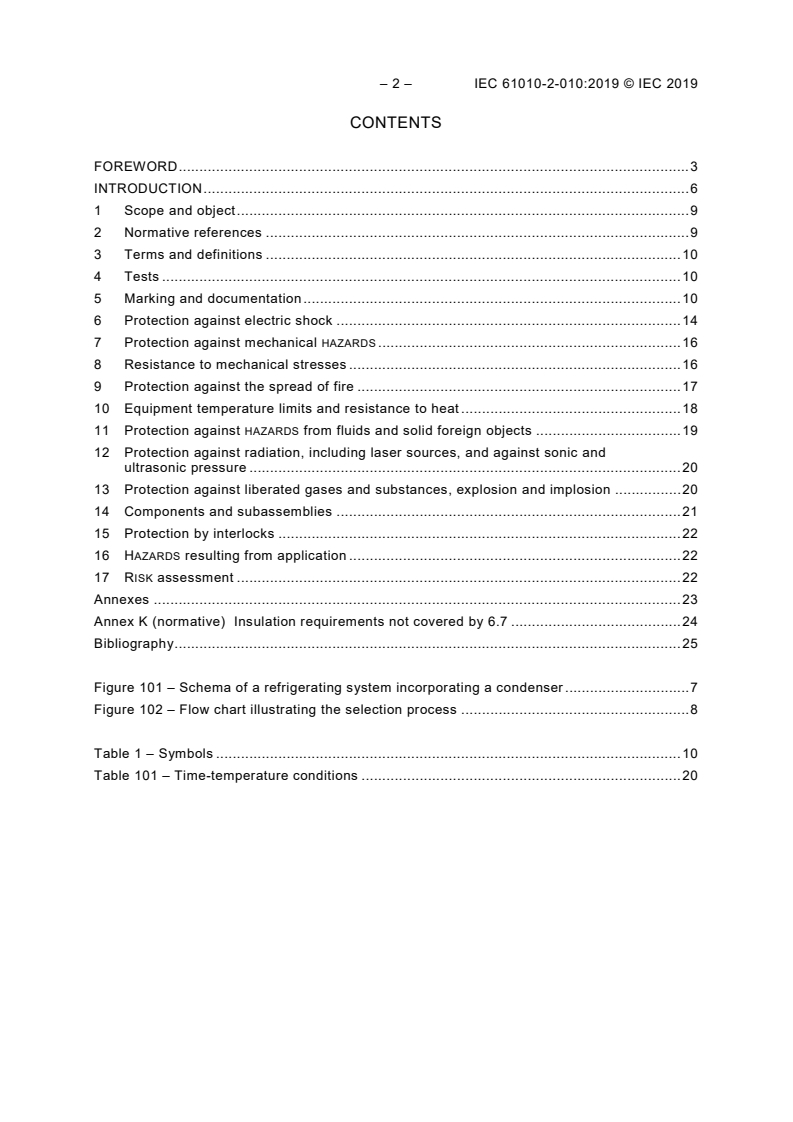
IEC 61010-2-010:2019 - Safety requirements for electrical equipment for measurement, control and laboratory use - Part 2-010: Particular requirements for laboratory equipment for the heating of materials Released:2/12/2019
Overview - IEC 61010-2-010:2019 (Laboratory equipment for the heating of materials)
IEC 61010-2-010:2019 is the Part 2 standard in the IEC 61010 series that specifies particular safety requirements for electrical equipment where heating of materials is a function. It applies to:
- Electrical test and measurement equipment (e.g., signal generators, laboratory power supplies, transducers),
- Electrical industrial process-control equipment, and
- Electrical laboratory equipment, including in vitro diagnostic (IVD) devices.
This fourth edition (2019) cancels and replaces the 2014 edition and is a group safety publication per IEC Guide 104. It is intended to be used together with the latest edition of IEC 61010-1 (general safety requirements).
Key topics and technical requirements
The standard supplements IEC 61010-1 with specific provisions for heating systems and covers the following technical areas:
- Tests and conformity procedures for heating functions.
- Marking and documentation requirements (including operator instructions and warnings).
- Protection against electric shock and mechanical hazards for heated equipment.
- Resistance to mechanical stresses, and protection against the spread of fire.
- Equipment temperature limits and resistance to heat (temperature management for safe operation).
- Protection against fluids and solid foreign objects, and against radiation, sonic/ultrasonic pressure.
- Protection from liberated gases, explosion and implosion where applicable.
- Components and subassemblies, interlocks, and safeguards to prevent hazardous operation.
- Hazard analysis and risk assessment requirements specific to heating functions.
Notable changes in the 2019 edition:
- Alignment with Amendment 1 of IEC 61010-1:2010 and with IEC 61010-2-011 and IEC 61010-2-012.
- New guidance and instructions for flammable liquid heat transfer media and revised handling of flammable liquids.
- Clause reorganizations and clarifications (including deleted and revised subclauses and clarified requirements in Clause 10.101).
Practical applications - who uses this standard
IEC 61010-2-010:2019 is essential for:
- Manufacturers and design engineers of laboratory heaters, ovens, hotplates, incubators, and related heated laboratory/process equipment.
- Producers of test & measurement and process-control devices that incorporate heating functions.
- Compliance engineers, testing laboratories, and certification bodies assessing safety for heated equipment.
- Lab managers, procurement specialists and occupational safety professionals specifying safe equipment for research, clinical, and industrial labs.
Related standards
- IEC 61010-1 - General requirements for electrical equipment for measurement, control and laboratory use.
- IEC 61010-2-011 - Particular requirements for equipment incorporating refrigerating systems.
- IEC 61010-2-012 - Particular requirements where heating and refrigerating systems interact (or other environmental factors apply).
Use IEC 61010-2-010:2019 when the device’s primary hazard profile stems from the heating of materials; consult Part 2-011 or Part 2-012 when refrigerating systems or combined heating/cooling interactions are present.
Relations
- Effective Date
- 05-Sep-2023
Buy Documents
IEC 61010-2-010:2019 RLV - Safety requirements for electrical equipment for measurement, control and laboratory use - Part 2-010: Particular requirements for laboratory equipment for the heating of materials Released:2/12/2019
IEC 61010-2-010:2019 - Safety requirements for electrical equipment for measurement, control and laboratory use - Part 2-010: Particular requirements for laboratory equipment for the heating of materials Released:2/12/2019
Get Certified
Connect with accredited certification bodies for this standard

ECOCERT
Organic and sustainability certification.

Eurofins Food Testing Global
Global leader in food, environment, and pharmaceutical product testing.

IMP NDT d.o.o.
Non-destructive testing services. Radiography, ultrasonic, magnetic particle, penetrant, visual inspection.
Sponsored listings
Frequently Asked Questions
IEC 61010-2-010:2019 is a standard published by the International Electrotechnical Commission (IEC). Its full title is "Safety requirements for electrical equipment for measurement, control and laboratory use - Part 2-010: Particular requirements for laboratory equipment for the heating of materials". This standard covers: IEC 61010-2-010:2019 specifies particular safety requirements for the following types a) to c) of electrical equipment and their accessories, wherever they are intended to be used, whenever the heating of materials is one of the functions of the equipment. a) Electrical test and measurement equipment This is equipment which by electromagnetic means tests, measures, indicates or records one or more electrical or physical quantities, also non-measuring equipment such as signal generators, measurement standards, power supplies for laboratory use, transducers, transmitters, etc. b) Electrical industrial process-control equipment This is equipment which controls one or more output quantities to specific values, with each value determined by manual setting, by local or remote programming, or by one or more input variables. c) Electrical laboratory equipment This is equipment which measures, indicates, monitors, inspects or analyses materials, or is used to prepare materials, and includes in vitro diagnostic (IVD) equipment. This fourth edition cancels and replaces the third edition published in 2014. This edition constitutes a technical revision. This edition includes the following significant technical changes with respect to the previous edition: a) alignment with changes introduced by Amendment 1 of IEC 61010-1:2010; b) alignment with IEC 61010-2-011 and IEC 61010-2-012: - new matching Introduction clarifying which standard(s) to use; - new 5.4.101 instructions for flammable liquid; - subclause 9.5 on flammable liquids replaced with text from IEC 61010-2-012; c) subclause 5.2.101 deleted; d) requirements in 10.101 b) and c) clarified. It has the status of a group safety publication in accordance with IEC Guide 104.
IEC 61010-2-010:2019 specifies particular safety requirements for the following types a) to c) of electrical equipment and their accessories, wherever they are intended to be used, whenever the heating of materials is one of the functions of the equipment. a) Electrical test and measurement equipment This is equipment which by electromagnetic means tests, measures, indicates or records one or more electrical or physical quantities, also non-measuring equipment such as signal generators, measurement standards, power supplies for laboratory use, transducers, transmitters, etc. b) Electrical industrial process-control equipment This is equipment which controls one or more output quantities to specific values, with each value determined by manual setting, by local or remote programming, or by one or more input variables. c) Electrical laboratory equipment This is equipment which measures, indicates, monitors, inspects or analyses materials, or is used to prepare materials, and includes in vitro diagnostic (IVD) equipment. This fourth edition cancels and replaces the third edition published in 2014. This edition constitutes a technical revision. This edition includes the following significant technical changes with respect to the previous edition: a) alignment with changes introduced by Amendment 1 of IEC 61010-1:2010; b) alignment with IEC 61010-2-011 and IEC 61010-2-012: - new matching Introduction clarifying which standard(s) to use; - new 5.4.101 instructions for flammable liquid; - subclause 9.5 on flammable liquids replaced with text from IEC 61010-2-012; c) subclause 5.2.101 deleted; d) requirements in 10.101 b) and c) clarified. It has the status of a group safety publication in accordance with IEC Guide 104.
IEC 61010-2-010:2019 is classified under the following ICS (International Classification for Standards) categories: 19.080 - Electrical and electronic testing; 71.040.20 - Laboratory ware and related apparatus. The ICS classification helps identify the subject area and facilitates finding related standards.
IEC 61010-2-010:2019 has the following relationships with other standards: It is inter standard links to IEC 61010-2-010:2014. Understanding these relationships helps ensure you are using the most current and applicable version of the standard.
IEC 61010-2-010:2019 is available in PDF format for immediate download after purchase. The document can be added to your cart and obtained through the secure checkout process. Digital delivery ensures instant access to the complete standard document.
Standards Content (Sample)
IEC 61010-2-010 ®
Edition 4.0 2019-02
REDLINE VERSION
INTERNATIONAL
STANDARD
colour
inside
GROUP SAFETY PUBLICATION
Safety requirements for electrical equipment for measurement, control and
laboratory use –
Part 2-010: Particular requirements for laboratory equipment for the heating of
materials
All rights reserved. Unless otherwise specified, no part of this publication may be reproduced or utilized in any form
or by any means, electronic or mechanical, including photocopying and microfilm, without permission in writing from
either IEC or IEC's member National Committee in the country of the requester. If you have any questions about IEC
copyright or have an enquiry about obtaining additional rights to this publication, please contact the address below or
your local IEC member National Committee for further information.
IEC Central Office Tel.: +41 22 919 02 11
3, rue de Varembé info@iec.ch
CH-1211 Geneva 20 www.iec.ch
Switzerland
About the IEC
The International Electrotechnical Commission (IEC) is the leading global organization that prepares and publishes
International Standards for all electrical, electronic and related technologies.
About IEC publications
The technical content of IEC publications is kept under constant review by the IEC. Please make sure that you have the
latest edition, a corrigendum or an amendment might have been published.
IEC publications search - webstore.iec.ch/advsearchform Electropedia - www.electropedia.org
The advanced search enables to find IEC publications by a The world's leading online dictionary on electrotechnology,
variety of criteria (reference number, text, technical containing more than 22 000 terminological entries in English
committee,…). It also gives information on projects, replaced and French, with equivalent terms in 16 additional languages.
and withdrawn publications. Also known as the International Electrotechnical Vocabulary
(IEV) online.
IEC Just Published - webstore.iec.ch/justpublished
Stay up to date on all new IEC publications. Just Published IEC Glossary - std.iec.ch/glossary
details all new publications released. Available online and 67 000 electrotechnical terminology entries in English and
once a month by email. French extracted from the Terms and Definitions clause of
IEC publications issued since 2002. Some entries have been
IEC Customer Service Centre - webstore.iec.ch/csc collected from earlier publications of IEC TC 37, 77, 86 and
If you wish to give us your feedback on this publication or CISPR.
need further assistance, please contact the Customer Service
Centre: sales@iec.ch.
IEC 61010-2-010 ®
Edition 4.0 2019-02
REDLINE VERSION
INTERNATIONAL
STANDARD
colour
inside
GROUP SAFETY PUBLICATION
Safety requirements for electrical equipment for measurement, control and
laboratory use –
Part 2-010: Particular requirements for laboratory equipment for the heating of
materials
INTERNATIONAL
ELECTROTECHNICAL
COMMISSION
ICS 19.080; 71.040.20 ISBN 978-2-8322-6577-2
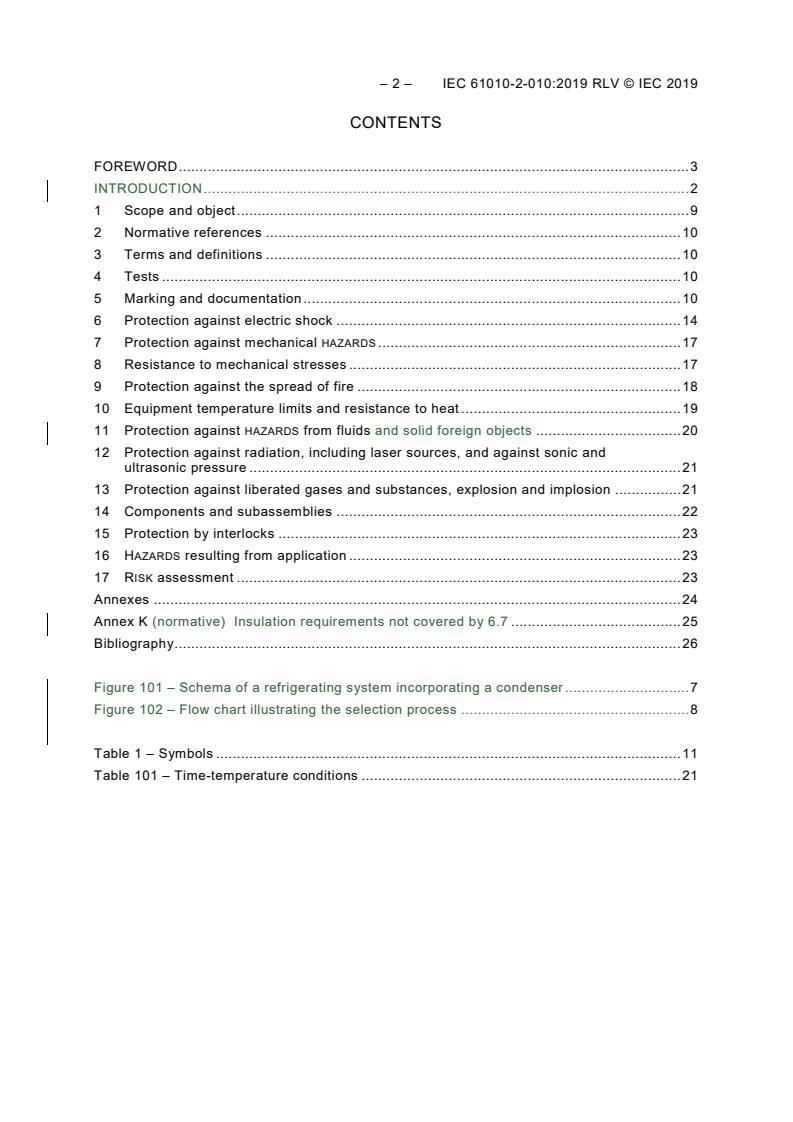
– 2 – IEC 61010-2-010:2019 RLV © IEC 2019
CONTENTS
FOREWORD . 3
INTRODUCTION . 2
1 Scope and object . 9
2 Normative references . 10
3 Terms and definitions . 10
4 Tests . 10
5 Marking and documentation . 10
6 Protection against electric shock . 14
7 Protection against mechanical HAZARDS . 17
8 Resistance to mechanical stresses . 17
9 Protection against the spread of fire . 18
10 Equipment temperature limits and resistance to heat . 19
11 Protection against HAZARDS from fluids and solid foreign objects . 20
12 Protection against radiation, including laser sources, and against sonic and
ultrasonic pressure . 21
13 Protection against liberated gases and substances, explosion and implosion . 21
14 Components and subassemblies . 22
15 Protection by interlocks . 23
16 HAZARDS resulting from application . 23
17 RISK assessment . 23
Annexes . 24
Annex K (normative) Insulation requirements not covered by 6.7 . 25
Bibliography . 26
Figure 101 – Schema of a refrigerating system incorporating a condenser . 7
Figure 102 – Flow chart illustrating the selection process . 8
Table 1 – Symbols . 11
Table 101 – Time-temperature conditions . 21
INTERNATIONAL ELECTROTECHNICAL COMMISSION
____________
SAFETY REQUIREMENTS FOR ELECTRICAL EQUIPMENT
FOR MEASUREMENT, CONTROL AND LABORATORY USE –
Part 2-010: Particular requirements for laboratory
equipment for the heating of materials
FOREWORD
1) The International Electrotechnical Commission (IEC) is a worldwide organization for standardization comprising
all national electrotechnical committees (IEC National Committees). The object of IEC is to promote
international co-operation on all questions concerning standardization in the electrical and electronic fields. To
this end and in addition to other activities, IEC publishes International Standards, Technical Specifications,
Technical Reports, Publicly Available Specifications (PAS) and Guides (hereafter referred to as "IEC
Publication(s)"). Their preparation is entrusted to technical committees; any IEC National Committee interested
in the subject dealt with may participate in this preparatory work. International, governmental and non-
governmental organizations liaising with the IEC also participate in this preparation. IEC collaborates closely
with the International Organization for Standardization (ISO) in accordance with conditions determined by
agreement between the two organizations.
2) The formal decisions or agreements of IEC on technical matters express, as nearly as possible, an international
consensus of opinion on the relevant subjects since each technical committee has representation from all
interested IEC National Committees.
3) IEC Publications have the form of recommendations for international use and are accepted by IEC National
Committees in that sense. While all reasonable efforts are made to ensure that the technical content of IEC
Publications is accurate, IEC cannot be held responsible for the way in which they are used or for any
misinterpretation by any end user.
4) In order to promote international uniformity, IEC National Committees undertake to apply IEC Publications
transparently to the maximum extent possible in their national and regional publications. Any divergence
between any IEC Publication and the corresponding national or regional publication shall be clearly indicated in
the latter.
5) IEC itself does not provide any attestation of conformity. Independent certification bodies provide conformity
assessment services and, in some areas, access to IEC marks of conformity. IEC is not responsible for any
services carried out by independent certification bodies.
6) All users should ensure that they have the latest edition of this publication.
7) No liability shall attach to IEC or its directors, employees, servants or agents including individual experts and
members of its technical committees and IEC National Committees for any personal injury, property damage or
other damage of any nature whatsoever, whether direct or indirect, or for costs (including legal fees) and
expenses arising out of the publication, use of, or reliance upon, this IEC Publication or any other IEC
Publications.
8) Attention is drawn to the Normative references cited in this publication. Use of the referenced publications is
indispensable for the correct application of this publication.
9) Attention is drawn to the possibility that some of the elements of this IEC Publication may be the subject of
patent rights. IEC shall not be held responsible for identifying any or all such patent rights.
This redline version of the official IEC Standard allows the user to identify the changes
made to the previous edition. A vertical bar appears in the margin wherever a change
has been made. Additions are in green text, deletions are in strikethrough red text.
– 4 – IEC 61010-2-010:2019 RLV © IEC 2019
International Standard IEC 61010-2-010 has been prepared by IEC technical committee 66:
Safety of measuring, control and laboratory equipment.
It has the status of a group safety publication in accordance with IEC Guide 104.
This fourth edition cancels and replaces the third edition published in 2014. This edition
constitutes a technical revision.
This edition includes the following significant technical changes with respect to the previous
edition:
a) alignment with changes introduced by Amendment 1 of IEC 61010-1:2010;
b) alignment with IEC 61010-2-011 and IEC 61010-2-012:
– new matching Introduction clarifying which standard(s) to use;
– new 5.4.101 instructions for flammable liquid HEAT TRANSFER MEDIUM;
– subclause 9.5 on flammable liquids replaced with text from IEC 61010-2-012;
c) subclause 5.2.101 deleted;
d) requirements in 10.101 b) and c) clarified.
The text of this International Standard is based on the following documents:
CDV Report on voting
66/657/CDV 66/678/RVC
Full information on the voting for the approval of this International Standard can be found in
the report on voting indicated in the above table.
This document has been drafted in accordance with the ISO/IEC Directives, Part 2.
A list of all parts of the IEC 61010 series, published under the general title: Safety
requirements for electrical equipment for measurement, control, and laboratory use, can be
found on the IEC website.
This Part 2-010 is to be used in conjunction with the latest edition of IEC 61010-1. It was
established on the basis of the third edition (2010) and its Amendment 1 (2016), hereinafter
referred to as Part 1.
This Part 2-010 supplements or modifies the corresponding clauses in IEC 61010-1 so as to
convert that publication into the IEC standard: Particular requirements for laboratory
equipment for the heating of materials.
Where a particular subclause of Part 1 is not mentioned in this Part 2-010, that subclause
applies as far as is reasonable. Where this Part 2-010 states "addition", "modification",
"replacement", or "deletion" the relevant requirement, test specification or note in Part 1
should be adapted accordingly.
In this standard:
1) the following print types are used:
– requirements: in roman type;
– NOTES in small roman type;
– conformity and test: in italic type;
– terms used throughout this standard which have been defined in Clause 3: SMALL
ROMAN CAPITALS;
2) subclauses, figures, tables and notes which are additional to those in Part 1 are numbered
starting from 101. Additional annexes are lettered starting from AA.
The committee has decided that the contents of this document will remain unchanged until the
stability date indicated on the IEC web site under "http://webstore.iec.ch" in the data related
to the specific document. At this date, the document will be
• reconfirmed,
• withdrawn,
• replaced by a revised edition, or
• amended.
IMPORTANT – The 'colour inside' logo on the cover page of this publication indicates
that it contains colours which are considered to be useful for the correct
understanding of its contents. Users should therefore print this document using a
colour printer.
– 6 – IEC 61010-2-010:2019 RLV © IEC 2019
INTRODUCTION
This Part 2-010, Part 2-011 and Part 2-012, taken together, address the specific HAZARDS
associated with the heating and cooling of materials by equipment and are organized as
follows:
Specifically addresses the HAZARDS associated with equipment incorporating heating
IEC 61010-2-010
systems.
Specifically addresses the HAZARDS associated with equipment incorporating
IEC 61010-2-011
refrigerating systems.
Specifically addresses the HAZARDS associated with equipment incorporating both
heating and refrigerating systems that interact with each other such that the combined
heating and cooling system yield additional or more severe HAZARDS for the two
IEC 61010-2-012
systems than if treated separately. It also addresses the HAZARDS associated with the
treatment of materials by other factors like irradiation, excessive humidity, CO2 and
mechanical movement, etc.
Guidance for the application of the appropriate Part 2 standard(s)
When the equipment includes only a material heating system, and no refrigerating system or
other environmental factors apply, then Part 2-010 applies without needing Part 2-011 or
Part 2-012. Similarly, when the equipment includes only a refrigerating system, and no
material heating system or other environmental factors apply, then Part 2-011 applies without
needing Part 2-010 or Part 2-012. However, when the equipment incorporates both a material
heating system, and a refrigerating system or the materials being treated in the intended
application introduce significant heat into the refrigerating system, a determination should be
made as to whether the interaction between the two systems will generate additional or more
severe HAZARDS than if the systems were evaluated separately (controlled temperature, see
flow chart of Figure 102 for selection process). If the interaction of the heating and cooling
functions yields no additional or more severe HAZARDS, then both Part 2-010 and Part 2-011
HAZARDS result
apply for their respective functions. Conversely, if additional or more severe
from the combining of the heating and cooling functions, or if the equipment incorporates
additional material treatment factors, then Part 2-012 applies, but not Part 2-010 or Part 2-011.
What HAZARDS are applicable for a refrigerating system?
The typical HAZARDS for a refrigerating system (see Figure 101) consisting of a
motor-compressor, a condenser, an expansion device and an evaporator include but are not
limited to:
– The maximum temperature of low-pressure side (return temperature) to the motor-
compressor. A motor-compressor incorporates a refrigerant cooled motor and it must be
established that the maximum temperatures of low-pressure side under least favourable
RATINGS within the motor.
condition do not exceed the insulation
– The maximum pressure of low-pressure side at the inlet to the motor-compressor. The
housing of the motor-compressor is exposed to this pressure and so the design RATING of
the motor-compressor housing must accommodate the worst-case pressures whilst
providing the correct safety margin for a pressure vessel.
– The maximum temperature of high-pressure side to the condenser. The temperatures of
the high-pressure side under most unfavourable conditions may present a temperature
HAZARD if the OPERATOR is exposed to them or if the electrical insulation is degraded.
– The maximum pressure of high-pressure side at the outlet to the motor-compressor. The
refrigerant components downstream of the motor-compressor up to the expansion device
are exposed to this pressure and so the design RATING of these components must
accommodate the worst-case pressures whilst providing the appropriate safety margin for
a pressure vessel.
– The maximum controlled temperatures, namely, the soaked temperature conditions, where
the heat is being extracted from, may impact the maximum temperature of low-pressure
side to the motor-compressor as well as present a temperature HAZARD if the OPERATOR is
exposed to them or if the electrical insulation is degraded. Whether this controlled
temperature is derived from an integral heating function of the device or from the heat
dissipated from the material being cooled, the impact under worst-case conditions should
be evaluated.
– The current draw of the equipment should be established when including the worst-case
running conditions of the refrigerating system including any defrost cycles that may apply.
The worst-case conditions need to be determined for the equipment and will include both the
least favourable NORMAL USE conditions as well as the most unfavourable testing results under
SINGLE FAULT CONDITIONS.
Figure 101 – Schema of a refrigerating system incorporating a condenser
– 8 – IEC 61010-2-010:2019 RLV © IEC 2019
The selection process is illustrated in the following flow chart (see Figure 102).
Figure 102 – Flow chart illustrating the selection process
SAFETY REQUIREMENTS FOR ELECTRICAL EQUIPMENT
FOR MEASUREMENT, CONTROL AND LABORATORY USE –
Part 2-010: Particular requirements for laboratory
equipment for the heating of materials
1 Scope and object
This clause of Part 1 is applicable except as follows:
1.1.1 Equipment included in scope
Replacement:
Replace the second paragraph by the following:
This part of IEC 61010 specifies particular safety requirements for electrically powered
laboratory equipment for the heating of materials, where whenever the following types a) to c)
of electrical equipment and their accessories, wherever they are intended to be used, the
heating of materials is one of the functions of the equipment.
NOTE If all or part of the equipment falls within the scope of one or more other part 2 standards of IEC 61010 as
well as within the scope of this standard, it will also need to meet the requirements of those other part 2 standards.
In particular, if equipmen is intended to be used for IVD purposes, it will need to meet the requirements of
IEC 61010-2-101.
Addition:
Add the following text after item c):
It is possible that all or part of the equipment falls within the scope of one or more other
Part 2 standards of IEC 61010 as well as within the scope of this standard. In that case, the
requirements of those other Part 2 standards will also apply. In particular, if equipment is
intended to be used for in vitro diagnostic (IVD) purposes, the requirements of
IEC 61010-2-101 will also apply. However, when the equipment incorporates a refrigerating
system and a heating function where the combination of the two introduces additional or more
HAZARDS than if treated separately, then it is possible that IEC 61010-2-012 is
severe
applicable instead of this Part 2-010.
See further information in the flow chart (Figure 102) for the selection process and the
guidance in the Introduction.
1.1.2 Equipment excluded from scope
Addition:
Add the following items after item j):
aa) equipment for the heating and ventilation of laboratories;
bb) sterilizing equipment;
cc) heating and/or cooling equipment which the OPERATOR is intended to enter, and which is
OPERATOR to remain inside with the door or doors closed.
large enough for the
– 10 – IEC 61010-2-010:2019 RLV © IEC 2019
2 Normative references
This clause of Part 1 is applicable, except as follows:
Addition:
Add the following reference to the list:
ISO 7010:2011, Graphical symbols – Safety colours and safety signs – Registered safety
signs (available at https://www.iso.org/obp)
3 Terms and definitions
This clause of Part 1 is applicable except as follows:
3.2 Parts and accessories
Addition:
Add the following new term and definition:
3.2.101
HEAT TRANSFER MEDIUM
medium used to transfer heat to the material being processed
4 Tests
This clause of Part 1 is applicable except as follows:
4.4.2.11 Heating devices
Addition:
Add the following new text after the existing text:
If a HAZARD could be caused by over-filling or under-filling with a liquid HEAT TRANSFER MEDIUM,
the equipment shall be tested when it is empty, partially filled, or overfilled, whichever is least
favourable. In case of doubt, the test shall be carried out in more than one condition. The
HEAT TRANSFER MEDIUM used for the test shall be of a type specified for NORMAL USE.
5 Marking and documentation
This clause of Part 1 is applicable except as follows:
5.1 Marking
5.1.3 MAINS supply
Addition:
Add the following new text to the end of item c):
If, for periods of 1 min or less after switching on, the actual power or current can be much
higher than the marked maximum RATED power or current, the short-term maximum may be
marked in brackets after the maximum RATED power or current.
Table 1 – Symbols
Addition:
Add the following new symbol to Table 1:
Number Symbol Publication Description
Background colour
Warning;
– yellow (optional, not green);
101 ISO 7010-W021:2011-05
symbol and outline
Flammable material
– black (optional).
5.1.6 Switches and circuit-breakers
Addition:
Add the following new text after the last paragraph, before the conformity statement:
For ovens and similar equipment, there shall be an indication of the "ON" condition on each
side of the equipment which has a door in it or has any other opening intended for loading
material.
5.2 Warning markings
Replacement of the first paragraph by the following:
Warning markings specified in 5.1.5.2 c), 5.2.101, 6.1.2 b), 6.1.2.101 2), 7.3.2 b) 3), 7.4, 10.1,
9.5 c), and 13.2.2 shall meet the following requirements:
Additional subclause:
5.2.101 Equipment with high ACCESSIBLE current
If the ACCESSIBLE current of the equipment exceeds the limit of 6.3.1 b) or 6.3.2 b) for non-
permanently connected equipment, but is within the limit for PERMANENTLY CONNECTED
EQUIPMENT, there shall be a warning marking requiring permanent connection to the supply
source. The marking shall be on or beside the cover of the TERMINALS for connection to the
supply source, and the warning shall be repeated in the installation instructions. Symbol 14
of Table 1 is an adequate warning marking, particularly when it may not be known in which
country the equipment will be used and, therefore, in which language it would be appropriate
to print the warning marking.
Conformity is checked by inspection.
5.4.3 Equipment installation
Replacement:
Replace the text with the following new text:
The documentation shall include installation and specific commissioning instructions
(examples are listed below) and, if necessary for safety, warnings against HAZARDS which
– 12 – IEC 61010-2-010:2019 RLV © IEC 2019
could arise during installation or commissioning or as a result of improper installation or
commissioning of the equipment. Such information includes, if applicable:
a) assembly, location and mounting requirements. If a HAZARD could be caused by hot items
falling from the equipment, for example when a door is opened, there shall be a warning
that the equipment shall not be mounted on a surface of flammable material;
b) instructions for protective earthing;
c) connections to the supply, including the warning and statement which are necessary when
permanent connection to the supply source is essential (see 5.2.101), and for equipment
in which HAZARDOUS LIVE parts may need to be ACCESSIBLE (see 6.1.2), a statement
requiring the fitting of a residual current-operated circuit-breaker;
d) for PERMANENTLY CONNECTED EQUIPMENT:
1) supply wiring requirements;
2) requirements for any external switch or circuit-breaker (see 6.11.23.1) and external
overcurrent protection devices (see 9.6.2), and a recommendation that the switch or
circuit-breaker be near the equipment;
e) ventilation requirements;
f) requirements and safety characteristics for special external services, for example:
maximum and minimum temperatures, pressure, or flow of air or cooling liquid.
g) the maximum sound level produced by equipment which emits sound, if measurement is
required by 12.5.1;
h) instructions relating to sound level (see 12.5.1);
i) any requirement for drying-out (see 5.4.3.101);
j) if the heating of materials could lead to liberation of hazardous substances: installation
instructions shall warn of any need for an extraction system, additional temperature-
limiting devices relating to safe temperatures for the materials, etc. or other necessary
measures (see also Note 2 to 5.4.1).
NOTE An extraction system is a system which removes air from the building, not a recirculating system.
It is recommended to add a statement in the documentation for the installation that the safety
of any system incorporating the equipment is the responsibility of the assembler of the system.
Conformity is checked by inspection.
Addition:
Add the following new subclause:
5.4.3.101 Drying-out
If, after transport or storage in humid conditions, equipment could fail to meet all the safety
requirements of this document, the installation instructions shall specify a period of operation
to dry out the equipment and restore it to NORMAL CONDITION. The instructions shall include
a warning that the equipment cannot be assumed to meet all the safety requirements of this
document during the drying-out process.
Conformity is checked by inspection.
5.4.4 Equipment operation
Addition:
Add the following at the end of item g):
(see 5.4.4.101);
Add the following after item j):
aa) specification of additional protection needed by the OPERATOR when HAZARDOUS LIVE parts
are permitted to be ACCESSIBLE (see 6.1.2.101);
bb) a warning about any possible HAZARDS of explosion, implosion, or the release of toxic or
flammable gases arising from the materials being heated see also 5.4.4 h));
cc) specification of HEAT TRANSFER MEDIA which are suitable for use, for example liquids for
use in a heating bath;
dd) specific requirements for ventilation.
Addition:
Add the following new subclause:
5.4.4.101 Cleaning and decontamination
The instructions shall include recommendations for cleaning and, where necessary,
decontamination, together with the recognized generic names of recommended materials for
cleaning and decontamination, and an indication of any materials which could be likely to be
used but which are incompatible with parts of the equipment or with material contained in it.
The instructions shall also state that the RESPONSIBLE BODY shall ensure that:
a) appropriate decontamination is carried out if hazardous material is spilled onto or into the
equipment;
b) no decontamination or cleaning agents are used which could cause a HAZARD as a result
of a reaction with parts of the equipment or with material contained in it;
c) the manufacturer or its agent is consulted if there is any doubt about the compatibility of
decontamination or cleaning agents with parts of the equipment or with material contained
in it.
Manufacturers should be aware of the internationally recognized "Laboratory Biosafety
Manual", published by the World Health Organization in Geneva, which gives information on
decontaminants, their use, dilutions, properties and potential applications. There are also
national guidelines which cover these areas.
Cleaning and decontamination may be necessary as a safeguard when laboratory heating
equipment and any accessories are maintained, repaired, or transferred. Manufacturers
should provide a format document for the RESPONSIBLE BODY to certify that such treatment has
been carried out.
Conformity is checked by inspection.
5.4.5 Equipment maintenance and service
Addition:
Add the following new text:
If a high-temperature cable or other special cable is used for the MAINS supply cord, the
instructions shall state that it is to be replaced by an equivalent cable only.
If practicable, instructions shall specify methods for the RESPONSIBLE BODY to check the
effective operation of devices or systems for overtemperature protection or liquid-level
– 14 – IEC 61010-2-010:2019 RLV © IEC 2019
protection which are necessary for safety, and shall state how often the checks need to be
made.
Addition:
Add the following new subclause:
5.4.101 Additional instructions for equipment intended for use with flammable liquid
HEAT TRANSFER MEDIUM
For baths, circulators and shaking baths intended for use with flammable liquid HEAT TRANSFER
, the instructions shall include sufficient information to ensure the safe handling,
MEDIUM
servicing and disposal of the equipment.
The instructions shall include the substance of the following warnings as necessary:
– WARNING: Ensure all ventilation openings are not obstructed;
– WARNING: No smoking! No flame! Do not use electrical parts which can produce spark
when operating around the equipment and the application system;
– WARNING: Drain and recover the liquid when the equipment idles, if the liquid heat
transfer medium is used with an open bath tank and if it is highly volatile at ambient
temperature.
A label carrying symbol 101 shall be provided with equipment which can be used with a
flammable liquid HEAT TRANSFER MEDIUM along with instructions for the RESPONSIBLE BODY to
affix the label visibly on the equipment if it is to be used with a flammable liquid HEAT
.
TRANSFER MEDIUM
The instructions shall be provided with detailed information for procedures to reduce the RISK
with regard to the use of a flammable liquid HEAT TRANSFER MEDIUM, including how the
adjustable temperature-limiting device is adequately set so that the surface temperature in
contact with the liquid is below the limit of 9.5 a).
Conformity is checked by inspection.
6 Protection against electric shock
This clause of Part 1 is applicable except as follows:
6.1 General
6.1.1 Requirements
Addition:
Add the following new text after the conformity statement:
If a drying-out process is specified (see 6.7.2.2.101), this is carried out in accordance with the
operator manual installation instructions (see 5.4.3.101) before making the measurements of
6.3. Drying-out is followed by a rest period of 2 h, with the equipment de-energized, before
the measurements are taken.
Measurements are made with the equipment at ambient temperature. If there is doubt whether
the permissible limits could be exceeded at the maximum operating controlled temperature,
the relevant measurements are repeated at the maximum operating controlled temperature
and the higher values are used.
Addition:
Add the following new subclause:
6.1.2.101 Exceptions for ovens and furnaces
HAZARDOUS LIVE parts are permitted to be ACCESSIBLE if efficient operation of an oven or
furnace would otherwise be impossible for one or more of the following reasons:
a) continuous access is needed (for example, conveyor ovens and tube furnaces);
b) ports are needed for observation or for the insertion of probes or sensors;
c) it is necessary to maintain a steady operating controlled temperature to prevent thermal
shock to materials being treated, and therefore ACCESSIBLE heaters, etc., have to remain
energized even when a door is opened.
In the above cases, ACCESSIBLE internal parts are permitted to be HAZARDOUS LIVE only if all
those of the following conditions that are as applicable are met:
1) the HAZARDOUS LIVE parts are supplied from a circuit protected by a residual current
operated circuit-breaker which interrupts the supply at a differential current of 30 mA or
less, or the installation instructions specify that the equipment shall be connected to a
supply source which incorporates such a circuit-breaker;
2) warning markings give notice of the potential HAZARD and a lamp indicates the presence of
the HAZARD (symbol 12 of Table 1);
3) conveyor belts, muffles, etc., which are conductive are connected to the PROTECTIVE
CONDUCTOR TERMINAL;
4) the instructions for use state that it is necessary for the OPERATOR to be protected against
electric shock, including electric shock resulting from the possibility of simultaneous
contact with HAZARDOUS LIVE parts and parts connected to the PROTECTIVE CONDUCTOR
TERMINAL, and indicate the means of protection. These protective means may include one
or more of the following:
TOOLS;
i) insulated
ii) insulating clothing;
OPERATOR standing on an insulating surface;
iii)
iv) shrouding of parts connected to the PROTECTIVE CONDUCTOR TERMINAL with which the
OPERATOR might come into contact in NORMAL USE.
Conformity is checked by inspection.
6.3.1 b) 1) Current Levels in NORMAL CONDITION
Addition:
Add the following new text to the end of item b) 1):
Levels for PERMANENTLY CONNECTED EQUIPMENT are 1,5 times the above these values.
6.3.2 b) 1) Current Levels in SINGLE FAULT CONDITION
Addition:
Add the following new text to the end of item b) 1):
Levels for PERMANENTLY CONNECTED EQUIPMENT are 1,5 times the above these values.
– 16 – IEC 61010-2-010:2019 RLV © IEC 2019
6.7.2.2 Solid insulation
Addition:
Add the following new subclause:
6.7.2.2.101 Drying-out time
If the performance requirements of the equipment cannot be achieved without the use of
hygroscopic heater insulation it is permissible for equipment to require a period of operation
to dry out the insulation before meeting the requirements of 6.7.2.2, 6.3.1 and 6.8.2 providing
provided the operator RESPONSIBLE BODY is made aware of this (see 5.4.3.101).
Conformity is checked by performing the drying-out process specified in the user manual
(see 5.4.3.101) before conducting the tests of 6.3.1 and 6.8.2.
6.8.2 Humidity preconditioning
Addition:
Add the following new text at the end of the existing text:
If a drying-out process is specified (see 6.7.2.2.101), this is carried out in accordance with the
operator manual (see 5.4.3.101) before the tests of 6.8.3. Drying-out is followed by a rest
period of 2 h with the equipment de-energized. The tests are then performed and completed
within 1 h of the end of the rest period.
If there is doubt as to whether the equipment would pass a particular test at maximum
operating controlled temperature, then that test is repeated at maximum operating controlled
temperature.
Equipment for which a drying-out period is specified (see 5.4.3.101) shall not be subjected
to humidity preconditioning.
6.8.3.1 The a.c. voltage test
Replacement:
Replace the first sentence by the following new sentence:
The voltage tester shall be capable of maintaining the test voltage throughout the test within
±5 % of the specified value.
6.9.2 Insulating materials
Addition:
Add the following note before the conformity statement:
NOTE Although ceramics can provide satisfactory electrical insulation at ambient temperature, their insulating
properties are reduced at high temperatures. This is not only because they are susceptible to progressive
mechanical deterioration, but also because they can become electrically conductive at high temperatures and in
NORMAL USE can be contaminated by conductive material.
6.10.1 MAINS supply cords
Addition:
Add the following new text to the third paragraph:
Alternatively, additional protection shall be provided to prevent the cord from contacting
coming into contact with the hot surface.
Add the following new text to the fourth paragraph:
The appliance coupler shall have a temperature RATING above the temperatures measured
under NORMAL CONDITION on any part of the appliance coupler itself.
7 Protection against mechanical HAZARDS
This clause of Part 1 is applicable.
8 Resistance to mechanical stresses
This clause of Part 1 is applicable except as follows:
8.1 General
Replacement of item 3):
3) except for FIXED EQUIPMENT, equipment with a mass over 100 kg, and equipment which is
not moved in NORMAL USE whose size and weight make unintentional movement unlikely,
the appropriate test of 8.3. The equipment is not operated during the tests.
Addition:
Add the following new item to the numbered list:
4) for heating equipment with a horizontal surface of glass or ceramic, the test of 8.2.101.
8.2.2 Impact test
Addition:
Add the following new text before the first paragraph:
For heating equipment with a horizontal surface of glass, ceramic, or similar material, this
surface shall be tested as specified in 8.2.101. The rest of the equipment is tested as
specified below.
Addition:
Add the following new subclause:
8.2.101 Dynamic test of horizontal heating surfaces of glass or ceramic material
Conformity to the requirements for horizontal heating surfaces made of glass or ceramic
material is checked after performing the treatment of a) to c).
a) The heater is operated at the maximum setting until the surface temperature of the heating
zone does not rise by more than 1 °C in 15 min. The heater is then switched off, and a
loaded vessel is dropped flat 10 times from a height of 150 mm onto the heating zone.
The loaded vessel has a copper or aluminium base which is flat over a diameter of
120 mm ± 10 mm, with a rounded edge of having a radius of at least 10 mm. It is filled to a
uniform height with sand or shot to give a total mass of 1,8 kg ± 0,01 kg.
b) After the above treatment to each heating zone in turn, the heater is again operated at the
maximum setting until the surface temperature does not rise by more than 1 °C in 15 min.
– 18 – IEC 61010-2-010:2019 RLV © IEC 2019
(1 l ± 0,1 l) of a saline solution of 1 % NaCl in water, at a temperature of 15 °C ± 5 °C, is
poured steadily onto the heating surface. The heater is then switched off and after 15 min
all excess solution is cleaned off the surface.
c) The heater is allowed to cool to approximately room ambient temperature, then the same
quantity of the saline solution is poured steadily onto the heating surface and again all
excess solution is cleaned off the surface.
A voltage test according to 6.8 applicable to the type of insulation (see 6.7) shall be
performed. The test voltage shall be for BASIC INSULATION. No breakdown shall occur.
No breakage of glass parts shall have occurred which could cause a cutting HAZARD.
NOTE Subclause 8.2.101 corresponds to 21.102 of IEC 60335-2-6:2002 2014.
9 Protection against the spread of fire
This clause of Part 1 is applicable except as follows:
9.5 Requirements for equipment containing or using flammable liquids
Replacement:
Replace item a) and Note 1 by the following:
a) The equipment shall be so constructed that it complies with items 1), 2) and 3) as follows:
1) In NORMAL CONDITION and SINGLE FAULT CONDITION, the surface temperature of the
flammable liquid shall not exceed the flash point of the liquid being exposed to the air.
In NORMAL CONDITION and SINGLE FAULT CONDITION the surface temperature of any
heating element at the surface of the liquid and in contact with air shall not exceed (t -
25) °C , where t is the fire point of the liquid.
NOTE 1 Fire point is the temperature to which a HEAT TRANSFER MEDIUM must be heated (under specified
conditions) so that the vapour/air mixture at the surface will support a flame for at least 5 s when an external
flame is applied and withdrawn. Flash point is lowest liquid temperature at which, under certain standardized
conditions, the HEAT TRANSFER MEDIUM gives off vapours in quantity such as to be capable of forming an
ignitable vapour/air mixture
2) In NORMAL CONDITION and SINGLE FAULT CONDITION, the surface temperature of any
heating device at the surface of the flammable liquid and in contact with air shall not
exceed (t − 25) °C, where t is the fire point of the liquid.
3) For equipment where an OPERATOR setting could expose a flammable liquid to a
condition where 1) or 2) could be exceeded in the case of a SINGLE FAULT CONDITION
during REASONABLY FORESEEABLE MISUSE, additional measures shall be provided to
protect the OPERATOR from this HAZARD.
– For example, a liquid level cut out that disables the heating device before the
temperature requirements of a) 1) or 2) are exceeded is considered to comply with
this requirement.
– Consideration should be given to any scenario that can expose any permitted
flammable liquid to a temperature that could exceed t – 100 °C, where t is the
a a
auto-ignition temperature.
– The use of a flammable liquid not approved by the manufacturer for use in the
equipment is not considered as an OPERATOR setting and is therefore beyond the
evaluation of Clause 16.
NOTE 101 Guidance on what is considered REASONABLY FORESEEABLE MISUSE is provided in 16.1.
It is not sufficient to limit the surface temperature of the surface of the flammable liquid and
parts in contact with the surface limited solely by the temperature control system.
Overtemperature protection meeting the requirements of 10.101 achieved by an independent,
adjustable over-temperature-limiting device shall be used.
NOTE 102 The surface temperature of the heating device used to heat a liquid can be considerably higher than
the temperature of the liquid.
NOTE 103 Additional instructions for equipment intended for use with flammable liquid HEAT TRANSFER MEDIUM are
detailed in 5.4.101.
Addition:
Add the following note after item c):
NOTE 101 104 Where flammable material liquid is present in the equipment, symbol 101 can be used as a
warning marking.
Replacement:
Replace the first paragraph of the conformity statement by the following:
Conformity is checked by inspection, including nameplate, doc
...
IEC 61010-2-010 ®
Edition 4.0 2019-02
INTERNATIONAL
STANDARD
NORME
INTERNATIONALE
colour
inside
GROUP SAFETY PUBLICATION
PUBLICATION GROUPÉE DE SÉCURITÉ
Safety requirements for electrical equipment for measurement, control and
laboratory use –
Part 2-010: Particular requirements for laboratory
equipment for the heating of materials
Exigences de sécurité pour appareils électriques de mesurage, de régulation et
de laboratoire –
Partie 2-010: Exigences particulières pour appareils de laboratoire utilisés pour
l'échauffement des matières
All rights reserved. Unless otherwise specified, no part of this publication may be reproduced or utilized in any form
or by any means, electronic or mechanical, including photocopying and microfilm, without permission in writing from
either IEC or IEC's member National Committee in the country of the requester. If you have any questions about IEC
copyright or have an enquiry about obtaining additional rights to this publication, please contact the address below or
your local IEC member National Committee for further information.
Droits de reproduction réservés. Sauf indication contraire, aucune partie de cette publication ne peut être reproduite
ni utilisée sous quelque forme que ce soit et par aucun procédé, électronique ou mécanique, y compris la photocopie
et les microfilms, sans l'accord écrit de l'IEC ou du Comité national de l'IEC du pays du demandeur. Si vous avez des
questions sur le copyright de l'IEC ou si vous désirez obtenir des droits supplémentaires sur cette publication, utilisez
les coordonnées ci-après ou contactez le Comité national de l'IEC de votre pays de résidence.
IEC Central Office Tel.: +41 22 919 02 11
3, rue de Varembé info@iec.ch
CH-1211 Geneva 20 www.iec.ch
Switzerland
About the IEC
The International Electrotechnical Commission (IEC) is the leading global organization that prepares and publishes
International Standards for all electrical, electronic and related technologies.
About IEC publications
The technical content of IEC publications is kept under constant review by the IEC. Please make sure that you have the
latest edition, a corrigendum or an amendment might have been published.
IEC publications search - webstore.iec.ch/advsearchform Electropedia - www.electropedia.org
The advanced search enables to find IEC publications by a The world's leading online dictionary on electrotechnology,
variety of criteria (reference number, text, technical containing more than 22 000 terminological entries in English
committee,…). It also gives information on projects, replaced and French, with equivalent terms in 16 additional languages.
and withdrawn publications. Also known as the International Electrotechnical Vocabulary
(IEV) online.
IEC Just Published - webstore.iec.ch/justpublished
Stay up to date on all new IEC publications. Just Published IEC Glossary - std.iec.ch/glossary
details all new publications released. Available online and 67 000 electrotechnical terminology entries in English and
once a month by email. French extracted from the Terms and Definitions clause of
IEC publications issued since 2002. Some entries have been
IEC Customer Service Centre - webstore.iec.ch/csc collected from earlier publications of IEC TC 37, 77, 86 and
If you wish to give us your feedback on this publication or CISPR.
need further assistance, please contact the Customer Service
Centre: sales@iec.ch.
A propos de l'IEC
La Commission Electrotechnique Internationale (IEC) est la première organisation mondiale qui élabore et publie des
Normes internationales pour tout ce qui a trait à l'électricité, à l'électronique et aux technologies apparentées.
A propos des publications IEC
Le contenu technique des publications IEC est constamment revu. Veuillez vous assurer que vous possédez l’édition la
plus récente, un corrigendum ou amendement peut avoir été publié.
Recherche de publications IEC - Electropedia - www.electropedia.org
webstore.iec.ch/advsearchform Le premier dictionnaire d'électrotechnologie en ligne au
La recherche avancée permet de trouver des publications IEC monde, avec plus de 22 000 articles terminologiques en
en utilisant différents critères (numéro de référence, texte, anglais et en français, ainsi que les termes équivalents dans
comité d’études,…). Elle donne aussi des informations sur les 16 langues additionnelles. Egalement appelé Vocabulaire
projets et les publications remplacées ou retirées. Electrotechnique International (IEV) en ligne.
IEC Just Published - webstore.iec.ch/justpublished Glossaire IEC - std.iec.ch/glossary
Restez informé sur les nouvelles publications IEC. Just 67 000 entrées terminologiques électrotechniques, en anglais
Published détaille les nouvelles publications parues. et en français, extraites des articles Termes et Définitions des
Disponible en ligne et une fois par mois par email. publications IEC parues depuis 2002. Plus certaines entrées
antérieures extraites des publications des CE 37, 77, 86 et
Service Clients - webstore.iec.ch/csc CISPR de l'IEC.
Si vous désirez nous donner des commentaires sur cette
publication ou si vous avez des questions contactez-nous:
sales@iec.ch.
IEC 61010-2-010 ®
Edition 4.0 2019-02
INTERNATIONAL
STANDARD
NORME
INTERNATIONALE
colour
inside
GROUP SAFETY PUBLICATION
PUBLICATION GROUPÉE DE SÉCURITÉ
Safety requirements for electrical equipment for measurement, control and
laboratory use –
Part 2-010: Particular requirements for laboratory
equipment for the heating of materials
Exigences de sécurité pour appareils électriques de mesurage, de régulation et
de laboratoire –
Partie 2-010: Exigences particulières pour appareils de laboratoire utilisés pour
l'échauffement des matières
INTERNATIONAL
ELECTROTECHNICAL
COMMISSION
COMMISSION
ELECTROTECHNIQUE
INTERNATIONALE
ICS 19.080; 71.040.20 ISBN 978-2-8322-6502-4
– 2 – IEC 61010-2-010:2019 © IEC 2019
CONTENTS
FOREWORD . 3
INTRODUCTION . 6
1 Scope and object . 9
2 Normative references . 9
3 Terms and definitions . 10
4 Tests . 10
5 Marking and documentation . 10
6 Protection against electric shock . 14
7 Protection against mechanical HAZARDS . 16
8 Resistance to mechanical stresses . 16
9 Protection against the spread of fire . 17
10 Equipment temperature limits and resistance to heat . 18
11 Protection against HAZARDS from fluids and solid foreign objects . 19
12 Protection against radiation, including laser sources, and against sonic and
ultrasonic pressure . 20
13 Protection against liberated gases and substances, explosion and implosion . 20
14 Components and subassemblies . 21
15 Protection by interlocks . 22
16 HAZARDS resulting from application . 22
17 RISK assessment . 22
Annexes . 23
Annex K (normative) Insulation requirements not covered by 6.7 . 24
Bibliography . 25
Figure 101 – Schema of a refrigerating system incorporating a condenser . 7
Figure 102 – Flow chart illustrating the selection process . 8
Table 1 – Symbols . 10
Table 101 – Time-temperature conditions . 20
INTERNATIONAL ELECTROTECHNICAL COMMISSION
____________
SAFETY REQUIREMENTS FOR ELECTRICAL EQUIPMENT
FOR MEASUREMENT, CONTROL AND LABORATORY USE –
Part 2-010: Particular requirements for laboratory
equipment for the heating of materials
FOREWORD
1) The International Electrotechnical Commission (IEC) is a worldwide organization for standardization comprising
all national electrotechnical committees (IEC National Committees). The object of IEC is to promote
international co-operation on all questions concerning standardization in the electrical and electronic fields. To
this end and in addition to other activities, IEC publishes International Standards, Technical Specifications,
Technical Reports, Publicly Available Specifications (PAS) and Guides (hereafter referred to as "IEC
Publication(s)"). Their preparation is entrusted to technical committees; any IEC National Committee interested
in the subject dealt with may participate in this preparatory work. International, governmental and non-
governmental organizations liaising with the IEC also participate in this preparation. IEC collaborates closely
with the International Organization for Standardization (ISO) in accordance with conditions determined by
agreement between the two organizations.
2) The formal decisions or agreements of IEC on technical matters express, as nearly as possible, an international
consensus of opinion on the relevant subjects since each technical committee has representation from all
interested IEC National Committees.
3) IEC Publications have the form of recommendations for international use and are accepted by IEC National
Committees in that sense. While all reasonable efforts are made to ensure that the technical content of IEC
Publications is accurate, IEC cannot be held responsible for the way in which they are used or for any
misinterpretation by any end user.
4) In order to promote international uniformity, IEC National Committees undertake to apply IEC Publications
transparently to the maximum extent possible in their national and regional publications. Any divergence
between any IEC Publication and the corresponding national or regional publication shall be clearly indicated in
the latter.
5) IEC itself does not provide any attestation of conformity. Independent certification bodies provide conformity
assessment services and, in some areas, access to IEC marks of conformity. IEC is not responsible for any
services carried out by independent certification bodies.
6) All users should ensure that they have the latest edition of this publication.
7) No liability shall attach to IEC or its directors, employees, servants or agents including individual experts and
members of its technical committees and IEC National Committees for any personal injury, property damage or
other damage of any nature whatsoever, whether direct or indirect, or for costs (including legal fees) and
expenses arising out of the publication, use of, or reliance upon, this IEC Publication or any other IEC
Publications.
8) Attention is drawn to the Normative references cited in this publication. Use of the referenced publications is
indispensable for the correct application of this publication.
9) Attention is drawn to the possibility that some of the elements of this IEC Publication may be the subject of
patent rights. IEC shall not be held responsible for identifying any or all such patent rights.
International Standard IEC 61010-2-010 has been prepared by IEC technical committee 66:
Safety of measuring, control and laboratory equipment.
It has the status of a group safety publication in accordance with IEC Guide 104.
This fourth edition cancels and replaces the third edition published in 2014. This edition
constitutes a technical revision.
This edition includes the following significant technical changes with respect to the previous
edition:
a) alignment with changes introduced by Amendment 1 of IEC 61010-1:2010;
b) alignment with IEC 61010-2-011 and IEC 61010-2-012:
– 4 – IEC 61010-2-010:2019 © IEC 2019
– new matching Introduction clarifying which standard(s) to use;
– new 5.4.101 instructions for flammable liquid HEAT TRANSFER MEDIUM;
– subclause 9.5 on flammable liquids replaced with text from IEC 61010-2-012;
c) subclause 5.2.101 deleted;
d) requirements in 10.101 b) and c) clarified.
The text of this International Standard is based on the following documents:
CDV Report on voting
66/657/CDV 66/678/RVC
Full information on the voting for the approval of this International Standard can be found in
the report on voting indicated in the above table.
This document has been drafted in accordance with the ISO/IEC Directives, Part 2.
A list of all parts of the IEC 61010 series, published under the general title: Safety
requirements for electrical equipment for measurement, control, and laboratory use, can be
found on the IEC website.
This Part 2-010 is to be used in conjunction with the latest edition of IEC 61010-1. It was
established on the basis of the third edition (2010) and its Amendment 1 (2016), hereinafter
referred to as Part 1.
This Part 2-010 supplements or modifies the corresponding clauses in IEC 61010-1 so as to
convert that publication into the IEC standard: Particular requirements for laboratory
equipment for the heating of materials.
Where a particular subclause of Part 1 is not mentioned in this Part 2-010, that subclause
applies as far as is reasonable. Where this Part 2-010 states "addition", "modification",
"replacement", or "deletion" the relevant requirement, test specification or note in Part 1
should be adapted accordingly.
In this standard:
1) the following print types are used:
– requirements: in roman type;
– NOTES in small roman type;
– conformity and test: in italic type;
– terms used throughout this standard which have been defined in Clause 3: SMALL
ROMAN CAPITALS;
2) subclauses, figures, tables and notes which are additional to those in Part 1 are numbered
starting from 101. Additional annexes are lettered starting from AA.
The committee has decided that the contents of this document will remain unchanged until the
stability date indicated on the IEC web site under "http://webstore.iec.ch" in the data related
to the specific document. At this date, the document will be
• reconfirmed,
• withdrawn,
• replaced by a revised edition, or
• amended.
IMPORTANT – The 'colour inside' logo on the cover page of this publication indicates
that it contains colours which are considered to be useful for the correct
understanding of its contents. Users should therefore print this document using a
colour printer.
– 6 – IEC 61010-2-010:2019 © IEC 2019
INTRODUCTION
This Part 2-010, Part 2-011 and Part 2-012, taken together, address the specific HAZARDS
associated with the heating and cooling of materials by equipment and are organized as
follows:
Specifically addresses the HAZARDS associated with equipment incorporating heating
IEC 61010-2-010
systems.
Specifically addresses the HAZARDS associated with equipment incorporating
IEC 61010-2-011
refrigerating systems.
Specifically addresses the HAZARDS associated with equipment incorporating both
heating and refrigerating systems that interact with each other such that the combined
heating and cooling system yield additional or more severe HAZARDS for the two
IEC 61010-2-012
systems than if treated separately. It also addresses the HAZARDS associated with the
treatment of materials by other factors like irradiation, excessive humidity, CO2 and
mechanical movement, etc.
Guidance for the application of the appropriate Part 2 standard(s)
When the equipment includes only a material heating system, and no refrigerating system or
other environmental factors apply, then Part 2-010 applies without needing Part 2-011 or
Part 2-012. Similarly, when the equipment includes only a refrigerating system, and no
material heating system or other environmental factors apply, then Part 2-011 applies without
needing Part 2-010 or Part 2-012. However, when the equipment incorporates both a material
heating system, and a refrigerating system or the materials being treated in the intended
application introduce significant heat into the refrigerating system, a determination should be
made as to whether the interaction between the two systems will generate additional or more
severe HAZARDS than if the systems were evaluated separately (controlled temperature, see
flow chart of Figure 102 for selection process). If the interaction of the heating and cooling
functions yields no additional or more severe HAZARDS, then both Part 2-010 and Part 2-011
HAZARDS result
apply for their respective functions. Conversely, if additional or more severe
from the combining of the heating and cooling functions, or if the equipment incorporates
additional material treatment factors, then Part 2-012 applies, but not Part 2-010 or Part 2-011.
What HAZARDS are applicable for a refrigerating system?
The typical HAZARDS for a refrigerating system (see Figure 101) consisting of a
motor-compressor, a condenser, an expansion device and an evaporator include but are not
limited to:
– The maximum temperature of low-pressure side (return temperature) to the motor-
compressor. A motor-compressor incorporates a refrigerant cooled motor and it must be
established that the maximum temperatures of low-pressure side under least favourable
RATINGS within the motor.
condition do not exceed the insulation
– The maximum pressure of low-pressure side at the inlet to the motor-compressor. The
housing of the motor-compressor is exposed to this pressure and so the design RATING of
the motor-compressor housing must accommodate the worst-case pressures whilst
providing the correct safety margin for a pressure vessel.
– The maximum temperature of high-pressure side to the condenser. The temperatures of
the high-pressure side under most unfavourable conditions may present a temperature
HAZARD if the OPERATOR is exposed to them or if the electrical insulation is degraded.
– The maximum pressure of high-pressure side at the outlet to the motor-compressor. The
refrigerant components downstream of the motor-compressor up to the expansion device
are exposed to this pressure and so the design RATING of these components must
accommodate the worst-case pressures whilst providing the appropriate safety margin for
a pressure vessel.
– The maximum controlled temperatures, namely, the soaked temperature conditions, where
the heat is being extracted from, may impact the maximum temperature of low-pressure
side to the motor-compressor as well as present a temperature HAZARD if the OPERATOR is
exposed to them or if the electrical insulation is degraded. Whether this controlled
temperature is derived from an integral heating function of the device or from the heat
dissipated from the material being cooled, the impact under worst-case conditions should
be evaluated.
– The current draw of the equipment should be established when including the worst-case
running conditions of the refrigerating system including any defrost cycles that may apply.
The worst-case conditions need to be determined for the equipment and will include both the
least favourable NORMAL USE conditions as well as the most unfavourable testing results under
SINGLE FAULT CONDITIONS.
Figure 101 – Schema of a refrigerating system incorporating a condenser
– 8 – IEC 61010-2-010:2019 © IEC 2019
The selection process is illustrated in the following flow chart (see Figure 102).
Figure 102 – Flow chart illustrating the selection process
SAFETY REQUIREMENTS FOR ELECTRICAL EQUIPMENT
FOR MEASUREMENT, CONTROL AND LABORATORY USE –
Part 2-010: Particular requirements for laboratory
equipment for the heating of materials
1 Scope and object
This clause of Part 1 is applicable except as follows:
1.1.1 Equipment included in scope
Replacement:
Replace the second paragraph by the following:
This part of IEC 61010 specifies particular safety requirements for the following types a) to c)
of electrical equipment and their accessories, wherever they are intended to be used,
whenever the heating of materials is one of the functions of the equipment.
Addition:
Add the following text after item c):
It is possible that all or part of the equipment falls within the scope of one or more other
Part 2 standards of IEC 61010 as well as within the scope of this standard. In that case, the
requirements of those other Part 2 standards will also apply. In particular, if equipment is
intended to be used for in vitro diagnostic (IVD) purposes, the requirements of
IEC 61010-2-101 will also apply. However, when the equipment incorporates a refrigerating
system and a heating function where the combination of the two introduces additional or more
severe HAZARDS than if treated separately, then it is possible that IEC 61010-2-012 is
applicable instead of this Part 2-010.
See further information in the flow chart (Figure 102) for the selection process and the
guidance in the Introduction.
1.1.2 Equipment excluded from scope
Addition:
Add the following items after item j):
aa) equipment for the heating and ventilation of laboratories;
bb) sterilizing equipment;
cc) heating and/or cooling equipment which the OPERATOR is intended to enter, and which is
large enough for the OPERATOR to remain inside with the door or doors closed.
2 Normative references
This clause of Part 1 is applicable, except as follows:
Addition:
Add the following reference to the list:
– 10 – IEC 61010-2-010:2019 © IEC 2019
ISO 7010, Graphical symbols – Safety colours and safety signs – Registered safety signs
(available at https://www.iso.org/obp)
3 Terms and definitions
This clause of Part 1 is applicable except as follows:
3.2 Parts and accessories
Addition:
Add the following new term and definition:
3.2.101
HEAT TRANSFER MEDIUM
medium used to transfer heat to the material being processed
4 Tests
This clause of Part 1 is applicable except as follows:
4.4.2.11 Heating devices
Addition:
Add the following new text after the existing text:
If a HAZARD could be caused by over-filling or under-filling with a liquid HEAT TRANSFER MEDIUM,
the equipment shall be tested when it is empty, partially filled, or overfilled, whichever is least
favourable. In case of doubt, the test shall be carried out in more than one condition. The
HEAT TRANSFER MEDIUM used for the test shall be of a type specified for NORMAL USE.
5 Marking and documentation
This clause of Part 1 is applicable except as follows:
5.1.3 MAINS supply
Addition:
Add the following new text to the end of item c):
If, for periods of 1 min or less after switching on, the actual power or current can be much
higher than the marked maximum RATED power or current, the short-term maximum may be
marked in brackets after the maximum RATED power or current.
Table 1 – Symbols
Addition:
Add the following new symbol to Table 1:
Number Symbol Publication Description
Background colour
Warning;
– yellow (optional, not green); ISO 7010-W021:2011-
symbol and outline 05
Flammable material
– black (optional).
5.1.6 Switches and circuit-breakers
Addition:
Add the following new text after the last paragraph, before the conformity statement:
For ovens and similar equipment, there shall be an indication of the "ON" condition on each
side of the equipment which has a door in it or has any other opening intended for loading
material.
5.4.3 Equipment installation
Replacement:
Replace the text with the following new text:
The documentation shall include installation and specific commissioning instructions and, if
necessary for safety, warnings against HAZARDS which could arise during installation or
commissioning or as a result of improper installation or commissioning of the equipment. Such
information includes, if applicable:
a) assembly, location and mounting requirements. If a HAZARD could be caused by hot items
falling from the equipment, for example when a door is opened, there shall be a warning
that the equipment shall not be mounted on a surface of flammable material;
b) instructions for protective earthing;
c) connections to the supply, and for equipment in which HAZARDOUS LIVE parts may need to
be ACCESSIBLE (see 6.1.2), a statement requiring the fitting of a residual current-operated
circuit-breaker;
d) for PERMANENTLY CONNECTED EQUIPMENT:
1) supply wiring requirements;
2) requirements for any external switch or circuit-breaker (see 6.11.3.1) and external
overcurrent protection devices (see 9.6.2), and a recommendation that the switch or
circuit-breaker be near the equipment;
e) ventilation requirements;
f) requirements and safety characteristics for special external services, for example:
maximum and minimum temperatures, pressure, or flow of air or cooling liquid.
g) the maximum sound level produced by equipment which emits sound, if measurement is
required by 12.5.1;
h) instructions relating to sound level (see 12.5.1);
i) any requirement for drying-out (see 5.4.3.101);
j) if the heating of materials could lead to liberation of hazardous substances: installation
instructions shall warn of any need for an extraction system, additional temperature-
limiting devices relating to safe temperatures for the materials, or other necessary
measures (see also Note 2 to 5.4.1).
NOTE An extraction system is a system which removes air from the building, not a recirculating system.
– 12 – IEC 61010-2-010:2019 © IEC 2019
It is recommended to add a statement in the documentation for the installation that the safety
of any system incorporating the equipment is the responsibility of the assembler of the system.
Conformity is checked by inspection.
Addition:
Add the following new subclause:
5.4.3.101 Drying-out
If, after transport or storage in humid conditions, equipment could fail to meet all the safety
requirements of this document, the installation instructions shall specify a period of operation
to dry out the equipment and restore it to NORMAL CONDITION. The instructions shall include
a warning that the equipment cannot be assumed to meet all the safety requirements of this
document during the drying-out process.
Conformity is checked by inspection.
5.4.4 Equipment operation
Addition:
Add the following at the end of item g):
(see 5.4.4.101);
Add the following after item j):
OPERATOR when HAZARDOUS LIVE parts
aa) specification of additional protection needed by the
are permitted to be ACCESSIBLE (see 6.1.2.101);
bb) a warning about any possible HAZARDS of explosion, implosion, or the release of toxic or
flammable gases arising from the materials being heated see also 5.4.4 h));
cc) specification of HEAT TRANSFER MEDIA which are suitable for use, for example liquids for
use in a heating bath;
dd) specific requirements for ventilation.
Addition:
Add the following new subclause:
5.4.4.101 Cleaning and decontamination
The instructions shall include recommendations for cleaning and, where necessary,
decontamination, together with the recognized generic names of recommended materials for
cleaning and decontamination, and an indication of any materials which could be likely to be
used but which are incompatible with parts of the equipment or with material contained in it.
The instructions shall also state that the RESPONSIBLE BODY shall ensure that:
a) appropriate decontamination is carried out if hazardous material is spilled onto or into the
equipment;
b) no decontamination or cleaning agents are used which could cause a HAZARD as a result
of a reaction with parts of the equipment or with material contained in it;
c) the manufacturer or its agent is consulted if there is any doubt about the compatibility of
decontamination or cleaning agents with parts of the equipment or with material contained
in it.
Manufacturers should be aware of the internationally recognized "Laboratory Biosafety
Manual", published by the World Health Organization in Geneva, which gives information on
decontaminants, their use, dilutions, properties and potential applications. There are also
national guidelines which cover these areas.
Cleaning and decontamination may be necessary as a safeguard when laboratory heating
equipment and any accessories are maintained, repaired, or transferred. Manufacturers
should provide a document for the RESPONSIBLE BODY to certify that such treatment has been
carried out.
Conformity is checked by inspection.
5.4.5 Equipment maintenance and service
Addition:
Add the following new text:
If a high-temperature cable or other special cable is used for the MAINS supply cord, the
instructions shall state that it is to be replaced by an equivalent cable only.
If practicable, instructions shall specify methods for the RESPONSIBLE BODY to check the
effective operation of devices or systems for overtemperature protection or liquid-level
protection which are necessary for safety, and shall state how often the checks need to be
made.
Addition:
Add the following new subclause:
5.4.101 Additional instructions for equipment intended for use with flammable liquid
HEAT TRANSFER MEDIUM
For baths, circulators and shaking baths intended for use with flammable liquid HEAT TRANSFER
MEDIUM, the instructions shall include sufficient information to ensure the safe handling,
servicing and disposal of the equipment.
The instructions shall include the substance of the following warnings as necessary:
– WARNING: Ensure all ventilation openings are not obstructed;
– WARNING: No smoking! No flame! Do not use electrical parts which can produce spark
when operating around the equipment and the application system;
– WARNING: Drain and recover the liquid when the equipment idles, if the liquid heat
transfer medium is used with an open bath tank and if it is highly volatile at ambient
temperature.
A label carrying symbol 101 shall be provided with equipment which can be used with a
flammable liquid HEAT TRANSFER MEDIUM along with instructions for the RESPONSIBLE BODY to
affix the label visibly on the equipment if it is to be used with a flammable liquid HEAT
TRANSFER MEDIUM.
The instructions shall be provided with detailed information for procedures to reduce the RISK
with regard to the use of a flammable liquid HEAT TRANSFER MEDIUM, including how the
adjustable temperature-limiting device is adequately set so that the surface temperature in
contact with the liquid is below the limit of 9.5 a).
Conformity is checked by inspection.
– 14 – IEC 61010-2-010:2019 © IEC 2019
6 Protection against electric shock
This clause of Part 1 is applicable except as follows:
6.1 General
6.1.1 Requirements
Addition:
Add the following new text after the conformity statement:
If a drying-out process is specified (see 6.7.2.2.101), this is carried out in accordance with the
installation instructions (see 5.4.3.101) before making the measurements of 6.3. Drying-out is
followed by a rest period of 2 h, with the equipment de-energized, before the measurements
are taken.
Measurements are made with the equipment at ambient temperature. If there is doubt whether
the permissible limits could be exceeded at the maximum controlled temperature, the relevant
measurements are repeated at the maximum controlled temperature and the higher values are
used.
Addition:
Add the following new subclause:
6.1.2.101 Exceptions for ovens and furnaces
HAZARDOUS LIVE parts are permitted to be ACCESSIBLE if efficient operation of an oven or
furnace would otherwise be impossible for one or more of the following reasons:
a) continuous access is needed (for example, conveyor ovens and tube furnaces);
b) ports are needed for observation or for the insertion of probes or sensors;
c) it is necessary to maintain a steady controlled temperature to prevent thermal shock to
materials being treated, and therefore ACCESSIBLE heaters, etc., have to remain energized
even when a door is opened.
In the above cases, ACCESSIBLE internal parts are permitted to be HAZARDOUS LIVE only if all
the following conditions as applicable are met:
1) the HAZARDOUS LIVE parts are supplied from a circuit protected by a residual current
operated circuit-breaker which interrupts the supply at a differential current of 30 mA or
less, or the installation instructions specify that the equipment shall be connected to a
supply source which incorporates such a circuit-breaker;
2) warning markings give notice of the potential HAZARD and a lamp indicates the presence of
the HAZARD (symbol 12 of Table 1);
3) conveyor belts, muffles, etc., which are conductive are connected to the PROTECTIVE
CONDUCTOR TERMINAL;
4) the instructions for use state that it is necessary for the OPERATOR to be protected against
electric shock, including electric shock resulting from the possibility of simultaneous
contact with HAZARDOUS LIVE parts and parts connected to the PROTECTIVE CONDUCTOR
TERMINAL, and indicate the means of protection. These protective means may include one
or more of the following:
i) insulated TOOLS;
ii) insulating clothing;
iii) OPERATOR standing on an insulating surface;
iv) shrouding of parts connected to the PROTECTIVE CONDUCTOR TERMINAL with which the
OPERATOR might come into contact in NORMAL USE.
Conformity is checked by inspection.
6.3.1 Levels in NORMAL CONDITION
Addition:
Add the following new text to the end of item b) 1):
Levels for PERMANENTLY CONNECTED EQUIPMENT are 1,5 times these values.
6.3.2 Levels in SINGLE FAULT CONDITION
Addition:
Add the following new text to the end of item b) 1):
Levels for PERMANENTLY CONNECTED EQUIPMENT are 1,5 times these values.
6.7.2.2 Solid insulation
Addition:
Add the following new subclause:
6.7.2.2.101 Drying-out time
If the performance requirements of the equipment cannot be achieved without the use of
hygroscopic heater insulation it is permissible for equipment to require a period of operation
to dry out the insulation before meeting the requirements of 6.7.2.2, 6.3.1 and 6.8.2 provided
the RESPONSIBLE BODY is made aware of this (see 5.4.3.101).
Conformity is checked by performing the drying-out process specified in the user manual
(see 5.4.3.101) before conducting the tests of 6.3.1 and 6.8.2.
6.8.2 Humidity preconditioning
Addition:
Add the following new text at the end of the existing text:
If a drying-out process is specified (see 6.7.2.2.101), this is carried out in accordance with the
operator manual (see 5.4.3.101) before the tests of 6.8.3. Drying-out is followed by a rest
period of 2 h with the equipment de-energized. The tests are then performed and completed
within 1 h of the end of the rest period.
If there is doubt as to whether the equipment would pass a particular test at maximum
controlled temperature, then that test is repeated at maximum controlled temperature.
Equipment for which a drying-out period is specified (see 5.4.3.101) shall not be subjected
to humidity preconditioning.
6.8.3.1 The a.c. voltage test
Replacement:
– 16 – IEC 61010-2-010:2019 © IEC 2019
Replace the first sentence by the following new sentence:
The voltage tester shall be capable of maintaining the test voltage throughout the test within
±5 % of the specified value.
6.9.2 Insulating materials
Addition:
Add the following note before the conformity statement:
NOTE Although ceramics can provide satisfactory electrical insulation at ambient temperature, their insulating
properties are reduced at high temperatures. This is not only because they are susceptible to progressive
mechanical deterioration, but also because they can become electrically conductive at high temperatures and in
NORMAL USE can be contaminated by conductive material.
6.10.1 MAINS supply cords
Addition:
Add the following new text to the third paragraph:
Alternatively, additional protection shall be provided to prevent the cord from coming into
contact with the hot surface.
Add the following new text to the fourth paragraph:
The appliance coupler shall have a temperature RATING above the temperatures measured
under NORMAL CONDITION on any part of the appliance coupler itself.
7 Protection against mechanical HAZARDS
This clause of Part 1 is applicable.
8 Resistance to mechanical stresses
This clause of Part 1 is applicable except as follows:
8.1 General
Addition:
Add the following new item to the numbered list:
4) for heating equipment with a horizontal surface of glass or ceramic, the test of 8.2.101.
8.2.2 Impact test
Addition:
Add the following new text before the first paragraph:
For heating equipment with a horizontal surface of glass, ceramic, or similar material, this
surface shall be tested as specified in 8.2.101. The rest of the equipment is tested as
specified below.
Addition:
Add the following new subclause:
8.2.101 Dynamic test of horizontal heating surfaces of glass or ceramic material
Conformity to the requirements for horizontal heating surfaces made of glass or ceramic
material is checked after performing the treatment of a) to c).
a) The heater is operated at the maximum setting until the surface temperature of the heating
zone does not rise by more than 1 °C in 15 min. The heater is then switched off, and a
loaded vessel is dropped flat 10 times from a height of 150 mm onto the heating zone.
The loaded vessel has a copper or aluminium base which is flat over a diameter of
120 mm ± 10 mm, with a rounded edge having a radius of at least 10 mm. It is filled to a
uniform height with sand or shot to give a total mass of 1,8 kg ± 0,01 kg.
b) After the above treatment to each heating zone in turn, the heater is again operated at the
maximum setting until the surface temperature does not rise by more than 1 °C in 15 min.
(1 l ± 0,1 l) of a saline solution of 1 % NaCl in water, at a temperature of 15 °C ± 5 °C, is
poured steadily onto the heating surface. The heater is then switched off and after 15 min
all excess solution is cleaned off the surface.
c) The heater is allowed to cool to approximately ambient temperature, then the same
quantity of the saline solution is poured steadily onto the heating surface and again all
excess solution is cleaned off the surface.
A voltage test according to 6.8 applicable to the type of insulation (see 6.7) shall be
BASIC INSULATION. No breakdown shall occur.
performed. The test voltage shall be for
No breakage of glass parts shall have occurred which could cause a cutting HAZARD.
NOTE Subclause 8.2.101 corresponds to 21.102 of IEC 60335-2-6:2014.
9 Protection against the spread of fire
This clause of Part 1 is applicable except as follows:
9.5 Requirements for equipment containing or using flammable liquids
Replacement:
Replace item a) and Note 1 by the following:
a) The equipment shall be so constructed that it complies with items 1), 2) and 3) as follows:
1) In NORMAL CONDITION and SINGLE FAULT CONDITION, the surface temperature of the
flammable liquid shall not exceed the flash point of the liquid being exposed to the air.
2) In NORMAL CONDITION and SINGLE FAULT CONDITION, the surface temperature of any
heating device at the surface of the flammable liquid and in contact with air shall not
exceed (t − 25) °C, where t is the fire point of the liquid.
3) For equipment where an OPERATOR setting could expose a flammable liquid to a
condition where 1) or 2) could be exceeded in the case of a SINGLE FAULT CONDITION
during REASONABLY FORESEEABLE MISUSE, additional measures shall be provided to
protect the OPERATOR from this HAZARD.
– For example, a liquid level cut out that disables the heating device before the
temperature requirements of a) 1) or 2) are exceeded is considered to comply with
this requirement.
– Consideration should be given to any scenario that can expose any permitted
flammable liquid to a temperature that could exceed t – 100 °C, where t is the
a a
auto-ignition temperature.
– 18 – IEC 61010-2-010:2019 © IEC 2019
– The use of a flammable liquid not approved by the manufacturer for use in the
equipment is not considered as an OPERATOR setting and is therefore beyond the
evaluation of Clause 16.
NOTE 101 Guidance on what is considered REASONABLY FORESEEABLE MISUSE is provided in 16.1.
It is not sufficient to limit the surface temperature of the flammable liquid and parts in contact
with the surface solely by the temperature control system. Overtemperature protection
meeting the requirements of 10.101 achieved by an independent, adjustable
temperature-limiting device shall be used.
NOTE 102 The surface temperature of the heating device used to heat a liquid can be considerably higher than
the temperature of the liquid.
NOTE 103 Additional instructions for equipment intended for use with flammable liquid HEAT TRANSFER MEDIUM are
detailed in 5.4.101.
Addition:
Add the following note after item c):
NOTE 104 Where flammable liquid is present in the equipment, symbol 101 can be used as a warning marking.
Replacement:
Replace the first paragraph of the conformity statement by the following:
Conformity is checked by inspection, including nameplate, documentation and function of the
equipment and, if necessary, by the tests and measurements of temperature as specified in
10.4 and 10.101.
10 Equipment temperature limits and resistance to heat
This clause of Part 1
...