

IEC 62386-306:2023
(Main)Digital addressable lighting interface - Part 306: Particular requirements - Input devices - General purpose sensor
General Information
- Abstract
IEC 62386-306:2023 is applicable to input devices that provide sensor information or measurements to the lighting control system.
This document is only applicable to input devices complying with IEC 62386-103.
- Status
- Published
- Publication Date
- 05-Dec-2023
- Technical Committee
- TC 34 - Lighting
- Drafting Committee
- WG 11 - TC 34/WG 11
- Current Stage
- PPUB - Publication issued
- Start Date
- 06-Dec-2023
- Completion Date
- 05-Jan-2024
Overview
IEC 62386-306:2023 is an international standard published by the International Electrotechnical Commission (IEC) that specifies particular requirements for input devices classified as general purpose sensors within the Digital Addressable Lighting Interface (DALI) system. This standard focuses on input devices that provide vital sensor data or measurements to lighting control systems, ensuring seamless, interoperable communication. It is applicable exclusively to input devices that comply with IEC 62386-103, integrating into the broader DALI ecosystem for advanced lighting control.
The standard addresses electrical specifications, transmission protocols, operational methods, event generation, device and instance configuration, and error handling for sensors. With a detailed command set and comprehensive variable declarations, IEC 62386-306:2023 provides a robust framework to support accurate sensor reporting and reliable system behavior.
Key Topics
Scope and Application
IEC 62386-306:2023 applies to general purpose sensors used as input devices within DALI systems, assisting in integrating sensor measurements securely and efficiently into lighting control networks.Electrical and Communication Specifications
Defines electrical requirements and bus power supply protocols, promoting consistent sensor performance and reliable data transmission on the DALI interface.Transmission Protocols and Timing
Standardizes message structure and timing for sensor communication, ensuring accurate and timely reporting of sensor data and input signals.Sensor Measurement and Event Reporting
Details the measurement accuracy, input value ranges, and event generation mechanisms including alarm signaling and hysteresis management to prevent false triggers.Configuration and Control
Offers guidelines for configuring sensors via report timers, deadtime timers, hysteresis settings, and alarm thresholds, enabling customized sensor responses and behavior tuning.Error and Exception Handling
Establishes protocols for handling physical sensor failures and manufacturer-specific errors, including the definition of error codes and recovery actions to maintain system integrity.Command and Variable Definitions
Enumerates standard commands for device control, configuration, querying, and event filtering. Provides a detailed declaration of variables necessary for sensor operation within the DALI network.
Applications
IEC 62386-306:2023 is essential for developers, manufacturers, and integrators of DALI lighting control systems where sensor data is imperative for dynamic lighting adjustments such as:
Smart Building Automation
Sensors compliant with this standard enable responsive lighting that adjusts to occupancy, daylight availability, and environmental factors.Energy Management Systems
Accurate sensor input supports energy-efficient lighting, triggering dimming or switching events based on measured conditions.Industrial and Commercial Lighting Control
Facilitates monitoring of ambient environmental parameters to enhance safety, productivity, and comfort through adaptive lighting.Integration with IoT and Smart Sensor Networks
Ensures interoperability of lighting sensors within broader smart systems for cohesive building management.
By adhering to IEC 62386-306:2023, lighting systems benefit from high reliability, flexibility, and seamless integration of sensor inputs, enhancing both user experience and energy efficiency.
Related Standards
IEC 62386-103
Foundational standard defining general requirements and variables for input devices compatible with IEC 62386 series, upon which Part 306 builds.IEC 62386-101 and IEC 62386-102
Define DALI system general requirements and device types, providing context for device interoperability and system architecture.Other Parts of IEC 62386 Series
Cover outputs, control gear, and specific device interfaces complementing input sensor standards to form a comprehensive DALI ecosystem.IEC Electropedia and International Electrotechnical Vocabulary (IEV)
Provide terminological clarity for electrotechnical terms used throughout the standard.
For comprehensive implementation, stakeholders should reference the IEC 62386 series to ensure full compatibility and best practices for digital lighting control systems involving sensor inputs.
By standardizing general purpose sensor requirements within the DALI framework, IEC 62386-306:2023 plays a critical role in advancing intelligent, efficient, and interoperable lighting control solutions worldwide.
Get Certified
Connect with accredited certification bodies for this standard

IMQ S.p.A. (Certification)
Italian electrical product certification.

SLG Prüf- und Zertifizierungs GmbH
German testing and certification body.

UL Solutions
Global safety science company with testing, inspection and certification.
Sponsored listings
Frequently Asked Questions
IEC 62386-306:2023 is a standard published by the International Electrotechnical Commission (IEC). Its full title is "Digital addressable lighting interface - Part 306: Particular requirements - Input devices - General purpose sensor". This standard covers: IEC 62386-306:2023 is applicable to input devices that provide sensor information or measurements to the lighting control system. This document is only applicable to input devices complying with IEC 62386-103.
IEC 62386-306:2023 is applicable to input devices that provide sensor information or measurements to the lighting control system. This document is only applicable to input devices complying with IEC 62386-103.
IEC 62386-306:2023 is classified under the following ICS (International Classification for Standards) categories: 29.140.50 - Lighting installation systems; 29.140.99 - Other standards related to lamps. The ICS classification helps identify the subject area and facilitates finding related standards.
IEC 62386-306:2023 is available in PDF format for immediate download after purchase. The document can be added to your cart and obtained through the secure checkout process. Digital delivery ensures instant access to the complete standard document.
Standards Content (Sample)
IEC 62386-306 ®
Edition 1.0 2023-12
INTERNATIONAL
STANDARD
NORME
INTERNATIONALE
colour
inside
Digital addressable lighting interface –
Part 306: Particular requirements – Input devices – General purpose sensor
Interface d'éclairage adressable numérique –
Partie 306: Exigences particulières – Dispositifs d'entrée – Capteur à usage
général
All rights reserved. Unless otherwise specified, no part of this publication may be reproduced or utilized in any form
or by any means, electronic or mechanical, including photocopying and microfilm, without permission in writing from
either IEC or IEC's member National Committee in the country of the requester. If you have any questions about IEC
copyright or have an enquiry about obtaining additional rights to this publication, please contact the address below or
your local IEC member National Committee for further information.
Droits de reproduction réservés. Sauf indication contraire, aucune partie de cette publication ne peut être reproduite ni
utilisée sous quelque forme que ce soit et par aucun procédé, électronique ou mécanique, y compris la photocopie et
les microfilms, sans l'accord écrit de l'IEC ou du Comité national de l'IEC du pays du demandeur. Si vous avez des
questions sur le copyright de l'IEC ou si vous désirez obtenir des droits supplémentaires sur cette publication, utilisez
les coordonnées ci-après ou contactez le Comité national de l'IEC de votre pays de résidence.
IEC Secretariat Tel.: +41 22 919 02 11
3, rue de Varembé info@iec.ch
CH-1211 Geneva 20 www.iec.ch
Switzerland
About the IEC
The International Electrotechnical Commission (IEC) is the leading global organization that prepares and publishes
International Standards for all electrical, electronic and related technologies.
About IEC publications
The technical content of IEC publications is kept under constant review by the IEC. Please make sure that you have the
latest edition, a corrigendum or an amendment might have been published.
IEC publications search - webstore.iec.ch/advsearchform IEC Products & Services Portal - products.iec.ch
The advanced search enables to find IEC publications by a Discover our powerful search engine and read freely all the
variety of criteria (reference number, text, technical publications previews. With a subscription you will always have
committee, …). It also gives information on projects, replaced access to up to date content tailored to your needs.
and withdrawn publications.
Electropedia - www.electropedia.org
IEC Just Published - webstore.iec.ch/justpublished
The world's leading online dictionary on electrotechnology,
Stay up to date on all new IEC publications. Just Published
containing more than 22 300 terminological entries in English
details all new publications released. Available online and once
and French, with equivalent terms in 19 additional languages.
a month by email.
Also known as the International Electrotechnical Vocabulary
(IEV) online.
IEC Customer Service Centre - webstore.iec.ch/csc
If you wish to give us your feedback on this publication or need
further assistance, please contact the Customer Service
Centre: sales@iec.ch.
A propos de l'IEC
La Commission Electrotechnique Internationale (IEC) est la première organisation mondiale qui élabore et publie des
Normes internationales pour tout ce qui a trait à l'électricité, à l'électronique et aux technologies apparentées.
A propos des publications IEC
Le contenu technique des publications IEC est constamment revu. Veuillez vous assurer que vous possédez l’édition la
plus récente, un corrigendum ou amendement peut avoir été publié.
Recherche de publications IEC - IEC Products & Services Portal - products.iec.ch
webstore.iec.ch/advsearchform Découvrez notre puissant moteur de recherche et consultez
La recherche avancée permet de trouver des publications IEC gratuitement tous les aperçus des publications. Avec un
en utilisant différents critères (numéro de référence, texte, abonnement, vous aurez toujours accès à un contenu à jour
comité d’études, …). Elle donne aussi des informations sur les adapté à vos besoins.
projets et les publications remplacées ou retirées.
Electropedia - www.electropedia.org
IEC Just Published - webstore.iec.ch/justpublished
Le premier dictionnaire d'électrotechnologie en ligne au monde,
Restez informé sur les nouvelles publications IEC. Just
avec plus de 22 300 articles terminologiques en anglais et en
Published détaille les nouvelles publications parues.
français, ainsi que les termes équivalents dans 19 langues
Disponible en ligne et une fois par mois par email.
additionnelles. Egalement appelé Vocabulaire
Electrotechnique International (IEV) en ligne.
Service Clients - webstore.iec.ch/csc
Si vous désirez nous donner des commentaires sur cette
publication ou si vous avez des questions contactez-nous:
sales@iec.ch.
IEC 62386-306 ®
Edition 1.0 2023-12
INTERNATIONAL
STANDARD
NORME
INTERNATIONALE
colour
inside
Digital addressable lighting interface –
Part 306: Particular requirements – Input devices – General purpose sensor
Interface d'éclairage adressable numérique –
Partie 306: Exigences particulières – Dispositifs d'entrée – Capteur à usage
général
INTERNATIONAL
ELECTROTECHNICAL
COMMISSION
COMMISSION
ELECTROTECHNIQUE
INTERNATIONALE
ICS 29.140.50, 29.140.99 ISBN 978-2-8322-7954-0
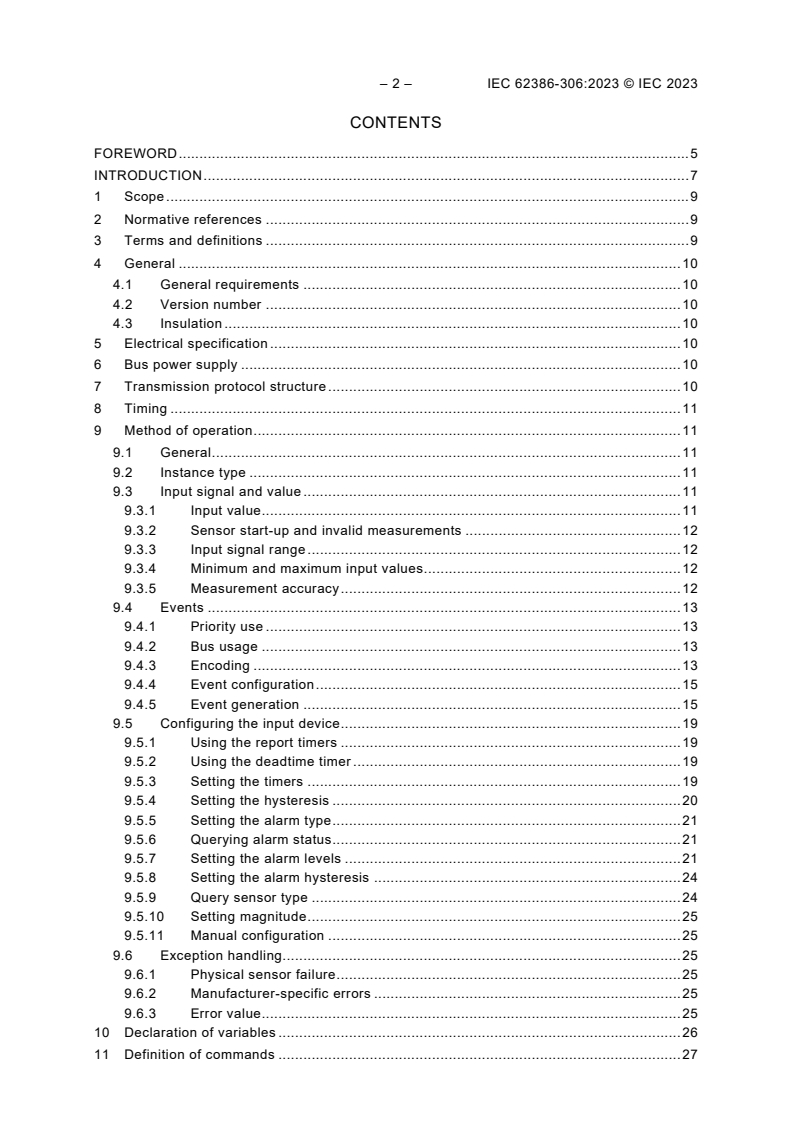
– 2 – IEC 62386-306:2023 © IEC 2023
CONTENTS
FOREWORD . 5
INTRODUCTION . 7
1 Scope . 9
2 Normative references . 9
3 Terms and definitions . 9
4 General . 10
4.1 General requirements . 10
4.2 Version number . 10
4.3 Insulation . 10
5 Electrical specification . 10
6 Bus power supply . 10
7 Transmission protocol structure . 10
8 Timing . 11
9 Method of operation . 11
9.1 General . 11
9.2 Instance type . 11
9.3 Input signal and value . 11
9.3.1 Input value . 11
9.3.2 Sensor start-up and invalid measurements . 12
9.3.3 Input signal range . 12
9.3.4 Minimum and maximum input values. 12
9.3.5 Measurement accuracy . 12
9.4 Events . 13
9.4.1 Priority use . 13
9.4.2 Bus usage . 13
9.4.3 Encoding . 13
9.4.4 Event configuration . 15
9.4.5 Event generation . 15
9.5 Configuring the input device . 19
9.5.1 Using the report timers . 19
9.5.2 Using the deadtime timer . 19
9.5.3 Setting the timers . 19
9.5.4 Setting the hysteresis . 20
9.5.5 Setting the alarm type . 21
9.5.6 Querying alarm status . 21
9.5.7 Setting the alarm levels . 21
9.5.8 Setting the alarm hysteresis . 24
9.5.9 Query sensor type . 24
9.5.10 Setting magnitude . 25
9.5.11 Manual configuration . 25
9.6 Exception handling. 25
9.6.1 Physical sensor failure . 25
9.6.2 Manufacturer-specific errors . 25
9.6.3 Error value . 25
10 Declaration of variables . 26
11 Definition of commands . 27
11.1 General . 27
11.2 Overview sheets . 28
11.2.1 General . 28
11.2.2 Standard commands . 28
11.3 Event messages . 28
11.3.1 INPUT NOTIFICATION (device/instance, event) . 28
11.3.2 POWER NOTIFICATION (device) . 28
11.4 Device control instructions . 28
11.5 Device configuration instructions . 28
11.6 Device queries . 29
11.7 Instance control instructions . 29
11.8 Instance configuration instructions . 29
11.8.1 General . 29
11.8.2 SET EVENT FILTER (DTR1:DTR0) . 29
11.8.3 SET REPORT TIMER (DTR0) . 29
11.8.4 SET ALARM REPORT TIMER (DTR0) . 29
11.8.5 SET HYSTERESIS (DTR0) . 29
11.8.6 SET DEADTIME TIMER (DTR0) . 29
11.8.7 SET HYSTERESIS MIN (DTR0). 29
11.8.8 SET ALARM TYPE (DTR0) . 29
11.8.9 SET MAGNITUDE (DTR0) . 30
11.8.10 SET ALARM (DTR2,DTR1,DTR0). 30
11.8.11 SET ALARM HYSTERESIS (DTR2,DTR1,DTR0) . 30
11.9 Instance queries . 30
11.9.1 General . 30
11.9.2 QUERY DEADTIME TIMER . 30
11.9.3 QUERY INSTANCE ERROR . 30
11.9.4 QUERY REPORT TIMER . 30
11.9.5 QUERY ALARM REPORT TIMER . 30
11.9.6 QUERY HYSTERESIS . 30
11.9.7 QUERY HYSTERESIS MIN . 30
11.9.8 QUERY MEASUREMENT VARIABLE (DTR0) . 31
11.10 Special commands . 32
Annex A (normative) Units of measure and quantity names . 33
A.1 Units of measure . 33
A.2 Quantity names . 34
Annex B (informative) Guidance on the design of application controllers . 35
B.1 Calculating input values, event values and measurements . 35
B.2 Example 1 – 6-bit measurement resolution . 35
B.3 Example 2 – 12-bit measurement resolution . 37
Bibliography . 39
Figure 1 – IEC 62386 graphical overview . 7
Figure 2 – Example of "measuredValue" changes and resultant hysteresis bands . 16
Figure 3 – Example of "measuredValue" changes and alarm levels . 18
Table 1 – Measurement and alarm events . 14
Table 2 – Event filter . 15
– 4 – IEC 62386-306:2023 © IEC 2023
Table 3 – "alarmType" . 17
Table 4 – "alarmIsActivated" . 17
Table 5 – Example alarm event messages . 18
Table 6 – Timer settings . 20
Table 7 – Default and reset values for "hysteresisMin" . 21
Table 8 – Set alarm . 22
Table 9 – "alarmX" value versus resolution examples . 23
Table 10 – Set alarm disable values . 24
Table 11 – "manualCapabilityInstance3xx" values . 25
Table 12 – "instanceErrorByte" values. 26
Table 13 – Declaration of device variables . 26
Table 14 – Restrictions and modifications to instance variables defined in
IEC 62386-103:2022 . 26
Table 15 – Declaration of instance variables . 27
Table 16 – Standard commands . 28
Table 17 – DTR reference . 31
Table A.1 – "unitOfMeasurement" values . 33
Table A.2 – "quantityName" values . 34
Table B.1 – Calculating input values and event values from measurements . 36
Table B.2 – Calculating measurements from event values . 36
Table B.3 – Calculating input values and event values from measurements . 37
Table B.4 – Calculating measurements from event values . 38
INTERNATIONAL ELECTROTECHNICAL COMMISSION
____________
DIGITAL ADDRESSABLE LIGHTING INTERFACE –
Part 306: Particular requirements – Input devices –
General purpose sensor
FOREWORD
1) The International Electrotechnical Commission (IEC) is a worldwide organization for standardization comprising
all national electrotechnical committees (IEC National Committees). The object of IEC is to promote international
co-operation on all questions concerning standardization in the electrical and electronic fields. To this end and
in addition to other activities, IEC publishes International Standards, Technical Specifications, Technical Reports,
Publicly Available Specifications (PAS) and Guides (hereafter referred to as “IEC Publication(s)”). Their
preparation is entrusted to technical committees; any IEC National Committee interested in the subject dealt with
may participate in this preparatory work. International, governmental and non-governmental organizations liaising
with the IEC also participate in this preparation. IEC collaborates closely with the International Organization for
Standardization (ISO) in accordance with conditions determined by agreement between the two organizations.
2) The formal decisions or agreements of IEC on technical matters express, as nearly as possible, an international
consensus of opinion on the relevant subjects since each technical committee has representation from all
interested IEC National Committees.
3) IEC Publications have the form of recommendations for international use and are accepted by IEC National
Committees in that sense. While all reasonable efforts are made to ensure that the technical content of IEC
Publications is accurate, IEC cannot be held responsible for the way in which they are used or for any
misinterpretation by any end user.
4) In order to promote international uniformity, IEC National Committees undertake to apply IEC Publications
transparently to the maximum extent possible in their national and regional publications. Any divergence between
any IEC Publication and the corresponding national or regional publication shall be clearly indicated in the latter.
5) IEC itself does not provide any attestation of conformity. Independent certification bodies provide conformity
assessment services and, in some areas, access to IEC marks of conformity. IEC is not responsible for any
services carried out by independent certification bodies.
6) All users should ensure that they have the latest edition of this publication.
7) No liability shall attach to IEC or its directors, employees, servants or agents including individual experts and
members of its technical committees and IEC National Committees for any personal injury, property damage or
other damage of any nature whatsoever, whether direct or indirect, or for costs (including legal fees) and
expenses arising out of the publication, use of, or reliance upon, this IEC Publication or any other IEC
Publications.
8) Attention is drawn to the Normative references cited in this publication. Use of the referenced publications is
indispensable for the correct application of this publication.
9) IEC draws attention to the possibility that the implementation of this document may involve the use of (a)
patent(s). IEC takes no position concerning the evidence, validity or applicability of any claimed patent rights in
respect thereof. As of the date of publication of this document, IEC had not received notice of (a) patent(s), which
may be required to implement this document. However, implementers are cautioned that this may not represent
the latest information, which may be obtained from the patent database available at https://patents.iec.ch. IEC
shall not be held responsible for identifying any or all such patent rights.
IEC 62386-306 has been prepared by IEC technical committee 34: Lighting. It is an International
Standard.
The text of this International Standard is based on the following documents:
Draft Report on voting
34/1132/FDIS 34/1146/RVD
Full information on the voting for its approval can be found in the report on voting indicated in
the above table.
The language used for the development of this International Standard is English.
– 6 – IEC 62386-306:2023 © IEC 2023
This document has been drafted in accordance with the ISO/IEC Directives, Part 2, and
developed in accordance with ISO/IEC Directives, Part 1 and ISO/IEC Directives, IEC
Supplement, available at www.iec.ch/members_experts/refdocs. The main document types
developed by IEC are described in greater detail at www.iec.ch/standardsdev/publications.
This document is intended to be used in conjunction with:
• IEC 62386-101, which contains general requirements for system components;
• IEC 62386-103, which contains general requirements for control devices.
A list of all parts in the IEC 62386 series, published under the general title Digital addressable
lighting interface, can be found on the IEC website.
The committee has decided that the contents of this document will remain unchanged until the
stability date indicated on the IEC website under webstore.iec.ch in the data related to the
specific document. At this date, the document will be
• reconfirmed,
• withdrawn, or
• revised.
IMPORTANT – The "colour inside" logo on the cover page of this document indicates
that it contains colours which are considered to be useful for the correct understanding
of its contents. Users should therefore print this document using a colour printer.
INTRODUCTION
The IEC 62386 series specifies a bus system for control by digital signals of electronic lighting
equipment and contains several parts, referred to as series. The IEC 62386-1xx series includes
the basic specifications. IEC 62386-101 contains general requirements for system components,
IEC 62386-102 extends this information with general requirements for control gear and
IEC 62386-103 extends it further with general requirements for control devices. IEC 62386-104
and IEC 62386-105 can be applied to control gear or control devices. IEC 62386-104 gives
requirements for wireless and alternative wired system components. IEC 62386-105 describes
firmware transfer. IEC 62386-150 gives requirements for an auxiliary power supply which can
be stand-alone, or built into control gear or control devices.
The IEC 62386-2xx series extends the general requirements for control gear with lamp specific
extensions (mainly for backward compatibility with Edition 1 of IEC 62386) and with control gear
specific features.
The IEC 62386-3xx series extends the general requirements for control devices with input
device specific extensions describing the instance types as well as some common features that
can be combined with multiple instance types.
This first edition of IEC 62386-306 is intended to be used in conjunction with IEC 62386-101
and IEC 62386-103. The division into separately published parts provides for ease of future
amendments and revisions. Additional requirements will be added as and when a need for them
is recognized.
The setup of the standards is graphically represented in Figure 1 below.
Figure 1 – IEC 62386 graphical overview
When this part of IEC 62386 refers to any of the clauses of the parts of the IEC 62386-1xx
series, the extent to which such a clause is applicable is specified. The other parts also include
additional requirements, as necessary.
All numbers used in this document are decimal numbers unless otherwise noted. Hexadecimal
numbers are given in the format 0xVV, where VV is the value. Binary numbers are given in the
format XXXXXXXXb or in the format XXXX XXXX, where X is 0 or 1, "x" in binary numbers
means "don't care". Where a variable is referred by a bit number, bit 0 is the least significant
bit.
– 8 – IEC 62386-306:2023 © IEC 2023
The following typographic expressions are used:
Variables: "variableName" or "variableName[3:0]", giving only bits 3 to 0 of "variableName";
Range of values: [lowest, highest];
Command: "COMMAND NAME".
DIGITAL ADDRESSABLE LIGHTING INTERFACE –
Part 306: Particular requirements – Input devices –
General purpose sensor
1 Scope
This part of IEC 62386 is applicable to input devices that provide sensor information or
measurements to the lighting control system.
This document is only applicable to input devices complying with IEC 62386-103.
2 Normative references
The following documents are referred to in the text in such a way that some or all of their content
constitutes requirements of this document. For dated references, only the edition cited applies.
For undated references, the latest edition of the referenced document (including any
amendments) applies.
IEC 62386-101:2022, Digital addressable lighting interface – Part 101: General requirements –
System components
IEC 62386-103:2022, Digital addressable lighting interface – Part 103: General requirements –
Control devices
IEC 62386-333:2018, Digital addressable lighting interface – Part 333: Particular requirements
for control devices – Manual configuration (feature type 33)
3 Terms and definitions
For the purposes of this document, the terms and definitions given in IEC 62386-101 and
IEC 62386-103 and the following apply.
ISO and IEC maintain terminology databases for use in standardization at the following
addresses:
• IEC Electropedia: available at http://www.electropedia.org/
• ISO online browsing platform: available at http://www.iso.org/obp
3.1
instance
sensor signal processing unit of an input device
[SOURCE: IEC 62386-101:2022, 3.29, modified – "sensor" has been added, narrowing the
definition to a sensor.]
3.2
strictly monotonic
either entirely increasing or decreasing without repeating values
– 10 – IEC 62386-306:2023 © IEC 2023
3.3
unit of measurement
real scalar quantity, defined and adopted by convention, with which any other quantity of the
same kind can be compared to express the ratio of the second quantity to the first one as a
number
Note 1 to entry: A sensor detecting a temperature of 26 °C would have a unit of measurement designated as
degrees Celsius.
[SOURCE: IEC 60050-112:2010, 112-01-14, modified – Note 1 to entry has been deleted and
Notes 2, 3 and 4 to entry have been replaced by a new Note 1 to entry.]
3.4
quantity name
term designating a property of a phenomenon, body, or substance, where the property has a
magnitude that can be expressed by means of a number and a reference
Note 1 to entry: A sensor detecting a temperature of 26 °C would have a quantity name defined as temperature.
[SOURCE: IEC 60050-112:2019, 112-01-01 and 112-01-02, modified – The two definitions have
been combined and the Notes to entry have been replaced with a new Note 1 to entry.]
4 General
4.1 General requirements
The requirements of IEC 62386-103:2022, Clause 4 apply, with the restrictions, changes and
additions identified below.
4.2 Version number
In IEC 62386-103:2022, 4.2, "103" shall be replaced by "306", "version number" shall be
replaced by "extended version number" and "versionNumber" shall be replaced by
"extendedVersionNumber".
4.3 Insulation
According to applicable safety standards, it can be required that the input device has at least
supplementary insulation to accessible parts. This depends on the connected components. In
this case special attention should be paid with respect to the sensor(s) being used.
NOTE IEC 62386-103:2022 requires system components to have at least basic insulation.
5 Electrical specification
The requirements of IEC 62386-103:2022, Clause 5 apply.
6 Bus power supply
The requirements of IEC 62386-103:2022, Clause 6 apply.
7 Transmission protocol structure
The requirements of IEC 62386-103:2022, Clause 7 apply.
NOTE Subclause 9.4 provides detailed event information applicable to instances.
8 Timing
The requirements of IEC 62386-103:2022, Clause 8 apply.
9 Method of operation
9.1 General
The requirements of IEC 62386-103:2022, Clause 9 apply, with the following restrictions and
additions.
9.2 Instance type
The instance type ("instanceType") shall be equal to 6.
9.3 Input signal and value
9.3.1 Input value
The measured input signal shall be scaled and an offset applied for bipolar inputs, with
"measuredValue" containing the result with a precision of "resolution" bits. "measuredValue" shall
be encoded in "inputValue" as described in IEC 62386-103:2022, 9.8.2.
NOTE 1 "measuredValue" has "resolution" bits, whereas "inputValue" has a multiple of 8 bits. For example if
"resolution" = 27 then "measuredValue" will be a 27-bit value and "inputValue" will be a 32-bit value.
The input signal shall be scaled by the variable "magnitude":
"magnitude" − 127
scaled input signal = input signal/10
An offset, K, is added to the scaled input signal, depending on the range of the input signal
(see 9.3.3). K shall be calculated as follows:
"resolution" − 1
• for bipolar input signals: K = 2 – 1,
• in all other cases: K = 0.
This gives:
"magnitude" − 127
"measuredValue" = input signal/10 + K
The resulting "measuredValue" shall be a strictly monotonic function of the input signal. Units of
measure are listed in Clause A.1, and quantity names are listed in Clause A.2.
NOTE 2 The measured value can be a relative value, depending on the quantity and unit of measure.
EXAMPLE The following example demonstrates the encoding: A sensor has "resolution" = 5, "magnitude" = 128 and
measures input voltages that can extend to negative values. An input signal of −50 V is measured. Scaled input
128 − 127
signal = −50/10 = −5. Offset K = 15 is added to this, giving a "measuredValue" of 10 (01010b). This has a
resolution of 5, so these 5 bits make up the top 5 bits of the 1-byte "inputValue" and are repeated in the 3 least
significant bits of "inputValue", resulting in 82 (01010010b). When encoding into a 9-bit measurement event (Table 1),
this will be encoded as 512 + 165 (1010100101b) (Bit 9 = 1 indicating a measurement event.)
Annex B gives guidance for application controller developers in calculating the measured signal
from the "inputValue" and other variables.
– 12 – IEC 62386-306:2023 © IEC 2023
9.3.2 Sensor start-up and invalid measurements
After the receiver start-up, it can take the sensor some time before valid measurements are
obtained. During this time, "inputValue" shall be MASK. After the first valid measurement is
obtained, "inputValue" shall not be MASK, except in the case of physical sensor failure (see
9.6.1). When "inputValue" is MASK, "measuredValue" shall not change, meaning it shall stay at
the power-on value, or the last valid measured value.
The following are examples of "inputValue" MASK values and highest valid values, for several
values of "resolution":
• "resolution" = 4: "inputValue" is a 1-byte value
– MASK is 0xFF, resulting in a QUERY INPUT VALUE reply of 0xFF.
– After applying the scale and offset, the highest possible "measuredValue" is 0xE, which
results in the 1-byte "inputValue" of 0xEE.
• "resolution" = 9: "inputValue" is a 2-byte value
– MASK is 0xFFFF, resulting in a QUERY INPUT VALUE reply of 0xFF and a QUERY
INPUT VALUE LATCH reply of 0xFF.
– After applying the scale and offset, the highest possible "measuredValue" is 0x1FE, which
results in the 2-byte "inputValue" of 0xFF7F.
• "resolution" = 18: "inputValue" is a 3-byte value
– MASK is 0xFFFFFF, resulting in a QUERY INPUT VALUE reply of 0xFF and replies of
0xFF for each of the two QUERY INPUT VALUE LATCH commands sent after QUERY
INPUT VALUE.
– After applying the scale and offset, the highest possible "measuredValue" is 0x3FFFE,
which results in the 3-byte "inputValue" of 0xFFFFBF.
9.3.3 Input signal range
To indicate an input signal that can extend into negative values as well as positive values, a
Boolean factory programmed instance variable "inputSignalSigned" shall be maintained by the
instance.
• if the input signal can be negative or positive, "inputSignalSigned" = 1 (TRUE), and K > 0;
• if the input signal can be positive only, "inputSignalSigned" = 0 (FALSE), and K = 0;
where K is the offset described in 9.3.1.
"inputSignalSigned" can be queried via QUERY MEASUREMENT VARIABLE (DTR0).
9.3.4 Minimum and maximum input values
On each change of "measuredValue", the following shall be recalculated:
• If "measuredValue" > "maxMeasuredValue", then "maxMeasuredValue" shall be set to
"measuredValue".
• If "measuredValue" < "minMeasuredValue", then "minMeasuredValue" shall be set to
"measuredValue".
Querying of "maxMeasuredValue" and "minMeasuredValue" is described in 11.9.8.
9.3.5 Measurement accuracy
Measurement accuracy is manufacturer-specific and shall be stated in the product documents.
9.4 Events
9.4.1 Priority use
9.4.1.1 General
The default "eventPriority" is shown in Table 14.
NOTE Application controllers can avoid setting "eventPriority" to 2, to help ensure they have a timeslot to respond.
9.4.1.2 Periodic events
The periodic "INPUT NOTIFICATION" messages of the following types shall be sent with the
priority as shown:
• triggered by the report timer that reports the measurement event: priority 5,
• triggered by the alarm report timer that reports the alarm event: priority 5.
9.4.1.3 Alarm events
The "ALARM EVENT" message triggered by an alarm activation or deactivation shall be sent
with priority "eventPriority".
9.4.1.4 Measurement events
The measurement event message triggered by a change in "measuredValue" outside of the
hysteresis band, shall always be sent with priority 4.
9.4.2 Bus usage
9.4.2.1 Instance level
Multiple events from an instance shall not be sent in a transaction. There is a configurable delay
T that shall be taken into account. See 9.5.2 for more information.
deadtime
9.4.2.2 Device level
At the device level, events from different instances may be sent in a transaction.
9.4.3 Encoding
Measurement and alarm events shall be encoded as shown in Table 1.
– 14 – IEC 62386-306:2023 © IEC 2023
Table 1 – Measurement and alarm events
Event name Event information Description
9 8 7 6 5 4 3 2 1 0
Measured value A measured value report, passing the 9 most significant bits of
1 "measurementEvent"
report "inputValue".
"alarmIsActivated[0]" is 0 and has not changed at any time since the
Alarm 0 0 0 - - - - - - 0 0
last alarm event transmission.
0 0 - - - - - - 0 1 "alarmIsActivated[0]" is 1 and has not changed at any time since the
last alarm event transmission.
0 0 - - - - - - 1 0 "alarmIsActivated[0]" is 0 and has changed at least once since the
last alarm event transmission.
0 0 - - - - - - 1 1 "alarmIsActivated[0]" is 1 and has changed at least once since the
last alarm event transmission.
Alarm 1 0 0 - - - - 0 0 - - "alarmIsActivated[1]" is 0 and has not changed at any time since the
last alarm event transmission.
0 0 - - - - 0 1 - - "alarmIsActivated[1]" is 1 and has not changed at any time since the
last alarm event transmission.
0 0 - - - - 1 0 - - "alarmIsActivated[1]" is 0 and has changed at least once since the
last alarm event transmission.
0 0 - - - - 1 1 - - "alarmIsActivated[1]" is 1 and has changed at least once since the
last alarm event transmission.
Alarm 2 0 0 - - 0 0 - - - - "alarmIsActivated[2]" is 0 and has not changed at any time since the
last alarm event transmission.
0 0 - - 0 1 - - - - "alarmIsActivated[2]" is 1 and has not changed at any time since the
last alarm event transmission.
0 0 - - 1 0 - - - - "alarmIsActivated[2]" is 0 and has changed at least once since the
last alarm event transmission.
0 0 - - 1 1 - - - - "alarmIsActivated[2]" is 1 and has changed at least once since the
last alarm event transmission.
Alarm 3 0 0 0 0 - - - - - - "alarmIsActivated[3]" is 0 and has not changed at any time since the
last alarm event transmission.
0 0 0 1 - - - - - - "alarmIsActivated[3]" is 1 and has not changed at any time since the
last alarm event transmission.
0 0 1 0 - - - - - - "alarmIsActivated[3]" is 0 and has changed at least once since the
last alarm event transmission.
0 0 1 1 - - - - - - "alarmIsActivated[3]" is 1 and has changed at least once since the
last alarm event transmission.
01xxxxxxxxb Reserved
An alarm event is indicated by clearing bits 8 and 9. The remaining bits are calculated by bitwise
OR-ing the alarm status bits. In order to perform the OR-ing, every bit that is marked with "-"
shall be assumed 0.
A measurement event is indicated by setting bit 9. The measurement event shall be encoded
as follows:
• if "resolution" ≤ 9: "measurementEvent" shall be calculated from "measuredValue" such that the
resulting event information is a 9-bit value, according to IEC 62386-103:2022, 9.8.2;
• in all other cases: "measurementEvent" shall provide the 9 most significant bits of
"measuredValue".
NOTE The measured value is an offset binary value. "measurementEvent" indicates the magnitude of the reading as
a proportion of full scale. To determine the original value, the application controller can consider "resolution". To
obtain full-resolution values when "resolution" > 9, an application controller can query the input value via QUERY
INPUT VALUE and QUERY INPUT VALUE LATCH.
9.4.4 Event configuration
Events shall be enabled or disabled according to the value of "eventFilter". For this document,
"eventFilter" shall be reduced to two bytes.
NOTE Inhibiting events increases the effective bus bandwidth availability.
The "eventFilter" shall have the definition as given in Table 2.
Table 2 – Event filter
Bit Description Value Default
0 Measured value report event enabled? "1" = "Yes" 1
1 Alarm 0 activated event enabled? "1" = "Yes" 0
2 Alarm 0 deactivated event enabled? "1" = "Yes" 0
3 Alarm 1 activated event enabled? "1" = "Yes" 0
4 Alarm 1 deactivated event enabled? "1" = "Yes" 0
5 Alarm 2 activated event enabled? "1" = "Yes" 0
6 Alarm 2 deactivated event enabled? "1" = "Yes" 0
7 Alarm 3 activated event enabled? "1" = "Yes" 0
8 Alarm 3 deactivated event enabled? "1" = "Yes" 0
9 to 15 Reserved 0 0
The filter can be set via SET EVENT FILTER (DTR1:DTR0) and be queried using
QUERY EVENT FILTER 0-7 and QUERY EVENT FILTER 8-15, see IEC 62386-103:2022 for
details.
9.4.5 Event generation
9.4.5.1 General
Two types of events shall be generated. The measurement event provides a report of
"inputValue" and the alarm event provides the status of each alarm.
9.4.5.2 Measurement event
The measured value report event is a report of the "measuredValue". In order to avoid flooding
the system with too many events triggered by small measurement changes, a hysteresis band
is introduced. This hysteresis band is restricted by its upper ("hysteresisBandHigh") and lower
("hysteresisBandLow") boundaries. The height of the hysteresis band ("hysteresisBand"), has a
direct impact on how sensitively the input device responds to changes of the measured value
and therefore event generation. The hysteresis band is not symmetrically arranged towards
"measuredValue". Depending on the direction of the last change of "measuredValue" the
hysteresis band is spanned above or below "measuredValue".
The measurement event shall be generated
• each time "measuredValue" becomes greater than "hysteresisBandHigh" or less than
"hysteresisBandLow", or;
• after a timeout of T since the previous measured value report, irrespective of the actual
report
"measuredValue".
The power-on values of "hysteresisBandLow" and "hysteresisBandHigh" are 0, such that the first
non-zero value of "measuredValue" shall cause the measured value report event to be generated
according to the first condition shown below. See 9.5.4 for details.
– 16 – IEC 62386-306:2023 © IEC 2023
In case a new measurement event occurs before the current measurement event has been sent,
the new measurement event shall replace the current measurement
...