

CISPR 14-1:2020
(Main)Electromagnetic compatibility - Requirements for household appliances, electric tools and similar apparatus - Part 1: Emission
General Information
- Abstract
CISPR 14-1:2020 specifies the requirements that apply to the emission of radio-frequency disturbances in the frequency range 9 kHz to 400 GHz from appliances, electric tools and similar apparatus as defined below, whether powered by AC or DC (including a battery). This document is applicable to the following equipment:
- household appliances or similar equipment;
- electric tools;
- similar apparatus.
Also included in the scope of this document are separate parts of the above mentioned equipment such as motors and switching devices (e.g. power or protective relays). However, no emission requirements apply to such separate parts, unless otherwise stated in this document. Products which incorporate radio transmit/receive functions are included in the scope of this document. Equipment under the scope of this document making use of IPT is also in the scope. Excluded from the scope of this document are:
- equipment for which all emission requirements in the radio-frequency range are explicitly formulated in other CISPR standards;
- equipment intended to be used only on a vehicle, ship or aircraft;
- equipment used only in industrial environment
- the effects of electromagnetic phenomena relating to the safety of the equipment.
Multifunction equipment may be required to comply with clauses in this and other standards. The details are given in 6.5. The emission requirements in this document are not intended to be applicable to the intentional transmissions from a radio transmitter as defined by the ITU including their spurious emissions. This seventh edition cancels and replaces the sixth edition published in 2016. This edition constitutes a technical revision. This edition includes the following significant changes with respect to the previous edition:
- extension of the frequency range for radiated measurements above 1 GHz;
- revision of general test conditions and addition of new specific test conditions (e.g. for robotic equipment);
- introduction of additional requirements for equipment making use of inductive power transfer technology;
- remove from the normative text any compliance requirement based on statistical evaluation;
- revision of clicks analysis, with particular relevance to the determination of the observation time and the application of the upper quartile method for different types of click analysers.
Refer to the Foreword of the document for examples of equipment.
- Status
- Published
- Publication Date
- 06-Sep-2020
- Current Stage
- PPUB - Publication issued
- Start Date
- 07-Sep-2020
- Completion Date
- 04-Sep-2020
Buy Documents
CISPR 14-1:2020 - Electromagnetic compatibility - Requirements for household appliances, electric tools and similar apparatus - Part 1: Emission Released:9/7/2020
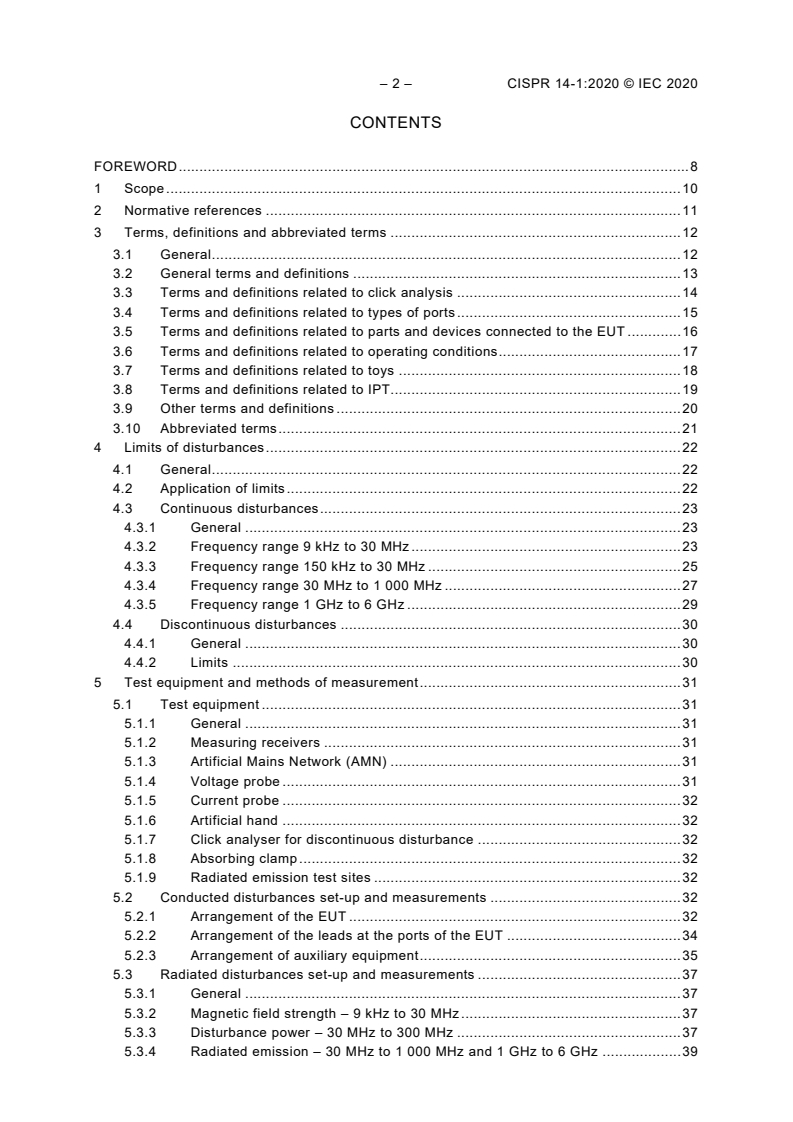
CISPR 14-1:2020 - Electromagnetic compatibility - Requirements for household appliances, electric tools and similar apparatus - Part 1: Emission Released:9/7/2020
Overview
CISPR 14-1:2020 - Electromagnetic compatibility (EMC) - Requirements for household appliances, electric tools and similar apparatus - Part 1: Emission is the 7th edition international standard published by IEC/CISPR. It specifies radio‑frequency emission requirements for appliances, electric tools and similar apparatus powered from AC or DC (including battery) in the frequency range 9 kHz to 400 GHz. The standard covers whole products and certain separate parts (e.g., motors, switching devices) and explicitly includes products with embedded radio functions and equipment using inductive power transfer (IPT). Exclusions include equipment whose RF emission limits are defined in other CISPR standards, equipment solely intended for vehicles/ships/aircraft, equipment for industrial-only environments, and safety‑related electromagnetic effects.
Key topics and technical requirements
- Scope & applicability: Defines categories of covered equipment (household appliances, electric tools, similar apparatus) and exceptions.
- Emission limits: Detailed limits for continuous and discontinuous disturbances across defined frequency bands (e.g., 9 kHz–30 MHz, 30 MHz–1 GHz, 1 GHz–6 GHz), with application rules in Clause 4.
- Test methods & measurement setups: Procedures for conducted and radiated measurements, including required test equipment such as measuring receivers, Artificial Mains Network (AMN), voltage/current probes, artificial hand, absorbing clamp and radiated emission test sites.
- Measurement interpretation: Rules for continuous and discontinuous disturbance analysis, including click analysis methodology, observation times and the upper‑quartile method.
- Operating conditions: Standard operating conditions, mains/DC supply requirements, multifunction equipment clauses (6.5), IPT-specific test requirements and Annex A standard operating conditions and loads for specific equipment types.
- Technical updates in 2020 edition:
- Extension of radiated measurement frequency range above 1 GHz.
- Revised general and new specific test conditions (e.g., robotic equipment).
- Additional IPT requirements.
- Removal of statistical‑based compliance requirements from normative text.
- Updated click analysis procedures.
Practical applications and who uses it
- Product designers and electrical/electronic engineers use CISPR 14-1:2020 to design appliances and tools that meet EMC emission limits early in development.
- EMC test laboratories and compliance officers use the measurement methods and reporting requirements for pre‑compliance and formal certification testing.
- Manufacturers and regulatory bodies use the standard to support market access, demonstrate conformity, and reduce risk of interference with radio services.
- Test planners use Annex A for equipment‑specific operating conditions; engineers use click analysis and IPT guidance for emerging product features.
Related standards
- Emission requirements explicitly formulated in other CISPR standards take precedence where applicable. CISPR 14-1 should be used alongside other IEC/CISPR EMC guidance and the ITU definition of radio transmitters when addressing intentional transmissions and spurious emissions.
Keywords: CISPR 14-1:2020, electromagnetic compatibility, EMC emission, household appliances, electric tools, radiated emission, conducted emission, inductive power transfer, click analysis, AMN, EMC testing.
Relations
- Effective Date
- 05-Sep-2023
- Effective Date
- 05-Sep-2023
- Effective Date
- 05-Sep-2023
- Effective Date
- 05-Sep-2023
Buy Documents
CISPR 14-1:2020 - Electromagnetic compatibility - Requirements for household appliances, electric tools and similar apparatus - Part 1: Emission Released:9/7/2020
CISPR 14-1:2020 - Electromagnetic compatibility - Requirements for household appliances, electric tools and similar apparatus - Part 1: Emission Released:9/7/2020
Get Certified
Connect with accredited certification bodies for this standard

ANCE
Mexican certification and testing association.

Intertek Slovenia
Intertek testing, inspection, and certification services in Slovenia.

LNE (Laboratoire National de Métrologie et d'Essais)
French national laboratory for metrology and testing.
Sponsored listings
Frequently Asked Questions
CISPR 14-1:2020 is a standard published by the International Electrotechnical Commission (IEC). Its full title is "Electromagnetic compatibility - Requirements for household appliances, electric tools and similar apparatus - Part 1: Emission". This standard covers: CISPR 14-1:2020 specifies the requirements that apply to the emission of radio-frequency disturbances in the frequency range 9 kHz to 400 GHz from appliances, electric tools and similar apparatus as defined below, whether powered by AC or DC (including a battery). This document is applicable to the following equipment: - household appliances or similar equipment; - electric tools; - similar apparatus. Also included in the scope of this document are separate parts of the above mentioned equipment such as motors and switching devices (e.g. power or protective relays). However, no emission requirements apply to such separate parts, unless otherwise stated in this document. Products which incorporate radio transmit/receive functions are included in the scope of this document. Equipment under the scope of this document making use of IPT is also in the scope. Excluded from the scope of this document are: - equipment for which all emission requirements in the radio-frequency range are explicitly formulated in other CISPR standards; - equipment intended to be used only on a vehicle, ship or aircraft; - equipment used only in industrial environment - the effects of electromagnetic phenomena relating to the safety of the equipment. Multifunction equipment may be required to comply with clauses in this and other standards. The details are given in 6.5. The emission requirements in this document are not intended to be applicable to the intentional transmissions from a radio transmitter as defined by the ITU including their spurious emissions. This seventh edition cancels and replaces the sixth edition published in 2016. This edition constitutes a technical revision. This edition includes the following significant changes with respect to the previous edition: - extension of the frequency range for radiated measurements above 1 GHz; - revision of general test conditions and addition of new specific test conditions (e.g. for robotic equipment); - introduction of additional requirements for equipment making use of inductive power transfer technology; - remove from the normative text any compliance requirement based on statistical evaluation; - revision of clicks analysis, with particular relevance to the determination of the observation time and the application of the upper quartile method for different types of click analysers. Refer to the Foreword of the document for examples of equipment.
CISPR 14-1:2020 specifies the requirements that apply to the emission of radio-frequency disturbances in the frequency range 9 kHz to 400 GHz from appliances, electric tools and similar apparatus as defined below, whether powered by AC or DC (including a battery). This document is applicable to the following equipment: - household appliances or similar equipment; - electric tools; - similar apparatus. Also included in the scope of this document are separate parts of the above mentioned equipment such as motors and switching devices (e.g. power or protective relays). However, no emission requirements apply to such separate parts, unless otherwise stated in this document. Products which incorporate radio transmit/receive functions are included in the scope of this document. Equipment under the scope of this document making use of IPT is also in the scope. Excluded from the scope of this document are: - equipment for which all emission requirements in the radio-frequency range are explicitly formulated in other CISPR standards; - equipment intended to be used only on a vehicle, ship or aircraft; - equipment used only in industrial environment - the effects of electromagnetic phenomena relating to the safety of the equipment. Multifunction equipment may be required to comply with clauses in this and other standards. The details are given in 6.5. The emission requirements in this document are not intended to be applicable to the intentional transmissions from a radio transmitter as defined by the ITU including their spurious emissions. This seventh edition cancels and replaces the sixth edition published in 2016. This edition constitutes a technical revision. This edition includes the following significant changes with respect to the previous edition: - extension of the frequency range for radiated measurements above 1 GHz; - revision of general test conditions and addition of new specific test conditions (e.g. for robotic equipment); - introduction of additional requirements for equipment making use of inductive power transfer technology; - remove from the normative text any compliance requirement based on statistical evaluation; - revision of clicks analysis, with particular relevance to the determination of the observation time and the application of the upper quartile method for different types of click analysers. Refer to the Foreword of the document for examples of equipment.
CISPR 14-1:2020 is classified under the following ICS (International Classification for Standards) categories: 33.100.10 - Emission. The ICS classification helps identify the subject area and facilitates finding related standards.
CISPR 14-1:2020 has the following relationships with other standards: It is inter standard links to CISPR 14-1:2016, CISPR 14-1:2016/ISH1:2017, CISPR 14-1:2016/COR1:2016, CISPR 14-1:2016/ISH2:2017. Understanding these relationships helps ensure you are using the most current and applicable version of the standard.
CISPR 14-1:2020 is available in PDF format for immediate download after purchase. The document can be added to your cart and obtained through the secure checkout process. Digital delivery ensures instant access to the complete standard document.
Standards Content (Sample)
CISPR 14-1 ®
Edition 7.0 2020-09
INTERNATIONAL
STANDARD
colour
inside
INTERNATIONAL SPECIAL COMMITTEE ON RADIO INTERFERENCE
Electromagnetic compatibility – Requirements for household appliances, electric
tools and similar apparatus –
Part 1: Emission
All rights reserved. Unless otherwise specified, no part of this publication may be reproduced or utilized in any form
or by any means, electronic or mechanical, including photocopying and microfilm, without permission in writing from
either IEC or IEC's member National Committee in the country of the requester. If you have any questions about IEC
copyright or have an enquiry about obtaining additional rights to this publication, please contact the address below or
your local IEC member National Committee for further information.
IEC Central Office Tel.: +41 22 919 02 11
3, rue de Varembé info@iec.ch
CH-1211 Geneva 20 www.iec.ch
Switzerland
About the IEC
The International Electrotechnical Commission (IEC) is the leading global organization that prepares and publishes
International Standards for all electrical, electronic and related technologies.
About IEC publications
The technical content of IEC publications is kept under constant review by the IEC. Please make sure that you have the
latest edition, a corrigendum or an amendment might have been published.
IEC publications search - webstore.iec.ch/advsearchform Electropedia - www.electropedia.org
The advanced search enables to find IEC publications by a The world's leading online dictionary on electrotechnology,
variety of criteria (reference number, text, technical containing more than 22 000 terminological entries in English
committee,…). It also gives information on projects, replaced and French, with equivalent terms in 16 additional languages.
and withdrawn publications. Also known as the International Electrotechnical Vocabulary
(IEV) online.
IEC Just Published - webstore.iec.ch/justpublished
Stay up to date on all new IEC publications. Just Published IEC Glossary - std.iec.ch/glossary
details all new publications released. Available online and once 67 000 electrotechnical terminology entries in English and
a month by email. French extracted from the Terms and definitions clause of IEC
publications issued between 2002 and 2015. Some entries
IEC Customer Service Centre - webstore.iec.ch/csc have been collected from earlier publications of IEC TC 37, 77,
If you wish to give us your feedback on this publication or need 86 and CISPR.
further assistance, please contact the Customer Service
Centre: sales@iec.ch.
CISPR 14-1 ®
Edition 7.0 2020-09
INTERNATIONAL
STANDARD
colour
inside
INTERNATIONAL SPECIAL COMMITTEE ON RADIO INTERFERENCE
Electromagnetic compatibility – Requirements for household appliances, electric
tools and similar apparatus –
Part 1: Emission
INTERNATIONAL
ELECTROTECHNICAL
COMMISSION
ICS 33.100.10 ISBN 978-2-8322-8744-6
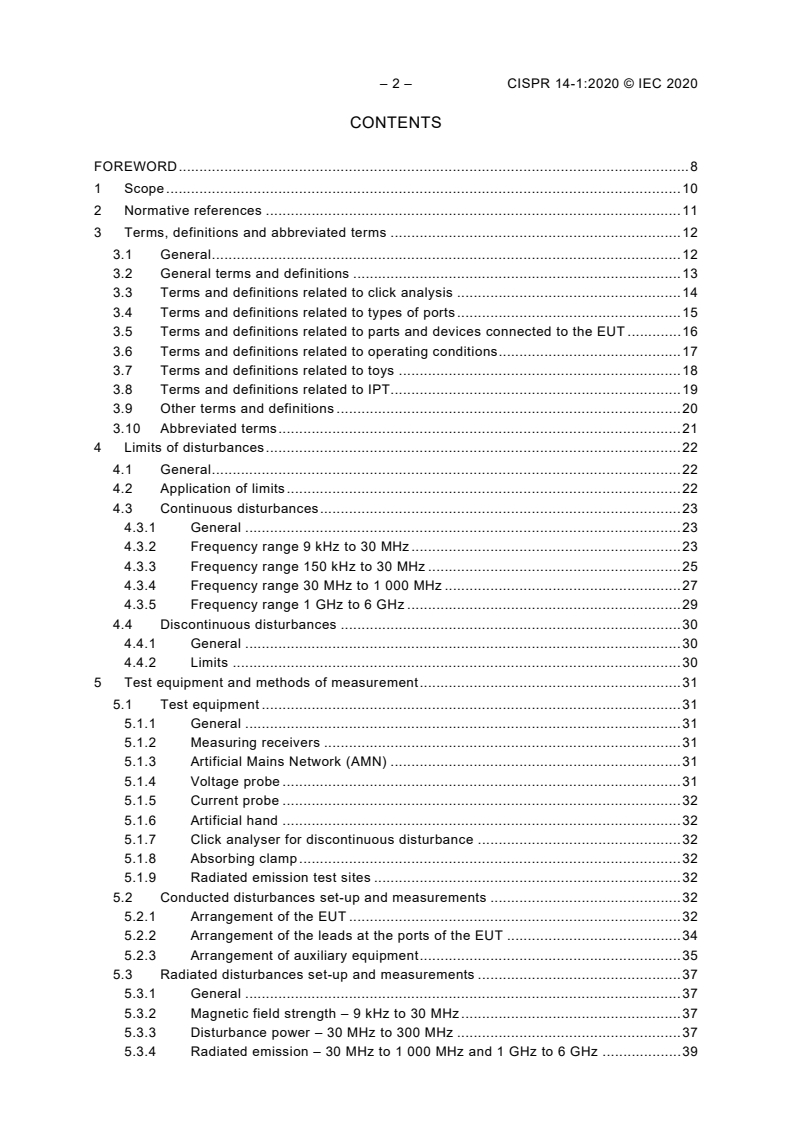
– 2 – CISPR 14-1:2020 © IEC 2020
CONTENTS
FOREWORD . 8
1 Scope . 10
2 Normative references . 11
3 Terms, definitions and abbreviated terms . 12
3.1 General . 12
3.2 General terms and definitions . 13
3.3 Terms and definitions related to click analysis . 14
3.4 Terms and definitions related to types of ports . 15
3.5 Terms and definitions related to parts and devices connected to the EUT . 16
3.6 Terms and definitions related to operating conditions . 17
3.7 Terms and definitions related to toys . 18
3.8 Terms and definitions related to IPT. 19
3.9 Other terms and definitions . 20
3.10 Abbreviated terms . 21
4 Limits of disturbances . 22
4.1 General . 22
4.2 Application of limits . 22
4.3 Continuous disturbances . 23
4.3.1 General . 23
4.3.2 Frequency range 9 kHz to 30 MHz . 23
4.3.3 Frequency range 150 kHz to 30 MHz . 25
4.3.4 Frequency range 30 MHz to 1 000 MHz . 27
4.3.5 Frequency range 1 GHz to 6 GHz . 29
4.4 Discontinuous disturbances . 30
4.4.1 General . 30
4.4.2 Limits . 30
5 Test equipment and methods of measurement . 31
5.1 Test equipment . 31
5.1.1 General . 31
5.1.2 Measuring receivers . 31
5.1.3 Artificial Mains Network (AMN) . 31
5.1.4 Voltage probe . 31
5.1.5 Current probe . 32
5.1.6 Artificial hand . 32
5.1.7 Click analyser for discontinuous disturbance . 32
5.1.8 Absorbing clamp . 32
5.1.9 Radiated emission test sites . 32
5.2 Conducted disturbances set-up and measurements . 32
5.2.1 Arrangement of the EUT . 32
5.2.2 Arrangement of the leads at the ports of the EUT . 34
5.2.3 Arrangement of auxiliary equipment . 35
5.3 Radiated disturbances set-up and measurements . 37
5.3.1 General . 37
5.3.2 Magnetic field strength – 9 kHz to 30 MHz . 37
5.3.3 Disturbance power – 30 MHz to 300 MHz . 37
5.3.4 Radiated emission – 30 MHz to 1 000 MHz and 1 GHz to 6 GHz . 39
5.4 Measurement procedures and interpretation of results . 40
5.4.1 Continuous disturbance . 40
5.4.2 Discontinuous disturbance . 41
5.4.3 Exceptions . 43
6 Operating conditions . 45
6.1 General . 45
6.2 Mains operation . 46
6.2.1 Voltage at the AC mains port . 46
6.2.2 Frequency at the AC mains port . 46
6.3 DC operation . 46
6.3.1 Battery operation . 46
6.3.2 Operation from a DC supply other than a battery . 46
6.4 Speed controls . 47
6.5 Multifunction equipment . 47
6.6 Equipment with built-in luminaires . 47
6.7 Equipment incorporating IPT functions . 48
7 Compliance with this document . 48
8 Measurement uncertainty . 48
9 Test report . 48
Annex A (normative) Standard operating conditions and normal loads for specific
equipment . 68
A.1 Motor operated equipment for household and similar purposes . 68
A.1.1 Vacuum cleaners . 68
A.1.2 Floor polishers . 69
A.1.3 Coffee grinders and coffee makers . 69
A.1.4 Kitchen machines . 69
A.1.5 Personal care appliances with a motor . 69
A.1.6 Fans . 70
A.1.7 Extractors and range hoods . 70
A.1.8 Hair-dryers, fan heaters . 70
A.1.9 Refrigerators and freezers . 70
A.1.10 Washing machines. 70
A.1.11 Dishwashers . 71
A.1.12 Tumble dryers . 71
A.1.13 Centrifugal dryers . 71
A.1.14 Razors and clippers . 71
A.1.15 Sewing machines . 71
A.1.16 Electro-mechanical office machines . 71
A.1.17 Projectors . 72
A.1.18 Milking machines . 72
A.1.19 Lawn mowers . 72
A.1.20 Air conditioning equipment. 72
A.2 Electric tools . 74
A.2.1 General . 74
A.2.2 Handheld (portable) motor-operated tools . 74
A.2.3 Transportable (semi-stationary) motor-operated tools . 74
A.2.4 Soldering equipment, soldering guns, soldering irons and similar . 74
A.2.5 Glue guns . 75
– 4 – CISPR 14-1:2020 © IEC 2020
A.2.6 Heat guns . 75
A.2.7 Power staplers . 75
A.2.8 Spray guns . 75
A.2.9 Internal vibrators . 75
A.3 Motor-operated electro-medical apparatus . 75
A.3.1 General . 75
A.3.2 Dental drills . 75
A.3.3 Saws and knives . 75
A.3.4 Electrocardiograms and similar recorders . 75
A.3.5 Pumps . 76
A.4 Electrical heating equipment . 76
A.4.1 General . 76
A.4.2 Hobs and hotplates . 76
A.4.3 Cooking pans, table-type roasters, deep-fat fryers . 76
A.4.4 Feed boilers, water boilers, kettles and similar boilers . 76
A.4.5 Instantaneous water heaters . 76
A.4.6 Storage heaters . 76
A.4.7 Warming plates, boiling tables, heating drawers, heating cabinets . 77
A.4.8 Cooking ovens, grills, waffle irons, waffle grills . 77
A.4.9 Toasters . 77
A.4.10 Ironing machines . 77
A.4.11 Clothes irons . 78
A.4.12 Vacuum packagers . 78
A.4.13 Flexible electrical heating equipment . 78
A.4.14 Air convection room heaters . 78
A.4.15 Rice cookers . 79
A.5 Thermostats . 79
A.5.1 General . 79
A.5.2 Thermostatically controlled three-phase switches . 80
A.5.3 Thermostats – Alternative procedure to that specified in A.5.1 . 80
A.6 Automatic goods-dispensing machines, entertainment machines and similar
equipment . 81
A.6.1 General . 81
A.6.2 Automatic dispensing machines . 81
A.6.3 Juke boxes . 81
A.6.4 Automatic entertainment machines incorporating a winnings-payout
mechanism . 81
A.6.5 Automatic entertainment machines with no winnings-payout mechanism . 82
A.7 Electric and electronic toys . 82
A.7.1 General . 82
A.7.2 Operating conditions . 82
A.8 Miscellaneous equipment . 83
A.8.1 Time switches not incorporated in equipment. 83
A.8.2 Electric fence energizers . 84
A.8.3 Electronic gas igniters . 84
A.8.4 Insect killers . 85
A.8.5 Personal care appliances without a motor . 85
A.8.6 Air cleaners . 85
A.8.7 Steam generators and humidifiers . 85
A.8.8 Battery chargers other than IPT chargers . 86
A.8.9 External Power Supplies (EPS) . 86
A.8.10 Lifting devices (electric hoists) . 86
A.8.11 Robotic equipment . 87
A.8.12 Other robotic equipment . 89
A.8.13 Clocks . 89
A.9 Induction cooking appliances . 89
A.9.1 General . 89
A.9.2 Operating conditions for EUT with fixed cooking zone(s). 89
A.9.3 Operating conditions for EUT with many small coils . 90
A.10 Equipment making use of IPT other than induction cooking appliances . 90
A.10.1 General . 90
A.10.2 IPTS . 90
A.10.3 IPTC . 91
A.10.4 IPTE . 91
A.11 Operating conditions for particular equipment and integrated parts . 92
A.11.1 Integrated starting switches, speed controls, etc. . 92
A.11.2 Regulating controls and external power controller . 92
A.11.3 Equipment operated from External Power Supplies (EPS) . 93
A.11.4 Remote controls and timers . 93
Annex B (normative) Click rate of special equipment. 101
Annex C (informative) Background information on the measurement of discontinuous
disturbances/clicks . 102
C.1 General . 102
C.2 Additional recommendations for the use of an oscilloscope . 102
C.3 Additional recommendations for the application of exceptions . 103
C.4 Example for the use of the upper quartile method . 103
C.5 Background information about the minimum observation time . 106
Annex D (informative) Statistical evaluation . 108
D.1 General . 108
D.2 Method based on a general margin to the limit . 108
D.3 Test based on the non-central t-distribution . 109
D.4 Test based on the binomial distribution . 110
D.5 Larger sample size. 111
Bibliography . 112
Figure 1 – IPT terms . 21
Figure 2 – Examples of test configuration . 22
Figure 3 – Examples of discontinuous disturbances whose duration and separation
meet the definition of clicks (see 3.3.3) . 50
Figure 4 – Examples of discontinuous disturbance whose duration or separation do not
meet the definition of click . 51
Figure 5 – Flow chart for emission measurements of mains operated equipment in the
frequency range from 30 MHz to 1 000 MHz . 52
Figure 6 – Flow chart for emission testing of battery operated equipment in the
frequency range from 30 MHz to 1 000 MHz . 53
Figure 7 – Flow chart for emission measurements in the frequency range from 1 GHz
to 6 GHz . 54
– 6 – CISPR 14-1:2020 © IEC 2020
Figure 8 – Flow diagram for the evaluation of discontinuous disturbance, based on
measuring the clicks . 55
Figure 9 – Flow diagram for the evaluation of discontinuous disturbance, based on
counting the switching operations . 56
Figure 10 – Artificial hand – RC element . 57
Figure 11 – Application of the artificial hand – Portable electric drill . 57
Figure 12 – Application of the artificial hand – Portable electric saw . 58
Figure 13 – Cable bundling . 58
Figure 14 – Voltage probe measurement for mains powered EUT . 59
Figure 15 – Radiated emission – Location of the EUT on the turntable and measuring
distance . 60
Figure 16 – Radiated emission – Example of test set-up for table-top EUT . 60
Figure 17 – Radiated emission – Example of test set-up for table-top EUT . 61
Figure 18 – Radiated emission – Example of test set-up for table-top EUT (top view) . 61
Figure 19 – Radiated emission – Example of test set-up for floor standing EUT . 62
Figure 20 – Radiated emission – Example of the test set-up for an EUT made of
multiple table-top parts . 63
Figure 21 – Radiated emission – Example of the test set-up for an EUT in SAC or
OATS, made of a combination of table-top and floor standing parts . 64
Figure 22 – Radiated emission – Height of the EUT in the FAR . 65
Figure 23 – Example of test setup for disturbance voltage measurements on table-top
EUT (horizontal RGP) . 66
Figure 24 – Example of alternative test setup (vertical RGP) for measurements on table-
top EUT (disturbance voltage on mains port and disturbance current on auxiliary port) . 66
Figure 25 – Example of disturbance voltage measurement arrangement for floor
standing EUT(s) . 67
Figure A.1 – Arrangement for measurement of the disturbance voltage produced at the
fence port of electric fence energizers (see A.8.2) . 95
Figure A.2 – Measuring arrangement for toys running on tracks . 96
Figure A.3 – Radiated emission – Test set-up for floor operated vacuum cleaner . 97
Figure A.4 – Example of an idle roller for the measurement of radiated emissions of
robotic cleaners . 97
Figure A.5 – Measurement arrangement for two-terminal external power controller . 98
Figure A.6 – Applicable cases for testing equipment making use of IPT . 99
Figure A.7 – Setup for operation of the mobile part on a test surface other than
horizontal . 100
Figure C.1 – Discontinuous disturbance at i.f. reference level and QP output, as shown
in CISPR 16-1-1:2015, Table 17, test pulse 1 . 102
Figure D.1 – Unit to unit variation of sub-range maximum . 110
Table 1 – Application of limits . 23
Table 2 – Disturbance voltage limits for the AC mains port of equipment with active IPT
functions . 24
Table 3 – Magnetic field strength limits . 24
Table 4 – Limits for the magnetic field induced current. 25
Table 5 – General limits . 26
Table 6 – Limits for the mains port of motor operated tools . 27
Table 7 – Disturbance power limits – 30 MHz to 300 MHz . 28
Table 8 – Reduction applicable to Table 7 limits . 28
Table 9 – Radiated disturbance limits and testing methods – 30 MHz to 1 000 MHz . 29
Table 10 – Required highest frequency for radiated electric field strength
measurements . 29
Table 11 – Radiated electric field disturbance limits and test methods – 1 GHz to 6 GHz . 30
Table A.1 – Types of EUT, operating modes and test setup . 90
Table B.1 – Application of factor f for the determination of the click rate of special
equipment . 101
Table C.1 – Discontinuous disturbances recorded during the first run at 500 kHz. 104
Table C.2 – Discontinuous disturbances recorded during the second run at 500 kHz . 105
Table C.3 – Discontinuous disturbances recorded during the first run at 1,4 MHz . 105
Table C.4 – Discontinuous disturbances recorded during the second run at 1,4 MHz . 106
Table C.5 – Examples of minimum observation time . 107
Table D.1 – Values of the coefficient K as a function the sample size . 108
E
Table D.2 – General margin to the limit for statistical evaluation . 109
Table D.3 – Factor k for the application of the non-central t-distribution . 109
Table D.4 – Application of the binomial distribution . 111
– 8 – CISPR 14-1:2020 © IEC 2020
INTERNATIONAL ELECTROTECHNICAL COMMISSION
INTERNATIONAL SPECIAL COMMITTEE ON RADIO INTERFERENCE
____________
ELECTROMAGNETIC COMPATIBILITY –
REQUIREMENTS FOR HOUSEHOLD APPLIANCES,
ELECTRIC TOOLS AND SIMILAR APPARATUS –
Part 1: Emission
FOREWORD
1) The International Electrotechnical Commission (IEC) is a worldwide organization for standardization comprising
all national electrotechnical committees (IEC National Committees). The object of IEC is to promote international
co-operation on all questions concerning standardization in the electrical and electronic fields. To this end and
in addition to other activities, IEC publishes International Standards, Technical Specifications, Technical Reports,
Publicly Available Specifications (PAS) and Guides (hereafter referred to as “IEC Publication(s)”). Their
preparation is entrusted to technical committees; any IEC National Committee interested in the subject dealt with
may participate in this preparatory work. International, governmental and non-governmental organizations liaising
with the IEC also participate in this preparation. IEC collaborates closely with the International Organization for
Standardization (ISO) in accordance with conditions determined by agreement between the two organizations.
2) The formal decisions or agreements of IEC on technical matters express, as nearly as possible, an international
consensus of opinion on the relevant subjects since each technical committee has representation from all
interested IEC National Committees.
3) IEC Publications have the form of recommendations for international use and are accepted by IEC National
Committees in that sense. While all reasonable efforts are made to ensure that the technical content of IEC
Publications is accurate, IEC cannot be held responsible for the way in which they are used or for any
misinterpretation by any end user.
4) In order to promote international uniformity, IEC National Committees undertake to apply IEC Publications
transparently to the maximum extent possible in their national and regional publications. Any divergence between
any IEC Publication and the corresponding national or regional publication shall be clearly indicated in the latter.
5) IEC itself does not provide any attestation of conformity. Independent certification bodies provide conformity
assessment services and, in some areas, access to IEC marks of conformity. IEC is not responsible for any
services carried out by independent certification bodies.
6) All users should ensure that they have the latest edition of this publication.
7) No liability shall attach to IEC or its directors, employees, servants or agents including individual experts and
members of its technical committees and IEC National Committees for any personal injury, property damage or
other damage of any nature whatsoever, whether direct or indirect, or for costs (including legal fees) and
expenses arising out of the publication, use of, or reliance upon, this IEC Publication or any other IEC Publications.
8) Attention is drawn to the Normative references cited in this publication. Use of the referenced publications is
indispensable for the correct application of this publication.
9) Attention is drawn to the possibility that some of the elements of this IEC Publication may be the subject of patent
rights. IEC shall not be held responsible for identifying any or all such patent rights.
The International Standard CISPR 14-1 has been prepared by subcommittee CISPR/F:
Interference related to household appliances tools, lighting equipment and similar apparatus,
of IEC technical committee CISPR.
This seventh edition cancels and replaces the sixth edition published in 2016. This edition
constitutes a technical revision.
This edition includes the following significant changes with respect to the previous edition:
– extension of the frequency range for radiated measurements above 1 GHz;
– revision of general test conditions and addition of new specific test conditions (e.g. for
robotic equipment);
– introduction of additional requirements for equipment making use of inductive power transfer
technology;
– remove from the normative text any compliance requirement based on statistical evaluation;
– revision of clicks analysis, with particular relevance to the determination of the observation
time and the application of the upper quartile method for different types of click analysers.
The text of this document is based on the following documents:
FDIS Report on voting
CIS/F/796/FDIS CIS/F/799/RVD
Full information on the voting for the approval of this standard can be found in the report on
voting indicated in the above table.
This publication has been drafted in accordance with the ISO/IEC Directives, Part 2.
A list of all parts in the CISPR 14 series can be found on the IEC website under the general title
Electromagnetic compatibility – Requirements for household appliances, electric tools and
similar apparatus.
The committee has decided that the contents of this publication will remain unchanged until the
stability date indicated on the IEC web site under "http://webstore.iec.ch" in the data related to
the specific publication. At this date, the publication will be
• reconfirmed,
• withdrawn,
• replaced by a revised edition, or
• amended
IMPORTANT – The 'colour inside' logo on the cover page of this publication indicates
that it contains colours which are considered to be useful for the correct understanding
of its contents. Users should therefore print this document using a colour printer.
– 10 – CISPR 14-1:2020 © IEC 2020
ELECTROMAGNETIC COMPATIBILITY –
REQUIREMENTS FOR HOUSEHOLD APPLIANCES,
ELECTRIC TOOLS AND SIMILAR APPARATUS –
Part 1: Emission
1 Scope
This part of CISPR 14 specifies the requirements that apply to the emission of radio-frequency
disturbances in the frequency range 9 kHz to 400 GHz from appliances, electric tools and similar
apparatus as defined below, whether powered by AC or DC (including a battery).
This document is applicable to the following equipment:
• household appliances or similar equipment;
NOTE 1 Examples are equipment used:
– for typical housekeeping functions in the household environment, which includes the dwelling and its
associated buildings, the garden, etc.;
– for typical housekeeping functions in shops, offices, commercial and other similar working environments;
– on farms;
– by clients in hotels and other residential type environments;
– for induction cooking or air-conditioning, either in residential or commercial environments.
• electric tools;
NOTE 2 Examples of electric tools include electric motor-operated or electromagnetically driven hand-held tools,
transportable tools, lawn and garden machinery.
• similar apparatus.
NOTE 3 Examples are:
– external power controllers using semiconductor devices;
– motor-driven electro-medical equipment;
– electric/electronic toys;
– personal care and beauty care appliances;
– automatic goods-dispensing machines;
– entertainment machines;
– cine or slide projectors;
– battery chargers and external power supplies for use with products under the scope of this document;
– electric fence energisers.
Also included in the scope of this document are separate parts of the above mentioned
equipment such as motors and switching devices (e.g. power or protective relays). However,
no emission requirements apply to such separate parts, unless otherwise stated in this
document.
Products which incorporate radio transmit/receive functions are included in the scope of this
document.
Equipment under the scope of this document making use of IPT is also in the scope.
Excluded from the scope of this document are:
– equipment for which all emission requirements in the radio-frequency range are explicitly
formulated in other CISPR standards;
NOTE 4 Examples are:
− luminaires, including portable luminaires for children, discharge lamps and other lighting devices under the
scope of CISPR 15;
− information technology equipment, e.g. home computers, personal computers, electronic copying machines
under the scope of CISPR 32;
− audio/video equipment and electronic music instruments other than toys under the scope of CISPR 32;
− mains communication devices, as well as baby surveillance systems;
− equipment which is under the scope of CISPR 11 (e.g. microwave ovens) but be aware of 6.5 on
multifunction equipment (e.g. for another function requiring click measurements)
− radio controls, walkie-talkies and other types of radio-transmitters;
− arc welding equipment.
– equipment intended to be used only on a vehicle, ship or aircraft;
– equipment used only in industrial environment
– the effects of electromagnetic phenomena relating to the safety of the equipment.
Multifunction equipment may be required to comply with clauses in this and other standards.
The details are given in 6.5.
The emission requirements in this document are not intended to be applicable to the intentional
transmissions from a radio transmitter as defined by the ITU including their spurious emissions.
2 Normative references
The following documents are referred to in the text in such a way that some or all of their content
constitutes requirements of this document. For dated references, only the edition cited applies.
For undated references, the latest edition of the referenced document (including any
amendments) applies.
CISPR 16-1-1:2015 , Specification for radio disturbance and immunity measuring apparatus
and methods – Part 1-1: Radio disturbance and immunity measuring apparatus – Measuring
apparatus
CISPR 16-1-2:2014, Specification for radio disturbance and immunity measuring apparatus and
methods – Part 1-2: Radio disturbance and immunity measuring apparatus – Coupling devices
for conducted disturbance measurements
CISPR 16-1-2:2014/AMD1:2017
CISPR 16-1-3:2004, Specification for radio disturbance and immunity measuring apparatus and
methods – Part 1-3: Radio disturbance and immunity measuring apparatus – Ancillary
equipment – Disturbance power
CISPR 16-1-3:2004/AMD1:2016
CISPR 16-1-3:2004/AMD2:2020
CISPR 16-1-4:2019, Specification for radio disturbance and immunity measuring apparatus and
methods – Part 1-4: Radio disturbance and immunity measuring apparatus – Antennas and test
sites for radiated disturbance measurements
____________
th th th
4 edition (2015). This 4 edition has been replaced in 2019 by a 5 Edition CISPR 16-1-1:2019, Specification
for radio disturbance and immunity measuring apparatus and methods – Part 1-1: Radio disturbance and immunity
measuring apparatus – Measuring apparatus.
– 12 – CISPR 14-1:2020 © IEC 2020
CISPR 16-2-1:2014, Specification for radio disturbance and immunity measuring apparatus and
methods – Part 2-1: Methods of measurement of disturbances and immunity – Conducted
disturbance measurements
CISPR 16-2-1:2014/AMD1:2017
CISPR 16-2-2:2010, Specification for radio disturbance and immunity measuring apparatus and
methods – Part 2-2: Methods of measurement of disturbances and immunity – Measurement of
disturbance power
CISPR 16-2-3:2016, Specification for radio disturbance and immunity measuring apparatus and
methods – Part 2-3: Methods of measurement of disturbances and immunity – Radiated
disturbance measurements
CISPR 16-2-3:2016/AMD1:2019
CISPR 16-4-2:2011, Specification for radio disturbance and immunity measuring apparatus and
methods – Part 4-2: Uncertainties, statistics and limit modelling – Measurement instrumentation
uncertainty
CISPR 16-4-2:2011/AMD1:20
...
CISPR 14-1 ®
Edition 7.0 2020-09
INTERNATIONAL
STANDARD
NORME
INTERNATIONALE
colour
inside
INT ERNATIONAL SPECIAL COMMITTEE ON RADIO INTERFERENCE
C OMITÉ INTERNATIONAL SPÉCIAL DES PERTURBATIONS RADIOÉLECTRIQUES
Electromagnetic compatibility – Requirements for household appliances, electric
tools and similar apparatus –
Part 1: Emission
Compatibilité électromagnétique – Exigences relatives aux appareils
électrodomestiques, aux outils électriques et aux appareils analogues –
Partie 1: Émission
All rights reserved. Unless otherwise specified, no part of this publication may be reproduced or utilized in any form
or by any means, electronic or mechanical, including photocopying and microfilm, without permission in writing from
either IEC or IEC's member National Committee in the country of the requester. If you have any questions about IEC
copyright or have an enquiry about obtaining additional rights to this publication, please contact the address below or
your local IEC member National Committee for further information.
Droits de reproduction réservés. Sauf indication contraire, aucune partie de cette publication ne peut être reproduite
ni utilisée sous quelque forme que ce soit et par aucun procédé, électronique ou mécanique, y compris la photocopie
et les microfilms, sans l'accord écrit de l'IEC ou du Comité national de l'IEC du pays du demandeur. Si vous avez des
questions sur le copyright de l'IEC ou si vous désirez obtenir des droits supplémentaires sur cette publication, utilisez
les coordonnées ci-après ou contactez le Comité national de l'IEC de votre pays de résidence.
IEC Central Office Tel.: +41 22 919 02 11
3, rue de Varembé info@iec.ch
CH-1211 Geneva 20 www.iec.ch
Switzerland
About the IEC
The International Electrotechnical Commission (IEC) is the leading global organization that prepares and publishes
International Standards for all electrical, electronic and related technologies.
About IEC publications
The technical content of IEC publications is kept under constant review by the IEC. Please make sure that you have the
latest edition, a corrigendum or an amendment might have been published.
IEC publications search - webstore.iec.ch/advsearchform IEC online collection - oc.iec.ch
The advanced search enables to find IEC publications by a Discover our powerful search engine and read freely all the
variety of criteria (reference number, text, technical publications previews. With a subscription you will always
committee, …). It also gives information on projects, replaced have access to up to date content tailored to your needs.
and withdrawn publications.
Electropedia - www.electropedia.org
IEC Just Published - webstore.iec.ch/justpublished
The world's leading online dictionary on electrotechnology,
Stay up to date on all new IEC publications. Just Published
containing more than 22 000 terminological entries in English
details all new publications released. Available online and
and French, with equivalent terms in 18 additional languages.
once a month by email.
Also known as the International Electrotechnical Vocabulary
(IEV) online.
IEC Customer Service Centre - webstore.iec.ch/csc
If you wish to give us your feedback on this publication or
need further assistance, please contact the Customer Service
Centre: sales@iec.ch.
A propos de l'IEC
La Commission Electrotechnique Internationale (IEC) est la première organisation mondiale qui élabore et publie des
Normes internationales pour tout ce qui a trait à l'électricité, à l'électronique et aux technologies apparentées.
A propos des publications IEC
Le contenu technique des publications IEC est constamment revu. Veuillez vous assurer que vous possédez l’édition la
plus récente, un corrigendum ou amendement peut avoir été publié.
Recherche de publications IEC - IEC online collection - oc.iec.ch
webstore.iec.ch/advsearchform Découvrez notre puissant moteur de recherche et consultez
La recherche avancée permet de trouver des publications IEC gratuitement tous les aperçus des publications. Avec un
en utilisant différents critères (numéro de référence, texte, abonnement, vous aurez toujours accès à un contenu à jour
comité d’études, …). Elle donne aussi des informations sur adapté à vos besoins.
les projets et les publications remplacées ou retirées.
Electropedia - www.electropedia.org
IEC Just Published - webstore.iec.ch/justpublished
Le premier dictionnaire d'électrotechnologie en ligne au
Restez informé sur les nouvelles publications IEC. Just
monde, avec plus de 22 000 articles terminologiques en
Published détaille les nouvelles publications parues.
anglais et en français, ainsi que les termes équivalents dans
Disponible en ligne et une fois par mois par email.
16 langues additionnelles. Egalement appelé Vocabulaire
Electrotechnique International (IEV) en ligne.
Service Clients - webstore.iec.ch/csc
Si vous désirez nous donner des commentaires sur cette
publication ou si vous avez des questions contactez-nous:
sales@iec.ch.
CISPR 14-1 ®
Edition 7.0 2020-09
INTERNATIONAL
STANDARD
NORME
INTERNATIONALE
colour
inside
INT ERNATIONAL SPECIAL COMMITTEE ON RADIO INTERFERENCE
C OMITÉ INTERNATIONAL SPÉCIAL DES PERTURBATIONS RADIOÉLECTRIQUES
Electromagnetic compatibility – Requirements for household appliances, electric
tools and similar apparatus –
Part 1: Emission
Compatibilité électromagnétique – Exigences relatives aux appareils
électrodomestiques, aux outils électriques et aux appareils analogues –
Partie 1: Émission
INTERNATIONAL
ELECTROTECHNICAL
COMMISSION
COMMISSION
ELECTROTECHNIQUE
INTERNATIONALE
ICS 33.100.10 ISBN 978-2-8322-1031-4
– 2 – CISPR 14-1:2020 © IEC 2020
CONTENTS
FOREWORD . 8
1 Scope . 10
2 Normative references . 11
3 Terms, definitions and abbreviated terms . 12
3.1 General . 12
3.2 General terms and definitions . 13
3.3 Terms and definitions related to click analysis . 14
3.4 Terms and definitions related to types of ports . 15
3.5 Terms and definitions related to parts and devices connected to the EUT . 16
3.6 Terms and definitions related to operating conditions . 17
3.7 Terms and definitions related to toys . 18
3.8 Terms and definitions related to IPT. 19
3.9 Other terms and definitions . 20
3.10 Abbreviated terms . 21
4 Limits of disturbances . 22
4.1 General . 22
4.2 Application of limits . 22
4.3 Continuous disturbances . 23
4.3.1 General . 23
4.3.2 Frequency range 9 kHz to 30 MHz . 23
4.3.3 Frequency range 150 kHz to 30 MHz . 25
4.3.4 Frequency range 30 MHz to 1 000 MHz . 27
4.3.5 Frequency range 1 GHz to 6 GHz . 29
4.4 Discontinuous disturbances . 30
4.4.1 General . 30
4.4.2 Limits . 30
5 Test equipment and methods of measurement . 31
5.1 Test equipment . 31
5.1.1 General . 31
5.1.2 Measuring receivers . 31
5.1.3 Artificial Mains Network (AMN) . 31
5.1.4 Voltage probe . 31
5.1.5 Current probe . 32
5.1.6 Artificial hand . 32
5.1.7 Click analyser for discontinuous disturbance . 32
5.1.8 Absorbing clamp . 32
5.1.9 Radiated emission test sites . 32
5.2 Conducted disturbances set-up and measurements . 32
5.2.1 Arrangement of the EUT . 32
5.2.2 Arrangement of the leads at the ports of the EUT . 34
5.2.3 Arrangement of auxiliary equipment . 35
5.3 Radiated disturbances set-up and measurements . 37
5.3.1 General . 37
5.3.2 Magnetic field strength – 9 kHz to 30 MHz . 37
5.3.3 Disturbance power – 30 MHz to 300 MHz . 37
5.3.4 Radiated emission – 30 MHz to 1 000 MHz and 1 GHz to 6 GHz . 39
5.4 Measurement procedures and interpretation of results . 40
5.4.1 Continuous disturbance . 40
5.4.2 Discontinuous disturbance . 41
5.4.3 Exceptions . 43
6 Operating conditions . 45
6.1 General . 45
6.2 Mains operation . 46
6.2.1 Voltage at the AC mains port . 46
6.2.2 Frequency at the AC mains port . 46
6.3 DC operation . 46
6.3.1 Battery operation . 46
6.3.2 Operation from a DC supply other than a battery . 46
6.4 Speed controls . 47
6.5 Multifunction equipment . 47
6.6 Equipment with built-in luminaires . 47
6.7 Equipment incorporating IPT functions . 48
7 Compliance with this document . 48
8 Measurement uncertainty . 48
9 Test report . 48
Annex A (normative) Standard operating conditions and normal loads for specific
equipment . 68
A.1 Motor operated equipment for household and similar purposes . 68
A.1.1 Vacuum cleaners . 68
A.1.2 Floor polishers . 69
A.1.3 Coffee grinders and coffee makers . 69
A.1.4 Kitchen machines . 69
A.1.5 Personal care appliances with a motor . 69
A.1.6 Fans . 70
A.1.7 Extractors and range hoods . 70
A.1.8 Hair-dryers, fan heaters . 70
A.1.9 Refrigerators and freezers . 70
A.1.10 Washing machines. 70
A.1.11 Dishwashers . 71
A.1.12 Tumble dryers . 71
A.1.13 Centrifugal dryers . 71
A.1.14 Razors and clippers . 71
A.1.15 Sewing machines . 71
A.1.16 Electro-mechanical office machines . 71
A.1.17 Projectors . 72
A.1.18 Milking machines . 72
A.1.19 Lawn mowers . 72
A.1.20 Air conditioning equipment. 72
A.2 Electric tools . 74
A.2.1 General . 74
A.2.2 Handheld (portable) motor-operated tools . 74
A.2.3 Transportable (semi-stationary) motor-operated tools . 74
A.2.4 Soldering equipment, soldering guns, soldering irons and similar . 74
A.2.5 Glue guns . 75
– 4 – CISPR 14-1:2020 © IEC 2020
A.2.6 Heat guns . 75
A.2.7 Power staplers . 75
A.2.8 Spray guns . 75
A.2.9 Internal vibrators . 75
A.3 Motor-operated electro-medical apparatus . 75
A.3.1 General . 75
A.3.2 Dental drills . 75
A.3.3 Saws and knives . 75
A.3.4 Electrocardiograms and similar recorders . 75
A.3.5 Pumps . 76
A.4 Electrical heating equipment . 76
A.4.1 General . 76
A.4.2 Hobs and hotplates . 76
A.4.3 Cooking pans, table-type roasters, deep-fat fryers . 76
A.4.4 Feed boilers, water boilers, kettles and similar boilers . 76
A.4.5 Instantaneous water heaters . 76
A.4.6 Storage heaters . 76
A.4.7 Warming plates, boiling tables, heating drawers, heating cabinets . 77
A.4.8 Cooking ovens, grills, waffle irons, waffle grills . 77
A.4.9 Toasters . 77
A.4.10 Ironing machines . 77
A.4.11 Clothes irons . 78
A.4.12 Vacuum packagers . 78
A.4.13 Flexible electrical heating equipment . 78
A.4.14 Air convection room heaters . 78
A.4.15 Rice cookers . 79
A.5 Thermostats . 79
A.5.1 General . 79
A.5.2 Thermostatically controlled three-phase switches . 80
A.5.3 Thermostats – Alternative procedure to that specified in A.5.1 . 80
A.6 Automatic goods-dispensing machines, entertainment machines and similar
equipment . 81
A.6.1 General . 81
A.6.2 Automatic dispensing machines . 81
A.6.3 Juke boxes . 81
A.6.4 Automatic entertainment machines incorporating a winnings-payout
mechanism . 81
A.6.5 Automatic entertainment machines with no winnings-payout mechanism . 82
A.7 Electric and electronic toys . 82
A.7.1 General . 82
A.7.2 Operating conditions . 82
A.8 Miscellaneous equipment . 83
A.8.1 Time switches not incorporated in equipment. 83
A.8.2 Electric fence energizers . 84
A.8.3 Electronic gas igniters . 84
A.8.4 Insect killers . 85
A.8.5 Personal care appliances without a motor . 85
A.8.6 Air cleaners . 85
A.8.7 Steam generators and humidifiers . 85
A.8.8 Battery chargers other than IPT chargers . 86
A.8.9 External Power Supplies (EPS) . 86
A.8.10 Lifting devices (electric hoists) . 86
A.8.11 Robotic equipment . 87
A.8.12 Other robotic equipment . 89
A.8.13 Clocks . 89
A.9 Induction cooking appliances . 89
A.9.1 General . 89
A.9.2 Operating conditions for EUT with fixed cooking zone(s). 89
A.9.3 Operating conditions for EUT with many small coils . 90
A.10 Equipment making use of IPT other than induction cooking appliances . 90
A.10.1 General . 90
A.10.2 IPTS . 90
A.10.3 IPTC . 91
A.10.4 IPTE . 91
A.11 Operating conditions for particular equipment and integrated parts . 92
A.11.1 Integrated starting switches, speed controls, etc. . 92
A.11.2 Regulating controls and external power controller . 92
A.11.3 Equipment operated from External Power Supplies (EPS) . 93
A.11.4 Remote controls and timers . 93
Annex B (normative) Click rate of special equipment. 101
Annex C (informative) Background information on the measurement of discontinuous
disturbances/clicks . 102
C.1 General . 102
C.2 Additional recommendations for the use of an oscilloscope . 102
C.3 Additional recommendations for the application of exceptions . 103
C.4 Example for the use of the upper quartile method . 103
C.5 Background information about the minimum observation time . 106
Annex D (informative) Statistical evaluation . 108
D.1 General . 108
D.2 Method based on a general margin to the limit . 108
D.3 Test based on the non-central t-distribution . 109
D.4 Test based on the binomial distribution . 110
D.5 Larger sample size. 111
Bibliography . 112
Figure 1 – IPT terms . 21
Figure 2 – Examples of test configuration . 22
Figure 3 – Examples of discontinuous disturbances whose duration and separation
meet the definition of clicks (see 3.3.3) . 50
Figure 4 – Examples of discontinuous disturbance whose duration or separation do not
meet the definition of click . 51
Figure 5 – Flow chart for emission measurements of mains operated equipment in the
frequency range from 30 MHz to 1 000 MHz . 52
Figure 6 – Flow chart for emission testing of battery operated equipment in the
frequency range from 30 MHz to 1 000 MHz . 53
Figure 7 – Flow chart for emission measurements in the frequency range from 1 GHz
to 6 GHz . 54
– 6 – CISPR 14-1:2020 © IEC 2020
Figure 8 – Flow diagram for the evaluation of discontinuous disturbance, based on
measuring the clicks . 55
Figure 9 – Flow diagram for the evaluation of discontinuous disturbance, based on
counting the switching operations . 56
Figure 10 – Artificial hand – RC element . 57
Figure 11 – Application of the artificial hand – Portable electric drill . 57
Figure 12 – Application of the artificial hand – Portable electric saw . 58
Figure 13 – Cable bundling . 58
Figure 14 – Voltage probe measurement for mains powered EUT . 59
Figure 15 – Radiated emission – Location of the EUT on the turntable and measuring
distance . 60
Figure 16 – Radiated emission – Example of test set-up for table-top EUT . 60
Figure 17 – Radiated emission – Example of test set-up for table-top EUT . 61
Figure 18 – Radiated emission – Example of test set-up for table-top EUT (top view) . 61
Figure 19 – Radiated emission – Example of test set-up for floor standing EUT . 62
Figure 20 – Radiated emission – Example of the test set-up for an EUT made of
multiple table-top parts . 63
Figure 21 – Radiated emission – Example of the test set-up for an EUT in SAC or
OATS, made of a combination of table-top and floor standing parts . 64
Figure 22 – Radiated emission – Height of the EUT in the FAR . 65
Figure 23 – Example of test setup for disturbance voltage measurements on table-top
EUT (horizontal RGP) . 66
Figure 24 – Example of alternative test setup (vertical RGP) for measurements on table-
top EUT (disturbance voltage on mains port and disturbance current on auxiliary port) . 66
Figure 25 – Example of disturbance voltage measurement arrangement for floor
standing EUT(s) . 67
Figure A.1 – Arrangement for measurement of the disturbance voltage produced at the
fence port of electric fence energizers (see A.8.2) . 95
Figure A.2 – Measuring arrangement for toys running on tracks . 96
Figure A.3 – Radiated emission – Test set-up for floor operated vacuum cleaner . 97
Figure A.4 – Example of an idle roller for the measurement of radiated emissions of
robotic cleaners . 97
Figure A.5 – Measurement arrangement for two-terminal external power controller . 98
Figure A.6 – Applicable cases for testing equipment making use of IPT . 99
Figure A.7 – Setup for operation of the mobile part on a test surface other than
horizontal . 100
Figure C.1 – Discontinuous disturbance at i.f. reference level and QP output, as shown
in CISPR 16-1-1:2015, Table 17, test pulse 1 . 102
Figure D.1 – Unit to unit variation of sub-range maximum . 110
Table 1 – Application of limits . 23
Table 2 – Disturbance voltage limits for the AC mains port of equipment with active IPT
functions . 24
Table 3 – Magnetic field strength limits . 24
Table 4 – Limits for the magnetic field induced current. 25
Table 5 – General limits . 26
Table 6 – Limits for the mains port of motor operated tools . 27
Table 7 – Disturbance power limits – 30 MHz to 300 MHz . 28
Table 8 – Reduction applicable to Table 7 limits . 28
Table 9 – Radiated disturbance limits and testing methods – 30 MHz to 1 000 MHz . 29
Table 10 – Required highest frequency for radiated electric field strength
measurements . 29
Table 11 – Radiated electric field disturbance limits and test methods – 1 GHz to 6 GHz . 30
Table A.1 – Types of EUT, operating modes and test setup . 90
Table B.1 – Application of factor f for the determination of the click rate of special
equipment . 101
Table C.1 – Discontinuous disturbances recorded during the first run at 500 kHz. 104
Table C.2 – Discontinuous disturbances recorded during the second run at 500 kHz . 105
Table C.3 – Discontinuous disturbances recorded during the first run at 1,4 MHz . 105
Table C.4 – Discontinuous disturbances recorded during the second run at 1,4 MHz . 106
Table C.5 – Examples of minimum observation time . 107
Table D.1 – Values of the coefficient K as a function the sample size . 108
E
Table D.2 – General margin to the limit for statistical evaluation . 109
Table D.3 – Factor k for the application of the non-central t-distribution . 109
Table D.4 – Application of the binomial distribution . 111
– 8 – CISPR 14-1:2020 © IEC 2020
INTERNATIONAL ELECTROTECHNICAL COMMISSION
INTERNATIONAL SPECIAL COMMITTEE ON RADIO INTERFERENCE
____________
ELECTROMAGNETIC COMPATIBILITY –
REQUIREMENTS FOR HOUSEHOLD APPLIANCES,
ELECTRIC TOOLS AND SIMILAR APPARATUS –
Part 1: Emission
FOREWORD
1) The International Electrotechnical Commission (IEC) is a worldwide organization for standardization comprising
all national electrotechnical committees (IEC National Committees). The object of IEC is to promote international
co-operation on all questions concerning standardization in the electrical and electronic fields. To this end and
in addition to other activities, IEC publishes International Standards, Technical Specifications, Technical Reports,
Publicly Available Specifications (PAS) and Guides (hereafter referred to as “IEC Publication(s)”). Their
preparation is entrusted to technical committees; any IEC National Committee interested in the subject dealt with
may participate in this preparatory work. International, governmental and non-governmental organizations liaising
with the IEC also participate in this preparation. IEC collaborates closely with the International Organization for
Standardization (ISO) in accordance with conditions determined by agreement between the two organizations.
2) The formal decisions or agreements of IEC on technical matters express, as nearly as possible, an international
consensus of opinion on the relevant subjects since each technical committee has representation from all
interested IEC National Committees.
3) IEC Publications have the form of recommendations for international use and are accepted by IEC National
Committees in that sense. While all reasonable efforts are made to ensure that the technical content of IEC
Publications is accurate, IEC cannot be held responsible for the way in which they are used or for any
misinterpretation by any end user.
4) In order to promote international uniformity, IEC National Committees undertake to apply IEC Publications
transparently to the maximum extent possible in their national and regional publications. Any divergence between
any IEC Publication and the corresponding national or regional publication shall be clearly indicated in the latter.
5) IEC itself does not provide any attestation of conformity. Independent certification bodies provide conformity
assessment services and, in some areas, access to IEC marks of conformity. IEC is not responsible for any
services carried out by independent certification bodies.
6) All users should ensure that they have the latest edition of this publication.
7) No liability shall attach to IEC or its directors, employees, servants or agents including individual experts and
members of its technical committees and IEC National Committees for any personal injury, property damage or
other damage of any nature whatsoever, whether direct or indirect, or for costs (including legal fees) and
expenses arising out of the publication, use of, or reliance upon, this IEC Publication or any other IEC Publications.
8) Attention is drawn to the Normative references cited in this publication. Use of the referenced publications is
indispensable for the correct application of this publication.
9) Attention is drawn to the possibility that some of the elements of this IEC Publication may be the subject of patent
rights. IEC shall not be held responsible for identifying any or all such patent rights.
The International Standard CISPR 14-1 has been prepared by subcommittee CISPR/F:
Interference related to household appliances tools, lighting equipment and similar apparatus,
of IEC technical committee CISPR.
This seventh edition cancels and replaces the sixth edition published in 2016. This edition
constitutes a technical revision.
This edition includes the following significant changes with respect to the previous edition:
– extension of the frequency range for radiated measurements above 1 GHz;
– revision of general test conditions and addition of new specific test conditions (e.g. for
robotic equipment);
– introduction of additional requirements for equipment making use of inductive power transfer
technology;
– remove from the normative text any compliance requirement based on statistical evaluation;
– revision of clicks analysis, with particular relevance to the determination of the observation
time and the application of the upper quartile method for different types of click analysers.
The text of this document is based on the following documents:
FDIS Report on voting
CIS/F/796/FDIS CIS/F/799/RVD
Full information on the voting for the approval of this standard can be found in the report on
voting indicated in the above table.
This publication has been drafted in accordance with the ISO/IEC Directives, Part 2.
A list of all parts in the CISPR 14 series can be found on the IEC website under the general title
Electromagnetic compatibility – Requirements for household appliances, electric tools and
similar apparatus.
The committee has decided that the contents of this publication will remain unchanged until the
stability date indicated on the IEC web site under "http://webstore.iec.ch" in the data related to
the specific publication. At this date, the publication will be
• reconfirmed,
• withdrawn,
• replaced by a revised edition, or
• amended
IMPORTANT – The 'colour inside' logo on the cover page of this publication indicates
that it contains colours which are considered to be useful for the correct understanding
of its contents. Users should therefore print this document using a colour printer.
– 10 – CISPR 14-1:2020 © IEC 2020
ELECTROMAGNETIC COMPATIBILITY –
REQUIREMENTS FOR HOUSEHOLD APPLIANCES,
ELECTRIC TOOLS AND SIMILAR APPARATUS –
Part 1: Emission
1 Scope
This part of CISPR 14 specifies the requirements that apply to the emission of radio-frequency
disturbances in the frequency range 9 kHz to 400 GHz from appliances, electric tools and similar
apparatus as defined below, whether powered by AC or DC (including a battery).
This document is applicable to the following equipment:
• household appliances or similar equipment;
NOTE 1 Examples are equipment used:
– for typical housekeeping functions in the household environment, which includes the dwelling and its
associated buildings, the garden, etc.;
– for typical housekeeping functions in shops, offices, commercial and other similar working environments;
– on farms;
– by clients in hotels and other residential type environments;
– for induction cooking or air-conditioning, either in residential or commercial environments.
• electric tools;
NOTE 2 Examples of electric tools include electric motor-operated or electromagnetically driven hand-held tools,
transportable tools, lawn and garden machinery.
• similar apparatus.
NOTE 3 Examples are:
– external power controllers using semiconductor devices;
– motor-driven electro-medical equipment;
– electric/electronic toys;
– personal care and beauty care appliances;
– automatic goods-dispensing machines;
– entertainment machines;
– cine or slide projectors;
– battery chargers and external power supplies for use with products under the scope of this document;
– electric fence energisers.
Also included in the scope of this document are separate parts of the above mentioned
equipment such as motors and switching devices (e.g. power or protective relays). However,
no emission requirements apply to such separate parts, unless otherwise stated in this
document.
Products which incorporate radio transmit/receive functions are included in the scope of this
document.
Equipment under the scope of this document making use of IPT is also in the scope.
Excluded from the scope of this document are:
– equipment for which all emission requirements in the radio-frequency range are explicitly
formulated in other CISPR standards;
NOTE 4 Examples are:
− luminaires, including portable luminaires for children, discharge lamps and other lighting devices under the
scope of CISPR 15;
− information technology equipment, e.g. home computers, personal computers, electronic copying machines
under the scope of CISPR 32;
− audio/video equipment and electronic music instruments other than toys under the scope of CISPR 32;
− mains communication devices, as well as baby surveillance systems;
− equipment which is under the scope of CISPR 11 (e.g. microwave ovens) but be aware of 6.5 on
multifunction equipment (e.g. for another function requiring click measurements)
− radio controls, walkie-talkies and other types of radio-transmitters;
− arc welding equipment.
– equipment intended to be used only on a vehicle, ship or aircraft;
– equipment used only in industrial environment
– the effects of electromagnetic phe
...