

IEC 61243-3:2009
(Main)Live working - Voltage detectors - Part 3: Two-pole low-voltage type
General Information
- Abstract
IEC 61243-3:2009 is applicable to hand-held two-pole voltage detectors with its accessories (crocodile clips and detachable leads) to be used in contact with parts of electrical systems:
- for a.c. voltages not exceeding 1 000 V at nominal frequencies between 16 2/3 Hz and up to 500 Hz, and/or
- for d.c. voltages not exceeding 1 500 V.
Voltage detectors covered by this standard are intended to be used under dry and humid conditions, both indoor and outdoor. They are not intended to be used under rain conditions. Voltage detectors covered by this standard are not intended to be used for continuous operation. Voltage detectors covered by this standard are intended to be used up to 2 000 m above sea level. Voltage detectors covered by this standard are not considered as measuring devices. Relevant safety requirements for measuring devices are included in IEC 61010 series. This second edition cancels and replaces the first edition published in 1998. It is a technical revision.
- Status
- Published
- Publication Date
- 19-Nov-2009
- Technical Committee
- TC 78 - Live working
- Drafting Committee
- PT 61243-3 - TC 78/PT 61243-3
- Current Stage
- DELPUB - Deleted Publication
- Start Date
- 09-Oct-2014
- Completion Date
- 28-Aug-2026
Overview
IEC 61243-3:2009 is an international standard developed by the International Electrotechnical Commission (IEC) that specifies requirements for two-pole low-voltage voltage detectors used in live working on electrical systems. This standard applies primarily to hand-held voltage detectors equipped with accessories such as crocodile clips and detachable leads.
The standard covers voltage detectors designed for use with:
- Alternating current (a.c.) voltages up to 1,000 V at nominal frequencies from 16 2/3 Hz to 500 Hz
- Direct current (d.c.) voltages up to 1,500 V
These detectors are intended for use in dry and humid indoor and outdoor environments, excluding rainy conditions, and at altitudes up to 2,000 meters above sea level. IEC 61243-3:2009 emphasizes safety and functional performance but clarifies that these devices are not measuring instruments; those fall under the IEC 61010 series.
This second edition supersedes the 1998 edition with technical revisions, aligning the requirements with current electrical safety and design practices for live working voltage detectors.
Key Topics
Safety and Performance Requirements
- Protection against electric shocks and electrical stresses is paramount to ensure user safety.
- Devices must feature clear and reliable visual and/or audible indication of voltage presence.
- Strict requirements on insulating materials, mechanical robustness, and component design protect against environmental factors and usage errors.
Electrical and Functional Specifications
- The standard defines minimum insulation clearances and creepage distances based on voltage ratings.
- Requirements include response time, frequency and ripple dependency, and power source dependability.
- Testing under different climatic conditions ensures performance under various temperatures and humidity levels.
Mechanical and Environmental Considerations
- Voltage detectors must withstand vibrations, drops, and shocks encountered in field conditions.
- Devices should provide sufficient degree of protection (IP rating) to prevent ingress of dust and moisture.
- The construction must prevent accidental disassembly and surface temperatures must remain safe during use.
Marking and Instructions
- Clear marking on indicators, probes, and leads is essential for correct identification and use.
- Comprehensive instructions are mandatory, providing guidance on correct operation, limitations, and precautions.
- The standard also addresses foreseeable misuse scenarios to minimize risks during live working.
Applications
IEC 61243-3:2009 standard voltage detectors are critical tools for:
- Electrical maintenance and testing personnel working on low-voltage distribution networks.
- Safety verification of de-energized circuits in industrial, commercial, and residential installations.
- Troubleshooting and fault detection in low-voltage electrical systems ensuring compliance with safety protocols.
- Use in environments where reliable detection of live voltage is necessary to prevent electrical hazards, excluding wet rain conditions and continuous operation settings.
Organizations employing these detectors can ensure compliance with internationally recognized safety and performance criteria, facilitating safer live working practices and preventing accidents during electrical inspections.
Related Standards
When deploying voltage detectors compliant with IEC 61243-3:2009, it is advisable to consider related standards to ensure comprehensive safety and functionality:
- IEC 61010 series: Covers safety requirements for electrical measuring instruments, which complements the voltage detector standards.
- IEC 61243-1: Specifies requirements for voltage detectors for higher voltage ranges.
- IEC 60529: Defines the degrees of protection provided by enclosures (IP Code), relevant for environmental resistance.
- Electropedia (www.electropedia.org): A valuable resource for terminology used in electrical equipment standards.
Compliance with IEC 61243-3:2009 provides confidence in the safety, reliability, and operational integrity of two-pole low-voltage voltage detectors, supporting critical live working electrical safety practices worldwide.
Keywords: IEC 61243-3:2009, voltage detectors, two-pole low-voltage type, live working, electrical safety, hand-held voltage detector, low-voltage electrical systems, insulating materials, electrical testing tools, IEC standards, electrical equipment safety.
Relations
- Effective Date
- 05-Sep-2023
- Effective Date
- 05-Sep-2023
- Effective Date
- 05-Sep-2023
- Effective Date
- 05-Sep-2023
Get Certified
Connect with accredited certification bodies for this standard

IMQ S.p.A. (Certification)
Italian electrical product certification.

SLG Prüf- und Zertifizierungs GmbH
German testing and certification body.

UL Solutions
Global safety science company with testing, inspection and certification.
Sponsored listings
Frequently Asked Questions
IEC 61243-3:2009 is a standard published by the International Electrotechnical Commission (IEC). Its full title is "Live working - Voltage detectors - Part 3: Two-pole low-voltage type". This standard covers: IEC 61243-3:2009 is applicable to hand-held two-pole voltage detectors with its accessories (crocodile clips and detachable leads) to be used in contact with parts of electrical systems: - for a.c. voltages not exceeding 1 000 V at nominal frequencies between 16 2/3 Hz and up to 500 Hz, and/or - for d.c. voltages not exceeding 1 500 V. Voltage detectors covered by this standard are intended to be used under dry and humid conditions, both indoor and outdoor. They are not intended to be used under rain conditions. Voltage detectors covered by this standard are not intended to be used for continuous operation. Voltage detectors covered by this standard are intended to be used up to 2 000 m above sea level. Voltage detectors covered by this standard are not considered as measuring devices. Relevant safety requirements for measuring devices are included in IEC 61010 series. This second edition cancels and replaces the first edition published in 1998. It is a technical revision.
IEC 61243-3:2009 is applicable to hand-held two-pole voltage detectors with its accessories (crocodile clips and detachable leads) to be used in contact with parts of electrical systems: - for a.c. voltages not exceeding 1 000 V at nominal frequencies between 16 2/3 Hz and up to 500 Hz, and/or - for d.c. voltages not exceeding 1 500 V. Voltage detectors covered by this standard are intended to be used under dry and humid conditions, both indoor and outdoor. They are not intended to be used under rain conditions. Voltage detectors covered by this standard are not intended to be used for continuous operation. Voltage detectors covered by this standard are intended to be used up to 2 000 m above sea level. Voltage detectors covered by this standard are not considered as measuring devices. Relevant safety requirements for measuring devices are included in IEC 61010 series. This second edition cancels and replaces the first edition published in 1998. It is a technical revision.
IEC 61243-3:2009 is classified under the following ICS (International Classification for Standards) categories: 13.260 - Protection against electric shock. Live working; 29.240.20 - Power transmission and distribution lines; 29.260.99 - Other electrical equipment for working in special conditions. The ICS classification helps identify the subject area and facilitates finding related standards.
IEC 61243-3:2009 has the following relationships with other standards: It is inter standard links to IEC 61243-3:1998/COR1:2000, IEC 61243-3:2014, IEC 61243-3:1998/COR2:2000, IEC 61243-3:1998. Understanding these relationships helps ensure you are using the most current and applicable version of the standard.
IEC 61243-3:2009 is available in PDF format for immediate download after purchase. The document can be added to your cart and obtained through the secure checkout process. Digital delivery ensures instant access to the complete standard document.
Standards Content (Sample)
IEC 61243-3 ®
Edition 2.0 2009-11
INTERNATIONAL
STANDARD
NORME
INTERNATIONALE
colour
inside
Live working – Voltage detectors –
Part 3: Two-pole low-voltage type
Travaux sous tension – Détecteurs de tension –
Partie 3: Type bipolaire basse tension
All rights reserved. Unless otherwise specified, no part of this publication may be reproduced or utilized in any form or by
any means, electronic or mechanical, including photocopying and microfilm, without permission in writing from either IEC or
IEC's member National Committee in the country of the requester.
If you have any questions about IEC copyright or have an enquiry about obtaining additional rights to this publication,
please contact the address below or your local IEC member National Committee for further information.
Droits de reproduction réservés. Sauf indication contraire, aucune partie de cette publication ne peut être reproduite
ni utilisée sous quelque forme que ce soit et par aucun procédé, électronique ou mécanique, y compris la photocopie
et les microfilms, sans l'accord écrit de la CEI ou du Comité national de la CEI du pays du demandeur.
Si vous avez des questions sur le copyright de la CEI ou si vous désirez obtenir des droits supplémentaires sur cette
publication, utilisez les coordonnées ci-après ou contactez le Comité national de la CEI de votre pays de résidence.
IEC Central Office
3, rue de Varembé
CH-1211 Geneva 20
Switzerland
Email: inmail@iec.ch
Web: www.iec.ch
About the IEC
The International Electrotechnical Commission (IEC) is the leading global organization that prepares and publishes
International Standards for all electrical, electronic and related technologies.
About IEC publications
The technical content of IEC publications is kept under constant review by the IEC. Please make sure that you have the
latest edition, a corrigenda or an amendment might have been published.
ƒ Catalogue of IEC publications: www.iec.ch/searchpub
The IEC on-line Catalogue enables you to search by a variety of criteria (reference number, text, technical committee,…).
It also gives information on projects, withdrawn and replaced publications.
ƒ IEC Just Published: www.iec.ch/online_news/justpub
Stay up to date on all new IEC publications. Just Published details twice a month all new publications released. Available
on-line and also by email.
ƒ Electropedia: www.electropedia.org
The world's leading online dictionary of electronic and electrical terms containing more than 20 000 terms and definitions
in English and French, with equivalent terms in additional languages. Also known as the International Electrotechnical
Vocabulary online.
ƒ Customer Service Centre: www.iec.ch/webstore/custserv
If you wish to give us your feedback on this publication or need further assistance, please visit the Customer Service
Centre FAQ or contact us:
Email: csc@iec.ch
Tel.: +41 22 919 02 11
Fax: +41 22 919 03 00
A propos de la CEI
La Commission Electrotechnique Internationale (CEI) est la première organisation mondiale qui élabore et publie des
normes internationales pour tout ce qui a trait à l'électricité, à l'électronique et aux technologies apparentées.
A propos des publications CEI
Le contenu technique des publications de la CEI est constamment revu. Veuillez vous assurer que vous possédez
l’édition la plus récente, un corrigendum ou amendement peut avoir été publié.
ƒ Catalogue des publications de la CEI: www.iec.ch/searchpub/cur_fut-f.htm
Le Catalogue en-ligne de la CEI vous permet d’effectuer des recherches en utilisant différents critères (numéro de référence,
texte, comité d’études,…). Il donne aussi des informations sur les projets et les publications retirées ou remplacées.
ƒ Just Published CEI: www.iec.ch/online_news/justpub
Restez informé sur les nouvelles publications de la CEI. Just Published détaille deux fois par mois les nouvelles
publications parues. Disponible en-ligne et aussi par email.
ƒ Electropedia: www.electropedia.org
Le premier dictionnaire en ligne au monde de termes électroniques et électriques. Il contient plus de 20 000 termes et
définitions en anglais et en français, ainsi que les termes équivalents dans les langues additionnelles. Egalement appelé
Vocabulaire Electrotechnique International en ligne.
ƒ Service Clients: www.iec.ch/webstore/custserv/custserv_entry-f.htm
Si vous désirez nous donner des commentaires sur cette publication ou si vous avez des questions, visitez le FAQ du
Service clients ou contactez-nous:
Email: csc@iec.ch
Tél.: +41 22 919 02 11
Fax: +41 22 919 03 00
IEC 61243-3 ®
Edition 2.0 2009-11
INTERNATIONAL
STANDARD
NORME
INTERNATIONALE
colour
inside
Live working – Voltage detectors –
Part 3: Two-pole low-voltage type
Travaux sous tension – Détecteurs de tension –
Partie 3: Type bipolaire basse tension
INTERNATIONAL
ELECTROTECHNICAL
COMMISSION
COMMISSION
ELECTROTECHNIQUE
PRICE CODE
INTERNATIONALE
XB
CODE PRIX
ICS 13.260; 29.240.20; 29.260.99 ISBN 978-2-88910-452-9
– 2 – 61243-3 © IEC:2009
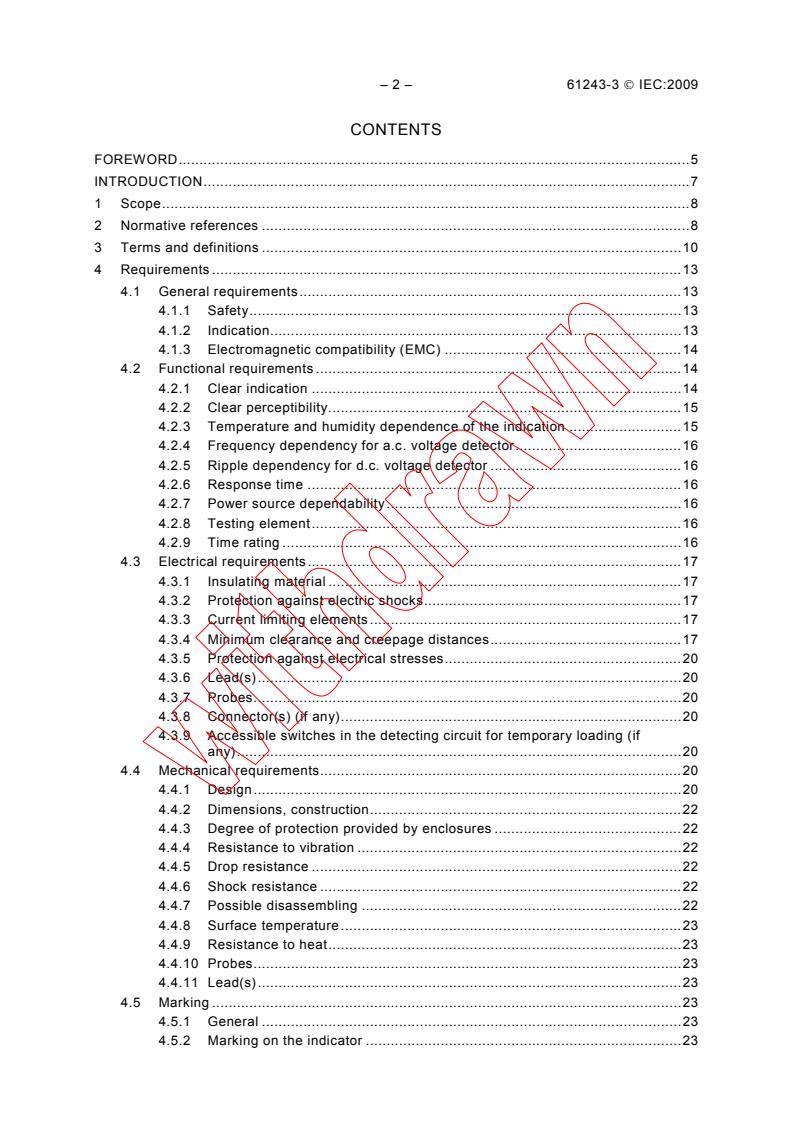
CONTENTS
FOREWORD.5
INTRODUCTION.7
1 Scope.8
2 Normative references .8
3 Terms and definitions .10
4 Requirements .13
4.1 General requirements.13
4.1.1 Safety.13
4.1.2 Indication.13
4.1.3 Electromagnetic compatibility (EMC) .14
4.2 Functional requirements .14
4.2.1 Clear indication .14
4.2.2 Clear perceptibility.15
4.2.3 Temperature and humidity dependence of the indication .15
4.2.4 Frequency dependency for a.c. voltage detector.16
4.2.5 Ripple dependency for d.c. voltage detector .16
4.2.6 Response time .16
4.2.7 Power source dependability.16
4.2.8 Testing element.16
4.2.9 Time rating .16
4.3 Electrical requirements.17
4.3.1 Insulating material .17
4.3.2 Protection against electric shocks.17
4.3.3 Current limiting elements.17
4.3.4 Minimum clearance and creepage distances.17
4.3.5 Protection against electrical stresses.20
4.3.6 Lead(s).20
4.3.7 Probes.20
4.3.8 Connector(s) (if any).20
4.3.9 Accessible switches in the detecting circuit for temporary loading (if
any).20
4.4 Mechanical requirements.20
4.4.1 Design.20
4.4.2 Dimensions, construction.22
4.4.3 Degree of protection provided by enclosures .22
4.4.4 Resistance to vibration .22
4.4.5 Drop resistance .22
4.4.6 Shock resistance .22
4.4.7 Possible disassembling .22
4.4.8 Surface temperature.23
4.4.9 Resistance to heat.23
4.4.10 Probes.23
4.4.11 Lead(s).23
4.5 Marking .23
4.5.1 General .23
4.5.2 Marking on the indicator .23
61243-3 © IEC:2009 – 3 –
4.5.3 Marking on the probe and/or the lead .24
4.6 Instructions for use.24
4.7 Requirements in case of reasonably foreseeable misuse during live working.24
4.7.1 AC/DC voltage misuse.24
4.7.2 Maximum current to earth in case of misuse .25
4.7.3 Misuse in case of mistaking of the voltage of the low voltage network .26
5 Tests .26
5.1 General .26
5.2 Tests for general requirements.27
5.2.1 Indication.27
5.2.2 Electromagnetic compatibility (EMC) .27
5.3 Tests for functional requirements .28
5.3.1 Clear indication .28
5.3.2 Clear perceptibility of visual indication.30
5.3.3 Clear perceptibility of audible indication (when available) .32
5.3.4 Temperature and humidity dependence of the indication .34
5.3.5 Frequency dependency for a.c. voltage detector.35
5.3.6 Ripple dependency for d.c. voltage detector .36
5.3.7 Response time .36
5.3.8 Power source dependability.37
5.3.9 Testing element.37
5.3.10 Time rating .37
5.4 Tests for electrical requirements.38
5.4.1 Tests on the insulation .38
5.4.2 Protection against electric shocks.39
5.4.3 Current limiting elements.40
5.4.4 Minimum clearance and creepage distances.40
5.4.5 Protection against electrical stresses.40
5.4.6 Lead(s).41
5.4.7 Probe(s) .41
5.4.8 Connector(s) .41
5.4.9 Switches for temporary loading (if any).41
5.5 Tests for mechanical requirements .42
5.5.1 Design.42
5.5.2 Dimensions, construction.42
5.5.3 Degree of protection provided by enclosures .42
5.5.4 Vibration resistance.42
5.5.5 Drop resistance .43
5.5.6 Shock resistance .44
5.5.7 Possible disassembling .44
5.5.8 Surface temperature.44
5.5.9 Heat resistance .45
5.5.10 Probes.45
5.5.11 Lead(s).47
5.6 Marking .48
5.6.1 Visual inspection and measurement .48
5.6.2 Durability of marking.48
5.7 Instructions for use.48
5.7.1 Type test .48
– 4 – 61243-3 © IEC:2009
5.7.2 Alternative test in case of voltage detectors having completed the
production phase.49
5.8 Tests for reasonably foreseeable misuse during live working.49
5.8.1 AC/DC voltage misuse.49
5.8.2 Maximum current to earth in case of misuse .49
5.8.3 Misuse in case of mistaking of the voltage of the low voltage network .50
6 Conformity assessment .50
7 Modifications .50
Annex A (informative) Differences with IEC 61010 series.51
Annex B (normative) Supplementary functions Phase indication – Rotating field
indication – Continuity check .56
Annex C (normative) Instructions for use .62
Annex D (normative) General type test procedure.63
Annex E (normative) Classification of defects and associated requirements and tests .65
Annex F (informative) In-service care and use .67
Bibliography.69
Figure 1a – Illustration of the electrical insulation of an indicator casing .18
Figure 1b – Illustration of the electrical insulation of a probe with a detachable lead .18
Figure 1 – Illustration of the electrical insulation features applicable to components of
a voltage detector .18
Figure 2a – Example of a voltage detector with the indicator integrated in a probe.21
Figure 2b – Example of a voltage detector with the indicator not integrated in a probe.21
Figure 2 – Voltage detector.21
Figure 3 – Maximum rms a.c. current to earth in case of misuse .25
Figure 4 – Maximum d.c. current to earth in case of misuse.25
Figure 5 – Test sep-up for the influence of interference voltage .29
Figure 6 – Test set-up for measurement of clear perceptibility of visual indication.31
Figure 7a – Positioning of the voltage detector in the test set-up .33
Figure 7b – Key measurement points on the hemisphere .33
Figure 7 – Test set-up for measurement of clear perceptibility of audible indication .33
Figure 8 – Test set-up for close adhesion of insulation of the insulated part of the
contact electrode .46
Table 1 – Climatic categories of voltage detectors .16
Table 2 – Minimum clearance distances for basic insulation and for supplementary
insulation .19
Table 3 – Minimum clearance distances for reinforced insulation .19
Table 4 – Parameters to be observed to check the climatic dependence.34
Table 5 – AC voltage values for test on the complete equipment .39
Table 6 – Maximum permissible surface temperatures .45
Table B.1 – Classification of defects and associated requirements and tests .61
Table D.1 – Sequential order for performing type tests .63
Table D.2 – Type tests out of sequence .64
Table E.1 – Classification of defects and associated requirements and tests .65
Table F.1 – Periodic testing .68
61243-3 © IEC:2009 – 5 –
INTERNATIONAL ELECTROTECHNICAL COMMISSION
____________
LIVE WORKING –
VOLTAGE DETECTORS –
Part 3: Two-pole low-voltage type
FOREWORD
1) The International Electrotechnical Commission (IEC) is a worldwide organization for standardization comprising
all national electrotechnical committees (IEC National Committees). The object of IEC is to promote
international co-operation on all questions concerning standardization in the electrical and electronic fields. To
this end and in addition to other activities, IEC publishes International Standards, Technical Specifications,
Technical Reports, Publicly Available Specifications (PAS) and Guides (hereafter referred to as “IEC
Publication(s)”). Their preparation is entrusted to technical committees; any IEC National Committee interested
in the subject dealt with may participate in this preparatory work. International, governmental and non-
governmental organizations liaising with the IEC also participate in this preparation. IEC collaborates closely
with the International Organization for Standardization (ISO) in accordance with conditions determined by
agreement between the two organizations.
2) The formal decisions or agreements of IEC on technical matters express, as nearly as possible, an international
consensus of opinion on the relevant subjects since each technical committee has representation from all
interested IEC National Committees.
3) IEC Publications have the form of recommendations for international use and are accepted by IEC National
Committees in that sense. While all reasonable efforts are made to ensure that the technical content of IEC
Publications is accurate, IEC cannot be held responsible for the way in which they are used or for any
misinterpretation by any end user.
4) In order to promote international uniformity, IEC National Committees undertake to apply IEC Publications
transparently to the maximum extent possible in their national and regional publications. Any divergence
between any IEC Publication and the corresponding national or regional publication shall be clearly indicated in
the latter.
5) IEC itself does not provide any attestation of conformity. Independent certification bodies provide conformity
assessment services and, in some areas, access to IEC marks of conformity. IEC is not responsible for any
services carried out by independent certification bodies.
6) All users should ensure that they have the latest edition of this publication.
7) No liability shall attach to IEC or its directors, employees, servants or agents including individual experts and
members of its technical committees and IEC National Committees for any personal injury, property damage or
other damage of any nature whatsoever, whether direct or indirect, or for costs (including legal fees) and
expenses arising out of the publication, use of, or reliance upon, this IEC Publication or any other IEC
Publications.
8) Attention is drawn to the Normative references cited in this publication. Use of the referenced publications is
indispensable for the correct application of this publication.
9) Attention is drawn to the possibility that some of the elements of this IEC Publication may be the subject of
patent rights. IEC shall not be held responsible for identifying any or all such patent rights.
International Standard IEC 61243-3 has been prepared by IEC technical committee 78: Live
working.
This second edition cancels and replaces the first edition published in 1998. It is a technical
revision.
This edition includes the following significant technical changes with respect to the previous
edition:
– no more switches are allowed for scale change;
– all the voltage detectors are now for use indoor and outdoor excluding the use under rain
conditions;
– no contact electrode which has the construction of a hook is allowed;
– no more voltage classes (A and B) are considered;
– the concept of double or reinforced insulation design (or constructional arrangements
providing an equivalent protection) is added;
– 6 – 61243-3 © IEC:2009
– for testing, the consideration of normal and single fault conditions is added;
– EMC requirements and tests are upgraded;
– the influence of interference voltage is now considered;
– the classification of the voltage detector into an overvoltage category is increased to at
least category III;
– the protection against electrical stresses is reinforced (transient and temporary
overvoltages);
– the degree of protection provided by all the enclosures (IP code) is increased to be at
least IP54, unless otherwise specified;
– the requirement and test for switches for temporary loading have been reviewed;
– the requirement for ELV indication has been reviewed (a redundant non-disconnectable
indicating system is not anymore the unique means allowed);
– the ranges of climatic conditions for operation of voltage detectors of category N and of
category S have been reviewed;
– the ball pressure test now refers to IEC 60695-10-2;
– a wear test concerning the insulating material of the lead(s) is added;
– the conformity assessment of voltage detectors having completed the production phase is
added;
– the normative annex on supplementary functions has been reviewed;
– the normative annex on sampling plans and procedure has been deleted (not applicable
according to IEC 61318);
– the informative annex on acceptance tests has been deleted (consideration now included
in IEC 61318).
The text of this standard is based on the following documents:
FDIS Report on voting
78/821/FDIS 78/832/RVD
Full information on the voting for the approval of this standard can be found in the report on
voting indicated in the above table.
This publication has been drafted in accordance with the ISO/IEC Directives, Part 2.
A list of all parts of the IEC 61243 series can be found, under the general title Live working –
Voltage detectors, on the IEC website.
The committee has decided that the contents of this publication will remain unchanged until
the maintenance result date indicated on the IEC web site under "http://webstore.iec.ch" in
the data related to the specific publication. At this date, the publication will be
• reconfirmed;
• withdrawn;
• replaced by a revised edition; or
• amended.
IMPORTANT – The “colour inside” logo on the cover page of this publication indicates
that it contains colours which are considered to be useful for the correct understanding
of its contents. Users should therefore print this publication using a colour printer.
61243-3 © IEC:2009 – 7 –
INTRODUCTION
The devices covered by this standard are designed to be used in a live working environment
to determine the status (presence or absence of operating voltage) of low-voltage
installations.
The live working environment comes with its specific hazards and working conditions which
are generally more severe than the ones encountered by workers in other fields than live
working.
This International Standard is a product standard giving essential requirements and tests to
verify that the devices perform well and will contribute to the safety of the users, provided
they are used by skilled persons, and according to safe working procedures and to local or
national regulations.
Voltage detectors are not considered as measuring or testing devices, separately covered by
IEC 61010 series. However, in case of misuse by general electrical workers, the requirements
and tests included in this document are intended to achieve an equivalent level of safety.
To take into consideration the specific needs of a live working environment, the following
differences exist with IEC 61010 series:
– some requirements and tests exist in both standards but with different sanctions or pass
test criteria (see A.1);
– some requirements of IEC 61010 are not included in this standard with the rationale (see
A.2);
– some additional requirements of this standard are not specified in IEC 61010 with the
rationale (see A.3).
This International Standard has been prepared according to the requirements of IEC 61477,
where applicable.
The product covered by this standard may have an impact on the environment during some or
all stages of its life cycle. These impacts can range from slight to significant, be of short-term
or long-term, and occur at the global, regional or local level.
This standard does not include requirements and test provisions for the manufacturers of the
product, or recommendations to the users of the product for environmental improvement.
However, all parties intervening in its design, manufacture, packaging, distribution, use,
maintenance, repair, reuse, recovery and disposal are invited to take account of
environmental considerations.
– 8 – 61243-3 © IEC:2009
LIVE WORKING –
VOLTAGE DETECTORS –
Part 3: Two-pole low-voltage type
1 Scope
This part of IEC 61243 is applicable to hand-held two-pole voltage detectors with its
accessories (crocodile clips and detachable leads) to be used in contact with parts of
electrical systems:
Hz and up
– for a.c. voltages not exceeding 1 000 V at nominal frequencies between 16 2 3
to 500 Hz,
and/or
– for d.c. voltages not exceeding 1 500 V.
NOTE The a.c. voltages defined in this standard refer either to phase-to-phase voltages or phase to neutral
voltages.
Contact electrode extensions are not covered by this standard.
Voltage detectors covered by this standard are intended to be used under dry and humid
conditions, both indoor and outdoor. They are not intended to be used under rain conditions.
Voltage detectors covered by this standard are not intended to be used for continuous
operation.
Voltage detectors covered by this standard are intended to be used up to 2 000 m above sea
level.
This standard also includes provisions for the following supplementary functions when
available (see Annex B):
– phase indication,
– rotating field indication, and
– continuity check.
Other supplementary functions are not covered by this standard.
Voltage detectors covered by this standard are not considered as measuring devices.
Relevant safety requirements for measuring devices are included in IEC 61010 series.
2 Normative references
The following referenced documents are indispensable for the application of this document.
For dated references, only the edition cited applies. For undated references, the latest edition
of the referenced document (including any amendments) applies.
IEC 60068-2-6, Environmental testing – Part 2-6: Tests – Test Fc: Vibration (sinusoidal)
IEC 60068-2-31:2008, Environmental testing – Part 2-31: Tests – Test Ec: Rough handling
shocks, primarily for equipment-type specimens
61243-3 © IEC:2009 – 9 –
IEC 60068-2-75:1997, Environmental testing – Part 2: Tests – Test Eh: Hammer tests
IEC 60112, Method for the determination of the proof and the comparative tracking indices of
solid insulating materials
IEC 60304, Standard colours for insulation for low-frequency cables and wires
IEC 60417, Graphical symbols for use on equipment
IEC/TS 60479-1:2005, Effects of current on human beings and livestock – Part 1: General
aspects
IEC 60529:1989, Degrees of protection provided by enclosures (IP Code)
Amendment 1:1999
IEC 60664-1:2007, Insulation coordination for equipment within low-voltage systems – Part 1:
Principles, requirements and tests
IEC 60664-3, Insulation coordination for equipment within low-voltage systems – Part 3: Use
of coating, potting or moulding for protection against pollution
IEC 60695-10-2:2003, Fire hazard testing – Part 10-2: Abnormal heat – Ball pressure test
IEC 60942, Electroacoustics – Sound calibrators
IEC 61010-031:2002, Safety requirements for electrical equipment for measurement, control
and laboratory use – Part 031: Safety requirements for hand-held probe assemblies for
electrical measurement and test
Amendment 1:2008
IEC 61010-1:2001, Safety requirements for electrical equipment for measurement, control,
and laboratory use – Part 1: General requirements
IEC 61140:2001, Protection against electric shock – Common aspects for installation and
equipment
Amendment 1:2004
IEC 61180-1, High-voltage test techniques for low-voltage equipment – Part 1: Definitions,
test and procedure requirements
IEC 61180-2, High-voltage test techniques for low-voltage equipment – Part 2: Test
equipment
IEC 61260, Electroacoustics – Octave-band and fractional-octave-band filters
IEC 61318, Live working – Conformity assessment applicable to tools, devices and equipment
IEC 61326-1:2005, Electrical equipment for measurement, control and laboratory use – EMC
requirements – Part 1: General requirements
IEC 61477, Live working – Minimum requirements for the utilization of tools, devices and
equipment
—————————
There exists a consolidated edition 2.1 (2001) that includes Edition 2 and its Amendment 1.
There exists a consolidated edition 1.1 (2008) that includes Edition 1 and its Amendment 1.
– 10 – 61243-3 © IEC:2009
IEC 61557-7:2007, Electrical safety in low voltage distribution systems up to 1 000 V a.c. and
1 500 V d.c. – Equipment for testing, measuring or monitoring of protective measures –
Part 7: Phase sequence
IEC 61672-1, Electroacoustics – Sound level meters – Part 1: Specifications
ISO 286-1, ISO system of limits and fits – Part 1: Bases of tolerances, deviations and fits
ISO 286-2, ISO system of limits and fits – Part 2: Tables of standard tolerance grades and
limit deviations for holes and shafts
ISO 354, Acoustics – Measurement of sound absorption in a reverberation room
ISO 3744:1994, Acoustics – Determination of sound power levels of noise sources using
sound pressure – Engineering method in an essentially free field over a reflecting plane
ISO 3745, Acoustics – Determination of sound power levels of noise sources using sound
pressure – Precision methods for anechoic and hemi-anechoic rooms
ISO 7000:2004, Graphical symbols for use on equipment – Index and synopsis
3 Terms and definitions
For the purposes of this document, the terms and definitions given in IEC 61318 and the
following apply.
3.1
basic insulation
insulation applied to live parts of a voltage detector to provide basic protection against electric
shock
NOTE Basic insulation does not necessarily include insulation used exclusively for functional purposes (3.10.1 of
IEC 61140).
[3.17.2 of IEC 60664-1, modified]
3.2
clear indication
unambiguous detection and indication of the voltage state between the contact electrodes
[IEV 651-10-10, modified]
3.3
clear perceptibility
case where the indication is unmistakably discernible by the user under specific
environmental conditions when the voltage detector is in its operating position
3.4
contact electrode
conductive part of the probe which establishes the electric connection to the part to be
checked
[IEV 651-10-09, modified]
NOTE In certain designs, a part of the contact electrode is covered with insulating material.
61243-3 © IEC:2009 – 11 –
3.5
extra low voltage
ELV
voltage below 50 V a.c. or 120 V d.c.
3.6
hand-guard
distinctive physical barrier (fixed to or part of the probe) to prevent the fingers or hands of the
operator from inadvertently touching the contact electrode or any energized part
3.7
hazardous live
capable of rendering an electrical shock or electrical burn in normal condition or single fault
condition
3.8
indicating voltage
U
i
approximate value of the operating voltage identified by the voltage detector
NOTE The indicating voltage of the voltage detector is the parameter associated with its clear indication. Certain
types of voltage detectors may have several indicating voltages and/or several indicating voltage ranges. Limit
values of a voltage range are named U min. and U max.
i i
3.9
indicator
part of the voltage detector which indicates the presence of the operating voltage between the
contact electrodes
[IEV 651-10-08, modified]
NOTE The indicator may provide as well information related to supplementary functions.
3.10
inspection
conformity evaluation by observation and judgement, accompanied as appropriate by
measurement, testing, gauging or calculation
[3.8.2 of ISO 9000, modified]
3.11
interference voltage
voltage at power frequency picked up inductively or capacitively by the part to be tested
3.12
internal energy source
integrated functional power supply
3.13
lead
flexible cable connecting different components of the voltage detector together
3.14
normal condition
condition in which all means of protection are intact
[2.7 of IEC Guide 104]
– 12 – 61243-3 © IEC:2009
3.15
operating current
minimum value of current required to operate the different indicating systems
3.16
probe
insulated part of a voltage detector intended to be handled by the user to bring its contact
electrode in contact with the component to be checked
NOTE 1 The probe may contain the indicator.
NOTE 2 The probe does not include a lead. The probe and the lead may be detachable or not.
3.17
protective impedance
component, assembly of components or the combination of basic insulation and a current or
voltage-limiting device, whose impedance, construction and reliability are such that, when
connected between accessible conductive parts which are hazardous when live, it provides
protection to the extent required by this standard in normal condition and single fault condition
3.18
reasonably foreseeable misuse
use of a product, process or service in a way not intended by the supplier, but which may
result from readily predictable human behaviour
[3.14 of ISO/IEC Guide 51]
3.19
recovery time
r
t
minimum no-load time between two uses as specified by the manufacturer
3.20
response time
time delay between a sudden change of the voltage state between the contact electrodes and
the associated clear indication
3.21
single fault condition
condition in which one means of protection against hazards is defective, or one fault is
present which could cause a hazard
NOTE If a single fault condition results unavoidably in one or more other fault conditions, all are considered as
one single fault condition.
[2.8 of IEC Guide 104]
3.22
temporary overvoltage
power frequency overvoltage of relatively long duration
NOTE This overvoltage is undamped or weakly damped. In some cases its frequency may be several times
smaller or higher than power frequency.
[IEV 604-03-12]
3.23
testing element
built-in element or separate device, by means of which the functioning of the voltage detector
can be checked by the user
61243-3 © IEC:2009 – 13 –
[IEV 651-10-11, modified]
3.24
threshold voltage
U
t
minimum voltage between the two contact electrodes required to give a clear indication
3.25
time rating
t
r
specified on-load time during which the voltage detector is able to operate correctly
3.26
transient overvoltage
a short duration overvoltage of few milliseconds or less, oscillatory or non-oscillatory, usually
highly damped
[IEV 604-03-13]
3.27
two-pole voltage detector
voltage detector for bi-polar application, made of two probes, an indicator included or not in
one of the probes and lead(s)
NOTE The term voltage detector is used in this document for two-pole low voltage detector.
3.28
voltage detector (for live working)
device used to provide clear evidence of the presence or absence of the operating voltage
[adapted from 11.2.5 of IEC 60743 and IEV 651-10-04]
4 Requirements
4.1 General requirements
4.1.1 Safety
Voltage detectors covered by this standard shall be designed and manufactured in order to
contribute to the safety of the users, provided the voltage detectors are used by skilled
persons, in accordance with safe methods of work and the instructions for use.
4.1.2 Indication
The voltage detector shall give a clear indication of the state "voltage present" of the
operating voltage by means of the status change of the signal. The indication shall be visual.
An audible indication is optional. Simultaneous indications shall be provided when the voltage
detector has more than one system of indication.
The visual indication (display) can be of different types but the clear indication of the
presence of the operating voltage shall not display a discrete voltage value.
NOTE 1 Displays could consist of: change of the lighting state of LED(s), movement of a needle or of other
current activated component, alphanumeric characters on a screen, etc.
NOTE 2 Displays providing a discrete voltage value are considered as supplementary measuring functions and
should fulfil the relevant standards.
– 14 – 61243-3 © IEC:2009
4.1.3 Electromagnetic compatibility (EMC)
Voltage detectors shall comply with the requirements of class A equipment for use in
industrial locations according to IEC 61326-1.
NOTE In some countries additional requirements may be added to fulfil EMC regulations.
4.2 Functional requirements
4.2.1 Clear indication
4.2.1.1 Clear indication of the operating voltage and threshold voltage
The voltage detector shall clearly indicate at its nominal frequency or nominal frequencies the
presence of
– every indicating voltage and/or,
– every indicating voltage range.
For voltage detectors having successive indications or successive range of indication (step by
step), the change of state:
– of each step of the indicating voltage (U ) shall be limited to the interval included between
i
1,1U and 0,85 U ;
i i
()step−1
()step
– of each step of indicating voltage range (U min, U max ) shall be limited to the interval
i i
included between max and min.
1,1U 0,85 U
i i
()step−1
()step
For voltage detectors having single indication, the change of state of the indicating voltage
shall occur below 0,85 U
i.
NOTE The voltage detector should not indicate usual values of interference voltages as “voltage present”. In the
case where such values would be indicated, the voltage detector should have a means to discriminate between an
operating voltage and an interference voltage in order to provide the user with a clear indication of the status of the
operating voltage.
The user shall not have access to the threshold voltage setting.
The user shall not have access to any switches used for scale change.
4.2.1.2 Clear indication of a voltage above the ELV
The voltage detector shall clearly indicate the presence of a voltage above the ELV limit by
having a ELV limit indication.
The ELV limit indication shall function properly at all nominal frequencies when the voltage on
the part to be checked is equal to or higher than the ELV limit (50 V a.c. and/or 120 V d.c).
NOTE 1 The ELV limit indication is only to warn the user of the presence of a voltage, not for its evaluation.
Voltage detectors with internal energy source shall still provide the ELV limit indication when
the internal energy source is exhausted.
NOTE 2 For a voltage det
...