

IEC 60384-20:2015
(Main)Fixed capacitors for use in electronic equipment - Part 20: Sectional specification - Fixed metallized polyphenylene sulfide film dielectric surface mount d.c. capacitors
General Information
- Abstract
IEC 60384-20:2015 applies to fixed surface mount capacitors for direct current, with metallized electrodes and polyphenylene sulfide dielectric for use in electronic equipment. These capacitors have metallized connecting pads or soldering strips and are intended to be mounted directly onto substrates for hybrid circuits or onto printed boards. They may have "self healing properties" depending on conditions of use and are primarily intended for applications where the a.c. component is small with respect to the rated voltage. This edition includes the following significant technical changes with respect to the previous edition:
a) Revision of the structure in accordance with ISO/IEC Directives, Part 2:2011 (sixth edition) to the extent practicable, and harmonization between other similar kinds of documents.
b) In addition, Clause 4 and all the tables have been reviewed in order to prevent duplications and contradictions.
- Status
- Published
- Publication Date
- 21-Jul-2015
- Technical Committee
- TC 40 - Capacitors and resistors for electronic equipment
- Drafting Committee
- MT 60384-20 - TC 40/MT 60384-20
- Current Stage
- DELPUB - Deleted Publication
- Start Date
- 03-Feb-2023
- Completion Date
- 30-Apr-2021
Buy Documents
IEC 60384-20:2015 - Fixed capacitors for use in electronic equipment - Part 20: Sectional specification - Fixed metallized polyphenylene sulfide film dielectric surface mount d.c. capacitors Released:7/22/2015
Overview
IEC 60384-20:2015 is an international standard published by the International Electrotechnical Commission (IEC) that specifies requirements for fixed metallized polyphenylene sulfide (PPS) film dielectric surface mount direct current (d.c.) capacitors. These capacitors are designed for use in electronic equipment and are characterized by their metallized electrodes and PPS dielectric material. The standard defines the mechanical, electrical, and environmental characteristics, test methods, and quality assessment procedures for these components.
This standard applies specifically to fixed surface mount capacitors with metallized connecting pads or soldering strips intended to be mounted directly on hybrid circuit substrates or printed circuit boards (PCBs). Featuring potential self-healing properties under specific conditions, these capacitors are primarily meant for applications where the alternating current (a.c.) component is small relative to the rated voltage.
Key Topics
- Scope and Object: Defines fixed metallized PPS film capacitors for d.c. applications, emphasizing mounting on substrates or printed boards.
- Preferred Ratings and Characteristics: Details nominal capacitance values, tolerances, rated voltages, category voltages, and temperature ratings tailored for reliable performance.
- Mechanical and Electrical Specifications: Outlines requirements for capacitance, tangent loss (tan δ), insulation resistance, voltage proof, and mechanical robust tests like shear and substrate bending.
- Quality Assessment Procedures: Establishes primary manufacturing quality verifications, structural similarity analysis, certified test record requirements, qualification approval tests, and ongoing quality conformance inspections to ensure compliance and reliability.
- Test and Measurement Methods: Comprehensive evaluation including visual inspections, solderability, resistance to soldering heat, rapid temperature changes, climatic sequences, endurance, charge-discharge cycles, and solvent resistance.
- Marking Requirements: Specifies marking conventions on capacitors and their packaging to ensure traceability and proper identification.
Applications
IEC 60384-20 capacitors are widely used in electronic equipment where stable and reliable d.c. capacitance is critical. Their primary applications include:
- Hybrid Circuits and Printed Circuit Boards (PCBs): Surface mount technology (SMT) capacitors designed for compact assembly on hybrid substrates or PCBs.
- Consumer Electronics: Devices requiring stable filtering and bypass functions with minimal a.c. ripple voltage.
- Industrial Electronics: Applications demanding durability under thermal cycling and environmental stresses.
- Automotive Electronics: Circuits exposed to harsh temperature and vibration conditions, benefiting from the capacitors’ robustness and self-healing properties.
- Communication Equipment: Use in signal filtering and power supply stabilization where low loss and stable capacitance are important.
Related Standards
IEC 60384-20:2015 harmonizes with other IEC capacitor standards and follows the ISO/IEC Directives Part 2 structure to ensure consistency across component specifications. Related standards include:
- IEC 60384 Series: A family of standards for fixed capacitors specifying various dielectric materials and construction methods.
- ISO/IEC Directives, Part 2: Provides general rules for the structure and drafting of International Standards ensuring clarity and harmonization.
- IEC TC 40 Standards: Cover capacitors used in electronic equipment, including additional specifications for film capacitors with different dielectrics.
- Industry-Specific Standards: Supplementary requirements may apply in automotive, aerospace, and industrial sectors to complement IEC 60384-20 for specialized use.
Keywords
fixed metallized polyphenylene sulfide film capacitor, IEC 60384-20, surface mount capacitor, direct current capacitors, d.c. capacitors for electronics, self-healing capacitors, hybrid circuit capacitors, printed circuit board capacitors, capacitor test methods, capacitor quality standards, IEC capacitor specifications
Relations
- Effective Date
- 05-Sep-2023
- Effective Date
- 05-Sep-2023
- Effective Date
- 05-Sep-2023
Buy Documents
IEC 60384-20:2015 - Fixed capacitors for use in electronic equipment - Part 20: Sectional specification - Fixed metallized polyphenylene sulfide film dielectric surface mount d.c. capacitors Released:7/22/2015
Frequently Asked Questions
IEC 60384-20:2015 is a standard published by the International Electrotechnical Commission (IEC). Its full title is "Fixed capacitors for use in electronic equipment - Part 20: Sectional specification - Fixed metallized polyphenylene sulfide film dielectric surface mount d.c. capacitors". This standard covers: IEC 60384-20:2015 applies to fixed surface mount capacitors for direct current, with metallized electrodes and polyphenylene sulfide dielectric for use in electronic equipment. These capacitors have metallized connecting pads or soldering strips and are intended to be mounted directly onto substrates for hybrid circuits or onto printed boards. They may have "self healing properties" depending on conditions of use and are primarily intended for applications where the a.c. component is small with respect to the rated voltage. This edition includes the following significant technical changes with respect to the previous edition: a) Revision of the structure in accordance with ISO/IEC Directives, Part 2:2011 (sixth edition) to the extent practicable, and harmonization between other similar kinds of documents. b) In addition, Clause 4 and all the tables have been reviewed in order to prevent duplications and contradictions.
IEC 60384-20:2015 applies to fixed surface mount capacitors for direct current, with metallized electrodes and polyphenylene sulfide dielectric for use in electronic equipment. These capacitors have metallized connecting pads or soldering strips and are intended to be mounted directly onto substrates for hybrid circuits or onto printed boards. They may have "self healing properties" depending on conditions of use and are primarily intended for applications where the a.c. component is small with respect to the rated voltage. This edition includes the following significant technical changes with respect to the previous edition: a) Revision of the structure in accordance with ISO/IEC Directives, Part 2:2011 (sixth edition) to the extent practicable, and harmonization between other similar kinds of documents. b) In addition, Clause 4 and all the tables have been reviewed in order to prevent duplications and contradictions.
IEC 60384-20:2015 is classified under the following ICS (International Classification for Standards) categories: 31.060.10 - Fixed capacitors. The ICS classification helps identify the subject area and facilitates finding related standards.
IEC 60384-20:2015 has the following relationships with other standards: It is inter standard links to IEC 60384-20:2008/COR1:2008, IEC 60384-20:2023, IEC 60384-20:2008. Understanding these relationships helps ensure you are using the most current and applicable version of the standard.
IEC 60384-20:2015 is available in PDF format for immediate download after purchase. The document can be added to your cart and obtained through the secure checkout process. Digital delivery ensures instant access to the complete standard document.
Standards Content (Sample)
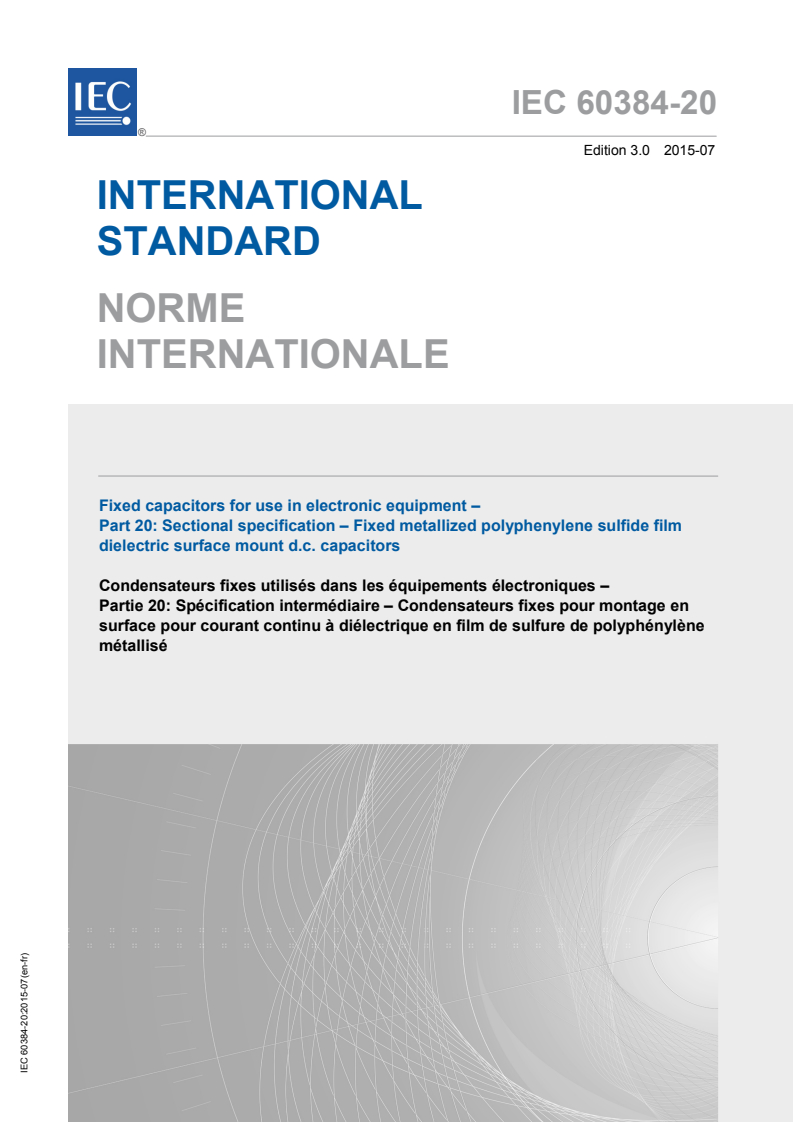
IEC 60384-20 ®
Edition 3.0 2015-07
INTERNATIONAL
STANDARD
NORME
INTERNATIONALE
Fixed capacitors for use in electronic equipment –
Part 20: Sectional specification – Fixed metallized polyphenylene sulfide film
dielectric surface mount d.c. capacitors
Condensateurs fixes utilisés dans les équipements électroniques –
Partie 20: Spécification intermédiaire – Condensateurs fixes pour montage en
surface pour courant continu à diélectrique en film de sulfure de polyphénylène
métallisé
All rights reserved. Unless otherwise specified, no part of this publication may be reproduced or utilized in any form
or by any means, electronic or mechanical, including photocopying and microfilm, without permission in writing from
either IEC or IEC's member National Committee in the country of the requester. If you have any questions about IEC
copyright or have an enquiry about obtaining additional rights to this publication, please contact the address below or
your local IEC member National Committee for further information.
Droits de reproduction réservés. Sauf indication contraire, aucune partie de cette publication ne peut être reproduite
ni utilisée sous quelque forme que ce soit et par aucun procédé, électronique ou mécanique, y compris la photocopie
et les microfilms, sans l'accord écrit de l'IEC ou du Comité national de l'IEC du pays du demandeur. Si vous avez des
questions sur le copyright de l'IEC ou si vous désirez obtenir des droits supplémentaires sur cette publication, utilisez
les coordonnées ci-après ou contactez le Comité national de l'IEC de votre pays de résidence.
IEC Central Office Tel.: +41 22 919 02 11
3, rue de Varembé Fax: +41 22 919 03 00
CH-1211 Geneva 20 info@iec.ch
Switzerland www.iec.ch
About the IEC
The International Electrotechnical Commission (IEC) is the leading global organization that prepares and publishes
International Standards for all electrical, electronic and related technologies.
About IEC publications
The technical content of IEC publications is kept under constant review by the IEC. Please make sure that you have the
latest edition, a corrigenda or an amendment might have been published.
IEC Catalogue - webstore.iec.ch/catalogue Electropedia - www.electropedia.org
The stand-alone application for consulting the entire The world's leading online dictionary of electronic and
bibliographical information on IEC International Standards, electrical terms containing more than 30 000 terms and
Technical Specifications, Technical Reports and other definitions in English and French, with equivalent terms in 15
documents. Available for PC, Mac OS, Android Tablets and additional languages. Also known as the International
iPad. Electrotechnical Vocabulary (IEV) online.
IEC publications search - www.iec.ch/searchpub IEC Glossary - std.iec.ch/glossary
The advanced search enables to find IEC publications by a More than 60 000 electrotechnical terminology entries in
variety of criteria (reference number, text, technical English and French extracted from the Terms and Definitions
committee,…). It also gives information on projects, replaced clause of IEC publications issued since 2002. Some entries
and withdrawn publications. have been collected from earlier publications of IEC TC 37,
77, 86 and CISPR.
IEC Just Published - webstore.iec.ch/justpublished
Stay up to date on all new IEC publications. Just Published IEC Customer Service Centre - webstore.iec.ch/csc
details all new publications released. Available online and If you wish to give us your feedback on this publication or
also once a month by email. need further assistance, please contact the Customer Service
Centre: csc@iec.ch.
A propos de l'IEC
La Commission Electrotechnique Internationale (IEC) est la première organisation mondiale qui élabore et publie des
Normes internationales pour tout ce qui a trait à l'électricité, à l'électronique et aux technologies apparentées.
A propos des publications IEC
Le contenu technique des publications IEC est constamment revu. Veuillez vous assurer que vous possédez l’édition la
plus récente, un corrigendum ou amendement peut avoir été publié.
Catalogue IEC - webstore.iec.ch/catalogue Electropedia - www.electropedia.org
Application autonome pour consulter tous les renseignements
Le premier dictionnaire en ligne de termes électroniques et
bibliographiques sur les Normes internationales,
électriques. Il contient plus de 30 000 termes et définitions en
Spécifications techniques, Rapports techniques et autres
anglais et en français, ainsi que les termes équivalents dans
documents de l'IEC. Disponible pour PC, Mac OS, tablettes
15 langues additionnelles. Egalement appelé Vocabulaire
Android et iPad.
Electrotechnique International (IEV) en ligne.
Recherche de publications IEC - www.iec.ch/searchpub
Glossaire IEC - std.iec.ch/glossary
Plus de 60 000 entrées terminologiques électrotechniques, en
La recherche avancée permet de trouver des publications IEC
en utilisant différents critères (numéro de référence, texte, anglais et en français, extraites des articles Termes et
comité d’études,…). Elle donne aussi des informations sur les Définitions des publications IEC parues depuis 2002. Plus
projets et les publications remplacées ou retirées. certaines entrées antérieures extraites des publications des
CE 37, 77, 86 et CISPR de l'IEC.
IEC Just Published - webstore.iec.ch/justpublished
Service Clients - webstore.iec.ch/csc
Restez informé sur les nouvelles publications IEC. Just
Published détaille les nouvelles publications parues. Si vous désirez nous donner des commentaires sur cette
Disponible en ligne et aussi une fois par mois par email. publication ou si vous avez des questions contactez-nous:
csc@iec.ch.
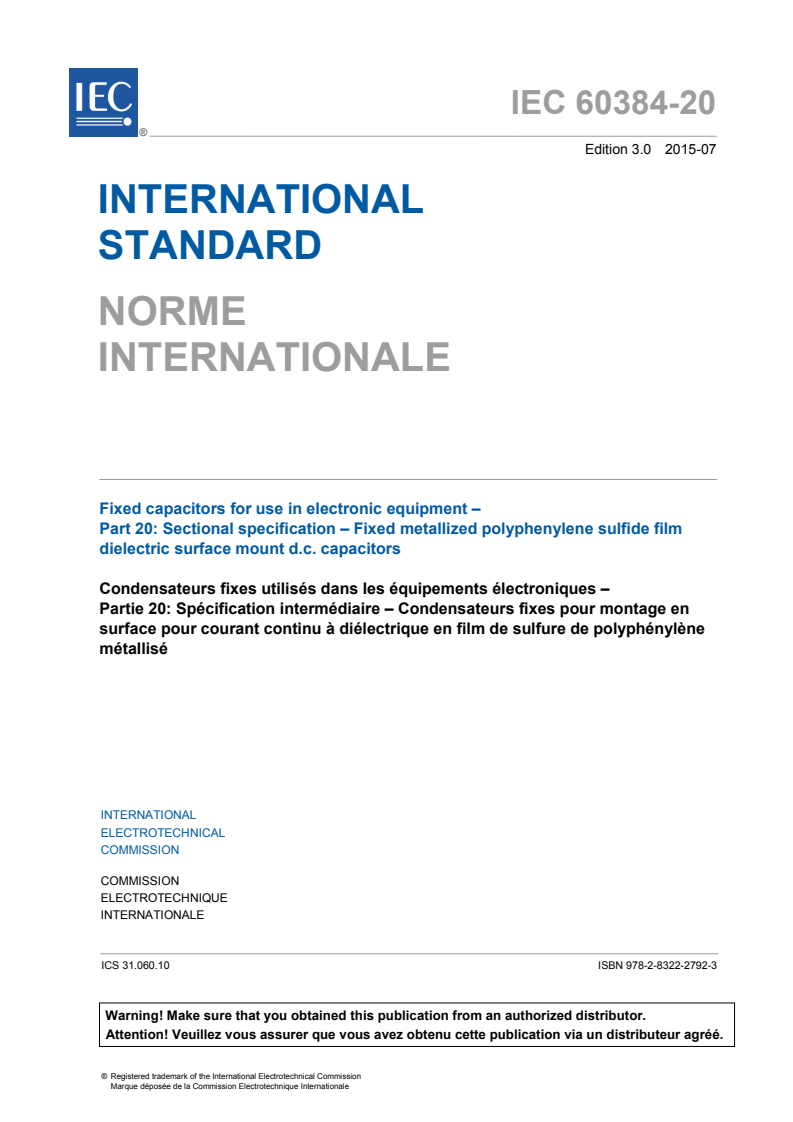
IEC 60384-20 ®
Edition 3.0 2015-07
INTERNATIONAL
STANDARD
NORME
INTERNATIONALE
Fixed capacitors for use in electronic equipment –
Part 20: Sectional specification – Fixed metallized polyphenylene sulfide film
dielectric surface mount d.c. capacitors
Condensateurs fixes utilisés dans les équipements électroniques –
Partie 20: Spécification intermédiaire – Condensateurs fixes pour montage en
surface pour courant continu à diélectrique en film de sulfure de polyphénylène
métallisé
INTERNATIONAL
ELECTROTECHNICAL
COMMISSION
COMMISSION
ELECTROTECHNIQUE
INTERNATIONALE
ICS 31.060.10 ISBN 978-2-8322-2792-3
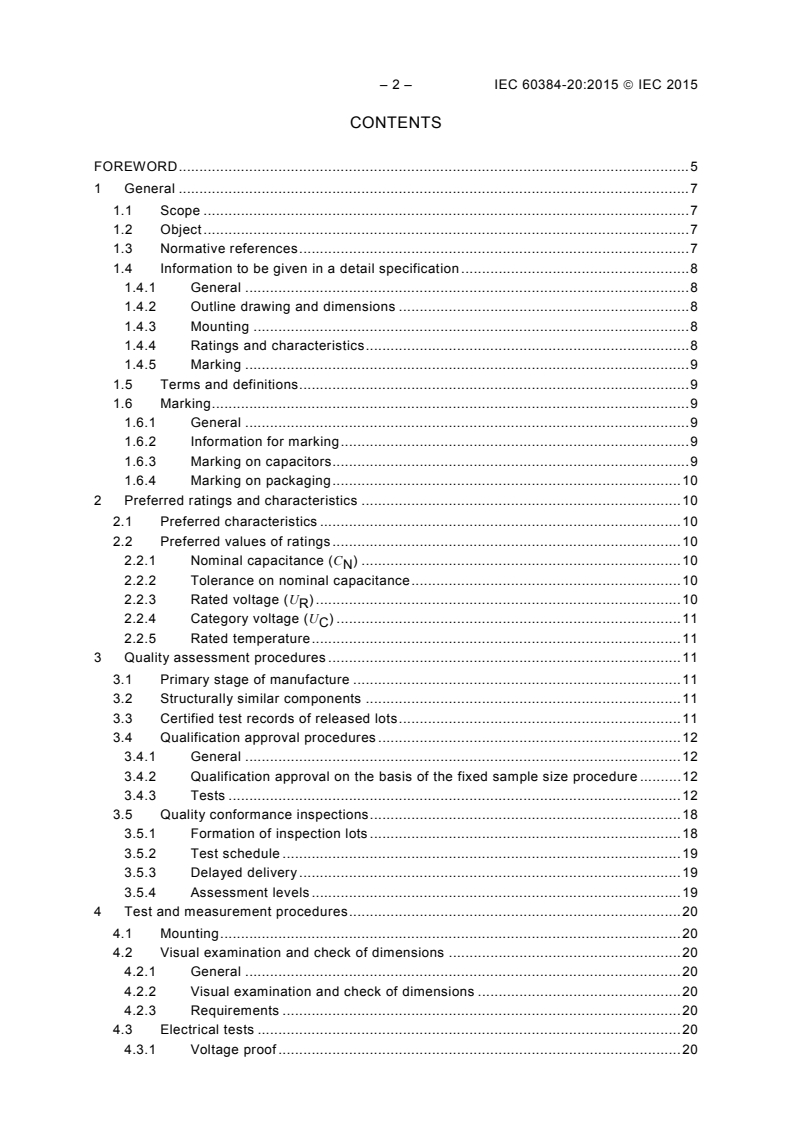
– 2 – IEC 60384-20:2015 IEC 2015
CONTENTS
FOREWORD . 5
1 General . 7
1.1 Scope . 7
1.2 Object . 7
1.3 Normative references . 7
1.4 Information to be given in a detail specification . 8
1.4.1 General . 8
1.4.2 Outline drawing and dimensions . 8
1.4.3 Mounting . 8
1.4.4 Ratings and characteristics . 8
1.4.5 Marking . 9
1.5 Terms and definitions . 9
1.6 Marking . 9
1.6.1 General . 9
1.6.2 Information for marking . 9
1.6.3 Marking on capacitors . 9
1.6.4 Marking on packaging . 10
2 Preferred ratings and characteristics . 10
2.1 Preferred characteristics . 10
2.2 Preferred values of ratings . 10
2.2.1 Nominal capacitance (C ) . 10
N
2.2.2 Tolerance on nominal capacitance . 10
2.2.3 Rated voltage (U ) . 10
R
2.2.4 Category voltage (U ) . 11
C
2.2.5 Rated temperature . 11
3 Quality assessment procedures . 11
3.1 Primary stage of manufacture . 11
3.2 Structurally similar components . 11
3.3 Certified test records of released lots . 11
3.4 Qualification approval procedures . 12
3.4.1 General . 12
3.4.2 Qualification approval on the basis of the fixed sample size procedure . 12
3.4.3 Tests . 12
3.5 Quality conformance inspections . 18
3.5.1 Formation of inspection lots . 18
3.5.2 Test schedule . 19
3.5.3 Delayed delivery . 19
3.5.4 Assessment levels . 19
4 Test and measurement procedures . 20
4.1 Mounting . 20
4.2 Visual examination and check of dimensions . 20
4.2.1 General . 20
4.2.2 Visual examination and check of dimensions . 20
4.2.3 Requirements . 20
4.3 Electrical tests . 20
4.3.1 Voltage proof . 20
4.3.2 Capacitance . 21
4.3.3 Tangent of loss angle (tan δ) . 21
4.3.4 Insulation resistance . 22
4.4 Shear test . 23
4.4.1 General . 23
4.5 Substrate bending test . 23
4.5.1 General . 23
4.5.2 Initial inspections . 23
4.5.3 Final inspections and requirements . 23
4.6 Resistance to soldering heat . 24
4.6.1 General . 24
4.6.2 Initial inspections . 24
4.6.3 Test conditions . 24
4.6.4 Recovery . 24
4.6.5 Final inspections and requirements . 24
4.7 Solderability . 24
4.7.1 General . 24
4.7.2 Test conditions . 24
4.7.3 Final inspections and requirements . 24
4.8 Rapid change of temperature . 24
4.8.1 General . 24
4.8.2 Initial inspections . 24
4.8.3 Test conditions . 24
4.8.4 Final inspections and requirements . 25
4.9 Climatic sequence. 25
4.9.1 General . 25
4.9.2 Initial inspections . 25
4.9.3 Dry heat . 25
4.9.4 Damp heat, cyclic, test Db, first cycle . 25
4.9.5 Cold. 25
4.9.6 Damp heat, cyclic, test Db, remaining cycles . 25
4.9.7 Recovery . 25
4.9.8 Final inspections and requirements . 25
4.10 Damp heat, steady state . 25
4.10.1 General . 25
4.10.2 Initial inspections . 25
4.10.3 Test conditions . 26
4.10.4 Recovery . 26
4.10.5 Final inspections and requirements . 26
4.11 Endurance . 26
4.11.1 General . 26
4.11.2 Initial inspections . 26
4.11.3 Test conditions . 26
4.11.4 Final inspections and requirements . 26
4.12 Charge and discharge . 27
4.12.1 General . 27
4.12.2 Initial inspections . 27
4.12.3 Test conditions . 27
4.12.4 Recovery . 27
– 4 – IEC 60384-20:2015 IEC 2015
4.12.5 Final inspections and requirements . 27
4.13 Component solvent resistance (if required) . 27
4.13.1 General . 27
4.14 Solvent resistance of the marking (if required) . 27
4.14.1 General . 27
Bibliography . 28
Table 1 – Percentage limit of the rated voltage at a.c. voltage frequency . 11
Table 2 – Category voltages for upper category temperature 125 °C . 11
Table 3 – Category voltages for upper category temperature 155 °C . 11
Table 4 – Sampling plan for qualification approval – Assessment level EZ . 13
Table 5 – Test schedule for qualification approval (1 of 5) . 14
Table 6 – Lot-by-lot inspection . 19
Table 7 – Periodic tests . 20
Table 8 – Test voltages . 21
Table 9 – Tangent of loss angle limits . 22
Table 10 – Requirements insulation resistance . 23
Table 11 – Correction factor dependent on test temperature . 23
Table 12 – Endurance test for Grade 1, 2 and 3 capacitors . 26
INTERNATIONAL ELECTROTECHNICAL COMMISSION
____________
FIXED CAPACITORS FOR USE IN ELECTRONIC EQUIPMENT –
Part 20: Sectional specification – Fixed metallized polyphenylene sulfide
film dielectric surface mount d.c. capacitors
FOREWORD
1) The International Electrotechnical Commission (IEC) is a worldwide organization for standardization comprising
all national electrotechnical committees (IEC National Committees). The object of IEC is to promote
international co-operation on all questions concerning standardization in the electrical and electronic fields. To
this end and in addition to other activities, IEC publishes International Standards, Technical Specifications,
Technical Reports, Publicly Available Specifications (PAS) and Guides (hereafter referred to as “IEC
Publication(s)”). Their preparation is entrusted to technical committees; any IEC National Committee interested
in the subject dealt with may participate in this preparatory work. International, governmental and non-
governmental organizations liaising with the IEC also participate in this preparation. IEC collaborates closely
with the International Organization for Standardization (ISO) in accordance with conditions determined by
agreement between the two organizations.
2) The formal decisions or agreements of IEC on technical matters express, as nearly as possible, an international
consensus of opinion on the relevant subjects since each technical committee has representation from all
interested IEC National Committees.
3) IEC Publications have the form of recommendations for international use and are accepted by IEC National
Committees in that sense. While all reasonable efforts are made to ensure that the technical content of IEC
Publications is accurate, IEC cannot be held responsible for the way in which they are used or for any
misinterpretation by any end user.
4) In order to promote international uniformity, IEC National Committees undertake to apply IEC Publications
transparently to the maximum extent possible in their national and regional publications. Any divergence
between any IEC Publication and the corresponding national or regional publication shall be clearly indicated in
the latter.
5) IEC itself does not provide any attestation of conformity. Independent certification bodies provide conformity
assessment services and, in some areas, access to IEC marks of conformity. IEC is not responsible for any
services carried out by independent certification bodies.
6) All users should ensure that they have the latest edition of this publication.
7) No liability shall attach to IEC or its directors, employees, servants or agents including individual experts and
members of its technical committees and IEC National Committees for any personal injury, property damage or
other damage of any nature whatsoever, whether direct or indirect, or for costs (including legal fees) and
expenses arising out of the publication, use of, or reliance upon, this IEC Publication or any other IEC
Publications.
8) Attention is drawn to the Normative references cited in this publication. Use of the referenced publications is
indispensable for the correct application of this publication.
9) Attention is drawn to the possibility that some of the elements of this IEC Publication may be the subject of
patent rights. IEC shall not be held responsible for identifying any or all such patent rights.
International Standard IEC 60384-20 has been prepared by IEC technical committee 40:
Capacitors and resistors for electronic equipment.
This third edition cancels and replaces the second edition, published in 2008, and constitutes
a technical revision.
This edition includes the following significant technical changes with respect to the previous
edition:
a) Revision of the structure in accordance with ISO/IEC Directives, Part 2:2011 (sixth edition)
to the extent practicable, and harmonization between other similar kinds of documents.
b) In addition, Clause 4 and all the tables have been reviewed in order to prevent
duplications and contradictions.
– 6 – IEC 60384-20:2015 IEC 2015
The text of this standard is based on the following documents:
FDIS Report on voting
40/2381/FDIS 40/2394/RVD
Full information on the voting for the approval of this standard can be found in the report on
voting indicated in the above table.
This publication has been drafted in accordance with the ISO/IEC Directives, Part 2.
A list of all parts in the IEC 60384 series, published under the general title Fixed capacitors
for use in electronic equipment, can be found on the IEC website.
The committee has decided that the contents of this publication will remain unchanged until
the stability date indicated on the IEC website under "http://webstore.iec.ch" in the data
related to the specific publication. At this date, the publication will be
• reconfirmed,
• withdrawn,
• replaced by a revised edition, or
• amended.
FIXED CAPACITORS FOR USE IN ELECTRONIC EQUIPMENT –
Part 20: Sectional specification – Fixed metallized polyphenylene sulfide
film dielectric surface mount d.c. capacitors
1 General
1.1 Scope
This part of IEC 60384 applies to fixed surface mount capacitors for direct current, with
metallized electrodes and polyphenylene sulfide dielectric for use in electronic equipment.
These capacitors have metallized connecting pads or soldering strips and are intended to be
mounted directly onto substrates for hybrid circuits or onto printed boards. They may have
"self-healing properties" depending on conditions of use and are primarily intended for
applications where the a.c. component is small with respect to the rated voltage.
These capacitors are divided to 3 grades. Performance grade 1 for long life, performance
grade 2 for general purpose and performance grade 3 for miniature type.
Capacitors for radio interference suppression are not included, but are covered by
IEC 60384-14.
Capacitors used for motor or fluorescent lamp are outside the scope of this standard.
1.2 Object
The object of this standard is to prescribe preferred ratings and characteristics and to select
from IEC 60384-1, the appropriate quality assessment procedures, tests and measuring
methods and to give general performance requirements for this type of capacitor. Test
severities and requirements prescribed in detail specifications referring to this standard shall
be of equal or higher performance level, lower performance levels are not permitted.
1.3 Normative references
The following documents, in whole or in part, are normatively referenced in this document and
are indispensable for its application. For dated references, only the edition cited applies. For
undated references, the latest edition of the referenced document (including any
amendments) applies.
IEC 60062:2004, Marking codes for resistors and capacitors
IEC 60063, Preferred number series for resistors and capacitors
IEC 60068-1:2013, Environmental testing – Part 1: General and guidance
IEC 60384-1:2008, Fixed capacitors for use in electronic equipment – Part 1: Generic
specification
IEC 61193-2:2007, Quality assessment systems – Part 2: Selection and use of sampling
plans for inspection of electronic components and packages
ISO 3, Preferred numbers – Series of preferred numbers
– 8 – IEC 60384-20:2015 IEC 2015
1.4 Information to be given in a detail specification
1.4.1 General
Detail specifications shall be derived from the blank detail specification.
Detail specifications shall not specify requirements inferior to those of the generic, sectional
or blank detail specification. When more severe requirements are included, they shall be
listed in 1.9 of the detail specification and indicated in the test schedules, for example by an
asterisk.
The information given in 1.4.2 may, for convenience, be presented in tabular form.
The following information shall be given in each detail specification and the values quoted
shall preferably be selected from those given in the appropriate clause of this standard.
1.4.2 Outline drawing and dimensions
There shall be an illustration of the capacitor as an aid to easy recognition and for comparison
of the capacitor with others. Dimensions and their associated tolerances, which affect
interchangeability and mounting, shall be given in the detail specification. All dimensions shall
preferably be stated in millimetres, however, when the original dimensions are given in inches,
the converted metric dimensions in millimetres shall be added.
The numerical values of the body shall be given as follows:
– for general: the width, length and height.
The numerical values of the terminals shall be given as follows:
– for terminals: the width, length and spacing.
When the configuration is other than described above, the detail specification shall state such
dimensional information as will adequately describe the capacitors.
1.4.3 Mounting
The method of mounting for tests and measurements are given in 4.1. The detail specification
shall specify the methods of mounting for normal use.
1.4.4 Ratings and characteristics
1.4.4.1 General
The ratings and characteristics shall be given in accordance with the relevant clauses of this
standard, together with the following.
1.4.4.2 Nominal capacitance range
See 2.2.1.
When products approved to the detail specification have different nominal capacitance ranges,
the following statement should be added: "The nominal capacitance range available in each
voltage range is given in the register of approvals, available for example on the IECQ on-line
certificate system website www.iecq.org”.
1.4.4.3 Particular characteristics
Additional characteristics may be listed, when they are considered necessary to specify
adequately the component for design and application purposes.
1.4.4.4 Soldering
The detail specification shall prescribe the test methods, severities and requirements
applicable for the solderability and the resistance to soldering heat tests.
1.4.5 Marking
The detail specification shall specify the content of the marking on the capacitor and on the
packaging. When there are deviations from 1.6, these shall be given in the detail specification.
1.5 Terms and definitions
For the purposes of this document, the terms and definitions given in IEC 60384-1:2008, as
well as the following apply.
1.5.1
performance grade 1 capacitors
capacitors for long-life applications with stringent requirements for the electrical
parameters
1.5.2
performance grade 2 capacitors
capacitors for general application where the stringent requirements for
grade 1 capacitors are not necessary
1.5.3
performance grade 3 capacitors
miniature type capacitors having a rated voltage of less than
63 V and for which less stringent requirements than for grade 2 capacitors are acceptable
1.6 Marking
1.6.1 General
See IEC 60384-1:2008, 2.4, with the following details.
1.6.2 Information for marking
The information given in the marking is normally selected from the following list. The relative
importance of each item is indicated by its position in the list:
a) nominal capacitance (in clear or code according to IEC 60062:2004);
b) rated voltage (d.c. voltage may be indicated by the symbol or );
c) tolerance on nominal capacitance;
d) category voltage;
e) year and month (or, year and week) of manufacture;
f) manufacturer's name and/or trademark;
g) manufacturer's type designation;
h) reference to the detail specification.
1.6.3 Marking on capacitors
Marking on capacitors are marked as necessary.
Any marking shall be legible and not easily smeared or removed by rubbing with the finger.
– 10 – IEC 60384-20:2015 IEC 2015
1.6.4 Marking on packaging
The packaging containing the capacitors should be clearly marked with all the information
listed in 1.6.2 as necessary.
2 Preferred ratings and characteristics
2.1 Preferred characteristics
Preferred climatic categories shall be given in the preferred characteristics only.
The capacitors covered by this standard are classified into climatic categories according to
the general rules given in IEC 60068-1:2013, Annex A.
The lower and upper category temperature shall be taken from the following:
lower category temperature: –55 °C, –40 °C and –25 °C;
upper category temperature: +100 °C, +105 °C, +125 °C and +155 °C.
With continuous operation at 155 °C in excess of the endurance test time, accelerated aging
has to be considered (see detail specification).
The severities for the cold and dry heat tests are the lower and upper category temperatures
respectively.
2.2 Preferred values of ratings
2.2.1 Nominal capacitance (C )
N
Preferred values of nominal capacitance shall be taken from the E 6 series of IEC 60063 are:
1 – 1,5 – 2,2 – 3,3 – 4,7 and 6,8;
n
and their decimal multiples (× 10 , n: integer).
If other values are required they shall preferably be chosen from the E 12 series.
2.2.2 Tolerance on nominal capacitance
The preferred values of tolerance on nominal capacitance are: ±5 %, ±10 % and ±20 %.
2.2.3 Rated voltage (U )
R
Preferred values of rated direct voltage taken from R 10 series of ISO 3 are:
1,0 – 1,6 – 2,5 – 4,0 – 5,0 – 6,3;
n
and their decimal multiples (× 10 , n: integer).
The sum of the d.c. voltage and the peak a.c. voltage applied to the capacitor should not
exceed the rated voltage.
The value of the peak a.c. voltage should not exceed the following percentages of the rated
voltage at the frequencies stated in Table 1 and should not be greater than 280 V, unless
otherwise specified in the detail specification.
Table 1 – Percentage limit of the rated
voltage at a.c. voltage frequency
AC voltage frequency Percentage limit of
the rated voltage
Hz %
50 20
100 15
1 000 3
10 000 1
2.2.4 Category voltage (U )
C
The category voltage for capacitors is given in Table 2 and Table 3.
2.2.5 Rated temperature
The standard value of rated temperature is 100 °C or 105 °C.
Table 2 – Category voltages for upper category temperature 125 °C
Dimensions in volt
Upper category temperature 125 °C / rated temperature 100 °C, or 105 °C
U
10 16 25 40 50 63 100 160 250 400
R
U = 0,80 U 8,0 13 20 32 40 50 80 130 200 320
C R
Table 3 – Category voltages for upper category temperature 155 °C
Dimensions in volt
Upper category temperature 155 °C / rated temperature 100 °C, or 105 °C
U 10 16 25 40 50 63 100 160 250 400
R
U = 0,50 U 5,0 8,0 13 20 25 32 50 80 130 200
C R
3 Quality assessment procedures
3.1 Primary stage of manufacture
The primary stage of manufacture is the winding of the capacitor element or the equivalent
operation.
3.2 Structurally similar components
Capacitors, considered as being structurally similar, are capacitors produced with similar
processes and materials, though they may be of different case sizes and values.
3.3 Certified test records of released lots
The information required in IEC 60384-1:2008, Q.9 shall be made available when prescribed
in the detail specification and when requested by a purchaser. After the endurance test the
required parameters are the capacitance, tangent of loss angle and the insulation resistance.
– 12 – IEC 60384-20:2015 IEC 2015
3.4 Qualification approval procedures
3.4.1 General
The procedures for qualification approval testing are given in IEC 60384-1:2008, Q.5.
The schedule to be used for qualification approval testing on the basis of lot-by-lot and
periodic tests is given in 3.5. The procedure using a fixed sample size schedule is given in
3.4.2 and 3.4.3.
3.4.2 Qualification approval on the basis of the fixed sample size procedure
The fixed sample size procedure is described in IEC 60384-1:2008, Clause Q.5.3, list item b).
The sample shall be representative of the range of capacitors for which approval is sought.
The sample may be the whole or part of the range given in the detail specification.
The sample shall consist of four specimens having the maximum and minimum rated voltages,
and, for these voltages, the maximum and minimum capacitances. When there are more than
four rated voltages an intermediate voltage shall also be tested. Thus, for the approval of a
range, testing is required of either four or six values (capacitance/voltage combinations).
When the range consists of less than four values, the number of specimens to be tested shall
be that required for four values.
Two (for six values) or three (for four values) per value may be used as replacements for
specimens which are non-conforming because of incidents not attributable to the
manufacturer.
The numbers given in Group 0 assume that all groups are applicable. If this is not so the
numbers may be reduced accordingly.
When additional groups are introduced into the qualification approval test schedule, the
number of specimens required for Group 0 shall be increased by the same number as that
required for the additional groups.
Table 4 gives the number of samples to be tested in each group or subgroup together with the
permissible number of non-conforming items for qualification approval tests.
3.4.3 Tests
The complete series of tests specified in Table 4 and Table 5 are required for the approval of
capacitors covered by one detail specification. The tests of each group shall be carried out in
the order given.
The whole sample shall be subjected to the tests of Group 0 and then divided for the other
groups.
Non-conforming specimens found during the tests of Group 0 shall not be used for the other
groups.
Approval is granted when the number of non-conforming samples is zero.
Table 4 and Table 5 together form the fixed sample size test schedule for the qualification
approval on the basis of the fixed sample size procedure.
Table 4 gives the number of the samples or permissible non-conforming items for each tests
or test groups.
Table 5 gives a summary of the test conditions and performance requirements, and choices of
the test conditions and performance requirements in the detail specification.
The test conditions and performance requirements for the qualification approval on the basis
of the fixed sample size procedure should be identical to those for quality conformance
inspections given in the detail specification.
Table 4 – Sampling plan for qualification approval – Assessment level EZ
Permissible
Number of number of
Group
Test Subclause specimens non-confor-
no.
ming items
a
n c
d
Visual examination 4.2 0
144+12
Dimensions 4.2
Capacitance 4.3.2
Tangent of loss angle 4.3.3
Voltage proof 4.3.1
Insulation resistance 4.3.4
Spare specimens 12
Resistance to soldering heat 4.6
1A 12 0
b
Component solvent resistance 4.13
Solderability 4.7
1B 12 0
b
Solvent resistance of the marking 4.14
2 Substrate bending test 4.5 12 0
Mounting 4.1
Visual examination 4.2.1
c
3 Capacitance 4.3.2 108 0
Tangent of loss angle 4.3.3
Insulation resistance 4.3.4
Shear test 4.4 24 0
3.1 Rapid change of temperature 4.8
Climatic sequence 4.9
3.2 Damp heat, steady state 4.10 24 0
3.3 Endurance 4.11 36 0
3.4 Charge and discharge 4.12 24 0
a
Capacitance/voltage combinations, see 3.4.2.
b
If required.
c
Specimens found defective after mounting shall not be taken into account when calculating the permissible
non-conforming items for the following tests. They shall be replaced by spare parts.
d
Spare specimens.
– 14 – IEC 60384-20:2015 IEC 2015
Table 5 – Test schedule for qualification approval (1 of 5)
Number of
specimens (n) and
a a
Subclause number and test , D or Conditions of test Performance
number of
b a
inspection items ND and measurements requirements
permissible non-
conformances (c)
Group 0 ND See Table 4
4.2.1 Visual examination As in 4.2.2 See detail
specification
4.2 Dimensions (detail) See detail
specification
4.3.2 Capacitance As in 4.3.2.2 Within specified
tolerance
4.3.3 Tangent of loss angle As in 4.3.3.2 See Table 9
4.3.1 Voltage proof As in 4.3.1.2 and No breakdown or
4.3.1.3 flashover. Self-
healing breakdowns
allowed
4.3.4 Insulation resistance As in 4.3.4.2 See Table 10
Group 1A
D See Table 4
4.6 Resistance to soldering heat As in 4.6.3
4.6.2 Initial inspections As in 4.3.2.2
Capacitance
4.6.4 Recovery As in 4.6.4
4.6.5 Final inspections As in 4.2.2 No signs of damage
Visual examination such as cracks
Capacitance As in 4.3.2.2
│∆C/C│ ≤ 2 % of
value measured in
4.6.2, however,
≤3 % for Grade 3
4.13 Component solvent As in 4.13 See detail
c ,e
resistance specification
Method 2
Group 1B D See Table 4
4.7 Solderability As in 4.7.2
4.7.3 Final inspections As in 4.2.2 Areas to be soldered
Visual examination shall be covered with
a new solder coating
with no more than a
small amount of
scattered
imperfections such as
pinholes or un-wetted
or de-wetted areas.
These imperfections
shall not be
concentrated in one
area.
4.14 Solvent resistance of the As in 4.14 Legible marking
c ,e
marking
Method 1
Table 5 (2 of 5)
Number of
specimens (n) and
a a
Subclause number and test , D or Conditions of test Performance
number of
b a
inspection items ND and measurements requirements
permissible non-
conformances (c)
Group 2
D See Table 4
4.5 Substrate bending test See
IEC 60384-1:2008,
4.35
4.5.2 Initial inspections As in 4.3.2.2
Capacitance
4.5.3 Final inspections As in 4.2.2 No visible damage
Visual examination
Capacitance As in 4.3.2.2 (under
│∆C/C│ for Grade 1
board bending
and Grade 2:
position)
≤2 %, Grade 3:
≤5 % of value
measured in 4.5.2.
Group 3 D See Table 4
4.1 Mounting As in 4.1
Substrate
d
material: …
Visual examination As in 4.2.2 See detail
specification
Capacitance As in 4.3.2.2 │∆C/C│ for Grade 1
and Grade 2:
≤2 %, Grade 3:
≤3 % of value
measured in 4.3.2
Tangent of loss angle As in 4.3.3.2 See detail
specification
Insulation resistance As in 4.3.4.2 See detail
specification
Subgroup 3.1 D See Table 4
4.4 Shear test As in 4.4
4.8 Rapid change of As in 4.8.3
temperature
T = Lower category
A
temperature
T = Upper category
B
temperature
4.8.2 Initial inspections
Capacitance As in 4.3.2.2
Tangent of loss angle As in 4.3.3.2
4.8.4 Final inspections
Visual examination As in 4.2.2 No visible damage
Capacitance As in 4.3.2.2 See detail
specification
Tangent of loss angle As in 4.3.3.2 See detail
specification
– 16 – IEC 60384-20:2015 IEC 2015
Table 5 (3 of 5)
Number of
specimens (n) and
a a
Subclause number and test , D or Conditions of test Performance
number of
b a
inspection items ND and measurements requirements
permissible non-
conformances (c)
4.9 Climatic sequence
4.9.2 Initial inspections
Capacitan
...