

IEC 60664-3:2016
(Main)Insulation coordination for equipment within low-voltage systems - Part 3: Use of coating, potting or moulding for protection against pollution
General Information
- Abstract
IEC 60664-3:2016 applies to assemblies protected against pollution by the use of coating, potting or moulding, thus allowing a reduction of clearance and creepage distances as described in IEC 60664-1. This document describes the requirements and test procedures for two methods of protection:
- type 1 protection improves the microenvironment of the parts under the protection;
- type 2 protection is considered to be similar to solid insulation. This edition includes the following significant technical changes with respect to the previous edition:
a) information added concerning interpolation;
b) provided scratch test is only for type 2 protection;
c) renumbered the scratch test to follow the visual examination test, since it makes more sense there;
d) separated the tables under what is now called Annex A, to make them clearer.
- Status
- Published
- Publication Date
- 03-Nov-2016
- Technical Committee
- TC 109 - Insulation co-ordination for low-voltage equipment
- Drafting Committee
- MT 2 - TC 109/MT 2
- Current Stage
- PPUB - Publication issued
- Start Date
- 04-Nov-2016
- Completion Date
- 30-Nov-2016
Buy Documents
IEC 60664-3:2016 RLV - Insulation coordination for equipment within low-voltage systems - Part 3: Use of coating, potting or moulding for protection against pollution Released:11/4/2016
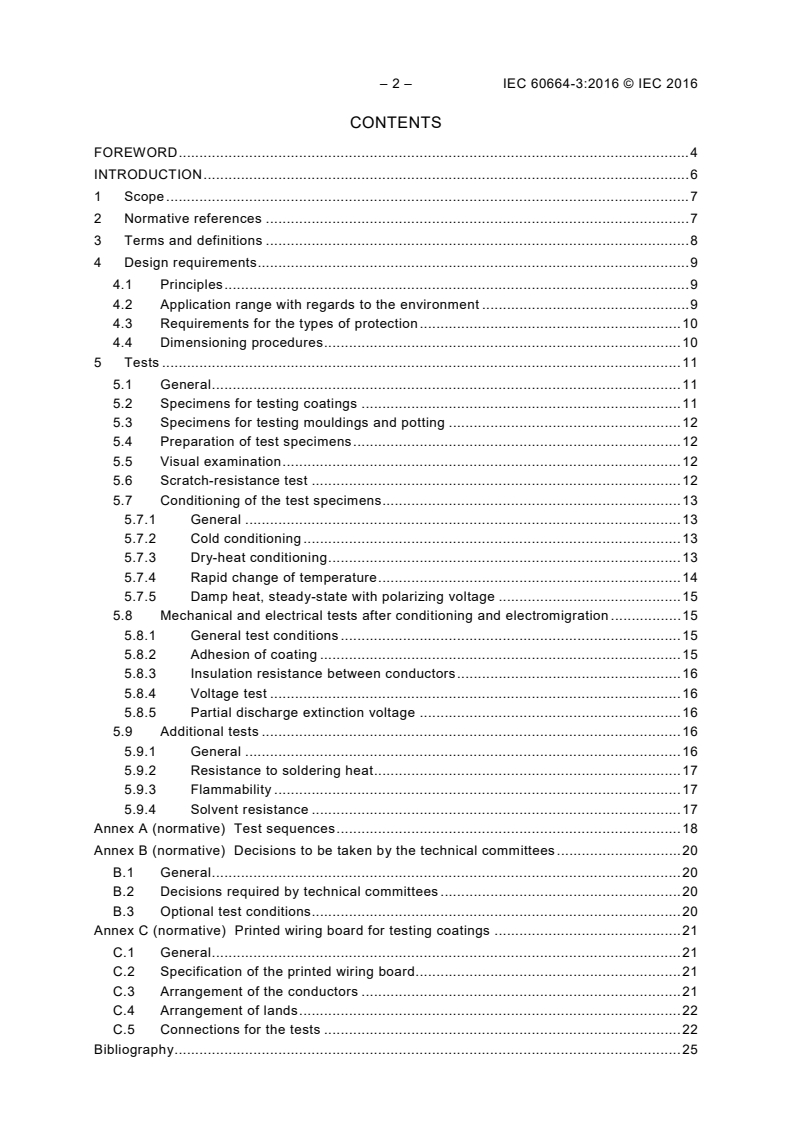
IEC 60664-3:2016 - Insulation coordination for equipment within low-voltage systems - Part 3: Use of coating, potting or moulding for protection against pollution Released:11/4/2016
Overview
IEC 60664-3:2016 - "Insulation coordination for equipment within low-voltage systems - Part 3: Use of coating, potting or moulding for protection against pollution" specifies how coating, potting, or moulding can be used as permanent pollution protection to allow reductions in required clearance and creepage distances (as referenced in IEC 60664-1 / IEC 60664-5). The standard defines two protection types: type 1 (improves the micro-environment) and type 2 (treated as similar to solid insulation). It also establishes test methods, conditioning procedures and acceptance criteria for protected assemblies such as PCBs, substrates and multi-layer boards.
Key Topics
- Scope and application: Applies to permanent protective systems on printed wiring boards, terminals and rigid assemblies; excludes assemblies after repair.
- Protection types:
- Type 1: Improves microenvironment under the protective layer (less stringent than solid insulation).
- Type 2: Considered equivalent to solid insulation - enables greater reduction of creepage/clearance.
- Design and dimensioning: Rules that permit reduced spacing only when appropriate protection and testing are applied; reference to minimum spacings (see standard Table 1 for type 2).
- Testing requirements:
- Visual examination and scratch-resistance test (scratch test applies to type 2 protection only).
- Environmental conditioning: cold, dry-heat, rapid temperature change, damp heat with polarizing voltage, and electromigration conditioning.
- Electrical/mechanical tests after conditioning: adhesion, insulation resistance, AC withstand voltage, and partial discharge extinction voltage.
- Additional tests: resistance to soldering heat, flammability, solvent resistance, where applicable.
- Specimens and test boards: Guidance for preparing coated/potted/moulded specimens and printed wiring board configurations for testing.
- Notable updates in 2016 edition: interpolation guidance added; scratch test limited to type 2 and renumbered; Annex A tables separated for clarity.
Applications
- Use by electrical designers, safety engineers, and PCB manufacturers to justify reduced creepage/clearance with permanent encapsulation.
- Reference for component suppliers and assembly houses when specifying coatings, potting compounds or moulding processes for low-voltage equipment.
- Essential for test laboratories and certification bodies performing environmental and electrical testing on protected assemblies.
- Useful to standards committees defining product-specific insulation requirements.
Related Standards
- IEC 60664-1 and IEC 60664-5 - overall insulation coordination and clearance/creepage rules.
- IEC 60068 series - environmental test methods referenced for conditioning procedures.
This standard helps ensure safe, reliable pollution protection in low-voltage systems while allowing optimized PCB and assembly designs when coating, potting or moulding are applied.
Relations
- Effective Date
- 25-Aug-2026
- Effective Date
- 13-May-2026
- Effective Date
- 05-Sep-2023
- Effective Date
- 05-Sep-2023
- Effective Date
- 05-Sep-2023
Buy Documents
IEC 60664-3:2016 RLV - Insulation coordination for equipment within low-voltage systems - Part 3: Use of coating, potting or moulding for protection against pollution Released:11/4/2016
IEC 60664-3:2016 - Insulation coordination for equipment within low-voltage systems - Part 3: Use of coating, potting or moulding for protection against pollution Released:11/4/2016
Get Certified
Connect with accredited certification bodies for this standard

IMQ S.p.A. (Certification)
Italian electrical product certification.

SLG Prüf- und Zertifizierungs GmbH
German testing and certification body.

UL Solutions
Global safety science company with testing, inspection and certification.
Sponsored listings
Frequently Asked Questions
IEC 60664-3:2016 is a standard published by the International Electrotechnical Commission (IEC). Its full title is "Insulation coordination for equipment within low-voltage systems - Part 3: Use of coating, potting or moulding for protection against pollution". This standard covers: IEC 60664-3:2016 applies to assemblies protected against pollution by the use of coating, potting or moulding, thus allowing a reduction of clearance and creepage distances as described in IEC 60664-1. This document describes the requirements and test procedures for two methods of protection: - type 1 protection improves the microenvironment of the parts under the protection; - type 2 protection is considered to be similar to solid insulation. This edition includes the following significant technical changes with respect to the previous edition: a) information added concerning interpolation; b) provided scratch test is only for type 2 protection; c) renumbered the scratch test to follow the visual examination test, since it makes more sense there; d) separated the tables under what is now called Annex A, to make them clearer.
IEC 60664-3:2016 applies to assemblies protected against pollution by the use of coating, potting or moulding, thus allowing a reduction of clearance and creepage distances as described in IEC 60664-1. This document describes the requirements and test procedures for two methods of protection: - type 1 protection improves the microenvironment of the parts under the protection; - type 2 protection is considered to be similar to solid insulation. This edition includes the following significant technical changes with respect to the previous edition: a) information added concerning interpolation; b) provided scratch test is only for type 2 protection; c) renumbered the scratch test to follow the visual examination test, since it makes more sense there; d) separated the tables under what is now called Annex A, to make them clearer.
IEC 60664-3:2016 is classified under the following ICS (International Classification for Standards) categories: 29.080.30 - Insulation systems. The ICS classification helps identify the subject area and facilitates finding related standards.
IEC 60664-3:2016 has the following relationships with other standards: It is inter standard links to EN ISO 18246:2023, EN ISO 19363:2021, IEC 60664-3:2003/AMD1:2010, IEC 60664-3:2003/AMD1:2010/COR1:2010, IEC 60664-3:2003. Understanding these relationships helps ensure you are using the most current and applicable version of the standard.
IEC 60664-3:2016 is available in PDF format for immediate download after purchase. The document can be added to your cart and obtained through the secure checkout process. Digital delivery ensures instant access to the complete standard document.
Standards Content (Sample)
IEC 60664-3 ®
Edition 3.0 2016-11
REDLINE VERSION
INTERNATIONAL
STANDARD
colour
inside
BASIC SAFETY PUBLICATION
Insulation coordination for equipment within low-voltage systems –
Part 3: Use of coating, potting or moulding for protection against pollution
All rights reserved. Unless otherwise specified, no part of this publication may be reproduced or utilized in any form
or by any means, electronic or mechanical, including photocopying and microfilm, without permission in writing from
either IEC or IEC's member National Committee in the country of the requester. If you have any questions about IEC
copyright or have an enquiry about obtaining additional rights to this publication, please contact the address below or
your local IEC member National Committee for further information.
IEC Central Office Tel.: +41 22 919 02 11
3, rue de Varembé Fax: +41 22 919 03 00
CH-1211 Geneva 20 info@iec.ch
Switzerland www.iec.ch
About the IEC
The International Electrotechnical Commission (IEC) is the leading global organization that prepares and publishes
International Standards for all electrical, electronic and related technologies.
About IEC publications
The technical content of IEC publications is kept under constant review by the IEC. Please make sure that you have the
latest edition, a corrigenda or an amendment might have been published.
IEC Catalogue - webstore.iec.ch/catalogue Electropedia - www.electropedia.org
The stand-alone application for consulting the entire The world's leading online dictionary of electronic and
bibliographical information on IEC International Standards, electrical terms containing 20 000 terms and definitions in
Technical Specifications, Technical Reports and other English and French, with equivalent terms in 15 additional
documents. Available for PC, Mac OS, Android Tablets and languages. Also known as the International Electrotechnical
iPad. Vocabulary (IEV) online.
IEC publications search - www.iec.ch/searchpub IEC Glossary - std.iec.ch/glossary
The advanced search enables to find IEC publications by a 65 000 electrotechnical terminology entries in English and
variety of criteria (reference number, text, technical French extracted from the Terms and Definitions clause of
committee,…). It also gives information on projects, replaced IEC publications issued since 2002. Some entries have been
and withdrawn publications. collected from earlier publications of IEC TC 37, 77, 86 and
CISPR.
IEC Just Published - webstore.iec.ch/justpublished
Stay up to date on all new IEC publications. Just Published IEC Customer Service Centre - webstore.iec.ch/csc
details all new publications released. Available online and If you wish to give us your feedback on this publication or
also once a month by email. need further assistance, please contact the Customer Service
Centre: csc@iec.ch.
IEC 60664-3 ®
Edition 3.0 2016-11
REDLINE VERSION
INTERNATIONAL
STANDARD
colour
inside
BASIC SAFETY PUBLICATION
Insulation coordination for equipment within low-voltage systems –
Part 3: Use of coating, potting or moulding for protection against pollution
INTERNATIONAL
ELECTROTECHNICAL
COMMISSION
ICS 29.080.30 ISBN 978-2-8322-3738-0
– 2 – IEC 60664-3:2016 RLV © IEC 2016
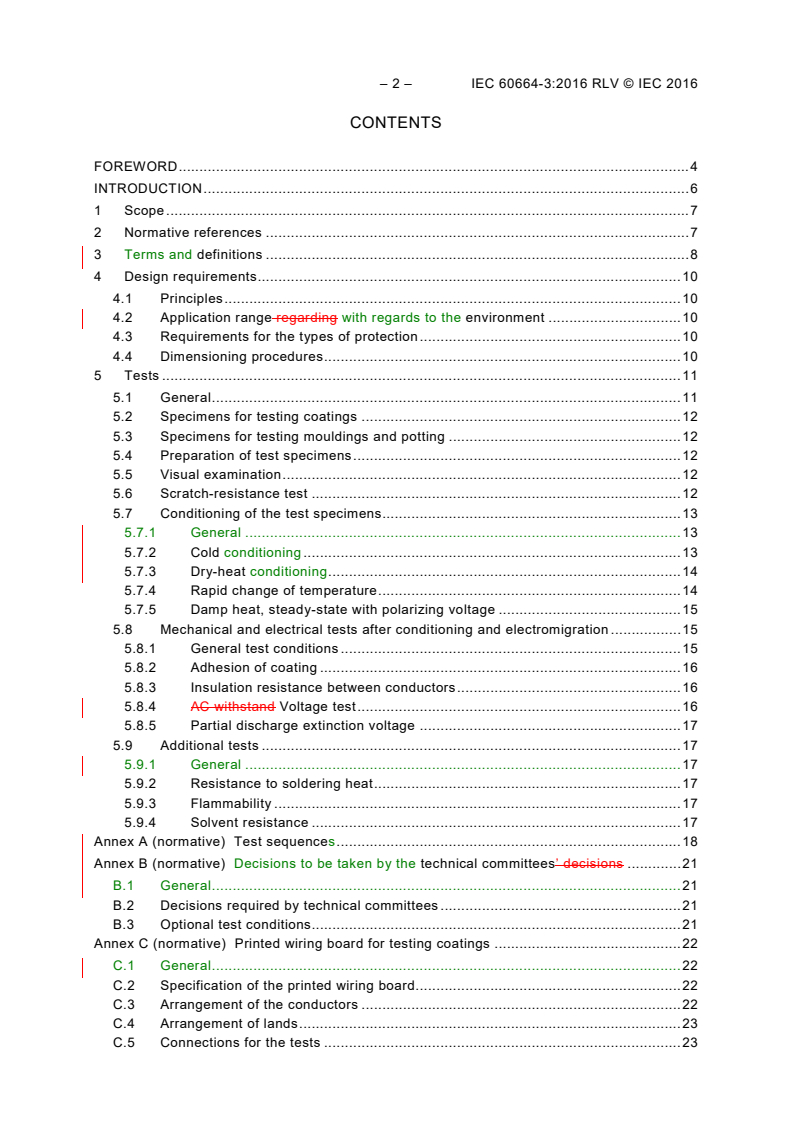
CONTENTS
FOREWORD . 4
INTRODUCTION . 6
1 Scope . 7
2 Normative references . 7
3 Terms and definitions . 8
4 Design requirements . 10
4.1 Principles . 10
4.2 Application range regarding with regards to the environment . 10
4.3 Requirements for the types of protection . 10
4.4 Dimensioning procedures . 10
5 Tests . 11
5.1 General . 11
5.2 Specimens for testing coatings . 12
5.3 Specimens for testing mouldings and potting . 12
5.4 Preparation of test specimens . 12
5.5 Visual examination . 12
5.6 Scratch-resistance test . 12
5.7 Conditioning of the test specimens . 13
5.7.1 General . 13
5.7.2 Cold conditioning . 13
5.7.3 Dry-heat conditioning . 14
5.7.4 Rapid change of temperature . 14
5.7.5 Damp heat, steady-state with polarizing voltage . 15
5.8 Mechanical and electrical tests after conditioning and electromigration . 15
5.8.1 General test conditions . 15
5.8.2 Adhesion of coating . 16
5.8.3 Insulation resistance between conductors . 16
5.8.4 AC withstand Voltage test . 16
5.8.5 Partial discharge extinction voltage . 17
5.9 Additional tests . 17
5.9.1 General . 17
5.9.2 Resistance to soldering heat . 17
5.9.3 Flammability . 17
5.9.4 Solvent resistance . 17
Annex A (normative) Test sequences . 18
Annex B (normative) Decisions to be taken by the technical committees’ decisions . 21
B.1 General . 21
B.2 Decisions required by technical committees . 21
B.3 Optional test conditions. 21
Annex C (normative) Printed wiring board for testing coatings . 22
C.1 General . 22
C.2 Specification of the printed wiring board. 22
C.3 Arrangement of the conductors . 22
C.4 Arrangement of lands . 23
C.5 Connections for the tests . 23
Bibliography . 26
Figure 1 – Scratch-resistance test for protecting layers . 13
Figure C.1 – Configuration of the test specimen . 24
Figure C.2 – Configuration of lands and adjacent conductors . 25
Table 1 – Minimum spacings for type 2 protection . 11
Table 2 – Dry-heat conditioning . 14
Table 3 – Degrees of severities for rapid change of temperature . 15
Table A.1 – Test sequence 1 . 18
Table A.2 – Test sequence 2 additional conditioning with respect to electromigration . 19
Table A.3 – Additional tests . 20
– 4 – IEC 60664-3:2016 RLV © IEC 2016
INTERNATIONAL ELECTROTECHNICAL COMMISSION
____________
INSULATION COORDINATION FOR EQUIPMENT
WITHIN LOW-VOLTAGE SYSTEMS –
Part 3: Use of coating, potting or moulding
for protection against pollution
FOREWORD
1) The International Electrotechnical Commission (IEC) is a worldwide organization for standardization comprising
all national electrotechnical committees (IEC National Committees). The object of IEC is to promote
international co-operation on all questions concerning standardization in the electrical and electronic fields. To
this end and in addition to other activities, IEC publishes International Standards, Technical Specifications,
Technical Reports, Publicly Available Specifications (PAS) and Guides (hereafter referred to as “IEC
Publication(s)”). Their preparation is entrusted to technical committees; any IEC National Committee interested
in the subject dealt with may participate in this preparatory work. International, governmental and non-
governmental organizations liaising with the IEC also participate in this preparation. IEC collaborates closely
with the International Organization for Standardization (ISO) in accordance with conditions determined by
agreement between the two organizations.
2) The formal decisions or agreements of IEC on technical matters express, as nearly as possible, an international
consensus of opinion on the relevant subjects since each technical committee has representation from all
interested IEC National Committees.
3) IEC Publications have the form of recommendations for international use and are accepted by IEC National
Committees in that sense. While all reasonable efforts are made to ensure that the technical content of IEC
Publications is accurate, IEC cannot be held responsible for the way in which they are used or for any
misinterpretation by any end user.
4) In order to promote international uniformity, IEC National Committees undertake to apply IEC Publications
transparently to the maximum extent possible in their national and regional publications. Any divergence
between any IEC Publication and the corresponding national or regional publication shall be clearly indicated in
the latter.
5) IEC itself does not provide any attestation of conformity. Independent certification bodies provide conformity
assessment services and, in some areas, access to IEC marks of conformity. IEC is not responsible for any
services carried out by independent certification bodies.
6) All users should ensure that they have the latest edition of this publication.
7) No liability shall attach to IEC or its directors, employees, servants or agents including individual experts and
members of its technical committees and IEC National Committees for any personal injury, property damage or
other damage of any nature whatsoever, whether direct or indirect, or for costs (including legal fees) and
expenses arising out of the publication, use of, or reliance upon, this IEC Publication or any other IEC
Publications.
8) Attention is drawn to the Normative references cited in this publication. Use of the referenced publications is
indispensable for the correct application of this publication.
9) Attention is drawn to the possibility that some of the elements of this IEC Publication may be the subject of
patent rights. IEC shall not be held responsible for identifying any or all such patent rights.
This redline version of the official IEC Standard allows the user to identify the changes
made to the previous edition. A vertical bar appears in the margin wherever a change
has been made. Additions are in green text, deletions are in strikethrough red text.
International Standard IEC 60664-3 has been prepared by IEC technical committee TC 109:
Insulation co-ordination for low-voltage equipment.
It has the status of a basic safety publication in accordance with IEC Guide 104.
This third edition cancels and replaces the second edition published in 2003 and Amendment
1:2010. This edition constitutes a technical revision.
This edition includes the following significant technical changes with respect to the previous
edition:
a) information added concerning interpolation;
b) provided scratch test is only for type 2 protection;
c) renumbered the scratch test to follow the visual examination test, since it makes more
sense there;
d) separated the tables under what is now called Annex A, to make them clearer.
The text of this standard is based on the following documents:
FDIS Report on voting
109/153/FDIS 109/154/RVD
Full information on the voting for the approval of this standard can be found in the report on
voting indicated in the above table.
This publication has been drafted in accordance with the ISO/IEC Directives, Part 2.
In this standard, the following types are used:
– Terms used throughout this standard which have been defined in Clause 3: bold type
A list of all parts in the IEC 60664 series, published under the general title Insulation
coordination for equipment within low-voltage systems, can be found on the IEC website.
The committee has decided that the contents of this publication will remain unchanged until
the stability date indicated on the IEC website under "http://webstore.iec.ch" in the data
related to the specific publication. At this date, the publication will be
• reconfirmed,
• withdrawn,
• replaced by a revised edition, or
• amended.
IMPORTANT – The “colour inside” logo on the cover page of this publication indicates
that it contains colours which are considered to be useful for the correct understanding
of its contents. Users should therefore print this publication using a colour printer.
– 6 – IEC 60664-3:2016 RLV © IEC 2016
INTRODUCTION
This part of IEC 60664 details the conditions in which the reduction of clearance and
creepage distances can apply to rigid assemblies such as printed boards or terminals of
components. Protection against pollution can be achieved by any kind of encapsulation such
as coating, potting or moulding. The protection may be applied to one or both sides of the
assembly. This standard specifies the insulating properties of the protecting material.
Between any two unprotected conductive parts, the clearance and creepage distance
requirements of IEC 60664-1 or IEC 60664-5 apply.
This document refers only to permanent protection. It does not cover assemblies after repair.
Technical committees need to should consider the influence on the protection of overheated
overheating conductors and components, especially under fault conditions, and to decide if
any additional requirements are necessary.
Safe performance of assemblies is dependent upon a precise and controlled manufacturing
process for the application of the protective system. Requirements for quality control, e.g. by
sampling tests, should be considered by technical committees.
INSULATION COORDINATION FOR EQUIPMENT
WITHIN LOW-VOLTAGE SYSTEMS –
Part 3: Use of coating, potting or moulding
for protection against pollution
1 Scope
This part of IEC 60664 applies to assemblies protected against pollution by the use of
coating, potting or moulding, thus allowing a reduction of clearance and creepage distances
as described in Part 1 or Part 5 IEC 60664-1.
NOTE 1 When reference is made to Part 1 or Part 5, IEC 60664-1 or IEC 60664-5 are meant.
This document describes the requirements and test procedures for two methods of
protection:
– type 1 protection improves the microenvironment of the parts under the protection;
– type 2 protection is considered to be similar to solid insulation.
This document also applies to all kinds of protected printed boards, including the surface of
inner layers of multi-layer boards, substrates and similarly protected assemblies. In the case
of multi-layer printed boards, the distances through an inner layer are covered by the
requirements for solid insulation in Part 1 IEC 60664-1.
NOTE 2 Examples of substrates are hybrid integrated circuits and thick-film technology.
This document refers only to permanent protection. It does not cover assemblies that are
subjected to mechanical adjustment or repair.
The principles of this standard are applicable to functional, basic, supplementary and
reinforced insulation.
2 Normative references
The following documents are referred to in the text in such a way that some or all of their
content constitutes requirements of this document. For dated references, only the edition
cited applies. For undated references, the latest edition of the referenced document (including
any amendments) applies.
IEC 60068-2-1:1990, Environmental testing − Part 2-1: Tests − Tests A: Cold
Amendment 1 (1993)
Amendment 2 (1994)
IEC 60068-2-2:1974, Basic Environmental testing procedures − Part 2-2: Tests − Tests B:
Dry heat
Amendment 1 (1993)
Amendment 2 (1994)
IEC 60068-2-14:1984, Basic Environmental testing procedures − Part 2-14: Tests − Test N:
Change of temperature
Amendment 1 (1986)
– 8 – IEC 60664-3:2016 RLV © IEC 2016
IEC 60068-2-78:2001, Environmental testing − Part 2-78: Tests − Test Cab: Damp heat,
steady state
IEC 60249-1:1982, Base materials for printed circuits – Part 1: Test methods
Amendment 4 (1993)
IEC 60249-2 (all parts), Base materials for printed circuit – Part 2: Specifications
IEC 60326-2:1990, Printed boards – Part 2: Test methods
Amendment 1 (1992)
IEC 60454-3-1:1998/AMD1:2001, Pressure-sensitive adhesive tapes for electrical purposes –
Part 3: Specifications for individual materials – Sheet 1: PVC film tapes with
pressure-sensitive adhesive
IEC 60664-1:1992 2007, Insulation coordination for equipment within low-voltage systems –
Part 1: Principles, requirements and tests
Amendment 1 (2000)
Amendment 2 (2002)
IEC 60664-5:, Insulation coordination for equipment within low-voltage systems – Part 5:
A comprehensive method for determining clearance and creepage distances equal to or less
1)
than 2 mm
IEC 61189-2:2006, Test methods for electrical materials, printed boards and other
interconnection structures and assemblies – Part 2: Test methods for materials for
interconnection structures
IEC 61189-3:2007, Test methods for electrical materials, printed boards and other
interconnection structures and assemblies – Part 3: Test methods for interconnection
structures (printed boards)
IEC 61249-2 (all parts), Materials for printed boards and other interconnecting structures –
Reinforced base materials, clad and unclad
IEC Guide 104:1997 2010, The preparation of safety publications and the use of basic safety
publications and group safety publications
ISO/IEC Guide 51, Safety aspects – Guidelines for their inclusion in standards
3 Terms and definitions
For the purposes of this document, the terms and definitions given in IEC 60664-1 and the
following apply.
ISO and IEC maintain terminological databases for use in standardization at the following
addresses:
• IEC Electropedia: available at http://www.electropedia.org
• ISO Online browsing platform: available at http://www.iso.org/obp
1)
To be published.
3.1
base material
insulating material upon which a conductive pattern may be formed
Note 1 to entry: The base material may be rigid or flexible, or both. It may be a dielectric or an insulated metal
sheet.
[SOURCE: IEC 60194, definition 40.1334 60050-541:1990, 541-02-01]
3.2
printed board
general term for completely processed printed circuit and printed wiring configurations
base material cut to size containing all required holes and bearing at least one conductive
pattern.
Printed boards are typically subdivided according to
– their structure (e.g., single- and double-sided, multilayers)
– the nature of the base material (e.g., rigid, flexible)
NOTE This includes single-sided, double-sided and multilayer boards with rigid, flexible, and rigid-flex base
materials
[SOURCE: IEC 60194, definition 60.1485 60050-541:1990, 541-01-03]
3.3
conductor (of a printed board) single conductive path in a conductive pattern
[SOURCE: IEC 60194, definition 22.0251 60050-541:1990, 541-01-20]
3.4
protection
any kind of measure which reduces the influence of the environment
3.5
coating
insulating material such as varnish or dry film laid on the surface of the assembly
Note 1 to entry: Coating and base material of a printed board form an insulating system that may have
properties similar to solid insulation
[SOURCE: IEC 60050-212:2010, 212-11-61].
3.6
solid insulation
solid insulating material interposed, or a combination of solid insulating materials, placed
between two conductive parts or between a conductive part and a body part
NOTE EXAMPLE In the case of a printed board with a coating, solid insulation consists of the
board itself as well as the coating. In other cases, solid insulation consists of the
encapsulating material.
[SOURCE: IEC 60050-903:2013, 903-04-14]
3.7
spacing
any combination of clearances, creepage distances and insulation distances through
insulation
[SOURCE: IEC 60050-471:2007, 471-01-20]
– 10 – IEC 60664-3:2016 RLV © IEC 2016
4 Design requirements
4.1 Principles
The dimensioning of spacings between conductors depends on the type of protection used.
When type 1 protection is used, dimensioning of clearances and creepage distances shall
follow the requirements of Part 1 or Part 5 IEC 60664-1. If the requirements of this standard
are met, pollution degree 1 applies under the protection.
When type 2 protection is used, spacings between conductive parts shall meet the
requirements and tests for solid insulation of Part 1 IEC 60664-1 and their dimensions shall
not be less than the minimum clearances specified in Part 1 or Part 5 IEC 60664-1 for
homogeneous field conditions.
4.2 Application range regarding with regards to the environment
The design requirements are applicable in all microenvironments.
Stresses such as temperature, chemical or mechanical stresses, or those listed in 3.3.2.3 of
Part 1 5.3.2.4 of IEC 60664-1:2007 shall be taken into account when the protective material is
selected.
Absorption of humidity by the protective material shall not impair the insulation properties of
the parts being protected.
NOTE Absorption of humidity can be checked by an insulation resistance measurement under humid conditions.
4.3 Requirements for the types of protection
Protection is achieved in the following ways.
– Type 1 protection improves the microenvironment of the parts under the protection. The
clearance and creepage distance requirements of Part 1 or Part 5 IEC 60664-1 for
pollution degree 1 apply under the protection. Between two conductive parts, it is a
requirement that one or both conductive parts, together with all the spacings between
them, are covered by the protection.
– Type 2 protection is considered to be similar to solid insulation. Under the protection,
the requirements for solid insulation specified in Part 1 IEC 60664-1 are applicable and
the spacings shall be not less than those specified in Table 1. The requirements for
clearances and creepage distances in Part 1 or Part 5 IEC 60664-1 do not apply. Between
two conductive parts, it is a requirement that both conductive parts, together with all the
spacings between them, are covered by the protection so that no air gap exists between
the protective material, the conductive parts and the printed board.
Clearance and creepage distance requirements according to Part 1 or Part 5 IEC 60664-1
apply to all unprotected parts of the equipment.
4.4 Dimensioning procedures
For type 1 protection, the dimensioning requirements of 3.1 and 3.2 of Part 1 or Part 5 5.1
and 5.2 of IEC 60664-1:2007 apply.
For type 2 protection, the spacing between the conductors before the protection is applied
shall not be less than the values as specified in Table 1. These values apply to basic
insulation, supplementary insulation as well as reinforced insulation. These values may also
be applied to functional insulation.
NOTE In case of multi-layer boards, the spacing between the conductors at the surface of inner layers is
dimensioned as specified for type 1 protection or type 2 protection depending on the result of the tests on the
protection.
Table 1 – Minimum spacings for type 2 protection
a)
Maximum peak value of any voltage Minimum spacings
kV mm
≤ 0,33 0,01
> 0,33 and ≤ 0,4 0,02
0,04
> 0,4 and ≤ 0,5
> 0,5 and ≤ 0,6 0,06
> 0,6 and ≤ 0,8 0,1
0,15
> 0,8 and ≤ 1,0
0,2
> 1,0 and ≤ 1,2
> 1,2 and ≤ 1,5 0,3
> 1,5 and ≤ 2,0 0,45
0,6
> 2,0 and ≤ 2,5
> 2,5 and ≤ 3,0 0,8
> 3,0 and ≤ 4,0 1,2
1,5
> 4,0 and ≤ 5,0
> 5,0 and ≤ 6,0 2
> 6,0 and ≤ 8,0 3
> 8,0 and ≤ 10 3,5
> 10 and ≤ 12 4,5
> 12 and ≤ 15 5,5
> 15 and ≤ 20 8
> 20 and ≤ 25
> 25 and ≤ 30 12,5
> 30 and ≤ 40 17
> 40 and ≤ 50
> 50 and ≤ 60 27
> 60 and ≤ 80 35
> 80 and ≤ 100
a)
Transient overvoltages are disregarded since they are unlikely to degrade the
protected assembly.
Compliance is checked by measurement of the spacing before applying the protection.
5 Tests
5.1 General
The suitability of protection is evaluated by carrying out all the tests described in 5.8 after
the conditioning described in 5.7.
The suitability of protection is evaluated after the visual examination test described in 5.5,
the scratch-resistance test described in 5.6 and the subsequent conditioning described in 5.7.
– 12 – IEC 60664-3:2016 RLV © IEC 2016
Six specimens are used unless otherwise specified by technical committees. In addition,
technical committees may specify the additional tests of 5.9, each of which is carried out
on a separate new specimen.
These tests are designed for type testing. Technical committees should consider if any of the
tests shall be specified for routine or sampling tests.
The sequence of tests is shown in Annex A.
No failure of any specimen under test is permitted.
Annex B lists the decisions required to be taken by technical committees when referring
to this standard.
5.2 Specimens for testing coatings
Test specimens may be:
– test specimens according to Annex C, which specifically applies for printed wiring boards;
the specimen used for testing shall have the same minimum distances as those from
production;
– specimens from production; or
– any printed board, as long as the test specimens are representative of those from
production.
5.3 Specimens for testing mouldings and potting
Production specimens shall be used, or they shall be representative of those from production.
5.4 Preparation of test specimens
Printed boards shall be cleaned and coated using the normal procedure of the manufacturer.
The soldering procedure is carried out but without the components being in place. Moulded
and potted specimens shall be tested without further preparation.
5.5 Visual examination
The specimens shall be visually examined according to test 1b in 5.1.2 of IEC 60326-2 3V02
in 6.2 of IEC 61189-3:2007.
The specimens shall show no
– blistering,
– swelling,
– separation from the base material,
– cracks,
– voids,
– areas with adjacent unprotected conductive parts, with the exception of lands,
– electromigration (following electromigration conditioning),
following the test sequence criteria given in the tables within Annex A.
5.6 Scratch-resistance test
The scratch-resistance test is only carried out for type 2 protection. Prior to the sequence of
tests for type 2 protection, the test samples shall be subjected to the scratch-resistance test.
NOTE In some cases, the scratch-resistance test cannot be applied to assemblies protected against pollution by
the use of potting or moulding. In such cases, considerations for any alternative or additional tests can be
necessary.
Scratches shall be made across five pairs of conducting parts and the intervening separations
at points where the separations insulation will be subject to the maximum potential gradient
during the tests electric field strength between conductors.
Protective layers shall be scratched by means of a hardened steel pin, the end of which has
the form of a cone with an angle of 40°. Its tip shall be rounded and polished, with a radius of
0,25 mm ± 0,02 mm. The pin shall be loaded so that the force exerted along its axis is
10 N ± 0,5 N. The scratches shall be made by drawing the pin along the surface in a plane
perpendicular to the conductor edges of the protective layer at a speed of approximately
20 mm/s as shown in Figure 1. Five scratches shall be made at least 5 mm apart and at least
5 mm from the edges.
B C
Direction of movement
of pin
Pin
85°
80°
D
A
Specimen
under test
IEC
NOTE The pin is in the plane ABCD which is perpendicular to the specimen under test.
Figure 1 – Scratch-resistance test for protecting layers
5.7 Conditioning of the test specimens
5.7.1 General
The conditioning methods are suitable for the majority of applications. For particular
applications, a modification of the parameters specified for the conditioning may be
appropriate and should be considered by technical committees.
NOTE The climatic sequence from 5.7.2 to 5.7.5 is intended to simulate ageing.
5.7.2 Cold conditioning
The cold conditioning (simulation of storage and transportation) is carried out according to
test Ab of IEC 60068-2-1. The severities shall be specified by the technical committees and
selected from the following temperatures:
– −10 °C
– −25 °C
– −40 °C
– −65 °C
The duration of the test is 96 h.
– 14 – IEC 60664-3:2016 RLV © IEC 2016
5.7.3 Dry-heat conditioning
The dry-heat conditioning is carried out according to test Bb of IEC 60068-2-2. However, the
conditioning time and conditioning temperature corresponds to the composition of the printed
board and the working surface temperature shown in Table 2. Interpolation of Table 2's
maximum working surface temperatures and corresponding conditioning temperature values is
allowed.
Table 2 – Dry-heat conditioning
Resin/base material Maximum working Conditioning Conditioning time
surface temperature temperature
°C °C h
105 165 1 000
Epoxide/cellulose paper
75 125 1 000
140 175 1 000
Epoxide/woven glass surfaces/cellulose
100 125 1 000
paper core
75 95 1 000
140 175 1 000
Epoxide/woven glass surfaces/
100 125 1 000
non-woven glass core
75 95 1 000
140 175 1 000
Epoxide/woven glass 100 125 1 000
75 95 1 000
160 200 1 000
Polyester/glass mat
100 130 1 000
75 100 1 000
Phenolic/cellulose paper
110 155 1 000
(with defined flammability –
a)
vertical burning test) 75 110 1 000
125 170 1 000
Phenolic/cellulose paper 100 140 1 000
75 110 1 000
a)
For defined flammability, refer to IEC 60249-1, subclause 4.3.4 8.6 of IEC 61189-2:2006 and the relevant
part of IEC 60249-2 61249-2.
5.7.4 Rapid change of temperature
The rapid change of temperature conditioning is in accordance with test Na of
IEC 60068-2-14. The temperatures are in accordance with Table 3, where the degree
of severity shall be specified by the relevant technical committee.
Table 3 – Degrees of severities for rapid change of temperature
Minimum Maximum temperature
Degree of severity
temperature
°C °C
1 −10 125
2 −25 125
3 −40 125
4 −65 125
The conditioning is carried out as follows:
– duration of one cycle: 1 h (30 min ± 2 min at each temperature)
– rate of change of temperature: within 30 s
– number of cycles: 5 50
When a protected assembly is likely to be subjected to many variations of temperature during
its service life, the technical committee may specify an increased number of cycles.
5.7.5 Damp heat, steady-state with polarizing voltage
5.7.5.1 General conditioning
The test specimens shall be placed in the humidity chamber for 96 h under conditions
according to defined in test Cab of IEC 60068-2-78 as follows:
– temperature: 40 °C ± 2 °C
+2 %
93 %
– relative humidity:
−3 %
A DC voltage of 100 V is applied between conductors and adjacent lands. When a test
specimen according to as defined in Annex C is used, the positive pole of the supply shall be
connected to the “common”.
The test result is assessed according to 5.6, 5.8.3, 5.8.4 and 5.8.5.
5.7.5.2 Additional conditioning with respect to electromigration
When equipment can be expected to be subject to abnormally severe conditions of pollution
or humidity for significant periods during its service life, technical committees may specify a
longer DC voltage test under damp heat conditions.
In order to minimize the overall testing time, this test should be carried out on six new test
specimens which have been subjected to the soldering process (see 5.4), scratch-resistance
test (only for type 2 protection) (see 5.6) and visual examination (see 5.5) only. The test is
carried out according to 5.7.5.1. Preferred durations are 10 days, 21 days or 56 days.
5.8 Mechanical and electrical tests after conditioning and electromigration
5.8.1 General test conditions
The tests are carried out in a room having a temperature of between 15 °C to 35 °C and
a relative humidity of between 45 % and 75 %.
For the tests of 5.8.3, 5.8.4 and 5.8.5, the specimens are placed in a chamber having
+2%
a temperature of 40 °C ± 2 °C and a relative humidity of in accordance with
93%
−3%
– 16 – IEC 60664-3:2016 RLV © IEC 2016
IEC 60068-2-78 for 48 h. The test in 5.8.3 shall be conducted while the specimens are in the
humidity chamber. The tests in 5.8.4 and 5.8.5 shall be conducted within one hour after
removing the specimens from the humidity chamber.
5.8.2 Adhesion of coating
The tested area shall contain portions of metalization and base material.
The specimen shall be cleaned with a suitable organic solvent and allowed to dry.
Non-transferable transparent pressure-sensitive tape, in accordance with IEC 60454-3-1, is
used. The tape shall have a minimum width of 13 mm. A suitable tape is
IEC 60454-3-1-5/F-PVCP/90x. A new piece of tape shall be used for each test.
A 50-mm length of the tape is applied to the test specimen. Air bubbles are excluded by using
means such as finger pressure, a hand roller or an eraser.
Within 10 s, the tape is removed by a snap pull applied approximately perpendicular to the
surface of the test specimen.
NOTE A minimum achievable pull force may can be specified by technical committees.
After the test, the coating shall not have loosened and there shall be no material transferred
to the tape that is visible to the naked eye. In order to assess whether there has been any
transfer of material, the tape may be placed on a sheet of white paper or card. If a white or
light-coloured coating is being tested, a suitably contrasting coloured paper or card is used
instead.
5.8.3 Insulation resistance between conductors
The test shall be carried out according to 6.4.1 of IEC 60326-2 10.3 of IEC 61189-3:2007, the
voltage specified for test 6a method 3E03 being as close to the working voltage as possible.
The minimum value for the insulation resistance between the conductors shall be 100 MΩ,
unless otherwise specified by technical committees.
5.8.4 AC withstand Voltage test
With a type 1 protection the impulse voltage test shall be carried out according to 6.1.2.2.1 of
IEC 60664-1:2007.
NOTE 1 Because there is no relation between pollution degree and the Uimp withstand, a conductive layer,
applied on the surface of the protection to perform the test, is not necessary.
With a type 2 protection, the electrical tests on the protected specimen shall be carried out
according to 4.1.2.3 of Part 1 6.1.3.4 of IEC 60664-1:2007 with the exception that the test
voltage is either as specified in 3.3.3.2.2 of Part 1 5.3.3.2.3 of IEC 60664-1:2007 or 0,707
times the relevant rated impulse voltage according to Table F.1 of Part 1 IEC 60664-1:2007,
whichever is the higher value. If the assembly is subjected to pollution degree 3 or 4, the
withstand voltage test shall be carried out with a conductive layer on the surface of the
protection to simulate the pollution degree.
NOTE 2 The conductive layer is not connected to the test generator or to one of the lands.
Reinforced insulation shall be tested with twice the test voltage required for basic insulation.
5.8.5 Partial discharge extinction voltage
The partial discharge test is only carried out for type 2 protection. The partial discharge
extinction voltage and the test method are specified in 4.1.2.4 of Part 1 6.1.3.5 of IEC 60664-
1:2007. The partial discharge test voltage is 700 V peak or the peak value of the working
voltage multiplied by the relevant factors described in 4.1.2.4 of Part 1 6.1.3.5 of IEC 60664-
1:2007, whichever is higher. If the assembly is subjected to pollution degree 3 or 4, the
measurement of the partial discharge extinction voltage shall be carried out with a conductive
layer on the surface of the protection.
The partial discharge extinction voltage is reached when the magnitude of the discharge does
not exceed 5 pC.
5.9 Additional tests
5.9.1 General
Technical committees may require one or more of these tests in 5.9.2, 5.9.3 and 5.9.4 to be
carried out.
5.9.2 Resistance to soldering heat
The test shall be carried out according to test 19c of 9.2.3 of IEC 60326-2 3N02 of 11.2 of
IEC 61189-3:2007.
The floating time shall be 20 s. After the test, the test specimen shall be assessed according
to 5.6.
5.9.3 Flammability
The test shall be carried out according to test 16b of 8.4.2 of IEC 60326-2 3C02 of 8.2 of
IEC 61189-3:2007. The temperature shall be specified by the relevant technical committee.
The test shall be carried out on protected and unprotected assemblies. The results of the test
shall not be adversely affected by the protection.
5.9.4 Solvent resistance
This test shall be carried out according to test 17a of 8.5 of IEC 60326-2:1990.
The solvent used is dichlor-methane (methylene chloride) unless otherwise specified by the
technical committee.
The test shall be carried out using such organic solvent as agreed between user and
manufacturer and as appropriate to the application.
During the handling of the organic solvent, appropriate personal protective equipment should
be used.
After the test, the solvent shall be removed and the test specimen shall be assessed
according to 5.6.
– 18 – IEC 60664-3:2016 RLV © IEC 2016
Annex A
(normative)
Test sequences
The following flow-chart Table A.1, Table A.2 and Table A.3 shows the order in which the
tests of Clause 5 have to be carried out. No failure of any specimen under test is permitted.
5.4
Soldering with the normal soldering procedure of the manufacturer,
e.g. with the steps cleaning, protecting, soldering
15 °C. 35 °C
5.5
Scratch resistance test
45 %. 75 % r.h.
5.6
Visual examination
Six specimens 5.7.4.2 Six specimens One specimen
for each test
5.7 5.9
Additional
Additional conditioning with respect
Conditioning of the test specimens
to electromigration tests
5.7.1 96 h Cold 40°C/93% 10 or Damp heat,
−10 °C
r.h. 21 or steady
−25 °C
56 days state with
−40 °C
DC 100 V
polarizing
−65 °C
voltage
5.7.2 Temperature 1000 h Dry heat 5.9.1 Resistance to
from Table 2 soldering heat
5.7.3 −10°C/+125°C 5 Rapid change 9.2.3 of
cycles of IEC 60326-2
−25°C/+125°C
temperature t = 20 s
−40°C/+125°C
0,5h/30s/0,5h
−65°C/+125°C
5.7.4.1 40°C/93%r.h. 96 h Damp heat,
DC 100 V steady state
with polari-
5.9.2 Flammability
zing voltage
Test 16b
of 8.4.2 of
IEC 60326-2
5.8
Mechanical and electrical tests after
conditioning and electromigration
5.8.2 _ Adhesion of coating
(tape test)
15 °C. 35 °C
5.6 45 %. 75 % r.h. _ 5.9.3 Solvent
Visual examination
resistance
8.5 of IEC
48 h Humidity test 60326-2, with
dichlor-methane
5.8.3 40 °C/93 % r.h. _ Insulation resistance
≥ 100 MΩ
5.8.4 _
AC withstand voltage
5.8.5 _ Partial discharge
extinction voltage (type 2
protection only)
Table A.1 – Test sequence 1
Reference Test/conditioning requirements (six specimens)
5.4 Soldering with the normal soldering procedure of the manufacturer,
e.g. with the steps cleaning, protecting, soldering
5.6 Scratch resistance test (type 2 protection only)
5.5 Visual examination
5.7 Conditioning of the test specimens
Temperature/Humidity Time Condition
5.7.2 −10 °C 96 h Cold
−25 °C
−40 °C
−65 °C
5.7.3 Temperature from Table 2 1 000 h Dry heat
5.7.4 50 Rapid change of temperature
−10 °C/+125 °C
cycles 0,5 h/30 s/0,5 h
−25 °C/+125 °C
−40 °C/+125 °C
−65 °C/+125 °C
5.7.5.1 40 °C/93 % r.h. 96 h Damp heat,
DC 100 V steady state with polarizing voltage
5.8 Mechanical and electrical tests after
conditioning and electromigration
5.8.2 Adhesion of coating
(tape test)
5.5 Visual examination
5.8.1 40 °C/93 % r.h
...
IEC 60664-3 ®
Edition 3.0 2016-11
INTERNATIONAL
STANDARD
NORME
INTERNATIONALE
BASIC SAFETY PUBLICATION
PUBLICATION FONDAMENTALE DE SÉCURITÉ
Insulation coordination for equipment within low-voltage systems –
Part 3: Use of coating, potting or moulding for protection against pollution
Coordination de l'isolement des matériels dans les systèmes (réseaux) à basse
tension –
Partie 3: Utilisation de revêtement, d'empotage ou de moulage pour la protection
contre la pollution
All rights reserved. Unless otherwise specified, no part of this publication may be reproduced or utilized in any form
or by any means, electronic or mechanical, including photocopying and microfilm, without permission in writing from
either IEC or IEC's member National Committee in the country of the requester. If you have any questions about IEC
copyright or have an enquiry about obtaining additional rights to this publication, please contact the address below or
your local IEC member National Committee for further information.
Droits de reproduction réservés. Sauf indication contraire, aucune partie de cette publication ne peut être reproduite
ni utilisée sous quelque forme que ce soit et par aucun procédé, électronique ou mécanique, y compris la photocopie
et les microfilms, sans l'accord écrit de l'IEC ou du Comité national de l'IEC du pays du demandeur. Si vous avez des
questions sur le copyright de l'IEC ou si vous désirez obtenir des droits supplémentaires sur cette publication, utilisez
les coordonnées ci-après ou contactez le Comité national de l'IEC de votre pays de résidence.
IEC Central Office Tel.: +41 22 919 02 11
3, rue de Varembé Fax: +41 22 919 03 00
CH-1211 Geneva 20 info@iec.ch
Switzerland www.iec.ch
About the IEC
The International Electrotechnical Commission (IEC) is the leading global organization that prepares and publishes
International Standards for all electrical, electronic and related technologies.
About IEC publications
The technical content of IEC publications is kept under constant review by the IEC. Please make sure that you have the
latest edition, a corrigenda or an amendment might have been published.
IEC Catalogue - webstore.iec.ch/catalogue Electropedia - www.electropedia.org
The stand-alone application for consulting the entire The world's leading online dictionary of electronic and
bibliographical information on IEC International Standards, electrical terms containing 20 000 terms and definitions in
Technical Specifications, Technical Reports and other English and French, with equivalent terms in 15 additional
documents. Available for PC, Mac OS, Android Tablets and languages. Also known as the International Electrotechnical
iPad. Vocabulary (IEV) online.
IEC publications search - www.iec.ch/searchpub IEC Glossary - std.iec.ch/glossary
The advanced search enables to find IEC publications by a 65 000 electrotechnical terminology entries in English and
variety of criteria (reference number, text, technical French extracted from the Terms and Definitions clause of
committee,…). It also gives information on projects, replaced IEC publications issued since 2002. Some entries have been
and withdrawn publications. collected from earlier publications of IEC TC 37, 77, 86 and
CISPR.
IEC Just Published - webstore.iec.ch/justpublished
Stay up to date on all new IEC publications. Just Published IEC Customer Service Centre - webstore.iec.ch/csc
details all new publications released. Available online and If you wish to give us your feedback on this publication or
also once a month by email. need further assistance, please contact the Customer Service
Centre: csc@iec.ch.
A propos de l'IEC
La Commission Electrotechnique Internationale (IEC) est la première organisation mondiale qui élabore et publie des
Normes internationales pour tout ce qui a trait à l'électricité, à l'électronique et aux technologies apparentées.
A propos des publications IEC
Le contenu technique des publications IEC est constamment revu. Veuillez vous assurer que vous possédez l’édition la
plus récente, un corrigendum ou amendement peut avoir été publié.
Catalogue IEC - webstore.iec.ch/catalogue Electropedia - www.electropedia.org
Application autonome pour consulter tous les renseignements
Le premier dictionnaire en ligne de termes électroniques et
bibliographiques sur les Normes internationales,
électriques. Il contient 20 000 termes et définitions en anglais
Spécifications techniques, Rapports techniques et autres
et en français, ainsi que les termes équivalents dans 15
documents de l'IEC. Disponible pour PC, Mac OS, tablettes
langues additionnelles. Egalement appelé Vocabulaire
Android et iPad.
Electrotechnique International (IEV) en ligne.
Recherche de publications IEC - www.iec.ch/searchpub
Glossaire IEC - std.iec.ch/glossary
65 000 entrées terminologiques électrotechniques, en anglais
La recherche avancée permet de trouver des publications IEC
en utilisant différents critères (numéro de référence, texte, et en français, extraites des articles Termes et Définitions des
comité d’études,…). Elle donne aussi des informations sur les publications IEC parues depuis 2002. Plus certaines entrées
projets et les publications remplacées ou retirées. antérieures extraites des publications des CE 37, 77, 86 et
CISPR de l'IEC.
IEC Just Published - webstore.iec.ch/justpublished
Service Clients - webstore.iec.ch/csc
Restez informé sur les nouvelles publications IEC. Just
Published détaille les nouvelles publications parues. Si vous désirez nous donner des commentaires sur cette
Disponible en ligne et aussi une fois par mois par email. publication ou si vous avez des questions contactez-nous:
csc@iec.ch.
IEC 60664-3 ®
Edition 3.0 2016-11
INTERNATIONAL
STANDARD
NORME
INTERNATIONALE
BASIC SAFETY PUBLICATION
PUBLICATION FONDAMENTALE DE SÉCURITÉ
Insulation coordination for equipment within low-voltage systems –
Part 3: Use of coating, potting or moulding for protection against pollution
Coordination de l'isolement des matériels dans les systèmes (réseaux) à basse
tension –
Partie 3: Utilisation de revêtement, d'empotage ou de moulage pour la protection
contre la pollution
INTERNATIONAL
ELECTROTECHNICAL
COMMISSION
COMMISSION
ELECTROTECHNIQUE
INTERNATIONALE
ICS 29.080.30 ISBN 978-2-8322-3693-2
– 2 – IEC 60664-3:2016 © IEC 2016
CONTENTS
FOREWORD . 4
INTRODUCTION . 6
1 Scope . 7
2 Normative references . 7
3 Terms and definitions . 8
4 Design requirements . 9
4.1 Principles . 9
4.2 Application range with regards to the environment . 9
4.3 Requirements for the types of protection . 10
4.4 Dimensioning procedures . 10
5 Tests . 11
5.1 General . 11
5.2 Specimens for testing coatings . 11
5.3 Specimens for testing mouldings and potting . 12
5.4 Preparation of test specimens . 12
5.5 Visual examination . 12
5.6 Scratch-resistance test . 12
5.7 Conditioning of the test specimens . 13
5.7.1 General . 13
5.7.2 Cold conditioning . 13
5.7.3 Dry-heat conditioning . 13
5.7.4 Rapid change of temperature . 14
5.7.5 Damp heat, steady-state with polarizing voltage . 15
5.8 Mechanical and electrical tests after conditioning and electromigration . 15
5.8.1 General test conditions . 15
5.8.2 Adhesion of coating . 15
5.8.3 Insulation resistance between conductors . 16
5.8.4 Voltage test . 16
5.8.5 Partial discharge extinction voltage . 16
5.9 Additional tests . 16
5.9.1 General . 16
5.9.2 Resistance to soldering heat . 17
5.9.3 Flammability . 17
5.9.4 Solvent resistance . 17
Annex A (normative) Test sequences . 18
Annex B (normative) Decisions to be taken by the technical committees . 20
B.1 General . 20
B.2 Decisions required by technical committees . 20
B.3 Optional test conditions. 20
Annex C (normative) Printed wiring board for testing coatings . 21
C.1 General . 21
C.2 Specification of the printed wiring board. 21
C.3 Arrangement of the conductors . 21
C.4 Arrangement of lands . 22
C.5 Connections for the tests . 22
Bibliography . 25
Figure 1 – Scratch-resistance test for protecting layers . 13
Figure C.1 – Configuration of the test specimen . 23
Figure C.2 – Configuration of lands and adjacent conductors . 24
Table 1 – Minimum spacings for type 2 protection . 10
Table 2 – Dry-heat conditioning . 14
Table 3 – Degrees of severities for rapid change of temperature . 14
Table A.1 – Test sequence 1 . 18
Table A.2 – Test sequence 2 additional conditioning with respect to electromigration . 19
Table A.3 – Additional tests . 19
– 4 – IEC 60664-3:2016 © IEC 2016
INTERNATIONAL ELECTROTECHNICAL COMMISSION
____________
INSULATION COORDINATION FOR EQUIPMENT
WITHIN LOW-VOLTAGE SYSTEMS –
Part 3: Use of coating, potting or moulding
for protection against pollution
FOREWORD
1) The International Electrotechnical Commission (IEC) is a worldwide organization for standardization comprising
all national electrotechnical committees (IEC National Committees). The object of IEC is to promote
international co-operation on all questions concerning standardization in the electrical and electronic fields. To
this end and in addition to other activities, IEC publishes International Standards, Technical Specifications,
Technical Reports, Publicly Available Specifications (PAS) and Guides (hereafter referred to as “IEC
Publication(s)”). Their preparation is entrusted to technical committees; any IEC National Committee interested
in the subject dealt with may participate in this preparatory work. International, governmental and non-
governmental organizations liaising with the IEC also participate in this preparation. IEC collaborates closely
with the International Organization for Standardization (ISO) in accordance with conditions determined by
agreement between the two organizations.
2) The formal decisions or agreements of IEC on technical matters express, as nearly as possible, an international
consensus of opinion on the relevant subjects since each technical committee has representation from all
interested IEC National Committees.
3) IEC Publications have the form of recommendations for international use and are accepted by IEC National
Committees in that sense. While all reasonable efforts are made to ensure that the technical content of IEC
Publications is accurate, IEC cannot be held responsible for the way in which they are used or for any
misinterpretation by any end user.
4) In order to promote international uniformity, IEC National Committees undertake to apply IEC Publications
transparently to the maximum extent possible in their national and regional publications. Any divergence
between any IEC Publication and the corresponding national or regional publication shall be clearly indicated in
the latter.
5) IEC itself does not provide any attestation of conformity. Independent certification bodies provide conformity
assessment services and, in some areas, access to IEC marks of conformity. IEC is not responsible for any
services carried out by independent certification bodies.
6) All users should ensure that they have the latest edition of this publication.
7) No liability shall attach to IEC or its directors, employees, servants or agents including individual experts and
members of its technical committees and IEC National Committees for any personal injury, property damage or
other damage of any nature whatsoever, whether direct or indirect, or for costs (including legal fees) and
expenses arising out of the publication, use of, or reliance upon, this IEC Publication or any other IEC
Publications.
8) Attention is drawn to the Normative references cited in this publication. Use of the referenced publications is
indispensable for the correct application of this publication.
9) Attention is drawn to the possibility that some of the elements of this IEC Publication may be the subject of
patent rights. IEC shall not be held responsible for identifying any or all such patent rights.
International Standard IEC 60664-3 has been prepared by IEC technical committee TC 109:
Insulation co-ordination for low-voltage equipment.
It has the status of a basic safety publication in accordance with IEC Guide 104.
This third edition cancels and replaces the second edition published in 2003 and Amendment
1:2010. This edition constitutes a technical revision.
This edition includes the following significant technical changes with respect to the previous
edition:
a) information added concerning interpolation;
b) provided scratch test is only for type 2 protection;
c) renumbered the scratch test to follow the visual examination test, since it makes more
sense there;
d) separated the tables under what is now called Annex A, to make them clearer.
The text of this standard is based on the following documents:
FDIS Report on voting
109/153/FDIS 109/154/RVD
Full information on the voting for the approval of this standard can be found in the report on
voting indicated in the above table.
This publication has been drafted in accordance with the ISO/IEC Directives, Part 2.
In this standard, the following types are used:
– Terms used throughout this standard which have been defined in Clause 3: bold type
A list of all parts in the IEC 60664 series, published under the general title Insulation
coordination for equipment within low-voltage systems, can be found on the IEC website.
The committee has decided that the contents of this publication will remain unchanged until
the stability date indicated on the IEC website under "http://webstore.iec.ch" in the data
related to the specific publication. At this date, the publication will be
• reconfirmed,
• withdrawn,
• replaced by a revised edition, or
• amended.
– 6 – IEC 60664-3:2016 © IEC 2016
INTRODUCTION
This part of IEC 60664 details the conditions in which the reduction of clearance and
creepage distances can apply to rigid assemblies such as printed boards or terminals of
components. Protection against pollution can be achieved by any kind of encapsulation such
as coating, potting or moulding. The protection may be applied to one or both sides of the
assembly. This standard specifies the insulating properties of the protecting material.
Between any two unprotected conductive parts, the clearance and creepage distance
requirements of IEC 60664-1 apply.
This document refers only to permanent protection. It does not cover assemblies after repair.
Technical committees should consider the influence on the protection of overheating
conductors and components, especially under fault conditions, and to decide if any additional
requirements are necessary.
Safe performance of assemblies is dependent upon a precise and controlled manufacturing
process for the application of the protective system. Requirements for quality control, e.g. by
sampling tests, should be considered by technical committees.
INSULATION COORDINATION FOR EQUIPMENT
WITHIN LOW-VOLTAGE SYSTEMS –
Part 3: Use of coating, potting or moulding
for protection against pollution
1 Scope
This part of IEC 60664 applies to assemblies protected against pollution by the use of
coating, potting or moulding, thus allowing a reduction of clearance and creepage distances
as described in IEC 60664-1.
This document describes the requirements and test procedures for two methods of
protection:
– type 1 protection improves the microenvironment of the parts under the protection;
– type 2 protection is considered to be similar to solid insulation.
This document also applies to all kinds of protected printed boards, including the surface of
inner layers of multi-layer boards, substrates and similarly protected assemblies. In the case
of multi-layer printed boards, the distances through an inner layer are covered by the
requirements for solid insulation in IEC 60664-1.
NOTE Examples of substrates are hybrid integrated circuits and thick-film technology.
This document refers only to permanent protection. It does not cover assemblies that are
subjected to mechanical adjustment or repair.
The principles of this standard are applicable to functional, basic, supplementary and
reinforced insulation.
2 Normative references
The following documents are referred to in the text in such a way that some or all of their
content constitutes requirements of this document. For dated references, only the edition
cited applies. For undated references, the latest edition of the referenced document (including
any amendments) applies.
IEC 60068-2-1, Environmental testing – Part 2-1: Tests – Test A: Cold
IEC 60068-2-2, Environmental testing – Part 2-2: Tests – Test B: Dry heat
IEC 60068-2-14, Environmental testing – Part 2-14: Tests – Test N: Change of temperature
IEC 60068-2-78, Environmental testing – Part 2-78: Tests – Test Cab: Damp heat, steady
state
IEC 60326-2:1990, Printed boards – Part 2: Test methods
IEC 60454-3-1:1998/AMD1:2001, Pressure-sensitive adhesive tapes for electrical purposes –
Part 3: Specifications for individual materials – Sheet 1: PVC film tapes with pressure –
sensitive adhesive
– 8 – IEC 60664-3:2016 © IEC 2016
IEC 60664-1:2007, Insulation coordination for equipment within low-voltage systems – Part 1:
Principles, requirements and tests
IEC 61189-2:2006, Test methods for electrical materials, printed boards and other
interconnection structures and assemblies – Part 2: Test methods for materials for
interconnection structures
IEC 61189-3:2007, Test methods for electrical materials, printed boards and other
interconnection structures and assemblies – Part 3: Test methods for interconnection
structures (printed boards)
IEC 61249-2 (all parts), Materials for printed boards and other interconnecting structures –
Reinforced base materials, clad and unclad
IEC Guide 104:2010, The preparation of safety publications and the use of basic safety
publications and group safety publications
ISO/IEC Guide 51, Safety aspects – Guidelines for their inclusion in standards
3 Terms and definitions
For the purposes of this document, the terms and definitions given in IEC 60664-1 and the
following apply.
ISO and IEC maintain terminological databases for use in standardization at the following
addresses:
• IEC Electropedia: available at http://www.electropedia.org
• ISO Online browsing platform: available at http://www.iso.org/obp
3.1
base material
insulating material upon which a conductive pattern may be formed
Note 1 to entry: The base material may be rigid or flexible, or both. It may be a dielectric or an insulated metal
sheet.
[SOURCE: IEC 60050-541:1990, 541-02-01]
3.2
printed board
base material cut to size containing all required holes and bearing at least one conductive
pattern.
Printed boards are typically subdivided according to
– their structure (e.g., single- and double-sided, multilayers)
– the nature of the base material (e.g., rigid, flexible)
[SOURCE: IEC 60050-541:1990, 541-01-03]
3.3
conductor (of a printed board) single conductive path in a conductive pattern
[SOURCE: IEC 60050-541:1990, 541-01-20]
3.4
protection
measure which reduces the influence of the environment
3.5
coating
insulating material such as varnish or dry film laid on the surface of the assembly
Note 1 to entry: Coating and base material of a printed board form an insulating system that may have
properties similar to solid insulation
[SOURCE: IEC 60050-212:2010, 212-11-61].
3.6
solid insulation
solid insulating material, or a combination of solid insulating materials, placed between two
conductive parts or between a conductive part and a body part
EXAMPLE In the case of a printed board with a coating, solid insulation consists of the board
itself as well as the coating. In other cases, solid insulation consists of the encapsulating
material.
[SOURCE: IEC 60050-903:2013, 903-04-14]
3.7
spacing
any combination of clearances, creepage distances and insulation distances through
insulation
[SOURCE: IEC 60050-471:2007, 471-01-20]
4 Design requirements
4.1 Principles
The dimensioning of spacings between conductors depends on the type of protection used.
When type 1 protection is used, dimensioning of clearances and creepage distances shall
follow the requirements of IEC 60664-1. If the requirements of this standard are met, pollution
degree 1 applies under the protection.
When type 2 protection is used, spacings between conductive parts shall meet the
requirements and tests for solid insulation of IEC 60664-1 and their dimensions shall not be
less than the minimum clearances specified in IEC 60664-1 for homogeneous field conditions.
4.2 Application range with regards to the environment
The design requirements are applicable in all microenvironments.
Stresses such as temperature, chemical or mechanical stresses, or those listed in 5.3.2.4 of
IEC 60664-1:2007 shall be taken into account when the protective material is selected.
Absorption of humidity by the protective material shall not impair the insulation properties of
the parts being protected.
NOTE Absorption of humidity can be checked by an insulation resistance measurement under humid conditions.
– 10 – IEC 60664-3:2016 © IEC 2016
4.3 Requirements for the types of protection
Protection is achieved in the following ways.
– Type 1 protection improves the microenvironment of the parts under the protection. The
clearance and creepage distance requirements of IEC 60664-1 for pollution degree 1
apply under the protection. Between two conductive parts, it is a requirement that one or
both conductive parts, together with all the spacings between them, are covered by the
protection.
– Type 2 protection is considered to be similar to solid insulation. Under the protection,
the requirements for solid insulation specified in IEC 60664-1 are applicable and the
spacings shall be not less than those specified in Table 1. The requirements for
clearances and creepage distances in IEC 60664-1 do not apply. Between two conductive
parts, it is a requirement that both conductive parts, together with all the spacings
between them, are covered by the protection so that no air gap exists between the
protective material, the conductive parts and the printed board.
Clearance and creepage distance requirements according to IEC 60664-1 apply to all
unprotected parts of the equipment.
4.4 Dimensioning procedures
For type 1 protection, the dimensioning requirements of 5.1 and 5.2 of IEC 60664-1:2007
apply.
For type 2 protection, the spacing between the conductors before the protection is applied
shall not be less than the values as specified in Table 1. These values apply to basic
insulation, supplementary insulation as well as reinforced insulation. These values may also
be applied to functional insulation.
NOTE In case of multi-layer boards, the spacing between the conductors at the surface of inner layers is
dimensioned as specified for type 1 protection or type 2 protection depending on the result of the tests on the
protection.
Table 1 – Minimum spacings for type 2 protection
a)
Maximum peak value of any voltage Minimum spacings
kV mm
0,01
≤ 0,33
0,02
> 0,33 and ≤ 0,4
> 0,4 and ≤ 0,5 0,04
> 0,5 and ≤ 0,6 0,06
0,1
> 0,6 and ≤ 0,8
> 0,8 and ≤ 1,0 0,15
> 1,0 and ≤ 1,2 0,2
0,3
> 1,2 and ≤ 1,5
> 1,5 and ≤ 2,0 0,45
> 2,0 and ≤ 2,5 0,6
> 2,5 and ≤ 3,0 0,8
> 3,0 and ≤ 4,0 1,2
> 4,0 and ≤ 5,0 1,5
> 5,0 and ≤ 6,0 2
> 6,0 and ≤ 8,0
> 8,0 and ≤ 10 3,5
a)
Maximum peak value of any voltage Minimum spacings
kV mm
> 10 and ≤ 12 4,5
> 12 and ≤ 15 5,5
> 15 and ≤ 20
> 20 and ≤ 25
> 25 and ≤ 30 12,5
> 30 and ≤ 40 17
> 40 and ≤ 50
> 50 and ≤ 60 27
> 60 and ≤ 80 35
> 80 and ≤ 100
a)
Transient overvoltages are disregarded since they are unlikely to degrade the
protected assembly.
Compliance is checked by measurement of the spacing before applying the protection.
5 Tests
5.1 General
The suitability of protection is evaluated by carrying out all the tests described in 5.8 after
the conditioning described in 5.7.
The suitability of protection is evaluated after the visual examination test described in 5.5,
the scratch-resistance test described in 5.6 and the subsequent conditioning described in 5.7.
Six specimens are used unless otherwise specified by technical committees. In addition,
technical committees may specify the additional tests of 5.9, each of which is carried out
on a separate new specimen.
These tests are designed for type testing. Technical committees should consider if any of the
tests shall be specified for routine or sampling tests.
The sequence of tests is shown in Annex A.
No failure of any specimen under test is permitted.
Annex B lists the decisions required to be taken by technical committees when referring
to this standard.
5.2 Specimens for testing coatings
Test specimens may be:
– test specimens according to Annex C, which specifically applies for printed wiring boards;
the specimen used for testing shall have the same minimum distances as those from
production;
– specimens from production; or
– any printed board, as long as the test specimens are representative of those from
production.
– 12 – IEC 60664-3:2016 © IEC 2016
5.3 Specimens for testing mouldings and potting
Production specimens shall be used, or they shall be representative of those from production.
5.4 Preparation of test specimens
Printed boards shall be cleaned and coated using the normal procedure of the manufacturer.
The soldering procedure is carried out but without the components being in place. Moulded
and potted specimens shall be tested without further preparation.
5.5 Visual examination
The specimens shall be visually examined according to test 3V02 in 6.2 of IEC 61189-3:2007.
The specimens shall show no
– blistering,
– swelling,
– separation from the base material,
– cracks,
– voids,
– areas with adjacent unprotected conductive parts, with the exception of lands,
– electromigration (following electromigration conditioning),
following the test sequence criteria given in the tables within Annex A.
5.6 Scratch-resistance test
The scratch-resistance test is only carried out for type 2 protection. Prior to the sequence of
tests for type 2 protection, the test samples shall be subjected to the scratch-resistance test.
NOTE In some cases, the scratch-resistance test cannot be applied to assemblies protected against pollution by
the use of potting or moulding. In such cases, considerations for any alternative or additional tests can be
necessary.
Scratches shall be made across five pairs of conducting parts and the intervening separations
at points where the insulation will be subject to the maximum electric field strength between
conductors.
Protective layers shall be scratched by means of a hardened steel pin, the end of which has
the form of a cone with an angle of 40°. Its tip shall be rounded and polished, with a radius of
0,25 mm ± 0,02 mm. The pin shall be loaded so that the force exerted along its axis is
10 N ± 0,5 N. The scratches shall be made by drawing the pin along the surface in a plane
perpendicular to the conductor edges of the protective layer at a speed of approximately
20 mm/s as shown in Figure 1. Five scratches shall be made at least 5 mm apart and at least
5 mm from the edges.
B C
Direction of movement
of pin
Pin
85°
80°
D
A
Specimen
under test
IEC
NOTE The pin is in the plane ABCD which is perpendicular to the specimen under test.
Figure 1 – Scratch-resistance test for protecting layers
5.7 Conditioning of the test specimens
5.7.1 General
The conditioning methods are suitable for the majority of applications. For particular
applications, a modification of the parameters specified for the conditioning may be
appropriate and should be considered by technical committees.
NOTE The climatic sequence from 5.7.2 to 5.7.5 is intended to simulate ageing.
5.7.2 Cold conditioning
The cold conditioning (simulation of storage and transportation) is carried out according to
test Ab of IEC 60068-2-1. The severities shall be specified by the technical committees and
selected from the following temperatures:
– −10 °C
– −25 °C
– −40 °C
– −65 °C
The duration of the test is 96 h.
5.7.3 Dry-heat conditioning
The dry-heat conditioning is carried out according to test Bb of IEC 60068-2-2. However, the
conditioning time and conditioning temperature corresponds to the composition of the printed
board and the working surface temperature shown in Table 2. Interpolation of Table 2's
maximum working surface temperatures and corresponding conditioning temperature values is
allowed.
– 14 – IEC 60664-3:2016 © IEC 2016
Table 2 – Dry-heat conditioning
Resin/base material Maximum working Conditioning Conditioning time
surface temperature temperature
°C °C h
105 165 1 000
Epoxide/cellulose paper
75 125 1 000
140 175 1 000
Epoxide/woven glass surfaces/cellulose
100 125 1 000
paper core
75 95 1 000
140 175 1 000
Epoxide/woven glass surfaces/
100 125 1 000
non-woven glass core
75 95 1 000
140 175 1 000
Epoxide/woven glass 100 125 1 000
75 95 1 000
160 200 1 000
Polyester/glass mat
100 130 1 000
75 100 1 000
Phenolic/cellulose paper
110 155 1 000
(with defined flammability –
a)
vertical burning test) 75 110 1 000
125 170 1 000
Phenolic/cellulose paper 100 140 1 000
75 110 1 000
a)
For defined flammability, refer to 8.6 of IEC 61189-2:2006 and the relevant part of IEC 61249-2.
5.7.4 Rapid change of temperature
The rapid change of temperature conditioning is in accordance with test Na of
IEC 60068-2-14. The temperatures are in accordance with Table 3, where the degree
of severity shall be specified by the relevant technical committee.
Table 3 – Degrees of severities for rapid change of temperature
Minimum Maximum temperature
Degree of severity
temperature
°C °C
1 −10 125
2 −25 125
3 −40 125
4 −65 125
The conditioning is carried out as follows:
– duration of one cycle: 1 h (30 min ± 2 min at each temperature)
– rate of change of temperature: within 30 s
– number of cycles: 50
When a protected assembly is likely to be subjected to many variations of temperature during
its service life, the technical committee may specify an increased number of cycles.
5.7.5 Damp heat, steady-state with polarizing voltage
5.7.5.1 General conditioning
The test specimens shall be placed in the humidity chamber for 96 h under conditions defined
in test Cab of IEC 60068-2-78 as follows:
– temperature: 40 °C ± 2 °C
+2 %
93 %
– relative humidity:
−3 %
A DC voltage of 100 V is applied between conductors and adjacent lands. When a test
specimen as defined in Annex C is used, the positive pole of the supply shall be connected to
the “common”.
The test result is assessed according to 5.6, 5.8.3, 5.8.4 and 5.8.5.
5.7.5.2 Additional conditioning with respect to electromigration
When equipment can be expected to be subject to abnormally severe conditions of pollution
or humidity for significant periods during its service life, technical committees may specify a
longer DC voltage test under damp heat conditions.
In order to minimize the overall testing time, this test should be carried out on six new test
specimens which have been subjected to the soldering process (see 5.4), scratch-resistance
test (only for type 2 protection) (see 5.6) and visual examination (see 5.5) only. The test is
carried out according to 5.7.5.1. Preferred durations are 10 days, 21 days or 56 days.
5.8 Mechanical and electrical tests after conditioning and electromigration
5.8.1 General test conditions
The tests are carried out in a room having a temperature of between 15 °C to 35 °C and
a relative humidity of between 45 % and 75 %.
For the tests of 5.8.3, 5.8.4 and 5.8.5, the specimens are placed in a chamber having
+2%
a temperature of 40 °C ± 2 °C and a relative humidity of in accordance with
93%
−3%
IEC 60068-2-78 for 48 h. The test in 5.8.3 shall be conducted while the specimens are in the
humidity chamber. The tests in 5.8.4 and 5.8.5 shall be conducted within one hour after
removing the specimens from the humidity chamber.
5.8.2 Adhesion of coating
The tested area shall contain portions of metalization and base material.
The specimen shall be cleaned with a suitable organic solvent and allowed to dry.
Non-transferable transparent pressure-sensitive tape, in accordance with IEC 60454-3-1, is
used. The tape shall have a minimum width of 13 mm. A suitable tape is
IEC 60454-3-1-5/F-PVCP/90x. A new piece of tape shall be used for each test.
A 50-mm length of the tape is applied to the test specimen. Air bubbles are excluded by using
means such as finger pressure, a hand roller or an eraser.
– 16 – IEC 60664-3:2016 © IEC 2016
Within 10 s, the tape is removed by a snap pull applied approximately perpendicular to the
surface of the test specimen.
NOTE A minimum achievable pull force can be specified by technical committees.
After the test, the coating shall not have loosened and there shall be no material transferred
to the tape that is visible to the naked eye. In order to assess whether there has been any
transfer of material, the tape may be placed on a sheet of white paper or card. If a white or
light-coloured coating is being tested, a suitably contrasting coloured paper or card is used
instead.
5.8.3 Insulation resistance between conductors
The test shall be carried out according to 10.3 of IEC 61189-3:2007, the voltage specified for
test method 3E03 being as close to the working voltage as possible.
The minimum value for the insulation resistance between the conductors shall be 100 MΩ,
unless otherwise specified by technical committees.
5.8.4 Voltage test
With a type 1 protection the impulse voltage test shall be carried out according to 6.1.2.2.1 of
IEC 60664-1:2007.
NOTE 1 Because there is no relation between pollution degree and the Uimp withstand, a conductive layer,
applied on the surface of the protection to perform the test, is not necessary.
With a type 2 protection, the electrical tests on the protected specimen shall be carried out
according to 6.1.3.4 of IEC 60664-1:2007 with the exception that the test voltage is either as
specified in 5.3.3.2.3 of IEC 60664-1:2007 or 0,707 times the relevant rated impulse voltage
according to Table F.1 of IEC 60664-1:2007, whichever is the higher value. If the assembly is
subjected to pollution degree 3 or 4, the withstand voltage test shall be carried out with a
conductive layer on the surface of the protection to simulate the pollution degree.
NOTE 2 The conductive layer is not connected to the test generator or to one of the lands.
Reinforced insulation shall be tested with twice the test voltage required for basic insulation.
5.8.5 Partial discharge extinction voltage
The partial discharge test is only carried out for type 2 protection. The partial discharge
extinction voltage and the test method are specified in 6.1.3.5 of IEC 60664-1:2007. The
partial discharge test voltage is 700 V peak or the peak value of the working voltage
multiplied by the relevant factors described in 6.1.3.5 of IEC 60664-1:2007, whichever is
higher. If the assembly is subjected to pollution degree 3 or 4, the measurement of the partial
discharge extinction voltage shall be carried out with a conductive layer on the surface of the
protection.
The partial discharge extinction voltage is reached when the magnitude of the discharge does
not exceed 5 pC.
5.9 Additional tests
5.9.1 General
Technical committees may require one or more of the tests in 5.9.2, 5.9.3 and 5.9.4 to be
carried out.
5.9.2 Resistance to soldering heat
The test shall be carried out according to test 3N02 of 11.2 of IEC 61189-3:2007.
The floating time shall be 20 s. After the test, the test specimen shall be assessed according
to 5.6.
5.9.3 Flammability
The test shall be carried out according to test 3C02 of 8.2 of IEC 61189-3:2007. The
temperature shall be specified by the relevant technical committee.
The test shall be carried out on protected and unprotected assemblies. The results of the test
shall not be adversely affected by the protection.
5.9.4 Solvent resistance
This test shall be carried out according to test 17a of 8.5 of IEC 60326-2:1990.
The test shall be carried out using such organic solvent as agreed between user and
manufacturer and as appropriate to the application.
During the handling of the organic solvent, appropriate personal protective equipment should
be used.
After the test, the solvent shall be removed and the test specimen shall be assessed
according to 5.6.
– 18 – IEC 60664-3:2016 © IEC 2016
Annex A
(normative)
Test sequences
The following Table A.1, Table A.2 and Table A.3 show the order in which the tests of
Clause 5 have to be carried out. No failure of any specimen under test is permitted.
Table A.1 – Test sequence 1
Reference Test/conditioning requirements (six specimens)
5.4 Soldering with the normal soldering procedure of the manufacturer,
e.g. with the steps cleaning, protecting, soldering
5.6 Scratch resistance test (type 2 protection only)
5.5 Visual examination
5.7 Conditioning of the test specimens
Temperature/Humidity Time Condition
5.7.2 −10 °C 96 h Cold
−25 °C
−40 °C
−65 °C
5.7.3 Temperature from Table 2 1 000 h Dry heat
5.7.4 −10 °C/+125 °C 50 Rapid change of temperature
cycles 0,5 h/30 s/0,5 h
−25 °C/+125 °C
−40 °C/+125 °C
−65 °C/+125 °C
5.7.5.1 40 °C/93 % r.h. 96 h Damp heat,
DC 100 V steady state with polarizing voltage
5.8 Mechanical and electrical tests after
conditioning and electromigration
5.8.2 Adhesion of coating
(tape test)
5.5 Visual examination
5.8.1 40 °C/93 % r.h 48 h Humidity conditioning
5.8.3 Insulation resistance
≥ 100 MΩ
5.8.4 Voltage test
5.8.5 Partial discharge
extinction voltage
(type 2 protection only)
Table A.2 – Test sequence 2 additional conditioning with respect to electromigration
Reference Test/conditioning requirements (six specimens)
Soldering with the normal soldering procedure of the manufacturer,
5.4
e.g. with the steps cleaning, protecting, soldering
5.6 Scratch resistan
...