

IEC TR 60870-6-505:2002
(Main)Telecontrol equipment and systems - Part 6-505: Telecontrol protocols compatible with ISO standards and ITU-T recommendations - TASE.2 User guide
General Information
- Abstract
Is a technical report providing guidance for utility users who are evaluating, procuring, and configuring TASE.2, as well as aid to vendors implementing TASE.2 in their products. Describes the individual server and data objects comprising TASE.2, with cross references to the specification. Provides the basic understanding needed to use the TASE.2 specifications in an informed manner.
- Status
- Published
- Publication Date
- 07-Dec-2006
- Technical Committee
- TC 57 - Power systems management and associated information exchange
- Drafting Committee
- WG 7 - TC 57/WG 7
- Current Stage
- PPUB - Publication issued
- Start Date
- 20-Aug-2002
- Completion Date
- 15-Jun-2002
Buy Documents
IEC TR 60870-6-505:2002 - Telecontrol equipment and systems - Part 6-505: Telecontrol protocols compatible with ISO standards and ITU-T recommendations - TASE.2 User guide Released:8/20/2002
IEC TR 60870-6-505:2002+AMD1:2005 CSV - Telecontrol equipment and systems - Part 6-505: Telecontrol protocols compatible with ISO standards and ITU-T recommendations - TASE.2 User guide Released:12/8/2006
Overview
IEC TR 60870-6-505:2002 - “Telecontrol equipment and systems - Part 6-505: Telecontrol protocols compatible with ISO standards and ITU‑T recommendations - TASE.2 User guide” is a technical report from the IEC that provides practical guidance for using the TASE.2 (Telecontrol Application Service Element 2) family of standards. It helps utility users evaluate, procure, configure and operate TASE.2-based systems and supports vendors implementing TASE.2 in products. The report explains the TASE.2 object model, conformance blocks, deployment profiles and operational concerns to give readers a working understanding of the standard.
Key topics and technical requirements
- TASE.2 concepts and architecture: protocol architecture, client/server associations and API over ISO/OSI or TCP/IP profiles.
- Server and data objects: detailed descriptions of objects such as Association, Data Value, Data Set, Transfer Set, Account, Device, Program, Event (with cross-references to the normative specification).
- Conformance blocks: functional groupings including Periodic Power System Data, Device Control, Program Control, Event Reporting, Time Series Data and Information Messages - defining required objects and behaviors for each block.
- Services and data types: support for real‑time indications, control operations, time series, scheduling and accounting, unstructured file transfer, remote program control, and event notification.
- Profiles and network mapping: OSI and TCP/IP profiles, network configuration guidance and interoperability considerations.
- Operational concerns: procurement guidance (specification and NICD), configuration management, performance/fault management, bilateral table issues and user interface recommendations.
- Security and interoperability: informative security recommendations, version compatibility and interoperability testing guidance.
Applications and who uses it
- Utilities and system owners evaluating or deploying TASE.2 for exchanging time‑critical control center, power plant and substation data.
- Network architects and engineers designing wide‑area and local‑area telecontrol links using ISO/ITU‑T compliant stacks.
- Procurement managers preparing specifications and vendors implementing TASE.2 functionality in SCADA/EMS/telecontrol products.
- Integrators performing conformance testing, mapping utility data to conformance blocks, and managing operational configuration and fault/performance monitoring.
Related standards
- IEC 60870-6-503
- IEC 60870-6-702
- IEC 60870-6-802 These normative documents define the TASE.2 protocol services; IEC TR 60870-6-505 serves as the user guide and implementation aid.
Keywords: IEC TR 60870-6-505, TASE.2, telecontrol protocols, telecontrol, IEC, ISO, ITU‑T, utility telecontrol, real‑time data exchange, conformance blocks, power system communications.
Relations
- Effective Date
- 05-Sep-2023
Buy Documents
IEC TR 60870-6-505:2002 - Telecontrol equipment and systems - Part 6-505: Telecontrol protocols compatible with ISO standards and ITU-T recommendations - TASE.2 User guide Released:8/20/2002
IEC TR 60870-6-505:2002+AMD1:2005 CSV - Telecontrol equipment and systems - Part 6-505: Telecontrol protocols compatible with ISO standards and ITU-T recommendations - TASE.2 User guide Released:12/8/2006
Get Certified
Connect with accredited certification bodies for this standard

ANCE
Mexican certification and testing association.

Intertek Slovenia
Intertek testing, inspection, and certification services in Slovenia.

LNE (Laboratoire National de Métrologie et d'Essais)
French national laboratory for metrology and testing.
Sponsored listings
Frequently Asked Questions
IEC TR 60870-6-505:2002 is a technical report published by the International Electrotechnical Commission (IEC). Its full title is "Telecontrol equipment and systems - Part 6-505: Telecontrol protocols compatible with ISO standards and ITU-T recommendations - TASE.2 User guide". This standard covers: Is a technical report providing guidance for utility users who are evaluating, procuring, and configuring TASE.2, as well as aid to vendors implementing TASE.2 in their products. Describes the individual server and data objects comprising TASE.2, with cross references to the specification. Provides the basic understanding needed to use the TASE.2 specifications in an informed manner.
Is a technical report providing guidance for utility users who are evaluating, procuring, and configuring TASE.2, as well as aid to vendors implementing TASE.2 in their products. Describes the individual server and data objects comprising TASE.2, with cross references to the specification. Provides the basic understanding needed to use the TASE.2 specifications in an informed manner.
IEC TR 60870-6-505:2002 is classified under the following ICS (International Classification for Standards) categories: 33.200 - Telecontrol. Telemetering. The ICS classification helps identify the subject area and facilitates finding related standards.
IEC TR 60870-6-505:2002 has the following relationships with other standards: It is inter standard links to IEC TR 60870-6-505:2002/AMD1:2005. Understanding these relationships helps ensure you are using the most current and applicable version of the standard.
IEC TR 60870-6-505:2002 is available in PDF format for immediate download after purchase. The document can be added to your cart and obtained through the secure checkout process. Digital delivery ensures instant access to the complete standard document.
Standards Content (Sample)
TECHNICAL IEC
REPORT
TR 60870-6-505
First edition
2002-08
Telecontrol equipment and systems –
Part 6-505:
Telecontrol protocols compatible with
ISO standards and ITU-T recommendations –
TASE.2 User guide
Reference number
IEC/TR 60870-6-505:2002(E)
Publication numbering
As from 1 January 1997 all IEC publications are issued with a designation in the
60000 series. For example, IEC 34-1 is now referred to as IEC 60034-1.
Consolidated editions
The IEC is now publishing consolidated versions of its publications. For example,
edition numbers 1.0, 1.1 and 1.2 refer, respectively, to the base publication, the
base publication incorporating amendment 1 and the base publication incorporating
amendments 1 and 2.
Further information on IEC publications
The technical content of IEC publications is kept under constant review by the IEC,
thus ensuring that the content reflects current technology. Information relating to
this publication, including its validity, is available in the IEC Catalogue of
publications (see below) in addition to new editions, amendments and corrigenda.
Information on the subjects under consideration and work in progress undertaken
by the technical committee which has prepared this publication, as well as the list
of publications issued, is also available from the following:
• IEC Web Site (www.iec.ch)
• Catalogue of IEC publications
The on-line catalogue on the IEC web site (http://www.iec.ch/searchpub/cur_fut.htm)
enables you to search by a variety of criteria including text searches, technical
committees and date of publication. On-line information is also available on
recently issued publications, withdrawn and replaced publications, as well as
corrigenda.
• IEC Just Published
This summary of recently issued publications (http://www.iec.ch/online_news/
justpub/jp_entry.htm) is also available by email. Please contact the Customer
Service Centre (see below) for further information.
• Customer Service Centre
If you have any questions regarding this publication or need further assistance,
please contact the Customer Service Centre:
Email: custserv@iec.ch
Tel: +41 22 919 02 11
Fax: +41 22 919 03 00
TECHNICAL IEC
REPORT
TR 60870-6-505
First edition
2002-08
Telecontrol equipment and systems –
Part 6-505:
Telecontrol protocols compatible with
ISO standards and ITU-T recommendations –
TASE.2 User guide
IEC 2002 Copyright - all rights reserved
No part of this publication may be reproduced or utilized in any form or by any means, electronic or
mechanical, including photocopying and microfilm, without permission in writing from the publisher.
International Electrotechnical Commission, 3, rue de Varembé, PO Box 131, CH-1211 Geneva 20, Switzerland
Telephone: +41 22 919 02 11 Telefax: +41 22 919 03 00 E-mail: inmail@iec.ch Web: www.iec.ch
PRICE CODE
Commission Electrotechnique Internationale
XA
International Electrotechnical Commission
Международная Электротехническая Комиссия
For price, see current catalogue
– 2 – TR 60870-6-505 IEC:2002(E)
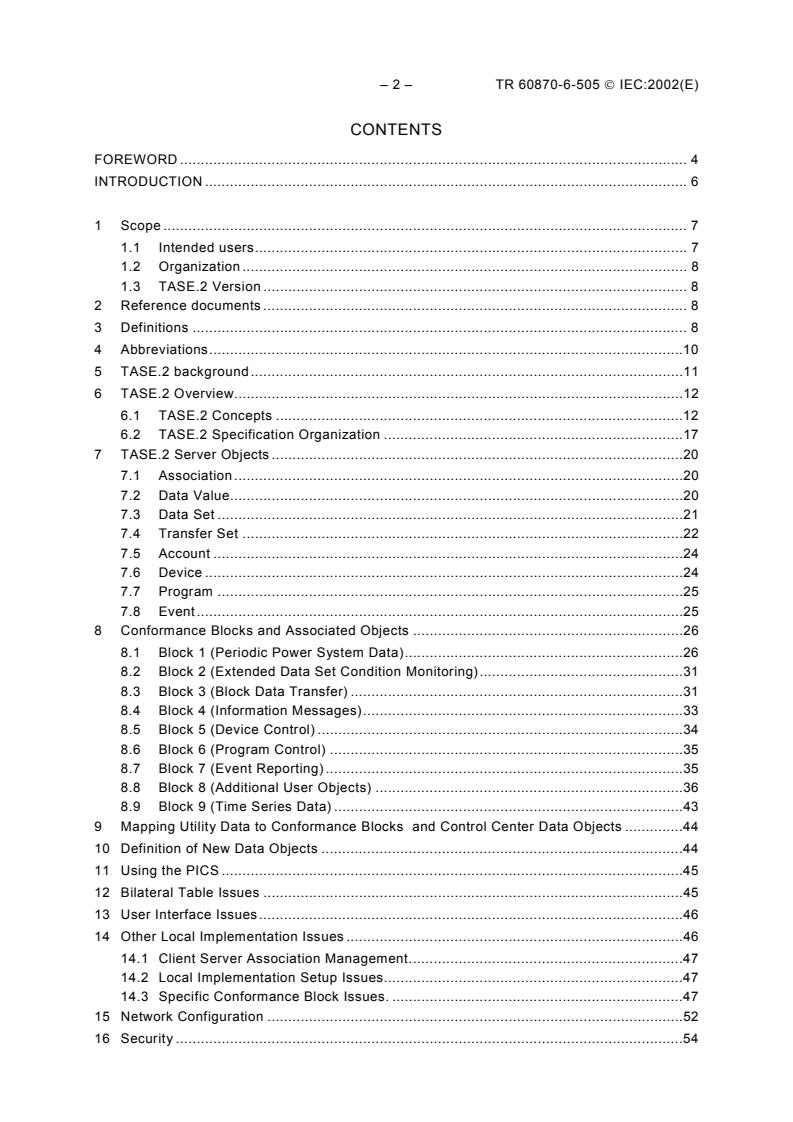
CONTENTS
FOREWORD . 4
INTRODUCTION .6
1 Scope . 7
1.1 Intended users. 7
1.2 Organization . 8
1.3 TASE.2 Version . 8
2 Reference documents . 8
3 Definitions . 8
4 Abbreviations.10
5 TASE.2 background .11
6 TASE.2 Overview.12
6.1 TASE.2 Concepts .12
6.2 TASE.2 Specification Organization .17
7 TASE.2 Server Objects .20
7.1 Association.20
7.2 Data Value.20
7.3 Data Set .21
7.4 Transfer Set .22
7.5 Account .24
7.6 Device .24
7.7 Program .25
7.8 Event.25
8 Conformance Blocks and Associated Objects .26
8.1 Block 1 (Periodic Power System Data).26
8.2 Block 2 (Extended Data Set Condition Monitoring).31
8.3 Block 3 (Block Data Transfer) .31
8.4 Block 4 (Information Messages).33
8.5 Block 5 (Device Control) .34
8.6 Block 6 (Program Control) .35
8.7 Block 7 (Event Reporting) .35
8.8 Block 8 (Additional User Objects) .36
8.9 Block 9 (Time Series Data) .43
9 Mapping Utility Data to Conformance Blocks and Control Center Data Objects .44
10 Definition of New Data Objects .44
11 Using the PICS .45
12 Bilateral Table Issues .45
13 User Interface Issues.46
14 Other Local Implementation Issues .46
14.1 Client Server Association Management.47
14.2 Local Implementation Setup Issues.47
14.3 Specific Conformance Block Issues. .47
15 Network Configuration .52
16 Security .54
TR 60870-6-505 IEC:2002(E) – 3 –
17 Profiles .54
17.1 OSI.54
17.2 TCP/IP.54
18 Procurement of TASE.2 .55
18.1 Preparing a Procurement Specification .55
18.2 Network Interface Control Document .56
19 Management of a TASE.2 Network .56
19.1 Configuration Management .56
19.2 Performance Management.57
19.3 Fault Management.57
20 Inter-Operability.57
20.1 Summary of Interoperability Tests.58
20.2 Version Compatibility.59
20.3 User Object Compatibility .59
Bibliography.60
Figure 1 – TASE.2 Protocol Architecture .12
Figure 2 – Application Program Interface (API) .13
Figure 3 – TASE.2 Client/Server Model with Multiple Associations .15
Figure 4 – TASE.2 Object Models .16
Figure 5 – Transfer Account Data Object Model Structure .38
Figure 6 – Example of Transfer Account Data Object Use .39
Figure 7 – Example of AGC Regulation Capacity Report using the General Data
Report Object.42
– 4 – TR 60870-6-505 IEC:2002(E)
INTERNATIONAL ELECTROTECHNICAL COMMISSION
____________
TELECONTROL EQUIPMENT AND SYSTEMS –
Part 6-505: Telecontrol protocols compatible with
ISO standards and ITU-T recommendations –
TASE.2 User guide
FOREWORD
1) The IEC (International Electrotechnical Commission) is a worldwide organization for standardization comprising
all national electrotechnical committees (IEC National Committees). The object of the IEC is to promote
international co-operation on all questions concerning standardization in the electrical and electronic fields. To
this end and in addition to other activities, the IEC publishes International Standards. Their preparation is
entrusted to technical committees; any IEC National Committee interested in the subject dealt with may
participate in this preparatory work. International, governmental and non-governmental organizations liaising
with the IEC also participate in this preparation. The IEC collaborates closely with the International
Organization for Standardization (ISO) in accordance with conditions determined by agreement between the
two organizations.
2) The formal decisions or agreements of the IEC on technical matters express, as nearly as possible, an
international consensus of opinion on the relevant subjects since each technical committee has representation
from all interested National Committees.
3) The documents produced have the form of recommendations for international use and are published in the form
of standards, technical specifications, technical reports or guides and they are accepted by the National
Committees in that sense.
4) In order to promote international unification, IEC National Committees undertake to apply IEC International
Standards transparently to the maximum extent possible in their national and regional standards. Any
divergence between the IEC Standard and the corresponding national or regional standard shall be clearly
indicated in the latter.
5) The IEC provides no marking procedure to indicate its approval and cannot be rendered responsible for any
equipment declared to be in conformity with one of its standards.
6) Attention is drawn to the possibility that some of the elements of this technical report may be the subject of
patent rights. The IEC shall not be held responsible for identifying any or all such patent rights.
The main task of IEC technical committees is to prepare International Standards. However, a
technical committee may propose the publication of a technical report when it has collected
data of a different kind from that which is normally published as an International Standard, for
example “state of the art”.
Technical reports do not necessarily have to be reviewed until the data they provide are
considered to be no longer valid or useful by the maintenance team.
IEC 60870-6-505, which is a technical report, has been prepared by IEC technical
committee 57: Power system control and associated communications.
The text of this technical report is based on the following documents:
Enquiry draft Report on voting
57/548/CDV 57/580/RVC
Full information on the voting for the approval of this technical report can be found in the
report on voting indicated in the above table.
This publication has been drafted in accordance with the ISO/IEC Directives, Part 2.
This document, which is purely informative, is not to be regarded as an International Standard.
TR 60870-6-505 IEC:2002(E) – 5 –
The committee has decided that the contents of this publication will remain unchanged until 2007.
At this date, the publication will be
• reconfirmed;
• withdrawn;
• replaced by a revised edition, or
• amended.
– 6 – TR 60870-6-505 IEC:2002(E)
INTRODUCTION
A large number of utilities use the Telecontrol Application Service Element.2 (TASE.2), an
international standard protocol for communication of real-time data. TASE.2 provides a
common means for all utilities to exchange data between not only control centers, but power
plants and substations as well. The adoption of TASE.2 has lead to the availability of
competitively priced data communication products based on TASE.2 from multiple vendors at
a fraction of the cost of a proprietary system. This report provides guidance for utility users
who are evaluating, procuring, and configuring TASE.2, as well as aid to vendors
implementing TASE.2 in their products. The individual server and data objects comprising
TASE.2 are described, with cross references to the specification. This provides the reader the
basic understanding needed to use the TASE.2 specifications in an informed manner.
The guide then addresses practical issues that arise in connection with TASE.2 use.
TR 60870-6-505 IEC:2002(E) – 7 –
TELECONTROL EQUIPMENT AND SYSTEMS –
Part 6-505: Telecontrol protocols compatible with
ISO standards and ITU-T recommendations –
TASE.2 User guide
1 Scope
This technical report provides a set of guidelines on the use of the following TASE.2
international standards:
IEC 60870-6-503
IEC 60870-6-702
IEC 60870-6-802
These standards specify a method of exchanging time-critical control center data through
wide- and local-area networks using a full ISO compliant protocol stack. They contain
provisions for supporting both centralized and distributed architectures. These standards
include the exchange of real-time indications, control operations, time series data, scheduling
and accounting information, unstructured ASCII or binary files, remote program control, and
event notification.
However, the style of the TASE.2 standards may make them somewhat difficult to read for
someone either not familiar with the precise syntax of the language used to describe the
protocol or with all the background leading up to the development of these specifications.
Furthermore, certain types of information that may be very useful to a user of TASE.2 but not
necessary for specifying the protocol or services provided by TASE.2 have been omitted.
Thus the need for this User Guide.
1.1 Intended users
This User Guide is intended for a broad audience of readers from an end user trying to decide
if TASE.2 is appropriate for their data transfer needs to a vendor planning to implement
TASE.2, with the goal of offering a TASE.2 product. In particular, this guide should be helpful
to the following:
• An end user, such as an electric utility, with the need to transfer real-time data to another
utility or utilities or to another internal control center, who is trying to evaluate which
protocol is the most appropriate.
• An end user who has already decided to use TASE.2 and now needs guidance in how to
procure TASE.2.
• An end user who has procured TASE.2 and is now concerned about how to map their
actual data into TASE.2 data objects exactly.
• An end user who is looking for conventions and answers to practical questions regarding
configuring TASE.2 software and networks.
• A vendor with a project to implement the TASE.2 specification either as a special project
or to offer a standard product.
– 8 – TR 60870-6-505 IEC:2002(E)
1.2 Organization
This guide first introduces the background and concepts of TASE.2 to provide a framework for
understanding the TASE.2 specification. Then the individual server and data objects
comprising TASE.2 are described with cross references into the specification. At this point,
(i.e., Clauses 1-8) the reader should have all the necessary basic understanding to use the
TASE.2 specifications intelligently. The remainder of the guide (Clauses 9-20) address
practical issues that arise in connection with the use of TASE.2.
1.3 TASE.2 Version
This edition of the TASE.2 User Guide was prepared using the Second Edition of the TASE.2
standards, which at the time of the preparation of this report was the 2000 edition.
2 Reference documents
The following referenced documents are indispensable for the application of this document.
For dated references, only the edition cited applies. For undated references, the latest edition
of the referenced document (including any amendments) applies.
IEC 60870-5-101:1995, Telecontrol equipment and systems – Part 5: Transmission protocols -
Section 101: Companion standard for basic telecontrol tasks
IEC 60870-6-503:2002, Telecontrol equipment and systems – Part 6-503: Telecontrol
protocols compatible with ISO standards and ITU-T recommendations – TASE.2 Services and
protocol
IEC 60870-6-702:1998, Telecontrol equipment and systems – Part 6-702: Telecontrol
protocols compatible which ISO standards and ITU-T recommendations – Functional profile
for providing the TASE.2 application service in end systems
IEC 60870-6-802:2002, Telecontrol equipment and systems – Part 6-802: Telecontrol
protocols compatible with ISO standards and ITU-T recommendations – TASE.2 Object
models
ISO/IEC 8802-2:1998, Information technology – Telecommunications and information
exchange between systems – Local and metropolitan area networks – Specific requirements –
Part 2: Logical link control
ISO/IEC 9506 (all parts), Industrial automation systems – Manufacturing message
specification
3 Definitions
For the purposes of this technical report, the following definitions apply.
3.1
action
activity performed by the TASE.2 server triggered by some local predefined stimulus or set
of circumstances
3.2
accounting information
set of information which describes an account for a utility. See IEC 60870-6-802 for
more details
TR 60870-6-505 IEC:2002(E) – 9 –
3.3
bilateral agreement
agreement between two control centers which identifies the data elements and objects that
can be accessed and the level of access permitted
3.4
bilateral table
computer representation of the Bilateral Agreement. The representation used is a local matter
3.5
client
TASE.2 user who requests services or objects owned by another TASE.2 user acting as
a server. The client is a communicating entity which makes use of the VCC for the lifetime
of an association via one or more TASE.2 service requests
3.6
data set
object which provides services to group data values for singular operations by a TASE.2 client
3.7
data value
object which represents some alphanumeric quantity that is part of the Virtual Control Center
(VCC) which is visible to a TASE.2 user. Data Values exist as part of the implementation
of the control center and represent either real entities within the utility such as current, or
derived values calculated in the control center. Data Value objects include services for
accessing and managing them
3.8
instance
implementation of TASE.2 executed in either the client or the server role
3.9
interchange schedule
set of information that specifies how energy is transferred from one system to another. See
IEC 60870-6-802 for more details
3.10
object
abstract entity used to implement the TASE.2 protocol and to represent data and optionally
provide services for accessing that data within a VCC
3.11
object model
abstract representation that is used for real data, devices, operator stations, programs, event
conditions, and event enrollments
3.12
operation
activity which is performed by the TASE.2 server at the request of the TASE.2 client
3.13
server
TASE.2 user that is the source of data and provides services for accessing that data.
A TASE.2 server behaves as a VCC over the lifetime of an association
3.14
service
activity which is either a TASE.2 action or operation
– 10 – TR 60870-6-505 IEC:2002(E)
3.15
tagged
the term is derived from the practice of putting a physical tag on a device as it is turned off for
servicing or locked out from network access as a safety measure. The TASE.2 term tagged is
used to signal such a condition to the TASE.2 user
3.16
time series
set of values of a given element that is taken at different times as specified by a single time
interval. A time series is implemented through the transfer set mechanism as defined within
this specification
3.17
transfer account
set of information that associates interchange scheduling information with either hourly or
profile data
3.18
transfer conditions
events or circumstances under which a TASE.2 server reports the values of a data set, values
in a time series, or all transfer account information
3.19
transfer set
object used to control data exchange by associating data values with transmission parameters
such as time intervals, for example. There are four types of Transfer Sets: Data Set Transfer
Sets, Time Series Transfer Sets, Transfer Account Transfer Sets, and information Message
Transfer Sets
3.20
user
implementation of TASE.2 executed in either the client or the server role
3.21
Virtual Control Center (VCC)
abstract representation of a real control center which describes a set of behaviour with
regards to communication and data management functionality and limitations. VCC is a
concept taken from the underlying MMS services
4 Abbreviations
For the purpose of this standard, the following abbreviations apply.
ACSE Association Control Service Element
API Application Program Interface
BCD Binary Coded Decimal
COV Change Of Value
DIS Draft International Standard
EPRI Electric Power Research Institute
HLO Hot line order
ICC Inter-Control Center
ICCP Inter-Control Center Communications Protocol
IDEC Inter-utility Data Exchange Consortium
IP Internet Protocol
TR 60870-6-505 IEC:2002(E) – 11 –
KQH Kilovar hour readings
KWH Kilowatt hour readings
LFC Load Following
MMS Manufacturing Messaging Specification
MOD Motor operated disconnect
PDU Protocol Data Unit
QOS Quality of Service
RBE Report by Exception
ROSE Remote Operations Service Element
TAL Time Allowed to Live
TASE Tele-control Application Service Element, (IEC’s designation of an international
standard protocol for utility data exchange)
TASE.1 TASE based on the ELCOM-90 protocol
TASE.2 TASE based on the ICCP protocol
TCP Transmission Control Protocol
TLE Time Limit for Execution
TOD Time of Day
UCA Utility Communications Architecture
UCS Utility Communications Standards working group
UDP User Datagram Protocol
VCC Virtual Control Center
VMD Virtual Manufacturing Device
WSCC Western System Coordinating Council
WEICG WSCC Energy Management Systems Inter-utility Communications Guidelines
5 TASE.2 background
Inter-utility real-time data exchange has become critical to the operation of inter-connected
systems within the electric power utility industry. The ability to exchange power system data
with boundary control areas and beyond provides visibility for disturbance detection and
reconstruction, improved modelling capability and enhanced operation through future security
control centers or independent system operators.
Historically, utilities have relied on in-house or proprietary, non-IS standard protocols such as
those developed by the Western Systems Coordinating Council (WSCC), ELCOM, and the
Inter-utility Data Exchange Consortium (IDEC) to exchange real-time data. TASE.2 began as
an effort by power utilities, several major data exchange protocol support groups for the
protocols mentioned above, EPRI, consultants and a number of SCADA/EMS and protocol
vendors to develop a comprehensive, international standard for real-time data exchange
within the electric power utilities industry.
By giving all interested parties an opportunity to provide requirements input and to participate
in the protocol definition process, it was expected that the final product would both meet the
needs of and be accepted by the electric power utility industry. To accomplish this goal, the
Utility Communications Specification (UCS) Working Group was formed in September 1991 to:
1) develop the protocol specification;
2) develop a prototype implementation to test the specification;
3) submit the specification for standardization;
4) perform inter-operability tests among the developing vendors.
– 12 – TR 60870-6-505 IEC:2002(E)
UCS submitted TASE.2 to the IEC Technical Committee (TC) 57 Working Group (WG) 07 as a
proposed protocol standard. Another proposed standard based on ELCOM-90 over ROSE was
also being considered by WG 07. TC 57 decided on a multi-standard approach to allow (1) a
quick implementation to meet European Common Market requirements by 1992 and (2) also
allow long term development of a more comprehensive protocol. The first protocol was
designated TASE.1 (Telecontrol Application Service Element-1). The second protocol, based
on TASE.2 over MMS, was designated TASE.2.
Successful first implementations of TASE.2 between SCADA/EMS control centers led to
further expansion to allow communications between control centers and power plants. This
expansion did not impact the basic services, but did lead to the development of specific power
plant objects. These objects were incorporated into TASE.2. Similarly, protection event data
objects were also added to support substation communications. The second edition of the
TASE.2 standards also includes one new object for the exchange of general data reports and
another new object for sending acknowledgements of complex data objects.
6 TASE.2 Overview
6.1 TASE.2 Concepts
6.1.1 Protocol Architecture
TASE.2 maximizes the use of existing standard protocols in all layers up to and including the
lower layers of layer 7 in the OSI reference model. This has the benefit of requiring new
protocol development for TASE.2 only in the upper sublayer of layer 7.
The protocol stack used by TASE.2 is shown in Figure 1. The upper three layers conform to
the standard 7-layer OSI protocol stack with control center applications at the top. TASE.2
specifies the use of the Manufacturing Messaging Specification (MMS) for the messaging
services needed by TASE.2 in layer 7. MMS specifies the mechanics of naming, listing, and
addressing variables, and of message control and interpretation, while TASE.2 specifies such
things as the control center object formats and methods for data requests and reporting.
Applications at different control centers, possibly written by different vendors, but both
conforming to these mechanics, formats, and methods, may interoperate to share data,
control utility devices, output information messages, or define and execute remote programs.
Application ICCP IEC 60870-6-503/802
MMS
ACSE
Presentation ISO Presentation
Session ISO Session
Transport ISO Transport Class 4 | TCP
Network ISO CLNP | IP
Data Link ISO 8802-2 LLC, FDDI, FR, ISDN, etc.
Physical Ethernet LAN, WAN, Point-to-Point Circuit, ATM, SDH, etc.
Figure 1 – TASE.2 Protocol Architecture
TASE.2 also utilizes the services of the Application Control Service Element (ACSE) in layer 7
to establish and manage logical associations or connections between sites. TASE.2 relies on
the ISO Presentation Layer 6 and Session Layer 5 as well.
TR 60870-6-505 IEC:2002(E) – 13 –
Because of the protocol architecture, TASE.2 is independent of the lower layers, so that as
new protocols evolve in the lower layers, TASE.2 will be able to operate over them with only
configuration changes. Thus TASE.2 is able to operate over either an ISO-compliant transport
layer or a TCP/IP transport service, as long as ISO layers 5-7 are maintained.
IEC 60870-6-702, which is a Protocol Conformance Protocol Specification (PICS), provides
details on the requirements of each of the protocols in Layers 5-7. This information is
especially important to protocol stack providers.
6.1.2 Application Program Interface (API)
An Application Program Interface (API) is not specified in the TASE.2 specification – only the
protocol and service definitions are specified and are the subject of standardization. Each
vendor implementing TASE.2 is free to choose the API most suitable for their product or for
their intended customers. Figure 2 illustrates this concept.
For example, an Energy Management System/Supervisory Control And Data Acquisition
(EMS/SCADA) vendor may choose to provide an API optimized for interfacing with several
different types of applications, such as:
– A proprietary real-time SCADA database for the storing and retrieving of real-time power
system data, such as analogs, status, and accumulator values, on a periodic basis or
when a value changes
– A Relational Data Base Management System (RDBMS) for the storing and retrieving of
historical or other non-real time data, or of Block 8 transfer account or device outage data
objects.
– Scheduling and accounting applications to send, for example (1) interchange schedules
once an hour or once a day and (2) binary files containing accounting data spreadsheet
files.
– Dispatcher console operator message application and/or alarm processor application to
send ASCII text messages to be displayed on a dispatcher’s console display at another
control center
These are just a few examples of the types of APIs an EMS/SCADA vendor may provide for
its TASE.2 product. How they are implemented is considered a “local implementation issue” in
the TASE.2 specification. As long as the protocol services are implemented according to the
specification, interoperability is assured between different TASE.2 vendor’s products.
• Alarm processor
Accounting
•
• Interchange scheduling
Maintenance management
•
SCADA Data EMS Operator Network
RDBMS
acquisition
database applications console management
and control
APIs are not
Application program interface
standardized
TASE.2
MMS
OSI Layers 1-6
Figure 2 – Application Program Interface (API)
– 14 – TR 60870-6-505 IEC:2002(E)
6.1.3 Client/Server Model
TASE.2 is based on client/server concepts. All data transfers originate with a request from
a control center (the client) to another control center which owns and manages the data (the
server). For example, if a Control Center X application needs data from the Control Center
Y SCADA database, the Control Center X application acting as the client may request Control
Center Y acting as the server to send the data under conditions specified by the client.
There are various services provided in TASE.2 to accomplish data transfers, depending on
the type of request. For example, if the client makes a one-shot request, the data will be
returned as a response to the request. However, if the client makes a request for the periodic
transfer of data or the transfer of data only when it changes, then the client will first establish
the reporting mechanism with the server (i.e., specify reporting conditions such as periodicity
for periodic transfers or other trigger conditions such as report-by-exception only), and the
server will then send the data as an unsolicited report whenever the reporting conditions
are satisfied.
A control center may function as both a client and a server.
6.1.4 Multiple Associations and Sites
TASE.2 uses the ISO ACSE to establish logical associations. Multiple associations may be
established from a client to multiple, different control center servers. Although TASE.2 may
be operated over a point-to-point link, it is envisioned that most installations will operate over
a router-based Wide Area Network (WAN). As noted previously, TASE.2 is independent of the
underlying transport network, so any combination of subnetworks may comprise the WAN,
including the LANs within a site.
Multiple associations may also be established to the same control center for the purpose of
providing associations with different Quality Of Service (QOS). A TASE.2 client then uses the
association with the appropriate QOS for the operation to be performed. For example, to
ensure the real time data messages are not delayed by non-real data transfers, both a High
and Low priority association may be established, with a separate message queue for each.
TASE.2 will check the High priority message queue and service any messages queued before
servicing the Low priority message queue. This permits a common data link to be shared for
the transfer of both high priority SCADA data and lower priority information message
transfers.
Figure 3 illustrates a TASE.2 network serving four utilities. As shown, Utility A is a client to
server C (Association C1) and a server for four associations: two to client C (Association A1
and A2), one to client B (Association A3), and one to client D (Association A4). The
association to client B (A3) would presumably be accomplished via a router at utility C, but
could follow any path available if a WAN is provided to interconnect all utilities. Each of the
other utilities shown have similar associations established to meet their individual needs.
Utility D functions only as a client. Utilities B and C function as both clients and servers. The
point made by this diagram is that TASE.2 provides the capability for any type of
interconnectivity needed via configuration of the TASE.2 software.
Only a client is allowed to initially establish an association in TASE.2. When the TASE.2 users
at each end of an association are capable of being both a client and a server, then the side to
initiate the association is a system configuration issue.
TASE.2 optionally permits an established association to be used by either a client or server
application at a site, independent of how the association was established. How associations
are actually started and used in any actual configuration of TASE.2 is a system configuration
issue for each particular installation. However, if a site that can utilise one association for
both client-server directions (i.e., dual use) attempts to establish an association with a site
that does not support dual use, it is the responsibility of the dual use site to fall back to single
use associations.
TR 60870-6-505 IEC:2002(E) – 15 –
Client C (Hi Priority) - A1
Client C (Lo Priority) - A2
Security
Client A - C1
Utility A
Center C
Client B - A3
BLT-C
BLT-B
BLT-D
Client = requester of data or service
Trans.
Server = provider of data or service
Service
Utility B
Info.
Provider
D
Figure 3 – TASE.2 Client/Server Model with Multiple Associations
6.1.5 Access Control via Bilateral Tables
To provide access control, the server checks each client request to ensure that that particular
client has access rights to the data or capability requested. Access control is provided
through the use of Bilateral Tables (BLTs) defined for each TASE.2 client that has one or
more associations with a TASE.2 server. BLTs provide execute, read/write, read only, or no
access for each item (which includes data values, devices, and programs) that can be
requested by a client.
A BLT is the computer version of a bilateral agreement established by two control centers.
Each control center acting as a server specifies for each control center acting as a client
which objects it is willing to make available, and for each available object, which types of
access are supported. It is only necessary for the server to maintain the BLT on-line, which
serves as a kind of “shopping list” of available data objects from which the client can choose
using the TASE.2 protocol services. For example, as shown in Figure 3, Utility A acting as a
server maintains a separate BLT for each client utility (for example, Utilities B-D), providing
different access rights for each client utility.
Once an association is established, before any other operations are attempted, the TASE.2
client reads the BLT version attribute and the TASE.2 version attribute maintained at the
server. The client then compares the returned values with the values of its versions, and if
there is a mismatch with either attribute, the client is required to conclude the association until
the mismatches are resolved. Additionally, for any operations used by the TASE.2 client on
any data objects after the association has been established, if the TASE.2 server is using an
access control mechanism, it must perform the general validity check to ensure that all
identifiers referenced in the operation are valid and covered in the Bilateral Table.
If inconsistencies are detected in the bilateral tables applicable to a particular association, the
TASE.2 client may use the Get Data Value Names operation described in Subclause 7.2
below to obtain a list of the names of all the Data Value objects which it can access (as
defined in the BLT version at the TASE.2 server). These can then be compared to the list of
objects that the client believes should be accessible at that server. Any observed differences
should be addressed by the network administrator and resolved to obtain identical BLT
records at both the client and server.
Client D – A4
Client B - C2
Client C - B1
– 16 – TR 60870-6-505 IEC:2002(E)
6.1.6 Use of Object Models
Object model concepts are used in two different ways in TASE.2. Figure 4 illustrates these
concepts.
ICCP server objects
Control center
Data objects
Object models
Request
• Indication point
Operations
• Association
• Control point
Response
• Data value
• Protection equip
• Data set
• Information buffer
• Transfer set
• Account/schedule
• Account
• Device outage
• Device
Report • Power plant
Actions
• Program
• Event
Event
Figure 4 – TASE.2 Object Models
6.1.6.1 TASE.2 Server Objects
Firstly, all TASE.2 services are provided via TASE.2 server objects which may be thought of
as classical objects with data attributes and methods as defined in object-oriented design
methodologies. There are two basic types of methods in TASE.2 called operations and
actions. An operation is client-initiated via a request to a server, typically followed by a
response from the server. An action, on the other hand, is a server-initiated function. An
example of an action is the transfer of data via a report to a client in response to a timer
expiring or some other external event at the server, such as a change in status of a breaker.
IEC 60870-6-503 contains all the TASE.2 server object definitions. These objects are required
to implement the TASE.2 protocol and are sometimes referred to as “internal” objects.
Explanations of these objects is included in this guide in the TASE.2 Server Object
Description subclause.
6.1.6.2 TASE.2 Data Objects
Secondly, all other data and control elements typically exchanged between control centers
are defined as “data objects”. These range from simple to complex data structures. In contrast
to the “server objects”, these objects are not required to implement the TASE.2 protocol, and
so are sometimes referred to as “external” objects.
The standard Control Center Data Objects are defined in IEC 60870-6-802. They are also
described in this guide in the Conformance Block clause. Supported data types include
control messages, status, analogs, quality codes, schedules, text and simple files. Further-
more, additional data objects can be defined by TASE.2 users and transferred using existing
TASE.2 server objects with no change in the TASE.2 protocol software contained in
IEC 60870-6-503. The approach to defining new data objects is described in this guide
in Clause 10.
TR 60870-6-505 IEC:2002(E) – 17 –
6.1.6.3 Object Model Notation
The TASE.2 specification uses a formal method of describing objects. The first level is known
as an Abstract Object Model. This model comprises a Name for the model, followed by a list
of Attributes, headed by one Attribute known as a Key Attribute. In some cases, an Attribute
listed actually another object model inherited by the new object model. The meaning of each
attribute is provided after the formal object model is presented.
Some object models, especially those used to describe control center data objects, contain
Constraints, which provide alternative lists of Attributes within a single object model. These
Constraints thus provide some flexibility in how the object can be used. All abstract models
are described first in the specification.
Abstract object models then have to be mapped to concrete Structures with Components.
Each Component is mapped to a data type. The services are mapped to MMS services. This
must be specified to ensure that each implementer of TASE.2 uses the same data types and
MMS services to implement the abstract models so that interoperability can be achieved with
other vendor’s TASE.2 products.
Clause 7 describes in more detail the organization of the TASE.2 specification and the use of
these models.
6.1.7 Conformance Blocks and Services
Conformance blocks are defined for TASE.2 for server objects in Clause 9 of IEC 60870-6-
503 as a way of grouping TASE.2 objects together to provide fundamental types of services.
A vendor need not implement all defined conformance blocks (nine in all). However, any
implementation claiming conformance to TASE.2 must fully support Block 1, as defined in
Clause 8 of this guide. Likewise, a TASE.2 end user need not procure all TASE.2
conformance blocks, only the ones actually needed to meet the user’s data transfer
requirements.
Conformance blocks are also defined in Clause 9 of IEC 60870-6-802 for data objects as a
way of specifying which ser
...
IEC TR 60870-6-505 ®
Edition 1.1 2006-12
CONSOLIDATED VERSION
TECHNICAL
REPORT
Telecontrol equipment and systems –
Part 6-505: Telecontrol protocols compatible with ISO standards and ITU-T
recommendations – TASE.2 User guide
All rights reserved. Unless otherwise specified, no part of this publication may be reproduced or utilized in any form
or by any means, electronic or mechanical, including photocopying and microfilm, without permission in writing from
either IEC or IEC's member National Committee in the country of the requester.
If you have any questions about IEC copyright or have an enquiry about obtaining additional rights to this publication,
please contact the address below or your local IEC member National Committee for further information.
IEC Central Office Tel.: +41 22 919 02 11
3, rue de Varembé Fax: +41 22 919 03 00
CH-1211 Geneva 20 info@iec.ch
Switzerland www.iec.ch
About the IEC
The International Electrotechnical Commission (IEC) is the leading global organization that prepares and publishes
International Standards for all electrical, electronic and related technologies.
About IEC publications
The technical content of IEC publications is kept under constant review by the IEC. Please make sure that you have the
latest edition, a corrigenda or an amendment might have been published.
Useful links:
IEC publications search - www.iec.ch/searchpub Electropedia - www.electropedia.org
The advanced search enables you to find IEC publications The world's leading online dictionary of electronic and
by a variety of criteria (reference number, text, technical electrical terms containing more than 30 000 terms and
committee,…). definitions in English and French, with equivalent terms in
It also gives information on projects, replaced and additional languages. Also known as the International
withdrawn publications. Electrotechnical Vocabulary (IEV) on-line.
IEC Just Published - webstore.iec.ch/justpublished Customer Service Centre - webstore.iec.ch/csc
Stay up to date on all new IEC publications. Just Published If you wish to give us your feedback on this publication
details all new publications released. Available on-line and or need further assistance, please contact the
also once a month by email. Customer Service Centre: csc@iec.ch.
IEC TR 60870-6-505 ®
Edition 1.1 2006-12
CONSOLIDATED VERSION
TECHNICAL
REPORT
Telecontrol equipment and systems –
Part 6-505: Telecontrol protocols compatible with ISO standards and ITU-T
recommendations – TASE.2 User guide
INTERNATIONAL
ELECTROTECHNICAL
COMMISSION
ICS 33.200 ISBN 2-8318-8304-0
– 2 – TR 60870-6-505 © IEC:2002+A1:2005(E)
CONTENTS
FOREWORD.4
INTRODUCTION.6
1 Scope.7
1.1 Intended users.7
1.2 Organization.8
1.3 TASE.2 Version.8
2 Reference documents.8
3 Definitions.8
4 Abbreviations.10
5 TASE.2 background.11
6 TASE.2 Overview.12
6.1 TASE.2 Concepts.12
6.2 TASE.2 Specification Organization .17
7 TASE.2 Server Objects.20
7.1 Association.20
7.2 Data Value.20
7.3 Data Set.21
7.4 Transfer Set.22
7.5 Account.24
7.6 Device.24
7.7 Program .25
7.8 Event.25
8 Conformance Blocks and Associated Objects .26
8.1 Block 1 (Periodic Power System Data) .26
8.2 Block 2 (Extended Data Set Condition Monitoring) .31
8.3 Block 3 (Block Data Transfer).31
8.4 Block 4 (Information Messages) .33
8.5 Block 5 (Device Control).34
8.6 Block 6 (Program Control) .35
8.7 Block 7 (Event Reporting).35
8.8 Block 8 (Additional User Objects) .36
8.9 Block 9 (Time Series Data).43
9 Mapping Utility Data to Conformance Blocks and Control Center Data Objects .44
10 Definition of New Data Objects .44
11 Using the PICS.45
12 Bilateral Table Issues.45
13 User Interface Issues .46
14 Other Local Implementation Issues.46
14.1 Client Server Association Management. .47
14.2 Local Implementation Setup Issues. .47
14.3 Specific Conformance Block Issues.47
15 Network Configuration.52
16 Security.54
TR 60870-6-505 © IEC:2002+A1:2005(E) – 3 –
17 Profiles.54
17.1 OSI.54
17.2 TCP/IP.54
18 Procurement of TASE.2.55
18.1 Preparing a Procurement Specification.55
18.2 Network Interface Control Document .56
19 Management of a TASE.2 Network .56
19.1 Configuration Management.56
19.2 Performance Management.57
19.3 Fault Management.57
20 Inter-Operability .57
20.1 Summary of Interoperability Tests .58
20.2 Version Compatibility.59
20.3 User Object Compatibility.59
Annex A (informative) Power system model exchange with TASE.2 linkage .60
Annex B (informative) TASE.2 security recommendations.64
Annex C (informative) TASE.2 User’s guide implementation recommendations.72
Bibliography.80
Figure 1 – TASE.2 Protocol Architecture.12
Figure 2 – Application Program Interface (API) .13
Figure 3 – TASE.2 Client/Server Model with Multiple Associations.15
Figure 4 – TASE.2 Object Models .16
Figure 5 – Transfer Account Data Object Model Structure.38
Figure 6 – Example of Transfer Account Data Object Use.39
Figure 7 – Example of AGC Regulation Capacity Report using the General Data
Report Object .42
Figure A.1 – Use case diagram .63
Figure B.1 – TASE.2 standard profile.70
Figure B.2 – TASE.2 secure profile .70
Figure C.1 – Validity processing .75
Figure C.2 – Current source processing.76
Figure C.3 – Normal value processing .77
– 4 – TR 60870-6-505 © IEC:2002+A1:2005(E)
INTERNATIONAL ELECTROTECHNICAL COMMISSION
____________
TELECONTROL EQUIPMENT AND SYSTEMS –
Part 6-505: Telecontrol protocols compatible with
ISO standards and ITU-T recommendations –
TASE.2 User guide
FOREWORD
1) The International Electrotechnical Commission (IEC) is a worldwide organization for standardization comprising
all national electrotechnical committees (IEC National Committees). The object of IEC is to promote
international co-operation on all questions concerning standardization in the electrical and electronic fields. To
this end and in addition to other activities, IEC publishes International Standards, Technical Specifications,
Technical Reports, Publicly Available Specifications (PAS) and Guides (hereafter referred to as “IEC
Publication(s)”). Their preparation is entrusted to technical committees; any IEC National Committee interested
in the subject dealt with may participate in this preparatory work. International, governmental and non-
governmental organizations liaising with the IEC also participate in this preparation. IEC collaborates closely
with the International Organization for Standardization (ISO) in accordance with conditions determined by
agreement between the two organizations.
2) The formal decisions or agreements of IEC on technical matters express, as nearly as possible, an international
consensus of opinion on the relevant subjects since each technical committee has representation from all
interested IEC National Committees.
3) IEC Publications have the form of recommendations for international use and are accepted by IEC National
Committees in that sense. While all reasonable efforts are made to ensure that the technical content of IEC
Publications is accurate, IEC cannot be held responsible for the way in which they are used or for any
misinterpretation by any end user.
4) In order to promote international uniformity, IEC National Committees undertake to apply IEC Publications
transparently to the maximum extent possible in their national and regional publications. Any divergence
between any IEC Publication and the corresponding national or regional publication shall be clearly indicated in
the latter.
5) IEC provides no marking procedure to indicate its approval and cannot be rendered responsible for any
equipment declared to be in conformity with an IEC Publication.
6) All users should ensure that they have the latest edition of this publication.
7) No liability shall attach to IEC or its directors, employees, servants or agents including individual experts and
members of its technical committees and IEC National Committees for any personal injury, property damage or
other damage of any nature whatsoever, whether direct or indirect, or for costs (including legal fees) and
expenses arising out of the publication, use of, or reliance upon, this IEC Publication or any other IEC
Publications.
8) Attention is drawn to the Normative references cited in this publication. Use of the referenced publications is
indispensable for the correct application of this publication.
9) Attention is drawn to the possibility that some of the elements of this IEC Publication may be the subject of
patent rights. IEC shall not be held responsible for identifying any or all such patent rights.
This consolidated version of the official IEC Standard and its amendment has been
prepared for user convenience.
IEC 60870-6-505 edition 1.1 contains the first edition (2002) [documents 57/548/CDV and
57/580/RVC] and its amendment 1 (2005) [documents 57/663/DTR + 57/730/DTR and
57/695/RVC + 57/737/RVC].
A vertical line in the margin shows where the base publication has been modified by
amendment 1.
The main task of IEC technical committees is to prepare International Standards. However, a
technical committee may propose the publication of a technical report when it has collected
data of a different kind from that which is normally published as an International Standard, for
example "state of the art".
IEC 60870-6-505, which is a technical report, has been prepared by IEC technical committee
57: Power systems management and associated information exchange.
TR 60870-6-505 © IEC:2002+A1:2005(E) – 5 –
This publication has been drafted in accordance with the ISO/IEC Directives, Part 2.
The committee has decided that the contents of the base publication and its amendments will
remain unchanged until the maintenance result date indicated on the IEC web site under
"http://webstore.iec.ch" in the data related to the specific publication. At this date,
the publication will be
• reconfirmed,
• withdrawn,
• replaced by a revised edition, or
• amended.
– 6 – TR 60870-6-505 © IEC:2002+A1:2005(E)
INTRODUCTION
A large number of utilities use the Telecontrol Application Service Element.2 (TASE.2), an
international standard protocol for communication of real-time data. TASE.2 provides a
common means for all utilities to exchange data between not only control centers, but power
plants and substations as well. The adoption of TASE.2 has lead to the availability of
competitively priced data communication products based on TASE.2 from multiple vendors at
a fraction of the cost of a proprietary system. This report provides guidance for utility users
who are evaluating, procuring, and configuring TASE.2, as well as aid to vendors
implementing TASE.2 in their products. The individual server and data objects comprising
TASE.2 are described, with cross references to the specification. This provides the reader the
basic understanding needed to use the TASE.2 specifications in an informed manner.
The guide then addresses practical issues that arise in connection with TASE.2 use.
TR 60870-6-505 © IEC:2002+A1:2005(E) – 7 –
TELECONTROL EQUIPMENT AND SYSTEMS –
Part 6-505: Telecontrol protocols compatible with
ISO standards and ITU-T recommendations –
TASE.2 User guide
1 Scope
This technical report provides a set of guidelines on the use of the following TASE.2
international standards:
IEC 60870-6-503
IEC 60870-6-702
IEC 60870-6-802
These standards specify a method of exchanging time-critical control center data through
wide- and local-area networks using a full ISO compliant protocol stack. They contain
provisions for supporting both centralized and distributed architectures. These standards
include the exchange of real-time indications, control operations, time series data, scheduling
and accounting information, unstructured ASCII or binary files, remote program control, and
event notification.
However, the style of the TASE.2 standards may make them somewhat difficult to read for
someone either not familiar with the precise syntax of the language used to describe the
protocol or with all the background leading up to the development of these specifications.
Furthermore, certain types of information that may be very useful to a user of TASE.2 but not
necessary for specifying the protocol or services provided by TASE.2 have been omitted.
Thus the need for this User Guide.
1.1 Intended users
This User Guide is intended for a broad audience of readers from an end user trying to decide
if TASE.2 is appropriate for their data transfer needs to a vendor planning to implement
TASE.2, with the goal of offering a TASE.2 product. In particular, this guide should be helpful
to the following:
• An end user, such as an electric utility, with the need to transfer real-time data to another
utility or utilities or to another internal control center, who is trying to evaluate which
protocol is the most appropriate.
• An end user who has already decided to use TASE.2 and now needs guidance in how to
procure TASE.2.
• An end user who has procured TASE.2 and is now concerned about how to map their
actual data into TASE.2 data objects exactly.
• An end user who is looking for conventions and answers to practical questions regarding
configuring TASE.2 software and networks.
• A vendor with a project to implement the TASE.2 specification either as a special project
or to offer a standard product.
– 8 – TR 60870-6-505 © IEC:2002+A1:2005(E)
1.2 Organization
This guide first introduces the background and concepts of TASE.2 to provide a framework for
understanding the TASE.2 specification. Then the individual server and data objects
comprising TASE.2 are described with cross references into the specification. At this point,
(i.e., Clauses 1-8) the reader should have all the necessary basic understanding to use the
TASE.2 specifications intelligently. The remainder of the guide (Clauses 9-20) address
practical issues that arise in connection with the use of TASE.2.
1.3 TASE.2 Version
This edition of the TASE.2 User Guide was prepared using the Second Edition of the TASE.2
standards, which at the time of the preparation of this report was the 2000 edition.
2 Reference documents
The following referenced documents are indispensable for the application of this document.
For dated references, only the edition cited applies. For undated references, the latest edition
of the referenced document (including any amendments) applies.
IEC 60870-5-101:1995, Telecontrol equipment and systems – Part 5: Transmission protocols -
Section 101: Companion standard for basic telecontrol tasks
IEC 60870-6-503:2002, Telecontrol equipment and systems – Part 6-503: Telecontrol
protocols compatible with ISO standards and ITU-T recommendations – TASE.2 Services and
protocol
IEC 60870-6-702:1998, Telecontrol equipment and systems – Part 6-702: Telecontrol
protocols compatible which ISO standards and ITU-T recommendations – Functional profile
for providing the TASE.2 application service in end systems
IEC 60870-6-802:2002, Telecontrol equipment and systems – Part 6-802: Telecontrol
protocols compatible with ISO standards and ITU-T recommendations – TASE.2 Object
models
ISO/IEC 8802-2:1998, Information technology – Telecommunications and information
exchange between systems – Local and metropolitan area networks – Specific requirements –
Part 2: Logical link control
ISO/IEC 9506 (all parts), Industrial automation systems – Manufacturing message
specification
3 Definitions
For the purposes of this technical report, the following definitions apply.
3.1
action
activity performed by the TASE.2 server triggered by some local predefined stimulus or set
of circumstances
3.2
accounting information
set of information which describes an account for a utility. See IEC 60870-6-802 for
more details
TR 60870-6-505 © IEC:2002+A1:2005(E) – 9 –
3.3
bilateral agreement
agreement between two control centers which identifies the data elements and objects that
can be accessed and the level of access permitted
3.4
bilateral table
computer representation of the Bilateral Agreement. The representation used is a local matter
3.5
client
TASE.2 user who requests services or objects owned by another TASE.2 user acting as
a server. The client is a communicating entity which makes use of the VCC for the lifetime
of an association via one or more TASE.2 service requests
3.6
data set
object which provides services to group data values for singular operations by a TASE.2 client
3.7
data value
object which represents some alphanumeric quantity that is part of the Virtual Control Center
(VCC) which is visible to a TASE.2 user. Data Values exist as part of the implementation
of the control center and represent either real entities within the utility such as current, or
derived values calculated in the control center. Data Value objects include services for
accessing and managing them
3.8
instance
implementation of TASE.2 executed in either the client or the server role
3.9
interchange schedule
set of information that specifies how energy is transferred from one system to another. See
IEC 60870-6-802 for more details
3.10
object
abstract entity used to implement the TASE.2 protocol and to represent data and optionally
provide services for accessing that data within a VCC
3.11
object model
abstract representation that is used for real data, devices, operator stations, programs, event
conditions, and event enrollments
3.12
operation
activity which is performed by the TASE.2 server at the request of the TASE.2 client
3.13
server
TASE.2 user that is the source of data and provides services for accessing that data.
A TASE.2 server behaves as a VCC over the lifetime of an association
– 10 – TR 60870-6-505 © IEC:2002+A1:2005(E)
3.14
service
activity which is either a TASE.2 action or operation
3.15
tagged
the term is derived from the practice of putting a physical tag on a device as it is turned off for
servicing or locked out from network access as a safety measure. The TASE.2 term tagged is
used to signal such a condition to the TASE.2 user
3.16
time series
set of values of a given element that is taken at different times as specified by a single time
interval. A time series is implemented through the transfer set mechanism as defined within
this specification
3.17
transfer account
set of information that associates interchange scheduling information with either hourly or
profile data
3.18
transfer conditions
events or circumstances under which a TASE.2 server reports the values of a data set, values
in a time series, or all transfer account information
3.19
transfer set
object used to control data exchange by associating data values with transmission parameters such
as time intervals, for example. There are four types of Transfer Sets: Data Set Transfer Sets, Time
Series Transfer Sets, Transfer Account Transfer Sets, and information Message Transfer Sets
3.20
user
implementation of TASE.2 executed in either the client or the server role
3.21
Virtual Control Center (VCC)
abstract representation of a real control center which describes a set of behaviour with
regards to communication and data management functionality and limitations. VCC is a
concept taken from the underlying MMS services
4 Abbreviations
For the purpose of this standard, the following abbreviations apply.
ACSE Association Control Service Element
API Application Program Interface
BCD Binary Coded Decimal
COV Change Of Value
DIS Draft International Standard
EPRI Electric Power Research Institute
HLO Hot line order
ICC Inter-Control Center
ICCP Inter-Control Center Communications Protocol
IDEC Inter-utility Data Exchange Consortium
TR 60870-6-505 © IEC:2002+A1:2005(E) – 11 –
IP Internet Protocol
KQH Kilovar hour readings
KWH Kilowatt hour readings
LFC Load Following
MMS Manufacturing Messaging Specification
MOD Motor operated disconnect
PDU Protocol Data Unit
QOS Quality of Service
RBE Report by Exception
ROSE Remote Operations Service Element
TAL Time Allowed to Live
TASE Tele-control Application Service Element, (IEC’s designation of an international
standard protocol for utility data exchange)
TASE.1 TASE based on the ELCOM-90 protocol
TASE.2 TASE based on the ICCP protocol
TCP Transmission Control Protocol
TLE Time Limit for Execution
TOD Time of Day
UCA Utility Communications Architecture
UCS Utility Communications Standards working group
UDP User Datagram Protocol
VCC Virtual Control Center
VMD Virtual Manufacturing Device
WSCC Western System Coordinating Council
WEICG WSCC Energy Management Systems Inter-utility Communications Guidelines
5 TASE.2 background
Inter-utility real-time data exchange has become critical to the operation of inter-connected
systems within the electric power utility industry. The ability to exchange power system data
with boundary control areas and beyond provides visibility for disturbance detection and
reconstruction, improved modelling capability and enhanced operation through future security
control centers or independent system operators.
Historically, utilities have relied on in-house or proprietary, non-IS standard protocols such as
those developed by the Western Systems Coordinating Council (WSCC), ELCOM, and the
Inter-utility Data Exchange Consortium (IDEC) to exchange real-time data. TASE.2 began as
an effort by power utilities, several major data exchange protocol support groups for the
protocols mentioned above, EPRI, consultants and a number of SCADA/EMS and protocol
vendors to develop a comprehensive, international standard for real-time data exchange
within the electric power utilities industry.
By giving all interested parties an opportunity to provide requirements input and to participate
in the protocol definition process, it was expected that the final product would both meet the
needs of and be accepted by the electric power utility industry. To accomplish this goal, the
Utility Communications Specification (UCS) Working Group was formed in September 1991 to:
1) develop the protocol specification;
2) develop a prototype implementation to test the specification;
3) submit the specification for standardization;
4) perform inter-operability tests among the developing vendors.
– 12 – TR 60870-6-505 © IEC:2002+A1:2005(E)
UCS submitted TASE.2 to the IEC Technical Committee (TC) 57 Working Group (WG) 07 as a
proposed protocol standard. Another proposed standard based on ELCOM-90 over ROSE was
also being considered by WG 07. TC 57 decided on a multi-standard approach to allow (1) a
quick implementation to meet European Common Market requirements by 1992 and (2) also
allow long term development of a more comprehensive protocol. The first protocol was
designated TASE.1 (Telecontrol Application Service Element-1). The second protocol, based
on TASE.2 over MMS, was designated TASE.2.
Successful first implementations of TASE.2 between SCADA/EMS control centers led to
further expansion to allow communications between control centers and power plants. This
expansion did not impact the basic services, but did lead to the development of specific power
plant objects. These objects were incorporated into TASE.2. Similarly, protection event data
objects were also added to support substation communications. The second edition of the
TASE.2 standards also includes one new object for the exchange of general data reports and
another new object for sending acknowledgements of complex data objects.
6 TASE.2 Overview
6.1 TASE.2 Concepts
6.1.1 Protocol Architecture
TASE.2 maximizes the use of existing standard protocols in all layers up to and including the
lower layers of layer 7 in the OSI reference model. This has the benefit of requiring new
protocol development for TASE.2 only in the upper sublayer of layer 7.
The protocol stack used by TASE.2 is shown in Figure 1. The upper three layers conform to
the standard 7-layer OSI protocol stack with control center applications at the top. TASE.2
specifies the use of the Manufacturing Messaging Specification (MMS) for the messaging
services needed by TASE.2 in layer 7. MMS specifies the mechanics of naming, listing, and
addressing variables, and of message control and interpretation, while TASE.2 specifies such
things as the control center object formats and methods for data requests and reporting.
Applications at different control centers, possibly written by different vendors, but both
conforming to these mechanics, formats, and methods, may interoperate to share data,
control utility devices, output information messages, or define and execute remote programs.
Application ICCP IEC 60870-6-503/802
MMS
ACSE
Presentation ISO Presentation
Session ISO Session
Transport ISO Transport Class 4 | TCP
Network ISO CLNP | IP
Data Link ISO 8802-2 LLC, FDDI, FR, ISDN, etc.
Physical Ethernet LAN, WAN, Point-to-Point Circuit, ATM, SDH, etc.
Figure 1 – TASE.2 Protocol Architecture
TASE.2 also utilizes the services of the Application Control Service Element (ACSE) in layer 7
to establish and manage logical associations or connections between sites. TASE.2 relies on
the ISO Presentation Layer 6 and Session Layer 5 as well.
TR 60870-6-505 © IEC:2002+A1:2005(E) – 13 –
Because of the protocol architecture, TASE.2 is independent of the lower layers, so that as
new protocols evolve in the lower layers, TASE.2 will be able to operate over them with only
configuration changes. Thus TASE.2 is able to operate over either an ISO-compliant transport
layer or a TCP/IP transport service, as long as ISO layers 5-7 are maintained.
IEC 60870-6-702, which is a Protocol Conformance Protocol Specification (PICS), provides
details on the requirements of each of the protocols in Layers 5-7. This information is
especially important to protocol stack providers.
6.1.2 Application Program Interface (API)
An Application Program Interface (API) is not specified in the TASE.2 specification – only the
protocol and service definitions are specified and are the subject of standardization. Each
vendor implementing TASE.2 is free to choose the API most suitable for their product or for
their intended customers. Figure 2 illustrates this concept.
For example, an Energy Management System/Supervisory Control And Data Acquisition
(EMS/SCADA) vendor may choose to provide an API optimized for interfacing with several
different types of applications, such as:
– A proprietary real-time SCADA database for the storing and retrieving of real-time power
system data, such as analogs, status, and accumulator values, on a periodic basis or
when a value changes
– A Relational Data Base Management System (RDBMS) for the storing and retrieving of
historical or other non-real time data, or of Block 8 transfer account or device outage data
objects.
– Scheduling and accounting applications to send, for example (1) interchange schedules
once an hour or once a day and (2) binary files containing accounting data spreadsheet
files.
– Dispatcher console operator message application and/or alarm processor application to
send ASCII text messages to be displayed on a dispatcher’s console display at another
control center
These are just a few examples of the types of APIs an EMS/SCADA vendor may provide for
its TASE.2 product. How they are implemented is considered a “local implementation issue” in
the TASE.2 specification. As long as the protocol services are implemented according to the
specification, interoperability is assured between different TASE.2 vendor’s products.
• Alarm processor
• Accounting
• Interchange scheduling
Maintenance management
•
SCADA Data EMS Operator Network
RDBMS
acquisition
database applications console management
and control
APIs are not
Application program interface
standardized
TASE.2
MMS
OSI Layers 1-6
Figure 2 – Application Program Interface (API)
– 14 – TR 60870-6-505 © IEC:2002+A1:2005(E)
6.1.3 Client/Server Model
TASE.2 is based on client/server concepts. All data transfers originate with a request from
a control center (the client) to another control center which owns and manages the data (the
server). For example, if a Control Center X application needs data from the Control Center
Y SCADA database, the Control Center X application acting as the client may request Control
Center Y acting as the server to send the data under conditions specified by the client.
There are various services provided in TASE.2 to accomplish data transfers, depending on
the type of request. For example, if the client makes a one-shot request, the data will be
returned as a response to the request. However, if the client makes a request for the periodic
transfer of data or the transfer of data only when it changes, then the client will first establish
the reporting mechanism with the server (i.e., specify reporting conditions such as periodicity
for periodic transfers or other trigger conditions such as report-by-exception only), and the
server will then send the data as an unsolicited report whenever the reporting conditions
are satisfied.
A control center may function as both a client and a server.
6.1.4 Multiple Associations and Sites
TASE.2 uses the ISO ACSE to establish logical associations. Multiple associations may be
established from a client to multiple, different control center servers. Although TASE.2 may
be operated over a point-to-point link, it is envisioned that most installations will operate over
a router-based Wide Area Network (WAN). As noted previously, TASE.2 is independent of the
underlying transport network, so any combination of subnetworks may comprise the WAN,
including the LANs within a site.
Multiple associations may also be established to the same control center for the purpose of
providing associations with different Quality Of Service (QOS). A TASE.2 client then uses the
association with the appropriate QOS for the operation to be performed. For example, to
ensure the real time data messages are not delayed by non-real data transfers, both a High
and Low priority association may be established, with a separate message queue for each.
TASE.2 will check the High priority message queue and service any messages queued before
servicing the Low priority message queue. This permits a common data link to be shared for
the transfer of both high priority SCADA data and lower priority information message
transfers.
Figure 3 illustrates a TASE.2 network serving four utilities. As shown, Utility A is a client to
server C (Association C1) and a server for four associations: two to client C (Association A1
and A2), one to client B (Association A3), and one to client D (Association A4). The
association to client B (A3) would presumably be accomplished via a router at utility C, but
could follow any path available if a WAN is provided to interconnect all utilities. Each of the
other utilities shown have similar associations established to meet their individual needs.
Utility D functions only as a client. Utilities B and C function as both clients and servers. The
point made by this diagram is that TASE.2 provides the capability for any type of
interconnectivity needed via configuration of the TASE.2 software.
Only a client is allowed to initially establish an association in TASE.2. When the TASE.2 users
at each end of an association are capable of being both a client and a server, then the side to
initiate the association is a system configuration issue.
TASE.2 optionally permits an established association to be used by either a client or server
application at a site, independent of how the association was established. How associations
are actually started and used in any actual configuration of TASE.2 is a system configuration
issue for each particular installation. However, if a site that can utilise one association for
both client-server directions (i.e., dual use) attempts to establish an association with a site
that does not support dual use, it is the responsibility of the dual use site to fall back to single
use associations.
TR 60870-6-505 © IEC:2002+A1:2005(E) – 15 –
Client C (Hi Priority) - A1
Client C (Lo Priority) - A2
Security
Client A - C1
Utility A
Center C
Client B - A3
BLT-C
BLT-B
BLT-D
Client = requester of data or service
Trans.
Server = provider of data or service
Service
Utility B
Info.
Provider
D
Figure 3 – TASE.2 Client/Server Model with Multiple Associations
6.1.5 Access Control via Bilateral Tables
To provide access control, the server checks each client request to ensure that that particular
client has access rights to the data or capability requested. Access control is provided
through the use of Bilateral Tables (BLTs) defined for each TASE.2 client that has one or
more associations with a TASE.2 server. BLTs provide execute, read/write, read only, or no
access for each item (which includes data values, devices, and programs) that can be
requested by a client.
A BLT is the computer version of a bilateral agreement established by two control centers.
Each control center acting as a server specifies for each control center acting as a client
which objects it is willing to make available, and for each available object, which types of
access are supported. It is only necessary for the server to maintain the BLT on-line, which
serves as a kind of “shopping list” of available data objects from which the client can choose
using the TASE.2 protocol services. For example, as shown in Figure 3, Utility A acting as a
server maintains a separate BLT for each client utility (for example, Utilities B-D), providing
different access rights for each client utility.
Once an association is established, before any other operations are attempted, the TASE.2
client reads the BLT version attribute and the TASE.2 version attribute maintained at the
server. The client then compares the returned values with the values of its versions, and if
there is a mismatch with either attribute, the client is required to conclude the association until
the mismatches are resolved. Additionally, for any operations used by the TASE.2 client on
any data objects after the association has been established, if the TASE.2 server is using an
access control mechanism, it must perform the general validity check to ensure that all
identifiers referenced in the operation are valid and covered in the Bilateral Table.
If inconsistencies are detected in the bilateral tables applicable to a particular association, the
TASE.2 client may use the Get Data Value Names operation described in Subclause 7.2
below to obtain a list of the names of all the Data Value objects which it can access (as
defined in the BLT version at the TASE.2 server). These can then be compared to the list of
objects that the client believes should be accessible at that server. Any observed differences
should be addressed by the network administrator and resolved to obtain identical BLT
records at both the client and server.
Client D – A4
Client B - C2
Client C - B1
– 16 – TR 60870-6-505 © IEC:2002+A1:2005(E)
6.1.6 Use of Object Models
Object model concepts are used in two different ways in TASE.2. Figure 4 illustrates these
concepts.
ICCP server objects
Control center
Data objects
Object models
Request
• Indication point
Operations
• Association
• Control point
Response
• Data value
• Protection equip
• Data set
• Information buffer
• Transfer set
• Account/schedule
• Account
• Device outage
• Device
Report • Power plant
Actions
• Program
• Event
Event
Figure 4 – TASE.2 Object Models
6.1.6.1 TASE.2 Server Objects
Firstly, all TASE.2 services are provided via TASE.2 server objects which may be thought of
as classical objects with data attributes and methods as defined in object-oriented design
methodologies. There are two basic types of methods in TASE.2 called operations and
actions. An operation is client-initiated via a request to a server, typically followed by a
response from the server. An action, on the other hand, is a server-initiated function. An
example of an action is the transfer of data via a report to a client in response to a timer
expiring or some other external event at the server, such as a change in status of a breaker.
IEC 60870-6-503 contains all the TASE.2 server object definitions. These objects are required
to implement the TASE.2 protocol and are sometimes referred to as “internal” objects.
Explanations of these objects is included in this guide in the TASE.2 Server Object
Description subclause.
6.1.6.2 TASE.2 Data Objects
Secondly, all other data and control elements typically exchanged between control centers
are defined as “data objects”. These range from simple to complex data structur
...