

IEC 61281-1:2017
(Main)Fibre optic communication subsystems - Part 1: Generic specification
General Information
- Abstract
IEC 61281-1:2017 is a generic specification for fibre optic communication subsystems (FOCSs). The parameters defined herein form a specifiable minimum set of specifications that are common to all fibre optic subsystems. Additional parameters can be used depending on the particular application and technology. Those additional parameters will be specified in the relevant documents, as appropriate. Each specified parameter is measured using one of the test procedures. The use of these parameters for system design is given in design guides. This second edition cancels and replaces the first edition published in 1999. This edition constitutes a technical revision. This edition includes the following significant technical change with respect to the previous edition: addition of new definitions.
Keywords: fibre optic communication subsystems (FOCSs)
- Status
- Published
- Publication Date
- 14-Dec-2017
- Technical Committee
- SC 86C - Fibre optic systems, sensing and active devices
- Drafting Committee
- WG 1 - TC 86/SC 86C/WG 1
- Current Stage
- PPUB - Publication issued
- Start Date
- 15-Dec-2017
- Completion Date
- 17-Jan-2018
Overview
IEC 61281-1:2017 is an international standard published by the International Electrotechnical Commission (IEC) that establishes a generic specification for fibre optic communication subsystems (FOCSs). Serving as a fundamental framework, this standard defines a minimum set of parameters common to all fibre optic subsystems. It supports a wide range of applications by allowing additional parameters to be specified based on the particular technology or application needs.
This edition, which revises the initial 1999 version, incorporates technical updates including new definitions to aid clarity and uniformity. The parameters outlined are measured through specified test procedures and their practical use in designing fibre optic systems is detailed in associated design guides.
Key Topics
- Fibre Optic Communication Subsystems (FOCSs): General descriptions and characteristics of fibre optic subsystems, emphasizing both digital and analogue systems.
- Minimum Specifiable Parameters: Establishment of baseline technical parameters that define subsystem performance and interoperability.
- Test Procedures: Standardized methods to measure parameters ensuring consistency across implementations.
- Digital and Analogue Subsystem Characteristics: Requirements for transmitters, receivers, regenerators, and repeaters for both digital and analogue fibre optic subsystems.
- Fibre Optic Links and Cable Plant Characteristics: Specifications for fibre optic cables, cable sections, splice and connector attributes.
- Optical Devices and Amplifiers: Characteristics and performance metrics of active optical devices including optical amplifiers and semiconductor optical amplifiers.
- Terminologies and Definitions: Inclusion of precise definitions to promote mutual understanding and reduce ambiguity in fibre optic communications.
Applications
IEC 61281-1:2017 is essential for manufacturers, system integrators, and designers working within the fibre optic communications industry. It provides:
- A common technical foundation for designing subsystems that ensure compatibility and reliable performance in optical networks.
- Guidelines that assist in the development of digital and analogue transmission systems used in telecommunications, data centers, broadband networks, and industrial communication.
- A base for specifying test procedures that validate equipment performance, leading to higher quality and interoperability across vendors.
- Support for the design of fibre optic links, including considerations for optical amplification and signal regeneration to optimize network reach and signal integrity.
- Reference for improvements and updates in fibre optic technology by integrating new terms and measurements that reflect evolving industry needs.
Related Standards
IEC 61281-1:2017 serves as part of a broader series addressing fibre optic communication subsystems. Users should consult related IEC standards and documents for comprehensive coverage, including:
- Other parts of the IEC 61281 series that define specific subsystem types or advanced parameters.
- IEC technical committee 86 publications focused on fibre optics and active device specifications.
- IEC Electropedia and ISO electrotechnical databases for standard terminology and up-to-date definitions.
- Design guides and technical reports complementing this standard to assist in applying parameters in real-world system designs.
Keywords: fibre optic communication subsystems, FOCS, IEC 61281-1:2017, digital fibre optic subsystems, analogue fibre optic subsystems, optical amplifiers, optical transmitters, fibre optic links, optical devices, international standard, fibre optic system design, IEC standards, optical communication technology.
Relations
- Effective Date
- 05-Sep-2023
Get Certified
Connect with accredited certification bodies for this standard

IMQ S.p.A. (Certification)
Italian electrical product certification.

SLG Prüf- und Zertifizierungs GmbH
German testing and certification body.

UL Solutions
Global safety science company with testing, inspection and certification.
Sponsored listings
Frequently Asked Questions
IEC 61281-1:2017 is a standard published by the International Electrotechnical Commission (IEC). Its full title is "Fibre optic communication subsystems - Part 1: Generic specification". This standard covers: IEC 61281-1:2017 is a generic specification for fibre optic communication subsystems (FOCSs). The parameters defined herein form a specifiable minimum set of specifications that are common to all fibre optic subsystems. Additional parameters can be used depending on the particular application and technology. Those additional parameters will be specified in the relevant documents, as appropriate. Each specified parameter is measured using one of the test procedures. The use of these parameters for system design is given in design guides. This second edition cancels and replaces the first edition published in 1999. This edition constitutes a technical revision. This edition includes the following significant technical change with respect to the previous edition: addition of new definitions. Keywords: fibre optic communication subsystems (FOCSs)
IEC 61281-1:2017 is a generic specification for fibre optic communication subsystems (FOCSs). The parameters defined herein form a specifiable minimum set of specifications that are common to all fibre optic subsystems. Additional parameters can be used depending on the particular application and technology. Those additional parameters will be specified in the relevant documents, as appropriate. Each specified parameter is measured using one of the test procedures. The use of these parameters for system design is given in design guides. This second edition cancels and replaces the first edition published in 1999. This edition constitutes a technical revision. This edition includes the following significant technical change with respect to the previous edition: addition of new definitions. Keywords: fibre optic communication subsystems (FOCSs)
IEC 61281-1:2017 is classified under the following ICS (International Classification for Standards) categories: 29.180 - Transformers. Reactors; 33.180.01 - Fibre optic systems in general. The ICS classification helps identify the subject area and facilitates finding related standards.
IEC 61281-1:2017 has the following relationships with other standards: It is inter standard links to IEC 61281-1:1999. Understanding these relationships helps ensure you are using the most current and applicable version of the standard.
IEC 61281-1:2017 is available in PDF format for immediate download after purchase. The document can be added to your cart and obtained through the secure checkout process. Digital delivery ensures instant access to the complete standard document.
Standards Content (Sample)
IEC 61281-1 ®
Edition 2.0 2017-12
INTERNATIONAL
STANDARD
NORME
INTERNATIONALE
Fibre optic communication subsystems –
Part 1: Generic specification
Sous-systèmes de télécommunications fibroniques –
Partie 1: Spécification générique
All rights reserved. Unless otherwise specified, no part of this publication may be reproduced or utilized in any form
or by any means, electronic or mechanical, including photocopying and microfilm, without permission in writing from
either IEC or IEC's member National Committee in the country of the requester. If you have any questions about IEC
copyright or have an enquiry about obtaining additional rights to this publication, please contact the address below or
your local IEC member National Committee for further information.
Droits de reproduction réservés. Sauf indication contraire, aucune partie de cette publication ne peut être reproduite
ni utilisée sous quelque forme que ce soit et par aucun procédé, électronique ou mécanique, y compris la photocopie
et les microfilms, sans l'accord écrit de l'IEC ou du Comité national de l'IEC du pays du demandeur. Si vous avez des
questions sur le copyright de l'IEC ou si vous désirez obtenir des droits supplémentaires sur cette publication, utilisez
les coordonnées ci-après ou contactez le Comité national de l'IEC de votre pays de résidence.
IEC Central Office Tel.: +41 22 919 02 11
3, rue de Varembé Fax: +41 22 919 03 00
CH-1211 Geneva 20 info@iec.ch
Switzerland www.iec.ch
About the IEC
The International Electrotechnical Commission (IEC) is the leading global organization that prepares and publishes
International Standards for all electrical, electronic and related technologies.
About IEC publications
The technical content of IEC publications is kept under constant review by the IEC. Please make sure that you have the
latest edition, a corrigenda or an amendment might have been published.
IEC Catalogue - webstore.iec.ch/catalogue Electropedia - www.electropedia.org
The stand-alone application for consulting the entire The world's leading online dictionary of electronic and
bibliographical information on IEC International Standards, electrical terms containing 20 000 terms and definitions in
Technical Specifications, Technical Reports and other English and French, with equivalent terms in 16 additional
documents. Available for PC, Mac OS, Android Tablets and languages. Also known as the International Electrotechnical
iPad. Vocabulary (IEV) online.
IEC publications search - www.iec.ch/searchpub IEC Glossary - std.iec.ch/glossary
The advanced search enables to find IEC publications by a 65 000 electrotechnical terminology entries in English and
variety of criteria (reference number, text, technical French extracted from the Terms and Definitions clause of
committee,…). It also gives information on projects, replaced IEC publications issued since 2002. Some entries have been
and withdrawn publications. collected from earlier publications of IEC TC 37, 77, 86 and
CISPR.
IEC Just Published - webstore.iec.ch/justpublished
Stay up to date on all new IEC publications. Just Published IEC Customer Service Centre - webstore.iec.ch/csc
details all new publications released. Available online and If you wish to give us your feedback on this publication or
also once a month by email. need further assistance, please contact the Customer Service
Centre: csc@iec.ch.
A propos de l'IEC
La Commission Electrotechnique Internationale (IEC) est la première organisation mondiale qui élabore et publie des
Normes internationales pour tout ce qui a trait à l'électricité, à l'électronique et aux technologies apparentées.
A propos des publications IEC
Le contenu technique des publications IEC est constamment revu. Veuillez vous assurer que vous possédez l’édition la
plus récente, un corrigendum ou amendement peut avoir été publié.
Catalogue IEC - webstore.iec.ch/catalogue Electropedia - www.electropedia.org
Application autonome pour consulter tous les renseignements
Le premier dictionnaire en ligne de termes électroniques et
bibliographiques sur les Normes internationales,
électriques. Il contient 20 000 termes et définitions en anglais
Spécifications techniques, Rapports techniques et autres
et en français, ainsi que les termes équivalents dans 16
documents de l'IEC. Disponible pour PC, Mac OS, tablettes
langues additionnelles. Egalement appelé Vocabulaire
Android et iPad.
Electrotechnique International (IEV) en ligne.
Recherche de publications IEC - www.iec.ch/searchpub
Glossaire IEC - std.iec.ch/glossary
65 000 entrées terminologiques électrotechniques, en anglais
La recherche avancée permet de trouver des publications IEC
en utilisant différents critères (numéro de référence, texte, et en français, extraites des articles Termes et Définitions des
comité d’études,…). Elle donne aussi des informations sur les publications IEC parues depuis 2002. Plus certaines entrées
projets et les publications remplacées ou retirées. antérieures extraites des publications des CE 37, 77, 86 et
CISPR de l'IEC.
IEC Just Published - webstore.iec.ch/justpublished
Service Clients - webstore.iec.ch/csc
Restez informé sur les nouvelles publications IEC. Just
Published détaille les nouvelles publications parues. Si vous désirez nous donner des commentaires sur cette
Disponible en ligne et aussi une fois par mois par email. publication ou si vous avez des questions contactez-nous:
csc@iec.ch.
IEC 61281-1 ®
Edition 2.0 2017-12
INTERNATIONAL
STANDARD
NORME
INTERNATIONALE
Fibre optic communication subsystems –
Part 1: Generic specification
Sous-systèmes de télécommunications fibroniques –
Partie 1: Spécification générique
INTERNATIONAL
ELECTROTECHNICAL
COMMISSION
COMMISSION
ELECTROTECHNIQUE
INTERNATIONALE
ICS 33.180.01 ISBN 978-2-8322-5188-1
– 2 – IEC 61281-1:2017 © IEC 2017
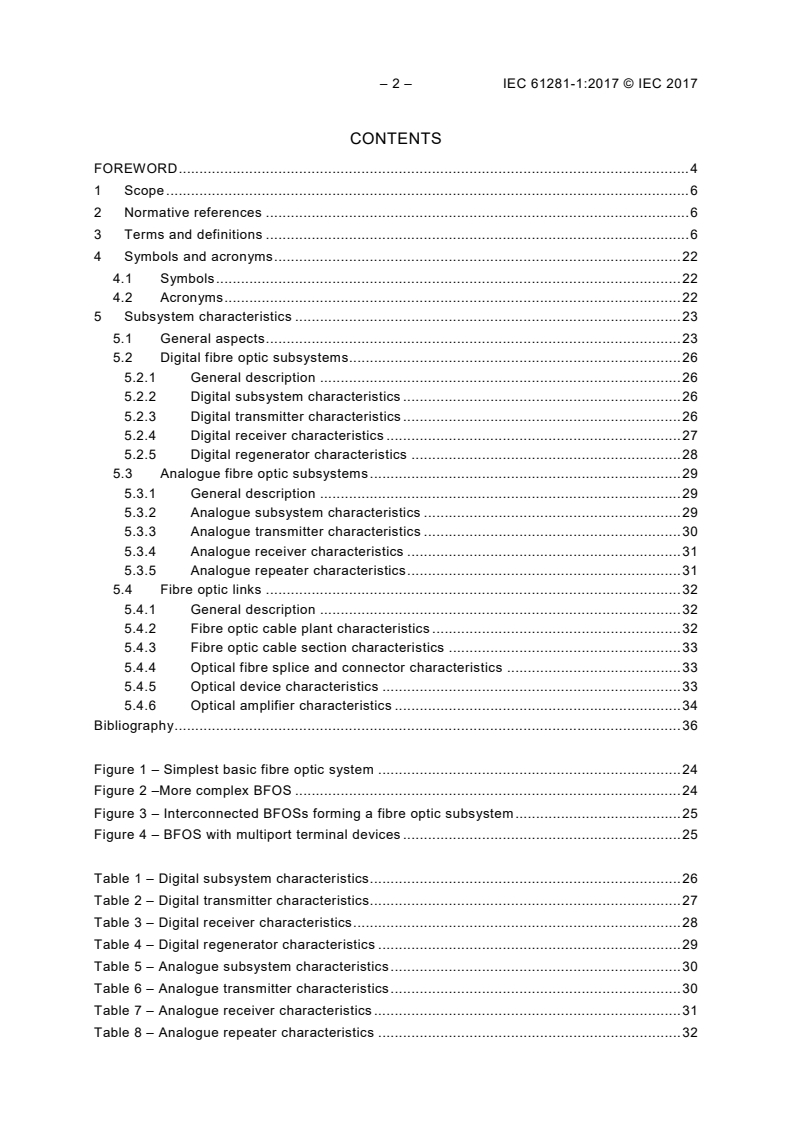
CONTENTS
FOREWORD . 4
1 Scope . 6
2 Normative references . 6
3 Terms and definitions . 6
4 Symbols and acronyms . 22
4.1 Symbols . 22
4.2 Acronyms . 22
5 Subsystem characteristics . 23
5.1 General aspects . 23
5.2 Digital fibre optic subsystems . 26
5.2.1 General description . 26
5.2.2 Digital subsystem characteristics . 26
5.2.3 Digital transmitter characteristics . 26
5.2.4 Digital receiver characteristics . 27
5.2.5 Digital regenerator characteristics . 28
5.3 Analogue fibre optic subsystems . 29
5.3.1 General description . 29
5.3.2 Analogue subsystem characteristics . 29
5.3.3 Analogue transmitter characteristics . 30
5.3.4 Analogue receiver characteristics . 31
5.3.5 Analogue repeater characteristics . 31
5.4 Fibre optic links . 32
5.4.1 General description . 32
5.4.2 Fibre optic cable plant characteristics . 32
5.4.3 Fibre optic cable section characteristics . 33
5.4.4 Optical fibre splice and connector characteristics . 33
5.4.5 Optical device characteristics . 33
5.4.6 Optical amplifier characteristics . 34
Bibliography . 36
Figure 1 – Simplest basic fibre optic system . 24
Figure 2 –More complex BFOS . 24
Figure 3 – Interconnected BFOSs forming a fibre optic subsystem . 25
Figure 4 – BFOS with multiport terminal devices . 25
Table 1 – Digital subsystem characteristics . 26
Table 2 – Digital transmitter characteristics. 27
Table 3 – Digital receiver characteristics . 28
Table 4 – Digital regenerator characteristics . 29
Table 5 – Analogue subsystem characteristics . 30
Table 6 – Analogue transmitter characteristics . 30
Table 7 – Analogue receiver characteristics . 31
Table 8 – Analogue repeater characteristics . 32
Table 9 – Fibre optic cable plant characteristics . 33
Table 10 – Optical device characteristics . 33
Table 11 – Optical fibre amplifier characteristics . 34
Table 12 – Semiconductor optical amplifier characteristics . 35
– 4 – IEC 61281-1:2017 © IEC 2017
INTERNATIONAL ELECTROTECHNICAL COMMISSION
____________
FIBRE OPTIC COMMUNICATION SUBSYSTEMS –
Part 1: Generic specification
FOREWORD
1) The International Electrotechnical Commission (IEC) is a worldwide organization for standardization comprising
all national electrotechnical committees (IEC National Committees). The object of IEC is to promote
international co-operation on all questions concerning standardization in the electrical and electronic fields. To
this end and in addition to other activities, IEC publishes International Standards, Technical Specifications,
Technical Reports, Publicly Available Specifications (PAS) and Guides (hereafter referred to as “IEC
Publication(s)”). Their preparation is entrusted to technical committees; any IEC National Committee interested
in the subject dealt with may participate in this preparatory work. International, governmental and non-
governmental organizations liaising with the IEC also participate in this preparation. IEC collaborates closely
with the International Organization for Standardization (ISO) in accordance with conditions determined by
agreement between the two organizations.
2) The formal decisions or agreements of IEC on technical matters express, as nearly as possible, an international
consensus of opinion on the relevant subjects since each technical committee has representation from all
interested IEC National Committees.
3) IEC Publications have the form of recommendations for international use and are accepted by IEC National
Committees in that sense. While all reasonable efforts are made to ensure that the technical content of IEC
Publications is accurate, IEC cannot be held responsible for the way in which they are used or for any
misinterpretation by any end user.
4) In order to promote international uniformity, IEC National Committees undertake to apply IEC Publications
transparently to the maximum extent possible in their national and regional publications. Any divergence
between any IEC Publication and the corresponding national or regional publication shall be clearly indicated in
the latter.
5) IEC itself does not provide any attestation of conformity. Independent certification bodies provide conformity
assessment services and, in some areas, access to IEC marks of conformity. IEC is not responsible for any
services carried out by independent certification bodies.
6) All users should ensure that they have the latest edition of this publication.
7) No liability shall attach to IEC or its directors, employees, servants or agents including individual experts and
members of its technical committees and IEC National Committees for any personal injury, property damage or
other damage of any nature whatsoever, whether direct or indirect, or for costs (including legal fees) and
expenses arising out of the publication, use of, or reliance upon, this IEC Publication or any other IEC
Publications.
8) Attention is drawn to the Normative references cited in this publication. Use of the referenced publications is
indispensable for the correct application of this publication.
9) Attention is drawn to the possibility that some of the elements of this IEC Publication may be the subject of
patent rights. IEC shall not be held responsible for identifying any or all such patent rights.
International Standard IEC 61281-1 has been prepared by subcommittee 86C: Fibre optic
systems and active devices, of IEC technical committee 86: Fibre optics.
This second edition cancels and replaces the first edition published in 1999. This edition
constitutes a technical revision.
This edition includes the following significant technical change with respect to the previous
edition: addition of new definitions.
The text of this International Standard is based on the following documents:
CDV Report on voting
86C/1408/CDV 86C/1468/RVC
Full information on the voting for the approval of this International Standard can be found in
the report on voting indicated in the above table.
This document has been drafted in accordance with the ISO/IEC Directives, Part 2.
A list of all parts in the IEC 61281-1 series, published under the general title Fibre optic
communication subsystems, can be found on the IEC website.
The committee has decided that the contents of this document will remain unchanged until the
stability date indicated on the IEC website under "http://webstore.iec.ch" in the data related to
the specific document. At this date, the document will be
• reconfirmed,
• withdrawn,
• replaced by a revised edition, or
• amended.
– 6 – IEC 61281-1:2017 © IEC 2017
FIBRE OPTIC COMMUNICATION SUBSYSTEMS –
Part 1: Generic specification
1 Scope
This part of IEC 61281 is a generic specification for fibre optic communication subsystems
(FOCSs).
The parameters defined herein form a specifiable minimum set of specifications that are
common to all fibre optic subsystems. Additional parameters can be used depending on
the particular application and technology. Those additional parameters will be specified in the
relevant documents, as appropriate.
Each specified parameter is measured using one of the test procedures. The use of these
parameters for system design is given in design guides.
2 Normative references
There are no normative references in this document.
3 Terms and definitions
For the purpose of this document, the following terms and definitions apply.
ISO and IEC maintain terminological databases for use in standardization at the following
addresses:
• IEC Electropedia: available at http://www.electropedia.org/
• ISO Online browsing platform: available at http://www.iso.org/obp
NOTE Within a definition, terms defined elsewhere in Clause 3 are in italics.
3.1
active optical device
optical device, other than an optical dynamic device, exhibiting one or more of the following
functions:
• generation or detection of optical power;
• conversion of an electronic signal to a corresponding optical one or vice versa;
• optical amplification or optical regeneration (2R or 3R) of an optical signal;
• direct conversion of the optical frequency of an optical signal
Note 1 to entry: Active optical devices may comprise passive optical elements.
[SOURCE: IEC TS 62538:2008, 2.1.2, modified – The term "optical active device" has been
replaced by "active optical device".]
3.2
amplified spontaneous emission
ASE
optical power associated to spontaneously emitted photon amplified by an active medium in
an optical amplifier
Note 1 to entry: This note applies to the French language only.
[SOURCE: IEC TR 61931:1998, 2.7.87 – The note has been added.]
3.3
analogue input signal bandwidth
bandwidth at the electrical input to the transmitter
3.4
attenuation
reduction of optical power induced by transmission through a medium, given as L (dB) where
L = 10 log (P /P ), and P and P are the power into and out of the transmission medium
10 in out in out
Note 1 to entry: P and P are typically expressed in mW.
in out
3.5
bandwidth
difference (expressed in Hz) between the highest and lowest modulation frequencies at which
the modulus of the power spectrum or of the complex transfer function is one-half of the peak
value of the modulus
3.6
basic fibre optic system
BFOS
serial combination of a transmit terminal device, a fibre optic link, and a receive terminal
device
Note 1 to entry: This note applies to the French language only.
3.7
bit-error ratio
BER
number of errored bits divided by the total number of bits, over some stipulated period of time
Note 1 to entry: This note applies to the French language only.
3.8
branching device
BD
passive device whose purpose is to transfer optical power between two or more ports in a
predetermined manner
Note 1 to entry: The ports may be connected to waveguides, sources, detectors etc.
Note 2 to entry: This note applies to the French language only.
[SOURCE: IEC 60050-731:1991, 731-05-10, modified – The other terms "optical fibre coupler"
and "optical coupler" have been deleted, and the acronym "BD" has been added. Note 2 has
also been added.]
– 8 – IEC 61281-1:2017 © IEC 2017
3.9
carrier-to-noise ratio
CNR
ratio of carrier power to noise power in a channel of defined bandwidth, prior to any non-linear
processing
Note 1 to entry: Carrier-to-noise ratio is expressed in dB.
Note 2 to entry: This note applies to the French language only.
3.10
centre wavelength
mean of the closest spaced half-power wavelengths, one above and one below the peak
wavelength of an optical spectrum
Note 1 to entry: Other spectral wavelengths are centroidal wavelengths, half-power wavelengths, and peak
wavelengths.
3.11
centroidal wavelength
mean or average wavelength of an optical spectrum
Note 1 to entry: Other spectral wavelengths are centre wavelengths, half-power wavelengths, and peak
wavelengths.
3.12
chirping
change of the wavelength or optical frequency of an intensity-modulated transmitter as a
function of the instantaneous intensity of the modulating signal
Note 1 to entry: When chirped signals are transmitted through an optical fibre, the signal waveform is distorted by
chromatic dispersion. This process may cause a degradation in the quality of performance, designated as a
chirping penalty.
3.13
chromatic dispersion
dispersion
rate of change in group delay to wavelength between the end points of the fibre optic cable
plant
Note 1 to entry: Chromatic dispersion is usually expressed in ps/nm.
3.14
encircled flux
fraction of cumulative power to total output power as a function of radial distance from the
centre of the multimode optical fibre’s core
3.15
environmental condition
characteristic of the environment that may affect performance of a device or system
Note 1 to entry: Examples of ambient conditions are pressure, temperature, humidity, radiation, and vibration.
[SOURCE: IEC 60050-151:2001, 151-16-03, modified – The other term "ambient condition"
has been deleted.]
3.16
extinction ratio
ratio of the average power level of logical "1" to the average power level of logical "0", in a
digital transmission system
Note 1 to entry: Extinction ratio is expressed in dB.
3.17
fibre optic cable plant
FOCP
serial combination of fibre optic cable sections, connectors, and splices providing the optical
path between two terminal devices, between two optical devices, or between a terminal
device and an optical device
Note 1 to entry: This note applies to the French language only.
3.18
fibre optic cable section
single optical fibre cable which can be unjointed
3.19
fibre optic communication system
assembly of fibre optic subsystems for transmitting information
3.20
fibre optic link
FOL
serial combination of a fibre optic cable plant and optical devices, providing the optical path
between a transmit terminal device and a receive terminal device
Note 1 to entry: This is equivalent to a basic fibre optic subsystem minus the transmitter and receiver.
Note 2 to entry: This note applies to the French language only.
3.21
fibre optic subsystem
assembly of interconnected basic fibre optic subsystems
Note to entry: The assembly is specified at defined interfaces within the fibre optic system.
3.22
fibre optic terminal device
device that converts one or more electrical signals into one or more optical signals, or vice-
versa, and that is connected to at least one optical fibre
Note 1 to entry: A fibre optic terminal device always has one or more integral connectors or pigtails.
Note 2 to entry: Examples include a receive terminal device, a transmit terminal device, a transmitter, and a
receiver.
3.23
full-width at half-maximum
FWHM
positive difference of the closest spaced half-power wavelengths, one above and one below
the peak wavelength of an optical spectrum
Note 1 to entry: Other spectral widths are N-dB-down widths and root-mean-square widths.
Note 2 to entry: The FWHM equals the N-dB-down width where N = 3.
Note 3 to entry: This note applies to the French language only.
3.24
half-power wavelength
wavelength corresponding to a half peak power value of the optical spectrum
Note 1 to entry: Other spectral wavelengths are central wavelengths, centroidal wavelengths, and peak
wavelengths.
– 10 – IEC 61281-1:2017 © IEC 2017
3.25
harmonic distortion
distortion in a system or transducer characterized by the presence at the output of spectral
components which are harmonically related to the spectral components of the input signal
Note 1 to entry: See IEEE Dictionary Online.
3.26
input power range
range of optical power levels such that, for any input signal power of the OFA which lies within
this range, the corresponding output signal power lies in the specified output power range,
where the OFA performance is ensured
[SOURCE: IEC 61291-1:2012, 3.2.1.36, modified – In the definition, the two occurrences of
the term "OA" have been replaced by "OFA".]
3.27
intermodulation distortion
IMD
distortion characterized by the appearance of spectral components with frequencies equal to
the sums and differences of integral multiples of two or more component frequencies of the
input signal
Note 1 to entry: See IEEE Dictionary Online.
Note 2 to entry: This note applies to the French language only.
3.28
intersymbol interference
ISI
overlap of adjacent pulses as caused by the limited bandwidth characteristics of the optical
devices in a fibre optic link
Note 1 to entry: This note applies to the French language only.
3.29
jitter
random or data-induced short-term non-cumulative variations of the phases or of the
significant instants of a digital signal from their ideal positions in time relative to a reference
(clock) signal
Note 1 to entry: In practice, "short-term" embraces all spectral components of 10 Hz and above.
Note 2 to entry: Jitter is expressed in terms of absolute time or as a fraction of a unit interval.
3.30
jitter tolerance
maximum jitter amplitude that a digital receiver can accept for a given penalty or alternatively
without the addition of a given number of errors to the digital signal
Note 1 to entry: The maximum jitter amplitude tolerated is generally dependent on the frequency of the jitter.
3.31
jitter transfer function
ratio of the output jitter to the applied input jitter as a function of modulation frequency
3.32
light source
device or instrument that emits light that is coupled into a fibre under test
3.33
line code
sequence of symbols that the binary data is converted into for purposes of transmission
Note 1 to entry: Examples include Manchester, return-to-zero, block codes, digital scrambling.
Note 2 to entry: Line codes are used to recover timing, and in some cases they may be used to detect line errors,
and to convey additional information.
3.34
loss budget
sum of the fibre optic link loss and the power penalty
Note 1 to entry: The loss budget equals the power budget minus the working margin.
Note 2 to entry: The initial/final loss budget is the loss budget at the beginning/end of the life of the link.
Note 3 to entry: The final loss budget equals the sum of the initial loss budget and the reserve margin.
Note 4 to entry: Loss budget is expressed in dB.
3.35
maximum reflectance tolerable at input
maximum fraction of power exiting the input port of the OFA, reflected
into the OFA itself, for which the device still meets its specifications
Note 1 to entry: The measurement is performed with a given input signal optical power.
Note 2 to entry: Maximum reflectance tolerable at input is expressed in dB.
3.36
maximum reflectance tolerable at output
maximum fraction of power exiting the output port of the OFA,
reflected into the OFA itself, for which the device still meets its specifications
Note 1 to entry: The measurement is performed with a given input signal optical power.
Note 2 to entry: Maximum reflectance tolerable at output is expressed in dB.
3.37
maximum total output power
highest optical power level at the output port of the OFA operating
within the absolute maximum ratings
3.38
modal bandwidth
multimode fibre bandwidth due to differential mode attenuation and delay
Note 1 to entry: It does not include chromatic dispersion.
Note 2 to entry: It is measured using a source of narrow spectral width.
3.39
modal noise
noise generated in a fibre optic communication system by the combination of differential
modal attenuation and of fluctuations in the distribution of optical energy among the bound
modes or in the relative phases of the bound modes
3.40
mode partition noise
MPN
noise due to the rapid fluctuation of the power distribution among the longitudinal modes of a
laser
– 12 – IEC 61281-1:2017 © IEC 2017
Note 1 to entry: Due to the chromatic dispersion of the fibre optic cable plant, mode partition noise can produce
signal fluctuations at the receiver.
Note 2 to entry: This note applies to the French language only.
3.41
modulation factor/index
ratio of the peak optical signal of a transmitter modulated by an input analogue signal to the
average optical signal without any input signal
Note 1 to entry: Modulation factor/index is expressed as a percentage.
3.42
multipoint link
two or more fibre optic links that interconnect three or more terminal devices
3.43
N-dB-down width
positive difference of the closest spaced wavelengths, one above and one below the peak
wavelength, at which the spectral power density is N dB down from its peak value
Note 1 to entry: Other spectral widths are full-widths at half-maximum and root-mean-square widths.
3.44
noise figure
NF
decrease of the signal-to-noise ratio (SNR), at the output of the optical detector with unitary
quantum efficiency and zero excess noise, due to the propagation of a shot noise-limited
signal through the OFA
Note 1 to entry: The operating conditions at which the noise figure is specified should be stated.
Note 2 to entry: This property can be described at a discrete wavelength or as a function of wavelength.
Note 3 to entry: The noise degradation due to the OFA is attributable to different contributions, for example:
signal-spontaneous beat noise, spontaneous-spontaneous beat noise, internal reflections noise, signal shot noise,
spontaneous shot noise. Each of these contributions depends on various conditions which should be specified for a
correct evaluation of the noise figure.
Note 4 to entry: By convention this noise figure is a positive number.
Note 5 to entry: In the case of OFAs for analogue applications the noise figure also represents the ratio between
input and the output carrier-to-noise ratios.
Note 6 to entry: The noise figure is expressed in dB.
Note 7 to entry: This note applies to the French language only.
[SOURCE: IEC 61291-1:2012, 3.2.1.38, modified – The information about the unit has been
moved from the definition to the new Note 6. In this entry, the term "OA" has been replaced by
"OFA". Note 7 has been added.]
3.45
non-wavelength-selective branching device
NWSBD
bidirectional passive component possessing three or more ports which operates non-
selectively over a specified range of wavelengths, divides or combines optical power coming
into one or more input port(s) among its one or more output port(s) in a predetermined fashion,
without any amplification, switching, or other active modulation
Note 1 to entry: This note applies to the French language only.
[SOURCE: IEC 60875-1:2015, 3.2.1, modified – The other terms "optical coupler" and "optical
splitter" have been deleted, and the abbreviated term "NWSBD" and the note have been
added.]
3.46
operating wavelength range
specified interval of wavelengths around a nominal wavelength within which an optical
component is designed to operate with the specified performance
[SOURCE: IEC TR 61931:1998, 2.6.88, modified – The words "the operating wavelength"
have been replaced by "a nominal wavelength" in the definition.]
3.47
optical amplifier
active optical device that receives an optical input and retransmits it as an optical output of
increased power
Note 1 to entry: An example is an optical fibre amplifier (OFA).
3.48
optical attenuator
passive device, which produces a controlled signal attenuation in an optical fibre transmission
line
Note 1 to entry: An attenuator is intended to be wavelength independent.
[SOURCE: IEC 60869-1:2012, 3.2.1, modified – The information in the note was originally in
the definition.]
3.49
optical connection
splice type, connector type and/or fibre type used as input and output ports of an optical
device
3.50
optical device
generic optical unit, either an optical element, optical component, optical assembly, optical
sub-assembly or optical module
Note 1 to entry: Optical devices can reduce the optical power or change the wavelength of the optical input.
Note 2 to entry: There are active optical devices and passive optical devices.
[SOURCE: IEC TS 62538:2008, 2.2.6, modified – The note has been replaced by two new
notes.]
3.51
optical fibre connector
component normally attached to an optical cable or piece of apparatus for the purpose of
providing frequent optical interconnection/disconnection of optical fibres or cables
Note 1 to entry: This usually consists of two plugs mated together in an adaptor.
[SOURCE: IEC 60874-1:2011, 3.14, modified – The information in the note was originally in
the definition.]
– 14 – IEC 61281-1:2017 © IEC 2017
3.52
optical fibre pigtail
short length of optical fibre permanently attached to a component and intended to facilitate
jointing between that component and another optical fibre or component
[SOURCE: IEC TR 61931:1998, 2.6.14]
3.53
optical fibre splice
permanent or semi-permanent joint to couple optical power between two fibre optic cable
sections
3.54
optical line bandwidth
interface signal bandwidth at the boundary between the fibre optic cable plant and the
terminal device
Note 1 to entry: See also transport bandwidth.
3.55
optical line bit rate
interface rate at the boundary between the fibre optic cable plant and the terminal device
Note 1 to entry: See also transport bit rate.
3.56
optical modulator
optical device that modifies the intensity, frequency, phase, or polarization of an optical
carrier in accordance with an input signal
3.57
optical power
amount of radiant energy per unit time that crosses a given section in the transmission path
Note 1 to entry: Optical power is expressed in watts or, on the logarithmic scale, in dBm (where 0 dBm = 1 mW).
3.58
optical receiver
Rx
terminal device with a single optical input and a corresponding single electrical output
3.59
optical regenerator
regenerative repeater
Rg
active optical device that receives, reshapes, retimes, and retransmits a digital optical signal
3.60
optical repeater
Rp
active optical device that receives, improves, and retransmits an analogue optical signal
3.61
optical return loss
ORL
ratio of the incident power to the reflected power from an end point of the fibre optic cable
plant
Note 1 to entry: For reflected power from an optical device or terminal device, "reflectance" is the preferred term.
Note 2 to entry: Optical return loss is expressed in positive dB.
Note 3 to entry: This note applies to the French language only.
3.62
optical signal-to-noise-ratio
OSNR
ratio of the optical signal power to the noise power measured in reference optical bandwidth
Note 1 to entry: Typically, the reference optical bandwidth is 0,1 nm.
Note 2 to entry: OSNR is expressed in dB.
Note 3 to entry: This note applies to the French language only.
3.63
optical splitter
wavelength-independent branching device in which the number of output ports exceeds the
number of input ports
3.64
optical switch
passive component processing one or more ports which selectively transmits, redirects or
blocks optical power in an optical fibre transmission line
[SOURCE: IEC 60876-1:2014, 3.2.1]
3.65
optical time domain reflectometer
OTDR
instrument to characterize and measure the attenuation and optical return loss of a fibre
under test by backscattering
Note 1 to entry: This note applies to the French language only.
3.66
optical transmitter
Tx
device which transmits terminal device with a single electrical input and a corresponding
single optical output
3.67
output power range
the range of optical power levels within which the output signal optical
power of the OFA lies, when the corresponding input signal power lies within the input power
range, where the OFA performance is ensured
3.68
passive optical device
optical device, other than an optical dynamic device or an active optical device, which does
not require external power for its operation, except to control the stability of its own
characteristics
Note 1 to entry: Passive optical devices may comprise optical detectors for monitoring purposes only.
[SOURCE: IEC TS 62538:2008, 2.1.3, modified – The terms "optical passive device" and
"optical active device" have been replaced by "passive optical device" and "active optical
device" respectively.]
– 16 – IEC 61281-1:2017 © IEC 2017
3.69
peak wavelength
wavelength corresponding to the maximum power value of the optical spectrum
Note 1 to entry: Other spectral wavelengths are central wavelengths, centroidal wavelengths, and half-power
wavelengths.
3.70
point-to-point link
fibre optic link that connects a transmitter to a receiver
3.71
polarization-dependent gain
PDG
maximum variation of the OFA gain due to a variation of the state of polarization of the input
signal, at nominal operating conditions
Note 1 to entry: A source of PDG in OFAs is the PDL (polarization-dependent loss) of the passive components
used inside.
Note 2 to entry: This note applies to the French language only.
[SOURCE: IEC 61291-1:2012, 3.2.1.12, modified – In this entry, the term "OA" has been
replaced by "OFA". Note 2 has been added.]
3.72
polarization mode dispersion
PMD
distortion of the transmitted signal attributable to the different velocities of the polarization
components of the same mode and their dependence on wavelength
[SOURCE: IEC TR 61931:1998, 2.4.65, modified – The acronym "PMD" has been added as an
admitted term, and the note has been deleted.]
3.73
power budget
difference between the transmitted optical power and the receiver sensitivity
Note 1 to entry: The power budget equals the sum of the loss budget and the working margin.
Note 2 to entry: The initial/final power budget is the power budget at the beginning/end of the life of the
transmitter and receiver.
Note 3 to entry: Power budget, transmitted optical power and receiver sensitivity are expressed in dBm.
3.74
powering and control
electrical currents and/or voltages, as well as electrical signals,
necessary for OFA operation within the stated maximum ratings
Note 1 to entry: Necessary tolerances on electrical powering and switching on and off procedures are to be
included.
3.75
power penalty
increase of received optical power required to compensate for optical transmission
impairments at a specified quality of performance
Note 1 to entry: Impairments include distortion of the optical signal, dispersion and modal bandwidth of the fibre
optic cable plant, and modal noise. These include degradation due to reflections and to the combined effects of
intersymbol interference, mode-partition noise, and chirping.
Note 2 to entry: Power penalty is expressed in dB.
3.76
pump leakage to input
pump optical power which is emitted from the OFA input port
Note 1 to entry: The measurement is performed with a given input signal optical power.
Note 2 to entry: The maximum pump leakage to input occurs for no input signal.
[SOURCE: IEC 61291-1:2012, 3.2.1.61, modified – In the definition, the term "OA" has been
replaced by "OFA".]
3.77
pump leakage to output
pump optical power which is emitted from the OFA output port
Note 1 to entry: The measurement is performed with a given input signal optical power.
Note 2 to entry: The maximum pump leakage to output occurs for no input signal.
[SOURCE: IEC 61291-1:2012, 3.2.1.60, modified – In the definition, the term "OA" has been
replaced by "OFA"]
3.78
Q-factor
ratio of the difference between the mean voltage of the 1 and 0 rails, to the sum of their
standard deviation values
3.79
quality of performance
criteria used to indicate a measure of transmission performance
Note 1 to entry: The most common criteria for digital fibre optic systems are bit-error ratio, Q-factor, signal-to-
noise ratio and optical signal-to-noise ratio.
Note 2 to entry: The most common criteria for analogue fibre optic systems are signal-to-noise ratio and linearity.
3.80
receive terminal device
terminal device that converts one or more optical input signals into one or more electrical
output signals
3.81
receiver bandwidth
bandwidth of the optical-to-electrical transfer function of an optical receiver
3.82
receiver dynamic range
difference of the receiver overload and the receiver sensitivity
Note 1 to entry: Receiver dynamic range, receiver overload and receiver sensitivity are expressed in dBm.
3.83
receiver overload
maximum receiver input power
maximum receiver optical input signal average power above which a specified quality of
performance cannot be maintained
– 18 – IEC 61281-1:2017 © IEC 2017
3.84
receiver sensitivity
minimum receiver optical input signal average power below which a specified quality of
performance cannot be maintained
3.85
reference test method
RTM
test method for measuring given characteristics strictly according to the definition of these
characteristics and giving results that are accurate, reproducible and relatable to practical use
Note 1 to entry: This note applies to the French language only.
[SOURCE: IEC TR 61931:1998, 2.8.1, modified – The note has been added.]
3.86
reflectance
ratio of the reflected power to the incident power from an optical device or a terminal device
Note 1 to entry: For reflected power from an end point of the fibre optic cable plant, optical return loss is the
preferred term.
Note 2 to entry: Reflectance is expressed in negative dB.
3.87
relative intensity noise
RIN
ratio of the average fluctuation (per unit electrical frequency) in light power to the average
desired light power, for an analogue optical transmitter or repeater
Note 1 to entry: RIN is usually measured within a narrow electrical passband as a function of input current or
output power.
Note 2 to entry: RIN is expressed in dB/Hz.
Note 3 to entry: This note applies to the French language only.
3.88
reliability
ability to perform as required, without failure, for a given time interval, under
given conditions
Note 1 to entry: The time interval duration can be expressed in units appropriate to the item concerned, e.g.
calendar time, operating cycles, distance run, etc., and the units should always be clearly stated.
Note 2 to entry: Given conditions include aspects that affect reliability, such as: mode of operation, stress levels,
environmental conditions, and maintenance.
Note 3 to entry: Reliab
...