

IEC 60679-1:1997/AMD2:2003
(Amendment)Amendment 2 - Quartz crystal controlled oscillators of assessed quality - Part 1: Generic specification
General Information
- Abstract
- Status
- Published
- Publication Date
- 12-May-2003
- Technical Committee
- TC 49 - Piezoelectric, dielectric and electrostatic devices and associated materials for frequency control, selection and detection
- Drafting Committee
- WG 7 - TC 49/WG 7
- Current Stage
- DELPUB - Deleted Publication
- Start Date
- 11-Apr-2007
- Completion Date
- 28-Aug-2026
Overview
IEC 60679-1:1997/AMD2:2003 is the second amendment to the Part 1 generic specification of quartz crystal controlled oscillators of assessed quality. Published by the International Electrotechnical Commission (IEC), this amendment enhances the foundational standard for piezoelectric devices used in frequency control and selection. It delineates updated definitions, test methods, and measurement practices critical for ensuring the precise performance of high-quality quartz oscillators.
This amendment focuses particularly on the characterization and measurement of phase jitter and frequency stability, which are essential parameters for oscillators used in telecommunications, data transmission, and synchronous networks. It also incorporates references to other key international standards related to synchronization and jitter control, reflecting latest industry requirements for oscillator performance validation.
Key Topics
Phase Jitter Definition and Analysis
Phase jitter is the short-term variation in the timing of zero crossings of an oscillator output signal from its ideal position. It is characterized by phase changes with frequency components equal or greater than 10 Hz. This amendment clearly distinguishes between jitter and slower variations known as wander (below 10 Hz), emphasizing the impact of phase jitter on bit error rates and system synchronization.Measurement Techniques
Three primary methods for phase jitter measurement are specified:- Time domain measurement using real-time or sampling oscilloscopes with high bandwidth and data capabilities.
- Data domain measurement through Bit Error Rate (BER) testers to assess the communication system’s overall performance.
- Frequency domain measurement leveraging phase noise test sets, the preferred approach for its accuracy across arbitrary output frequencies.
Jitter Quantification and Metrics
The standard defines jitter amplitude in terms of Unit Interval (UI), peak-to-peak, and root mean square (r.m.s.) values, accounting for Gaussian and non-Gaussian jitter distributions. It also explains related timing metrics such as Time Interval Error (TIE), Maximum Time Interval Error (MTIE), and Time Deviation (TDEV), which help characterize oscillator stability over time.Fourier Frequency Range for Jitter Analysis
The amendment sets recommended Fourier frequency ranges for phase noise measurement based on the oscillator's output frequency, critical for consistent and comparable jitter evaluation. These ranges align with synchronization standards like ITU-T G.825 and Telcordia GR-253.Electrical Test Procedures
New clauses detail standard test setups and procedures for jitter measurement, including figures illustrating sampling oscilloscope configurations and phase noise test systems. The document advises on observation times, evaluation methods, and accuracy considerations to ensure reliable and repeatable measurements.
Applications
Quartz crystal controlled oscillators complying with IEC 60679-1:1997/AMD2:2003 are integral to industries and systems requiring high precision timing and frequency stability, including:
Telecommunications
Ensuring synchronization within digital hierarchy networks such as SDH (Synchronous Digital Hierarchy) and SONET (Synchronous Optical Network) to minimize data transmission errors caused by jitter or wander.Data Communications
Improving bit error rates in high-speed data streams by controlling oscillator jitter, critical in fiber optic networks and multiplexed transmission systems.Test and Measurement Equipment
Calibration and validation of oscillators used in instrumentation for frequency control, pattern generation, and timing references.Industrial and Scientific Research
Use in applications where accurate timing and frequency control impact system performance, such as radar, navigation, and timekeeping systems.
Related Standards
IEC 60679-1:1997/AMD2:2003 references several important standards vital for comprehensive jitter and synchronization assessment:
- ITU-T G.825 – Regulation of jitter and wander in synchronous digital hierarchy networks
- ITU-T O.172 – Measurement equipment for jitter and wander in SDH systems
- ANSI T1.105.03 – Jitter specifications for network interfaces in SONET
- ETSI EN 300462 – Generic requirements for synchronization networks in transmission and multiplexing
- Telcordia GR-253 – Common generic criteria for SONET transport systems
These standards provide the framework and test conditions to which quartz oscillators must adhere for compatibility and performance assurance in modern synchronous communication infrastructures.
By adhering to IEC 60679-1:1997/AMD2:2003, manufacturers and system integrators benefit from a detailed and harmonized approach to jitter measurement, oscillator quality assessment, and synchronization stability - crucial factors for reducing errors and optimizing system reliability in frequency-sensitive applications worldwide.
Relations
- Effective Date
- 05-Sep-2023
- Effective Date
- 05-Sep-2023
Frequently Asked Questions
IEC 60679-1:1997/AMD2:2003 is a standard published by the International Electrotechnical Commission (IEC). Its full title is "Amendment 2 - Quartz crystal controlled oscillators of assessed quality - Part 1: Generic specification". This standard covers: Amendment 2 - Quartz crystal controlled oscillators of assessed quality - Part 1: Generic specification
Amendment 2 - Quartz crystal controlled oscillators of assessed quality - Part 1: Generic specification
IEC 60679-1:1997/AMD2:2003 is classified under the following ICS (International Classification for Standards) categories: 31.140 - Piezoelectric devices. The ICS classification helps identify the subject area and facilitates finding related standards.
IEC 60679-1:1997/AMD2:2003 has the following relationships with other standards: It is inter standard links to IEC 60679-1:1997, IEC 60679-1:2007. Understanding these relationships helps ensure you are using the most current and applicable version of the standard.
IEC 60679-1:1997/AMD2:2003 is available in PDF format for immediate download after purchase. The document can be added to your cart and obtained through the secure checkout process. Digital delivery ensures instant access to the complete standard document.
Standards Content (Sample)
NORME CEI
INTERNATIONALE IEC
60679-1
INTERNATIONAL
STANDARD
AMENDEMENT 2
AMENDMENT 2
2003-05
Amendement 2
Oscillateurs pilotés par quartz
sous assurance de la qualité –
Partie 1:
Spécification générique
Amendment 2
Quartz crystal controlled oscillators
of assessed quality –
Part 1:
Generic specification
IEC 2003 Droits de reproduction réservés Copyright - all rights reserved
International Electrotechnical Commission 3, rue de Varembé Geneva, Switzerland
Telefax: +41 22 919 0300 e-mail: inmail@iec.ch IEC web site http://www.iec.ch
CODE PRIX
Commission Electrotechnique Internationale
J
PRICE CODE
International Electrotechnical Commission
Pour prix, voir catalogue en vigueur
For price, see current catalogue
– 2 – 60679-1 Amend. 2 CEI:2003
AVANT-PROPOS
Le présent amendement a été établi par le comité d'études 49 de la CEI: Dispositifs piézo-
électriques et diélectriques pour la commande et le choix de la fréquence.
Le texte de cet amendement est issu des documents suivants:
FDIS Rapport de vote
49/591/FDIS 49/605/RVD
Le rapport de vote indiqué dans le tableau ci-dessus donne toute information sur le vote ayant
abouti à l'approbation de cet amendement.
Le comité a décidé que le contenu de la publication de base et de ses amendements ne sera
pas modifié avant 2005. A cette date, la publication sera
• reconduite;
• supprimée;
• remplacée par une édition révisée, ou
• amendée.
_____________
Page 12
1.2 Références normatives
Insérer, à la page 14, les nouvelles normes suivantes:
UIT-T G.825, Régulation de la gigue et du dérapage dans les réseaux numériques à
hiérarchie numérique synchrone
UIT-T O.172, Appareil de mesure de la gigue et du dérapage dans les systèmes numériques
à hiérarchie numérique synchrone
ANSI T1.105.03, Synchronous Optical Network (SONET) – Jitter at Network Interfaces
ETSI EN 300462, Transmission and Multiplexing™; Generic requirements for synchronization
networks
Telcordia GR-253, Synchronous Optical Network (SONET) Transport Systems: Common
Generic Criteria
Page 16
2 Terminologie et prescriptions générales
2.2 Définitions
Ajouter, à la page 32, après la définition 2.2.38, la nouvelle définition suivante:
60679-1 Amend. 2 IEC:2003 – 3 –
FOREWORD
This amendment has been prepared by IEC technical committee 49: Piezoelectric and
dielectric devices for frequency control and selection.
The text of this amendment is based on the following documents:
FDIS Report on voting
49/591/FDIS 49/605/RVD
Full information on the voting for the approval of this amendment can be found in the report
on voting indicated in the above table.
The committee has decided that the contents of the base publication and its amendments will
remain unchanged until 2005. At this date, the publication will be
• reconfirmed;
• withdrawn;
• replaced by a revised edition, or
• amended.
_____________
Page 13
1.2 Normative references
Insert, on page 15, the following new standards:
ITU-T G.825, The control of jitter and wander within digital networks which are based on the
synchronous digital hierarchy (SDH)
ITU-T O.172, Jitter and wander measuring equipment for digital systems which are based on
the synchronous digital hierarchy (SDH)
ANSI T1.105.03, Synchronous Optical Network (SONET) – Jitter at Network Interfaces
ETSI EN 300462, Transmission and Multiplexing™; Generic requirements for synchronization
networks
Telcordia GR-253, Synchronous Optical Network (SONET) Transport Systems: Common
Generic Criteria
Page 17
2 Terminology and general requirements
2.2 Definitions
Add, on page 33, after definition 2.2.38, the following new definition:
– 4 – 60679-1 Amend. 2 CEI:2003
2.2.39 tremblement de phase
Les tremblements de phase sont les changements à court terme des recouvrements au point
nul du signal de sortie d’oscillateur à partir de sa position idéale en temps. Le tremblement de
phase est défini comme le changement de phase ∆φ avec des composantes de la fréquence
supérieures ou égales à 10 Hz. Les changements plus lents que 10 Hz sont nommés
«dérive». Un tremblement excessif peut augmenter le taux de transmission des bits d’erreur
d’un signal de communication en transmettant non correctement le flux des données et peut
causer des problèmes de synchronisation.
Le changement correspondant de la longueur de période
ΔT = Δϕ /(2π f )
c
est nommé «le tremblement de période» (f est la fréquence d’horloge).
c
T
réf.
Point de
déclenchement
Tremblement
de crête à crête
IEC 1455/03
Légende
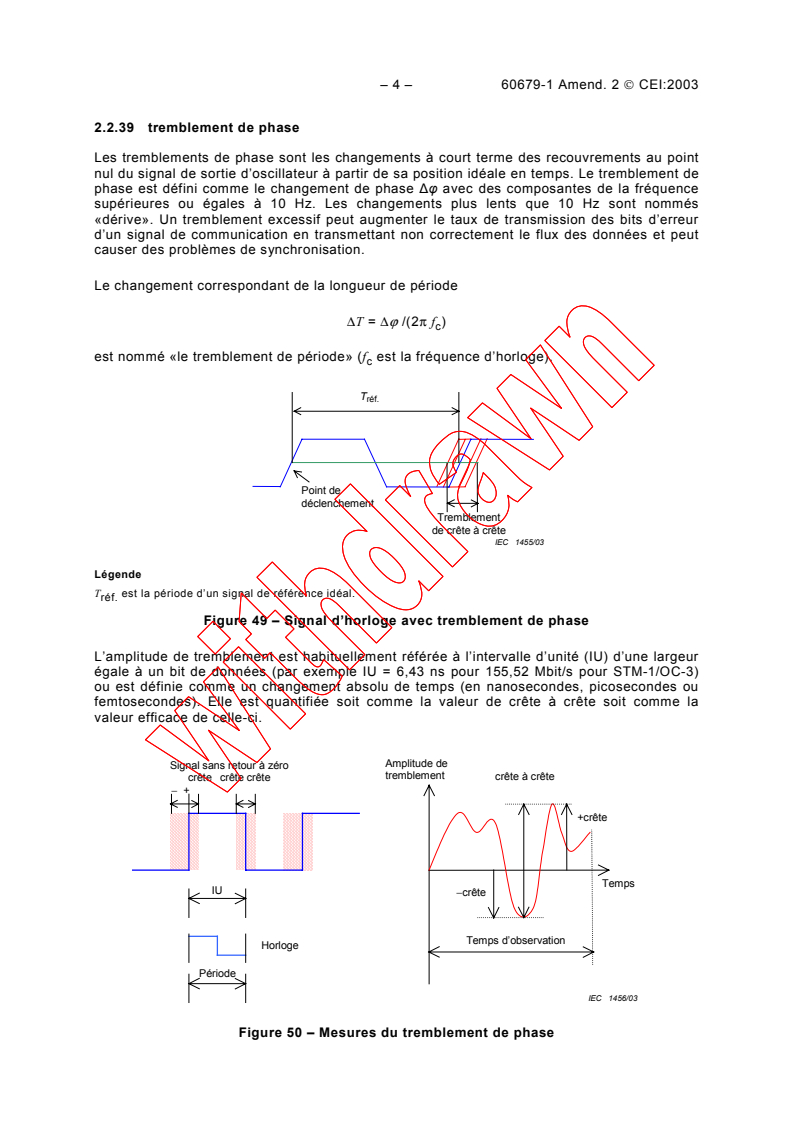
T est la période d’un signal de référence idéal.
réf.
Figure 49 – Signal d’horloge avec tremblement de phase
L’amplitude de tremblement est habituellement référée à l’intervalle d’unité (IU) d’une largeur
égale à un bit de données (par exemple IU = 6,43 ns pour 155,52 Mbit/s pour STM-1/OC-3)
ou est définie comme un changement absolu de temps (en nanosecondes, picosecondes ou
femtosecondes). Elle est quantifiée soit comme la valeur de crête à crête soit comme la
valeur efficace de celle-ci.
Amplitude de
Signal sans retour à zéro
tremblement
crête à crête
crête crête crête
− +
+crête
Temps
IU
−crête
Temps d’observation
Horloge
Période
IEC 1456/03
Figure 50 – Mesures du tremblement de phase
60679-1 Amend. 2 IEC:2003 – 5 –
2.2.39 phase jitter
Phase jitter is the short-term variation of the zero crossings of the oscillator output signal from
their ideal position in time. Phase jitter is defined as phase variation Δϕ with frequency
components greater than or equal to 10 Hz. Variations slower than 10 Hz are called “wander”.
Excessive jitter can increase the bit error rate (BER) of a communication signal by incorrectly
transmitting a data-stream and can cause synchronisation problems.
The corresponding variation of the period length
ΔT = Δϕ /(2π f )
c
is called “period jitter” (f is the clock frequency).
c
T
ref.
Trigger-
point
Peak-to-peak
jitter
IEC 1455/03
Key
T is the period of an ideal reference signal.
ref.
Figure 49 – Clock signal with phase jitter
The jitter amplitude is usually referred to the Unit Interval (UI) of one data bit-width
(e.g. UI = 6,43 ns for 155,52 Mbit/s for STM-1/OC-3) or defined as absolute time variation
(in nanoseconds, picoseconds or femtoseconds). It is quantified either as the peak-to-peak
value, or as the r.m.s. value thereof.
Jitter amplitude
NRZ-Signal
peak-to-peak
peak peak peak
− +
+peak
Time
UI
−peak
Observation time
Clock
Period
IEC 1456/03
Figure 50 – Phase jitter measures
– 6 – 60679-1 Amend. 2 CEI:2003
Pour le tremblement aléatoire, la valeur efficace est définie comme la déviation normalisée
σ (sigma) de la distribution gaussienne ci-dessous. Le tremblement de crête à crête est alors
la gamme couverte par 7σ (c’est-à-dire ±3,5 σ) conformément à un niveau de fiabilité de
–6
99,95348 % (c’est-à-dire une queue de 465 × 10 ).
0,4
0,3
0,2
0,1
−4 −3 −2 −1 1 2 3 4
µ−σ µ µ+σ
IEC 1457/03
Figure 51 – Distribution gaussienne du tremblement
Signal sans retour à zéro idéal
Amplitude de
tremblement
IEC 1458/03
Figure 52 – Amplitude de tremblement et période de fréquence de tremblement
Dans le cas des sous-harmoniques entraînées dans la génération du signal, le tremblement
de phase peut contenir des composantes spectrales non aléatoires dues au changement
périodique du cycle de travail. Ceci cause une distribution non gaussienne, c’est-à-dire la
règle de 7σ pour les valeurs de crête à crête n’est plus applicable. Dans de tels cas, seules
les valeurs de crête à crête sont significatives. Cependant, la détermination des valeurs de
crête à crête est sensible aux incidents. Le temps d’observation recommandé pour le
tremblement de phase de crête à crête est égal à 1 min.
Pour la caractérisation du tremblement il est important de définir la gamme de fréquences de
Fourier considérée, c’est-à-dire les composantes de fréquence du tremblement lui-même.
Cela doit être défini par l’application (comme dans les normes UIT-T G.825, ANSI T1.105.03,
Telcordia GR-253, et ETSI EN 300462).
Période de
fréquence de
tremblement (f )
t
60679-1 Amend. 2 IEC:2003 – 7 –
For random type jitter the r.m.s. value is defined as the standard deviation σ (sigma) of the
underlying Gaussian distribution. The peak-to-peak jitter is then the range covered by 7σ
–6
(i.e. ±3,5 σ), according to a confidence level of 99,95348 % (i.e. 465 × 10 tail).
0,4
0,3
0,2
0,1
1 2 3 4
−4 −3 −2 −1
µ−σ µ+σ
µ
IEC 1457/03
Figure 51 – Gaussian distribution of jitter
Ideal NRZ-signal
Jitter amplitude
IEC 1458/03
Figure 52 – Jitter amplitude and period of jitter frequency
In the case of subharmonics involved in the signal generation, phase jitter may contain non-
random spectral components due to periodical change of the duty cycle. This causes a non-
Gaussian distribution, i.e. the 7σ-rule for peak-to-peak values no longer applies. In such
cases only peak-to-peak values are meaningful. However, the determination of peak-to-peak
values is sensitive to incidents. The recommended observation time for peak-to-peak jitter
is 1 min.
For the characterisation of jitter it is important to define the considered Fourier frequency
range, i.e. the frequency components of the jitter itself. This is defined by the application
(see standards ITU-T G.825, ANSI T1.105.03, Telcordia GR-253 and ETSI EN 300462).
Period of jitter
frequency (f )
t
– 8 – 60679-1 Amend. 2 CEI:2003
IU
crête à crête
Tolérance maximale de
tremblement
UI
crête à crête
622 156 39
A3
15 15 15 15
1,5 1,5 1,5 A2
1,5 1,5 1,5 1,5
0,15 0,05 0,15
A1
0,15 0,15 0,15 0,15
f
f f f f f
0 1 2 3 4
OC-1 30 Hz 300 Hz 2 kHz 20 kHz 400 kHz
STM-1
19,3 Hz 500 Hz 6,5 kHz 65 kHz 1,3 MHz
OC-3
30 Hz 300 Hz 6,5 kHz 65 kHz 1,3 MHz
STM-4
9,65 Hz 1 kHz 25 kHz 250 kHz 5 MHz
OC-12
30 Hz 300 Hz 25 kHz 250 kHz 5 MHz
STM-16
12,1 Hz 5 kHz 100 kHz 250 kHz 20 MHz
OC-48
600 Hz 6 kHz 100 kHz 250 kHz 20 MHz
IEC 1459/03
Figure 53 – Tolérance de tremblement conformément à l’UIT-T G.825,
ANSI T1.105.03, Telcordia GR-253 et ETSI EN 300462
En connexion avec le tremblement et la dérive de phase, trois paramètres sont aussi utilisés
pour la caractérisation de l’horloge:
– erreur dans l’intervalle de temps (en nanosecondes ou picosecondes);
– erreur maximale dans l’intervalle de temps (de crête à crête);
– écart en temps (valeur efficace).
L’erreur dans l’intervalle de temps est définie comme l’écart en temps entre le signal étant
mesuré et le signal d’horloge de référence, typiquement en nanosecondes.
L’erreur maximale dans l’intervalle de temps est une mesure qui caractérise les décalages de
la fréquence. L’erreur maximale dans l’intervalle de temps (τ) est définie comme l’erreur dans
l’intervalle de temps de crête à crête la plus grande dans chaque intervalle d’observation de
la longueur τ (en secondes).
L‘écart en temps (valeur efficace) est une mesure qui caractérise le contenu du spectre.
L‘écart en temps (τ) est défini comme la valeur efficace d’une erreur dans l’intervalle de
temps filtré lorsque le filtre-passe bande est à la fréquence centrale de 0,42/τ. Il est calculé à
partir des échantillons d’une erreur dans l’intervalle de temps pour chaque point τ par un
i
écart normalisé σ(τ ) (voir note).
i
NOTE Pour des informations plus détaillées, se référer aux normes UIT-T G.810 à G.813 ou ANSI T1.101 et
T1.105.03, Telcordia GR-253 et ETSI EN 300462.
Fréquence de
tremblement
60679-1 Amend. 2 IEC:2003 – 9 –
UI
pp
Maximum jitter tolerance
UI
pp
622 156 39
A3
15 15 15 15
1,5 1,5 1,5 A2
1,5 1,5 1,5 1,5
0,15 0,05 0,15
A1
0,15 0,15 0,15 0,15
f
f f f f f
0 1 2 3 4
30 Hz 300 Hz 2 kHz 20 kHz 400 kHz
OC-1
STM-1
19,3 Hz 500 Hz 6,5 kHz 65 kHz 1,3 MHz
OC-3
30 Hz 300 Hz 6,5 kHz 65 kHz 1,3 MHz
STM-4
9,65 Hz 1 kHz 25 kHz 250 kHz 5 MHz
OC-12
30 Hz 300 Hz 25 kHz 250 kHz 5 MHz
STM-16
12,1 Hz 5 kHz 100 kHz 250 kHz 20 MHz
OC-48
600 Hz 6 kHz 100 kHz 250 kHz 20 MHz
IEC 1459/03
Figure 53 – Jitter tolerance according to ITU-T G.825, ANSI T1.105.03,
Telcordia GR-253 and ETSI EN 300462
In connection with jitter and wander, the following three parameters are also used for clock
characterisation:
– TIE Time Interval Error (in nanoseconds or picoseconds);
– MTIE Maximum Time Interval Error (peak-to-peak TIE);
– TDEV Time deviation (r.m.s. value).
TIE is defined as the time deviation between the signal being measured and the reference
clock, typically measured in nanoseconds.
MTIE is a measure that characterises frequency offsets. MTIE(τ) is defined as the largest
peak-to-peak TIE in any observation interval of length τ (in seconds).
TDEV characterises the spectral content. TDEV(τ) is defined as the r.m.s. of filtered TIE,
where the bandpass filter is centred on a frequency of 0,42/τ . It is calculated from the
TIE samples for each point τ by the standard deviation σ(τ ) (see note).
i i
NOTE For more details, refer to standards ITU-T G.810 to G.813, or ANSI T1.101 and T1.105.03, Telcordia
GR-253 and ETSI EN 300462.
Jitter frequency
– 10 – 60679-1 Amend. 2 CEI:2003
Page 136
4.5 Méthodes d’essais électriques
Insérer après le paragraphe 4.5.32.3 les nouveaux paragraphes suivants:
4.5.33 Tremblement de phase
Trois méthodes principales sont décrites:
a) Mesure dans le domaine temps en utilisant un oscilloscope numérique de temps réel ou
un oscilloscope d’échantillonnage
b) Mesure dans le domaine données (instrument de mesure du taux des bits d’erreur)
c) Mesure dans le domaine fréquence
1) Utilisant un instrument de mesure du bruit de phase, ou
2) Un instrument de mesure du tremblement et de la dérive de phase
La méthode de mesure recommandée est celle décrite en c)1) utilisant un instrument de
mesure du bruit de phase, parce qu’elle permet d'obtenir une précision suffisante pour les
fréquences arbitraires de sorti
...