

IEC 62341-5-2:2019
(Main)Organic light emitting diode (OLED) displays - Part 5-2: Mechanical endurance test methods
General Information
- Abstract
IEC 62341-5-2:2019 defines test methods for evaluating the mechanical endurance quality of organic light emitting diode (OLED) display panels and modules or their packaged form for transportation. It takes into account, wherever possible, the environmental test methods outlined in IEC 60068 (all parts). The object of this document is to establish uniform preferred test methods for judging the mechanical endurance properties of OLED display devices.
This edition includes the following significant technical changes with respect to the previous edition:
- Vibration and shock tests for large displays (for example, TVs and monitors) are added.
- Status
- Published
- Publication Date
- 17-Mar-2019
- Technical Committee
- TC 110 - Electronic displays
- Drafting Committee
- WG 18 - TC 110/WG 18
- Current Stage
- PPUB - Publication issued
- Start Date
- 18-Mar-2019
- Completion Date
- 29-Mar-2019
Buy Documents
IEC 62341-5-2:2019 - Organic light emitting diode (OLED) displays - Part 5-2: Mechanical endurance test methods Released:3/18/2019
IEC 62341-5-2:2019 RLV - Organic light emitting diode (OLED) displays - Part 5-2: Mechanical endurance test methods Released:3/18/2019
Overview
IEC 62341-5-2:2019 - "Organic light emitting diode (OLED) displays - Part 5-2: Mechanical endurance test methods" defines standardized test methods to evaluate the mechanical endurance of OLED display panels, modules and packaged units for transportation. The document establishes uniform preferred procedures for assessing mechanical robustness during both product use and transportation, referencing environmental test methods from IEC 60068 where applicable. Edition 2 (2019) notably adds vibration and shock tests for large displays (for example, TVs and monitors).
Key topics and technical requirements
- Scope and objectives: Defines tests to judge mechanical endurance properties of OLED displays and modules.
- Test categories: Distinguishes tests addressing the product usage environment and those for packaged transportation.
- Mechanical test methods included:
- Vibration (sinusoidal) - apparatus, frequency ranges, amplitudes, directions and evaluation.
- Shock - test set-up and pass/fail evaluation.
- Quasistatic strength - specimen preparation, loading apparatus and evaluation of strength.
- Four‑point bending test - fixture configuration, loading procedure and post‑test analysis.
- Transportation drop test - packaged drop sequences and evaluation criteria.
- Peel strength test - procedures for adhesive/laminate strength assessments.
- Shock test for large displays - added in this edition to cover TVs and monitors.
- Common test elements: standard atmospheric conditions; visual examination and dimensional verification; reporting requirements; sample/specimen definitions and evaluation guidance.
- Data reduction and analysis: Annexes include examples (e.g., four‑point bending data reduction, finite element considerations, Weibull analysis examples).
Practical applications and users
Who uses IEC 62341-5-2:
- OLED manufacturers and module assemblers for design verification and production qualification.
- Reliability and test laboratories executing mechanical endurance and transport qualification tests.
- OEMs and TV/monitor makers validating large-display robustness and supplier components.
- Packaging engineers assessing transport protection and drop resistance.
- Quality, procurement and compliance teams referencing objective test methods in supplier contracts, acceptance criteria and failure investigations.
Why it matters:
- Enables consistent, repeatable evaluation of mechanical robustness across vendors.
- Helps reduce field failures and transport damage by validating design and packaging.
- Supports regulatory/compliance documentation, warranty assessment and supplier quality control.
Related standards
- IEC 60068 (all parts) - environmental test methods referenced for consistency.
- Other parts of the IEC 62341 series - additional OLED display performance and reliability standards.
Keywords: IEC 62341-5-2, OLED displays, mechanical endurance test methods, vibration test, shock test, four-point bending, quasistatic strength, peel strength, transportation drop test, display reliability.
Relations
- Effective Date
- 05-Sep-2023
Buy Documents
IEC 62341-5-2:2019 - Organic light emitting diode (OLED) displays - Part 5-2: Mechanical endurance test methods Released:3/18/2019
IEC 62341-5-2:2019 RLV - Organic light emitting diode (OLED) displays - Part 5-2: Mechanical endurance test methods Released:3/18/2019
Frequently Asked Questions
IEC 62341-5-2:2019 is a standard published by the International Electrotechnical Commission (IEC). Its full title is "Organic light emitting diode (OLED) displays - Part 5-2: Mechanical endurance test methods". This standard covers: IEC 62341-5-2:2019 defines test methods for evaluating the mechanical endurance quality of organic light emitting diode (OLED) display panels and modules or their packaged form for transportation. It takes into account, wherever possible, the environmental test methods outlined in IEC 60068 (all parts). The object of this document is to establish uniform preferred test methods for judging the mechanical endurance properties of OLED display devices. This edition includes the following significant technical changes with respect to the previous edition: - Vibration and shock tests for large displays (for example, TVs and monitors) are added.
IEC 62341-5-2:2019 defines test methods for evaluating the mechanical endurance quality of organic light emitting diode (OLED) display panels and modules or their packaged form for transportation. It takes into account, wherever possible, the environmental test methods outlined in IEC 60068 (all parts). The object of this document is to establish uniform preferred test methods for judging the mechanical endurance properties of OLED display devices. This edition includes the following significant technical changes with respect to the previous edition: - Vibration and shock tests for large displays (for example, TVs and monitors) are added.
IEC 62341-5-2:2019 is classified under the following ICS (International Classification for Standards) categories: 31.260 - Optoelectronics. Laser equipment. The ICS classification helps identify the subject area and facilitates finding related standards.
IEC 62341-5-2:2019 has the following relationships with other standards: It is inter standard links to IEC 62341-5-2:2013. Understanding these relationships helps ensure you are using the most current and applicable version of the standard.
IEC 62341-5-2:2019 is available in PDF format for immediate download after purchase. The document can be added to your cart and obtained through the secure checkout process. Digital delivery ensures instant access to the complete standard document.
Standards Content (Sample)
IEC 62341-5-2 ®
Edition 2.0 2019-03
INTERNATIONAL
STANDARD
colour
inside
Organic light emitting diode (OLED) displays –
Part 5-2: Mechanical endurance test methods
All rights reserved. Unless otherwise specified, no part of this publication may be reproduced or utilized in any form
or by any means, electronic or mechanical, including photocopying and microfilm, without permission in writing from
either IEC or IEC's member National Committee in the country of the requester. If you have any questions about IEC
copyright or have an enquiry about obtaining additional rights to this publication, please contact the address below or
your local IEC member National Committee for further information.
IEC Central Office Tel.: +41 22 919 02 11
3, rue de Varembé info@iec.ch
CH-1211 Geneva 20 www.iec.ch
Switzerland
About the IEC
The International Electrotechnical Commission (IEC) is the leading global organization that prepares and publishes
International Standards for all electrical, electronic and related technologies.
About IEC publications
The technical content of IEC publications is kept under constant review by the IEC. Please make sure that you have the
latest edition, a corrigendum or an amendment might have been published.
IEC publications search - webstore.iec.ch/advsearchform Electropedia - www.electropedia.org
The advanced search enables to find IEC publications by a The world's leading online dictionary on electrotechnology,
variety of criteria (reference number, text, technical containing more than 22 000 terminological entries in English
committee,…). It also gives information on projects, replaced and French, with equivalent terms in 16 additional languages.
and withdrawn publications. Also known as the International Electrotechnical Vocabulary
(IEV) online.
IEC Just Published - webstore.iec.ch/justpublished
Stay up to date on all new IEC publications. Just Published IEC Glossary - std.iec.ch/glossary
details all new publications released. Available online and 67 000 electrotechnical terminology entries in English and
once a month by email. French extracted from the Terms and Definitions clause of
IEC publications issued since 2002. Some entries have been
IEC Customer Service Centre - webstore.iec.ch/csc collected from earlier publications of IEC TC 37, 77, 86 and
If you wish to give us your feedback on this publication or CISPR.
need further assistance, please contact the Customer Service
Centre: sales@iec.ch.
IEC 62341-5-2 ®
Edition 2.0 2019-03
INTERNATIONAL
STANDARD
colour
inside
Organic light emitting diode (OLED) displays –
Part 5-2: Mechanical endurance test methods
INTERNATIONAL
ELECTROTECHNICAL
COMMISSION
ICS 31.260 ISBN 978-2-8322-6603-8
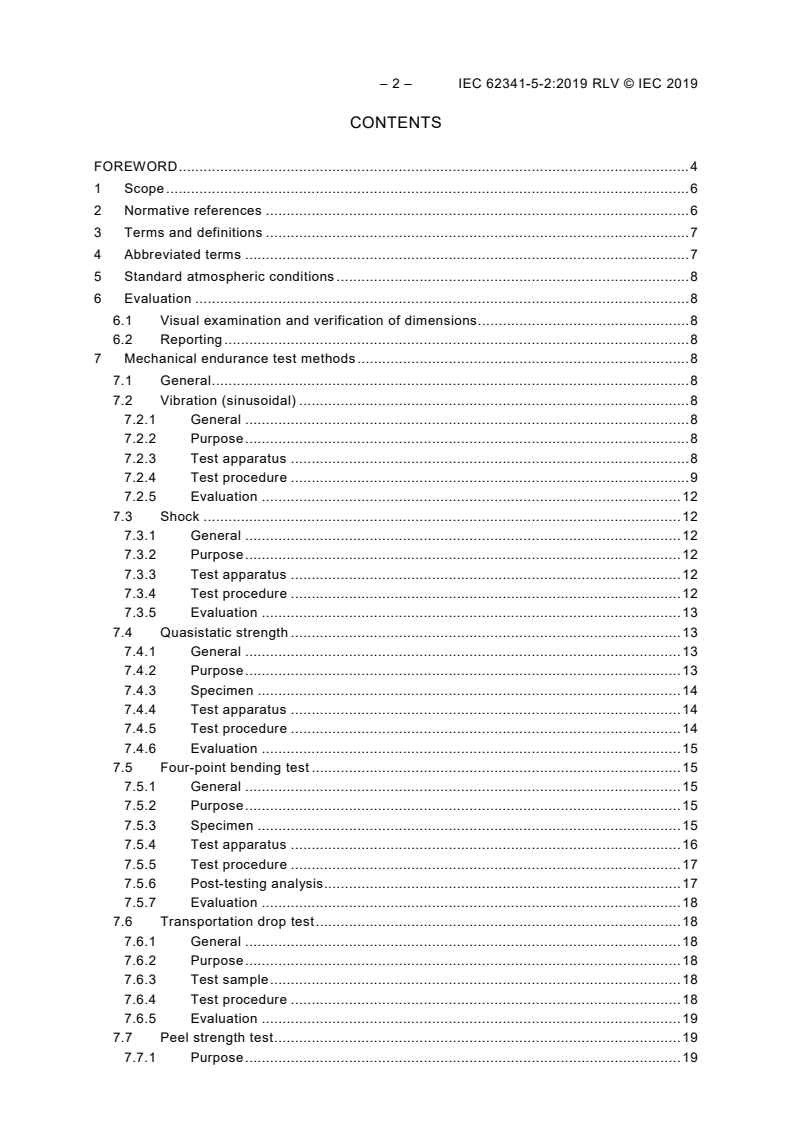
– 2 – IEC 62341-5-2:2019 © IEC 2019
CONTENTS
FOREWORD . 4
1 Scope . 6
2 Normative references . 6
3 Terms and definitions . 7
4 Abbreviated terms . 7
5 Standard atmospheric conditions . 7
6 Evaluation . 7
6.1 Visual examination and verification of dimensions . 7
6.2 Reporting . 8
7 Mechanical endurance test methods . 8
7.1 General . 8
7.2 Vibration (sinusoidal) . 8
7.2.1 General . 8
7.2.2 Purpose . 8
7.2.3 Test apparatus . 8
7.2.4 Test procedure . 8
7.2.5 Evaluation . 12
7.3 Shock . 12
7.3.1 General . 12
7.3.2 Purpose . 12
7.3.3 Test apparatus . 12
7.3.4 Test procedure . 12
7.3.5 Evaluation . 13
7.4 Quasistatic strength . 13
7.4.1 General . 13
7.4.2 Purpose . 13
7.4.3 Specimen . 14
7.4.4 Test apparatus . 14
7.4.5 Test procedure . 14
7.4.6 Evaluation . 15
7.5 Four-point bending test . 15
7.5.1 General . 15
7.5.2 Purpose . 15
7.5.3 Specimen . 15
7.5.4 Test apparatus . 16
7.5.5 Test procedure . 17
7.5.6 Post-testing analysis . 17
7.5.7 Evaluation . 18
7.6 Transportation drop test . 18
7.6.1 General . 18
7.6.2 Purpose . 18
7.6.3 Test sample . 18
7.6.4 Test procedure . 18
7.6.5 Evaluation . 19
7.7 Peel strength test . 19
7.7.1 Purpose . 19
7.7.2 Test procedure . 19
7.7.3 Evaluation . 20
7.8 Shock test for large size display . 20
7.8.1 Purpose . 20
7.8.2 Test procedure . 20
Annex A (informative) Example of raw test data reduction for four-point bending test . 21
A.1 Purpose . 21
A.2 Sample test results . 21
A.3 Finite element analysis . 22
A.4 Use of conversion factor . 26
A.5 Evaluation . 27
Bibliography . 29
Figure 1 – Example of the specimen and jig . 9
Figure 2 – Directions of vibration test . 9
Figure 3 – Configuration of OLED shock test set-up . 12
Figure 4 – Schematic of quasistatic strength measurement apparatus example . 14
Figure 5 – Schematics of test apparatus and pinned bearing edges . 16
Figure 6 – Specimen configuration under four-point bending test . 16
Figure 7 – Order of transportation package drop . 19
Figure 8 – Example of peeling strength test . 20
Figure A.1 – Specimen dimensions used for sample test . 21
Figure A.2 – Examples of test results: Load-displacement curves . 22
Figure A.3 – Finite element model of test specimen . 23
Figure A.4 – Displacement contour map after moving the loading bar down by 2 mm . 24
Figure A.5 – Contour map of maximum principal stress distribution . 24
Figure A.6 – Maximum principal stress and maximum stress along the edge . 25
Figure A.7 – Final relationship between panel strength and failure load . 25
Figure A.8 – Extraction of conversion factor by linear fitting . 26
Figure A.9 – Example of Weibull distribution of strength data and statistical outputs . 28
Figure A.10 – Fitted failure probability distribution of strength data and B strength . 28
Table 1 – Frequency range – Lower end . 10
Table 2 – Frequency range – Upper end . 10
Table 3 – Recommended frequency ranges . 11
Table 4 – Recommended vibration amplitudes . 11
Table 5 – Conditions for shock test . 13
Table 6 – Examples of test parameter combinations . 17
Table 7 – Example of package drop sequence . 19
Table A.1 – Results of raw test data . 22
Table A.2 – Example of conversion factor (t = 0,4mm, test span = 20mm/40mm) . 26
Table A.3 – Failure load and converted strength data . 27
– 4 – IEC 62341-5-2:2019 © IEC 2019
INTERNATIONAL ELECTROTECHNICAL COMMISSION
____________
ORGANIC LIGHT EMITTING DIODE (OLED) DISPLAYS –
Part 5-2: Mechanical endurance test methods
FOREWORD
1) The International Electrotechnical Commission (IEC) is a worldwide organization for standardization comprising
all national electrotechnical committees (IEC National Committees). The object of IEC is to promote
international co-operation on all questions concerning standardization in the electrical and electronic fields. To
this end and in addition to other activities, IEC publishes International Standards, Technical Specifications,
Technical Reports, Publicly Available Specifications (PAS) and Guides (hereafter referred to as “IEC
Publication(s)”). Their preparation is entrusted to technical committees; any IEC National Committee interested
in the subject dealt with may participate in this preparatory work. International, governmental and
non-governmental organizations liaising with the IEC also participate in this preparation. IEC collaborates
closely with the International Organization for Standardization (ISO) in accordance with conditions determined
by agreement between the two organizations.
2) The formal decisions or agreements of IEC on technical matters express, as nearly as possible, an international
consensus of opinion on the relevant subjects since each technical committee has representation from all
interested IEC National Committees.
3) IEC Publications have the form of recommendations for international use and are accepted by IEC National
Committees in that sense. While all reasonable efforts are made to ensure that the technical content of IEC
Publications is accurate, IEC cannot be held responsible for the way in which they are used or for any
misinterpretation by any end user.
4) In order to promote international uniformity, IEC National Committees undertake to apply IEC Publications
transparently to the maximum extent possible in their national and regional publications. Any divergence
between any IEC Publication and the corresponding national or regional publication shall be clearly indicated in
the latter.
5) IEC itself does not provide any attestation of conformity. Independent certification bodies provide conformity
assessment services and, in some areas, access to IEC marks of conformity. IEC is not responsible for any
services carried out by independent certification bodies.
6) All users should ensure that they have the latest edition of this publication.
7) No liability shall attach to IEC or its directors, employees, servants or agents including individual experts and
members of its technical committees and IEC National Committees for any personal injury, property damage or
other damage of any nature whatsoever, whether direct or indirect, or for costs (including legal fees) and
expenses arising out of the publication, use of, or reliance upon, this IEC Publication or any other IEC
Publications.
8) Attention is drawn to the Normative references cited in this publication. Use of the referenced publications is
indispensable for the correct application of this publication.
9) Attention is drawn to the possibility that some of the elements of this IEC Publication may be the subject of
patent rights. IEC shall not be held responsible for identifying any or all such patent rights.
International Standard IEC 62341-5-2 has been prepared by IEC technical committee 110:
Electronic display devices.
This second edition replaces the first edition published in 2013. This edition constitutes a
technical revision.
This edition includes the following significant technical changes with respect to the previous
edition:
a) Vibration and shock tests for large displays (for example, TVs and monitors) are added.
The text of this International Standard is based on the following documents:
FDIS Report on voting
110/1069/FDIS 110/1083/RVD
Full information on the voting for the approval of this International Standard can be found in
the report on voting indicated in the above table.
This document has been drafted in accordance with the ISO/IEC Directives, Part 2.
A list of all the parts in the IEC 62341 series, under the general title Organic light emitting
diode (OLED) displays, can be found on the IEC website.
The committee has decided that the contents of this document will remain unchanged until the
stability date indicated on the IEC website under "http://webstore.iec.ch" in the data related to
the specific document. At this date, the document will be
• reconfirmed,
• withdrawn,
• replaced by a revised edition, or
• amended.
A bilingual version of this publication may be issued at a later date.
IMPORTANT – The 'colour inside' logo on the cover page of this publication indicates
that it contains colours which are considered to be useful for the correct
understanding of its contents. Users should therefore print this document using a
colour printer.
– 6 – IEC 62341-5-2:2019 © IEC 2019
ORGANIC LIGHT EMITTING DIODE (OLED) DISPLAYS –
Part 5-2: Mechanical endurance test methods
1 Scope
This part of IEC 62341 defines test methods for evaluating the mechanical endurance quality
of organic light emitting diode (OLED) display panels and modules or their packaged form for
transportation. It takes into account, wherever possible, the environmental test methods
outlined in IEC 60068 (all parts). The object of this document is to establish uniform preferred
test methods for judging the mechanical endurance properties of OLED display devices.
There are generally two categories of mechanical endurance tests: those relating to the
product usage environment and those relating to the transportation environment in packaged
form. Quasistatic strength, four-point bending and peel strength tests are introduced here for
usage environment, while vibration, shock and transportation drop tests are applicable to the
transportation environment. Mechanical endurance tests can be categorized into mobile
applications, notebook computer or monitor applications and large size TV applications.
Special considerations or limitations of test methods according to the size or application of the
specimen are noted.
In case of contradiction between this document and a relevant specification, the latter will
govern.
NOTE This document is established separately from IEC 61747-5-3, because the technology of organic light
emitting diodes is considerably different from that of liquid crystal devices in such matters as:
– used materials and structure
– operation principles
– measuring methods
2 Normative references
The following documents are referred to in the text in such a way that some or all of their
content constitutes requirements of this document. For dated references, only the edition
cited applies. For undated references, the latest edition of the referenced document (including
any amendments) applies.
IEC 60068-2-6, Environmental testing – Part 2-6: Tests – Test Fc: Vibration (sinusoidal)
IEC 60068-2-27:2008, Environmental testing – Part 2-27: Tests – Test Ea and guidance:
Shock
IEC 61747-1-1:2014, Liquid crystal and solid-state display devices – Part 1-1: Generic –
Generic specification
IEC 61747-5-3:2009, Liquid crystal display devices – Part 5-3: Environmental, endurance and
mechanical test methods – Glass strength and reliability
IEC 61747-10-1:2013, Liquid crystal display devices – Part 10-1: Environmental, endurance
and mechanical test methods – Mechanical
IEC 62341-5:2009, Organic light emitting diode (OLED) displays – Part 5: Environmental
testing methods
IEC 62341-6-1, Organic light emitting diode (OLED) displays – Part 6-1: Measuring methods
of optical and electro-optical parameters
IEC 62341-6-2:2015, Organic light emitting diode (OLED) displays – Part 6-2: Measuring
methods of visual quality and ambient performance
ISO 2206, Packaging – Complete, filled transport packages – Identification of parts when
testing
ISO 2248:1985, Packaging – Complete, filled transport packages – Vertical impact test by
dropping
3 Terms and definitions
For the purposes of this document, the following terms and definitions apply.
ISO and IEC maintain terminological databases for use in standardization at the following
addresses:
• IEC Electropedia: available at http://www.electropedia.org/
• ISO Online browsing platform: available at http://www.iso.org/obp
NOTE Most of the definitions used comply with IEC 62341-1-2.
3.1
strength
stress at which a sample fails for a given loading condition
3.2
glass edge strength
measured stress at failure where the failure origin is known to have occurred at an edge
4 Abbreviated terms
B the value at the lower 10 % position in the Weibull distribution [1]
FEA finite element analysis
FPCB flexible printed circuit board
TSP touch screen panel
5 Standard atmospheric conditions
The standard atmospheric conditions in IEC 62341-5:2009, 5.3, shall apply unless otherwise
specifically agreed between customer and supplier.
6 Evaluation
6.1 Visual examination and verification of dimensions
The specimen shall be submitted to the visual and dimensional checks in non-operation
conditions and functional checks in operational conditions specified by the following:
_____________
Numbers in square brackets refer to the Bibliography.
– 8 – IEC 62341-5-2:2019 © IEC 2019
a) visual checks of damage to the exterior body of the specimen including marking,
encapsulation and terminals shall be done as specified in IEC 61747-1-1:2014, 4.3;
b) dimensions given in the relevant specification shall be verified;
c) visual and optical performance shall be checked as specified in IEC 62341-6-1.
Unless otherwise specified, visual inspection shall be performed under the conditions and
methods specified in IEC 62341-6-2:2015, 6.2.
6.2 Reporting
For the main results in each test, generally the minimum and averaged values or B value
instead of the minimum value shall be reported over the number of specimens depending on
the test purposes. The relevant specification shall provide the criteria upon which the
acceptance or rejection of the specimen is to be based.
7 Mechanical endurance test methods
7.1 General
Choice of the appropriate tests depends on the type of devices. The relevant specification
shall state which tests are applicable.
7.2 Vibration (sinusoidal)
7.2.1 General
Test Fc, specified in IEC 60068-2-6 and IEC 61747-10-1:2013, 5.4, is applicable with the
following specific conditions. In case of contradiction between these documents,
IEC 61747-10-1:2013, 5.4, shall prevail.
7.2.2 Purpose
The purpose of this test is to investigate the behaviour of the specimen in a vibration
environment such as transportation or in actual use.
7.2.3 Test apparatus
The equipment shall be capable of maintaining the test conditions specified in 7.2.4.1. The
vibration testing table should not resonate within the test condition vibration frequency range.
The required characteristics apply to the complete vibration system, which includes the power
amplifier, vibrator, test fixture, specimen and control system when loaded for testing. The
body of the device shall be securely clamped during the test. If the device has a specified
method of installation, it shall be used to clamp the device. The specimen shall be tested
under the non-operational condition.
7.2.4 Test procedure
7.2.4.1 General
The test specimen should be hooked up to the jig as shown in Figure 1 for a large size display.
Top
Top
y
Display
x
Jig
z
IEC
Figure 1 – Example of the specimen and jig
During this test for the large size display, the specimen should be turned off and the test
based on the specific time; the specimen quality is checked. The jig is on the base plate,
which should be fixed at the plate. The conditions for fixation of the specimen are depicted in
Figure 2 according to the different axes.
z
Top
y
y
x
x
x
Top
y
z
z
Base plate
Base plate
Base plate IEC
IEC
IEC
a) x-axis b) y-axis c) z-axis
Figure 2 – Directions of vibration test
To start, the condition should be as in Figure 2a), and the vibration frequency and the
duration time should be reported. After testing the x-axis condition, the specimen should be
set as in Figure 2b). The test with the specified vibration frequency and the duration time
should be operated. Finally, the test with the z-axis should be done. The test shall be
performed as described in 7.2.4.2.
NOTE The large size is defined for TVs. The size would be over 40 in.
7.2.4.2 Test conditions
7.2.4.2.1 Basic motion
The basic motion shall be a sinusoidal function of time and such that the fixing points of the
specimen move substantially in phase and in straight parallel lines.
7.2.4.2.2 Spurious motion
The maximum amplitude of spurious transverse motion at the check points in any
perpendicular area to the specified axis shall not exceed 25 %. In the case of large size or
high mass specimens, the occurrence of spurious rotational motion of the vibration table can
be important. If so, the relevant specification shall specify a tolerance level.
7.2.4.2.3 Signal tolerance
Unless otherwise stated in the relevant specification, acceleration signal tolerance
measurements shall be performed and signal tolerance shall not exceed 5 %.
– 10 – IEC 62341-5-2:2019 © IEC 2019
7.2.4.2.4 Vibration amplitude tolerance
Reference point: ±15 %.
Check point: ±25 %.
7.2.4.2.5 Frequency tolerances
7.2.4.2.5.1 Endurance by sweeping
±1 Hz from 5 Hz to 50 Hz.
±2 % above 50 Hz.
7.2.4.2.5.2 Endurance at critical frequencies
±2 %.
7.2.4.3 Severities
7.2.4.3.1 General
A vibration severity is defined by the combination of three parameters: frequency range,
vibration amplitude and duration of endurance (in sweep cycles or time).
7.2.4.3.2 Frequency range
The frequency range shall be given in the relevant specification by selecting a lower
frequency from Table 1 and an upper frequency from Table 2.
Table 1 – Frequency range – Lower end
Lower frequency f (Hz)
Table 2 – Frequency range – Upper end
Upper frequency f (Hz)
The recommended ranges are shown in Table 3.
Table 3 – Recommended frequency ranges
Recommended frequency ranges, from f to f (Hz)
1 2
5 to 100
5 to 200
5 to 500
10 to 55
10 to 200
10 to 300
10 to 500
7.2.4.3.3 Vibration amplitude
The vibration amplitude shall be stated in the relevant specification. Recommended vibration
amplitudes with cross-over frequency are shown in Table 4.
Table 4 – Recommended vibration amplitudes
Displacement amplitude below
Acceleration amplitude above the cross-over frequency
the cross-over frequency
M
m/s g
m
n
0,035 4,9 0,5
0,075 9,8 1,0
0,10 14,7 1,5
0,15 19,6 2,0
0,20 29,4 3,0
NOTE 1 The values listed apply in Table 4 for cross-over frequencies between 57 Hz and 62 Hz.
NOTE 2 Regardless of display size, the same amplitude is calculated and applied at per unit area.
7.2.4.3.4 Duration of endurance
7.2.4.3.4.1 Endurance by sweeping
The duration of the endurance test in each axis shall be given as a number of sweep cycles
chosen from the list given below:
1, 5, 10, 20, 30, 45, 60, 120
The sweeping shall be continuous and the frequency shall change exponentially with time.
The endurance time associated with the number of sweep cycles or sweep rate in
octaves/minute shall be specified. During the vibration response investigation, the specimen
and the vibration response data shall be examined in order to determine critical frequencies.
7.2.4.3.4.2 Endurance at critical frequencies
The duration of the endurance test in each axis at the critical frequencies found during the
vibration response investigation shall be chosen from the list given below. This test shall be
repeated for the number of critical frequencies as specified by the relevant specification.
10 min, 15 min, 30 min, 90 min
– 12 – IEC 62341-5-2:2019 © IEC 2019
7.2.5 Evaluation
After the test, visual, dimensional and functional checks shall be performed and compared as
described in 6.1.
7.3 Shock
7.3.1 General
IEC 60068-2-27 and 61747-10-1:2013, 5.5, shall be applied with the following specific
conditions. In case of contradiction between these document, IEC 61747-10-1:2013, 5.5, shall
prevail.
7.3.2 Purpose
This test aims to provide a standard procedure for determining the ability of an OLED panel or
module to withstand specified severities of shock. During transportation or in use, an OLED
panel or module can be subjected to conditions involving relatively non-repetitive shocks.
7.3.3 Test apparatus
The body of the specimen shall be securely clamped during the test in the test direction and
aligned with the z-axis of the test machine; for example, Figure 3 depicts the shock test along
the y’-direction of the specimen. If the device has a specified method of installation, it shall be
used to clamp the device.
Clamp
OLED
module
OLED
module
y'
y'
z
y
x'
z'
x
IEC
IEC
a) Example of a shock test machine b) test direction of a specimen
Figure 3 – Configuration of OLED shock test set-up
7.3.4 Test procedure
Test Ea, specified in IEC 60068-2-27, is applicable, with the following specific requirements.
The conditions shall be selected from Table 5, taking into consideration the mass of the
device and its internal construction.
Table 5 – Conditions for shock test
Corresponding velocity change ΔV
Corresponding duration D of the
Peak amplitude A
nominal pulse
Half-sine Trapezoidal
(m/s ) (g )
n
(ms)
(m/s) (m/s)
50 (5) 30 1,0 -
150 (15) 11 1,0 1,5
300 (30) 18 3,4 4,8
300 (30) 11 2,1 2,9
300 (30) 6 1,1 1,6
500 (50) 11 3,4 4,9
500 (50) 3 0,9 1,3
1 000 (100) 11 6,9 9,7
1 000 (100) 6 3,7 5,3
2 000 (200) 6 7,5 10,6
2 000 (200) 3 3,7 5,3
5 000 (500) 1 3,1 -
10 000 (1000) 1 6,2 -
NOTE Preferred values are underlined.
The choice of waveform to be used depends on a number of factors, and difficulties inherent
in making such a choice preclude a preferred order being given in the document (see
IEC 60068-2-27:2008, Clause A.3). The relevant specification shall state the waveform
utilized.
Unless otherwise specified by the relevant specification, three successive shocks shall be
applied in each direction of three mutually perpendicular axes of the specimen, for a total of
18 shocks. Depending on the number of identical devices available and the mounting
arrangements, particularly in the case of components, they can be oriented such that the
multiple axis/direction requirements of the relevant specification can be met by the application
of three shocks in one direction only (see IEC 60068-2-27:2008, Clause A.7).
7.3.5 Evaluation
Visual, dimensional and functional checks shall be performed and compared as described in
6.1 to the relevant specification.
7.4 Quasistatic strength
7.4.1 General
IEC 61747-5-3:2009, 5.4, is applicable with the following specific conditions.
7.4.2 Purpose
The objective of this document is to establish uniform requirements for accurate and reliable
measurements of the quasistatic strength of OLED panels or modules. The quasistatic
strength of an OLED module may be specified to ensure the mechanical endurance level from
the quasistatic external loadings in and around the display area in normal use, such as sitting
on the product or touching/pushing a finger-tip in the display area.
– 14 – IEC 62341-5-2:2019 © IEC 2019
7.4.3 Specimen
This document applies to the OLED panels or modules for mobile and IT applications. OLED
module products incorporating additional components, for example, a touch screen panel
(TSP), protective film and window cover, may be used as an acceptable form of the specimen.
In all cases a minimum sample size of at least six panels or modules shall be used to obtain a
statistically significant strength distribution representative of quasistatic resistance of the
specimen to external loadings induced by handling, processing and fabrication of the
specimen specified as a part of the end product.
F
Metal rod
Specimen
Frame with cavity
Hard plate
IEC
IEC
a) Boundary support with cavity b) Side support
Figure 4 – Schematic of quasistatic strength measurement apparatus example
7.4.4 Test apparatus
The quasistatic strength of a specimen is measured by supporting the specimen on the
mounting frame and loading it at the centre as shown in Figure 4. The specimen shall be put
on the frame with the rectangular cavity as shown in Figure 4a) or on side supports as shown
in Figure 4b). The size of a rectangular cavity in the frame (Figure 4a)) shall be specified by
the relevant specification and shall be as big as the edge of the supporting area allows. It is
recommended to set the cavity to be around the active area size for mobile applications. The
tip of the metal loading bar shall be rounded in shape and the diameter of the metal rod varies
according to the specimen size under testing. It is recommended to use a metal rod of 10 mm
in diameter for the samples which have a display diagonal length of up to 101,6 mm (4 in). For
larger modules, such as for notebook computer or monitor applications, a rod of 19 mm
diameter is recommended. The same apparatus may also be used for loading the OLED
module off-center and obtaining its strength at different locations. For TV applications, this
quasistatic strength test is generally not applicable.
7.4.5 Test procedure
7.4.5.1 General
The displacement rate should be slow enough so that there is no significant dynamic
response from the loading such that the maximum strain rate upon the specimen shall be of
-4 -1
the order of 1,0 × 10 s [3]. The typical loading rate or crosshead speed is 3 mm/min or 5
mm/min for small size displays such that failure may occur within the measurement time of
30 s to 45 s. Depending on the purpose of the test, the following test procedure may be
applied.
7.4.5.2 Static loading resistance
For this test, a specified load is set to assess module resistance to the external static load
from the relevant specification. A specified load is set and applied on the surface of the
specimen by lowering the metal rod as shown in Figure 4. After reaching the specified load,
the rod is set to return back to the starting position. Multiple loads may be applied in steps.
The loading position of the specimen shall be the center of the active area of the display, but
multiple loading positions, including the off-center position, may also be applied depending on
the area of interest.
7.4.5.3 Quasistatic failure load
In continuation of the specified load test in 7.4.5.2, this test is intended to measure the failure
load. The metal rod is lowered to push the surface of the specimen until the specimen breaks.
The specimen is categorized as a failure when the applied load from continuing to push the
rod into the specimen drops below a designated proportion of the peak load value. The
designated proportion is typically 2 % below the peak value.
7.4.6 Evaluation
For the static load test, the relevant specification shall provide the specified load level upon
which the acceptance or rejection of the resistance of specimen is to be based. For the failure
load test in 7.4.5.3, the average, maximum and minimum values along with the failure load of
each test specimen are reported. It shall be noted in the test reporting whether the specimen
incorporates any additional component.
7.5 Four-point bending test
7.5.1 General
This document is established separately from IEC 61747-5-3, where the characterization of
the glass component is particularly emphasized. The quasistatic strength of the edges of the
glass or simply the flexural strength of OLED panels and the integrity of the panel structure
are assessed in the four-point bending test configuration. Even though there is no limitation
when using the four-point bending test on the size of the display panels, this test is generally
applicable for mobile applications, which are at most 101,6 mm in diagonal size.
7.5.2 Purpose
The four-point bending test is important since the result of this test can be used as an
indicator of the mechanical endurance level when either the panel sample or module sample
is exposed to various mechanical loadings under hostile usage conditions, such as twisting a
handset, etc. For the purpose of this test, the glass in OLED display panels is considered
brittle and as having the property that fracture normally occurs at the surface of the glass from
the maximum tensile stress. The failure strength of the display module is determined when the
weakest component in the specimen fails. Depending on the panel structure, the weakest link
could be the inferior edge of the glass or some other failure, such as disintegration of the
sealing material. The four-point bending test is recommended since it distributes the
maximum tensile stress over a larger volume or area in comparison to the three-point bending
test.
7.5.3 Specimen
The specimen is a display panel consisting of rear and front glasses. The test specimen may
contain a polarizer; however, it is not necessary if the testing is done at production phase
where the polarizers have not yet been placed. The use of a polarizer or other low elastic
modulus tape is permitted on the specimen surface to hold the cracked fragments and permit
observation of the origin of the crack. At least ten specimens shall be used for the purpose of
estimating the mean. A minimum of twenty specimens shall be necessary if estimates
regarding the form of strength distribution are to be reported. Unless otherwise taken for a
specific purpose, the samples shall be taken from several sheets or regions of a single sheet
– 16 – IEC 62341-5-2:2019 © IEC 2019
from which the display panels are made. Any specimen may be rejected prior to testing for
defects considered likely to affect the quasistatic strength of the edges of the glass. The
variation in width or thickness shall not exceed 5 % over the length of the specimen equal to
the support span.
7.5.4 Test apparatus
7.5.4.1 Testing machine
The testing machine consists of a test frame and a four-point bending test fixture. Figure 6
illustrates an example of a four-point bending test fixture with an OLED panel specimen. The
test frame consists of a vertical loading machine, which could be electromechanical,
servo-hydraulic or pneumatic driven, a load cell mounted and controller software. It is
assumed that the fixtures are relatively rigid and that most of the testing-machine crosshead
travel is imposed as strain on the specimen. There are also several requirements for a
four-point bending apparatus to be met in order to ensure reliable data with minimal variation
[2].
7.5.4.2 Bearing cylinders
Cylindrical bearing edges shall be used for the support of the specimen and for the
application of the load. The bearing cylinder radius shall be approximately 2 mm to 5 mm
depending on the thickness of the specimen [3]. The cylinders shall be made of sufficiently
hardened steel to prevent excessive deformation under load and be free to roll in order to
relieve frictional constraints. Moreover two loading bearings and one support bearing cylinder
also shall be provided to rotate laterally to compensate for any irregular surface contact with a
specimen and to ensure uniform and even distribution of the load between the two inner
bearing edges. Figure 5 shows a suitable arrangement using pinned bearing assemblies.
d d
Bearing
cylinders
Panel front
Test fixture
IEC
IEC
a) side view b) front view
Figure 5 – Schematics of test apparatus and pinned bearing edges
S
L
S
L
z
z
y
y
S
x S
S
S
x
L
L
IEC
IEC
a) x-direction bending b) y-direction bending
Figure 6 – Specimen configuration under four-point bending test
7.5.5 Test procedure
The specimen length, L, is determined as the length of either the long side or short side of the
front glass as described in Figure 6a) and Figure 6b), respectively. The amount of overhang
of the specimen, d in Figure 5, shall be at least 2 mm beyond the outer bearings to allow the
specimen to slide over the support and to eliminate the effect of the specimen’s end condition.
Slowly apply the load at right angles to the fixture. The maximum permissible stress in the
specimen due to initial load shall not exceed 25 % of the mean strength. In the four-point
bending test, a specimen is loaded at constant displacement rate until rupture. The
displacement rate to be used depends on the chosen spans and it is chosen such that the
time to complete one test cycle would be sufficiently long as described in 7.3.4 while the time
to failure for a typical specimen ranges from 30 s to 45 s. In Table 6 some examples of the
combinations of test configurations and displacement rates are given.
Table 6 – Examples of test parameter combinations
Displacement rate
L (mm) S (mm) S (mm)
S L
(mm/min.)
25 20 10 3
45 40 20 5
85 80 40 10
Specifically the span between the test jig and the loading rollers needs to be adjusted for a
different specimen size with a specified support span (S ) and load span (S ) to cover most
S L
parts of the panel edge under bending. On the other hand, to prevent the effect of the bending
area size on the glass edge strength and to test under the same strength criteria regardless of
the specimen sizes tested, a constant load span and support span may be specified. In any
case, the load span shall be half of the support span [3]. The bearing cylinders shall be
carefully positioned such that the spans are accurate within ± 0,10 mm.
7.5.6 Post-testing analysis
7.5.6.1 Breakage origin analy
...
IEC 62341-5-2 ®
Edition 2.0 2019-03
REDLINE VERSION
INTERNATIONAL
STANDARD
colour
inside
Organic light emitting diode (OLED) displays –
Part 5-2: Mechanical endurance testing methods
All rights reserved. Unless otherwise specified, no part of this publication may be reproduced or utilized in any form
or by any means, electronic or mechanical, including photocopying and microfilm, without permission in writing from
either IEC or IEC's member National Committee in the country of the requester. If you have any questions about IEC
copyright or have an enquiry about obtaining additional rights to this publication, please contact the address below or
your local IEC member National Committee for further information.
IEC Central Office Tel.: +41 22 919 02 11
3, rue de Varembé info@iec.ch
CH-1211 Geneva 20 www.iec.ch
Switzerland
About the IEC
The International Electrotechnical Commission (IEC) is the leading global organization that prepares and publishes
International Standards for all electrical, electronic and related technologies.
About IEC publications
The technical content of IEC publications is kept under constant review by the IEC. Please make sure that you have the
latest edition, a corrigendum or an amendment might have been published.
IEC publications search - webstore.iec.ch/advsearchform Electropedia - www.electropedia.org
The advanced search enables to find IEC publications by a The world's leading online dictionary on electrotechnology,
variety of criteria (reference number, text, technical containing more than 22 000 terminological entries in English
committee,…). It also gives information on projects, replaced and French, with equivalent terms in 16 additional languages.
and withdrawn publications. Also known as the International Electrotechnical Vocabulary
(IEV) online.
IEC Just Published - webstore.iec.ch/justpublished
Stay up to date on all new IEC publications. Just Published IEC Glossary - std.iec.ch/glossary
details all new publications released. Available online and 67 000 electrotechnical terminology entries in English and
once a month by email. French extracted from the Terms and Definitions clause of
IEC publications issued since 2002. Some entries have been
IEC Customer Service Centre - webstore.iec.ch/csc collected from earlier publications of IEC TC 37, 77, 86 and
If you wish to give us your feedback on this publication or CISPR.
need further assistance, please contact the Customer Service
Centre: sales@iec.ch.
IEC 62341-5-2 ®
Edition 2.0 2019-03
REDLINE VERSION
INTERNATIONAL
STANDARD
colour
inside
Organic light emitting diode (OLED) displays –
Part 5-2: Mechanical endurance testing methods
INTERNATIONAL
ELECTROTECHNICAL
COMMISSION
ICS 31.260 ISBN 978-2-8322-6683-0
– 2 – IEC 62341-5-2:2019 RLV © IEC 2019
CONTENTS
FOREWORD . 4
1 Scope . 6
2 Normative references . 6
3 Terms and definitions . 7
4 Abbreviated terms . 7
5 Standard atmospheric conditions . 8
6 Evaluation . 8
6.1 Visual examination and verification of dimensions . 8
6.2 Reporting . 8
7 Mechanical endurance test methods . 8
7.1 General . 8
7.2 Vibration (sinusoidal) . 8
7.2.1 General . 8
7.2.2 Purpose . 8
7.2.3 Test apparatus . 8
7.2.4 Test procedure . 9
7.2.5 Evaluation . 12
7.3 Shock . 12
7.3.1 General . 12
7.3.2 Purpose . 12
7.3.3 Test apparatus . 12
7.3.4 Test procedure . 12
7.3.5 Evaluation . 13
7.4 Quasistatic strength . 13
7.4.1 General . 13
7.4.2 Purpose . 13
7.4.3 Specimen . 14
7.4.4 Test apparatus . 14
7.4.5 Test procedure . 14
7.4.6 Evaluation . 15
7.5 Four-point bending test . 15
7.5.1 General . 15
7.5.2 Purpose . 15
7.5.3 Specimen . 15
7.5.4 Test apparatus . 16
7.5.5 Test procedure . 17
7.5.6 Post-testing analysis . 17
7.5.7 Evaluation . 18
7.6 Transportation drop test . 18
7.6.1 General . 18
7.6.2 Purpose . 18
7.6.3 Test sample . 18
7.6.4 Test procedure . 18
7.6.5 Evaluation . 19
7.7 Peel strength test . 19
7.7.1 Purpose . 19
7.7.2 Test procedure . 19
7.7.3 Evaluation . 20
7.8 Shock test for large size display . 20
7.8.1 Purpose . 20
7.8.2 Test procedure . 20
Annex A (informative) Example of raw test data reduction for four-point bending test . 21
A.1 Purpose . 21
A.2 Sample test results . 21
A.3 Finite element analysis . 22
A.4 Use of conversion factor . 26
A.5 Evaluation . 27
Bibliography . 29
Figure 1 – Example of the specimen and jig . 9
Figure 2 – Directions of vibration test . 9
Figure 3 – Configuration of OLED shock test set-up . 12
Figure 4 – Schematic of quasistatic strength measurement apparatus example . 14
Figure 5 – Schematics of test apparatus and pinned bearing edges . 16
Figure 6 – Specimen configuration under four-point bending test . 16
Figure 7 – Order of transportation package drop . 19
Figure 8 – Example of peeling strength test . 20
Figure A.1 – Specimen dimensions used for sample test . 21
Figure A.2 – Examples of test results: Load-displacement curves . 22
Figure A.3 – Finite element model of test specimen . 23
Figure A.4 – Displacement contour map after moving down the loading bar down
by 2 mm . 24
Figure A.5 – Contour map of maximum principal stress distribution . 24
Figure A.6 – Maximum principal stress and maximum stress along the edge . 25
Figure A.7 – Final relationship between panel strength and failure load . 25
Figure A.8 – Extraction of conversion factor by linear fitting . 26
Figure A.9 – Example of Weibull distribution of strength data and statistical outputs . 28
Figure A.10 – Fitted failure probability distribution of strength data and B10 strength. 28
Table 1 – Frequency range – Lower end . 10
Table 2 – Frequency range – Upper end . 10
Table 3 – Recommended frequency ranges . 11
Table 4 – Recommended vibration amplitudes . 11
Table 5 – Conditions for shock test . 13
Table 6 – Examples of test parameter combinations . 17
Table 7 – Example of package drop sequence . 19
Table A.1 – Results of raw test data . 22
Table A.2 – Example of conversion factor (t = 0,4mm, test span = 20mm/40mm) . 26
Table A.3 – Failure load and converted strength data . 27
– 4 – IEC 62341-5-2:2019 RLV © IEC 2019
INTERNATIONAL ELECTROTECHNICAL COMMISSION
____________
ORGANIC LIGHT EMITTING DIODE (OLED) DISPLAYS –
Part 5-2: Mechanical endurance testing methods
FOREWORD
1) The International Electrotechnical Commission (IEC) is a worldwide organization for standardization comprising
all national electrotechnical committees (IEC National Committees). The object of IEC is to promote
international co-operation on all questions concerning standardization in the electrical and electronic fields. To
this end and in addition to other activities, IEC publishes International Standards, Technical Specifications,
Technical Reports, Publicly Available Specifications (PAS) and Guides (hereafter referred to as “IEC
Publication(s)”). Their preparation is entrusted to technical committees; any IEC National Committee interested
in the subject dealt with may participate in this preparatory work. International, governmental and
non-governmental organizations liaising with the IEC also participate in this preparation. IEC collaborates
closely with the International Organization for Standardization (ISO) in accordance with conditions determined
by agreement between the two organizations.
2) The formal decisions or agreements of IEC on technical matters express, as nearly as possible, an international
consensus of opinion on the relevant subjects since each technical committee has representation from all
interested IEC National Committees.
3) IEC Publications have the form of recommendations for international use and are accepted by IEC National
Committees in that sense. While all reasonable efforts are made to ensure that the technical content of IEC
Publications is accurate, IEC cannot be held responsible for the way in which they are used or for any
misinterpretation by any end user.
4) In order to promote international uniformity, IEC National Committees undertake to apply IEC Publications
transparently to the maximum extent possible in their national and regional publications. Any divergence
between any IEC Publication and the corresponding national or regional publication shall be clearly indicated in
the latter.
5) IEC itself does not provide any attestation of conformity. Independent certification bodies provide conformity
assessment services and, in some areas, access to IEC marks of conformity. IEC is not responsible for any
services carried out by independent certification bodies.
6) All users should ensure that they have the latest edition of this publication.
7) No liability shall attach to IEC or its directors, employees, servants or agents including individual experts and
members of its technical committees and IEC National Committees for any personal injury, property damage or
other damage of any nature whatsoever, whether direct or indirect, or for costs (including legal fees) and
expenses arising out of the publication, use of, or reliance upon, this IEC Publication or any other IEC
Publications.
8) Attention is drawn to the Normative references cited in this publication. Use of the referenced publications is
indispensable for the correct application of this publication.
9) Attention is drawn to the possibility that some of the elements of this IEC Publication may be the subject of
patent rights. IEC shall not be held responsible for identifying any or all such patent rights.
This redline version of the official IEC Standard allows the user to identify the changes
made to the previous edition. A vertical bar appears in the margin wherever a change
has been made. Additions are in green text, deletions are in strikethrough red text.
International Standard IEC 62341-5-2 has been prepared by IEC technical committee 110:
Electronic display devices.
This second edition replaces the first edition published in 2013. This edition constitutes a
technical revision.
This edition includes the following significant technical changes with respect to the previous
edition:
a) Vibration and shock tests for large displays (for example, TVs and monitors) are added.
The text of this International Standard is based on the following documents:
FDIS Report on voting
110/1069/FDIS 110/1083/RVD
Full information on the voting for the approval of this International Standard can be found in
the report on voting indicated in the above table.
This document has been drafted in accordance with the ISO/IEC Directives, Part 2.
A list of all the parts in the IEC 62341 series, under the general title Organic light emitting
diode (OLED) displays, can be found on the IEC website.
The committee has decided that the contents of this document will remain unchanged until the
stability date indicated on the IEC website under "http://webstore.iec.ch" in the data related to
the specific document. At this date, the document will be
• reconfirmed,
• withdrawn,
• replaced by a revised edition, or
• amended.
IMPORTANT – The 'colour inside' logo on the cover page of this publication indicates
that it contains colours which are considered to be useful for the correct
understanding of its contents. Users should therefore print this document using a
colour printer.
– 6 – IEC 62341-5-2:2019 RLV © IEC 2019
ORGANIC LIGHT EMITTING DIODE (OLED) DISPLAYS –
Part 5-2: Mechanical endurance testing methods
1 Scope
This part of IEC 62341 defines testing methods for evaluating the mechanical endurance
quality of organic light emitting diode (OLED) display panels and modules or their packaged
form for transportation. It takes into account, wherever possible, the environmental testing
methods outlined in IEC 60068 (all parts). The object of this document is to establish uniform
preferred test methods for judging the mechanical endurance properties of OLED display
devices.
There are generally two categories of mechanical endurance tests: those relating to the
product usage environment and those relating to the transportation environment in packaged
form. Vibration, shock, Quasistatic strength, four-point bending test and peel strength tests
are introduced here for usage environment, while vibration, shock and transportation drop
tests is are applicable to the transportation environment. Mechanical endurance tests may
also can be categorized into mobile applications, notebook computer or monitor applications
and large size TV applications. Special considerations or limitations of test methods according
to the size or application of the specimen will be are noted.
In case of contradiction between this document and a relevant specification, the latter will
govern.
NOTE This document is established separately from IEC 61747-5-3, because the technology of organic light
emitting diodes is considerably different from that of liquid crystal devices in such matters as:
– used materials and structure
– operation principles
– measuring methods
2 Normative references
The following documents are referred to in the text in such a way that some or all of their
content constitutes requirements of this document. For dated references, only the edition
cited applies. For undated references, the latest edition of the referenced document (including
any amendments) applies.
IEC 60068-2-6:2007, Environmental testing – Part 2-6: Tests – Test Fc: Vibration (sinusoidal)
IEC 60068-2-27:2008, Environmental testing – Part 2-27: Tests – Test Ea and guidance:
Shock
IEC 61747-1-1:2014, Liquid crystal and solid-state display devices – Part 1-1: Generic –
Generic specification
IEC 61747-5:1998, Liquid crystal and solid-state display devices – Part 5: Environmental,
endurance and mechanical test methods
IEC 61747-5-3:2009, Liquid crystal display devices – Part 5-3: Environmental, endurance and
mechanical test methods – Glass strength and reliability
IEC 61747-10-1:2013, Liquid crystal display devices – Part 10-1: Environmental, endurance
and mechanical test methods – Mechanical
IEC 62341-1-2:2007, Organic light emitting diode displays – Part 1-2: Terminology and letter
symbols
IEC 62341-5:2009, Organic light emitting diode (OLED) displays – Part 5: Environmental
testing methods
IEC 62341-6-1:2009, Organic light emitting diode (OLED) displays – Part 6-1: Measuring
methods of optical and electro-optical parameters
IEC 62341-6-2:2012 2015, Organic light emitting diode (OLED) displays – Part 6-2: Measuring
methods of visual quality and ambient performance
ISO 2206:1987, Packaging – Complete, filled transport packages – Identification of parts
when testing
ISO 2248:1985, Packaging – Complete, filled transport packages – Vertical impact test by
dropping
3 Terms and definitions
For the purposes of this document, the following terms and definitions given in IEC 62341-1-2
and the following apply.
ISO and IEC maintain terminological databases for use in standardization at the following
addresses:
• IEC Electropedia: available at http://www.electropedia.org/
• ISO Online browsing platform: available at http://www.iso.org/obp
NOTE Most of the definitions used comply with IEC 62341-1-2.
3.1
strength
stress at which a sample fails for a given loading condition
3.2
glass edge strength
measured stress at failure where the failure origin is known to have occurred at an edge
4 Abbreviated terms
B the value at the lower 10 % position in the Weibull distribution [1]
FEA finite element analysis
FPCB flexible printed circuit board
TSP touch screen panel
_____________
Numbers in square brackets refer to the Bibliography.
– 8 – IEC 62341-5-2:2019 RLV © IEC 2019
5 Standard atmospheric conditions
The standard atmospheric conditions in IEC 62341-5:2009, 5.3, shall apply unless otherwise
specifically agreed between customer and supplier.
6 Evaluations
6.1 Visual examination and verification of dimensions
The specimen shall be submitted to the visual and dimensional checks in non-operation
conditions and functional checks in operational conditions prescribed specified by the
following specification:
a) visual checks of damage to the exterior body of the specimen including marking,
encapsulation and terminals shall be examined as specified in IEC 61747-5:1998, 1.5
done as specified in IEC 61747-1-1:2014, 4.3;
b) dimensions given in the customer’s relevant specification shall be verified;
c) visual and optical performance shall be checked as specified in IEC 62341-6-1.
Unless otherwise specified, visual inspection shall be performed under the conditions and
methods specified in IEC 62341-6-2:2012 2015, 6.2.
6.2 Reporting
For the main results in each test, generally the minimum and averaged values or B value
instead of the minimum value shall be reported over the number of specimens depending on
the test purposes. The relevant specification shall provide the criteria upon which the
acceptance or rejection of the specimen is to be based.
7 Mechanical endurance test methods
7.1 General
Choice of the appropriate tests depends on the type of devices. The relevant specification
shall state which tests are applicable.
7.2 Vibration (sinusoidal)
7.2.1 General
Test Fc, specified in IEC 60068-2-6 and IEC 61747-5:1998, 2.3 IEC 61747-10-1:2013, 5.4 is
applicable with the following specific conditions. In case of contradiction between these
documents, IEC 617475:1998, 2.3 IEC 61747-10-1:2013, 5.4, shall govern prevail.
7.2.2 Purpose
The purpose of this test is to investigate the behaviour of the specimen in a vibration
environment such as transportation or in actual use.
7.2.3 Test apparatus
The equipment shall be capable of maintaining the test conditions specified in 7.2.4.1. The
vibration testing table should not resonate within the test condition vibration frequency range.
The required characteristics apply to the complete vibration system, which includes the power
amplifier, vibrator, test fixture, specimen and control system when loaded for testing. The
body of the device shall be securely clamped during the test. If the device has a specified
method of installation, it shall be used to clamp the device. The specimen shall be tested
under the non-operational condition.
Top
7.2.4 Test procedure
7.2.4.1 General
The test specimen should be hooked up to the jig as shown in Figure 1 for a large size display.
Top
y
Display
x
Jig
z
IEC
Figure 1 – Example of the specimen and jig
During this test for the large size display, the specimen should be turned off and the test
based on the specific time; the specimen quality is checked. The jig is on the base plate,
which should be fixed at the plate. The conditions for fixation of the specimen are depicted in
Figure 2 according to the different axes.
z
Top
y
y
x
x x
Top
y
z
z
Base plate
Base plate
Base plate IEC
IEC
IEC
a) x-axis b) y-axis c) z-axis
Figure 2 – Directions of vibration test
To start, the condition should be as in Figure 2a), and the vibration frequency and the
duration time should be reported. After testing the x-axis condition, the specimen should be
set as in Figure 2b). The test with the specified vibration frequency and the duration time
should be operated. Finally, the test with the z-axis should be done. The test shall be
performed as described in 7.2.4.2.
NOTE The large size is defined for TVs. The size would be over 40 in.
7.2.4.2 Test conditions
7.2.4.2.1 Basic motion
The basic motion shall be a sinusoidal function of time and such that the fixing points of the
specimen move substantially in phase and in straight parallel lines.
7.2.4.2.2 Spurious motion
The maximum amplitude of spurious transverse motion at the check points in any
perpendicular area to the specified axis shall not exceed 25 %. In the case of large size or
high mass specimens, the occurrence of spurious rotational motion of the vibration table may
can be important. If so, the relevant specification shall prescribe specify a tolerance level.
– 10 – IEC 62341-5-2:2019 RLV © IEC 2019
7.2.4.2.3 Signal tolerance
Unless otherwise stated in the relevant specification, acceleration signal tolerance
measurements shall be performed and signal tolerance shall not exceed 5 %.
7.2.4.2.4 Vibration amplitude tolerance
Reference point: ±15 %.
Check point: ±25 %.
7.2.4.2.5 Frequency tolerances
7.2.4.2.5.1 Endurance by sweeping
±1 Hz from 5 Hz to 50 Hz.
±2 % above 50 Hz.
7.2.4.2.5.2 Endurance at critical frequencies
±2 %.
7.2.4.3 Severities
7.2.4.3.1 General
A vibration severity is defined by the combination of three parameters: frequency range,
vibration amplitude and duration of endurance (in sweep cycles or time).
7.2.4.3.2 Frequency range
The frequency range shall be given in the relevant specification by selecting a lower
frequency from Table 1 and an upper frequency from Table 2.
Table 1 – Frequency range – Lower end
Lower frequency f (Hz)
Table 2 – Frequency range – Upper end
Upper frequency f (Hz)
The recommended ranges are shown in Table 3.
Table 3 – Recommended frequency ranges
Recommended frequency ranges, from f to f (Hz)
1 2
5 to 100
5 to 200
5 to 500
10 to 55
10 to 200
10 to 300
10 to 500
7.2.4.3.3 Vibration amplitude
The vibration amplitude shall be stated in the relevant specification. Recommended vibration
amplitudes with cross-over frequency are shown in Table 4.
Table 4 – Recommended vibration amplitudes
Displacement amplitude below
Acceleration amplitude above the cross-over frequency
the cross-over frequency
M
m/s g
m
n
0,035 4,9 0,5
0,075 9,8 1,0
0,10 14,7 1,5
0,15 19,6 2,0
0,20 2,4 29,4 3,0
NOTE 1 The values listed apply in Table 4 for cross-over frequencies between 57 Hz and 62 Hz.
NOTE 2 Regardless of display size, the same amplitude is calculated and applied at per unit area.
7.2.4.3.4 Duration of endurance
7.2.4.3.4.1 Endurance by sweeping
The duration of the endurance test in each axis shall be given as a number of sweep cycles
chosen from the list given below:
1, 5, 10, 20, 30, 45, 60, 120
The sweeping shall be continuous and the frequency shall change exponentially with time.
The endurance time associated with the number of sweep cycles or sweep rate in
octaves/minute shall be specified. During the vibration response investigation, the specimen
and the vibration response data shall be examined in order to determine critical frequencies.
7.2.4.3.4.2 Endurance at critical frequencies
The duration of the endurance test in each axis at the critical frequencies found during the
vibration response investigation shall be chosen from the list given below. This test shall be
repeated for the number of critical frequencies as specified by the relevant specification.
10 min, 15 min, 30 min, 90 min
– 12 – IEC 62341-5-2:2019 RLV © IEC 2019
7.2.5 Evaluation
After the test, visual, dimensional and functional checks shall be performed and compared as
described in 6.1.
7.3 Shock
7.3.1 General
IEC 60068-2-27 and 61747-5:1998, 2.4 61747-10-1:2013, 5.5, shall be applied with the
following specific conditions. In case of contradiction between these documents, IEC 61747-
5:1998, 2.4 IEC 61747-10-1:2013, 5.5, shall govern prevail.
7.3.2 Purpose
This test aims to provide a standard procedure for determining the ability of an OLED panel or
module to withstand specified severities of shock. During transportation or in use, an OLED
panel or module may can be subjected to conditions involving relatively non-repetitive shocks.
7.3.3 Test apparatus
The body of the specimen shall be securely clamped during the test in the test direction and
aligned with the z-axis of the test machine; for example, Figure 3 depicts the shock test along
the y’-direction of the specimen. If the device has a specified method of installation, it shall be
used to clamp the device.
Clamp
OLED
module
OLED
module
y'
y'
z
y
x'
z'
x
IEC
IEC
a) Example of a shock test machine b) test direction of a specimen
Figure 3 – Configuration of OLED shock test set-up
7.3.4 Test procedure
Test Ea, specified in IEC 60068-2-27, is applicable, with the following specific requirements.
The conditions shall be selected from Table 5, taking into consideration the mass of the
device and its internal construction.
Table 5 – Conditions for shock test
Corresponding velocity change ΔV
Corresponding duration D of the
Peak amplitude A
nominal pulse
Half-sine Trapezoidal
(m/s ) (g )
n
(ms)
(m/s) (m/s)
50 (5) 30 1,0 -
150 (15) 11 1,0 1,5
300 (30) 18 3,4 4,8
300 (30) 11 2,1 2,9
300 (30) 6 1,1 1,6
500 (50) 11 3,4 4,9
500 (50) 3 0,9 1,3
1 000 (100) 11 6,9 9,7
1 000 (100) 6 3,7 5,3
2 000 (200) 6 7,5 10,6
2 000 (200) 3 3,7 5,3
5 000 (500) 1 3,1 -
10 000 (1000) 1 6,2 -
NOTE Preferred values are underlined.
The choice of waveform to be used depends on a number of factors, and difficulties inherent
in making such a choice preclude a preferred order being given in the document (see
IEC 60068-2-27:2008, Clause A.3). The relevant specification shall state the waveform
utilized.
Unless otherwise prescribed specified by the relevant specification, three successive shocks
shall be applied in each direction of three mutually perpendicular axes of the specimen, for a
total of 18 shocks. Depending on the number of identical devices available and the mounting
arrangements, particularly in the case of components, they may can be oriented such that the
multiple axis/direction requirements of the relevant specification can be met by the application
of three shocks in one direction only (see IEC 60068-2-27:2008, Clause A.7).
7.3.5 Evaluation
Visual, dimensional and functional checks shall be performed and compared as described in
6.1 to the relevant specification.
7.4 Quasistatic strength
7.4.1 General
IEC 61747-5-3:2009, 5.4, is applicable with the following specific conditions.
7.4.2 Purpose
The objective of this document is to establish uniform requirements for accurate and reliable
measurements of the quasistatic strength of OLED panels or modules. The quasistatic
strength of an OLED module may be specified to ensure the mechanical endurance level from
the quasistatic external loadings in and around the display area in normal use, such as sitting
on the product or touching/pushing a finger-tip in the display area.
– 14 – IEC 62341-5-2:2019 RLV © IEC 2019
7.4.3 Specimen
This document applies to the OLED panels or modules for mobile and IT applications. OLED
module products incorporating additional components, for example, a touch screen panel
(TSP), protective film and window cover, may be used as an acceptable form of the specimen.
In all cases a minimum sample size of at least six panels or modules shall be used to obtain a
statistically significant strength distribution representative of quasistatic resistance of the
specimen to external loadings induced by handling, processing and fabrication of the
specimen specified as a part of the end product.
F
Metal rod
Specimen
Frame with cavity
Hard plate
IEC
IEC
a) Boundary support with cavity b) Side support
Figure 4 – Schematic of quasistatic strength measurement apparatus example
7.4.4 Test apparatus
The quasistatic strength of a specimen is measured by supporting the specimen on the
mounting frame and loading it at the centre as shown in Figure 4. The specimen shall be put
on the frame with the rectangular cavity as shown in Figure 4a) or on side supports as shown
in Figure 4b). The size of a rectangular cavity in the frame (Figure 4a)) shall be specified by
the relevant specification and shall be as big as the edge of the supporting area allows. It is
recommended to set the cavity to be around the active area size for mobile applications. The
tip of the metal loading bar shall be rounded in shape and the diameter of the metal rod varies
according to the specimen size under testing. It is recommended to use a metal rod of 10 mm
in diameter for the samples which have a display diagonal length of up to 101,6 mm (4 in). For
larger modules, such as for notebook computer or monitor applications, a rod of 19 mm
diameter is recommended. The same apparatus may also be used for loading the OLED
module off-center and obtaining its strength at different locations. For TV applications, this
quasistatic strength test is generally not applicable.
7.4.5 Test procedure
7.4.5.1 General
The displacement rate should be slow enough so that there is no significant dynamic
response from the loading such that the maximum strain rate upon the specimen shall be of
-4 -1
the order of 1,0 × 10 s [3]. The typical loading rate or crosshead speed is 3 mm/min or 5
mm/min for small size displays such that failure may occur within the measurement time of
30 s to 45 s. Depending on the purpose of the test, the following test procedure may be
applied.
7.4.5.2 Static loading resistance
For this test, a specified load is set to assess module resistance to the external static load
from the relevant specification. A specified load is set andapplied on the surface of the
specimen by lowering the metal rod as shown in Figure 4. After reaching the specified load,
the rod is set to return back to the starting position. Multiple loads may be applied in steps.
The loading position of the specimen shall be the center of the active area of the display, but
multiple loading positions, including the off-center position, may also be applied depending on
the area of interest.
7.4.5.3 Quasistatic failure load
In continuation of the specified load test in 7.4.5.2, this test is intended to measure the failure
load. The metal rod is lowered to push the surface of the specimen until the specimen breaks.
The specimen is categorized as a failure when the applied load starts to drop by more than a
designated portion, e.g. 2 % of the peak load value. The specimen is categorized as a failure
when the applied load from continuing to push the rod into the specimen drops below a
designated proportion of the peak load value. The designated proportion is typically 2 %
below the peak value.
7.4.6 Evaluation
For the static load test, the relevant specification shall provide the specified load level upon
which the acceptance or rejection of the resistance of specimen is to be based. For the failure
load test in 7.4.5.3, the average, maximum and minimum values along with the failure load of
each test specimen are reported. It shall be noted in the test reporting about whether the
specimen if it incorporates any additional component.
7.5 Four-point bending test
7.5.1 General
This document is established separately from IEC 61747-5-3, where the characterization of
the glass component is particularly emphasized. The quasistatic strength of the edges of the
glass or simply the flexural strength of OLED panels and the integrity of the panel structure
are assessed in the four-point bending test configuration. Even though there is no limitation
when using the four-point bending test on the size of the display panels, this test is generally
applicable for mobile applications, which is are at most 101,6 mm in diagonal size.
7.5.2 Purpose
The four-point bending test is important since the result of this test can be used as an
indicator of the mechanical endurance level when either the panel sample or module sample
is exposed to various mechanical loadings under hostile usage conditions, such as twisting a
handset, etc. For the purpose of this test, the glasses in OLED display panels are is
considered brittle and as having the property that fracture normally occurs at the surface of
the glass from the maximum tensile stress. The failure strength of the display module is
determined when the weakest component in the specimen fails. Depending on the panel
structure, the weakest link could be the inferior edge of the glass or some other failure origins,
such as disintegration of the sealing material. The four-point bending test is recommended
since it distributes the maximum tensile stress over a larger volume or area in comparison to
the three-point bending test.
7.5.3 Specimen
The specimen is a display panel consisting of rear and front glasses. The test specimen may
contain a polarizer; however, it is not necessary if the testing is done at production phase
where the polarizers have not yet been placed. The use of a polarizer or other low elastic
modulus tape is permitted on the specimen surface to hold the cracked fragments and permit
observation of the origin of the crack. At least ten specimens shall be used for the purpose of
estimating the mean. A minimum of twenty specimens shall be necessary if estimates
– 16 – IEC 62341-5-2:2019 RLV © IEC 2019
regarding the form of strength distribution are to be reported. Unless otherwise taken for a
specific purpose, the samples shall be taken from several sheets or regions of a single sheet
from which the display panels are made. Any specimen may be rejected prior to testing for
defects considered likely to affect the quasistatic strength of the edges of the glass. The
variation in width or thickness shall not exceed 5 % over the length of the specimen equal to
the support span.
7.5.4 Test apparatus
7.5.4.1 Testing machine
The testing machine consists of a test frame and a four-point bending test fixture. Figure 6
illustrates an example of a four-point bending test fixture with an OLED panel specimen. The
test frame consists of a vertical loading machine, which could be electromechanical,
servo-hydraulic or pneumatic driven, a load cell mounted and controller software. It is
assumed that the fixtures are relatively rigid and that most of the testing-machine crosshead
travel is imposed as strain on the specimen. There are also several requirements for a
four-point bending apparatus to be met in order to ensure reliable data with minimal variation
[2].
7.5.4.2 Bearing cylinders
Cylindrical bearing edges shall be used for the support of the specimen and for the
application of the load. The bearing cylinder radius shall be approximately 2 mm to 5 mm
depending on the thickness of the specimen [3]. The cylinders shall be made of sufficiently
hardened steel to prevent excessive deformation under load and be free to roll in order to
relieve frictional constraints. Moreover two loading bearings and one support bearing cylinder
also shall be provided to rotate laterally to compensate for any irregular surface contact with a
specimen and to ensure uniform and even distribution of the load between the two inner
bearing edges. Figure 5 shows a suitable arrangement using pinned bearing assemblies.
d d
Bearing
cylinders
Panel front
Test fixture
IEC
IEC
a) side view b) front view
Figure 5 – Schematics of test apparatus and pinned bearing edges
S
L
S
L
z
z
y
y
S
x S
S
S
x
L
L
IEC
IEC
a) x-direction bending b) y-direction bending
Figure 6 – Specimen configuration under four-point bending test
7.5.5 Test procedure
The specimen length, L, is determined as the length of either the long side or short side of the
front glass as described in Figure 6a) and Figure 6b), respectively. The amount of overhang
of the specimen, d in Figure 5, shall be at least 2 mm beyond the outer bearings to allow the
specimen to slide over the support and to eliminate the effect of the specimen’s end condition.
Slowly apply the load at right angles to the fixture. The maximum permissible stress in the
specimen due to initial load shall not exceed 25 % of the mean strength. In the four-point
bending test, a specimen is loaded at constant displacement rate until rupture. The
displacement
...