

IEC 61340-4-7:2025
(Main)Electrostatics - Part 4-7: Standard test methods for specific applications - Ionization
General Information
- Abstract
IEC 61340-4-7:2025 provides test methods and procedures for evaluating and selecting air ionization equipment and systems (ionizers). This document establishes measurement techniques, under specified conditions, to determine offset voltage (ion balance) and decay (charge neutralization) time for ionizers. This document does not include measurements of electromagnetic interference (EMI), or the use of ionizers in connection with ordnance, flammables, explosive items or electrically initiated explosive devices. As contained in this document, the test methods and test conditions can be used by manufacturers of ionizers to provide performance data describing their products. Users of ionizers are urged to modify the test methods and test conditions for their specific application in order to qualify ionizers for use, or to make periodic verifications of ionizer performance. The user will decide the extent of the data required for each application.
This edition includes the following significant technical changes with respect to the previous edition:
a) in Figure 5, a NOTE 3 was added to clarify that for AC bars and grids, a single emitter alternating between +/− polarity is used;
b) in Annex B, the relative error for measurement equipment was updated to include the consideration for the resolution of the voltmeter.
- Status
- Published
- Publication Date
- 18-Aug-2025
- Technical Committee
- TC 101 - Electrostatics
- Drafting Committee
- WG 5 - TC 101/WG 5
- Current Stage
- PPUB - Publication issued
- Start Date
- 19-Aug-2025
- Completion Date
- 12-Sep-2025
Buy Documents
IEC 61340-4-7:2025 - Electrostatics - Part 4-7: Standard test methods for specific applications - Ionization/19/2025
REDLINE IEC 61340-4-7:2025 CMV - Electrostatics - Part 4-7: Standard test methods for specific applications - Ionization Released:8/19/2025
IEC 61340-4-7:2025 - Electrostatique - Partie 4-7 : Méthodes d'essai normalisées pour des applications spécifiques - Ionisation/19/2025
IEC 61340-4-7:2025 - Electrostatics - Part 4-7: Standard test methods for specific applications - Ionization/19/2025
Overview
IEC 61340-4-7:2025 - "Electrostatics - Part 4-7: Standard test methods for specific applications - Ionization" defines standardized test methods for evaluating and selecting air ionization equipment (ionizers). The standard sets out measurement techniques, test fixtures and procedures to determine offset voltage (ion balance) and decay (charge neutralization) time for ionizers under specified conditions. It is intended to produce reproducible performance data that manufacturers, test labs and end users can rely on - while noting that users should adapt test conditions for their specific applications.
Key topics and requirements
- Primary measurements: offset voltage (ion balance) and charged-plate decay time (neutralization rate).
- Test methods and instrumentation: charged plate monitor arrangements (contacting and non-contacting), fixture and voltmeter considerations, and procedures for measuring capacitance of an isolated plate (Annex B).
- Equipment categories and test locations: room ionization, laminar flow hoods (vertical and horizontal), worksurface/benchtop ionizers, overhead ionizers, and compressed-gas ionizers (guns/nozzles).
- Test conditions and reproducibility: defined test points and set-ups to generate meaningful, repeatable data; guidance on preparing the test area and sources of measurement error (Annex A).
- Safety and exclusions: safety considerations (Annex C); the standard explicitly excludes EMI measurements and use of ionizers with ordnance, flammables, explosive items or electrically initiated explosive devices.
- Recent updates (2025 edition):
- Clarification that for AC bars/grids a single emitter alternating between +/− polarity is used (Figure 5 NOTE 3).
- Annex B updated to include voltmeter resolution in the relative error for measurement equipment.
Applications and who uses it
- Manufacturers: to provide standardized performance data for ionizers and to design product test protocols.
- Test laboratories and QA teams: to verify ionizer performance, characterize neutralization rates and ion balance, and perform periodic verifications.
- ESD control engineers and facility managers: in electronics assembly, cleanrooms, semiconductor fabs, medical device manufacturing, and other ESD-sensitive environments to qualify ionizers for specific processes.
- Procurement and compliance: to compare products objectively and ensure compatibility with an organization’s electrostatic discharge (ESD) control program.
Related standards
- Part of the IEC 61340 series on electrostatics. Developed by IEC Technical Committee 101 (Electrostatics). Users should consult other IEC 61340 parts for grounding, triboelectric charging, and ESD control program requirements.
Keywords: IEC 61340-4-7, ionization test methods, electrostatics standard, ionizers, offset voltage, decay time, charged plate monitor, ESD control.
Relations
- Effective Date
- 05-Sep-2023
Buy Documents
IEC 61340-4-7:2025 - Electrostatics - Part 4-7: Standard test methods for specific applications - Ionization/19/2025
REDLINE IEC 61340-4-7:2025 CMV - Electrostatics - Part 4-7: Standard test methods for specific applications - Ionization Released:8/19/2025
IEC 61340-4-7:2025 - Electrostatique - Partie 4-7 : Méthodes d'essai normalisées pour des applications spécifiques - Ionisation/19/2025
IEC 61340-4-7:2025 - Electrostatics - Part 4-7: Standard test methods for specific applications - Ionization/19/2025
Get Certified
Connect with accredited certification bodies for this standard

IMQ S.p.A. (Certification)
Italian electrical product certification.

SLG Prüf- und Zertifizierungs GmbH
German testing and certification body.

UL Solutions
Global safety science company with testing, inspection and certification.
Sponsored listings
Frequently Asked Questions
IEC 61340-4-7:2025 is a standard published by the International Electrotechnical Commission (IEC). Its full title is "Electrostatics - Part 4-7: Standard test methods for specific applications - Ionization". This standard covers: IEC 61340-4-7:2025 provides test methods and procedures for evaluating and selecting air ionization equipment and systems (ionizers). This document establishes measurement techniques, under specified conditions, to determine offset voltage (ion balance) and decay (charge neutralization) time for ionizers. This document does not include measurements of electromagnetic interference (EMI), or the use of ionizers in connection with ordnance, flammables, explosive items or electrically initiated explosive devices. As contained in this document, the test methods and test conditions can be used by manufacturers of ionizers to provide performance data describing their products. Users of ionizers are urged to modify the test methods and test conditions for their specific application in order to qualify ionizers for use, or to make periodic verifications of ionizer performance. The user will decide the extent of the data required for each application. This edition includes the following significant technical changes with respect to the previous edition: a) in Figure 5, a NOTE 3 was added to clarify that for AC bars and grids, a single emitter alternating between +/− polarity is used; b) in Annex B, the relative error for measurement equipment was updated to include the consideration for the resolution of the voltmeter.
IEC 61340-4-7:2025 provides test methods and procedures for evaluating and selecting air ionization equipment and systems (ionizers). This document establishes measurement techniques, under specified conditions, to determine offset voltage (ion balance) and decay (charge neutralization) time for ionizers. This document does not include measurements of electromagnetic interference (EMI), or the use of ionizers in connection with ordnance, flammables, explosive items or electrically initiated explosive devices. As contained in this document, the test methods and test conditions can be used by manufacturers of ionizers to provide performance data describing their products. Users of ionizers are urged to modify the test methods and test conditions for their specific application in order to qualify ionizers for use, or to make periodic verifications of ionizer performance. The user will decide the extent of the data required for each application. This edition includes the following significant technical changes with respect to the previous edition: a) in Figure 5, a NOTE 3 was added to clarify that for AC bars and grids, a single emitter alternating between +/− polarity is used; b) in Annex B, the relative error for measurement equipment was updated to include the consideration for the resolution of the voltmeter.
IEC 61340-4-7:2025 is classified under the following ICS (International Classification for Standards) categories: 17.200.99 - Other standards related to thermodynamics; 29.020 - Electrical engineering in general. The ICS classification helps identify the subject area and facilitates finding related standards.
IEC 61340-4-7:2025 has the following relationships with other standards: It is inter standard links to IEC 61340-4-7:2017. Understanding these relationships helps ensure you are using the most current and applicable version of the standard.
IEC 61340-4-7:2025 is available in PDF format for immediate download after purchase. The document can be added to your cart and obtained through the secure checkout process. Digital delivery ensures instant access to the complete standard document.
Standards Content (Sample)
IEC 61340-4-7 ®
Edition 3.0 2025-08
INTERNATIONAL
STANDARD
Electrostatics -
Part 4-7: Standard test methods for specific applications - Ionization
ICS 17.200.99; 29.020 ISBN 978-2-8327-0643-5
All rights reserved. Unless otherwise specified, no part of this publication may be reproduced or utilized in any form or
by any means, electronic or mechanical, including photocopying and microfilm, without permission in writing from either
IEC or IEC's member National Committee in the country of the requester. If you have any questions about IEC copyright
or have an enquiry about obtaining additional rights to this publication, please contact the address below or your local
IEC member National Committee for further information.
IEC Secretariat Tel.: +41 22 919 02 11
3, rue de Varembé info@iec.ch
CH-1211 Geneva 20 www.iec.ch
Switzerland
About the IEC
The International Electrotechnical Commission (IEC) is the leading global organization that prepares and publishes
International Standards for all electrical, electronic and related technologies.
About IEC publications
The technical content of IEC publications is kept under constant review by the IEC. Please make sure that you have the
latest edition, a corrigendum or an amendment might have been published.
IEC publications search - IEC Products & Services Portal - products.iec.ch
webstore.iec.ch/advsearchform Discover our powerful search engine and read freely all the
The advanced search enables to find IEC publications by a publications previews, graphical symbols and the glossary.
variety of criteria (reference number, text, technical With a subscription you will always have access to up to date
committee, …). It also gives information on projects, content tailored to your needs.
replaced and withdrawn publications.
Electropedia - www.electropedia.org
The world's leading online dictionary on electrotechnology,
IEC Just Published - webstore.iec.ch/justpublished
Stay up to date on all new IEC publications. Just Published containing more than 22 500 terminological entries in English
details all new publications released. Available online and and French, with equivalent terms in 25 additional languages.
once a month by email. Also known as the International Electrotechnical Vocabulary
(IEV) online.
IEC Customer Service Centre - webstore.iec.ch/csc
If you wish to give us your feedback on this publication or
need further assistance, please contact the Customer
Service Centre: sales@iec.ch.
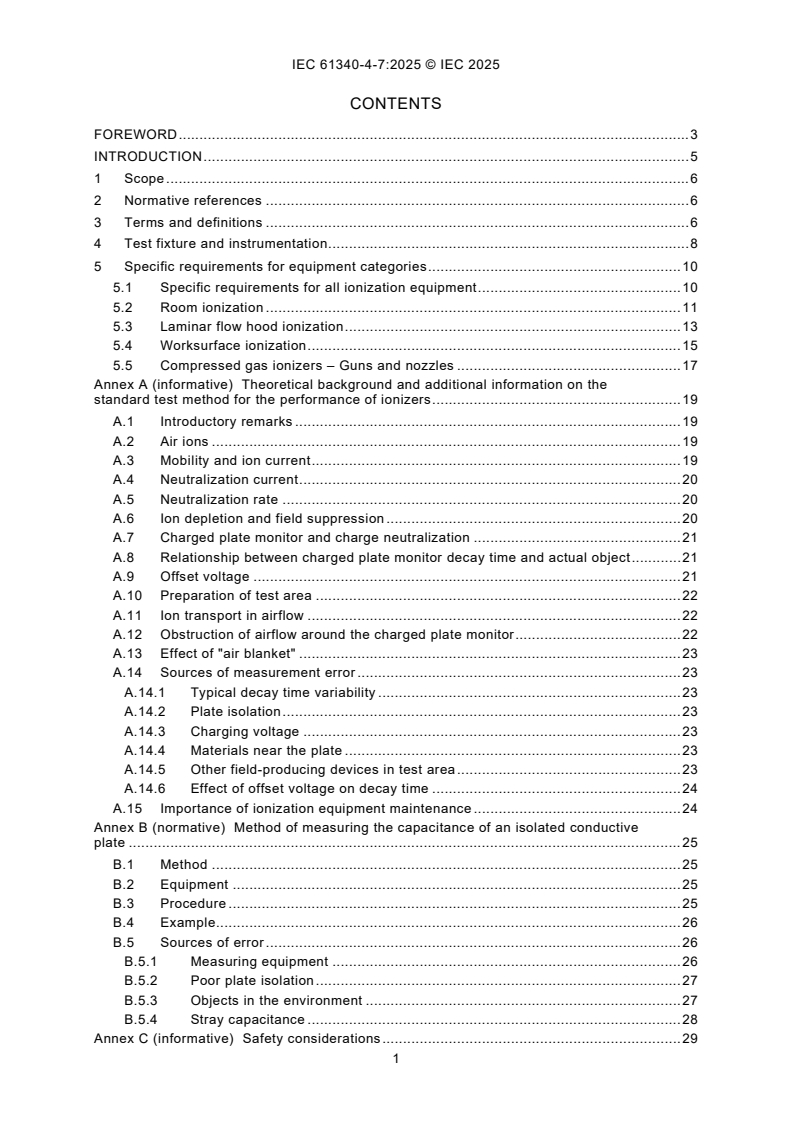
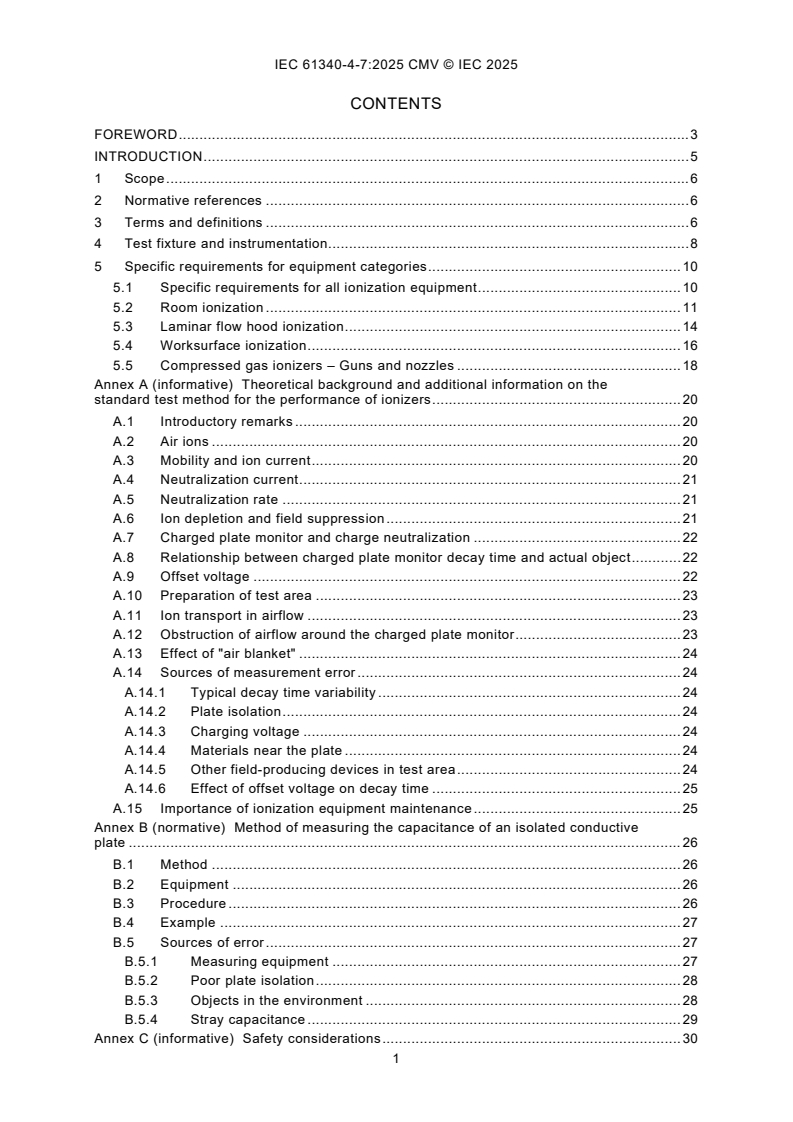
CONTENTS
FOREWORD . 3
INTRODUCTION . 5
1 Scope . 6
2 Normative references . 6
3 Terms and definitions . 6
4 Test fixture and instrumentation . 8
5 Specific requirements for equipment categories . 10
5.1 Specific requirements for all ionization equipment . 10
5.2 Room ionization . 11
5.3 Laminar flow hood ionization . 13
5.4 Worksurface ionization . 15
5.5 Compressed gas ionizers – Guns and nozzles . 17
Annex A (informative) Theoretical background and additional information on the
standard test method for the performance of ionizers . 19
A.1 Introductory remarks . 19
A.2 Air ions . 19
A.3 Mobility and ion current . 19
A.4 Neutralization current . 20
A.5 Neutralization rate . 20
A.6 Ion depletion and field suppression . 20
A.7 Charged plate monitor and charge neutralization . 21
A.8 Relationship between charged plate monitor decay time and actual object . 21
A.9 Offset voltage . 21
A.10 Preparation of test area . 22
A.11 Ion transport in airflow . 22
A.12 Obstruction of airflow around the charged plate monitor . 22
A.13 Effect of "air blanket" . 23
A.14 Sources of measurement error . 23
A.14.1 Typical decay time variability . 23
A.14.2 Plate isolation . 23
A.14.3 Charging voltage . 23
A.14.4 Materials near the plate . 23
A.14.5 Other field-producing devices in test area . 23
A.14.6 Effect of offset voltage on decay time . 24
A.15 Importance of ionization equipment maintenance . 24
Annex B (normative) Method of measuring the capacitance of an isolated conductive
plate . 25
B.1 Method . 25
B.2 Equipment . 25
B.3 Procedure . 25
B.4 Example. 26
B.5 Sources of error . 26
B.5.1 Measuring equipment . 26
B.5.2 Poor plate isolation . 27
B.5.3 Objects in the environment . 27
B.5.4 Stray capacitance . 28
Annex C (informative) Safety considerations . 29
C.1 General . 29
C.2 Electrical . 29
C.3 Ozone . 29
C.4 Radioactive . 29
C.5 X-ray . 29
C.6 Installation . 29
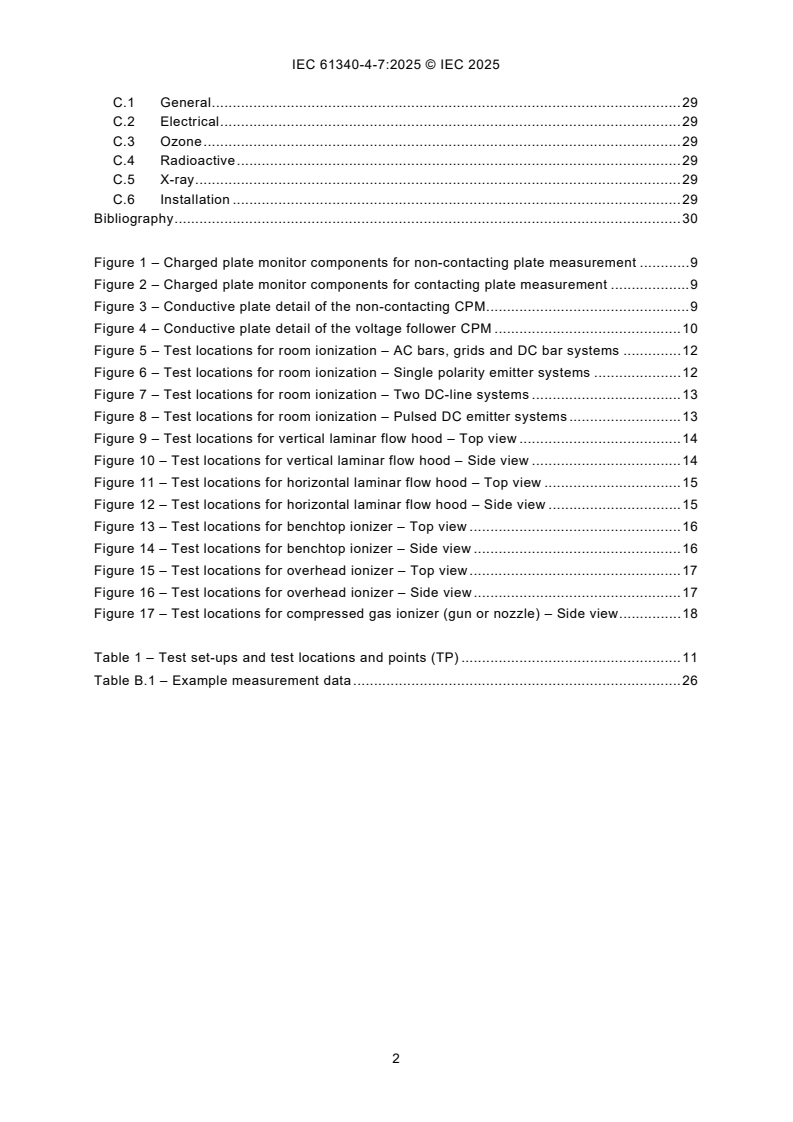
Bibliography . 30
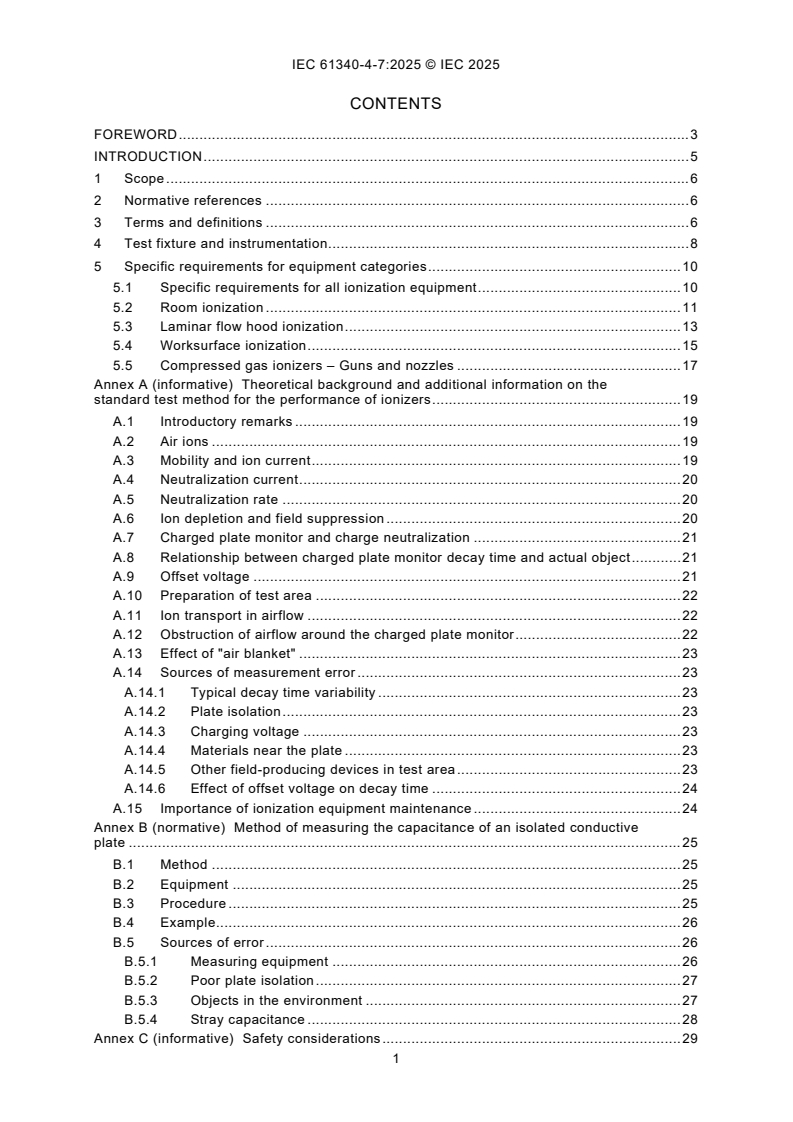
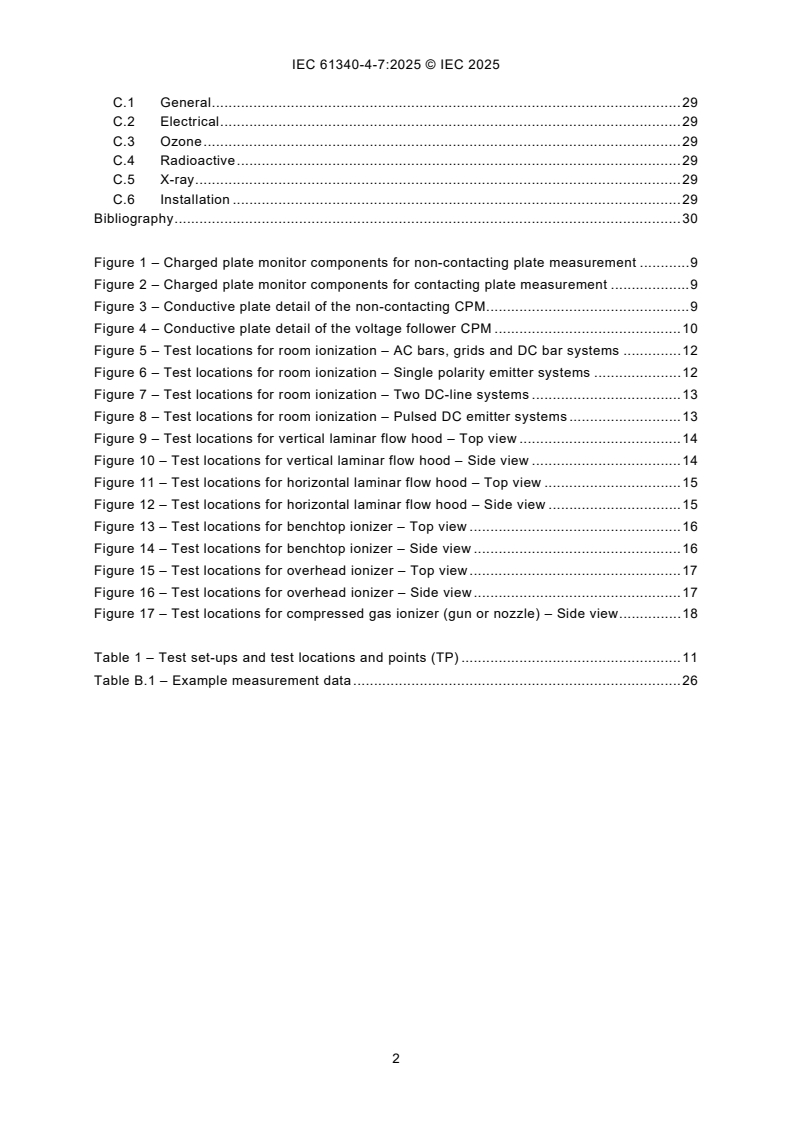
Figure 1 – Charged plate monitor components for non-contacting plate measurement . 9
Figure 2 – Charged plate monitor components for contacting plate measurement . 9
Figure 3 – Conductive plate detail of the non-contacting CPM . 9
Figure 4 – Conductive plate detail of the voltage follower CPM . 10
Figure 5 – Test locations for room ionization – AC bars, grids and DC bar systems . 12
Figure 6 – Test locations for room ionization – Single polarity emitter systems . 12
Figure 7 – Test locations for room ionization – Two DC-line systems . 13
Figure 8 – Test locations for room ionization – Pulsed DC emitter systems . 13
Figure 9 – Test locations for vertical laminar flow hood – Top view . 14
Figure 10 – Test locations for vertical laminar flow hood – Side view . 14
Figure 11 – Test locations for horizontal laminar flow hood – Top view . 15
Figure 12 – Test locations for horizontal laminar flow hood – Side view . 15
Figure 13 – Test locations for benchtop ionizer – Top view . 16
Figure 14 – Test locations for benchtop ionizer – Side view . 16
Figure 15 – Test locations for overhead ionizer – Top view . 17
Figure 16 – Test locations for overhead ionizer – Side view . 17
Figure 17 – Test locations for compressed gas ionizer (gun or nozzle) – Side view . 18
Table 1 – Test set-ups and test locations and points (TP) . 11
Table B.1 – Example measurement data . 26
INTERNATIONAL ELECTROTECHNICAL COMMISSION
____________
Electrostatics -
Part 4-7: Standard test methods for specific applications - Ionization
FOREWORD
1) The International Electrotechnical Commission (IEC) is a worldwide organization for standardization comprising
all national electrotechnical committees (IEC National Committees). The object of IEC is to promote international
co-operation on all questions concerning standardization in the electrical and electronic fields. To this end and
in addition to other activities, IEC publishes International Standards, Technical Specifications, Technical Reports,
Publicly Available Specifications (PAS) and Guides (hereafter referred to as “IEC Publication(s)”). Their
preparation is entrusted to technical committees; any IEC National Committee interested in the subject dealt with
may participate in this preparatory work. International, governmental and non-governmental organizations liaising
with the IEC also participate in this preparation. IEC collaborates closely with the International Organization for
Standardization (ISO) in accordance with conditions determined by agreement between the two organizations.
2) The formal decisions or agreements of IEC on technical matters express, as nearly as possible, an international
consensus of opinion on the relevant subjects since each technical committee has representation from all
interested IEC National Committees.
3) IEC Publications have the form of recommendations for international use and are accepted by IEC National
Committees in that sense. While all reasonable efforts are made to ensure that the technical content of IEC
Publications is accurate, IEC cannot be held responsible for the way in which they are used or for any
misinterpretation by any end user.
4) In order to promote international uniformity, IEC National Committees undertake to apply IEC Publications
transparently to the maximum extent possible in their national and regional publications. Any divergence between
any IEC Publication and the corresponding national or regional publication shall be clearly indicated in the latter.
5) IEC itself does not provide any attestation of conformity. Independent certification bodies provide conformity
assessment services and, in some areas, access to IEC marks of conformity. IEC is not responsible for any
services carried out by independent certification bodies.
6) All users should ensure that they have the latest edition of this publication.
7) No liability shall attach to IEC or its directors, employees, servants or agents including individual experts and
members of its technical committees and IEC National Committees for any personal injury, property damage or
other damage of any nature whatsoever, whether direct or indirect, or for costs (including legal fees) and
expenses arising out of the publication, use of, or reliance upon, this IEC Publication or any other IEC
Publications.
8) Attention is drawn to the Normative references cited in this publication. Use of the referenced publications is
indispensable for the correct application of this publication.
9) IEC draws attention to the possibility that the implementation of this document may involve the use of (a)
patent(s). IEC takes no position concerning the evidence, validity or applicability of any claimed patent rights in
respect thereof. As of the date of publication of this document, IEC had not received notice of (a) patent(s), which
may be required to implement this document. However, implementers are cautioned that this may not represent
the latest information, which may be obtained from the patent database available at https://patents.iec.ch. IEC
shall not be held responsible for identifying any or all such patent rights.
IEC 61340-4-7 has been prepared by IEC technical committee 101: Electrostatics. It is an
International Standard.
This third edition cancels and replaces the second edition published in 2017. This edition
constitutes a technical revision.
This edition includes the following significant technical changes with respect to the previous
edition:
a) in Figure 5, a NOTE 3 was added to clarify that for AC bars and grids, a single emitter
alternating between +/− polarity is used;
b) in Annex B, the relative error for measurement equipment was updated to include the
consideration for the resolution of the voltmeter.
The text of this International Standard is based on the following documents:
Draft Report on voting
101/739/FDIS 101/744/RVD
Full information on the voting for its approval can be found in the report on voting indicated in
the above table.
The language used for the development of this International Standard is English.
This document was drafted in accordance with ISO/IEC Directives, Part 2, and developed in
accordance with ISO/IEC Directives, Part 1 and ISO/IEC Directives, IEC Supplement, available
at www.iec.ch/members_experts/refdocs. The main document types developed by IEC are
described in greater detail at www.iec.ch/publications.
A list of all parts in the IEC 61340 series, published under the general title Electrostatics, can
be found on the IEC website.
The committee has decided that the contents of this document will remain unchanged until the
stability date indicated on the IEC website under webstore.iec.ch in the data related to the
specific document. At this date, the document will be
– reconfirmed,
– withdrawn, or
– revised.
INTRODUCTION
Grounding is the primary method used to limit static charge when protecting electrostatic
discharge sensitive items in the work environment. However, grounding methods are not
effective in removing static charges from the surfaces of non-conductive (insulative) or isolated
(ungrounded) conductive materials. Air ionization techniques, by means of ionizer systems, can
be utilized to reduce this charge.
The preferred way of evaluating the ability of an ionizer to neutralize a static charge is to directly
measure the rate of charge decay. Charges to be neutralized can be located on insulators as
well as on isolated conductors. It is difficult to charge an insulator reliably and repeatably.
Charge neutralization is more easily evaluated by measuring the rate of decay of the voltage of
an isolated conductive plate. The measurement of this decay should not interfere with or change
the nature of the actual decay. Four practical methods of air ionization are addressed in this
document:
a) radioactive emission;
b) high-voltage corona from AC electric fields;
c) high-voltage corona from DC electric fields;
d) soft X-ray emission.
This part of IEC 61340 provides test methods and procedures that can be used when evaluating
ionization equipment. The objective of the test methods is to generate meaningful, reproducible
data. The test methods are not meant to be a recommendation for any particular ionizer
configuration. The wide variety of ionizers, and the environments within which they are used,
will often require test methods different from those described in this document. Users of this
document should be prepared to adapt the test methods as required to produce meaningful data
in their own application of ionizers.
Similarly, the test conditions chosen in this document do not represent a recommendation for
acceptable ionizer performance. There is a wide range of item sensitivities to static charge.
There is also a wide range of environmental conditions affecting the operation of ionizers.
Performance specifications should be agreed upon between the user and manufacturer of the
ionizer in each application. Users of this document should be prepared to establish reasonable
performance requirements for their own application of ionizers.
Annex B provides a method for measuring capacitance of the isolated conductive plate.
1 Scope
This part of IEC 61340 provides test methods and procedures for evaluating and selecting air
ionization equipment and systems (ionizers).
This document establishes measurement techniques, under specified conditions, to determine
offset voltage (ion balance) and decay (charge neutralization) time for ionizers.
This document does not include measurements of electromagnetic interference (EMI), or the
use of ionizers in connection with ordnance, flammables, explosive items or electrically initiated
explosive devices.
As contained in this document, the test methods and test conditions can be used by
manufacturers of ionizers to provide performance data describing their products. Users of
ionizers are urged to modify the test methods and test conditions for their specific application
in order to qualify ionizers for use, or to make periodic verifications of ionizer performance. The
user will decide the extent of the data required for each application.
2 Normative references
The following documents are referred to in the text in such a way that some or all of their content
constitutes requirements of this document. For dated references, only the edition cited applies.
For undated references, the latest edition of the referenced document (including any
amendments) applies.
IEC 61010-1, Safety requirements for electrical equipment for measurement, control, and
laboratory use - Part 1: General requirements
3 Terms and definitions
For the purposes of this document, the following terms and definitions apply.
ISO and IEC maintain terminology databases for use in standardization at the following
addresses:
– IEC Electropedia: available at https://www.electropedia.org/
– ISO Online browsing platform: available at https://www.iso.org/obp
3.1
air conductivity
ability of air to conduct (pass) an electric current under the influence of an electric field
3.2
air ions
molecular clusters of about ten molecules (water, impurities, etc.) bound by polarization forces
to a singly charged oxygen or nitrogen molecule
3.3
charge decay
decrease or neutralization or both of a net electrostatic charge
3.4
charged plate monitor
CPM
instrument using a charged metal plate of a defined capacitance and geometry which is
discharged in order to measure charge dissipation and neutralization properties of products or
materials
3.5
compressed gas ionizer
ionization device that can be used to neutralize charged surfaces or remove surface particles
or both with pressurized gas
Note 1 to entry: This type of ionizer can be used to ionize the gas within production equipment.
3.6
corona
production of positive or negative ions by a very localized high electric field
Note 1 to entry: The field is normally established by applying a high voltage to a conductor in the shape of a sharp
point or wire.
3.7
decay time
time necessary for a voltage (due to an electrostatic charge) to decay from an initial value to
some chosen final value
3.8
emitter
conducting sharp object, usually a needle or wire, which will cause a corona discharge when
kept at a high potential
3.9
horizontal laminar flow
non-turbulent airflow in a horizontal direction
3.10
ionizer
device designed to generate positive or negative or both air ions
3.11
isolated conductor
conductor that has sufficiently high resistance to ground that significant charge dissipation is
prevented within the timescale of interest
3.12
laminar flow hood ionization
device or system that provides local area ionization coverage in vertical or horizontal laminar
flow hoods or benches
3.13
offset voltage
ion balance
observed voltage on the isolated conductive plate of a charged plate monitor (CPM) that has
been placed in an ionized environment
3.14
peak offset voltage
for pulsed ionizers, maximum value of the offset voltage for each polarity, as the ionizer cycles
between positive and negative ion outputs
3.15
room ionization
ionization system that provides large area coverage with air ions
3.16
worksurface ionization
ionization device or system used to control static charges on a worksurface
Note 1 to entry: Worksurface ionizers include benchtop ionizers, overhead worksurface ionizers and laminar flow
hood ionizers.
3.17
vertical laminar flow
non-turbulent airflow in a vertical direction
4 Test fixture and instrumentation
WARNING – Procedures and equipment described in this document can expose personnel to
hazardous electrical and non-electrical conditions. Users of this document are responsible for
selecting equipment that complies with applicable laws, regulatory codes and both external and
internal policy. Users are cautioned that this document cannot replace or supersede any
requirements for personnel safety. See Annex C for safety considerations.
The instrument described in this document to make performance measurements on air
ionization equipment is the charged plate monitor (CPM); refer to Figure 1 and Figure 2. The
conductive plate shall be (15,0 ± 0,1) cm × (15,0 ± 0,1) cm and the total capacitance of the test
circuit, with plate, while the instrument is in its normal operating mode, shall be 20 pF ± 2 pF
as measured per Annex B. See Figure 3 and Figure 4. The instrument described in this
document can also be used for compliance verification of air ionizers.
For the isolated conductive plate design shown in Figure 3, there shall be no objects, grounded
or otherwise, closer than dimension "A" of the conductive plate, except the supporting insulators
or plate voltage contacts, as shown in Figure 3 (refer to Annex B). For the conductive plate
assembly shown in Figure 4, there shall be no objects, grounded or otherwise, within 2,5 cm of
the plate assembly in any direction, other than a support structure (e.g. a tripod) located below
the ground plate of the assembly.
The conductive plate, when charged to the desired test voltage, shall not decay by more than
10 % of the test voltage within 5 min, in the absence of ionization.
The voltage on the conductive plate shall be monitored with a response time sufficient to
accurately measure changing plate voltages. Changing plate voltages are a function of the
ionization technology type being monitored.
For safety reasons (see Clause C.1), the voltage source used to charge the conductive plate
should be current limited. The voltage source used to charge the conductive plate shall meet
the requirements of IEC 61010-1.
NOTE See Figure 3 for a detailed drawing of the non-contacting CPM.
Figure 1 – Charged plate monitor components for non-contacting plate measurement
NOTE See Figure 4 for a detailed drawing of the contacting CPM.
Figure 2 – Charged plate monitor components for contacting plate measurement
Figure 3 – Conductive plate detail of the non-contacting CPM
Figure 4 – Conductive plate detail of the voltage follower CPM
5 Specific requirements for equipment categories
5.1 Specific requirements for all ionization equipment
See Annex A for information regarding theoretical background and additional information on the
standard test method for the performance of ionizers.
For the types of ionization equipment listed in 5.2, 5.3, 5.4 and 5.5, the following specific
requirements apply:
a) Decay time test – The conductive plate of the test fixture shall be charged to an initial
charging voltage, which shall be higher than the initial test voltage. The time required for
the voltage to decay from the initial test voltage to 10 % of that value shall be recorded
(refer to Clause 4 and Figure 1). Measurements shall be made with both polarities of
charging voltage.
b) Offset voltage test – The conductive plate shall be momentarily grounded to remove any
residual charges and to verify the zero setting of the voltage monitoring device. The plate
is then monitored within the ionized environment, per the procedure described for each
equipment category. The resulting observed voltage is referred to as the offset voltage.
c) Locations – The decay time and offset voltage shall be measured and recorded for each
test location and point (TP) described in the test location figures (see Table 1).
d) Same conditions – Decay time and offset voltage shall be measured under the same
conditions without any equipment adjustments.
e) Peak offset voltage – In the case of pulsed ionizers, offset voltage shall be measured and
recorded in peak values using the test equipment described in Clause 4.
f) Other parameters – Application specific parameters such as humidity, temperature, air
speed, for example shall be recorded.
Table 1 – Test set-ups and test locations and points (TP)
Charged plate
Offset voltage
initial voltage
Figure Number of test
Equipment category measurement time
(both polarities)
references locations
interval
V
Room ionization
Bars, grids, AC Figure 5 2 (1 to 5) min 1 000
Bars, pulsed and DC Figure 5 2 (1 to 5) min 1 000
Single polarity emitter Figure 6 3 (1 to 5) min 1 000
Two DC line Figure 7 3 (1 to 5) min 1 000
Pulsed DC emitter Figure 8 2 (1 to 5) min 1 000
Laminar flow hood
Figure 9 and
Vertical 8 (1 to 5) min 1 000
Figure 10
Figure 11 and
Horizontal 6 (1 to 5) min 1 000
Figure 12
Worksurface ionization
Benchtop Figure 13 and
12 (1 to 5) min 1 000
Figure 14
Overhead Figure 15 and
12 (1 to 5) min 1 000
Figure 16
Compressed gas ionization
Guns and nozzles Figure 17 1 10 s to 1 min 1 000
5.2 Room ionization
The area around the charged plate monitor should be cleared for a horizontal distance of 1,5 m
in all directions. The ionization system should be operated for a minimum of 30 min to stabilize
conditions in the test area.
To avoid affecting the test, the test technician should be grounded and stand outside the 1,5 m
cleared area.
Decay time from a 1 000 V initial test voltage to a 100 V final test voltage shall be measured
for both positive (+) and negative (−) polarities.
The air speed at the test location shall be recorded.
Measurements should be taken with the charged plate monitor at a distance of 1,5 m from the
ionizer under test. Since installed ionizer heights can vary, a consistent measurement height
should be selected for the evaluation of different systems. This height and the ionizer mounting
height shall be recorded in the test results.
The minimum number of test locations is determined by the type of system (see Table 1 and
refer to Figure 5 through Figure 8).
Decay time as described in 5.1 a), shall be measured at each test location.
Offset voltage as described in 5.1 b) and e) shall be determined at each test location. Offset
voltage shall be measured after a period of at least 1 min to allow the reading to stabilize (5 min
maximum).
NOTE 1 For AC bars or grids, the shaded areas represent areas where the coverage is less than 100 %.
NOTE 2 TP1 is directly under grid or bar while TP2 is centred between grids or bars.
NOTE 3 For AC bars and grids, a single emitter alternating between +/− polarity is used.
Figure 5 – Test locations for room ionization – AC bars, grids and DC bar systems
Three measurement locations required.
Figure 6 – Test locations for room ionization – Single polarity emitter systems
Three measurement locations required.
Figure 7 – Test locations for room ionization – Two DC-line systems
Two measurement locations required.
Figure 8 – Test locations for room ionization – Pulsed DC emitter systems
5.3 Laminar flow hood ionization
The test should be performed on a surface that does not contain obstructions to airflow. Unless
otherwise specified, the test surface should be static dissipative or conductive and grounded.
To avoid affecting the test, the test technician should be grounded.
Decay time from a 1 000 V initial test voltage to a 100 V final test voltage shall be measured
for both positive (+) and negative (−) polarities.
The air speed at test location TP4, as shown in Figure 9 and Figure 11, shall be recorded.
For a vertical laminar flow hood, the test set-up is shown in Figure 9 and Figure 10. Data shall
be taken at test positions TP1 through TP8 as shown in Figure 9.
For a horizontal laminar flow hood, the test set-up is shown in Figure 11 and Figure 12. Data
shall be taken at test positions TP1 through TP6 as shown in Figure 11.
Decay time as described in 5.1 a), shall be measured at each test location.
Offset voltage as described in 5.1 b) and e) shall be determined at each test locatio
...
IEC 61340-4-7 ®
Edition 3.0 2025-08
INTERNATIONAL
STANDARD
COMMENTED VERSION
Electrostatics -
Part 4-7: Standard test methods for specific applications - Ionization
ICS 17.200.99; 29.020 ISBN 978-2-8327-0669-5
All rights reserved. Unless otherwise specified, no part of this publication may be reproduced or utilized in any form or
by any means, electronic or mechanical, including photocopying and microfilm, without permission in writing from either
IEC or IEC's member National Committee in the country of the requester. If you have any questions about IEC copyright
or have an enquiry about obtaining additional rights to this publication, please contact the address below or your local
IEC member National Committee for further information.
IEC Secretariat Tel.: +41 22 919 02 11
3, rue de Varembé info@iec.ch
CH-1211 Geneva 20 www.iec.ch
Switzerland
About the IEC
The International Electrotechnical Commission (IEC) is the leading global organization that prepares and publishes
International Standards for all electrical, electronic and related technologies.
About IEC publications
The technical content of IEC publications is kept under constant review by the IEC. Please make sure that you have the
latest edition, a corrigendum or an amendment might have been published.
IEC publications search - IEC Products & Services Portal - products.iec.ch
webstore.iec.ch/advsearchform Discover our powerful search engine and read freely all the
The advanced search enables to find IEC publications by a publications previews, graphical symbols and the glossary.
variety of criteria (reference number, text, technical With a subscription you will always have access to up to date
committee, …). It also gives information on projects, content tailored to your needs.
replaced and withdrawn publications.
Electropedia - www.electropedia.org
The world's leading online dictionary on electrotechnology,
IEC Just Published - webstore.iec.ch/justpublished
Stay up to date on all new IEC publications. Just Published containing more than 22 500 terminological entries in English
details all new publications released. Available online and and French, with equivalent terms in 25 additional languages.
once a month by email. Also known as the International Electrotechnical Vocabulary
(IEV) online.
IEC Customer Service Centre - webstore.iec.ch/csc
If you wish to give us your feedback on this publication or
need further assistance, please contact the Customer
Service Centre: sales@iec.ch.
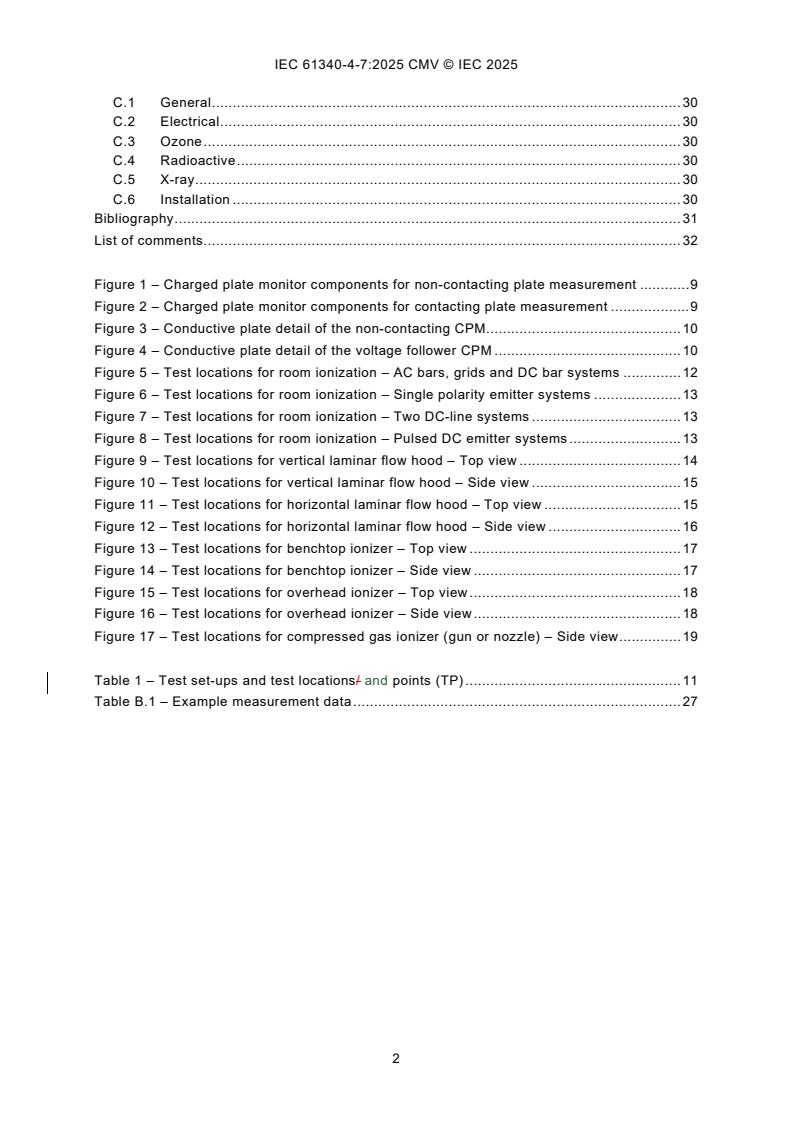
CONTENTS
FOREWORD . 3
INTRODUCTION . 5
1 Scope . 6
2 Normative references . 6
3 Terms and definitions . 6
4 Test fixture and instrumentation. 8
5 Specific requirements for equipment categories . 10
5.1 Specific requirements for all ionization equipment . 10
5.2 Room ionization . 11
5.3 Laminar flow hood ionization . 14
5.4 Worksurface ionization . 16
5.5 Compressed gas ionizers – Guns and nozzles . 18
Annex A (informative) Theoretical background and additional information on the
standard test method for the performance of ionizers . 20
A.1 Introductory remarks . 20
A.2 Air ions . 20
A.3 Mobility and ion current . 20
A.4 Neutralization current . 21
A.5 Neutralization rate . 21
A.6 Ion depletion and field suppression . 21
A.7 Charged plate monitor and charge neutralization . 22
A.8 Relationship between charged plate monitor decay time and actual object . 22
A.9 Offset voltage . 22
A.10 Preparation of test area . 23
A.11 Ion transport in airflow . 23
A.12 Obstruction of airflow around the charged plate monitor . 23
A.13 Effect of "air blanket" . 24
A.14 Sources of measurement error . 24
A.14.1 Typical decay time variability . 24
A.14.2 Plate isolation . 24
A.14.3 Charging voltage . 24
A.14.4 Materials near the plate . 24
A.14.5 Other field-producing devices in test area . 24
A.14.6 Effect of offset voltage on decay time . 25
A.15 Importance of ionization equipment maintenance . 25
Annex B (normative) Method of measuring the capacitance of an isolated conductive
plate . 26
B.1 Method . 26
B.2 Equipment . 26
B.3 Procedure . 26
B.4 Example . 27
B.5 Sources of error . 27
B.5.1 Measuring equipment . 27
B.5.2 Poor plate isolation . 28
B.5.3 Objects in the environment . 28
B.5.4 Stray capacitance . 29
Annex C (informative) Safety considerations . 30
C.1 General . 30
C.2 Electrical . 30
C.3 Ozone . 30
C.4 Radioactive . 30
C.5 X-ray . 30
C.6 Installation . 30
Bibliography . 31
List of comments. 32
Figure 1 – Charged plate monitor components for non-contacting plate measurement . 9
Figure 2 – Charged plate monitor components for contacting plate measurement . 9
Figure 3 – Conductive plate detail of the non-contacting CPM. 10
Figure 4 – Conductive plate detail of the voltage follower CPM . 10
Figure 5 – Test locations for room ionization – AC bars, grids and DC bar systems . 12
Figure 6 – Test locations for room ionization – Single polarity emitter systems . 13
Figure 7 – Test locations for room ionization – Two DC-line systems . 13
Figure 8 – Test locations for room ionization – Pulsed DC emitter systems . 13
Figure 9 – Test locations for vertical laminar flow hood – Top view . 14
Figure 10 – Test locations for vertical laminar flow hood – Side view . 15
Figure 11 – Test locations for horizontal laminar flow hood – Top view . 15
Figure 12 – Test locations for horizontal laminar flow hood – Side view . 16
Figure 13 – Test locations for benchtop ionizer – Top view . 17
Figure 14 – Test locations for benchtop ionizer – Side view . 17
Figure 15 – Test locations for overhead ionizer – Top view . 18
Figure 16 – Test locations for overhead ionizer – Side view . 18
Figure 17 – Test locations for compressed gas ionizer (gun or nozzle) – Side view . 19
Table 1 – Test set-ups and test locations/ and points (TP) . 11
Table B.1 – Example measurement data . 27
INTERNATIONAL ELECTROTECHNICAL COMMISSION
____________
Electrostatics -
Part 4-7: Standard test methods for specific applications - Ionization
FOREWORD
1) The International Electrotechnical Commission (IEC) is a worldwide organization for standardization comprising
all national electrotechnical committees (IEC National Committees). The object of IEC is to promote international
co-operation on all questions concerning standardization in the electrical and electronic fields. To this end and
in addition to other activities, IEC publishes International Standards, Technical Specifications, Technical Reports,
Publicly Available Specifications (PAS) and Guides (hereafter referred to as “IEC Publication(s)”). Their
preparation is entrusted to technical committees; any IEC National Committee interested in the subject dealt with
may participate in this preparatory work. International, governmental and non-governmental organizations liaising
with the IEC also participate in this preparation. IEC collaborates closely with the International Organization for
Standardization (ISO) in accordance with conditions determined by agreement between the two organizations.
2) The formal decisions or agreements of IEC on technical matters express, as nearly as possible, an international
consensus of opinion on the relevant subjects since each technical committee has representation from all
interested IEC National Committees.
3) IEC Publications have the form of recommendations for international use and are accepted by IEC National
Committees in that sense. While all reasonable efforts are made to ensure that the technical content of IEC
Publications is accurate, IEC cannot be held responsible for the way in which they are used or for any
misinterpretation by any end user.
4) In order to promote international uniformity, IEC National Committees undertake to apply IEC Publications
transparently to the maximum extent possible in their national and regional publications. Any divergence between
any IEC Publication and the corresponding national or regional publication shall be clearly indicated in the latter.
5) IEC itself does not provide any attestation of conformity. Independent certification bodies provide conformity
assessment services and, in some areas, access to IEC marks of conformity. IEC is not responsible for any
services carried out by independent certification bodies.
6) All users should ensure that they have the latest edition of this publication.
7) No liability shall attach to IEC or its directors, employees, servants or agents including individual experts and
members of its technical committees and IEC National Committees for any personal injury, property damage or
other damage of any nature whatsoever, whether direct or indirect, or for costs (including legal fees) and
expenses arising out of the publication, use of, or reliance upon, this IEC Publication or any other IEC
Publications.
8) Attention is drawn to the Normative references cited in this publication. Use of the referenced publications is
indispensable for the correct application of this publication.
9) IEC draws attention to the possibility that the implementation of this document may involve the use of (a)
patent(s). IEC takes no position concerning the evidence, validity or applicability of any claimed patent rights in
respect thereof. As of the date of publication of this document, IEC had not received notice of (a) patent(s), which
may be required to implement this document. However, implementers are cautioned that this may not represent
the latest information, which may be obtained from the patent database available at https://patents.iec.ch. IEC
shall not be held responsible for identifying any or all such patent rights.
This commented version (CMV) of the official standard IEC 61340-4-7:2025 edition 3.0 allows
the user to identify the changes made to the previous IEC 61340-4-7:2017
edition 2.0. Furthermore, comments from IEC TC 101 experts are provided to explain the
reasons of the most relevant changes, or to clarify any part of the content.
A vertical bar appears in the margin wherever a change has been made. Additions are in green
text, deletions are in strikethrough red text. Experts' comments are identified by a blue-
background number. Mouse over a number to display a pop-up note with the comment.
This publication contains the CMV and the official standard. The full list of comments is available
at the end of the CMV.
IEC 61340-4-7 has been prepared by IEC technical committee 101: Electrostatics. It is an
International Standard.
This third edition cancels and replaces the second edition published in 2017. This edition
constitutes a technical revision.
This edition includes the following significant technical changes with respect to the previous
edition:
a) in Figure 5, a NOTE 3 was added to clarify that for AC bars and grids, a single emitter
alternating between +/− polarity is used;
b) in Annex B, the relative error for measurement equipment was updated to include the
consideration for the resolution of the voltmeter.
The text of this International Standard is based on the following documents:
Draft Report on voting
101/739/FDIS 101/744/RVD
Full information on the voting for its approval can be found in the report on voting indicated in
the above table.
The language used for the development of this International Standard is English.
This document was drafted in accordance with ISO/IEC Directives, Part 2, and developed in
accordance with ISO/IEC Directives, Part 1 and ISO/IEC Directives, IEC Supplement, available
at www.iec.ch/members_experts/refdocs. The main document types developed by IEC are
described in greater detail at www.iec.ch/publications.
A list of all parts in the IEC 61340 series, published under the general title Electrostatics, can
be found on the IEC website.
The committee has decided that the contents of this document will remain unchanged until the
stability date indicated on the IEC website under webstore.iec.ch in the data related to the
specific document. At this date, the document will be
– reconfirmed,
– withdrawn, or
– revised.
INTRODUCTION
Grounding is the primary method used to limit static charge when protecting electrostatic
discharge sensitive items in the work environment. However, grounding methods are not
effective in removing static charges from the surfaces of non-conductive (insulative) or isolated
(ungrounded) 1 conductive materials. Air ionization techniques, by means of ionizer systems,
can be utilized to reduce this charge.
The preferred way of evaluating the ability of an ionizer to neutralize a static charge is to directly
measure the rate of charge decay. Charges to be neutralized may can be located on insulators
as well as on isolated conductors. It is difficult to charge an insulator reliably and repeatably.
Charge neutralization is more easily evaluated by measuring the rate of decay of the voltage of
an isolated conductive plate. The measurement of this decay should not interfere with or change
the nature of the actual decay. Four practical methods of air ionization are addressed in this
document:
a) radioactive emission;
b) high-voltage corona from AC electric fields;
c) high-voltage corona from DC electric fields;
d) soft X-ray emission.
This part of IEC 61340 provides test methods and procedures that can be used when evaluating
ionization equipment. The objective of the test methods is to generate meaningful, reproducible
data. The test methods are not meant to be a recommendation for any particular ionizer
configuration. The wide variety of ionizers, and the environments within which they are used,
will often require test methods different from those described in this document. Users of this
document should be prepared to adapt the test methods as required to produce meaningful data
in their own application of ionizers.
Similarly, the test conditions chosen in this document do not represent a recommendation for
acceptable ionizer performance. There is a wide range of item sensitivities to static charge.
There is also a wide range of environmental conditions affecting the operation of ionizers.
Performance specifications should be agreed upon between the user and manufacturer of the
ionizer in each application. Users of this document should be prepared to establish reasonable
performance requirements for their own application of ionizers.
Annex B provides a method for measuring capacitance of the isolated conductive plate.
1 Scope
This part of IEC 61340 provides test methods and procedures for evaluating and selecting air
ionization equipment and systems (ionizers).
This document establishes measurement techniques, under specified conditions, to determine
offset voltage (ion balance) and decay (charge neutralization) time for ionizers.
This document does not include measurements of electromagnetic interference (EMI), or the
use of ionizers in connection with ordnance, flammables, explosive items or electrically initiated
explosive devices.
As contained in this document, the test methods and test conditions can be used by
manufacturers of ionizers to provide performance data describing their products. Users of
ionizers are urged to modify the test methods and test conditions for their specific application
in order to qualify ionizers for use, or to make periodic verifications of ionizer performance. The
user will decide the extent of the data required for each application.
CAUTION: Procedures and equipment described in this document can expose personnel to hazardous electrical and
non-electrical conditions. Users of this document are responsible for selecting equipment that complies with
applicable laws, regulatory codes and both external and internal policy. Users are cautioned that this document
cannot replace or supersede any requirements for personnel safety.
2 Normative references
There are no normative references in this document.
The following documents are referred to in the text in such a way that some or all of their content
constitutes requirements of this document. For dated references, only the edition cited applies.
For undated references, the latest edition of the referenced document (including any
amendments) applies.
IEC 61010-1, Safety requirements for electrical equipment for measurement, control, and
laboratory use - Part 1: General requirements 2
3 Terms and definitions
For the purposes of this document, the following terms and definitions apply.
ISO and IEC maintain terminology databases for use in standardization at the following
addresses:
– IEC Electropedia: available at https://www.electropedia.org/
– ISO Online browsing platform: available at https://www.iso.org/obp
3.1
air conductivity
ability of air to conduct (pass) an electric current under the influence of an electric field
3.2
air ions
molecular clusters of about ten molecules (water, impurities, etc.) bound by polarization forces
to a singly charged oxygen or nitrogen molecule
3.3
charge decay
decrease and/or neutralization or both of a net electrostatic charge
3.4
charged plate monitor
CPM
instrument using a charged metal plate of a defined capacitance and geometry which is
discharged in order to measure charge dissipation/ and neutralization properties of products or
materials
Note 1 to entry: This note applies to the French language only.
3.5
compressed gas ionizer
ionization device that can be used to neutralize charged surfaces and/or remove surface
particles or both with pressurized gas
Note 1 to entry: This type of ionizer may can be used to ionize the gas within production equipment.
3.6
corona
production of positive or negative ions by a very localized high electric field
Note 1 to entry: The field is normally established by applying a high voltage to a conductor in the shape of a sharp
point or wire.
3.7
decay rate 3
decrease of charge or voltage per unit time
3.7
decay time
time necessary for a voltage (due to an electrostatic charge) to decay from an initial value to
some chosen final value
3.8
emitter
conducting sharp object, usually a needle or wire, which will cause a corona discharge when
kept at a high potential
3.9
horizontal laminar flow
non-turbulent airflow in a horizontal direction
3.10
ionizer
device designed to generate positive and/or negative or both air ions
3.11
isolated conductor
non-grounded conductor
conductor that has sufficiently high resistance to ground that significant charge dissipation is
prevented within the timescale of interest 4
3.12
laminar flow hood ionization
device or system that provides local area ionization coverage in vertical or horizontal laminar
flow hoods or benches
3.14
non-contacting voltage measurement 5
measurement technique using an electrostatic fieldmeter or voltmeter to monitor the voltage
induced on an isolated conductive plate where there is no direct connection from the
measurement sensor to the isolated conductive plate
3.13
offset voltage
ion balance
observed voltage on the isolated conductive plate of a charged plate monitor (CPM) that has
been placed in an ionized environment
3.14
peak offset voltage
for pulsed ionizers, maximum value of the offset voltage for each polarity, as the ionizer cycles
between positive and negative ion outputs
3.15
room ionization
ionization system that provides large area coverage with air ions
3.16
worksurface ionization
ionization device or system used to control static charges at on a worksurface
Note 1 to entry: This type Worksurface ionizers include benchtop ionizers, overhead worksurface ionizers and
laminar flow hood ionizers.
3.17
vertical laminar flow
non-turbulent airflow in a vertical direction
3.20
contacting voltage measurement 6
measurement technique using high input impedance circuitry used to monitor the voltage induced on
an isolated conductive plate where there is a direct connection from the circuitry to the conductive
plate
4 Test fixture and instrumentation
WARNING – Procedures and equipment described in this document can expose personnel to
hazardous electrical and non-electrical conditions. Users of this document are responsible for
selecting equipment that complies with applicable laws, regulatory codes and both external and
internal policy. Users are cautioned that this document cannot replace or supersede any
requirements for personnel safety. See Annex C for safety considerations. 7
The instrument described in this document to make performance measurements on air
ionization equipment is the charged plate monitor (CPM); refer to Figure 1 and Figure 2. The
conductive plate shall be (15,0 ± 0,1) cm × (15,0 ± 0,1) cm and the total capacitance of the test
circuit, with plate, while the instrument is in its normal operating mode, shall be 20 pF ± 2 pF
as measured per Annex B. See Figure 3 and Figure 4. The instrument described in this
document may can also be used for compliance verification of air ionizers.
For the isolated conductive plate design shown in Figure 3, there shall be no objects, grounded
or otherwise, closer than dimension "A" of the conductive plate, except the supporting insulators
or plate voltage contacts, as shown in Figure 3 (refer to Annex B). For the conductive plate
assembly shown in Figure 4, there shall be no objects, grounded or otherwise, within 2,54
2,5 cm of the plate assembly in any direction, other than a support structure (e.g. a tripod)
located below the ground plate of the assembly.
The conductive plate, when charged to the desired test voltage, shall not decay by more than
10 % of the test voltage within 5 min, in the absence of ionization.
The voltage on the conductive plate shall be monitored in such a way that the system conforms
to 4.1, 4.2 and 4.3. The response time of the monitoring device shall be sufficient to accurately
measure changing plate voltages with a response time sufficient to accurately measure
changing plate voltages. Changing plate voltages are a function of the ionization technology
type being monitored. 8
For safety reasons (see Clause C.1), the voltage source used to charge the conductive plate
should be current limited. The voltage source used to charge the conductive plate shall meet
the requirements of IEC 61010-1. 9
NOTE See Figure 3 for a detailed drawing of the non-contacting CPM.
Figure 1 – Charged plate monitor components for non-contacting plate measurement
NOTE See Figure 4 for a detailed drawing of the contacting CPM.
Figure 2 – Charged plate monitor components for contacting plate measurement
(15,0 ± 0,1) cm × (15,0 ± 0,1) cm
Conductive plate
Dimension A
Insulator
Ground plate ≥ 15
Ground
cm
IEC
Figure 3 – Conductive plate detail of the non-contacting CPM
Figure 4 – Conductive plate detail of the voltage follower CPM
5 Specific requirements for equipment categories
5.1 Specific requirements for all ionization equipment
See Annex A for information regarding theoretical background and additional information on the
standard test method for the performance of ionizers. 10
For the types of ionization equipment listed in 5.2, 5.3, 5.4 and 5.5, the following specific
requirements apply:
a) Decay time test – The conductive plate of the test fixture shall be charged to an initial test
voltage and allowed to decay to 10 % of the initial test voltage. The time required shall be
monitored and recorded for both polarities of initial charge. This time is referred to as the
decay time (refer to 4.1 and Figure 1). The conductive plate of the test fixture shall be
charged to an initial charging voltage, which shall be higher than the initial test voltage. The
time required for the voltage to decay from the initial test voltage to 10 % of that value shall
be recorded (refer to Clause 4 and Figure 1). Measurements shall be made with both
polarities of charging voltage. 11
b) Offset voltage test – The conductive plate shall be momentarily grounded to remove any
residual charges and to verify the zero setting of the voltage monitoring device. The plate
is then monitored within the ionized environment, per the procedure described for each
equipment category. The resulting observed voltage is referred to as the offset voltage.
c) Locations – The decay time and offset voltage shall be measured and recorded 12 for each
test location/ and point (TP) described in the test location figures (see Table 1).
d) Same conditions – Decay time and offset voltage shall be measured under the same
conditions without any equipment adjustments. If ionizers from different categories are to
be compared, the same test voltages shall be used for all tests. 13
e) Peak offset voltage – In the case of pulsed ionizers, offset voltage shall be measured and
reported recorded in peak values using the test equipment described in Clause 4.
f) Other parameters – Application specific parameters such as humidity, temperature, air
speed, etc., for example shall be recorded.
Table 1 – Test set-ups and test locations/ and points (TP)
Charged plate
Offset voltage
initial voltage
Figure Number of test
Equipment category measurement time
(both polarities)
references locations
interval
V
Room ionization
Bars, grids, AC Figure 5 2 (1 to 5) min 1 000
Bars, pulsed and DC Figure 5 2 (1 to 5) min 1 000
Single polarity emitter Figure 6 3 (1 to 5) min 1 000
DualTwo DC line Figure 7 3 (1 to 5) min 1 000
Pulsed DC emitter Figure 8 2 (1 to 5) min 1 000
Laminar flow hood
Figure 9 and
Vertical 8 (1 to 5) min 1 000
Figure 10
Figure 11 and
Horizontal 6 (1 to 5) min 1 000
Figure 12
Worksurface ionization
Benchtop Figure 13 and
12 (1 to 5) min 1 000
Figure 14
Overhead Figure 15 and
12 (1 to 5) min 1 000
Figure 16
Compressed gas ionization
Guns and nozzles Figure 17 1 10 s to 1 min 1 000
5.2 Room ionization
The area around the charged plate monitor should be cleared for a horizontal distance of 1,5 m
in all directions. The ionization system should be operated for a minimum of 30 min to stabilize
conditions in the test area.
To avoid affecting the test, the test technician should be grounded and stand outside the 1,5 m
cleared area.
Decay time from a 1 000 V initial test voltage to a 100 V final test voltage shall be measured
for both positive (+) and negative (−) polarities.
The air speed at the test location shall be recorded.
Measurements should be taken with the charged plate monitor at a distance of 1,5 m from the
ionizer under test. Since installed ionizer heights can vary, a consistent measurement height
should be selected for the evaluation of different systems. This height and the ionizer mounting
height shall be recorded in the test results.
The minimum number of test locations is determined by the type of system (see Table 1 and
refer to Figure 5 through Figure 8).
Decay time as described in 5.1 a), shall be measured at each test location.
Offset voltage as described in 5.1 b) and e) shall be determined at each test location. Offset
voltage shall be measured after a period of at least 1 min to allow the reading to stabilize (5 min
maximum).
NOTE 1 Example For AC grids (shaded areas, less than 100 % coverage) and pulsed or steady-state DC bars. For
AC bars or grids, the shaded areas represent areas where the coverage is less than 100 %.
NOTE 2 TP1 is directly under grid or bar while TP2 is centred between grids or bars.
NOTE 3 For AC bars and grids, a single emitter alternating between +/− polarity is used.
Figure 5 – Test locations for room ionization – AC bars, grids and DC bar systems
Three measurement locations required.
Figure 6 – Test locations for room ionization – Single polarity emitter systems
Three measurement locations required.
Figure 7 – Test locations for room ionization – Dual Two DC-line systems
Two measurement locations required.
Figure 8 – Test locations for room ionization – Pulsed DC emitter systems
5.3 Laminar flow hood ionization
The test should be performed on a surface that does not contain obstructions to airflow. Unless
otherwise specified, the test surface should be static dissipative or conductive and properly
grounded.
To avoid affecting the test, the test technician should be properly grounded.
Decay time from a 1 000 V initial test voltage to a 100 V final test voltage shall be measured
for both positive (+) and negative (−) polarities.
The air speed at test location TP4, as shown in Figure 9 and Figure 11, should shall be
recorded.
For a vertical laminar flow hood, the test set-up is shown in Figure 9 and Figure 10. Data shall
be taken at test positions TP1 through TP8 as shown in Figure 9.
For a horizontal laminar flow hood, the test set-up is shown in Figures 9 Figure 11 and 10
Figure 12. Data shall be taken at test positions TP1 through TP6 as shown in Figure 11.
Decay time as described in 5.1 a), shall be measured at each test location.
Offset voltage as described in 5.1 b) and e) shall be determined at each test location. Offset
voltage shall be measured after a period of at least 1 min, or as necessary to allow the reading
to stabilize (5 min maximum).
Dimensions in centimetres
Eight measurement locations required, all dimensions nominal.
Figure 9 – Test locations for vertical laminar flow hood – Top view
Dimensions in centimetres
All dimensions nominal.
Figure 10 – Test locations for vertical laminar flow hood – Side view
Dimensions in centimetres
Six measurement locations required, all dimensions nominal.
Figure 11 – Test locations for horizontal laminar flow hood – Top view
Dimensions in centimetres
All dimensions nominal.
Figure 12 – Test locations for horizontal laminar flow hood – Side view
5.4 Worksurface ionization
The test should be performed on a surface that does not contain obstructions to airflow. Unless
otherwise specified, the test surface should be static dissipative or conductive and properly
grounded.
To avoid affecting the test, the test technician should be properly grounded.
Decay time from a 1 000 V initial test voltage to a 100 V final test voltage shall be measured
for both positive (+) and negative (−) polarities.
The unit shall be measured with the heater on and off, if so equipped. The unit shall be tested
with any filters in place if so equipped. Measurements shall be made at both minimum and
maximum airflows for units with variable airflow. The air speed shall be measured and included
in the test results. End users should test ionizers with the same configuration of operating
heaters and filters that they intend to use.
For benchtop units, the ionizer shall be placed as shown in Figure 13 and Figure 14. Airflow
shall be directed at test location TP2 and measured at test locations TP2 and TP5. The charged
plate monitor shall face the ionizer. Measurements with the charged plate monitor shall be made
at test locations TP1 through TP12 as shown in Figure 13.
For overhead units, the ionizer shall be placed as shown in Figure 15 and Figure 16. Airflow
shall be measured at test locations TP5 and TP8. Measurements with the charged plate monitor
shall be made at test locations TP1 through TP12 as shown in Figure 15.
Decay time as described in 5.1 a), shall be measured at each test location.
Offset voltage as described in 5.1 b) and e) shall be determined at each test location. Offset
voltage shall be measured after a period of at least 1 min, or as necessary to allow the reading
to stabilize (5 min maximum).
Dimensions in centimetres
Twelve measurement locations required, all dimensions nominal.
Figure 13 – Test locations for benchtop ionizer – Top view
Dimensions in centimetres
All dimensions nominal.
Figure 14 – Test locations for benchtop ionizer – Side view
Dimensions in centimetres
Twelve measurement locations required, all dimensions nominal.
Figure 15 – Test locations for overhead ionizer – Top view
Dimensions in centimetres
All dimensions nominal.
Figure 16 – Test locations for overhead ionizer – Side view
5.5 Compressed gas ionizers – Guns and nozzles
The test should be performed on a surface that does not contain obstructions to airflow. Unless
otherwise specified, the test surface should be static dissipative or conductive and properly
grounded.
To avoid affecting the test, the test technician should be properly grounded.
Decay time from a 1 000 V initial test voltage to a 100 V final test voltage shall be measured
for both positive (+) and negative (−) polarities.
Unless otherwise specified, the input pressure shall be 200 kPa. End users should test
compressed gas ionizers in the same configuration of input pressure and distance that they
intend to use.
The tests shall be performed using the test set-up shown in Figure 17.
Decay time as described in 5.1 a), shall be measured at the test location.
Offset voltage as described in 5.1 b) and e) shall be determined at the test location. Offset
voltage shall be measured after a period of at least 10 s or as necessary to allow the reading
to stabilize (1 min maximum).
Dimensions in centimetres
One measurement location required, all dimensions nominal.
Figure 17 – Test locations for compressed gas ionizer (gun or nozzle) – Side view
Annex A
(informative)
Theoretical background and additional information on the standard test
method for the performance of ionizers
A.1 Introductory remarks
The field from static charges, located on insulators or isolated conductors, can be neutralized
by oppositely charged air ions depositing on the charged bodies.
A.2 Air ions
Air ions are molecular clusters consisting of about ten molecules (often water) around a (singly)
charged oxygen or nitrogen molecule. Normally, relatively few ions are present in the air.
Typically, the number is less than 1 000 per cm . These "natural" ions are usually formed by
radiation from radioactive materials in the air, in the ground or in building materials.
For neutralization purposes, much higher ion concentrations are needed. Although radioactivity
can also be employed in such situations, the most common ion production method is by collision
between neutral molecules and electrons accelerated in an electric field with field strengths
exceeding 3 MV/m (at atmospheric pressure). This is generally referred to as high voltage
corona ionization.
A.3 Mobility and ion current
If an ion is exposed to an electric field E, it will move with an average drift speed (v) proportional
to E, i.e.
v= kE
(A.1)
where k is the mobility of the ion.
–4 2 –1 –1
Ordinary air ions have mobilities in the range of 1 to 2 × 10 m V s (square metre per volt-
second).
If the air has a concentration n of positive ions with the mobility k, and charge e, an electric field
E will cause an electric current to flow in the direction of E with the density j.
j enkE λE
(A.2)
The constant λ (enk) is called the positive conductivity of the air (or more precisely, the polar
conductivity due to the positive ions). Negative ions will move in the opposite direction of the
field, but Formula (A.2) can still be used to calculate the current density from negative ions,
when e is taken as the numerical value of the ion charge. The current density from negative
ions will thus also be in the direction of the field.
==
A.4 Neutralization current
If a body completely surrounded by ionized air is given a charge q, an electric field is established
around the body and charges will flow towards it and away from it. The field will vary from point
to point, but is always proportional to the charge q. The current towards the body is carried by
the ions of polarity opposite to that of q, and is known as the neutralization current. The
neutralization current is proportional to the charge q and to the relevant opposite conductivity
of the surrounding air.
A.5 Neutralization rate
If the conductivity does not change, the relative rate of charge neutralization is constant and
the charge will decay exponentially with a time constant τ equal to the permittivity of the air e
o
divided by the conductivity λ.
τλ= e /
o
(A.3)
It should be noted that it is the conductivity, not the ion concentration itself that determines the
neutralizing ability of the air. If the particle concentration of the air is increased, by smoke for
example, the average mobility of the ions, and thus the conductivity, can decrease by a factor
of ten or more. The number of charged particles per unit volume of air, i.e. the ion concentration,
can still be more or less constant.
A.6 Ion depletion and field suppression
The conditions for fulfilling Formula (A.3) are almost never met.
It was assumed that the conductivity was not affected by the neutralization process. In the case
of room ionization, for example, the field from the charge to be neutralized can partially deplete
the air of ions. This lowers the air conductivity, making the neutralization slower than predicted
by Formula (A.3). The degree of ion depletion will increase with the field strength from the
charged body. The rate of neutralization
...
IEC 61340-4-7 ®
Edition 3.0 2025-08
NORME
INTERNATIONALE
Electrostatique -
Partie 4-7: Méthodes d'essai normalisées pour des applications spécifiques -
Ionisation
ICS 17.200.99; 29.020 ISBN 978-2-8327-0643-5
Droits de reproduction réservés. Sauf indication contraire, aucune partie de cette publication ne peut être reproduite ni
utilisée sous quelque forme que ce soit et par aucun procédé, électronique ou mécanique, y compris la photocopie et
les microfilms, sans l'accord écrit de l'IEC ou du Comité national de l'IEC du pays du demandeur. Si vous avez des
questions sur le copyright de l'IEC ou si vous désirez obtenir des droits supplémentaires sur cette publication, utilisez
les coordonnées ci-après ou contactez le Comité national de l'IEC de votre pays de résidence.
IEC Secretariat Tel.: +41 22 919 02 11
3, rue de Varembé info@iec.ch
CH-1211 Geneva 20 www.iec.ch
Switzerland
A propos de l'IEC
La Commission Electrotechnique Internationale (IEC) est la première organisation mondiale qui élabore et publie des
Normes internationales pour tout ce qui a trait à l'électricité, à l'électronique et aux technologies apparentées.
A propos des publications IEC
Le contenu technique des publications IEC est constamment revu. Veuillez vous assurer que vous possédez l’édition la
plus récente, un corrigendum ou amendement peut avoir été publié.
Recherche de publications IEC - IEC Products & Services Portal - products.iec.ch
webstore.iec.ch/advsearchform Découvrez notre puissant moteur de recherche et consultez
La recherche avancée permet de trouver des publications gratuitement tous les aperçus des publications, symboles
IEC en utilisant différents critères (numéro de référence, graphiques et le glossaire. Avec un abonnement, vous aurez
texte, comité d’études, …). Elle donne aussi des toujours accès à un contenu à jour adapté à vos besoins.
informations sur les projets et les publications remplacées
ou retirées. Electropedia - www.electropedia.org
Le premier dictionnaire d'électrotechnologie en ligne au
IEC Just Published - webstore.iec.ch/justpublished monde, avec plus de 22 500 articles terminologiques en
Restez informé sur les nouvelles publications IEC. Just anglais et en français, ainsi que les termes équivalents
dans 25 langues additionnelles. Egalement appelé
Published détaille les nouvelles publications parues.
Disponible en ligne et une fois par mois par email. Vocabulaire Electrotechnique International (IEV) en ligne.
Service Clients - webstore.iec.ch/csc
Si vous désirez nous donner des commentaires sur cette
publication ou si vous avez des questions contactez-
nous: sales@iec.ch.
SOMMAIRE
AVANT-PROPOS . 3
INTRODUCTION . 5
1 Domaine d'application . 6
2 Références normatives . 6
3 Termes et définitions . 6
4 Dispositif d'essai et appareils de mesure . 8
5 Exigences spécifiques pour les catégories de matériels . 10
5.1 Exigences spécifiques pour l'ensemble des matériels d'ionisation . 10
5.2 Ionisation de salles . 11
5.3 Ionisation de hottes à flux laminaire . 13
5.4 Ionisation de surfaces de travail . 16
5.5 Ioniseurs à gaz comprimé – Pistolets et buses . 18
Annexe A (informative) Principes théoriques et informations supplémentaires sur la
méthode d'essai normalisée pour évaluer la performance des ioniseurs. 20
A.1 Remarques introductives . 20
A.2 Ions de l'air . 20
A.3 Mobilité et courant ionique . 20
A.4 Courant de neutralisation . 21
A.5 Vitesse de neutralisation . 21
A.6 Appauvrissement en ions et suppression de champ . 21
A.7 Dispositif de surveillance à plaque de charge (CPM) et neutralisation des
charges . 22
A.8 Relation entre le temps de décroissance du dispositif de surveillance à
plaque de charge et l'objet réel . 22
A.9 Tension de décalage . 23
A.10 Préparation de la zone d'essai . 23
A.11 Transport d'ions dans le flux d'air. 23
A.12 Obstruction du flux d'air autour du dispositif de surveillance à plaque de
charge . 24
A.13 Effet de la "couverture d'air" . 24
A.14 Sources d'erreur de mesure . 24
A.14.1 Variabilité type du temps de décroissance . 24
A.14.2 Isolation de la plaque . 24
A.14.3 Tension de charge . 24
A.14.4 Matériaux proches de la plaque . 25
A.14.5 Autres appareils qui produisent un champ dans la zone d'essai . 25
A.14.6 Effet de la tension de décalage sur le temps de décroissance . 25
A.15 Importance de la maintenance du matériel d'ionisation . 25
Annexe B (normative) Méthode de mesure de la capacité d'une plaque conductrice
isolée . 27
B.1 Méthode . 27
B.2 Matériel . 27
B.3 Procédure . 27
B.4 Exemple . 28
B.5 Sources d'erreur . 28
B.5.1 Matériel de mesure . 28
B.5.2 Isolation médiocre de la plaque . 29
B.5.3 Objets dans l'environnement . 29
B.5.4 Capacité parasite . 30
Annexe C (informative) Considérations de sécurité . 31
C.1 Généralités . 31
C.2 Électricité . 31
C.3 Ozone . 31
C.4 Radioactivité . 31
C.5 Rayons X . 31
C.6 Installation . 31
Bibliographie . 32
Figure 1 – Composants de surveillance à plaque de charge pour le mesurage de la
plaque sans contact . 9
Figure 2 – Composants de surveillance à plaque de charge pour le mesurage de la
plaque avec contact . 9
Figure 3 – Détail de la plaque conductrice du CPM sans contact . 9
Figure 4 – Détail de la plaque conductrice du CPM qui suit la tension . 10
Figure 5 – Emplacements d'essai pour ionisation de salles – Systèmes de grilles et de
barres en courant alternatif et de barres en courant continu. 12
Figure 6 – Emplacements d'essai pour ionisation de salles – Systèmes d'émetteur à
polarité unique . 12
Figure 7 – Emplacements d'essai pour ionisation de salles – Systèmes de lignes en
courant continu doubles . 13
Figure 8 – Emplacements d'essai pour ionisation de salles – Systèmes d'émetteur en
courant continu pulsé . 13
Figure 9 – Emplacements d'essai pour hotte à flux laminaire vertical – Vue de dessus . 14
Figure 10 – Emplacements d'essai pour hotte à flux laminaire vertical – Vue de côté . 15
Figure 11 – Emplacements d'essai pour hotte à flux laminaire horizontal – Vue de
dessus . 15
Figure 12 – Emplacements d'essai pour hotte à flux laminaire horizontal – Vue de côté . 16
Figure 13 – Emplacements d'essai pour ioniseur de table – Vue de dessus . 17
Figure 14 – Emplacements d'essai pour ioniseur de table – Vue de côté . 17
Figure 15 – Emplacements d'essai pour ioniseur aérien – Vue de dessus . 18
Figure 16 – Emplacements d'essai pour ioniseur aérien – Vue de côté . 18
Figure 17 – Emplacements d'essai pour ioniseur à gaz comprimé (pistolet ou buse) –
Vue de côté . 19
Tableau 1 – Montages d'essai et emplacements et points d'essai (TP) . 11
Tableau B.1 – Exemple de données de mesure . 28
COMMISSION ÉLECTROTECHNIQUE INTERNATIONALE
____________
Électrostatique -
Partie 4-7: Méthodes d'essai normalisées pour
des applications spécifiques - Ionisation
AVANT-PROPOS
1) La Commission Électrotechnique Internationale (IEC) est une organisation mondiale de normalisation composée
de l'ensemble des comités électrotechniques nationaux (Comités nationaux de l'IEC). L'IEC a pour objet de
favoriser la coopération internationale pour toutes les questions de normalisation dans les domaines de
l'électricité et de l'électronique. À cet effet, l'IEC – entre autres activités – publie des Normes internationales,
des Spécifications techniques, des Rapports techniques, des Spécifications accessibles au public (PAS) et des
Guides (ci-après dénommés "Publication(s) de l'IEC"). Leur élaboration est confiée à des comités d'études, aux
travaux desquels tout Comité national intéressé par le sujet traité peut participer. Les organisations
internationales, gouvernementales et non gouvernementales, en liaison avec l'IEC, participent également aux
travaux. L'IEC collabore étroitement avec l'Organisation Internationale de Normalisation (ISO), selon des
conditions fixées par accord entre les deux organisations.
2) Les décisions ou accords officiels de l'IEC concernant les questions techniques représentent, dans la mesure du
possible, un accord international sur les sujets étudiés, étant donné que les Comités nationaux de l'IEC intéressés
sont représentés dans chaque comité d'études.
3) Les Publications de l'IEC se présentent sous la forme de recommandations internationales et sont agréées
comme telles par les Comités nationaux de l'IEC. Tous les efforts raisonnables sont entrepris afin que l'IEC
s'assure de l'exactitude du contenu technique de ses publications; l'IEC ne peut pas être tenue responsable de
l'éventuelle mauvaise utilisation ou interprétation qui en est faite par un quelconque utilisateur final.
4) Dans le but d'encourager l'uniformité internationale, les Comités nationaux de l'IEC s'engagent, dans toute la
mesure possible, à appliquer de façon transparente les Publications de l'IEC dans leurs publications nationales
et régionales. Toutes divergences entre toutes Publications de l'IEC et toutes publications nationales ou
régionales correspondantes doivent être indiquées en termes clairs dans ces dernières.
5) L'IEC elle-même ne fournit aucune attestation de conformité. Des organismes de certification indépendants
fournissent des services d'évaluation de conformité et, dans certains secteurs, accèdent aux marques de
conformité de l'IEC. L'IEC n'est responsable d'aucun des services effectués par les organismes de certification
indépendants.
6) Tous les utilisateurs doivent s'assurer qu'ils sont en possession de la dernière édition de cette publication.
7) Aucune responsabilité ne doit être imputée à l'IEC, à ses administrateurs, employés, auxiliaires ou mandataires,
y compris ses experts particuliers et les membres de ses comités d'études et des Comités nationaux de l'IEC,
pour tout préjudice causé en cas de dommages corporels et matériels, ou de tout autre dommage de quelque
nature que ce soit, directe ou indirecte, ou pour supporter les coûts (y compris les frais de justice) et les dépenses
découlant de la publication ou de l'utilisation de cette Publication de l'IEC ou de toute autre Publication de l'IEC,
ou au crédit qui lui est accordé.
8) L'attention est attirée sur les références normatives citées dans cette publication. L'utilisation de publications
référencées est obligatoire pour une application correcte de la présente publication.
9) L'IEC attire l'attention sur le fait que la mise en application du présent document peut entraîner l'utilisation d'un
ou de plusieurs brevets. L'IEC ne prend pas position quant à la preuve, à la validité et à l'applicabilité de tout
droit de brevet revendiqué à cet égard. À la date de publication du présent document, l'IEC n'avait pas reçu
notification qu'un ou plusieurs brevets pouvaient être nécessaires à sa mise en application. Toutefois, il y a lieu
d'avertir les responsables de la mise en application du présent document que des informations plus récentes
sont susceptibles de figurer dans la base de données de brevets, disponible à l'adresse https://patents.iec.ch.
L'IEC ne saurait être tenue pour responsable de ne pas avoir identifié de tels droits de brevets.
L'IEC 61340-4-7 a été établie par le comité d'études 101 de l'IEC: Électrostatique. Il s'agit d'une
Norme internationale.
Cette troisième édition annule et remplace la deuxième édition parue en 2017. Cette édition
constitue une révision technique.
Cette édition inclut les modifications techniques majeures suivantes par rapport à l'édition
précédente:
a) une NOTE 3 a été ajoutée à la Figure 5 afin d'expliciter qu'un seul émetteur à alternance
de polarité +/- est utilisé pour les barres et les grilles en courant alternatif;
b) à l'Annexe B, l'erreur relative aux appareils de mesure à été mise à jour pour prendre en
compte la résolution du voltmètre.
Le texte de cette Norme internationale est issu des documents suivants:
Projet Rapport de vote
101/739/FDIS 101/744/RVD
Le rapport de vote indiqué dans le tableau ci-dessus donne toute information sur le vote ayant
abouti à son approbation.
La langue employée pour l'élaboration de cette Norme internationale est l'anglais.
Ce document a été rédigé selon les Directives ISO/IEC, Partie 2, il a été développé selon les
Directives ISO/IEC, Partie 1 et les Directives ISO/IEC, Supplément IEC, disponibles sous
www.iec.ch/members_experts/refdocs. Les principaux types de documents développés par
l'IEC sont décrits plus en détail sous www.iec.ch/publications.
Une liste de toutes les parties de la série IEC 61340, publiées sous le titre général
Électrostatique, se trouve sur le site web de l'IEC.
Le comité a décidé que le contenu de ce document ne sera pas modifié avant la date de stabilité
indiquée sur le site web de l'IEC sous webstore.iec.ch dans les données relatives au document
recherché. À cette date, le document sera
– reconduit,
– supprimé, ou
– révisé.
INTRODUCTION
La mise à la terre est la principale méthode utilisée pour limiter la charge statique lors de la
protection d'éléments sensibles aux décharges électrostatiques dans l'environnement de
travail. Toutefois, les méthodes de mise à la terre ne sont pas efficaces pour éliminer les
charges statiques des surfaces des matériaux non conducteurs (isolants) ou des matériaux
conducteurs isolés (non reliés à la terre). Des techniques d'ionisation de l'air, par l'emploi de
systèmes ioniseurs, peuvent être utilisées pour réduire ces charges.
La méthode préférentielle pour évaluer l'aptitude d'un ioniseur à neutraliser une charge statique
consiste à mesurer directement la vitesse de décroissance des charges. Les charges à
neutraliser peuvent être situées sur des isolants ainsi que sur des conducteurs isolés. Il est
difficile de charger un isolant de manière fiable et répétable. Il est plus facile d'évaluer la
neutralisation des charges en mesurant la vitesse de décroissance de la tension d'une plaque
conductrice isolée. Il convient que le mesurage de cette décroissance n'ait aucune incidence
sur la nature de la décroissance réelle ou ne la modifie pas. Quatre méthodes pratiques
d'ionisation de l'air sont traitées dans le présent document:
a) émissions radioactives;
b) effet corona à haute tension provenant de champs électriques alternatifs;
c) effet corona à haute tension provenant de champs électriques continus;
d) émissions de rayons X mous.
La présente partie de l'IEC 61340 fournit des méthodes et des procédures d'essai qui peuvent
être utilisées pour évaluer un matériel d'ionisation. L'objectif des méthodes d'essai est de
générer des données reproductibles significatives. Les méthodes d'essai ne sont pas destinées
à constituer une recommandation pour une quelconque configuration particulière d'ioniseur. La
grande diversité d'ioniseurs et les environnements dans lesquels ils sont utilisés exigent
souvent des méthodes d'essai différentes de celles qui sont décrites dans le présent document.
Il convient que les utilisateurs du présent document soient prêts à adapter les méthodes d'essai
en fonction des exigences afin de produire des données significatives pour leur propre
application d'ioniseurs.
De la même manière, les conditions d'essai choisies dans le présent document ne constituent
pas une recommandation des performances acceptables d'un ioniseur. Il existe une large plage
de sensibilités des éléments à une charge statique. Il existe également un grand nombre de
conditions environnementales qui ont une influence sur le fonctionnement des ioniseurs. Il
convient que les spécifications de performance fassent l'objet d'un accord entre l'utilisateur et
le fabricant de l'ioniseur dans chaque application. Il convient que les utilisateurs du présent
document soient prêts à établir des exigences de performance raisonnables pour leur propre
application d'ioniseurs.
L'Annexe B fournit une méthode de mesure de la capacité de la plaque conductrice isolée.
1 Domaine d'application
La présente partie de l'IEC 61340 fournit des méthodes et des procédures d'essai pour évaluer
et choisir le matériel et les systèmes d'ionisation de l'air (ioniseurs).
Le présent document établit des techniques de mesure, dans des conditions spécifiées,
destinées à déterminer la tension de décalage (équilibre ionique) et le temps de décroissance
(neutralisation des charges) pour les ioniseurs.
Le présent document ne traite pas des mesurages des brouillages électromagnétiques (EMI,
Electromagnetic Interference) ni de l'emploi d'ioniseurs en relation avec des éléments
pyrotechniques, inflammables, explosifs ou des appareils explosifs amorcés électriquement.
Les méthodes d'essai et les conditions d'essai spécifiées dans le présent document peuvent
être utilisées telles quelles par les fabricants d'ioniseurs afin de fournir des données de
performance pour la description de leurs produits. Les utilisateurs d'ioniseurs sont encouragés
à modifier les méthodes d'essai et les conditions d'essai de leur application spécifique afin de
qualifier les ioniseurs pour l'utilisation ou d'effectuer des vérifications périodiques de la
performance des ioniseurs. Il revient à l'utilisateur de déterminer la quantité de données
exigées pour chaque application.
2 Références normatives
Les documents suivants sont cités dans le texte de sorte qu'ils constituent, pour tout ou partie
de leur contenu, des exigences du présent document. Pour les références datées, seule
l'édition citée s'applique. Pour les références non datées, la dernière édition du document de
référence s'applique (y compris les éventuels amendements).
IEC 61010-1, Règles de sécurité pour appareils électriques de mesurage, de régulation et de
laboratoire - Partie 1: Exigences générales
3 Termes et définitions
Pour les besoins du présent document, les termes et définitions suivants s'appliquent.
L'ISO et l'IEC tiennent à jour des bases de données terminologiques destinées à être utilisées
en normalisation, consultables aux adresses suivantes:
– IEC Electropedia: disponible à l'adresse https://www.electropedia.org/
– ISO Online browsing platform: disponible à l'adresse https://www.iso.org/obp
3.1
conductivité de l'air
aptitude de l'air à conduire (transmettre) un courant électrique sous l'influence d'un champ
électrique
3.2
ions de l'air
groupes moléculaires d'environ 10 molécules (eau, impuretés, etc.) liées par des forces de
polarisation à une molécule d'oxygène ou d'azote à charge unique
3.3
décroissance de la charge
diminution ou neutralisation, ou les deux, d'une charge électrostatique nette
3.4
dispositif de surveillance à plaque de charge
CPM
appareil qui utilise une plaque métallique chargée d'une capacité et d'une géométrie définies,
laquelle est déchargée afin de mesurer les propriétés de dissipation et de neutralisation des
charges de produits ou de matériaux
Note 1 à l'article: L'abréviation "CPM" est dérivée du terme anglais développé correspondant "charged plate
monitor".
3.5
ioniseur à gaz comprimé
appareil d'ionisation qui peut être utilisé pour neutraliser des surfaces chargées ou éliminer des
particules de surface, ou les deux, avec un gaz sous pression
Note 1 à l'article: Ce type d'ioniseur peut être utilisé pour ioniser le gaz dans un matériel de production.
3.6
effet corona
production d'ions positifs ou négatifs par un champ électrique important très localisé
Note 1 à l'article: Ce champ est normalement établi en appliquant une haute tension à un conducteur en forme
d'une pointe acérée ou d'un fil.
3.7
temps de décroissance
temps nécessaire pour qu'une tension (due à une charge électrostatique) décroît d'une valeur
initiale à une certaine valeur finale choisie
3.8
émetteur
objet conducteur acéré, habituellement une aiguille ou un fil, qui provoque une décharge par
effet corona lorsqu'il est maintenu à un potentiel élevé
3.9
flux laminaire horizontal
flux d'air non turbulent dans une direction horizontale
3.10
ioniseur
appareil conçu pour générer des ions d'air positifs ou négatifs, ou les deux
3.11
conducteur isolé
conducteur qui présente une résistance à la terre suffisamment élevée pour empêcher une
dissipation importante de la charge sur l'échelle de temps considérée
3.12
ionisation de hottes à flux laminaire
appareil ou système qui procure une couverture d'ionisation dans une zone locale dans des
hottes à flux laminaire vertical ou horizontal ou des dispositifs de table
3.13
tension de décalage
équilibre ionique
tension observée sur la plaque conductrice isolée d'un dispositif de surveillance à plaque de
charge (CPM) qui a été placé dans un environnement ionisé
3.14
tension de crête de décalage
pour les ioniseurs pulsés, valeur maximale de la tension de décalage pour chaque polarité,
lorsque l'ioniseur parcourt un cycle entre des sorties d'ions positifs et négatifs
3.15
ionisation de salles
système d'ionisation qui assure une couverture sur une grande surface avec les ions de l'air
3.16
ionisation de surfaces de travail
appareil ou système d'ionisation utilisé pour contrôler les charges statiques sur une surface de
travail
Note 1 à l'article: Les ioniseurs de surface de travail comprennent les ioniseurs de table, les ioniseurs de surface
de travail aériens et les ioniseurs de hotte à flux laminaire.
3.17
flux laminaire vertical
flux d'air non turbulent dans une direction verticale
4 Dispositif d'essai et appareils de mesure
AVERTISSEMENT – Les procédures et le matériel décrits dans le présent document peuvent
exposer le personnel à des conditions électriques et non électriques dangereuses. Il appartient
aux utilisateurs du présent document de choisir un matériel qui satisfait aux lois, aux codes
réglementaires, ainsi qu'aux politiques extérieures et intérieures en vigueur. Les utilisateurs
sont avertis que le présent document ne peut pas remplacer ni annuler les exigences relatives
à la sécurité du personnel. Pour les considérations de sécurité, se reporter à l'Annexe C.
L'appareil décrit dans le présent document pour effectuer des mesurages de performance sur
un matériel d'ionisation de l'air est le dispositif de surveillance à plaque de charge, ou CPM
(voir la Figure 1 et la Figure 2). La plaque conductrice doit mesurer
(15,0 ± 0,1) cm × (15,0 ± 0,1) cm. La capacité totale du circuit d'essai, plaque comprise,
lorsque l'appareil est en mode de fonctionnement normal, doit être de 20 pF ± 2 pF, mesurée
conformément à l'Annexe B). Voir la Figure 3 et la Figure 4. L'appareil décrit dans le présent
document peut également être utilisé pour vérifier la conformité des ioniseurs d'air.
Concernant la conception de plaque conductrice isolée représentée à la Figure 3, aucun objet,
relié à la terre ou non, ne doit se trouver à une distance de la plaque conductrice inférieure à
la dimension "A", à l'exception des supports isolants ou des contacts de tension de la plaque,
comme cela est représenté à la Figure 3 (voir l'Annexe B). Concernant l'assemblage de la
plaque conductrice représenté à la Figure 4, aucun objet, relié à la terre ou non, ne doit se
trouver à moins de 2,5 cm de l'assemblage de la plaque, dans toutes les directions, à
l'exception d'une structure de support (par exemple, un trépied) au-dessous de la plaque de
masse de l'assemblage.
La plaque conductrice, lorsqu'elle est chargée à la tension d'essai souhaitée, ne doit pas
décroître de plus de 10 % de la tension d'essai en 5 min, en l'absence d'ionisation.
La tension de la plaque conductrice doit être surveillée avec un temps de réponse suffisant
pour mesurer avec exactitude les variations de la tension de la plaque. Les variations de la
tension de la plaque dépendent du type de technologie d'ionisation à surveiller.
Pour des raisons de sécurité (voir l'Article C.1), il convient de limiter le courant de la source de
tension utilisée pour charger la plaque conductrice. La source de tension utilisée pour charger
la plaque conductrice doit satisfaire aux exigences de l'IEC 61010-1.
Sonde
Voir NOTE
Commutateur
Plaque conductrice
Isolant
Plaque de masse
Terre
Alimentation
haute tension
limitée en
Voltmètre ou
courant
électromètre sans
contact
Temporisation de
décroissance
NOTE Voir la Figure 3 pour un schéma détaillé du CPM sans contact.
Figure 1 – Composants de surveillance à plaque de charge
pour le mesurage de la plaque sans contact
+HT
Détecteur de
seuil et
A/N
temporisation
de décroissance
20 pF –HT
–HT +HT
IEC
NOTE Voir la Figure 4 pour un schéma détaillé du CPM avec contact.
Figure 2 – Composants de surveillance à plaque de charge pour le mesurage de la
plaque avec contact
Plaque conductrice
de (15,0 ± 0,1) cm × (15,0 ± 0,1) cm
Dimension A
Définie par
Isolant
l'utilisateur
Plaque de masse
Terre
≥ 15 cm
IEC
Figure 3 – Détail de la plaque conductrice du CPM sans contact
Assemblage de plaque conductrice
de (15,0 ± 0,1) cm × (15,0 ± 0,1) cm
Isolant Blindage
commandé
Isolant
Plaque de
masse
≥ 15 cm IEC
Figure 4 – Détail de la plaque conductrice du CPM qui suit la tension
5 Exigences spécifiques pour les catégories de matériels
5.1 Exigences spécifiques pour l'ensemble des matériels d'ionisation
Pour les principes théoriques et des informations supplémentaires sur la méthode d'essai
normalisée afin d'évaluer la performance des ioniseurs, se reporter à l'Annexe A.
Pour les types de matériels d'ionisation indiqués aux 5.2, 5.3, 5.4 et 5.5, les exigences
spécifiques suivantes s'appliquent:
a) essai de temps de décroissance – La plaque conductrice du dispositif d'essai doit être
chargée à une tension de charge initiale qui doit être supérieure à la tension d'essai initiale.
Le temps exigé pour que la tension décroisse de la tension d'essai initiale à 10 % de cette
valeur doit être enregistré (voir l'Article 4 et la Figure 1). Les mesurages doivent être
réalisés avec les deux polarités de la tension de charge;
b) essai de tension de décalage – La plaque conductrice doit être momentanément reliée à la
terre pour éliminer toutes les charges résiduelles et vérifier le réglage du zéro de l'appareil
de surveillance de la tension. La plaque est ensuite surveillée dans l'environnement ionisé
en appliquant la procédure décrite pour chaque catégorie de matériel. La tension résultante
observée est appelée tension de décalage;
c) emplacements – Le temps de décroissance et la tension de décalage doivent être mesurés
et enregistrés pour chaque emplacement et point d'essai (TP, Test Point) décrit sur les
figures représentant les emplacements d'essai (voir le Tableau 1);
d) mêmes conditions – Le temps de décroissance et la tension de décalage doivent être
mesurés dans les mêmes conditions sans aucun réglage du matériel;
e) tension de crête de décalage – Dans le cas des ioniseurs pulsés, la tension de décalage
doit être mesurée et enregistrée sous la forme de valeurs de crête à l'aide du matériel
d'essai décrit à l'Article 4;
f) autres paramètres – Les paramètres spécifiques à l'application tels que l'humidité, la
température, la vitesse de l'air, par exemple, doivent être consignés.
Tableau 1 – Montages d'essai et emplacements et points d'essai (TP)
Tension initiale
de la plaque
Nombre Intervalle de temps de
Figure de
chargée (les
Catégorie de matériel d'emplacements mesure de la tension
référence
deux polarités)
d'essai de décalage
V
Ionisation de salles
Barres et grilles en
Figure 5 2 (1 à 5) min 1 000
courant alternatif
Barres en courant continu
Figure 5 2 (1 à 5) min 1 000
pulsé
Émetteur à polarité
Figure 6 3 (1 à 5) min 1 000
unique
Ligne en courant continu
Figure 7 3 (1 à 5) min 1 000
double
Émetteur en courant
Figure 8 2 (1 à 5) min 1 000
continu pulsé
Hotte à flux laminaire
Figure 9 et
Vertical 8 (1 à 5) min 1 000
Figure 10
Figure 11 et
Horizontal 6 (1 à 5) min 1 000
Figure 12
Ionisation de surfaces de travail
Unité de table Figure 13 et
12 (1 à 5) min 1 000
Figure 14
Unité aérienne Figure 15 et
12 (1 à 5) min 1 000
Figure 16
Ionisation à gaz comprimé
Pistolets et buses Figure 17 1 10 s à 1 min 1 000
5.2 Ionisation de salles
Il convient de prévoir une distance horizontale de 1,5 m dans toutes les directions dans la zone
située autour du dispositif de surveillance à plaque de charge. Il convient de faire fonctionner
le système d'ionisation pendant 30 min au minimum pour stabiliser les conditions dans la zone
d'essai.
Pour ne pas fausser l'essai, il convient que le technicien d'essai soit relié à la terre et qu'il se
tienne à l'extérieur de la zone dégagée de 1,5 m.
Le temps de décroissance d'une tension d'essai initiale de 1 000 V à une tension d'essai finale
de 100 V doit être mesuré à la fois pour les polarités positive (+) et négative (−).
La vitesse de l'air à l'emplacement d'essai doit être consignée.
Lors des mesurages, il convient de placer le dispositif de surveillance à plaque de charge à une
distance de 1,5 m de l'ioniseur soumis à l'essai. Puisque la hauteur de l'ioniseur installé peut
varier, il convient de choisir une hauteur de mesure cohérente pour l'évaluation de différents
systèmes. Cette hauteur et la hauteur de montage de l'ioniseur doivent être consignées dans
les résultats de l'essai.
Le nombre minimal d'emplacements d'essai est déterminé par le type de système (voir le
Tableau 1 et les Figure 5 à Figure 8).
Le temps de décroissance décrit au 5.1 a) doit être mesuré à chaque emplacement d'essai.
La tension de décalage décrite au 5.1 b) et e) doit être déterminée à chaque emplacement
d'essai. La tension de décalage doit être mesurée à l'issue d'une période d'au moins 1 min pour
permettre à l'affichage de se stabiliser (5 min au maximum).
Plaque chargée
Barres en courant continu
(ou) Barres et grilles en courant alternatif
TP1
TP2
IEC
NOTE 1 Pour les grilles ou barres en courant alternatif, les zones ombrées représentent les zones où la couverture
est inférieure à 100 %.
NOTE 2 TP1 se trouve directement au-dessous de la grille ou de la barre, tandis que TP2 est centré entre les grilles
ou les barres.
NOTE 3 Pour les grilles et les barres en courant alternatif, un seul émetteur à alternance de polarité +/− est utilisé.
Figure 5 – Emplacements d'essai pour ionisation de salles – Systèmes de grilles
et de barres en courant alternatif et de barres en courant continu
Plaque chargée Émetteur
TP1
TP3
TP2
Trois emplacements de mesure sont exigés.
Figure 6 – Emplacements d'essai pour ionisation de salles –
Systèmes d'émetteur à polarité unique
Plaque chargée Émetteur
TP1
TP2
TP3
IEC
Trois emplacements de mesure sont exigés.
Figure 7 – Emplacements d'essai pour ionisation de salles –
Systèmes de lignes en courant continu doubles
Plaque chargée Émetteur
TP1
TP2
IEC
Deux emplacements de mesure sont exigés.
Figure 8 – Emplacements d'essai pour ionisation de salles –
Systèmes d'émetteur en courant continu pulsé
5.3 Ionisation de hottes à flux laminaire
Il convient d'effectuer l'essai sur une surface qui ne présente aucune obstruction au flux d'air.
Sauf spécification contraire, il convient que la surface d'essai soit réalisée dans un matériau
électrostatiquement dissipatif ou conducteur, et qu'elle soit reliée à la terre.
Pour ne pas fausser l'essai, il convient que le technicien d'essai soit relié à la terre.
Le temps de décroissance d'une tension d'essai initiale de 1 000 V à une tension d'essai finale
de 100 V doit être mesuré à la fois pour les polarités positive (+) et négative (−).
La vitesse de l'air à l'emplacement d'essai TP4, comme cela est représenté à la Figure 9 et à
la Figure 11, doit être enregistrée.
Pour une hotte à flux laminaire vertical, le montage d'essai est représenté à la Figure 9 et à la
Figure 10. Les données doivent être mesurées aux emplacements d'essai TP1 à TP8, comme
cela est représenté à la Figure 9.
Pour une hotte à flux laminaire horizontal, le montage d'essai est représenté à la Figure 11 et
à la Figure 12. Les données doivent être mesurées aux emplacements d'essai TP1 à TP6,
comme cela est représenté à la Figure 11.
Le temps de décroissance décrit au 5.1 a) doit être mesuré à chaque emplacement d'essai.
La tension de décalage décrite au 5.1 b) et e) doit être déterminée à chaque emplacement
d'essai. La tension de décalage doit être mesurée à l'issue d'une période d'au moins 1 min ou
de la durée nécessaire pour permettre à l'affichage de se stabiliser (5 min au maximum).
Dimensions en centimètres
Huit emplacements de mesure sont exigés, toutes les dimensions sont nominales.
Figure 9 – Emplacements d'essai pour hotte à flux laminaire vertical – Vue de dessus
Dimensions en centimètres
Toutes les dimensions sont nominales.
Figure 10 – Emplacements d'essai pour hotte à flux laminaire vertical – Vue de côté
Dimensions en centimètres
Six emplacements de mesure sont exigés, toutes les dimensions sont nominales.
Figure 11 – Emplacements d'essai pour hotte à flux laminaire horizontal –
Vue de dessus
Dimensions en centimètres
Toutes les dimensions sont nominales.
Figure 12 – Emplacements d'essai pour hotte à flux laminaire horizontal – Vue de côté
5.4 Ionisation de surfaces de travail
Il convient d'effectuer l'essai sur une surface qui ne présente aucune obstruction au flux d'air.
Sauf spécification contraire, il convient que la surface d'essai soit réalisée dans un matériau
électrostatiquement dissipatif ou conducteur, et qu'elle soit convenablement reliée à la terre.
Pour ne pas fausser l'essai, il convient que le technicien d'essai soit convenablement relié à la
terre.
Le temps de décroissance d'une tension d'essai initiale de 1 000 V à une tension d'essai finale
de 100 V doit être mesuré à la fois pour les polarités positive (+) et négative (−).
Si l'unité est équipée d'un dispositif de chauffage, les mesurages doivent être effectués avec
le dispositif de chauffage activé et désactivé. Si l'unité est équipée de filtres, elle doit être
soumise à l'essai avec tous les filtres en place. Pour les unités à débit d'air variable, les
mesurages doivent être effectués à la fois avec les débits d'air minimal et maximal. La vitesse
de l'air doit être mesurée et consignée dans les résultats de l'essai. Il convient que les
utilisateurs finaux effectuent les essais des ioniseurs avec une configuration de dispositifs de
chauffage et de filtres en exploitation identique à celle qu'ils envisagent d'utiliser.
Pour les unités de table, l'ioniseur doit être placé comme cela est représenté à la Figure 13 et
à la Figure 14. Le flux d'air doit être dirigé vers l'emplacement d'essai TP2 et mesuré aux
emplacements d'essai TP2 et TP5. Le dispositif de surveillance à plaque de charge doit être
tourné vers l'ioniseur. Les mesurages avec le dispositif de surveillance à plaque de charge
doivent être effectués aux emplacements d'essai TP1 à TP12, comme cela est représenté à la
Figure 13.
Pour les unités aériennes, l'ioniseur doit être placé comme cela est représenté à la Figure 15
et à la Figure 16. Le flux d'air doit être mesuré aux emplacements d'essai TP5 et TP8. Les
mesurages avec le dispositif de surveillance à plaque de charge doivent être effectués aux
emplacements d'essai TP1 à TP12, comme cela est représenté à la Figure 15.
Le temps de décroissance décrit au 5.1 a) doit être mesuré à chaque emplacement d'essai.
La tension de décalage décrite au 5.1 b) et e) doit être déterminée à chaque emplacement
d'essai. La tension de décalage doit être mesurée à l'issue d'une période d'au moins 1 min ou
de la durée nécessaire pour permettre à l'affichage de se stabiliser (5 min au maximum).
Dimensions en centimètres
Douze emplacements de mesure sont exigés, toutes les dimensions sont nominales.
Figure 13 – Emplacements d'essai pour ioniseur de table – Vue de dessus
Dimensions en centimètres
Toutes les dimensions sont nominales.
Figure 14 – Emplacements d'essai pour ioniseur de table – Vue de côté
Dimensions en centimètres
Douze emplacements de mesure sont exigés, toutes les dimensions sont nominales.
Figure 15 – Emplacements d'essai pour ioniseur aérien – Vue de dessus
Dimensions en centimètres
Toutes les dimensions sont nominales.
Figure 16 – Emplacements d'essai pour ioniseur aérien – Vue de côté
5.5 Ioniseurs à gaz comprimé – Pistolets et buses
Il convient d'effectuer l'essai sur une surface qui ne présente aucune obstruction au flux d'air.
Sauf spécification contraire, il convient que la surface d'essai soit réalisée dans un matériau
électrostatiquement dissipatif ou conducteur, et qu'elle soit convenablement reliée à la terre.
Pour ne pas fausser l'essai, il convient que le technicien d'essai soit convenablement relié à la
terre.
Le temps de décroissance d'une tension d'essai initiale de 1 000 V à une tension d'essai finale
de 100 V doit être mesuré à la fois pour les polarités positive (+) et négative (−).
Sauf spécification contraire, la pression d'entrée doit être de 200 kPa. Il convient que les
utilisateurs finaux effectuent les essais des ioniseurs à gaz comprimé avec une configuration
de pression d'entrée et de distance identique à celle qu'ils envisagent d'utiliser.
Les essais doivent être effectués avec le montage d'essai représenté à la Figure 17.
Le temps de
...
IEC 61340-4-7 ®
Edition 3.0 2025-08
INTERNATIONAL
STANDARD
NORME
INTERNATIONALE
Electrostatics -
Part 4-7: Standard test methods for specific applications - Ionization
Electrostatique -
Partie 4-7: Méthodes d'essai normalisées pour des applications spécifiques -
Ionisation
ICS 17.200.99, 29.020 ISBN 978-2-8327-0643-5
All rights reserved. Unless otherwise specified, no part of this publication may be reproduced or utilized in any form or
by any means, electronic or mechanical, including photocopying and microfilm, without permission in writing from either
IEC or IEC's member National Committee in the country of the requester. If you have any questions about IEC copyright
or have an enquiry about obtaining additional rights to this publication, please contact the address below or your local
IEC member National Committee for further information.
Droits de reproduction réservés. Sauf indication contraire, aucune partie de cette publication ne peut être reproduite ni
utilisée sous quelque forme que ce soit et par aucun procédé, électronique ou mécanique, y compris la photocopie et
les microfilms, sans l'accord écrit de l'IEC ou du Comité national de l'IEC du pays du demandeur. Si vous avez des
questions sur le copyright de l'IEC ou si vous désirez obtenir des droits supplémentaires sur cette publication, utilisez
les coordonnées ci-après ou contactez le Comité national de l'IEC de votre pays de résidence.
IEC Secretariat Tel.: +41 22 919 02 11
3, rue de Varembé info@iec.ch
CH-1211 Geneva 20 www.iec.ch
Switzerland
About the IEC
The International Electrotechnical Commission (IEC) is the leading global organization that prepares and publishes
International Standards for all electrical, electronic and related technologies.
About IEC publications
The technical content of IEC publications is kept under constant review by the IEC. Please make sure that you have the
latest edition, a corrigendum or an amendment might have been published.
IEC publications search - IEC Products & Services Portal - products.iec.ch
webstore.iec.ch/advsearchform Discover our powerful search engine and read freely all the
The advanced search enables to find IEC publications by a publications previews, graphical symbols and the glossary.
variety of criteria (reference number, text, technical With a subscription you will always have access to up to date
committee, …). It also gives information on projects, content tailored to your needs.
replaced and withdrawn publications.
Electropedia - www.electropedia.org
IEC Just Published - webstore.iec.ch/justpublished The world's leading online dictionary on electrotechnology,
Stay up to date on all new IEC publications. Just Published containing more than 22 500 terminological entries in English
details all new publications released. Available online and and French, with equivalent terms in 25 additional languages.
once a month by email. Also known as the International Electrotechnical Vocabulary
(IEV) online.
IEC Customer Service Centre - webstore.iec.ch/csc
If you wish to give us your feedback on this publication or
need further assistance, please contact the Customer
Service Centre: sales@iec.ch.
A propos de l'IEC
La Commission Electrotechnique Internationale (IEC) est la première organisation mondiale qui élabore et publie des
Normes internationales pour tout ce qui a trait à l'électricité, à l'électronique et aux technologies apparentées.
A propos des publications IEC
Le contenu technique des publications IEC est constamment revu. Veuillez vous assurer que vous possédez l’édition la
plus récente, un corrigendum ou amendement peut avoir été publié.
Recherche de publications IEC - IEC Products & Services Portal - products.iec.ch
webstore.iec.ch/advsearchform Découvrez notre puissant moteur de recherche et consultez
La recherche avancée permet de trouver des publications gratuitement tous les aperçus des publications, symboles
IEC en utilisant différents critères (numéro de référence, graphiques et le glossaire. Avec un abonnement, vous aurez
texte, comité d’études, …). Elle donne aussi des toujours accès à un contenu à jour adapté à vos besoins.
informations sur les projets et les publications remplacées
ou retirées. Electropedia - www.electropedia.org
Le premier dictionnaire d'électrotechnologie en ligne au
IEC Just Published - webstore.iec.ch/justpublished monde, avec plus de 22 500 articles terminologiques en
Restez informé sur les nouvelles publications IEC. Just anglais et en français, ainsi que les termes équivalents
Published détaille les nouvelles publications parues. dans 25 langues additionnelles. Egalement appelé
Disponible en ligne et une fois par mois par email. Vocabulaire Electrotechnique International (IEV) en ligne.
Service Clients - webstore.iec.ch/csc
Si vous désirez nous donner des commentaires sur cette
publication ou si vous avez des questions contactez-
nous: sales@iec.ch.
CONTENTS
FOREWORD . 3
INTRODUCTION . 5
1 Scope . 6
2 Normative references . 6
3 Terms and definitions . 6
4 Test fixture and instrumentation . 8
5 Specific requirements for equipment categories . 10
5.1 Specific requirements for all ionization equipment . 10
5.2 Room ionization . 11
5.3 Laminar flow hood ionization . 13
5.4 Worksurface ionization . 15
5.5 Compressed gas ionizers – Guns and nozzles . 17
Annex A (informative) Theoretical background and additional information on the
standard test method for the performance of ionizers . 19
A.1 Introductory remarks . 19
A.2 Air ions . 19
A.3 Mobility and ion current . 19
A.4 Neutralization current . 20
A.5 Neutralization rate . 20
A.6 Ion depletion and field suppression . 20
A.7 Charged plate monitor and charge neutralization . 21
A.8 Relationship between charged plate monitor decay time and actual object . 21
A.9 Offset voltage . 21
A.10 Preparation of test area . 22
A.11 Ion transport in airflow . 22
A.12 Obstruction of airflow around the charged plate monitor . 22
A.13 Effect of "air blanket" . 23
A.14 Sources of measurement error . 23
A.14.1 Typical decay time variability . 23
A.14.2 Plate isolation . 23
A.14.3 Charging voltage . 23
A.14.4 Materials near the plate . 23
A.14.5 Other field-producing devices in test area . 23
A.14.6 Effect of offset voltage on decay time . 24
A.15 Importance of ionization equipment maintenance . 24
Annex B (normative) Method of measuring the capacitance of an isolated conductive
plate . 25
B.1 Method . 25
B.2 Equipment . 25
B.3 Procedure . 25
B.4 Example. 26
B.5 Sources of error . 26
B.5.1 Measuring equipment . 26
B.5.2 Poor plate isolation . 27
B.5.3 Objects in the environment . 27
B.5.4 Stray capacitance . 28
Annex C (informative) Safety considerations . 29
C.1 General . 29
C.2 Electrical . 29
C.3 Ozone . 29
C.4 Radioactive . 29
C.5 X-ray . 29
C.6 Installation . 29
Bibliography . 30
Figure 1 – Charged plate monitor components for non-contacting plate measurement . 9
Figure 2 – Charged plate monitor components for contacting plate measurement . 9
Figure 3 – Conductive plate detail of the non-contacting CPM . 9
Figure 4 – Conductive plate detail of the voltage follower CPM . 10
Figure 5 – Test locations for room ionization – AC bars, grids and DC bar systems . 12
Figure 6 – Test locations for room ionization – Single polarity emitter systems . 12
Figure 7 – Test locations for room ionization – Two DC-line systems . 13
Figure 8 – Test locations for room ionization – Pulsed DC emitter systems . 13
Figure 9 – Test locations for vertical laminar flow hood – Top view . 14
Figure 10 – Test locations for vertical laminar flow hood – Side view . 14
Figure 11 – Test locations for horizontal laminar flow hood – Top view . 15
Figure 12 – Test locations for horizontal laminar flow hood – Side view . 15
Figure 13 – Test locations for benchtop ionizer – Top view . 16
Figure 14 – Test locations for benchtop ionizer – Side view . 16
Figure 15 – Test locations for overhead ionizer – Top view . 17
Figure 16 – Test locations for overhead ionizer – Side view . 17
Figure 17 – Test locations for compressed gas ionizer (gun or nozzle) – Side view . 18
Table 1 – Test set-ups and test locations and points (TP) . 11
Table B.1 – Example measurement data . 26
INTERNATIONAL ELECTROTECHNICAL COMMISSION
____________
Electrostatics -
Part 4-7: Standard test methods for specific applications - Ionization
FOREWORD
1) The International Electrotechnical Commission (IEC) is a worldwide organization for standardization comprising
all national electrotechnical committees (IEC National Committees). The object of IEC is to promote international
co-operation on all questions concerning standardization in the electrical and electronic fields. To this end and
in addition to other activities, IEC publishes International Standards, Technical Specifications, Technical Reports,
Publicly Available Specifications (PAS) and Guides (hereafter referred to as “IEC Publication(s)”). Their
preparation is entrusted to technical committees; any IEC National Committee interested in the subject dealt with
may participate in this preparatory work. International, governmental and non-governmental organizations liaising
with the IEC also participate in this preparation. IEC collaborates closely with the International Organization for
Standardization (ISO) in accordance with conditions determined by agreement between the two organizations.
2) The formal decisions or agreements of IEC on technical matters express, as nearly as possible, an international
consensus of opinion on the relevant subjects since each technical committee has representation from all
interested IEC National Committees.
3) IEC Publications have the form of recommendations for international use and are accepted by IEC National
Committees in that sense. While all reasonable efforts are made to ensure that the technical content of IEC
Publications is accurate, IEC cannot be held responsible for the way in which they are used or for any
misinterpretation by any end user.
4) In order to promote international uniformity, IEC National Committees undertake to apply IEC Publications
transparently to the maximum extent possible in their national and regional publications. Any divergence between
any IEC Publication and the corresponding national or regional publication shall be clearly indicated in the latter.
5) IEC itself does not provide any attestation of conformity. Independent certification bodies provide conformity
assessment services and, in some areas, access to IEC marks of conformity. IEC is not responsible for any
services carried out by independent certification bodies.
6) All users should ensure that they have the latest edition of this publication.
7) No liability shall attach to IEC or its directors, employees, servants or agents including individual experts and
members of its technical committees and IEC National Committees for any personal injury, property damage or
other damage of any nature whatsoever, whether direct or indirect, or for costs (including legal fees) and
expenses arising out of the publication, use of, or reliance upon, this IEC Publication or any other IEC
Publications.
8) Attention is drawn to the Normative references cited in this publication. Use of the referenced publications is
indispensable for the correct application of this publication.
9) IEC draws attention to the possibility that the implementation of this document may involve the use of (a)
patent(s). IEC takes no position concerning the evidence, validity or applicability of any claimed patent rights in
respect thereof. As of the date of publication of this document, IEC had not received notice of (a) patent(s), which
may be required to implement this document. However, implementers are cautioned that this may not represent
the latest information, which may be obtained from the patent database available at https://patents.iec.ch. IEC
shall not be held responsible for identifying any or all such patent rights.
IEC 61340-4-7 has been prepared by IEC technical committee 101: Electrostatics. It is an
International Standard.
This third edition cancels and replaces the second edition published in 2017. This edition
constitutes a technical revision.
This edition includes the following significant technical changes with respect to the previous
edition:
a) in Figure 5, a NOTE 3 was added to clarify that for AC bars and grids, a single emitter
alternating between +/− polarity is used;
b) in Annex B, the relative error for measurement equipment was updated to include the
consideration for the resolution of the voltmeter.
The text of this International Standard is based on the following documents:
Draft Report on voting
101/739/FDIS 101/744/RVD
Full information on the voting for its approval can be found in the report on voting indicated in
the above table.
The language used for the development of this International Standard is English.
This document was drafted in accordance with ISO/IEC Directives, Part 2, and developed in
accordance with ISO/IEC Directives, Part 1 and ISO/IEC Directives, IEC Supplement, available
at www.iec.ch/members_experts/refdocs. The main document types developed by IEC are
described in greater detail at www.iec.ch/publications.
A list of all parts in the IEC 61340 series, published under the general title Electrostatics, can
be found on the IEC website.
The committee has decided that the contents of this document will remain unchanged until the
stability date indicated on the IEC website under webstore.iec.ch in the data related to the
specific document. At this date, the document will be
– reconfirmed,
– withdrawn, or
– revised.
INTRODUCTION
Grounding is the primary method used to limit static charge when protecting electrostatic
discharge sensitive items in the work environment. However, grounding methods are not
effective in removing static charges from the surfaces of non-conductive (insulative) or isolated
(ungrounded) conductive materials. Air ionization techniques, by means of ionizer systems, can
be utilized to reduce this charge.
The preferred way of evaluating the ability of an ionizer to neutralize a static charge is to directly
measure the rate of charge decay. Charges to be neutralized can be located on insulators as
well as on isolated conductors. It is difficult to charge an insulator reliably and repeatably.
Charge neutralization is more easily evaluated by measuring the rate of decay of the voltage of
an isolated conductive plate. The measurement of this decay should not interfere with or change
the nature of the actual decay. Four practical methods of air ionization are addressed in this
document:
a) radioactive emission;
b) high-voltage corona from AC electric fields;
c) high-voltage corona from DC electric fields;
d) soft X-ray emission.
This part of IEC 61340 provides test methods and procedures that can be used when evaluating
ionization equipment. The objective of the test methods is to generate meaningful, reproducible
data. The test methods are not meant to be a recommendation for any particular ionizer
configuration. The wide variety of ionizers, and the environments within which they are used,
will often require test methods different from those described in this document. Users of this
document should be prepared to adapt the test methods as required to produce meaningful data
in their own application of ionizers.
Similarly, the test conditions chosen in this document do not represent a recommendation for
acceptable ionizer performance. There is a wide range of item sensitivities to static charge.
There is also a wide range of environmental conditions affecting the operation of ionizers.
Performance specifications should be agreed upon between the user and manufacturer of the
ionizer in each application. Users of this document should be prepared to establish reasonable
performance requirements for their own application of ionizers.
Annex B provides a method for measuring capacitance of the isolated conductive plate.
1 Scope
This part of IEC 61340 provides test methods and procedures for evaluating and selecting air
ionization equipment and systems (ionizers).
This document establishes measurement techniques, under specified conditions, to determine
offset voltage (ion balance) and decay (charge neutralization) time for ionizers.
This document does not include measurements of electromagnetic interference (EMI), or the
use of ionizers in connection with ordnance, flammables, explosive items or electrically initiated
explosive devices.
As contained in this document, the test methods and test conditions can be used by
manufacturers of ionizers to provide performance data describing their products. Users of
ionizers are urged to modify the test methods and test conditions for their specific application
in order to qualify ionizers for use, or to make periodic verifications of ionizer performance. The
user will decide the extent of the data required for each application.
2 Normative references
The following documents are referred to in the text in such a way that some or all of their content
constitutes requirements of this document. For dated references, only the edition cited applies.
For undated references, the latest edition of the referenced document (including any
amendments) applies.
IEC 61010-1, Safety requirements for electrical equipment for measurement, control, and
laboratory use - Part 1: General requirements
3 Terms and definitions
For the purposes of this document, the following terms and definitions apply.
ISO and IEC maintain terminology databases for use in standardization at the following
addresses:
– IEC Electropedia: available at https://www.electropedia.org/
– ISO Online browsing platform: available at https://www.iso.org/obp
3.1
air conductivity
ability of air to conduct (pass) an electric current under the influence of an electric field
3.2
air ions
molecular clusters of about ten molecules (water, impurities, etc.) bound by polarization forces
to a singly charged oxygen or nitrogen molecule
3.3
charge decay
decrease or neutralization or both of a net electrostatic charge
3.4
charged plate monitor
CPM
instrument using a charged metal plate of a defined capacitance and geometry which is
discharged in order to measure charge dissipation and neutralization properties of products or
materials
3.5
compressed gas ionizer
ionization device that can be used to neutralize charged surfaces or remove surface particles
or both with pressurized gas
Note 1 to entry: This type of ionizer can be used to ionize the gas within production equipment.
3.6
corona
production of positive or negative ions by a very localized high electric field
Note 1 to entry: The field is normally established by applying a high voltage to a conductor in the shape of a sharp
point or wire.
3.7
decay time
time necessary for a voltage (due to an electrostatic charge) to decay from an initial value to
some chosen final value
3.8
emitter
conducting sharp object, usually a needle or wire, which will cause a corona discharge when
kept at a high potential
3.9
horizontal laminar flow
non-turbulent airflow in a horizontal direction
3.10
ionizer
device designed to generate positive or negative or both air ions
3.11
isolated conductor
conductor that has sufficiently high resistance to ground that significant charge dissipation is
prevented within the timescale of interest
3.12
laminar flow hood ionization
device or system that provides local area ionization coverage in vertical or horizontal laminar
flow hoods or benches
3.13
offset voltage
ion balance
observed voltage on the isolated conductive plate of a charged plate monitor (CPM) that has
been placed in an ionized environment
3.14
peak offset voltage
for pulsed ionizers, maximum value of the offset voltage for each polarity, as the ionizer cycles
between positive and negative ion outputs
3.15
room ionization
ionization system that provides large area coverage with air ions
3.16
worksurface ionization
ionization device or system used to control static charges on a worksurface
Note 1 to entry: Worksurface ionizers include benchtop ionizers, overhead worksurface ionizers and laminar flow
hood ionizers.
3.17
vertical laminar flow
non-turbulent airflow in a vertical direction
4 Test fixture and instrumentation
WARNING – Procedures and equipment described in this document can expose personnel to
hazardous electrical and non-electrical conditions. Users of this document are responsible for
selecting equipment that complies with applicable laws, regulatory codes and both external and
internal policy. Users are cautioned that this document cannot replace or supersede any
requirements for personnel safety. See Annex C for safety considerations.
The instrument described in this document to make performance measurements on air
ionization equipment is the charged plate monitor (CPM); refer to Figure 1 and Figure 2. The
conductive plate shall be (15,0 ± 0,1) cm × (15,0 ± 0,1) cm and the total capacitance of the test
circuit, with plate, while the instrument is in its normal operating mode, shall be 20 pF ± 2 pF
as measured per Annex B. See Figure 3 and Figure 4. The instrument described in this
document can also be used for compliance verification of air ionizers.
For the isolated conductive plate design shown in Figure 3, there shall be no objects, grounded
or otherwise, closer than dimension "A" of the conductive plate, except the supporting insulators
or plate voltage contacts, as shown in Figure 3 (refer to Annex B). For the conductive plate
assembly shown in Figure 4, there shall be no objects, grounded or otherwise, within 2,5 cm of
the plate assembly in any direction, other than a support structure (e.g. a tripod) located below
the ground plate of the assembly.
The conductive plate, when charged to the desired test voltage, shall not decay by more than
10 % of the test voltage within 5 min, in the absence of ionization.
The voltage on the conductive plate shall be monitored with a response time sufficient to
accurately measure changing plate voltages. Changing plate voltages are a function of the
ionization technology type being monitored.
For safety reasons (see Clause C.1), the voltage source used to charge the conductive plate
should be current limited. The voltage source used to charge the conductive plate shall meet
the requirements of IEC 61010-1.
NOTE See Figure 3 for a detailed drawing of the non-contacting CPM.
Figure 1 – Charged plate monitor components for non-contacting plate measurement
NOTE See Figure 4 for a detailed drawing of the contacting CPM.
Figure 2 – Charged plate monitor components for contacting plate measurement
Figure 3 – Conductive plate detail of the non-contacting CPM
Figure 4 – Conductive plate detail of the voltage follower CPM
5 Specific requirements for equipment categories
5.1 Specific requirements for all ionization equipment
See Annex A for information regarding theoretical background and additional information on the
standard test method for the performance of ionizers.
For the types of ionization equipment listed in 5.2, 5.3, 5.4 and 5.5, the following specific
requirements apply:
a) Decay time test – The conductive plate of the test fixture shall be charged to an initial
charging voltage, which shall be higher than the initial test voltage. The time required for
the voltage to decay from the initial test voltage to 10 % of that value shall be recorded
(refer to Clause 4 and Figure 1). Measurements shall be made with both polarities of
charging voltage.
b) Offset voltage test – The conductive plate shall be momentarily grounded to remove any
residual charges and to verify the zero setting of the voltage monitoring device. The plate
is then monitored within the ionized environment, per the procedure described for each
equipment category. The resulting observed voltage is referred to as the offset voltage.
c) Locations – The decay time and offset voltage shall be measured and recorded for each
test location and point (TP) described in the test location figures (see Table 1).
d) Same conditions – Decay time and offset voltage shall be measured under the same
conditions without any equipment adjustments.
e) Peak offset voltage – In the case of pulsed ionizers, offset voltage shall be measured and
recorded in peak values using the test equipment described in Clause 4.
f) Other parameters – Application specific parameters such as humidity, temperature, air
speed, for example shall be recorded.
Table 1 – Test set-ups and test locations and points (TP)
Charged plate
Offset voltage
initial voltage
Figure Number of test
Equipment category measurement time
(both polarities)
references locations
interval
V
Room ionization
Bars, grids, AC Figure 5 2 (1 to 5) min 1 000
Bars, pulsed and DC Figure 5 2 (1 to 5) min 1 000
Single polarity emitter Figure 6 3 (1 to 5) min 1 000
Two DC line Figure 7 3 (1 to 5) min 1 000
Pulsed DC emitter Figure 8 2 (1 to 5) min 1 000
Laminar flow hood
Figure 9 and
Vertical 8 (1 to 5) min 1 000
Figure 10
Figure 11 and
Horizontal 6 (1 to 5) min 1 000
Figure 12
Worksurface ionization
Benchtop Figure 13 and
12 (1 to 5) min 1 000
Figure 14
Overhead Figure 15 and
12 (1 to 5) min 1 000
Figure 16
Compressed gas ionization
Guns and nozzles Figure 17 1 10 s to 1 min 1 000
5.2 Room ionization
The area around the charged plate monitor should be cleared for a horizontal distance of 1,5 m
in all directions. The ionization system should be operated for a minimum of 30 min to stabilize
conditions in the test area.
To avoid affecting the test, the test technician should be grounded and stand outside the 1,5 m
cleared area.
Decay time from a 1 000 V initial test voltage to a 100 V final test voltage shall be measured
for both positive (+) and negative (−) polarities.
The air speed at the test location shall be recorded.
Measurements should be taken with the charged plate monitor at a distance of 1,5 m from the
ionizer under test. Since installed ionizer heights can vary, a consistent measurement height
should be selected for the evaluation of different systems. This height and the ionizer mounting
height shall be recorded in the test results.
The minimum number of test locations is determined by the type of system (see Table 1 and
refer to Figure 5 through Figure 8).
Decay time as described in 5.1 a), shall be measured at each test location.
Offset voltage as described in 5.1 b) and e) shall be determined at each test location. Offset
voltage shall be measured after a period of at least 1 min to allow the reading to stabilize (5 min
maximum).
NOTE 1 For AC bars or grids, the shaded areas represent areas where the coverage is less than 100 %.
NOTE 2 TP1 is directly under grid or bar while TP2 is centred between grids or bars.
NOTE 3 For AC bars and grids, a single emitter alternating between +/− polarity is used.
Figure 5 – Test locations for room ionization – AC bars, grids and DC bar systems
Three measurement locations required.
Figure 6 – Test locations for room ionization – Single polarity emitter systems
Three measurement locations required.
Figure 7 – Test locations for room ionization – Two DC-line systems
Two measurement locations required.
Figure 8 – Test locations for room ionization – Pulsed DC emitter systems
5.3 Laminar flow hood ionization
The test should be performed on a surface that does not contain obstructions to airflow. Unless
otherwise specified, the test surface should be static dissipative or conductive and grounded.
To avoid affecting the test, the test technician should be grounded.
Decay time from a 1 000 V initial test voltage to a 100 V final test voltage shall be measured
for both positive (+) and negative (−) polarities.
The air speed at test location TP4, as shown in Figure 9 and Figure 11, shall be recorded.
For a vertical laminar flow hood, the test set-up is shown in Figure 9 and Figure 10. Data shall
be taken at test positions TP1 through TP8 as shown in Figure 9.
For a horizontal laminar flow hood, the test set-up is shown in Figure 11 and Figure 12. Data
shall be taken at test positions TP1 through TP6 as shown in Figure 11.
Decay time as described in 5.1 a), shall be measured at each test location.
Offset voltage as described in 5.1 b) and e) shall be determined at each test location. Offset
voltage shall be measured after a period of at least 1 min, or as necessary to allow the reading
to stabilize (5 min maximum).
Dimensions in centimetres
Eight measurement locations required, all dimensions nominal.
Figure 9 – Test locations for vertical laminar flow hood – Top view
Dimensions in centimetres
All dimensions nominal.
Figure 10 – Test locations for vertical laminar flow hood – Side view
Dimensions in centimetres
Six measurement locations required, all dimensions nominal.
Figure 11 – Test locations for horizontal laminar flow hood – Top view
Dimensions in centimetres
All dimensions nominal.
Figure 12 – Test locations for horizontal laminar flow hood – Side view
5.4 Worksurface ionization
The test should be performed on a surface that does not contain obstructions to airflow. Unless
otherwise specified, the test surface should be static dissipative or conductive and properly
grounded.
To avoid affecting the test, the test technician should be properly grounded.
Decay time from a 1 000 V initial test voltage to a 100 V final test voltage shall be measured
for both positive (+) and negative (−) polarities.
The unit shall be measured with the heater on and off, if so equipped. The unit shall be tested
with any filters in place if so equipped. Measurements shall be made at both minimum and
maximum airflows for units with variable airflow. The air speed shall be measured and included
in the test results. End users should test ionizers with the same configuration of operating
heaters and filters that they intend to use.
For benchtop units, the ionizer shall be placed as shown in Figure 13 and Figure 14. Airflow
shall be directed at test location TP2 and measured at test locations TP2 and TP5. The charged
plate monitor shall face the ionizer. Measurements with the charged plate monitor shall be made
at test locations TP1 through TP12 as shown in Figure 13.
For overhead units, the ionizer shall be placed as shown in Figure 15 and Figure 16. Airflow
shall be measured at test locations TP5 and TP8. Measurements with the charged plate monitor
shall be made at test locations TP1 through TP12 as shown in Figure 15.
Decay time as described in 5.1 a), shall be measured at each test location.
Offset voltage as described in 5.1 b) and e) shall be determined at each test location. Offset
voltage shall be measured after a period of at least 1 min, or as necessary to allow the reading
to stabilize (5 min maximum).
Dimensions in centimetres
Twelve measurement locations required, all dimensions nominal.
Figure 13 – Test locations for benchtop ionizer – Top view
Dimensions in centimetres
All dimensions nominal.
Figure 14 – Test locations for benchtop ionizer – Side view
Dimensions in centimetres
Twelve measurement locations required, all dimensions nominal.
Figure 15 – Test locations for overhead ionizer – Top view
Dimensions in centimetres
All dimensions nominal.
Figure 16 – Test locations for overhead ionizer – Side view
5.5 Compressed gas ionizers – Guns and nozzles
The test should be performed on a surface that does not contain obstructions to airflow. Unless
otherwise specified, the test surface should be static dissipative or conductive and properly
grounded.
To avoid affecting the test, the test technician should be properly grounded.
Decay time from a 1 000 V initial test voltage to a 100 V final test voltage shall be measured
for both positive (+) and negative (−) polarities.
Unless otherwise specified, the input pressure shall be 200 kPa. End users should test
compressed gas ionizers in the same configuration of input pressure and distance that they
intend to use.
The tests shall be performed using the test set-up shown in Figure 17.
Decay time as described in 5.1 a), shall be measured at the test location.
Offset voltage as described in 5.1 b) and e) shall be determined at the test location. Offset
voltage shall be measured after a period of at least 10 s or as necessary to allow the reading
to stabilize (1 min maximum).
Dimensions in centimetres
One measurement location required, all dimensions nominal.
Figure 17 – Test locations for compressed gas ionizer (gun or nozzle) – Side view
Annex A
(informative)
Theoretical background and additional information on the standard test
method for the performance of ionizers
A.1 Introductory remarks
The field from static charges, located on insulators or isolated conductors, can be neutralized
by oppositely charged air ions depositing on the charged bodies.
A.2 Air ions
Air ions are molecular clusters consisting of about ten molecules (often water) around a (singly)
charged oxygen or nitrogen molecule. Normally, relatively few ions are present in the air.
Typically, the number is less than 1 000 per cm . These "natural" ions are usually formed by
radiation from radioactive materials in the air, in the ground or in building materials.
For neutralization purposes, much higher ion concentrations are needed. Although radioactivity
can also be employed in such situations, the most common ion production method is by collision
between neutral molecules and electrons accelerated in an electric field with field strengths
exceeding 3 MV/m (at atmospheric pressure). This is generally referred to as high voltage
corona ionization.
A.3 Mobility and ion current
If an ion is exposed to an electric field E, it will move with an average drift speed (v) proportional
to E, i.e.
v= kE
(A.1)
where k is the mobility of the ion.
–4 2 –1 –1
Ordinary air ions have mobilities in the range of 1 to 2 × 10 m V s (square metre per volt-
second).
If the air has a concentration n of positive ions with the mobility k, and charge e, an electric field
E will cause an electric current to flow in the direction of E with the density j.
j enkE λE
(A.2)
The constant λ (enk) is called the positive conductivity of the air (or more precisely, the polar
conductivity due to the positive ions). Negative ions will move in the opposite direction of the
field, but Formula (A.2) can still be used to calculate the current density from negative ions,
when e is taken as the numerical value of the ion charge. The current density from negative
ions will thus also be in the direction of the field.
==
A.4 Neutralization current
If a body completely surrounded by ionized air is given a charge q, an electric field is established
around the body and charges will flow towards it and away from it. The field will vary from point
to point, but is always proportional to the charge q. The current towards the body is carried by
the ions of polarity opposite to that of q, and is known as the neutralization current. The
neutralization current is proportional to the charge q and to the relevant opposite conductivity
of the surrounding air.
A.5 Neutralization rate
If the conductivity does not change, the relative rate of charge neutralization is constant and
the charge will decay exponentially with a time constant τ equal to the permittivity of the air e
o
divided by the conductivity λ.
τλ= e /
o
(A.3)
It should be noted that it is the conductivity, not the ion concentration itself that determines the
neutralizing ability of the air. If the particle concentration of the air is increased, by smoke for
example, the average mobility of the ions, and thus the conductivity, can decrease by a factor
of ten or more. The number of charged particles per unit volume of air, i.e. the ion concentration,
can still be more or less constant.
A.6 Ion depletion and field suppression
The conditions for fulfilling Formula (A.3) are almost never met.
It was assumed that the conductivity was not affected by the neutralization process. In the case
of room ionization, for example, the field from the charge to be neutralized can partially deplete
the air of ions. This lowers the air conductivity, making the neutralization slower than predicted
by Formula (A.3). The degree of ion depletion will increase with the field strength from the
charged body. The rate of neutralization will thus decrease as the amount of charge to be
neutralized increases.
When fans or compressed gas ionizers are used, this effect is much less pronounced.
Neutralization becomes dependent mostly on the flow rate of the ionized air.
It was also assumed that the charged body was completely surrounded by ionized air. The field
from any part of the body would contribute, according to Formula (A.2), to the neutralization
current. This is rarely the case.
Part of the electric flux from the charge will extend through any insulating supports and thus n
...