


IEC 61724-1:2017
(Main)Photovoltaic system performance - Part 1: Monitoring
General Information
- Abstract
IEC 61724-1:2017 outlines equipment, methods, and terminology for performance monitoring and analysis of photovoltaic (PV) systems. It addresses sensors, installation, and accuracy for monitoring equipment in addition to measured parameter data acquisition and quality checks, calculated parameters, and performance metrics. In addition, it serves as a basis for other standards which rely upon the data collected.
- Status
- Published
- Publication Date
- 02-Mar-2017
- Technical Committee
- TC 82 - Solar photovoltaic energy systems
- Drafting Committee
- WG 3 - TC 82/WG 3
- Current Stage
- DELPUB - Deleted Publication
- Start Date
- 21-Jul-2021
- Completion Date
- 01-May-2020
Buy Documents

IEC 61724-1:2017 - Photovoltaic system performance - Part 1: Monitoring Released:3/3/2017


IEC 61724-1:2017 - Photovoltaic system performance - Part 1: Monitoring Released:1/17/2019
Overview
IEC 61724-1:2017 - Photovoltaic system performance, Part 1: Monitoring defines equipment, methods and terminology for monitoring and analysing photovoltaic (PV) system performance. The standard specifies how to measure, record and quality‑check the on-site and remotely sourced data that underpin performance assessment. It also establishes a common basis for other standards and tools that rely on PV monitoring data.
Key topics and requirements
- Monitoring system classification: Defines classes of monitoring systems and suggested applications (site selection, performance verification, O&M).
- Measured parameters: Requirements for key sensors and signals including irradiance (in‑plane and global), module/backsheet temperature, ambient air temperature, wind speed/direction, soiling ratio, rainfall, snow, humidity, tracker position, and DC/AC electrical measurements.
- Sensors and installation: Guidance on sensor selection, alignment, attachment (module backsheet sensors), calibration and maintenance to control measurement uncertainty.
- Data acquisition and timing: Rules for sampling, recording, timestamping and reporting of PV system data to ensure temporal consistency and traceability.
- Data quality and processing: Procedures for quality checks, invalid-reading removal, treatment of missing data and data filtering to derive reliable datasets.
- Calculated parameters and metrics: Definitions and methods for computing irradiation, energy (DC/AC), array and system yields, losses, efficiencies, performance ratios (PR) including temperature‑corrected PR, and performance indices.
- Annexes: Practical guidance on sampling interval selection, sensor attachment, derate factors and monitoring of systems with local loads/storage.
Practical applications and users
IEC 61724-1 is intended for professionals who require consistent, auditable PV performance data:
- PV system owners and asset managers - verify energy production and contract compliance.
- Operations & Maintenance (O&M) teams - detect faults, assess soiling and plan maintenance.
- Designers and engineers - validate model predictions and component performance.
- Testing labs and certification bodies - establish measurement traceability and uncertainty.
- Researchers and PV analytics providers - standardize inputs for performance models and benchmarking.
- Policy makers and utilities - base policy, interconnection and support schemes on consistent performance metrics.
Related standards and implementation
IEC 61724-1 provides the monitoring foundation for other PV performance and grid‑integration standards and is available from the IEC webstore. Implementing this standard improves data quality for performance assessment, comparison across sites, and automated analytics in PV system monitoring and asset management.
Keywords: IEC 61724-1, PV system monitoring, photovoltaic performance, irradiance measurement, performance metrics, data acquisition, sensors, monitoring equipment, performance ratio.
Relations
- Effective Date
- 05-Sep-2023
- Effective Date
- 05-Sep-2023
Buy Documents
IEC 61724-1:2017 - Photovoltaic system performance - Part 1: Monitoring Released:3/3/2017
IEC 61724-1:2017 - Photovoltaic system performance - Part 1: Monitoring Released:1/17/2019
Get Certified
Connect with accredited certification bodies for this standard

DNV
DNV is an independent assurance and risk management provider.

Lloyd's Register
Lloyd's Register is a global professional services organisation specialising in engineering and technology.
DNV Energy Systems
Energy and renewable energy certification.
Sponsored listings
Frequently Asked Questions
IEC 61724-1:2017 is a standard published by the International Electrotechnical Commission (IEC). Its full title is "Photovoltaic system performance - Part 1: Monitoring". This standard covers: IEC 61724-1:2017 outlines equipment, methods, and terminology for performance monitoring and analysis of photovoltaic (PV) systems. It addresses sensors, installation, and accuracy for monitoring equipment in addition to measured parameter data acquisition and quality checks, calculated parameters, and performance metrics. In addition, it serves as a basis for other standards which rely upon the data collected.
IEC 61724-1:2017 outlines equipment, methods, and terminology for performance monitoring and analysis of photovoltaic (PV) systems. It addresses sensors, installation, and accuracy for monitoring equipment in addition to measured parameter data acquisition and quality checks, calculated parameters, and performance metrics. In addition, it serves as a basis for other standards which rely upon the data collected.
IEC 61724-1:2017 is classified under the following ICS (International Classification for Standards) categories: 27.160 - Solar energy engineering. The ICS classification helps identify the subject area and facilitates finding related standards.
IEC 61724-1:2017 has the following relationships with other standards: It is inter standard links to IEC 61724:1998, IEC 61724-1:2021. Understanding these relationships helps ensure you are using the most current and applicable version of the standard.
IEC 61724-1:2017 is available in PDF format for immediate download after purchase. The document can be added to your cart and obtained through the secure checkout process. Digital delivery ensures instant access to the complete standard document.
Standards Content (Sample)
IEC 61724-1 ®
Edition 1.0 2017-03
INTERNATIONAL
STANDARD
Photovoltaic system performance –
Part 1: Monitoring
All rights reserved. Unless otherwise specified, no part of this publication may be reproduced or utilized in any form
or by any means, electronic or mechanical, including photocopying and microfilm, without permission in writing from
either IEC or IEC's member National Committee in the country of the requester. If you have any questions about IEC
copyright or have an enquiry about obtaining additional rights to this publication, please contact the address below or
your local IEC member National Committee for further information.
IEC Central Office Tel.: +41 22 919 02 11
3, rue de Varembé Fax: +41 22 919 03 00
CH-1211 Geneva 20 info@iec.ch
Switzerland www.iec.ch
About the IEC
The International Electrotechnical Commission (IEC) is the leading global organization that prepares and publishes
International Standards for all electrical, electronic and related technologies.
About IEC publications
The technical content of IEC publications is kept under constant review by the IEC. Please make sure that you have the
latest edition, a corrigenda or an amendment might have been published.
IEC Catalogue - webstore.iec.ch/catalogue Electropedia - www.electropedia.org
The stand-alone application for consulting the entire The world's leading online dictionary of electronic and
bibliographical information on IEC International Standards, electrical terms containing 20 000 terms and definitions in
Technical Specifications, Technical Reports and other English and French, with equivalent terms in 16 additional
documents. Available for PC, Mac OS, Android Tablets and languages. Also known as the International Electrotechnical
iPad. Vocabulary (IEV) online.
IEC publications search - www.iec.ch/searchpub IEC Glossary - std.iec.ch/glossary
The advanced search enables to find IEC publications by a 65 000 electrotechnical terminology entries in English and
variety of criteria (reference number, text, technical French extracted from the Terms and Definitions clause of
committee,…). It also gives information on projects, replaced IEC publications issued since 2002. Some entries have been
and withdrawn publications. collected from earlier publications of IEC TC 37, 77, 86 and
CISPR.
IEC Just Published - webstore.iec.ch/justpublished
Stay up to date on all new IEC publications. Just Published IEC Customer Service Centre - webstore.iec.ch/csc
details all new publications released. Available online and If you wish to give us your feedback on this publication or
also once a month by email. need further assistance, please contact the Customer Service
Centre: csc@iec.ch.
IEC 61724-1 ®
Edition 1.0 2017-03
INTERNATIONAL
STANDARD
Photovoltaic system performance –
Part 1: Monitoring
INTERNATIONAL
ELECTROTECHNICAL
COMMISSION
ICS 27.160 ISBN 978-2-8322-3988-9
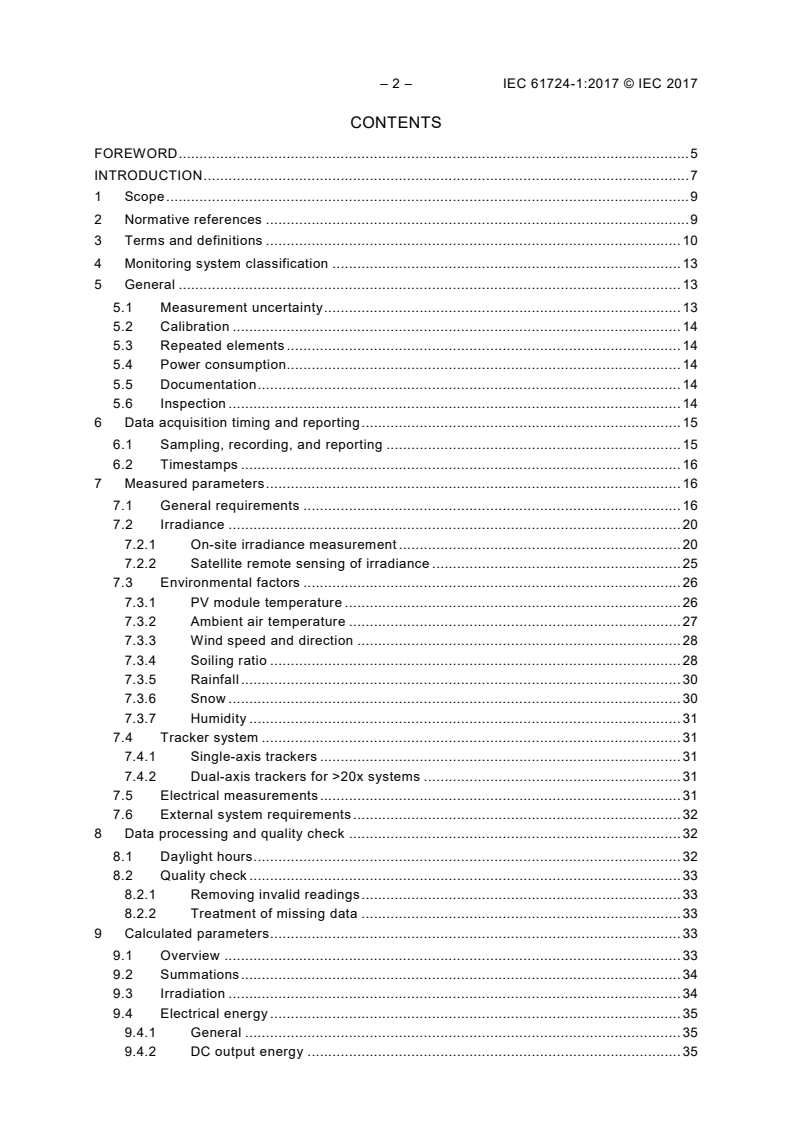
– 2 – IEC 61724-1:2017 © IEC 2017
CONTENTS
FOREWORD . 5
INTRODUCTION . 7
1 Scope . 9
2 Normative references . 9
3 Terms and definitions . 10
4 Monitoring system classification . 13
5 General . 13
5.1 Measurement uncertainty . 13
5.2 Calibration . 14
5.3 Repeated elements . 14
5.4 Power consumption. 14
5.5 Documentation . 14
5.6 Inspection . 14
6 Data acquisition timing and reporting . 15
6.1 Sampling, recording, and reporting . 15
6.2 Timestamps . 16
7 Measured parameters . 16
7.1 General requirements . 16
7.2 Irradiance . 20
7.2.1 On-site irradiance measurement . 20
7.2.2 Satellite remote sensing of irradiance . 25
7.3 Environmental factors . 26
7.3.1 PV module temperature . 26
7.3.2 Ambient air temperature . 27
7.3.3 Wind speed and direction . 27
7.3.4 Soiling ratio . 28
7.3.5 Rainfall . 30
7.3.6 Snow . 30
7.3.7 Humidity . 30
7.4 Tracker system . 31
7.4.1 Single-axis trackers . 31
7.4.2 Dual-axis trackers for >20x systems . 31
7.5 Electrical measurements . 31
7.6 External system requirements . 32
8 Data processing and quality check . 32
8.1 Daylight hours . 32
8.2 Quality check . 33
8.2.1 Removing invalid readings . 33
8.2.2 Treatment of missing data . 33
9 Calculated parameters . 33
9.1 Overview . 33
9.2 Summations . 34
9.3 Irradiation . 34
9.4 Electrical energy . 35
9.4.1 General . 35
9.4.2 DC output energy . 35
9.4.3 AC output energy . 35
9.5 Array power rating . 35
9.5.1 DC power rating. 35
9.5.2 AC power rating . 35
9.6 Yields . 35
9.6.1 General . 35
9.6.2 PV array energy yield . 36
9.6.3 Final system yield . 36
9.6.4 Reference yield . 36
9.7 Yield losses . 36
9.7.1 General . 36
9.7.2 Array capture loss . 36
9.7.3 Balance of systems (BOS) loss . 36
9.8 Efficiencies . 37
9.8.1 Array (DC) efficiency . 37
9.8.2 System (AC) efficiency . 37
9.8.3 BOS efficiency . 37
10 Performance metrics. 37
10.1 Overview . 37
10.2 Summations . 38
10.3 Performance ratios . 38
10.3.1 Performance ratio . 38
10.3.2 Temperature-corrected performance ratios . 39
10.4 Performance indices . 40
11 Data filtering . 41
11.1 Use of available data . 41
11.2 Filtering data to specific conditions . 41
11.3 Reduced inverter, grid, or load availability . 41
Annex A (informative) Sampling interval . 42
A.1 General considerations . 42
A.2 Time constants . 42
A.3 Aliasing error . 42
A.4 Example . 43
Annex B (informative) Module backsheet temperature sensor selection and
attachment . 44
B.1 Objective . 44
B.2 Sensor and material selection . 44
B.2.1 Optimal sensor types . 44
B.2.2 Optimal tapes . 44
B.2.3 Cyanoacrylate adhesives and backsheet integrity . 44
B.3 Sensor attachment method . 45
B.3.1 Permanent versus temporary . 45
B.3.2 Attachment location . 45
B.3.3 Sensor attachment. 45
Annex C (informative) Derate factors . 48
Annex D (normative) Systems with local loads, storage, or auxiliary sources . 49
D.1 System types . 49
D.2 Parameters and formulas . 51
– 4 – IEC 61724-1:2017 © IEC 2017
Bibliography . 57
Figure 1 – Possible elements of PV systems . 7
Figure 2 – Sampling, recording, and reporting. 15
Figure B.1 – Sensor attachment, permanent . 46
Figure B.2 – Sensor attachment, temporary . 46
Figure B.3 – Sensor element wire strain relief . 46
Figure D.1 – Energy flow between possible elements of different PV system types . 49
Table 1 – Monitoring system classifications and suggested applications . 13
Table 2 – Sampling and recording interval requirements . 16
Table 3 – Measured parameters and requirements for each monitoring system class . 18
Table 4 – Relation between system size (AC) and number of sensors for specific
sensors referenced in Table 3 . 20
Table 5 – Sensor choices and requirements for in-plane and global irradiance . 21
Table 6 – Irradiance sensor alignment accuracy . 22
Table 7 – Irradiance sensor maintenance requirements . 23
Table 8 – PV module temperature sensor maintenance requirements . 26
Table 9 – Ambient air temperature sensor maintenance requirements . 27
Table 10 – Wind sensor maintenance requirements . 28
Table 11 – Inverter-level electrical measurement requirements . 32
Table 12 – Plant-level AC electrical output measurement requirements . 32
Table 13 – Calculated parameters . 34
Table 14 – Performance metrics . 38
Table D.1 – Elements of different PV system types . 50
Table D.2 – Parameters and equations for different system types . 51
INTERNATIONAL ELECTROTECHNICAL COMMISSION
____________
PHOTOVOLTAIC SYSTEM PERFORMANCE –
Part 1: Monitoring
FOREWORD
1) The International Electrotechnical Commission (IEC) is a worldwide organization for standardization comprising
all national electrotechnical committees (IEC National Committees). The object of IEC is to promote
international co-operation on all questions concerning standardization in the electrical and electronic fields. To
this end and in addition to other activities, IEC publishes International Standards, Technical Specifications,
Technical Reports, Publicly Available Specifications (PAS) and Guides (hereafter referred to as “IEC
Publication(s)”). Their preparation is entrusted to technical committees; any IEC National Committee interested
in the subject dealt with may participate in this preparatory work. International, governmental and non-
governmental organizations liaising with the IEC also participate in this preparation. IEC collaborates closely
with the International Organization for Standardization (ISO) in accordance with conditions determined by
agreement between the two organizations.
2) The formal decisions or agreements of IEC on technical matters express, as nearly as possible, an international
consensus of opinion on the relevant subjects since each technical committee has representation from all
interested IEC National Committees.
3) IEC Publications have the form of recommendations for international use and are accepted by IEC National
Committees in that sense. While all reasonable efforts are made to ensure that the technical content of IEC
Publications is accurate, IEC cannot be held responsible for the way in which they are used or for any
misinterpretation by any end user.
4) In order to promote international uniformity, IEC National Committees undertake to apply IEC Publications
transparently to the maximum extent possible in their national and regional publications. Any divergence
between any IEC Publication and the corresponding national or regional publication shall be clearly indicated in
the latter.
5) IEC itself does not provide any attestation of conformity. Independent certification bodies provide conformity
assessment services and, in some areas, access to IEC marks of conformity. IEC is not responsible for any
services carried out by independent certification bodies.
6) All users should ensure that they have the latest edition of this publication.
7) No liability shall attach to IEC or its directors, employees, servants or agents including individual experts and
members of its technical committees and IEC National Committees for any personal injury, property damage or
other damage of any nature whatsoever, whether direct or indirect, or for costs (including legal fees) and
expenses arising out of the publication, use of, or reliance upon, this IEC Publication or any other IEC
Publications.
8) Attention is drawn to the Normative references cited in this publication. Use of the referenced publications is
indispensable for the correct application of this publication.
9) Attention is drawn to the possibility that some of the elements of this IEC Publication may be the subject of
patent rights. IEC shall not be held responsible for identifying any or all such patent rights.
International Standard IEC 61724-1 has been prepared by IEC technical committee 82: Solar
photovoltaic energy systems.
This first edition cancels and replaces the first edition of IEC 61724, published in 1998. This
edition constitutes a technical revision.
This edition (in conjunction with IEC TS 61724-2:2016 and IEC TS 61724-3:2016) includes the
following significant technical changes with respect to IEC 61724:
a) IEC 61724 is now written with multiple parts. This document is IEC 61724-1, addressing
PV system monitoring. IEC TS 61724-2 and IEC TS 61724-3 address performance
analysis based on the monitoring data.
b) Three classes of monitoring systems are defined corresponding to different levels of
accuracy and different intended applications.
c) Required measurements for each class of monitoring system are stated, along with the
required number and accuracy of sensors.
– 6 – IEC 61724-1:2017 © IEC 2017
d) Options for satellite-based irradiance measurement are provided.
e) Soiling measurement is introduced.
f) New performance metrics are introduced, including temperature compensated
performance ratios and others.
g) Numerous recommendations and explanatory notes are included.
The text of this standard is based on the following documents:
FDIS Report on voting
82/1215/FDIS 82/1248/RVD
Full information on the voting for the approval of this International Standard can be found in
the report on voting indicated in the above table.
This document has been drafted in accordance with the ISO/IEC Directives, Part 2.
A list of all parts in the IEC 61724 series, published under the general title Photovoltaic
system performance, can be found on the IEC website.
The committee has decided that the contents of this document will remain unchanged until the
stability date indicated on the IEC website under "http://webstore.iec.ch" in the data related to
the specific document. At this date, the document will be
• reconfirmed,
• withdrawn,
• replaced by a revised edition, or
• amended.
A bilingual version of this publication may be issued at a later date.
INTRODUCTION
This International Standard defines classes of photovoltaic (PV) performance monitoring
systems and serves as guidance for various monitoring system choices.
Figure 1 illustrates possible major elements comprising different PV system types. The PV
array may include both fixed axis and tracking systems and both flat plate and concentrator
systems. Module-level electronics, if present, may be a component of the monitoring system.
For simplicity, the main clauses of this document are written for grid-connected systems
without local loads, energy storage, or auxiliary sources, as shown by the bold lines in
Figure 1. Annex D includes details for systems with additional components.
Back up Other RNE
Load(s) Utility
source(s) source(s)
on AC grid line
on AC on AC
I , V P P I , V P I , P
I , P
BUac BUac BUac REac Lac Lac Lac FG FG
TG TG
I , P
TL,dcc TL,dcc
V
G
I , P
AC TB,ac TB,ac
V
Pac
I , V P
Aac,ac Aac,ac Aac,ac
I , P I , P
FPac FPac TPac TPac
PCE-BDI PCE-GCI
I ,
Adc,ac
I , P I , P P
TP TP FP FP Adc,ac
V
Adc,ac
V
Pdc
DC
I , I , I ,
Ldc BUdc Adc,dc
V ,
S
V V V
Ldc BUdc Adc,dc
I , P P
I , P TS TS Adc,dc
P P P FS FS
Ldc BUdc REdc
Back up Other RNE
Load(s) Energy
source(s) source(s)
PV array PV array
on DC storage
on DC on DC
IEC
Key
RNE renewable energy
PCE power conditioning equipment
BDI bi-directional inverter
GCI grid-connected inverter
Bold lines denote simple grid-connected system without local loads, energy storage, or auxiliary sources.
Figure 1 – Possible elements of PV systems
The purposes of a performance monitoring system are diverse and can include the following:
G
i
G
i
– 8 – IEC 61724-1:2017 © IEC 2017
• identification of performance trends in an individual PV system;
• localization of potential faults in a PV system;
• comparison of PV system performance to design expectations and guarantees;
• comparison of PV systems of different configurations; and
• comparison of PV systems at different locations.
These diverse purposes give rise to a diverse set of requirements, and different sensors
and/or analysis methods may be more or less suited depending on the specific objective. For
example, for comparing performance to design expectations and guarantees, the focus should
be on system-level data and consistency between prediction and test methods, while for
analysing performance trends and localizing faults, there may be a need for greater resolution
at sub-levels of the system and an emphasis on measurement repeatability and correlation
metrics rather than absolute accuracy.
The monitoring system should be adapted to the PV system's size and user requirements. In
general, larger and more expensive PV systems should have more monitoring points and
higher accuracy sensors than smaller and lower-cost PV systems. This document defines
three classifications of monitoring system with differentiated requirements which are
appropriate to a range of purposes.
PHOTOVOLTAIC SYSTEM PERFORMANCE –
Part 1: Monitoring
1 Scope
This part of IEC 61724 outlines equipment, methods, and terminology for performance
monitoring and analysis of photovoltaic (PV) systems. It addresses sensors, installation, and
accuracy for monitoring equipment in addition to measured parameter data acquisition and
quality checks, calculated parameters, and performance metrics. In addition, it serves as a
basis for other standards which rely upon the data collected.
2 Normative references
The following documents are referred to in the text in such a way that some or all of their
content constitutes requirements of this document. For dated references, only the edition
cited applies. For undated references, the latest edition of the referenced document (including
any amendments) applies.
IEC 60050-131, International Electrotechnical Vocabulary – Part 131: Circuit theory
IEC 60904-2, Photovoltaic devices – Part 2: Requirements for photovoltaic reference devices
IEC 60904-3, Photovoltaic devices – Part 3: Measurement principles for terrestrial
photovoltaic (PV) solar devices with reference spectral irradiance data
IEC 60904-5, Photovoltaic devices – Part 5: Determination of the equivalent cell temperature
(ECT) of photovoltaic (PV) devices by the open-circuit voltage method
IEC 60904-10, Photovoltaic devices – Part 10: Methods of linearity measurement
IEC TS 61836, Solar photovoltaic energy systems – Terms, definitions and symbols
IEC 61557-12, Electrical safety in low voltage distribution systems up to 1 000 V a.c. and
1 500 V d.c. – Equipment for testing, measuring or monitoring of protective measures –
Part 12: Performance measuring and monitoring devices (PMD)
IEC 62053-21, Electricity metering equipment (a.c.) – Particular requirements – Part 21: Static
meters for active energy (classes 1 and 2)
IEC 62053-22, Electricity metering equipment (a.c.) – Particular requirements – Part 22: Static
meters for active energy (classes 0,2 S and 0,5 S)
IEC 62670-3, Photovoltaic concentrators (CPV) – Performance testing – Part 3: Performance
measurements and power rating
IEC 62817:2014, Photovoltaic systems – Design qualification of solar trackers
ISO/IEC Guide 98-1, Uncertainty of measurement – Part 1: Introduction to the expression of
uncertainty in measurement
– 10 – IEC 61724-1:2017 © IEC 2017
ISO/IEC Guide 98-3, Uncertainty of measurement – Part 3: Guide to the expression of
uncertainty in measurement (GUM:1995)
ISO 9060, Solar energy – Specification and classification of instruments for measuring
hemispherical solar and direct solar radiation
ISO 9488, Solar energy – Vocabulary
ISO 9846, Solar energy – Calibration of a pyranometer using a pyrheliometer
ISO 9847, Solar energy – Calibration of field pyranometers by comparison to a reference
pyranometer
WMO No. 8, Guide to meteorological instruments and methods of observation
ASTM G183, Standard Practice for Field Use of Pyranometers, Pyrheliometers and UV
Radiometers
3 Terms and definitions
For the purposes of this document, the terms and definitions given in IEC 60050-131, IEC
TS 61836, ISO 9488 and the following apply.
ISO and IEC maintain terminological databases for use in standardization at the following
addresses:
• IEC Electropedia: available at http://www.electropedia.org/
• ISO Online browsing platform: available at http://www.iso.org/obp
3.1
sample
data acquired from a sensor or measuring device
3.2
sampling interval
time between samples
3.3
record
data recorded and stored in data log, based on acquired samples
3.4
recording interval
τ
time between records
3.5
report
aggregate value based on series of records
3.6
reporting period
time between reports
3.7
irradiance
G
incident flux of radiant power per unit area
−2
Note 1 to entry: Expressed in units of W·m .
3.8
in-plane irradiance
G or POA
i
the sum of direct, diffuse, and ground-reflected irradiance incident upon an inclined surface
parallel to the plane of the modules in the PV array, also known as plane-of-array (POA)
irradiance
−2
Note 1 to entry: Expressed in units of W·m .
3.9
global horizontal irradiance
GHI
direct plus diffuse irradiance incident on a horizontal surface
−2
Note 1 to entry: Expressed in units of W·m .
3.10
circumsolar
immediately surrounding the solar disk
3.11
direct normal irradiance
DNI
irradiance emanating from the solar disk and from the circumsolar region of the sky within a
subtended full angle of 5° falling on a plane surface normal to the sun’s rays
Note 1 to entry: Some DNI measurement instruments have a field of view with a subtended full angle of up to 6°.
−2
Note 2 to entry: Expressed in units of W·m .
3.12
circumsolar ratio
CSR
fraction of measured direct normal irradiance (DNI) emanating from the circumsolar region of
the sky, i.e. within the angular acceptance of the DNI sensor but outside the solar disk
3.13
diffuse horizontal irradiance
G or DHI
d
global horizontal irradiance excluding the portion emanating from the solar disk and from the
circumsolar region of the sky within a subtended full angle of 5°
Note 1 to entry: Some diffuse irradiance measurement instruments exclude a circumsolar region within a
subtended full angle of up to 6°.
−2
Note 2 to entry: Expressed in units of W·m .
3.14
in-plane direct beam irradiance
G
i,b
in-plane irradiance emanating from the solar disk and from the circumsolar region of the sky
within a subtended full angle of 5°, excluding scattering and reflections.
Note 1 to entry: The in-plane direct beam irradiance Gi,b = cos(𝜃)×DNI, where 𝜃 is the angle between the sun and
the normal to the plane. When the plane of array is normal to the sun, Gi,b = DNI.
– 12 – IEC 61724-1:2017 © IEC 2017
−2
Note 2 to entry: Expressed in units of W·m .
3.15
in-plane diffuse irradiance
G
i,d
in-plane irradiance excluding the direct beam irradiance
Note 1 to entry: G = G – G .
i,d i i,b
−2
Note 2 to entry: Expressed in units of W·m .
3.16
irradiation
H
irradiance integrated over a specified time interval
−2
Note 1 to entry: Expressed in units of kW⋅h·m .
3.17
standard test conditions
STC
-2
reference values of in-plane irradiance (1 000 W⋅m ), PV cell junction temperature (25 °C),
and the reference spectral irradiance defined in IEC 60904-3
3.18
soiling ratio
SR
ratio of the actual power output of the PV array under given soiling conditions to the power
that would be expected if the PV array were clean and free of soiling
3.19
soiling level
SL
fractional power loss due to soiling, given by 1 − SR
3.20
active power
P
under periodic conditions, mean value, taken over one period, of the instantaneous product of
current and voltage
Note 1 to entry: Under sinusoidal conditions, the active power is the real part of the complex power.
Note 2 to entry: Expressed in units of W.
3.21
apparent power
S
product of the r.m.s. voltage between the terminals of a two-terminal element or two-terminal
circuit and the r.m.s. electric current in the element or circuit
Note 1 to entry: Under sinusoidal conditions, the apparent power is the modulus of the complex power.
Note 2 to entry: Expressed in units of VA.
3.22
power factor
λ
under periodic conditions, ratio of the absolute value of the active power P to the apparent
power S:
P
λ =
S
4 Monitoring system classification
The required accuracy and complexity of the monitoring system depends on the PV system
size and user objectives. This document defines three classifications of monitoring systems
providing varying levels of accuracy, as listed in Table 1.
The monitoring system classification shall be stated in any conformity declarations to this
standard. The monitoring system classification may be referenced either by its letter code (A,
B, C) or its name (high accuracy, medium accuracy, basic accuracy) as indicated in Table 1.
In this document, the letter codes are used for convenience.
Class A or Class B would be most appropriate for large PV systems, such as utility-scale and
large commercial installations, while Class B or Class C would be most appropriate for small
systems, such as smaller commercial and residential installations. However, users of the
standard may specify any classification appropriate to their application, regardless of PV
system size.
Throughout this document, some requirements are designated as applying to a particular
classification. Where no designation is given, the requirements apply to all classifications.
Table 1 – Monitoring system classifications and suggested applications
Typical applications Class A Class B Class C
High accuracy Medium accuracy Basic accuracy
Basic system performance assessment X X X
Documentation of a performance guarantee X X
System losses analysis X X
Electricity network interaction assessment X
Fault localization X
PV technology assessment X
Precise PV system degradation measurement X
5 General
5.1 Measurement uncertainty
Where requirements on measurement uncertainties are stated in the document, they refer to
the combined uncertainties of the measurement sensors and any signal-conditioning
electronics.
Measurement uncertainties shall apply over the typical range of values of each measured
quantity indicated in the document, as well as over the typical temperature range at which the
system will operate. The effect of non-linearity of the measurement within the typical range
shall be included within the stated uncertainty.
– 14 – IEC 61724-1:2017 © IEC 2017
Measurement uncertainties can be calculated as outlined in ISO/IEC Guide 98-1 and
ISO/IEC Guide 98-3.
5.2 Calibration
Sensors and signal-conditioning electronics used in the monitoring system shall be calibrated
prior to the start of monitoring.
Recalibration of sensors and signal-conditioning electronics is to be performed as required by
the manufacturer or at more frequent intervals where specified.
It is recommended to perform periodic cross-checks of each sensor against sister sensors or
reference devices in order to identify out-of-calibration sensors.
5.3 Repeated elements
Depending on system size and user requirements, the monitoring system may include
redundancy in sensors and/or repetition of sensor elements for different components or
subsections of the full PV system. Accordingly, the measured and calculated parameters
defined in this document may have multiple instances, each corresponding to a subsection or
subcomponent of the PV system.
5.4 Power consumption
The parasitic power drawn by tracking, monitoring, and other ancillary systems required for
operation of the PV plant shall be considered a power loss of the plant, not a load supplied by
the plant.
5.5 Documentation
Specifications of all components of the monitoring system, including sensors and signal-
conditioning electronics, shall be documented.
User guides shall be provided for the monitoring system software.
All system maintenance, including cleaning of sensors, PV modules, or other soiled surfaces,
shall be documented.
A log should be kept to record unusual events, component changes, sensor recalibration,
changes to the data acquisition system, changes to the overall system operation, failures,
faults, or accidents.
When a conformity declaration is made, documentation shall demonstrate consistency with
the indicated class A, B, or C.
5.6 Inspection
For Class A and Class B the monitoring system should be inspected at least annually and
preferably at more frequent intervals, while for Class C inspection should be per site-specific
requirements. Inspection should look for damage to or displacement of exterior sensors,
evidence of moisture or vermin in enclosures, loose wiring connections at sensors or within
enclosures, detachment of temperature sensors, embrittlement of attachments, and other
potential problems.
6 Data acquisition timing and reporting
6.1 Sampling, recording, and reporting
A sample is defined as data acquired from a sensor or measuring device, and the sampling
interval is the time between samples. Samples do not need to be permanently stored.
A record is defined as data entered into a data log for data storage, based on acquired
samples, and the recording interval, denoted by τ in this document, is the time between
records. The recording interval should be an integer multiple of the sampling interval, and an
integer number of recording intervals should fit within 1 h.
The recorded parameter value for each record is the average, maximum, minimum, sum, or
other function of the samples acquired during the recording interval, as appropriate for the
measured quantity. The record can also include supplementary data such as additional
statistics of the samples, number of missing data points, error codes, transients, and/or other
data of special interest. (For wind data records, see statement in 7.3.3.)
A report is defined as an aggregate value covering multiple recording intervals, and the
reporting period is the time between reports. Typically the reporting period would be chosen
to be days, weeks, months, or years.
Figure 2 illustrates the relations between samples, records, and reports. Table 2 lists
maximum values for sampling intervals and recording intervals. Further considerations
relating to the sampling interval are addressed in Annex A.
Samples
(Data acquisition)
Sampling interval
Records
(Data storage)
Recording interval (τ)
Reports
(Summary
Reporting period
parameters and
metrics)
Time
IEC
Figure 2 – Sampling, recording, and reporting
– 16 – IEC 61724-1:2017 © IEC 2017
Table 2 – Sampling and recording interval requirements
Class A Class B Class C
High accuracy Medium accuracy Basic accuracy
Maximum sampling interval
*
For irradiance, temperature, wind , and
** **
3 s 1 min 1 min
electrical output
** **
For soiling, rain, snow, and humidity 1 min 1 min 1 min
Maximum recording interval 1 min 15 min 60 min
*
See statement in 7.3.3 regarding including maximum and minimum readings in wind data records.
**
The indicated sampling interval requirements for class B and class C apply to ground-based measurements,
but do not apply when using satellite-based estimation of irradiance or meteorological parameters. (A
ground-based instrument will require frequent samples to construct the proper average over a recording
interval, e.g. in the case of partly cloudy conditions, while satellite-based estimation may derive the same
average from a single image during the reporting period.)
6.2 Timestamps
Each record and each report shall include a timestamp.
Timestamp data shall include the date and time corresponding to the beginning or end of the
recording interval or reporting period and the choice shall be specified.
The time should refer either to local standard time (not daylight savings time) or universal
time, to avoid winter/summer time changes, and the choice of time shall be specified.
Midnight shall be treated as the start of a new day and expressed as 00:00.
When multiple data acquisition units are involved that each independently apply timestamps,
the clocks of the units shall be synchronized, preferably by an automated mechanism such as
global positioning system (GPS) or network time protocol (NTP).
It is recommended that documentation of timestamps follow ISO 8601, Data elements and
interchange formats – Information interchange – Representation of dates and times.
7 Measured parameters
7.1 General requirements
Table 3 lists measured parameters defined by this document and a summary of measurement
requirements. The purpose of each monitoring parameter is listed in Table 3 in order to guide
the user. More details and additional requirements are provided in the subsequent referenced
subclauses.
A check mark (√) in Table 3 indicates a required parameter to be measured on site, qualified
by specific notes where included.
Table 3 lists the minimum number of on-site sensors, in many cases by reference to Table 4.
Where no number is given, only one sensor is required, although redundant sensors are
typically advisable. When multiple sensors are required, they shall be distributed throughout
the PV plant, or placed at monitoring points indicated in the table. If the plant includes
multiple sections that have different PV technology types or substantially different local
geography, then at least one sensor shall be placed in each section.
The symbol “E” in Table 3 indicates a parameter that may be estimated based on local or
regional meteorological data or satellite data, rather than measured on site.
Empty cells in Table 3 indicate optional parameters that may be chosen for specific system
requirements or to meet project specifications.
NOTE The most significant and direct impacts on PV performance are in-plane irradiance received by the PV
array, the PV cell temperature, and shading losses due to soiling or snow. Monitoring of meteorological p
...
IEC 61724-1 ®
Edition 1.0 2017-03
INTERNATIONAL
STANDARD
NORME
INTERNATIONALE
Photovoltaic system performance –
Part 1: Monitoring
Performances des systèmes photovoltaïques –
Partie 1: Surveillance
All rights reserved. Unless otherwise specified, no part of this publication may be reproduced or utilized in any form
or by any means, electronic or mechanical, including photocopying and microfilm, without permission in writing from
either IEC or IEC's member National Committee in the country of the requester. If you have any questions about IEC
copyright or have an enquiry about obtaining additional rights to this publication, please contact the address below or
your local IEC member National Committee for further information.
Droits de reproduction réservés. Sauf indication contraire, aucune partie de cette publication ne peut être reproduite
ni utilisée sous quelque forme que ce soit et par aucun procédé, électronique ou mécanique, y compris la photocopie
et les microfilms, sans l'accord écrit de l'IEC ou du Comité national de l'IEC du pays du demandeur. Si vous avez des
questions sur le copyright de l'IEC ou si vous désirez obtenir des droits supplémentaires sur cette publication, utilisez
les coordonnées ci-après ou contactez le Comité national de l'IEC de votre pays de résidence.
IEC Central Office Tel.: +41 22 919 02 11
3, rue de Varembé info@iec.ch
CH-1211 Geneva 20 www.iec.ch
Switzerland
About the IEC
The International Electrotechnical Commission (IEC) is the leading global organization that prepares and publishes
International Standards for all electrical, electronic and related technologies.
About IEC publications
The technical content of IEC publications is kept under constant review by the IEC. Please make sure that you have the
latest edition, a corrigenda or an amendment might have been published.
IEC Catalogue - webstore.iec.ch/catalogue Electropedia - www.electropedia.org
The stand-alone application for consulting the entire The world's leading online dictionary of electronic and
bibliographical information on IEC International Standards, electrical terms containing 21 000 terms and definitions in
Technical Specifications, Technical Reports and other English and French, with equivalent terms in 16 additional
documents. Available for PC, Mac OS, Android Tablets and languages. Also known as the International Electrotechnical
iPad. Vocabulary (IEV) online.
IEC publications search - webstore.iec.ch/advsearchform IEC Glossary - std.iec.ch/glossary
The advanced search enables to find IEC publications by a 67 000 electrotechnical terminology entries in English and
variety of criteria (reference number, text, technical French extracted from the Terms and Definitions clause of
committee,…). It also gives information on projects, replaced IEC publications issued since 2002. Some entries have been
and withdrawn publications. collected from earlier publications of IEC TC 37, 77, 86 and
CISPR.
IEC Just Published - webstore.iec.ch/justpublished
Stay up to date on all new IEC publications. Just Published IEC Customer Service Centre - webstore.iec.ch/csc
details all new publications released. Available online and If you wish to give us your feedback on this publication or
also once a month by email. need further assistance, please contact the Customer Service
Centre: sales@iec.ch.
A propos de l'IEC
La Commission Electrotechnique Internationale (IEC) est la première organisation mondiale qui élabore et publie des
Normes internationales pour tout ce qui a trait à l'électricité, à l'électronique et aux technologies apparentées.
A propos des publications IEC
Le contenu technique des publications IEC est constamment revu. Veuillez vous assurer que vous possédez l’édition la
plus récente, un corrigendum ou amendement peut avoir été publié.
Catalogue IEC - webstore.iec.ch/catalogue Electropedia - www.electropedia.org
Application autonome pour consulter tous les renseignements
Le premier dictionnaire en ligne de termes électroniques et
bibliographiques sur les Normes internationales,
électriques. Il contient 21 000 termes et définitions en anglais
Spécifications techniques, Rapports techniques et autres
et en français, ainsi que les termes équivalents dans 16
documents de l'IEC. Disponible pour PC, Mac OS, tablettes
langues additionnelles. Egalement appelé Vocabulaire
Android et iPad.
Electrotechnique International (IEV) en ligne.
Recherche de publications IEC -
Glossaire IEC - std.iec.ch/glossary
webstore.iec.ch/advsearchform
67 000 entrées terminologiques électrotechniques, en anglais
La recherche avancée permet de trouver des publications IEC et en français, extraites des articles Termes et Définitions des
en utilisant différents critères (numéro de référence, texte, publications IEC parues depuis 2002. Plus certaines entrées
comité d’études,…). Elle donne aussi des informations sur les antérieures extraites des publications des CE 37, 77, 86 et
projets et les publications remplacées ou retirées. CISPR de l'IEC.
IEC Just Published - webstore.iec.ch/justpublished Service Clients - webstore.iec.ch/csc
Restez informé sur les nouvelles publications IEC. Just Si vous désirez nous donner des commentaires sur cette
Published détaille les nouvelles publications parues. publication ou si vous avez des questions contactez-nous:
Disponible en ligne et aussi une fois par mois par email. sales@iec.ch.
IEC 61724-1 ®
Edition 1.0 2017-03
INTERNATIONAL
STANDARD
NORME
INTERNATIONALE
Photovoltaic system performance –
Part 1: Monitoring
Performances des systèmes photovoltaïques –
Partie 1: Surveillance
INTERNATIONAL
ELECTROTECHNICAL
COMMISSION
COMMISSION
ELECTROTECHNIQUE
INTERNATIONALE
ICS 27.160 ISBN 978-2-8322-5227-7
– 2 – IEC 61724-1:2017 © IEC 2017
CONTENTS
FOREWORD . 5
INTRODUCTION . 7
1 Scope . 9
2 Normative references . 9
3 Terms and definitions . 10
4 Monitoring system classification . 13
5 General . 13
5.1 Measurement uncertainty . 13
5.2 Calibration . 14
5.3 Repeated elements . 14
5.4 Power consumption. 14
5.5 Documentation . 14
5.6 Inspection . 14
6 Data acquisition timing and reporting . 15
6.1 Sampling, recording, and reporting . 15
6.2 Timestamps . 16
7 Measured parameters . 16
7.1 General requirements . 16
7.2 Irradiance . 20
7.2.1 On-site irradiance measurement . 20
7.2.2 Satellite remote sensing of irradiance . 25
7.3 Environmental factors . 26
7.3.1 PV module temperature . 26
7.3.2 Ambient air temperature . 27
7.3.3 Wind speed and direction . 28
7.3.4 Soiling ratio . 28
7.3.5 Rainfall . 30
7.3.6 Snow . 30
7.3.7 Humidity . 31
7.4 Tracker system . 31
7.4.1 Single-axis trackers . 31
7.4.2 Dual-axis trackers for >20x systems . 31
7.5 Electrical measurements . 31
7.6 External system requirements . 32
8 Data processing and quality check . 32
8.1 Daylight hours . 32
8.2 Quality check . 33
8.2.1 Removing invalid readings . 33
8.2.2 Treatment of missing data . 33
9 Calculated parameters . 33
9.1 Overview . 33
9.2 Summations . 34
9.3 Irradiation . 34
9.4 Electrical energy . 35
9.4.1 General . 35
9.4.2 DC output energy . 35
9.4.3 AC output energy . 35
9.5 Array power rating . 35
9.5.1 DC power rating. 35
9.5.2 AC power rating . 35
9.6 Yields . 35
9.6.1 General . 35
9.6.2 PV array energy yield . 36
9.6.3 Final system yield . 36
9.6.4 Reference yield . 36
9.7 Yield losses . 36
9.7.1 General . 36
9.7.2 Array capture loss . 36
9.7.3 Balance of systems (BOS) loss . 36
9.8 Efficiencies . 37
9.8.1 Array (DC) efficiency . 37
9.8.2 System (AC) efficiency . 37
9.8.3 BOS efficiency . 37
10 Performance metrics. 37
10.1 Overview . 37
10.2 Summations . 38
10.3 Performance ratios . 38
10.3.1 Performance ratio . 38
10.3.2 Temperature-corrected performance ratios . 39
10.4 Performance indices . 40
11 Data filtering . 41
11.1 Use of available data . 41
11.2 Filtering data to specific conditions . 41
11.3 Reduced inverter, grid, or load availability . 41
Annex A (informative) Sampling interval . 42
A.1 General considerations . 42
A.2 Time constants . 42
A.3 Aliasing error . 42
A.4 Example . 43
Annex B (informative) Module backsheet temperature sensor selection and
attachment . 44
B.1 Objective . 44
B.2 Sensor and material selection . 44
B.2.1 Optimal sensor types . 44
B.2.2 Optimal tapes . 44
B.2.3 Cyanoacrylate adhesives and backsheet integrity . 44
B.3 Sensor attachment method . 45
B.3.1 Permanent versus temporary . 45
B.3.2 Attachment location . 45
B.3.3 Sensor attachment. 45
Annex C (informative) Derate factors . 48
Annex D (normative) Systems with local loads, storage, or auxiliary sources . 49
D.1 System types . 49
D.2 Parameters and formulas . 51
– 4 – IEC 61724-1:2017 © IEC 2017
Bibliography . 57
Figure 1 – Possible elements of PV systems . 7
Figure 2 – Sampling, recording, and reporting. 15
Figure B.1 – Sensor attachment, permanent . 46
Figure B.2 – Sensor attachment, temporary . 46
Figure B.3 – Sensor element wire strain relief . 47
Figure D.1 – Energy flow between possible elements of different PV system types . 49
Table 1 – Monitoring system classifications and suggested applications . 13
Table 2 – Sampling and recording interval requirements . 16
Table 3 – Measured parameters and requirements for each monitoring system class . 18
Table 4 – Relation between system size (AC) and number of sensors for specific
sensors referenced in Table 3 . 20
Table 5 – Sensor choices and requirements for in-plane and global irradiance . 21
Table 6 – Irradiance sensor alignment accuracy . 22
Table 7 – Irradiance sensor maintenance requirements . 23
Table 8 – PV module temperature sensor maintenance requirements . 26
Table 9 – Ambient air temperature sensor maintenance requirements . 27
Table 10 – Wind sensor maintenance requirements . 28
Table 11 – Inverter-level electrical measurement requirements . 32
Table 12 – Plant-level AC electrical output measurement requirements . 32
Table 13 – Calculated parameters . 34
Table 14 – Performance metrics . 38
Table D.1 – Elements of different PV system types . 50
Table D.2 – Parameters and equations for different system types . 51
INTERNATIONAL ELECTROTECHNICAL COMMISSION
____________
PHOTOVOLTAIC SYSTEM PERFORMANCE –
Part 1: Monitoring
FOREWORD
1) The International Electrotechnical Commission (IEC) is a worldwide organization for standardization comprising
all national electrotechnical committees (IEC National Committees). The object of IEC is to promote international
co-operation on all questions concerning standardization in the electrical and electronic fields. To this end and
in addition to other activities, IEC publishes International Standards, Technical Specifications, Technical Reports,
Publicly Available Specifications (PAS) and Guides (hereafter referred to as “IEC Publication(s)”). Their
preparation is entrusted to technical committees; any IEC National Committee interested in the subject dealt with
may participate in this preparatory work. International, governmental and non-governmental organizations liaising
with the IEC also participate in this preparation. IEC collaborates closely with the International Organization for
Standardization (ISO) in accordance with conditions determined by agreement between the two organizations.
2) The formal decisions or agreements of IEC on technical matters express, as nearly as possible, an international
consensus of opinion on the relevant subjects since each technical committee has representation from all
interested IEC National Committees.
3) IEC Publications have the form of recommendations for international use and are accepted by IEC National
Committees in that sense. While all reasonable efforts are made to ensure that the technical content of IEC
Publications is accurate, IEC cannot be held responsible for the way in which they are used or for any
misinterpretation by any end user.
4) In order to promote international uniformity, IEC National Committees undertake to apply IEC Publications
transparently to the maximum extent possible in their national and regional publications. Any divergence between
any IEC Publication and the corresponding national or regional publication shall be clearly indicated in the latter.
5) IEC itself does not provide any attestation of conformity. Independent certification bodies provide conformity
assessment services and, in some areas, access to IEC marks of conformity. IEC is not responsible for any
services carried out by independent certification bodies.
6) All users should ensure that they have the latest edition of this publication.
7) No liability shall attach to IEC or its directors, employees, servants or agents including individual experts and
members of its technical committees and IEC National Committees for any personal injury, property damage or
other damage of any nature whatsoever, whether direct or indirect, or for costs (including legal fees) and
expenses arising out of the publication, use of, or reliance upon, this IEC Publication or any other IEC
Publications.
8) Attention is drawn to the Normative references cited in this publication. Use of the referenced publications is
indispensable for the correct application of this publication.
9) Attention is drawn to the possibility that some of the elements of this IEC Publication may be the subject of patent
rights. IEC shall not be held responsible for identifying any or all such patent rights.
International Standard IEC 61724-1 has been prepared by IEC technical committee 82: Solar
photovoltaic energy systems.
This bilingual version (2019-01) corresponds to the monolingual English version, published in
2017-03.
This first edition cancels and replaces the first edition of IEC 61724, published in 1998. This
edition constitutes a technical revision.
This edition (in conjunction with IEC TS 61724-2:2016 and IEC TS 61724-3:2016) includes the
following significant technical changes with respect to IEC 61724:
a) IEC 61724 is now written with multiple parts. This document is IEC 61724-1, addressing PV
system monitoring. IEC TS 61724-2 and IEC TS 61724-3 address performance analysis
based on the monitoring data.
b) Three classes of monitoring systems are defined corresponding to different levels of
accuracy and different intended applications.
– 6 – IEC 61724-1:2017 © IEC 2017
c) Required measurements for each class of monitoring system are stated, along with the
required number and accuracy of sensors.
d) Options for satellite-based irradiance measurement are provided.
e) Soiling measurement is introduced.
f) New performance metrics are introduced, including temperature compensated performance
ratios and others.
g) Numerous recommendations and explanatory notes are included.
The text of this standard is based on the following documents:
FDIS Report on voting
82/1215/FDIS 82/1248/RVD
Full information on the voting for the approval of this International Standard can be found in the
report on voting indicated in the above table.
The French version of this standard has not been voted upon.
This document has been drafted in accordance with the ISO/IEC Directives, Part 2.
A list of all parts in the IEC 61724 series, published under the general title Photovoltaic system
performance, can be found on the IEC website.
The committee has decided that the contents of this document will remain unchanged until the
stability date indicated on the IEC website under "http://webstore.iec.ch" in the data related to
the specific document. At this date, the document will be
• reconfirmed,
• withdrawn,
• replaced by a revised edition, or
• amended.
INTRODUCTION
This International Standard defines classes of photovoltaic (PV) performance monitoring
systems and serves as guidance for various monitoring system choices.
Figure 1 illustrates possible major elements comprising different PV system types. The PV array
may include both fixed axis and tracking systems and both flat plate and concentrator systems.
Module-level electronics, if present, may be a component of the monitoring system.
For simplicity, the main clauses of this document are written for grid-connected systems without
local loads, energy storage, or auxiliary sources, as shown by the bold lines in Figure 1.
Annex D includes details for systems with additional components.
Back up Other RNE
Load(s) Utility
source(s) source(s)
on AC grid line
on AC on AC
I , V P P I , V P
I , P I , P
BUac BUac BUac REac Lac Lac Lac
TG TG FG FG
I , P
TL,dcc TL,dcc
V
G
I , P
AC TB,ac TB,ac
V
Pac
I , V P
Aac,ac Aac,ac Aac,ac
I , P I , P
FPac FPac TPac TPac
PCE-BDI PCE-GCI
I ,
Adc,ac
I , P I , P P
TP TP FP FP Adc,ac
V
Adc,ac
V
Pdc
DC
I , I , I ,
Ldc BUdc Adc,dc
V ,
S
V V V
Ldc BUdc Adc dc
I , P P
TS TS Adc,dc
I , P
P P P
FS FS
Ldc BUdc REdc
Back up Other RNE
Load(s) Energy
source(s) source(s)
PV array PV array
on DC storage
on DC on DC
IEC
Key
RNE renewable energy
PCE power conditioning equipment
BDI bi-directional inverter
GCI grid-connected inverter
Bold lines denote simple grid-connected system without local loads, energy storage, or auxiliary sources.
Figure 1 – Possible elements of PV systems
The purposes of a performance monitoring system are diverse and can include the following:
G
i
G
i
– 8 – IEC 61724-1:2017 © IEC 2017
• identification of performance trends in an individual PV system;
• localization of potential faults in a PV system;
• comparison of PV system performance to design expectations and guarantees;
• comparison of PV systems of different configurations; and
• comparison of PV systems at different locations.
These diverse purposes give rise to a diverse set of requirements, and different sensors and/or
analysis methods may be more or less suited depending on the specific objective. For example,
for comparing performance to design expectations and guarantees, the focus should be on
system-level data and consistency between prediction and test methods, while for analysing
performance trends and localizing faults, there may be a need for greater resolution at sub-
levels of the system and an emphasis on measurement repeatability and correlation metrics
rather than absolute accuracy.
The monitoring system should be adapted to the PV system's size and user requirements. In
general, larger and more expensive PV systems should have more monitoring points and higher
accuracy sensors than smaller and lower-cost PV systems. This document defines three
classifications of monitoring system with differentiated requirements which are appropriate to a
range of purposes.
PHOTOVOLTAIC SYSTEM PERFORMANCE –
Part 1: Monitoring
1 Scope
This part of IEC 61724 outlines equipment, methods, and terminology for performance
monitoring and analysis of photovoltaic (PV) systems. It addresses sensors, installation, and
accuracy for monitoring equipment in addition to measured parameter data acquisition and
quality checks, calculated parameters, and performance metrics. In addition, it serves as a
basis for other standards which rely upon the data collected.
2 Normative references
The following documents are referred to in the text in such a way that some or all of their content
constitutes requirements of this document. For dated references, only the edition cited applies.
For undated references, the latest edition of the referenced document (including any
amendments) applies.
IEC 60050-131, International Electrotechnical Vocabulary – Part 131: Circuit theory
IEC 60904-2, Photovoltaic devices – Part 2: Requirements for photovoltaic reference devices
IEC 60904-3, Photovoltaic devices – Part 3: Measurement principles for terrestrial photovoltaic
(PV) solar devices with reference spectral irradiance data
IEC 60904-5, Photovoltaic devices – Part 5: Determination of the equivalent cell temperature
(ECT) of photovoltaic (PV) devices by the open-circuit voltage method
IEC 60904-10, Photovoltaic devices – Part 10: Methods of linearity measurement
IEC TS 61836, Solar photovoltaic energy systems – Terms, definitions and symbols
IEC 61557-12, Electrical safety in low voltage distribution systems up to 1 000 V a.c. and 1 500
V d.c. – Equipment for testing, measuring or monitoring of protective measures –
Part 12: Performance measuring and monitoring devices (PMD)
IEC 62053-21, Electricity metering equipment (a.c.) – Particular requirements – Part 21: Static
meters for active energy (classes 1 and 2)
IEC 62053-22, Electricity metering equipment (a.c.) – Particular requirements – Part 22: Static
meters for active energy (classes 0,2 S and 0,5 S)
IEC 62670-3, Photovoltaic concentrators (CPV) – Performance testing – Part 3: Performance
measurements and power rating
IEC 62817:2014, Photovoltaic systems – Design qualification of solar trackers
ISO/IEC Guide 98-1, Uncertainty of measurement – Part 1: Introduction to the expression of
uncertainty in measurement
– 10 – IEC 61724-1:2017 © IEC 2017
ISO/IEC Guide 98-3, Uncertainty of measurement – Part 3: Guide to the expression of
uncertainty in measurement (GUM:1995)
ISO 9060, Solar energy – Specification and classification of instruments for measuring
hemispherical solar and direct solar radiation
ISO 9488, Solar energy – Vocabulary
ISO 9846, Solar energy – Calibration of a pyranometer using a pyrheliometer
ISO 9847, Solar energy – Calibration of field pyranometers by comparison to a reference
pyranometer
WMO No. 8, Guide to meteorological instruments and methods of observation
ASTM G183, Standard Practice for Field Use of Pyranometers, Pyrheliometers and UV
Radiometers
3 Terms and definitions
For the purposes of this document, the terms and definitions given in IEC 60050-131, IEC
TS 61836, ISO 9488 and the following apply.
ISO and IEC maintain terminological databases for use in standardization at the following
addresses:
• IEC Electropedia: available at http://www.electropedia.org/
• ISO Online browsing platform: available at http://www.iso.org/obp
3.1
sample
data acquired from a sensor or measuring device
3.2
sampling interval
time between samples
3.3
record
data recorded and stored in data log, based on acquired samples
3.4
recording interval
τ
time between records
3.5
report
aggregate value based on series of records
3.6
reporting period
time between reports
3.7
irradiance
G
incident flux of radiant power per unit area
−2
Note 1 to entry: Expressed in units of W·m .
3.8
in-plane irradiance
G or POA
i
the sum of direct, diffuse, and ground-reflected irradiance incident upon an inclined surface
parallel to the plane of the modules in the PV array, also known as plane-of-array (POA)
irradiance
−2
Note 1 to entry: Expressed in units of W·m .
3.9
global horizontal irradiance
GHI
direct plus diffuse irradiance incident on a horizontal surface
−2
Note 1 to entry: Expressed in units of W·m .
3.10
circumsolar
immediately surrounding the solar disk
3.11
direct normal irradiance
DNI
irradiance emanating from the solar disk and from the circumsolar region of the sky within a
subtended full angle of 5° falling on a plane surface normal to the sun’s rays
Note 1 to entry: Some DNI measurement instruments have a field of view with a subtended full angle of up to 6°.
−2
Note 2 to entry: Expressed in units of W·m .
3.12
circumsolar ratio
CSR
fraction of measured direct normal irradiance (DNI) emanating from the circumsolar region of
the sky, i.e. within the angular acceptance of the DNI sensor but outside the solar disk
3.13
diffuse horizontal irradiance
G or DHI
d
global horizontal irradiance excluding the portion emanating from the solar disk and from the
circumsolar region of the sky within a subtended full angle of 5°
Note 1 to entry: Some diffuse irradiance measurement instruments exclude a circumsolar region within a subtended
full angle of up to 6°.
−2
Note 2 to entry: Expressed in units of W·m .
3.14
in-plane direct beam irradiance
G
i,b
in-plane irradiance emanating from the solar disk and from the circumsolar region of the sky
within a subtended full angle of 5°, excluding scattering and reflections.
– 12 – IEC 61724-1:2017 © IEC 2017
Note 1 to entry: The in-plane direct beam irradiance Gi,b = cos(𝜃𝜃)×DNI, where 𝜃𝜃 is the angle between the sun and
the normal to the plane. When the plane of array is normal to the sun, Gi,b = DNI.
−2
Note 2 to entry: Expressed in units of W·m .
3.15
in-plane diffuse irradiance
G
i,d
in-plane irradiance excluding the direct beam irradiance
Note 1 to entry: G = G – G .
i,d i i,b
−2
Note 2 to entry: Expressed in units of W·m .
3.16
irradiation
H
irradiance integrated over a specified time interval
−2
Note 1 to entry: Expressed in units of kW⋅h·m .
3.17
standard test conditions
STC
-2
reference values of in-plane irradiance (1 000 W⋅m ), PV cell junction temperature (25 °C), and
the reference spectral irradiance defined in IEC 60904-3
3.18
soiling ratio
SR
ratio of the actual power output of the PV array under given soiling conditions to the power that
would be expected if the PV array were clean and free of soiling
3.19
soiling level
SL
fractional power loss due to soiling, given by 1 − SR
3.20
active power
P
under periodic conditions, mean value, taken over one period, of the instantaneous product of
current and voltage
Note 1 to entry: Under sinusoidal conditions, the active power is the real part of the complex power.
Note 2 to entry: Expressed in units of W.
3.21
apparent power
S
product of the r.m.s. voltage between the terminals of a two-terminal element or two-terminal
circuit and the r.m.s. electric current in the element or circuit
Note 1 to entry: Under sinusoidal conditions, the apparent power is the modulus of the complex power.
Note 2 to entry: Expressed in units of VA.
3.22
power factor
λ
under periodic conditions, ratio of the absolute value of the active power P to the apparent
power S:
P
λ =
S
4 Monitoring system classification
The required accuracy and complexity of the monitoring system depends on the PV system size
and user objectives. This document defines three classifications of monitoring systems
providing varying levels of accuracy, as listed in Table 1.
The monitoring system classification shall be stated in any conformity declarations to this
standard. The monitoring system classification may be referenced either by its letter code (A,
B, C) or its name (high accuracy, medium accuracy, basic accuracy) as indicated in Table 1. In
this document, the letter codes are used for convenience.
Class A or Class B would be most appropriate for large PV systems, such as utility-scale and
large commercial installations, while Class B or Class C would be most appropriate for small
systems, such as smaller commercial and residential installations. However, users of the
standard may specify any classification appropriate to their application, regardless of PV system
size.
Throughout this document, some requirements are designated as applying to a particular
classification. Where no designation is given, the requirements apply to all classifications.
Table 1 – Monitoring system classifications and suggested applications
Typical applications Class A Class B Class C
High accuracy Medium accuracy Basic accuracy
Basic system performance assessment X X X
Documentation of a performance guarantee X X
System losses analysis X X
Electricity network interaction assessment X
Fault localization X
PV technology assessment X
Precise PV system degradation measurement X
5 General
5.1 Measurement uncertainty
Where requirements on measurement uncertainties are stated in the document, they refer to
the combined uncertainties of the measurement sensors and any signal-conditioning
electronics.
Measurement uncertainties shall apply over the typical range of values of each measured
quantity indicated in the document, as well as over the typical temperature range at which the
system will operate. The effect of non-linearity of the measurement within the typical range shall
be included within the stated uncertainty.
– 14 – IEC 61724-1:2017 © IEC 2017
Measurement uncertainties can be calculated as outlined in ISO/IEC Guide 98-1 and
ISO/IEC Guide 98-3.
5.2 Calibration
Sensors and signal-conditioning electronics used in the monitoring system shall be calibrated
prior to the start of monitoring.
Recalibration of sensors and signal-conditioning electronics is to be performed as required by
the manufacturer or at more frequent intervals where specified.
It is recommended to perform periodic cross-checks of each sensor against sister sensors or
reference devices in order to identify out-of-calibration sensors.
5.3 Repeated elements
Depending on system size and user requirements, the monitoring system may include
redundancy in sensors and/or repetition of sensor elements for different components or
subsections of the full PV system. Accordingly, the measured and calculated parameters
defined in this document may have multiple instances, each corresponding to a subsection or
subcomponent of the PV system.
5.4 Power consumption
The parasitic power drawn by tracking, monitoring, and other ancillary systems required for
operation of the PV plant shall be considered a power loss of the plant, not a load supplied by
the plant.
5.5 Documentation
Specifications of all components of the monitoring system, including sensors and signal-
conditioning electronics, shall be documented.
User guides shall be provided for the monitoring system software.
All system maintenance, including cleaning of sensors, PV modules, or other soiled surfaces,
shall be documented.
A log should be kept to record unusual events, component changes, sensor recalibration,
changes to the data acquisition system, changes to the overall system operation, failures,
faults, or accidents.
When a conformity declaration is made, documentation shall demonstrate consistency with the
indicated class A, B, or C.
5.6 Inspection
For Class A and Class B the monitoring system should be inspected at least annually and
preferably at more frequent intervals, while for Class C inspection should be per site-specific
requirements. Inspection should look for damage to or displacement of exterior sensors,
evidence of moisture or vermin in enclosures, loose wiring connections at sensors or within
enclosures, detachment of temperature sensors, embrittlement of attachments, and other
potential problems.
6 Data acquisition timing and reporting
6.1 Sampling, recording, and reporting
A sample is defined as data acquired from a sensor or measuring device, and the sampling
interval is the time between samples. Samples do not need to be permanently stored.
A record is defined as data entered into a data log for data storage, based on acquired samples,
and the recording interval, denoted by τ in this document, is the time between records. The
recording interval should be an integer multiple of the sampling interval, and an integer number
of recording intervals should fit within 1 h.
The recorded parameter value for each record is the average, maximum, minimum, sum, or
other function of the samples acquired during the recording interval, as appropriate for the
measured quantity. The record can also include supplementary data such as additional
statistics of the samples, number of missing data points, error codes, transients, and/or other
data of special interest. (For wind data records, see statement in 7.3.3.)
A report is defined as an aggregate value covering multiple recording intervals, and the
reporting period is the time between reports. Typically the reporting period would be chosen to
be days, weeks, months, or years.
Figure 2 illustrates the relations between samples, records, and reports. Table 2 lists maximum
values for sampling intervals and recording intervals. Further considerations relating to the
sampling interval are addressed in Annex A.
Samples
(Data acquisition)
Sampling interval
Records
(Data storage)
Recording interval (τ)
Reports
(Summary
Reporting period
parameters and
metrics)
Time
IEC
Figure 2 – Sampling, recording, and reporting
– 16 – IEC 61724-1:2017 © IEC 2017
Table 2 – Sampling and recording interval requirements
Class A Class B Class C
High accuracy Medium accuracy Basic accuracy
Maximum sampling interval
*
For irradiance, temperature, wind , and
** **
3 s
1 min 1 min
electrical output
** **
For soiling, rain, snow, and humidity 1 min
1 min 1 min
Maximum recording interval 1 min 15 min 60 min
*
See statement in 7.3.3 regarding including maximum and minimum readings in wind data records.
**
The indicated sampling interval requirements for class B and class C apply to ground-based measurements,
but do not apply when using satellite-based estimation of irradiance or meteorological parameters. (A ground-
based instrument will require frequent samples to construct the proper average over a recording interval, e.g.
in the case of pa
...