

IEC 61788-14:2010
(Main)Superconductivity - Part 14: Superconducting power devices - General requirements for characteristic tests of current leads designed for powering superconducting devices
General Information
- Abstract
IEC 61788-14:2010 provides general requirements for characteristic tests of conventional as well as superconducting current leads to be used for powering superconducting equipment. Current leads are indispensable components of superconducting devices in practical uses such as MRI diagnostic equipment, NMR spectrometers, single crystal growth devices, SMES, particle accelerators such as Tevatron, HERA, RHIC and LHC, experimental test instruments for nuclear fusion reactors, such as ToreSupra, TRIAM, LHD, EAST, KSTAR, W7-X, JT-60SA and ITER, etc., and of advanced superconducting devices in the near future in practical uses such as magnetic levitated trains, superconducting fault current limiters, superconducting transformers, etc. The major functions of current leads are to power high currents into superconducting devices and to minimize the overall heat load, including heat leakage from room temperature to cryogenic temperature and Joule heating through current leads. For this purpose, current leads are dramatically effective for lowering the overall heat load to use the high temperature superconducting component as a part of the current leads. Key words: superconductivity, TC90
- Status
- Published
- Publication Date
- 23-Jun-2010
- Technical Committee
- TC 90 - Superconductivity
- Drafting Committee
- WG 12 - TC 90/WG 12
- Current Stage
- PPUB - Publication issued
- Start Date
- 24-Jun-2010
- Completion Date
- 15-Jul-2010
Buy Documents
IEC 61788-14:2010 - Superconductivity - Part 14: Superconducting power devices - General requirements for characteristic tests of current leads designed for powering superconducting devices Released:6/24/2010
IEC 61788-14:2010 - Superconductivity - Part 14: Superconducting power devices - General requirements for characteristic tests of current leads designed for powering superconducting devices Released:6/24/2010
Overview
IEC 61788-14:2010 - Superconductivity, Part 14 - defines general requirements for characteristic tests of current leads used to power superconducting devices. The standard covers both conventional (normal‑conducting) and superconducting (typically high‑temperature superconducting, HTS) current leads and sets common test principles to verify electrical, thermal and mechanical performance while minimizing heat load into cryogenic systems. Target audience includes designers, manufacturers, test laboratories and system integrators working with superconducting power devices (TC90).
Key topics and technical requirements
- Scope and terminology: Defines current lead types (normal conducting, HTS, gas‑cooled, non‑gas‑cooled, self‑cooled) and key heat terms (heat leakage, heat load, rated current heat load).
- Test items and methods (main clauses and Annexes):
- Structure inspection and mechanical checks
- Stress/strain effect tests
- Thermal property tests (heat leakage and heat load measurements)
- Rated current‑carrying tests (electrical performance under operating current)
- Contact resistance and voltage drop measurements
- High voltage and insulation tests
- Pressure drop, leak tightness and safety margin tests
- Reporting requirements, test precautions and documentation
- Annex D: supplementary test items for HTS components
- Performance benchmarks: Illustrative figures (e.g., optimized self‑cooled normal leads conduct into a helium bath on the order of ~1.1–1.2 W/kA) are referenced to guide expected thermal performance.
- Reporting and traceability: Specifies required test reports and data to ensure consistent evaluation and comparison.
Practical applications and users
IEC 61788-14 is applicable to current leads for a wide range of superconducting equipment, including:
- Medical and research instruments: MRI diagnostic systems, NMR spectrometers, single‑crystal growth apparatus
- Energy and large‑scale research: SMES, particle accelerators (Tevatron, HERA, RHIC, LHC)
- Fusion testbeds and reactors: ToreSupra, TRIAM, LHD, EAST, KSTAR, W7‑X, JT‑60SA, ITER
- Emerging and future commercial devices: magnetic levitation trains, superconducting fault current limiters (SFCL), superconducting transformers
Typical users:
- Current lead and HTS component designers
- Cryogenic and electrical test laboratories
- Manufacturers supplying superconducting systems or components
- Project engineers validating system-level cryogenic heat loads and electrical feedthroughs
Related standards and references
Normative references cited in IEC 61788-14 include:
- IEC 60050-815 (IEV - Superconductivity)
- IEC 60071-1 (Insulation coordination)
- IEC 60137 (Insulated bushings >1 000 V)
IEC 61788-14 provides standardized, test‑focused guidance to improve compatibility, safety and cryogenic efficiency of current leads across superconducting applications. Keywords: IEC 61788-14:2010, superconductivity, current leads, HTS current lead, TC90, cryogenic testing.
Buy Documents
IEC 61788-14:2010 - Superconductivity - Part 14: Superconducting power devices - General requirements for characteristic tests of current leads designed for powering superconducting devices Released:6/24/2010
IEC 61788-14:2010 - Superconductivity - Part 14: Superconducting power devices - General requirements for characteristic tests of current leads designed for powering superconducting devices Released:6/24/2010
Get Certified
Connect with accredited certification bodies for this standard

IMQ S.p.A. (Certification)
Italian electrical product certification.

SLG Prüf- und Zertifizierungs GmbH
German testing and certification body.

UL Solutions
Global safety science company with testing, inspection and certification.
Sponsored listings
Frequently Asked Questions
IEC 61788-14:2010 is a standard published by the International Electrotechnical Commission (IEC). Its full title is "Superconductivity - Part 14: Superconducting power devices - General requirements for characteristic tests of current leads designed for powering superconducting devices". This standard covers: IEC 61788-14:2010 provides general requirements for characteristic tests of conventional as well as superconducting current leads to be used for powering superconducting equipment. Current leads are indispensable components of superconducting devices in practical uses such as MRI diagnostic equipment, NMR spectrometers, single crystal growth devices, SMES, particle accelerators such as Tevatron, HERA, RHIC and LHC, experimental test instruments for nuclear fusion reactors, such as ToreSupra, TRIAM, LHD, EAST, KSTAR, W7-X, JT-60SA and ITER, etc., and of advanced superconducting devices in the near future in practical uses such as magnetic levitated trains, superconducting fault current limiters, superconducting transformers, etc. The major functions of current leads are to power high currents into superconducting devices and to minimize the overall heat load, including heat leakage from room temperature to cryogenic temperature and Joule heating through current leads. For this purpose, current leads are dramatically effective for lowering the overall heat load to use the high temperature superconducting component as a part of the current leads. Key words: superconductivity, TC90
IEC 61788-14:2010 provides general requirements for characteristic tests of conventional as well as superconducting current leads to be used for powering superconducting equipment. Current leads are indispensable components of superconducting devices in practical uses such as MRI diagnostic equipment, NMR spectrometers, single crystal growth devices, SMES, particle accelerators such as Tevatron, HERA, RHIC and LHC, experimental test instruments for nuclear fusion reactors, such as ToreSupra, TRIAM, LHD, EAST, KSTAR, W7-X, JT-60SA and ITER, etc., and of advanced superconducting devices in the near future in practical uses such as magnetic levitated trains, superconducting fault current limiters, superconducting transformers, etc. The major functions of current leads are to power high currents into superconducting devices and to minimize the overall heat load, including heat leakage from room temperature to cryogenic temperature and Joule heating through current leads. For this purpose, current leads are dramatically effective for lowering the overall heat load to use the high temperature superconducting component as a part of the current leads. Key words: superconductivity, TC90
IEC 61788-14:2010 is classified under the following ICS (International Classification for Standards) categories: 01 - GENERALITIES. TERMINOLOGY. STANDARDIZATION. DOCUMENTATION; 17.220.20 - Measurement of electrical and magnetic quantities; 29.050 - Superconductivity and conducting materials. The ICS classification helps identify the subject area and facilitates finding related standards.
IEC 61788-14:2010 is available in PDF format for immediate download after purchase. The document can be added to your cart and obtained through the secure checkout process. Digital delivery ensures instant access to the complete standard document.
Standards Content (Sample)
IEC 61788-14 ®
Edition 1.0 2010-06
INTERNATIONAL
STANDARD
Superconductivity –
Part 14: Superconducting power devices – General requirements for
characteristic tests of current leads designed for powering superconducting
devices
All rights reserved. Unless otherwise specified, no part of this publication may be reproduced or utilized in any form
or by any means, electronic or mechanical, including photocopying and microfilm, without permission in writing from
either IEC or IEC's member National Committee in the country of the requester.
If you have any questions about IEC copyright or have an enquiry about obtaining additional rights to this publication,
please contact the address below or your local IEC member National Committee for further information.
IEC Central Office
3, rue de Varembé
CH-1211 Geneva 20
Switzerland
Email: inmail@iec.ch
Web: www.iec.ch
About the IEC
The International Electrotechnical Commission (IEC) is the leading global organization that prepares and publishes
International Standards for all electrical, electronic and related technologies.
About IEC publications
The technical content of IEC publications is kept under constant review by the IEC. Please make sure that you have the
latest edition, a corrigenda or an amendment might have been published.
ƒ Catalogue of IEC publications: www.iec.ch/searchpub
The IEC on-line Catalogue enables you to search by a variety of criteria (reference number, text, technical committee,…).
It also gives information on projects, withdrawn and replaced publications.
ƒ IEC Just Published: www.iec.ch/online_news/justpub
Stay up to date on all new IEC publications. Just Published details twice a month all new publications released. Available
on-line and also by email.
ƒ Electropedia: www.electropedia.org
The world's leading online dictionary of electronic and electrical terms containing more than 20 000 terms and definitions
in English and French, with equivalent terms in additional languages. Also known as the International Electrotechnical
Vocabulary online.
ƒ Customer Service Centre: www.iec.ch/webstore/custserv
If you wish to give us your feedback on this publication or need further assistance, please visit the Customer Service
Centre FAQ or contact us:
Email: csc@iec.ch
Tel.: +41 22 919 02 11
Fax: +41 22 919 03 00
IEC 61788-14 ®
Edition 1.0 2010-06
INTERNATIONAL
STANDARD
Superconductivity –
Part 14: Superconducting power devices – General requirements for
characteristic tests of current leads designed for powering superconducting
devices
INTERNATIONAL
ELECTROTECHNICAL
COMMISSION
PRICE CODE
U
ICS 29.050 ISBN 978-2-88912-006-2
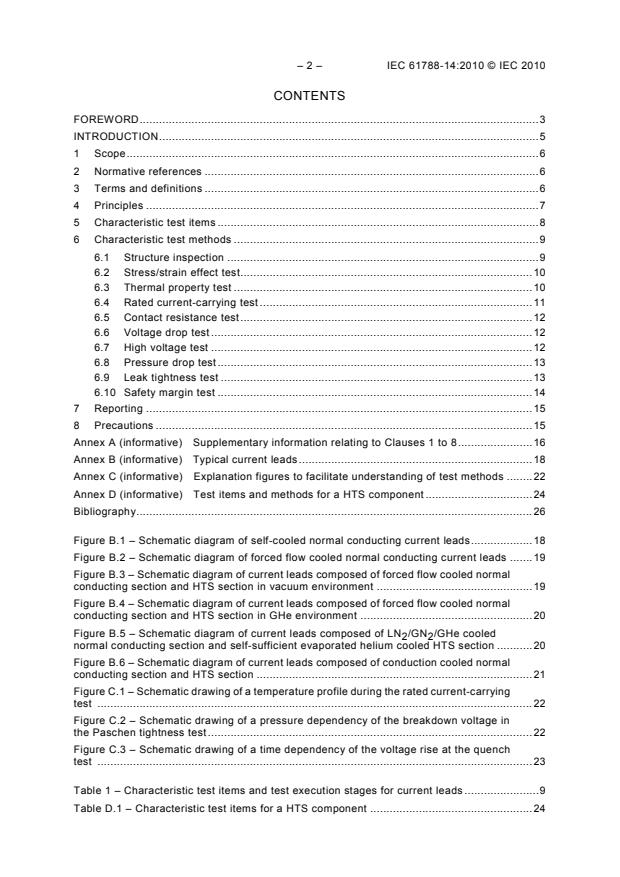
– 2 – 61788-14 © IEC:2010(E)
CONTENTS
FOREWORD.3
INTRODUCTION.5
1 Scope.6
2 Normative references .6
3 Terms and definitions .6
4 Principles .7
5 Characteristic test items .8
6 Characteristic test methods .9
6.1 Structure inspection .9
6.2 Stress/strain effect test.10
6.3 Thermal property test .10
6.4 Rated current-carrying test .11
6.5 Contact resistance test.12
6.6 Voltage drop test .12
6.7 High voltage test .12
6.8 Pressure drop test.13
6.9 Leak tightness test .13
6.10 Safety margin test .14
7 Reporting .15
8 Precautions .15
Annex A (informative) Supplementary information relating to Clauses 1 to 8.16
Annex B (informative) Typical current leads.18
Annex C (informative) Explanation figures to facilitate understanding of test methods .22
Annex D (informative) Test items and methods for a HTS component .24
Bibliography.26
Figure B.1 – Schematic diagram of self-cooled normal conducting current leads.18
Figure B.2 – Schematic diagram of forced flow cooled normal conducting current leads .19
Figure B.3 – Schematic diagram of current leads composed of forced flow cooled normal
conducting section and HTS section in vacuum environment .19
Figure B.4 – Schematic diagram of current leads composed of forced flow cooled normal
conducting section and HTS section in GHe environment .20
Figure B.5 – Schematic diagram of current leads composed of LN /GN /GHe cooled
2 2
normal conducting section and self-sufficient evaporated helium cooled HTS section .20
Figure B.6 – Schematic diagram of current leads composed of conduction cooled normal
conducting section and HTS section .21
Figure C.1 – Schematic drawing of a temperature profile during the rated current-carrying
test .22
Figure C.2 – Schematic drawing of a pressure dependency of the breakdown voltage in
the Paschen tightness test.22
Figure C.3 – Schematic drawing of a time dependency of the voltage rise at the quench
test .23
Table 1 – Characteristic test items and test execution stages for current leads .9
Table D.1 – Characteristic test items for a HTS component .24
61788-14 © IEC:2010(E) – 3 –
INTERNATIONAL ELECTROTECHNICAL COMMISSION
____________
SUPERCONDUCTIVITY –
Part 14: Superconducting power devices –
General requirements for characteristic tests of current
leads designed for powering superconducting devices
FOREWORD
1) The International Electrotechnical Commission (IEC) is a worldwide organization for standardization comprising
all national electrotechnical committees (IEC National Committees). The object of IEC is to promote international
co-operation on all questions concerning standardization in the electrical and electronic fields. To this end and in
addition to other activities, IEC publishes International Standards, Technical Specifications, Technical Reports,
Publicly Available Specifications (PAS) and Guides (hereafter referred to as “IEC Publication(s)”). Their
preparation is entrusted to technical committees; any IEC National Committee interested in the subject dealt with
may participate in this preparatory work. International, governmental and non-governmental organizations liaising
with the IEC also participate in this preparation. IEC collaborates closely with the International Organization for
Standardization (ISO) in accordance with conditions determined by agreement between the two organizations.
2) The formal decisions or agreements of IEC on technical matters express, as nearly as possible, an international
consensus of opinion on the relevant subjects since each technical committee has representation from all
interested IEC National Committees.
3) IEC Publications have the form of recommendations for international use and are accepted by IEC National
Committees in that sense. While all reasonable efforts are made to ensure that the technical content of IEC
Publications is accurate, IEC cannot be held responsible for the way in which they are used or for any
misinterpretation by any end user.
4) In order to promote international uniformity, IEC National Committees undertake to apply IEC Publications
transparently to the maximum extent possible in their national and regional publications. Any divergence between
any IEC Publication and the corresponding national or regional publication shall be clearly indicated in the latter.
5) IEC itself does not provide any attestation of conformity. Independent certification bodies provide conformity
assessment services and, in some areas, access to IEC marks of conformity. IEC is not responsible for any
services carried out by independent certification bodies.
6) All users should ensure that they have the latest edition of this publication.
7) No liability shall attach to IEC or its directors, employees, servants or agents including individual experts and
members of its technical committees and IEC National Committees for any personal injury, property damage or
other damage of any nature whatsoever, whether direct or indirect, or for costs (including legal fees) and expenses
arising out of the publication, use of, or reliance upon, this IEC Publication or any other IEC Publications.
8) Attention is drawn to the Normative references cited in this publication. Use of the referenced publications is
indispensable for the correct application of this publication.
9) Attention is drawn to the possibility that some of the elements of this IEC Publication may be the subject of patent
rights. IEC shall not be held responsible for identifying any or all such patent rights.
International Standard IEC 61788-14 has been prepared by IEC technical committee 90:
Superconductivity.
The text of this standard is based on the following documents:
FDIS Report on voting
90/244/FDIS 90/250/RVD
Full information on the voting for the approval of this standard can be found in the report on
voting indicated in the above table.
This publication has been drafted in accordance with the ISO/IEC Directives, Part 2.
A list of all parts of the IEC 61788 series, published under the general title Superconductivity,
can be found on the IEC website.
– 4 – 61788-14 © IEC:2010(E)
The committee has decided that the contents of this publication will remain unchanged until the
stability date indicated on the IEC web site under "http://webstore.iec.ch" in the data related to
the specific publication. At this date, the publication will be
• reconfirmed,
• withdrawn,
• replaced by a revised edition, or
• amended.
A bilingual version of this standard may be issued at a later date.
61788-14 © IEC:2010(E) – 5 –
INTRODUCTION
Current leads are indispensable components of superconducting devices in practical uses such
as MRI diagnostic equipment, NMR spectrometers, single crystal growth devices, SMES,
particle accelerators such as Tevatron, HERA, RHIC and LHC, experimental test instruments for
nuclear fusion reactors, such as ToreSupra, TRIAM, LHD, EAST, KSTAR, W7-X, JT-60SA and
ITER, etc., and of advanced superconducting devices in the near future in practical uses such as
magnetic levitated trains, superconducting fault current limiters, superconducting transformers,
etc.
The major functions of current leads are to power high currents into superconducting devices
and to minimize the overall heat load, including heat leakage from room temperature to
cryogenic temperature and Joule heating through current leads. For this purpose, current leads
are dramatically effective for lowering the overall heat load to use the high temperature
superconducting component as a part of the current leads.
On the other hand, the current lead technologies applied to superconducting devices depend on
each application, as well as on the manufacturer's experience and accumulated know-how. Due
to their use as component parts, it is difficult to judge the compatibility, flexibility between
devices, convenience, overall economical efficiency, etc of current leads. This may impede
progress in the growth and development of superconducting equipment technology and its
application to commercial activities, which is a cause for concern.
Consequently, it is judged industrially effective to clarify the definition of current leads to be
applied to superconducting devices and to standardize the common characteristic test methods
in a series of general rules.
– 6 – 61788-14 © IEC:2010(E)
SUPERCONDUCTIVITY –
Part 14: Superconducting power devices –
General requirements for characteristic tests of current
leads designed for powering superconducting devices
1 Scope
This part of IEC 61788 provides general requirements for characteristic tests of conventional as
well as superconducting current leads to be used for powering superconducting equipment.
2 Normative references
The following referenced documents are indispensable for the application of this document. For
dated references, only the edition cited applies. For undated references, the latest edition of the
referenced document (including any amendments) applies.
IEC 60050-815:2000, International Electrotechnical Vocabulary (IEV) – Part 815:
Superconductivity
IEC 60071-1, Insulation coordination – Part 1: Definitions, principles and rules
IEC 60137, Insulated bushings for alternating voltages above 1 000 V
3 Terms and definitions
For the purposes of this document, the terms and definitions contained in IEC 60050-815:2000
as well as the following terms and definitions apply:
3.1
current lead
power lead
conductor to introduce electric current into a device with an insulation and a cooling channel
especially when leading from room temperature to cryogenic temperature
[IEV 815-06-47]
3.2
normal conducting current lead
conventional current lead
current lead made only of a normal conducting section
3.3
superconducting current lead
current lead containing a superconducting section
NOTE A superconducting current lead consists of a normal conducting section from room temperature to intermediate
temperature and a superconducting section from intermediate temperature to cryogenic temperature. In this standard,
the superconducting section is mostly made by a high temperature superconductor (HTS).
3.4
non-gas cooled type current lead
current lead cooled by conduction cooling method
61788-14 © IEC:2010(E) – 7 –
3.5
gas-cooled type current lead
current lead cooled by a cooling gas
NOTE In some cases, the gas cooling is made between cooling via gas flow inside the leads and (additional)
convection cooling on the outside surface.
3.6
self-cooled current lead
vapour enthalpy cooled current lead
current lead capably cooled by an evaporated gas generated by heat load from current leads
into cryogen
3.7
heat leakage
non-current heat leakage
heat conducted from higher temperature portion into lower temperature portion of the current
lead at zero current operation without any Joule heating
3.8
heat load
total heat induced into a cryogenic system through the current leads under current-carrying
operation
3.9
rated current heat load
heat load at a rated current operation
4 Principles
The powering of superconducting equipment is made via components that provide the electrical
link between the room temperature environment and the cryogenic temperature of the powered
equipment. These components are called current leads. Since they operate in a gradient of
temperature and they transport current into the cryogenic environment, they are one of the major
sources of a heat leakage into the cryostat.
The current leads can be classified into two types:
– normal conducting current leads, made entirely from normal conducting section. These are
usually joined at their cold end to a superconducting (SC) bus or link leading to the device
being powered;
– high temperature superconducting (HTS) current leads, which incorporate a section of HTS
material. A normal conducting section is necessary to conduct the current from room
temperature to the warm end of the HTS section. The latter must be maintained at a
sufficiently low temperature to ensure that it remains superconducting for the maximum
rated current of the lead. The cold end of the HTS section is usually joined to the device by
a SC bus.
Depending on the cooling method, the leads can be either non-gas-cooled or gas-cooled. Both
types of cooling methods can be used if the lead is subdivided into two, hydraulically separated,
sections. If the device being powered uses low temperature superconducting (LTS) material, the
link to the lead is usually via LTS cables or wires.
Optimized, self-cooled normal conducting current leads conduct into the helium bath 1,1 W/kA
1)
[1] to 1,2 W/kA [2]. This value can be reduced substantially by using HTS material. HTS current
___________
1)
Figures in square brackets refer to the Bibliography.
– 8 – 61788-14 © IEC:2010(E)
leads have been extensively studied, designed and tested, and are already being integrated into
large-scale systems [3] [4].
The design of a current lead is uniquely linked to the system within which it has to operate. The
choice of materials, the cooling method, the geometry, the electrical characteristics and the
admissible cryogenic consumptions are strongly influenced by boundary conditions imposed by
the whole system. System requirements are electrical, cryogenic, and mechanical, and include
the following:
– maximum operating current, operation mode, current ramp rate, insulation voltage, circuit
time constant, ambient magnetic fields;
– cryogen availability, cryogen inlet/outlet temperature and pressure, admissible heat loads,
time duration when the lead shall operate safely in case of failure of cryogen supply;
– the volume available for integration, including mechanical support, vacuum insulation, and
connection to the hydraulic and electrical interfaces.
NOTE 1 The heat leakage for self-cooled current leads should make use of 1,2 W/kA in the case of large current
capacities.
NOTE 2 Typical current leads based on these principles are shown in Annex B.
5 Characteristic test items
The following clauses describe the qualification tests that should be performed on a current lead
at both room and cryogenic temperatures in order to verify its mechanical, electrical and thermal
performance. It is assumed that the design of the current lead has been carried out in
consideration of general versatility. Before application to an actual system, it is also necessary
to do the optimization of the current lead according to the constraints imposed by each system.
The characteristic test items shown in Table 1 should enable the user to verify if the current lead
meets the specified requirements, and to judge if the test items meet the execution stage of the
current lead. It is the responsibility of the user of this standard to select the appropriate tests
according to Table 1 considering the boundary conditions of the current leads.
61788-14 © IEC:2010(E) – 9 –
Table 1 – Characteristic test items and test execution stages for current leads
Characteristic test execution stage
Characteristic test
Test items
category
a b c
R&D Catalogue Receive
Structure inspection Yes Yes
Mechanical
characteristics
Stress/strain effect test Yes
Non-current heat leakage test Yes Yes
Thermal
properties
Rated current heat load test Yes Yes
Rated current-carrying test Yes Yes
Contact resistance test Yes
Electrical
characteristics
High voltage test Yes Yes
Voltage drop test Yes Yes
Pressure drop test with rated gas flow Yes Yes
Hydraulic
characteristics
Leak tightness test Yes
Cryogen failure test Yes Yes
Safety margin
5 Quench test Yes
characteristics
Maximum pressure test Yes Yes
NOTE 4 Characteristic test items and methods for the components of HTS section are shown in Annex D.
a
“R&D” means the test stage for basic research or trial productions of current lead systems.
b
“Catalogue” means the test stage for performed R&D or mass production of the current leads.
c
“Receive” means the test stage after installation of the current lead system in the site.
6 Characteristic test methods
The test methods listed here are recommendations. The user may also select other test methods
if required by specific applications or boundary conditions.
6.1 Structure inspection
6.1.1 Purpose
This test shall inspect dimensions, applicable materials, structure, structural state and so on as
well as the thermal insulation property and leak tightness of the container in the target system.
6.1.2 Methods
The structure inspection test at room temperature shall inspect dimensions, applicable materials,
structure, structural state and so on.
The structure inspection test at low temperature shall inspect visually the state of frost forming
on the surface of a cryostat filled with cryogen or connected to a refrigerator. As for cryostats
with the vacuum thermal insulating layer, it shall be confirmed that there is no malfunction in the
layer such as tears and/or collapsing.
6.1.3 Results
Test results shall be collated with the specifications and fully reported.
– 10 – 61788-14 © IEC:2010(E)
6.2 Stress/strain effect test
6.2.1 Purpose
This test shall confirm the mechanical stress/strain effect on the current leads at room
temperature and low temperatures.
6.2.2 Methods
A mechanical stress/strain level at room temperature and low temperatures in the target system
shall be simulated, and mechanical stress/strain is loaded up to the maximum level below the
elastic limit of the superconductor.
NOTE 1 The maximum load should be defined depending on the safety margin, and is typically 1,1 times the
specification level.
NOTE 2 The test should be done repeatedly a specified number of times by distinguishing the condition between
electromagnetic loading and thermal loading.
NOTE 3 Special notice should be taken of internal stress/strain appearing due to the cooling of the current leads
from room temperature to operating conditions.
6.2.3 Results
Test results shall be collated with the specifications and fully reported.
6.3 Thermal property test
6.3.1 Non-current heat leakage test
6.3.1.1 Purpose
This test shall measure the non-current heat leakage, which is observed at zero current without
any Joule heating, associated with the heat conduction from the room-temperature end to the
intermediate-temperature portion, from the intermediate-temperature portion to the
low-temperature end or from the room-temperature end to the low-temperature end of current
leads.
6.3.1.2 Me
...
IEC 61788-14 ®
Edition 1.0 2010-06
INTERNATIONAL
STANDARD
NORME
INTERNATIONALE
Superconductivity –
Part 14: Superconducting power devices – General requirements for
characteristic tests of current leads designed for powering superconducting
devices
Supraconductivité –
Partie 14 : Dispositifs supraconducteurs de puissance – Exigences générales
pour les essais de caractéristiques d'amenées de courant conçues pour
alimenter des dispositifs supraconducteurs
All rights reserved. Unless otherwise specified, no part of this publication may be reproduced or utilized in any form
or by any means, electronic or mechanical, including photocopying and microfilm, without permission in writing from
either IEC or IEC's member National Committee in the country of the requester. If you have any questions about IEC
copyright or have an enquiry about obtaining additional rights to this publication, please contact the address below or
your local IEC member National Committee for further information.
Droits de reproduction réservés. Sauf indication contraire, aucune partie de cette publication ne peut être reproduite
ni utilisée sous quelque forme que ce soit et par aucun procédé, électronique ou mécanique, y compris la photocopie
et les microfilms, sans l'accord écrit de l'IEC ou du Comité national de l'IEC du pays du demandeur. Si vous avez des
questions sur le copyright de l'IEC ou si vous désirez obtenir des droits supplémentaires sur cette publication, utilisez
les coordonnées ci-après ou contactez le Comité national de l'IEC de votre pays de résidence.
IEC Central Office Tel.: +41 22 919 02 11
3, rue de Varembé Fax: +41 22 919 03 00
CH-1211 Geneva 20 info@iec.ch
Switzerland www.iec.ch
About the IEC
The International Electrotechnical Commission (IEC) is the leading global organization that prepares and publishes
International Standards for all electrical, electronic and related technologies.
About IEC publications
The technical content of IEC publications is kept under constant review by the IEC. Please make sure that you have the
latest edition, a corrigenda or an amendment might have been published.
IEC Catalogue - webstore.iec.ch/catalogue Electropedia - www.electropedia.org
The stand-alone application for consulting the entire The world's leading online dictionary of electronic and
bibliographical information on IEC International Standards, electrical terms containing more than 30 000 terms and
Technical Specifications, Technical Reports and other definitions in English and French, with equivalent terms in 14
documents. Available for PC, Mac OS, Android Tablets and additional languages. Also known as the International
iPad. Electrotechnical Vocabulary (IEV) online.
IEC publications search - www.iec.ch/searchpub IEC Glossary - std.iec.ch/glossary
The advanced search enables to find IEC publications by a More than 55 000 electrotechnical terminology entries in
variety of criteria (reference number, text, technical English and French extracted from the Terms and Definitions
committee,…). It also gives information on projects, replaced clause of IEC publications issued since 2002. Some entries
and withdrawn publications. have been collected from earlier publications of IEC TC 37,
77, 86 and CISPR.
IEC Just Published - webstore.iec.ch/justpublished
Stay up to date on all new IEC publications. Just Published IEC Customer Service Centre - webstore.iec.ch/csc
details all new publications released. Available online and If you wish to give us your feedback on this publication or
also once a month by email. need further assistance, please contact the Customer Service
Centre: csc@iec.ch.
A propos de l'IEC
La Commission Electrotechnique Internationale (IEC) est la première organisation mondiale qui élabore et publie des
Normes internationales pour tout ce qui a trait à l'électricité, à l'électronique et aux technologies apparentées.
A propos des publications IEC
Le contenu technique des publications IEC est constamment revu. Veuillez vous assurer que vous possédez l’édition la
plus récente, un corrigendum ou amendement peut avoir été publié.
Catalogue IEC - webstore.iec.ch/catalogue Electropedia - www.electropedia.org
Application autonome pour consulter tous les renseignements
Le premier dictionnaire en ligne de termes électroniques et
bibliographiques sur les Normes internationales,
électriques. Il contient plus de 30 000 termes et définitions en
Spécifications techniques, Rapports techniques et autres
anglais et en français, ainsi que les termes équivalents dans
documents de l'IEC. Disponible pour PC, Mac OS, tablettes
14 langues additionnelles. Egalement appelé Vocabulaire
Android et iPad.
Electrotechnique International (IEV) en ligne.
Recherche de publications IEC - www.iec.ch/searchpub
Glossaire IEC - std.iec.ch/glossary
La recherche avancée permet de trouver des publications IEC Plus de 55 000 entrées terminologiques électrotechniques, en
en utilisant différents critères (numéro de référence, texte, anglais et en français, extraites des articles Termes et
comité d’études,…). Elle donne aussi des informations sur les Définitions des publications IEC parues depuis 2002. Plus
projets et les publications remplacées ou retirées. certaines entrées antérieures extraites des publications des
CE 37, 77, 86 et CISPR de l'IEC.
IEC Just Published - webstore.iec.ch/justpublished
Service Clients - webstore.iec.ch/csc
Restez informé sur les nouvelles publications IEC. Just
Published détaille les nouvelles publications parues. Si vous désirez nous donner des commentaires sur cette
Disponible en ligne et aussi une fois par mois par email. publication ou si vous avez des questions contactez-nous:
csc@iec.ch.
IEC 61788-14 ®
Edition 1.0 2010-06
INTERNATIONAL
STANDARD
NORME
INTERNATIONALE
Superconductivity –
Part 14: Superconducting power devices – General requirements for
characteristic tests of current leads designed for powering superconducting
devices
Supraconductivité –
Partie 14 : Dispositifs supraconducteurs de puissance – Exigences générales
pour les essais de caractéristiques d'amenées de courant conçues pour
alimenter des dispositifs supraconducteurs
INTERNATIONAL
ELECTROTECHNICAL
COMMISSION
COMMISSION
ELECTROTECHNIQUE
PRICE CODE
INTERNATIONALE
CODE PRIX U
ICS 29.050 ISBN 978-2-8322-1468-8
– 2 – IEC 61788-14:2010 © IEC 2010
CONTENTS
FOREWORD . 3
INTRODUCTION . 5
1 Scope . 6
2 Normative references . 6
3 Terms and definitions . 6
4 Principles . 7
5 Characteristic test items . 8
6 Characteristic test methods . 9
6.1 Structure inspection . 9
6.2 Stress/strain effect test. 10
6.3 Thermal property test . 10
6.4 Rated current-carrying test . 11
6.5 Contact resistance test . 12
6.6 Voltage drop test . 12
6.7 High voltage test . 12
6.8 Pressure drop test . 13
6.9 Leak tightness test . 13
6.10 Safety margin test . 14
7 Reporting . 15
8 Precautions . 15
Annex A (informative) Supplementary information relating to Clauses 1 to 8 . 16
Annex B (informative) Typical current leads . 18
Annex C (informative) Explanation figures to facilitate understanding of test methods . 22
Annex D (informative) Test items and methods for a HTS component . 24
Bibliography . 26
Figure B.1 – Schematic diagram of self-cooled normal conducting current leads . 18
Figure B.2 – Schematic diagram of forced flow cooled normal conducting current leads . 19
Figure B.3 – Schematic diagram of current leads composed of forced flow cooled normal
conducting section and HTS section in vacuum environment . 19
Figure B.4 – Schematic diagram of current leads composed of forced flow cooled normal
conducting section and HTS section in GHe environment . 20
Figure B.5 – Schematic diagram of current leads composed of LN /GN /GHe cooled
2 2
normal conducting section and self-sufficient evaporated helium cooled HTS section . 20
Figure B.6 – Schematic diagram of current leads composed of conduction cooled normal
conducting section and HTS section . 21
Figure C.1 – Schematic drawing of a temperature profile during the rated current-carrying
test . 22
Figure C.2 – Schematic drawing of a pressure dependency of the breakdown voltage in
the Paschen tightness test . 22
Figure C.3 – Schematic drawing of a time dependency of the voltage rise at the quench
test . 23
Table 1 – Characteristic test items and test execution stages for current leads . 9
Table D.1 – Characteristic test items for a HTS component . 24
INTERNATIONAL ELECTROTECHNICAL COMMISSION
____________
SUPERCONDUCTIVITY –
Part 14: Superconducting power devices –
General requirements for characteristic tests of current
leads designed for powering superconducting devices
FOREWORD
1) The International Electrotechnical Commission (IEC) is a worldwide organization for standardization comprising
all national electrotechnical committees (IEC National Committees). The object of IEC is to promote international
co-operation on all questions concerning standardization in the electrical and electronic fields. To this end and in
addition to other activities, IEC publishes International Standards, Technical Specifications, Technical Reports,
Publicly Available Specifications (PAS) and Guides (hereafter referred to as “IEC Publication(s)”). Their
preparation is entrusted to technical committees; any IEC National Committee interested in the subject dealt with
may participate in this preparatory work. International, governmental and non-governmental organizations liaising
with the IEC also participate in this preparation. IEC collaborates closely with the International Organization for
Standardization (ISO) in accordance with conditions determined by agreement between the two organizations.
2) The formal decisions or agreements of IEC on technical matters express, as nearly as possible, an international
consensus of opinion on the relevant subjects since each technical committee has representation from all
interested IEC National Committees.
3) IEC Publications have the form of recommendations for international use and are accepted by IEC National
Committees in that sense. While all reasonable efforts are made to ensure that the technical content of IEC
Publications is accurate, IEC cannot be held responsible for the way in which they are used or for any
misinterpretation by any end user.
4) In order to promote international uniformity, IEC National Committees undertake to apply IEC Publications
transparently to the maximum extent possible in their national and regional publications. Any divergence between
any IEC Publication and the corresponding national or regional publication shall be clearly indicated in the latter.
5) IEC itself does not provide any attestation of conformity. Independent certification bodies provide conformity
assessment services and, in some areas, access to IEC marks of conformity. IEC is not responsible for any
services carried out by independent certification bodies.
6) All users should ensure that they have the latest edition of this publication.
7) No liability shall attach to IEC or its directors, employees, servants or agents including individual experts and
members of its technical committees and IEC National Committees for any personal injury, property damage or
other damage of any nature whatsoever, whether direct or indirect, or for costs (including legal fees) and expenses
arising out of the publication, use of, or reliance upon, this IEC Publication or any other IEC Publications.
8) Attention is drawn to the Normative references cited in this publication. Use of the referenced publications is
indispensable for the correct application of this publication.
9) Attention is drawn to the possibility that some of the elements of this IEC Publication may be the subject of patent
rights. IEC shall not be held responsible for identifying any or all such patent rights.
International Standard IEC 61788-14 has been prepared by IEC technical committee 90:
Superconductivity.
This bilingual version (2014-03) corresponds to the monolingual English version, published in
2010-06.
The text of this standard is based on the following documents:
FDIS Report on voting
90/244/FDIS 90/250/RVD
Full information on the voting for the approval of this standard can be found in the report on
voting indicated in the above table.
The French version of this standard has not been voted upon.
– 4 – IEC 61788-14:2010 © IEC 2010
This publication has been drafted in accordance with the ISO/IEC Directives, Part 2.
A list of all parts of the IEC 61788 series, published under the general title Superconductivity,
can be found on the IEC website.
The committee has decided that the contents of this publication will remain unchanged until the
stability date indicated on the IEC web site under "http://webstore.iec.ch" in the data related to
the specific publication. At this date, the publication will be
• reconfirmed,
• withdrawn,
• replaced by a revised edition, or
• amended.
INTRODUCTION
Current leads are indispensable components of superconducting devices in practical uses such
as MRI diagnostic equipment, NMR spectrometers, single crystal growth devices, SMES,
particle accelerators such as Tevatron, HERA, RHIC and LHC, experimental test instruments for
nuclear fusion reactors, such as ToreSupra, TRIAM, LHD, EAST, KSTAR, W7-X, JT-60SA and
ITER, etc., and of advanced superconducting devices in the near future in practical uses such as
magnetic levitated trains, superconducting fault current limiters, superconducting transformers,
etc.
The major functions of current leads are to power high currents into superconducting devices
and to minimize the overall heat load, including heat leakage from room temperature to
cryogenic temperature and Joule heating through current leads. For this purpose, current leads
are dramatically effective for lowering the overall heat load to use the high temperature
superconducting component as a part of the current leads.
On the other hand, the current lead technologies applied to superconducting devices depend on
each application, as well as on the manufacturer's experience and accumulated know-how. Due
to their use as component parts, it is difficult to judge the compatibility, flexibility between
devices, convenience, overall economical efficiency, etc of current leads. This may impede
progress in the growth and development of superconducting equipment technology and its
application to commercial activities, which is a cause for concern.
Consequently, it is judged industrially effective to clarify the definition of current leads to be
applied to superconducting devices and to standardize the common characteristic test methods
in a series of general rules.
– 6 – IEC 61788-14:2010 © IEC 2010
SUPERCONDUCTIVITY –
Part 14: Superconducting power devices –
General requirements for characteristic tests of current
leads designed for powering superconducting devices
1 Scope
This part of IEC 61788 provides general requirements for characteristic tests of conventional as
well as superconducting current leads to be used for powering superconducting equipment.
2 Normative references
The following referenced documents are indispensable for the application of this document. For
dated references, only the edition cited applies. For undated references, the latest edition of the
referenced document (including any amendments) applies.
IEC 60050-815:2000, International Electrotechnical Vocabulary (IEV) – Part 815:
Superconductivity
IEC 60071-1, Insulation coordination – Part 1: Definitions, principles and rules
IEC 60137, Insulated bushings for alternating voltages above 1 000 V
3 Terms and definitions
For the purposes of this document, the terms and definitions contained in IEC 60050-815:2000
as well as the following terms and definitions apply:
3.1
current lead
power lead
conductor to introduce electric current into a device with an insulation and a cooling channel
especially when leading from room temperature to cryogenic temperature
[IEV 815-06-47]
3.2
normal conducting current lead
conventional current lead
current lead made only of a normal conducting section
3.3
superconducting current lead
current lead containing a superconducting section
NOTE A superconducting current lead consists of a normal conducting section from room temperature to intermediate
temperature and a superconducting section from intermediate temperature to cryogenic temperature. In this standard,
the superconducting section is mostly made by a high temperature superconductor (HTS).
3.4
non-gas cooled type current lead
current lead cooled by conduction cooling method
3.5
gas-cooled type current lead
current lead cooled by a cooling gas
NOTE In some cases, the gas cooling is made between cooling via gas flow inside the leads and (additional)
convection cooling on the outside surface.
3.6
self-cooled current lead
vapour enthalpy cooled current lead
current lead capably cooled by an evaporated gas generated by heat load from current leads
into cryogen
3.7
heat leakage
non-current heat leakage
heat conducted from higher temperature portion into lower temperature portion of the current
lead at zero current operation without any Joule heating
3.8
heat load
total heat induced into a cryogenic system through the current leads under current-carrying
operation
3.9
rated current heat load
heat load at a rated current operation
4 Principles
The powering of superconducting equipment is made via components that provide the electrical
link between the room temperature environment and the cryogenic temperature of the powered
equipment. These components are called current leads. Since they operate in a gradient of
temperature and they transport current into the cryogenic environment, they are one of the major
sources of a heat leakage into the cryostat.
The current leads can be classified into two types:
– normal conducting current leads, made entirely from normal conducting section. These are
usually joined at their cold end to a superconducting (SC) bus or link leading to the device
being powered;
– high temperature superconducting (HTS) current leads, which incorporate a section of HTS
material. A normal conducting section is necessary to conduct the current from room
temperature to the warm end of the HTS section. The latter must be maintained at a
sufficiently low temperature to ensure that it remains superconducting for the maximum
rated current of the lead. The cold end of the HTS section is usually joined to the device by
a SC bus.
Depending on the cooling method, the leads can be either non-gas-cooled or gas-cooled. Both
types of cooling methods can be used if the lead is subdivided into two, hydraulically separated,
sections. If the device being powered uses low temperature superconducting (LTS) material, the
link to the lead is usually via LTS cables or wires.
Optimized, self-cooled normal conducting current leads conduct into the helium bath 1,1 W/kA
1)
[1] to 1,2 W/kA [2]. This value can be reduced substantially by using HTS material. HTS current
___________
1)
Figures in square brackets refer to the Bibliography.
– 8 – IEC 61788-14:2010 © IEC 2010
leads have been extensively studied, designed and tested, and are already being integrated into
large-scale systems [3] [4].
The design of a current lead is uniquely linked to the system within which it has to operate. The
choice of materials, the cooling method, the geometry, the electrical characteristics and the
admissible cryogenic consumptions are strongly influenced by boundary conditions imposed by
the whole system. System requirements are electrical, cryogenic, and mechanical, and include
the following:
– maximum operating current, operation mode, current ramp rate, insulation voltage, circuit
time constant, ambient magnetic fields;
– cryogen availability, cryogen inlet/outlet temperature and pressure, admissible heat loads,
time duration when the lead shall operate safely in case of failure of cryogen supply;
– the volume available for integration, including mechanical support, vacuum insulation, and
connection to the hydraulic and electrical interfaces.
NOTE 1 The heat leakage for self-cooled current leads should make use of 1,2 W/kA in the case of large current
capacities.
NOTE 2 Typical current leads based on these principles are shown in Annex B.
5 Characteristic test items
The following clauses describe the qualification tests that should be performed on a current lead
at both room and cryogenic temperatures in order to verify its mechanical, electrical and thermal
performance. It is assumed that the design of the current lead has been carried out in
consideration of general versatility. Before application to an actual system, it is also necessary
to do the optimization of the current lead according to the constraints imposed by each system.
The characteristic test items shown in Table 1 should enable the user to verify if the current lead
meets the specified requirements, and to judge if the test items meet the execution stage of the
current lead. It is the responsibility of the user of this standard to select the appropriate tests
according to Table 1 considering the boundary conditions of the current leads.
Table 1 – Characteristic test items and test execution stages for current leads
Characteristic test execution stage
Characteristic test
Test items
category
a b c
R&D Catalogue Receive
Structure inspection Yes Yes
Mechanical
characteristics
Stress/strain effect test Yes
Non-current heat leakage test Yes Yes
Thermal
properties
Rated current heat load test Yes Yes
Rated current-carrying test Yes Yes
Contact resistance test Yes
Electrical
characteristics
High voltage test Yes Yes
Voltage drop test Yes Yes
Pressure drop test with rated gas flow Yes Yes
Hydraulic
characteristics
Leak tightness test Yes
Cryogen failure test Yes Yes
Safety margin
5 Quench test Yes
characteristics
Maximum pressure test Yes Yes
NOTE 4 Characteristic test items and methods for the components of HTS section are shown in Annex D.
a
“R&D” means the test stage for basic research or trial productions of current lead systems.
b
“Catalogue” means the test stage for performed R&D or mass production of the current leads.
c
“Receive” means the test stage after installation of the current lead system in the site.
6 Characteristic test methods
The test methods listed here are recommendations. The user may also select other test methods
if required by specific applications or boundary conditions.
6.1 Structure inspection
6.1.1 Purpose
This test shall inspect dimensions, applicable materials, structure, structural state and so on as
well as the thermal insulation property and leak tightness of the container in the target system.
6.1.2 Methods
The structure inspection test at room temperature shall inspect dimensions, applicable materials,
structure, structural state and so on.
The structure inspection test at low temperature shall inspect visually the state of frost forming
on the surface of a cryostat filled with cryogen or connected to a refrigerator. As for cryostats
with the vacuum thermal insulating layer, it shall be confirmed that there is no malfunction in the
layer such as tears and/or collapsing.
6.1.3 Results
Test results shall be collated with the specifications and fully reported.
– 10 – IEC 61788-14:2010 © IEC 2010
6.2 Stress/strain effect test
6.2.1 Purpose
This test shall confirm the mechanical stress/strain effect on the current leads at room
temperature and low temperatures.
6.2.2 Methods
A mechanical stress/strain level at room temperature and low temperatures in the target system
shall be simulated, and mechanical stress/strain is loaded up to the maximum level below the
elastic limit of the superconductor.
NOTE 1 The maximum load should be defined depending on the safety margin, and is typically 1,1 times the
specification level.
NOTE 2 The test should be done repeatedly a specified number of times by distinguishing the condition between
electromagnetic loading and thermal loading.
NOTE 3 Special notice should be taken of internal stress/strain appearing due to the cooling of the current leads
from room temperature to operating conditions.
6.2.3 Results
Test results shall be collated with the specifications and fully reported.
6.3 Thermal property test
6.3.1 Non-current heat leakage test
6.3.1.1 Purpose
This test shall measure the non-current heat leakage, which is observed at zero current without
any Joule heating, associated with the heat conduction from the room-temperature end to the
intermediate-temperature portion, from the intermediate-temperature portion to the
low-temperature end or from the room-temperature end to the low-temperature end of current
leads.
6.3.1.2 Methods
The heat leakage shall be measured by the evaporation method of liquid cryogen, the enthalpy
change method of forced flow cryogenic gas or the thermal conduction method using a
cryocooler, depending on the cooling condition of the testing current leads.
a) Evaporation method
The current leads are installed in a special cryostat for the heat leakage test with known
values of background heat leakage into the measurement region. In the cryostat the cold
ends of the current leads are cooled with an appropriate coolant such as liquid helium and/or
liquid nitrogen. The mass flow rate of evaporated coolant is measured at the outlet of the
cryostat. The heat leakage through the current leads is evaluated by analyzing an increment
in the mass flow rate of evaporated coolant by installing the current leads. Corresponding
measurements should be carried out in the case of the intermediate-temperature portion.
b) Enthalpy change method
The current leads are installed in a cryostat with known values of background heat leakage
into the measurement region. The temperature and mass flow controlled forced flow
cryogenic gases such as supercritical helium are supplied to the cooling portions of the
current leads. The heat leakage through the current leads is evaluated by the enthalpy
changes of cryogenic gases between inlet and outlet of the current leads.
c) Thermal conduction method
The current leads are installed in a cryostat with known values of background heat leakage
into the measurement region. The cooling portions of the current leads are thermally
connected to the cold heads of the cryocooler. The heat leakage through the current leads is
evaluated by the increment of heat loads to the cold heads of the cryocooler.
NOTE 1 In the evaporation method, a part of evaporated coolant remains in the cryostat as a low-temperature gas.
Because the density of a low-temperature gas is large, it is necessary to correct the amount of the evaporated coolant
when the mass flow rate is measured at the outlet of the cryostat.
NOTE 2 In R&D, the value of the heat leakage through the current lead is estimated from the numerical solution of
the energy balance equation along the conductor of the current lead. Temperatures of cold and warm ends are taken
to be boundary values of the energy balance equation. The form of the energy balance equation depends on the
structure of the current leads. In the case of the gas-cooled normal conducting current leads, the energy balance
equation may consist of such terms as heat conduction, ohmic heat generation and heat exchange with cooling gas.
6.3.1.3 Results
Test results shall be collated with the specifications and fully reported.
6.3.2 Rated current heat load test
6.3.2.1 Purpose
This test shall measure the amount of heat load at the rated current.
6.3.2.2 Methods
The methods shall be pursuant to those of the non-current heat leakage test without current
(6.3.1.2).
6.3.2.3 Results
Test results shall be collated with the specifications and fully reported.
6.4 Rated current-carrying test
6.4.1 Purpose
This test shall confirm performances of the current leads at the rated current under the normal
operation conditions.
6.4.2 Methods
To compare the performances of the current leads to the design values, the temperature profile
shall be measured. The measuring points of temperature shall be at least the three positions of
the room-temperature end, the intermediate-temperature portion and the low-temperature end.
It shall be noticed that the temperature of the room-temperature end is affected by boundary
conditions such as size, cooling condition of the bus bar, and so on.
The temperature rise shall be measured usually by the thermometer method or the resistance
method.
Prior to the test, all cooling conditions of the refrigerator, the cryogen level or others shall be
confirmed.
The current of the leads shall be maintained at the rated value until the cooling condition settles
down in the steady state.
A typical example of temperature profile during the rated current-carrying test is shown in
Clause C.1 of Annex C.
– 12 – IEC 61788-14:2010 © IEC 2010
6.4.3 Results
Test results shall be collated with the specifications and fully reported.
6.5 Contact resistance test
6.5.1 Purpose
This test shall measure the contact resistance between HTS parts and normal conducting parts
at intermediate-temperature portions. The contact resistance between HTS parts and LTS parts
at low-temperature ends shall be measured, if it is required for the current leads.
6.5.2 Methods
The measurement of the total contact resistance, including the target contact section, shall be
performed by the four-terminal method. The test results shall be corrected for the additional
resistances due to other sections, except for that of the target contact.
NOTE For a current lead of small capacity less than a few kA, the influence of the two-dimensional current
distribution on the contact resistance can be disregarded. However, the measurement and the correction by analysis
or simulation considering the current distribution at the target joint shall be necessary for the current lead of the large
capacity. Therefore, it is very difficult to get accurate value of the contact resistance. Even in this case, it is necessary
to confirm the contact resistance is at least below the tolerance value by correcting the measurement with analysis or
simulation considering the two-dimensional current distribution at the target joint.
6.5.3 Results
Test results shall be collated with the specifications and fully reported.
6.6 Voltage drop test
6.6.1 Purpose
This test shall confirm that the voltage drop of the current leads under the rated current is as
expected from design calculations.
6.6.2 Methods
The cooling conditions shall conform to those of the rated current-carrying test.
The voltage drop shall be measured by the voltage taps between the room-temperature end and
the low-temperature end.
6.6.3 Results
Test results shall be collated with the specifications and fully reported.
6.7 High voltage test
6.7.1 Purpose
This test shall confirm that there is no abnormality in the voltage drop property having an
influence on the insulation performance of current leads.
6.7.2 Methods
Prior to the test, make sure that there is no problem associated with the insulation performance
of the current leads, by using an insulation-resistance tester. Apply a given test voltage to
current leads for more than one consecutive minute. The test voltage applied has to be in
accordance with the requirements of the system in which the current lead shall be used.
For current leads for alternating-current equipment, the test shall be pursuant to the withstand
voltage specification of the target equipment. For this, IEC 60071-1 and IEC 60137 shall be
applied.
NOTE The Paschen tightness may be required by the system that demands high reliability. The Paschen tightness
means that in case of a vacuum leak of the cryostat, the system must withstand the applied voltage even at the so
called Paschen minimum that occurs at the pressure range of 0,1 kPa to 1 kPa. (A typical dependence of the
breakdown voltage on pressure is shown in Clause C.2). To carry out this test, the current lead has to be installed in
a vacuum vessel which is evacuated. After applying a required test voltage, the pressure in the vessel is slowly
increased until normal pressure. During the whole process, the leak current between the current lead and ground
potential is continuously monitored.
6.7.3 Results
Test results shall be collated with the specifications and fully reported.
6.8 Pressure drop test
6.8.1 Purpose
This test shall measure the pressure drop in the current lead at the rated pressure and the rated
mass flow of cryogenic gas.
6.8.2 Methods
Pressure differences of the cryogenic gas between inlet and outlet of the current lead shall
measure by a pressure gauge. The absolute pressure of inlet and/or outlet of the current lead
should be specified.
6.8.3 Results
Test results shall be collated with the specifications and fully reported.
6.9 Leak tightness test
6.9.1 Purpose
This test shall confirm the adaptability on leak tightness between current leads and
superconducting equipment.
6.9.2 Methods
For the gas-cooled type current leads, install them in a cryostat with the air-side open end
sealed and confirm the leak tightness by a leak detector.
For the non-gas-cooled type current leads, this test shall be carried out under installation of the
current leads into the cryostat, if requested.
6.9.3 Results
Test results shall be collated with each specification based on the type of the current leads and
fully reported.
NOTE Test results shall be collated with each specification of the gas cooled type current leads or the non-gas
cooled type current leads depending on different design conditions of the withstand hydraulic pressure and the
leakage tightness based on the operation condition, the environmental condition etc. of the superconducting devices.
– 14 – IEC 61788-14:2010 © IEC 2010
6.10 Safety margin test
6.10.1 Cryogen failure test
6.10.1.1 Purpose
This test shall perform the withstanding time test on the safety operation in case of failure of
cryogen supply.
NOTE This test is usually performed on the gas-cooled type current leads.
6.10.1.2 Methods
Voltage taps and some thermometers shall be installed on the current lead. Time-based
changes in voltage drop of the current lead and maximum temperature rises at the measuring
points shall be measured. The cryogen shall be failed under the rated current, and then the
voltage changes and maximum temperature rises shall be measured, while it requests that the
maximum temperature rise part in the current lead is estimated by the calculation and/or the
simulation when it is designed, and the thermometer is set up in the part.
6.10.1.3 Results
Test results shall be collated with the specifications and fully reported.
6.10.2 Quench test
6.10.2.1 Purpose
This test shall perform the safety margin test after the initiation of normal zone in the HTS
component of the current lead. For the HTS component, the propagation speed of the normal
zone is very slow, especially in the low voltage region. However the voltage drop of the HTS
component increases rapidly after it reaches some threshold level. At the same time, the
temperature of the HTS component increases rapidly and it causes the thermal runaway of the
HTS component. The current of the current leads has to be decreased quickly after detecting the
quench of the HTS component to prevent the burnout of the current leads. In order to detect the
quench of the HTS component, the detectable voltage level is necessary, which is larger than
the noise level. Therefore it is very important to measure the time between the detection of a
quench and the thermal runaway.
6.10.2.2 Methods
The voltage taps, some thermometers and heaters shall be installed on the current lead as
needed. The rated current is maintained in the current leads. A normal conducting section is
compulsorily induced into the HTS component by a heater and/or by stopping cryogen flow or
cryocooler. The subsequent spreading of the quench is observed. The time between the
detection of the first measurable voltage increase for quench detection and the thermal runaway
is measured. The safety margin of the HTS current lead is evaluated. A schematic time
dependency of the voltage rise at the quench test is shown in Annex C.3.
6.10.2.3 Results
Test results shall be collated with the specifications and fully reported.
6.10.3 Maximum pressure test
6.10.3.1 Purpose
This test shall confirm the integrity of the current lead under the maximum pressure condition.
The heat exchanger of the current lead has to withstand maximum pressure in fault conditions
which is higher than in normal operation.
6.10.3.2 Methods
The current lead is pressurized at room temperature up to the maximum pressure by using the
gas with low dew point. The integrity of the current lead is confirmed by the visual inspection and
the tightness leak test.
NOTE Pressure gauges and some strain gauges are attached on the current lead, if necessary. Danger of
pressurization by gas should be prevented by continuous monitoring of the sensors. The usual pressure proof test is
done by using a liquid such as water for safety reasons. However, it is necessary to perform the maximum pressure
test by using gas, so that the cryogenic equipment as well as the current leads may prevent blockage caused by
retention of moisture.
6.10.3.3 Results
Test results shall be collated with the specifications and fully reported.
7 Reporting
The following data shall be reported:
– the outline of current leads;
– the test conditions;
– characteristic test results collating to the specifications;
– the findings acquired through them.
8 Precautions
Prior to the characteristic tests, make sure that test designers and persons involved are
reminded of the following.
a) Electrical tests
The preventive means and countermeasure for electrical hazards shall be taken with
room-temperature electrical tests and low-temperature electrical tests in mind.
b) Cryogen and generated gas
On low-temperature tests, preventive means and countermeasures for electrical hazards shall
be taken relating to gas replacement, cryogen injection, cryogenic leakage, physical contact
with cryogen, constantly-generated gas and intentionally-generated gas.
The cryogenic tests shall be based on the local legal regional laws.
– 16 – IEC 61788-14:2010 © IEC 2010
Annex A
(informative)
Supplementary information relating to Clauses 1 to 8
A.1 Scope
As applicable materials for superconducting current leads, in addition to the high-temperature
copper oxide superconductors specified in this standard, superconductors such as MgB ,
Nb Sn, Nb-Ti may be applicable, depending on designed temperatures.
A.2 Current lead structure
A.2.1 Normal conducting current lead (conventional current lead)
The conducting parts of this current lead are made of normal conducting material, including
additional connecting terminals or reinforcing material at both ends.
A.2.2 Superconducting current lead
The conducting parts of this current lead are made of normal conducting material in the high
temperature region. The conducting components in the intermediate and low temperature region
are superconducting material, HTS or LTS, as required by the design temperature.
NOTE There may be other definitions of terms of temperature ranges.
A.3 Applicable materials
A.3.1 Normal conducting materials
As normal conducting materials for current leads as specified in this standard, copper, copper
alloys, aluminium, or aluminium alloys are commonly used.
In addition, normal conducting materials that are used in current leads m
...