

IEC 60092-350:2008
(Main)Electrical installations in ships - Part 350: General construction and test methods of power, control and instrumentation cables for shipboard and offshore applications
General Information
- Abstract
This part of IEC 60092 provides the general constructional requirements and test methods for use in the manufacture of electric power, control and instrumentation cables with copper conductors intended for fixed electrical systems at voltages up to and including 18/30(36) kV on board ships and offshore (mobile and fixed) units. This third edition cancels and replaces the second edition published in 2001 and constitutes a technical revision. This edition includes the following significant technical changes with respect to the previous edition:
a) the new insulating compounds contained in IEC 60092-351;
b) the new sheathing compounds contained in IEC 60092-359;
c) the publication of IEC 60092-376;
d) the inclusion of cables up to 30 kV in the revision of IEC 60092-354;
e) for use in a limited number of closely defined applications, the provision to allow the design of a single core cable with a single extrusion covering, having a thickness equal to that of both an insulation and sheath;
f) new tests for the determination of enhanced cold properties, oil resistance, and resistance to drilling fluids.
- Status
- Published
- Publication Date
- 06-Feb-2008
- Technical Committee
- SC 18A - Electric cables for ships and mobile and fixed offshore units
- Drafting Committee
- MT 2 - TC 18/SC 18A/MT 2
- Current Stage
- DELPUB - Deleted Publication
- Start Date
- 12-Aug-2014
- Completion Date
- 28-Aug-2026
Buy Documents
IEC 60092-350:2008 - Electrical installations in ships - Part 350: General construction and test methods of power, control and instrumentation cables for shipboard and offshore applications Released:2/7/2008
Overview
IEC 60092-350:2008 - Electrical installations in ships - Part 350 - specifies general constructional requirements and test methods for electric power, control and instrumentation cables with copper conductors intended for fixed shipboard and offshore electrical systems up to and including 18/30(36) kV. The third edition (2008) is a technical revision that updates insulating and sheathing compounds, adds new test methods (enhanced cold, oil resistance, drilling-fluid resistance), and permits specific single-core single-extrusion designs for narrowly defined applications.
Key Topics
- Scope and exclusions: Applies to fixed systems (including those subject to ship motion or vibration) but excludes optical fibre, sub-sea/umbilical, data/communication and coaxial cables.
- Construction requirements: Requirements for conductors, insulation systems, screens, cabling, inner/outer sheaths, fillers, metal braid armour and marking.
- Test program:
- Routine tests, sample tests and type tests (electrical and non-electrical).
- New test additions in this edition for enhanced cold properties, hot oil immersion / oil resistance, and resistance to drilling fluids.
- Fire-related tests and mechanical property ageing tests are included.
- Dimensional and quality checks: Measurement of conductor sizes, insulation/sheath thickness, hot-set, cold bend and impact tests (annexes provide test procedures and calculation methods).
- Design allowances: Limited acceptance of a single extrusion functioning as both insulation and sheath in specific cases, and inclusion of cables up to 30 kV in related parts.
Applications
IEC 60092-350 is used to ensure safe, reliable marine and offshore cabling for:
- Shipyards and vessel electrical system designers
- Offshore platform and FPSO electrical engineers
- Cable manufacturers producing marine power, control and instrumentation cables
- Classification societies, procurement and quality assurance teams specifying conformity for shipboard installations
- Test laboratories performing routine, sample and type qualification tests for marine cables
Using this standard supports compliance with marine safety, durability in harsh offshore environments (oil, low temperatures, drilling fluids) and compatibility with shipboard electrical systems.
Related Standards
- IEC 60092-351 - Insulating materials for shipboard and offshore cables (referenced for new insulating compounds)
- IEC 60092-359 - Sheathing materials for shipboard power and telecommunication cables (new sheathing compounds)
- IEC 60092-354 / 60092-376 - Related parts of the IEC 60092 series addressing specific cable types and ratings
- IEC 60227 / IEC 60245 - Standards covering frequently-flexed cables (not intended for marine fixed installations)
- IEC 62230 - Referenced for recommended spark-test voltages (see annex B)
Keywords: IEC 60092-350, marine cables, shipboard electrical installations, offshore cable construction, cable test methods, power control instrumentation cables, copper conductors, 18/30(36) kV.
Relations
- Effective Date
- 05-Sep-2023
- Effective Date
- 05-Sep-2023
Buy Documents
IEC 60092-350:2008 - Electrical installations in ships - Part 350: General construction and test methods of power, control and instrumentation cables for shipboard and offshore applications Released:2/7/2008
Get Certified
Connect with accredited certification bodies for this standard

DNV
DNV is an independent assurance and risk management provider.

Lloyd's Register
Lloyd's Register is a global professional services organisation specialising in engineering and technology.

FSC International
Forest Stewardship Council certification.
Sponsored listings
Frequently Asked Questions
IEC 60092-350:2008 is a standard published by the International Electrotechnical Commission (IEC). Its full title is "Electrical installations in ships - Part 350: General construction and test methods of power, control and instrumentation cables for shipboard and offshore applications". This standard covers: This part of IEC 60092 provides the general constructional requirements and test methods for use in the manufacture of electric power, control and instrumentation cables with copper conductors intended for fixed electrical systems at voltages up to and including 18/30(36) kV on board ships and offshore (mobile and fixed) units. This third edition cancels and replaces the second edition published in 2001 and constitutes a technical revision. This edition includes the following significant technical changes with respect to the previous edition: a) the new insulating compounds contained in IEC 60092-351; b) the new sheathing compounds contained in IEC 60092-359; c) the publication of IEC 60092-376; d) the inclusion of cables up to 30 kV in the revision of IEC 60092-354; e) for use in a limited number of closely defined applications, the provision to allow the design of a single core cable with a single extrusion covering, having a thickness equal to that of both an insulation and sheath; f) new tests for the determination of enhanced cold properties, oil resistance, and resistance to drilling fluids.
This part of IEC 60092 provides the general constructional requirements and test methods for use in the manufacture of electric power, control and instrumentation cables with copper conductors intended for fixed electrical systems at voltages up to and including 18/30(36) kV on board ships and offshore (mobile and fixed) units. This third edition cancels and replaces the second edition published in 2001 and constitutes a technical revision. This edition includes the following significant technical changes with respect to the previous edition: a) the new insulating compounds contained in IEC 60092-351; b) the new sheathing compounds contained in IEC 60092-359; c) the publication of IEC 60092-376; d) the inclusion of cables up to 30 kV in the revision of IEC 60092-354; e) for use in a limited number of closely defined applications, the provision to allow the design of a single core cable with a single extrusion covering, having a thickness equal to that of both an insulation and sheath; f) new tests for the determination of enhanced cold properties, oil resistance, and resistance to drilling fluids.
IEC 60092-350:2008 is classified under the following ICS (International Classification for Standards) categories: 29.060.20 - Cables; 47.020.60 - Electrical equipment of ships and of marine structures. The ICS classification helps identify the subject area and facilitates finding related standards.
IEC 60092-350:2008 has the following relationships with other standards: It is inter standard links to IEC 60092-350:2001, IEC 60092-350:2014. Understanding these relationships helps ensure you are using the most current and applicable version of the standard.
IEC 60092-350:2008 is available in PDF format for immediate download after purchase. The document can be added to your cart and obtained through the secure checkout process. Digital delivery ensures instant access to the complete standard document.
Standards Content (Sample)
IEC 60092-350
Edition 3.0 2008-02
INTERNATIONAL
STANDARD
Electrical installations in ships –
Part 350: General construction and test methods of power, control and
instrumentation cables for shipboard and offshore applications
All rights reserved. Unless otherwise specified, no part of this publication may be reproduced or utilized in any form
or by any means, electronic or mechanical, including photocopying and microfilm, without permission in writing from
either IEC or IEC's member National Committee in the country of the requester.
If you have any questions about IEC copyright or have an enquiry about obtaining additional rights to this publication,
please contact the address below or your local IEC member National Committee for further information.
IEC Central Office
3, rue de Varembé
CH-1211 Geneva 20
Switzerland
Email: inmail@iec.ch
Web: www.iec.ch
About the IEC
The International Electrotechnical Commission (IEC) is the leading global organization that prepares and publishes
International Standards for all electrical, electronic and related technologies.
About IEC publications
The technical content of IEC publications is kept under constant review by the IEC. Please make sure that you have the
latest edition, a corrigenda or an amendment might have been published.
ƒ Catalogue of IEC publications: www.iec.ch/searchpub
The IEC on-line Catalogue enables you to search by a variety of criteria (reference number, text, technical committee,…).
It also gives information on projects, withdrawn and replaced publications.
ƒ IEC Just Published: www.iec.ch/online_news/justpub
Stay up to date on all new IEC publications. Just Published details twice a month all new publications released. Available
on-line and also by email.
ƒ Electropedia: www.electropedia.org
The world's leading online dictionary of electronic and electrical terms containing more than 20 000 terms and definitions
in English and French, with equivalent terms in additional languages. Also known as the International Electrotechnical
Vocabulary online.
ƒ Customer Service Centre: www.iec.ch/webstore/custserv
If you wish to give us your feedback on this publication or need further assistance, please visit the Customer Service
Centre FAQ or contact us:
Email: csc@iec.ch
Tel.: +41 22 919 02 11
Fax: +41 22 919 03 00
IEC 60092-350
Edition 3.0 2008-02
INTERNATIONAL
STANDARD
Electrical installations in ships –
Part 350: General construction and test methods of power, control and
instrumentation cables for shipboard and offshore applications
INTERNATIONAL
ELECTROTECHNICAL
COMMISSION
PRICE CODE
XA
ICS 47.020.60; 29.060.20 ISBN 2-8318-9551-0
– 2 – 60092-350 © IEC:2008(E)
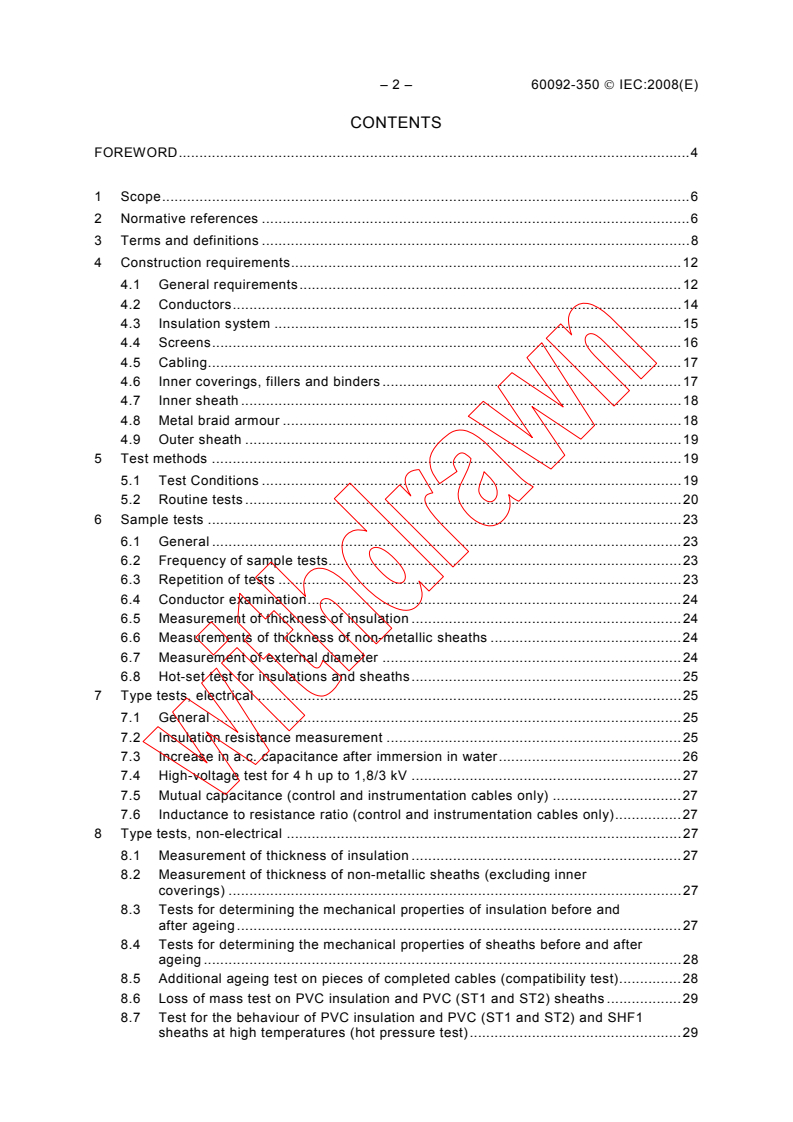
CONTENTS
FOREWORD.4
1 Scope.6
2 Normative references .6
3 Terms and definitions .8
4 Construction requirements.12
4.1 General requirements.12
4.2 Conductors.14
4.3 Insulation system .15
4.4 Screens.16
4.5 Cabling.17
4.6 Inner coverings, fillers and binders .17
4.7 Inner sheath .18
4.8 Metal braid armour .18
4.9 Outer sheath .19
5 Test methods .19
5.1 Test Conditions .19
5.2 Routine tests .20
6 Sample tests .23
6.1 General .23
6.2 Frequency of sample tests.23
6.3 Repetition of tests .23
6.4 Conductor examination.24
6.5 Measurement of thickness of insulation .24
6.6 Measurements of thickness of non-metallic sheaths .24
6.7 Measurement of external diameter .24
6.8 Hot-set test for insulations and sheaths.25
7 Type tests, electrical .25
7.1 General .25
7.2 Insulation resistance measurement .25
7.3 Increase in a.c. capacitance after immersion in water.26
7.4 High-voltage test for 4 h up to 1,8/3 kV .27
7.5 Mutual capacitance (control and instrumentation cables only) .27
7.6 Inductance to resistance ratio (control and instrumentation cables only).27
8 Type tests, non-electrical .27
8.1 Measurement of thickness of insulation .27
8.2 Measurement of thickness of non-metallic sheaths (excluding inner
coverings) .27
8.3 Tests for determining the mechanical properties of insulation before and
after ageing.27
8.4 Tests for determining the mechanical properties of sheaths before and after
ageing .28
8.5 Additional ageing test on pieces of completed cables (compatibility test).28
8.6 Loss of mass test on PVC insulation and PVC (ST1 and ST2) sheaths .29
8.7 Test for the behaviour of PVC insulation and PVC (ST1 and ST2) and SHF1
sheaths at high temperatures (hot pressure test).29
60092-350 © IEC:2008(E) – 3 –
8.8 Test for the behaviour of PVC insulation and PVC sheath (ST1 and ST2) and
SHF1 and SHF2 sheaths at low temperature .29
8.9 Special test for low temperature behaviour (when required) .29
8.10 Test of the metal coating of copper wires .30
8.11 Galvanizing test .30
8.12 Test for resistance of PVC insulation and PVC (ST1 and ST2) and SHF1
sheaths to cracking (heat shock test) .30
8.13 Ozone resistance test for insulation and for sheaths.30
8.14 Hot oil immersion test and enhanced hot oil immersion test for sheaths .30
8.15 Mud drilling fluid test (when required).30
8.16 Fire tests.31
8.17 Determination of hardness for HEPR and HF HEPR .32
8.18 Determination of elastic modulus for HEPR and HF HEPR .32
8.19 Durability of print.32
Annex A (normative) Fictitious calculation method for determination of dimensions of
protective coverings.33
Annex B (informative) Recommended minimum spark test voltage levels (according to
IEC 62230) .39
Annex C (normative) Rounding of numbers.41
Annex D (normative) Calculation of the lower and upper limits for the outer dimensions
of cables with circular copper conductors.43
Annex E (normative) Cold bend test and impact test for low temperature behaviour.46
Annex F (normative) Procedure and requirements for enhanced hot oil immersion test
for sheaths.48
Annex G (normative) Drilling fluid test procedure and requirements .50
Bibliography.52
Table 1 – Minimum size of conductors .14
Table 2 – Routine test voltage .21
Table 3 – Number of samples according to cable length .23
Table 4 – Test methods and requirements for halogen free compounds .32
Table A.1 – Fictitious diameter of conductor .34
Table A.2 – Increase of diameter for concentric conductors and metallic screens .34
Table A.3 – Assembly coefficient k for laid–up .36
Table A.4 –Coefficient c .37
f
Table B.1 – Recommended minimum spark-test voltages for cables having rated
voltage (U ) between 300 V and 3 000 V.39
Table D.1 – Lower and upper limits of circular copper conductors for cables for fixed
installations .45
– 4 – 60092-350 © IEC:2008(E)
INTERNATIONAL ELECTROTECHNICAL COMMISSION
____________
ELECTRICAL INSTALLATIONS IN SHIPS –
Part 350: General construction and test methods of power,
control and instrumentation cables for shipboard
and offshore applications
FOREWORD
1) The International Electro-technical Commission (IEC) is a worldwide organization for standardization
comprising all national electro-technical committees (IEC National Committees). The object of IEC is to promote
international co-operation on all questions concerning standardization in the electrical and electronic fields. To
this end and in addition to other activities, IEC publishes International Standards, Technical Specifications,
Technical Reports, Publicly Available Specifications (PAS) and Guides (hereafter referred to as “IEC
Publication(s)”). Their preparation is entrusted to technical committees; any IEC National Committee interested
in the subject dealt with may participate in this preparatory work. International, governmental and non-
governmental organizations liaising with the IEC also participate in this preparation. IEC collaborates closely
with the International Organization for Standardization (ISO) in accordance with conditions determined by
agreement between the two organizations.
2) The formal decisions or agreements of IEC on technical matters express, as nearly as possible, an international
consensus of opinion on the relevant subjects since each technical committee has representation from all
interested IEC National Committees.
3) IEC Publications have the form of recommendations for international use and are accepted by IEC National
Committees in that sense. While all reasonable efforts are made to ensure that the technical content of IEC
Publications is accurate, IEC cannot be held responsible for the way in which they are used or for any
misinterpretation by any end user.
4) In order to promote international uniformity, IEC National Committees undertake to apply IEC Publications
transparently to the maximum extent possible in their national and regional publications. Any divergence
between any IEC Publication and the corresponding national or regional publication shall be clearly indicated in
the latter.
5) IEC provides no marking procedure to indicate its approval and cannot be rendered responsible for any
equipment declared to be in conformity with an IEC Publication.
6) All users should ensure that they have the latest edition of this publication.
7) No liability shall attach to IEC or its directors, employees, servants or agents including individual experts and
members of its technical committees and IEC National Committees for any personal injury, property damage or
other damage of any nature whatsoever, whether direct or indirect, or for costs (including legal fees) and
expenses arising out of the publication, use of, or reliance upon, this IEC Publication or any other IEC
Publications.
8) Attention is drawn to the Normative references cited in this publication. Use of the referenced publications is
indispensable for the correct application of this publication.
9) Attention is drawn to the possibility that some of the elements of this IEC Publication may be the subject of
patent rights. IEC shall not be held responsible for identifying any or all such patent rights.
International Standard IEC 60092-350 has been prepared by subcommittee 18A: Cables and
cable installations, of IEC technical committee 18: Electrical installations of ships and of
mobile and fixed offshore units.
This third edition cancels and replaces the second edition published in 2001 and constitutes a
technical revision.
This edition includes the following significant technical changes with respect to the previous
edition:
a) the new insulating compounds contained in IEC 60092-351;
b) the new sheathing compounds contained in IEC 60092-359;
c) the publication of IEC 60092-376;
d) the inclusion of cables up to 30 kV in the revision of IEC 60092-354;
60092-350 © IEC:2008(E) – 5 –
e) for use in a limited number of closely defined applications, the provision to allow the
design of a single core cable with a single extrusion covering, having a thickness equal to
that of both an insulation and sheath;
f) new tests for the determination of enhanced cold properties, oil resistance, and resistance
to drilling fluids.
The text of this standard is based on the following documents:
FDIS Report on voting
18A/285/FDIS 18A/286/RVD
Full information on the voting for the approval of this standard can be found in the report on
voting indicated in the above table.
This publication has been drafted in accordance with the ISO/IEC Directives, Part 2.
The list of all the parts of the IEC 60092 series, under the general title Electrical installations
in ships, can be found on the IEC website.
The committee has decided that the contents of this publication will remain unchanged until
the maintenance result date indicated on the IEC web site under "http://webstore.iec.ch" in
the data related to the specific publication. At this date, the publication will be
• reconfirmed,
• withdrawn,
• replaced by a revised edition, or
• amended.
A bilingual version of this publication may be issued at a later date.
– 6 – 60092-350 © IEC:2008(E)
ELECTRICAL INSTALLATIONS IN SHIPS –
Part 350: General construction and test methods of power,
control and instrumentation cables for shipboard
and offshore applications
1 Scope
This part of IEC 60092 provides the general constructional requirements and test methods for
use in the manufacture of electric power, control and instrumentation cables with copper
conductors intended for fixed electrical systems at voltages up to and including 18/30(36) kV
on board ships and offshore (mobile and fixed) units.
The reference to fixed systems includes those that are subjected to vibration (due to the
movement of the ship or installation) or movement (due to motion of the ship or installation)
and not to those that are intended for frequent flexing. Cables suitable for frequent or
continual flexing use are detailed in other IEC specifications, for example IEC 60227 and
IEC 60245, and their uses are restricted to those situations which do not directly involve
exposure to a marine environment, for example, portable tools and domestic appliances.
The following types of cables are not included:
– optical fibre;
– sub-sea and umbilical cables;
– data and communication cables;
– coaxial cables.
2 Normative references
The following referenced documents are indispensable for the application of this document.
For dated references, only the edition cited applies. For undated references, the latest edition
of the referenced document (including any amendments) applies.
IEC 60050-461, International Electro-technical Vocabulary (IEV) – Chapter 461: Electric
cables
IEC 60092-351:2004, Electrical installations in ships – Part 351: Insulating materials for
shipboard and offshore units, power, control, instrumentation, telecommunication and data
cables
IEC 60092-359, Electrical installations in ships – Part 359: Sheathing materials for shipboard
power and telecommunication cables
IEC 60228, Conductors of insulated cables
IEC 60331-11:1999, Tests for electric cables under fire conditions – Circuit integrity – Part 11:
Apparatus – Fire alone at a flame temperature of at least 750 °C
IEC 60331-12:2002, Tests for electric cables under fire conditions – Circuit integrity – Part 12:
Apparatus – Fire with shock at a temperature of at least 830° C
IEC 60331-21:1999, Tests for electric cables under fire conditions – Circuit integrity – Part 21:
Procedures and requirements – Cables of rated voltage up to and including 0,6/1,0 kV
60092-350 © IEC:2008(E) – 7 –
IEC 60331-31:2002, Tests for electric cables under fire conditions – Circuit integrity – Part 31:
Procedures and requirements for fire with shock – Cables of rated voltage up to and including
0,6/1 kV
IEC 60332-1-2:2004, Tests on electric and optical fibre cables under fire conditions – Part 1-
2: Test for vertical flame propagation for a single insulated wire or cable – Procedure for
1 kW pre-mixed flame
IEC 60332-3-22:2000, Tests on electric cables under fire conditions – Part 3-22: Test for
vertical flame spread of vertically-mounted bunched wires or cables – Category A
IEC 60684-2:1997, Flexible insulating sleeving – Part 2: Methods of test
1)
Amendment 1 (2003)
IEC 60754-1:1994, Test on gases evolved during combustion of materials from cables –
Part 1: Determination of the amount of halogen acid gas
IEC 60754-2:1991, Test on gases evolved during combustion of materials from cables –
Part 2: Determination of degree of acidity of gases by measuring pH and conductivity
IEC 60811-1-1:1993, Common test methods for insulating and sheathing materials of electric
cables and optical cables – Part 1-1: Methods for general application – Measurement of
thickness and overall dimensions – Tests for determining the mechanical properties
2)
Amendment 1 (2001)
IEC 60811-1-2:1985, Common test methods for insulating and sheathing materials of electric
cables – Part 1: Methods for general application – Section Two: Thermal ageing
methods
IEC 60811-1-4:1985, Common test methods for insulating and sheathing materials of electric
cables – Part 1: Methods for general application – Section Four: Test at low temperature
IEC 60811-2-1:1998, Common test methods for insulating and sheathing materials of electric
and optical cables – Part 2-1: Methods specific to elastomeric compounds – Ozone
resistance, hot set and mineral oil immersion tests
3)
Amendment 1 (2001)
IEC 60811-3-1:1985, Common test methods for insulating and sheathing materials of electric
cables – Part 3: Methods specific to PVC compounds – Section One: Pressure test at high
temperature – Tests for resistance to cracking
IEC 60811-3-2:1985, Common test methods of insulating and sheathing materials of electric
and optical cables – Part 3: Methods specific to PVC compounds – Section Two: Loss of mass
test – Thermal stability test
IEC 61034-1:2005, Measurement of smoke density of cables burning under defined conditions
– Part 1: Test apparatus
IEC 61034-2:2005, Measurement of smoke density of cables burning under defined conditions
– Part 2: Test procedure and requirements
———————
1)
There exists a consolidated edition 2.1 (2003), including IEC 60684-2:1997 and its Amendment 1.
2)
There exists a consolidated edition 2.1 (2001), including IEC 60811-1-1:1993 and its Amendment 1.
3)
There exists a consolidated edition 2.1 (2001), including IEC 60811-2-1:1998 and its Amendment 1.
– 8 – 60092-350 © IEC:2008(E)
ISO 1817:2005, Rubber vulcanized – Determination of the effect of liquids
ISO 7989-2:2007, Steel wire and wire products – Non-ferrous metalic coatings on steel wire –
Part 2: Zinc or zinc-alloy coating
3 Terms and definitions
For the purposes of this document, the terms and definitions given in IEC 60050-461 as well
as the following terms and definitions apply.
3.1
approximate value
value which is neither guaranteed nor checked
NOTE It is used, for example, for the calculation of other dimensional values.
3.2
braid
covering formed from plaited metallic or non-metallic material
[IEV 461-05-10]
3.3
braid armour
covering formed from braided metal wires used to protect a cable from external mechanical
effects
NOTE 1 Where the rules of the applicable national, regulatory or approval body permit the practice, it is also
possible to use the braid armour as an earth conductor.
NOTE 2 Copper-wire braid armour may also provide a limited function of an electrostatic collective screen,
provided it is effectively earthed.
3.4
compatibility test
test intended to check that the insulation and sheath are not liable to deteriorate in operation
due to contact either with each other or with other components in the cable
3.5
conductor (of a cable)
part of a cable which has the specific function of carrying current
[IEV 461-01-01]
3.6
conductor screen
non-metallic conducting layer applied between the conductor and insulation to equalise the
electrical stress between these components
NOTE It may also provide smooth surfaces at the boundaries of the insulation and assist in the elimination of
spaces at these boundaries
3.7
core-insulated conductor (North America)
assembly comprising a conductor and its own insulation (and screens, if any)
NOTE In North American usage, the core of a cable has been defined as the assembly of components of a cable
lying under a common covering such as the sheath (jacket).
60092-350 © IEC:2008(E) – 9 –
3.8
drain wire
un-insulated wire laid in contact with a screen or a shield which has the specific function of
earthing an electrostatic screen by ensuring a low resistive path throughout the length of the
cable
[IEV 461-03-07, modified]
3.9
electrostatic screen
electrostatic shield (North America)
earthed metallic layer surrounding a cable which confines the electric field generated by the
cable within the cable cores, pair(s), triples(s) or quad(s), and/or protects the core(s), pair(s),
triple(s) or quad(s) from external influence
NOTE Metallic sheaths, foils, braids, armours and earthed concentric conductors may also serve as an
electrostatic screen, provided they are effectively grounded or earthed.
3.10
fictitious value
value calculated according to the "fictitious method" described in Annex A
[IEC 60502-2, definition 3.1.4]
3.11
filler
material used to fill the interstices between the cores of a multi-conductor cable
[IEV 461-04-05]
3.12
fire resistance (circuit integrity)
ability to continue to operate in the designated manner whilst subject to a specified flame
source for a specified period of time
[IEC 60331-11, definition 3.1, modified]
3.13
flexible cable
cable which is required to be capable of being flexed while in service and of which the
structure and materials are such as to fulfil this requirement
[IEV 461-06-14]
3.14
individually screened cable
radial field cable
cable in which each core is covered with an individual screen
[IEV 461-06-12]
3.15
inner covering
non-metallic covering which surrounds the assembly of the cores (and fillers, if any) of a
multi-conductor cable and over which further layers are applied
NOTE 1 The inner covering can be either extruded or taped, and in either case forms a continuous layer, which
has only an approximate value of thickness and no defined mechanical requirements.
NOTE 2 Taped inner coverings are also sometimes called lapped beddings.
[IEV 461-05-02, modified]
– 10 – 60092-350 © IEC:2008(E)
3.16
inner sheath
inner jacket (North America)
non-metallic sheath generally applied under a metallic sheath, reinforcement or armour It
should be extruded. The inner sheath must have the following properties:
-It must be extruded.
-It can be used to fill the interstices.
-It must be of a material listed in IEC 60092-359.
-It must have a defined nominal thickness (value).
3.17
insulated cable
assembly consisting of
– one or more cores;
– their individual covering(s) (if any);
– assembly protection (if any);
– protective covering(s) (if any).
NOTE 1 Additional un-insulated conductor(s) may be included in the cable.
NOTE 2 The assembly protection may consist of fillers, binders or inner coverings.
NOTE 3 The protective covering(s) consists of one or more “constituent elements” such as a metallic braid, wire
or a metallic screen, thermosetting or thermoplastic sheaths, (impregnated) fibrous braid or woven tape, bedding
for metal armour or paint for metal armour.
[IEV 461-06-01, modified]
3.18
insulation screen
core screen
electrical screen of non-metallic and/or metallic material covering the insulation
[IEV 461-03-03]
3.19
length of lay
axial length of one complete turn of the helix formed by one cable component in a twisted
construction
[IEV 461-04-01, modified]
3.20
median value
middle value, when several results have been obtained and ordered in increasing (or
decreasing) succession, if the number of available values is odd, and the mean of the two
middle values if the number is even ( from IEC 60502-2)
3.21
multi-unit cable
cable consisting of more than one pair, triple or quad unit either unscreened or with an
individual electrostatic screen around each unit or having an electrostatic screen applied
around the assembly of units (a collective screen) in a twisted construction
60092-350 © IEC:2008(E) – 11 –
3.22
nominal value
value by which quantity is designated, and which is often used in tables
NOTE Usually, in this standard, nominal values refer to values which are to be checked by measurements, taking
into account specified tolerances.
3.23
oversheath
outer sheath
protective (overall) jacket (North America)
non metallic sheath applied over a covering, generally metallic, ensuring the protection of the
cable from the outside. The outer sheath must have the following properties:
-It must be extruded.
-It can be used to fill the interstices.
-It must be of a material listed in IEC 60092-359.
-It must have a defined nominal thickness (value).
NOTE In North America, the term sheath is generally used for metallic coverings, whereas the term jacket is
used only for non-metallic coverings.
3.24
pair unit
two cores laid up with or without interstitial fillers or binder tape(s)
3.25
quad unit
four cores laid up with or without interstitial fillers or binder tape(s)
3.26
separator
thin layer used as a barrier to prevent mutually detrimental effects between different
components of a cable, such as between the conductor and insulation or between insulation
and sheath
[IEV 461-05-01]
3.27
single unit cable
cable consisting of either one pair, triple or quad unit, either unscreened or with an individual
electrostatic screen
3.28
stranded conductor
conductor consisting of a number of individual wires all or some of which generally have a
helical form
NOTE 1 The cross section of a stranded conductor may be circular or otherwise shaped.
NOTE 2 The term “strand” is also used to designate a single wire.
[IEV 461-01-07, modified]
3.29
S/Z cabling
method of cabling in which the direction of lay of the cable components is periodically
reversed
– 12 – 60092-350 © IEC:2008(E)
[IEV 461-04-07]
3.30
triple unit
three cores laid up with or without interstitial fillers or binder(s)
3.31
tests
3.31.1
routine test
test made by the manufacturer on each manufactured length of cable to check that each
length meets the specified requirements
[IEC 60502-2, definition 3.2.1]
3.31.2
sample test
test made by the manufacturer on samples of completed cable or components taken from a
completed cable, at a specified frequency, so as to verify that the finished product meets the
specified requirements
[IEC 60502-2, definition 3.2.2]
3.31.3
type test
test made before supplying, on a general commercial basis, a type of cable covered by this
standard, in order to demonstrate satisfactory performance characteristics to meet the
intended application
NOTE These tests are of such a nature that, after they have been made, they need not be repeated unless
changes are made in the cable materials or design or manufacturing process which might change the performance
characteristics.
[IEC 60502-2, definition 3.2.3)
4 Construction requirements
4.1 General requirements
The construction of the cable is given in the applicable product standard.
4.1.1 Voltage designation
The standard method of designating the rated voltages of cables covered by this standard
shall take the form U /U (U ) where
o m
U is the rated power-frequency voltage between phase conductor and earth or metallic
o
screen, for which the cable is designed;
U is the rated power-frequency voltage between phase conductors for which the cable is
designed;
U is the maximum value of the “highest system voltage” for which the equipment may be
m
used.
All voltages are given as r.m.s. values.
60092-350 © IEC:2008(E) – 13 –
4.1.2 Cable marking
4.1.2.1 Indication of origin
Cables shall be provided with a continuous indication of origin (manufacturer’s name and/or
trade mark) by one or more of the following methods:
a) printing, indenting or embossing on the outer sheath;
b) a printed tape within the cable;
c) the inclusion of identification threads within the cable;
d) printing on the insulation of at least one core.
The marking shall be legible.
Spacing and dimensions of the indication of origin shall be as given in the applicable product
standard.
Conformity shall be checked by visual examination, and the durability of the print, where
applicable, shall be in accordance with the test given in 8.19.
NOTE National or regulatory authorities or approval bodies may request the method of marking according to their
applicable rules.
4.1.2.2 Rated voltage and cable construction
When specified in the applicable product standard, the rated voltage (U /U) and the
o
construction (number of cores and cross-sectional area of the conductors) shall be printed,
indented or embossed on the outer sheath.
The marking shall be legible.
Spacing and dimensions shall be as given in the applicable product standard.
Conformity shall be checked by visual examination, and the durability of the print where
applicable shall be in accordance with the test as given in 8.19
4.1.2.3 Optional cable designation/external markings
When agreed between the manufacturer and purchaser, cables may, in addition, be marked
with a code designation that signifies the type of insulation/screening/armouring and
sheathing materials used in their construction.
The marking shall be by embossing, indenting or printing on the outersheath.
The marking shall be legible.
Spacing and dimensions shall be as given in the applicable product standard.
Conformity shall be checked by visual examination, and the durability of the print where
applicable shall be in accordance with the test as given in 8.19.
4.1.3 Core identification
All cores shall be clearly identified.
The cores of multi-core cables or cores within pair, triple or quad unit(s) shall be identified by
colour or numbering as given in the applicable product standard.
– 14 – 60092-350 © IEC:2008(E)
The colour or numbering shall be clearly identifiable and durable.
Spacing and dimensions of any numbering shall be as given in the applicable product
standard.
Conformity shall be checked by visual examination, and the durability of the print where
applicable shall be in accordance with the test as given in 8.19.
4.1.4 Halogen-free cables
For halogen-free cables, the non-metallic components shall meet the requirements given in
Table 4.
4.2 Conductors
4.2.1 Material
The conductors shall consist of plain or metal-coated annealed copper (IEC 60228).
4.2.2 Metal coating and separator
The component copper wires shall be metal-coated when used for conductors having a
thermosetting insulation, unless a separator between the conductor and the insulation is
provided, or suitable compatibility type tests are carried out to demonstrate that no harmful
effects occur with uncoated copper wires. For conductors having thermoplastic insulation, the
metal coating may be omitted. The metal coating shall be considered as satisfactory if, on
visual inspection, the wire surface appears smooth, uniform and bright, and the insulation
does not adhere to the conductor.
If a compatibility test is required, it shall be carried out using the method and requirements
specified in 8.5.
4.2.3 Class and form
The conductors considered in this standard are intended only for fixed installations and shall
comply with class 2 or class 5 of IEC 60228. The minimum nominal conductor size depends
on the voltage rating of the cable and shall be in accordance with Table 1.
Stranded copper class 2 conductors are recommended for general fixed-installation systems.
To aid installation, a conductor of class 5 may be used. Cables using class 5 conductors
should not be regarded as suitable for repeated flexing in service.
Stranded circular non-compacted or compacted conductors are permitted for all cross-
sections. Sector-shaped conductors are permitted for cross-sections of 10 mm and above.
Table 1 – Minimum size of conductors
U Minimum cross-sectional area
mm
250 V 0,5
1 000 V 1,0
3 kV 10
6 kV 10
10 kV 16
15 kV 25
20 kV 35
60092-350 © IEC:2008(E) – 15 –
30 kV 50
The nominal size of the conductors shall be limited to 630 mm in accordance with the values
specified in IEC 60228.
All conductors shall have a regular shape and shall be free from sharp projections and other
defects liable to damage the insulation.
NOTE When a class 5 conductor is used, special consideration should be given to the current-carrying capacity
and the voltage drop. Class 5 conductors have, in most cases, a lower conductivity than the equivalent class 2
conductor of the same nominal cross-sectional area.
4.2.4 Resistance
Unless specified in the applicable standard, the d.c. resistance of the conductors shall not
exceed the applicable maximum value given in IEC 60228.
The d.c. resistance of conductors used in multi-unit (pairs, triples or quads) cables shall not
exceed the maximum value given in the applicable product standard.
The d.c. resistance of drain wires shall not exceed the maximum value given in the applicable
product standard.
Braids, including an optional earth lead underneath and in continuous contact with the braid, and armours, when
used as earthing conductors, should have a value of conductance at least equal to that of the value for phase
conductors for cross-sections up to and including 16 mm and 50 % of the value for phase conductors with cross-
sections greater than 16 mm .
The use of braids or armours as earthing conductors may not be permitted in some countries or by some approval
authorities.
4.3 Insulation system
4.3.1 Material
The insulation system shall consist of at least one of the following:
a) one of the compounds listed in IEC 60092-351;
b) a combination of two or more layer(s) of the compounds listed in IEC 60092-351;
c) a combination of one or more layers of inorganic tape(s) and one or more layer(s) of the
compounds listed in IEC 60092-351;
d) a combination of S95 or HF S95 compound together with a varnished glass braid;
e) one of the compounds listed in IEC 60092-351 applied with enhanced thickness equivalent
to the total thickness of insulation and sheath of a construction consisting of a single layer
of insulation and a single layer of sheath.
4.3.2 Application
The insulation shall be extruded in one or more closely adherent layers. The insulation system
shall form a compact and homogeneous body and shall be so applied that it fits closely onto
the conductor or tape(s), if any.
It shall be possible to remove the insulation without damaging the conductor or the metal
coating, if any.
Compliance shall be checked by visual inspection.
– 16 – 60092-350 © IEC:2008(E)
4.3.3 Insulation thickness
The thickness of insulation is specified for each size and type of cable in the applicable
product standard.
For single core or multi-core cables, the thickness at any point may be less than the specified
value, provided the difference does not exceed 0,1mm + 10 % of the specified value.
For single-unit or multi-unit cables, the thickness at any point may be less than the specified
value, provided the difference does not exceed 0,1mm + 20 % of the specified value.
The thickness of any separator, screen or inorganic tape(s) applied over the conductor or over
the insulation shall not be included in the thickness of insulation.
The thickness of the organic tape(s) shall be adequate to meet the performance requirements
of the applicable product standard.
4.4 Screens
4.4.1 Conductor and insulation screens for high-voltage cables
4.4.1.1 Conductor screen
The conductor screen shall consist of an extruded semi-conducting compound which may be
applied over a semi-conducting tape.
The extruded semi-conducting compound shall be firmly bonded to the insulation.
4.4.1.2 Insulation screen
The insulation screen shall consist of a non-metallic semi-conducting layer in combination
with a metallic layer. The non-metallic layer shall be extruded directly upon the insulation of
each core and consist of either a bonded or strippable semi-conducting compound.
NOTE A layer of semi-conducting tape or compound may then be applied over the individual cores or core
assembly.
The metallic layer shall be applied over the individual cores.
The metallic layer shall consist of one or more tapes, or a braid, or a concentric layer of wires,
or a combination of tape(s) and wires.
The dimensional, physical and electrical requirements of the metallic layer shall be
determined taking into account any other requirements (for example, national or approval
authority regulations and standards), including the value of current to be carried in the case of
fault.
4.4.2 Screens (shields) for low voltage cables
4.4.2.1 Construction
The screen shall consist of one of the following
a) a metal/polyester laminated electrostatic screening tape applied with the metallic side in
contact with a drain wire or a metallic screening tape with an appropriate overlapping.
The metal/polyester tape shall be either aluminium-bonded to polyester or copper-bonded
to polyester. The thickness of the tape is specified in the applicable product standard. The
metal/polyester tape shall be in contact with a drain wire which shall be composed of
metal-coated annealed copper wires in the case of aluminium laminate tape and either
60092-350 © IEC:2008(E) – 17 –
plain or tinned annealed copper wires in the case of copper laminate tape. The maximum
resistance of the drain wire is specified in the applicable product standard.
The metallic screening tape shall be a plain or metal-coated tape. The thickness of the
tape is specified in the applicable product standard; or,
b) a plain copper or metal-coated copper braid with a drain wire if necessary applied in
accordance with the formula given in 4.8.2; or
c) a combination of a) and b) above. In case of a combination of a metal/polyester tape and a
braid, the drain wire may be omitted; or
d) a concentric layer of wires or a combination of wires and copper tape(s).
4.4.2.2 Application
The screen may be applied either over a single unit as an individual screen or over a
formation of multi-cores or multi-units as a collective screen.
NOTE The electrostatic screens may also serve as an electromagnetic screen, in which case the requirements
need to be verified with the customer.
In multi-unit cables, the individual electrostatic screens shall be electrically isolated both from
each other and the collective screen, if any.
4.5 Cabling
4.5.1 Multi-core cables
The individual cores shall be twisted together in concentric layers with either a right- or left-
hand lay. The use of S/Z formations is permitted. When necessary, filler(s) or extruded layers
as detailed in 4.6 may be used to obtain a circular cable.
NOTE A non-hygroscopic binder tape or tapes may be applied ov
...