


IEC TR 63319:2025
(Main)A meta-modelling analysis approach to smart manufacturing reference models
General Information
- Abstract
CORRECTED VERSION 2025-06
IEC TR 63319:2025 uses a meta-modelling approach to identify commonalities among ten smart manufacturing reference models. Each reference model is placed into the context of the meta-model to facilitate analysis of both common and distinct features. Major smart manufacturing reference model topics are identified, and the reference models compared within each topic.
As part of the meta-modelling approach development, a collection of models differing in extent of abstraction characterizes the evolution of a particular smart manufacturing system from the meta-model through a unifying smart manufacturing reference model and successively less abstract domain models to a model for system implementation.
This document presents a range of issues and challenges for further work to specify a high-level smart manufacturing reference model that unifies the concepts and practices identified using the meta-model approach analysis of the smart manufacturing reference models.
It is published as a dual logo standard.
- Status
- Published
- Publication Date
- 05-Jun-2025
- Technical Committee
- TC 65 - Industrial-process measurement, control and automation
- Drafting Committee
- JWG 21 - TC 65/JWG 21
- Current Stage
- PPUB - Publication issued
- Start Date
- 06-Jun-2025
- Completion Date
- 09-Aug-2023
Overview
IEC TR 63319:2025 - "A meta‑modelling analysis approach to smart manufacturing reference models" is a Technical Report (dual‑logo) that applies a meta‑modelling method to identify commonalities and differences across ten smart manufacturing reference models. The document places each reference model in the context of a unifying SMRM meta‑model, describes an abstraction stack from high‑level meta‑model to implementation models, and outlines issues and challenges for defining a high‑level smart manufacturing reference model (SMRM).
Key reference models mapped and analyzed include:
- RAMI 4.0, NIST Smart Manufacturing Standards Landscape, IIC IIRA
- GERAM (ISO 15704:2019 Annex B), IMSA, KSTEP, IVRA Next
- Scandinavian SSIF, Smart Manufacturing Standards Map (SM2), URM‑MM
Key Topics and Technical Content
- Meta‑modelling approach: Methodology for creating a meta‑model that captures generic concepts, visualization, and use‑case driven modeling.
- Abstraction stack: Evolution from meta‑model → unifying SMRM → domain models → implementation models.
- Facet composition rules & aspect coherence rules: Formal guidance to combine model facets and ensure consistent aspect collections (e.g., life cycle, hierarchy, layer).
- Use cases and viewpoints: Mechanisms to articulate stakeholder concerns and derive views for design and implementation.
- Mapping and harmonization: Side‑by‑side mapping of ten SMRMs to the meta‑model, highlighting overlaps and gaps across life cycle, hierarchy, layers, and other facet collections.
- Analysis and recommendations: Identification of common aspect collections, outstanding technical questions, and candidate rules for a family of SMRM representations.
Practical Applications and Who Uses It
IEC TR 63319:2025 is practical for:
- Standards developers and consortia seeking harmonized SMRM constructs and cross‑model alignment.
- Enterprise and solution architects designing interoperable smart manufacturing systems who need a reference meta‑model and abstraction guidance.
- System integrators and OEMs aligning product lifecycles, hierarchy and layer concepts across different reference frameworks.
- Researchers and policymakers studying standardization gaps, evolution paths from models to implementations, and Industry 4.0 interoperability. Practical outcomes include clearer model-to-implementation traceability, improved interoperability roadmaps, and a framework for converging multiple reference models.
Related Standards and Keywords
This TR complements major frameworks (RAMI 4.0, IIRA, NIST, GERAM) and supports harmonization across smart manufacturing standards. Relevant keywords: IEC TR 63319:2025, smart manufacturing reference model, meta‑modelling, SMRM, Industry 4.0, interoperability, reference models, life cycle, hierarchy, layers.
Get Certified
Connect with accredited certification bodies for this standard

DVS-ZERT GmbH
German welding certification society.
CARES (UK Certification Authority for Reinforcing Steels)
UK certification for reinforcing steels and construction.
EWF/IIW (European/International Welding Federation)
International welding personnel certification.
Sponsored listings
Frequently Asked Questions
IEC TR 63319:2025 is a technical report published by the International Electrotechnical Commission (IEC). Its full title is "A meta-modelling analysis approach to smart manufacturing reference models". This standard covers: CORRECTED VERSION 2025-06 IEC TR 63319:2025 uses a meta-modelling approach to identify commonalities among ten smart manufacturing reference models. Each reference model is placed into the context of the meta-model to facilitate analysis of both common and distinct features. Major smart manufacturing reference model topics are identified, and the reference models compared within each topic. As part of the meta-modelling approach development, a collection of models differing in extent of abstraction characterizes the evolution of a particular smart manufacturing system from the meta-model through a unifying smart manufacturing reference model and successively less abstract domain models to a model for system implementation. This document presents a range of issues and challenges for further work to specify a high-level smart manufacturing reference model that unifies the concepts and practices identified using the meta-model approach analysis of the smart manufacturing reference models. It is published as a dual logo standard.
CORRECTED VERSION 2025-06 IEC TR 63319:2025 uses a meta-modelling approach to identify commonalities among ten smart manufacturing reference models. Each reference model is placed into the context of the meta-model to facilitate analysis of both common and distinct features. Major smart manufacturing reference model topics are identified, and the reference models compared within each topic. As part of the meta-modelling approach development, a collection of models differing in extent of abstraction characterizes the evolution of a particular smart manufacturing system from the meta-model through a unifying smart manufacturing reference model and successively less abstract domain models to a model for system implementation. This document presents a range of issues and challenges for further work to specify a high-level smart manufacturing reference model that unifies the concepts and practices identified using the meta-model approach analysis of the smart manufacturing reference models. It is published as a dual logo standard.
IEC TR 63319:2025 is classified under the following ICS (International Classification for Standards) categories: 25.040 - Industrial automation systems. The ICS classification helps identify the subject area and facilitates finding related standards.
IEC TR 63319:2025 is available in PDF format for immediate download after purchase. The document can be added to your cart and obtained through the secure checkout process. Digital delivery ensures instant access to the complete standard document.
Standards Content (Sample)
IEC TR 63319
Edition 1.0 2025-06
Corrected version
TECHNICAL
2025-06
REPORT
A meta-modelling analysis approach to smart manufacturing reference models
ICS 25.040 ISBN 978-2-8327-0475-2
All rights reserved. Unless otherwise specified, no part of this publication may be reproduced or utilized in any form or
by any means, electronic or mechanical, including photocopying and microfilm, without permission in writing from either
IEC or IEC's member National Committee in the country of the requester. If you have any questions about IEC copyright
or have an enquiry about obtaining additional rights to this publication, please contact the address below or your local
IEC member National Committee for further information.
IEC Secretariat Tel.: +41 22 919 02 11
3, rue de Varembé info@iec.ch
CH-1211 Geneva 20 www.iec.ch
Switzerland
About the IEC
The International Electrotechnical Commission (IEC) is the leading global organization that prepares and publishes
International Standards for all electrical, electronic and related technologies.
About IEC publications
The technical content of IEC publications is kept under constant review by the IEC. Please make sure that you have the
latest edition, a corrigendum or an amendment might have been published.
IEC publications search - IEC Products & Services Portal - products.iec.ch
webstore.iec.ch/advsearchform Discover our powerful search engine and read freely all the
publications previews, graphical symbols and the glossary.
The advanced search enables to find IEC publications by a
variety of criteria (reference number, text, technical With a subscription you will always have access to up to date
committee, …). It also gives information on projects, content tailored to your needs.
replaced and withdrawn publications.
Electropedia - www.electropedia.org
The world's leading online dictionary on electrotechnology,
IEC Just Published - webstore.iec.ch/justpublished
Stay up to date on all new IEC publications. Just Published containing more than 22 500 terminological entries in English
details all new publications released. Available online and and French, with equivalent terms in 25 additional languages.
once a month by email. Also known as the International Electrotechnical Vocabulary
(IEV) online.
IEC Customer Service Centre - webstore.iec.ch/csc
If you wish to give us your feedback on this publication or
need further assistance, please contact the Customer
Service Centre: sales@iec.ch.
– 2 – IEC TR 63319:2025 © IEC 2025
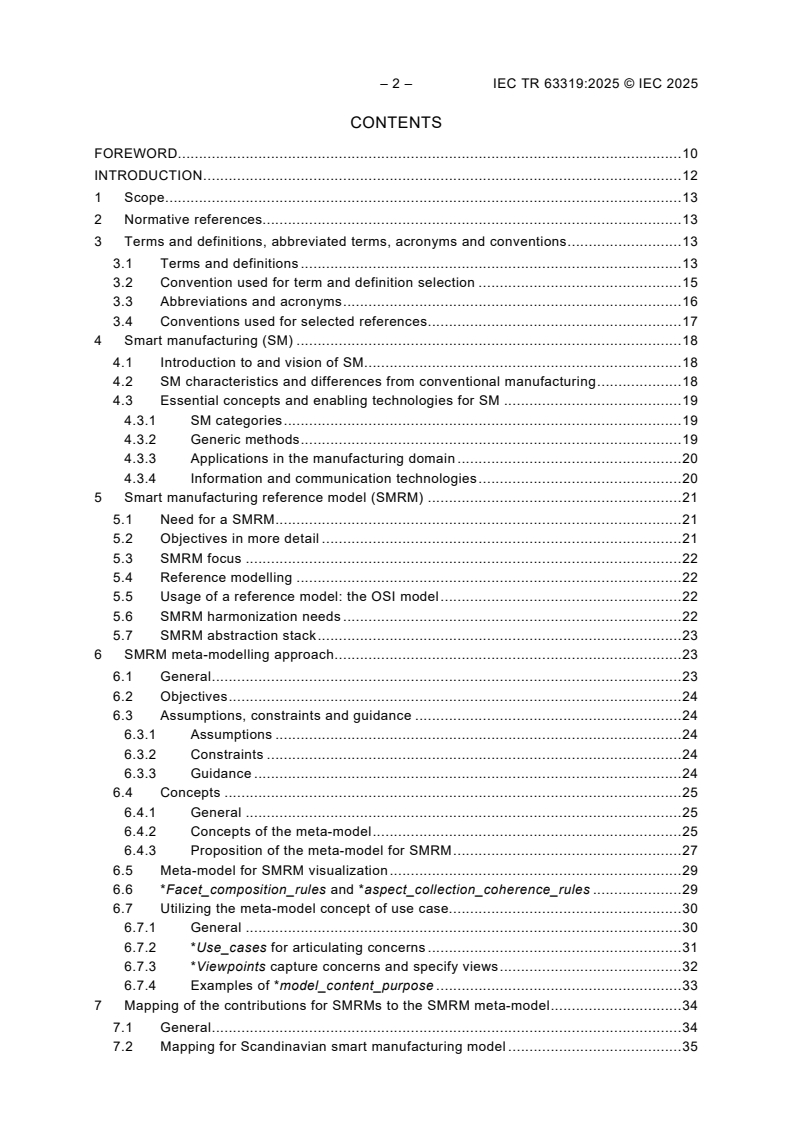
CONTENTS
FOREWORD . 10
INTRODUCTION . 12
1 Scope . 13
2 Normative references. 13
3 Terms and definitions, abbreviated terms, acronyms and conventions . 13
3.1 Terms and definitions . 13
3.2 Convention used for term and definition selection . 15
3.3 Abbreviations and acronyms . 16
3.4 Conventions used for selected references . 17
4 Smart manufacturing (SM) . 18
4.1 Introduction to and vision of SM . 18
4.2 SM characteristics and differences from conventional manufacturing . 18
4.3 Essential concepts and enabling technologies for SM . 19
4.3.1 SM categories . 19
4.3.2 Generic methods . 19
4.3.3 Applications in the manufacturing domain . 20
4.3.4 Information and communication technologies . 20
5 Smart manufacturing reference model (SMRM) . 21
5.1 Need for a SMRM . 21
5.2 Objectives in more detail . 21
5.3 SMRM focus . 22
5.4 Reference modelling . 22
5.5 Usage of a reference model: the OSI model . 22
5.6 SMRM harmonization needs . 22
5.7 SMRM abstraction stack . 23
6 SMRM meta-modelling approach . 23
6.1 General . 23
6.2 Objectives . 24
6.3 Assumptions, constraints and guidance . 24
6.3.1 Assumptions . 24
6.3.2 Constraints . 24
6.3.3 Guidance . 24
6.4 Concepts . 25
6.4.1 General . 25
6.4.2 Concepts of the meta-model . 25
6.4.3 Proposition of the meta-model for SMRM . 27
6.5 Meta-model for SMRM visualization . 29
6.6 *Facet_composition_rules and *aspect_collection_coherence_rules . 29
6.7 Utilizing the meta-model concept of use case. 30
6.7.1 General . 30
6.7.2 *Use_cases for articulating concerns . 31
6.7.3 *Viewpoints capture concerns and specify views . 32
6.7.4 Examples of *model_content_purpose . 33
7 Mapping of the contributions for SMRMs to the SMRM meta-model . 34
7.1 General . 34
7.2 Mapping for Scandinavian smart manufacturing model . 35
7.2.1 Graphical depiction of SSIF mapping . 35
7.2.2 SSIF *facet_composition_rule . 35
7.2.3 Business dimension *aspect_collection . 36
7.2.4 Product dimension *aspect_collection . 36
7.2.5 Production dimension *aspect_collection . 37
7.2.6 Space Time dimension (Life cycle) *aspect_collection . 37
7.3 Mapping for RAMI 4.0 . 38
7.3.1 Graphical depiction of RAMI 4.0 mapping . 38
7.3.2 RAMI 4.0 – *facet_composition_rule . 40
7.3.3 Service oriented architecture as a universal technical approach . 40
7.3.4 Layers *aspect_collection_coherence_rule . 41
7.3.5 Hierarchy Levels *aspect_collection_coherence_rule . 42
7.3.6 Life cycle *aspect_collection_coherence_rule . 42
7.4 Mapping for IMSA . 43
7.4.1 Graphical depiction of IMSA mapping . 43
7.4.2 System Hierarchy *aspect_collection_coherence_rule . 44
7.4.3 Life Cycle *aspect_collection_coherence_rule. 45
7.4.4 Intelligent Function *aspect_collection_coherence_rule . 45
7.5 Mapping for ISO 15704:2019, Annex B – GERAM . 46
7.5.1 Graphical depiction of ISO 15704:2019, Annex B – GERAM . 46
7.5.2 GERAM *facet_composition_rules . 46
7.5.3 Life cycle phases *aspect_collection_coherence_rule . 47
7.5.4 Modelling viewpoints *aspect_collection_coherence_rule . 47
7.5.5 Instantiation *aspect_collection_coherence_rule . 48
7.5.6 Manifestation *aspect_collection_coherence_rule . 48
7.5.7 Purpose *aspect_collection_coherence_rule . 48
7.5.8 Implementation *aspect_collection_coherence_rule . 49
7.6 Mapping for NIST Smart Manufacturing Standards Landscape . 50
7.6.1 Graphical depiction of NIST Smart Manufacturing Standards Landscape
mapping . 50
7.6.2 NIST *facet_composition_rules . 50
7.6.3 Business life cycle *aspect_collection_coherence_rule . 51
7.6.4 Product life cycle *aspect_collection_coherence_rule . 52
7.6.5 Production life cycle *aspect_collection_coherence_rule . 52
7.6.6 Manufacturing pyramid *aspect_collection_coherence_rule . 53
7.7 Mapping for KSTEP cube framework . 54
7.7.1 Graphical depiction of KSTEP cube framework mapping . 54
7.7.2 Space axis 1 *aspect_collection_coherence_rule . 54
7.7.3 Space axis 2 *aspect_collection_coherence_rule . 54
7.7.4 Time axis t *aspect_collection_coherence_rule . 54
7.8 Mapping for IVRA Next . 55
7.8.1 Graphical depiction of IVRA Next mapping . 55
7.8.2 Three axes of SM facet and SMU facet composition rules . 55
7.8.3 Product axis (thing) *aspect_collection_coherence_rule . 56
7.8.4 Service axis (occurrence) *aspect_collection_coherence_rule . 56
7.8.5 Knowledge axis *aspect_collection_coherence_rule . 56
7.8.6 Asset view *aspect_collection_coherence_rule . 57
7.8.7 Management view *aspect_collection_coherence_rule . 57
7.8.8 Activity view *aspect_collection_coherence_rule . 58
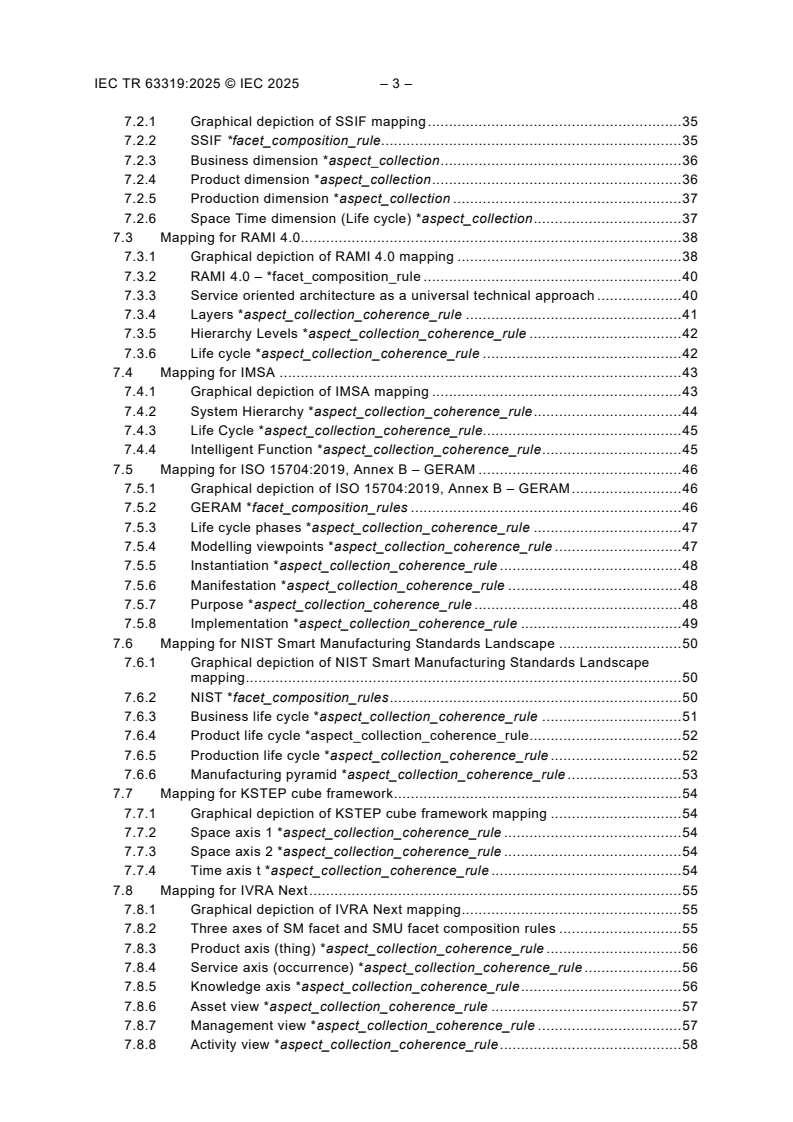
– 4 – IEC TR 63319:2025 © IEC 2025
7.9 Mapping for IIC Industrial Internet Reference Architecture . 59
7.9.1 Graphical depiction of IIC IIRA mapping . 59
7.10 Mapping for Smart Manufacturing Standards Map (SM2) . 60
7.10.1 Graphical depiction of Smart Manufacturing Standards Map (SM2) . 60
7.10.2 SM2 *facet_composition_rules . 62
7.11 Mapping for URM-MM . 62
7.11.1 Graphical depiction of URM-MM . 62
7.11.2 URM-MM *facet_composition_rules . 63
7.11.3 Model/Organization *aspect_collection_coherence_rule . 63
7.11.4 URM-MM *aspect_collection_coherence_rule . 64
8 Analysis of particular collections of aspects . 64
8.1 Identification of a set of common *aspects_collections . 64
8.2 Life cycle . 65
8.2.1 General . 65
8.2.2 Overview on contributions for SMRMs . 65
8.2.3 Particularities of contributions for SMRMs with respect to life cycle . 67
8.2.4 Fundamental questions concerning life cycle aspects of a SMRM . 70
8.2.5 Observed consequences to the life cycle questions . 70
8.2.6 Outlook . 72
8.3 Hierarchy . 72
8.3.1 General . 72
8.3.2 Overview on contributions for SMRMs with respect to hierarchy . 72
8.3.3 Particularities of contributions for SMRMs with respect to hierarchy . 73
8.3.4 Fundamental questions concerning hierarchy aspects of a SMRM . 78
8.3.5 Observed consequences to the hierarchy questions . 78
8.3.6 Outlook . 79
8.4 Layer . 79
8.4.1 General . 79
8.4.2 Overview on contributions for SMRMs . 80
8.4.3 Particularities of contributions for SMRMs with respect to layer . 81
8.4.4 Fundamental questions concerning layer aspects of a SMRM . 82
8.4.5 Observed consequences to the layer questions . 82
8.4.6 Outlook . 83
8.5 Additional aspects . 85
8.5.1 General . 85
8.5.2 Fundamental questions concerning additional *aspect_collections of a
SMRM . 85
8.5.3 Observed consequences to the additional *aspect_collections questions . 85
9 Toward a family of SMRM representations . 88
9.1 Expectations for a unifying SMRM . 88
9.2 Identification of generic (timeless) principles for SMRM . 89
9.3 Structurally addressing the missing smart technologies . 90
9.4 Observations from mapping and analysis . 91
9.5 Candidate *aspect_collection_coherence_rules and
*facet_composition_rules . 92
9.6 The family of SMRM representations . 93
9.7 The case for *use_case . 94
9.8 Approaching creation of the SMRM . 95
Annex A (informative) Objectives and terms of reference for JWG 21 . 97
A.1 Objectives . 97
A.2 Terms of reference . 97
Annex B (informative) Contributions for SMRMs . 98
B.1 RAMI . 98
B.1.1 General . 98
B.1.2 Layer axis . 99
B.1.3 Life cycle axis in RAMI 4.0 . 101
B.2 IMSA . 105
B.2.1 Intelligent manufacturing system framework . 105
B.2.2 Life cycle . 105
B.2.3 System hierarchy . 106
B.2.4 Intelligence characteristics . 106
B.2.5 Structural diagram of intelligent manufacturing standard system . 107
B.3 GERAM . 109
B.3.1 Rationale for enterprise-reference architecture and methodologies . 109
B.3.2 Generalized enterprise-reference architecture and methodologies . 109
B.3.3 Framework for enterprise architecture and enterprise integration . 111
B.4 NIST Smart Manufacturing EcoSystem and Standards Landscape . 115
B.5 KSTEP cube framework for standards . 117
B.5.1 Skeleton meta-model . 117
B.5.2 KSTEP cube framework . 119
B.6 IVRA Next . 121
B.6.1 General . 121
B.6.2 Overview . 121
B.6.3 Evolutional Model in Manufacturing . 125
B.7 ISO/TC 184 Automation systems and integration – the Big Picture of
standards (ISO TR 23087:2018 [40]) . 130
B.7.1 History . 130
B.7.2 Purpose . 131
B.7.3 Summary of axis and facets of the ISO/TC 184 Big picture of standards
diagram and matrix . 133
B.8 AIF framework and reference model for SM Standard Landscape (France) . 134
B.8.1 History . 134
B.8.2 Purpose . 134
B.8.3 Summary of facets and blocks of the AIF RM for SM Standard
Landscape . 136
B.9 ISO-IEC Smart Manufacturing Standards Landscape (SM2) . 138
B.9.1 History . 138
B.9.2 Terms of reference . 139
B.9.3 SM2 framework . 139
B.9.4 SM2 vocabulary . 142
B.10 URM-MM . 144
B.10.1 Background . 144
B.10.2 Overview . 144
B.10.3 Usage . 145
B.10.4 Practical use-case . 145
B.10.5 Illustration of Relevant International Standards Mapping . 149
B.11 Scandinavian model . 151
B.11.1 Scandinavian Semantic Model Design Principles . 151
– 6 – IEC TR 63319:2025 © IEC 2025
B.11.2 Domain Semantic Model exemplified by Product Dimension . 153
B.12 UK Model . 155
Annex C (informative) Definition of smart manufacturing, and interpretations . 157
Annex D (informative) Concepts of Meta-modelling . 158
Bibliography . 160
Figure 1 – Example of transition from centralized to distributed system paradigm . 18
Figure 2 – SMRM abstraction stack . 23
Figure 3 – Meta-model for SMRM . 29
Figure 4 – Segments of the SMRM meta-model . 31
Figure 5 – Relation between typical concerns and use-cases on SM . 32
Figure 6 – Example of an implementation model for *use-case #1 . 32
Figure 7 – Illustration about relation between a SMRM and a *stakeholder . 33
Figure 8 – Mapping for Scandinavian smart manufacturing model . 35
Figure 9 – Mapping for RAMI 4.0 . 38
Figure 10 – Mapping for IMSA . 44
Figure 11 – Mapping for ISO 15704:2019 – GERAM Annex . 46
Figure 12 – Mapping for NIST Smart Manufacturing Standards Landscape . 50
Figure 13 – NIST SMS Ecosystem − Integrated Smart Manufacturing . 51
Figure 14 – Mapping for KSTEP cube framework . 54
Figure 15 – IVRA Next: Mapping to Three Axes of SM and SMU . 55
Figure 16 – Mapping for IIC IIRA . 59
Figure 17 – System representation # 1 . 61
Figure 18 – System representation # 2 . 62
Figure 19 – Mapping for URM-MM . 63
Figure 20 – The validity of individual exemplary life cycles on elements over time . 65
Figure 21 – Graphical overview on different contributions for SMRMs . 66
Figure 22 – Graphical overview on different contributions for SMRMs with respect to
Hierarchy . 73
Figure 23 – Graphical overview on different contributions for SMRMs . 81
Figure 24 – N *aspect_collection of semantic coherence . 93
Figure 25 – Basic structure for a family of SMRM with alternative 3D representations . 94
Figure 26 – Basic structural representation for several of the contributions − SSIF,
RAMI 4.0, IMSA, and IVRA Next . 94
Figure B.1 – The viewpoint of the RAMI 4.0 model . 98
Figure B.2 – Linking of life cycles . 103
Figure B.3 – Factory reference architecture model as of IEC 62264-1 and IEC 61512-1,
with Industrie 4.0 enhancements . 104
Figure B.4 – Intelligent Manufacturing System Framework . 105
Figure B.5 – Structural diagram of intelligent manufacturing standard system . 107
Figure B.6 – Mapping between IMSA and standard system structure . 108
Figure B.7 – GERAM-ISO (Generalized Enterprise Reference Architecture and
Methodology − ISO) framework components . 112
Figure B.8 – GERA Modelling Framework representation with Modelling Views . 113
Figure B.9 – Smart Manufacturing Ecosystem. 116
Figure B.10 – Smart Manufacturing Standards Landscape . 117
Figure B.11 – Skeleton of the NIST framework . 118
Figure B.12 – Skeleton of the RAMI 4.0 framework and the KSTEP framework . 118
Figure B.13 – Three axes of the KSTEP cube framework . 119
Figure B.14 – KSTEP cube framework . 120
Figure B.15 – Digital twin of the KSTEP cube framework . 121
Figure B.16 – Three layers of manufacturing . 123
Figure B.17 – Three axes of SM . 124
Figure B.18 – Four cycles of SM . 125
Figure B.19 – EROR cycle for evolution . 126
Figure B.20 – Icons of scenario defining elements . 128
Figure B.21 – Cyber and physical connection . 129
Figure B.22 – Cross border management by PLU . 130
Figure B.23 – Example of a Big Picture matrix . 132
Figure B.24 – Graph-Nodes filtered building . 132
Figure B.25 – Tree map sector barrier . 133
Figure B.26 – Example: business, operate and ship . 133
Figure B.27 – Standards landscape . 135
Figure B.28 – Principles of the AIF framework for the SM standards landscape . 136
Figure B.29 – Relation between standards map projects . 139
Figure B.30 – Example mapping of product catalogue data standards . 140
Figure B.31 – Example mapping structure for production system standards . 141
Figure B.32 – Unified Reference Model − Map and Methodology (URM-MM) . 144
Figure B.33 – Diagram of Canvas on an example of a production system having
dynamic optimization . 146
Figure B.34 – Diagram of Use-case on an example of a production system having
dynamic optimization . 146
Figure B.35 – Diagram of Function on an example of a production system having
dynamic optimization . 147
Figure B.36 – Diagram of Data (1 of 2) on an example of a production system having
dynamic optimization . 148
Figure B.37 – Diagram of Data (2 of 2) on an example of a production system having
dynamic optimization . 149
Figure B.38 – Example of Mapping of Relevant International Standards at "Canvas" . 150
Figure B.39 – Example of Mapping of Relevant International Standards at "Data" . 151
Figure B.40 – Scandinavian Smart Industry Framework Semantic Cube . 152
Figure B.41 – Basic principles for the Semantic Space . 152
Figure B.42 – Domain Semantic Model exemplified by Product Dimension . 153
Figure B.43 – Separation of model content and Presentation . 154
Figure B.44 – Semantic model Architecture . 155
Figure B.45 – Dependencies between different aspects in Smart Products Through-Life . 156
Figure D.1 – Meta-abstraction stack . 158
Table 1 – SSIF business dimension *Aspect and *Viewpoint according to *Perspective . 36
Table 2 – SSIF product dimension *Aspect and *Viewpoint according to *Perspective . 36
– 8 – IEC TR 63319:2025 © IEC 2025
Table 3 – SSIF production dimension *Aspect and *Viewpoint according to
*Perspective . 37
Table 4 – SSIF Space Time dimension *Aspect and *Viewpoint according to the
*Perspective . 37
Table 5 – RAMI 4.0 *aspect_collections and bifurcations . 39
Table 6 – *Aspect and *Viewpoint for RAMI 4.0 Layers . 41
Table 7 – *Aspect and *Viewpoint for RAMI 4.0 Hierarchy Levels . 42
Table 8 – *Aspect and *Viewpoint for the RAMI 4.0 Life cycle . 43
Table 9 – *Aspect and *Viewpoint for the IMSA System Hierarchy . 44
Table 10 – *Aspect and *Viewpoint for IMSA Life Cycle . 45
Table 11 – *Aspects possible values and explanation for the IMSA Intelligent Functions . 45
Table 12 – *Aspects and *viewpoints for GERAM life cycle . 47
Table 13 – *Aspects and *viewpoints for GERAM modelling viewpoints . 48
Table 14 – *Aspects and *viewpoints of GERAM Instantiation *aspect_collection . 48
Table 15 – Representation of the physical manifestation of the enterprise-entity . 48
Table 16 – Representation of the model contents according to the purpose of the
enterprise entity . 49
Table 17 – Representation of the implementation of the enterprise-entity . 49
Table 18 – *Aspects for the Business life cycle . 52
Table 19 – *Aspects of the product life cycle . 52
Table 20 – *Aspects of the production life cycle . 52
Table 21 – *Aspects of the Manufacturing Pyramid . 53
Table 22 – Product axis (thing) *aspects and *viewpoints . 56
Table 23 – Service axis (occurrence) *aspects and *viewpoints . 56
Table 24 – Knowledge axis *aspects and *viewpoints . 56
Table 25 – Asset view *aspects and *viewpoints . 57
Table 26 – Management view *aspects and *viewpoints . 57
Table 27 – Activity view *aspects and *viewpoints . 58
Table 28 – Correspondence between SM2 concepts and SMRM meta-model concepts . 60
Table 29 – Examples of representations . 60
Table 30 – Mapping for System representation # 1 . 61
Table 31 – Mapping for System representation # 2 . 62
Table 32 – *Aspect and *Viewpoint for Model/Organization in URM-MM . 63
Table 33 – *Aspect and *Viewpoint for the horizontal column in URM-MM . 64
Table 34 – Particularities on life cycle on different contributors' perspective . 67
Table 35 – IMSA Hierarchy levels . 74
Table 36 – RAMI 4.0 Hierarchy related functionalities . 74
Table 37 – IVRA Hierarchical levels . 75
Table 38 – Big Picture Hierarchical levels . 76
Table 39 – Standards Landscape Hierarchical levels . 77
Table 40 – Particularities on layer on different contributors' models . 82
Table 41 – Aspects along the dimension of layers/Intelligent functions . 83
Table 42 – Grouping (and sub-grouping) of additional aspects . 86
Table 43 – Proposed assignment of the additional *aspect_collections groups . 87
Table B.1 – RAMI 4.0 Layers . 99
Table B.2 – RAMI 4.0 generalized life cycle phases . 102
Table B.3 – RAMI 4.0 Hierarchy Levels . 104
Table B.4 – Block "Identification" . 136
Table B.5 – Block "Object of standard" . 137
Table B.6 – Block "Hierarchy" . 137
Table B.7 – Block "Life cycle" . 137
Table B.8 – Block "Relevance" . 138
Table B.9 – Block "Interoperability" . 138
Table B.10 – Block "Priority" . 138
Table B.11 – Block "Validation" . 138
Table B.12 – Relevant blocks, sub-blocks and characteristics of SM2 . 142
– 10 – IEC TR 63319:2025 © IEC 2025
INTERNATIONAL ELECTROTECHNICAL COMMISSION
____________
A META-MODELLING ANALYSIS APPROACH TO SMART
MANUFACTURING REFERENCE MODELS
FOREWORD
1) The International Electrotechnical Commission (IEC) is a worldwide organization for standardization comprising
all national electrotechnical committees (IEC National Committees). The object of IEC is to promote international
co-operation on all questions concerning standardization in the electrical and electronic fields. To this end and
in addition to other activities, IEC publishes International Standards, Technical Specifications, Technical Reports,
Publicly Available Specifications (PAS) and Guides (hereafter referred to as “IEC Publication(s)”). Their
preparation is entrusted to technical committees; any IEC National Committee interested in the subject dealt with
may participate in this preparatory work. International, governmental and non-governmental organizations liaising
with the IEC also participate in this preparation. IEC collaborates closely with the International Organization for
Standardization (ISO) in accordance with conditions determined by agreement between the two organizations.
2) The formal decisions or agreements of IEC on technical matters express, as nearly as possible, an international
consensus of opinion on the relevant subjects since each technical committee has representation from all
interested IEC National Committees.
3) IEC Publications have the form of recommendations for international use and are accepted by IEC National
Committees in that sense. While all reasonable efforts are made to ensure that the technical content of IEC
Publications is accurate, IEC cannot be held responsible for the way in which they are used or for any
misinterpretation by any end user.
4) In order to promote international uniformity, IEC National Committees undertake to apply IEC Publications
transparently to the maximum extent possible in their national and regional publications. Any divergence between
any IEC Publication and the corresponding national or regional publication shall be clearly indicated in the latter.
5) IEC itself does not provide any attestation of conformity. Independent certification bodies provide conformity
assessment services and, in some areas, access to IEC marks of conformity. IEC is not responsible for any
services carried out by independent certification bodies.
6) All users should ensure that they have the latest edition of this publication.
7) No liability shall attach to IEC or its directors, employees, servants or agents including individual experts and
members of its technical committees and IEC National Committees for any personal injury, property damage or
other damage of any nature whatsoever, whether direct or indirect, or for costs (including legal fees) and
expenses arising out of the publication, use of, or reliance upon, this IEC Publication or any other IEC
Publications.
8) Attention is drawn to the Normative references cited in this publication. Use of the referenced publications is
indispensable for the correct application of this publication.
9) IEC draws attention to the possibility that the implementation of this document may involve the use of (a)
patent(s). IEC takes no position concerning the evidence, validity or applicability of any claimed patent rights in
respect thereof. As of the date of publication of this document, IEC had not received notice of (a) patent(s), which
may be required to implement this document. However, implementers are cautioned that this may not represent
the latest information, which may be obtained from the patent database available at https://patents.iec.ch. IEC
shall not be held responsible for identifying any or all such patent rights.
The main task of IEC technical committees is to prepare International Standards. However, a
technical committee may propose the publication of a Technical Report when it has collected
data of a different kind from that which is normally published as an International Standard, for
example "state of the art".
IEC TR 63319 has been prepared by IEC technical committee 65: Industrial-process
measurement, control and automation in cooperation with ISO technical committee 184:
Automation systems and integration
...