

IEC TR 61850-90-27:2023
(Main)Communication networks and systems for power utility automation - Part 90-27: Use of IEC 61850 for thermal energy systems connected to electric power grid
General Information
- Abstract
IEC TR 61850-90-27:2023, which is a Technical Report, is to provide basic aspects that need to be considered when using IEC 61850 for information exchange between systems and components to support applications for thermal systems connected to electric power networks. Thermal systems isolated from electric power networks are outside the scope of this document.
From the perspective of category, this document considers thermal systems that provide thermal energy services for residential and/or commercial buildings and districts. In other words, industrial thermal systems are outside the scope of this document.
From the perspective of energy transformation, this document deals with ones between electricity and thermal energy. Other types of energy such as gas will be documented in a future report.
From the perspective of resource, this document considers generic aspects of thermal energy generators, storage, and loads that may contribute to the operations and management of electric power networks. It also deals with specific types of resources that have electric parts such as power to heat (P2H) that is a kind of electric load, and combined heat and power (CHP) that is an electric generator. This document models the characteristics for such specific units of resources including alarms and ratings. On the other hand, it does not deal with other types of specific units according to the scope of this document. For example, gas boilers, thermal energy tanks, heat exchangers, HVAC, auxiliary devices for thermal systems are not modelled as logical nodes in this document.
As a summary, this document
- gives an overview of thermal energy resources connected to electric power networks.
- provides use cases for typical operations of thermal system and deducts exchanged information necessary for information modelling.
- provides mapping of requirements on LNs based on the use cases.
- defines generic logical nodes for resources in thermal systems.
- defines logical nodes for specific unit types of P2H and CHP.
- defines logical nodes for operations that may contribute to the operations of electric power networks.
- Status
- Published
- Publication Date
- 15-Aug-2023
- Technical Committee
- TC 57 - Power systems management and associated information exchange
- Drafting Committee
- WG 17 - TC 57/WG 17
- Current Stage
- PPUB - Publication issued
- Start Date
- 16-Aug-2023
- Completion Date
- 17-Aug-2023
Buy Documents
IEC TR 61850-90-27:2023 - Communication networks and systems for power utility automation - Part 90-27: Use of IEC 61850 for thermal energy systems connected to electric power grid Released:8/16/2023
Overview - IEC TR 61850-90-27:2023 (thermal energy systems)
IEC TR 61850-90-27:2023 extends the IEC 61850 family guidance to thermal energy systems connected to the electric power grid. As a Technical Report, it provides the foundational aspects for using IEC 61850 information exchange and data modelling to support residential and commercial/district thermal resources that interact with electricity (energy transformation between electricity and thermal energy). Industrial thermal systems, gas-only systems, and thermal systems isolated from the grid are outside its scope.
Key topics and technical requirements
- Information modelling: Defines requirements for information exchange and maps use-case-driven requirements onto IEC 61850 logical node (LN) classes.
- Logical nodes (LNs): Introduces generic and specific LNs for thermal resources, examples include DGTH, DSTH, DLTH, DETH, DETG, and unit-type LNs for P2H (power-to-heat) and CHP (combined heat and power).
- Operational functions & reference points: Models operational functions (e.g., thermal comfort profiles, modes to set active power) and thermal reference points (physical and virtual TCP/PCP).
- Use-case driven requirements: Provides detailed use cases (aggregated building storage for congestion management, small-scale CHP for grid stabilisation, centralised heat pumps, tertiary reserve via demand response) and derives exchanged-data needs.
- Metering & measurement: Defines thermal energy measurement LNs and extensions to electric measurement to support sector coupling.
- Scope limitations: Explicitly excludes modelling of gas boilers, heat exchangers, HVAC controls, thermal tanks as LNs (some concepts treated generically).
Practical applications and users
This report is intended for professionals implementing cross-domain energy solutions and grid-interactive thermal systems:
- Utility engineers and grid operators integrating thermal resources for congestion management and ancillary services.
- System integrators and software developers implementing IEC 61850-based controllers and communication stacks for building energy management, district heating/cooling, P2H, and CHP systems.
- Manufacturers of heat pumps, electric heaters, CHP units, and metering equipment who need standardized LN mappings and data objects.
- DER aggregators and energy service companies deploying demand response and storage orchestration across buildings and districts.
Related standards
- Core: IEC 61850 (substation and DER information modelling and communications)
- Cross-reference: IEC 62913-2-3 (actors and functional roles used in some use cases)
IEC TR 61850-90-27:2023 is a practical reference for architects of sector-coupled energy systems who want standardized, interoperable data models for thermal–electric interactions using IEC 61850.
Buy Documents
IEC TR 61850-90-27:2023 - Communication networks and systems for power utility automation - Part 90-27: Use of IEC 61850 for thermal energy systems connected to electric power grid Released:8/16/2023
Get Certified
Connect with accredited certification bodies for this standard

ANCE
Mexican certification and testing association.

Intertek Slovenia
Intertek testing, inspection, and certification services in Slovenia.

LNE (Laboratoire National de Métrologie et d'Essais)
French national laboratory for metrology and testing.
Sponsored listings
Frequently Asked Questions
IEC TR 61850-90-27:2023 is a technical report published by the International Electrotechnical Commission (IEC). Its full title is "Communication networks and systems for power utility automation - Part 90-27: Use of IEC 61850 for thermal energy systems connected to electric power grid". This standard covers: IEC TR 61850-90-27:2023, which is a Technical Report, is to provide basic aspects that need to be considered when using IEC 61850 for information exchange between systems and components to support applications for thermal systems connected to electric power networks. Thermal systems isolated from electric power networks are outside the scope of this document. From the perspective of category, this document considers thermal systems that provide thermal energy services for residential and/or commercial buildings and districts. In other words, industrial thermal systems are outside the scope of this document. From the perspective of energy transformation, this document deals with ones between electricity and thermal energy. Other types of energy such as gas will be documented in a future report. From the perspective of resource, this document considers generic aspects of thermal energy generators, storage, and loads that may contribute to the operations and management of electric power networks. It also deals with specific types of resources that have electric parts such as power to heat (P2H) that is a kind of electric load, and combined heat and power (CHP) that is an electric generator. This document models the characteristics for such specific units of resources including alarms and ratings. On the other hand, it does not deal with other types of specific units according to the scope of this document. For example, gas boilers, thermal energy tanks, heat exchangers, HVAC, auxiliary devices for thermal systems are not modelled as logical nodes in this document. As a summary, this document - gives an overview of thermal energy resources connected to electric power networks. - provides use cases for typical operations of thermal system and deducts exchanged information necessary for information modelling. - provides mapping of requirements on LNs based on the use cases. - defines generic logical nodes for resources in thermal systems. - defines logical nodes for specific unit types of P2H and CHP. - defines logical nodes for operations that may contribute to the operations of electric power networks.
IEC TR 61850-90-27:2023, which is a Technical Report, is to provide basic aspects that need to be considered when using IEC 61850 for information exchange between systems and components to support applications for thermal systems connected to electric power networks. Thermal systems isolated from electric power networks are outside the scope of this document. From the perspective of category, this document considers thermal systems that provide thermal energy services for residential and/or commercial buildings and districts. In other words, industrial thermal systems are outside the scope of this document. From the perspective of energy transformation, this document deals with ones between electricity and thermal energy. Other types of energy such as gas will be documented in a future report. From the perspective of resource, this document considers generic aspects of thermal energy generators, storage, and loads that may contribute to the operations and management of electric power networks. It also deals with specific types of resources that have electric parts such as power to heat (P2H) that is a kind of electric load, and combined heat and power (CHP) that is an electric generator. This document models the characteristics for such specific units of resources including alarms and ratings. On the other hand, it does not deal with other types of specific units according to the scope of this document. For example, gas boilers, thermal energy tanks, heat exchangers, HVAC, auxiliary devices for thermal systems are not modelled as logical nodes in this document. As a summary, this document - gives an overview of thermal energy resources connected to electric power networks. - provides use cases for typical operations of thermal system and deducts exchanged information necessary for information modelling. - provides mapping of requirements on LNs based on the use cases. - defines generic logical nodes for resources in thermal systems. - defines logical nodes for specific unit types of P2H and CHP. - defines logical nodes for operations that may contribute to the operations of electric power networks.
IEC TR 61850-90-27:2023 is classified under the following ICS (International Classification for Standards) categories: 33.200 - Telecontrol. Telemetering. The ICS classification helps identify the subject area and facilitates finding related standards.
IEC TR 61850-90-27:2023 is available in PDF format for immediate download after purchase. The document can be added to your cart and obtained through the secure checkout process. Digital delivery ensures instant access to the complete standard document.
Standards Content (Sample)
IEC TR 61850-90-27 ®
Edition 1.0 2023-08
TECHNICAL
REPORT
colour
inside
Communication networks and systems for power utility automation –
Part 90-27: Use of IEC 61850 for thermal energy systems connected to electric
power grid
All rights reserved. Unless otherwise specified, no part of this publication may be reproduced or utilized in any form
or by any means, electronic or mechanical, including photocopying and microfilm, without permission in writing from
either IEC or IEC's member National Committee in the country of the requester. If you have any questions about IEC
copyright or have an enquiry about obtaining additional rights to this publication, please contact the address below or
your local IEC member National Committee for further information.
IEC Secretariat Tel.: +41 22 919 02 11
3, rue de Varembé info@iec.ch
CH-1211 Geneva 20 www.iec.ch
Switzerland
About the IEC
The International Electrotechnical Commission (IEC) is the leading global organization that prepares and publishes
International Standards for all electrical, electronic and related technologies.
About IEC publications
The technical content of IEC publications is kept under constant review by the IEC. Please make sure that you have the
latest edition, a corrigendum or an amendment might have been published.
IEC publications search - webstore.iec.ch/advsearchform IEC Products & Services Portal - products.iec.ch
The advanced search enables to find IEC publications by a Discover our powerful search engine and read freely all the
variety of criteria (reference number, text, technical publications previews. With a subscription you will always have
committee, …). It also gives information on projects, replaced access to up to date content tailored to your needs.
and withdrawn publications.
Electropedia - www.electropedia.org
IEC Just Published - webstore.iec.ch/justpublished
The world's leading online dictionary on electrotechnology,
Stay up to date on all new IEC publications. Just Published
containing more than 22 300 terminological entries in English
details all new publications released. Available online and once
and French, with equivalent terms in 19 additional languages.
a month by email.
Also known as the International Electrotechnical Vocabulary
(IEV) online.
IEC Customer Service Centre - webstore.iec.ch/csc
If you wish to give us your feedback on this publication or need
further assistance, please contact the Customer Service
Centre: sales@iec.ch.
IEC TR 61850-90-27 ®
Edition 1.0 2023-08
TECHNICAL
REPORT
colour
inside
Communication networks and systems for power utility automation –
Part 90-27: Use of IEC 61850 for thermal energy systems connected to electric
power grid
INTERNATIONAL
ELECTROTECHNICAL
COMMISSION
ICS 33.200 ISBN 978-2-8322-7339-5
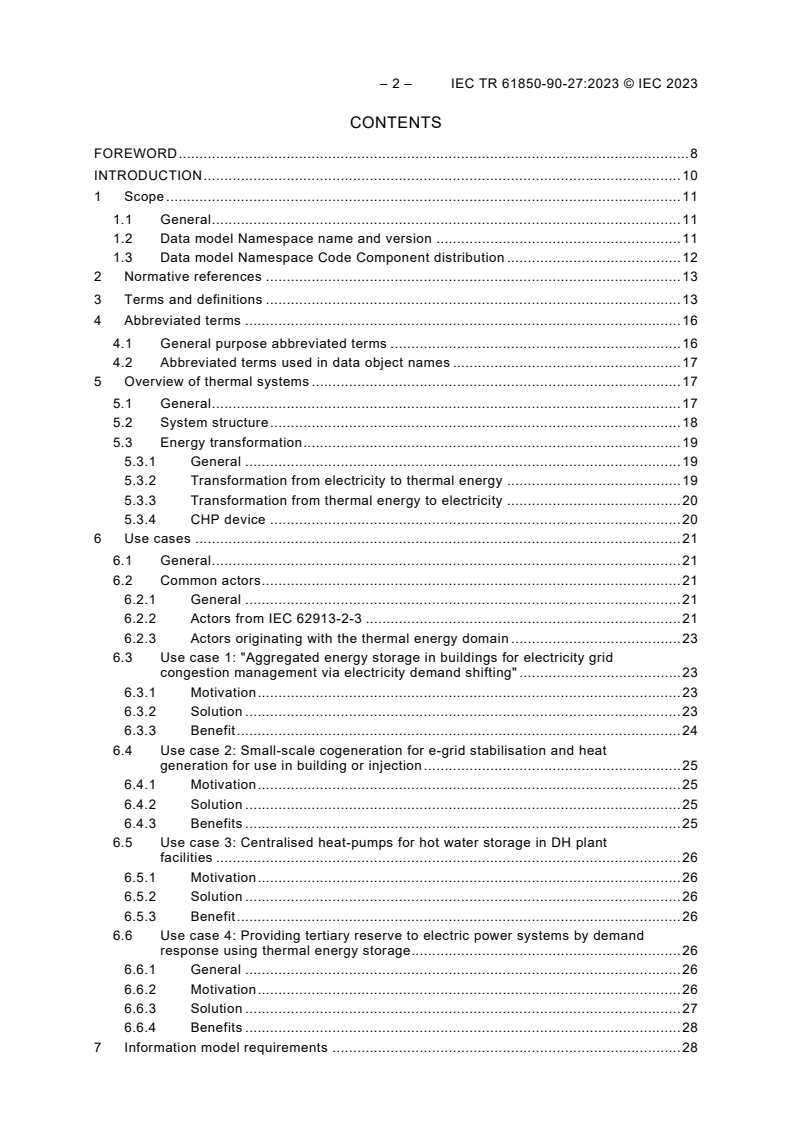
– 2 – IEC TR 61850-90-27:2023 © IEC 2023
CONTENTS
FOREWORD . 8
INTRODUCTION . 10
1 Scope . 11
1.1 General . 11
1.2 Data model Namespace name and version . 11
1.3 Data model Namespace Code Component distribution . 12
2 Normative references . 13
3 Terms and definitions . 13
4 Abbreviated terms . 16
4.1 General purpose abbreviated terms . 16
4.2 Abbreviated terms used in data object names . 17
5 Overview of thermal systems . 17
5.1 General . 17
5.2 System structure . 18
5.3 Energy transformation . 19
5.3.1 General . 19
5.3.2 Transformation from electricity to thermal energy . 19
5.3.3 Transformation from thermal energy to electricity . 20
5.3.4 CHP device . 20
6 Use cases . 21
6.1 General . 21
6.2 Common actors . 21
6.2.1 General . 21
6.2.2 Actors from IEC 62913-2-3 . 21
6.2.3 Actors originating with the thermal energy domain . 23
6.3 Use case 1: "Aggregated energy storage in buildings for electricity grid
congestion management via electricity demand shifting" . 23
6.3.1 Motivation . 23
6.3.2 Solution . 23
6.3.3 Benefit . 24
6.4 Use case 2: Small-scale cogeneration for e-grid stabilisation and heat
generation for use in building or injection . 25
6.4.1 Motivation . 25
6.4.2 Solution . 25
6.4.3 Benefits . 25
6.5 Use case 3: Centralised heat-pumps for hot water storage in DH plant
facilities . 26
6.5.1 Motivation . 26
6.5.2 Solution . 26
6.5.3 Benefit . 26
6.6 Use case 4: Providing tertiary reserve to electric power systems by demand
response using thermal energy storage . 26
6.6.1 General . 26
6.6.2 Motivation . 26
6.6.3 Solution . 27
6.6.4 Benefits . 28
7 Information model requirements . 28
7.1 General . 28
7.2 Mappings of requirements on LN classes at the resource level . 28
7.3 Mappings of requirements on LN classes at the operational function level . 33
7.4 Mappings of requirements on LN classes at the reference point level in
thermal energy network . 34
8 Logical node classes and data objects modelling . 36
8.1 General . 36
8.1.1 General . 36
8.1.2 Modelling principles of logical nodes considering sector coupling . 36
8.2 Generic resource LN . 39
8.2.1 Generic LN classes related to electrical DERs (DGEN, DSTO and
DLOD) . 39
8.2.2 Generic LN classes related to thermal energy resources (DGTH, DSTH
and DLTH) . 39
8.2.3 Generic LN classes related to both electrical DERs and thermal energy
resources (DETH and DETG) . 40
8.3 LN classes related to specific type of units . 40
8.3.1 General . 40
8.3.2 Modelling P2H units . 41
8.3.3 Modelling of CHP . 44
8.3.4 Modelling of thermal storage units . 45
8.4 Modelling of operational functions for energy services . 46
8.5 Modelling of reference points in thermal systems . 48
9 LN class definitions . 49
9.1 General . 49
9.2 Abstract logical nodes for thermal systems (AbstractLNs_90_27) . 49
9.2.1 General . 49
9.2.2 <> LN: All energy (electricity, thermal energy, and gas) mixed
DER Name: AllEnergyMixedDERLN . 51
9.2.3 <> LN: Transformation from electricity to thermal Name:
TransformationFromElectricityToThermalLN . 51
9.2.4 <> LN: Transformation from thermal energy to
electricity Name: TransformationFromThermalToElectricityLN . 52
9.2.5 <> LN: Mixed electricity and thermal generator Name:
MixedElectricityAndThermalGeneratorLN . 52
9.2.6 <> LN: Thermal resource Name: ThermalResourceLN . 52
9.2.7 <> LN: Non thermal storage operational settings Name:
NonThermalStorageOperationalSettingsLN . 53
9.2.8 <> LN: Thermal storage operational settings Name:
ThermalStorageOperationalSettingsLN . 54
9.2.9 <> LN: Electricity to thermal energy unit Name:
ElectricityToThermalUnitLN . 54
9.2.10 <> LN: Thermal operation function Name:
ThermalOperationalFunctionLN . 54
9.2.11 <> LN: Thermal reference point Name:
ThermalReferenceLN . 54
9.2.12 <> LN: Physical thermal reference Name:
PhysicalThermalReferenceLN . 55
9.2.13 <> LN: Virtual Thermal Reference Point Name:
VirtualThermalReferenceLN . 55
9.3 Generic logical nodes for thermal resource (LNGroupD) . 56
9.3.1 General . 56
– 4 – IEC TR 61850-90-27:2023 © IEC 2023
9.3.2 LN: Thermal generating resource Name: DGTH . 56
9.3.3 LN: Thermal storage resource Name: DSTH . 61
9.3.4 LN: Thermal load resource Name: DLTH . 65
9.3.5 LN: Mixed electricity and thermal generating unit Name: DETG . 68
9.3.6 LN: Electricity to thermal transforming unit Name: DETH . 71
9.4 Extended logical nodes for distributed energy resources (LNGroupD) . 74
9.4.1 General . 74
9.4.2 LN: DER generating unit extended in 90-27 Name: DGENExt . 74
9.4.3 LN: DER load unit extended in 90-27 Name: DLODExt . 84
9.5 Unit type logical nodes for thermal resources (LNGroupD) . 93
9.5.1 General . 93
9.5.2 LN: CHP system controller Name: DCHCExt . 93
9.5.3 LN: Fuel cell controller Name: DFCLExt . 96
9.5.4 LN: Electric heat pump Name: DHPM . 99
9.5.5 LN: Electric resistance heater Name: DRSH . 103
9.6 Logical nodes for operational functions related to thermal systems
(LNGroupD) . 105
9.6.1 General . 105
9.6.2 LN: Thermal comfort profile Name: DTHP . 105
9.6.3 LN: Mode to cause DER to set active power Name: DWGCExt . 107
9.7 Logical nodes for thermal reference points (LNGroupD) . 112
9.7.1 General . 112
9.7.2 LN: Thermal Connection Point Name: DTCP . 113
9.7.3 LN: Thermal Point of Common Coupling Name: DTPC . 115
9.7.4 LN: Virtual Thermal Connection Point Name: DVTR . 117
9.8 Logical nodes for metering and measurement (LNGroupM) . 119
9.8.1 General . 119
9.8.2 LN: Local electric power system measurement Name: MLPS . 120
9.8.3 LN: Thermal energy measurement Name: MTHM . 122
9.9 Logical nodes for further power system equipment (LNGroupZ) . 124
9.9.1 General . 124
9.9.2 LN: Power cable Name: ZCABExt . 124
9.9.3 LN: Power overhead line Name: ZLINExt . 127
9.10 Enumerated data attribute types . 130
9.10.1 General . 130
9.10.2 Classes list . 131
9.10.3 ThermalGeneratorStateKind enumeration . 131
9.10.4 ThermalGeneratorOperationModeType enumeration . 132
9.10.5 ThermalStorageOperationControlKind enumeration . 132
9.10.6 HeatSourceKind enumeration . 132
9.10.7 CompressorKind enumeration . 133
9.10.8 ThermalComfortStatusKind enumeration . 133
9.10.9 ThermalStorageKind enumeration . 133
9.10.10 ThermalMediumKind enumeration . 134
9.10.11 FuelCellKind enumeration . 134
9.10.12 TCPIslandStateKind enumeration . 135
9.10.13 ThermalGenerationKind enumeration . 135
Annex A (informative) Complete descriptions of use cases . 136
A.1 Aggregated energy storage in buildings for electricity grid congestion
management via electricity demand shifting . 136
A.1.1 Description of the use case . 136
A.1.2 Diagrams of use case . 138
A.1.3 Technical details . 139
A.1.4 Step by step analysis of use case . 142
A.1.5 Information exchanged . 147
A.1.6 Common terms and definitions . 147
A.2 Small-scale cogeneration for e-grid stabilisation and heat generation for use
in building or injection . 147
A.2.1 Description of use case . 147
A.2.2 Diagrams of use case . 149
A.2.3 Technical details . 151
A.2.4 Step by step analysis of use case . 153
A.2.5 Information exchanged . 158
A.2.6 Common terms and definitions . 158
A.3 Centralised heat-pumps for hot water storage in DH plant facilities . 158
A.3.1 Description of use case . 158
A.3.2 Diagrams of use case . 160
A.3.3 Technical details . 162
A.3.4 Step by step analysis of use case . 164
A.3.5 Information exchanged . 166
A.3.6 Common terms and definitions . 167
A.4 Providing tertiary reserve to electric power systems by demand response
using thermal energy storage . 167
A.4.1 Description of use case . 167
A.4.2 Use case diagram . 172
A.4.3 Technical details . 173
A.4.4 Step by step analysis of user case . 174
A.4.5 Information exchanged . 177
A.4.6 Common terms and definitions . 179
Annex B (informative) Considerations of LN design for CHP . 180
Figure 1 – A typical structure of thermal system . 18
Figure 2 – A configuration of heat pump. 19
Figure 3 – A typical configuration of a CHP device . 20
Figure 4 – Configuration and behaviour of a polymer electrolyte fuel cell . 21
Figure 5 – UC1 Case 1: The aggregated electricity demand is lower than electricity
generation . 24
Figure 6 – UC1 Case 2: The aggregated electricity demand is higher than electricity
generation . 24
Figure 7 – Main use case diagram of UC4: Providing tertiary reserve to electric power
systems by demand response using thermal energy storage . 27
Figure 8 – Hierarchical class model of DER resources – basic principles . 37
Figure 9 – Principles to guide the extension of IEC 61850-7-420 for supporting other
types of energies . 38
Figure 10 – Logical nodes representing data related to thermal system . 40
Figure 11 – An example of a simple DER resource model of a PV generating unit . 41
Figure 12 – Modelling of a heat pump . 43
– 6 – IEC TR 61850-90-27:2023 © IEC 2023
Figure 13 – Data objects in DLOD and DETH . 44
Figure 14 – Modelling of a CHP . 45
Figure 15 – An example of thermal storage resources including thermal mass in a
building with mappings to logical nodes . 46
Figure 16 – DER Generic model. 47
Figure 17 – Modelling of operational functions for thermal systems . 48
Figure 18 – Class model of an Electric Reference Point . 48
Figure 19 – Proposed extension of the class model of an Electric Reference Point . 49
Figure 20 – Class diagram AbstractResourceLNs . 50
Figure 21 – Class diagram AbstractUnitLNs . 50
Figure 22 – Class diagram AbstractOperationalFunctionLNs . 51
Figure 23 – Class diagram for resources . 56
Figure 24 – Class diagram for resource units . 93
Figure 25 – Class diagram for thermal reference points . 113
Figure 26 – Class diagram for measurements . 120
Figure 27 – Class diagram for lines and cables . 124
Figure 28 – Class diagram DOEnums_90_27::DOEnums_90_27 . 131
Figure A.1 – Facility HVAC system with Thermal Energy Storage – Normal Operation
(Peak Shift) . 169
Figure A.2 – Facility HVAC system with Thermal Energy Storage – Demand Response
with Normal Operation . 169
Figure A.3 – Thermal energy storage system configuration . 170
Figure A.4 – Thermal system and related actors . 170
Figure A.5 – HVAC&R facilities operations in regular rotation . 171
Figure A.6 – Use case diagram for providing tertiary reserve to electric power systems
by demand response using thermal energy storage . 172
Figure A.7 – Sequence diagram for providing tertiary reserve to electric power systems
by demand response using thermal energy storage . 173
Table 1 – Tracking information of (Tr)IEC 61850-90-27:2023A namespace . 12
Table 2 – Attributes of (Tr)IEC 61850-90-27:2023A namespace . 12
Table 3 – Normative abbreviations for data object names . 17
Table 4 – Common actors from IEC SRD 62913-2-3 . 22
Table 5 – Actors originating with thermal energy domain . 23
Table 6 – Mappings of requirements and IEC 61850 for DER system and coupling point . 29
Table 7 – Mappings of requirements and IEC 61850 for P2H resource . 29
Table 8 – Mappings of requirements and IEC 61850 for aggregated energy storage
resource . 31
Table 9 – Mappings of requirements and IEC 61850 for CHP resource . 32
Table 10 – Mappings of requirements and IEC 61850 for operational function level . 34
Table 11 – Mappings of requirements and IEC 61850 for reference point . 34
Table 12 – Data objects of AllEnergyMixedDERLN . 51
Table 13 – Data objects of TransformationFromElectricityToThermalLN . 52
Table 14 – Data objects of ThermalResourceLN . 52
Table 15 – Data objects of NonThermalStorageOperationalSettingsLN . 53
Table 16 – Data objects of ElectricityToThermalUnitLN . 54
Table 17 – Data objects of ThermalOperationalFunctionLN . 54
Table 18 – Data objects of ThermalReferenceLN . 55
Table 19 – Data objects of PhysicalThermalReferenceLN . 55
Table 20 – Data objects of VirtualThermalReferenceLN . 56
Table 21 – Data objects of DGTH . 57
Table 22 – Data objects of DSTH . 61
Table 23 – Data objects of DLTH . 65
Table 24 – Data objects of DETG . 68
Table 25 – Relations of DETG with other classes . 71
Table 26 – Data objects of DETH . 71
Table 27 – Relations of DETH with other classes . 74
Table 28 – Data objects of DGENExt . 74
Table 29 – Data objects of DLODExt . 85
Table 30 – Data objects of DCHCExt . 94
Table 31 – Data objects of DFCLExt . 96
Table 32 – Data objects of DHPM . 100
Table 33 – Data objects of DRSH . 103
Table 34 – Data objects of DTHP . 106
Table 35 – Data objects of DWGCExt . 108
Table 36 – Data objects of DTCP . 113
Table 37 – Data objects of DTPC . 116
Table 38 – Data objects of DVTR . 118
Table 39 – Data objects of MLPS . 120
Table 40 – Data objects of MTHM . 122
Table 41 – Data objects of ZCABExt . 125
Table 42 – Data objects of ZLINExt . 128
Table 43 – List of classes defined in DOEnums_90_27 package . 131
Table 44 – Literals of ThermalGeneratorStateKind . 132
Table 45 – Literals of ThermalGeneratorOperationModeType . 132
Table 46 – Literals of ThermalStorageOperationControlKind . 132
Table 47 – Literals of HeatSourceKind . 133
Table 48 – Literals of CompressorKind . 133
Table 49 – Literals of ThermalComfortStatusKind . 133
Table 50 – Literals of ThermalStorageKind . 134
Table 51 – Literals of ThermalMediumKind . 134
Table 52 – Literals of FuelCellKind . 134
Table 53 – Literals of TCPIslandStateKind . 135
Table 54 – Literals of ThermalGenerationKind . 135
Table A.1 – Conditions of use case 4 . 171
– 8 – IEC TR 61850-90-27:2023 © IEC 2023
INTERNATIONAL ELECTROTECHNICAL COMMISSION
____________
COMMUNICATION NETWORKS AND
SYSTEMS FOR POWER UTILITY AUTOMATION –
Part 90-27: Use of IEC 61850 for thermal energy systems
connected to an electric power grid
FOREWORD
1) The International Electrotechnical Commission (IEC) is a worldwide organization for standardization comprising
all national electrotechnical committees (IEC National Committees). The object of IEC is to promote international
co-operation on all questions concerning standardization in the electrical and electronic fields. To this end and
in addition to other activities, IEC publishes International Standards, Technical Specifications, Technical Reports,
Publicly Available Specifications (PAS) and Guides (hereafter referred to as "IEC Publication(s)"). Their
preparation is entrusted to technical committees; any IEC National Committee interested in the subject dealt with
may participate in this preparatory work. International, governmental and non-governmental organizations liaising
with the IEC also participate in this preparation. IEC collaborates closely with the International Organization for
Standardization (ISO) in accordance with conditions determined by agreement between the two organizations.
2) The formal decisions or agreements of IEC on technical matters express, as nearly as possible, an international
consensus of opinion on the relevant subjects since each technical committee has representation from all
interested IEC National Committees.
3) IEC Publications have the form of recommendations for international use and are accepted by IEC National
Committees in that sense. While all reasonable efforts are made to ensure that the technical content of IEC
Publications is accurate, IEC cannot be held responsible for the way in which they are used or for any
misinterpretation by any end user.
4) In order to promote international uniformity, IEC National Committees undertake to apply IEC Publications
transparently to the maximum extent possible in their national and regional publications. Any divergence between
any IEC Publication and the corresponding national or regional publication shall be clearly indicated in the latter.
5) IEC itself does not provide any attestation of conformity. Independent certification bodies provide conformity
assessment services and, in some areas, access to IEC marks of conformity. IEC is not responsible for any
services carried out by independent certification bodies.
6) All users should ensure that they have the latest edition of this publication.
7) No liability shall attach to IEC or its directors, employees, servants or agents including individual experts and
members of its technical committees and IEC National Committees for any personal injury, property damage or
other damage of any nature whatsoever, whether direct or indirect, or for costs (including legal fees) and
expenses arising out of the publication, use of, or reliance upon, this IEC Publication or any other IEC
Publications.
8) Attention is drawn to the Normative references cited in this publication. Use of the referenced publications is
indispensable for the correct application of this publication.
9) Attention is drawn to the possibility that some of the elements of this IEC Publication may be the subject of patent
rights. IEC shall not be held responsible for identifying any or all such patent rights.
IEC TR 61850-90-27 has been prepared by IEC technical committee 57: Power systems
management and associated information exchange. It is a Technical Report.
The text of this Technical Report is based on the following documents:
Draft Report on voting
57/2571/DTR 57/2584/RVDTR
Full information on the voting for its approval can be found in the report on voting indicated in
the above table.
The language used for the development of this Technical Report is English.
This document was drafted in accordance with ISO/IEC Directives, Part 2, and developed in
accordance with ISO/IEC Directives, Part 1 and ISO/IEC Directives, IEC Supplement, available
at www.iec.ch/members_experts/refdocs. The main document types developed by IEC are
described in greater detail at www.iec.ch/publications.
A list of all parts in the IEC 61850 series, published under the general title Communication
networks and systems for power utility automation, can be found on the IEC website.
This IEC standard includes Code Components i.e. components that are intended to be directly
processed by a computer. Such content is any text found between the markers
and , or otherwise is clearly labelled in this standard as a Code Component.

The purchase of this IEC standard carries a copyright license for the purchaser to sell software

containing Code Components from this standard to end users either directly or via distributors,

subject to IEC software licensing conditions, which can be found at: http://www.iec.ch/CCv1.

The committee has decided that the contents of this document will remain unchanged until the

stability date indicated on the IEC website under webstore.iec.ch in the data related to the

specific document. At this date, the document will be

• reconfirmed,

• withdrawn,

• replaced by a revised edition, or

• amended.

IMPORTANT – The "colour inside" logo on the cover page of this document indicates

that it contains colours which are considered to be useful for the correct understanding

of its contents. Users should therefore print this document using a colour printer.


– 10 – IEC TR 61850-90-27:2023 © IEC 2023

INTRODUCTION

The world-wide need to reduce greenhouse gas emissions considerably in order to further

reduce detrimental effects on the climate requires that all sectors – power generation, industry,

transport, buildings construction and agriculture – contribute to the low-carbon transition.

The power sector has been identified as having the biggest potential for cutting emissions and

measures. Ways to accomplish that have also been identified: more renewable energy

generation. As some renewable energy sources are intermittent, their integration into the

electrical grid calls for adequate measures in order not to endanger system stability and

reliability. To accomplish the increased renewable energy integration, there are several

measures at hand, one of them being the conversion of excess electrical energy into another

energy carrier such as gas or heat and hence to couple the electrical grid with the heat network

and the gas network.

In order to allow for future sector coupling activities using the IEC 61850 series, the IEC is

aware that the scope of the IEC 61850 series of standards needs to be enhanced. This is true

especially for IEC 61850-7-420 tackling distributed energy resources. Hence this report is a

crucial first step towards introducing relevant non-electric energy sectors such as gas and heat

as cross sectors to the electric energy system.


COMMUNICATION NETWORKS AND

SYSTEMS FOR POWER UTILITY AUTOMATION –


Part 90-27: Use of IEC 61850 for thermal energy systems

connected to an electric power grid


1 Scope

1.1 General

The scope of this part of IEC 61850, which is a Technical Report, is to provide basic aspects

that need to be considered when using IEC 61850 for information exchange between systems

and components to support applications for thermal systems connected to electric power

networks. Thermal systems isolated from electric power networks are outside the scope of this

document.

From the perspective of category, this document considers thermal systems that provide

thermal energy services for residential and/or commercial buildings and districts. In other words,

industrial thermal systems are outside the scope of this document.

From the perspective of energy transformation, this document deals with ones between

electricity and thermal energy. Other types of energy such as gas will be documented in a future

report.

From the perspective of resource, this document considers generic aspects of thermal energy

generators, storage, and loads that may contribute to the operations and management of

electric power networks. It also deals with specific types of resources that have electric parts

such as power to heat (P2H) that is a kind of electric load, and combined heat and power (CHP)

that is an electric generator. This document models the characteristics for such specific units

of resources including alarms and ratings. On the other hand, it does not deal with other types

of specific units according to the scope of this document. For example, gas boilers, thermal

energy tanks, heat exchangers, HVAC, auxiliary devices for thermal systems are not modelled

as logical nodes in this document.

As a summary, this document

– gives an overview of thermal energy resources connected to electric power networks.

– provides use cases for typical operations of thermal system and deducts exchanged

information necessary for information modelling.

– provides mapping of requirements on LNs based on the use cases.

– defines generic logical nodes for resources in thermal systems.

– defines logical nodes for specific unit types of P2H and CHP.

– defines logical nodes for operations that may contribute to the operations of electric power

networks.

1.2 Data model Namespace name and version

Table 1 shows all tracking information of (Tr)IEC 61850-90-27:2023A namespace.


– 12 – IEC TR 61850-90-27:2023 © IEC 2023

Table 1 – Tracking information of (Tr)IEC 61850-90-27:2023A namespace

Attribute Content

Namespace IEC specific information

Version of the UML model used for

WG17build10

generating the document (informative)

Date of the UML model used for 2023-07-11

generating the document (informative)

Autogeneration software name and j61850DocBuilder
...