

IEC TR 61508-3-3:2025
(Main)Functional safety of electrical/electronic/programmable electronic safety-related systems - Part 3-3: Object-oriented software in safety-related systems
General Information
- Abstract
IEC TR 61508-3-3:2025 makes a proposal as to which topics to consider and which methods and techniques to use when designing object-oriented software to ensure suitable quality for use in functional safety applications.
Object-oriented languages are perceived as "state-of-the-art" nowadays. Such languages seem to be excluded from use by several statements in IEC 61508-3. However there are additions in some tables such as in IEC 61508-3:2010, Table B.1, where notes are added under which their use might be justified. Such exceptions that would allow, for example, dynamic objects, name the main concerns such as memory allocation and predictable timing issues and guide the user to safe use of object-oriented languages. These considerations are taken up in this document to specify methods and techniques that allow the reduction of systematic faults to the levels required by the respective systematic capabilities.
This document is not intended to replace any part of IEC 61508-3. Rules that exist in IEC 61508‑3 are valid here as well and are not repeated, including rules that concern:
• the software life cycle,
• involvement of the assessor,
• modularization,
• principle of information hiding,
• proving and conventional testing,
• basic aspects of documentation,
• low coupling and high cohesion,
• responsibilities and training of people,
• operational experience as described in IEC 61508-4 and IEC 61508-7
This TR is a supplement to the IEC 61508 standard series. It has to be read in conjunction with IEC 61508-3 and proposes a way how the use of object-oriented software in safety relevant applications can be justified.
- Status
- Published
- Publication Date
- 15-Jul-2025
- Technical Committee
- SC 65A - System aspects
Buy Documents


IEC TR 61508-3-3:2025 - Functional safety of electrical/electronic/programmable electronic safety-related systems - Part 3-3: Object-oriented software in safety-related systems Released:7/16/2025
Overview
IEC TR 61508-3-3:2025 is a Technical Report published by the International Electrotechnical Commission (IEC). This report supplements the IEC 61508 series, focusing specifically on the application of object-oriented software in safety-related systems. As object-oriented programming becomes increasingly prevalent in functional safety domains, this document provides structured guidance on how to safely design, implement, verify, and justify the use of object-oriented software within systems intended to meet functional safety requirements.
This report does not replace the requirements in IEC 61508-3, but rather proposes important topics, methods, and techniques to be considered. It aims to reduce systematic faults to levels required by relevant systematic capability, thereby making the use of object-oriented languages justifiable in safety-related environments.
Key Topics
- Initial Project Considerations: Advice on assessing the suitability of object-oriented design early in project planning, including identifying potential benefits and risks.
- Contract-Oriented Programming: Guidance on the use of contracts, including invariants, pre-conditions and post-conditions for safer interface specifications.
- Encapsulation: Exploration of how class structures encapsulate data and functionality, and the implications for functional safety and testability.
- Inheritance and Polymorphism: Consideration of design features like inheritance hierarchies and dynamic polymorphism, emphasizing predictable behavior and verifiable design.
- Dynamic Objects and Memory Management: Addressing key concerns such as dynamic object allocation, memory fragmentation, and predictable timing-critical for safety-related applications.
- Cross-Cutting Considerations: Focus on issues like modularization, information hiding, testing coverage, and exception handling throughout the software lifecycle.
- Maintenance and Evolution: Recommendations for maintaining object-oriented safety-related code, including reuse considerations and adaptation to changes.
The report supports the alignment of object-oriented programming techniques with requirements for systematic capability, as defined in IEC 61508-3 and related parts.
Applications
The practical value of IEC TR 61508-3-3:2025 lies in enabling the safe adoption of object-oriented approaches in safety-critical sectors including:
- Industrial Automation and Controls: Assures safer use of OO software in programmable safety controllers and manufacturing systems.
- Process Industry: Aids in the design of reliable control software where safety integrity levels (SILs) are mandated.
- Electrical/Electronic Systems: Supports developers working on embedded systems or safety-related electronics.
- Software Tools and Libraries: Guides the evaluation and integration of object-oriented frameworks or pre-developed libraries in safety applications.
- System Integrators and Assessors: Provides a basis for justifying use of OO languages in conformity assessments, including the rationale for adopting or excluding specific techniques.
By recommending techniques such as well-defined class contracts, careful management of dynamic objects, and robust verification strategies, the report enhances confidence in the systematic reliability of safety-related software.
Related Standards
IEC TR 61508-3-3:2025 is intended to be read in conjunction with the broader IEC 61508 suite, including:
- IEC 61508-1: General requirements for functional safety of E/E/PE safety-related systems.
- IEC 61508-3: Software requirements for electrical/electronic/programmable electronic safety systems.
- IEC 61508-4: Definitions and abbreviations relevant to functional safety.
- IEC 61508-7: Guidelines and examples of methods for functional safety.
Other related international standards may include:
- ISO/IEC/IEEE software lifecycle standards
- ISO 26262 for automotive functional safety
- IEC 61131-3 for programmable logic controllers and OO extensions
These related standards provide the broader context for applying the recommendations from IEC TR 61508-3-3, making it a valuable supplement in achieving effective, compliant, and state-of-the-art safety-related OO software development.
Keywords: IEC 61508-3-3, functional safety, object-oriented software, safety-related systems, systematic capability, contract-oriented programming, encapsulation, inheritance, dynamic objects, industrial automation, software lifecycle, compliance, international standards.
Buy Documents
IEC TR 61508-3-3:2025 - Functional safety of electrical/electronic/programmable electronic safety-related systems - Part 3-3: Object-oriented software in safety-related systems Released:7/16/2025
Get Certified
Connect with accredited certification bodies for this standard

DVS-ZERT GmbH
German welding certification society.
CARES (UK Certification Authority for Reinforcing Steels)
UK certification for reinforcing steels and construction.
CIS Institut d.o.o.
Personal Protective Equipment (PPE) certification body. Notified Body NB-2890 for EU Regulation 2016/425 PPE.
Sponsored listings
Frequently Asked Questions
IEC TR 61508-3-3:2025 is a technical report published by the International Electrotechnical Commission (IEC). Its full title is "Functional safety of electrical/electronic/programmable electronic safety-related systems - Part 3-3: Object-oriented software in safety-related systems". This standard covers: IEC TR 61508-3-3:2025 makes a proposal as to which topics to consider and which methods and techniques to use when designing object-oriented software to ensure suitable quality for use in functional safety applications. Object-oriented languages are perceived as "state-of-the-art" nowadays. Such languages seem to be excluded from use by several statements in IEC 61508-3. However there are additions in some tables such as in IEC 61508-3:2010, Table B.1, where notes are added under which their use might be justified. Such exceptions that would allow, for example, dynamic objects, name the main concerns such as memory allocation and predictable timing issues and guide the user to safe use of object-oriented languages. These considerations are taken up in this document to specify methods and techniques that allow the reduction of systematic faults to the levels required by the respective systematic capabilities. This document is not intended to replace any part of IEC 61508-3. Rules that exist in IEC 61508‑3 are valid here as well and are not repeated, including rules that concern: • the software life cycle, • involvement of the assessor, • modularization, • principle of information hiding, • proving and conventional testing, • basic aspects of documentation, • low coupling and high cohesion, • responsibilities and training of people, • operational experience as described in IEC 61508-4 and IEC 61508-7 This TR is a supplement to the IEC 61508 standard series. It has to be read in conjunction with IEC 61508-3 and proposes a way how the use of object-oriented software in safety relevant applications can be justified.
IEC TR 61508-3-3:2025 makes a proposal as to which topics to consider and which methods and techniques to use when designing object-oriented software to ensure suitable quality for use in functional safety applications. Object-oriented languages are perceived as "state-of-the-art" nowadays. Such languages seem to be excluded from use by several statements in IEC 61508-3. However there are additions in some tables such as in IEC 61508-3:2010, Table B.1, where notes are added under which their use might be justified. Such exceptions that would allow, for example, dynamic objects, name the main concerns such as memory allocation and predictable timing issues and guide the user to safe use of object-oriented languages. These considerations are taken up in this document to specify methods and techniques that allow the reduction of systematic faults to the levels required by the respective systematic capabilities. This document is not intended to replace any part of IEC 61508-3. Rules that exist in IEC 61508‑3 are valid here as well and are not repeated, including rules that concern: • the software life cycle, • involvement of the assessor, • modularization, • principle of information hiding, • proving and conventional testing, • basic aspects of documentation, • low coupling and high cohesion, • responsibilities and training of people, • operational experience as described in IEC 61508-4 and IEC 61508-7 This TR is a supplement to the IEC 61508 standard series. It has to be read in conjunction with IEC 61508-3 and proposes a way how the use of object-oriented software in safety relevant applications can be justified.
IEC TR 61508-3-3:2025 is classified under the following ICS (International Classification for Standards) categories: 13.110 - Safety of machinery; 25.040.40 - Industrial process measurement and control. The ICS classification helps identify the subject area and facilitates finding related standards.
IEC TR 61508-3-3:2025 is available in PDF format for immediate download after purchase. The document can be added to your cart and obtained through the secure checkout process. Digital delivery ensures instant access to the complete standard document.
Standards Content (Sample)
IEC TR 61508-3-3 ®
Edition 1.0 2025-07
TECHNICAL
REPORT
Functional safety of electrical/electronic/programmable electronic safety-related
systems –
Part 3-3: Object-oriented software in safety-related systems
ICS 13.110; 25.040.40 ISBN 978-2-8327-0556-8
All rights reserved. Unless otherwise specified, no part of this publication may be reproduced or utilized in any form or
by any means, electronic or mechanical, including photocopying and microfilm, without permission in writing from either
IEC or IEC's member National Committee in the country of the requester. If you have any questions about IEC copyright
or have an enquiry about obtaining additional rights to this publication, please contact the address below or your local
IEC member National Committee for further information.
IEC Secretariat Tel.: +41 22 919 02 11
3, rue de Varembé info@iec.ch
CH-1211 Geneva 20 www.iec.ch
Switzerland
About the IEC
The International Electrotechnical Commission (IEC) is the leading global organization that prepares and publishes
International Standards for all electrical, electronic and related technologies.
About IEC publications
The technical content of IEC publications is kept under constant review by the IEC. Please make sure that you have the
latest edition, a corrigendum or an amendment might have been published.
IEC publications search - IEC Products & Services Portal - products.iec.ch
webstore.iec.ch/advsearchform Discover our powerful search engine and read freely all the
The advanced search enables to find IEC publications by a publications previews, graphical symbols and the glossary.
variety of criteria (reference number, text, technical With a subscription you will always have access to up to date
committee, …). It also gives information on projects, content tailored to your needs.
replaced and withdrawn publications.
Electropedia - www.electropedia.org
The world's leading online dictionary on electrotechnology,
IEC Just Published - webstore.iec.ch/justpublished
Stay up to date on all new IEC publications. Just Published containing more than 22 500 terminological entries in English
details all new publications released. Available online and and French, with equivalent terms in 25 additional languages.
once a month by email. Also known as the International Electrotechnical Vocabulary
(IEV) online.
IEC Customer Service Centre - webstore.iec.ch/csc
If you wish to give us your feedback on this publication or
need further assistance, please contact the Customer
Service Centre: sales@iec.ch.
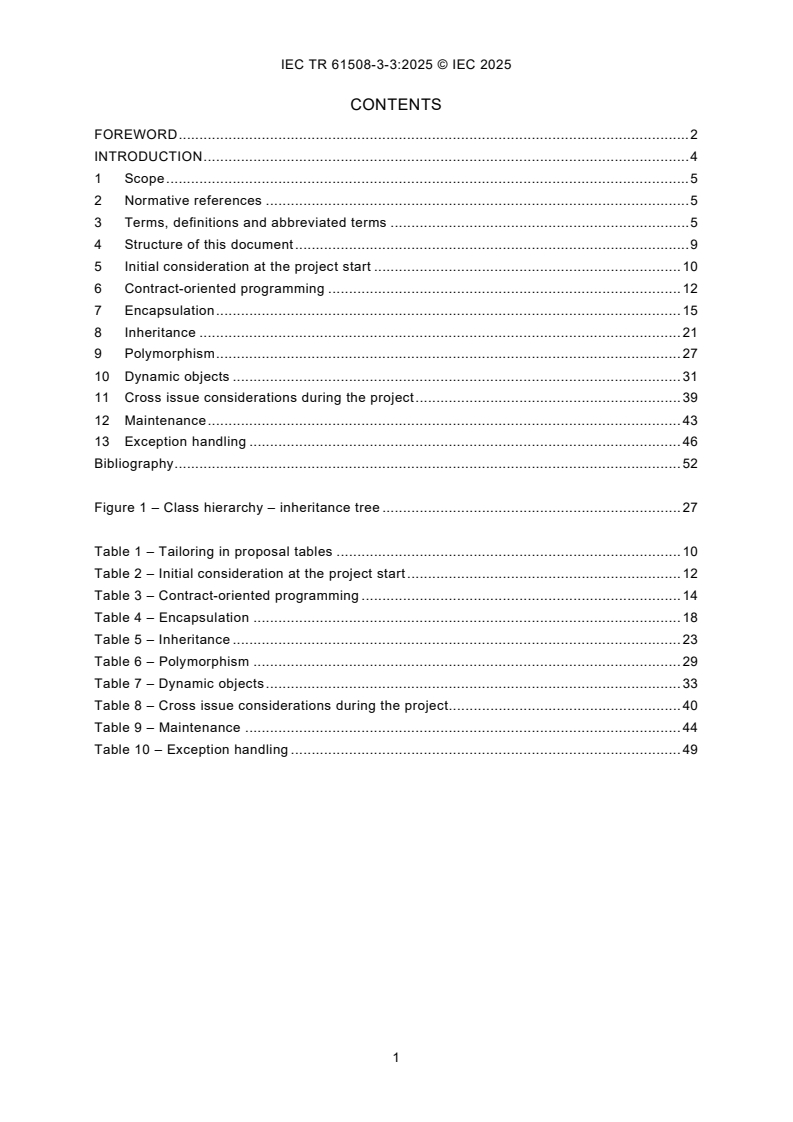
CONTENTS
FOREWORD . 2
INTRODUCTION . 4
1 Scope . 5
2 Normative references . 5
3 Terms, definitions and abbreviated terms . 5
4 Structure of this document . 9
5 Initial consideration at the project start . 10
6 Contract-oriented programming . 12
7 Encapsulation . 15
8 Inheritance . 21
9 Polymorphism . 27
10 Dynamic objects . 31
11 Cross issue considerations during the project . 39
12 Maintenance . 43
13 Exception handling . 46
Bibliography . 52
Figure 1 – Class hierarchy – inheritance tree . 27
Table 1 – Tailoring in proposal tables . 10
Table 2 – Initial consideration at the project start . 12
Table 3 – Contract-oriented programming . 14
Table 4 – Encapsulation . 18
Table 5 – Inheritance . 23
Table 6 – Polymorphism . 29
Table 7 – Dynamic objects . 33
Table 8 – Cross issue considerations during the project. 40
Table 9 – Maintenance . 44
Table 10 – Exception handling . 49
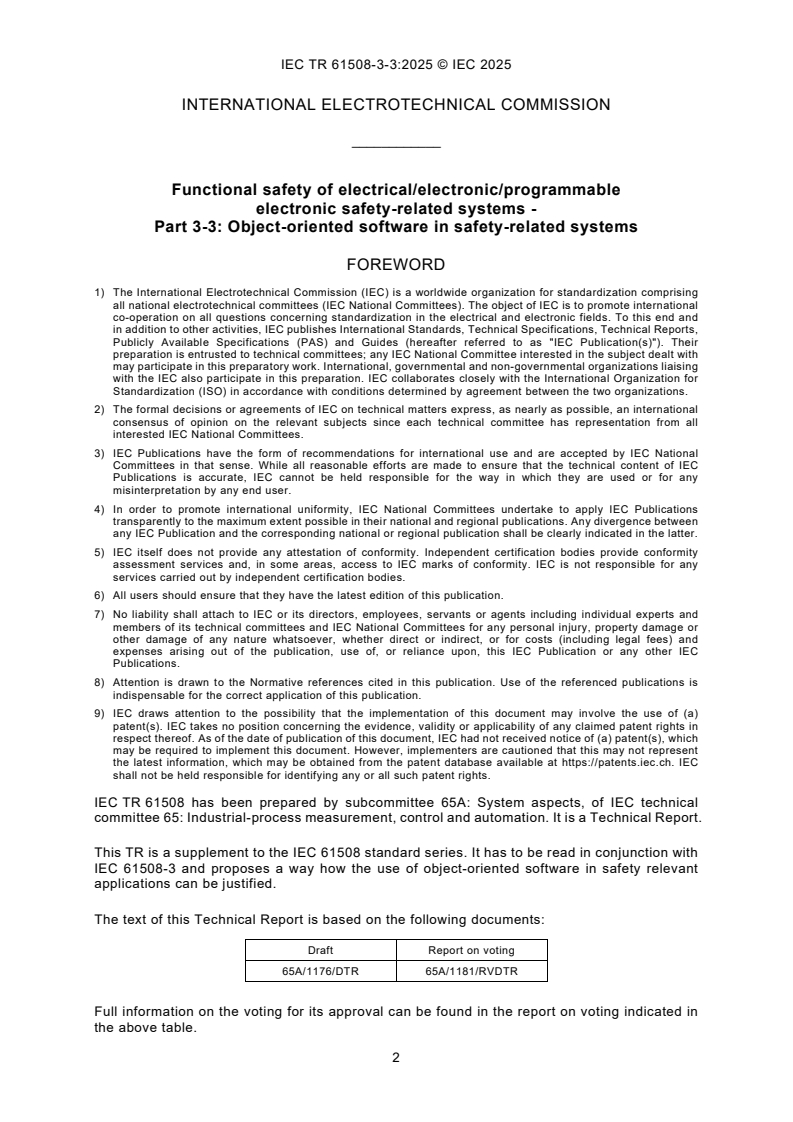
INTERNATIONAL ELECTROTECHNICAL COMMISSION
____________
Functional safety of electrical/electronic/programmable
electronic safety-related systems -
Part 3-3: Object-oriented software in safety-related systems
FOREWORD
1) The International Electrotechnical Commission (IEC) is a worldwide organization for standardization comprising
all national electrotechnical committees (IEC National Committees). The object of IEC is to promote international
co-operation on all questions concerning standardization in the electrical and electronic fields. To this end and
in addition to other activities, IEC publishes International Standards, Technical Specifications, Technical Reports,
Publicly Available Specifications (PAS) and Guides (hereafter referred to as "IEC Publication(s)"). Their
preparation is entrusted to technical committees; any IEC National Committee interested in the subject dealt with
may participate in this preparatory work. International, governmental and non-governmental organizations liaising
with the IEC also participate in this preparation. IEC collaborates closely with the International Organization for
Standardization (ISO) in accordance with conditions determined by agreement between the two organizations.
2) The formal decisions or agreements of IEC on technical matters express, as nearly as possible, an international
consensus of opinion on the relevant subjects since each technical committee has representation from all
interested IEC National Committees.
3) IEC Publications have the form of recommendations for international use and are accepted by IEC National
Committees in that sense. While all reasonable efforts are made to ensure that the technical content of IEC
Publications is accurate, IEC cannot be held responsible for the way in which they are used or for any
misinterpretation by any end user.
4) In order to promote international uniformity, IEC National Committees undertake to apply IEC Publications
transparently to the maximum extent possible in their national and regional publications. Any divergence between
any IEC Publication and the corresponding national or regional publication shall be clearly indicated in the latter.
5) IEC itself does not provide any attestation of conformity. Independent certification bodies provide conformity
assessment services and, in some areas, access to IEC marks of conformity. IEC is not responsible for any
services carried out by independent certification bodies.
6) All users should ensure that they have the latest edition of this publication.
7) No liability shall attach to IEC or its directors, employees, servants or agents including individual experts and
members of its technical committees and IEC National Committees for any personal injury, property damage or
other damage of any nature whatsoever, whether direct or indirect, or for costs (including legal fees) and
expenses arising out of the publication, use of, or reliance upon, this IEC Publication or any other IEC
Publications.
8) Attention is drawn to the Normative references cited in this publication. Use of the referenced publications is
indispensable for the correct application of this publication.
9) IEC draws attention to the possibility that the implementation of this document may involve the use of (a)
patent(s). IEC takes no position concerning the evidence, validity or applicability of any claimed patent rights in
respect thereof. As of the date of publication of this document, IEC had not received notice of (a) patent(s), which
may be required to implement this document. However, implementers are cautioned that this may not represent
the latest information, which may be obtained from the patent database available at https://patents.iec.ch. IEC
shall not be held responsible for identifying any or all such patent rights.
IEC TR 61508 has been prepared by subcommittee 65A: System aspects, of IEC technical
committee 65: Industrial-process measurement, control and automation. It is a Technical Report.
This TR is a supplement to the IEC 61508 standard series. It has to be read in conjunction with
IEC 61508-3 and proposes a way how the use of object-oriented software in safety relevant
applications can be justified.
The text of this Technical Report is based on the following documents:
Draft Report on voting
65A/1176/DTR 65A/1181/RVDTR
Full information on the voting for its approval can be found in the report on voting indicated in
the above table.
The language used for the development of this Technical Report is English.
This document was drafted in accordance with ISO/IEC Directives, Part 2, and developed in
accordance with ISO/IEC Directives, Part 1 and ISO/IEC Directives, IEC Supplement, available
at www.iec.ch/members_experts/refdocs. The main document types developed by IEC are
described in greater detail at www.iec.ch/publications.
A list of all parts in the IEC 61508 series, published under the general title Functional safety of
electrical/electronic/programmable electronic safety-related systems, can be found on the IEC
website.
The committee has decided that the contents of this document will remain unchanged until the
stability date indicated on the IEC website under webstore.iec.ch in the data related to the
specific document. At this date, the document will be
• reconfirmed,
• withdrawn, or
• revised.
INTRODUCTION
This document addresses specific concepts associated with object-oriented (OO) software. It
deals only with OO software in general without referencing any specific language. Each of the
concepts is discussed under separate clauses, one addressing fundamentals – i.e. benefits,
disadvantages and counter-measures to the disadvantages, the others detailing guidance on
the attributes to be satisfied in safety-related systems, according to the systematic capability to
be achieved.
It is useful to consider addressing the language-specific best practice contained in guidelines,
coding rules, handbooks etc. for each OO language. If an object-oriented module is modified,
it is proposed that the entire module conform to the guidance within this document. Further, it
is useful to consider assessing the interfaces, interactions and side effects on unchanged
modules to determine that there is no impact on other unchanged modules and their integration.
See also IEC 61508-3:2010, Annex D.
This document is intended as a supplement to the existing requirements in the IEC 61508 series
which continue to apply.
1 Scope
This part of IEC 61508, which is a Technical Report, makes a proposal as to which topics to
consider and which methods and techniques to use when designing object-oriented software to
ensure suitable quality for use in functional safety applications.
Object-oriented languages are perceived as "state-of-the-art" nowadays. Such languages seem
to be excluded from use by several statements in IEC 61508-3. However there are additions in
some tables such as in IEC 61508-3:2010, Table B.1, where notes are added under which their
use might be justified. Such exceptions that would allow, for example, dynamic objects, name
the main concerns such as memory allocation and predictable timing issues and guide the user
to safe use of object-oriented languages. These considerations are taken up in this document
to specify methods and techniques that allow the reduction of systematic faults to the levels
required by the respective systematic capabilities.
This document is not intended to replace any part of IEC 61508-3. Rules that exist in
IEC 61508-3 are valid here as well and are not repeated, including rules that concern:
• the software life cycle,
• involvement of the assessor,
• modularization,
• principle of information hiding,
• proving and conventional testing,
• basic aspects of documentation,
• low coupling and high cohesion,
• responsibilities and training of people,
• operational experience as described in IEC 61508-4 and IEC 61508-7.
2 Normative references
The following documents are referred to in the text in such a way that some or all of their content
constitutes requirements of this document. For dated references, only the edition cited applies.
For undated references, the latest edition of the referenced document (including any
amendments) applies.
IEC 61508-1:2010 Functional Safety of electrical/electronic/programmable electronic
safety-related systems - Part 1: General requirements
IEC 61508-4, Functional Safety of electrical/electronic/programmable electronic safety-related
systems - Part 4: Definitions and abbreviations
3 Terms, definitions and abbreviated terms
3.1 Terms and definitions
For the purposes of this document, the terms and definitions given in IEC 61508-4 and the
following apply.
ISO and IEC maintain terminology databases for use in standardization at the following
addresses:
• IEC Electropedia: available at https://www.electropedia.org/
• ISO Online browsing platform: available at https://www.iso.org/obp
3.1.1
abstract class
class that cannot be directly instantiated
3.1.2
abstract data type
data type for which the user can create instances and operate on those instances, but the range
of valid operations available to the user does not depend in any way on the internal
representation of the instances or the way in which the operations are realized. The data is
"abstract" in the sense that values in the extent, i.e., the concrete values that represent the
instances, are any set of values that support the operations and are irrelevant to the user. An
abstract data type defines the operations on the data as part of the definition of the data and
separates what can be done (interface) from how it is done (realization)
[SOURCE: ISO/IEC/IEEE 31320-2:2012, 3.1.2]
3.1.3
abstraction layer
interface to the system that allows some or all the capabilities of the system to be accessed in
a different and generally more abstract manner
Note 1 to entry: An abstraction layer for a module is the same in the case where the system is the module.
[SOURCE: ISO 22166-1:2021, 3.1.1]
3.1.4
assertion
sentence or proposition in logic which is asserted (or assumed) to be true
[SOURCE: ISO/TS 21526:2019, 3.7]
3.1.5
invariant
assertion that is always true for a specified segment or at a specified
point of a computer program
3.1.6
pre-condition
condition that is required to be true before making an execution of a property request
[SOURCE: ISO/IEC/IEEE 31320-2:2012, 3.1.148]
3.1.7
post-condition
condition that is guaranteed to be true after a successful execution of a property request
[SOURCE: ISO/IEC/IEEE 31320-2:2012, 3.1.147]
3.1.8
base class
class which defines attributes and operations that are inherited by a subclass via a
generalization relationship
[SOURCE: ISO 13374-2:2007, B.2.2.7]
3.1.9
cast
treat an object of one type as an object of another type
[SOURCE: ISO/IEC/IEEE 31320-2:2012, 3.1.17]
3.1.10
down-cast
cast of an object from a base class sub-object, to a more derived class sub-object
Note 1 to entry: Depending on the complexity of the object's type, this may make RTTI (runtime type information)
and the use of the dynamic cast operator necessary.
[SOURCE: ISO/IEC TR 18015:2006, 3.15]
3.1.11
delegation
action that assigns something, such as authorization, responsibility or provision of a service to
another object
Note 1 to entry: A delegation, once made, may later be withdrawn.
[SOURCE: ISO/IEC 15414:2015, 6.6.6]
3.1.12
derived class
class created by inheritance from another class
Note 1 to entry: A derived class is also named extended class or child class.
[SOURCE: IEC 61131-3:2013, 3.27]
3.1.13
flattening
virtual disassembling an inheritance hierarchy into classes of the lowest level; mainly for
deriving the necessary or desired test cases
3.1.14
framework
reusable design (models and/or code) that can be refined (specialized) and extended to provide
some portion of the overall functionality of many applications
[SOURCE: ISO/IEC/IEEE 31320-2:2012, 3.1.64]
3.1.15
friend class
other class that has the same access rights to methods and attributes as the class itself
3.1.16
garbage collection
storage allocation technique in which the contents of all
allocated storage areas are moved to the beginning of the storage space and the remaining
storage blocks are combined into a single block
[SOURCE: ISO/IEC/IEEE 24765:2017, 3.2412, modified – the term “memory compaction” has
been removed, the domain has been added, and definition 2 has been removed.]
3.1.17
information hiding
principle of denying access to or knowledge of a language construct or specific details thereof,
except for those details considered essential for the user to know
3.1.18
inheritance hierarchy
hierarchical arrangement of managed object classes where the hierarchy is organized on the
basis of the class specialization
[SOURCE: ISO/IEC 10165-1:1993, 3.8.17]
3.1.19
interface (of an object)
names of all the methods defined for the object, including inherited methods; for each of the
methods the ordered list of its formal parameters and the description and passing technique
associated with each, any returned value and its description, and exceptions that can be raised
[SOURCE: ISO/IEC 1989:2014, 4.109]
3.1.20
Liskov Substitution Principle
LSP
principle for hierarchies in which none of the used methods is supposed to have a stronger pre-
condition than the related methods of the classes it is derived from and no weaker post-
condition than the related methods of these classes
3.1.21
memory fragmentation
available memory split into pieces such that it is difficult to use
3.1.22
reflective construct
construct that is viewed as the cause of measures in the relationship between a construct and
its measures
[SOURCE: ISO/IEC/IEEE 24765:2017, 3.3361]
3.1.23
exception
1) event that causes suspension of normal program execution
2) indication that an operation request was not performed successfully
Note 1 to entry: Types include addressing exception, data exception, operation exception, overflow exception,
protection exception, and underflow exception.
[SOURCE: ISO/IEC/IEEE 24765:2017, 3.1496]
3.1.24
class
description of a set of objects that share the same attributes, operations, relationships, and
semantics; classes may have attributes and may support operations
[SOURCE: ISO/IEC 14776-261:2012, 3.1.26]
3.1.25
root class
class, from which all other classes in a hierarchy are derived, but which is not derived itself
from any other class, top of an inheritance hierarchy, special base class
Note 1 to entry: In a wider context a root class forms a description of a set of objects that share the same attributes,
operations, relationships, and semantics; classes may have attributes and may support operations.
3.2 Abbreviated terms
EUC Equipment under control
OO Object-oriented or object-orientation
SIL Safety integrity level
4 Structure of this document
4.1 General
This document describes the special characteristics of OO software and methods for mitigation
of the safety related problems considering these topics:
1) initial considerations at the project start;
2) contract-oriented programming;
3) encapsulation;
4) inheritance;
5) polymorphism;
6) dynamic objects;
7) cross issue considerations during the project;
8) maintenance;
9) exception handling.
Each of the concepts is discussed under two separate aspects:
1) fundamentals: benefits, disadvantages and counter-measures to the disadvantages;
2) mitigating methods: to satisfy in safety-related systems, according to the systematic
capability to be achieved.
This document does not refer to a specific lifecycle. The main focus is on the development
phase (Box 10) of the life cycle of IEC 61508-1, and the details that conform to IEC 61508-3.
4.2 Tailoring of methods or techniques
Clause 5 to Clause 13 propose techniques and measures based on topics related to object-
oriented software. The appropriate techniques and measures are selected according to the
systematic capability. The use of other measures and techniques where necessary can be
considered, provided that the same effectiveness is met. Details regarding the techniques and
measures are described in Table 1.
The ranking of the techniques and measures is linked to the concept of effectiveness used in
IEC 61508-2.
Table 1 – Tailoring in proposal tables
++ The technique or measure is strongly proposed for this systematic capability. If this technique or measure
is not used then the rationale behind not using it is detailed during the safety planning and agreed with
the assessor.
+ The technique or measure is proposed for this safety integrity level as a lower proposal to a ++ proposal.
- The technique or measure has no proposal for or against being used.
-- The technique or measure is positively not proposed for this safety integrity level. If this technique or
measure is used then the rationale behind using it is detailed during the safety planning and agreed with
the assessor.
All other factors being equal, techniques which are ranked ++ will be more effective in either
preventing the introduction of systematic faults during software development, or (for the case
of the software architecture) more effective in controlling residual faults in the software revealed
during execution than techniques ranked as +.
Given the large number of factors that affect systematic capability it is not possible to give an
algorithm for combining the techniques and measures that will be correct for any given
application. For a particular application, it is proposed to state the selected combination of
techniques or measures during safety planning found appropriate.
5 Initial consideration at the project start
5.1 Fundamentals
5.1.1 General
Clause 5 deals with issues relevant to the decision whether OO design and programming could
be used. It is considered useful to take the indicated considerations and measures before
design or programming starts, or both.
5.1.2 Flexible design capabilities
Benefits:
– use of tailored design options to the problem at hand.
Problems:
– fault options might be missed in verification planning.
5.1.3 Facilitates formal graphical design concepts
Benefits:
– graphical design enables the designer to grasp the main design features at a glance;
– most graphical design techniques are based on formal concepts;
– modern graphical design formalisms cover a broad range of relevant design aspects, from
data models to state machines to constraints;
– graphical designs are easier to understand for many people.
Problems:
– complex graphical designs might lead to restricted safety due to inefficient verification
techniques;
– complex graphical designs might lead to restricted safety due to inefficient implementation
and verification efforts;
– effort for manual test planning might explode;
– verification strategies planned without regard to the graphical design might become
inefficient.
5.1.4 Abstraction layers
Benefits:
– concept of interfaces of class hierarchies enables an easier overview over the software
system.
Problems:
– additional editing effort.
5.1.5 Facilitates reuse
Benefits:
– improved encapsulation, inheritance and polymorphism each provide additional facilities
that could be exploited for reuse;
– by helping to reduce code redundancy, OO designs cater for reuse from the very beginning
of a design.
Problems
– reuse might lead to unwanted functionality;
– reused software might contain elements which are not validated according to safety
prerequisites;
– reuse might increase the risk of an unstructured heap of code entities.
5.1.6 More functionality in the programming environment
Benefits:
– OO languages provide implicit mechanisms to cope with the functionality added by OO's
concepts (through compilation or run-time systems or IDE), like stack handling for recursion.
Problems:
– maximum response time exceeded due to invisible activities.
5.2 Mitigating measures
A typical set of mitigating measures would be as follows:
1) requirements of IEC 61508-3 and their SIL classification states are observed;
2) requirements of IEC 61508-3 are adjusted as per the proposals in this document;
3) proposals of 5.3 are observed from the beginning of the development cycle;
4) adequate patterns and tools are used;
5) considered libraries are known before programming starts;
NOTE OO software generally relies heavily on libraries.
6) libraries are evaluated to meet the proposals of this document;
7) ease of modification and adaptation are considered from the beginning on during the whole
development project;
8) well-accepted language-specific design and coding rules are followed and documented
throughout the project. See also IEC 61508-3.
It is beneficial to know the safety-related language manual of the manufacturer as well as the
compiler, programming environment, run-time system and operating system to be used and
when the developer is competent in using them. See also IEC 61508-3.
5.3 Technical details
5.3.1 Proposals
Table 2 contains proposals for consideration at project start.
Table 2 – Initial consideration at the project start
No. Proposal References SC1 SC2 SC3 SC4
5.3.1.1 Use OO patterns or frameworks, or both. + + + ++
Use automated OO-related methods and IEC 61508-3:2010, 7.4.4; + + + +
5.3.1.2
tools. 7.3.2.2
5.3.2 OO patterns and/or frameworks
It is better to use existing OO design patterns and frameworks instead of completely new design.
The design and implementation effort will be reduced and already existing safety considerations
for these patterns and frameworks will help avoid new errors. Moreover, since people are
already acquainted with them, understanding the new designs will be much easier. Patterns
and frameworks as they are common in OO design are helpful in taking advantage of design
experiences from earlier projects. If a framework is available that has already been employed
successfully for other projects or similar problems, it is beneficial to use it, or use a part of it,
or at least take it as a template. The requirements for pre-existing software from IEC 61508-1,
IEC 61508−2 and IEC 61508−7 apply accordingly.
5.3.3 Automated OO-related methods and tools
In OO, methods and tools exist to support specification, design, code generation and verification
including test generation on the base of (semi-)formal specifications and designs.
Semi-formal modelling systems such as UML provide a sound basis for automated design
verification, code and test generation where, whenever the corresponding UML software is
appropriately validated (according to tool levels and SILs), reliable results are reached.
6 Contract-oriented programming
6.1 Fundamentals
6.1.1 General
Contracts are an implementation of the general concept of behavioural subtyping which extends
the inheritance principle: Its basis – the Liskov substitution principle – states that replacing any
object of a given class by an object of a derived class results in identically correct statements
without altering any of its genuine properties.
NOTE The Liskov substitution principle (LSP) is observed especially during creation of an object hierarchy.
Though not necessarily related to object-oriented programming – contract-oriented
programming could as well be applied in more basic programming approaches, yet with the aid
of a lot of infrastructure programming. It is best integrated into the object-oriented approach
where many programming languages already support it, for example Ada, Eiffel, Scala, or are
planned to support it in the future for example C++ .
Contracts provide means for formal description of interfaces, designs and code, and with the
aid of run-time checking the constraints allow for a better way of introducing exceptions. If
applied properly, however, explicitly raising exceptions becomes unnecessary.
Contract-oriented programming provides means for static formal correctness checks of designs
and programs. Even if contract-oriented programming is not used consider applying the
proposed measures.
6.1.2 Definition of interfaces
Benefits:
– well-defined interfaces by formal definitions;
– well-defined specification of methods;
– responsibility-driven design;
– support of run-time checks.
Problems:
– necessity of learning another type of thinking;
– if not used properly, faulty situations might not be adequately checked and formal
verification becomes more difficult;
– overhead for writing the contracts.
6.1.3 Controlled checkpointing
Benefits:
– better testing capabilities;
– well defined location of checkpoints.
Problems:
– redundancy due to checkpoints;
– maximum allowed reaction time exceeded due to invisible activities.
6.1.4 Verification, validation
Benefits:
– tests could be supported by the contract; in particular test data selection could be supported
by preconditions, while test evaluation could be supported by post conditions;
– tests could be generated such as to attempt to breach the contracts;
– improved efficiency and reliability;
– already existing designs could be verified.
___________
Ada, Eiffel, Scala and C++ are examples of suitable products available commercially. This information is given
for the convenience of users of this document and does not constitute an endorsement by IEC of these products.
Problems:
– overhead for ensuring that classes are derived such that preconditions and invariants within
the hierarchy are properly set.
6.2 Mitigating measures
A typical set of mitigating measures would be as follows:
1) contracts are used during design and coding;
2) verification is done against the contracts; contracts are used for test planning in general;
3) all contracts are covered during testing.
6.3 Technical details
6.3.1 Proposals
Table 3 contains proposals for consideration for contract-oriented programming.
Table 3 – Contract-oriented programming
No. Proposal References SC1 SC2 SC3 SC4
IEC 61508- + + + ++
6.3.1.1 Class invariants are stated and kept.
3:2010, 7.4.2.2
Invariants of a base class are preserved in a derived IEC 61508- + + ++ ++
6.3.1.2
class. 3:2010, 7.4.2.2
IEC 61508- + + ++ ++
3:2010, Table
6.3.1.3 All assertion checks are executed during testing. A.2 row 3a;
Table C.2 row
3a
Pre- and post-conditions and invariants of methods are IEC 61508- ++ ++ ++ ++
6.3.1.4
explicitly stated. 3:2010, 7.4.2.2
Pre-conditions of a base class are not to be IEC 61508- ++ ++ ++ ++
6.3.1.5
strengthened in a derived class. 3:2010, 7.4.2.2
IEC 61508- ++ ++ ++ ++
Post-conditions of a base class will not be weakened 3:2010,
6.3.1.6
in a derived class. 7.4.2.2; Table
C.2
IEC 61508- + + ++ ++
All component interactions are tested such as to cover
6.3.1.7 all possible combinations of internal pre- and post- 3:2010, Table
states. A.6
No derived class introduces new public methods for ++ ++ ++ ++
6.3.1.8 modifying the state of the base class (history
constraint).
6.3.2 Keeping class invariants
In OO, invariants are especially important, as they are a major means of asserting integrity.
Class invariants help specifying interfaces of classes, documenting and understanding the
semantics of classes and class hierarchies.
6.3.3 Preserved invariants of a base class in a derived class
Facilitates understanding the related hierarchy by understanding the base class.
6.3.4 Executing all assertion checks during testing
The use of assertions is beneficial in general. Assertions are reasonable mainly for exhaustive
understanding of all possible states of the EUC, the feasibility of application-specific recovery,
and the anticipation of unintended behaviour modes. OO languages offer better possibilities of
placing assertions than conventional languages do. However, consider ensuring that assertions
do not cause any unacceptable timing behaviour in any mode of operation. Preferably use
simple methods by which assertions are avoided; for example where get() or set() methods
are concerned.
6.3.5 Explicitly stated pre- and post-conditions and invariants of methods
Explicitly stating pre- and post-conditions facilitates deriving test cases and testing data,
improves understandability of the source code, helps demonstrate compliance with the design,
and could be used for verification. Use of a formal specification is generally supported by tools.
The use of formal languages, methods and tools (e.g. Spec#, JML, SPARK Ada, OCL) is
encouraged.
Pre- and post-conditions support proofs of correctness.
6.3.6 Not strengthened pre-conditions of a base class in a derived class
See 6.3.5.
6.3.7 Not weakened postconditions of a base class in a derived class
See 6.3.5.
6.3.8 Testing all component interactions
As common in safety-related software.
6.3.9 No derived class introducing new public methods for modifying the state of the
base class
To exclude violation of contracts by newly introduced methods.
7 Encapsulation
7.1 Fundamentals
7.1.1 General
Most OO languages provide a fundamental construct commonly called "class" that collects both
data and functional aspects, called "methods", into a single entity. The class is the basic
concept of most OO languages.
A class is a type and thus it is in principle instantiable into multiple objects. The encapsulation
aspect resembles the concept of modules in conventional languages and therefore most of the
rules of IEC 61508-3 apply for class design. This, however, introduces the obligations of
handling creation and destruction, copying and referencing.
Clause 7 considers only the aspects that a class is a type.
7.1.2 Layering, abstraction layers
Benefits:
– better nesting of functionalities;
– ease of constructing complex nested systems;
– decreased complexity of single development tasks like implementing a single class, because
of increased abstraction;
– if done properly, fine-grained distribution of development tasks;
– ease of combination.
Problems:
– loss of understandability of control flow;
– more implicit mechanisms influence the control flow;
– OO spaghetti design;
– combinatorial explosion of tests done in combination with other objects by overlapping
responsibilities;
– potentially unintended functionality;
– side effects;
– losing overview.
7.1.3 Instances
Benefits:
– ease of handling objects.
Problems:
– large memory consumption;
– control of memory consumption;
– temptation to use dynamic memory, even if unnecessary;
– keeping track of creation & destruction;
– keeping track of copy & reference.
7.1.4 Abstract data types
Benefits:
– theoretically sound concepts during the design phase;
– facilitates application of formal methods;
– formally concise specification of data structures.
Problems:
– understandability suffers in case of bad application.
7.1.5 Coverage analysis
Benefits:
– due to simple methods fewer branches per method to be covered.
Problems:
– more hidden branches are to be observed.
7.1.6 Granularity of unit tests
Benefits:
– improved coverage at finer degree (class).
Problems:
– test results are not significant.
7.1.7 Tests with objects from other classes
Benefits: None.
Problems:
– combinatorial explosion of potential test cases.
7.1.8 Free combination of objects
Benefits:
– small, tightly coupled units of code;
– ease of separation of responsibilities.
Problems:
– diminished readability and addressing of wrong entities due to syntactical short-cuts;
– objects in indeterminate state due to incomplete initialization;
– behaviour of an object is not tested with respect to all potential states of that object;
– understandability problems from checking and maintenance problems;
– inflexible design in conflict with maintainability and modern development approaches; hard
to keep track of control flow.
7.1.9 Fine-grained modularisation
Benefits:
– increase of code sharing;
– ease of modification and extension because of flexible combination;
– decrease the complexity of interfaces;
– separation of concerns;
– more precise interface specifications possible.
Problems:
– unchecked problems due to unchecked code combinations;
– unintended and invisible consequences of actions due to side effects;
– behaviour of an object is not tested with respect to all of its potential states;
– not achieving the assumed coverage goal as intended;
– inappropriate usage;
– obfuscated code.
7.2 Mitigating measures
A typical set of mitigating measures would be as follows:
1) interface-segregation principle: client is not forced to depend on methods that are not used;
NOTE The interface-segregation principle (ISP) states that a client must not be forced to depend on methods
it does not use. ISP splits interfaces that are very large into smaller and more specific ones so that clients will
only have to know about the methods that are of interest to them. Such shrunken interfaces are also called role
interfaces. ISP is intended to keep a system decoupled and thus easier to refactor, change, and redeploy.
2) either all hidden branches are tracked by test planning or the design/implementation forms
a basis to prove that the issues from hidden branches are separated;
3) modules that use abstract data types are separated and cross checked by appropriate
personnel. The results with the specific scope of understandability and usability are
reviewed and re-iterated during development;
4) the significance of tests is classified by test planning;
5) the call tree of the individual methods is analysed to demonstrate which selection
possibilities exist and are not avoided;
6) side effects are avoided (see 7.3.11, 7.3.12 below);
7) metrics are applied for class design complexities, interfaces and code sizes;
7.3 Technical details
7.3.1 Proposals
Table 4 contains proposals for consideration with encapsulation.
Table 4 – Encapsulation
No. Proposal References SC1 SC2 SC3 SC4
Clause 6 (this - - + +
document);
OO metrics are specified and used for the
7.3.1.1
project.
IEC 61508-3:2010,
Table C.1, R2
Clause 6 (this - - + +
document);
Target values for the metrics of the project are
7.3.1.2
specified.
IEC 61508-3:2010,
Table C.1, R2
Clause 6 (this - - + +
document);
The effects of applying a metric as part of the
7.3.1.3
verification of the project is documented.
IEC 61508-3:2010,
Table C.1, R2
For all pairs of communicating objects that IEC 61508-3:2010, - + + +
implement state machines, all pairs of 7.2.2.10 a); 7.4.3.2
7.3.1.4 corresponding transitions of invoking and e); 7.9.2.13; Clause
invoked objects are traversed by at least one F.3 d); Clause F.4
test case. d).
Design patterns and other forms of re-usable See Gamma et al. in - + + +
7.3.1.5
structures or architectures are used. the Bibliography
Composite classes are identified such that + ++ ++ ++
7.3.1.6 each component takes over one well defined
responsibility.
Classes have only one responsibility, are highly ++ ++ ++ ++
7.3.1.7 cohesive in themselves and loosely coupled to
other classes.
No. Proposal References SC1 SC2 SC3 SC4
Clause 6 (this + + ++ ++
The methods of a class and their signatures
document),
are designed to optimally support the intended
7.3.1.8
IEC 61508-3:2010,
responsibility of that class and are
Clause F.7 Table
documented.
F.2
Operator overloading is used only with sound ++ ++ ++ ++
7.3.1.9
and well-founded documented justification.
Methods access attributes of their object
+ + + +
7.3.1.10
directly only via 'this' or 'self'.
All possibly used side effects of methods are ++ ++ ++ ++
7.3.1.11
specified.
Every side effect is justified. The number of ++ ++ ++ ++
7.3.1.12
side effects is reduced as far as possible.
7.3.1.13 Public attributes are not used. + + ++ ++
7.3.2 OO metrics
OO metrics for the project are specified and used. Loss of understandability could be controlled
by limiting the complexity of the object structure, by means of increasing the level of detail of
the documentation and good structuring of the problematic part of the whole software system.
Introducing metrics is a means of achieving this.
Classical software engineering metrics could be applied. OO uses additional metrics like depth
of inheritance, number of classes, number of class hierarchies, number of objects, numbers
and size of OO interfaces etc.
7.3.3 Target value for the metrics
Target values for the metri
...