

IEC 61760-1:2020
(Main)Surface mounting technology - Part 1: Standard method for the specification of surface mounting components (SMDs)
General Information
- Abstract
IEC 61760-1:2020 defines requirements for component specifications of electronic components that are intended for usage in surface mounting technology. To this end, it specifies a reference set of process conditions and related test conditions to be considered when compiling component specifications.
The objective of this document is to ensure that a wide variety of SMDs can be subjected to the same placement, mounting and subsequent processes (e.g. cleaning, inspection) during assembly. This document defines tests and requirements that need to be part of any SMD component's general, sectional or detail specification. In addition, this document provides component users and manufacturers with a reference set of typical process conditions used in surface mounting technology.
Some of the requirements for component specifications in this document are also applicable to components with leads intended for mounting on a circuit board. Cases for which this is appropriate are indicated in the relevant subclauses.
This edition includes the following significant technical changes with respect to the previous edition:
a) inclusion of additional mounting methods: conductive glue bonding, sintering and solderless interconnection.
- Status
- Published
- Publication Date
- 13-Jul-2020
- Technical Committee
- TC 91 - Electronics assembly technology
- Drafting Committee
- WG 1 - TC 91/WG 1
Overview
IEC 61760-1:2020 is an international standard published by the International Electrotechnical Commission (IEC) that defines the standard method for the specification of surface mounting components (SMDs). Specifically, it provides a comprehensive framework for the component specifications of electronic parts intended for surface mounting technology (SMT). This standard ensures that a wide variety of SMDs can withstand consistent placement, mounting, cleaning, inspection, and other assembly processes across manufacturers and users, fostering uniformity and reliability in electronics manufacturing.
The 2020 edition introduces significant updates including the addition of mounting methods such as conductive glue bonding, sintering, and solderless interconnection, expanding the scope to accommodate evolving assembly techniques.
Key Topics
Component Design and Marking
The standard outlines requirements for SMD design, including marking durability, terminal arrangement, and component outline specifics to facilitate automated handling and identification. Emphasis is placed on marking for multipin and polarity-sensitive components.Assembly Technology Requirements
IEC 61760-1 specifies robustness criteria, land pattern design recommendations, and cleanliness standards to minimize contamination during assembly. Critical factors such as surface roughness, packaging, storage, and transportation effects on component integrity are addressed.Soldering and Mounting Processes
Detailed process conditions for reflow and wave soldering are provided, including temperature profiles and thermal resistance requirements. The standard also includes guidance on solderability, wettability, and temperature sensitivity.Additional Mounting Methods
The inclusion of conductive glue bonding, sintering, and solderless interconnection reflects modern SMT practices. Requirements for surface cleanliness, bonding strength tests, terminal design, and curing heat resistance are defined to ensure suitability for these techniques.Post-Assembly and Removal
Guidelines for cleaning methods, inspection, as well as removal and replacement of SMDs using soldering or gluing techniques help maintain quality during repair or rework.Compliance and Environmental Considerations
The standard highlights the necessity for material declarations, environmental regulatory compliance, and supply chain transparency to support sustainable and responsible component usage.
Applications
IEC 61760-1:2020 is essential for manufacturers, designers, and quality engineers involved in the production and specification of surface mounting devices used in:
- Consumer electronics like smartphones, laptops, and wearable devices
- Automotive electronics requiring reliable soldering and mounting under harsh conditions
- Industrial and medical devices where precise component placement and reliability are critical
- Aerospace and defense electronics that demand rigorous compliance and durability standards
The standard facilitates consistent component quality, enabling automated assembly lines to operate efficiently and minimizing defects related to improper component design or handling.
Related Standards
To fully leverage IEC 61760-1:2020 for surface mounting technology, consider these complementary standards:
- IPC-7351 – Generic Requirements for Surface Mount Design and Land Pattern Standard
- IEC 60068 series – Environmental testing for electronic components
- IPC-A-610 – Acceptability of Electronic Assemblies
- JEDEC JESD22 – Reliability and stress test methods for semiconductor devices
Together, these standards help in defining component design, testing, and assembly acceptability criteria, reinforcing the quality and performance of surface mounting technology applications.
Keywords: IEC 61760-1, surface mounting technology, SMD specification, component design, soldering, conductive glue bonding, sintering, solderless interconnection, electronic component standards, SMT assembly process, component marking, land pattern design, surface mount device, electronic manufacturing standards.
Relations
- Effective Date
- 05-Sep-2023
- Effective Date
- 05-Sep-2023
Frequently Asked Questions
IEC 61760-1:2020 is a standard published by the International Electrotechnical Commission (IEC). Its full title is "Surface mounting technology - Part 1: Standard method for the specification of surface mounting components (SMDs)". This standard covers: IEC 61760-1:2020 defines requirements for component specifications of electronic components that are intended for usage in surface mounting technology. To this end, it specifies a reference set of process conditions and related test conditions to be considered when compiling component specifications. The objective of this document is to ensure that a wide variety of SMDs can be subjected to the same placement, mounting and subsequent processes (e.g. cleaning, inspection) during assembly. This document defines tests and requirements that need to be part of any SMD component's general, sectional or detail specification. In addition, this document provides component users and manufacturers with a reference set of typical process conditions used in surface mounting technology. Some of the requirements for component specifications in this document are also applicable to components with leads intended for mounting on a circuit board. Cases for which this is appropriate are indicated in the relevant subclauses. This edition includes the following significant technical changes with respect to the previous edition: a) inclusion of additional mounting methods: conductive glue bonding, sintering and solderless interconnection.
IEC 61760-1:2020 defines requirements for component specifications of electronic components that are intended for usage in surface mounting technology. To this end, it specifies a reference set of process conditions and related test conditions to be considered when compiling component specifications. The objective of this document is to ensure that a wide variety of SMDs can be subjected to the same placement, mounting and subsequent processes (e.g. cleaning, inspection) during assembly. This document defines tests and requirements that need to be part of any SMD component's general, sectional or detail specification. In addition, this document provides component users and manufacturers with a reference set of typical process conditions used in surface mounting technology. Some of the requirements for component specifications in this document are also applicable to components with leads intended for mounting on a circuit board. Cases for which this is appropriate are indicated in the relevant subclauses. This edition includes the following significant technical changes with respect to the previous edition: a) inclusion of additional mounting methods: conductive glue bonding, sintering and solderless interconnection.
IEC 61760-1:2020 is classified under the following ICS (International Classification for Standards) categories: 31.240 - Mechanical structures for electronic equipment. The ICS classification helps identify the subject area and facilitates finding related standards.
IEC 61760-1:2020 has the following relationships with other standards: It is inter standard links to IEC 61760-1:2026, IEC 61760-1:2006. Understanding these relationships helps ensure you are using the most current and applicable version of the standard.
IEC 61760-1:2020 is available in PDF format for immediate download after purchase. The document can be added to your cart and obtained through the secure checkout process. Digital delivery ensures instant access to the complete standard document.
Standards Content (Sample)
IEC 61760-1 ®
Edition 3.0 2020-07
INTERNATIONAL
STANDARD
NORME
INTERNATIONALE
colour
inside
Surface mounting technology –
Part 1: Standard method for the specification of surface mounting components
(SMDs)
Technique du montage en surface –
Partie 1: Méthode normalisée pour la spécification des composants montés en
surface (CMS)
All rights reserved. Unless otherwise specified, no part of this publication may be reproduced or utilized in any form
or by any means, electronic or mechanical, including photocopying and microfilm, without permission in writing from
either IEC or IEC's member National Committee in the country of the requester. If you have any questions about IEC
copyright or have an enquiry about obtaining additional rights to this publication, please contact the address below or
your local IEC member National Committee for further information.
Droits de reproduction réservés. Sauf indication contraire, aucune partie de cette publication ne peut être reproduite
ni utilisée sous quelque forme que ce soit et par aucun procédé, électronique ou mécanique, y compris la photocopie
et les microfilms, sans l'accord écrit de l'IEC ou du Comité national de l'IEC du pays du demandeur. Si vous avez des
questions sur le copyright de l'IEC ou si vous désirez obtenir des droits supplémentaires sur cette publication, utilisez
les coordonnées ci-après ou contactez le Comité national de l'IEC de votre pays de résidence.
IEC Central Office Tel.: +41 22 919 02 11
3, rue de Varembé info@iec.ch
CH-1211 Geneva 20 www.iec.ch
Switzerland
About the IEC
The International Electrotechnical Commission (IEC) is the leading global organization that prepares and publishes
International Standards for all electrical, electronic and related technologies.
About IEC publications
The technical content of IEC publications is kept under constant review by the IEC. Please make sure that you have the
latest edition, a corrigendum or an amendment might have been published.
IEC publications search - webstore.iec.ch/advsearchform Electropedia - www.electropedia.org
The advanced search enables to find IEC publications by a The world's leading online dictionary on electrotechnology,
variety of criteria (reference number, text, technical containing more than 22 000 terminological entries in English
committee,…). It also gives information on projects, replaced and French, with equivalent terms in 16 additional languages.
and withdrawn publications. Also known as the International Electrotechnical Vocabulary
(IEV) online.
IEC Just Published - webstore.iec.ch/justpublished
Stay up to date on all new IEC publications. Just Published IEC Glossary - std.iec.ch/glossary
details all new publications released. Available online and 67 000 electrotechnical terminology entries in English and
once a month by email. French extracted from the Terms and Definitions clause of
IEC publications issued since 2002. Some entries have been
IEC Customer Service Centre - webstore.iec.ch/csc collected from earlier publications of IEC TC 37, 77, 86 and
If you wish to give us your feedback on this publication or CISPR.
need further assistance, please contact the Customer Service
Centre: sales@iec.ch.
A propos de l'IEC
La Commission Electrotechnique Internationale (IEC) est la première organisation mondiale qui élabore et publie des
Normes internationales pour tout ce qui a trait à l'électricité, à l'électronique et aux technologies apparentées.
A propos des publications IEC
Le contenu technique des publications IEC est constamment revu. Veuillez vous assurer que vous possédez l’édition la
plus récente, un corrigendum ou amendement peut avoir été publié.
Recherche de publications IEC - Electropedia - www.electropedia.org
webstore.iec.ch/advsearchform Le premier dictionnaire d'électrotechnologie en ligne au
La recherche avancée permet de trouver des publications IEC monde, avec plus de 22 000 articles terminologiques en
en utilisant différents critères (numéro de référence, texte, anglais et en français, ainsi que les termes équivalents dans
comité d’études,…). Elle donne aussi des informations sur les 16 langues additionnelles. Egalement appelé Vocabulaire
projets et les publications remplacées ou retirées. Electrotechnique International (IEV) en ligne.
IEC Just Published - webstore.iec.ch/justpublished Glossaire IEC - std.iec.ch/glossary
Restez informé sur les nouvelles publications IEC. Just 67 000 entrées terminologiques électrotechniques, en anglais
Published détaille les nouvelles publications parues. et en français, extraites des articles Termes et Définitions des
Disponible en ligne et une fois par mois par email. publications IEC parues depuis 2002. Plus certaines entrées
antérieures extraites des publications des CE 37, 77, 86 et
Service Clients - webstore.iec.ch/csc CISPR de l'IEC.
Si vous désirez nous donner des commentaires sur cette
publication ou si vous avez des questions contactez-nous:
sales@iec.ch.
IEC 61760-1 ®
Edition 3.0 2020-07
INTERNATIONAL
STANDARD
NORME
INTERNATIONALE
colour
inside
Surface mounting technology –
Part 1: Standard method for the specification of surface mounting components
(SMDs)
Technique du montage en surface –
Partie 1: Méthode normalisée pour la spécification des composants montés en
surface (CMS)
INTERNATIONAL
ELECTROTECHNICAL
COMMISSION
COMMISSION
ELECTROTECHNIQUE
INTERNATIONALE
ICS 31.240 ISBN 978-2-8322-8588-6
– 2 – IEC 61760-1:2020 © IEC 2020
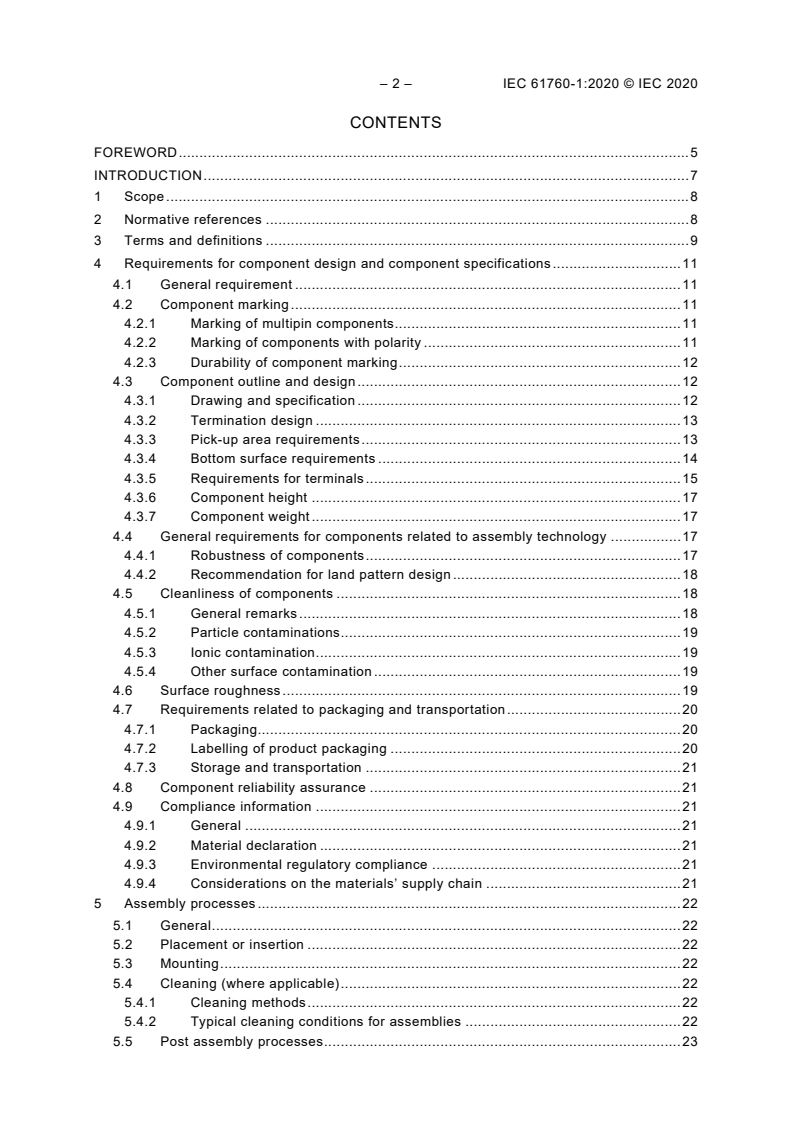
CONTENTS
FOREWORD . 5
INTRODUCTION . 7
1 Scope . 8
2 Normative references . 8
3 Terms and definitions . 9
4 Requirements for component design and component specifications . 11
4.1 General requirement . 11
4.2 Component marking . 11
4.2.1 Marking of multipin components . 11
4.2.2 Marking of components with polarity . 11
4.2.3 Durability of component marking . 12
4.3 Component outline and design . 12
4.3.1 Drawing and specification . 12
4.3.2 Termination design . 13
4.3.3 Pick-up area requirements . 13
4.3.4 Bottom surface requirements . 14
4.3.5 Requirements for terminals . 15
4.3.6 Component height . 17
4.3.7 Component weight . 17
4.4 General requirements for components related to assembly technology . 17
4.4.1 Robustness of components . 17
4.4.2 Recommendation for land pattern design . 18
4.5 Cleanliness of components . 18
4.5.1 General remarks . 18
4.5.2 Particle contaminations . 19
4.5.3 Ionic contamination . 19
4.5.4 Other surface contamination . 19
4.6 Surface roughness . 19
4.7 Requirements related to packaging and transportation . 20
4.7.1 Packaging. 20
4.7.2 Labelling of product packaging . 20
4.7.3 Storage and transportation . 21
4.8 Component reliability assurance . 21
4.9 Compliance information . 21
4.9.1 General . 21
4.9.2 Material declaration . 21
4.9.3 Environmental regulatory compliance . 21
4.9.4 Considerations on the materials’ supply chain . 21
5 Assembly processes . 22
5.1 General . 22
5.2 Placement or insertion . 22
5.3 Mounting . 22
5.4 Cleaning (where applicable) . 22
5.4.1 Cleaning methods . 22
5.4.2 Typical cleaning conditions for assemblies . 22
5.5 Post assembly processes . 23
5.6 Removal and/or replacement of SMDs . 23
5.6.1 Removal and/or replacement of soldered SMDs . 23
5.6.2 Removal and/or replacement of glued SMDs . 24
6 Soldering . 24
6.1 General . 24
6.1.1 Mounting by soldering . 24
6.1.2 Securing the component on the substrate prior to soldering . 25
6.1.3 Reflow soldering . 25
6.1.4 Wave soldering . 26
6.1.5 Other soldering methods . 27
6.2 Process conditions . 27
6.2.1 General . 27
6.2.2 Reflow soldering . 27
6.2.3 Wave soldering . 29
6.3 Requirements for components and component specifications . 29
6.3.1 General . 29
6.3.2 Requirements for temperature sensitive devices . 30
6.3.3 Wettability . 30
6.3.4 Resistance to dissolution of metallization. 30
6.3.5 Resistance to soldering heat . 30
6.3.6 Resistance to vacuum during soldering . 31
6.3.7 Resistance to cleaning solvent. 31
6.3.8 Warpage during reflow soldering. 32
7 Conductive glue bonding . 32
7.1 Mounting . 32
7.2 Bonding strength test for the component glue interface test . 33
7.3 Requirements to components for conductive glue bonding . 34
7.3.1 Components for conductive glue bonding. 34
7.3.2 Cleanliness of the surface . 34
7.3.3 Terminal surface defects . 34
7.3.4 Outgassing of halogenic substances . 34
7.3.5 Coplanarity . 35
7.3.6 Stand-off . 35
7.3.7 Terminal dimensions and tolerances . 35
7.3.8 Resistance to curing heat . 35
8 Sintering . 36
8.1 General . 36
8.2 Typical process conditions . 37
8.3 Requirements for components and component specifications . 37
9 Solderless interconnection . 38
9.1 General . 38
9.2 Typical process conditions . 38
9.3 Requirements for components and component specifications . 39
Annex A (informative) Details on compliance information . 40
A.1 Material declaration . 40
A.2 Environmental regulatory compliance . 41
A.3 Considerations on the materials' supply chain . 41
Bibliography . 43
– 4 – IEC 61760-1:2020 © IEC 2020
Figure 1 – Example of a component with marked specific orientation put in tape (top)
and tray (bottom) . 12
Figure 2 – Vacuum pipette, pick-up area and component compartment . 14
Figure 3 – Coplanarity of terminals . 15
Figure 4 – Stable seating of component . 15
Figure 5 – Unstable seating of component . 16
Figure 6 – Terminals arranged peripherally in two rows . 16
Figure 7 – Good contrast between component body and surroundings . 16
Figure 8 – Component weight and pipette suction strength . 17
Figure 9 – Process steps for soldering . 25
Figure 10 – Generic reflow temperature/time profile . 28
Figure 11 – Generic wave soldering temperature/time profile . 29
Figure 12 – Process steps for gluing . 33
Figure 13 – Stand-off definition . 35
Figure 14 – Sinter process on one side, both sides, and both sides including
presintering . 37
Table 1 – Typical roughness requirements . 20
Table 2 – Basic cleaning processes . 23
Table 3 – Examples of substances proposed to be included in risk evaluation and
customer reporting . 35
Table 4 – Examples of typical curing conditions . 36
INTERNATIONAL ELECTROTECHNICAL COMMISSION
____________
SURFACE MOUNTING TECHNOLOGY –
Part 1: Standard method for the specification
of surface mounting components (SMDs)
FOREWORD
1) The International Electrotechnical Commission (IEC) is a worldwide organization for standardization comprising
all national electrotechnical committees (IEC National Committees). The object of IEC is to promote
international co-operation on all questions concerning standardization in the electrical and electronic fields. To
this end and in addition to other activities, IEC publishes International Standards, Technical Specifications,
Technical Reports, Publicly Available Specifications (PAS) and Guides (hereafter referred to as "IEC
Publication(s)"). Their preparation is entrusted to technical committees; any IEC National Committee interested
in the subject dealt with may participate in this preparatory work. International, governmental and non-
governmental organizations liaising with the IEC also participate in this preparation. IEC collaborates closely
with the International Organization for Standardization (ISO) in accordance with conditions determined by
agreement between the two organizations.
2) The formal decisions or agreements of IEC on technical matters express, as nearly as possible, an international
consensus of opinion on the relevant subjects since each technical committee has representation from all
interested IEC National Committees.
3) IEC Publications have the form of recommendations for international use and are accepted by IEC National
Committees in that sense. While all reasonable efforts are made to ensure that the technical content of IEC
Publications is accurate, IEC cannot be held responsible for the way in which they are used or for any
misinterpretation by any end user.
4) In order to promote international uniformity, IEC National Committees undertake to apply IEC Publications
transparently to the maximum extent possible in their national and regional publications. Any divergence
between any IEC Publication and the corresponding national or regional publication shall be clearly indicated in
the latter.
5) IEC itself does not provide any attestation of conformity. Independent certification bodies provide conformity
assessment services and, in some areas, access to IEC marks of conformity. IEC is not responsible for any
services carried out by independent certification bodies.
6) All users should ensure that they have the latest edition of this publication.
7) No liability shall attach to IEC or its directors, employees, servants or agents including individual experts and
members of its technical committees and IEC National Committees for any personal injury, property damage or
other damage of any nature whatsoever, whether direct or indirect, or for costs (including legal fees) and
expenses arising out of the publication, use of, or reliance upon, this IEC Publication or any other IEC
Publications.
8) Attention is drawn to the Normative references cited in this publication. Use of the referenced publications is
indispensable for the correct application of this publication.
9) Attention is drawn to the possibility that some of the elements of this IEC Publication may be the subject of
patent rights. IEC shall not be held responsible for identifying any or all such patent rights.
International Standard IEC 61760-1 has been prepared by IEC technical committee 91:
Surface mounting technology.
This third edition cancels and replaces the second edition published in 2006. This edition
constitutes a technical revision.
This edition includes the following significant technical changes with respect to the previous
edition:
a) inclusion of additional mounting methods: conductive glue bonding, sintering and
solderless interconnection.
– 6 – IEC 61760-1:2020 © IEC 2020
The text of this International Standard is based on the following documents:
FDIS Report on voting
91/1648/FDIS 91/1653/RVD
Full information on the voting for the approval of this International Standard can be found in
the report on voting indicated in the above table.
This document has been drafted in accordance with the ISO/IEC Directives, Part 2.
A list of all parts in the IEC 61760 series, published under the general title Surface mounting
technology, can be found on the IEC website.
The committee has decided that the contents of this document will remain unchanged until the
stability date indicated on the IEC website under "http://webstore.iec.ch" in the data related to
the specific document. At this date, the document will be
• reconfirmed,
• withdrawn,
• replaced by a revised edition, or
• amended.
IMPORTANT – The 'colour inside' logo on the cover page of this publication indicates
that it contains colours which are considered to be useful for the correct
understanding of its contents. Users should therefore print this document using a
colour printer.
INTRODUCTION
Specifications for electronic components have in the past been formulated for each
component family. The regulations for environmental tests have been selected from
IEC 60068 and other IEC and ISO publications. The intention for this procedure was that all
components, once installed in a piece of equipment, had to satisfy certain criteria.
The introduction and increasing use of different mounting processes on one assembly make it
necessary to extend the existing requirements to include those arising from processing during
assembly.
Nevertheless, there existed no harmonized standard that prescribes the content of a
component specification before the publication of IEC 61760-1. It is the purpose of this
document to define the general requirements for component specifications derived from the
assembly processes. This is done in three steps.
In the first step, general requirements for component specifications and component design
related to the handling and placement of the component on the substrate are given (Clause 4).
In the second step, the requirements related to assembly processes are given (Clause 5). In
the third step, additional requirements resulting from specific mounting methods are given
(Clauses 6 to 9).
Mixed technology boards, i.e. boards containing through-hole components and SMDs, require
additional consideration with respect to the through-hole components. These may be subject
to the same requirements as the SMDs. Persons responsible for drafting specifications for
"non-surface mounting components" wishing to include a statement on their ability to
withstand surface mounting conditions should use the classifications and tests set out in the
present document.
– 8 – IEC 61760-1:2020 © IEC 2020
SURFACE MOUNTING TECHNOLOGY –
Part 1: Standard method for the specification
of surface mounting components (SMDs)
1 Scope
This part of IEC 61760 defines requirements for component specifications of electronic
components that are intended for usage in surface mounting technology. To this end, it
specifies a reference set of process conditions and related test conditions to be considered
when compiling component specifications.
The objective of this document is to ensure that a wide variety of SMDs can be subjected to
the same placement, mounting and subsequent processes (e.g. cleaning, inspection) during
assembly. This document defines tests and requirements that need to be part of any SMD
component's general, sectional or detail specification. In addition, this document provides
component users and manufacturers with a reference set of typical process conditions used in
surface mounting technology.
Some of the requirements for component specifications in this document are also applicable
to components with leads intended for mounting on a circuit board. Cases for which this is
appropriate are indicated in the relevant subclauses.
2 Normative references
The following documents are referred to in the text in such a way that some or all of their
content constitutes requirements of this document. For dated references, only the edition
cited applies. For undated references, the latest edition of the referenced document (including
any amendments) applies.
IEC 60068 (all parts), Environmental testing
IEC 60068-2-2, Environmental testing – Part 2-2: Tests – Test B: Dry heat
IEC 60068-2-21, Environmental testing – Part 2-21: Tests – Test U: Robustness of
terminations and integral mounting devices
IEC 60068-2-45:1980, Basic environmental testing procedures – Part 2-45: Tests – Test XA
and guidance: Immersion in cleaning solvents
IEC 60068-2-45:1980/AMD1:1993
IEC 60068-2-58, Environmental testing – Part 2-58: Tests – Test Td: Test methods for
solderability, resistance to dissolution of metallization and to soldering heat of surface
mounting devices (SMDs)
IEC 60191-6, Mechanical standardization of semiconductor devices – Part 6: General rules for
the preparation of outline drawings of surface mounted semiconductor device packages
IEC 60194-2, Printed boards design, manufacture and assembly – Vocabulary – Part 2:
Common usage in electronic technologies as well as printed board and electronic assembly
technologies
IEC 60286-3, Packaging of components for automatic handling – Part 3: Packaging of surface
mount components on continuous tapes
IEC 60286-4, Packaging of components for automatic handling – Part 4: Stick magazines for
electronic components encapsulated in packages of different forms
IEC 60286-5, Packaging of components for automatic handling – Part 5: Matrix trays
IEC 60286-6, Packaging of components for automatic handling – Part 6: Bulk case packaging
for surface mounting components
IEC 60749-20:2008, Semiconductor devices – Mechanical and climatic test methods – Part 20:
Resistance of plastic encapsulated SMDs to the combined effect of moisture and soldering
heat
IEC 61188-6-4, Printed boards and printed board assemblies – Design and use – Part 6-4:
Land pattern design – Generic requirements for dimensional drawings of surface mounted
components (SMD) from the viewpoint of land pattern design
IEC 61340-5-1, Electrostatics – Part 5-1: Protection of electronic devices from electrostatic
phenomena – General requirements
IEC 61340-5-3, Electrostatics – Part 5-3: Protection of electronic devices from electrostatic
phenomena – Properties and requirements classification for packaging intended for
electrostatic discharge sensitive devices
IEC 61760-2, Surface mounting technology – Part 2: Transportation and storage conditions of
surface mounting devices (SMD) – Application guide
IEC 61760-4, Surface mounting technology – Part 4: Classification, packaging, labelling and
handling of moisture sensitive devices
IEC 62090, Product package labels for electronic components using bar code and two-
dimensional symbologies
IPC/JEDEC J-STD-020, Moisture/Reflow Sensitivity Classification for Nonhermetic Solid State
Devices
IPC/JEDEC J-STD-033, Handling, Packaging, Shipping, and Use of Moisture/Reflow Sensitive
Surface Mount Devices
3 Terms and definitions
For the purposes of this document, the terms and definitions of IEC 60194-2 and the following
apply.
ISO and IEC maintain terminological databases for use in standardization at the following
addresses:
• IEC Electropedia: available at http://www.electropedia.org/
• ISO Online browsing platform: available at http://www.iso.org/obp
3.1
adhesive
substance such as glue or cement used to bond objects together
– 10 – IEC 61760-1:2020 © IEC 2020
Note 1 to entry: In surface mounting technology different gluing systems are used:
– nonconductive adhesive (only for mechanical connection);
– electrically conductive adhesive (for electrical and mechanical connection);
– thermally conductive adhesive (for thermal and mechanical connection);
– combination of electrically and thermally conductive adhesive.
Most used adhesives are thermal curing systems, but there are also UV-curing systems in use.
3.2
centring force
force required by the pick-up tooling to centre a surface mounting device in its proper location
on a substrate
3.3
coplanarity
distance in height between the lowest and highest leads when the component is in its seating
plane
3.4
dewetting
condition that results when molten solder coats a surface and then recedes to leave
irregularly shaped mounds of solder that are separated by areas that are covered with a thin
film of solder and with the basis metal not exposed
3.5
dissolution of metallization
process of dissolving metal or a plated metal alloy, usually by introduction of chemicals
Note 1 to entry: For the purposes of this document, the dissolution of metallization also includes dissolution by
exposure to molten solder.
3.6
immersion attitude
positioning of an object when immersed in a solder bath
3.7
lead-free component
component where lead content in the materials is equal to or less than 0,1 % by weight per
material used
3.8
Montreal protocol
agreement by industrialized nations, at a meeting held in Montreal, Canada, to eliminate
chlorofluorocarbons from all processes by 1995
3.9
pick-up force
dynamic force exerted on the body of a component – generally from above – and its seating
plane during the pick-up of the component (e.g. from a tape or tray)
Note 1 to entry: The maximum level is normally taken into account.
3.10
placement force
dynamic force exerted on the component body (generally from above) and its seating plane
Note 1 to entry: This occurs during the period between the component’s first contact with the substrate (or the
soldering paste or adhesive etc.) and its coming to rest. The maximum level is normally taken into account.
3.11
resistance to soldering heat
ability of a component to withstand the effects of the heat generated by the soldering process
3.12
seating plane
surface on which a component rests
3.13
solderability
ability of a metal to be wetted by molten solder
3.14
solder meniscus
contour of a solder shape that is the result of the surface tension forces that take place during
wetting
3.15
stand-off
distance between seating plane of the component and the seating plane of the terminations
3.16
substrate
basic material that forms the support structure of an electronic circuit
3.17
SMD
surface mounting component
surface mounting device
electronic component designed for mounting on to terminal pads or conducting tracks on the
surface of substrate
3.18
wetting
physical phenomenon in which surface tension of a liquid, usually when in contact with solids,
is reduced to the point where the liquid diffuses and makes intimate contact with the entire
substrate surface in the form of a thin layer
4 Requirements for component design and component specifications
4.1 General requirement
A component specification for SMDs shall, in addition to the requirements listed in 4.2 to 4.9,
contain specifications of the relevant tests and requirements from Clauses 5 to 9.
4.2 Component marking
4.2.1 Marking of multipin components
Pin 1 (see Figure 1) shall be clearly marked on a multipin component (e.g. SO-IC, QFP).
4.2.2 Marking of components with polarity
For components with polarity, the polarity of the component shall be clearly marked on the
component (e.g. for electrolytic capacitors).
– 12 – IEC 61760-1:2020 © IEC 2020
4.2.3 Durability of component marking
Specifications shall require that the specified component marking shall remain legible after
the test specified in 5.4 has been performed. This test shall be performed after completion of
the relevant test for resistance to soldering heat or for solderability, as specified in the
component specification.
Key
D direction of unreeling
T tray
1 pin 1 of the component
Figure 1 – Example of a component with marked specific orientation put in tape (top)
and tray (bottom)
4.3 Component outline and design
4.3.1 Drawing and specification
Drawings, including bottom-view, top-view and side-view drawings, of the component showing
all dimensions and tolerances of its body and terminals shall be part of the component
specification. The drawings shall include reference to the positioning of the component body
and terminals on the mounting land pattern. If conductive surfaces are not planar, their three-
dimensional geometry shall be clearly specified with the relevant tolerances. An example is
the presence of grooves on thermal pads of QFP.
In any 2D drawing or 3D data, conductive parts and/or surfaces and insulating parts/surfaces
shall be clearly distinguished, at least for the bottom and the sides of components, as well as
for movable parts. This requirement applies both to the disassembled and the assembled
condition for parts requiring a final assembly step after mounting on a substrate (e.g. if a
connector contains spring-loaded retainers whose position and/or angle changes upon
mating). The locations and dimensions of conductive parts/surfaces shall be specified, even if
they are not intended for establishing a contact with the mounting surface, for example
punched or sawn surfaces consisting of unplated leadframe resulting from component
singulation for moulded semiconductor packages.
The generic requirements for dimensional drawings of SMDs from the viewpoint of land-
pattern design as specified in IEC 61188-6-4 shall be adopted for surface mounting devices.
Where necessary (e.g. in the case of large components with an overall length of more than
25 mm), the detail specification shall contain data on thermal expansion, at least along the X
and Y axes. In the case of mechanical fixation of large components (e.g. by screwing),
mismatch of the coefficients of thermal expansion between component and mounting
substrate can result in warping of the component and the mounting substrate.
For components singulated by punching or sawing, for which parts of the terminals may not
wet during a soldering operation owing to the absence of a surface finish preserving a
solderable surface on the leadframe, such surfaces shall be indicated in the drawing.
For bottom-termination components (BTCs) as QFNs (quad-flat no lead packages), DFNs
(dual-flat no lead packages), etc., for which a wettable-flank pin modification has been applied
to assure the formation of an outer fillet in reflow soldering, the minimum height of the plated
flank of the leadframe shall be indicated in the drawing.
NOTE 1 For components intended for high-reliability applications, such as automotive and aerospace industries,
the height of the wettable portion typically is larger than 100 µm to enable a robust automated solder-joint
inspection.
NOTE 2 The presence of an outer fillet, as enabled by a wettable-flank pin modifciation, generally increases the
reliability of the solder joints under environmental loads such as thermal cycling.
4.3.2 Termination design
The relevant specification shall provide information on termination design (i.e. the termination
base material, layer structure and finish).
4.3.3 Pick-up area requirements
The design of the component shall consider that it shall be possible to grip the component by
suction and transport it to its exact placement position on the substrate. It shall be possible to
create a vacuum strong enough to fix the component in its position under the pipette. During
the total transport process, which may include optical inspection, the component shall remain
exactly in its position under the pipette, until the component is placed.
The centre of the suction area should match the centre of gravity and the geometrical centre.
The opening of the pipette (Y), the dimension (L) of the component or its pick up area (X) and
the tolerances on the position of the component inside the compartment of packaging with
length dimension (A ) and width dimension (B ) shall match in such a way that the vacuum
0 0
needed for pick up can be created (see Figure 2 for an illustration of the geometrical
dimensions). It shall be possible to apply the vacuum irrespective of the component’s position
in its compartment.
For further requirements concerning the position of the component inside the packaging, see
IEC 60286-3 for taping, IEC 60286-4 for stick magazines and IEC 60286-5 for matrix trays.
Dimension L may be the length or the width of the component, as applicable.
Requirement: X − Y > Z
Z = (Z + Z ) = (A − L)
1 2 0
Z = (Z + Z ) = (B − L)
1 2 0
– 14 – IEC 61760-1:2020 © IEC 2020
IEC 464/06
Key
C component
P component pocket
N pick-up nozzle (pipette)
Y opening of the pipette
L dimension of the component (length or width)
X dimension of the pick-up area of the component
A length dimension of compartment of packaging
B width dimension of compartment of packaging
Z gap between component and packaging – left-sided
Z gap between component and packaging – right-sided
Example for a component with a flat surface.
Figure 2 – Vacuum pipette, pick-up area and component compartment
If it is not possible to provide a pick-up area of sufficient size to enable gripping the
component by suction, the component design shall enable gripping the component by
mechanical chucks or grippers. The component specification shall provide guidance on
appropriate chuck or gripper designs.
4.3.4 Bottom surface requirements
In cases where the component is to be bonded to the substrate with adhesive, its lower
surface (except for the terminals) shall be capable of retaining the applied adhesive.
The stand-off between the lower surface of bonded components and the seating plane shall
be specified. The detail specification shall state the maximum stand-off. For components that
are fixed by an additional fixing adhesive or if a cleaning process is used, the minimum stand-
off should be included in the component specification, because, owing to the use of the
additional fixing adhesive, all pins have to be inside the material for the electrical connection
(solder paste or conductive adhesive).
4.3.5 Requirements for terminals
4.3.5.1 Coplanarity
Detail specifications of multipin components intended for reflow soldering or conductive gluing
shall state the coplanarity of the lower surfaces of all terminals in accordance with
IEC 60191-6 (see Figure 3). The typical value of coplanarity needed for reflow soldering is
0,1 mm to 0,15 mm, but this depends on the size of the component and the thickness of
printed solder. In any case, the coplanarity shall not exceed the recommended stencil
thickness for solder paste printing, given in the recommended land pattern (see 4.4.2). The
components' terminals shall be sufficiently coplanar to ensure that contact is made with the
solder on the solder surfaces after solder printing or with the conductive adhesive. Detail
specifications of two-pin components for mounting with conductive adhesive shall state the
coplanarity of both terminals in relation to the bottom surface of the component.
Figure 3 – Coplanarity of terminals
4.3.5.2 Arrangement of terminals
The terminals shall be arranged in such a way that stable seating in the solder paste or glue
is ensured and tilting is avoided (see Figure 4, Figure 5 and Figure 6).
Key
S solder paste depot
Figure 4 – Stable seating of component
– 16 – IEC 61760-1:2020 © IEC 2020
Key
S solder paste depot
Figure 5 – Unstable seating of component
The land pattern of the component and its contacts should be analysed by the placement
machine. The terminals should be arranged peripherally or otherwise symmetrically.
Asymmetrical arrangements of terminals can cause problems, because the identification
algorithms are not always capable of identifying asymmetrical structures. For small-sized
components, symmetrical terminals are needed to prevent tombstoning.
Figure 6 – Terminals arranged peripherally in two rows
4.3.5.3 Optical recognition
The optical contrast between the terminal's bottom surface and the c
...