

IEC 60034-27-4:2018
(Main)Rotating electrical machines - Part 27-4: Measurement of insulation resistance and polarization index of winding insulation of rotating electrical machines
General Information
- Abstract
IEC 60034-27-4:2018 provides recommended test procedures for the measurement of insulation resistance and polarization index of stator and rotor winding insulation of rotating electrical machines. This document recommends minimum acceptable values of insulation resistance and polarization index of winding insulation valid for fully processed low and high voltage AC and DC rotating electrical machines with a rated power of 750 W or higher.
- Status
- Published
- Publication Date
- 23-Jan-2018
- Technical Committee
- TC 2 - Rotating machinery
- Drafting Committee
- MT 10 - TC 2/MT 10
- Current Stage
- PPUB - Publication issued
- Start Date
- 24-Jan-2018
- Completion Date
- 16-Feb-2018
Buy Documents
IEC 60034-27-4:2018 - Rotating electrical machines - Part 27-4: Measurement of insulation resistance and polarization index of winding insulation of rotating electrical machines Released:1/24/2018
Overview
IEC 60034-27-4:2018, published by the International Electrotechnical Commission (IEC), specifies standard test procedures for the measurement of insulation resistance and the polarization index of winding insulation in rotating electrical machines. This international standard is relevant for fully processed low and high voltage AC and DC rotating machines with a rated power of 750 W or higher. By providing recommended minimum values and clear test methods, IEC 60034-27-4 helps ensure the reliability and safety of stator and rotor windings in electric motors and generators.
Key Topics
- Insulation Resistance Measurement: Guidance on how to measure the insulation resistance (IR) of winding insulation using DC voltage, including considerations for temperature correction and environmental factors.
- Polarization Index (PI): Procedures for determining the polarization index, which is a comparative measurement of insulation resistance over time, commonly at 1 minute and 10 minutes after voltage application.
- Measurement Influences: Discussion of factors such as winding temperature, air humidity, and insulation system type that affect measurement accuracy and result interpretation.
- Recommended Minimum Values: Empirical and practical limits for insulation resistance and polarization index in both new and operational windings, supporting maintenance and acceptance testing.
- Equipment Requirements: Requirements for test instrumentation, ensuring reliable measurement results and data consistency.
- Result Interpretation: Guidance on how to evaluate and trend test results over time for predictive maintenance and diagnostics.
Applications
IEC 60034-27-4:2018 provides practical value to a range of industries and stakeholders:
- Quality Control in Manufacturing: Manufacturing facilities use these test procedures to verify the quality and safety of winding insulation during production of motors and generators.
- Maintenance and Servicing: Plant operators, utilities, and maintenance teams apply these guidelines during periodic inspections or overhauls to assess insulation health, detect potential deterioration, and prevent failures.
- Diagnostics and Predictive Maintenance: By tracking insulation resistance and polarization index measurements over time, organizations can identify developing issues, evaluate the impacts of ageing and contamination, and plan timely maintenance.
- Commissioning and Acceptance Testing: The standard assists in determining whether new or refurbished rotating machines meet international safety and reliability benchmarks before being placed into service.
- Safety Assurance: Regular testing based on IEC 60034-27-4 helps prevent hazardous conditions by identifying breakdowns in winding insulation that could lead to electrical faults or equipment damage.
Related Standards
IEC 60034-27-4 forms part of a broader set of standards for rotating electrical machines:
- IEC 60034 series – Rotating Electrical Machines: This series covers general requirements, testing, and performance guidelines for rotating machinery.
- IEC 60034-1 – Rating and Performance: Establishes basic definitions and performance parameters for machines subject to insulation testing.
- IEC 60050-411 – International Electrotechnical Vocabulary: Rotating Machinery: Defines terminology used in IEC 60034-27-4.
- Related test methods: The standard references best practices for other diagnostic tests, such as dielectric absorption ratio (DAR) and high voltage DC testing, which support comprehensive assessments of insulation systems.
Practical Benefits
Implementing IEC 60034-27-4 delivers several operational advantages:
- Standardized Testing: Ensures consistency and comparability of insulation measurements worldwide.
- Enhanced Reliability: Detects early signs of insulation degradation, minimizing the risk of unexpected breakdowns.
- Global Compliance: Aligns with internationally recognized methods, increasing confidence for manufacturers, end-users, and certifying bodies.
- Cost Efficiency: By enabling effective condition monitoring and trending, maintenance can be scheduled proactively, reducing downtime and repair expenses.
By following IEC 60034-27-4:2018, organizations can optimize the reliability, efficiency, and safety of rotating electrical machines, while meeting global quality and performance standards.
Buy Documents
IEC 60034-27-4:2018 - Rotating electrical machines - Part 27-4: Measurement of insulation resistance and polarization index of winding insulation of rotating electrical machines Released:1/24/2018
Get Certified
Connect with accredited certification bodies for this standard

IMQ S.p.A. (Certification)
Italian electrical product certification.

SLG Prüf- und Zertifizierungs GmbH
German testing and certification body.

UL Solutions
Global safety science company with testing, inspection and certification.
Sponsored listings
Frequently Asked Questions
IEC 60034-27-4:2018 is a standard published by the International Electrotechnical Commission (IEC). Its full title is "Rotating electrical machines - Part 27-4: Measurement of insulation resistance and polarization index of winding insulation of rotating electrical machines". This standard covers: IEC 60034-27-4:2018 provides recommended test procedures for the measurement of insulation resistance and polarization index of stator and rotor winding insulation of rotating electrical machines. This document recommends minimum acceptable values of insulation resistance and polarization index of winding insulation valid for fully processed low and high voltage AC and DC rotating electrical machines with a rated power of 750 W or higher.
IEC 60034-27-4:2018 provides recommended test procedures for the measurement of insulation resistance and polarization index of stator and rotor winding insulation of rotating electrical machines. This document recommends minimum acceptable values of insulation resistance and polarization index of winding insulation valid for fully processed low and high voltage AC and DC rotating electrical machines with a rated power of 750 W or higher.
IEC 60034-27-4:2018 is classified under the following ICS (International Classification for Standards) categories: 29.160.01 - Rotating machinery in general; 33.180.20 - Fibre optic interconnecting devices. The ICS classification helps identify the subject area and facilitates finding related standards.
IEC 60034-27-4:2018 is available in PDF format for immediate download after purchase. The document can be added to your cart and obtained through the secure checkout process. Digital delivery ensures instant access to the complete standard document.
Standards Content (Sample)
IEC 60034-27-4 ®
Edition 1.0 2018-01
INTERNATIONAL
STANDARD
NORME
INTERNATIONALE
colour
inside
Rotating electrical machines –
Part 27-4: Measurement of insulation resistance and polarization index of
winding insulation of rotating electrical machines
Machines électriques tournantes –
Partie 27-4: Mesure de la résistance d’isolement et de l’index de polarisation sur
le système d’isolation des enroulements des machines électriques tournantes
All rights reserved. Unless otherwise specified, no part of this publication may be reproduced or utilized in any form
or by any means, electronic or mechanical, including photocopying and microfilm, without permission in writing from
either IEC or IEC's member National Committee in the country of the requester. If you have any questions about IEC
copyright or have an enquiry about obtaining additional rights to this publication, please contact the address below or
your local IEC member National Committee for further information.
Droits de reproduction réservés. Sauf indication contraire, aucune partie de cette publication ne peut être reproduite
ni utilisée sous quelque forme que ce soit et par aucun procédé, électronique ou mécanique, y compris la photocopie
et les microfilms, sans l'accord écrit de l'IEC ou du Comité national de l'IEC du pays du demandeur. Si vous avez des
questions sur le copyright de l'IEC ou si vous désirez obtenir des droits supplémentaires sur cette publication, utilisez
les coordonnées ci-après ou contactez le Comité national de l'IEC de votre pays de résidence.
IEC Central Office Tel.: +41 22 919 02 11
3, rue de Varembé info@iec.ch
CH-1211 Geneva 20 www.iec.ch
Switzerland
About the IEC
The International Electrotechnical Commission (IEC) is the leading global organization that prepares and publishes
International Standards for all electrical, electronic and related technologies.
About IEC publications
The technical content of IEC publications is kept under constant review by the IEC. Please make sure that you have the
latest edition, a corrigenda or an amendment might have been published.
IEC Catalogue - webstore.iec.ch/catalogue Electropedia - www.electropedia.org
The stand-alone application for consulting the entire The world's leading online dictionary of electronic and
bibliographical information on IEC International Standards, electrical terms containing 21 000 terms and definitions in
Technical Specifications, Technical Reports and other English and French, with equivalent terms in 16 additional
documents. Available for PC, Mac OS, Android Tablets and languages. Also known as the International Electrotechnical
iPad. Vocabulary (IEV) online.
IEC publications search - webstore.iec.ch/advsearchform IEC Glossary - std.iec.ch/glossary
The advanced search enables to find IEC publications by a 67 000 electrotechnical terminology entries in English and
variety of criteria (reference number, text, technical French extracted from the Terms and Definitions clause of
committee,…). It also gives information on projects, replaced IEC publications issued since 2002. Some entries have been
and withdrawn publications. collected from earlier publications of IEC TC 37, 77, 86 and
CISPR.
IEC Just Published - webstore.iec.ch/justpublished
Stay up to date on all new IEC publications. Just Published IEC Customer Service Centre - webstore.iec.ch/csc
details all new publications released. Available online and If you wish to give us your feedback on this publication or
also once a month by email. need further assistance, please contact the Customer Service
Centre: sales@iec.ch.
A propos de l'IEC
La Commission Electrotechnique Internationale (IEC) est la première organisation mondiale qui élabore et publie des
Normes internationales pour tout ce qui a trait à l'électricité, à l'électronique et aux technologies apparentées.
A propos des publications IEC
Le contenu technique des publications IEC est constamment revu. Veuillez vous assurer que vous possédez l’édition la
plus récente, un corrigendum ou amendement peut avoir été publié.
Catalogue IEC - webstore.iec.ch/catalogue Electropedia - www.electropedia.org
Application autonome pour consulter tous les renseignements
Le premier dictionnaire en ligne de termes électroniques et
bibliographiques sur les Normes internationales,
électriques. Il contient 21 000 termes et définitions en anglais
Spécifications techniques, Rapports techniques et autres
et en français, ainsi que les termes équivalents dans 16
documents de l'IEC. Disponible pour PC, Mac OS, tablettes
langues additionnelles. Egalement appelé Vocabulaire
Android et iPad.
Electrotechnique International (IEV) en ligne.
Recherche de publications IEC -
Glossaire IEC - std.iec.ch/glossary
webstore.iec.ch/advsearchform
67 000 entrées terminologiques électrotechniques, en anglais
La recherche avancée permet de trouver des publications IEC et en français, extraites des articles Termes et Définitions des
en utilisant différents critères (numéro de référence, texte, publications IEC parues depuis 2002. Plus certaines entrées
comité d’études,…). Elle donne aussi des informations sur les antérieures extraites des publications des CE 37, 77, 86 et
projets et les publications remplacées ou retirées. CISPR de l'IEC.
IEC Just Published - webstore.iec.ch/justpublished Service Clients - webstore.iec.ch/csc
Restez informé sur les nouvelles publications IEC. Just Si vous désirez nous donner des commentaires sur cette
Published détaille les nouvelles publications parues. publication ou si vous avez des questions contactez-nous:
Disponible en ligne et aussi une fois par mois par email. sales@iec.ch.
IEC 60034-27-4 ®
Edition 1.0 2018-01
INTERNATIONAL
STANDARD
NORME
INTERNATIONALE
colour
inside
Rotating electrical machines –
Part 27-4: Measurement of insulation resistance and polarization index of
winding insulation of rotating electrical machines
Machines électriques tournantes –
Partie 27-4: Mesure de la résistance d’isolement et de l’index de polarisation sur
le système d’isolation des enroulements des machines électriques tournantes
INTERNATIONAL
ELECTROTECHNICAL
COMMISSION
COMMISSION
ELECTROTECHNIQUE
INTERNATIONALE
ICS 29.160.01 ISBN 978-2-8322-5252-9
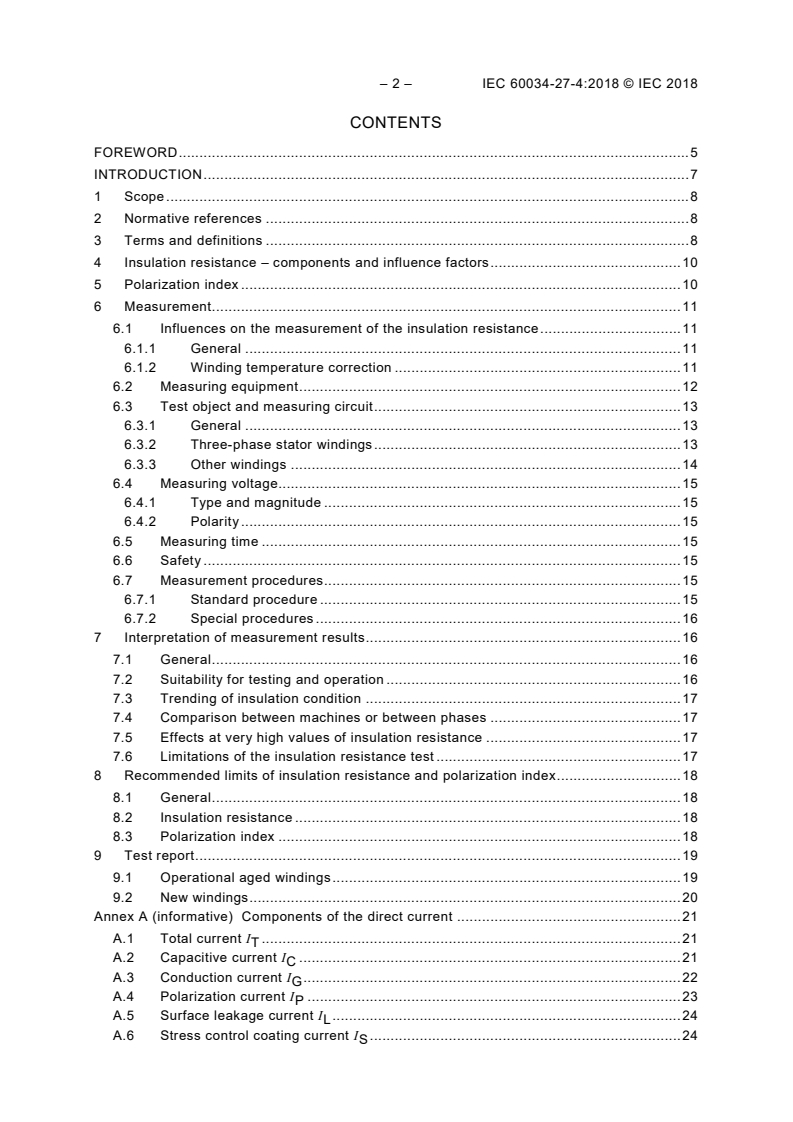
– 2 – IEC 60034-27-4:2018 © IEC 2018
CONTENTS
FOREWORD . 5
INTRODUCTION . 7
1 Scope . 8
2 Normative references . 8
3 Terms and definitions . 8
4 Insulation resistance – components and influence factors . 10
5 Polarization index . 10
6 Measurement . 11
6.1 Influences on the measurement of the insulation resistance . 11
6.1.1 General . 11
6.1.2 Winding temperature correction . 11
6.2 Measuring equipment . 12
6.3 Test object and measuring circuit . 13
6.3.1 General . 13
6.3.2 Three-phase stator windings . 13
6.3.3 Other windings . 14
6.4 Measuring voltage. 15
6.4.1 Type and magnitude . 15
6.4.2 Polarity . 15
6.5 Measuring time . 15
6.6 Safety . 15
6.7 Measurement procedures . 15
6.7.1 Standard procedure . 15
6.7.2 Special procedures . 16
7 Interpretation of measurement results . 16
7.1 General . 16
7.2 Suitability for testing and operation . 16
7.3 Trending of insulation condition . 17
7.4 Comparison between machines or between phases . 17
7.5 Effects at very high values of insulation resistance . 17
7.6 Limitations of the insulation resistance test . 17
8 Recommended limits of insulation resistance and polarization index . 18
8.1 General . 18
8.2 Insulation resistance . 18
8.3 Polarization index . 18
9 Test report . 19
9.1 Operational aged windings . 19
9.2 New windings . 20
Annex A (informative) Components of the direct current . 21
A.1 Total current I . 21
T
A.2 Capacitive current I . 21
C
A.3 Conduction current I . 22
G
A.4 Polarization current I . 23
P
A.5 Surface leakage current I . 24
L
A.6 Stress control coating current I . 24
S
Annex B (informative) Graphical estimation of the slope parameter X for temperature
correction from measurement data . 25
Annex C (informative) Examples of test results of synthetic resin based high voltage
windings . 27
C.1 Machine with dry and clean surface of the insulation . 27
C.2 Machine with a wet and contaminated surface . 28
C.3 Machine with continuous stress control layers in galvanic contact with high
voltage conductors . 29
C.3.1 Stress control coating current I . 29
S
C.3.2 Effects on insulation resistance and polarization index . 30
C.3.3 Examples of test results. 30
Annex D (informative) Measurement of leakage current to assess interphase
insulation resistance . 32
Annex E (informative) Other DC tests . 34
E.1 General . 34
E.2 Dielectric absorption ratio (DAR) . 34
E.3 Monitoring charge and discharge currents . 35
E.4 High voltage DC tests . 37
E.4.1 General . 37
E.4.2 Uniform-time voltage step test . 37
E.4.3 Graded-time voltage step test . 37
E.4.4 Ramped-time voltage step test . 37
E.5 Wet insulation resistance measurement . 38
Bibliography . 39
Figure 1 – Equivalent circuit diagram of winding insulation in a DC voltage test . 10
Figure 2 – Connection for testing of the entire winding . 14
Figure 3 – Connection for phase-to-earth measurement . 14
Figure A.1 – Relationships between different currents and time . 21
Figure B.1 – Graphical estimation of the slope parameter X in a semi-logarithmic
diagram . 26
Figure C.1 – Total current versus time on a clean and dry insulation. The scales are
logarithmic . 27
Figure C.2 – Insulation resistance versus time on a clean and dry insulation . 28
Figure C.3 – Total current versus time on a wet and contaminated insulation . 28
Figure C.4 – Insulation resistance versus time on a wet and contaminated insulation . 29
Figure C.5 – Total current versus time on a dry and clean surface with a continuous
stress control coating . 30
Figure C.6 – Insulation resistance versus time on a dry and clean surface with a
stress control coating . 31
Figure D.1 – Connection for phase-to-phase measurement. The test instrument shall
be floating with respect to earth. Other phase to phase combinations are permitted . 32
Figure D.2 – Measurement of interphase leakage current with a measurement
instrument equipped with a guard connection. 33
Figure D.3 – Measurement of interphase leakage current with a measurement
instrument not equipped with a guard connection . 33
Figure E.1 – Measurement of current and insulation resistance that results in a DAR
of 1,09 . 35
– 4 – IEC 60034-27-4:2018 © IEC 2018
Figure E.2 – Charge and discharge currents after a step voltage of 2,5 kV for the
three-phase windings of a 50 MVA hydro-generator: . 36
Table 1 – Values of the parameter X for the temperature correction . 12
Table 2 – Guidelines for DC voltage magnitudes to be applied during the insulation
resistance measurement . 15
Table 3 – Recommended minimum insulation resistance values at a base temperature
of 40 °C . 18
Table 4 – Recommended minimum values of polarization index for high voltage
insulation systems . 19
Table B.1 – Example data from insulation resistance measurements at different
winding temperatures . 25
INTERNATIONAL ELECTROTECHNICAL COMMISSION
____________
ROTATING ELECTRICAL MACHINES –
Part 27-4: Measurement of insulation resistance and polarization
index of winding insulation of rotating electrical machines
FOREWORD
1) The International Electrotechnical Commission (IEC) is a worldwide organization for standardization comprising
all national electrotechnical committees (IEC National Committees). The object of IEC is to promote
international co-operation on all questions concerning standardization in the electrical and electronic fields. To
this end and in addition to other activities, IEC publishes International Standards, Technical Specifications,
Technical Reports, Publicly Available Specifications (PAS) and Guides (hereafter referred to as “IEC
Publication(s)”). Their preparation is entrusted to technical committees; any IEC National Committee interested
in the subject dealt with may participate in this preparatory work. International, governmental and non-
governmental organizations liaising with the IEC also participate in this preparation. IEC collaborates closely
with the International Organization for Standardization (ISO) in accordance with conditions determined by
agreement between the two organizations.
2) The formal decisions or agreements of IEC on technical matters express, as nearly as possible, an international
consensus of opinion on the relevant subjects since each technical committee has representation from all
interested IEC National Committees.
3) IEC Publications have the form of recommendations for international use and are accepted by IEC National
Committees in that sense. While all reasonable efforts are made to ensure that the technical content of IEC
Publications is accurate, IEC cannot be held responsible for the way in which they are used or for any
misinterpretation by any end user.
4) In order to promote international uniformity, IEC National Committees undertake to apply IEC Publications
transparently to the maximum extent possible in their national and regional publications. Any divergence
between any IEC Publication and the corresponding national or regional publication shall be clearly indicated in
the latter.
5) IEC itself does not provide any attestation of conformity. Independent certification bodies provide conformity
assessment services and, in some areas, access to IEC marks of conformity. IEC is not responsible for any
services carried out by independent certification bodies.
6) All users should ensure that they have the latest edition of this publication.
7) No liability shall attach to IEC or its directors, employees, servants or agents including individual experts and
members of its technical committees and IEC National Committees for any personal injury, property damage or
other damage of any nature whatsoever, whether direct or indirect, or for costs (including legal fees) and
expenses arising out of the publication, use of, or reliance upon, this IEC Publication or any other IEC
Publications.
8) Attention is drawn to the Normative references cited in this publication. Use of the referenced publications is
indispensable for the correct application of this publication.
9) Attention is drawn to the possibility that some of the elements of this IEC Publication may be the subject of
patent rights. IEC shall not be held responsible for identifying any or all such patent rights.
International Standard IEC 60034-27-4 has been prepared by IEC technical committee 2:
Rotating machinery.
The text of this International Standard is based on the following documents:
FDIS Report on voting
2/1880/FDIS 2/1890/RVD
Full information on the voting for the approval of this International Standard can be found in
the report on voting indicated in the above table.
This document has been drafted in accordance with the ISO/IEC Directives, Part 2.
– 6 – IEC 60034-27-4:2018 © IEC 2018
A list of all parts in the IEC 60034 series, published under the general title Rotating electrical
machines, can be found on the IEC website.
NOTE A table of cross-references of all IEC TC 2 publications can be found in the IEC TC 2 dashboard on the
IEC website.
The committee has decided that the contents of this document will remain unchanged until the
stability date indicated on the IEC website under "http://webstore.iec.ch" in the data related to
the specific document. At this date, the document will be
• reconfirmed,
• withdrawn,
• replaced by a revised edition, or
• amended.
IMPORTANT – The 'colour inside' logo on the cover page of this publication indicates
that it contains colours which are considered to be useful for the correct
understanding of its contents. Users should therefore print this document using a
colour printer.
INTRODUCTION
This document provides guidelines for measurement of the insulation resistance and the
polarization index on stator and rotor winding insulation of rotating electrical machines. The
document also describes typical insulation resistance characteristics, the effect of influential
factors which impact or change these characteristics, and how these characteristics indicate
winding condition. It recommends minimum acceptable values of insulation resistance for AC
and DC rotating machine windings. Interpretation will depend on the nature of the insulation
materials – specifically if the insulation is of the thermoset or thermoplastic type.
Insulation resistance measurement has been recommended and used for over 50 years to
evaluate the condition of electrical insulation. It is recommended to track periodic
measurements, accumulated over months and years of service or in connection with servicing
and overhaul of rotating machines.
Empirical limits verified in practice can be used as a basis for evaluating the quality of stator
winding insulation systems in manufacturing. Furthermore, trend evaluation, e.g. diagnostic
tests as part of the functional evaluation of insulation systems or in connection with servicing
and overhaul of rotating machines, can also provide information on ageing processes,
possible repair options and the recommended time interval between tests. These
measurements give no indication of local weak points in the insulation system and the trend
evaluations cannot be used to predict the time to failure of the winding insulation.
– 8 – IEC 60034-27-4:2018 © IEC 2018
ROTATING ELECTRICAL MACHINES –
Part 27-4: Measurement of insulation resistance and polarization
index of winding insulation of rotating electrical machines
1 Scope
This part of IEC 60034 provides recommended for the measurement of
test procedures
insulation resistance and polarization index of stator and rotor winding insulation of
rotating electrical machines.
This document recommends minimum acceptable values of insulation resistance and
polarization index of winding insulation valid for fully processed low and high voltage AC and
DC rotating electrical machines with a rated power of 750 W or higher.
2 Normative references
The following documents are referred to in the text in such a way that some or all of their
content constitutes requirements of this document. For dated references, only the edition
cited applies. For undated references, the latest edition of the referenced document (including
any amendments) applies.
IEC 60050-411, International Electrotechnical Vocabulary – Chapter 411: Rotating machinery
3 Terms and definitions
For the purposes of this document, the terms and definitions given in IEC 60050-411 and the
following apply.
ISO and IEC maintain terminological databases for use in standardization at the following
addresses:
• IEC Electropedia: available at http://www.electropedia.org/
• ISO Online browsing platform: available at http://www.iso.org/obp
3.1
rated voltage
rated line-to-line voltage for a three-phase AC machine, line-to-
earth voltage for a single phase machine and rated direct voltage for DC machines or field
windings
3.2
insulation resistance
R
it
capability of the electrical insulation of a winding to resist direct
current and is determined by the quotient of the applied direct voltage divided by the total
current across the machine insulation, taken at a specified time t from start of voltage
application
Note 1 to entry: The voltage application time is usually 1 min (R ) and 10 min (R ); however other values can be
i1 i10
used. Unit conventions: subscript values of 1 through 10 are assumed to be in minutes, subscript values of 15 and
greater are assumed to be in seconds.
Note 2 to entry: Insulation resistance is sometimes abbreviated as IR.
3.3
polarization index
PI
quotient of the insulation resistance measured at two different times, usually t = 1 min and
t , = 10 min after application of the direct voltage, that is an indicator of the condition of the
insulation
Note 1 to entry: Other times are discussed in Clause E.2.
3.4
polarization current
I
P
current resulting from polarization processes, which decays with time of DC voltage
application at a decreasing rate from an initial value to essentially zero
Note 1 to entry: The polarization current is also called absorption current.
3.5
conduction current
I
G
ohmic current that is constant with time and passes through the
bulk of the main insulation
3.6
surface leakage current
I
L
ohmic current that is constant with time and passes over the surface of the end windings of
the stator winding or between exposed conductors and the rotor body in insulated rotor
windings if there are depositions of conductive materials, e.g., moisture or contamination
3.7
capacitive current
I
C
current of comparatively high magnitude and short duration
(typically < 1 s), which decays exponentially with time of DC voltage application
3.8
stress control coating current
I
S
ohmic current that is constant with time, flowing in parallel to the surface leakage current
through a continuous stress control coating on the surface of the end winding insulation
between conductor and earth
3.9
total current
I
T
time dependent current, which is usually measured during insulation resistance measurement
and is the sum of all current components
Note 1 to entry: The total current is the basis for the determination of the insulation resistance R and the
it
polarization index PI.
3.10
polarity effect
effect of obtaining different values of the insulation resistance R when the polarity of the
it
insulation resistance meter leads are reversed
Note 1 to entry: This is observed when humidity is present in the insulation. It is caused by a phenomenon known
as electro-endosmosis.
– 10 – IEC 60034-27-4:2018 © IEC 2018
4 Insulation resistance – components and influence factors
The insulation resistance of a rotating machine winding is a function of the type and condition
of the insulating materials, the insulation system design and the techniques used to
manufacture the winding.
The insulation resistance is measured with DC voltage. The measurement of the resistance
over time provides information on current components caused by different physical
mechanisms. Figure 1 is a schematic showing the different direct current components.
Information on the various current components is provided in Annex A.
Voltage source with internal
and lead resistance
R R
2 n
R R R
R V L S
m
C
C C C
1 2 n
U
I I I I I I
T C G P L S
Conduction
Total current Capacitive Polarization Surface leakage Stress control
current
current current coating current
current
IEC
Figure 1 – Equivalent circuit diagram of winding
insulation in a DC voltage test
5 Polarization index
The polarization index is the quotient of the insulation resistances measured at two different
= 1 min and t = 10 min after application of direct voltage:
times t
1 10
R
i
PI = (1)
R
i
Variants of the polarization index definition with a quotient of insulation resistance of other
measuring times may be used in special applications and need to be indicated (see Annex E).
More measurement points during the 10 min interval may yield additional information.
The polarization index describes the variation of the IR between two specific points in time
and therefore, better than with a single insulation resistance value, it may indicate
contamination and/or moisture deposition on the winding, or absorbed moisture in the
winding. However, it may not indicate internal voids caused by improper impregnation or
thermal deterioration.
The polarization index can be used to estimate the suitability of the winding for application of
a voltage withstand test or for operation. It may provide information for assessing the
condition of the insulation system.
Owing to the negligible polarization currents in the time interval from 1 min to 10 min, the
determination of the polarization index may not apply for small machines with random-wound
windings, for the field windings in generator rotors, for non-insulated field and squirrel-cage
rotor windings and for DC machine armatures.
The polarization index depends on the type of the insulation system, especially on the nature
of the insulation materials and procedures used for winding manufacture (for synthetic resin
based or shellac- and asphalt based, see 7.1). Furthermore it depends on the kind of stress
control coating (see Clause C.3) and the magnitude of the test voltage (see 6.4.1). The
influence of the temperature on the polarization index is not significant under the condition
that the winding temperature is constant between the 1 min and 10 min readings of the
insulation resistance (see 6.1.2).
Before a winding is recommended for a voltage withstand test or for operation, the
polarization index should have a minimum value (see recommendations in 8.3).
6 Measurement
6.1 Influences on the measurement of the insulation resistance
6.1.1 General
The resistance measurement result depends on environmental factors, mainly on the winding
temperature and on the humidity content of the air. The winding temperature influence can be
obtained from empirical data or an experimental measurement and used for the correction of
measurement results taken at different temperatures (see 6.1.2).
The air relative humidity affects the surface leakage current and can usually not be estimated,
as its effect further depends on the air temperature, surface properties of the insulation and
the nature of any surface contamination. For this reason it is generally recommended to
perform insulation resistance measurements at winding temperatures above the dew point.
6.1.2 Winding temperature correction
The variation of temperature affects all of the identified current components, except the
capacitive current I , because an increase in temperature supplies thermal energy, which
C
frees additional charge carriers and so reduces resistivity. Therefore the insulation resistance
value of a winding depends on the winding temperature.
To allow a comparison of insulation resistance values obtained at different temperatures it is
recommended that all IR values measured be corrected to a common base temperature of
40 °C, if applicable (see Table 1). If the R after 1 min of voltage application is > 5 GΩ, or if
i
the R for a synthetic resin based insulation system is measured at a temperature less than
i
40 °C, then no correction is needed [4]. Otherwise the correction factor is calculated using
Formula (2):
40−T
X
K = 0,5 (2)
T
Where
40 is the base temperature (°C);
T is the winding temperature (°C);
X is the slope parameter for an insulation system (K).
Formula (2) is based on Formula (A.3), taking into account all relevant current components.
NOTE 1 This formula expresses that the IR is reduced by half, if the winding temperature T increases by X Kelvin.
The same empirical relation can be equally expressed by exponential functions with other bases, like e. The slope
parameter can be directly transformed, in case of a basis e by dividing X with -ln(0,5).
NOTE 2 Base temperatures other than 40 °C can be used, e.g. 20 °C.
– 12 – IEC 60034-27-4:2018 © IEC 2018
R at the base temperature is obtained by multiplying the resistance value measured at a
i
winding temperature T with the correction factor K (Formula (3)):
T
R = R × K
i T (3)
T
i
c
where
R is the insulation resistance corrected to the base temperature (MΩ);
ic
R is the measured insulation resistance at winding temperature (MΩ);
iT
K is the temperature correction factor.
T
The slope parameter X in Formula (2) characterizes the degree of insulation resistance
temperature dependency of an individual insulation system. Preferably, this parameter is
estimated experimentally. The recommended method is by performing IR measurements at
several winding temperatures in the expected range where measurements may be made,
, all above the dew point, and plotting the results on a semi-logarithmic scale.
including 40 °C
From the result of an exponential approximation the slope parameter X can be derived. An
example for the procedure is given in Annex B. If experimental data are not available for an
insulation system, the values for X in Table 1 can be used, Table 1 is based on empirical
data, and there is no apparent reason for the discontinuity at 40 °C.
The temperature correction with an exponential approximation by equations 2 and 3 can
cause significant errors with an increasing difference between winding temperature and base
temperature. It is recommended to apply this method only for a winding temperature range as
given in Table 1, which is derived from experimental measurements.
NOTE 3 If different insulation systems are used in the slot and the end winding regions, then it is the insulation
system in the slot region that is relevant for temperature correction.
Table 1 – Values of the parameter X for the temperature correction
Types of insulation system Slope parameter X Temperature range
K °C
Shellac and asphaltic based 10 10 to 60
Synthetic resin based No correction (K = 1) 10 to 40
T
(e.g. epoxy, polyester, polyesterimide and others)
17 40 to 60
These values are based on experiments and are considered to be a conservative approach,
i.e. minimum values. Typically the temperature dependency (Formula 2) is smaller, i.e. the
slope parameter is higher.
For the estimation of the polarization index PI, the temperature correction is not required as
the difference in winding temperature during the measurement of R and R is considered to
i1 i10
be negligible.
6.2 Measuring equipment
For direct measurement the preferred equipment is an insulation resistance meter. For R
i1
readings below 5 000 MΩ, a digital instrument should have at least the following
characteristics:
• Display: 3 digits
• Accuracy: ± 5 % of reading, ± 5 digits
If no insulation resistance meter is available, the insulation resistance can be obtained from a
measurement of voltage and current (indirect measurement). For such indirect measurements
a stabilized DC voltage source, a voltmeter and a micro ammeter can be used. The voltage
fluctuation of a real DC voltage source will introduce a variation of i (t) = C dU /dt. Since the
c 0 0
capacitance C of most high voltage machines is large, a minimum stability and noise is
required for the DC supply to neglect this effect. The insulation resistance is calculated from
the volt- and ammeter readings using Formula (4).
R = U / I (4)
i t
t
where
R is the insulation resistance (MΩ) at time t;
it
U is the measured voltage (voltmeter reading) of the DC voltage source (V);
I is the measured current (ammeter reading) (µA) at time t.
t
For the measurement of high IR values a meter with guard option is recommended, to avoid
leakage and capacitive influences from the measuring cable.
The instrumentation shall take no more than 5 s to reach the test voltage.
6.3 Test object and measuring circuit
6.3.1 General
Depending on the aim of the test and the design of the test object, different measuring circuits
apply. For checking the recommended minimum IR the test shall be performed on the entire
winding. In order to check for insulation problems on each phase winding and between phase
windings, measurements shall be performed phase by phase if each phase winding can be
easily disconnected from one another. For trending purposes, the same connection shall
always be applied.
If possible, external elements such as cables, switches, capacitors, current transformers, etc.
shall be disconnected from the winding. Items still connected to the winding need to be
recorded.
To obtain insulation resistance measurements on directly water-cooled windings, the water
should be removed and the internal circuit thoroughly dried. In some water-cooled windings
the manufacturer may have provided a means of measuring the insulation resistance without
the need for the coolant to be drained. In general, if the water is not removed then the
conductivity of the water should be less than what is recommended by the machine
manufacturer. In this case, the water conductivity will largely dominate the insulation
resistance; and thus PI = 1 and R = 1 MΩ may be expected.
i10
In any case the winding elements that are not under test shall be connected with short leads
to machine earth to avoid any undesirable effects, such as equalizing currents or AC current
induced to test circuit.
6.3.2 Three-phase stator windings
6.3.2.1 Connection for measurements of the entire winding to earth
All phase windings are connected together as shown in Figure 2.
– 14 – IEC 60034-27-4:2018 © IEC 2018
IEC
Figure 2 – Connection for testing of the entire winding
6.3.2.2 Connection for phase-to-earth measurements
Testing each phase winding separately (see Figure 3) is the preferred method for trending
purposes and to achieve comparative values for the individual phases. The same circuit is
applicable for testing more than one phase winding to earth, by connecting the desired phase
windings to be tested together and the others to earth.
In case the measuring instrument is equipped with a guard option, instead of connecting the
remaining phase windings to earth they can be connected to the guard in order to eliminate
the effects from currents between phase windings, like leakage and stress control coating
currents. Since this is a deviation from the standard procedure, it has to be noted in the test
report.
IEC
Figure 3 – Connection for phase-to-earth measurement
6.3.2.3 Connection for phase-to-phase measurements
This test is not a standard measurement procedure, however it may provide additional
information of a diagnostic nature. See Annex D.
6.3.3 Other windings
Other windings, like field windings or a high voltage rotor winding shall be connected similarly
to the phase-to-earth measurement of the stator winding (see 6.3.2.2).
All elements that are not part of the measuring circuit, such as brush rigging from static
excitation, need to be disconnected from the test object e.g. by lifting or removing the
brushes. Rotating diodes shall be bridged, to avoid problems in the case of winding damage
during testing. The same has to be done with permanently installed monitoring equipment
such as rotor current monitors or on-line temperature measuring systems.
6.4 Measuring voltage
6.4.1 Type and magnitude
The measurement of the insulation resistance requires the application of a DC voltage. The
voltage magnitude shall be restricted to a value appropriate for the voltage rating of the
winding and the basic insulation condition. This is particularly important in the case of low
voltage machines or wet windings. If the voltage magnitude is too high, it may overstress the
insulation and lead to an insulation failure. Guidelines for voltage magnitudes are presented
in Table 2.
Table 2 – Guidelines for DC voltage magnitudes to be applied
during the insulation resistance measurement
Rated voltage DC voltage magnitude
V V
< 1 000 500
1 000 to 2 500 500 to 1 000
2 501 to 5 000 1 000 to 2 500
5 001 to 12 000 2 500 to 5 000
> 12 000 5 000 to 10 000
NOTE Tests can be performed with higher magnitudes only if it is agreed between test service provider and the
customer.
6.4.2 Polarity
Insulation resistance measurements are usually conducted at constant DC voltage having
polarity is preferred to accommodate the phenomenon of electro-
negative polarity. Negative
endosmosis in case of humidity inside the insulation system.
6.5 Measuring time
Readings of the IR are taken after the test voltage has been applied for the specified time,
e.g. after one min for insulation resistance R and after 10 min for i
...