

IEC 60747-5-6:2021
(Main)Semiconductor devices - Part 5-6: Optoelectronic devices - Light emitting diodes
General Information
- Abstract
IEC 60747-5-6:2021 specifies the terminology, the essential ratings and characteristics, the measuring methods and the quality evaluations of light emitting diodes (LEDs) for general industrial applications such as signals, controllers, sensors, etc.
LEDs for lighting applications are out of the scope of this part of IEC 60747.
LEDs are classified as follows:
- LED package;
- LED flat illuminator;
- LED numeric display and alpha-numeric display;
- LED dot-matrix display;
- infrared-emitting diode (IR LED);
- ultraviolet-emitting diode (UV LED).
LEDs with a heat spreader or having a terminal geometry that performs the function of a heat spreader are within the scope of this part of IEC 60747.
An integration of LEDs and controlgears, integrated LED modules, semi-integrated LED modules, integrated LED lamps or semi-integrated LED lamps, are out of the scope of this part of IEC 60747. This edition includes the following significant technical changes with respect to the previous edition:
- ultraviolet-emitting diodes (UV LED) and their related technical contents were added;
- power efficiency (ηPE) as part of electrical and optical characteristics were added;
- new measuring methods related to thermal resistance were added;
- hydrogen sulphide corrosion test was added to quality evaluation;
- some standards were added to the bibliography.
- Status
- Published
- Publication Date
- 05-Jul-2021
- Technical Committee
- SC 47E - Discrete semiconductor devices
- Drafting Committee
- WG 9 - TC 47/SC 47E/WG 9
- Current Stage
- PPUB - Publication issued
- Start Date
- 06-Jul-2021
- Completion Date
- 25-Jun-2021
Buy Documents
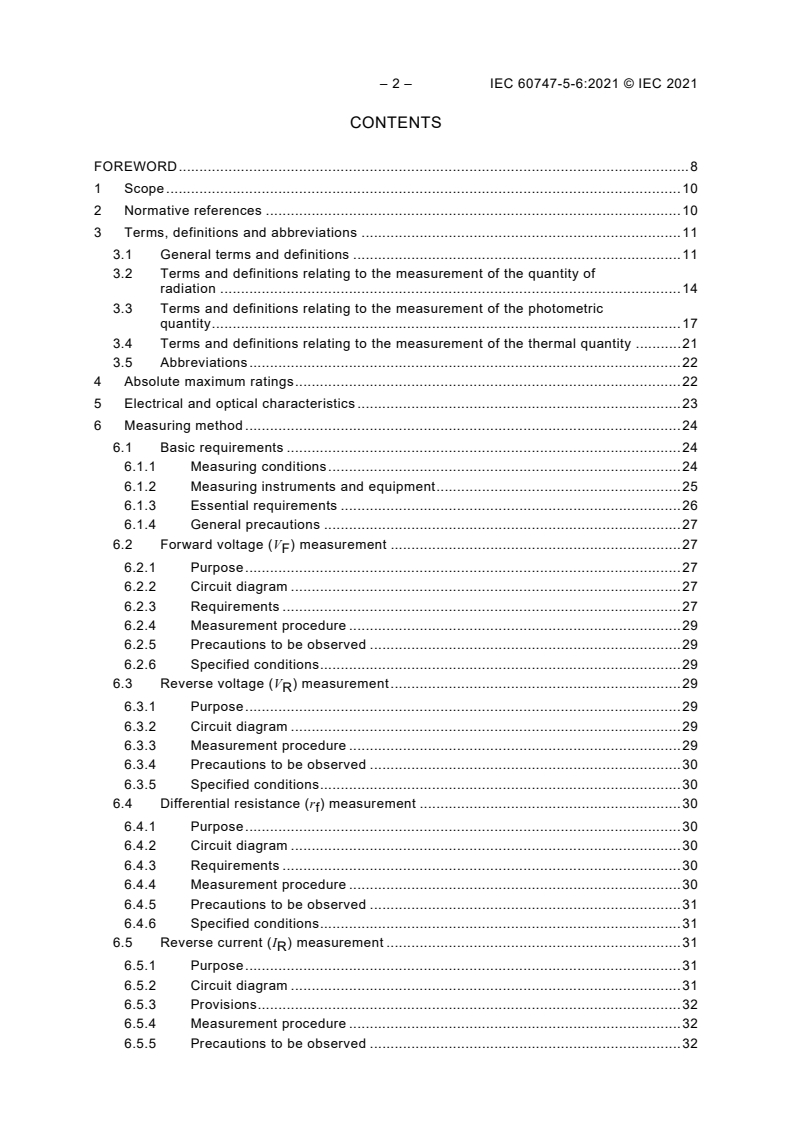
IEC 60747-5-6:2021 - Semiconductor devices - Part 5-6: Optoelectronic devices - Light emitting diodes Released:7/6/2021
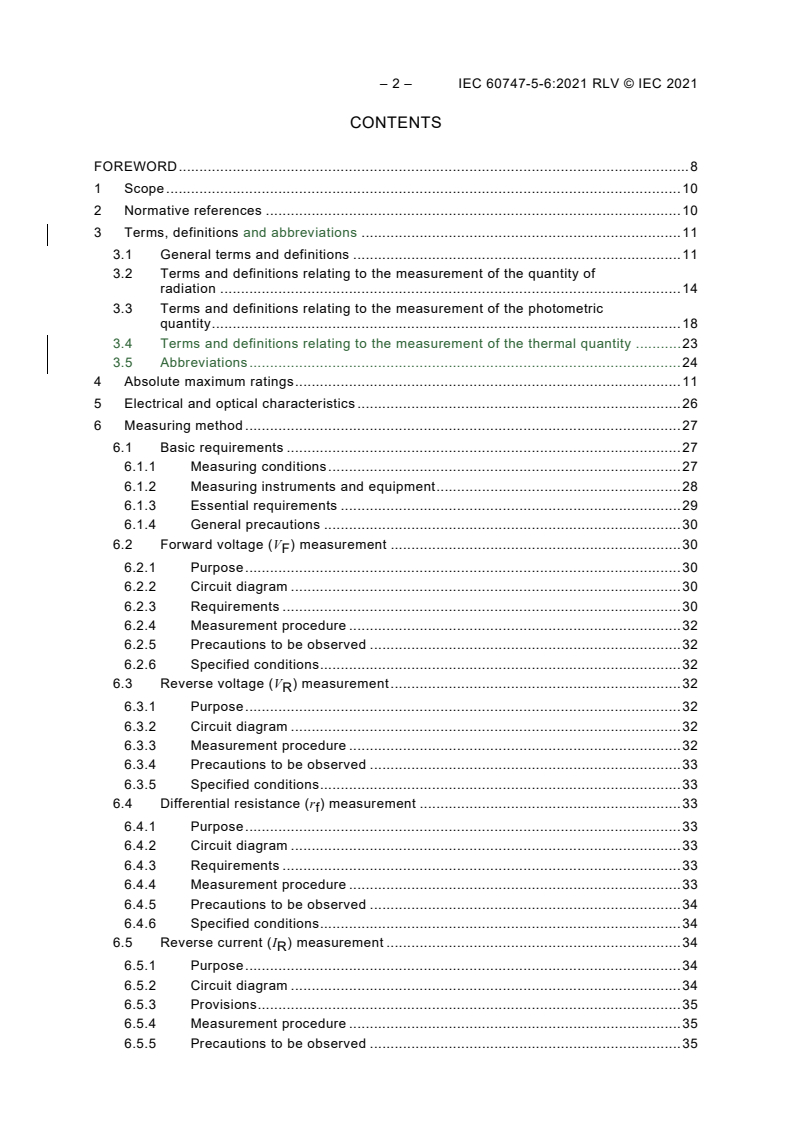
IEC 60747-5-6:2021 RLV - Semiconductor devices - Part 5-6: Optoelectronic devices - Light emitting diodes Released:7/6/2021
Overview
IEC 60747-5-6:2021 - Semiconductor devices - Part 5-6: Optoelectronic devices - Light emitting diodes - specifies terminology, essential ratings and characteristics, measuring methods, and quality evaluations for light emitting diodes (LEDs) used in general industrial applications (signals, controllers, sensors, displays, etc.). LEDs for lighting applications and integrated LED+controlgear modules are expressly out of scope. The standard covers packaged LEDs, flat illuminators, numeric/alpha-numeric displays, dot-matrix displays, infrared (IR) LEDs and ultraviolet (UV) LEDs. LEDs with heat spreader functions are included.
This edition adds UV‑LED content, introduces power efficiency (ηPE) in electrical/optical characteristics, expands thermal‑resistance measurement methods, and adds a hydrogen sulphide corrosion test to quality evaluation.
Key Topics and Requirements
- Terminology and classifications for LED package types (package, flat illuminator, numeric/alpha displays, dot‑matrix, IR LED, UV LED).
- Absolute maximum ratings and essential electrical/optical characteristics (forward/reverse voltage, reverse current, differential resistance).
- Comprehensive measuring methods including:
- Forward/reverse voltage and current measurements
- Capacitance, response time, frequency response and cut‑off frequency
- Junction temperature and multiple thermal resistance measurement techniques
- Luminous flux, radiant flux, luminous intensity, radiant intensity, luminance, illuminance
- Emission spectrum, peak wavelength, spectral bandwidth and chromaticity
- Directional characteristics and full‑width half‑maximum (FWHM)
- Quality evaluation framework covering classification levels, test specimens, lot inspection and environmental tests (including hydrogen sulphide corrosion).
- Package marking and information required to be indicated on product packaging.
Practical Applications
IEC 60747-5-6 is intended to standardize testing and specification of LEDs used in:
- Industrial signal and status indicators
- Sensor illumination and IR emitters for proximity/remote sensing
- Display modules (numeric, alphanumeric, dot‑matrix) for instrumentation
- UV LED components for curing, sensing or inspection (non‑lighting applications) Use of the standard helps ensure consistent performance data, reliable thermal management, and robust environmental durability in product design, testing, procurement and certification.
Who Should Use This Standard
- LED manufacturers and package designers
- Test laboratories and QA/qualification engineers
- Product designers (industrial electronics, sensors, displays)
- Procurement and compliance teams specifying LED performance
- Certification bodies assessing conformity to optoelectronic device requirements
Related Standards
- Other parts of the IEC 60747 semiconductor device series and IEC optoelectronic standards for measurement and safety. Check IEC catalog/bibliography for cross‑references and updates.
Relations
- Effective Date
- 10-Feb-2026
- Effective Date
- 05-Sep-2023
Buy Documents
IEC 60747-5-6:2021 - Semiconductor devices - Part 5-6: Optoelectronic devices - Light emitting diodes Released:7/6/2021
IEC 60747-5-6:2021 RLV - Semiconductor devices - Part 5-6: Optoelectronic devices - Light emitting diodes Released:7/6/2021
Frequently Asked Questions
IEC 60747-5-6:2021 is a standard published by the International Electrotechnical Commission (IEC). Its full title is "Semiconductor devices - Part 5-6: Optoelectronic devices - Light emitting diodes". This standard covers: IEC 60747-5-6:2021 specifies the terminology, the essential ratings and characteristics, the measuring methods and the quality evaluations of light emitting diodes (LEDs) for general industrial applications such as signals, controllers, sensors, etc. LEDs for lighting applications are out of the scope of this part of IEC 60747. LEDs are classified as follows: - LED package; - LED flat illuminator; - LED numeric display and alpha-numeric display; - LED dot-matrix display; - infrared-emitting diode (IR LED); - ultraviolet-emitting diode (UV LED). LEDs with a heat spreader or having a terminal geometry that performs the function of a heat spreader are within the scope of this part of IEC 60747. An integration of LEDs and controlgears, integrated LED modules, semi-integrated LED modules, integrated LED lamps or semi-integrated LED lamps, are out of the scope of this part of IEC 60747. This edition includes the following significant technical changes with respect to the previous edition: - ultraviolet-emitting diodes (UV LED) and their related technical contents were added; - power efficiency (ηPE) as part of electrical and optical characteristics were added; - new measuring methods related to thermal resistance were added; - hydrogen sulphide corrosion test was added to quality evaluation; - some standards were added to the bibliography.
IEC 60747-5-6:2021 specifies the terminology, the essential ratings and characteristics, the measuring methods and the quality evaluations of light emitting diodes (LEDs) for general industrial applications such as signals, controllers, sensors, etc. LEDs for lighting applications are out of the scope of this part of IEC 60747. LEDs are classified as follows: - LED package; - LED flat illuminator; - LED numeric display and alpha-numeric display; - LED dot-matrix display; - infrared-emitting diode (IR LED); - ultraviolet-emitting diode (UV LED). LEDs with a heat spreader or having a terminal geometry that performs the function of a heat spreader are within the scope of this part of IEC 60747. An integration of LEDs and controlgears, integrated LED modules, semi-integrated LED modules, integrated LED lamps or semi-integrated LED lamps, are out of the scope of this part of IEC 60747. This edition includes the following significant technical changes with respect to the previous edition: - ultraviolet-emitting diodes (UV LED) and their related technical contents were added; - power efficiency (ηPE) as part of electrical and optical characteristics were added; - new measuring methods related to thermal resistance were added; - hydrogen sulphide corrosion test was added to quality evaluation; - some standards were added to the bibliography.
IEC 60747-5-6:2021 is classified under the following ICS (International Classification for Standards) categories: 31.080.99 - Other semiconductor devices. The ICS classification helps identify the subject area and facilitates finding related standards.
IEC 60747-5-6:2021 has the following relationships with other standards: It is inter standard links to EN 62007-1:2015/A1:2022, IEC 60747-5-6:2016. Understanding these relationships helps ensure you are using the most current and applicable version of the standard.
IEC 60747-5-6:2021 is available in PDF format for immediate download after purchase. The document can be added to your cart and obtained through the secure checkout process. Digital delivery ensures instant access to the complete standard document.
Standards Content (Sample)
IEC 60747-5-6 ®
Edition 2.0 2021-07
INTERNATIONAL
STANDARD
Semiconductor devices –
Part 5-6: Optoelectronic devices – Light emitting diodes
All rights reserved. Unless otherwise specified, no part of this publication may be reproduced or utilized in any form
or by any means, electronic or mechanical, including photocopying and microfilm, without permission in writing from
either IEC or IEC's member National Committee in the country of the requester. If you have any questions about IEC
copyright or have an enquiry about obtaining additional rights to this publication, please contact the address below or
your local IEC member National Committee for further information.
IEC Central Office Tel.: +41 22 919 02 11
3, rue de Varembé info@iec.ch
CH-1211 Geneva 20 www.iec.ch
Switzerland
About the IEC
The International Electrotechnical Commission (IEC) is the leading global organization that prepares and publishes
International Standards for all electrical, electronic and related technologies.
About IEC publications
The technical content of IEC publications is kept under constant review by the IEC. Please make sure that you have the
latest edition, a corrigendum or an amendment might have been published.
IEC publications search - webstore.iec.ch/advsearchform IEC online collection - oc.iec.ch
The advanced search enables to find IEC publications by a Discover our powerful search engine and read freely all the
variety of criteria (reference number, text, technical publications previews. With a subscription you will always
committee, …). It also gives information on projects, replaced have access to up to date content tailored to your needs.
and withdrawn publications.
Electropedia - www.electropedia.org
IEC Just Published - webstore.iec.ch/justpublished
The world's leading online dictionary on electrotechnology,
Stay up to date on all new IEC publications. Just Published
containing more than 22 000 terminological entries in English
details all new publications released. Available online and
and French, with equivalent terms in 18 additional languages.
once a month by email.
Also known as the International Electrotechnical Vocabulary
(IEV) online.
IEC Customer Service Centre - webstore.iec.ch/csc
If you wish to give us your feedback on this publication or
need further assistance, please contact the Customer Service
Centre: sales@iec.ch.
IEC 60747-5-6 ®
Edition 2.0 2021-07
INTERNATIONAL
STANDARD
Semiconductor devices –
Part 5-6: Optoelectronic devices – Light emitting diodes
INTERNATIONAL
ELECTROTECHNICAL
COMMISSION
ICS 31.080.99 ISBN 978-2-8322-9853-4
– 2 – IEC 60747-5-6:2021 © IEC 2021
CONTENTS
FOREWORD . 8
1 Scope . 10
2 Normative references . 10
3 Terms, definitions and abbreviations . 11
3.1 General terms and definitions . 11
3.2 Terms and definitions relating to the measurement of the quantity of
radiation . 14
3.3 Terms and definitions relating to the measurement of the photometric
quantity . 17
3.4 Terms and definitions relating to the measurement of the thermal quantity . 21
3.5 Abbreviations . 22
4 Absolute maximum ratings . 22
5 Electrical and optical characteristics . 23
6 Measuring method . 24
6.1 Basic requirements . 24
6.1.1 Measuring conditions . 24
6.1.2 Measuring instruments and equipment . 25
6.1.3 Essential requirements . 26
6.1.4 General precautions . 27
6.2 Forward voltage (V ) measurement . 27
F
6.2.1 Purpose . 27
6.2.2 Circuit diagram . 27
6.2.3 Requirements . 27
6.2.4 Measurement procedure . 29
6.2.5 Precautions to be observed . 29
6.2.6 Specified conditions . 29
6.3 Reverse voltage (V ) measurement . 29
R
6.3.1 Purpose . 29
6.3.2 Circuit diagram . 29
6.3.3 Measurement procedure . 29
6.3.4 Precautions to be observed . 30
6.3.5 Specified conditions . 30
6.4 Differential resistance (r ) measurement . 30
f
6.4.1 Purpose . 30
6.4.2 Circuit diagram . 30
6.4.3 Requirements . 30
6.4.4 Measurement procedure . 30
6.4.5 Precautions to be observed . 31
6.4.6 Specified conditions . 31
6.5 Reverse current (I ) measurement . 31
R
6.5.1 Purpose . 31
6.5.2 Circuit diagram . 31
6.5.3 Provisions . 32
6.5.4 Measurement procedure . 32
6.5.5 Precautions to be observed . 32
6.5.6 Specified conditions . 32
6.6 Measurement of capacitance between terminals (C ). 32
t
6.6.1 General . 32
6.6.2 Measurement using LCR meter . 33
6.6.3 Measurement using AC bridge . 33
6.7 Measurement of junction temperature (T ) and thermal resistance (R
j th(j-
, R ) . 35
X)el th(j-X)real
6.7.1 Purpose . 35
6.7.2 Measurement principle. 35
6.7.3 Measurement procedure . 37
6.7.4 Precautions to be observed . 42
6.7.5 Specified conditions . 42
6.8 Response time measurement . 42
6.8.1 Purpose . 42
6.8.2 Circuit diagram . 42
6.8.3 Provisions . 43
6.8.4 Measurement procedure . 43
6.8.5 Precautions to be observed . 43
6.8.6 Specified conditions . 44
6.9 Frequency response and cut-off frequency (f ) measurement . 44
c
6.9.1 Purpose . 44
6.9.2 Circuit diagram . 44
6.9.3 Provisions . 45
6.9.4 Measurement procedure . 45
6.9.5 Precautions to be observed . 46
6.9.6 Specified conditions . 46
6.10 Luminous flux (Φ ) measurement . 46
v
6.10.1 Purpose . 46
6.10.2 Measurement principle. 46
6.10.3 Measuring circuit . 46
6.10.4 Measurement procedure . 47
6.10.5 Precautions to be observed . 47
6.10.6 Measurement conditions to be defined . 48
6.11 Radiant flux (Φ ) measurement. 48
e
6.11.1 Purpose . 48
6.11.2 Measurement principle. 48
6.11.3 Measuring circuit . 49
6.11.4 Measurement procedure . 49
6.11.5 Precautions to be observed . 49
6.11.6 Measurement conditions to be defined . 50
6.12 Luminous intensity (I ) measurement . 50
V
6.12.1 Purpose . 50
6.12.2 Measurement principle. 50
6.12.3 Measuring circuit . 51
6.12.4 Measurement procedure . 52
6.12.5 Precautions to be observed . 52
6.12.6 Measurement conditions to be defined . 52
6.13 Radiant intensity (I ) measurement . 52
e
– 4 – IEC 60747-5-6:2021 © IEC 2021
6.13.1 Purpose . 52
6.13.2 Measurement principle. 52
6.13.3 Measuring circuit . 53
6.13.4 Measurement procedure . 53
6.13.5 Measurement conditions to be defined . 53
6.14 Luminance (L ) measurement . 53
v
6.14.1 Purpose . 53
6.14.2 Measuring circuit . 54
6.14.3 Measurement procedure . 54
6.14.4 Measurement conditions to be defined . 54
6.15 Emission spectrum distribution, peak emission wavelength (λ ), and spectral
p
half bandwidth (∆λ) measurement . 55
6.15.1 Purpose . 55
6.15.2 Measuring circuit . 55
6.15.3 Measurement procedure . 56
6.15.4 Measurement conditions to be defined . 57
6.16 Chromaticity measurement. 57
6.16.1 Purpose . 57
6.16.2 Measurement principle. 57
6.16.3 Measuring circuit . 60
6.16.4 Measurement procedure . 60
6.16.5 Measuring conditions to be defined . 60
6.17 Directional characteristics and full width half maximum of an intensity
measurement . 60
6.17.1 Purpose . 60
6.17.2 Measuring circuit . 61
6.17.3 Measurement procedure . 61
6.17.4 Measuring conditions to be defined . 62
6.18 Illuminance (E ) measurement. 63
V
6.18.1 Purpose . 63
6.18.2 Measuring circuit . 63
6.18.3 Measurement procedure . 63
6.18.4 Measuring conditions to be defined . 63
7 Items to be indicated on the package . 63
8 Quality evaluation . 64
8.1 General . 64
8.2 Classification of quality evaluations . 64
8.2.1 General . 64
8.2.2 Classification I . 64
8.2.3 Classification II . 64
8.2.4 Classification III . 64
8.2.5 Precautions to be observed . 64
8.3 Quality evaluation test . 70
8.3.1 General . 70
8.3.2 Specimens . 71
8.4 Lot quality inspection . 71
8.4.1 General . 71
8.4.2 Specimens . 71
8.5 Periodical quality inspection . 71
8.5.1 General . 71
8.5.2 Specimens . 71
8.5.3 Inspection period . 71
8.6 Easing of the lot quality inspection standards . 71
8.7 Periodical evaluation maintenance tests . 72
8.7.1 Test items and specimens . 72
8.7.2 Test period . 72
8.8 Long-term storage products . 72
8.9 Continuous current test . 72
8.9.1 General . 72
8.9.2 Initial measurement . 72
8.9.3 Test circuits . 72
8.9.4 Test conditions . 73
8.9.5 Post-treatment . 73
8.9.6 Final measurement . 73
Annex A (normative) Standard luminous efficiency . 74
Annex B (normative) How to obtain the self-absorption correction factor . 77
B.1 Purpose . 77
B.2 LED light sources for self-absorption measurement . 77
B.3 Method . 77
Annex C (normative) How to obtain the colour correction factor . 79
C.1 Purpose . 79
C.2 Method . 79
C.2.1 Luminous flux and luminous intensity measurement . 79
C.2.2 Radiant flux and radiant intensity measurement . 80
Annex D (normative) Calibration of the luminance meter . 81
D.1 Purpose . 81
D.2 How to perform the calibration . 81
Annex E (normative) Colour-matching function of the XYZ colour system . 83
Annex F (normative) Spectral chromaticity coordinates . 88
Annex G (normative) Illuminance meter calibration . 93
G.1 Purpose . 93
G.2 How to perform the calibration . 93
Bibliography . 94
Figure 1 – Radiant intensity . 15
Figure 2 – Radiance. 16
Figure 3 – Radiant exitance . 16
Figure 4 – Irradiance . 17
Figure 5 – Spectral luminous efficiency . 18
Figure 6 – Circuit diagram for V measurement . 27
F
Figure 7 – Circuit diagram for V measurement with a constant voltage source and a
F
current-limiting resistor . 28
Figure 8 – Circuit diagram for V measurement using an SMU . 28
F
Figure 9 – Circuit diagram for V measurement . 29
R
– 6 – IEC 60747-5-6:2021 © IEC 2021
Figure 10 – Circuit diagram for r measurement . 30
f
Figure 11 – Circuit diagram for I measurement . 32
R
Figure 12 – Circuit diagram for C measurement . 33
t
Figure 13 – Circuit diagram for C measurement . 34
t
Figure 14 – An example of the temperature dependence of η . 35
PE
Figure 15 – Heating time duration dependence of the measured thermal resistance . 36
Figure 16 – Cumulative thermal capacitance versus cumulative thermal resistance
characteristics (structural function) . 37
Figure 17 – Circuit diagram for measurement of change in V . 38
F
Figure 18 – Change in V during the measurement . 39
F
Figure 19 – Example of the time variation in V . 40
F
Figure 20 – Transient vibration waveform immediately after the heating is off . 40
Figure 21 – Circuit diagram for response time measurement . 42
Figure 22 – Waveform of response time measurement . 44
Figure 23 – Circuit diagram for f measurement . 45
c
Figure 24 – Circuit diagram for Φ measurement . 47
V
Figure 25 – Circuit diagram for Φ measurement . 49
e
Figure 26 – Schematic diagram for I measurement . 51
V
Figure 27 – Circuit diagram for I measurement . 51
V
Figure 28 – Circuit diagram for I measurement . 53
e
Figure 29 – Circuit diagram for L measurement . 54
v
Figure 30 – Circuit diagram for λ measurement . 55
p
Figure 31 – Circuit diagram for λ measurement . 56
p
Figure 32 – Schematic diagram of ∆λ measurement . 57
Figure 33 – Chromaticity . 59
Figure 34 – Circuit diagram for chromaticity measurement . 61
Figure 35 – Directional characteristics (example 1) . 62
Figure 36 – Directional characteristics (example 2) . 62
Figure 37 – Circuit diagram for E measurement . 63
v
Figure 38 – Circuit diagram for continuous current test . 73
Figure B.1 – Schematic diagram for self-absorption measurement . 77
Figure D.1 – Schematic diagrams for calibration . 82
Figure G.1 – Schematic diagram for calibration . 93
Table 1 – Absolute maximum ratings . 22
Table 2 – Electrical and optical characteristics . 23
Table 3 – CIE averaged LED intensity measurements . 51
Table 4 – Items for the screening test and their conditions(reference) . 64
Table 5 – Quality evaluation tests . 65
Table 6 – Lot quality inspection . 67
Table 7 – Periodical quality inspection . 70
Table A.1 – Definitive values of the spectral luminous efficiency function for photopic
vision V(λ) . 74
Table E.1 – Colour-matching function of the XYZ colour system . 83
Table F.1 – Spectral chromaticity coordinates . 88
– 8 – IEC 60747-5-6:2021 © IEC 2021
INTERNATIONAL ELECTROTECHNICAL COMMISSION
____________
SEMICONDUCTOR DEVICES –
Part 5-6: Optoelectronic devices – Light emitting diodes
FOREWORD
1) The International Electrotechnical Commission (IEC) is a worldwide organization for standardization comprising
all national electrotechnical committees (IEC National Committees). The object of IEC is to promote international
co-operation on all questions concerning standardization in the electrical and electronic fields. To this end and
in addition to other activities, IEC publishes International Standards, Technical Specifications, Technical Reports,
Publicly Available Specifications (PAS) and Guides (hereafter referred to as "IEC Publication(s)"). Their
preparation is entrusted to technical committees; any IEC National Committee interested in the subject dealt with
may participate in this preparatory work. International, governmental and non-governmental organizations liaising
with the IEC also participate in this preparation. IEC collaborates closely with the International Organization for
Standardization (ISO) in accordance with conditions determined by agreement between the two organizations.
2) The formal decisions or agreements of IEC on technical matters express, as nearly as possible, an international
consensus of opinion on the relevant subjects since each technical committee has representation from all
interested IEC National Committees.
3) IEC Publications have the form of recommendations for international use and are accepted by IEC National
Committees in that sense. While all reasonable efforts are made to ensure that the technical content of IEC
Publications is accurate, IEC cannot be held responsible for the way in which they are used or for any
misinterpretation by any end user.
4) In order to promote international uniformity, IEC National Committees undertake to apply IEC Publications
transparently to the maximum extent possible in their national and regional publications. Any divergence between
any IEC Publication and the corresponding national or regional publication shall be clearly indicated in the latter.
5) IEC itself does not provide any attestation of conformity. Independent certification bodies provide conformity
assessment services and, in some areas, access to IEC marks of conformity. IEC is not responsible for any
services carried out by independent certification bodies.
6) All users should ensure that they have the latest edition of this publication.
7) No liability shall attach to IEC or its directors, employees, servants or agents including individual experts and
members of its technical committees and IEC National Committees for any personal injury, property damage or
other damage of any nature whatsoever, whether direct or indirect, or for costs (including legal fees) and
expenses arising out of the publication, use of, or reliance upon, this IEC Publication or any other IEC
Publications.
8) Attention is drawn to the Normative references cited in this publication. Use of the referenced publications is
indispensable for the correct application of this publication.
9) Attention is drawn to the possibility that some of the elements of this IEC Publication may be the subject of patent
rights. IEC shall not be held responsible for identifying any or all such patent rights.
IEC 60747-5-6 has been prepared by subcommittee 47E: Discrete semiconductor devices, of
IEC technical committee 47: Semiconductor devices. It is an International Standard.
This second edition cancels and replaces the first edition published in 2016. This edition
constitutes a technical revision.
This edition includes the following significant technical changes with respect to the previous
edition:
a) ultraviolet-emitting diodes (UV LED) and their related technical contents were added;
b) power efficiency (η ) as part of electrical and optical characteristics were added;
PE
c) new measuring methods related to thermal resistance were added;
d) hydrogen sulphide corrosion test was added to quality evaluation;
e) some standards were added to the bibliography.
The text of this International Standard is based on the following documents:
FDIS Report on voting
47E/745/FDIS 47E/752/RVD
Full information on the voting for its approval can be found in the report on voting indicated in
the above table.
The language used for the development of this International Standard is English.
This document was drafted in accordance with ISO/IEC Directives, Part 2, and developed in
accordance with ISO/IEC Directives, Part 1 and ISO/IEC Directives, IEC Supplement, available
at www.iec.ch/members_experts/refdocs. The main document types developed by IEC are
described in greater detail at www.iec.ch/standardsdev/publications.
A list of all parts in the IEC 60747 series, published under the general title Semiconductor
devices, can be found on the IEC website.
The committee has decided that the contents of this document will remain unchanged until the
stability date indicated on the IEC website under webstore.iec.ch in the data related to the
specific document. At this date, the document will be
• reconfirmed,
• withdrawn,
• replaced by a revised edition, or
• amended.
– 10 – IEC 60747-5-6:2021 © IEC 2021
SEMICONDUCTOR DEVICES –
Part 5-6: Optoelectronic devices – Light emitting diodes
1 Scope
This part of IEC 60747 specifies the terminology, the essential ratings and characteristics, the
measuring methods and the quality evaluations of light emitting diodes (LEDs) for general
industrial applications such as signals, controllers, sensors, etc.
LEDs for lighting applications are out of the scope of this part of IEC 60747.
LEDs are classified as follows:
a) LED package;
b) LED flat illuminator;
c) LED numeric display and alpha-numeric display;
d) LED dot-matrix display;
e) infrared-emitting diode (IR LED);
f) ultraviolet-emitting diode (UV LED).
LEDs with a heat spreader or having a terminal geometry that performs the function of a heat
spreader are within the scope of this part of IEC 60747.
An integration of LEDs and controlgears, integrated LED modules, semi-integrated LED
modules, integrated LED lamps or semi-integrated LED lamps, are out of the scope of this part
of IEC 60747.
2 Normative references
The following documents are referred to in the text in such a way that some or all of their content
constitutes requirements of this document. For dated references, only the edition cited applies.
For undated references, the latest edition of the referenced document (including any
amendments) applies.
IEC 60051 (all parts), Direct acting indicating analogue electrical measuring instruments and
their accessories
IEC 60068-2-17, Basic environmental testing procedures – Part 2-17: Tests – Test Q: Sealing
IEC 60068-2-30, Environmental testing – Part 2-30: Tests – Test Db: Damp heat, cyclic
(12 h + 12 h cycle)
IEC 60747-5-13, Semiconductor devices – Part 5-13: Optoelectronic devices – Hydrogen
sulphide corrosion test for LED packages
IEC 60749-6, Semiconductor devices – Mechanical and climatic test methods – Part 6: Storage
at high temperature
IEC 60749-10, Semiconductor devices – Mechanical and climatic test methods – Part 10:
Mechanical shock
IEC 60749-12, Semiconductor devices – Mechanical and climatic test methods – Part 12:
Vibration, variable frequency
IEC 60749-14, Semiconductor devices – Mechanical and climatic test methods – Part 14:
Robustness of terminations (lead integrity)
IEC 60749-15, Semiconductor devices – Mechanical and climatic test methods – Part 15:
Resistance to soldering temperature for through-hole mounted devices
IEC 60749-20, Semiconductor devices – Mechanical and climatic test methods – Part 20:
Resistance of plastic encapsulated SMDs to the combined effect of moisture and soldering heat
IEC 60749-21, Semiconductor devices – Mechanical and climatic test methods – Part 21:
Solderability
IEC 60749-24, Semiconductor devices – Mechanical and climatic test methods – Part 24:
Accelerated moisture resistance – Unbiased HAST
IEC 60749-25, Semiconductor devices – Mechanical and climatic test methods – Part 25:
Temperature cycling
IEC 60749-36, Semiconductor devices – Mechanical and climatic test methods – Part 36:
Acceleration, steady state
ISO 2859-1, Sampling procedures for inspection by attributes – Part 1: Sampling schemes
indexed by acceptance quality limit (AQL) for lot-by-lot inspection
3 Terms, definitions and abbreviations
For the purposes of this document, the following terms and definitions apply.
ISO and IEC maintain terminological databases for use in standardization at the following
addresses:
• IEC Electropedia: available at http://www.electropedia.org/
• ISO Online browsing platform: available at http://www.iso.org/obp
3.1 General terms and definitions
3.1.1
integrating sphere
hollow sphere, the interior of which is formed from, or coated with, a diffusely-reflecting material
that is as spectrally neutral and as spatially uniform as possible
Note 1 to entry: Owing to the internal reflections within the sphere, the illuminance on any part of the inside surface
of the sphere for which the direct flux is hidden is theoretically proportional to the luminous flux entering the sphere
or produced inside the sphere. The illuminance of the internal sphere wall can be measured via a small window.
Note 2 to entry: The window of an integrating sphere is often used in radiometric measurement systems to provide
a source with good spatial uniformity and with an angular distribution of radiance or luminance that is close to
Lambert's cosine law.
[SOURCE: IEC 60050-845:2020, 845-25-028]
3.1.2
diffuse reflector
reflector composed of a surface with diffuse reflection
– 12 – IEC 60747-5-6:2021 © IEC 2021
3.1.3
diffuse reflection
scattering by reflection in which, on the macroscopic scale, there is no regular reflection
[SOURCE: IEC 60050-845:2020, 845-24-054]
3.1.4
diffuse transmission
scattering by transmission in which, on the macroscopic scale, there is no regular transmission
[SOURCE: IEC 60050-845:2020, 845-24-055]
3.1.5
diffuse reflectance
ρ
d
quotient of the diffusely reflected part of the (whole) reflected flux and the incident flux
Note 1 to entry: Reflectance, ρ, is the sum of regular reflectance, ρ , and diffuse reflectance, ρ : ρ = ρ + ρ
r d r d
Note 2 to entry: The diffuse reflectance has unit one.
[SOURCE: IEC 60050-845:2020, 845-24-068]
3.1.6
diffuse transmittance
τ
d
quotient of the diffusely transmitted part of the (whole) transmitted flux and the incident flux
Note 1 to entry: Transmittance, τ, is the sum of regular transmittance, τ , and diffuse transmittance, τ : τ = τ + τ .
r d r d
Note 2 to entry: The diffuse transmittance has unit one.
[SOURCE: IEC 60050-845:2020, 845-24-069]
3.1.7
lambertian surface
ideal surface for which the radiation coming from that surface is distributed angularly according
to Lambert's cosine law
Note 1 to entry: For a lambertian surface, M = πL, where M is the radiant exitance or luminous exitance, and L the
radiance or luminance.
[SOURCE: IEC 60050-845:2020, 845-24-063]
3.1.8
spectral reflectance
R(λ)
ratio of reflected radiant flux to incident radiant flux for a wavelength λ
Note 1 to entry: Spectral reflectance is also known as the "spectral reflection factor".
3.1.9
spectral transmittance
T(λ)
ratio of transmitted radiant flux to incident radiant flux for a wavelength λ
Note 1 to entry: Spectral transmittance is also known as the "spectral transmittance factor".
3.1.10
spectral distribution
proportion of the quantum of radiation per unit wavelength included in the micro wavelength
interval centre on wavelength λ, which is expressed as a function of wavelength λ
Note 1 to entry: Spectral distribution is also known as the "spectrum distribution".
3.1.11
spectral sensitivity
S(λ)
light sensitivity as a function of wavelength
Note 1 to entry: The response output of the optical receiver for the radiant flux (or luminous flux) input of wavelength
λ is expressed as a function of wavelength λ.
3.1.12
distribution temperature
T
D
temperature of the Planckian radiator whose relative spectral distribution S(λ) is the same or
nearly the same as that of the radiation considered in the spectral range of interest for which
the following integral is minimized by adjustment of a and T:
λ
S λ
( )
t
1d− λ
∫
aS ( λT, )
b
λ
where λ is the wavelength, S (λ) is the relative spectral distribution of the radiation being
t
considered, S (λ, T) is the relative spectral distribution of the Planckian radiator at temperature
b
T, and a is a scaling factor
S ( λ)
t
Note 1 to entry: The scaling factor a is chosen to make the quotient equal to unity at a convenient
S ( λT, )
b
wavelength which, in photometry and colorimetry is typically 560 nm.
−1
c
P ( λT, )
−5
λT
S ( λT, ) = with P ( λT, ) λ e1− where c is the second radiation constant.
b 2
PT(560nm, )
Note 2 to entry: Distribution temperature is a meaningful characteristic for radiators having a relative spectral
distribution similar to that of a Planckian radiator, but only if calculated for an expanded wavelength range and for
radiation whose spectral distribution of radiant flux is a continuous function of wavelength in that range.
Note 3 to entry: In photometry and colorimetry the wavelength range set by λ and λ is the visible spectral range,
1 2
and in these cases the range from at least λ = 400 nm to λ = 750 nm is reco
...
IEC 60747-5-6 ®
Edition 2.0 2021-07
REDLINE VERSION
INTERNATIONAL
STANDARD
colour
inside
Semiconductor devices –
Part 5-6: Optoelectronic devices – Light emitting diodes
All rights reserved. Unless otherwise specified, no part of this publication may be reproduced or utilized in any form
or by any means, electronic or mechanical, including photocopying and microfilm, without permission in writing from
either IEC or IEC's member National Committee in the country of the requester. If you have any questions about IEC
copyright or have an enquiry about obtaining additional rights to this publication, please contact the address below or
your local IEC member National Committee for further information.
IEC Central Office Tel.: +41 22 919 02 11
3, rue de Varembé info@iec.ch
CH-1211 Geneva 20 www.iec.ch
Switzerland
About the IEC
The International Electrotechnical Commission (IEC) is the leading global organization that prepares and publishes
International Standards for all electrical, electronic and related technologies.
About IEC publications
The technical content of IEC publications is kept under constant review by the IEC. Please make sure that you have the
latest edition, a corrigendum or an amendment might have been published.
IEC publications search - webstore.iec.ch/advsearchform IEC online collection - oc.iec.ch
The advanced search enables to find IEC publications by a Discover our powerful search engine and read freely all the
variety of criteria (reference number, text, technical publications previews. With a subscription you will always
committee, …). It also gives information on projects, replaced have access to up to date content tailored to your needs.
and withdrawn publications.
Electropedia - www.electropedia.org
IEC Just Published - webstore.iec.ch/justpublished
The world's leading online dictionary on electrotechnology,
Stay up to date on all new IEC publications. Just Published
containing more than 22 000 terminological entries in English
details all new publications released. Available online and
and French, with equivalent terms in 18 additional languages.
once a month by email.
Also known as the International Electrotechnical Vocabulary
(IEV) online.
IEC Customer Service Centre - webstore.iec.ch/csc
If you wish to give us your feedback on this publication or
need further assistance, please contact the Customer Service
Centre: sales@iec.ch.
IEC 60747-5-6 ®
Edition 2.0 2021-07
REDLINE VERSION
INTERNATIONAL
STANDARD
colour
inside
Semiconductor devices –
Part 5-6: Optoelectronic devices – Light emitting diodes
INTERNATIONAL
ELECTROTECHNICAL
COMMISSION
ICS 31.080.99 ISBN 978-2-8322-4478-4
– 2 – IEC 60747-5-6:2021 RLV © IEC 2021
CONTENTS
FOREWORD . 8
1 Scope . 10
2 Normative references . 10
3 Terms, definitions and abbreviations . 11
3.1 General terms and definitions . 11
3.2 Terms and definitions relating to the measurement of the quantity of
radiation . 14
3.3 Terms and definitions relating to the measurement of the photometric
quantity . 18
3.4 Terms and definitions relating to the measurement of the thermal quantity . 23
3.5 Abbreviations . 24
4 Absolute maximum ratings . 11
5 Electrical and optical characteristics . 26
6 Measuring method . 27
6.1 Basic requirements . 27
6.1.1 Measuring conditions . 27
6.1.2 Measuring instruments and equipment . 28
6.1.3 Essential requirements . 29
6.1.4 General precautions . 30
6.2 Forward voltage (V ) measurement . 30
F
6.2.1 Purpose . 30
6.2.2 Circuit diagram . 30
6.2.3 Requirements . 30
6.2.4 Measurement procedure . 32
6.2.5 Precautions to be observed . 32
6.2.6 Specified conditions . 32
6.3 Reverse voltage (V ) measurement . 32
R
6.3.1 Purpose . 32
6.3.2 Circuit diagram . 32
6.3.3 Measurement procedure . 32
6.3.4 Precautions to be observed . 33
6.3.5 Specified conditions . 33
6.4 Differential resistance (r ) measurement . 33
f
6.4.1 Purpose . 33
6.4.2 Circuit diagram . 33
6.4.3 Requirements . 33
6.4.4 Measurement procedure . 33
6.4.5 Precautions to be observed . 34
6.4.6 Specified conditions . 34
6.5 Reverse current (I ) measurement . 34
R
6.5.1 Purpose . 34
6.5.2 Circuit diagram . 34
6.5.3 Provisions . 35
6.5.4 Measurement procedure . 35
6.5.5 Precautions to be observed . 35
6.5.6 Specified conditions . 35
6.6 Measurement of capacitance between terminals (C ). 35
t
6.6.1 General . 35
6.6.2 Measurement using LCR meter . 36
6.6.3 Measurement using AC bridge . 36
6.7 Measurement of junction temperature (T ) and thermal resistance
j
(R , R ) . 38
th(j-X)el th(j-X)real
6.7.1 Purpose . 38
6.7.2 Measurement principle. 38
6.7.3 Measurement procedure . 38
6.7.4 Precautions to be observed . 47
6.7.5 Specified conditions . 49
6.8 Response time measurement . 49
6.8.1 Purpose . 49
6.8.2 Circuit diagram . 49
6.8.3 Provisions . 50
6.8.4 Measurement procedure . 50
6.8.5 Precautions to be observed . 51
6.8.6 Specified conditions . 51
6.9 Frequency response and cut-off frequency (f ) measurement . 52
c
6.9.1 Purpose . 52
6.9.2 Circuit diagram . 52
6.9.3 Provisions . 53
6.9.4 Measurement procedure . 53
6.9.5 Precautions to be observed . 54
6.9.6 Specified conditions . 54
6.10 Luminous flux (Φ ) measurement . 54
v
6.10.1 Purpose . 54
6.10.2 Measurement principle. 54
6.10.3 Measuring circuit . 54
6.10.4 Measurement procedure . 55
6.10.5 Precautions to be observed . 55
6.10.6 Measurement conditions to be defined . 56
6.11 Radiant power flux (Φ ) measurement . 56
e
6.11.1 Purpose . 56
6.11.2 Measurement principle. 56
6.11.3 Measuring circuit . 57
6.11.4 Measurement procedure . 57
6.11.5 Precautions to be observed . 57
6.11.6 Measurement conditions to be defined . 58
6.12 Luminous intensity (I ) measurement . 58
V
6.12.1 Purpose . 58
6.12.2 Measurement principle. 58
6.12.3 Measuring circuit . 59
6.12.4 Measurement procedure . 60
6.12.5 Precautions to be observed . 60
6.12.6 Measurement conditions to be defined . 60
6.13 Radiant intensity (I ) measurement . 60
e
– 4 – IEC 60747-5-6:2021 RLV © IEC 2021
6.13.1 Purpose . 60
6.13.2 Measurement principle. 60
6.13.3 Measuring circuit . 61
6.13.4 Measurement procedure . 61
6.13.5 Measurement conditions to be defined . 61
6.14 Luminance (L ) measurement . 61
v
6.14.1 Purpose . 61
6.14.2 Measuring circuit . 62
6.14.3 Measurement procedure . 62
6.14.4 Measurement conditions to be defined . 62
6.15 Emission spectrum distribution, peak emission wavelength (λ ), and spectral
p
half bandwidth (∆λ) measurement . 63
6.15.1 Purpose . 63
6.15.2 Measuring circuit . 63
6.15.3 Measurement procedure . 64
6.15.4 Measurement conditions to be defined . 65
6.16 Chromaticity measurement. 65
6.16.1 Purpose . 65
6.16.2 Measurement principle. 66
6.16.3 Measuring circuit . 68
6.16.4 Measurement procedure . 68
6.16.5 Measuring conditions to be defined . 68
6.17 Directional characteristics and full width half maximum of an intensity
measurement . 69
6.17.1 Purpose . 69
6.17.2 Measuring circuit . 69
6.17.3 Measurement procedure . 69
6.17.4 Measuring conditions to be defined . 70
6.18 Illuminance (E ) measurement. 71
V
6.18.1 Purpose . 71
6.18.2 Measuring circuit . 71
6.18.3 Measurement procedure . 71
6.18.4 Measuring conditions to be defined . 71
7 Items to be indicated on the package . 71
8 Quality evaluation . 72
8.1 General . 72
8.2 Classification of quality evaluations . 72
8.2.1 General . 72
8.2.2 Classification I . 72
8.2.3 Classification II . 72
8.2.4 Classification III . 72
8.2.5 Precautions to be observed . 72
8.3 Quality evaluation test . 79
8.3.1 General . 79
8.3.2 Specimens . 79
8.4 Lot quality inspection . 80
8.4.1 General . 80
8.4.2 Specimens . 80
8.5 Periodical quality inspection . 80
8.5.1 General . 80
8.5.2 Specimens . 80
8.5.3 Inspection period . 80
8.6 Easing of the lot quality inspection standards . 80
8.7 Periodical evaluation maintenance tests . 81
8.7.1 Test items and specimens . 81
8.7.2 Test period . 81
8.8 Long-term storage products . 81
8.9 Continuous current test . 81
8.9.1 General . 81
8.9.2 Initial measurement . 81
8.9.3 Test circuits . 81
8.9.4 Test conditions . 82
8.9.5 Post-treatment . 82
8.9.6 Final measurement . 82
Annex A (normative) Standard luminous efficiency . 83
Annex B (normative) How to obtain the self-absorption correction factor . 86
B.1 Purpose . 86
B.2 LED light sources for self-absorption measurement . 86
B.3 Method . 86
Annex C (normative) How to obtain the colour correction factor . 88
C.1 Purpose . 88
C.2 Method . 88
C.2.1 Luminous flux and luminous intensity measurement . 88
C.2.2 Radiant flux and radiant intensity measurement . 89
Annex D (normative) Calibration of the luminance meter . 90
D.1 Purpose . 90
D.2 How to perform the calibration . 90
Annex E (normative) Colour-matching function of the XYZ colour system . 92
Annex F (normative) Spectral chromaticity coordinates . 98
Annex G (normative) Illuminometer Illuminance meter calibration . 103
G.1 Purpose . 103
G.2 How to perform the calibration . 103
Bibliography . 104
Figure 1 – Radiant intensity . 16
Figure 2 – Radiance. 17
Figure 3 – Radiant exitance . 18
Figure 4 – Irradiance . 18
Figure 5 – Spectral luminous efficiency . 19
Figure 6 – Circuit diagram for V measurement . 30
F
Figure 7 – Circuit diagram for V measurement with a constant voltage source and a
F
current-limiting resistor . 31
Figure 8 – Circuit diagram for V measurement using an SMU . 31
F
Figure 9 – Circuit diagram for V measurement . 32
R
– 6 – IEC 60747-5-6:2021 RLV © IEC 2021
Figure 10 – Circuit diagram for r measurement . 33
f
Figure 11 – Circuit diagram for I measurement . 35
R
Figure 12 – Circuit diagram for C measurement . 36
t
Figure 13 – Circuit diagram for C measurement . 37
t
Figure 14 – An example of the temperature dependence of η . 39
PE
Figure 15 – Waveform of change in V .
F
Figure 15 – Heating time duration dependence of the measured thermal resistance . 40
Figure 16 – Transient change in thermal resistance (double-logarithmic plots) .
Figure 16 – Cumulative thermal capacitance versus cumulative thermal resistance
characteristics (structural function) . 40
Figure 17 – Circuit diagram for measurement of change in V . 42
F
Figure 18 – Change in V during the measurement . 43
F
Figure 19 – Example of the time variation in V . 44
F
Figure 20 – Transient vibration waveform immediately after the heating is off . 44
Figure 21 – Circuit diagram for response time measurement . 50
Figure 22 – Waveform of response time measurement . 52
Figure 23 – Circuit diagram for f measurement . 53
c
Figure 24 – Circuit diagram for Φ measurement . 55
V
Figure 25 – Circuit diagram for Φ measurement . 57
e
Figure 26 – Schematic diagram for I measurement . 59
V
Figure 27 – Circuit diagram for I measurement . 59
V
Figure 28 – Circuit diagram for I measurement . 61
e
Figure 29 – Circuit diagram for L measurement . 62
v
Figure 30 – Circuit diagram for λ measurement . 63
p
Figure 31 – Circuit diagram for λ measurement . 64
p
Figure 32 – Schematic diagram of ∆λ measurement . 65
Figure 33 – Chromaticity . 67
Figure 34 – Circuit diagram for chromaticity measurement . 69
Figure 35 – Directional characteristics (example 1) . 70
Figure 36 – Directional characteristics (example 2) . 70
Figure 37 – Circuit diagram for E measurement . 71
v
Figure 38 – Circuit diagram for continuous current test . 82
Figure B.1 – Schematic diagram for self-absorption measurement . 86
Figure D.1 – Schematic diagrams for calibration . 91
Figure G.1 – Schematic diagram for calibration . 103
Table 1 – Absolute maximum ratings . 25
Table 2 – Electrical and optical characteristics . 26
Table 3 – CIE averaged LED intensity measurements . 59
Table 4 – Items for the screening test and their conditions(reference) . 73
Table 5 – Quality evaluation tests . 74
Table 6 – Lot quality inspection . 76
Table 7 – Periodical quality inspection . 79
Table A.1 – Definitive values of the spectral luminous efficiency function for photopic
vision V(λ) . 83
Table E.1 – Colour-matching function of the XYZ colour system . 92
Table F.1 – Spectral chromaticity coordinates . 98
– 8 – IEC 60747-5-6:2021 RLV © IEC 2021
INTERNATIONAL ELECTROTECHNICAL COMMISSION
____________
SEMICONDUCTOR DEVICES –
Part 5-6: Optoelectronic devices – Light emitting diodes
FOREWORD
1) The International Electrotechnical Commission (IEC) is a worldwide organization for standardization comprising
all national electrotechnical committees (IEC National Committees). The object of IEC is to promote international
co-operation on all questions concerning standardization in the electrical and electronic fields. To this end and
in addition to other activities, IEC publishes International Standards, Technical Specifications, Technical Reports,
Publicly Available Specifications (PAS) and Guides (hereafter referred to as "IEC Publication(s)"). Their
preparation is entrusted to technical committees; any IEC National Committee interested in the subject dealt with
may participate in this preparatory work. International, governmental and non-governmental organizations liaising
with the IEC also participate in this preparation. IEC collaborates closely with the International Organization for
Standardization (ISO) in accordance with conditions determined by agreement between the two organizations.
2) The formal decisions or agreements of IEC on technical matters express, as nearly as possible, an international
consensus of opinion on the relevant subjects since each technical committee has representation from all
interested IEC National Committees.
3) IEC Publications have the form of recommendations for international use and are accepted by IEC National
Committees in that sense. While all reasonable efforts are made to ensure that the technical content of IEC
Publications is accurate, IEC cannot be held responsible for the way in which they are used or for any
misinterpretation by any end user.
4) In order to promote international uniformity, IEC National Committees undertake to apply IEC Publications
transparently to the maximum extent possible in their national and regional publications. Any divergence between
any IEC Publication and the corresponding national or regional publication shall be clearly indicated in the latter.
5) IEC itself does not provide any attestation of conformity. Independent certification bodies provide conformity
assessment services and, in some areas, access to IEC marks of conformity. IEC is not responsible for any
services carried out by independent certification bodies.
6) All users should ensure that they have the latest edition of this publication.
7) No liability shall attach to IEC or its directors, employees, servants or agents including individual experts and
members of its technical committees and IEC National Committees for any personal injury, property damage or
other damage of any nature whatsoever, whether direct or indirect, or for costs (including legal fees) and
expenses arising out of the publication, use of, or reliance upon, this IEC Publication or any other IEC
Publications.
8) Attention is drawn to the Normative references cited in this publication. Use of the referenced publications is
indispensable for the correct application of this publication.
9) Attention is drawn to the possibility that some of the elements of this IEC Publication may be the subject of patent
rights. IEC shall not be held responsible for identifying any or all such patent rights.
This redline version of the official IEC Standard allows the user to identify the changes
made to the previous edition IEC 60747-5-6:2016. A vertical bar appears in the margin
wherever a change has been made. Additions are in green text, deletions are in
strikethrough red text.
IEC 60747-5-6 has been prepared by subcommittee 47E: Discrete semiconductor devices, of
IEC technical committee 47: Semiconductor devices. It is an International Standard.
This second edition cancels and replaces the first edition published in 2016. This edition
constitutes a technical revision.
This edition includes the following significant technical changes with respect to the previous
edition:
a) ultraviolet-emitting diodes (UV LED) and their related technical contents were added;
b) power efficiency (η ) as part of electrical and optical characteristics were added;
PE
c) new measuring methods related to thermal resistance were added;
d) hydrogen sulphide corrosion test was added to quality evaluation;
e) some standards were added to the bibliography.
The text of this International Standard is based on the following documents:
FDIS Report on voting
47E/745/FDIS 47E/752/RVD
Full information on the voting for its approval can be found in the report on voting indicated in
the above table.
The language used for the development of this International Standard is English.
This document was drafted in accordance with ISO/IEC Directives, Part 2, and developed in
accordance with ISO/IEC Directives, Part 1 and ISO/IEC Directives, IEC Supplement, available
at www.iec.ch/members_experts/refdocs. The main document types developed by IEC are
described in greater detail at www.iec.ch/standardsdev/publications.
A list of all parts in the IEC 60747 series, published under the general title Semiconductor
devices, can be found on the IEC website.
The committee has decided that the contents of this document will remain unchanged until the
stability date indicated on the IEC website under webstore.iec.ch in the data related to the
specific document. At this date, the document will be
• reconfirmed,
• withdrawn,
• replaced by a revised edition, or
• amended.
IMPORTANT – The 'colour inside' logo on the cover page of this publication indicates that it
contains colours which are considered to be useful for the correct understanding of its
contents. Users should therefore print this document using a colour printer.
– 10 – IEC 60747-5-6:2021 RLV © IEC 2021
SEMICONDUCTOR DEVICES –
Part 5-6: Optoelectronic devices – Light emitting diodes
1 Scope
This part of IEC 60747 specifies the terminology, the essential ratings and characteristics, the
measuring methods and the quality evaluations of light emitting diodes (LEDs) for general
industrial applications such as signals, controllers, sensors, etc.
LEDs for lighting applications are out of the scope of this part of IEC 60747.
LEDs are classified as follows:
a) LED package;
b) LED flat illuminator;
c) LED numeric display and alpha-numeric display;
d) LED dot-matrix display;
e) I LED (infrared-emitting diode (IR LED);
f) ultraviolet-emitting diode (UV LED).
LEDs with a heat spreader or having a terminal geometry that performs the function of a heat
spreader are within the scope of this part of IEC 60747.
An integration of LEDs and controlgears, integrated LED modules, semi-integrated LED
modules, integrated LED lamps or semi-integrated LED lamps, are out of the scope of this part
of IEC 60747.
2 Normative references
The following documents are referred to in the text in such a way that some or all of their content
constitutes requirements of this document. For dated references, only the edition cited applies.
For undated references, the latest edition of the referenced document (including any
amendments) applies.
IEC 60051 (all parts), Direct acting indicating analogue electrical measuring instruments and
their accessories
IEC 60068-2-17, Basic environmental testing procedures – Part 2-17: Tests – Test Q: Sealing
IEC 60068-2-30, Environmental testing – Part 2-30: Tests – Test Db: Damp heat, cyclic
(12 h + 12 h cycle)
IEC 60747-5-13, Semiconductor devices – Part 5-13: Optoelectronic devices – Hydrogen
sulphide corrosion test for LED packages
IEC 60749-6, Semiconductor devices – Mechanical and climatic test methods – Part 6: Storage
at high temperature
IEC 60749-10, Semiconductor devices – Mechanical and climatic test methods – Part 10:
Mechanical shock
IEC 60749-12, Semiconductor devices – Mechanical and climatic test methods – Part 12:
Vibration, variable frequency
IEC 60749-14, Semiconductor devices – Mechanical and climatic test methods – Part 14:
Robustness of terminations (lead integrity)
IEC 60749-15, Semiconductor devices – Mechanical and climatic test methods – Part 15:
Resistance to soldering temperature for through-hole mounted devices
IEC 60749-20, Semiconductor devices – Mechanical and climatic test methods – Part 20:
Resistance of plastic encapsulated SMDs to the combined effect of moisture and soldering heat
IEC 60749-21, Semiconductor devices – Mechanical and climatic test methods – Part 21:
Solderability
IEC 60749-24, Semiconductor devices – Mechanical and climatic test methods – Part 24:
Accelerated moisture resistance – Unbiased HAST
IEC 60749-25, Semiconductor devices – Mechanical and climatic test methods – Part 25:
Temperature cycling
IEC 60749-36, Semiconductor devices – Mechanical and climatic test methods – Part 36:
Acceleration, steady state
ISO 2859-1, Sampling procedures for inspection by attributes – Part 1: Sampling schemes
indexed by acceptance quality limit (AQL) for lot-by-lot inspection
3 Terms, definitions and abbreviations
For the purposes of this document, the following terms and definitions apply.
ISO and IEC maintain terminological databases for use in standardization at the following
addresses:
• IEC Electropedia: available at http://www.electropedia.org/
• ISO Online browsing platform: available at http://www.iso.org/obp
3.1 General terms and definitions
3.1.1
integrating sphere
hollow sphere whose internal surface is a diffuse reflector, as non-selective as possible, the
interior of which is formed from, or coated with, a diffusely-reflecting material that is as
spectrally neutral and as spatially uniform as possible
Note 1 to entry: Owing to the internal reflections within the sphere, the illuminance on any part of the inside surface
of the sphere for which the direct flux is hidden is theoretically proportional to the luminous flux entering the sphere
or produced inside the sphere. The illuminance of the internal sphere wall can be measured via a small window.
Note 2 to entry: The window of an integrating sphere is often used in radiometric measurement systems to provide
a source with good spatial uniformity and with an angular distribution of radiance or luminance that is close to
Lambert's cosine law.
[SOURCE: IEC 60050-845:1987, 845-05-24, modified – The term "Ulbricht sphere" and the note
have been removed. IEC 60050-845:2020, 845-25-028]
– 12 – IEC 60747-5-6:2021 RLV © IEC 2021
3.1.2
diffuse reflector
reflector composed of a surface with diffuse reflection
3.1.3
diffuse reflection
diffusion scattering by reflection in which, on the macroscopic scale, there is no regular
reflection
[SOURCE: IEC 60050-845:1987, 845-04-47 IEC 60050-845:2020, 845-24-054]
3.1.4
diffuse transmission
diffusion scattering by transmission in which, on the macroscopic scale, there is no regular
transmission
[SOURCE: IEC 60050-845:1987, 845-04-48 IEC 60050-845:2020, 845-24-055]
3.1.5
diffuse reflectance
R ρ
d d
ratio quotient of the diffusely reflected part of the (whole) reflected flux, to and the incident flux
Note 1 to entry: R = R + R Reflectance, ρ, is the sum of regular reflectance, ρ , and diffuse reflectance, ρ : ρ = ρ +
r d r d r
ρ
d
Note 2 to entry: The results of the measurements of R and R depend on the instruments and the measuring
r d
techniques used. The diffuse reflectance has unit one.
[SOURCE: IEC 60050-845:1987, 845-04-62 IEC 60050-845:2020, 845-24-068]
3.1.6
diffuse transmittance
τ
T
d d
ratio quotient of the diffusely transmitted part of the (whole) transmitted flux, to and the incident
flux
Note 1 to entry: T = T + T Transmittance, τ, is the sum of regular transmittance, τ , and diffuse transmittance, τ :
r d r d
τ = τ + τ .
r d
Note 2 to entry: The results of the measurements of T and T depend on the instruments and the measuring
r d
techniques used. The diffuse transmittance has unit one.
[SOURCE: IEC 60050-845:1987, 845-04-63 IEC 60050-845:2020, 845-24-069]
3.1.7
lambertian surface
ideal surface for which the radiation coming from that surface is distributed angularly according
to Lambert's cosine law
Note 1 to entry: For a lambertian surface, M = πL, where M is the radiant exitance or luminous exitance, and L the
radiance or luminance.
[SOURCE: IEC 60050-845:1987, 845-04-57 IEC 60050-845:2020, 845-24-063]
3.1.8
spectral reflectance
R(λ)
ratio between the spectral radiant flux of wavelength λ that is reflected by an object and the
spectral radiant flux of wavelength λ that is absorbed by the object
ratio of reflected radiant flux to incident radiant flux for a wavelength λ
Note 1 to entry: Spectral reflectance is also known as the "spectral reflection factor".
3.1.9
spectral transmittance
T(λ)
ratio between the spectral radiant flux of wavelength λ that is transmitted by an object and the
spectral radiant flux of wavelength λ that is absorbed by the object
ratio of transmitted radiant flux to incident radiant flux for a wavelength λ
Note 1 to entry: Spectral transmittance is also known as the "spectral transmittance factor".
3.1.10
spectral distribution
proportion of the quantum of radiation per unit wavelength included in the micro wavelength
interval centre on wavelength λ, which is expressed as a function of wavelength λ
Note 1 to entry: Spectral distribution is also known as the "spectrum distr
...