

IEC 62271-102:2001
(Main)High-voltage switchgear and controlgear - Part 102: Alternating current disconnectors and earthing switches
General Information
- Abstract
Applies to alternating current disconnectors and earthing switches, designed for indoor and outdoor enclosed and open terminal installations for voltages above 1 000 V and for service frequencies up to and including 60 Hz. It also applies to the operating devices of these disconnectors and earthing switches and their auxiliary equipment. Additional requirements for disconnectors and earthing switches in enclosed switchgear and controlgear are given in IEC 60298, IEC 60466 and IEC 60517. Note: Disconnectors in which the fuse forms an integral part are not covered by this standard. This first edition cancels and replaces the third edition of IEC 60129 published in 1984, amendment 1 (1992) and amendment 2 (1996) and constitutes a technical revision. In addition, it replaces IEC 61128, IEC 61129 and IEC 61259, which are hereby withdrawn and cancelled. This bilingual version (2003-07) replaces the English version. The contents of the corrigenda of April 2002, May 2003, February 2005 and June 2014 have been included in this copy.
- Status
- Published
- Publication Date
- 13-Feb-2013
- Technical Committee
- SC 17A - Switching devices
- Current Stage
- DELPUB - Deleted Publication
- Start Date
- 09-Aug-2019
- Completion Date
- 09-Aug-2019
Buy Documents
IEC 62271-102:2001/COR1:2002 - Corrigendum 1 - High-voltage switchgear and controlgear - Part 102: Alternating current disconnectors and earthing switches Released:4/30/2002
IEC 62271-102:2001/COR2:2003 - Corrigendum 2 - High-voltage switchgear and controlgear - Part 102: Alternating current disconnectors and earthing switches Released:5/27/2003
IEC 62271-102:2001 - High-voltage switchgear and controlgear - Part 102: Alternating current disconnectors and earthing switches Released:12/19/2001
IEC 62271-102:2001 - High-voltage switchgear and controlgear - Part 102: Alternating current disconnectors and earthing switches Released:12/19/2001
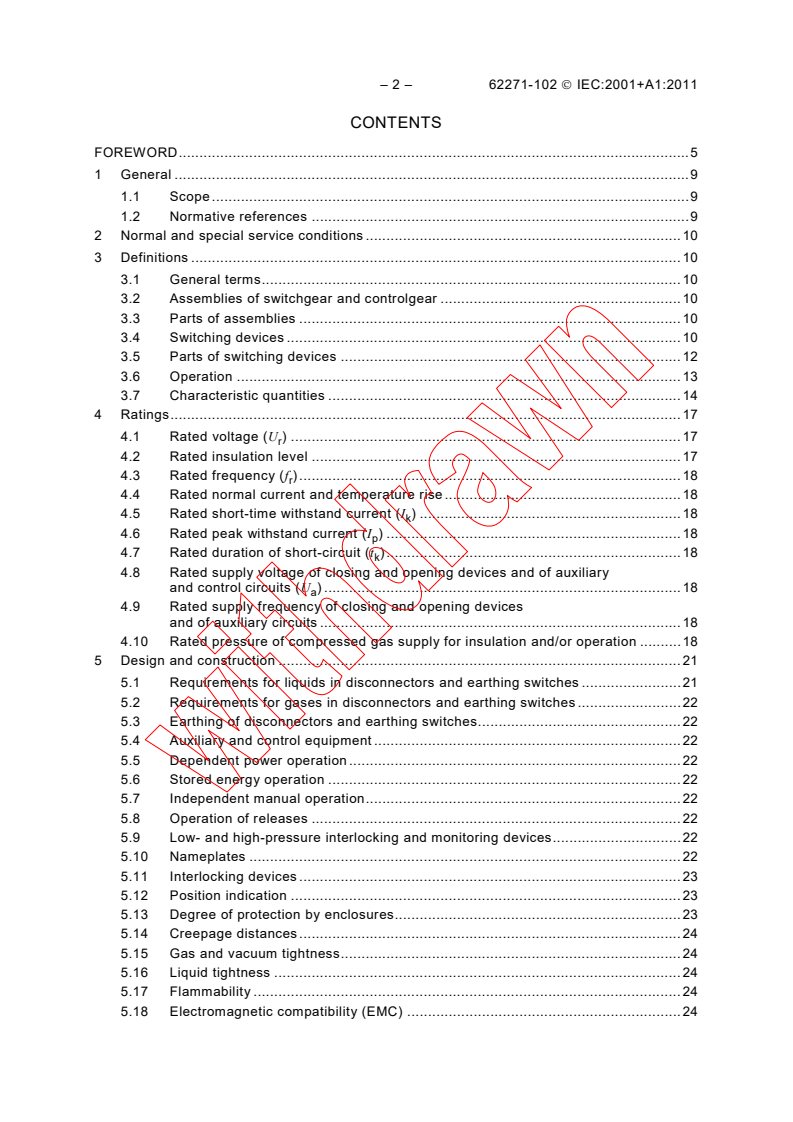
IEC 62271-102:2001+AMD1:2011 CSV - High-voltage switchgear and controlgear - Part 102: Alternating current disconnectors and earthing switches Released:2/15/2012
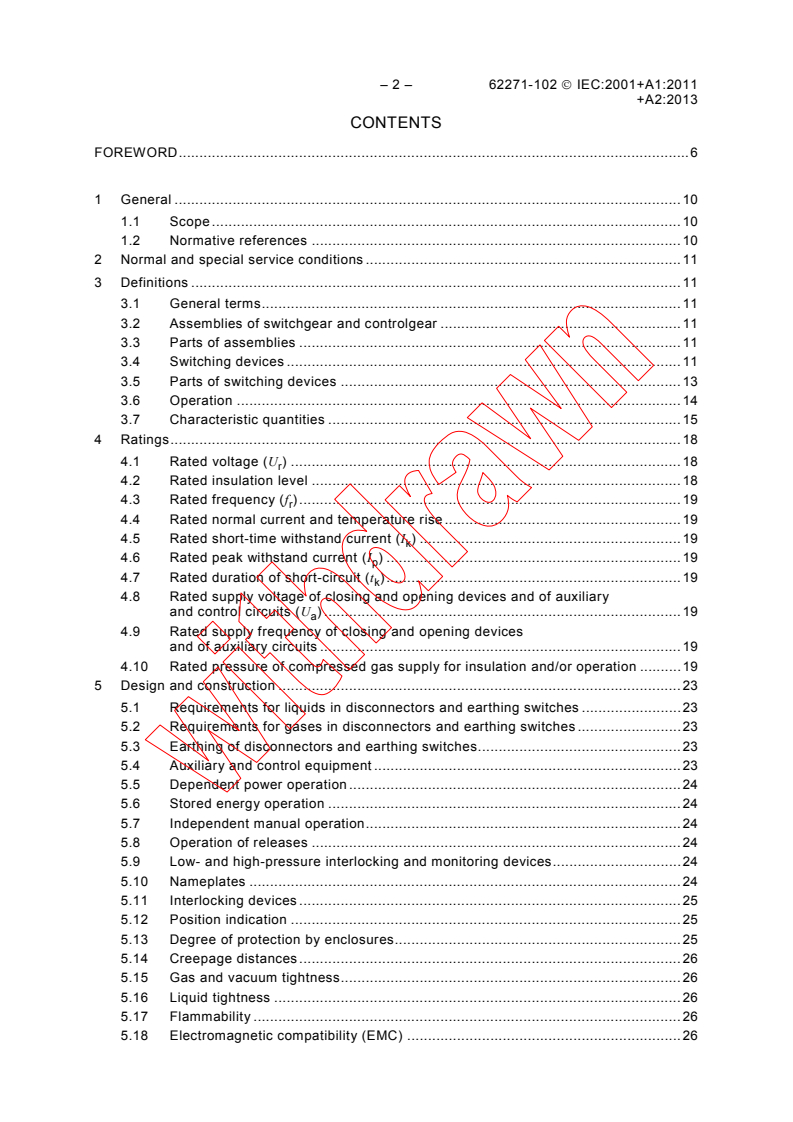
IEC 62271-102:2001+AMD1:2011+AMD2:2013 CSV - High-voltage switchgear and controlgear - Part 102: Alternatingcurrent disconnectors and earthing switches Released:2/14/2013
Overview
IEC 62271-102:2001 is the International Electrotechnical Commission standard for high‑voltage switchgear and controlgear - specifically covering alternating‑current disconnectors and earthing (grounding) switches. It applies to devices for voltages above 1 000 V and service frequencies up to 60 Hz, for both indoor and outdoor, enclosed and open terminal installations. The standard also covers the associated operating devices and auxiliary equipment. Note that disconnectors with an integral fuse are excluded.
Key topics and technical requirements
- Scope & definitions: clear terminology for assemblies, switching devices, parts and operations.
- Ratings: declared values such as rated voltage, rated frequency, rated normal current, short‑time and peak withstand currents, mechanical and electrical endurance.
- Design & construction: requirements for liquid and gas media, earthing, interlocks, position indication, creepage distances, EMC and mechanical strength.
- Tests:
- Type tests (dielectric, RIV, temperature‑rise, short‑time and peak withstand, tightness, EMC, mechanical and electrical endurance).
- Routine tests required for production verification (dielectric, resistance, tightness, mechanical operation).
- Special tests for bus‑transfer, induced current switching, bus‑charging switching, and operation under severe ice or temperature limits.
- Annexes: normative and informative annexes address position indicating devices, bus‑transfer current switching, induced current switching, and special requirements for gas‑insulated/metal‑enclosed switchgear.
- Selection, installation & maintenance: guidance on choosing the right device ratings, transport/storage rules, installation, operation and maintenance practices.
- Safety: electrical, mechanical, thermal and operational safety rules.
Applications and who uses this standard
IEC 62271-102 is used by:
- Switchgear manufacturers for product design, testing and certification.
- Power utilities and substation designers specifying disconnectors and earthing switches for transmission and distribution substations.
- Consulting and test laboratories performing type and routine tests to verify compliance.
- Procurement and standards teams preparing technical specifications, tenders and acceptance criteria. Practical applications include specifying disconnectors and earthing switches for high‑voltage substations, gas‑insulated switchgear (GIS), industrial power systems, and for safety and maintenance procedures.
Related standards
- IEC 60298, IEC 60466, IEC 60517 (additional requirements for enclosed switchgear)
- This edition replaces earlier publications (IEC 60129, IEC 61128, IEC 61129, IEC 61259) and includes corrigenda incorporated into the consolidated text.
Keywords: IEC 62271-102, high-voltage switchgear, disconnectors, earthing switches, type tests, ratings, gas‑insulated switchgear, bus‑transfer switching, induced current switching.
Relations
- Effective Date
- 20-Feb-2026
- Effective Date
- 20-Feb-2026
- Effective Date
- 20-Feb-2026
- Effective Date
- 20-Feb-2026
- Effective Date
- 20-Feb-2026
- Effective Date
- 20-Feb-2026
- Effective Date
- 20-Feb-2026
- Effective Date
- 20-Feb-2026
- Effective Date
- 20-Feb-2026
- Effective Date
- 20-Feb-2026
- Effective Date
- 20-Feb-2026
- Effective Date
- 20-Feb-2026
- Effective Date
- 20-Feb-2026
- Referred By
EN 61140:2016 - Protection against electric shock - Common aspects for installation and equipment - Effective Date
- 20-Feb-2026
- Effective Date
- 20-Feb-2026
Buy Documents
IEC 62271-102:2001/COR1:2002 - Corrigendum 1 - High-voltage switchgear and controlgear - Part 102: Alternating current disconnectors and earthing switches Released:4/30/2002
IEC 62271-102:2001/COR2:2003 - Corrigendum 2 - High-voltage switchgear and controlgear - Part 102: Alternating current disconnectors and earthing switches Released:5/27/2003
IEC 62271-102:2001 - High-voltage switchgear and controlgear - Part 102: Alternating current disconnectors and earthing switches Released:12/19/2001
IEC 62271-102:2001 - High-voltage switchgear and controlgear - Part 102: Alternating current disconnectors and earthing switches Released:12/19/2001
IEC 62271-102:2001+AMD1:2011 CSV - High-voltage switchgear and controlgear - Part 102: Alternating current disconnectors and earthing switches Released:2/15/2012
IEC 62271-102:2001+AMD1:2011+AMD2:2013 CSV - High-voltage switchgear and controlgear - Part 102: Alternatingcurrent disconnectors and earthing switches Released:2/14/2013
Get Certified
Connect with accredited certification bodies for this standard

IMQ S.p.A. (Certification)
Italian electrical product certification.

SLG Prüf- und Zertifizierungs GmbH
German testing and certification body.

UL Solutions
Global safety science company with testing, inspection and certification.
Sponsored listings
Frequently Asked Questions
IEC 62271-102:2001 is a standard published by the International Electrotechnical Commission (IEC). Its full title is "High-voltage switchgear and controlgear - Part 102: Alternating current disconnectors and earthing switches". This standard covers: Applies to alternating current disconnectors and earthing switches, designed for indoor and outdoor enclosed and open terminal installations for voltages above 1 000 V and for service frequencies up to and including 60 Hz. It also applies to the operating devices of these disconnectors and earthing switches and their auxiliary equipment. Additional requirements for disconnectors and earthing switches in enclosed switchgear and controlgear are given in IEC 60298, IEC 60466 and IEC 60517. Note: Disconnectors in which the fuse forms an integral part are not covered by this standard. This first edition cancels and replaces the third edition of IEC 60129 published in 1984, amendment 1 (1992) and amendment 2 (1996) and constitutes a technical revision. In addition, it replaces IEC 61128, IEC 61129 and IEC 61259, which are hereby withdrawn and cancelled. This bilingual version (2003-07) replaces the English version. The contents of the corrigenda of April 2002, May 2003, February 2005 and June 2014 have been included in this copy.
Applies to alternating current disconnectors and earthing switches, designed for indoor and outdoor enclosed and open terminal installations for voltages above 1 000 V and for service frequencies up to and including 60 Hz. It also applies to the operating devices of these disconnectors and earthing switches and their auxiliary equipment. Additional requirements for disconnectors and earthing switches in enclosed switchgear and controlgear are given in IEC 60298, IEC 60466 and IEC 60517. Note: Disconnectors in which the fuse forms an integral part are not covered by this standard. This first edition cancels and replaces the third edition of IEC 60129 published in 1984, amendment 1 (1992) and amendment 2 (1996) and constitutes a technical revision. In addition, it replaces IEC 61128, IEC 61129 and IEC 61259, which are hereby withdrawn and cancelled. This bilingual version (2003-07) replaces the English version. The contents of the corrigenda of April 2002, May 2003, February 2005 and June 2014 have been included in this copy.
IEC 62271-102:2001 is classified under the following ICS (International Classification for Standards) categories: 29.130.10 - High voltage switchgear and controlgear; 29.130.99 - Other switchgear and controlgear. The ICS classification helps identify the subject area and facilitates finding related standards.
IEC 62271-102:2001 has the following relationships with other standards: It is inter standard links to EN 60143-2:2013, EN 62271-200:2012, EN 62271-203:2004, EN 62271-109:2006, EN 62271-103:2011, EN 62271-105:2012, EN 62271-104:2009, EN 62271-201:2014, EN 62271-104:2015, EN 62271-205:2008, EN 62271-107:2012, EN 62271-112:2013, EN 62271-107:2005, EN 61140:2016, EN 62271-100:2009. Understanding these relationships helps ensure you are using the most current and applicable version of the standard.
IEC 62271-102:2001 is available in PDF format for immediate download after purchase. The document can be added to your cart and obtained through the secure checkout process. Digital delivery ensures instant access to the complete standard document.
Standards Content (Sample)
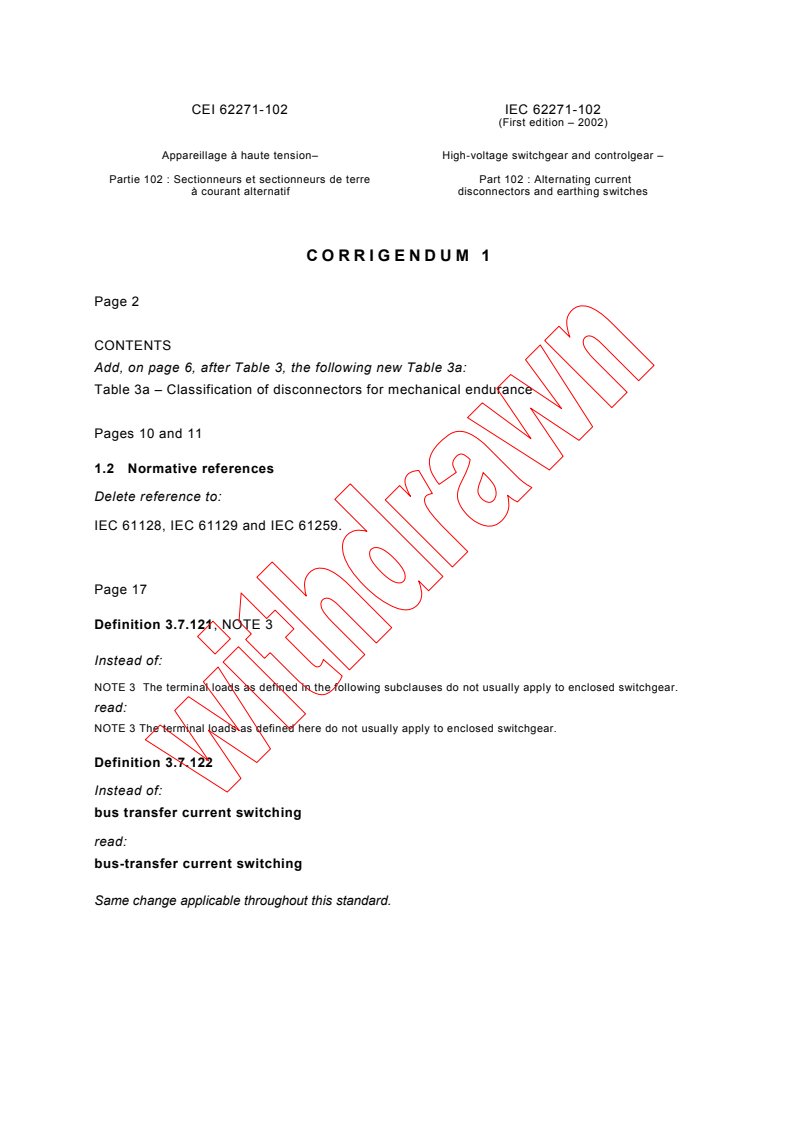
CEI 62271-102 IEC 62271-102
(First edition – 2002)
Appareillage à haute tension– High-voltage switchgear and controlgear –
Partie 102 : Sectionneurs et sectionneurs de terre Part 102 : Alternating current
à courant alternatif disconnectors and earthing switches
CORRIGENDUM 1
Page 2
CONTENTS
Add, on page 6, after Table 3, the following new Table 3a:
Table 3a – Classification of disconnectors for mechanical endurance
Pages 10 and 11
1.2 Normative references
Delete reference to:
IEC 61128, IEC 61129 and IEC 61259.
Page 17
Definition 3.7.121, NOTE 3
Instead of:
NOTE 3 The terminal loads as defined in the following subclauses do not usually apply to enclosed switchgear.
read:
NOTE 3 The terminal loads as defined here do not usually apply to enclosed switchgear.
Definition 3.7.122
Instead of:
bus transfer current switching
read:
bus-transfer current switching
Same change applicable throughout this standard.
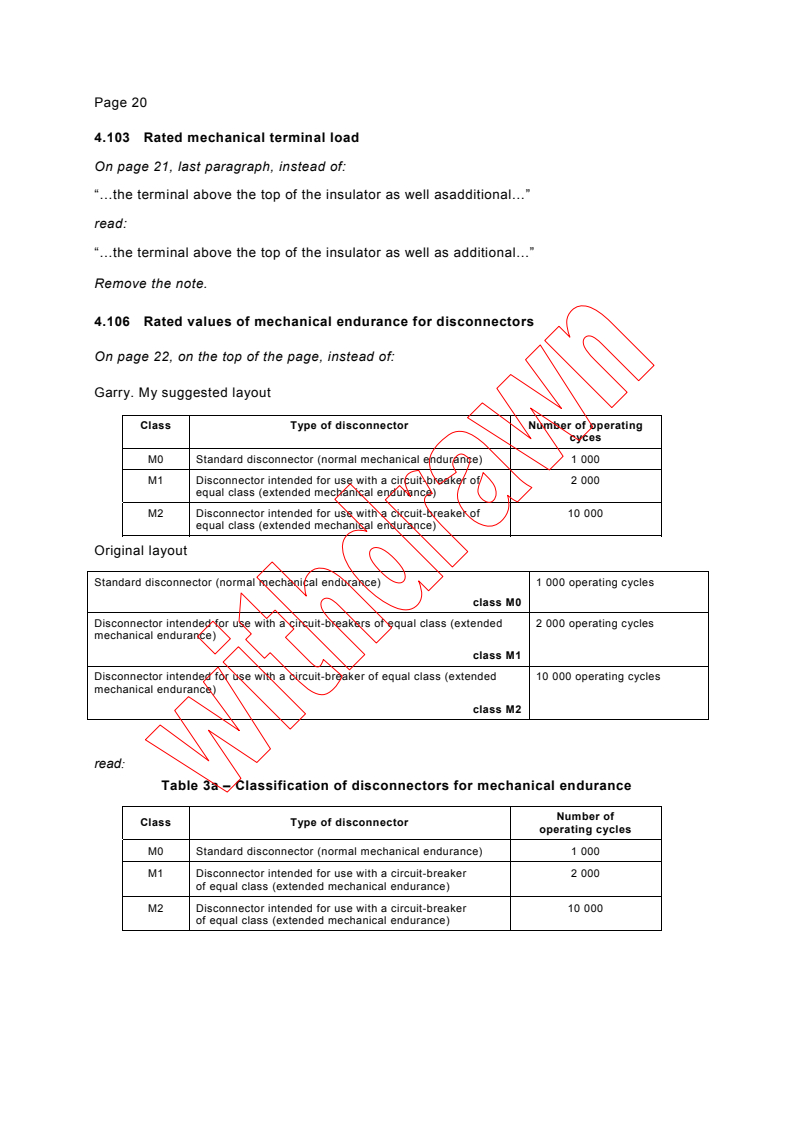
Page 20
4.103 Rated mechanical terminal load
On page 21, last paragraph, instead of:
“…the terminal above the top of the insulator as well asadditional…”
read:
“…the terminal above the top of the insulator as well as additional…”
Remove the note.
4.106 Rated values of mechanical endurance for disconnectors
On page 22, on the top of the page, instead of:
Garry. My suggested layout
Class Type of disconnector Number of operating
cyces
M0 Standard disconnector (normal mechanical endurance) 1 000
M1 Disconnector intended for use with a circuit-breaker of 2 000
equal class (extended mechanical endurance)
M2 Disconnector intended for use with a circuit-breaker of 10 000
equal class (extended mechanical endurance)
Original layout
Standard disconnector (normal mechanical endurance) 1 000 operating cycles
class M0
Disconnector intended for use with a circuit-breakers of equal class (extended 2 000 operating cycles
mechanical endurance)
class M1
Disconnector intended for use with a circuit-breaker of equal class (extended 10 000 operating cycles
mechanical endurance)
class M2
read:
Table 3a – Classification of disconnectors for mechanical endurance
Number of
Class Type of disconnector
operating cycles
M0 Standard disconnector (normal mechanical endurance) 1 000
M1 Disconnector intended for use with a circuit-breaker 2 000
of equal class (extended mechanical endurance)
M2 Disconnector intended for use with a circuit-breaker 10 000
of equal class (extended mechanical endurance)
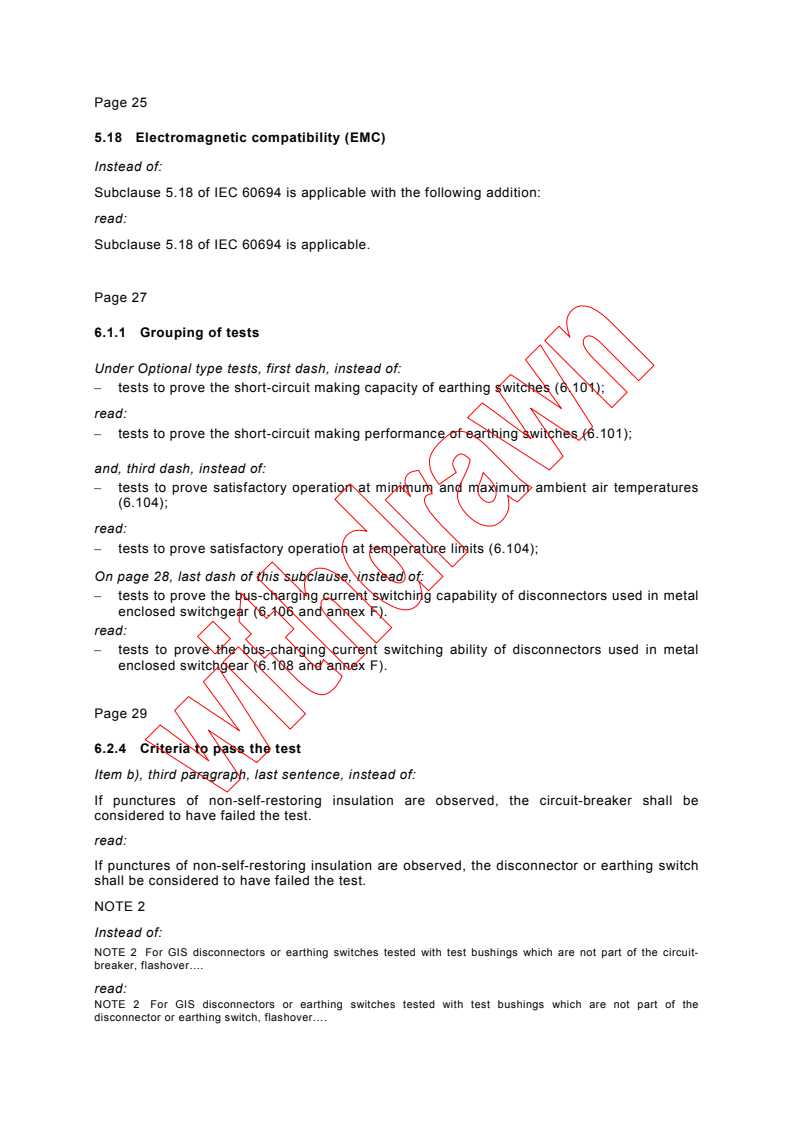
Page 25
5.18 Electromagnetic compatibility (EMC)
Instead of:
Subclause 5.18 of IEC 60694 is applicable with the following addition:
read:
Subclause 5.18 of IEC 60694 is applicable.
Page 27
6.1.1 Grouping of tests
Under Optional type test
...
IEC 62271-102
(First edition – 2001)
High-voltage switchgear and controlgear –
Part 102: Alternating current disconnectors and earthing switches
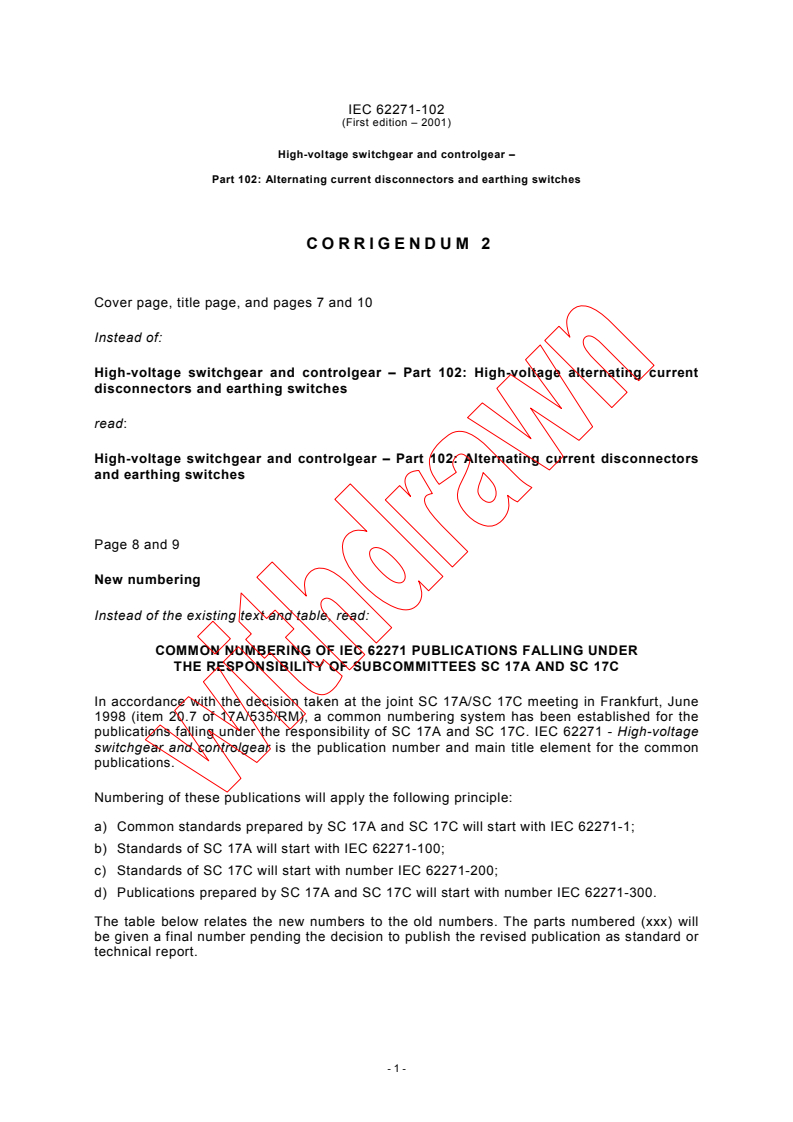
CORRIGENDUM 2
Cover page, title page, and pages 7 and 10
Instead of:
High-voltage switchgear and controlgear – Part 102: High-voltage alternating current
disconnectors and earthing switches
read:
High-voltage switchgear and controlgear – Part 102: Alternating current disconnectors
and earthing switches
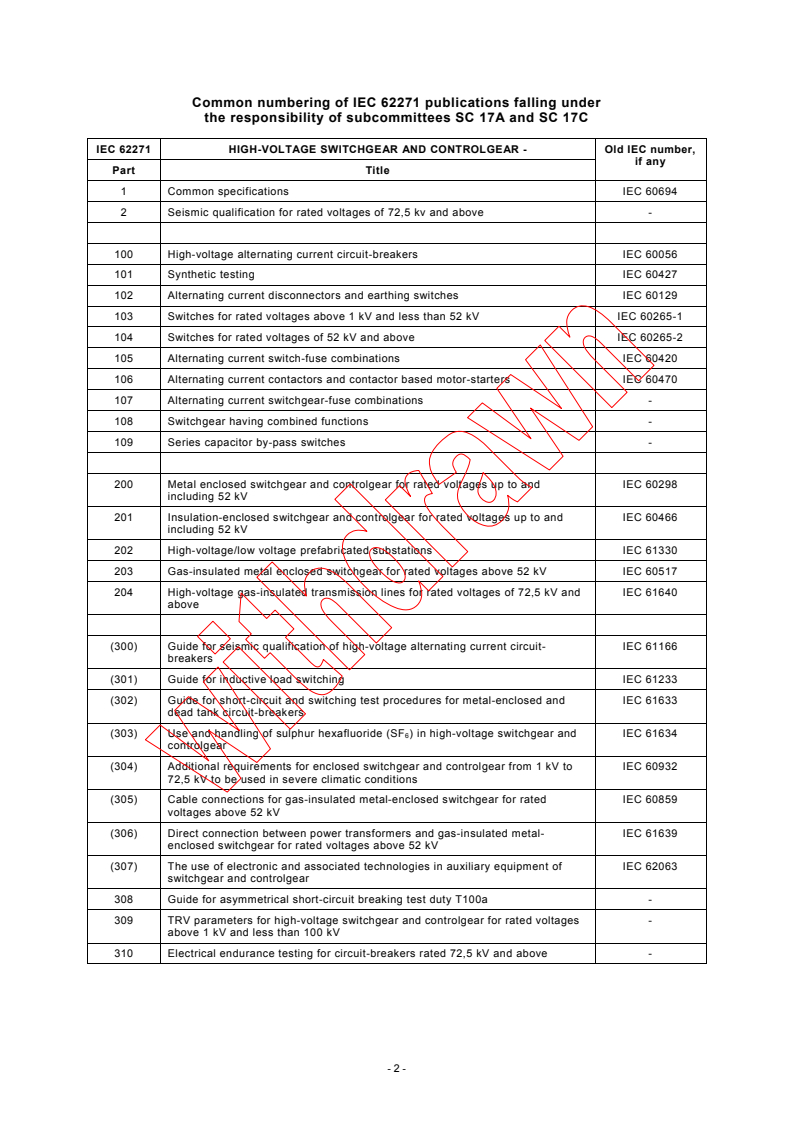
Page 8 and 9
New numbering
Instead of the existing text and table, read:
COMMON NUMBERING OF IEC 62271 PUBLICATIONS FALLING UNDER
THE RESPONSIBILITY OF SUBCOMMITTEES SC 17A AND SC 17C
In accordance with the decision taken at the joint SC 17A/SC 17C meeting in Frankfurt, June
1998 (item 20.7 of 17A/535/RM), a common numbering system has been established for the
publications falling under the responsibility of SC 17A and SC 17C. IEC 62271 - High-voltage
switchgear and controlgear is the publication number and main title element for the common
publications.
Numbering of these publications will apply the following principle:
a) Common standards prepared by SC 17A and SC 17C will start with IEC 62271-1;
b) Standards of SC 17A will start with IEC 62271-100;
c) Standards of SC 17C will start with number IEC 62271-200;
d) Publications prepared by SC 17A and SC 17C will start with number IEC 62271-300.
The table below relates the new numbers to the old numbers. The parts numbered (xxx) will
be given a final number pending the decision to publish the revised publication as standard or
technical report.
- 1 -
Common numbering of IEC 62271 publications falling under
the responsibility of subcommittees SC 17A and SC 17C
IEC 62271 HIGH-VOLTAGE SWITCHGEAR AND CONTROLGEAR - Old IEC number,
if any
Part Title
1 Common specifications IEC 60694
2 Seismic qualification for rated voltages of 72,5 kv and above -
100 High-voltage alternating current circuit-breakers IEC 60056
101 Synthetic testing IEC 60427
102 Alternating current disconnectors and earthing switches IEC 60129
103 Switches for rated voltages above 1 kV and less than 52 kV IEC 60265-1
104 Switches for rated voltages of 52 kV and above IEC 60265-2
105 Alternating current switch-fuse combinations IEC 60420
106 Alternating current contactors and contactor based motor-starters IEC 60470
107 Alternating current switchgear-fuse combinations -
108 Switchgear having combined functions -
109 Series capacitor by-pass switches -
200 Metal enclosed switchgear and controlgear for rated voltages up to and IEC 60298
including 52 kV
201 Insulation-enclosed switchgear and controlgear for rated voltages up to and IEC 60466
including 52 kV
202 High-voltage/low voltage prefabricated substations IEC 61330
203 Gas-insulated metal enclosed switchgear for rated voltages above 52 kV IEC 60517
204 High-voltage gas-insulated transmission lines for rated voltages of 72,5 kV and IEC 61640
above
(300) Guide for seismic qualification of high-voltage alternating current circuit- IEC 61166
breakers
(301) Guide for inductive load switching IEC 61233
(302) Guide for short-circuit and switching test procedures for metal-enclosed and IEC 61633
dead tank circuit-breakers
(303) Use and handling of sulphur hexafluoride (SF ) in high-voltage switchgear and IEC 61634
controlgear
(304) Additional requirements for enclosed switchgear and controlgear from 1 kV to IEC 60932
72,5 kV to be used in severe climatic conditions
(305) Cable connections f
...
INTERNATIONAL IEC
STANDARD
62271-102
First edition
2001-12
High-voltage switchgear and controlgear –
Part 102:
Alternating current disconnectors
and earthing switches
Appareillage à haute tension –
Partie 102:
Sectionneurs et sectionneurs de terre
à courant alternatif
Reference number
Publication numbering
As from 1 January 1997 all IEC publications are issued with a designation in the
60000 series. For example, IEC 34-1 is now referred to as IEC 60034-1.
Consolidated editions
The IEC is now publishing consolidated versions of its publications. For example,
edition numbers 1.0, 1.1 and 1.2 refer, respectively, to the base publication, the
base publication incorporating amendment 1 and the base publication incorporating
amendments 1 and 2.
Further information on IEC publications
The technical content of IEC publications is kept under constant review by the IEC,
thus ensuring that the content reflects current technology. Information relating to
this publication, including its validity, is available in the IEC Catalogue of
publications (see below) in addition to new editions, amendments and corrigenda.
Information on the subjects under consideration and work in progress undertaken
by the technical committee which has prepared this publication, as well as the list
of publications issued, is also available from the following:
• IEC Web Site (www.iec.ch)
• Catalogue of IEC publications
The on-line catalogue on the IEC web site (http://www.iec.ch/searchpub/cur_fut.htm)
enables you to search by a variety of criteria including text searches, technical
committees and date of publication. On-line information is also available on
recently issued publications, withdrawn and replaced publications, as well as
corrigenda.
• IEC Just Published
This summary of recently issued publications (http://www.iec.ch/online_news/
justpub/jp_entry.htm) is also available by email. Please contact the Customer
Service Centre (see below) for further information.
• Customer Service Centre
If you have any questions regarding this publication or need further assistance,
please contact the Customer Service Centre:
Email: custserv@iec.ch
Tel: +41 22 919 02 11
Fax: +41 22 919 03 00
INTERNATIONAL IEC
STANDARD
62271-102
First edition
2001-12
High-voltage switchgear and controlgear –
Part 102:
Alternating current disconnectors
and earthing switches
Appareillage à haute tension –
Partie 102:
Sectionneurs et sectionneurs de terre
à courant alternatif
IEC 2001 Copyright - all rights reserved
No part of this publication may be reproduced or utilized in any form or by any means, electronic or
mechanical, including photocopying and microfilm, without permission in writing from the publisher.
International Electrotechnical Commission, 3, rue de Varembé, PO Box 131, CH-1211 Geneva 20, Switzerland
Telephone: +41 22 919 02 11 Telefax: +41 22 919 03 00 E-mail: inmail@iec.ch Web: www.iec.ch
PRICE CODE
Commission Electrotechnique Internationale
XC
International Electrotechnical Commission
Международная Электротехническая Комиссия
For price, see current catalogue
– 2 – 62271-102 IEC:2001(E)
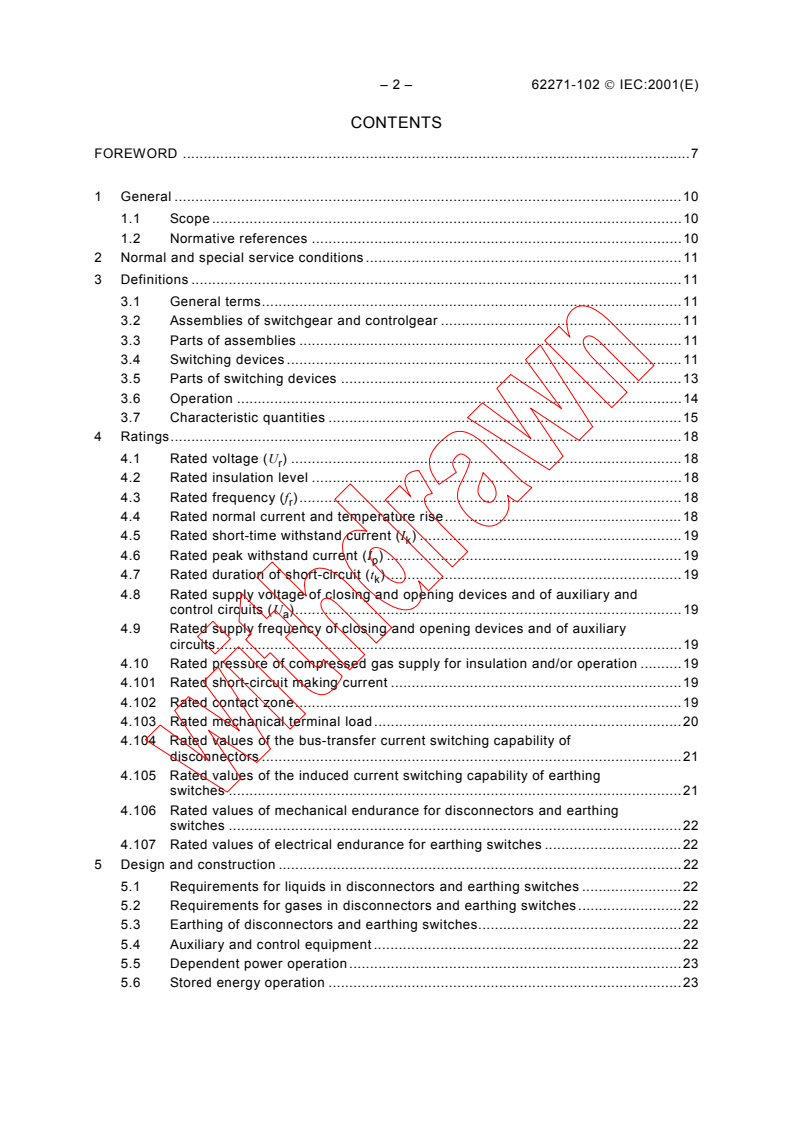
CONTENTS
FOREWORD .7
1 General .10
1.1 Scope .10
1.2 Normative references .10
2 Normal and special service conditions .11
3 Definitions .11
3.1 General terms.11
3.2 Assemblies of switchgear and controlgear .11
3.3 Parts of assemblies .11
3.4 Switching devices .11
3.5 Parts of switching devices .13
3.6 Operation .14
3.7 Characteristic quantities .15
4 Ratings.18
4.1 Rated voltage (U ) .18
r
4.2 Rated insulation level .18
4.3 Rated frequency (f ).18
r
4.4 Rated normal current and temperature rise.18
4.5 Rated short-time withstand current (I ) .19
k
4.6 Rated peak withstand current (I ) .19
p
4.7 Rated duration of short-circuit (t ).19
k
4.8 Rated supply voltage of closing and opening devices and of auxiliary and
control circuits (U ).19
a
4.9 Rated supply frequency of closing and opening devices and of auxiliary
circuits.19
4.10 Rated pressure of compressed gas supply for insulation and/or operation .19
4.101 Rated short-circuit making current .19
4.102 Rated contact zone.19
4.103 Rated mechanical terminal load .20
4.104 Rated values of the bus-transfer current switching capability of
disconnectors .21
4.105 Rated values of the induced current switching capability of earthing
switches .21
4.106 Rated values of mechanical endurance for disconnectors and earthing
switches .22
4.107 Rated values of electrical endurance for earthing switches .22
5 Design and construction .22
5.1 Requirements for liquids in disconnectors and earthing switches .22
5.2 Requirements for gases in disconnectors and earthing switches.22
5.3 Earthing of disconnectors and earthing switches.22
5.4 Auxiliary and control equipment .22
5.5 Dependent power operation.23
5.6 Stored energy operation .23
62271-102 © IEC:2001(E) – 3 –
5.7 Independent manual operation.23
5.8 Operation of releases .23
5.9 Low- and high-pressure interlocking and monitoring devices.23
5.10 Nameplates .23
5.11 Interlocking devices .24
5.12 Position indication .24
5.13 Degree of protection by enclosures.24
5.14 Creepage distances.25
5.15 Gas and vacuum tightness.25
5.16 Liquid tightness .25
5.17 Flammability .25
5.18 Electromagnetic compatibility (EMC).25
5.101 Special requirements for earthing switches .25
5.102 Requirements in respect of the isolating distance of disconnectors.25
5.103 Mechanical strength.26
5.104 Operation of disconnectors and earthing switches– Position of the movable
contact system and its indicating and signalling devices .26
5.105 Maximum force required for manual operation .27
5.106 Dimensional tolerances.27
6 Type tests .27
6.1 General .27
6.2 Dielectric tests.28
6.3 Radio interference voltage (riv) test .30
6.4 Measurement of the resistance of circuits .30
6.5 Temperature-rise tests.31
6.6 Short-time withstand current and peak withstand current tests.31
6.7 Verification of the protection .33
6.8 Tightness tests .33
6.9 Electromagnetic compatibility tests (EMC) .33
6.101 Test to prove the short-circuit making performance of earthing switches.33
6.102 Operating and mechanical endurance tests .34
6.103 Operation under severe ice conditions .37
6.104 Operation at the temperature limits.39
6.105 Test to verify the proper functioning of the position indicating device.40
6.106 Bus-transfer current switching tests .40
6.107 Induced current switching tests.40
6.108 Bus-charging switching tests .41
7 Routine tests .41
7.1 Dielectric test on the main circuit .41
7.2 Dielectric test on auxiliary and control circuits .41
7.3 Measurement of the resistance of the main circuit .42
7.4 Tightness test .42
7.5 Design and visual checks .42
7.101 Mechanical operating tests .42
– 4 – 62271-102 IEC:2001(E)
8 Guide to the selection of disconnectors and earthing switches.42
8.101 General .42
8.102 Selection of rated values for normal service conditions.43
9 Information to be given with enquiries, tenders and orders .46
9.101 Information to be given with enquiries and orders .46
9.102 Information to be given with tenders .47
10 Rules for transport, storage, installation, operation and maintenance .48
10.1 Conditions during transport, storage and installation.48
10.2 Installation.49
10.3 Operation .49
10.4 Maintenance.49
11 Safety.49
11.1 Electrical aspects .49
11.2 Mechanical aspects .49
11.3 Thermal aspects .49
11.4 Operation aspects .49
Annex A (normative) Design and testing of position indicating devices.56
A.1 General .56
A.2 Normal and special service conditions .56
A.3 Definitions .56
A.4 Ratings .57
A.5 Design and construction .57
A.6 Type tests.57
A.7 Routine tests .60
Annex B (normative) Bus-transfer current switching by disconnectors.61
B.1 General .61
B.2 Normal and special service conditions .61
B.3 Definitions .61
B.4 Ratings .61
B.5 Design and construction .62
B.6 Type tests.62
Annex C (normative) Induced current switching by earthing switches.67
C.1 General .67
C.2 Normal and special service conditions .67
C.3 Definitions .67
C.4 Ratings .68
C.5 Design and construction .69
C.6 Type tests.70
62271-102 © IEC:2001(E) – 5 –
Annex D (informative) Test voltage for the most disadvantageous dielectric position
of an earthing switch during operation (temporary approach) .77
Annex E (normative) Special requirements for disconnectors and earthing switches
used in gas-insulated and/or metal-enclosed switchgear.78
E.1 General .78
E.2 Normal and special service conditions .78
E.3 Definitions .78
E.4 Ratings .79
E.5 Design and construction .79
E.6 Type tests.80
E.7 Routine tests .81
E.8 Guide to the selection of disconnectors and earthing switches.82
E.9 Information to be given with enquiries, tenders and orders .82
E.10 Rules for transport, storage, installation, operation and maintenance .82
Annex F (normative) Gas-insulated metal-enclosed switchgear for rated voltages 72,5 kV
and above – Requirements for switching of bus-charging currents by disconnectors .83
F.1 General .83
F.2 Normal and special service conditions .83
F.3 Definitions .83
Figure 1 – Fixed contact parallel to support .50
Figure 2 – Fixed contact (as indicated in figure 8) perpendicular to support .50
Figure 3 – Three-phase test arrangement for disconnectors and earthing switches with
rated voltages below 52 kV .51
Figure 4 – Single-phase test arrangement for disconnectors with a horizontal isolating
distance and for earthing switches with rated voltage of 52 kV and above.52
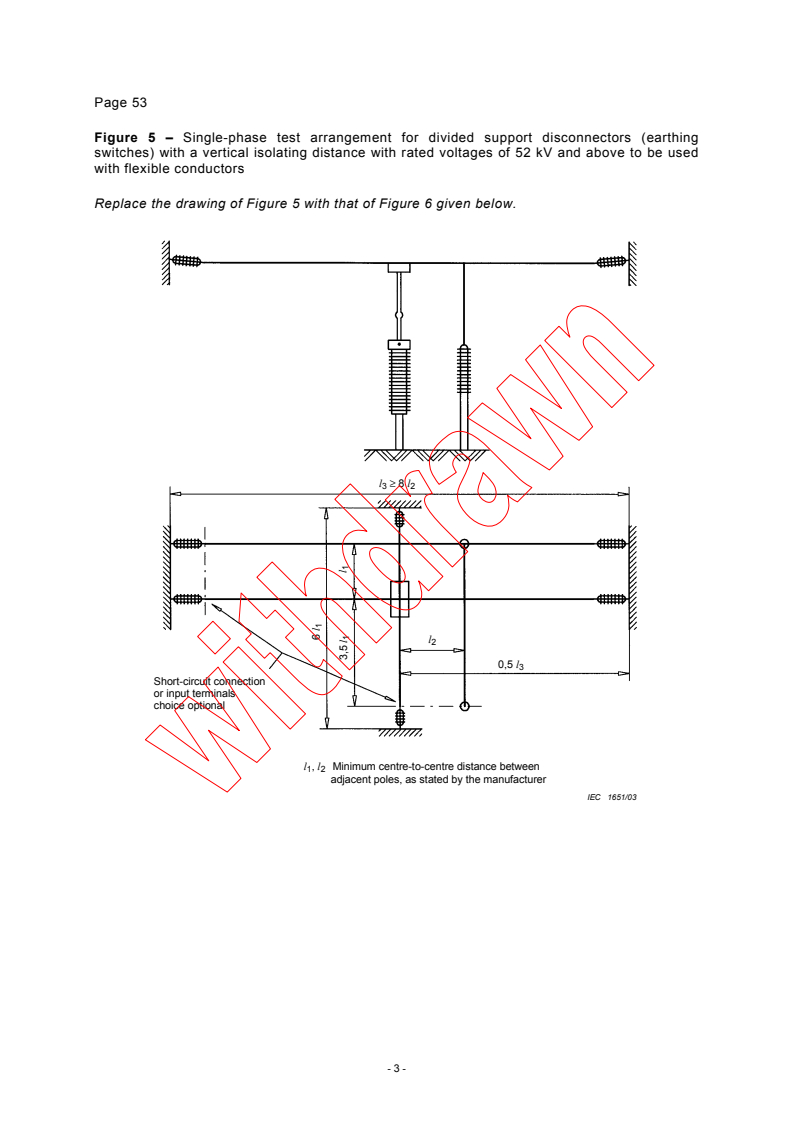
Figure 5 – Single-phase test arrangement for divided support disconnectors (earthing
switches) with a vertical isolating distance with rated voltages of 52 kV and above to
be used with flexible conductors .53
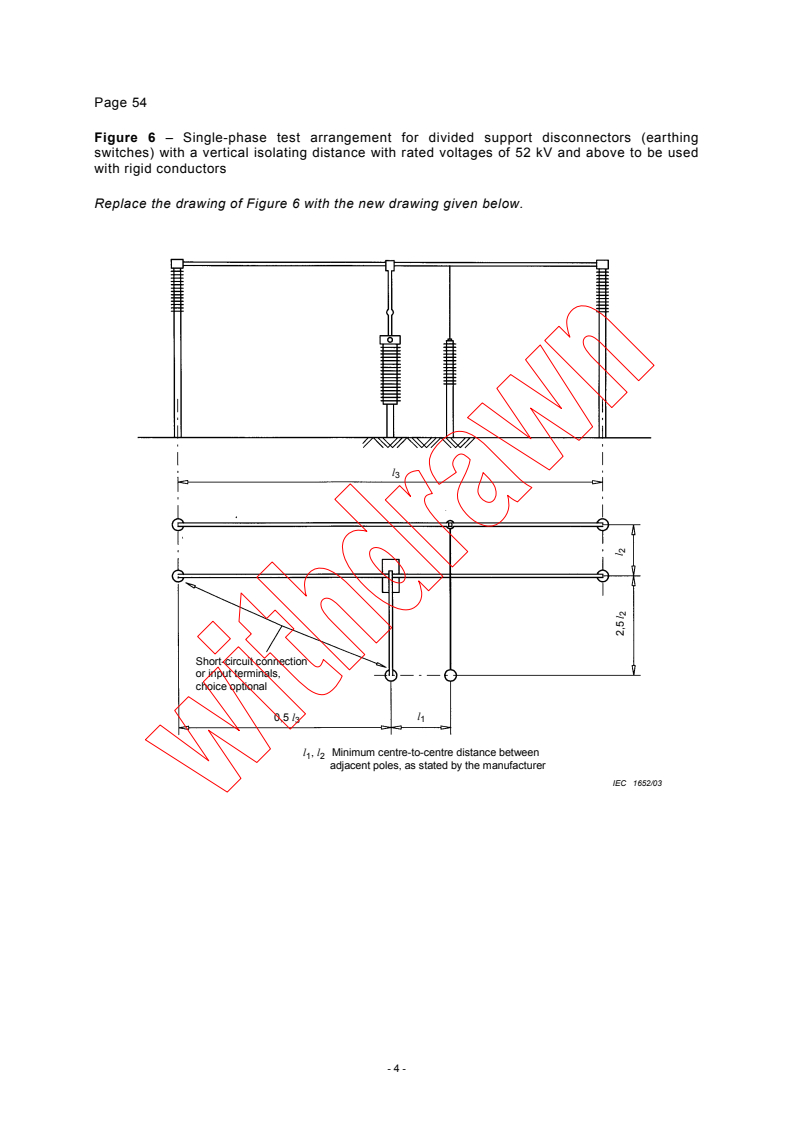
Figure 6 – Single-phase test arrangement for divided support disconnectors (earthing
switches) with a vertical isolating distance with rated voltages of 52 kV and above to
be used with rigid conductors.54
Figure 7 – Example of the application of rated mechanical terminal loads to a two-
column disconnector .55
Figure 8 – Example of the application of rated mechanical terminal loads to a
pantograph disconnector.55
Figure A.1 – Position indicating device .60
Figure B.1 – Test circuits for bus-transfer current making and breaking tests.66
Figure C.1 – Test circuit for electromagnetically induced current making and breaking
tests .75
Figure C.2 – Test circuits for electrostatically induced current making and breaking
tests .76
– 6 – 62271-102 IEC:2001(E)
Figure F.1 – Test circuit for test duty 1.85
Figure F.2 – Typical voltage waveform (Including VFT and FT components) .86
Figure F.3 – Test circuit for test duty 2.87
Figure F.4 –Test circuit for test duty 3.88
Table 1 – Recommended contact zones for "fixed" contacts supported by flexible
conductors.20
Table 2 – Recommended contact zones for "fixed" contacts supported by rigid
conductors.20
Table 3 – Recommended static mechanical terminal loads.21
Table 3a – Classification of disconnectors for mechanical endurance .22
Table 4 – Nameplate information .24
Table 5 – Power frequency 1 min withstand voltages .30
Table 6 – Power frequency voltage tests.41
Table B.1 – Rated bus-transfer voltages for disconnectors.62
Table C.1 – Standardized values of rated induced currents and voltages for earthing
switches.69
Table C.2 – Standardized values of recovery voltages for electromagnetically induced
current breaking tests .72
Table C.3 – Test circuit capacitances (C values) for electrostatically induced current
making and breaking tests .73
Table F.1 – Test voltages for making and breaking tests.85
Table F.2 – Specified bus-charging currents .88
Table F.3 – Specified number of tests.89
62271-102 © IEC:2001(E) – 7 –
INTERNATIONAL ELECTROTECHNICAL COMMISSION
____________
HIGH-VOLTAGE SWITCHGEAR AND CONTROLGEAR –
Part 102: Alternating current disconnectors
and earthing switches
FOREWORD
1) The IEC (International Electrotechnical Commission) is a worldwide organisation for standardisation comprising
all national electrotechnical committees (IEC National Committees). The object of the IEC is to promote
international co-operation on all questions concerning standardisation in the electrical and electronic fields. To
this end and in addition to other activities, the IEC publishes International Standards. Their preparation is
entrusted to technical committees; any IEC National Committee interested in the subject dealt with may
participate in this preparatory work. International, governmental and non-governmental organisations liaising
with the IEC also participate in this preparation. The IEC collaborates closely with the International
Organisation for Standardisation (ISO) in accordance with conditions determined by agreement between the
two organisations.
2) The formal decisions or agreements of the IEC on technical matters express, as nearly as possible, an
international consensus of opinion on the relevant subjects since each technical committee has representation
from all interested National Committees.
3) The documents produced have the form of recommendations for international use and are published in the form
of standards, technical specifications, technical reports or guides and they are accepted by the National
Committees in that sense.
4) In order to promote international unification, IEC National Committees undertake to apply IEC International
Standards transparently to the maximum extent possible in their national and regional standards. Any
divergence between the IEC Standard and the corresponding national or regional standard shall be clearly
indicated in the latter.
5) The IEC provides no marking procedure to indicate its approval and cannot be rendered responsible for any
equipment declared to be in conformity with one of its standards.
6) Attention is drawn to the possibility that some of the elements of this international standard may be the subject
of patent rights. The IEC shall not be held responsible for identifying any or all such patent rights.
International Standard IEC 62271-102 has been prepared by subcommittee 17A: High-voltage
switchgear and controlgear, of IEC technical committee 17: Switchgear and controlgear.
This first edition cancels and replaces the third edition of IEC 60129 published in 1984,
amendment 1 (1992) and amendment 2 (1996) and constitutes a technical revision. In
addition, it replaces IEC 61128, IEC 61129 and IEC 61259, which are hereby withdrawn and
cancelled. A reference table is provided at the end of this foreword.
The text of this standard is based on the following documents:
FDIS Report on voting
17A/617/FDIS 17A/619/RVD
Full information on the voting for the approval of this standard can be found in the report on
voting indicated in the above table.
This publication has been drafted in accordance with the ISO/IEC Directives, Part 3.
Annexes A, B, C, E and F form an integral part of this standard.
Annex D is for information only.
This standard should be read in conjunction with IEC 60694, second edition, published in
1996, to which it refers and which is applicable, unless otherwise specified. In order to
simplify the indication of corresponding requirements, the same numbering of clauses and
subclauses is used as in IEC 60694. Additional subclauses are numbered from 101.
– 8 – 62271-102 IEC:2001(E)
The committee has decided that the contents of this publication will remain unchanged
until the maintenance result date indicated on the IEC web site under "http://webstore.iec.ch"
in the data related to the specific publication. At this date, the publication will be
• reconfirmed;
• withdrawn;
• replaced by a revised edition, or
• amended
The contents of the corrigenda of April 2002, May 2003, February 2005 and June 2014
have been included in this copy.
New numbering
COMMON NUMBERING OF IEC 62271 PUBLICATIONS FALLING UNDER
THE RESPONSIBILITY OF SUBCOMMITTEES SC 17A AND SC 17C
In accordance with the decision taken at the joint SC 17A/SC 17C meeting in Frankfurt, June
1998 (item 20.7 of 17A/535/RM), a common numbering system has been established for the
publications falling under the responsibility of SC 17A and SC 17C. IEC 62271 - High-voltage
switchgear and controlgear is the publication number and main title element for the common
publications.
Numbering of these publications will apply the following principle:
a) Common standards prepared by SC 17A and SC 17C will start with IEC 62271-1;
b) Standards of SC 17A will start with IEC 62271-100;
c) Standards of SC 17C will start with number IEC 62271-200;
d) Publications prepared by SC 17A and SC 17C will start with number IEC 62271-300.
The table below relates the new numbers to the old numbers. The parts numbered (xxx) will
be given a final number pending the decision to publish the revised publication as standard or
technical report.
62271-102 © IEC:2001(E) – 9 –
Common numbering of IEC 62271 publications falling under
the responsibility of subcommittees SC 17A and SC 17C
IEC 62271 HIGH-VOLTAGE SWITCHGEAR AND CONTROLGEAR - Old IEC number,
if any
Part Title
1 Common specifications IEC 60694
2 Seismic qualification for rated voltages of 72,5 kv and above -
100 High-voltage alternating current circuit-breakers IEC 60056
101 Synthetic testing IEC 60427
102 Alternating current disconnectors and earthing switches IEC 60129
103 Switches for rated voltages above 1 kV and less than 52 kV IEC 60265-1
104 Switches for rated voltages of 52 kV and above IEC 60265-2
105 Alternating current switch-fuse combinations IEC 60420
106 Alternating current contactors and contactor based motor-starters IEC 60470
107 Alternating current switchgear-fuse combinations -
108 Switchgear having combined functions -
109 Series capacitor by-pass switches -
200 Metal enclosed switchgear and controlgear for rated voltages up to and IEC 60298
including 52 kV
201 Insulation-enclosed switchgear and controlgear for rated voltages up to and IEC 60466
including 52 kV
202 High-voltage/low voltage prefabricated substations IEC 61330
203 Gas-insulated metal enclosed switchgear for rated voltages above 52 kV IEC 60517
204 High-voltage gas-insulated transmission lines for rated voltages of 72,5 kV and IEC 61640
above
(300) Guide for seismic qualification of high-voltage alternating current circuit- IEC 61166
breakers
(301) Guide for inductive load switching IEC 61233
(302) Guide for short-circuit and switching test procedures for metal-enclosed and IEC 61633
dead tank circuit-breakers
(303) Use and handling of sulphur hexafluoride (SF ) in high-voltage switchgear and IEC 61634
controlgear
(304) Additional requirements for enclosed switchgear and controlgear from 1 kV to IEC 60932
72,5 kV to be used in severe climatic conditions
(305) Cable connections for gas-insulated metal-enclosed switchgear for rated IEC 60859
voltages above 52 kV
(306) Direct connection between power transformers and gas-insulated metal- IEC 61639
enclosed switchgear for rated voltages above 52 kV
(307) The use of electronic and associated technologies in auxiliary equipment of IEC 62063
switchgear and controlgear
308 Guide for asymmetrical short-circuit breaking test duty T100a -
309 TRV parameters for high-voltage switchgear and controlgear for rated voltages -
above 1 kV and less than 100 kV
310 Electrical endurance testing for circuit-breakers rated 72,5 kV and above -
– 10 – 62271-102 IEC:2001(E)
High-voltage switchgear and controlgear –
Part 102: Alternating current disconnectors and earthing switches
1 General
1.1 Scope
This part of IEC 62271 applies to alternating current disconnectors and earthing switches,
designed for indoor and outdoor enclosed and open terminal installations for voltages above
1 000 V and for service frequencies up to and including 60 Hz.
It also applies to the operating devices of these disconnectors and earthing switches and their
auxiliary equipment.
Additional requirements for disconnectors and earthing switches in enclosed switchgear and
controlgear are given in IEC 60298, IEC 60466 and IEC 60517.
NOTE Disconnectors in which the fuse forms an integral part are not covered by this standard.
1.2 Normative references
Subclause 1.2 of IEC 60694 is applicable with the following additions:
IEC 60137:1995, Insulating bushings for alternating voltages above 1 000 V
IEC 60265-1:1998, High-voltage switches – Part 1: Switches for rated voltages above 1 kV
and less than 52 kV
IEC 60265-2:1988, High-voltage switches – Part 2: High-voltage switches for rated voltages of
52 kV and above
IEC 60298:1990, A.C. metal-enclosed switchgear and controlgear for rated voltages above
1 kV and up to and including 52 kV
IEC 60466:1987, A.C. insulation-enclosed switchgear and controlgear for rated voltages
above 1 kV and up to and including 38 kV
IEC 60517:1990, Gas-insulated metal-enclosed switchgear for rated voltages of 72,5 kV and
above
IEC 60694:1996, Common specifications for high-voltage switchgear and controlgear
standards
IEC 60865-1:1993, Short-circuit currents – Calculation of effects – Part 1: Definitions and
calculation methods
ISO 2768-1:1989, General tolerances – Part 1: Tolerances for linear and angular dimensions
without individual tolerance indications
62271-102 © IEC:2001(E) – 11 –
2 Normal and special service conditions
Clause 2 of IEC 60694 is applicable.
3 Definitions
Clause 3 of IEC 60694 is applicable with the following additions:
This clause covers required definitions, most of them by reference to IEC 60050(151),
IEC 60050(441) and IEC 60050(604).
3.1 General terms
3.1.101
indoor switchgear and controlgear
[IEV 441-11-04]
3.1.102
outdoor switchgear and controlgear
[IEV 441-11-05]
3.1.103
temperature rise (of a part of a disconnector or earthing switch)
difference between the temperature of the part and the ambient air temperature
3.1.104
user
person or legal entity using the disconnectors or earthing switches
NOTE This may include the purchaser (for example an electricity supplier), but it may also include the contracting
company, the staff responsible for installation, the maintenance or operating staff or anybody else temporarily or
permanently responsible for the disconnector, earthing switch or substation, or even the operation of the
switchgear.
3.2 Assemblies of switchgear and controlgear
No particular definitions.
3.3 Parts of assemblies
No particular definitions.
3.4 Switching devices
3.4.101
disconnector
IEV 441-14-05 is applicable with the following additional notes:
NOTE 1 "Negligible current" implies currents such as the capacitive currents of bushings, busbars, connections,
very short lengths of cable, currents of permanently connected grading impedances of circuit-breakers and currents
of voltage transformers and dividers. For rated voltages of 420 kV and below, a current not exceeding 0,5 A is a
negligible current for the purpose of this definition; for rated voltage above 420 kV and currents exceeding 0,5 A,
the manufacturer should be consulted.
"No significant change in voltage" refers to such applications as the by-passing of induction voltage regulators or
circuit-breakers.
NOTE 2 For a disconnector having a rated voltage of 52 kV and above, a rated ability of bus-transfer current
switching may be assigned.
– 12 – 62271-102 IEC:2001(E)
3.4.101.1
disconnector class M0
disconnector having a mechanical endurance of 1 000 operating cycles, suitable for
applications in distribution and transmission systems fulfilling the general requirements of this
standard
3.4.101.2
disconnector class M1
disconnector having an extended mechanical endurance of 2 000 operating cycles, mainly for
applications where the disconnector is operated in conjunction with a circuit-breaker of an
equal class
3.4.101.3
disconnector class M2
disconnector having an extended mechanical endurance of 10 000 operating cycles, mainly
for applications where the disconnector is operated in conjunction with a circuit-breaker of an
equal class
3.4.102
divided support disconnector
(earthing switch)
[IEV 441-14-06(07)]
NOTE Examples are pantograph and semi-pantograph disconnectors.
3.4.103
centre-break disconnector
[IEV 441-14-08]
3.4.104
double-break disconnector
[IEV 441-14-09]
3.4.105
earthing switch
IEV 441-14-11 is applicable with the following addition:
NOTE An earthing switch having a rated voltage of 52 kV and above may have a rating for switching and carrying
induced currents.
Classes E1, E2 and E3 of IEC 60265-1 are based on electrical endurance of switches and
switch-disconnectors. These devices may sometimes be operated against a short-circuit
as a normal operation duty and the electrical endurance may be the measure of "low
maintenance“.
3.4.105.1
earthing switch class E0
earthing switch suitable for applications in distribution and transmission systems fulfilling the
general requirements of this standard
3.4.105.2
earthing switch class E1
earthing switch class E0 with a short-circuit making capability
NOTE This class of earthing switch is able to withstand two making operations at rated making current.
62271-102 © IEC:2001(E) – 13 –
3.4.105.3
earthing switch class E2
earthing switch of class E1 requiring minimal maintenance, capable of an extended number of
short-circuit making operations suitable for applications in systems up to and including 52 kV
NOTE This class of earthing switch proves its reduced maintenance requirements by a number of five making
operations at rated making current, but also requires minimal maintenance as lubrication (replenishment of gas and
cleaning of external surfaces where applicable).
3.5 Parts of switching devices
3.5.101
pole of a switching device
[IEV 441-15-01]
3.5.102
main circuit (of a switching device)
[IEV 441-15-02]
3.5.103
contact (of a mechanical switching device)
[IEV 441-15-05]
3.5.104
main contact
[IEV 441-15-07]
3.5.105
control contact
[IEV 441-15-09]
3.5.106
“a” contact
make contact
[IEV 441-15-12]
3.5.107
“b” contact
break contact
[IEV 441-15-13]
3.5.108
position signalling device
part of a disconnector or earthing switch which uses auxiliary energy to indicate whether the
contacts of the main circuit are in the open or closed position
– 14 – 62271-102 IEC:2001(E)
3.5.109
terminal (as a component)
component provided for the connection of a device to external conductors
[IEV 151-01-03]
3.5.110
contact zone (for divided support disconnectors and earthing switches)
spatial region of positions the fixed contact may take up for correct engagement with the
moving contact
3.6 Operation
3.6.101
operation (of a mechanical switching device)
[IEV 441-16-01]
3.6.102
operation cycle (of a mechanical switching device)
[IEV 441-16-02]
3.6.103
closing operation (of a mechanical switching device)
[IEV 441-16-08]
3.6.104
opening operation (of a mechanical switching device)
[IEV 441-16-09]
3.6.105
positively driven operation
[IEV 441-16-12]
3.6.106
dependent manual operation (of a mechanical switching device)
IEV 441-16-13 is applicable with the following addition:
NOTE Dependent manual operation may be performed by a crank or by a swing lever (horizontal or vertical).
3.6.107
dependent power operation (of a mechanical switching device)
[IEV 441-16-14]
3.6.108
stored energy operation (of a mechanical switching device)
[IEV 441-16-15]
3.6.109
independent manual operation (of a mechanical switching device)
[IEV 441-16-16]
62271-102 © IEC:2001(E) – 15 –
3.6.110
closed position (of a mechanical switching device)
IEV 441-16-22 is applicable with the following addition:
NOTE Predetermined continuity means that the contacts are fully engaged to carry the rated normal and the rated
short-circuit currents, as applicable.
3.6.111
open position (of a mechanical switching device)
[IEV 441-16-23]
3.6.112
interlocking device
[IEV 441-16-49]
3.7 Characteristic quantities
3.7.101
peak making current (of an earthing switch)
peak value of the first major loop of the current in a pole of the earthing switch during the
transient period following the initiation of current during a making operation
NOTE Where, for a three-phase circuit, a single value of (peak) making current is referred to, this is, unless
otherwise stated, the highest value in any phase.
3.7.102
peak current
peak value of the first major loop of current during the transient period following initiation
3.7.103
normal current (of a disconnector)
current which the main circuit of the disconnector is capable of carrying continuously under
specified conditions of use and behaviour
3.7.104
short-time withstand current
[IEV 441-17-17]
3.7.105
peak withstand current
[IEV 441-17-18]
3.7.106
rated value
quantity value assigned, generally by a manufacturer, for a specified operating condition of a
component, device or equipment
[IEV 151-04-03]
3.7.107
insulation level
test voltage, under specified conditions, that the insulation of a device is designed to withstand
[IEV 151-04-14]
– 16 – 62271-102 IEC:2001(E)
3.7.108
one minute power frequency withstand voltage
r.m.s. value of the sinusoidal alternating voltage at power frequency which the insulation of
the disconnector or earthing switch withstands under specified test conditions
(see IEC 60060-1)
3.7.109
impulse withstand voltage
peak value of the standard impulse voltage wave which the insulation of the disconnector or
earthing switch withstands under specified test conditions
(see IEC 60060-1)
NOTE Depending on the shape of the wave, the term may be qualified as switching impulse withstand voltage or
lightning impulse withstand voltage. [IEV 604-03-29, IEV 604-03-30].
3.7.110
external insulation
distances in atmospheric air, and surfaces of solid insulation of disconnectors and earthing
switches in contact with the air, which are subject to dielectric stresses and to the effect of
atmospheric and other external conditions such as pollution, humidity, vermin, etc.
[IEV 604-03-02, modified]
NOTE External insulation is either weather-protected or non-weather-protected, designed to operate outside or
inside closed shelters, respectively
3.7.111
internal insulation
internal solid, liquid or gaseous parts of the insulation of equipment which are protected from
the effects of atmospheric and other external conditions
[IEV 604-03-03]
3.7.112
self-restoring insulation
insulation which completely recovers its insulating properties after a disruptive discharge
[IEV 604-03-04]
3.7.113
non-self-restoring insulation
insulation which loses its insulating properties or does not recover them completely after a
disruptive discharge
[IEV 604-03-05]
NOTE Definitions 3.7.112 and 3.7.113 apply only when the discharge is caused by the application of a test
voltage during a dielectric test. However, discharges occurring in service may cause a self-restoring
...
IEC 62271-102
Edition 1.0 2001-12
INTERNATIONAL
STANDARD
NORME
INTERNATIONALE
High-voltage switchgear and controlgear –
Part 102: Alternating current disconnectors and earthing switches
Appareillage à haute tension –
Partie 102: Sectionneurs et sectionneurs de terre à courant alternatif
All rights reserved. Unless otherwise specified, no part of this publication may be reproduced or utilized in any form or by
any means, electronic or mechanical, including photocopying and microfilm, without permission in writing from either IEC or
IEC's member National Committee in the country of the requester.
If you have any questions about IEC copyright or have an enquiry about obtaining additional rights to this publication,
please contact the address below or your local IEC member National Committee for further information.
Droits de reproduction réservés. Sauf indication contraire, aucune partie de cette publication ne peut être reproduite
ni utilisée sous quelque forme que ce soit et par aucun procédé, électronique ou mécanique, y compris la photocopie
et les microfilms, sans l'accord écrit de la CEI ou du Comité national de la CEI du pays du demandeur.
Si vous avez des questions sur le copyright de la CEI ou si vous désirez obtenir des droits supplémentaires sur cette
publication, utilisez les coordonnées ci-après ou contactez le Comité national de la CEI de votre pays de résidence.
IEC Central Office
3, rue de Varembé
CH-1211 Geneva 20
Switzerland
Email: inmail@iec.ch
Web: www.iec.ch
About the IEC
The International Electrotechnical Commission (IEC) is the leading global organization that prepares and publishes
International Standards for all electrical, electronic and related technologies.
About IEC publications
The technical content of IEC publications is kept under constant review by the IEC. Please make sure that you have the
latest edition, a corrigenda or an amendment might have been published.
ƒ Catalogue of IEC publications: www.iec.ch/searchpub
The IEC on-line Catalogue enables you to search by a variety of criteria (reference number, text, technical committee,…).
It also gives information on projects, withdrawn and replaced publications.
ƒ IEC Just Published: www.iec.ch/online_news/justpub
Stay up to date on all new IEC publications. Just Published details twice a month all new publications released. Available
on-line and also by email.
ƒ Electropedia: www.electropedia.org
The world's leading online dictionary of electronic and electrical terms containing more than 20 000 terms and definitions
in English and French, with equivalent terms in additional languages. Also known as the International Electrotechnical
Vocabulary online.
ƒ Customer Service Centre: www.iec.ch/webstore/custserv
If you wish to give us your feedback on this publication or need further assistance, please visit the Customer Service
Centre FAQ or contact us:
Email: csc@iec.ch
Tel.: +41 22 919 02 11
Fax: +41 22 919 03 00
A propos de la CEI
La Commission Electrotechnique Internationale (CEI) est la première organisation mondiale qui élabore et publie des
normes internationales pour tout ce qui a trait à l'électricité, à l'électronique et aux technologies apparentées.
A propos des publications CEI
Le contenu technique des publications de la CEI est constamment revu. Veuillez vous assurer que vous possédez
l’édition la plus récente, un corrigendum ou amendement peut avoir été publié.
ƒ Catalogue des publications de la CEI: www.iec.ch/searchpub/cur_fut-f.htm
Le Catalogue en-ligne de la CEI vous permet d’effectuer des recherches en utilisant différents critères (numéro de référence,
texte, comité d’études,…). Il donne aussi des informations sur les projets et les publications retirées ou remplacées.
ƒ Just Published CEI: www.iec.ch/online_news/justpub
Restez informé sur les nouvelles publications de la CEI. Just Published détaille deux fois par mois les nouvelles
publications parues. Disponible en-ligne et aussi par email.
ƒ Electropedia: www.electropedia.org
Le premier dictionnaire en ligne au monde de termes électroniques et électriques. Il contient plus de 20 000 termes et
définitions en anglais et en français, ainsi que les termes équivalents dans les langues additionnelles. Egalement appelé
Vocabulaire Electrotechnique International en ligne.
ƒ Service Clients: www.iec.ch/webstore/custserv/custserv_entry-f.htm
Si vous désirez nous donner des commentaires sur cette publication ou si vous avez des questions, visitez le FAQ du
Service clients ou contactez-nous:
Email: csc@iec.ch
Tél.: +41 22 919 02 11
Fax: +41 22 919 03 00
IEC 62271-102
Edition 1.0 2001-12
INTERNATIONAL
STANDARD
NORME
INTERNATIONALE
High-voltage switchgear and controlgear –
Part 102: Alternating current disconnectors and earthing switches
Appareillage à haute tension –
Partie 102: Sectionneurs et sectionneurs de terre à courant alternatif
INTERNATIONAL
ELECTROTECHNICAL
COMMISSION
COMMISSION
ELECTROTECHNIQUE
PRICE CODE
INTERNATIONALE
XD
CODE PRIX
ICS 29.130.10; 29.130.99 ISBN 2-8318-6513-1
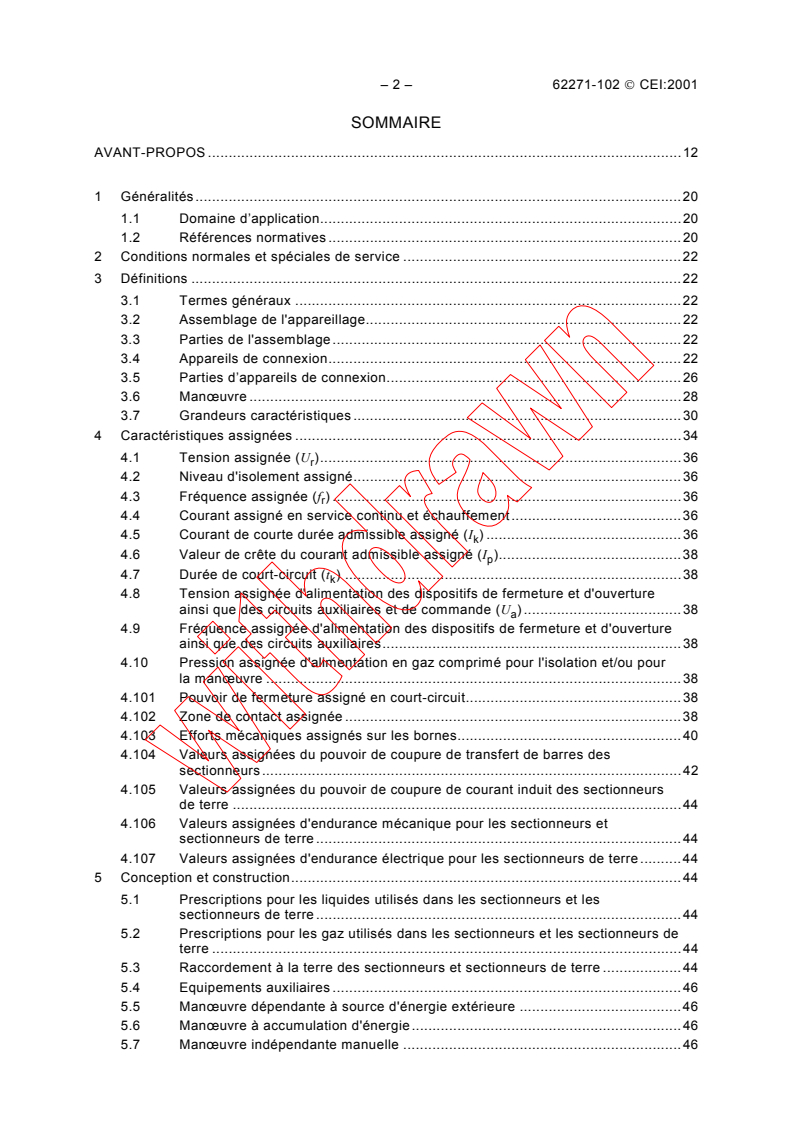
– 2 – 62271-102 © CEI:2001
SOMMAIRE
AVANT-PROPOS .12
1 Généralités.20
1.1 Domaine d’application.20
1.2 Références normatives.20
2 Conditions normales et spéciales de service .22
3 Définitions.22
3.1 Termes généraux.22
3.2 Assemblage de l'appareillage.22
3.3 Parties de l'assemblage.22
3.4 Appareils de connexion.22
3.5 Parties d’appareils de connexion.26
3.6 Manœuvre.28
3.7 Grandeurs caractéristiques .30
4 Caractéristiques assignées .34
4.1 Tension assignée (U ).36
r
4.2 Niveau d'isolement assigné.36
4.3 Fréquence assignée (f ) .36
r
4.4 Courant assigné en service continu et échauffement.36
4.5 Courant de courte durée admissible assigné (I ) .36
k
4.6 Valeur de crête du courant admissible assigné (I ).38
p
4.7 Durée de court-circuit (t ) .38
k
4.8 Tension assignée d'alimentation des dispositifs de fermeture et d'ouverture
ainsi que des circuits auxiliaires et de commande (U ) .38
a
4.9 Fréquence assignée d'alimentation des dispositifs de fermeture et d'ouverture
ainsi que des circuits auxiliaires.38
4.10 Pression assignée d'alimentation en gaz comprimé pour l'isolation et/ou pour
la manœuvre .38
4.101 Pouvoir de fermeture assigné en court-circuit.38
4.102 Zone de contact assignée .38
4.103 Efforts mécaniques assignés sur les bornes.40
4.104 Valeurs assignées du pouvoir de coupure de transfert de barres des
sectionneurs.42
4.105 Valeurs assignées du pouvoir de coupure de courant induit des sectionneurs
de terre .44
4.106 Valeurs assignées d'endurance mécanique pour les sectionneurs et
sectionneurs de terre.44
4.107 Valeurs assignées d'endurance électrique pour les sectionneurs de terre.44
5 Conception et construction.44
5.1 Prescriptions pour les liquides utilisés dans les sectionneurs et les
sectionneurs de terre.44
5.2 Prescriptions pour les gaz utilisés dans les sectionneurs et les sectionneurs de
terre .44
5.3 Raccordement à la terre des sectionneurs et sectionneurs de terre .44
5.4 Equipements auxiliaires .46
5.5 Manœuvre dépendante à source d'énergie extérieure .46
5.6 Manœuvre à accumulation d'énergie.46
5.7 Manœuvre indépendante manuelle .46
62271-102 © IEC:2001 – 3 –
CONTENTS
FOREWORD .13
1 General.21
1.1 Scope.21
1.2 Normative references.21
2 Normal and special service conditions .23
3 Definitions.23
3.1 General terms.23
3.2 Assemblies of switchgear and controlgear .23
3.3 Parts of assemblies.23
3.4 Switching devices.23
3.5 Parts of switching devices .27
3.6 Operation .29
3.7 Characteristic quantities .31
4 Ratings.35
4.1 Rated voltage (U ) .37
r
4.2 Rated insulation level.37
4.3 Rated frequency (f ).37
r
4.4 Rated normal current and temperature rise.37
4.5 Rated short-time withstand current (I ) .37
k
4.6 Rated peak withstand current (I ) .39
p
4.7 Rated duration of short-circuit (t ).39
k
4.8 Rated supply voltage of closing and opening devices and of auxiliary and
control circuits (U ).39
a
4.9 Rated supply frequency of closing and opening devices and of auxiliary
circuits.39
4.10 Rated pressure of compressed gas supply for insulation and/or operation .39
4.101 Rated short-circuit making current .39
4.102 Rated contact zone.39
4.103 Rated mechanical terminal load .41
4.104 Rated values of the bus-transfer current switching capability of
disconnectors .43
4.105 Rated values of the induced current switching capability of earthing
switches .45
4.106 Rated values of mechanical endurance for disconnectors and earthing
switches .45
4.107 Rated values of electrical endurance for earthing switches .45
5 Design and construction.45
5.1 Requirements for liquids in disconnectors and earthing switches .45
5.2 Requirements for gases in disconnectors and earthing switches.45
5.3 Earthing of disconnectors and earthing switches.45
5.4 Auxiliary and control equipment .47
5.5 Dependent power operation.47
5.6 Stored energy operation .47
5.7 Independent manual operation.47
– 4 – 62271-102 © CEI:2001
5.8 Fonctionnement des déclencheurs .46
5.9 Dispositifs de verrouillage et de surveillance à basse et à haute pression.46
5.10 Plaques signalétiques .46
5.11 Verrouillage .48
5.12 Indicateur de position.48
5.13 Degré de protection procuré par les enveloppes.48
5.14 Lignes de fuite.50
5.15 Etanchéité au gaz et au vide .50
5.16 Etanchéité aux liquides .50
5.17 Inflammabilité.50
5.18 Compatibilité électromagnétique (CEM) .50
5.101 Prescriptions spéciales pour les sectionneurs de terre .50
5.102 Spécifications relatives à la distance de sectionnement des sectionneurs.50
5.103 Résistance mécanique.52
5.104 Manœuvre des sectionneurs et des sectionneurs de terre – Position des
contacts mobiles et de leurs dispositifs indicateurs et de signalisation.52
5.105 Effort maximal requis pour la manœuvre manuelle .54
5.106 Tolérances dimensionnelles.54
6 Essais de type .56
6.1 Généralités.56
6.2 Essais diélectriques.58
6.3 Essai de tension de perturbation radioélectrique .62
6.4 Mesurage de la résistance du circuit principal .62
6.5 Essais d’échauffement.62
6.6 Essais au courant de courte durée et à la valeur de crête du courant
admissible .62
6.7 Vérification de la protection.68
6.8 Essais d'étanchéité.68
6.9 Essais de compatibilité électromagnétique (CEM) .68
6.101 Essais pour vérifier l'aptitude de fermeture en court-circuit des sectionneurs de
terre .68
6.102 Essais de fonctionnement et d'endurance mécanique.70
6.103 Fonctionnement dans des conditions sévères de formation de glace .78
6.104 Fonctionnement aux températures limites .82
6.105 Essais pour vérifier la fonction propre des dispositifs indicateurs de position .84
6.106 Essais de coupure de courant de transfert de barres.84
6.107 Essais de coupure de courant induit.84
6.108 Essais de coupure de courant de jeux de barres à vide .84
7 Essais individuels de série .84
7.1 Essais diélectriques sur le circuit principal .84
7.2 Essais diélectriques des circuits auxiliaires et de commande.86
7.3 Mesurage de la résistance du circuit principal .86
7.4 Essai d'étanchéité .86
7.5 Contrôles visuels et du modèle .86
7.101 Essais de fonctionnement mécanique .86
62271-102 © IEC:2001 – 5 –
5.8 Operation of releases .47
5.9 Low- and high-pressure interlocking and monitoring devices.47
5.10 Nameplates.47
5.11 Interlocking devices.49
5.12 Position indication.49
5.13 Degree of protection by enclosures.49
5.14 Creepage distances.51
5.15 Gas and vacuum tightness.51
5.16 Liquid tightness.51
5.17 Flammability .51
5.18 Electromagnetic compatibility (EMC) .51
5.101 Special requirements for earthing switches.51
5.102 Requirements in respect of the isolating distance of disconnectors.51
5.103 Mechanical strength.53
5.104 Operation of disconnectors and earthing switches– Position of the movable
contact system and its indicating and signalling devices .53
5.105 Maximum force required for manual operation .55
5.106 Dimensional tolerances .55
6 Type tests.57
6.1 General.57
6.2 Dielectric tests.59
6.3 Radio interference voltage (riv) test .63
6.4 Measurement of the resistance of circuits .63
6.5 Temperature-rise tests.63
6.6 Short-time withstand current and peak withstand current tests.63
6.7 Verification of the protection .69
6.8 Tightness tests.69
6.9 Electromagnetic compatibility tests (EMC) .69
6.101 Test to prove the short-circuit making performance of earthing switches.69
6.102 Operating and mechanical endurance tests .71
6.103 Operation under severe ice conditions .79
6.104 Operation at the temperature limits.83
6.105 Test to verify the proper functioning of the position indicating device.85
6.106 Bus-transfer current switching tests .85
6.107 Induced current switching tests.85
6.108 Bus-charging switching tests .85
7 Routine tests.85
7.1 Dielectric test on the main circuit .85
7.2 Dielectric test on auxiliary and control circuits .87
7.3 Measurement of the resistance of the main circuit .87
7.4 Tightness test.87
7.5 Design and visual checks .87
7.101 Mechanical operating tests .87
– 6 – 62271-102 © CEI:2001
8 Guide pour le choix des sectionneurs et des sectionneurs de terre. .88
8.101 Généralités.88
8.102 Choix des caractéristiques assignées pour les conditions normales de service.88
9 Renseignements à donner dans les appels d'offre, les soumissions et les commandes.94
9.101 Renseignements à donner dans les appels d'offre et les commandes.94
9.102 Renseignements à donner avec les soumissions.98
10 Règles pour le transport, le stockage, l’installation, le fonctionnement et la maintenance100
10.1 Conditions à respecter pendant le transport, le stockage et l’installation. 100
10.2 Installation. 100
10.3 Fonctionnement.100
10.4 Maintenance.102
11 Sécurité. 102
11.1 Aspects électriques . 102
11.2 Aspects mécaniques. 102
11.3 Aspects thermiques . 102
11.4 Aspects opérationnels. 102
Annexe A (normative) Conception et essais des dispositifs indicateur de position . 116
A.1 Généralités. 116
A.2 Conditions de service normales et spéciales . 116
A.3 Définitions . 116
A.4 Valeurs assignées . 118
A.5 Conception et réalisation . 118
A.6 Essais de type . 118
A.7 Essais individuels de série. 124
Annexe B (normative) Transfert de barres par les sectionneurs . 126
B.1 Généralités. 126
B.2 Conditions normales et spéciales de service . 126
B.3 Définitions . 126
B.4 Caractéristiques assignées . 128
B.5 Conception et construction. 128
B.6 Essais de type . 130
Annexe C (normative) Etablissement et coupure de courants induits par les
sectionneurs de terre .140
C.1 Généralités. 140
C.2 Conditions normales et spéciales de service . 140
C.3 Définitions . 140
C.4 Caractéristiques assignées . 142
C.5 Conception et construction. 144
C.6 Essais de type . 146
Annexe D (informative) Tension d'essai applicable à la position la plus défavorable d'un
point de vue diélectrique du sectionneur de terre pendant sa manœuvre (approche
temporaire) . 160
62271-102 © IEC:2001 – 7 –
8 Guide to the selection of disconnectors and earthing switches .89
8.101 General.89
8.102 Selection of rated values for normal service conditions.89
9 Information to be given with enquiries, tenders and orders .95
9.101 Information to be given with enquiries and orders .95
9.102 Information to be given with tenders .99
10 Rules for transport, storage, installation, operation and maintenance .101
10.1 Conditions during transport, storage and installation.101
10.2 Installation.101
10.3 Operation .101
10.4 Maintenance.103
11 Safety.103
11.1 Electrical aspects.103
11.2 Mechanical aspects.103
11.3 Thermal aspects.103
11.4 Operation aspects.103
Annex A (normative) Design and testing of position indicating devices.117
A.1 General.117
A.2 Normal and special service conditions .117
A.3 Definitions.117
A.4 Ratings.119
A.5 Design and construction.119
A.6 Type tests.119
A.7 Routine tests.125
Annex B (normative) Bus-transfer current switching by disconnectors.127
B.1 General.127
B.2 Normal and special service conditions .127
B.3 Definitions.127
B.4 Ratings.129
B.5 Design and construction.129
B.6 Type tests.131
Annex C (normative) Induced current switching by earthing switches.141
C.1 General.141
C.2 Normal and special service conditions .141
C.3 Definitions.141
C.4 Ratings.143
C.5 Design and construction.145
C.6 Type tests.147
Annex D (informative) Test voltage for the most disadvantageous dielectric position
of an earthing switch during operation (temporary approach) .161
– 8 – 62271-102 © CEI:2001
Annexe E (normative) Prescriptions spéciales pour les sectionneurs et sectionneurs de
terre utilisés dans l'appareillage sous enveloppe métallique et/ou à isolation gazeuse. 162
E.1 Généralités. 162
E.2 Conditions normales et spéciales de service . 162
E.3 Définitions . 162
E.4 Caractéristiques assignées . 164
E.5 Conception et construction. 164
E.6 Essais de type . 166
E.7 Essais individuels de série. 168
E.8 Guide pour le choix des sectionneurs et sectionneurs de terre . 170
E.9 Renseignements à donner dans les appels d'offres, les soumissions et les
commandes. 170
E.10 Règles pour le transport, le stockage, l'installation et la maintenance . 170
Annexe F (normative) Appareillage sous enveloppe métallique à isolation gazeuse de
tensions assignées égales ou supérieures à 72,5 kV Prescriptions pour l'établissement
et la coupure des courants de jeux de barres à vide par les sectionneurs . 172
F.1 Généralités. 172
F.2 Conditions normales et spéciales de service . 172
F.3 Définitions.172
F.6 Essais de type . 174
Figure 1 – Contact fixe parallèle au support. 102
Figure 2 – Contact fixe (comme indiqué à la figure 8) perpendiculaire au support. 104
Figure 3 – Disposition d’essai triphasé pour des sectionneurs et des sectionneurs de
terre de tension assignées inférieures à 52 kV. 104
Figure 4 – Disposition d’essai monophasé pour sectionneur comportant une distance de
sectionnement horizontale et pour sectionneurs de terre de tensions assignées égales
ou supérieures à 52 kV . 106
Figure 5 – Disposition d’essai monophasé pour sectionneurs à éléments séparés
(sectionneurs de terre) à distance de sectionnement verticale et de tensions assignées
supérieures ou égales à 52 kV, prévus pour être utilisés avec des conducteurs souples . 108
Figure 6 – Disposition d’essai monophasé pour sectionneurs à éléments séparés
(sectionneurs de terre) à distance de sectionnement verticale et de tensions assignées
supérieures ou égales à 52 kV, prévus pour être utilisés avec des conducteurs rigides . 110
Figure 7 – Exemple d’application des efforts mécaniques assignés sur les bornes d'un
sectionneur à deux colonnes . 112
Figure 8 – Exemple d’application des efforts mécaniques assignés sur les bornes d'un
sectionneur pantographe. 114
Figure A.1 – Dispositif indicateur de position . 124
Figure B.1 – Circuits pour les essais d'établissement et de coupure de courants de
transfert de barres . 138
Figure C.1 – Circuit d'essai pour l'établissement et la coupure de courants d'induction
électromagnétique. 156
Figure C.2 – Circuits d'essai pour l'établissement et la coupure de courants d'induction
électrostatique . 158
Figure F.1 – Circuit d'essai pour la séquence d'essai 1. 178
Figure F.2 – Forme d'onde de tension typique (incluant les composantes VFT et FT). 180
Figure F.3 – Circuit d'essai pour la séquence d'essais 2 . 182
Figure F.4 – Circuit d'essai pour la séquence d'essais 3 . 182
62271-102 © IEC:2001 – 9 –
Annex E (normative) Special requirements for disconnectors and earthing switches
used in gas-insulated and/or metal-enclosed switchgear.163
E.1 General.163
E.2 Normal and special service conditions .163
E.3 Definitions.163
E.4 Ratings.165
E.5 Design and construction.165
E.6 Type tests.167
E.7 Routine tests.169
E.8 Guide to the selection of disconnectors and earthing switches.171
E.9 Information to be given with enquiries, tenders and orders .171
E.10 Rules for transport, storage, installation, operation and maintenance .171
Annex F (normative) Gas-insulated metal-enclosed switchgear for rated voltages 72,5 kV
and above – Requirements for switching of bus-charging currents by disconnectors .173
F.1 General.173
F.2 Normal and special service conditions .173
F.3 Definitions.173
F.6 Type tests.175
Figure 1 – Fixed contact parallel to support .103
Figure 2 – Fixed contact (as indicated in figure 8) perpendicular to support .105
Figure 3 – Three-phase test arrangement for disconnectors and earthing switches with
rated voltages below 52 kV .105
Figure 4 – Single-phase test arrangement for disconnectors with a horizontal isolating
distance and for earthing switches with rated voltage of 52 kV and above.107
Figure 5 – Single-phase test arrangement for divided support disconnectors (earthing
switches) with a vertical isolating distance with rated voltages of 52 kV and above to
be used with flexible conductors .109
Figure 6 – Single-phase test arrangement for divided support disconnectors (earthing
switches) with a vertical isolating distance with rated voltages of 52 kV and above to
be used with rigid conductors.111
Figure 7 – Example of the application of rated mechanical terminal loads to a two-
column disconnector .113
Figure 8 – Example of the application of rated mechanical terminal loads to a
pantograph disconnector.115
Figure A.1 – Position indicating device .125
Figure B.1 – Test circuits for bus-transfer current making and breaking tests.139
Figure C.1 – Test circuit for electromagnetically induced current making and breaking
tests .157
Figure C.2 – Test circuits for electrostatically induced current making and breaking tests .159
Figure F.1 – Test circuit
...
IEC 62271-102 ®
Edition 1.1 2012-02
INTERNATIONAL
STANDARD
NORME
INTERNATIONALE
colour
inside
High-voltage switchgear and controlgear –
Part 102: Alternating current disconnectors and earthing switches
Appareillage à haute tension –
Partie 102: Sectionneurs et sectionneurs de terre à courant alternatif
All rights reserved. Unless otherwise specified, no part of this publication may be reproduced or utilized in any form
or by any means, electronic or mechanical, including photocopying and microfilm, without permission in writing from
either IEC or IEC's member National Committee in the country of the requester.
If you have any questions about IEC copyright or have an enquiry about obtaining additional rights to this publication,
please contact the address below or your local IEC member National Committee for further information.
Droits de reproduction réservés. Sauf indication contraire, aucune partie de cette publication ne peut être reproduite ni
utilisée sous quelque forme que ce soit et par aucun procédé, électronique ou mécanique, y compris la photocopie et les
microfilms, sans l'accord écrit de la CEI ou du Comité national de la CEI du pays du demandeur.
Si vous avez des questions sur le copyright de la CEI ou si vous désirez obtenir des droits supplémentaires sur cette
publication, utilisez les coordonnées ci-après ou contactez le Comité national de la CEI de votre pays de résidence.
IEC Central Office Tel.: +41 22 919 02 11
3, rue de Varembé Fax: +41 22 919 03 00
CH-1211 Geneva 20 info@iec.ch
Switzerland www.iec.ch
About the IEC
The International Electrotechnical Commission (IEC) is the leading global organization that prepares and publishes
International Standards for all electrical, electronic and related technologies.
About IEC publications
The technical content of IEC publications is kept under constant review by the IEC. Please make sure that you have the
latest edition, a corrigenda or an amendment might have been published.
Useful links:
IEC publications search - www.iec.ch/searchpub Electropedia - www.electropedia.org
The advanced search enables you to find IEC publications The world's leading online dictionary of electronic and
by a variety of criteria (reference number, text, technical electrical terms containing more than 30 000 terms and
committee,…). definitions in English and French, with equivalent terms in
It also gives information on projects, replaced and additional languages. Also known as the International
withdrawn publications. Electrotechnical Vocabulary (IEV) on-line.
IEC Just Published - webstore.iec.ch/justpublished Customer Service Centre - webstore.iec.ch/csc
Stay up to date on all new IEC publications. Just Published If you wish to give us your feedback on this publication
details all new publications released. Available on-line and or need further assistance, please contact the
also once a month by email. Customer Service Centre: csc@iec.ch.
A propos de la CEI
La Commission Electrotechnique Internationale (CEI) est la première organisation mondiale qui élabore et publie des
Normes internationales pour tout ce qui a trait à l'électricité, à l'électronique et aux technologies apparentées.
A propos des publications CEI
Le contenu technique des publications de la CEI est constamment revu. Veuillez vous assurer que vous possédez
l’édition la plus récente, un corrigendum ou amendement peut avoir été publié.
Liens utiles:
Recherche de publications CEI - www.iec.ch/searchpub Electropedia - www.electropedia.org
La recherche avancée vous permet de trouver des Le premier dictionnaire en ligne au monde de termes
publications CEI en utilisant différents critères (numéro de électroniques et électriques. Il contient plus de 30 000
référence, texte, comité d’études,…). termes et définitions en anglais et en français, ainsi que
Elle donne aussi des informations sur les projets et les les termes équivalents dans les langues additionnelles.
publications remplacées ou retirées. Egalement appelé Vocabulaire Electrotechnique
International (VEI) en ligne.
Just Published CEI - webstore.iec.ch/justpublished
Service Clients - webstore.iec.ch/csc
Restez informé sur les nouvelles publications de la CEI.
Just Published détaille les nouvelles publications parues. Si vous désirez nous donner des commentaires sur
Disponible en ligne et aussi une fois par mois par email. cette publication ou si vous avez des questions
contactez-nous: csc@iec.ch.
IEC 62271-102 ®
Edition 1.1 2012-02
INTERNATIONAL
STANDARD
NORME
INTERNATIONALE
colour
inside
High-voltage switchgear and controlgear –
Part 102: Alternating current disconnectors and earthing switches
Appareillage à haute tension –
Partie 102: Sectionneurs et sectionneurs de terre à courant alternatif
INTERNATIONAL
ELECTROTECHNICAL
COMMISSION
COMMISSION
ELECTROTECHNIQUE
PRICE CODE
INTERNATIONALE
CODE PRIX CR
ICS 29.130.10; 29.130.99 ISBN 978-2-88912-832-7
– 2 – 62271-102 IEC:2001+A1:2011
CONTENTS
FOREWORD . 5
1 General . 9
1.1 Scope . 9
1.2 Normative references . 9
2 Normal and special service conditions . 10
3 Definitions . 10
3.1 General terms . 10
3.2 Assemblies of switchgear and controlgear . 10
3.3 Parts of assemblies . 10
3.4 Switching devices . 10
3.5 Parts of switching devices . 12
3.6 Operation . 13
3.7 Characteristic quantities . 14
4 Ratings . 17
4.1 Rated voltage (U ) . 17
r
4.2 Rated insulation level . 17
4.3 Rated frequency (f ) . 18
r
4.4 Rated normal current and temperature rise . 18
4.5 Rated short-time withstand current (I ) . 18
k
4.6 Rated peak withstand current (I ) . 18
p
4.7 Rated duration of short-circuit (t ) . 18
k
4.8 Rated supply voltage of closing and opening devices and of auxiliary
and control circuits (U ) . 18
a
4.9 Rated supply frequency of closing and opening devices
and of auxiliary circuits . 18
4.10 Rated pressure of compressed gas supply for insulation and/or operation . 18
5 Design and construction . 21
5.1 Requirements for liquids in disconnectors and earthing switches . 21
5.2 Requirements for gases in disconnectors and earthing switches . 22
5.3 Earthing of disconnectors and earthing switches. 22
5.4 Auxiliary and control equipment . 22
5.5 Dependent power operation . 22
5.6 Stored energy operation . 22
5.7 Independent manual operation . 22
5.8 Operation of releases . 22
5.9 Low- and high-pressure interlocking and monitoring devices . 22
5.10 Nameplates . 22
5.11 Interlocking devices . 23
5.12 Position indication . 23
5.13 Degree of protection by enclosures . 23
5.14 Creepage distances . 24
5.15 Gas and vacuum tightness . 24
5.16 Liquid tightness . 24
5.17 Flammability . 24
5.18 Electromagnetic compatibility (EMC) . 24
62271-102 © IEC:2001+A1:2011 – 3 –
6 Type tests . 26
6.1 General . 26
6.2 Dielectric tests . 27
6.3 Radio interference voltage (riv) test . 29
6.4 Measurement of the resistance of circuits . 29
6.5 Temperature-rise tests . 30
6.6 Short-time withstand current and peak withstand current tests . 30
6.7 Verification of the protection . 32
6.8 Tightness tests . 32
6.9 Electromagnetic compatibility tests (EMC) . 32
7 Routine tests . 44
7.1 Dielectric test on the main circuit . 44
7.2 Dielectric test on auxiliary and control circuits . 44
7.3 Measurement of the resistance of the main circuit . 45
7.4 Tightness test . 45
7.5 Design and visual checks . 45
8 Guide to the selection of disconnectors and earthing switches . 45
9 Information to be given with enquiries, tenders and orders . 48
10 Rules for transport, storage, installation, operation and maintenance . 51
10.1 Conditions during transport, storage and installation . 51
10.2 Installation . 51
10.3 Operation . 52
10.4 Maintenance . 52
11 Safety . 52
11.1 Electrical aspects . 52
11.2 Mechanical aspects . 52
11.3 Thermal aspects . 52
11.4 Operation aspects . 52
Annex A (normative) Design and testing of position indicating devices . 60
Annex B (normative) Bus-transfer current switching by disconnectors . 65
Annex C (normative) Induced current switching by earthing switches . 72
Annex D (informative) Test voltage for the most disadvantageous dielectric position
of an earthing switch during operation (temporary approach) . 82
Annex E (normative) Special requirements for disconnectors and earthing switches
used in gas-insulated and/or metal-enclosed switchgear . 83
Annex F (normative) Gas-insulated metal-enclosed switchgear for rated voltages
72,5 kV and above – Requirements for switching of bus-charging currents by
disconnectors . 88
Annex G (normative) Alternative test methods for short-circuit current making tests . 96
Bibliography . 98
Figure 1 – Fixed contact parallel to support . 52
Figure 2 – Fixed contact (as indicated in figure 8) perpendicular to support . 53
Figure 3 – Three-phase test arrangement for disconnectors and earthing switches
with rated voltages below 52 kV . 54
– 4 – 62271-102 IEC:2001+A1:2011
Figure 4 – Single-phase test arrangement for disconnectors with a horizontal isolating
distance and for earthing switches with rated voltage of 52 kV and above . 55
Figure 5 – Single-phase test arrangement for divided support disconnectors
(earthing switches) with a vertical isolating distance with rated voltages of 52 kV
and above to be used with flexible conductors . 56
Figure 6 – Single-phase test arrangement for divided support disconnectors
(earthing switches) with a vertical isolating distance with rated voltages of 52 kV
and above to be used with rigid conductors . 57
Figure 7 – Example of the application of rated mechanical terminal loads to
a two-column disconnector . 58
Figure 8 – Example of the application of rated mechanical terminal loads
to a pantograph disconnector . 59
Figure A.1 – Position indicating device . 64
Figure B.1 – Test circuits for bus-transfer current making and breaking tests . 71
Figure C.1 – Test circuit for electromagnetically induced current making and breaking
tests . 80
Figure C.2 – Test circuits for electrostatically induced current making and breaking
tests . 81
Figure F.1 – Test circuit for test duty 1 . 91
Figure F.2 – Typical voltage waveform (Including VFT and FT components) . 92
Figure F.3 – Test circuit for test duty 2 . 93
Figure F.4 – Test circuit for test duty 3 . 93
Table 1 – Recommended contact zones for "fixed" contacts supported
by flexible conductors . 19
Table 2 – Recommended contact zones for "fixed" contacts supported
by rigid conductors . 19
Table 3 – Recommended static mechanical terminal loads . 20
Table 3a – Classification of disconnectors for mechanical endurance . 21
Table 4 – Nameplate information . 23
Table 5 – Power frequency 1 min withstand voltages . 29
Table 6 – Power frequency voltage tests . 44
Table 7 – Classification of earthing switch for electrical endurance . 21
Table 8 – Requirements on making current and pre-arcing time . 35
Table 9 – Invalid tests . 36
Table B.1 – Rated bus-transfer voltages for disconnectors. 66
Table C.1 – Standardized values of rated induced currents and voltages
for earthing switches . 74
Table C.2 – Standardized values of recovery voltages for electromagnetically induced
current breaking tests . 77
Table C.3 – Test circuit capacitances (C values) for electrostatically induced current
making and breaking tests . 78
Table F.1 – Test voltages for making and breaking tests . 90
Table F.2 – Specified bus-charging currents . 94
Table F.3 – Specified number of tests . 94
62271-102 © IEC:2001+A1:2011 – 5 –
INTERNATIONAL ELECTROTECHNICAL COMMISSION
____________
HIGH-VOLTAGE SWITCHGEAR AND CONTROLGEAR –
Part 102: Alternating current disconnectors
and earthing switches
FOREWORD
1) The International Electrotechnical Commission (IEC) is a worldwide organization for standardization comprising
all national electrotechnical committees (IEC National Committees). The object of IEC is to promote
international co-operation on all questions concerning standardization in the electrical and electronic fields. To
this end and in addition to other activities, IEC publishes International Standards, Technical Specifications,
Technical Reports, Publicly Available Specifications (PAS) and Guides (hereafter referred to as “IEC
Publication(s)”). Their preparation is entrusted to technical committees; any IEC National Committee interested
in the subject dealt with may participate in this preparatory work. International, governmental and non-
governmental organizations liaising with the IEC also participate in this preparation. IEC collaborates closely
with the International Organization for Standardization (ISO) in accordance with conditions determined by
agreement between the two organizations.
2) The formal decisions or agreements of IEC on technical matters express, as nearly as possible, an international
consensus of opinion on the relevant subjects since each technical committee has representation from all
interested IEC National Committees.
3) IEC Publications have the form of recommendations for international use and are accepted by IEC National
Committees in that sense. While all reasonable efforts are made to ensure that the technical content of IEC
Publications is accurate, IEC cannot be held responsible for the way in which they are used or for any
misinterpretation by any end user.
4) In order to promote international uniformity, IEC National Committees undertake to apply IEC Publications
transparently to the maximum extent possible in their national and regional publications. Any divergence
between any IEC Publication and the corresponding national or regional publication shall be clearly indicated in
the latter.
5) IEC itself does not provide any attestation of conformity. Independent certification bodies provide conformity
assessment services and, in some areas, access to IEC marks of conformity. IEC is not responsible for any
services carried out by independent certification bodies.
6) All users should ensure that they have the latest edition of this publication.
7) No liability shall attach to IEC or its directors, employees, servants or agents including individual experts and
members of its technical committees and IEC National Committees for any personal injury, property damage or
other damage of any nature whatsoever, whether direct or indirect, or for costs (including legal fees) and
expenses arising out of the publication, use of, or reliance upon, this IEC Publication or any other IEC
Publications.
8) Attention is drawn to the Normative references cited in this publication. Use of the referenced publications is
indispensable for the correct application of this publication.
9) Attention is drawn to the possibility that some of the elements of this IEC Publication may be the subject of
patent rights. IEC shall not be held responsible for identifying any or all such patent rights.
This consolidated version of IEC 62271-102 consists of the first edition (2001)
[documents 17A/617/FDIS and 17A/619/RVD], its amendment 1 (2011) [documents
17A/972/FDIS and 17A/978/RVD], its corrigenda of April 2002, May 2003, February 2005,
January 2012 and June 2014. It bears the edition number 1.1.
The technical content is therefore identical to the base edition and its amendment and
has been prepared for user convenience. A vertical line in the margin shows where the
base publication has been modified by amendment 1. Additions and deletions are
displayed in red, with deletions being struck through.
– 6 – 62271-102 IEC:2001+A1:2011
International Standard IEC 62271-102 has been prepared by subcommittee 17A: High-voltage
switchgear and controlgear, of IEC technical committee 17: Switchgear and controlgear.
The bilingual version (2003-08) corresponds to the monolingual English version, published in
2001-12.
The French version of this standard has not been voted upon.
Annexes A, B, C, E, F and G form an integral part of this standard.
Annex D is for information only.
This standard should be read in conjunction with IEC 60694, second edition, published in
1996, to which it refers and which is applicable, unless otherwise specified. In order to
simplify the indication of corresponding requirements, the same numbering of clauses and
subclauses is used as in IEC 60694. Additional subclauses are numbered from 101.
The committee has decided that the contents of the base publication and its amendments will
remain unchanged until the stability date indicated on the IEC web site under
"http://webstore.iec.ch" in the data related to the specific publication. At this date, the
publication will be
• reconfirmed,
• withdrawn,
• replaced by a revised edition, or
• amended.
IMPORTANT – The “colour inside” logo on the cover page of this publication indicates
that it contains colours which are considered to be useful for the correct understanding
of its contents. Users should therefore print this publication using a colour printer.
62271-102 © IEC:2001+A1:2011 – 7 –
COMMON NUMBERING OF IEC 62271 PUBLICATIONS FALLING UNDER
THE RESPONSIBILITY OF SUBCOMMITTEES SC 17A AND SC 17C
In accordance with the decision taken at the joint SC 17A/SC 17C meeting in Frankfurt, June
1998 (item 20.7 of 17A/535/RM), a common numbering system has been established for the
publications falling under the responsibility of SC 17A and SC 17C. IEC 62271 – High-voltage
switchgear and controlgear is the publication number and main title element for the common
publications.
The numbering of these publications will apply the following principle.
a) Common standards prepared by SC 17A and SC 17C will start with IEC 62271-1.
b) Standards of SC 17A will start with IEC 62271-100.
c) Standards of SC 17C will start with number IEC 62271-200.
d) Publications prepared by SC 17A and SC 17C will start with number IEC 62271-300.
The table below relates the new numbers to the old numbers. The parts numbered (xxx) will
be given a final number pending the decision to publish the revised publication as standard or
technical report.
– 8 – 62271-102 IEC:2001+A1:2011
Common numbering of IEC 62271 publications falling under the responsibility
of subcommittees SC 17A and SC 17C
IEC 62271 HIGH-VOLTAGE SWITCHGEAR AND CONTROLGEAR – Old IEC number,
series if any
Part New title
1 Common specifications IEC 60694
2 Seismic qualification for rated voltages of 72,5 kV and above -
100 High-voltage alternating current circuit-breakers IEC 60056
101 Synthetic testing IEC 60427
102 High-voltage alternating current disconnectors and earthing switches IEC 60129
103 Switches for rated voltages above 1 kV and less than 52 kV IEC 60265-1
104 Switches for rated voltages of 52 kV and above IEC 60265-2
105 Alternating current switch-fuse combinations IEC 60420
106 Alternating current contactors and contactor-based motor-starters IEC 60470
107 Alternating current switchgear-fuse combinations -
108 Switchgear having combined functions -
109 Series capacitor by-pass switches -
200 AC metal-enclosed switchgear and controlgear for rated voltages above 1 kV IEC 60298
and up to and including 52 kV
201 Insulation-enclosed switchgear and controlgear for rated voltages up to and IEC 60466
including 52 kV
202 High-voltage/low-voltage prefabricated substations IEC 61330
203 Gas-insulated metal-enclosed switchgear for rated voltages above 52 kV IEC 60517
204 High-voltage gas-insulated transmission lines for rated voltages of 72,5 kV and IEC 61640
above
(300) Guide for seismic qualification of high-voltage alternating current circuit- IEC 61166
breakers
(301) Guide for inductive load switching IEC 61233
(302) Guide for short-circuit and switching test procedures for metal-enclosed and IEC 61633
dead tank circuit-breakers
(303) Use and handling of sulphur hexafluoride (SF ) in high-voltage switchgear and IEC 61634
controlgear
(304) Additional requirements for enclosed switchgear and controlgear from 1 kV to IEC 60932
72,5 kV to be used in severe climatic conditions
(305) Cable connections for gas-insulated metal-enclosed switchgear for rated IEC 60859
voltages above 52 kV
(306) Direct connection between power transformers and gas-insulated metal- IEC 61639
enclosed switchgear for rated voltages above 52 kV
(307) Use of electronic and associated technologies in auxiliary equipment of IEC 62063
switchgear and controlgear
308 Guide for asymmetrical short-circuit breaking test duty T100a –
309 TRV parameters for high-voltage switchgear and controlgear for rated voltages -
above 1 kV and less than 100 kV
310 Electrical endurance testing for circuit-breakers rated 72,5 kV and above -
62271-102 © IEC:2001+A1:2011 – 9 –
HIGH-VOLTAGE SWITCHGEAR AND CONTROLGEAR –
Part 102: Alternating current disconnectors and earthing switches
1 General
1.1 Scope
This part of IEC 62271 applies to alternating current disconnectors and earthing switches,
designed for indoor and outdoor enclosed and open terminal installations for voltages above
1 000 V and for service frequencies up to and including 60 Hz.
It also applies to the operating devices of these disconnectors and earthing switches and their
auxiliary equipment.
Additional requirements for disconnectors and earthing switches in enclosed switchgear and
controlgear are given in IEC 60298, IEC 60466 and IEC 60517.
NOTE Disconnectors in which the fuse forms an integral part are not covered by this standard.
1.2 Normative references
Subclause 1.2 of IEC 60694 is applicable with the following additions:
IEC 60137:1995, Insulating bushings for alternating voltages above 1 000 V
IEC 60265-1:1998, High-voltage switches – Part 1: Switches for rated voltages above 1 kV
and less than 52 kV
IEC 60265-2:1988, High-voltage switches – Part 2: High-voltage switches for rated voltages of
52 kV and above
IEC 60298:1990, A.C. metal-enclosed switchgear and controlgear for rated voltages above
1 kV and up to and including 52 kV
IEC 60466:1987, A.C. insulation-enclosed switchgear and controlgear for rated voltages
above 1 kV and up to and including 38 kV
IEC 60517:1990, Gas-insulated metal-enclosed switchgear for rated voltages of 72,5 kV and
above
IEC 60694:1996, Common specifications for high-voltage switchgear and controlgear
standards
IEC 60865-1:1993, Short-circuit currents – Calculation of effects – Part 1: Definitions and
calculation methods
IEC 62271-1:2007, High-voltage switchgear and controlgear – Part 1: Common specifications
IEC 62271-100:2008, High-voltage switchgear and controlgear – Part 100: Alternating-current
circuit-breakers
ISO 2768-1:1989, General tolerances – Part 1: Tolerances for linear and angular dimensions
without individual tolerance indications
– 10 – 62271-102 IEC:2001+A1:2011
2 Normal and special service conditions
Clause 2 of IEC 60694 is applicable.
3 Definitions
Clause 3 of IEC 60694 is applicable with the following additions:
This clause covers required definitions, most of them by reference to IEC 60050(151),
IEC 60050(441) and IEC 60050(604).
3.1 General terms
3.1.101
indoor switchgear and controlgear
[IEV 441-11-04]
3.1.102
outdoor switchgear and controlgear
[IEV 441-11-05]
3.1.103
temperature rise (of a part of a disconnector or earthing switch)
difference between the temperature of the part and the ambient air temperature
3.1.104
user
person or legal entity using the disconnectors or earthing switches
NOTE This may include the purchaser (for example an electricity supplier), but it may also include the contracting
company, the staff responsible for installation, the maintenance or operating staff or anybody else temporarily or
permanently responsible for the disconnector, earthing switch or substation, or even the operation of the
switchgear.
3.2 Assemblies of switchgear and controlgear
No particular definitions.
3.3 Parts of assemblies
No particular definitions.
3.4 Switching devices
3.4.101
disconnector
IEV 441-14-05 is applicable with the following additional notes:
NOTE 1 "Negligible current" implies currents such as the capacitive currents of bushings, busbars, connections,
very short lengths of cable, currents of permanently connected grading impedances of circuit-breakers and currents
of voltage transformers and dividers. For rated voltages of 420 kV and below, a current not exceeding 0,5 A is a
negligible current for the purpose of this definition; for rated voltage above 420 kV and currents exceeding 0,5 A,
the manufacturer should be consulted.
"No significant change in voltage" refers to such applications as the by-passing of induction voltage regulators or
circuit-breakers.
NOTE 2 For a disconnector having a rated voltage of 52 kV and above, a rated ability of bus-transfer current
switching may be assigned.
62271-102 © IEC:2001+A1:2011 – 11 –
NOTE 1 "Negligible current" implies currents such as the capacitive currents of bushings, busbars, connections,
very short lengths of cable, currents of permanently connected grading impedances of circuit-breakers and currents
of voltage transformers and dividers (see also IEC 62271-305). For rated voltages of 420 kV and below, a current
not exceeding 0,5 A is a negligible current for the purpose of this definition; for rated voltage above 420 kV and
currents exceeding 0,5 A, the manufacturer should be consulted. "No significant change in voltage" refers to such
applications as the by-passing of induction voltage regulators or circuit-breakers and bus transfer.
NOTE 2 For a disconnector having a rated voltage of 52 kV and above, a rated ability of bus transfer current
switching may be assigned.
3.4.101.1
disconnector class M0
disconnector having a mechanical endurance of 1 000 operating cycles, suitable for
applications in distribution and transmission systems fulfilling the general requirements of this
standard
3.4.101.2
disconnector class M1
disconnector having an extended mechanical endurance of 2 000 operating cycles, mainly for
applications where the disconnector is operated in conjunction with a circuit-breaker of an
equal class
3.4.101.3
disconnector class M2
disconnector having an extended mechanical endurance of 10 000 operating cycles, mainly
for applications where the disconnector is operated in conjunction with a circuit-breaker of an
equal class
3.4.102
divided support disconnector
(earthing switch)
[IEV 441-14-06(07)]
NOTE Examples are pantograph and semi-pantograph disconnectors.
3.4.103
centre-break disconnector
[IEV 441-14-08]
3.4.104
double-break disconnector
[IEV 441-14-09]
3.4.105
earthing switch
IEV 441-14-11 is applicable with the following additional notes:
NOTE An earthing switch having a rated voltage of 52 kV and above may have a rating for switching and carrying
induced currents.
Classes E1, E2 and E3 of IEC 60265-1 are based on electrical endurance of switches and
switch-disconnectors. These devices may sometimes be operated against a short-circuit
as a normal operation duty and the electrical endurance may be the measure of "low
maintenance“.
NOTE 101 An earthing switch having a rated voltage of 52 kV and above may have a rating for switching and
carrying induced currents.
NOTE 102 These devices may sometimes be operated against short-circuit. The different classes of earthing
switches are related to the number of short-circuit making operations.
NOTE 103 For special applications such as fault initiating earthing switches the test procedures and the number
of tests may be agreed upon between the manufacturer and the user.
– 12 – 62271-102 IEC:2001+A1:2011
3.4.105.1
earthing switch class E0
earthing switch suitable for applications in distribution and transmission systems fulfilling the
general requirements of this standard, without a short-circuit making capability
3.4.105.2
earthing switch class E1
earthing switch class E0 with a short-circuit making capability earthing switch suitable for
applications in distribution and transmission systems fulfilling the general requirements of this
standard, with the capability to withstand two short-circuit making operations
NOTE This class of earthing switch is able to withstand two making operations at rated making current.
3.4.105.3
earthing switch class E2 (for earthing switches up to and including 52 kV)
earthing switch of class E1 requiring minimal maintenance, capable of an extended number of
short-circuit making operations suitable for applications in systems up to and including 52 kV
NOTE This class of earthing switch proves its reduced maintenance requirements by a number of five making
operations at rated making current, but also requires minimal maintenance as lubrication (replenishment of gas and
cleaning of external surfaces where applicable).
earthing switch suitable for applications in distribution and transmission systems fulfilling the
general requirements of this standard, with the capability to withstand five short-circuit making
operations
NOTE The increased number of making operations in Class E2 is restricted to voltages up to and including 52 kV
only depending on the operating conditions and the protection systems typical to such networks
3.4.105.4
earthing switch class M0 (for earthing switches)
earthing switch suitable for applications in distribution and transmission systems fulfilling the
general requirements of this standard, with the capability to withstand 1 000 operating cycles
3.4.105.5
combined function earthing switch
earthing switch having a common contact system for earthing and at least one of the following
functions:
• disconnecting;
• making and/or breaking of load currents;
• making and/or breaking of currents up to the rated short-circuit current
3.4.105.6
toggle point
point beyond which any further movement of the charging mechanism causes the stored
energy to be released
3.5 Parts of switching devices
3.5.101
pole of a switching device
[IEV 441-15-01]
3.5.102
main circuit (of a switching device)
[IEV 441-15-02]
3.5.103
contact (of a mechanical switching device)
[IEV 441-15-05]
62271-102 © IEC:2001+A1:2011 – 13 –
3.5.104
main contact
[IEV 441-15-07]
3.5.105
control contact
[IEV 441-15-09]
3.5.106
“a” contact
make contact
[IEV 441-15-12]
3.5.107
“b” contact
break contact
[IEV 441-15-13]
3.5.108
position signalling device
part of a disconnector or earthing switch which uses auxiliary energy to indicate whether the
contacts of the main circuit are in the open or closed position
3.5.109
terminal (as a component)
component provided for the connection of a device to external conductors
[IEV 151-01-03]
3.5.110
contact zone (for divided support disconnectors and earthing switches)
spatial region of positions the fixed contact may take up for correct engagement with the
moving contact
3.6 Operation
3.6.101
operation (of a mechanical switching device)
[IEV 441-16-01]
3.6.102
operation cycle (of a mechanical switching device)
[IEV 441-16-02]
3.6.103
closing operation (of a mechanical switching device)
[IEV 441-16-08]
3.6.104
opening operation (of a mechanical switching device)
[IEV 441-16-09]
3.6.105
positively driven operation
[IEV 441-16-12]
– 14 – 62271-102 IEC:2001+A1:2011
3.6.106
dependent manual operation (of a mechanical switching device)
IEV 441-16-13 is applicable with the following addition:
NOTE Dependent manual operation may be performed by a crank or by a swing lever (horizontal or vertical).
NOTE 101 Earthing switches with dependent manual operations should not be rated for short circuit making
capability.
3.6.107
dependent power operation (of a mechanical switching device)
[IEV 441-16-14]
3.6.108
stored energy operation (of a mechanical switching device)
[IEV 441-16-15]
3.6.109
independent manual operation (of a mechanical switching device)
[IEV 441-16-16]
3.6.110
closed position (of a mechanical switching device)
IEV 441-16-22 is applicable with the following addition:
NOTE Predetermined continuity means that the contacts are fully engaged to carry the rated normal and the rated
short-circuit currents, as applicable.
3.6.111
open position (of a mechanical switching device)
[IEV 441-16-23]
3.6.112
interlocking device
[IEV 441-16-49]
3.7 Characteristic quantities
3.7.101
peak making current (of an earthing switch)
peak value of the first major loop of the current in a pole of the earthing switch during the
transient period following the initiation of current during a making operation
NOTE Where, for a three-phase circuit, a single value of (peak) making current is referred to, this is, unless
otherwise stated, the highest value in any phase.
3.7.102
peak current
peak value of the first major loop of current during the transient period following initiation
3.7.103
normal current (of a disconnector)
current which the main circuit of the disconnector is capable of carrying continuously under
specified conditions of use and behaviour
3.7.104
short-time withstand current
[IEV 441-17-17]
62271-102 © IEC:2001+A1:2011 – 15 –
3.7.105
peak withstand current
[IEV 441-17-18]
3.7.106
rated value
quantity value assigned, generally by a manufacturer, for a specified operating condition of a
component, device or equipment
[IEV 151-04-03]
3.7.107
insulation level
test voltage, under specified conditions, that the insulation of a device is designed to withstand
[IEV 151-04-14]
3.7.108
one minute power frequency withstand voltage
r.m.s. value of the sinusoidal alternating voltage at power frequency which the insulation of
the disconnector or earthing switch withstands under specified test conditions
(see IEC 60060-1)
3.7.109
impulse withstand voltage
peak value of the standard impulse voltage wave which the insulation of the disconnector or
earthing switch withstands under specified test conditions
(see IEC 60060-1)
NOTE Depending on the shape of the wave, the term may be qualified as switching impulse withstand voltage or
lightning impulse withstand voltage. [IEV 604-03-29, IEV 604-03-30].
3.7.110
external insulation
distances in atmospheric air, and surfaces of solid insulation
...
IEC 62271-102 ®
Edition 1.2 2013-02
INTERNATIONAL
STANDARD
NORME
INTERNATIONALE
colour
inside
High-voltage switchgear and controlgear –
Part 102: Alternating current disconnectors and earthing switches
Appareillage à haute tension –
Partie 102: Sectionneurs et sectionneurs de terre à courant alternatif
All rights reserved. Unless otherwise specified, no part of this publication may be reproduced or utilized in any form
or by any means, electronic or mechanical, including photocopying and microfilm, without permission in writing from
either IEC or IEC's member National Committee in the country of the requester.
If you have any questions about IEC copyright or have an enquiry about obtaining additional rights to this publication,
please contact the address below or your local IEC member National Committee for further information.
Droits de reproduction réservés. Sauf indication contraire, aucune partie de cette publication ne peut être reproduite ni
utilisée sous quelque forme que ce soit et par aucun procédé, électronique ou mécanique, y compris la photocopie et les
microfilms, sans l'accord écrit de la CEI ou du Comité national de la CEI du pays du demandeur.
Si vous avez des questions sur le copyright de la CEI ou si vous désirez obtenir des droits supplémentaires sur cette
publication, utilisez les coordonnées ci-après ou contactez le Comité national de la CEI de votre pays de résidence.
IEC Central Office Tel.: +41 22 919 02 11
3, rue de Varembé Fax: +41 22 919 03 00
CH-1211 Geneva 20 info@iec.ch
Switzerland www.iec.ch
About the IEC
The International Electrotechnical Commission (IEC) is the leading global organization that prepares and publishes
International Standards for all electrical, electronic and related technologies.
About IEC publications
The technical content of IEC publications is kept under constant review by the IEC. Please make sure that you have the
latest edition, a corrigenda or an amendment might have been published.
Useful links:
IEC publications search - www.iec.ch/searchpub Electropedia - www.electropedia.org
The advanced search enables you to find IEC publications The world's leading online dictionary of electronic and
by a variety of criteria (reference number, text, technical electrical terms containing more than 30 000 terms and
committee,…). definitions in English and French, with equivalent terms in
It also gives information on projects, replaced and additional languages. Also known as the International
withdrawn publications. Electrotechnical Vocabulary (IEV) on-line.
IEC Just Published - webstore.iec.ch/justpublished Customer Service Centre - webstore.iec.ch/csc
Stay up to date on all new IEC publications. Just Published If you wish to give us your feedback on this publication
details all new publications released. Available on-line and or need further assistance, please contact the
also once a month by email. Customer Service Centre: csc@iec.ch.
A propos de la CEI
La Commission Electrotechnique Internationale (CEI) est la première organisation mondiale qui élabore et publie des
Normes internationales pour tout ce qui a trait à l'électricité, à l'électronique et aux technologies apparentées.
A propos des publications CEI
Le contenu technique des publications de la CEI est constamment revu. Veuillez vous assurer que vous possédez
l’édition la plus récente, un corrigendum ou amendement peut avoir été publié.
Liens utiles:
Recherche de publications CEI - www.iec.ch/searchpub Electropedia - www.electropedia.org
La recherche avancée vous permet de trouver des Le premier dictionnaire en ligne au monde de termes
publications CEI en utilisant différents critères (numéro de électroniques et électriques. Il contient plus de 30 000
référence, texte, comité d’études,…). termes et définitions en anglais et en français, ainsi que
Elle donne aussi des informations sur les projets et les les termes équivalents dans les langues additionnelles.
publications remplacées ou retirées. Egalement appelé Vocabulaire Electrotechnique
International (VEI) en ligne.
Just Published CEI - webstore.iec.ch/justpublished
Service Clients - webstore.iec.ch/csc
Restez informé sur les nouvelles publications de la CEI.
Just Published détaille les nouvelles publications parues. Si vous désirez nous donner des commentaires sur
Disponible en ligne et aussi une fois par mois par email. cette publication ou si vous avez des questions
contactez-nous: csc@iec.ch.
IEC 62271-102 ®
Edition 1.2 2013-02
INTERNATIONAL
STANDARD
NORME
INTERNATIONALE
colour
inside
High-voltage switchgear and controlgear –
Part 102: Alternating current disconnectors and earthing switches
Appareillage à haute tension –
Partie 102: Sectionneurs et sectionneurs de terre à courant alternatif
INTERNATIONAL
ELECTROTECHNICAL
COMMISSION
COMMISSION
ELECTROTECHNIQUE
INTERNATIONALE
ICS 29.130.10; 29.130.99 ISBN 978-2-8322-0650-8
– 2 – 62271-102 IEC:2001+A1:2011
+A2:2013
CONTENTS
FOREWORD . 6
1 General . 10
1.1 Scope . 10
1.2 Normative references . 10
2 Normal and special service conditions . 11
3 Definitions . 11
3.1 General terms . 11
3.2 Assemblies of switchgear and controlgear . 11
3.3 Parts of assemblies . 11
3.4 Switching devices . 11
3.5 Parts of switching devices . 13
3.6 Operation . 14
3.7 Characteristic quantities . 15
4 Ratings . 18
4.1 Rated voltage (U ) . 18
r
4.2 Rated insulation level . 18
4.3 Rated frequency (f ) . 19
r
4.4 Rated normal current and temperature rise . 19
4.5 Rated short-time withstand current (I ) . 19
k
4.6 Rated peak withstand current (I ) . 19
p
4.7 Rated duration of short-circuit (t ) . 19
k
4.8 Rated supply voltage of closing and opening devices and of auxiliary
and control circuits (U ) . 19
a
4.9 Rated supply frequency of closing and opening devices
and of auxiliary circuits . 19
4.10 Rated pressure of compressed gas supply for insulation and/or operation . 19
5 Design and construction . 23
5.1 Requirements for liquids in disconnectors and earthing switches . 23
5.2 Requirements for gases in disconnectors and earthing switches . 23
5.3 Earthing of disconnectors and earthing switches. 23
5.4 Auxiliary and control equipment . 23
5.5 Dependent power operation . 24
5.6 Stored energy operation . 24
5.7 Independent manual operation . 24
5.8 Operation of releases . 24
5.9 Low- and high-pressure interlocking and monitoring devices . 24
5.10 Nameplates . 24
5.11 Interlocking devices . 25
5.12 Position indication . 25
5.13 Degree of protection by enclosures . 25
5.14 Creepage distances . 26
5.15 Gas and vacuum tightness . 26
5.16 Liquid tightness . 26
5.17 Flammability . 26
5.18 Electromagnetic compatibility (EMC) . 26
62271-102 © IEC:2001+A1:2011 – 3 –
+A2:2013
6 Type tests . 28
6.1 General . 28
6.2 Dielectric tests . 29
6.3 Radio interference voltage (riv) test . 31
6.4 Measurement of the resistance of circuits . 32
6.5 Temperature-rise tests . 32
6.6 Short-time withstand current and peak withstand current tests . 32
6.7 Verification of the protection . 34
6.8 Tightness tests . 34
6.9 Electromagnetic compatibility tests (EMC) . 34
7 Routine tests . 46
7.1 Dielectric test on the main circuit . 46
7.2 Dielectric test on auxiliary and control circuits . 46
7.3 Measurement of the resistance of the main circuit . 47
7.4 Tightness test . 47
7.5 Design and visual checks . 47
8 Guide to the selection of disconnectors and earthing switches . 47
9 Information to be given with enquiries, tenders and orders . 50
10 Rules for transport, storage, installation, operation and maintenance . 53
10.1 Conditions during transport, storage and installation . 53
10.2 Installation . 53
10.3 Operation . 54
10.4 Maintenance . 54
11 Safety . 54
11.1 Electrical aspects . 54
11.2 Mechanical aspects . 54
11.3 Thermal aspects . 54
11.4 Operation aspects . 54
Annex A (normative) Design and testing of position indicating devices . 65
Annex B (normative) Bus-transfer current switching by disconnectors . 70
Annex C (normative) Induced current switching by earthing switches . 77
Annex D (informative) Test voltage for the most disadvantageous dielectric position
of an earthing switch during operation (temporary approach) . 87
Annex E (normative) Special requirements for disconnectors and earthing switches
used in gas-insulated and/or metal-enclosed switchgear . 88
Annex F (normative) Gas-insulated metal-enclosed switchgear for rated voltages
72,5 kV and above – Requirements for switching of bus-charging currents by
disconnectors . 93
Annex G (normative) Alternative test methods for short-circuit current making tests . 101
Annex H (normative) Specific requirements for resistor fitted disconnector in metal-
enclosed gas insulated switchgear . 103
Bibliography . 106
– 4 – 62271-102 IEC:2001+A1:2011
+A2:2013
Figure 1 – Fixed contact parallel to support . 54
Figure 2 – Fixed contact (as indicated in figure 8) perpendicular to support . 55
Figure 3 – Three-phase test arrangement for disconnectors and earthing switches
with rated voltages below 52 kV . 56
Figure 4 – Single-phase test arrangement for disconnectors with a horizontal isolating
distance and for earthing switches with rated voltage of 52 kV and above . 58
Figure 5 – Single-phase test arrangement for divided support disconnectors
(earthing switches) with a vertical isolating distance with rated voltages of 52 kV
and above to be used with flexible conductors . 60
Figure 6 – Single-phase test arrangement for divided support disconnectors
(earthing switches) with a vertical isolating distance with rated voltages of 52 kV
and above to be used with rigid conductors . 62
Figure 7 – Example of the application of rated mechanical terminal loads to
a two-column disconnector . 63
Figure 8 – Example of the application of rated mechanical terminal loads
to a pantograph disconnector . 64
Figure A.1 – Position indicating device . 69
Figure B.1 – Test circuits for bus-transfer current making and breaking tests . 76
Figure C.1 – Test circuit for electromagnetically induced current making and breaking
tests . 85
Figure C.2 – Test circuits for electrostatically induced current making and breaking
tests . 86
Figure F.1 – Test circuit for test duty 1 . 95
Figure F.2 – Typical voltage waveform (Including VFT and FT components) . 96
Figure F.3 – Test circuit for test duty 2 . 97
Figure F.4 – Test circuit for test duty 3 . 98
Figure H.1 – Examples of resistor fitted disconnectors . 103
Table 1 – Recommended contact zones for "fixed" contacts supported
by flexible conductors . 20
Table 2 – Recommended contact zones for "fixed" contacts supported
by rigid conductors . 21
Table 3 – Recommended static mechanical terminal loads . 22
Table 3a – Classification of disconnectors for mechanical endurance . 23
Table 4 – Nameplate information . 25
Table 5 – Power frequency 1 min withstand voltages . 31
Table 6 – Power frequency voltage tests . 46
Table 7 – Classification of earthing switch for electrical endurance . 23
Table 8 – Requirements on making current and pre-arcing time . 37
Table 9 – Invalid tests . 38
Table B.1 – Rated bus-transfer voltages for disconnectors. 71
Table C.1 – Standardized values of rated induced currents and voltages
for earthing switches . 79
Table C.2 – Standardized values of recovery voltages for electromagnetically induced
current breaking tests . 82
Table C.3 – Test circuit capacitances (C values) for electrostatically induced current
making and breaking tests . 83
62271-102 © IEC:2001+A1:2011 – 5 –
+A2:2013
Table F.1 – Test voltages for making and breaking tests . 95
Table F.2 – Specified bus-charging currents . 98
Table F.3 – Specified number of tests . 98
– 6 – 62271-102 IEC:2001+A1:2011
+A2:2013
INTERNATIONAL ELECTROTECHNICAL COMMISSION
____________
HIGH-VOLTAGE SWITCHGEAR AND CONTROLGEAR –
Part 102: Alternating current disconnectors
and earthing switches
FOREWORD
1) The International Electrotechnical Commission (IEC) is a worldwide organization for standardization comprising
all national electrotechnical committees (IEC National Committees). The object of IEC is to promote
international co-operation on all questions concerning standardization in the electrical and electronic fields. To
this end and in addition to other activities, IEC publishes International Standards, Technical Specifications,
Technical Reports, Publicly Available Specifications (PAS) and Guides (hereafter referred to as “IEC
Publication(s)”). Their preparation is entrusted to technical committees; any IEC National Committee interested
in the subject dealt with may participate in this preparatory work. International, governmental and non-
governmental organizations liaising with the IEC also participate in this preparation. IEC collaborates closely
with the International Organization for Standardization (ISO) in accordance with conditions determined by
agreement between the two organizations.
2) The formal decisions or agreements of IEC on technical matters express, as nearly as possible, an international
consensus of opinion on the relevant subjects since each technical committee has representation from all
interested IEC National Committees.
3) IEC Publications have the form of recommendations for international use and are accepted by IEC National
Committees in that sense. While all reasonable efforts are made to ensure that the technical content of IEC
Publications is accurate, IEC cannot be held responsible for the way in which they are used or for any
misinterpretation by any end user.
4) In order to promote international uniformity, IEC National Committees undertake to apply IEC Publications
transparently to the maximum extent possible in their national and regional publications. Any divergence
between any IEC Publication and the corresponding national or regional publication shall be clearly indicated in
the latter.
5) IEC itself does not provide any attestation of conformity. Independent certification bodies provide conformity
assessment services and, in some areas, access to IEC marks of conformity. IEC is not responsible for any
services carried out by independent certification bodies.
6) All users should ensure that they have the latest edition of this publication.
7) No liability shall attach to IEC or its directors, employees, servants or agents including individual experts and
members of its technical committees and IEC National Committees for any personal injury, property damage or
other damage of any nature whatsoever, whether direct or indirect, or for costs (including legal fees) and
expenses arising out of the publication, use of, or reliance upon, this IEC Publication or any other IEC
Publications.
8) Attention is drawn to the Normative references cited in this publication. Use of the referenced publications is
indispensable for the correct application of this publication.
9) Attention is drawn to the possibility that some of the elements of this IEC Publication may be the subject of
patent rights. IEC shall not be held responsible for identifying any or all such patent rights.
This consolidated version of IEC 62271-102 consists of the first edition (2001)
[documents 17A/617/FDIS and 17A/619/RVD], its amendment 1 (2011) [documents
17A/972/FDIS and 17A/978/RVD], its amendment 2 (2013) [documents 17A/1029/FDIS and
17A/1035/RVD] its corrigenda of April 2002, May 2003, February 2005, January 2012 and
June 2014. It bears the edition number 1.2.
The technical content is therefore identical to the base edition and its amendments and
has been prepared for user convenience. A vertical line in the margin shows where the
base publication has been modified by amendments 1 and 2. Additions and deletions
are displayed in red, with deletions being struck through.
62271-102 © IEC:2001+A1:2011 – 7 –
+A2:2013
International Standard IEC 62271-102 has been prepared by subcommittee 17A: High-voltage
switchgear and controlgear, of IEC technical committee 17: Switchgear and controlgear.
The bilingual version (2003-08) corresponds to the monolingual English version, published in
2001-12.
The French version of this standard has not been voted upon.
Annexes A, B, C, E, F, G and H form an integral part of this standard.
Annex D is for information only.
This standard should be read in conjunction with IEC 60694, second edition, published in
1996, to which it refers and which is applicable, unless otherwise specified. In order to
simplify the indication of corresponding requirements, the same numbering of clauses and
subclauses is used as in IEC 60694. Additional subclauses are numbered from 101.
The committee has decided that the contents of the base publication and its amendments will
remain unchanged until the stability date indicated on the IEC web site under
"http://webstore.iec.ch" in the data related to the specific publication. At this date, the
publication will be
• reconfirmed,
• withdrawn,
• replaced by a revised edition, or
• amended.
IMPORTANT – The “colour inside” logo on the cover page of this publication indicates
that it contains colours which are considered to be useful for the correct understanding
of its contents. Users should therefore print this publication using a colour printer.
– 8 – 62271-102 IEC:2001+A1:2011
+A2:2013
COMMON NUMBERING OF IEC 62271 PUBLICATIONS FALLING UNDER
THE RESPONSIBILITY OF SUBCOMMITTEES SC 17A AND SC 17C
In accordance with the decision taken at the joint SC 17A/SC 17C meeting in Frankfurt, June
1998 (item 20.7 of 17A/535/RM), a common numbering system has been established for the
publications falling under the responsibility of SC 17A and SC 17C. IEC 62271 – High-voltage
switchgear and controlgear is the publication number and main title element for the common
publications.
The numbering of these publications will apply the following principle.
a) Common standards prepared by SC 17A and SC 17C will start with IEC 62271-1.
b) Standards of SC 17A will start with IEC 62271-100.
c) Standards of SC 17C will start with number IEC 62271-200.
d) Publications prepared by SC 17A and SC 17C will start with number IEC 62271-300.
The table below relates the new numbers to the old numbers. The parts numbered (xxx) will
be given a final number pending the decision to publish the revised publication as standard or
technical report.
62271-102 © IEC:2001+A1:2011 – 9 –
+A2:2013
Common numbering of IEC 62271 publications falling under the responsibility
of subcommittees SC 17A and SC 17C
IEC 62271 HIGH-VOLTAGE SWITCHGEAR AND CONTROLGEAR – Old IEC number,
series if any
Part New title
1 Common specifications IEC 60694
2 Seismic qualification for rated voltages of 72,5 kV and above -
100 High-voltage alternating current circuit-breakers IEC 60056
101 Synthetic testing IEC 60427
102 High-voltage alternating current disconnectors and earthing switches IEC 60129
103 Switches for rated voltages above 1 kV and less than 52 kV IEC 60265-1
104 Switches for rated voltages of 52 kV and above IEC 60265-2
105 Alternating current switch-fuse combinations IEC 60420
106 Alternating current contactors and contactor-based motor-starters IEC 60470
107 Alternating current switchgear-fuse combinations -
108 Switchgear having combined functions -
109 Series capacitor by-pass switches -
200 AC metal-enclosed switchgear and controlgear for rated voltages above 1 kV IEC 60298
and up to and including 52 kV
201 Insulation-enclosed switchgear and controlgear for rated voltages up to and IEC 60466
including 52 kV
202 High-voltage/low-voltage prefabricated substations IEC 61330
203 Gas-insulated metal-enclosed switchgear for rated voltages above 52 kV IEC 60517
204 High-voltage gas-insulated transmission lines for rated voltages of 72,5 kV and IEC 61640
above
(300) Guide for seismic qualification of high-voltage alternating current circuit- IEC 61166
breakers
(301) Guide for inductive load switching IEC 61233
(302) Guide for short-circuit and switching test procedures for metal-enclosed and IEC 61633
dead tank circuit-breakers
(303) Use and handling of sulphur hexafluoride (SF ) in high-voltage switchgear and IEC 61634
controlgear
(304) Additional requirements for enclosed switchgear and controlgear from 1 kV to IEC 60932
72,5 kV to be used in severe climatic conditions
(305) Cable connections for gas-insulated metal-enclosed switchgear for rated IEC 60859
voltages above 52 kV
(306) Direct connection between power transformers and gas-insulated metal- IEC 61639
enclosed switchgear for rated voltages above 52 kV
(307) Use of electronic and associated technologies in auxiliary equipment of IEC 62063
switchgear and controlgear
308 Guide for asymmetrical short-circuit breaking test duty T100a –
309 TRV parameters for high-voltage switchgear and controlgear for rated voltages -
above 1 kV and less than 100 kV
310 Electrical endurance testing for circuit-breakers rated 72,5 kV and above -
– 10 – 62271-102 IEC:2001+A1:2011
+A2:2013
HIGH-VOLTAGE SWITCHGEAR AND CONTROLGEAR –
Part 102: Alternating current disconnectors and earthing switches
1 General
1.1 Scope
This part of IEC 62271 applies to alternating current disconnectors and earthing switches,
designed for indoor and outdoor enclosed and open terminal installations for voltages above
1 000 V and for service frequencies up to and including 60 Hz.
It also applies to the operating devices of these disconnectors and earthing switches and their
auxiliary equipment.
Additional requirements for disconnectors and earthing switches in enclosed switchgear and
controlgear are given in IEC 60298, IEC 60466 and IEC 60517.
NOTE Disconnectors in which the fuse forms an integral part are not covered by this standard.
1.2 Normative references
Subclause 1.2 of IEC 60694 is applicable with the following additions:
IEC 60137:1995, Insulating bushings for alternating voltages above 1 000 V
IEC 60265-1:1998, High-voltage switches – Part 1: Switches for rated voltages above 1 kV
and less than 52 kV
IEC 60265-2:1988, High-voltage switches – Part 2: High-voltage switches for rated voltages of
52 kV and above
IEC 60298:1990, A.C. metal-enclosed switchgear and controlgear for rated voltages above
1 kV and up to and including 52 kV
IEC 60466:1987, A.C. insulation-enclosed switchgear and controlgear for rated voltages
above 1 kV and up to and including 38 kV
IEC 60517:1990, Gas-insulated metal-enclosed switchgear for rated voltages of 72,5 kV and
above
IEC 60694:1996, Common specifications for high-voltage switchgear and controlgear
standards
IEC 60865-1:1993, Short-circuit currents – Calculation of effects – Part 1: Definitions and
calculation methods
IEC 62271-1:2007, High-voltage switchgear and controlgear – Part 1: Common specifications
IEC 62271-100:2008, High-voltage switchgear and controlgear – Part 100: Alternating-current
circuit-breakers
ISO 2768-1:1989, General tolerances – Part 1: Tolerances for linear and angular dimensions
without individual tolerance indications
62271-102 © IEC:2001+A1:2011 – 11 –
+A2:2013
2 Normal and special service conditions
Clause 2 of IEC 60694 is applicable.
3 Definitions
Clause 3 of IEC 60694 is applicable with the following additions:
This clause covers required definitions, most of them by reference to IEC 60050(151),
IEC 60050(441) and IEC 60050(604).
3.1 General terms
3.1.101
indoor switchgear and controlgear
[IEV 441-11-04]
3.1.102
outdoor switchgear and controlgear
[IEV 441-11-05]
3.1.103
temperature rise (of a part of a disconnector or earthing switch)
difference between the temperature of the part and the ambient air temperature
3.1.104
user
person or legal entity using the disconnectors or earthing switches
NOTE This may include the purchaser (for example an electricity supplier), but it may also include the contracting
company, the staff responsible for installation, the maintenance or operating staff or anybody else temporarily or
permanently responsible for the disconnector, earthing switch or substation, or even the operation of the
switchgear.
3.2 Assemblies of switchgear and controlgear
No particular definitions.
3.3 Parts of assemblies
No particular definitions.
3.4 Switching devices
3.4.101
disconnector
IEV 441-14-05 is applicable with the following additional notes:
NOTE 1 "Negligible current" implies currents such as the capacitive currents of bushings, busbars, connections,
very short lengths of cable, currents of permanently connected grading impedances of circuit-breakers and currents
of voltage transformers and dividers. For rated voltages of 420 kV and below, a current not exceeding 0,5 A is a
negligible current for the purpose of this definition; for rated voltage above 420 kV and currents exceeding 0,5 A,
the manufacturer should be consulted.
"No significant change in voltage" refers to such applications as the by-passing of induction voltage regulators or
circuit-breakers.
NOTE 2 For a disconnector having a rated voltage of 52 kV and above, a rated ability of bus-transfer current
switching may be assigned.
– 12 – 62271-102 IEC:2001+A1:2011
+A2:2013
NOTE 1 "Negligible current" implies currents such as the capacitive currents of bushings, busbars, connections,
very short lengths of cable, currents of permanently connected grading impedances of circuit-breakers and currents
of voltage transformers and dividers (see also IEC 62271-305). For rated voltages of 420 kV and below, a current
not exceeding 0,5 A is a negligible current for the purpose of this definition; for rated voltage above 420 kV and
currents exceeding 0,5 A, the manufacturer should be consulted. "No significant change in voltage" refers to such
applications as the by-passing of induction voltage regulators or circuit-breakers and bus transfer.
NOTE 2 For a disconnector having a rated voltage of 52 kV and above, a rated ability of bus transfer current
switching may be assigned.
3.4.101.1
disconnector class M0
disconnector having a mechanical endurance of 1 000 operating cycles, suitable for
applications in distribution and transmission systems fulfilling the general requirements of this
standard
3.4.101.2
disconnector class M1
disconnector having an extended mechanical endurance of 2 000 operating cycles, mainly for
applications where the disconnector is operated in conjunction with a circuit-breaker of an
equal class
3.4.101.3
disconnector class M2
disconnector having an extended mechanical endurance of 10 000 operating cycles, mainly
for applications where the disconnector is operated in conjunction with a circuit-breaker of an
equal class
3.4.102
divided support disconnector
(earthing switch)
[IEV 441-14-06(07)]
NOTE Examples are pantograph and semi-pantograph disconnectors.
3.4.103
centre-break disconnector
[IEV 441-14-08]
3.4.104
double-break disconnector
[IEV 441-14-09]
3.4.105
earthing switch
IEV 441-14-11 is applicable with the following additional notes:
NOTE An earthing switch having a rated voltage of 52 kV and above may have a rating for switching and carrying
induced currents.
Classes E1, E2 and E3 of IEC 60265-1 are based on electrical endurance of switches and
switch-disconnectors. These devices may sometimes be operated against a short-circuit
as a normal operation duty and the electrical endurance may be the measure of "low
maintenance“.
NOTE 101 An earthing switch having a rated voltage of 52 kV and above may have a rating for switching and
carrying induced currents.
NOTE 102 These devices may sometimes be operated against short-circuit. The different classes of earthing
switches are related to the number of short-circuit making operations.
NOTE 103 For special applications such as fault initiating earthing switches the test procedures and the number
of tests may be agreed upon between the manufacturer and the user.
62271-102 © IEC:2001+A1:2011 – 13 –
+A2:2013
3.4.105.1
earthing switch class E0
earthing switch suitable for applications in distribution and transmission systems fulfilling the
general requirements of this standard, without a short-circuit making capability
3.4.105.2
earthing switch class E1
earthing switch class E0 with a short-circuit making capability earthing switch suitable for
applications in distribution and transmission systems fulfilling the general requirements of this
standard, with the capability to withstand two short-circuit making operations
NOTE This class of earthing switch is able to withstand two making operations at rated making current.
3.4.105.3
earthing switch class E2 (for earthing switches up to and including 52 kV)
earthing switch of class E1 requiring minimal maintenance, capable of an extended number of
short-circuit making operations suitable for applications in systems up to and including 52 kV
NOTE This class of earthing switch proves its reduced maintenance requirements by a number of five making
operations at rated making current, but also requires minimal maintenance as lubrication (replenishment of gas and
cleaning of external surfaces where applicable).
earthing switch suitable for applications in distribution and transmission systems fulfilling the
general requirements of this standard, with the capability to withstand five short-circuit making
operations
NOTE The increased number of making operations in Class E2 is restricted to voltages up to and including 52 kV
only depending on the operating conditions and the protection systems typical to such networks
3.4.105.4
earthing switch class M0 (for earthing switches)
earthing switch suitable for applications in distribution and transmission systems fulfilling the
general requirements of this standard, with the capability to withstand 1 000 operating cycles
3.4.105.5
combined function earthing switch
earthing switch having a common contact system for earthing and at least one of the following
functions:
• disconnecting;
• making and/or breaking of load currents;
• making and/or breaking of currents up to the rated short-circuit current
3.4.105.6
toggle point
point beyond which any further movement of the charging mechanism causes the stored
energy to be released
3.5 Parts of switching devices
3.5.101
pole of a switching device
[IEV 441-15-01]
3.5.102
main circuit (of a switching device)
[IEV 441-15-02]
3.5.103
contact (of a mechanical switching device)
[IEV 441-15-05]
– 14 – 62271-102 IEC:2001+A1:2011
+A2:2013
3.5.104
main contact
[IEV 441-15-07]
3.5.105
control contact
[IEV 441-15-09]
3.5.106
“a” contact
make contact
[IEV 441-15-12]
3.5.107
“b” contact
break contact
[IEV 441-15-13]
3.5.108
position signalling device
part of a disconnector or earthing switch which uses auxiliary energy to indicate whether the
contacts of the main circuit are in the open or closed position
3.5.109
terminal (as a component)
component provided for the connection of a device to external conductors
[IEV 151-01-03]
3.5.110
contact zone (for divided support disconnectors and earthing switches)
spatial region of positions the fixed contact may take up for correct engagement with the
moving contact
3.6 Operation
3.6.101
operation (of a mechanical switching device)
[IEV 441-16-01]
3.6.102
operation cycle (of a mechanical switching device)
[IEV 441-16-02]
3.6.103
closing operation (of a mechanical switching device)
[IEV 441-16-08]
3.6.104
opening operation (of a mechanical switching device)
[IEV 441-16-09]
3.6.105
positively driven operation
[IEV 441-16-12]
62271-102 © IEC:2001+A1:2011 – 15 –
+A2:2013
3.6.106
dependent manual operation (of a mechanical switching device)
IEV 441-16-13 is applicable with the following addition:
NOTE Dependent manual operation may be performed by a crank or by a swing lever (horizontal or vertical).
NOTE 101 Earthing switches with dependent manual operations should not be rated for short circuit making
capability.
3.6.107
dependent power operation (of a mechanical switching device)
[IEV 441-16-14]
3.6.108
stored energy operation (of a mechanical switching device)
[IEV 441-16-15]
3.6.109
independent manual operation (of a mechanical switching device)
[IEV 441-16-16]
3.6.110
closed position (of a mechanical switching device)
IEV 441-16-22 is applicable with the following addition:
NOTE Predetermined continuity means that the contacts are fully engaged to carry the rated normal and the rated
short-circuit currents, as applicable.
3.6.111
open position (of a mechanical switching device)
[IEV 441-16-23]
3.6.112
interlocking device
[IEV 441-16-49]
3.7 Characteristic quantities
3.7.101
peak making current (of an earthing switch)
peak value of the first major loop of the current in a pole of the earthing switch during the
transient period following the initiation of current during a making operation
NOTE Where, for a three-phase circuit, a single value of (peak) making current is referred to, this is, unless
otherwise stated, the highest value in any phase.
3.7.102
peak current
peak value of the first major loop of current during the transient period following initiation
3.7.103
normal current (of a disconnector)
current which the main circuit of the disconnector is capable of carrying continuously under
specified conditions of use and behaviour
3.7.104
short-time withstand current
[IEV 441-17-17]
– 16 – 62271-102 IEC:2001+A1:2011
+A2:2013
3.7.105
peak withstand current
[IEV 441-17-18]
3.7.106
rated value
quantity value assigned, generally by a manufacturer, for a specified operating condition of a
component, device or equipment
[IEV 151-04-03]
3.7.107
insulation level
test voltage, under specified conditions, that the insulation of a device is designed to withstand
[IEV 151-04-14]
3.7.108
one minute power frequency withstand voltage
r.m.s. value of the sinusoidal alter
...