

IEC 62228-5:2021
(Main)Integrated circuits - EMC evaluation of transceivers - Part 5: Ethernet transceivers
General Information
- Abstract
IEC 62228-5:2021 specifies test and measurement methods for EMC evaluation of Ethernet transceiver ICs under network condition. It defines test configurations, test conditions, test signals, failure criteria, test procedures, test setups and test boards. It is applicable for transceiver of the Ethernet systems
100BASE-T1 according to ISO/IEC/IEEE 8802-3/AMD1;
100BASE-TX according to ISO/IEC/IEEE 8802-3;
1000BASE-T1 according to ISO/IEC/IEEE 8802-3/AMD4
and covers
the emission of RF disturbances;
the immunity against RF disturbances;
the immunity against impulses;
the immunity against electrostatic discharges (ESD).
- Status
- Published
- Publication Date
- 25-Apr-2021
- Technical Committee
- SC 47A - Integrated circuits
- Drafting Committee
- WG 9 - TC 47/SC 47A/WG 9
- Current Stage
- PPUB - Publication issued
- Start Date
- 26-Apr-2021
- Completion Date
- 14-May-2021
Buy Documents
IEC 62228-5:2021 - Integrated circuits - EMC evaluation of transceivers - Part 5: Ethernet transceivers Released:4/26/2021
IEC 62228-5:2021 - Integrated circuits - EMC evaluation of transceivers - Part 5: Ethernet transceivers Released:4/26/2021
Overview
IEC 62228-5:2021 is an international standard developed by the International Electrotechnical Commission (IEC) that specifies methods for the evaluation of electromagnetic compatibility (EMC) of Ethernet transceiver integrated circuits (ICs). Focused on Ethernet transceivers, this part of the standard provides a comprehensive framework for EMC testing under network conditions, including procedures, configuration, and evaluation criteria. It is applicable for ICs supporting Ethernet interface types such as 100BASE-T1, 100BASE-TX, and 1000BASE-T1 as defined in ISO/IEC/IEEE 8802-3.
Electromagnetic compatibility is crucial to ensure reliable communication and minimize interference in increasingly dense electronic and automotive environments. IEC 62228-5:2021 facilitates standardized EMC testing for Ethernet transceivers used in applications such as automotive, industrial automation, and networked control systems.
Key Topics
IEC 62228-5:2021 covers a range of EMC-relevant aspects for Ethernet transceivers, including:
- Test Configurations and Setups: Detailed instructions for assembling test circuits, test boards, and network arrangements for accurate EMC measurement.
- Test and Operating Conditions: Guidance on supply voltage, ambient conditions, and transceiver operation modes (normal and low power).
- Test Procedures: Step-by-step sequences for conducting emission and immunity testing, organized by type of disturbance.
- Test Signals and Criteria: Specifications of test signals appropriate for each Ethernet interface and operational mode, with defined failure/evaluation criteria based on transceiver performance.
- Types of EMC Assessment:
- Emission of RF Disturbances: Methods for measuring the levels of radio-frequency (RF) emissions from Ethernet transceiver ICs.
- Immunity to RF Disturbances: Procedures for assessing the ability of transceivers to function correctly in the presence of external RF fields.
- Impulse Immunity: Test approaches for evaluating resistance to transient electrical disturbances.
- Electrostatic Discharge (ESD) Immunity: Special methods for assessing transceiver resilience against ESD in both powered and unpowered conditions.
Applications
IEC 62228-5:2021 is pivotal for stakeholders involved in the design, integration, and validation of Ethernet transceivers, particularly where robust EMC performance is required:
- Automotive Ethernet Applications: Ensures compliance for 100BASE-T1 and 1000BASE-T1 transceivers used in in-vehicle networks, where low emissions and high immunity are essential for functional safety and data integrity.
- Industrial Networking: Relevant for manufacturers and integrators developing industrial Ethernet solutions, providing uniform EMC test procedures critical for factory automation, process control, and smart infrastructure.
- Telecommunications Equipment: Applicable in testing network interface components for communications systems, contributing to improved network reliability and reduced electromagnetic interference.
- Component Manufacturers and Test Houses: Offers a common framework for EMC evaluation, supporting product qualification, pre-compliance, and competitive benchmarking.
Related Standards
IEC 62228-5:2021 is part of a broader family of EMC standards and closely interacts with several related documents:
- ISO/IEC/IEEE 8802-3 - Ethernet standards referenced for interface definitions (100BASE-T1, 100BASE-TX, 1000BASE-T1).
- IEC 62228 Series - Other parts focusing on different types of transceivers and testing methodologies.
- IEC 61000 Series - General EMC standards for electromagnetic emission and immunity testing.
- ISO 10605 - ESD testing methodologies for automotive environments.
- CISPR 32 - EMC requirements for multimedia equipment.
For organizations and engineers working with Ethernet-enabled integrated circuits, applying IEC 62228-5:2021 ensures standardized, reliable EMC evaluation, supporting compliance, market access, and robust product performance in demanding electronic environments.
Buy Documents
IEC 62228-5:2021 - Integrated circuits - EMC evaluation of transceivers - Part 5: Ethernet transceivers Released:4/26/2021
IEC 62228-5:2021 - Integrated circuits - EMC evaluation of transceivers - Part 5: Ethernet transceivers Released:4/26/2021
Frequently Asked Questions
IEC 62228-5:2021 is a standard published by the International Electrotechnical Commission (IEC). Its full title is "Integrated circuits - EMC evaluation of transceivers - Part 5: Ethernet transceivers". This standard covers: IEC 62228-5:2021 specifies test and measurement methods for EMC evaluation of Ethernet transceiver ICs under network condition. It defines test configurations, test conditions, test signals, failure criteria, test procedures, test setups and test boards. It is applicable for transceiver of the Ethernet systems 100BASE-T1 according to ISO/IEC/IEEE 8802-3/AMD1; 100BASE-TX according to ISO/IEC/IEEE 8802-3; 1000BASE-T1 according to ISO/IEC/IEEE 8802-3/AMD4 and covers the emission of RF disturbances; the immunity against RF disturbances; the immunity against impulses; the immunity against electrostatic discharges (ESD).
IEC 62228-5:2021 specifies test and measurement methods for EMC evaluation of Ethernet transceiver ICs under network condition. It defines test configurations, test conditions, test signals, failure criteria, test procedures, test setups and test boards. It is applicable for transceiver of the Ethernet systems 100BASE-T1 according to ISO/IEC/IEEE 8802-3/AMD1; 100BASE-TX according to ISO/IEC/IEEE 8802-3; 1000BASE-T1 according to ISO/IEC/IEEE 8802-3/AMD4 and covers the emission of RF disturbances; the immunity against RF disturbances; the immunity against impulses; the immunity against electrostatic discharges (ESD).
IEC 62228-5:2021 is classified under the following ICS (International Classification for Standards) categories: 31.200 - Integrated circuits. Microelectronics. The ICS classification helps identify the subject area and facilitates finding related standards.
IEC 62228-5:2021 is available in PDF format for immediate download after purchase. The document can be added to your cart and obtained through the secure checkout process. Digital delivery ensures instant access to the complete standard document.
Standards Content (Sample)
IEC 62228-5 ®
Edition 1.0 2021-04
INTERNATIONAL
STANDARD
colour
inside
Integrated circuits – EMC evaluation of transceivers –
Part 5: Ethernet transceivers
All rights reserved. Unless otherwise specified, no part of this publication may be reproduced or utilized in any form
or by any means, electronic or mechanical, including photocopying and microfilm, without permission in writing from
either IEC or IEC's member National Committee in the country of the requester. If you have any questions about IEC
copyright or have an enquiry about obtaining additional rights to this publication, please contact the address below or
your local IEC member National Committee for further information.
IEC Central Office Tel.: +41 22 919 02 11
3, rue de Varembé info@iec.ch
CH-1211 Geneva 20 www.iec.ch
Switzerland
About the IEC
The International Electrotechnical Commission (IEC) is the leading global organization that prepares and publishes
International Standards for all electrical, electronic and related technologies.
About IEC publications
The technical content of IEC publications is kept under constant review by the IEC. Please make sure that you have the
latest edition, a corrigendum or an amendment might have been published.
IEC publications search - webstore.iec.ch/advsearchform IEC online collection - oc.iec.ch
The advanced search enables to find IEC publications by a Discover our powerful search engine and read freely all the
variety of criteria (reference number, text, technical publications previews. With a subscription you will always
committee, …). It also gives information on projects, replaced have access to up to date content tailored to your needs.
and withdrawn publications.
Electropedia - www.electropedia.org
IEC Just Published - webstore.iec.ch/justpublished
The world's leading online dictionary on electrotechnology,
Stay up to date on all new IEC publications. Just Published
containing more than 22 000 terminological entries in English
details all new publications released. Available online and
and French, with equivalent terms in 18 additional languages.
once a month by email.
Also known as the International Electrotechnical Vocabulary
(IEV) online.
IEC Customer Service Centre - webstore.iec.ch/csc
If you wish to give us your feedback on this publication or
need further assistance, please contact the Customer Service
Centre: sales@iec.ch.
IEC 62228-5 ®
Edition 1.0 2021-04
INTERNATIONAL
STANDARD
colour
inside
Integrated circuits – EMC evaluation of transceivers –
Part 5: Ethernet transceivers
INTERNATIONAL
ELECTROTECHNICAL
COMMISSION
ICS 31.200 ISBN 978-2-8322-9697-4
– 2 – IEC 62228-5:2021 © IEC 2021
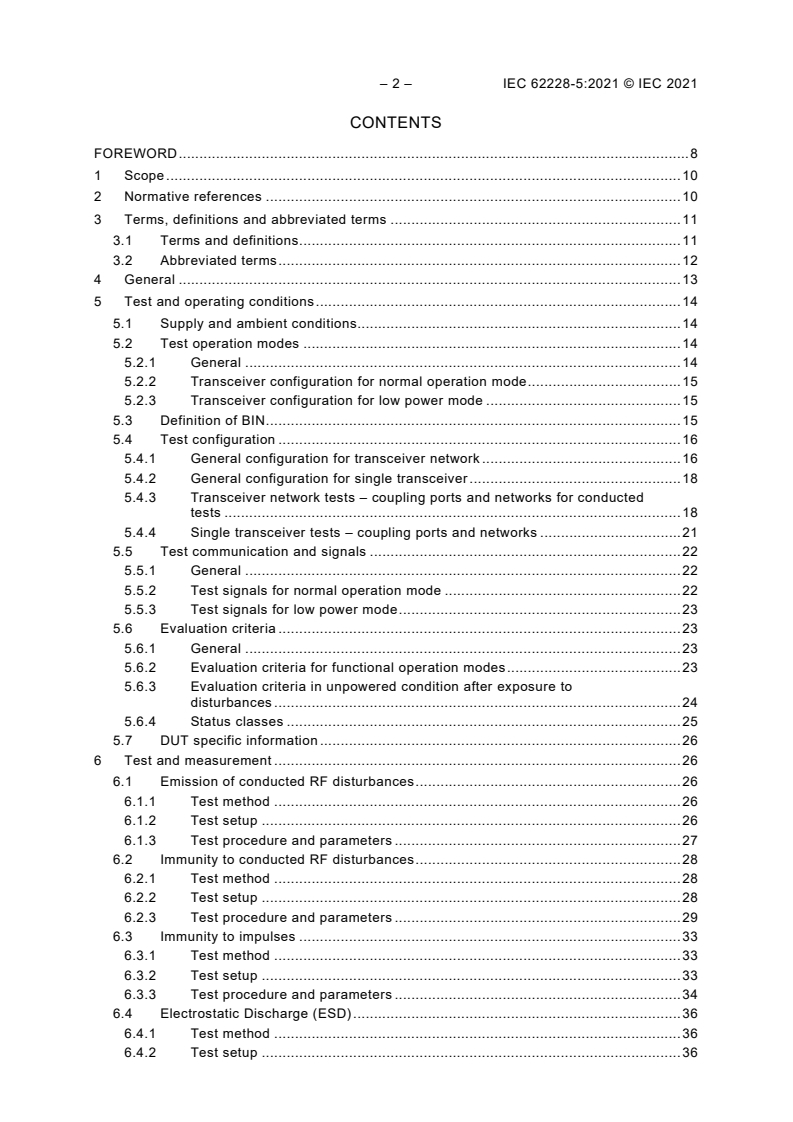
CONTENTS
FOREWORD . 8
1 Scope . 10
2 Normative references . 10
3 Terms, definitions and abbreviated terms . 11
3.1 Terms and definitions . 11
3.2 Abbreviated terms . 12
4 General . 13
5 Test and operating conditions . 14
5.1 Supply and ambient conditions. 14
5.2 Test operation modes . 14
5.2.1 General . 14
5.2.2 Transceiver configuration for normal operation mode . 15
5.2.3 Transceiver configuration for low power mode . 15
5.3 Definition of BIN . 15
5.4 Test configuration . 16
5.4.1 General configuration for transceiver network . 16
5.4.2 General configuration for single transceiver . 18
5.4.3 Transceiver network tests – coupling ports and networks for conducted
tests . 18
5.4.4 Single transceiver tests – coupling ports and networks . 21
5.5 Test communication and signals . 22
5.5.1 General . 22
5.5.2 Test signals for normal operation mode . 22
5.5.3 Test signals for low power mode . 23
5.6 Evaluation criteria . 23
5.6.1 General . 23
5.6.2 Evaluation criteria for functional operation modes . 23
5.6.3 Evaluation criteria in unpowered condition after exposure to
disturbances . 24
5.6.4 Status classes . 25
5.7 DUT specific information . 26
6 Test and measurement . 26
6.1 Emission of conducted RF disturbances . 26
6.1.1 Test method . 26
6.1.2 Test setup . 26
6.1.3 Test procedure and parameters . 27
6.2 Immunity to conducted RF disturbances . 28
6.2.1 Test method . 28
6.2.2 Test setup . 28
6.2.3 Test procedure and parameters . 29
6.3 Immunity to impulses . 33
6.3.1 Test method . 33
6.3.2 Test setup . 33
6.3.3 Test procedure and parameters . 34
6.4 Electrostatic Discharge (ESD) . 36
6.4.1 Test method . 36
6.4.2 Test setup . 36
6.4.3 Test procedure and parameters . 41
7 Test report . 43
Annex A (normative) Ethernet test circuits . 44
A.1 General . 44
A.2 Test circuit for Ethernet transceivers for functional tests . 44
A.3 Test circuit for Ethernet transceivers for ESD test . 46
Annex B (normative) Test circuit boards. 49
B.1 Test circuit board for transceiver network configuration . 49
B.2 Test circuit board for single transceiver configuration . 51
Annex C (informative) Test of Ethernet transceiver for radiated RF emission and RF
immunity . 53
C.1 General . 53
C.2 General configuration for transceiver network . 53
C.3 Tests . 54
C.3.1 General . 54
C.3.2 Emission of radiated RF disturbances . 58
C.3.3 Immunity to radiated RF disturbances . 59
Annex D (informative) Examples for test limits for Ethernet transceiver in automotive
application . 63
D.1 General . 63
D.2 Emission of conducted RF disturbances . 63
D.3 Immunity to conducted RF disturbances . 64
D.4 Immunity to impulses . 68
D.5 Electrostatic discharge (ESD) . 68
D.6 Emission of radiated RF disturbances . 69
D.7 Immunity to radiated RF disturbances . 70
Annex E (informative) Characterization of common mode chokes for EMC evaluation
of Ethernet transceivers . 72
E.1 General . 72
E.2 Test . 72
E.2.1 General . 72
E.2.2 S-parameter measurement mixed mode . 73
E.2.3 ESD damage . 80
E.2.4 Saturation test at RF disturbances . 82
E.2.5 Saturation test at ESD . 85
E.2.6 TDR measurement of differential mode impedance . 87
Annex F (informative) Characterization of ESD suppression devices for EMC
evaluation of Ethernet transceivers . 89
F.1 General . 89
F.2 Test . 90
F.2.1 General . 90
F.2.2 S-parameter measurement mixed mode . 91
F.2.3 ESD damage . 97
F.2.4 ESD discharge current measurement . 100
F.2.5 Test of unwanted clamping effect at RF immunity tests . 104
Bibliography . 108
Figure 1 – Minimum MDI interface test network (Min-BIN) . 16
Figure 2 – Standard MDI interface test network (Std-BIN) . 16
– 4 – IEC 62228-5:2021 © IEC 2021
Figure 3 – Optimized MDI interface test network (Opt-BIN) . 16
Figure 4 – General test configuration for tests in transceiver network for conducted
tests . 17
Figure 5 – General test configuration for unpowered ESD test . 18
Figure 6 – Transceiver network tests – coupling ports and networks . 19
Figure 7 – Coupling ports and networks for unpowered ESD tests . 22
Figure 8 – Principle drawing of the maximum deviation on an I-V characteristic . 25
Figure 9 – Test setup for measurement of conducted RF disturbances . 27
Figure 10 – Test setup for DPI tests . 29
Figure 11 – Test setup for impulse immunity tests. 33
Figure 12 – Test setup for powered ESD tests – principle arrangement. 36
Figure 13 – Test setup for powered ESD tests – stimulation and monitoring . 37
Figure 14 – Test setup for unpowered ESD tests – principle arrangement . 38
Figure 15 – Test setup for unpowered ESD tests – stimulation and monitoring for
function validation pre and post ESD test . 40
Figure A.1 – General drawing of the circuit diagram of test network for 100BASE-T1
and 1000BASE-T1 Ethernet transceivers for functional test using conducted test
methods . 45
Figure A.2 – General drawing of the circuit diagram of test network for 100BASE-TX
Ethernet transceivers for functional test using conducted test methods . 46
Figure A.3 – General drawing of the circuit diagram for ESD tests of Ethernet
transceivers in powered mode . 47
Figure A.4 – General drawing of the circuit diagram for ESD tests of Ethernet
transceivers in unpowered mode . 48
Figure B.1 – Example of functional conducted test board for Ethernet transceiver ICs
(100BASE-T1) . 49
Figure B.2 – Example of powered ESD test board for Ethernet transceivers ICs
(100BASE-T1) . 50
Figure B.3 – Example of unpowered ESD test board for Ethernet transceivers ICs
(100BASE-T1), top layer . 51
Figure B.4 – Example of unpowered ESD test board for Ethernet transceivers ICs
(100BASE-T1), bottom layer . 51
Figure C.1 – General test configuration for tests in transceiver network used for
radiated tests . 53
Figure C.2 – General drawing of the circuit diagram of test network for 100BASE-T1
and 1000BASE-T1 Ethernet transceivers for functional test using radiated RF test
methods . 55
Figure C.3 – Example of functional radiated test board for Ethernet transceiver ICs
(100BASE-T1), top layer (DUT side) . 56
Figure C.4 – Example of functional radiated test board for Ethernet transceiver ICs
(100BASE-T1), bottom layer (external circuitry side) . 57
Figure C.5 – Test setup for measurement of radiated RF emission . 58
Figure C.6 – Test setup for radiated RF immunity tests . 60
Figure D.1 – Example of limits for conducted RF emission – MDI Opt-BIN, V and
BAT
WAKE . 63
Figure D.2 – Example of limits for conducted RF emission – local supplies . 64
Figure D.3 – Example of limits for conducted RF immunity for functional status
class A – MDI Opt-BIN . 65
IC
Figure D.4 – Example of limits for conducted RF immunity for functional status
class A – V and WAKE . 65
IC BAT
Figure D.5 – Example of limits for conducted RF immunity for functional status
class C or D – MDI Opt-BIN . 67
IC IC
Figure D.6 – Example of limits for conducted RF immunity for functional status
class C or D – V and WAKE . 67
IC IC BAT
Figure D.7 – Example of limits for radiated RF emission for IC stripline with 6,7 mm
active conductor height . 69
Figure D.8 – Example of limits for radiated RF immunity . 70
Figure E.1 – General electrical drawing of a CMC . 72
Figure E.2 – Test setup for S-parameter measurements at CMC . 73
Figure E.3 – Example of test board 4-port S-parameter measurement at CMC – mixed
mode, top layer . 74
Figure E.4 – Example of test board 3-port S-parameter measurement at CMC – single
ended, top layer . 74
Figure E.5 – Recommended characteristics for S , S (RL) for CMC . 77
dd11 dd22
Figure E.6 – Recommended characteristics for S (IL) for CMC. 78
dd21
Figure E.7 – Recommended characteristics for S (CMR) for CMC . 78
cc21
Figure E.8 – Recommended characteristics for S , S (LCL) for CMC . 79
dc11 dc22
Figure E.9 – Recommended characteristics for S , S (DCMR) and S ,
sd21 sd12 ds21
S (CDMR) for CMC . 79
ds12
Figure E.10 – Test setup for ESD damage tests at CMC . 80
Figure E.11 – Example of ESD test board for CMC, top layer . 81
Figure E.12 – Test setup for RF saturation measurements at CMC . 83
Figure E.13 – Example of RF saturation / S-parameter test board for CMC, top layer. 83
Figure E.14 – Test setup for ESD saturation measurements at CMC . 85
Figure E.15 – Example of ESD saturation test board for CMC, top layer . 85
Figure E.16 – Example of ESD saturation tests results for CMC . 87
Figure E.17 – Test setup for TDR measurement at CMC . 87
Figure E.18 – Example of TDR test board for CMC, top layer . 88
Figure F.1 – Arrangement of ESD suppression device within the 100BASE-T1 and
1000BASE-T1 MDI interface . 90
Figure F.2 – Test setup for S-parameter measurements at ESD suppression device . 91
Figure F.3 – Example of test board 4-port S-parameter measurement for ESD
suppression device – mixed mode, top layer . 92
Figure F.4 – Example of test board 3-port S-parameter measurement for ESD
suppression device – single ended, top layer . 92
Figure F.5 – Recommended characteristics for S (RL) for ESD suppression device . 95
dd11
Figure F.6 – Recommended characteristics for S (IL) for ESD suppression device . 95
dd21
Figure F.7 – Recommended characteristics for S (DCMR) for ESD suppression
sd21
device . 96
Figure F.8 – Test setup for ESD damage tests at ESD suppression device . 97
Figure F.9 – Example of ESD test board for ESD suppression device, top layer . 98
Figure F.10 – Test setup for ESD discharge current measurement at ESD suppression
device . 100
– 6 – IEC 62228-5:2021 © IEC 2021
Figure F.11 – Example of ESD discharge current test board for ESD suppression
device, top and bottom layer . 101
Figure F.12 – Example of test results and recommended limits for remaining ESD
discharge current after the MDI test network for ESD suppression device . 103
Figure F.13 – Test setup for RF clamping test at ESD suppression device . 104
Figure F.14 – Example of test board RF clamping test at suppression device, top layer . 105
Figure F.15 – Recommended test power levels for RF clamping tests at ESD
suppression device . 107
Table 1 – Overview of measurements and tests . 13
Table 2 – Supply and ambient conditions for functional operation . 14
Table 3 – Definition for transceiver configuration for normal operation mode . 15
Table 4 – Definition for transceiver mode configuration for low power mode . 15
Table 5 – Selection recommendation of MII interfaces for transceiver network
configuration . 18
Table 6 – Transceiver network tests – component value definitions of coupling ports
and networks . 20
Table 7 – Definitions of coupling ports for unpowered ESD tests . 22
Table 8 – Definition for transceiver mode configuration for normal operation mode . 23
Table 9 – Evaluation criteria for Ethernet transceiver . 24
Table 10 – Definition of functional status classes . 25
Table 11 – Settings of the conducted RF measurement equipment . 27
Table 12 – Conducted emission measurements . 28
Table 13 – Specifications for DPI tests . 30
Table 14 – DPI tests for functional status class A evaluation of Ethernet transceivers . 31
IC
Table 15 – DPI tests for functional status class C or D evaluation of Ethernet
IC IC
transceivers . 32
Table 16 – Specifications for impulse immunity tests . 34
Table 17 – Parameters for impulse immunity test . 34
Table 18 – Impulse immunity tests for functional status class A evaluation of
IC
Ethernet transceivers . 35
Table 19 – Impulse immunity tests for functional status class C or D evaluation of
IC IC
Ethernet transceivers . 35
Table 20 – Specifications for ESD tests . 41
Table 21 – ESD tests in powered mode for functional status class A , C and D
IC IC IC
evaluation of Ethernet transceivers . 42
Table 22 – ESD tests in unpowered mode for functional status class D evaluation of
IC
Ethernet transceiver ICs . 43
Table B.1 – Parameter ESD test circuit board . 52
Table C.1 – Settings of the radiated RF measurement equipment . 59
Table C.2 – Radiated RF emission measurements . 59
Table C.3 – Specifications for radiated RF immunity tests . 61
Table C.4 – Radiated RF immunity tests for functional status class AIC evaluation of
Ethernet transceivers . 62
Table D.1 – Example of limits for conducted RF emission – test cases with
recommended limit classes . 64
Table D.2 – Example of limits for conducted RF immunity – test cases with
recommended limit classes for functional status class A . 66
IC
Table D.3 – Example of limits for conducted RF immunity – test cases with
recommended limit classes for functional status class C or D . 68
IC IC
Table D.4 – Example of limits for impulse immunity – Class I . 68
Table D.5 – Example of limits for impulse immunity – test cases with recommended
limit classes for functional status class C or D . 68
IC IC
Table D.6 – Example of limits for powered and unpowered ESD tests – test cases with
recommended limits for functional status class A1 A2 A3 C or D . 69
IC, IC, IC, IC IC
Table D.7 – Example of limits for radiated RF emission – test cases with recommended
limit classes . 70
Table D.8 – Example of limits for radiated RF immunity – test cases with recommended
limit classes . 71
Table E.1 – Test procedure and parameters for 3-port test board characterization for
CMC . 75
Table E.2 – Test procedure and parameters for S-parameter measurements at CMC . 76
Table E.3 – Required S-parameter measurements for CMC . 77
Table E.4 – Test parameters for ESD damage tests at CMC . 81
Table E.5 – Required ESD tests for damage for CMC . 82
Table E.6 – Test procedure and parameters for RF saturation tests at CMC . 84
Table E.7 – Required RF saturation tests for CMC . 84
Table E.8 – Test procedure and parameters for ESD saturation tests at CMC . 86
Table E.9 – Required ESD saturation tests for CMC . 86
Table E.10 – ESD saturation break down voltage classes for CMC . 86
Table E.11 – Test procedure and parameters for TDR measurement at CMC . 88
Table E.12 – Required TDR measurements for CMC . 88
Table F.1 – Specification of ESD suppression device . 89
Table F.2 – Test procedure and parameters for 3-port test board characterization for
ESD suppression device . 93
Table F.3 – Test procedure and parameters for S-parameter measurements at ESD
suppression device . 94
Table F.4 – Required S-parameter measurements for ESD suppression device . 94
Table F.5 – Test parameters for ESD damage tests at ESD suppression device . 99
Table F.6 – Required ESD tests for damage for ESD suppression device . 99
Table F.7 – Test parameters for ESD discharge current measurement at ESD
suppression device . 102
Table F.8 – Required current measurement for ESD suppression device . 102
Table F.9 – Recommended limits for remaining ESD discharge current after the MDI
test network for ESD suppression device . 103
Table F.10 – Limit classes and related applied ESD test voltages . 104
Table F.11 – Test procedure and parameters for RF clamping tests at ESD
suppression device . 106
Table F.12 – Required RF clamping tests for ESD suppression device . 107
– 8 – IEC 62228-5:2021 © IEC 2021
INTERNATIONAL ELECTROTECHNICAL COMMISSION
____________
INTEGRATED CIRCUITS –
EMC EVALUATION OF TRANSCEIVERS –
Part 5: Ethernet transceivers
FOREWORD
1) The International Electrotechnical Commission (IEC) is a worldwide organization for standardization comprising
all national electrotechnical committees (IEC National Committees). The object of IEC is to promote international
co-operation on all questions concerning standardization in the electrical and electronic fields. To this end and
in addition to other activities, IEC publishes International Standards, Technical Specifications, Technical Reports,
Publicly Available Specifications (PAS) and Guides (hereafter referred to as “IEC Publication(s)”). Their
preparation is entrusted to technical committees; any IEC National Committee interested in the subject dealt with
may participate in this preparatory work. International, governmental and non-governmental organizations liaising
with the IEC also participate in this preparation. IEC collaborates closely with the International Organization for
Standardization (ISO) in accordance with conditions determined by agreement between the two organizations.
2) The formal decisions or agreements of IEC on technical matters express, as nearly as possible, an international
consensus of opinion on the relevant subjects since each technical committee has representation from all
interested IEC National Committees.
3) IEC Publications have the form of recommendations for international use and are accepted by IEC National
Committees in that sense. While all reasonable efforts are made to ensure that the technical content of IEC
Publications is accurate, IEC cannot be held responsible for the way in which they are used or for any
misinterpretation by any end user.
4) In order to promote international uniformity, IEC National Committees undertake to apply IEC Publications
transparently to the maximum extent possible in their national and regional publications. Any divergence between
any IEC Publication and the corresponding national or regional publication shall be clearly indicated in the latter.
5) IEC itself does not provide any attestation of conformity. Independent certification bodies provide conformity
assessment services and, in some areas, access to IEC marks of conformity. IEC is not responsible for any
services carried out by independent certification bodies.
6) All users should ensure that they have the latest edition of this publication.
7) No liability shall attach to IEC or its directors, employees, servants or agents including individual experts and
members of its technical committees and IEC National Committees for any personal injury, property damage or
other damage of any nature whatsoever, whether direct or indirect, or for costs (including legal fees) and
expenses arising out of the publication, use of, or reliance upon, this IEC Publication or any other IEC Publications.
8) Attention is drawn to the Normative references cited in this publication. Use of the referenced publications is
indispensable for the correct application of this publication.
9) Attention is drawn to the possibility that some of the elements of this IEC Publication may be the subject of patent
rights. IEC shall not be held responsible for identifying any or all such patent rights.
International Standard IEC 62228-5 has been prepared by subcommittee 47A: Integrated
circuits, of IEC technical committee 47: Semiconductor devices.
The text of this International Standard is based on the following documents:
Draft Report on voting
47A/1115/FDIS 47A/1117/RVD
Full information on the voting for its approval can be found in the report on voting indicated in
the above table.
The language used for the development of this International Standard is English.
This document was drafted in accordance with ISO/IEC Directives, Part 2, and developed in
accordance with ISO/IEC Directives, Part 1 and ISO/IEC Directives, IEC Supplement, available
at www.iec.ch/members_experts/refdocs. The main document types developed by IEC are
described in greater detail at www.iec.ch/standardsdev/publications.
The committee has decided that the contents of this document will remain unchanged until the
stability date indicated on the IEC website under "http://webstore.iec.ch" in the data related to
the specific document. At this date, the document will be
• reconfirmed,
• withdrawn,
• replaced by a revised edition, or
• amended.
IMPORTANT – The 'colour inside' logo on the cover page of this publication indicates
that it contains colours which are considered to be useful for the correct understanding
of its contents. Users should therefore print this document using a colour printer.
– 10 – IEC 62228-5:2021 © IEC 2021
INTEGRATED CIRCUITS –
EMC EVALUATION OF TRANSCEIVERS –
Part 5: Ethernet transceivers
1 Scope
This part of IEC 62228 specifies test and measurement methods for EMC evaluation of Ethernet
transceiver ICs under network condition. It defines test configurations, test conditions, test
signals, failure criteria, test procedures, test setups and test boards. It is applicable for
transceiver of the Ethernet systems
• 100BASE-T1 according to ISO/IEC/IEEE 8802-3/AMD1;
• 100BASE-TX according to ISO/IEC/IEEE 8802-3;
• 1000BASE-T1 according to ISO/IEC/IEEE 8802-3/AMD4
and covers
• the emission of RF disturbances;
• the immunity against RF disturbances;
• the immunity against impulses;
• the immunity against electrostatic discharges (ESD).
2 Normative references
The following documents are referred to in the text in such a way that some or all of their content
constitutes requirements of this document. For dated references, only the edition cited applies.
For undated references, the latest edition of the referenced document (including any
amendments) applies.
IEC 61967-1, Integrated circuits – Measurement of electromagnetic emissions – Part 1: General
conditions and definitions
IEC 61967-4, Integrated circuits – Measurement of electromagnetic emissions, 150 kHz to 1
GHz – Part 4: Measurement of conducted emissions, 1 ohm/150 ohm direct coupling method
IEC 62132-1, Integrated circuits – Measurement of electromagnetic immunity – Part 1: General
conditions and definitions
IEC 62132-4, Integrated circuits – Measurement of electromagnetic immunity 150 kHz to 1 GHz
– Part 4: Direct RF power injection method
IEC 62215-3, Integrated circuits – Measurement of impulse immunity – Part 3: Non-
synchronous transient injection method
IEC 62228-1, Integrated circuits – EMC evaluation of transceivers – Part 1: General conditions
and definitions
ISO 10605, Road vehicles – Test methods for electrical disturbances from electrostatic
discharge
ISO 21111-2, Road vehicles – In-vehicle Ethernet – Part 2: Common physical entity
requirements
ISO 7637-2, Road vehicles – Electrical disturbances from conduction and coupling – Part 2:
Electrical transient conduction along supply lines only
ISO/IEC/IEEE 8802-3:2017, Information technology – Telecommunications and information
exchange between systems – Local and metropolitan area networks – Specific requirements –
Part 3: Standard for Ethernet
ISO/IEC/IEEE 8802-3:2017/AMD1:2017, Amendment 1 – Information technology –
Telecommunications and information exchange between systems – Local and metropolitan area
networks – Specific requirements – Part 3: Standard for Ethernet – Physical layer specifications
and management parameters for 100 Mb/s operation over a single balanced twisted pair cable
(100BASE-T1)
ISO/IEC/IEEE 8802-3:2017/AMD4:2017, Amendment 4 – Information technology –
Telecommunications and information exchange between systems – Local and metropolitan area
networks – Specific requirements – Part 3: Standard for Ethernet – Physical layer specifications
and management parameters for 1 Gb/s operation over a single twisted-pair copper cable
Electronic Components Industry Association, EIA-198-1, Ceramic Dielectric Capacitors Classes
I, II, III and IV
3 Terms, definitions and abbreviated terms
For the purposes of this document, the terms and definitions given in IEC 61967-1, IEC 62132‑1,
IEC 62228-1, as well as the following apply.
ISO and IEC maintain terminological databases for use in standardization at the following
addresses:
• ISO Online browsing platform: available at http://www.iso.org/obp
• IEC Electropedia: available at http://www.electropedia.org/
3.1 Terms and definitions
3.1.1
100BASE-T1 transceiver
transceiver 100 Mbit/s via single balanced twisted pair, with a functionality according to
ISO/IEC/IEEE 8802-3/AMD1 (100BASE-T1)
3.1.2
100BASE-TX transceiver
transceiver 100 Mbit/s via two balanced twisted pairs, with a functionality according to
ISO/IEC/IEEE 8802-3(100BASE-TX)
3.1.3
1000BASE-T1 transceiver
transceiver 1000 Mbit/s via single balanced twisted pair, with a functionality according to
ISO/IEC/IEEE 8802-3/AMD4 (1000BASE-T1)
3.1.4
global pin
pin that carries a signal or power, which enters or leaves the application board without any
active component in between
– 12 – IEC 62228-5:2021 © IEC 2021
3.1.5
local pin
pin that carries a signal or power, which does not leave the application board
3.1.6
mandatory components
pl
components needed for proper function and/or technical requirement of IC as specified by the
IC manufacturer
3.1.7
switch
IC with integrated Ethernet transceivers and switch functionality as defined in ISO/IEC/IEEE
8802-3
3.2 Abbreviated terms
ASIC Application specific integrated circuit
BIN Bus interface network
BIST Built in self-test
CMC Common mode choke
CDMR Common to differential mode conversion ratio
CMR Common mode rejection
DCMR Differential to common mode conversion ratio
DPI Direct RF power injection
DTT Data transfer test
DUT Device under test
FPGA Field programmable gate array
GMII Gigabit media independent interface
GPIO General purpose input or output
IL Insertion loss
INH Inhibit
LCL Longitudinal conversion loss
LPF Low pass filter
MDI Medium dependent interface
MII Media independent interface
PCB Printed circuit board
PRBS Pseudo random bit stream
PHY Ethernet single transceiver
RGMII Reduced gigabit media independent interface
...
IEC 62228-5 ®
Edition 1.0 2021-04
INTERNATIONAL
STANDARD
NORME
INTERNATIONALE
colour
inside
Integrated circuits – EMC evaluation of transceivers –
Part 5: Ethernet transceivers
Circuits intégrés – Évaluation de la CEM des émetteurs-récepteurs –
Partie 5: Émetteurs-récepteurs Ethernet
All rights reserved. Unless otherwise specified, no part of this publication may be reproduced or utilized in any form
or by any means, electronic or mechanical, including photocopying and microfilm, without permission in writing from
either IEC or IEC's member National Committee in the country of the requester. If you have any questions about IEC
copyright or have an enquiry about obtaining additional rights to this publication, please contact the address below or
your local IEC member National Committee for further information.
Droits de reproduction réservés. Sauf indication contraire, aucune partie de cette publication ne peut être reproduite
ni utilisée sous quelque forme que ce soit et par aucun procédé, électronique ou mécanique, y compris la photocopie
et les microfilms, sans l'accord écrit de l'IEC ou du Comité national de l'IEC du pays du demandeur. Si vous avez des
questions sur le copyright de l'IEC ou si vous désirez obtenir des droits supplémentaires sur cette publication, utilisez
les coordonnées ci-après ou contactez le Comité national de l'IEC de votre pays de résidence.
IEC Central Office Tel.: +41 22 919 02 11
3, rue de Varembé info@iec.ch
CH-1211 Geneva 20 www.iec.ch
Switzerland
About the IEC
The International Electrotechnical Commission (IEC) is the leading global organization that prepares and publishes
International Standards for all electrical, electronic and related technologies.
About IEC publications
The technical content of IEC publications is kept under constant review by the IEC. Please make sure that you have the
latest edition, a corrigendum or an amendment might have been published.
IEC publications search - webstore.iec.ch/advsearchform IEC online collection - oc.iec.ch
The advanced search enables to find IEC publications by a Discover our powerful search engine and read freely all the
variety of criteria (reference number, text, technical publications previews. With a subscription you will always
committee, …). It also gives information on projects, replaced have access to up to date content tailored to your needs.
and withdrawn publications.
Electropedia - www.electropedia.org
IEC Just Published - webstore.iec.ch/justpublished
The world's leading online dictionary on electrotechnology,
Stay up to date on all new IEC publications. Just Published
containing more than 22 000 terminological entries in English
details all new publications released. Available online and
and French, with equivalent terms in 18 additional languages.
once a month by email.
Also known as the International Electrotechnical Vocabulary
(IEV) online.
IEC Customer Service Centre - webstore.iec.ch/csc
If you wish to give us your feedback on this publication or
need further assistance, please contact the Customer Service
Centre: sales@iec.ch.
A propos de l'IEC
La Commission Electrotechnique Internationale (IEC) est la première organisation mondiale qui élabore et publie des
Normes internationales pour tout ce qui a trait à l'électricité, à l'électronique et aux technologies apparentées.
A propos des publications IEC
Le contenu technique des publications IEC est constamment revu. Veuillez vous assurer que vous possédez l’édition la
plus récente, un corrigendum ou amendement peut avoir été publié.
Recherche de publications IEC - IEC online collection - oc.iec.ch
webstore.iec.ch/advsearchform Découvrez notre puissant moteur de recherche et consultez
La recherche avancée permet de trouver des publications IEC gratuitement tous les aperçus des publications. Avec un
en utilisant différents critères (numéro de référence, texte, abonnement, vous aurez toujours accès à un contenu à jour
comité d’études, …). Elle donne aussi des informations sur adapté à vos besoins.
les projets et les publications remplacées ou retirées.
Electropedia - www.electropedia.org
IEC Just Published - webstore.iec.ch/justpublished
Le premier dictionnaire d'électrotechnologie en ligne au
Restez informé sur les nouvelles publications IEC. Just
monde, avec plus de 22 000 articles terminologiques en
Published détaille les nouvelles publications parues.
anglais et en français, ainsi que les termes équivalents dans
Disponible en ligne et une fois par mois par email.
16 langues additionnelles. Egalement appelé Vocabulaire
Electrotechnique International (IEV) en ligne.
Service Clients - webstore.iec.ch/csc
Si vous désirez nous donner des commentaires sur cette
publication ou si vous avez des questions contactez-nous:
sales@iec.ch.
IEC 62228-5 ®
Edition 1.0 2021-04
INTERNATIONAL
STANDARD
NORME
INTERNATIONALE
colour
inside
Integrated circuits – EMC evaluation of transceivers –
Part 5: Ethernet transceivers
Circuits intégrés – Évaluation de la CEM des émetteurs-récepteurs –
Partie 5: Émetteurs-récepteurs Ethernet
INTERNATIONAL
ELECTROTECHNICAL
COMMISSION
COMMISSION
ELECTROTECHNIQUE
INTERNATIONALE
ICS 31.200 ISBN 978-2-8322-1037-4
– 2 – IEC 62228-5:2021 © IEC 2021
CONTENTS
FOREWORD . 8
1 Scope . 10
2 Normative references . 10
3 Terms, definitions and abbreviated terms . 11
3.1 Terms and definitions . 11
3.2 Abbreviated terms . 12
4 General . 13
5 Test and operating conditions . 14
5.1 Supply and ambient conditions. 14
5.2 Test operation modes . 14
5.2.1 General . 14
5.2.2 Transceiver configuration for normal operation mode . 15
5.2.3 Transceiver configuration for low power mode . 15
5.3 Definition of BIN . 15
5.4 Test configuration . 16
5.4.1 General configuration for transceiver network . 16
5.4.2 General configuration for single transceiver . 18
5.4.3 Transceiver network tests – coupling ports and networks for conducted
tests . 18
5.4.4 Single transceiver tests – coupling ports and networks . 21
5.5 Test communication and signals . 22
5.5.1 General . 22
5.5.2 Test signals for normal operation mode . 22
5.5.3 Test signals for low power mode . 23
5.6 Evaluation criteria . 23
5.6.1 General . 23
5.6.2 Evaluation criteria for functional operation modes . 23
5.6.3 Evaluation criteria in unpowered condition after exposure to
disturbances . 24
5.6.4 Status classes . 25
5.7 DUT specific information . 26
6 Test and measurement . 26
6.1 Emission of conducted RF disturbances . 26
6.1.1 Test method . 26
6.1.2 Test setup . 26
6.1.3 Test procedure and parameters . 27
6.2 Immunity to conducted RF disturbances . 28
6.2.1 Test method . 28
6.2.2 Test setup . 28
6.2.3 Test procedure and parameters . 29
6.3 Immunity to impulses . 33
6.3.1 Test method . 33
6.3.2 Test setup . 33
6.3.3 Test procedure and parameters . 34
6.4 Electrostatic Discharge (ESD) . 36
6.4.1 Test method . 36
6.4.2 Test setup . 36
6.4.3 Test procedure and parameters . 41
7 Test report . 43
Annex A (normative) Ethernet test circuits . 44
A.1 General . 44
A.2 Test circuit for Ethernet transceivers for functional tests . 44
A.3 Test circuit for Ethernet transceivers for ESD test . 46
Annex B (normative) Test circuit boards. 49
B.1 Test circuit board for transceiver network configuration . 49
B.2 Test circuit board for single transceiver configuration . 51
Annex C (informative) Test of Ethernet transceiver for radiated RF emission and RF
immunity . 53
C.1 General . 53
C.2 General configuration for transceiver network . 53
C.3 Tests . 54
C.3.1 General . 54
C.3.2 Emission of radiated RF disturbances . 58
C.3.3 Immunity to radiated RF disturbances . 59
Annex D (informative) Examples for test limits for Ethernet transceiver in automotive
application . 63
D.1 General . 63
D.2 Emission of conducted RF disturbances . 63
D.3 Immunity to conducted RF disturbances . 64
D.4 Immunity to impulses . 68
D.5 Electrostatic discharge (ESD) . 68
D.6 Emission of radiated RF disturbances . 69
D.7 Immunity to radiated RF disturbances . 70
Annex E (informative) Characterization of common mode chokes for EMC evaluation
of Ethernet transceivers . 72
E.1 General . 72
E.2 Test . 72
E.2.1 General . 72
E.2.2 S-parameter measurement mixed mode . 73
E.2.3 ESD damage . 80
E.2.4 Saturation test at RF disturbances . 82
E.2.5 Saturation test at ESD . 85
E.2.6 TDR measurement of differential mode impedance . 87
Annex F (informative) Characterization of ESD suppression devices for EMC
evaluation of Ethernet transceivers . 89
F.1 General . 89
F.2 Test . 90
F.2.1 General . 90
F.2.2 S-parameter measurement mixed mode . 91
F.2.3 ESD damage . 97
F.2.4 ESD discharge current measurement . 100
F.2.5 Test of unwanted clamping effect at RF immunity tests . 104
Bibliography . 108
Figure 1 – Minimum MDI interface test network (Min-BIN) . 16
Figure 2 – Standard MDI interface test network (Std-BIN) . 16
– 4 – IEC 62228-5:2021 © IEC 2021
Figure 3 – Optimized MDI interface test network (Opt-BIN) . 16
Figure 4 – General test configuration for tests in transceiver network for conducted
tests . 17
Figure 5 – General test configuration for unpowered ESD test . 18
Figure 6 – Transceiver network tests – coupling ports and networks . 19
Figure 7 – Coupling ports and networks for unpowered ESD tests . 22
Figure 8 – Principle drawing of the maximum deviation on an I-V characteristic . 25
Figure 9 – Test setup for measurement of conducted RF disturbances . 27
Figure 10 – Test setup for DPI tests . 29
Figure 11 – Test setup for impulse immunity tests. 33
Figure 12 – Test setup for powered ESD tests – principle arrangement. 36
Figure 13 – Test setup for powered ESD tests – stimulation and monitoring . 37
Figure 14 – Test setup for unpowered ESD tests – principle arrangement . 38
Figure 15 – Test setup for unpowered ESD tests – stimulation and monitoring for
function validation pre and post ESD test . 40
Figure A.1 – General drawing of the circuit diagram of test network for 100BASE-T1
and 1000BASE-T1 Ethernet transceivers for functional test using conducted test
methods . 45
Figure A.2 – General drawing of the circuit diagram of test network for 100BASE-TX
Ethernet transceivers for functional test using conducted test methods . 46
Figure A.3 – General drawing of the circuit diagram for ESD tests of Ethernet
transceivers in powered mode . 47
Figure A.4 – General drawing of the circuit diagram for ESD tests of Ethernet
transceivers in unpowered mode . 48
Figure B.1 – Example of functional conducted test board for Ethernet transceiver ICs
(100BASE-T1) . 49
Figure B.2 – Example of powered ESD test board for Ethernet transceivers ICs
(100BASE-T1) . 50
Figure B.3 – Example of unpowered ESD test board for Ethernet transceivers ICs
(100BASE-T1), top layer . 51
Figure B.4 – Example of unpowered ESD test board for Ethernet transceivers ICs
(100BASE-T1), bottom layer . 51
Figure C.1 – General test configuration for tests in transceiver network used for
radiated tests . 53
Figure C.2 – General drawing of the circuit diagram of test network for 100BASE-T1
and 1000BASE-T1 Ethernet transceivers for functional test using radiated RF test
methods . 55
Figure C.3 – Example of functional radiated test board for Ethernet transceiver ICs
(100BASE-T1), top layer (DUT side) . 56
Figure C.4 – Example of functional radiated test board for Ethernet transceiver ICs
(100BASE-T1), bottom layer (external circuitry side) . 57
Figure C.5 – Test setup for measurement of radiated RF emission . 58
Figure C.6 – Test setup for radiated RF immunity tests . 60
Figure D.1 – Example of limits for conducted RF emission – MDI Opt-BIN, V and
BAT
WAKE . 63
Figure D.2 – Example of limits for conducted RF emission – local supplies . 64
Figure D.3 – Example of limits for conducted RF immunity for functional status
class A – MDI Opt-BIN . 65
IC
Figure D.4 – Example of limits for conducted RF immunity for functional status
class A – V and WAKE . 65
IC BAT
Figure D.5 – Example of limits for conducted RF immunity for functional status
class C or D – MDI Opt-BIN . 67
IC IC
Figure D.6 – Example of limits for conducted RF immunity for functional status
class C or D – V and WAKE . 67
IC IC BAT
Figure D.7 – Example of limits for radiated RF emission for IC stripline with 6,7 mm
active conductor height . 69
Figure D.8 – Example of limits for radiated RF immunity . 70
Figure E.1 – General electrical drawing of a CMC . 72
Figure E.2 – Test setup for S-parameter measurements at CMC . 73
Figure E.3 – Example of test board 4-port S-parameter measurement at CMC – mixed
mode, top layer . 74
Figure E.4 – Example of test board 3-port S-parameter measurement at CMC – single
ended, top layer . 74
Figure E.5 – Recommended characteristics for S , S (RL) for CMC . 77
dd11 dd22
Figure E.6 – Recommended characteristics for S (IL) for CMC. 78
dd21
Figure E.7 – Recommended characteristics for S (CMR) for CMC . 78
cc21
Figure E.8 – Recommended characteristics for S , S (LCL) for CMC . 79
dc11 dc22
Figure E.9 – Recommended characteristics for S , S (DCMR) and S ,
sd21 sd12 ds21
S (CDMR) for CMC . 79
ds12
Figure E.10 – Test setup for ESD damage tests at CMC . 80
Figure E.11 – Example of ESD test board for CMC, top layer . 81
Figure E.12 – Test setup for RF saturation measurements at CMC . 83
Figure E.13 – Example of RF saturation / S-parameter test board for CMC, top layer. 83
Figure E.14 – Test setup for ESD saturation measurements at CMC . 85
Figure E.15 – Example of ESD saturation test board for CMC, top layer . 85
Figure E.16 – Example of ESD saturation tests results for CMC . 87
Figure E.17 – Test setup for TDR measurement at CMC . 87
Figure E.18 – Example of TDR test board for CMC, top layer . 88
Figure F.1 – Arrangement of ESD suppression device within the 100BASE-T1 and
1000BASE-T1 MDI interface . 90
Figure F.2 – Test setup for S-parameter measurements at ESD suppression device . 91
Figure F.3 – Example of test board 4-port S-parameter measurement for ESD
suppression device – mixed mode, top layer . 92
Figure F.4 – Example of test board 3-port S-parameter measurement for ESD
suppression device – single ended, top layer . 92
Figure F.5 – Recommended characteristics for S (RL) for ESD suppression device . 95
dd11
Figure F.6 – Recommended characteristics for S (IL) for ESD suppression device . 95
dd21
Figure F.7 – Recommended characteristics for S (DCMR) for ESD suppression
sd21
device . 96
Figure F.8 – Test setup for ESD damage tests at ESD suppression device . 97
Figure F.9 – Example of ESD test board for ESD suppression device, top layer . 98
Figure F.10 – Test setup for ESD discharge current measurement at ESD suppression
device . 100
– 6 – IEC 62228-5:2021 © IEC 2021
Figure F.11 – Example of ESD discharge current test board for ESD suppression
device, top and bottom layer . 101
Figure F.12 – Example of test results and recommended limits for remaining ESD
discharge current after the MDI test network for ESD suppression device . 103
Figure F.13 – Test setup for RF clamping test at ESD suppression device . 104
Figure F.14 – Example of test board RF clamping test at suppression device, top layer . 105
Figure F.15 – Recommended test power levels for RF clamping tests at ESD
suppression device . 107
Table 1 – Overview of measurements and tests . 13
Table 2 – Supply and ambient conditions for functional operation . 14
Table 3 – Definition for transceiver configuration for normal operation mode . 15
Table 4 – Definition for transceiver mode configuration for low power mode . 15
Table 5 – Selection recommendation of MII interfaces for transceiver network
configuration . 18
Table 6 – Transceiver network tests – component value definitions of coupling ports
and networks . 20
Table 7 – Definitions of coupling ports for unpowered ESD tests . 22
Table 8 – Definition for transceiver mode configuration for normal operation mode . 23
Table 9 – Evaluation criteria for Ethernet transceiver . 24
Table 10 – Definition of functional status classes . 25
Table 11 – Settings of the conducted RF measurement equipment . 27
Table 12 – Conducted emission measurements . 28
Table 13 – Specifications for DPI tests . 30
Table 14 – DPI tests for functional status class A evaluation of Ethernet transceivers . 31
IC
Table 15 – DPI tests for functional status class C or D evaluation of Ethernet
IC IC
transceivers . 32
Table 16 – Specifications for impulse immunity tests . 34
Table 17 – Parameters for impulse immunity test . 34
Table 18 – Impulse immunity tests for functional status class A evaluation of
IC
Ethernet transceivers . 35
Table 19 – Impulse immunity tests for functional status class C or D evaluation of
IC IC
Ethernet transceivers . 35
Table 20 – Specifications for ESD tests . 41
Table 21 – ESD tests in powered mode for functional status class A , C and D
IC IC IC
evaluation of Ethernet transceivers . 42
Table 22 – ESD tests in unpowered mode for functional status class D evaluation of
IC
Ethernet transceiver ICs . 43
Table B.1 – Parameter ESD test circuit board . 52
Table C.1 – Settings of the radiated RF measurement equipment . 59
Table C.2 – Radiated RF emission measurements . 59
Table C.3 – Specifications for radiated RF immunity tests . 61
Table C.4 – Radiated RF immunity tests for functional status class AIC evaluation of
Ethernet transceivers . 62
Table D.1 – Example of limits for conducted RF emission – test cases with
recommended limit classes . 64
Table D.2 – Example of limits for conducted RF immunity – test cases with
recommended limit classes for functional status class A . 66
IC
Table D.3 – Example of limits for conducted RF immunity – test cases with
recommended limit classes for functional status class C or D . 68
IC IC
Table D.4 – Example of limits for impulse immunity – Class I . 68
Table D.5 – Example of limits for impulse immunity – test cases with recommended
limit classes for functional status class C or D . 68
IC IC
Table D.6 – Example of limits for powered and unpowered ESD tests – test cases with
recommended limits for functional status class A1 A2 A3 C or D . 69
IC, IC, IC, IC IC
Table D.7 – Example of limits for radiated RF emission – test cases with recommended
limit classes . 70
Table D.8 – Example of limits for radiated RF immunity – test cases with recommended
limit classes . 71
Table E.1 – Test procedure and parameters for 3-port test board characterization for
CMC . 75
Table E.2 – Test procedure and parameters for S-parameter measurements at CMC . 76
Table E.3 – Required S-parameter measurements for CMC . 77
Table E.4 – Test parameters for ESD damage tests at CMC . 81
Table E.5 – Required ESD tests for damage for CMC . 82
Table E.6 – Test procedure and parameters for RF saturation tests at CMC . 84
Table E.7 – Required RF saturation tests for CMC . 84
Table E.8 – Test procedure and parameters for ESD saturation tests at CMC . 86
Table E.9 – Required ESD saturation tests for CMC . 86
Table E.10 – ESD saturation break down voltage classes for CMC . 86
Table E.11 – Test procedure and parameters for TDR measurement at CMC . 88
Table E.12 – Required TDR measurements for CMC . 88
Table F.1 – Specification of ESD suppression device . 89
Table F.2 – Test procedure and parameters for 3-port test board characterization for
ESD suppression device . 93
Table F.3 – Test procedure and parameters for S-parameter measurements at ESD
suppression device . 94
Table F.4 – Required S-parameter measurements for ESD suppression device . 94
Table F.5 – Test parameters for ESD damage tests at ESD suppression device . 99
Table F.6 – Required ESD tests for damage for ESD suppression device . 99
Table F.7 – Test parameters for ESD discharge current measurement at ESD
suppression device . 102
Table F.8 – Required current measurement for ESD suppression device . 102
Table F.9 – Recommended limits for remaining ESD discharge current after the MDI
test network for ESD suppression device . 103
Table F.10 – Limit classes and related applied ESD test voltages . 104
Table F.11 – Test procedure and parameters for RF clamping tests at ESD
suppression device . 106
Table F.12 – Required RF clamping tests for ESD suppression device . 107
– 8 – IEC 62228-5:2021 © IEC 2021
INTERNATIONAL ELECTROTECHNICAL COMMISSION
____________
INTEGRATED CIRCUITS –
EMC EVALUATION OF TRANSCEIVERS –
Part 5: Ethernet transceivers
FOREWORD
1) The International Electrotechnical Commission (IEC) is a worldwide organization for standardization comprising
all national electrotechnical committees (IEC National Committees). The object of IEC is to promote international
co-operation on all questions concerning standardization in the electrical and electronic fields. To this end and
in addition to other activities, IEC publishes International Standards, Technical Specifications, Technical Reports,
Publicly Available Specifications (PAS) and Guides (hereafter referred to as “IEC Publication(s)”). Their
preparation is entrusted to technical committees; any IEC National Committee interested in the subject dealt with
may participate in this preparatory work. International, governmental and non-governmental organizations liaising
with the IEC also participate in this preparation. IEC collaborates closely with the International Organization for
Standardization (ISO) in accordance with conditions determined by agreement between the two organizations.
2) The formal decisions or agreements of IEC on technical matters express, as nearly as possible, an international
consensus of opinion on the relevant subjects since each technical committee has representation from all
interested IEC National Committees.
3) IEC Publications have the form of recommendations for international use and are accepted by IEC National
Committees in that sense. While all reasonable efforts are made to ensure that the technical content of IEC
Publications is accurate, IEC cannot be held responsible for the way in which they are used or for any
misinterpretation by any end user.
4) In order to promote international uniformity, IEC National Committees undertake to apply IEC Publications
transparently to the maximum extent possible in their national and regional publications. Any divergence between
any IEC Publication and the corresponding national or regional publication shall be clearly indicated in the latter.
5) IEC itself does not provide any attestation of conformity. Independent certification bodies provide conformity
assessment services and, in some areas, access to IEC marks of conformity. IEC is not responsible for any
services carried out by independent certification bodies.
6) All users should ensure that they have the latest edition of this publication.
7) No liability shall attach to IEC or its directors, employees, servants or agents including individual experts and
members of its technical committees and IEC National Committees for any personal injury, property damage or
other damage of any nature whatsoever, whether direct or indirect, or for costs (including legal fees) and
expenses arising out of the publication, use of, or reliance upon, this IEC Publication or any other IEC Publications.
8) Attention is drawn to the Normative references cited in this publication. Use of the referenced publications is
indispensable for the correct application of this publication.
9) Attention is drawn to the possibility that some of the elements of this IEC Publication may be the subject of patent
rights. IEC shall not be held responsible for identifying any or all such patent rights.
International Standard IEC 62228-5 has been prepared by subcommittee 47A: Integrated
circuits, of IEC technical committee 47: Semiconductor devices.
The text of this International Standard is based on the following documents:
Draft Report on voting
47A/1115/FDIS 47A/1117/RVD
Full information on the voting for its approval can be found in the report on voting indicated in
the above table.
The language used for the development of this International Standard is English.
This document was drafted in accordance with ISO/IEC Directives, Part 2, and developed in
accordance with ISO/IEC Directives, Part 1 and ISO/IEC Directives, IEC Supplement, available
at www.iec.ch/members_experts/refdocs. The main document types developed by IEC are
described in greater detail at www.iec.ch/standardsdev/publications.
The committee has decided that the contents of this document will remain unchanged until the
stability date indicated on the IEC website under "http://webstore.iec.ch" in the data related to
the specific document. At this date, the document will be
• reconfirmed,
• withdrawn,
• replaced by a revised edition, or
• amended.
IMPORTANT – The 'colour inside' logo on the cover page of this publication indicates
that it contains colours which are considered to be useful for the correct understanding
of its contents. Users should therefore print this document using a colour printer.
– 10 – IEC 62228-5:2021 © IEC 2021
INTEGRATED CIRCUITS –
EMC EVALUATION OF TRANSCEIVERS –
Part 5: Ethernet transceivers
1 Scope
This part of IEC 62228 specifies test and measurement methods for EMC evaluation of Ethernet
transceiver ICs under network condition. It defines test configurations, test conditions, test
signals, failure criteria, test procedures, test setups and test boards. It is applicable for
transceiver of the Ethernet systems
• 100BASE-T1 according to ISO/IEC/IEEE 8802-3/AMD1;
• 100BASE-TX according to ISO/IEC/IEEE 8802-3;
• 1000BASE-T1 according to ISO/IEC/IEEE 8802-3/AMD4
and covers
• the emission of RF disturbances;
• the immunity against RF disturbances;
• the immunity against impulses;
• the immunity against electrostatic discharges (ESD).
2 Normative references
The following documents are referred to in the text in such a way that some or all of their content
constitutes requirements of this document. For dated references, only the edition cited applies.
For undated references, the latest edition of the referenced document (including any
amendments) applies.
IEC 61967-1, Integrated circuits – Measurement of electromagnetic emissions – Part 1: General
conditions and definitions
IEC 61967-4, Integrated circuits – Measurement of electromagnetic emissions, 150 kHz to 1
GHz – Part 4: Measurement of conducted emissions, 1 ohm/150 ohm direct coupling method
IEC 62132-1, Integrated circuits – Measurement of electromagnetic immunity – Part 1: General
conditions and definitions
IEC 62132-4, Integrated circuits – Measurement of electromagnetic immunity 150 kHz to 1 GHz
– Part 4: Direct RF power injection method
IEC 62215-3, Integrated circuits – Measurement of impulse immunity – Part 3: Non-
synchronous transient injection method
IEC 62228-1, Integrated circuits – EMC evaluation of transceivers – Part 1: General conditions
and definitions
ISO 10605, Road vehicles – Test methods for electrical disturbances from electrostatic
discharge
ISO 21111-2, Road vehicles – In-vehicle Ethernet – Part 2: Common physical entity
requirements
ISO 7637-2, Road vehicles – Electrical disturbances from conduction and coupling – Part 2:
Electrical transient conduction along supply lines only
ISO/IEC/IEEE 8802-3:2017, Information technology – Telecommunications and information
exchange between systems – Local and metropolitan area networks – Specific requirements –
Part 3: Standard for Ethernet
ISO/IEC/IEEE 8802-3:2017/AMD1:2017, Amendment 1 – Information technology –
Telecommunications and information exchange between systems – Local and metropolitan area
networks – Specific requirements – Part 3: Standard for Ethernet – Physical layer specifications
and management parameters for 100 Mb/s operation over a single balanced twisted pair cable
(1
...