


IEC 60794-1-31:2021
(Main)Optical fibre cables - Part 1-31: Generic specification - Optical cable elements - Optical fibre ribbon
Optical fibre cables - Part 1-31: Generic specification - Optical cable elements - Optical fibre ribbon
IEC 60794-1-31:2021 which is a generic specification, covers optical fibre ribbons. Requirements which are described in this part apply to optical fibre ribbon cables for use with telecommunication equipment and devices employing similar techniques, in particular optical fibre cables in IEC 60794-2 for indoor use, in IEC 60794-3 for outdoor use, in IEC 60794-4 for self-supporting overhead use, in IEC 60794-5 for air blown use and in IEC 60794-6 for indoor/outdoor use. The detailed specification can be verified in specifications for each application such as IEC 60794-2 and IEC 60794-3. This second edition cancels and replaces the first edition published in 2018. This edition constitutes a technical revision. This edition includes the following significant technical changes with respect to the previous edition:
- The geometrical requirements for optical fibre ribbon with typically 250 µm coating diameter have been modified and those for the optical fibre ribbon with typically 200 µm coating diameter have been added.
- "Identification by positional identification" and "Identification by ribbon coding and fibre colouring" are moved to a new informative Annex A.
Câbles à fibres optiques - Partie 1-31: Spécification générique - Éléments de câbles optiques - Rubans de fibres optiques
IEC 60794-1-31:2021 qui est une spécification générique, s’applique aux rubans de fibres optiques. Les exigences qui sont décrites dans la présente partie s’appliquent aux câbles à rubans de fibres optiques destinés à être utilisés dans les équipements de télécommunications et les dispositifs utilisant des techniques analogues, en particulier les câbles à fibres optiques de l’IEC 60794-2 pour une utilisation à l’intérieur, de l’IEC 60794-3 pour une utilisation à l’extérieur, de l’IEC 60794-4 pour une utilisation aérienne autoporteuse, de l’IEC 60794-5 pour une utilisation soufflée et de l’IEC 60794-6 pour une utilisation à l’extérieur/l’intérieur. La spécification particulière peut être vérifiée dans les spécifications pour chaque application comme l’IEC 60794-2 et l’IEC 60794-3. Cette seconde édition annule et remplace la première édition, publiée en 2018. Cette édition constitue une révision technique. Cette édition inclut les modifications techniques majeures suivantes par rapport à l’édition précédente:
- Les exigences géométriques pour les rubans de fibres optiques ayant généralement un diamètre de revêtement de 250 µm ont été modifiées et celles pour le ruban de fibres optiques ayant généralement un diamètre de revêtement de 200 µm ont été ajoutées.
- Les paragraphes "Identification selon le positionnement" et "Identification par codage du ruban et coloration des fibres" ont été déplacés dans une nouvelle Annexe A informative.
General Information
- Status
- Published
- Publication Date
- 27-Jun-2021
- Technical Committee
- SC 86A - Fibres and cables
- Current Stage
- PPUB - Publication issued
- Start Date
- 28-Jun-2021
- Completion Date
- 19-Jul-2021
Relations
- Effective Date
- 05-Sep-2023
Overview
IEC 60794-1-31:2021 is the IEC generic specification for optical fibre ribbon cable elements. It defines construction, dimensional and mechanical requirements that apply to ribbons used in telecommunications and similar equipment. The 2021 (Edition 2.0) update revises geometrical requirements for ribbons with typical 250 µm coating and adds requirements for 200 µm coating ribbons. Identification methods for ribbons and fibres are now presented in an informative Annex A.
Key topics and technical requirements
- Ribbon types and structure: Defines common ribbon structures - edge-bonded, encapsulated, and partially-bonded - and describes their transverse rigidity and flexibility implications.
- Optical fibre classes: Specifies use of Category A1 multimode (IEC 60793-2-10) or Category B single-mode fibres (IEC 60793-2-50), with typical coating diameters of 250 µm or 200 µm.
- Dimensions and geometry: Provides maximum dimensions and structural geometry for common fibre counts (4, 6, 8, 12, 16, 24, 32, 36) and separate tables for 250 µm and 200 µm coatings. Partially-bonded ribbons have measurement guidance for unexpanded, coplanar fibre alignment.
- Mechanical requirements: Covers separability (individual fibre removal), ribbon stripping, torsion and other mechanical behaviors that are critical for handling, splicing and installation.
- Identification: Describes fibre and ribbon identification practices; positional identification and ribbon coding/fibre colouring are included in informative Annex A (moved from main text in this edition).
- Testing references: Points to cable element test methods and dimension definitions in IEC 60794-1-23 and general cable requirements in IEC 60794-1-1.
Practical applications and users
Who uses IEC 60794-1-31:2021:
- Cable manufacturers specifying ribbon construction, dimensions and mechanical performance.
- System designers and network engineers selecting ribbon-based cables for high-density backbone, data center and metro networks.
- Splicing and termination equipment vendors and fusion-splice technicians relying on mass splicing compatibility.
- Test laboratories and QA teams validating ribbon geometry and separability per standard test methods. Practical uses:
- High-density trunk and backbone cables where mass fusion splicing of ribbons speeds deployment.
- Indoor, outdoor, aerial and microduct installations when used alongside sectional specifications (see Related Standards).
Related standards
- IEC 60794-2 (Indoor cables)
- IEC 60794-3 (Outdoor cables)
- IEC 60794-4 (Aerial/self-supporting)
- IEC 60794-5 (Air-blown/microduct)
- IEC 60794-6 (Indoor/outdoor)
- IEC 60793-2-10 / IEC 60793-2-50 (fibre product specs)
- IEC 60794-1-23 (dimension and test method guidance)
Keywords: IEC 60794-1-31:2021, optical fibre ribbons, ribbon geometry, edge-bonded, encapsulated, partially-bonded, 250 µm, 200 µm, mass splicing, telecommunications standards.
Buy Documents
IEC 60794-1-31:2021 RLV - Optical fibre cables - Part 1-31: Generic specification - Optical cable elements - Optical fibre ribbon Released:6/28/2021 Isbn:9782832299753
IEC 60794-1-31:2021 - Optical fibre cables - Part 1-31: Generic specification - Optical cable elements - Optical fibre ribbon Released:6/28/2021 Isbn:9782832299449
Get Certified
Connect with accredited certification bodies for this standard

TL 9000 QuEST Forum
Telecommunications quality management system.

ANCE
Mexican certification and testing association.

Intertek Slovenia
Intertek testing, inspection, and certification services in Slovenia.
Sponsored listings
Frequently Asked Questions
IEC 60794-1-31:2021 is a standard published by the International Electrotechnical Commission (IEC). Its full title is "Optical fibre cables - Part 1-31: Generic specification - Optical cable elements - Optical fibre ribbon". This standard covers: IEC 60794-1-31:2021 which is a generic specification, covers optical fibre ribbons. Requirements which are described in this part apply to optical fibre ribbon cables for use with telecommunication equipment and devices employing similar techniques, in particular optical fibre cables in IEC 60794-2 for indoor use, in IEC 60794-3 for outdoor use, in IEC 60794-4 for self-supporting overhead use, in IEC 60794-5 for air blown use and in IEC 60794-6 for indoor/outdoor use. The detailed specification can be verified in specifications for each application such as IEC 60794-2 and IEC 60794-3. This second edition cancels and replaces the first edition published in 2018. This edition constitutes a technical revision. This edition includes the following significant technical changes with respect to the previous edition: - The geometrical requirements for optical fibre ribbon with typically 250 µm coating diameter have been modified and those for the optical fibre ribbon with typically 200 µm coating diameter have been added. - "Identification by positional identification" and "Identification by ribbon coding and fibre colouring" are moved to a new informative Annex A.
IEC 60794-1-31:2021 which is a generic specification, covers optical fibre ribbons. Requirements which are described in this part apply to optical fibre ribbon cables for use with telecommunication equipment and devices employing similar techniques, in particular optical fibre cables in IEC 60794-2 for indoor use, in IEC 60794-3 for outdoor use, in IEC 60794-4 for self-supporting overhead use, in IEC 60794-5 for air blown use and in IEC 60794-6 for indoor/outdoor use. The detailed specification can be verified in specifications for each application such as IEC 60794-2 and IEC 60794-3. This second edition cancels and replaces the first edition published in 2018. This edition constitutes a technical revision. This edition includes the following significant technical changes with respect to the previous edition: - The geometrical requirements for optical fibre ribbon with typically 250 µm coating diameter have been modified and those for the optical fibre ribbon with typically 200 µm coating diameter have been added. - "Identification by positional identification" and "Identification by ribbon coding and fibre colouring" are moved to a new informative Annex A.
IEC 60794-1-31:2021 is classified under the following ICS (International Classification for Standards) categories: 33.180.10 - Fibres and cables; 33.180.99 - Other fibre optic equipment. The ICS classification helps identify the subject area and facilitates finding related standards.
IEC 60794-1-31:2021 has the following relationships with other standards: It is inter standard links to IEC 60794-1-31:2018. Understanding these relationships helps ensure you are using the most current and applicable version of the standard.
IEC 60794-1-31:2021 is available in PDF format for immediate download after purchase. The document can be added to your cart and obtained through the secure checkout process. Digital delivery ensures instant access to the complete standard document.
Standards Content (Sample)
IEC 60794-1-31 ®
Edition 2.0 2021-06
REDLINE VERSION
INTERNATIONAL
STANDARD
colour
inside
Optical fibre cables –
Part 1-31: Generic specification – Optical cable elements – Optical fibre ribbon
All rights reserved. Unless otherwise specified, no part of this publication may be reproduced or utilized in any form
or by any means, electronic or mechanical, including photocopying and microfilm, without permission in writing from
either IEC or IEC's member National Committee in the country of the requester. If you have any questions about IEC
copyright or have an enquiry about obtaining additional rights to this publication, please contact the address below or
your local IEC member National Committee for further information.
IEC Central Office Tel.: +41 22 919 02 11
3, rue de Varembé info@iec.ch
CH-1211 Geneva 20 www.iec.ch
Switzerland
About the IEC
The International Electrotechnical Commission (IEC) is the leading global organization that prepares and publishes
International Standards for all electrical, electronic and related technologies.
About IEC publications
The technical content of IEC publications is kept under constant review by the IEC. Please make sure that you have the
latest edition, a corrigendum or an amendment might have been published.
IEC publications search - webstore.iec.ch/advsearchform IEC online collection - oc.iec.ch
The advanced search enables to find IEC publications by a Discover our powerful search engine and read freely all the
variety of criteria (reference number, text, technical publications previews. With a subscription you will always
committee, …). It also gives information on projects, replaced have access to up to date content tailored to your needs.
and withdrawn publications.
Electropedia - www.electropedia.org
IEC Just Published - webstore.iec.ch/justpublished
The world's leading online dictionary on electrotechnology,
Stay up to date on all new IEC publications. Just Published
containing more than 22 000 terminological entries in English
details all new publications released. Available online and
and French, with equivalent terms in 18 additional languages.
once a month by email.
Also known as the International Electrotechnical Vocabulary
(IEV) online.
IEC Customer Service Centre - webstore.iec.ch/csc
If you wish to give us your feedback on this publication or
need further assistance, please contact the Customer Service
Centre: sales@iec.ch.
IEC 60794-1-31 ®
Edition 2.0 2021-06
REDLINE VERSION
INTERNATIONAL
STANDARD
colour
inside
Optical fibre cables –
Part 1-31: Generic specification – Optical cable elements – Optical fibre ribbon
INTERNATIONAL
ELECTROTECHNICAL
COMMISSION
ICS 33.180.10; 33.180.99 ISBN 978-2-8322-9975-3
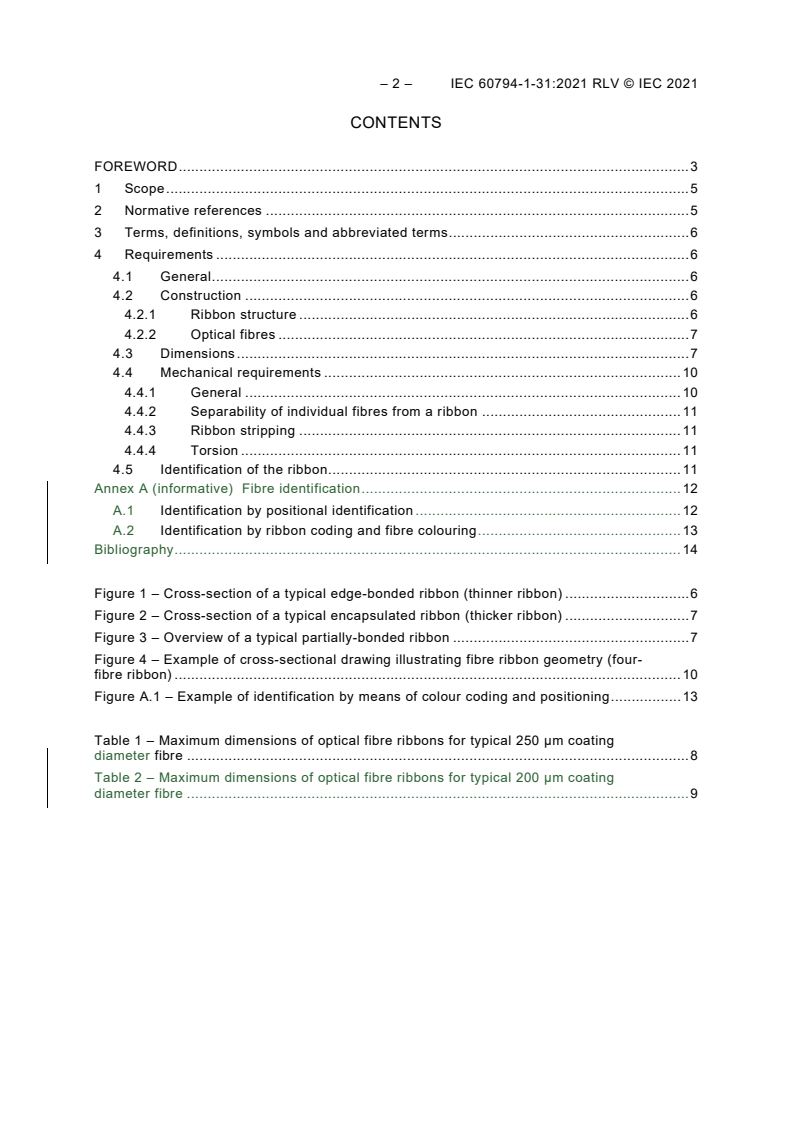
– 2 – IEC 60794-1-31:2021 RLV © IEC 2021
CONTENTS
FOREWORD . 3
1 Scope . 5
2 Normative references . 5
3 Terms, definitions, symbols and abbreviated terms . 6
4 Requirements . 6
4.1 General . 6
4.2 Construction . 6
4.2.1 Ribbon structure . 6
4.2.2 Optical fibres . 7
4.3 Dimensions . 7
4.4 Mechanical requirements . 10
4.4.1 General . 10
4.4.2 Separability of individual fibres from a ribbon . 11
4.4.3 Ribbon stripping . 11
4.4.4 Torsion . 11
4.5 Identification of the ribbon . 11
Annex A (informative) Fibre identification . 12
A.1 Identification by positional identification . 12
A.2 Identification by ribbon coding and fibre colouring . 13
Bibliography . 14
Figure 1 – Cross-section of a typical edge-bonded ribbon (thinner ribbon) . 6
Figure 2 – Cross-section of a typical encapsulated ribbon (thicker ribbon) . 7
Figure 3 – Overview of a typical partially-bonded ribbon . 7
Figure 4 – Example of cross-sectional drawing illustrating fibre ribbon geometry (four-
fibre ribbon) . 10
Figure A.1 – Example of identification by means of colour coding and positioning . 13
Table 1 – Maximum dimensions of optical fibre ribbons for typical 250 µm coating
diameter fibre . 8
Table 2 – Maximum dimensions of optical fibre ribbons for typical 200 µm coating
diameter fibre . 9
INTERNATIONAL ELECTROTECHNICAL COMMISSION
____________
OPTICAL FIBRE CABLES –
Part 1-31: Generic specification – Optical cable elements –
Optical fibre ribbon
FOREWORD
1) The International Electrotechnical Commission (IEC) is a worldwide organization for standardization comprising
all national electrotechnical committees (IEC National Committees). The object of IEC is to promote international
co-operation on all questions concerning standardization in the electrical and electronic fields. To this end and
in addition to other activities, IEC publishes International Standards, Technical Specifications, Technical Reports,
Publicly Available Specifications (PAS) and Guides (hereafter referred to as “IEC Publication(s)”). Their
preparation is entrusted to technical committees; any IEC National Committee interested in the subject dealt with
may participate in this preparatory work. International, governmental and non-governmental organizations liaising
with the IEC also participate in this preparation. IEC collaborates closely with the International Organization for
Standardization (ISO) in accordance with conditions determined by agreement between the two organizations.
2) The formal decisions or agreements of IEC on technical matters express, as nearly as possible, an international
consensus of opinion on the relevant subjects since each technical committee has representation from all
interested IEC National Committees.
3) IEC Publications have the form of recommendations for international use and are accepted by IEC National
Committees in that sense. While all reasonable efforts are made to ensure that the technical content of IEC
Publications is accurate, IEC cannot be held responsible for the way in which they are used or for any
misinterpretation by any end user.
4) In order to promote international uniformity, IEC National Committees undertake to apply IEC Publications
transparently to the maximum extent possible in their national and regional publications. Any divergence between
any IEC Publication and the corresponding national or regional publication shall be clearly indicated in the latter.
5) IEC itself does not provide any attestation of conformity. Independent certification bodies provide conformity
assessment services and, in some areas, access to IEC marks of conformity. IEC is not responsible for any
services carried out by independent certification bodies.
6) All users should ensure that they have the latest edition of this publication.
7) No liability shall attach to IEC or its directors, employees, servants or agents including individual experts and
members of its technical committees and IEC National Committees for any personal injury, property damage or
other damage of any nature whatsoever, whether direct or indirect, or for costs (including legal fees) and
expenses arising out of the publication, use of, or reliance upon, this IEC Publication or any other IEC
Publications.
8) Attention is drawn to the Normative references cited in this publication. Use of the referenced publications is
indispensable for the correct application of this publication.
9) Attention is drawn to the possibility that some of the elements of this IEC Publication may be the subject of patent
rights. IEC shall not be held responsible for identifying any or all such patent rights.
This redline version of the official IEC Standard allows the user to identify the changes made to
the previous edition IEC 60794-1-31:2018. A vertical bar appears in the margin wherever a change
has been made. Additions are in green text, deletions are in strikethrough red text.
– 4 – IEC 60794-1-31:2021 RLV © IEC 2021
IEC 60794-1-31 has been prepared by subcommittee SC86A: Fibres and cables, of IEC
technical committee 86: Fibre optics. It is an International Standard.
This second edition cancels and replaces the first edition published in 2018. This edition
constitutes a technical revision.
This edition includes the following significant technical changes with respect to the previous
edition:
a) The geometrical requirements for optical fibre ribbon with typically 250 µm coating diameter
have been modified and those for the optical fibre ribbon with typically 200 µm coating
diameter have been added.
b) "Identification by positional identification" and "Identification by ribbon coding and fibre
colouring" are moved to a new informative Annex A.
The text of this International Standard is based on the following documents:
CDV Report on voting
86A/2071/CDV 86A/2109/RVC
Full information on the voting for its approval can be found in the report on voting indicated in
the above table.
The language used for the development of this International Standard is English.
This document was drafted in accordance with ISO/IEC Directives, Part 2, and developed in
accordance with ISO/IEC Directives, Part 1 and ISO/IEC Directives, IEC Supplement, available
at www.iec.ch/members_experts/refdocs. The main document types developed by IEC are
described in greater detail at www.iec.ch/standardsdev/publications.
A list of all parts in the IEC 60794 series, published under the general title Optical fibre cables,
can be found on the IEC website.
The committee has decided that the contents of this document will remain unchanged until the
stability date indicated on the IEC website under webstore.iec.ch in the data related to the
specific document. At this date, the document will be
• reconfirmed,
• withdrawn,
• replaced by a revised edition, or
• amended.
IMPORTANT – The "colour inside" logo on the cover page of this document indicates
that it contains colours which are considered to be useful for the correct understanding
of its contents. Users should therefore print this document using a colour printer.
OPTICAL FIBRE CABLES –
Part 1-31: Generic specification – Optical cable elements –
Optical fibre ribbon
1 Scope
This part of IEC 60794, which is a generic specification, covers optical fibre ribbons.
Requirements which are described in this part apply to optical fibre ribbon cables for use with
telecommunication equipment and devices employing similar techniques, in particular optical
fibre cables in IEC 60794-2 for indoor use, in IEC 60794-3 for outdoor use, in IEC 60794-4 for
self-supporting overhead use, in IEC 60794-5 for air blown use and in IEC 60794-3 IEC 60794-
6 for indoor/outdoor use. The detailed specification can be verified in specifications for each
application are given in such as IEC 60794-2 and IEC 60794-3.
2 Normative references
The following documents are referred to in the text in such a way that some or all of their content
constitutes requirements of this document. For dated references, only the edition cited applies.
For undated references, the latest edition of the referenced document (including any
amendments) applies.
IEC 60304, Standard colours for insulation for low-frequency cables and wires
IEC 60793-2-10, Optical fibres – Part 2-10: Product specifications – Sectional specification for
category A1 multimode fibres
IEC 60793-2-50, Optical fibres – Part 2-50: Product specifications – Sectional specification for
class B single-mode fibres
IEC 60794-1-1, Optical fibre cables – Part 1-1: Generic specification – General
IEC 60794-1-23, Optical fibre cables – Part 1-23: Generic specification – Basic optical cable
test procedures – Cable element test methods
IEC 60794-2, Optical fibre cables – Part 2: Indoor cables – Sectional specification
IEC 60794-3, Optical fibre cables – Part 3: Outdoor cables – Sectional specification
IEC 60794-4, Optical fibre cables – Part 4: Sectional specification – Aerial optical cables along
electrical power lines
IEC 60794-5, Optical fibre cables – Part 5: Sectional specification – Microduct cabling for
installation by blowing
IEC 60794-6, Optical fibre cables – Part 6: Indoor-outdoor cables – Sectional specification for
indoor-outdoor cables
– 6 – IEC 60794-1-31:2021 RLV © IEC 2021
3 Terms, definitions, symbols and abbreviated terms
For the purposes of this document, the terms, definitions, symbols and abbreviated terms given
in IEC 60794-1-1 apply.
ISO and IEC maintain terminological databases for use in standardization at the following
addresses:
• IEC Electropedia: available at http://www.electropedia.org/
• ISO Online browsing platform: available at http://www.iso.org/obp
4 Requirements
4.1 General
Optical fibre ribbons are optical fibres which can be assembled in a composite linear array.
Fibres shall be arranged in parallel and formed into ribbons of typically four, six, eight, twelve,
sixteen, twenty-four, thirty-two, or thirty-six fibres each according to user requirements, and
shall be capable of mass splicing.
Some parameters shall be measured in the ribbon since the corresponding tests on the primary
coated fibre or finished cable are not sufficient for complete characterization. These parameters
are identified below.
4.2 Construction
4.2.1 Ribbon structure
Ribbon structures are typically designated as edge-bonded, encapsulated or partially-bonded.
Edge-bonded and encapsulated structures are differentiated by the amount of buffering
afforded to the fibres by the bonding agent. The partially-bonded ribbon may can be of either
structure but with the buffer applied periodically.
Figure 1 illustrates the edge-bonded structure in which the bonding agent is applied
predominantly between the fibres. Figure 2 illustrates the encapsulated structure in which the
bonding agent extends well beyond the extreme surface of any fibre. Figure 3 illustrates the
partially-bonded structure in which neighbouring fibres are fixed together periodically in the
longitudinal direction.
The edge-bonded and encapsulated ribbons are predominantly rigid in the transverse direction.
The partially-bonded structure enables the optical fibre ribbon to be rolled up easily and
accommodated very tightly in cables.
Figure 1 – Cross-section of a typical edge-bonded ribbon (thinner ribbon)
Figure 2 – Cross-section of a typical encapsulated ribbon (thicker ribbon)
Figure 3 – Overview of a typical partially-bonded ribbon
4.2.2 Optical fibres
Category A1 multimode fibres which meet the requirements of IEC 60793-2-10 or Category B
single-mode optical fibres which meet the requirements of IEC 60793-2-50 shall be used.
Diameter over the fibre coating is typically 250 µm or 200 µm. Other fibres may be used to
construct ribbons meeting the intent of this specification. Additional considerations with respect
to connectivity and tools are required when dealing with ribbons containing different fibre
dimensions.
NOTE Dimensions for ribbons with fibre coatings other than the typical 250 µm can be established between the
customer and supplier. There exist alternative coating diameters (such as 200 µm) which can be used and require
additional considerations with respect to connectivity and tools.
4.3 Dimensions
Unless otherwise specified in the detail specification, the maximum dimensions and the
structural geometry of optical fibre ribbons shall be as shown in Table 1 for typical 250 µm
coating diameter fibres and Table 2 for typical 200 µm coating diameter fibres. The definitions
of each dimension are defined in IEC 60794-1-23 and illustrated in Figure 4.
– 8 – IEC 60794-1-31:2021 RLV © IEC 2021
Table 1 – Maximum dimensions of optical fibre ribbons for
typical 250 µm coating diameter fibre
Fibre alignment
Width Height
Number
Extreme fibres Planarity
a
of fibres
w h b p
µm µm µm µm
4 1 220 360 786 50
6 1 648 360 1 310 50
c
8 380 360 1 834 50
2 300 2 172
b b
8 2 300 380
Per 4f unit Per 4f unit
12 3 400 380 360 2 882 75
16 4 340 360 3 930 100
b b
16 4 400 380
Per 8f unit Per 8f unit
c
b b
24 6 500 380
Per 12f unit Per 12f unit
d e c b b
4 400 8 688
32 ffs 380 Per 8f unit Per 8f unit
c
b b
36 9 800 380
Per 12f unit Per 12f unit
If the ribbon has flexibility, for example in the case of having a partially-bonded configuration, the dimensions of
the ribbon should be measured under the condition in which the tested ribbon is configured in such a way where
all the individual fibres are aligned to be a coplanar in approximately the same plane across the ribbon width, with
the ribbon in an unexpanded state. The example of a typical partially-bonded ribbon is illustrated in Figure 3.
a
Dimensions for other ribbons with fibre counts not listed above should be established between the customer
and supplier.
b
Per unit values are measured with the ribbon separated into the intended sub-units.
c
Maximum width shall be 2 300 in case the 8-fibre ribbon can be separated into two four-fibre sub-units. The
maximum height of 380 μm can be used in case the optical fibre ribbon can be separated into sub-units.
d
A thirty-two-fibre ribbon consists of two layers of sixteen-fibre ribbons.
e
ffs= for further specification.
Table 2 – Maximum dimensions of optical fibre ribbons for
typical 200 µm coating diameter fibre
Number Width Height Fibre alignment
a
of fibres
Extreme fibres Planarity
w h b p
µm µm µm µm
4 1 130 325 685 50
6 1 570 325 1 142 50
8 2 010 325 1 598 50
c c
8 TBD TBD
Per 4f unit Per 4f unit
12 2 890 325 2512 75
16 3 770 325 3425 100
c c
16 TBD TBD
Per 8f unit Per 8f unit
b
TBD TBD TBD TBD
b
TBD TBD TBD TBD
b
TBD TBD TBD TBD
If the ribbon has flexibility, for example in the case of having a partially-bonded configuration, the dimensions of
the ribbon should be measured under the condition in which the tested ribbon is configured in such a way where
all the individual fibres are aligned in approximately the same plane across the ribbon width, with the ribbon in an
unexpanded state. The example of a typical partially-bonded ribbon is illustrated in Figure 3.
For optical fibre ribbons for a typical 200 µm coating diameter fibre where neighbouring fibres are not in contact
with each other as illustrated in Figure 1 and Figure 2 (upper figure), or in partially-bonded structure as illustrated
in Figure 3, a greater value can be agreed between manufacturer and user. Even in that case, the maximum width
(w) and extreme fibres (b) should not exceed those of optical fibre ribbon for typical 250 µm coating diameter fibre
as shown in Table 1.
a
Dimensions for other ribbons with fibre counts not listed above should be established between the customer
and supplier.
b
For these fibre counts, the optical fibre ribbon can be separated into sub-units if designed to do so.
c
Per unit values are measured with the ribbon separated into the intended sub-units.
– 10 – IEC 60794-1-31:2021 RLV © IEC 2021
Key
a diameter of a coloured fibre
w width of that area
h height of that area
d distance between adjacent fibres
b distance between the extreme fibres
p planarity of the ribbon which is defined as the sum of the absolute values of the maximum positive and maximum
negative vertical separation from the basis line
In consideration of the precision of fibre geometric attributes and the relatively larger precision of ribbon geometry
requirements, it is acceptable for glass core/glass cladding fibres to use the edge of the cladding for the
measurements according to Table 1 and Table 2, as illustrated in Figure 4, in lieu of the fibre centres. In this case,
the measurements shall be made on the same side of all fibres (e.g. top or bottom, left or right side). This is consistent
with IEC 60794-1-23, method G2.
NOTE The maximum dimensions and the structural geometry of optical fibre ribbons for 24 or more typical 200 µm
coating diameter fibres are currently under study.
Figure 4 – Example of cross-sectional drawing illustrating fibre ribbon geometry
(four-fibre ribbon)
More stringent requirements may be agreed between the customer and supplier, as needed,
depending on the splice or the connector technique employed.
The dimensions and structural geometry can be verified with a type test, described as the visual
measurement method (IEC 60794-1-23, method G2) to establish and ensure proper control of
the ribbon manufacturing process. Once the process is established, and in order to ensure
functional performance, the width and height of the ribbons may be controlled and verified, for
final inspection purposes, with an aperture gauge (IEC 60794-1-23, method G3) or by the visual
measurement method.
4.4 Mechanical requirements
4.4.1 General
The optical fibre ribbon shall satisfy the specifications and be tested as indicated in 4.4.2 and
4.4.4.
Detailed specifications of an optical fibre ribbon shall be verified by application, such as indoor
and outdoor use, and are described in the sectional specifications for optical cables. Optical
fibre ribbon shall satisfy specifications and be tested as indicated below.
4.4.2 Separability of individual fibres from a ribbon
Fibre breakout capability at some level is generally required. Some ribbons of any type may be
intended to can be separated into predefined units. Specific requirements for breakout and
separability shall be as specified in the detail specifications.
The ribbons shall be constructed in such a way that fibres can be separated from the ribbon
construction, and formed into sub-units or individual optical fibres, as specified in the detail
specification, while meeting the following criteria:
• the ribbon shall be tested for the ability to break out individual fibres using the tear
(separability) test shown in IEC 60794-1-23, method G5, or a method agreed upon between
the customer and supplier;
• the end breakout shall be accomplished without specialized tools or apparatus;
• the mid-span breakout shall be accomplished following the ribbon manufacturer's
procedures;
• the fibre breakout procedure shall not be permanently detrimental to the optical and
mechanical performance of the fibre;
• any colour coding of fibres shall remain sufficiently intact within any 25 mm segment to
enable individual fibres to be distinguished from each other.
4.4.3 Ribbon stripping
The coating of individual fibres as well as the residual ribbon bonding material shall be easily
removable by an adequate stripping method, preferably thermal stripping. The ribbon bonding
materials and primary coating layers should be removed as a "strip" to avoid excess dust
generation. The method of removal shall be agreed between the customer and supplier or shall
be defined in the detail specification.
4.4.4 Torsion
The mechanical and functional integrity of a fibre ribbon can be verified by carrying out the
torsion test shown in IEC 60794-1-23, method G6.
4.5 Identification of the ribbon
4.5.1 General
Each fibre within a ribbon cable shall be uniquely identifiable using some scheme of ribbon
identification and fibre identification within a ribbon. Common schemes include ribbon coding
by printed legends, ribbon positioning (tubes, slots, etc.), fibre positional colour coding, colour
coded matrix, and fibre colour coding within a ribbon. Fibres within each ribbon shall be
identified by an agreed colour coding scheme or positional scheme. Examples of the colour
coding scheme and positional scheme are described in Annex A. Specific colour order is not
defined in IEC cable specifications due to regional differences. The guidance regarding the
colour coding scheme is given in IEC TR 61394. The scheme shall be defined in the detail
specification.
– 12 – IEC 60794-1-31:2021 RLV © IEC 2021
Annex A
Fibre identification
A.1 Identification by positional identification
If positional identification is specified, the scheme may follow the scheme described below and
illustrated in Figure A.1. The fibre shall should be distinguishable by means of colour coding
and positioning. For example (see Figure A.1):
a) a fibre ribbon has an identification coloured fibre on one side of the ribbon and a sub-
identification coloured one on the other side or has two identification coloured fibres on one
side. Sub-identification colour code can be used when the optical fibre ribbons are larger in
number than the identification colour code;
b) any colour of the identification fibre colours group is different from that of the sub-
identification fibre colours group. The side of the identification colours group corresponds
to fibre no. 1 in the ribbon;
c) the colour types and the order used for identification and sub-identification should be agreed
between the customer and the supplier. The colours of the other fibres shall should be
agreed between the customer and the supplier;
d) the colour range used is as described in IEC 60304. The specific colour order is not defined
in IEC cable specifications due to regional differences. There are plans to collect the
different regional colour schemes in a technical report. The guidance will be described in
IEC TR 63194 for colour coding scheme.
NOTE 1 The identification colour enables each fibre ribbon to be identified individually within a group of ribbons.
NOTE 2 The sub-identification colour shows the ribbon group.
NOTE 3 The identification and the sub-identification colour in a ribbon enables each fibre to be identified individually
within the ribbon.
Figure A.1 – Example of identification by means of colour coding and positioning
A.2 Identification by ribbon coding and fibre colouring
Ribbon coding may use printed legends establishing the ribbon number, directly. This may can
be accomplished by numbering, colour abbreviations corresponding to the agreed coding
scheme, blocks or hachures, or other methods meeting this intent.
Fibres within each ribbon shall should be identified by an agreed colour coding scheme or
positional scheme as in Clause A.1. Specific colour order is not defined in IEC cable
specifications due to regional differences. There are plans to collect the different regional colour
schemes in a technical report. The guidance regarding the colour coding scheme is given in
IEC TR 63194.
– 14 – IEC 60794-1-31:2021 RLV © IEC 2021
Bibliography
IEC 60304, Standard colours for insulation for low-frequency cables and wires
IEC TR 63194, Guidance for colour coding of optical fibre cables
___________
IEC 60794-1-31 ®
Edition 2.0 2021-06
INTERNATIONAL
STANDARD
NORME
INTERNATIONALE
colour
inside
Optical fibre cables –
Part 1-31: Generic specification – Optical cable elements – Optical fibre ribbon
Câbles à fibres optiques –
Partie 1-31: Spécification générique – Éléments de câbles optiques – Rubans
de fibres optiques
– 2 – IEC 60794-1-31:2021 © IEC 2021
CONTENTS
FOREWORD . 3
1 Scope . 5
2 Normative references . 5
3 Terms, definitions, symbols and abbreviated terms . 5
4 Requirements . 6
4.1 General . 6
4.2 Construction . 6
4.2.1 Ribbon structure . 6
4.2.2 Optical fibres . 7
4.3 Dimensions . 7
4.4 Mechanical requirements . 10
4.4.1 General . 10
4.4.2 Separability of individual fibres from a ribbon . 11
4.4.3 Ribbon stripping . 11
4.4.4 Torsion . 11
4.5 Identification of the ribbon . 11
Annex A (informative) Fibre identification . 12
A.1 Identification by positional identification . 12
A.2 Identification by ribbon coding and fibre colouring . 13
Bibliography . 14
Figure 1 – Cross-section of a typical edge-bonded ribbon (thinner ribbon) . 6
Figure 2 – Cross-section of a typical encapsulated ribbon (thicker ribbon) . 7
Figure 3 – Overview of a typical partially-bonded ribbon . 7
Figure 4 – Example of cross-sectional drawing illustrating fibre ribbon geometry (four-
fibre ribbon) . 10
Figure A.1 – Example of identification by means of colour coding and positioning . 12
Table 1 – Maximum dimensions of optical fibre ribbons for typical 250 µm coating
diameter fibre . 8
Table 2 – Maximum dimensions of optical fibre ribbons for typical 200 µm coating
diameter fibre . 9
INTERNATIONAL ELECTROTECHNICAL COMMISSION
____________
OPTICAL FIBRE CABLES –
Part 1-31: Generic specification – Optical cable elements –
Optical fibre ribbon
FOREWORD
1) The International Electrotechnical Commission (IEC) is a worldwide organization for standardization comprising
all national electrotechnical committees (IEC National Committees). The object of IEC is to promote international
co-operation on all questions concerning standardization in the electrical and electronic fields. To this end and
in addition to other activities, IEC publishes International Standards, Technical Specifications, Technical Reports,
Publicly Available Specifications (PAS) and Guides (hereafter referred to as “IEC Publication(s)”). Their
preparation is entrusted to technical committees; any IEC National Committee interested in the subject dealt with
may participate in this preparatory work. International, governmental and non-governmental organizations liaising
with the IEC also participate in this preparation. IEC collaborates closely with the International Organization for
Standardization (ISO) in accordance with conditions determined by agreement between the two organizations.
2) The formal decisions or agreements of IEC on technical matters express, as nearly as possible, an international
consensus of opinion on the relevant subjects since each technical committee has representation from all
interested IEC National Committees.
3) IEC Publications have the form of recommendations for international use and are accepted by IEC National
Committees in that sense. While all reasonable efforts are made to ensure that the technical content of IEC
Publications is accurate, IEC cannot be held responsible for the way in which they are used or for any
misinterpretation by any end user.
4) In order to promote international uniformity, IEC National Committees undertake to apply IEC Publications
transparently to the maximum extent possible in their national and regional publications. Any divergence between
any IEC Publication and the corresponding national or regional publication shall be clearly indicated in the latter.
5) IEC itself does not provide any attestation of conformity. Independent certification bodies provide conformity
assessment services and, in some areas, access to IEC marks of conformity. IEC is not responsible for any
services carried out by independent certification bodies.
6) All users should ensure that they have the latest edition of this publication.
7) No liability shall attach to IEC or its directors, employees, servants or agents including individual experts and
members of its technical committees and IEC National Committees for any personal injury, property damage or
other damage of any nature whatsoever, whether direct or indirect, or for costs (including legal fees) and
expenses arising out of the publication, use of, or reliance upon, this IEC Publication or any other IEC
Publications.
8) Attention is drawn to the Normative references cited in this publication. Use of the referenced publications is
indispensable for the correct application of this publication.
9) Attention is drawn to the possibility that some of the elements of this IEC Publication may be the subject of patent
rights. IEC shall not be held responsible for identifying any or all such patent rights.
IEC 60794-1-31 has been prepared by subcommittee SC86A: Fibres and cables, of IEC
technical committee 86: Fibre optics. It is an International Standard.
This second edition cancels and replaces the first edition published in 2018. This edition
constitutes a technical revision.
This edition includes the following significant technical changes with respect to the previous
edition:
a) The geometrical requirements for optical fibre ribbon with typically 250 µm coating diameter
have been modified and those for the optical fibre ribbon with typically 200 µm coating
diameter have been added.
b) "Identification by positional identification" and "Identification by ribbon coding and fibre
colouring" are moved to a new informative Annex A.
– 4 – IEC 60794-1-31:2021 © IEC 2021
The text of this International Standard is based on the following documents:
CDV Report on voting
86A/2071/CDV 86A/2109/RVC
Full information on the voting for its approval can be found in the report on voting indicated in
the above table.
The language used for the development of this International Standard is English.
This document was drafted in accordance with ISO/IEC Directives, Part 2, and developed in
accordance with ISO/IEC Directives, Part 1 and ISO/IEC Directives, IEC Supplement, available
at www.iec.ch/members_experts/refdocs. The main document types developed by IEC are
described in greater detail at www.iec.ch/standardsdev/publications.
A list of all parts in the IEC 60794 series, published under the general title Optical fibre cables,
can be found on the IEC website.
The committee has decided that the contents of this document will remain unchanged until the
stability date indicated on the IEC website under webstore.iec.ch in the data related to the
specific document. At this date, the document will be
• reconfirmed,
• withdrawn,
• replaced by a revised edition, or
• amended.
IMPORTANT – The "colour inside" logo on the cover page of this document indicates
that it contains colours which are considered to be useful for the correct understanding
of its contents. Users should therefore print this document using a colour printer.
OPTICAL FIBRE CABLES –
Part 1-31: Generic specification – Optical cable elements –
Optical fibre ribbon
1 Scope
This part of IEC 60794, which is a generic specification, covers optical fibre ribbons.
Requirements which are described in this part apply to optical fibre ribbon cables for use with
telecommunication equipment and devices employing similar techniques, in particular optical
fibre cables in IEC 60794-2 for indoor use, in IEC 60794-3 for outdoor use, in IEC 60794-4 for
self-supporting overhead use, in IEC 60794-5 for air blown use and in IEC 60794-6 for
indoor/outdoor use. The detailed specification can be verified in specifications for each
application such as IEC 60794-2 and IEC 60794-3.
2 Normative references
The following documents are referred to in the text in such a way that some or all of their content
constitutes requirements of this document. For dated references, only the edition cited applies.
For undated references, the latest edition of the referenced document (including any
amendments) applies.
IEC 60793-2-10, Optical fibres – Part 2-10: Product specifications – Sectional specification for
category A1 multimode fibres
IEC 60793-2-50, Optical fibres – Part 2-50: Product specifications – Sectional specification for
class B single-mode fibres
IEC 60794-1-1, Optical fibre cables – Part 1-1: Generic specification – General
IEC 60794-1-23, Optical fibre cables – Part 1-23: Generic specification – Basic optical cable
test procedures – Cable element test methods
IEC 60794-2, Optical fibre cables – Part 2: Indoor cables – Sectional specification
IEC 60794-3, Optical fibre cables – Part 3: Outdoor cables – Sectional specification
IEC 60794-4, Optical fibre cables – Part 4: Sectional specification – Aerial optical cables along
electrical power lines
IEC 60794-5, Optical fibre cables – Part 5: Sectional specification – Microduct cabling for
installation by blowing
IEC 60794-6, Optical fibre cables – Part 6: Indoor-outdoor cables – Sectional specification for
indoor-outdoor cables
3 Terms, definitions, symbols and abbreviated terms
For the purposes of this document, the terms, definitions, symbols and abbreviated terms given
in IEC 60794-1-1 apply.
– 6 – IEC 60794-1-31:2021 © IEC 2021
ISO and IEC maintain terminological databases for use in standardization at the following
addresses:
• IEC Electropedia: available at http://www.electropedia.org/
• ISO Online browsing platform: available at http://www.iso.org/obp
4 Requirements
4.1 General
Optical fibre ribbons are optical fibres which can be assembled in a composite linear array.
Fibres shall be arranged in parallel and formed into ribbons of typically four, six, eight, twelve,
sixteen, twenty-four, thirty-two, or thirty-six fibres each according to user requirements, and
shall be capable of mass splicing.
Some parameters shall be measured in the ribbon since the corresponding tests on the primary
coated fibre or finished cable are not sufficient for complete characterization. These parameters
are identified below.
4.2 Construction
4.2.1 Ribbon structure
Ribbon structures are typically designated as edge-bonded, encapsulated or partially-bonded.
Edge-bonded and encapsulated structures are differentiated by the amount of buffering
afforded to the fibres by the bonding agent. The partially-bonded ribbon can be of either
structure but with the buffer applied periodically.
Figure 1 illustrates the edge-bonded structure in which the bonding agent is applied
predominantly between the fibres. Figure 2 illustrates the encapsulated structure in which the
bonding agent extends well beyond the extreme surface of any fibre. Figure 3 illustrates the
partially-bonded structure in which neighbouring fibres are fixed together periodically in the
longitudinal direction.
The edge-bonded and encapsulated ribbons are predominantly rigid in the transverse direction.
The partially-bonded structure enables the optical fibre ribbon to be rolled up easily and
accommodated very tightly in cables.
Figure 1 – Cross-section of a typical edge-bonded ribbon (thinner ribbon)
Figure 2 – Cross-section of a typical encapsulated ribbon (thicker ribbon)
Figure 3 – Overview of a typical partially-bonded ribbon
4.2.2 Optical fibres
Category A1 multimode fibres which meet the requirements of IEC 60793-2-10 or Category B
single-mode optical fibres which meet the requirements of IEC 60793-2-50 shall be used.
Diameter over the fibre coating is typically 250 µm or 200 µm. Other fibres may be used to
construct ribbons meeting the intent of this specification. Additional considerations with
...
IEC 60794-1-31 ®
Edition 2.0 2021-06
INTERNATIONAL
STANDARD
NORME
INTERNATIONALE
colour
inside
Optical fibre cables –
Part 1-31: Generic specification – Optical cable elements – Optical fibre ribbon
Câbles à fibres optiques –
Partie 1-31: Spécification générique – Éléments de câbles optiques – Rubans
de fibres optiques
All rights reserved. Unless otherwise specified, no part of this publication may be reproduced or utilized in any form
or by any means, electronic or mechanical, including photocopying and microfilm, without permission in writing from
either IEC or IEC's member National Committee in the country of the requester. If you have any questions about IEC
copyright or have an enquiry about obtaining additional rights to this publication, please contact the address below or
your local IEC member National Committee for further information.
Droits de reproduction réservés. Sauf indication contraire, aucune partie de cette publication ne peut être reproduite
ni utilisée sous quelque forme que ce soit et par aucun procédé, électronique ou mécanique, y compris la photocopie
et les microfilms, sans l'accord écrit de l'IEC ou du Comité national de l'IEC du pays du demandeur. Si vous avez des
questions sur le copyright de l'IEC ou si vous désirez obtenir des droits supplémentaires sur cette publication, utilisez
les coordonnées ci-après ou contactez le Comité national de l'IEC de votre pays de résidence.
IEC Central Office Tel.: +41 22 919 02 11
3, rue de Varembé info@iec.ch
CH-1211 Geneva 20 www.iec.ch
Switzerland
About the IEC
The International Electrotechnical Commission (IEC) is the leading global organization that prepares and publishes
International Standards for all electrical, electronic and related technologies.
About IEC publications
The technical content of IEC publications is kept under constant review by the IEC. Please make sure that you have the
latest edition, a corrigendum or an amendment might have been published.
IEC publications search - webstore.iec.ch/advsearchform IEC online collection - oc.iec.ch
The advanced search enables to find IEC publications by a Discover our powerful search engine and read freely all the
variety of criteria (reference number, text, technical publications previews. With a subscription you will always
committee, …). It also gives information on projects, replaced have access to up to date content tailored to your needs.
and withdrawn publications.
Electropedia - www.electropedia.org
IEC Just Published - webstore.iec.ch/justpublished
The world's leading online dictionary on electrotechnology,
Stay up to date on all new IEC publications. Just Published
containing more than 22 000 terminological entries in English
details all new publications released. Available online and
and French, with equivalent terms in 18 additional languages.
once a month by email.
Also known as the International Electrotechnical Vocabulary
(IEV) online.
IEC Customer Service Centre - webstore.iec.ch/csc
If you wish to give us your feedback on this publication or
need further assistance, please contact the Customer Service
Centre: sales@iec.ch.
A propos de l'IEC
La Commission Electrotechnique Internationale (IEC) est la première organisation mondiale qui élabore et publie des
Normes internationales pour tout ce qui a trait à l'électricité, à l'électronique et aux technologies apparentées.
A propos des publications IEC
Le contenu technique des publications IEC est constamment revu. Veuillez vous assurer que vous possédez l’édition la
plus récente, un corrigendum ou amendement peut avoir été publié.
Recherche de publications IEC - IEC online collection - oc.iec.ch
webstore.iec.ch/advsearchform Découvrez notre puissant moteur de recherche et consultez
La recherche avancée permet de trouver des publications IEC gratuitement tous les aperçus des publications. Avec un
en utilisant différents critères (numéro de référence, texte, abonnement, vous aurez toujours accès à un contenu à jour
comité d’études, …). Elle donne aussi des informations sur adapté à vos besoins.
les projets et les publications remplacées ou retirées.
Electropedia - www.electropedia.org
IEC Just Published - webstore.iec.ch/justpublished
Le premier dictionnaire d'électrotechnologie en ligne au
Restez informé sur les nouvelles publications IEC. Just
monde, avec plus de 22 000 articles terminologiques en
Published détaille les nouvelles publications parues.
anglais et en français, ainsi que les termes équivalents dans
Disponible en ligne et une fois par mois par email.
16 langues additionnelles. Egalement appelé Vocabulaire
Electrotechnique International (IEV) en ligne.
Service Clients - webstore.iec.ch/csc
Si vous désirez nous donner des commentaires sur cette
publication ou si vous avez des questions contactez-nous:
sales@iec.ch.
IEC 60794-1-31 ®
Edition 2.0 2021-06
INTERNATIONAL
STANDARD
NORME
INTERNATIONALE
colour
inside
Optical fibre cables –
Part 1-31: Generic specification – Optical cable elements – Optical fibre ribbon
Câbles à fibres optiques –
Partie 1-31: Spécification générique – Éléments de câbles optiques – Rubans
de fibres optiques
INTERNATIONAL
ELECTROTECHNICAL
COMMISSION
COMMISSION
ELECTROTECHNIQUE
INTERNATIONALE
ICS 33.180.10; 33.180.99 ISBN 978-2-8322-9944-9
– 2 – IEC 60794-1-31:2021 © IEC 2021
CONTENTS
FOREWORD . 3
1 Scope . 5
2 Normative references . 5
3 Terms, definitions, symbols and abbreviated terms . 5
4 Requirements . 6
4.1 General . 6
4.2 Construction . 6
4.2.1 Ribbon structure . 6
4.2.2 Optical fibres . 7
4.3 Dimensions . 7
4.4 Mechanical requirements . 10
4.4.1 General . 10
4.4.2 Separability of individual fibres from a ribbon . 11
4.4.3 Ribbon stripping . 11
4.4.4 Torsion . 11
4.5 Identification of the ribbon . 11
Annex A (informative) Fibre identification . 12
A.1 Identification by positional identification . 12
A.2 Identification by ribbon coding and fibre colouring . 13
Bibliography . 14
Figure 1 – Cross-section of a typical edge-bonded ribbon (thinner ribbon) . 6
Figure 2 – Cross-section of a typical encapsulated ribbon (thicker ribbon) . 7
Figure 3 – Overview of a typical partially-bonded ribbon . 7
Figure 4 – Example of cross-sectional drawing illustrating fibre ribbon geometry (four-
fibre ribbon) . 10
Figure A.1 – Example of identification by means of colour coding and positioning . 12
Table 1 – Maximum dimensions of optical fibre ribbons for typical 250 µm coating
diameter fibre . 8
Table 2 – Maximum dimensions of optical fibre ribbons for typical 200 µm coating
diameter fibre . 9
INTERNATIONAL ELECTROTECHNICAL COMMISSION
____________
OPTICAL FIBRE CABLES –
Part 1-31: Generic specification – Optical cable elements –
Optical fibre ribbon
FOREWORD
1) The International Electrotechnical Commission (IEC) is a worldwide organization for standardization comprising
all national electrotechnical committees (IEC National Committees). The object of IEC is to promote international
co-operation on all questions concerning standardization in the electrical and electronic fields. To this end and
in addition to other activities, IEC publishes International Standards, Technical Specifications, Technical Reports,
Publicly Available Specifications (PAS) and Guides (hereafter referred to as “IEC Publication(s)”). Their
preparation is entrusted to technical committees; any IEC National Committee interested in the subject dealt with
may participate in this preparatory work. International, governmental and non-governmental organizations liaising
with the IEC also participate in this preparation. IEC collaborates closely with the International Organization for
Standardization (ISO) in accordance with conditions determined by agreement between the two organizations.
2) The formal decisions or agreements of IEC on technical matters express, as nearly as possible, an international
consensus of opinion on the relevant subjects since each technical committee has representation from all
interested IEC National Committees.
3) IEC Publications have the form of recommendations for international use and are accepted by IEC National
Committees in that sense. While all reasonable efforts are made to ensure that the technical content of IEC
Publications is accurate, IEC cannot be held responsible for the way in which they are used or for any
misinterpretation by any end user.
4) In order to promote international uniformity, IEC National Committees undertake to apply IEC Publications
transparently to the maximum extent possible in their national and regional publications. Any divergence between
any IEC Publication and the corresponding national or regional publication shall be clearly indicated in the latter.
5) IEC itself does not provide any attestation of conformity. Independent certification bodies provide conformity
assessment services and, in some areas, access to IEC marks of conformity. IEC is not responsible for any
services carried out by independent certification bodies.
6) All users should ensure that they have the latest edition of this publication.
7) No liability shall attach to IEC or its directors, employees, servants or agents including individual experts and
members of its technical committees and IEC National Committees for any personal injury, property damage or
other damage of any nature whatsoever, whether direct or indirect, or for costs (including legal fees) and
expenses arising out of the publication, use of, or reliance upon, this IEC Publication or any other IEC
Publications.
8) Attention is drawn to the Normative references cited in this publication. Use of the referenced publications is
indispensable for the correct application of this publication.
9) Attention is drawn to the possibility that some of the elements of this IEC Publication may be the subject of patent
rights. IEC shall not be held responsible for identifying any or all such patent rights.
IEC 60794-1-31 has been prepared by subcommittee SC86A: Fibres and cables, of IEC
technical committee 86: Fibre optics. It is an International Standard.
This second edition cancels and replaces the first edition published in 2018. This edition
constitutes a technical revision.
This edition includes the following significant technical changes with respect to the previous
edition:
a) The geometrical requirements for optical fibre ribbon with typically 250 µm coating diameter
have been modified and those for the optical fibre ribbon with typically 200 µm coating
diameter have been added.
b) "Identification by positional identification" and "Identification by ribbon coding and fibre
colouring" are moved to a new informative Annex A.
– 4 – IEC 60794-1-31:2021 © IEC 2021
The text of this International Standard is based on the following documents:
CDV Report on voting
86A/2071/CDV 86A/2109/RVC
Full information on the voting for its approval can be found in the report on voting indicated in
the above table.
The language used for the development of this International Standard is English.
This document was drafted in accordance with ISO/IEC Directives, Part 2, and developed in
accordance with ISO/IEC Directives, Part 1 and ISO/IEC Directives, IEC Supplement, available
at www.iec.ch/members_experts/refdocs. The main document types developed by IEC are
described in greater detail at www.iec.ch/standardsdev/publications.
A list of all parts in the IEC 60794 series, published under the general title Optical fibre cables,
can be found on the IEC website.
The committee has decided that the contents of this document will remain unchanged until the
stability date indicated on the IEC website under webstore.iec.ch in the data related to the
specific document. At this date, the document will be
• reconfirmed,
• withdrawn,
• replaced by a revised edition, or
• amended.
IMPORTANT – The "colour inside" logo on the cover page of this document indicates
that it contains colours which are considered to be useful for the correct understanding
of its contents. Users should therefore print this document using a colour printer.
OPTICAL FIBRE CABLES –
Part 1-31: Generic specification – Optical cable elements –
Optical fibre ribbon
1 Scope
This part of IEC 60794, which is a generic specification, covers optical fibre ribbons.
Requirements which are described in this part apply to optical fibre ribbon cables for use with
telecommunication equipment and devices employing similar techniques, in particular optical
fibre cables in IEC 60794-2 for indoor use, in IEC 60794-3 for outdoor use, in IEC 60794-4 for
self-supporting overhead use, in IEC 60794-5 for air blown use and in IEC 60794-6 for
indoor/outdoor use. The detailed specification can be verified in specifications for each
application such as IEC 60794-2 and IEC 60794-3.
2 Normative references
The following documents are referred to in the text in such a way that some or all of their content
constitutes requirements of this document. For dated references, only the edition cited applies.
For undated references, the latest edition of the referenced document (including any
amendments) applies.
IEC 60793-2-10, Optical fibres – Part 2-10: Product specifications – Sectional specification for
category A1 multimode fibres
IEC 60793-2-50, Optical fibres – Part 2-50: Product specifications – Sectional specification for
class B single-mode fibres
IEC 60794-1-1, Optical fibre cables – Part 1-1: Generic specification – General
IEC 60794-1-23, Optical fibre cables – Part 1-23: Generic specification – Basic optical cable
test procedures – Cable element test methods
IEC 60794-2, Optical fibre cables – Part 2: Indoor cables – Sectional specification
IEC 60794-3, Optical fibre cables – Part 3: Outdoor cables – Sectional specification
IEC 60794-4, Optical fibre cables – Part 4: Sectional specification – Aerial optical cables along
electrical power lines
IEC 60794-5, Optical fibre cables – Part 5: Sectional specification – Microduct cabling for
installation by blowing
IEC 60794-6, Optical fibre cables – Part 6: Indoor-outdoor cables – Sectional specification for
indoor-outdoor cables
3 Terms, definitions, symbols and abbreviated terms
For the purposes of this document, the terms, definitions, symbols and abbreviated terms given
in IEC 60794-1-1 apply.
– 6 – IEC 60794-1-31:2021 © IEC 2021
ISO and IEC maintain terminological databases for use in standardization at the following
addresses:
• IEC Electropedia: available at http://www.electropedia.org/
• ISO Online browsing platform: available at http://www.iso.org/obp
4 Requirements
4.1 General
Optical fibre ribbons are optical fibres which can be assembled in a composite linear array.
Fibres shall be arranged in parallel and formed into ribbons of typically four, six, eight, twelve,
sixteen, twenty-four, thirty-two, or thirty-six fibres each according to user requirements, and
shall be capable of mass splicing.
Some parameters shall be measured in the ribbon since the corresponding tests on the primary
coated fibre or finished cable are not sufficient for complete characterization. These parameters
are identified below.
4.2 Construction
4.2.1 Ribbon structure
Ribbon structures are typically designated as edge-bonded, encapsulated or partially-bonded.
Edge-bonded and encapsulated structures are differentiated by the amount of buffering
afforded to the fibres by the bonding agent. The partially-bonded ribbon can be of either
structure but with the buffer applied periodically.
Figure 1 illustrates the edge-bonded structure in which the bonding agent is applied
predominantly between the fibres. Figure 2 illustrates the encapsulated structure in which the
bonding agent extends well beyond the extreme surface of any fibre. Figure 3 illustrates the
partially-bonded structure in which neighbouring fibres are fixed together periodically in the
longitudinal direction.
The edge-bonded and encapsulated ribbons are predominantly rigid in the transverse direction.
The partially-bonded structure enables the optical fibre ribbon to be rolled up easily and
accommodated very tightly in cables.
Figure 1 – Cross-section of a typical edge-bonded ribbon (thinner ribbon)
Figure 2 – Cross-section of a typical encapsulated ribbon (thicker ribbon)
Figure 3 – Overview of a typical partially-bonded ribbon
4.2.2 Optical fibres
Category A1 multimode fibres which meet the requirements of IEC 60793-2-10 or Category B
single-mode optical fibres which meet the requirements of IEC 60793-2-50 shall be used.
Diameter over the fibre coating is typically 250 µm or 200 µm. Other fibres may be used to
construct ribbons meeting the intent of this specification. Additional considerations with respect
to connectivity and tools are required when dealing with ribbons containing different fibre
dimensions.
4.3 Dimensions
Unless otherwise specified in the detail specification, the maximum dimensions and the
structural geometry of optical fibre ribbons shall be as shown in Table 1 for typical 250 µm
coating diameter fibres and Table 2 for typical 200 µm coating diameter fibres. The definitions
of each dimension are defined in IEC 60794-1-23 and illustrated in Figure 4.
– 8 – IEC 60794-1-31:2021 © IEC 2021
Table 1 – Maximum dimensions of optical fibre ribbons for
typical 250 µm coating diameter fibre
Fibre alignment
Width Height
Number
Extreme fibres Planarity
a
of fibres
w h b p
µm µm µm µm
4 1 220 360 786 50
6 1 648 360 1 310 50
8 2 172 360 1 834 50
b b
8 2 300 380
Per 4f unit Per 4f unit
12 3 400 360 2 882 75
16 4 340 360 3 930 100
b b
16 4 400 380
Per 8f unit Per 8f unit
c
b b
24 6 500 380
Per 12f unit Per 12f unit
c
b b
32 8 688 380
Per 8f unit Per 8f unit
c
b b
36 9 800 380
Per 12f unit Per 12f unit
If the ribbon has flexibility, for example in the case of having a partially-bonded configuration, the dimensions of
the ribbon should be measured under the condition in which the tested ribbon is configured in such a way where
all the individual fibres are aligned in approximately the same plane across the ribbon width, with the ribbon in an
unexpanded state. The example of a typical partially-bonded ribbon is illustrated in Figure 3.
a
Dimensions for other ribbons with fibre counts not listed above should be established between the customer
and supplier.
b
Per unit values are measured with the ribbon separated into the intended sub-units.
c
The maximum height of 380 μm can be used in case the optical fibre ribbon can be separated into sub-units.
Table 2 – Maximum dimensions of optical fibre ribbons for
typical 200 µm coating diameter fibre
Number Width Height Fibre alignment
a
of fibres
Extreme fibres Planarity
w h b p
µm µm µm µm
4 1 130 325 685 50
6 1 570 325 1 142 50
8 2 010 325 1 598 50
c c
8 TBD TBD
Per 4f unit Per 4f unit
12 2 890 325 2512 75
16 3 770 325 3425 100
c c
16 TBD TBD
Per 8f unit Per 8f unit
b
TBD TBD TBD TBD
b
TBD TBD TBD TBD
b
TBD TBD TBD TBD
If the ribbon has flexibility, for example in the case of having a partially-bonded configuration, the dimensions of
the ribbon should be measured under the condition in which the tested ribbon is configured in such a way where
all the individual fibres are aligned in approximately the same plane across the ribbon width, with the ribbon in an
unexpanded state. The example of a typical partially-bonded ribbon is illustrated in Figure 3.
For optical fibre ribbons for a typical 200 µm coating diameter fibre where neighbouring fibres are not in contact
with each other as illustrated in Figure 1 and Figure 2 (upper figure), or in partially-bonded structure as illustrated
in Figure 3, a greater value can be agreed between manufacturer and user. Even in that case, the maximum width
(w) and extreme fibres (b) should not exceed those of optical fibre ribbon for typical 250 µm coating diameter fibre
as shown in Table 1.
a
Dimensions for other ribbons with fibre counts not listed above should be established between the customer
and supplier.
b
For these fibre counts, the optical fibre ribbon can be separated into sub-units if designed to do so.
c
Per unit values are measured with the ribbon separated into the intended sub-units.
– 10 – IEC 60794-1-31:2021 © IEC 2021
Key
a diameter of a coloured fibre
w width of that area
h height of that area
d distance between adjacent fibres
b distance between the extreme fibres
p planarity of the ribbon which is defined as the sum of the absolute values of the maximum positive and maximum
negative vertical separation from the basis line
In consideration of the precision of fibre geometric attributes and the relatively larger precision of ribbon geometry
requirements, it is acceptable for glass core/glass cladding fibres to use the edge of the cladding for the
measurements according to Table 1 and Table 2, as illustrated in Figure 4, in lieu of the fibre centres. In this case,
the measurements shall be made on the same side of all fibres (e.g. top or bottom, left or right side). This is consistent
with IEC 60794-1-23, method G2.
NOTE The maximum dimensions and the structural geometry of optical fibre ribbons for 24 or more typical 200 µm
coating diameter fibres are currently under study.
Figure 4 – Example of cross-sectional drawing illustrating fibre ribbon geometry
(four-fibre ribbon)
More stringent requirements may be agreed between the customer and supplier, as needed,
depending on the splice or the connector technique employed.
The dimensions and structural geometry can be verified with a type test, described as the visual
measurement method (IEC 60794-1-23, method G2) to establish and ensure proper control of
the ribbon manufacturing process. Once the process is established, and in order to ensure
functional performance, the width and height of the ribbons may be controlled and verified, for
final inspection purposes, with an aperture gauge (IEC 60794-1-23, method G3) or by the visual
measurement method.
4.4 Mechanical requirements
4.4.1 General
The optical fibre ribbon shall satisfy the specifications and be tested as indicated in 4.4.2 and
4.4.4.
Detailed specifications of an optical fibre ribbon shall be verified by application, such as indoor
and outdoor use, and are described in the sectional specifications for optical cables.
4.4.2 Separability of individual fibres from a ribbon
Fibre breakout capability at some level is generally required. Some ribbons of any type can be
separated into predefined units. Specific requirements for breakout and separability shall be as
specified in the detail specifications.
The ribbons shall be constructed in such a way that fibres can be separated from the ribbon
construction, and formed into sub-units or individual optical fibres, as specified in the detail
specification, while meeting the following criteria:
• the ribbon shall be tested for the ability to break out individual fibres using the tear
(separability) test shown in IEC 60794-1-23, method G5, or a method agreed upon between
the customer and supplier;
• the end breakout shall be accomplished without specialized tools or apparatus;
• the mid-span breakout shall be accomplished following the ribbon manufacturer's
procedures;
• the fibre breakout procedure shall not be permanently detrimental to the optical and
mechanical performance of the fibre;
• any colour coding of fibres shall remain sufficiently intact within any 25 mm segment to
enable individual fibres to be distinguished from each other.
4.4.3 Ribbon stripping
The coating of individual fibres as well as the residual ribbon bonding material shall be easily
removable by an adequate stripping method, preferably thermal stripping. The ribbon bonding
materials and primary coating layers should be removed as a "strip" to avoid excess dust
generation. The method of removal shall be agreed between the customer and supplier or shall
be defined in the detail specification.
4.4.4 Torsion
The mechanical and functional integrity of a fibre ribbon can be verified by carrying out the
torsion test shown in IEC 60794-1-23, method G6.
4.5 Identification of the ribbon
Each fibre within a ribbon cable shall be uniquely identifiable using some scheme of ribbon
identification and fibre identification within a ribbon. Common schemes include ribbon coding
by printed legends, ribbon positioning (tubes, slots, etc.), fibre positional colour coding, colour
coded matrix, and fibre colour coding within a ribbon. Fibres within each ribbon shall be
identified by an agreed colour coding scheme or positional scheme. Examples of the colour
coding scheme and positional scheme are described in Annex A. Specific colour order is not
defined in IEC cable specifications due to regional differences. The guidance regarding the
colour coding scheme is given in IEC TR 61394. The scheme shall be defined in the detail
specification.
– 12 – IEC 60794-1-31:2021 © IEC 2021
Annex A
(informative)
Fibre identification
A.1 Identification by positional identification
If positional identification is specified, the scheme may follow the scheme described below and
illustrated in Figure A.1. The fibre should be distinguishable by means of colour coding and
positioning. For example (see Figure A.1):
a) a fibre ribbon has an identification coloured fibre on one side of the ribbon and a sub-
identification coloured one on the other side or has two identification coloured fibres on one
side. Sub-identification colour code can be used when the optical fibre ribbons are larger in
number than the identification colour code;
b) any colour of the identification fibre colours group is different from that of the sub-
identification fibre colours group. The side of the identification colours group corresponds
to fibre no. 1 in the ribbon;
c) the colour types and the order used for identification and sub-identification should be agreed
between the customer and the supplier. The colours of the other fibres should be agreed
between the customer and the supplier;
d) the colour range used is as described in IEC 60304. The specific colour order is not defined
in IEC cable specifications due to regional differences. The guidance will be described in
IEC TR 63194 for colour coding scheme.
NOTE 1 The identification colour enables each fibre ribbon to be identified individually within a group of ribbons.
NOTE 2 The sub-identification colour shows the ribbon group.
NOTE 3 The identification and the sub-identification colour in a ribbon enables each fibre to be i
...
Questions, Comments and Discussion
Ask us and Technical Secretary will try to provide an answer. You can facilitate discussion about the standard in here.
Loading comments...