

IEC SRD 63347-1:2025
(Main)Smart city use case collection and analysis - Managing public health emergencies in smart cities - Part 1: High level analysis
General Information
- Abstract
IEC SRD 63347-1:2025 This part aims to explain how the work of ‘Management of Public Health Emergencies in Smart Cities’ use case collection and analyses address “Urban Immune System”, provide a brief overview of ‘Public Health Emergencies in Smart Cities’, and identify the key application areas and stakeholders of ‘Public Health Emergencies in Smart Cities’ It will also identify standards requirements relating to overall guidance documents and standards relating to overarching issues.
- Status
- Published
- Publication Date
- 25-Aug-2025
- Technical Committee
- SyC Smart Cities - Electrotechnical aspects of Smart Cities
- Drafting Committee
- WG 2 - SyC Smart Cities/WG 2
- Current Stage
- PPUB - Publication issued
- Start Date
- 26-Aug-2025
- Completion Date
- 12-Sep-2025
Overview
IEC SRD 63347-1:2025 - "Smart city use case collection and analysis - Managing public health emergencies in smart cities - Part 1: High level analysis" provides a high-level framework for how smart-city systems can support the management of public health emergencies. The standard explains the concept of an Urban Immune System, gives a compact overview of public health emergency scenarios in urban contexts, and identifies key application areas, stakeholders and standards requirements for overarching guidance documents.
Key topics and technical focus
This Part 1 high‑level analysis organizes practical areas of work and identifies gaps rather than prescribing low‑level technical specifications. Key topics covered include:
- Public health emergency management: scenarios, needs and objectives.
- Testing and tracking: current practices, rationale for new approaches, case studies, stakeholder roles.
- Effective treatment: care pathways, gaps and responsibilities.
- Medical supplies and facilities: workflows, temporary treatment facilities, logistics.
- Supply chains and services: transportation, food, energy, water, telecoms, volunteering and communications.
- Digital supplies and technology support: data collection & analytics, modelling, acting on insights, continuous model optimization.
- Data security and privacy: privacy protection, data governance and stakeholder responsibilities.
- Management platforms: architecture features, current practice, gaps and implementation considerations.
- Stakeholder analysis: roles, relationships and implementation across emergency stages.
The document emphasizes case studies, identification of gaps, stakeholder responsibilities and the need for interoperable guidance and standards.
Practical applications and who uses it
IEC SRD 63347-1 is intended for practitioners and decision‑makers involved in smart city resilience and public health preparedness:
- City planners and municipal emergency managers
- Public health authorities and healthcare providers
- Smart city platform designers and ICT vendors
- Telecom, logistics and utilities operators
- Standards developers and policy makers
- Urban resilience and risk management professionals
Practical uses:
- Framing smart-city projects that integrate health surveillance, testing, supply-chain resilience and digital platforms
- Informing procurement, interoperability and data‑governance requirements
- Guiding multi‑stakeholder coordination and emergency response playbooks
- Identifying priorities for technical implementations and standards harmonization
Related standards and guidance
Part 1 identifies the need to align with overarching guidance documents and standards covering emergency management, data privacy, ICT interoperability and urban resilience. Implementers should cross‑reference applicable national and international standards and regulatory requirements when developing specific solutions.
Keywords: IEC SRD 63347-1, smart city, public health emergencies, Urban Immune System, management platform, data privacy, supply chain resilience, testing and tracking.
Get Certified
Connect with accredited certification bodies for this standard

BSI Group
BSI (British Standards Institution) is the business standards company that helps organizations make excellence a habit.

Bureau Veritas
Bureau Veritas is a world leader in laboratory testing, inspection and certification services.

DNV
DNV is an independent assurance and risk management provider.
Sponsored listings
Frequently Asked Questions
IEC SRD 63347-1:2025 is a standardization document published by the International Electrotechnical Commission (IEC). Its full title is "Smart city use case collection and analysis - Managing public health emergencies in smart cities - Part 1: High level analysis". This standard covers: IEC SRD 63347-1:2025 This part aims to explain how the work of ‘Management of Public Health Emergencies in Smart Cities’ use case collection and analyses address “Urban Immune System”, provide a brief overview of ‘Public Health Emergencies in Smart Cities’, and identify the key application areas and stakeholders of ‘Public Health Emergencies in Smart Cities’ It will also identify standards requirements relating to overall guidance documents and standards relating to overarching issues.
IEC SRD 63347-1:2025 This part aims to explain how the work of ‘Management of Public Health Emergencies in Smart Cities’ use case collection and analyses address “Urban Immune System”, provide a brief overview of ‘Public Health Emergencies in Smart Cities’, and identify the key application areas and stakeholders of ‘Public Health Emergencies in Smart Cities’ It will also identify standards requirements relating to overall guidance documents and standards relating to overarching issues.
IEC SRD 63347-1:2025 is classified under the following ICS (International Classification for Standards) categories: 03.100.70 - Management systems; 33.040.60 - Powerline telecommunications. The ICS classification helps identify the subject area and facilitates finding related standards.
IEC SRD 63347-1:2025 is available in PDF format for immediate download after purchase. The document can be added to your cart and obtained through the secure checkout process. Digital delivery ensures instant access to the complete standard document.
Standards Content (Sample)
IEC SRD 63347-1 ®
Edition 1.0 2025-08
SYSTEMS REFERENCE
DELIVERABLE
Smart city use case collection and analysis - Managing public health
emergencies in smart cities -
Part 1: High level analysis
ICS 03.100.70; 33.040.60 ISBN 978-2-8327-0648-0
All rights reserved. Unless otherwise specified, no part of this publication may be reproduced or utilized in any form or
by any means, electronic or mechanical, including photocopying and microfilm, without permission in writing from either
IEC or IEC's member National Committee in the country of the requester. If you have any questions about IEC copyright
or have an enquiry about obtaining additional rights to this publication, please contact the address below or your local
IEC member National Committee for further information.
IEC Secretariat Tel.: +41 22 919 02 11
3, rue de Varembé info@iec.ch
CH-1211 Geneva 20 www.iec.ch
Switzerland
About the IEC
The International Electrotechnical Commission (IEC) is the leading global organization that prepares and publishes
International Standards for all electrical, electronic and related technologies.
About IEC publications
The technical content of IEC publications is kept under constant review by the IEC. Please make sure that you have the
latest edition, a corrigendum or an amendment might have been published.
IEC publications search - IEC Products & Services Portal - products.iec.ch
webstore.iec.ch/advsearchform Discover our powerful search engine and read freely all the
The advanced search enables to find IEC publications by a
publications previews, graphical symbols and the glossary.
variety of criteria (reference number, text, technical With a subscription you will always have access to up to date
committee, …). It also gives information on projects, content tailored to your needs.
replaced and withdrawn publications.
Electropedia - www.electropedia.org
IEC Just Published - webstore.iec.ch/justpublished The world's leading online dictionary on electrotechnology,
Stay up to date on all new IEC publications. Just Published containing more than 22 500 terminological entries in English
details all new publications released. Available online and and French, with equivalent terms in 25 additional languages.
once a month by email. Also known as the International Electrotechnical Vocabulary
(IEV) online.
IEC Customer Service Centre - webstore.iec.ch/csc
If you wish to give us your feedback on this publication or
need further assistance, please contact the Customer
Service Centre: sales@iec.ch.
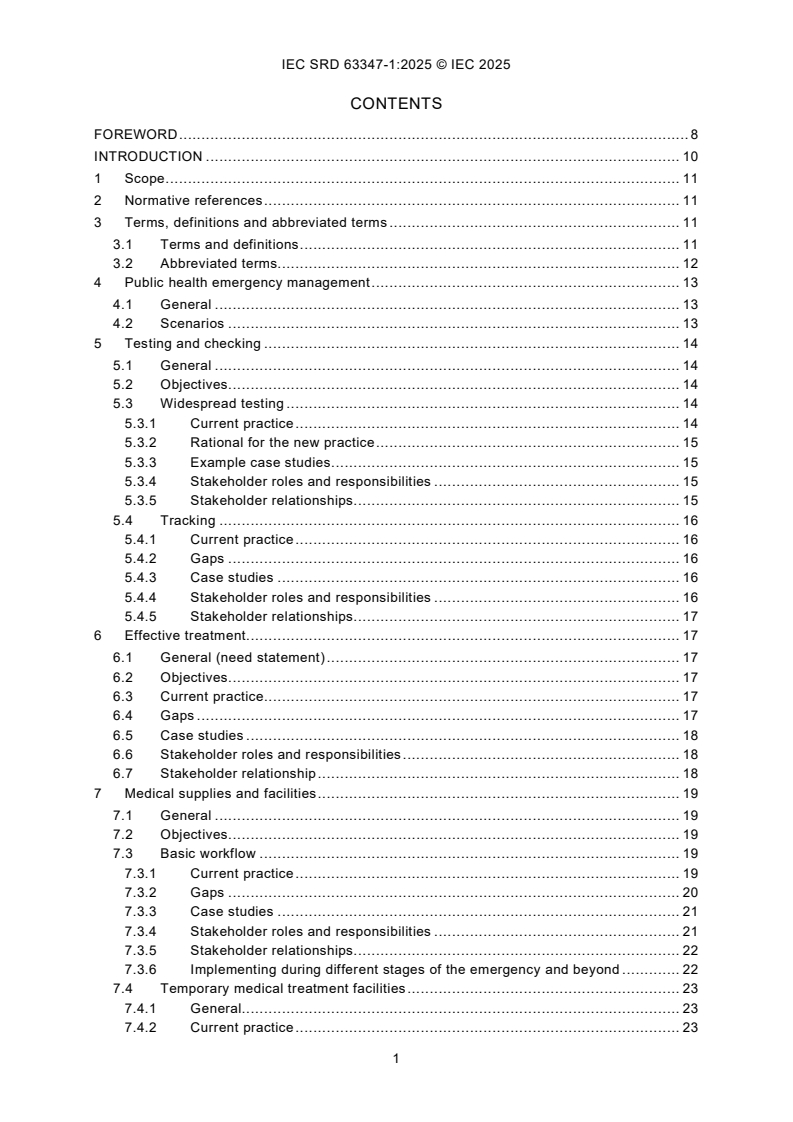
CONTENTS
FOREWORD . 8
INTRODUCTION . 10
1 Scope . 11
2 Normative references . 11
3 Terms, definitions and abbreviated terms . 11
3.1 Terms and definitions . 11
3.2 Abbreviated terms. 12
4 Public health emergency management . 13
4.1 General . 13
4.2 Scenarios . 13
5 Testing and checking . 14
5.1 General . 14
5.2 Objectives . 14
5.3 Widespread testing . 14
5.3.1 Current practice . 14
5.3.2 Rational for the new practice . 15
5.3.3 Example case studies . 15
5.3.4 Stakeholder roles and responsibilities . 15
5.3.5 Stakeholder relationships . 15
5.4 Tracking . 16
5.4.1 Current practice . 16
5.4.2 Gaps . 16
5.4.3 Case studies . 16
5.4.4 Stakeholder roles and responsibilities . 16
5.4.5 Stakeholder relationships . 17
6 Effective treatment . 17
6.1 General (need statement) . 17
6.2 Objectives . 17
6.3 Current practice . 17
6.4 Gaps . 17
6.5 Case studies . 18
6.6 Stakeholder roles and responsibilities . 18
6.7 Stakeholder relationship . 18
7 Medical supplies and facilities . 19
7.1 General . 19
7.2 Objectives . 19
7.3 Basic workflow . 19
7.3.1 Current practice . 19
7.3.2 Gaps . 20
7.3.3 Case studies . 21
7.3.4 Stakeholder roles and responsibilities . 21
7.3.5 Stakeholder relationships . 22
7.3.6 Implementing during different stages of the emergency and beyond . 22
7.4 Temporary medical treatment facilities . 23
7.4.1 General. 23
7.4.2 Current practice . 23
7.4.3 Gaps . 23
7.4.4 Example case studies . 24
7.4.5 Stakeholder roles and responsibilities . 24
7.4.6 Stakeholder relationships . 24
7.4.7 Implementing during different stages of the emergency and beyond . 25
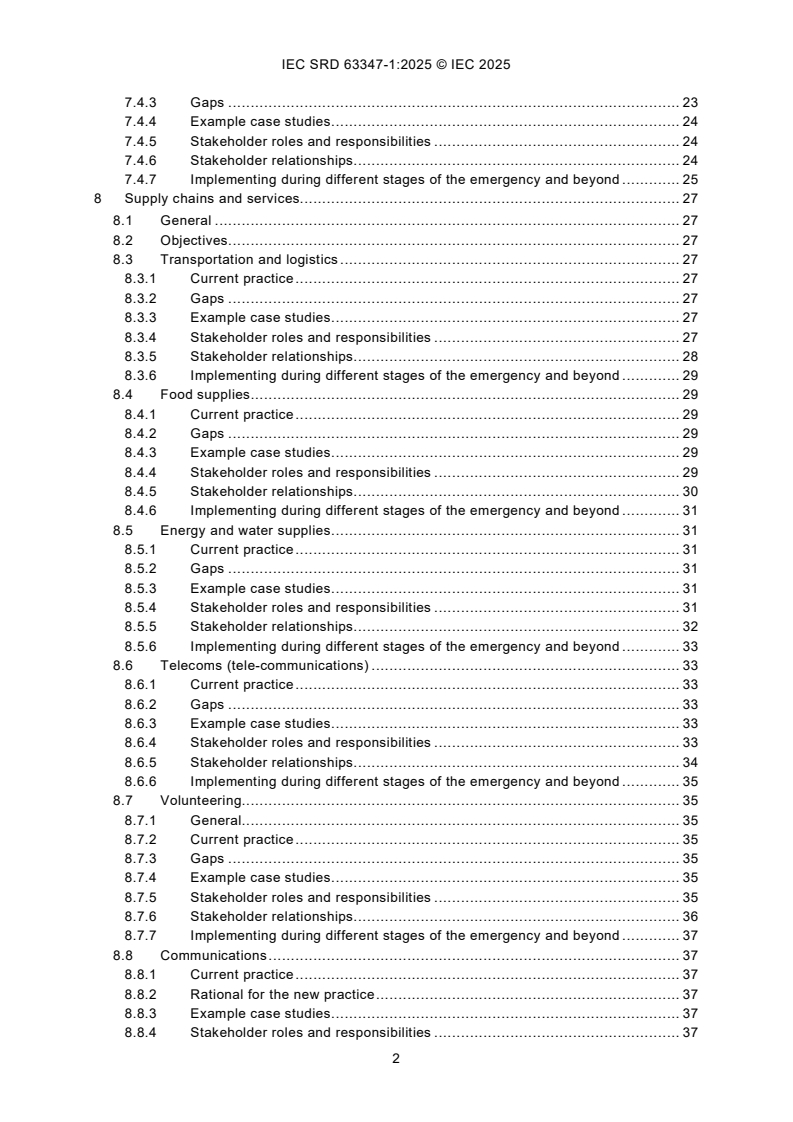
8 Supply chains and services. 27
8.1 General . 27
8.2 Objectives . 27
8.3 Transportation and logistics . 27
8.3.1 Current practice . 27
8.3.2 Gaps . 27
8.3.3 Example case studies . 27
8.3.4 Stakeholder roles and responsibilities . 27
8.3.5 Stakeholder relationships . 28
8.3.6 Implementing during different stages of the emergency and beyond . 29
8.4 Food supplies . 29
8.4.1 Current practice . 29
8.4.2 Gaps . 29
8.4.3 Example case studies . 29
8.4.4 Stakeholder roles and responsibilities . 29
8.4.5 Stakeholder relationships . 30
8.4.6 Implementing during different stages of the emergency and beyond . 31
8.5 Energy and water supplies . 31
8.5.1 Current practice . 31
8.5.2 Gaps . 31
8.5.3 Example case studies . 31
8.5.4 Stakeholder roles and responsibilities . 31
8.5.5 Stakeholder relationships . 32
8.5.6 Implementing during different stages of the emergency and beyond . 33
8.6 Telecoms (tele-communications) . 33
8.6.1 Current practice . 33
8.6.2 Gaps . 33
8.6.3 Example case studies . 33
8.6.4 Stakeholder roles and responsibilities . 33
8.6.5 Stakeholder relationships . 34
8.6.6 Implementing during different stages of the emergency and beyond . 35
8.7 Volunteering. 35
8.7.1 General. 35
8.7.2 Current practice . 35
8.7.3 Gaps . 35
8.7.4 Example case studies . 35
8.7.5 Stakeholder roles and responsibilities . 35
8.7.6 Stakeholder relationships . 36
8.7.7 Implementing during different stages of the emergency and beyond . 37
8.8 Communications . 37
8.8.1 Current practice . 37
8.8.2 Rational for the new practice . 37
8.8.3 Example case studies . 37
8.8.4 Stakeholder roles and responsibilities . 37
8.8.5 Stakeholder relationships . 38
8.8.6 Implementing during different stages of the emergency and beyond . 39
9 Digital supplies and technology support . 39
9.1 General . 39
9.2 Objectives . 39
9.3 Collecting and analysing data . 39
9.3.1 General. 39
9.3.2 Current practice . 39
9.3.3 Gaps . 40
9.3.4 Example case studies . 40
9.3.5 Stakeholder roles and responsibilities . 40
9.3.6 Stakeholder relationships . 41
9.3.7 Implementing during different stages of the emergency and beyond . 41
9.4 Developing models . 41
9.4.1 General. 41
9.4.2 Current practice . 41
9.4.3 Gaps . 42
9.4.4 Example case studies . 42
9.4.5 Stakeholder roles and responsibilities . 42
9.4.6 Stakeholder relationships . 43
9.4.7 Implementing during different stages of the emergency and beyond . 43
9.5 Acting in response to the data and the models . 43
9.5.1 General. 43
9.5.2 Current practice . 44
9.5.3 Gaps . 44
9.5.4 Example case studies . 44
9.5.5 Stakeholder roles and responsibilities Table 9-2. 44
9.5.6 Stakeholder relationships . 45
9.5.7 Implementing during different stages of the emergency and beyond . 46
9.6 Continuously optimize the models . 46
9.6.1 General. 46
9.6.2 Current practice . 46
9.6.3 Gaps . 46
9.6.4 Example case studies . 47
9.6.5 Stakeholder roles and responsibilities . 47
9.6.6 Stakeholder relationships . 47
9.6.7 Implementing during different stages of the emergency and beyond . 48
9.7 Data security and privacy protection . 48
9.7.1 General. 48
9.7.2 Current practice . 48
9.7.3 Gaps . 48
9.7.4 Example case studies . 49
9.7.5 Stakeholder roles and responsibilities . 49
9.7.6 Stakeholder relationships . 50
9.7.7 Implementing during different stages of the emergency and beyond . 51
10 Management platform . 51
10.1 General . 51
10.2 Objectives . 51
10.3 Digital platform . 51
10.3.1 General. 51
10.3.2 Current practice . 51
10.3.3 Gaps . 51
10.3.4 Example case studies . 52
10.3.5 Stakeholder roles and responsibilities . 52
10.3.6 Stakeholder relationships . 52
10.3.7 Implementing during different stages of the emergency and beyond . 52
10.4 Privacy between individual and community . 53
10.4.1 Current practice . 53
10.4.2 Gaps . 53
10.4.3 Example case studies . 53
10.4.4 Stakeholder roles and responsibilities . 53
10.4.5 Stakeholder relationships . 54
10.4.6 Implementing during different stages of the emergency and beyond . 55
10.5 Cost benefit analysis . 55
10.5.1 General. 55
10.5.2 Current practice . 55
10.5.3 Gaps . 55
10.5.4 Example case studies . 55
10.5.5 Stakeholder roles and responsibilities . 56
10.5.6 Stakeholder relationships . 56
10.5.7 Implementing during different stages of the emergency and beyond . 57
10.6 Budgets . 57
10.6.1 Current practice . 57
10.6.2 Gaps . 57
10.6.3 Example case studies . 58
10.6.4 Stakeholder roles and responsibilities . 58
10.6.5 Stakeholder relationships . 58
10.6.6 Implementing during different stages of the emergency and beyond . 59
11 Finances plans . 59
11.1 General . 59
11.2 Objectives . 59
11.3 Basic finances for citizens . 60
11.3.1 Current practice . 60
11.3.2 Gaps . 60
11.3.3 Example case studies . 60
11.3.4 Stakeholder roles and responsibilities . 60
11.3.5 Stakeholder relationships . 61
11.3.6 Implementing during different stages of the emergency and beyond . 62
11.4 Basic finances for enterprises . 62
11.4.1 Current practice . 62
11.4.2 Gaps . 62
11.4.3 Example case studies . 62
11.4.4 Stakeholder roles and responsibilities . 62
11.4.5 Stakeholder relationships . 63
11.4.6 Implementing during different stages of the emergency and beyond . 63
11.5 Banking services . 64
11.5.1 Current practice . 64
11.5.2 Gaps . 64
11.5.3 Example case studies . 64
11.5.4 Stakeholder roles and responsibilities . 64
11.5.5 Stakeholder relationships . 65
11.5.6 Implementing during different stages of the emergency and beyond . 65
12 Maintaining normal life . 65
12.1 General . 65
12.2 Objectives . 66
12.3 Online life . 66
12.3.1 General. 66
12.3.2 Current practice . 66
12.3.3 Rational for the new practice . 66
12.3.4 Example case studies . 66
12.3.5 Stakeholder roles and responsibilities . 66
12.3.6 Stakeholder relationships . 67
12.3.7 Implementing during different stages of the emergency and beyond . 68
12.4 Remote and home working . 68
12.4.1 General. 68
12.4.2 Current practice . 68
12.4.3 Gaps . 68
12.4.4 Example case studies . 68
12.4.5 Stakeholder roles and responsibilities . 68
12.4.6 Stakeholder relationships . 69
12.4.7 Implementing during different stages of the emergency and beyond . 70
12.5 Exercise and entertainment . 70
12.5.1 General. 70
12.5.2 Current practice . 70
12.5.3 Gaps . 70
12.5.4 Example case studies . 70
12.5.5 Stakeholder roles and responsibilities . 70
12.5.6 Stakeholder relationships . 71
12.5.7 Implementing during different stages of the emergency and beyond . 72
13 City collaboration . 72
13.1 General . 72
13.2 Objectives . 72
13.3 Learning from what is working elsewhere (see Table 13-1) . 72
13.3.1 Current practice . 72
13.3.2 Gaps . 72
13.3.3 Example case studies . 73
13.3.4 Stakeholder roles and responsibilities . 73
13.3.5 Stakeholder relationships . 74
13.3.6 Implementing during different stages of the emergency and beyond . 74
13.4 Sharing between cities (see Table 13-2) . 74
13.4.1 Current practice . 74
13.4.2 Gaps . 74
13.4.3 Example case studies . 75
13.4.4 Stakeholder roles and responsibilities . 75
13.4.5 Stakeholder relationships . 75
13.4.6 Implementing during different stages of the emergency and beyond . 76
13.5 Working with local companies and organizations (see Table 13-3) . 76
13.5.1 Current practice . 76
13.5.2 Gaps . 76
13.5.3 Example case studies . 76
13.5.4 Stakeholder roles and responsibilities . 76
13.5.5 Stakeholder relationships . 77
13.5.6 Implementing during different stages of the emergency and beyond . 78
Annex A (informative) Use case database collection and descriptions . 79
Bibliography . 81
Figure 4-1 – The structure of public health emergency management . 13
Figure 5-1 – Stakeholder relationship for widespread testing . 15
Figure 5-2 – Stakeholder relationship for PHE tracking . 17
Figure 6-1 – stakeholder relationship for effective treatment . 18
Figure 7-1 – Information management platform of emergency medical supplies and
facilities . 20
Figure 7-2 – The relationships of all stakeholders of the basic workflow . 22
Figure 7-3 – The relationships of all stakeholders of temporary medical facilities . 25
Figure 8-1 – Relationship between transportation logistics supply chain and service
stakeholders . 28
Figure 8-2 – Stakeholder relationships . 28
Figure 8-3 – Relationship between food supply chain and service stakeholders . 30
Figure 8-4 – Stakeholder relationships . 30
Figure 8-5 – Relationship between energy and water . 32
Figure 8-6 – Stakeholder relationships . 32
Figure 8-7 – Relationship Telecoms . 34
Figure 8-8 – Stakeholder relationships . 34
Figure 8-9 – Relationship Volunteering . 36
Figure 8-10 – Stakeholder relationships . 36
Figure 8-11 – Relationship Communications . 38
Figure 8-12 – Stakeholder relationships . 38
Figure 9-1 – Stakeholder relationships for collecting and analysing data . 41
Figure 9-2 – Stakeholder relationships for developing models . 43
Figure 9-3 – Stakeholder relationships for acting in response to the data and the
models . 46
Figure 9-4 – Stakeholder relationships for continuously optimize the models . 48
Figure 9-5 – Stakeholder relationships for data security and privacy protection . 50
Figure 10-1 – Relationship Digital public health emergency platform . 52
Figure 10-2 – Stakeholder relationships . 55
Figure 10-3 – Relationship between cost benefit analysis and modelling . 56
Figure 10-4 – Stakeholder relationships . 57
Figure 10-5 – Relationship Managing overall budgets. 58
Figure 10-6 – Stakeholder relationships . 59
Figure 11-1 – The relationships of all stakeholders of basic financial plan for citizens . 61
Figure 11-2 – The relationships of all stakeholders of finances for enterprises . 63
Figure 11-3 – The relationships of all stakeholders of banking services . 65
Figure 12-1 – Relationship Online life . 67
Figure 12-2 – Stakeholder relationships . 67
Figure 12-3 – Relationship between remote and home working . 69
Figure 12-4 – Stakeholder relationships . 69
Figure 12-5 – Relationship between exercise and entertainment . 71
Figure 12-6 – Stakeholder relationships . 71
Figure 13-1 – The relationships of stakeholders in the scenario of learning from what is
working elsewhere . 74
Figure 13-2 – The relationships of stakeholders in the scenario of city-to-city sharing . 76
Figure 13-3 – The relationships of stakeholders in the scenario of working with local
companies and organizations. 77
Table 7-1 – Requirements and needs about the workflow for the demand of medical
supplies and facilities in different stages . 23
Table 7-2 – Requirements and needs of temporary medical facilities in different stages . 25
Table 9-1 – Stakeholder roles and responsibilities for developing roles . 43
Table 9-2 – Stakeholder roles and responsibilities in acting in response to data and
models . 45
Table 9-3 – Stakeholder roles and responsibilities in continuously optimizing models . 47
Table 9-4 – Stakeholder roles and responsibilities in Data security and privacy
protection . 50
Table 10-1 – Stakeholder roles and responsibilities in Privacy between individual and
community . 54
Table 11-1 – Stakeholder roles and responsibilities of basic financial plan for citizens . 61
Table 11-2 – Stakeholder roles and responsibilities of basic finances for enterprises . 63
Table 11-3 – Stakeholder roles and responsibilities of working with banks . 65
Table 13-1 – Stakeholder roles and responsibilities in 13.3 Learning from what is
working elsewhere . 73
Table 13-2 – Stakeholder roles and responsibilities in 13.4 Sharing between cities . 75
Table 13-3 – Stakeholder roles and responsibilities in 13.5 Working with local
companies and organizations. 77
INTERNATIONAL ELECTROTECHNICAL COMMISSION
____________
Smart city use case collection and analysis –
Managing public health emergencies in smart cities -
Part 1: High level analysis
FOREWORD
1) The International Electrotechnical Commission (IEC) is a worldwide organization for standardization comprising
all national electrotechnical committees (IEC National Committees). The object of IEC is to promote international
co-operation on all questions concerning standardization in the electrical and electronic fields. To this end and
in addition to other activities, IEC publishes International Standards, Technical Specifications, Technical Reports,
Publicly Available Specifications (PAS) and Guides (hereafter referred to as “IEC Publication(s)”). Their
preparation is entrusted to technical committees; any IEC National Committee interested in the subject dealt with
may participate in this preparatory work. International, governmental and non-governmental organizations liaising
with the IEC also participate in this preparation. IEC collaborates closely with the International Organization for
Standardization (ISO) in accordance with conditions determined by agreement between the two organizations.
2) The formal decisions or agreements of IEC on technical matters express, as nearly as possible, an international
consensus of opinion on the relevant subjects since each technical committee has representation from all
interested IEC National Committees.
3) IEC Publications have the form of recommendations for international use and are accepted by IEC National
Committees in that sense. While all reasonable efforts are made to ensure that the technical content of IEC
Publications is accurate, IEC cannot be held responsible for the way in which they are used or for any
misinterpretation by any end user.
4) In order to promote international uniformity, IEC National Committees undertake to apply IEC Publications
transparently to the maximum extent possible in their national and regional publications. Any divergence between
any IEC Publication and the corresponding national or regional publication shall be clearly indicated in the latter.
5) IEC itself does not provide any attestation of conformity. Independent certification bodies provide conformity
assessment services and, in some areas, access to IEC marks of conformity. IEC is not responsible for any
services carried out by independent certification bodies.
6) All users should ensure that they have the latest edition of this publication.
7) No liability shall attach to IEC or its directors, employees, servants or agents including individual experts and
members of its technical committees and IEC National Committees for any personal injury, property damage or
other damage of any nature whatsoever, whether direct or indirect, or for costs (including legal fees) and
expenses arising out of the publication, use of, or reliance upon, this IEC Publication or any other IEC
Publications.
8) Attention is drawn to the Normative references cited in this publication. Use of the referenced publications is
indispensable for the correct application of this publication.
9) IEC draws attention to the possibility that the implementation of this document may involve the use of (a)
patent(s). IEC takes no position concerning the evidence, validity or applicability of any claimed patent rights in
respect thereof. As of the date of publication of this document, IEC had not received notice of (a) patent(s), which
may be required to implement this document. However, implementers are cautioned that this may not represent
the latest information, which may be obtained from the patent database available at https://patents.iec.ch. IEC
shall not be held responsible for identifying any or all such patent rights.
IEC SRD 63347-1 has been prepared by IEC systems committee Smart Cities: Electrotechnical
aspects of smart cities. It is a Systems Reference Deliverable.
The text of this Systems Reference Deliverable is based on the following documents:
Draft Report on voting
SyCSmartCities/378/DTS SyCSmartCities/389/RVDTS
Full information on the voting for its approval can be found in the report on voting indicated in
the above table.
The language used for the development of this Systems Reference Deliverable is English.
This document was drafted in accordance with ISO/IEC Directives, Part 2, and developed in
accordance with ISO/IEC Directives, Part 1 and ISO/IEC Directives, IEC Supplement, available
at www.iec.ch/members_experts/refdocs. The main document types developed by IEC are
described in greater detail at www.iec.ch/publications.
A list of all parts in the IEC 63347 series, published under the general title Smart city use case
collection and analysis – Managing public health emergencies in smart cities, can be found on
the IEC website.
The committee has decided that the contents of this document will remain unchanged until the
stability date indicated on the IEC website under webstore.iec.ch in the data related to the
specific document. At this date, the document will be
– reconfirmed,
– withdrawn, or
– revised.
INTRODUCTION
Smart cities are a key trend of urban development in the new information age, and an effective
way to ensure that cities are built and managed in a way that best supports the needs of their
residents. The major international standardization organizations are vigorously promoting the
research and development of standards. However, the Covid 19 pandemic has demonstrated
that there are few relevant international standards that provide guidance for the smart city to
respond to public health emergencies, as well as a lack of unified understanding and systematic
review, and clear direction for the development of such standards, which affects the
development and application of international standards for smart city public health emergency
(PHE).
In response to the above issues, this document: "Use case collection and analysis –
Management of public health emergencies in smart cities" has been developed to collect
relevant use cases in important scenarios of smart city management under public
...