

IEC 61400-1:2019/AMD1:2025
(Amendment)Amendment 1 - Wind energy generation systems - Part 1: Design requirements
General Information
- Abstract
- Status
- Published
- Publication Date
- 17-Dec-2025
- Technical Committee
- TC 88 - Wind energy generation systems
- Drafting Committee
- MT 1 - TC 88/MT 1
- Current Stage
- PPUB - Publication issued
- Start Date
- 18-Dec-2025
- Completion Date
- 28-Nov-2025
Buy Documents
IEC 61400-1:2019/AMD1:2025 - Amendment 1 - Wind energy generation systems - Part 1: Design requirements Released:12/18/2025
IEC 61400-1:2019/AMD1:2025 - Amendement 1 - Systemes de génération d'énergie éolienne - Partie 1: Exigences de conception Released:12/18/2025
IEC 61400-1:2019/AMD1:2025 - Amendment 1 - Wind energy generation systems - Part 1: Design requirements Released:12/18/2025
Overview - IEC 61400-1:2019/AMD1:2025 (Amendment 1)
IEC 61400-1:2019/AMD1:2025 is an amendment to the international standard for wind energy generation systems - Part 1: Design requirements. Published by IEC TC 88, this Amendment updates definitions, load models, safety factors and verification procedures used to design and assess onshore and related wind turbines. Key changes include new terminology (e.g., damage equivalent load, reference loads), updated turbulence and extreme wind models (including a Weibull-based Normal Turbulence Model, NTM), and revised guidance on serviceability limit states (SLS) and partial safety factors.
Key topics and technical requirements
- Definitions & symbols: Adds important terms (damage equivalent load / DEL, reference loads, serviceability, S1/S2/S3) and the flow inclination symbol φ (flow inclination assumed up to 8°).
- Wind models: Updates to Normal Turbulence Model (NTM) with Weibull distribution options and explicit reference to NTM90 (90% quantile); clarifies extreme wind speed return periods (1‑year and 50‑year).
- Serviceability limit states: Introduces S1, S2, S3 load levels and prescribes how SLS analyses relate to ultimate and fatigue load simulations; sets load partial safety factor γf = 1.0 for SLS.
- Partial safety factors: Revises application of material and resistance partial factors, aligns use with recognized design codes and adds rules for consequence-of-failure factor for component class 3 (safe-life components).
- Fatigue and load comparison: Defines DEL use and introduces a simplified evaluation route - limit state through load comparison against reference loads. Tolerances for acceptable exceedance: up to 5% for extreme loads and 3% for fatigue loads before full verification is required.
- Scope clarifications: Changes normative references to IEC 61400-3-1 (offshore) and IEC 61400-6 (tower & foundation).
Applications and who uses it
This Amendment is essential for:
- Wind turbine designers and structural engineers - for design verification, fatigue and ultimate strength analyses.
- Certification bodies and conformity assessors - for updated verification rules and partial factor applications.
- Asset owners, OEMs and consultants - to evaluate design changes, controller updates or site reassessments using the load comparison method.
- Foundation and tower specialists - due to links with IEC 61400-6 and changed load extraction points for assessment.
Practical uses include site assessment, turbine component redesign checks, fatigue life calculations using DELs, and assessing serviceability under frequent operational loads.
Related standards
- IEC 61400-1:2019 (base standard)
- IEC 61400-3-1 (design requirements for offshore wind turbines)
- IEC 61400-6 (tower and foundation design requirements)
Keywords: IEC 61400-1:2019/AMD1:2025, wind energy generation systems, design requirements, damage equivalent load, NTM, NTM90, serviceability limit state, DEL, partial safety factors, reference loads, load comparison.
Relations
- Effective Date
- 05-Sep-2023
Buy Documents
IEC 61400-1:2019/AMD1:2025 - Amendment 1 - Wind energy generation systems - Part 1: Design requirements Released:12/18/2025
IEC 61400-1:2019/AMD1:2025 - Amendement 1 - Systemes de génération d'énergie éolienne - Partie 1: Exigences de conception Released:12/18/2025
IEC 61400-1:2019/AMD1:2025 - Amendment 1 - Wind energy generation systems - Part 1: Design requirements Released:12/18/2025
Get Certified
Connect with accredited certification bodies for this standard

DNV
DNV is an independent assurance and risk management provider.

Lloyd's Register
Lloyd's Register is a global professional services organisation specialising in engineering and technology.
DNV Energy Systems
Energy and renewable energy certification.
Sponsored listings
Frequently Asked Questions
IEC 61400-1:2019/AMD1:2025 is a standard published by the International Electrotechnical Commission (IEC). Its full title is "Amendment 1 - Wind energy generation systems - Part 1: Design requirements". This standard covers: Amendment 1 - Wind energy generation systems - Part 1: Design requirements
Amendment 1 - Wind energy generation systems - Part 1: Design requirements
IEC 61400-1:2019/AMD1:2025 is classified under the following ICS (International Classification for Standards) categories: 27.180 - Wind turbine energy systems. The ICS classification helps identify the subject area and facilitates finding related standards.
IEC 61400-1:2019/AMD1:2025 has the following relationships with other standards: It is inter standard links to IEC 61400-1:2019. Understanding these relationships helps ensure you are using the most current and applicable version of the standard.
IEC 61400-1:2019/AMD1:2025 is available in PDF format for immediate download after purchase. The document can be added to your cart and obtained through the secure checkout process. Digital delivery ensures instant access to the complete standard document.
Standards Content (Sample)
IEC 61400-1 ®
Edition 4.0 2025-12
INTERNATIONAL
STANDARD
AMENDMENT 1
Wind energy generation systems -
Part 1: Design requirements
ICS 27.180 ISBN 978-2-8327-0831-6
IEC 61400-1:2019-02/AMD1:2025-12(en)
All rights reserved. Unless otherwise specified, no part of this publication may be reproduced or utilized in any form or
by any means, electronic or mechanical, including photocopying and microfilm, without permission in writing from either
IEC or IEC's member National Committee in the country of the requester. If you have any questions about IEC copyright
or have an enquiry about obtaining additional rights to this publication, please contact the address below or your local
IEC member National Committee for further information.
IEC Secretariat Tel.: +41 22 919 02 11
3, rue de Varembé info@iec.ch
CH-1211 Geneva 20 www.iec.ch
Switzerland
About the IEC
The International Electrotechnical Commission (IEC) is the leading global organization that prepares and publishes
International Standards for all electrical, electronic and related technologies.
About IEC publications
The technical content of IEC publications is kept under constant review by the IEC. Please make sure that you have the
latest edition, a corrigendum or an amendment might have been published.
IEC publications search - IEC Products & Services Portal - products.iec.ch
webstore.iec.ch/advsearchform Discover our powerful search engine and read freely all the
The advanced search enables to find IEC publications by a publications previews, graphical symbols and the glossary.
variety of criteria (reference number, text, technical With a subscription you will always have access to up to date
committee, …). It also gives information on projects, content tailored to your needs.
replaced and withdrawn publications.
Electropedia - www.electropedia.org
The world's leading online dictionary on electrotechnology,
IEC Just Published - webstore.iec.ch/justpublished
Stay up to date on all new IEC publications. Just Published containing more than 22 500 terminological entries in English
details all new publications released. Available online and and French, with equivalent terms in 25 additional languages.
once a month by email. Also known as the International Electrotechnical Vocabulary
(IEV) online.
IEC Customer Service Centre - webstore.iec.ch/csc
If you wish to give us your feedback on this publication or
need further assistance, please contact the Customer
Service Centre: sales@iec.ch.
INTERNATIONAL ELECTROTECHNICAL COMMISSION
____________
Wind energy generation systems -
Part 1: Design requirements
AMENDMENT 1
FOREWORD
1) The International Electrotechnical Commission (IEC) is a worldwide organization for standardization comprising
all national electrotechnical committees (IEC National Committees). The object of IEC is to promote international
co-operation on all questions concerning standardization in the electrical and electronic fields. To this end and
in addition to other activities, IEC publishes International Standards, Technical Specifications, Technical Reports,
Publicly Available Specifications (PAS) and Guides (hereafter referred to as "IEC Publication(s)"). Their
preparation is entrusted to technical committees; any IEC National Committee interested in the subject dealt with
may participate in this preparatory work. International, governmental and non-governmental organizations liaising
with the IEC also participate in this preparation. IEC collaborates closely with the International Organization for
Standardization (ISO) in accordance with conditions determined by agreement between the two organizations.
2) The formal decisions or agreements of IEC on technical matters express, as nearly as possible, an international
consensus of opinion on the relevant subjects since each technical committee has representation from all
interested IEC National Committees.
3) IEC Publications have the form of recommendations for international use and are accepted by IEC National
Committees in that sense. While all reasonable efforts are made to ensure that the technical content of IEC
Publications is accurate, IEC cannot be held responsible for the way in which they are used or for any
misinterpretation by any end user.
4) In order to promote international uniformity, IEC National Committees undertake to apply IEC Publications
transparently to the maximum extent possible in their national and regional publications. Any divergence between
any IEC Publication and the corresponding national or regional publication shall be clearly indicated in the latter.
5) IEC itself does not provide any attestation of conformity. Independent certification bodies provide conformity
assessment services and, in some areas, access to IEC marks of conformity. IEC is not responsible for any
services carried out by independent certification bodies.
6) All users should ensure that they have the latest edition of this publication.
7) No liability shall attach to IEC or its directors, employees, servants or agents including individual experts and
members of its technical committees and IEC National Committees for any personal injury, property damage or
other damage of any nature whatsoever, whether direct or indirect, or for costs (including legal fees) and
expenses arising out of the publication, use of, or reliance upon, this IEC Publication or any other IEC
Publications.
8) Attention is drawn to the Normative references cited in this publication. Use of the referenced publications is
indispensable for the correct application of this publication.
9) IEC draws attention to the possibility that the implementation of this document may involve the use of (a)
patent(s). IEC takes no position concerning the evidence, validity or applicability of any claimed patent rights in
respect thereof. As of the date of publication of this document, IEC had not received notice of (a) patent(s), which
may be required to implement this document. However, implementers are cautioned that this may not represent
the latest information, which may be obtained from the patent database available at https://patents.iec.ch. IEC
shall not be held responsible for identifying any or all such patent rights.
Amendment 1 to IEC 61400-1:2019 has been prepared by IEC technical committee 88: Wind
energy generation systems.
The text of this Amendment is based on the following documents:
Draft Report on voting
88/1109/FDIS 88/1133/RVD
Full information on the voting for its approval can be found in the report on voting indicated in
the above table.
The language used for the development of this Amendment is English.
This document was drafted in accordance with ISO/IEC Directives, Part 2, and developed in
accordance with ISO/IEC Directives, Part 1 and ISO/IEC Directives, IEC Supplement, available
at www.iec.ch/members_experts/refdocs. The main document types developed by IEC are
described in greater detail at www.iec.ch/publications/.
The committee has decided that the contents of this document will remain unchanged until the
stability date indicated on the IEC website under webstore.iec.ch in the data related to the
specific document. At this date, the document will be
– reconfirmed,
– withdrawn, or
– revised.
___________
2 Normative references
Delete:
IEC 61400-3, Wind energy generation systems - Part 3: Design requirements for offshore wind
turbines
Add the following new references:
IEC 61400-3-1, Wind energy generation systems - Part 3-1: Design requirements for offshore
wind turbines
IEC 61400-6, Wind energy generation systems - Part 6: Tower and foundation design
requirements
3 Terms and definitions
Add, after 3.77, the following new definitions:
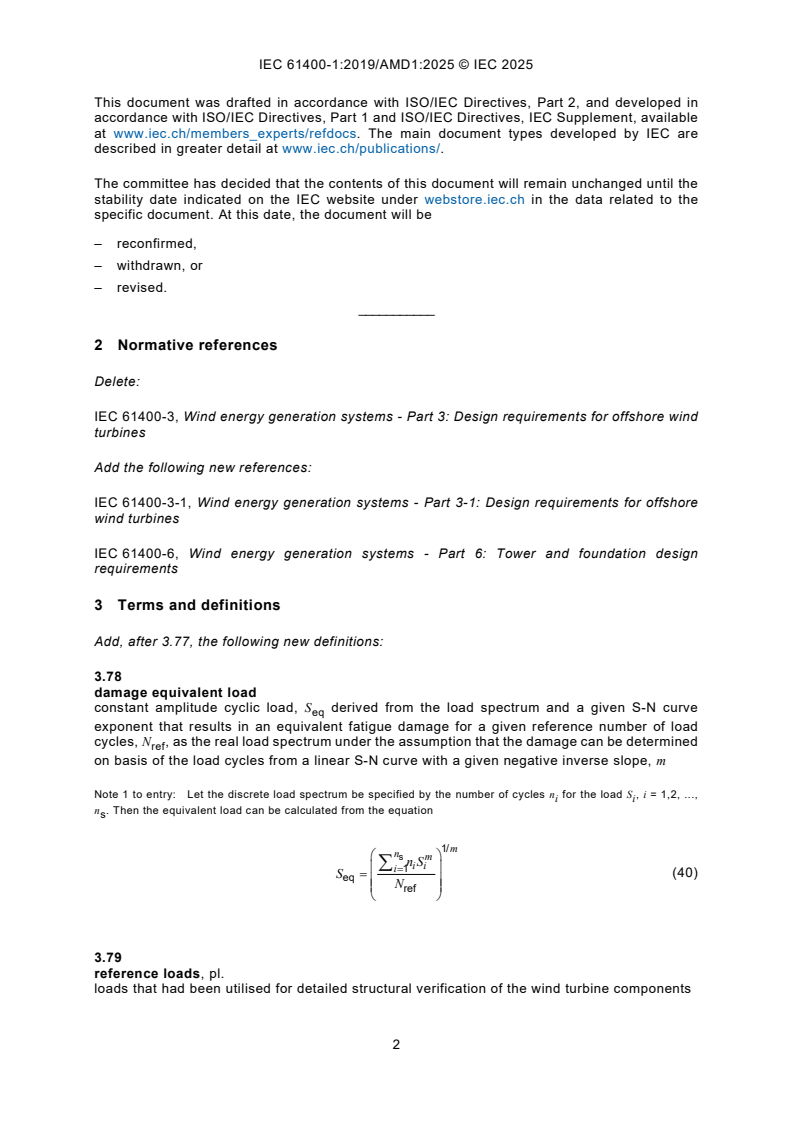
3.78
damage equivalent load
constant amplitude cyclic load, S derived from the load spectrum and a given S-N curve
eq
exponent that results in an equivalent fatigue damage for a given reference number of load
cycles, N , as the real load spectrum under the assumption that the damage can be determined
ref
on basis of the load cycles from a linear S-N curve with a given negative inverse slope, m
Note 1 to entry: Let the discrete load spectrum be specified by the number of cycles n for the load S , i = 1,2, .,
i i
n . Then the equivalent load can be calculated from the equation
s
1/m
n
s m
nS
∑ ii
i=1
S = (40)
eq
N
ref
3.79
reference loads, pl.
loads that had been utilised for detailed structural verification of the wind turbine components
3.80
serviceability
ability of a structure or structural element to perform adequately for normal use under all
expected actions
3.81
serviceability limit state
state which corresponds to conditions beyond which specified service requirements for a
structure or structural element are no longer met
3.82
S1
serviceability limit state load level for design lifetime actions, which relate to continued correct
operation of the wind turbine
3.83
S2
-4
serviceability limit state load level for frequent actions, which are exceeded for 10 of the
lifetime
3.84
S3
serviceability limit state load level for the equivalent to frequent actions, which are exceeded
-2
for 10 of the lifetime
4 Symbols and abbreviated terms
4.1 Symbols
Add the following symbol to the list:
φ angle between a horizontal plane and the wind velocity vector at hub height. The flow
inclination angle is positive if the wind velocity vector is pointing upwards.
4.2 Abbreviated terms
Add the following abbreviated terms to the list:
EM electromagnetic
EMC electromagnetic compatibility
LDD load duration distribution
LRD load revolution distribution
NTM90 normal turbulence model, 90 % percentile value of distribution
6.2 Wind turbine class
Replace the second paragraph with the following new text:
Class T assumes all wind model parameters to be the same and allows the combination of V
ref,T
with all turbulence categories. It does not cover all the areas prone to tropical cyclones. The
evaluation of the 1-year return period extreme wind speed should be done independently of the
50-year return period extreme wind speed. A site assessment based on Clause 11 is needed,
as a minimum assessing that V is below V of class T ( V ), and that V is below the value
50 ref ref,T 1
of the chosen class I, II or III.
6.3 Wind conditions
6.3.1 General
Replace the third and fourth paragraphs with the following new text:
The wind regime for load and safety considerations is divided into the normal wind conditions,
which will occur frequently during normal operation of a wind turbine, and the extreme wind
conditions that are defined as having a 1-year or 50-year return period .
The wind conditions include a constant mean flow combined, in many cases, with either a
varying deterministic gust profile or with turbulence. In all cases, an upwards inclination of the
mean flow with respect to a horizontal plane of 8° shall be considered. This flow inclination
angle shall be assumed to be invariant with height.
6.3.2.3 Normal turbulence model (NTM)
Replace the first paragraph, including Equation (10), with the following new text and equations:
For the normal turbulence model, the turbulence standard deviation, σ , shall be defined for the
standard wind turbine classes based on the Weibull distribution in Equation (41) for the given
hub height wind speed.
The Weibull distribution for σ shall either be applied as a distribution with scale and shape
parameters as in Equation (43) or by the 90 % quantile value in Equation (44) :
k
σ
P (σσ<=) 1− exp−
(41)
W 10
C
where
kV0,27 s/m+1,4
( ) (42)
hub
CI 0,75V+ 3,3 m / s
( ) (43)
ref hub
σI 0,75V+b b 5,6 m / s
( ) (44)
1 ref hub
6.3.3.2 Extreme wind speed model (EWM)
Add, after the third paragraph, the following new text:
For site guidance 11.9.3 shall be used instead of Equation (13).
___________
The return period of the extreme event is independent of the design lifetime of the turbine as the largest value
for the normal failure probability is given for a single year (see Annex K, Clause K.2).
The choice of NTM model affects the level of reliability against fatigue failure. Using the Weibull distribution is
more robust for inclusion of non-linear effects, but the resulting fatigue loads have no bias and therefore result
in a lower reliability level in most cases compared to using the 90 % quantile value.
= =
=
=
Replace footnote 3 with the following:
The turbulence standard deviation for the turbulent extreme wind model is not related to the normal (NTM) or the
extreme turbulence model (ETM).
7.4.1 General
Add, after the fifth paragraph, the following new text:
Serviceability limit states (SLS) consider the function of the structure or one of its components
under normal service conditions or the appearance of the structure.
Serviceability limit states should be verified with serviceability load levels S1, S2 or S3 as
required in the relevant IEC 61400 standard or technical specification.
For serviceability limit state analyses, S1 is derived from load simulations from the ultimate limit
states classified as N (normal) and for S2 and S3 the same load simulations are used as those
used as basis for the fatigue limit state. The partial safety factor for loads shall be:
γ = 1,0
f (45)
Table 2 – Design load cases (DLC)
Add the following to the key to the table:
"F/U" Fatigue as well as ultimate loads including the relevant safety factors */N or */A.
7.4.7 Parked (standstill or idling) (DLC 6.1 to 6.4)
Delete the fifth paragraph starting with "The partial safety factors for loads".
7.6.1.3 Partial safety factor for consequence of failure and component classes
Delete in the first paragraph, item a), "structural" between "fail-safe" and "components" and
add, after "for example"," secondary components and".
Delete, in the first paragraph, item b), "structural" between "safe-life" and "components".
Replace, in the first paragraph, item c), the first sentence with the following new text:
c) component class 3: used for "safe-life" components whose failure can lead to human
injuries, e.g. mechanical components that link actuators and brakes to main structural
components for the purpose of implementing non-redundant wind turbine protection
functions.
Add, before the last paragraph, the following new text:
For component class 3, if the characteristic value of the load response F due to gravity
gravity
can be calculated for the design situation in question, and gravity is an unfavourable load, the
consequences of the failure factor for combined loading from gravity and other sources can
have the value
(46)
γζ1,1+ 0,1
n
F
gravity
1−≤for FF
gravity k
F
ζ= k
(47)
0 for FF>
gravity k
where
F is the characteristic load.
k
7.6.2.2 Partial safety factors for loads
Add, after the fourth paragraph starting with "For load cases", the following new text:
When the NTM is represented by a statistical distribution (Equations (41), (42) and (43)), the
characteristic value of the load shall correspond to the same return period of the load as
obtained using the 90 % quantile value NTM90 (Equation (44)) except for DLC 1.1.
7.6.2.4 Partial safety factors for resistances where recognized design codes are not
available
Replace the text of footnote 17 with "Void".
7.6.2.5 Partial safety factors for materials where recognized design codes are available
Replace the existing text with the following new text:
Partial safety factors for resistance, γ , shall be applied as given in the recognized design
M
codes, see 7.6.1.4. Alternatively, 7.6.2.4 can be used. The partial safety factors for the
consequences of failure, γ , shall be applied additionally as specified in 7.6.1.3.
n
7.6.3.4 Partial material factors where recognized design codes are available
Replace the existing text with the following new text:
Partial safety factors for resistance, γ , shall be applied as given in the recognized design
M
codes, see 7.6.1.4. The partial safety factors for the consequences of failure, γ , shall be applied
n
additionally as specified in 7.6.1.3. Alternatively, the provisions from 7.6.3.3 can be used.
Add, after 7.6.6, the following new subclause 7.6.7:
=
7.6.7 Evaluation of limit state through load comparison
7.6.7.1 General
As a simplified approach, ultimate limit state analysis can be evaluated through a load
comparison with a previously analysed design case. The reference loads shall always serve as
the reference for a load comparison.
This comparison can be used to assess the suitability of an existing structural design for
changed environmental conditions (as per 11.10) or for minor changes in turbine design (e.g.
controller updates or modification in some other turbine components, e.g. tower). In case of a
change of a major component, the rest of the structure can be assessed based on a load
comparison.
The following shall be considered as long as no component specific standards within the
IEC 61400 series specifies otherwise.
For extreme loading, a comparison of contemporaneous loads is not required. All mandatory
load cases shall be considered. The sign of the extreme load shall be considered when relevant.
For fatigue loading, the comparison can be based on DELs. The slope of the S-N curve shall
be in alignment with the design analyses of each component.
The effect of mean loads shall be included if relevant.
An exceedance of up to 5 % in extreme loads and 3 % in fatigue loads compared to the
reference loads is acceptable. In case of exceedances above the given tolerances, a
structural verification shall be done including all relevant load channels for the specific
component.
7.6.7.2 Rotor blade
The comparison shall include a subset of blade sections and load directions representative for
the design.
If there is no relevant data/information available, at least the blade sections blade root,
maximum chord or one quarter of the blade length from blade root, blade mid and outer third of
the blade length and blade flanges should be considered.
7.6.7.3 Machinery structures and drive train components
For fatigue loading, equivalent loads calculated from the LDD or LRD shall be considered
additionally for rotating components like gearboxes, bearings, pitch and yaw systems.
7.6.7.4 Tower and foundation
The comparison shall include loads extracted at representative locations of the tower sections,
at least the tower top, tower bottom and if applicable at tower sections which show a significant
change in structural properties (e.g. transition sections in hybrid towers).
___________
If the mean load has a substantial contribution to the fatigue damage and it is driven by the wind speed, and if
the mean wind distribution differs significantly from the design conditions, then it is relevant to consider the effect.
Especially bolted flange connections can be critical.
The impact of these tolerances on the COV’s for loads and the probability of failure is negligible. In case of safety
factor calibrati
...
IEC 61400-1 ®
Edition 4.0 2025-12
NORME
INTERNATIONALE
AMENDEMENT 1
Systèmes de génération d'énergie éolienne -
Partie 1: Exigences de conception
ICS 27.180 ISBN 978-2-8327-0831-6
IEC 61400-1:2019-02/AMD1:2025-12(fr)
Droits de reproduction réservés. Sauf indication contraire, aucune partie de cette publication ne peut être reproduite ni
utilisée sous quelque forme que ce soit et par aucun procédé, électronique ou mécanique, y compris la photocopie et
les microfilms, sans l'accord écrit de l'IEC ou du Comité national de l'IEC du pays du demandeur. Si vous avez des
questions sur le copyright de l'IEC ou si vous désirez obtenir des droits supplémentaires sur cette publication, utilisez
les coordonnées ci-après ou contactez le Comité national de l'IEC de votre pays de résidence.
IEC Secretariat Tel.: +41 22 919 02 11
3, rue de Varembé info@iec.ch
CH-1211 Geneva 20 www.iec.ch
Switzerland
A propos de l'IEC
La Commission Electrotechnique Internationale (IEC) est la première organisation mondiale qui élabore et publie des
Normes internationales pour tout ce qui a trait à l'électricité, à l'électronique et aux technologies apparentées.
A propos des publications IEC
Le contenu technique des publications IEC est constamment revu. Veuillez vous assurer que vous possédez l’édition la
plus récente, un corrigendum ou amendement peut avoir été publié.
Recherche de publications IEC - IEC Products & Services Portal - products.iec.ch
webstore.iec.ch/advsearchform Découvrez notre puissant moteur de recherche et consultez
La recherche avancée permet de trouver des publications gratuitement tous les aperçus des publications, symboles
IEC en utilisant différents critères (numéro de référence, graphiques et le glossaire. Avec un abonnement, vous aurez
texte, comité d’études, …). Elle donne aussi des toujours accès à un contenu à jour adapté à vos besoins.
informations sur les projets et les publications remplacées
ou retirées. Electropedia - www.electropedia.org
Le premier dictionnaire d'électrotechnologie en ligne au
IEC Just Published - webstore.iec.ch/justpublished monde, avec plus de 22 500 articles terminologiques en
Restez informé sur les nouvelles publications IEC. Just anglais et en français, ainsi que les termes équivalents
dans 25 langues additionnelles. Egalement appelé
Published détaille les nouvelles publications parues.
Disponible en ligne et une fois par mois par email. Vocabulaire Electrotechnique International (IEV) en ligne.
Service Clients - webstore.iec.ch/csc
Si vous désirez nous donner des commentaires sur cette
publication ou si vous avez des questions contactez-
nous: sales@iec.ch.
COMMISSION ÉLECTROTECHNIQUE INTERNATIONALE
____________
Systèmes de génération d'énergie éolienne -
Partie 1: Exigences de conception
AMENDEMENT 1
AVANT-PROPOS
1) La Commission Électrotechnique Internationale (IEC) est une organisation mondiale de normalisation composée
de l'ensemble des comités électrotechniques nationaux (Comités nationaux de l'IEC). L'IEC a pour objet de
favoriser la coopération internationale pour toutes les questions de normalisation dans les domaines de
l'électricité et de l'électronique. À cet effet, l'IEC – entre autres activités – publie des Normes internationales,
des Spécifications techniques, des Rapports techniques, des Spécifications accessibles au public (PAS) et des
Guides (ci-après dénommés "Publication(s) de l'IEC"). Leur élaboration est confiée à des comités d'études, aux
travaux desquels tout Comité national intéressé par le sujet traité peut participer. Les organisations
internationales, gouvernementales et non gouvernementales, en liaison avec l'IEC, participent également aux
travaux. L'IEC collabore étroitement avec l'Organisation Internationale de Normalisation (ISO), selon des
conditions fixées par accord entre les deux organisations.
2) Les décisions ou accords officiels de l'IEC concernant les questions techniques représentent, dans la mesure du
possible, un accord international sur les sujets étudiés, étant donné que les Comités nationaux de l'IEC intéressés
sont représentés dans chaque comité d'études.
3) Les Publications de l'IEC se présentent sous la forme de recommandations internationales et sont agréées
comme telles par les Comités nationaux de l'IEC. Tous les efforts raisonnables sont entrepris afin que l'IEC
s'assure de l'exactitude du contenu technique de ses publications; l'IEC ne peut pas être tenue responsable de
l'éventuelle mauvaise utilisation ou interprétation qui en est faite par un quelconque utilisateur final.
4) Dans le but d'encourager l'uniformité internationale, les Comités nationaux de l'IEC s'engagent, dans toute la
mesure possible, à appliquer de façon transparente les Publications de l'IEC dans leurs publications nationales
et régionales. Toutes divergences entre toutes Publications de l'IEC et toutes publications nationales ou
régionales correspondantes doivent être indiquées en termes clairs dans ces dernières.
5) L'IEC elle-même ne fournit aucune attestation de conformité. Des organismes de certification indépendants
fournissent des services d'évaluation de conformité et, dans certains secteurs, accèdent aux marques de
conformité de l'IEC. L'IEC n'est responsable d'aucun des services effectués par les organismes de certification
indépendants.
6) Tous les utilisateurs doivent s'assurer qu'ils sont en possession de la dernière édition de cette publication.
7) Aucune responsabilité ne doit être imputée à l'IEC, à ses administrateurs, employés, auxiliaires ou mandataires,
y compris ses experts particuliers et les membres de ses comités d'études et des Comités nationaux de l'IEC,
pour tout préjudice causé en cas de dommages corporels et matériels, ou de tout autre dommage de quelque
nature que ce soit, directe ou indirecte, ou pour supporter les coûts (y compris les frais de justice) et les dépenses
découlant de la publication ou de l'utilisation de cette Publication de l'IEC ou de toute autre Publication de l'IEC,
ou au crédit qui lui est accordé.
8) L'attention est attirée sur les références normatives citées dans cette publication. L'utilisation de publications
référencées est obligatoire pour une application correcte de la présente publication.
9) L'IEC attire l'attention sur le fait que la mise en application du présent document peut entraîner l'utilisation d'un
ou de plusieurs brevets. L'IEC ne prend pas position quant à la preuve, à la validité et à l'applicabilité de tout
droit de brevet revendiqué à cet égard. À la date de publication du présent document, l'IEC n'avait pas reçu
notification qu'un ou plusieurs brevets pouvaient être nécessaires à sa mise en application. Toutefois, il y a lieu
d'avertir les responsables de la mise en application du présent document que des informations plus récentes
sont susceptibles de figurer dans la base de données de brevets, disponible à l'adresse https://patents.iec.ch.
L'IEC ne saurait être tenue pour responsable de ne pas avoir identifié de tels droits de brevets.
L'Amendement 1 à l'IEC 61400-1:2019 a été établi par le comité d'études 88 de l'IEC: Systèmes
de génération d'énergie éolienne.
Le texte de cet Amendement est issu des documents suivants:
Projet Rapport de vote
88/1109/FDIS 88/1133/RVD
Le rapport de vote indiqué dans le tableau ci-dessus donne toute information sur le vote ayant
abouti à son approbation.
La langue employée pour l'élaboration de cet Amendement est l'anglais.
Ce document a été rédigé selon les Directives ISO/IEC, Partie 2, il a été développé selon les
Directives ISO/IEC, Partie 1 et les Directives ISO/IEC, Supplément IEC, disponibles sous
www.iec.ch/members_experts/refdocs. Les principaux types de documents développés par
l'IEC sont décrits plus en détail sous www.iec.ch/publications.
Le comité a décidé que le contenu de ce document ne sera pas modifié avant la date de stabilité
indiquée sur le site web de l'IEC sous webstore.iec.ch dans les données relatives au document
recherché. À cette date, le document sera
– reconduit,
– supprimé, ou
– révisé.
___________
2 Références normatives
Supprimer:
IEC 61400-3, Wind energy generation systems - Part 3: Design requirements for offshore wind
turbines (disponible en anglais seulement)
Ajouter les nouvelles références suivantes:
IEC 61400-3-1, Systèmes de génération d'énergie éolienne - Partie 3-1: Exigences de
conception des éoliennes fixes en pleine mer
IEC 61400-6, Systèmes de génération d'énergie éolienne - Partie 6: Exigences en matière de
conception du mât et de la fondation
3 Termes et définitions
Ajouter, après le 3.77, les nouvelles définitions suivantes:
3.78
charge équivalente des dommages
charge cyclique d'amplitude constante, S , dérivée à partir du spectre de charge et d'un
eq
exposant de la courbe S-N donné, qui entraîne un dommage par fatigue équivalent pour un
nombre de référence donné de cycles de charge, N , en tant que spectre de charge réel, en
ref
prenant pour hypothèse que le dommage peut être déterminé en fonction des cycles de charge
à partir d'une courbe S-N linéaire avec une pente inverse négative donnée, m
Note 1 à l'article: Soit le spectre de charge discret spécifié par le nombre de cycles n pour la charge S , i = 1,2, .,
i i
n . La charge équivalente peut alors être calculée à partir de l'équation
s
1/m
n
s m
nS
∑ ii
i=1
S = (40)
eq
N
ref
3.79
charges de référence, pl.
charges utilisées lors de vérifications structurelles détaillées des composants d'éolienne
3.80
aptitude au fonctionnement
aptitude d'une structure ou d'un élément structurel à assurer correctement l'ensemble des
actions prévues dans des conditions d'utilisation normales
3.81
état limite de l'aptitude au fonctionnement
état qui correspond aux conditions en dehors desquelles les exigences d'entretien spécifiées
pour une structure ou un élément structurel ne sont plus respectées
3.82
S1
niveau de charge de l'état limite de l'aptitude au fonctionnement pour les actions de la durée
de vie de conception qui se rapportent au maintien du bon fonctionnement de l'éolienne
3.83
S2
niveau de charge de l'état limite de l'aptitude au fonctionnement pour les actions fréquentes qui
-4
sont dépassées pendant 10 de la durée de vie
3.84
S3
niveau de charge de l'état limite de l'aptitude au fonctionnement équivalant aux actions
-2
fréquentes qui sont dépassées pendant 10 de la durée de vie
4 Symboles et abréviations
4.1 Symboles
Ajouter le symbole suivant à la liste:
φ angle entre un plan horizontal et la vitesse vectorielle du vent à la hauteur du moyeu.
L'angle d'inclinaison de l'écoulement est positif si la vitesse vectorielle du vent est
orientée vers le haut.
4.2 Abréviations
Ajouter les abréviations suivantes à la liste:
EM électromagnétique
CEM compatibilité électromagnétique
LDD (Load Duration Distribution) distribution de la durée de charge
LRD (Load Revolution Distribution) distribution des tours de charge
e
NTM90
modèle de turbulence normale, valeur au 90 centile de
la distribution
6.2 Classe d'éoliennes
Remplacer le deuxième alinéa par le nouveau texte suivant:
La classe T implique que tous les paramètres du modèle de vent sont identiques et permet de
combiner V à toutes les catégories de turbulence. Elle ne couvre pas toutes les zones
ref,T
sujettes aux cyclones tropicaux. Il convient que l'évaluation de la vitesse du vent extrême avec
une période de retour de 1 an soit effectuée indépendamment de la vitesse du vent extrême
avec une période de retour de 50 ans. Il est nécessaire qu'une évaluation du site, fondée sur
l'Article 11, détermine au moins que V est inférieure à V de la classe T ( ), et que V
V
50 ref ref,T 1
est inférieure à la valeur de la classe I, II ou III choisie.
6.3 Conditions de vent
6.3.1 Généralités
Remplacer les troisième et quatrième alinéas par le nouveau texte suivant:
Le régime des vents, en matière de charges et de sécurité, est composé de conditions normales
de vent, qui se produisent fréquemment au cours du fonctionnement normal d'une éolienne, et
dans des conditions extrêmes de vent, lesquelles sont définies comme présentant une période
de retour de 1 an ou de 50 ans .
Les conditions de vent comprennent un écoulement moyen constant combiné, dans de
nombreux cas, avec un profil de rafale déterministe variable ou avec des turbulences. Dans
tous les cas, une inclinaison ascendante d'écoulement moyen par rapport à un plan horizontal
de 8º doit être prise en considération. Cet angle d'inclinaison d'écoulement doit par hypothèse
ne pas varier avec la hauteur.
___________
La période de retour de l'événement extrême est indépendante de la durée de vie prévue à la conception de
l'éolienne, la plus grande valeur de la probabilité de défaillance normale étant donnée pour une seule année (voir
l'Annexe K, Article K.2).
6.3.2.3 Modèle de turbulence normale (NTM)
Remplacer le premier alinéa, y compris l'Équation (10), par le nouveau texte et les nouvelles
équations suivants:
Dans le cas du modèle de turbulence normale, l'écart-type de la turbulence, σ , doit être défini
pour les classes d'éoliennes normalisées à partir de la loi de Weibull dans l'Équation (41) pour
la vitesse du vent donnée à hauteur de moyeu.
doit être appliquée soit en tant que distribution avec des paramètres
La loi de Weibull pour σ
d'échelle et de forme comme dans l'Équation (43) soit par la valeur du quantile à 90 %
comme dans l'Équation (44) :
k
σ
P (σσ<=) 1− exp− (41)
W 10
C
où
kV0,27 s/m+1,4
( ) (42)
hub
CI 0,75V+ 3,3 m / s
( ) (43)
ref hub
σI 0,75V+b b 5,6 m / s
( ) (44)
1 ref hub
6.3.3.2 Modèle de vitesse extrême du vent (EWM)
Ajouter, après le troisième alinéa, le nouveau texte suivant:
Pour des recommandations concernant le site, le 11.9.3 doit être utilisé à la place de
l'Équation (13).
Remplacer la note de bas de page 3 par le texte suivant:
L'écart-type de la turbulence pour le modèle de vent extrême turbulent n'est pas lié au modèle de turbulence
normale (NTM) ni au modèle de turbulence extrême (ETM).
7.4.1 Généralités
Ajouter, après le cinquième alinéa, le nouveau texte suivant:
Les états limites de l'aptitude au fonctionnement (SLS, Serviceability Limit States) tiennent
compte de la fonction de la structure ou de l'un de ses composants dans des conditions
normales de fonctionnement ou de l'aspect de la structure.
___________
Le choix du modèle NMT influence le niveau de fiabilité par rapport aux défaillances dues à la fatigue. L'utilisation
de la loi de Weibull pour incorporer les effets non linéaires est plus robuste. Toutefois, les charges de fatigue
résultantes ne présentent pas de biais et réduisent par conséquent le niveau de fiabilité dans la plupart des cas
par rapport à l'utilisation de la valeur du quantile à 90 %.
= =
=
=
Il convient de vérifier les états limites de l'aptitude au fonctionnement à l'aide des niveaux de
charge d'aptitude au fonctionnement S1, S2 ou S3, comme l'exige la norme IEC 61400
applicable ou la spécification technique applicable.
Dans le cadre des analyses des états limites de l'aptitude au fonctionnement, S1 est dérivé des
simulations de charge issues des états limites ultimes classés N (normal) et pour S2 et pour
S3, les mêmes simulations de charge sont utilisées que celles ayant servi de base pour l'état
limite de fatigue. Le facteur de sécurité partielle des charges doit être comme suit:
γ = 1,0
f (45)
Tableau 2 – Cas de charge pour la conception (DLC)
Ajouter le texte suivant à la légende du tableau:
"F/U" Charges de fatigue et charges ultimes, y compris les facteurs de sécurité */N ou */A.
7.4.7 Immobilisation (arrêt ou ralenti) (DLC 6.1 à 6.4)
Supprimer le cinquième alinéa qui commence par "Les facteurs de sécurité partielle des
charges".
7.6.1.3 Facteur de sécurité partielle des conséquences de défaillance et des classes de
composants
Au premier alinéa, point a), supprimer "structurels" entre "composants" et "à sécurité intégrée"
et ajouter, après "par exemple", "composants secondaires et".
Au premier alinéa, point b), supprimer "structurels" entre "composants" et "à durée de vie
assurée".
Au premier alinéa, point c), remplacer la première phrase par le nouveau texte suivant:
c) classe de composants 3: utilisée pour des composants "à durée de vie assurée" dont la
défaillance peut occasionner des blessures corporelles, par exemple les composants
mécaniques qui relient les actionneurs et les freins aux principaux composants structurels
afin de mettre en œuvre des fonctions de protection non redondantes de l'éolienne.
Ajouter, avant le dernier alinéa, le nouveau texte suivant:
Pour la classe de composants 3, si la valeur caractéristique de la réponse de charge F
gravity
due à la gravité peut être calculée pour la situation conceptuelle en question, et si la gravité
constitue une charge défavorable, les conséquences du facteur de défaillance pour les charges
combinées dues à la gravité et à d'autres sources peuvent avoir la valeur suivante:
γζ1,1+ 0,1 (46)
n
F
gravity
1−≤for FF
gravity k
F (47)
ζ=
k
0 for FF>
gravity k
où
F est la charge caractéristique.
k
=
7.6.2.2 Facteurs de sécurité partielle des charges
Ajouter, après le quatrième alinéa qui commence par "Pour les cas de charge", le nouveau
texte suivant:
Lorsque le NTM est représenté par une distribution statistique (Équations (41), (42) et (43)), la
valeur caractéristique de la charge doit correspondre à la même période de retour de la charge
que celle obtenue à l'aide de la valeur MNT90 du quantile à 90 % (Équation (44)), excepté pour
le DLC 1.1.
7.6.2.4 Facteurs de sécurité partielle pour des résistances dont les codes de conception
reconnus ne sont pas disponibles
Remplacer le texte de la note de bas de page 17 par "Vacant".
7.6.2.5 Facteurs de sécurité partielle des matériaux dont les codes de conception
reconnus sont disponibles
Remplacer le texte existant par le nouveau texte suivant:
Les facteurs de sécurité partielle de la résistance, γ , doivent s'appliquer comme l'indiquent les
M
codes de conception reconnus (voir 7.6.1.4). En variante, le 7.6.2.4 peut être appliqué. En outre,
les facteurs de sécurité partielle des conséquences de défaillance, γ , doivent s'appliquer
n
comme l'indique le 7.6.1.3.
7.6.3.4 Facteurs de matériaux partiels dont les codes de conception reconnus sont
disponibles
Remplacer le texte existant par le nouveau texte suivant:
Les facteurs de sécurité partielle de la résistance, γ , doivent s'appliquer comme l'indiquent les
M
codes de conception reconnus (voir 7.6.1.4). En outre, les facteurs de sécurité partielle des
conséquences de défaillance, γ , doivent s'appliquer comme l'indique le 7.6.1.3. En variante,
n
les dispositions du 7.6.3.3 peuvent être utilisées.
Ajouter, après le 7.6.6, le nouveau 7.6.7 suivant:
7.6.7 Évaluation de l'état limite par une comparaison des charges
7.6.7.1 Généralités
Dans le cadre d'une approche simplifiée, l'analyse de l'état limite ultime peut être réalisée par
une comparaison des charges à l'aide d'un cas de conception précédemment analysé. Les
charges de référence doivent toujours servir de référence dans le cadre d'une comparaison des
charges.
Cette comparaison peut être utilisée pour évaluer l'adaptabilité d'une conception structurelle
existante à des conditions environnementales modifiées (conformément au 11.10) ou à des
variations mineures de la conception de l'éolienne (par exemple, des mises à jour du régulateur
ou la modification d'autres composants de l'éolienne tels que le mât). Dans l'éventualité où un
composant essentiel est modifié, le reste de la structure peut être évalué à partir d'une
comparaison des charges.
Les éléments suivants doivent être pris en considération, sauf spécification contraire dans une
norme spécifique à un composant de la série IEC 61400.
Dans le cas des charges extrêmes, une comparaison des charges contemporaines n'est pas
exigée. Tous les cas de charge obligatoires doivent être pris en considération. Le signe de
charge extrême doit être pris en considération lorsqu'il est pertinent.
Dans le cas des charges de fatigue, la comparaison peut reposer sur les DEL. La pente de la
courbe S-N doit être alignée sur les analyses de conception de chaque composant.
L'effet des charges moyennes doit être pris en considération lorsqu'il est pertinent.
Un dépassement jusqu'à 5 % des charges extrêmes et jusqu'à 3 % des charges de fatigue par
rapport aux charges de référence est acceptable. En cas de dépassements des tolérances
données, tous les signaux de charge pertinents dans la conception du composant spécifique
doivent être compris dans la comparaison.
7.6.7.2 Pale de rotor
La comparaison doit comporter un sous-ensemble des sections de pales et de directions de
charge qui sont représentatives de la conception.
En l'absence de donnée ou d'information pertinente, il convient de prendre au moins en
considération les sections de pales pour les pieds de pale, les cordes de longueur maximale
ou le quart de la longueur de pâle à partir des pieds de pale, le milieu et le tiers extérieur de la
longueur de pale et des brides de pale.
7.6.7.3 Structures des machines et composants de transmission
Dans le cas des charges de fatigue, les charges équivalentes calculées à partir de la distribution
de la durée de charge (LDD) ou de la distribution des tours de charge (LRD) doivent également
être prises en considération pour les composants rotatifs tels que les multiplicateurs de vitesse,
les roulements, les systèmes de calage et d'orientation.
7.6.7.4 Mât et fondations
La comparaison doit comporter les charges extraites à partir d'emplacements représentatifs
des sections du mât, à savoir au moins le sommet et la base du mât et, le cas échéant, des
sections du mât dont les propriétés structurelles varient considérablement (par exemple, les
sections de transition des mâts hybrides).
Le moment de flexion S3 (état limite S3 selon l'IEC 61400-6) pour les parties en béton doit
également être comparé.
7.6.7.5 Déviation de pale et distance d'isolement du mât
La comparaison doit comporter une vérification de la distance d'isolement minimale du mât.
___________
Si la charge moyenne contribue de manière substantielle au dommage par fatigue, si elle est déterminée par la
vitesse du vent et si la distribution
...
IEC 61400-1 ®
Edition 4.0 2025-12
INTERNATIONAL
STANDARD
NORME
INTERNATIONALE
AMENDMENT 1
AMENDEMENT 1
Wind energy generation systems -
Part 1: Design requirements
Systèmes de génération d'énergie éolienne -
Partie 1: Exigences de conception
ICS 27.180 ISBN 978-2-8327-0831-6
IEC 61400-1:2019-02/AMD1:2025-12(en-fr)
All rights reserved. Unless otherwise specified, no part of this publication may be reproduced or utilized in any form or
by any means, electronic or mechanical, including photocopying and microfilm, without permission in writing from either
IEC or IEC's member National Committee in the country of the requester. If you have any questions about IEC copyright
or have an enquiry about obtaining additional rights to this publication, please contact the address below or your local
IEC member National Committee for further information.
Droits de reproduction réservés. Sauf indication contraire, aucune partie de cette publication ne peut être reproduite ni
utilisée sous quelque forme que ce soit et par aucun procédé, électronique ou mécanique, y compris la photocopie et
les microfilms, sans l'accord écrit de l'IEC ou du Comité national de l'IEC du pays du demandeur. Si vous avez des
questions sur le copyright de l'IEC ou si vous désirez obtenir des droits supplémentaires sur cette publication, utilisez
les coordonnées ci-après ou contactez le Comité national de l'IEC de votre pays de résidence.
IEC Secretariat Tel.: +41 22 919 02 11
3, rue de Varembé info@iec.ch
CH-1211 Geneva 20 www.iec.ch
Switzerland
About the IEC
The International Electrotechnical Commission (IEC) is the leading global organization that prepares and publishes
International Standards for all electrical, electronic and related technologies.
About IEC publications
The technical content of IEC publications is kept under constant review by the IEC. Please make sure that you have the
latest edition, a corrigendum or an amendment might have been published.
IEC publications search - IEC Products & Services Portal - products.iec.ch
webstore.iec.ch/advsearchform Discover our powerful search engine and read freely all the
The advanced search enables to find IEC publications by a publications previews, graphical symbols and the glossary.
variety of criteria (reference number, text, technical With a subscription you will always have access to up to date
committee, …). It also gives information on projects, content tailored to your needs.
replaced and withdrawn publications.
Electropedia - www.electropedia.org
IEC Just Published - webstore.iec.ch/justpublished The world's leading online dictionary on electrotechnology,
Stay up to date on all new IEC publications. Just Published containing more than 22 500 terminological entries in English
details all new publications released. Available online and and French, with equivalent terms in 25 additional languages.
once a month by email. Also known as the International Electrotechnical Vocabulary
(IEV) online.
IEC Customer Service Centre - webstore.iec.ch/csc
If you wish to give us your feedback on this publication or
need further assistance, please contact the Customer
Service Centre: sales@iec.ch.
A propos de l'IEC
La Commission Electrotechnique Internationale (IEC) est la première organisation mondiale qui élabore et publie des
Normes internationales pour tout ce qui a trait à l'électricité, à l'électronique et aux technologies apparentées.
A propos des publications IEC
Le contenu technique des publications IEC est constamment revu. Veuillez vous assurer que vous possédez l’édition la
plus récente, un corrigendum ou amendement peut avoir été publié.
Recherche de publications IEC - IEC Products & Services Portal - products.iec.ch
webstore.iec.ch/advsearchform Découvrez notre puissant moteur de recherche et consultez
La recherche avancée permet de trouver des publications gratuitement tous les aperçus des publications, symboles
IEC en utilisant différents critères (numéro de référence, graphiques et le glossaire. Avec un abonnement, vous aurez
texte, comité d’études, …). Elle donne aussi des toujours accès à un contenu à jour adapté à vos besoins.
informations sur les projets et les publications remplacées
ou retirées. Electropedia - www.electropedia.org
Le premier dictionnaire d'électrotechnologie en ligne au
IEC Just Published - webstore.iec.ch/justpublished monde, avec plus de 22 500 articles terminologiques en
Restez informé sur les nouvelles publications IEC. Just anglais et en français, ainsi que les termes équivalents
Published détaille les nouvelles publications parues. dans 25 langues additionnelles. Egalement appelé
Disponible en ligne et une fois par mois par email. Vocabulaire Electrotechnique International (IEV) en ligne.
Service Clients - webstore.iec.ch/csc
Si vous désirez nous donner des commentaires sur cette
publication ou si vous avez des questions contactez-
nous: sales@iec.ch.
INTERNATIONAL ELECTROTECHNICAL COMMISSION
____________
Wind energy generation systems -
Part 1: Design requirements
AMENDMENT 1
FOREWORD
1) The International Electrotechnical Commission (IEC) is a worldwide organization for standardization comprising
all national electrotechnical committees (IEC National Committees). The object of IEC is to promote international
co-operation on all questions concerning standardization in the electrical and electronic fields. To this end and
in addition to other activities, IEC publishes International Standards, Technical Specifications, Technical Reports,
Publicly Available Specifications (PAS) and Guides (hereafter referred to as "IEC Publication(s)"). Their
preparation is entrusted to technical committees; any IEC National Committee interested in the subject dealt with
may participate in this preparatory work. International, governmental and non-governmental organizations liaising
with the IEC also participate in this preparation. IEC collaborates closely with the International Organization for
Standardization (ISO) in accordance with conditions determined by agreement between the two organizations.
2) The formal decisions or agreements of IEC on technical matters express, as nearly as possible, an international
consensus of opinion on the relevant subjects since each technical committee has representation from all
interested IEC National Committees.
3) IEC Publications have the form of recommendations for international use and are accepted by IEC National
Committees in that sense. While all reasonable efforts are made to ensure that the technical content of IEC
Publications is accurate, IEC cannot be held responsible for the way in which they are used or for any
misinterpretation by any end user.
4) In order to promote international uniformity, IEC National Committees undertake to apply IEC Publications
transparently to the maximum extent possible in their national and regional publications. Any divergence between
any IEC Publication and the corresponding national or regional publication shall be clearly indicated in the latter.
5) IEC itself does not provide any attestation of conformity. Independent certification bodies provide conformity
assessment services and, in some areas, access to IEC marks of conformity. IEC is not responsible for any
services carried out by independent certification bodies.
6) All users should ensure that they have the latest edition of this publication.
7) No liability shall attach to IEC or its directors, employees, servants or agents including individual experts and
members of its technical committees and IEC National Committees for any personal injury, property damage or
other damage of any nature whatsoever, whether direct or indirect, or for costs (including legal fees) and
expenses arising out of the publication, use of, or reliance upon, this IEC Publication or any other IEC
Publications.
8) Attention is drawn to the Normative references cited in this publication. Use of the referenced publications is
indispensable for the correct application of this publication.
9) IEC draws attention to the possibility that the implementation of this document may involve the use of (a)
patent(s). IEC takes no position concerning the evidence, validity or applicability of any claimed patent rights in
respect thereof. As of the date of publication of this document, IEC had not received notice of (a) patent(s), which
may be required to implement this document. However, implementers are cautioned that this may not represent
the latest information, which may be obtained from the patent database available at https://patents.iec.ch. IEC
shall not be held responsible for identifying any or all such patent rights.
Amendment 1 to IEC 61400-1:2019 has been prepared by IEC technical committee 88: Wind
energy generation systems.
The text of this Amendment is based on the following documents:
Draft Report on voting
88/1109/FDIS 88/1133/RVD
Full information on the voting for its approval can be found in the report on voting indicated in
the above table.
The language used for the development of this Amendment is English.
This document was drafted in accordance with ISO/IEC Directives, Part 2, and developed in
accordance with ISO/IEC Directives, Part 1 and ISO/IEC Directives, IEC Supplement, available
at www.iec.ch/members_experts/refdocs. The main document types developed by IEC are
described in greater detail at www.iec.ch/publications/.
The committee has decided that the contents of this document will remain unchanged until the
stability date indicated on the IEC website under webstore.iec.ch in the data related to the
specific document. At this date, the document will be
– reconfirmed,
– withdrawn, or
– revised.
___________
2 Normative references
Delete:
IEC 61400-3, Wind energy generation systems - Part 3: Design requirements for offshore wind
turbines
Add the following new references:
IEC 61400-3-1, Wind energy generation systems - Part 3-1: Design requirements for offshore
wind turbines
IEC 61400-6, Wind energy generation systems - Part 6: Tower and foundation design
requirements
3 Terms and definitions
Add, after 3.77, the following new definitions:
3.78
damage equivalent load
constant amplitude cyclic load, S derived from the load spectrum and a given S-N curve
eq
exponent that results in an equivalent fatigue damage for a given reference number of load
cycles, N , as the real load spectrum under the assumption that the damage can be determined
ref
on basis of the load cycles from a linear S-N curve with a given negative inverse slope, m
Note 1 to entry: Let the discrete load spectrum be specified by the number of cycles n for the load S , i = 1,2, .,
i i
n . Then the equivalent load can be calculated from the equation
s
1/m
n
s m
nS
∑ ii
i=1
S = (40)
eq
N
ref
3.79
reference loads, pl.
loads that had been utilised for detailed structural verification of the wind turbine components
3.80
serviceability
ability of a structure or structural element to perform adequately for normal use under all
expected actions
3.81
serviceability limit state
state which corresponds to conditions beyond which specified service requirements for a
structure or structural element are no longer met
3.82
S1
serviceability limit state load level for design lifetime actions, which relate to continued correct
operation of the wind turbine
3.83
S2
-4
serviceability limit state load level for frequent actions, which are exceeded for 10 of the
lifetime
3.84
S3
serviceability limit state load level for the equivalent to frequent actions, which are exceeded
-2
for 10 of the lifetime
4 Symbols and abbreviated terms
4.1 Symbols
Add the following symbol to the list:
φ angle between a horizontal plane and the wind velocity vector at hub height. The flow
inclination angle is positive if the wind velocity vector is pointing upwards.
4.2 Abbreviated terms
Add the following abbreviated terms to the list:
EM electromagnetic
EMC electromagnetic compatibility
LDD load duration distribution
LRD load revolution distribution
NTM90 normal turbulence model, 90 % percentile value of distribution
6.2 Wind turbine class
Replace the second paragraph with the following new text:
Class T assumes all wind model parameters to be the same and allows the combination of V
ref,T
with all turbulence categories. It does not cover all the areas prone to tropical cyclones. The
evaluation of the 1-year return period extreme wind speed should be done independently of the
50-year return period extreme wind speed. A site assessment based on Clause 11 is needed,
as a minimum assessing that V is below V of class T ( V ), and that V is below the value
50 ref ref,T 1
of the chosen class I, II or III.
6.3 Wind conditions
6.3.1 General
Replace the third and fourth paragraphs with the following new text:
The wind regime for load and safety considerations is divided into the normal wind conditions,
which will occur frequently during normal operation of a wind turbine, and the extreme wind
conditions that are defined as having a 1-year or 50-year return period .
The wind conditions include a constant mean flow combined, in many cases, with either a
varying deterministic gust profile or with turbulence. In all cases, an upwards inclination of the
mean flow with respect to a horizontal plane of 8° shall be considered. This flow inclination
angle shall be assumed to be invariant with height.
6.3.2.3 Normal turbulence model (NTM)
Replace the first paragraph, including Equation (10), with the following new text and equations:
For the normal turbulence model, the turbulence standard deviation, σ , shall be defined for the
standard wind turbine classes based on the Weibull distribution in Equation (41) for the given
hub height wind speed.
The Weibull distribution for σ shall either be applied as a distribution with scale and shape
parameters as in Equation (43) or by the 90 % quantile value in Equation (44) :
k
σ
P (σσ<=) 1− exp−
(41)
W 10
C
where
kV0,27 s/m+1,4
( ) (42)
hub
CI 0,75V+ 3,3 m / s
( ) (43)
ref hub
σI 0,75V+b b 5,6 m / s
( ) (44)
1 ref hub
6.3.3.2 Extreme wind speed model (EWM)
Add, after the third paragraph, the following new text:
For site guidance 11.9.3 shall be used instead of Equation (13).
___________
The return period of the extreme event is independent of the design lifetime of the turbine as the largest value
for the normal failure probability is given for a single year (see Annex K, Clause K.2).
The choice of NTM model affects the level of reliability against fatigue failure. Using the Weibull distribution is
more robust for inclusion of non-linear effects, but the resulting fatigue loads have no bias and therefore result
in a lower reliability level in most cases compared to using the 90 % quantile value.
= =
=
=
Replace footnote 3 with the following:
The turbulence standard deviation for the turbulent extreme wind model is not related to the normal (NTM) or the
extreme turbulence model (ETM).
7.4.1 General
Add, after the fifth paragraph, the following new text:
Serviceability limit states (SLS) consider the function of the structure or one of its components
under normal service conditions or the appearance of the structure.
Serviceability limit states should be verified with serviceability load levels S1, S2 or S3 as
required in the relevant IEC 61400 standard or technical specification.
For serviceability limit state analyses, S1 is derived from load simulations from the ultimate limit
states classified as N (normal) and for S2 and S3 the same load simulations are used as those
used as basis for the fatigue limit state. The partial safety factor for loads shall be:
γ = 1,0
f (45)
Table 2 – Design load cases (DLC)
Add the following to the key to the table:
"F/U" Fatigue as well as ultimate loads including the relevant safety factors */N or */A.
7.4.7 Parked (standstill or idling) (DLC 6.1 to 6.4)
Delete the fifth paragraph starting with "The partial safety factors for loads".
7.6.1.3 Partial safety factor for consequence of failure and component classes
Delete in the first paragraph, item a), "structural" between "fail-safe" and "components" and
add, after "for example"," secondary components and".
Delete, in the first paragraph, item b), "structural" between "safe-life" and "components".
Replace, in the first paragraph, item c), the first sentence with the following new text:
c) component class 3: used for "safe-life" components whose failure can lead to human
injuries, e.g. mechanical components that link actuators and brakes to main structural
components for the purpose of implementing non-redundant wind turbine protection
functions.
Add, before the last paragraph, the following new text:
For component class 3, if the characteristic value of the load response F due to gravity
gravity
can be calculated for the design situation in question, and gravity is an unfavourable load, the
consequences of the failure factor for combined loading from gravity and other sources can
have the value
(46)
γζ1,1+ 0,1
n
F
gravity
1−≤for FF
gravity k
F
ζ= k
(47)
0 for FF>
gravity k
where
F is the characteristic load.
k
7.6.2.2 Partial safety factors for loads
Add, after the fourth paragraph starting with "For load cases", the following new text:
When the NTM is represented by a statistical distribution (Equations (41), (42) and (43)), the
characteristic value of the load shall correspond to the same return period of the load as
obtained using the 90 % quantile value NTM90 (Equation (44)) except for DLC 1.1.
7.6.2.4 Partial safety factors for resistances where recognized design codes are not
available
Replace the text of footnote 17 with "Void".
7.6.2.5 Partial safety factors for materials where recognized design codes are available
Replace the existing text with the following new text:
Partial safety factors for resistance, γ , shall be applied as given in the recognized design
M
codes, see 7.6.1.4. Alternatively, 7.6.2.4 can be used. The partial safety factors for the
consequences of failure, γ , shall be applied additionally as specified in 7.6.1.3.
n
7.6.3.4 Partial material factors where recognized design codes are available
Replace the existing text with the following new text:
Partial safety factors for resistance, γ , shall be applied as given in the recognized design
M
codes, see 7.6.1.4. The partial safety factors for the consequences of failure, γ , shall be applied
n
additionally as specified in 7.6.1.3. Alternatively, the provisions from 7.6.3.3 can be used.
Add, after 7.6.6, the following new subclause 7.6.7:
=
7.6.7 Evaluation of limit state through load comparison
7.6.7.1 General
As a simplified approach, ultimate limit state analysis can be evaluated through a load
comparison with a previously analysed design case. The reference loads shall always serve as
the reference for a load comparison.
This comparison can be used to assess the suitability of an existing structural design for
changed environmental conditions (as per 11.10) or for minor changes in turbine design (e.g.
controller updates or modification in some other turbine components, e.g. tower). In case of a
change of a major component, the rest of the structure can be assessed based on a load
comparison.
The following shall be considered as long as no component specific standards within the
IEC 61400 series specifies otherwise.
For extreme loading, a comparison of contemporaneous loads is not required. All mandatory
load cases shall be considered. The sign of the extreme load shall be considered when relevant.
For fatigue loading, the comparison can be based on DELs. The slope of the S-N curve shall
be in alignment with the design analyses of each component.
The effect of mean loads shall be included if relevant.
An exceedance of up to 5 % in extreme loads and 3 % in fatigue loads compared to the
reference loads is acceptable. In case of exceedances above the given tolerances, a
structural verification shall be done including all relevant load channels for the specific
component.
7.6.7.2 Rotor blade
The comparison shall include a subset of blade sections and load directions representative for
the design.
If there is no relevant data/information available, at least the blade sections blade root,
maximum chord or one quarter of the blade length from blade root, blade mid and outer third of
the blade length and blade flanges should be considered.
7.6.7.3 Machinery structures and drive train components
For fatigue loading, equivalent loads calculated from the LDD or LRD shall be considered
additionally for rotating components like gearboxes, bearings, pitch and yaw systems.
7.6.7.4 Tower and foundation
The comparison shall include loads extracted at representative locations of the tower sections,
at least the tower top, tower bottom and if applicable at tower sections which show a significant
change in structural properties (e.g. transition sections in hybrid towers).
___________
If the mean load has a substantial contribution to the fatigue damage and it is driven by the wind speed, and if
the mean wind distribution differs significantly from the design conditions, then it is relevant to consider the effect.
Especially bolted flange connections can be critical.
The impact of these tolerances on the COV’s for loads and the probability of failure is negligible. In case of safety
factor calibration according to Annex K, these tolerances need to be considered as an additional random variable
on the load side, with a COV equal to the tolerance.
S3 bending moment (S3 limit state as per IEC 61400-6) for concrete parts shall also be
compared.
7.6.7.5 Blade deflection and tower clearance
The comparison shall include a check of the minimum tower clearance.
10.12 Electromagnetic compatibility
Replace the existing title and text with the following:
10.12 Electromagnetic compatibility (EMC)
10.12.1 General
Wind turbines are to be designed and manufactured in such a way, that compatibility is ensured
for immunity and emissions. It includes all individual equipment/components containing
electronics, which are part of the wind turbine as well as the total wind turbine itself. A holistic
approach is required to ensure electromagnetic compatibility. Limitation of electromagnetic
radiation is regulated worldwide to ensure protection of the one and only existing
electromagnetic spectrum (as example used for wireless communication).
10.12.2 EMC design requirements
Reference for the wind turbine's constituent components and equipment, requirements are
described in IEC 61000-6-2 for immunity and IEC 61000-6-4 for emission.
The radiated emission limits for wind turbines are described in: CISPR 11:2024, Table 20.
When using safety critical or functional safety equipment, etc., additional EM immunity
requirements apply from their respective EMC standards which are not part of 10.12.
Detailed EMC technical documentation of the used equipment and components containing
electronics shall be part of the overall EMC design evaluation .
11.3.2 Wind condition parameters
Add the following to footnote 31:
Adjustments of either the load partial safety factors or the extreme 10 min average wind speed, V , are optional
and not required for compliance with this document.
Add, at the end of 11.3.2, the following new text:
Attention should be given to other known wind flow conditions (e.g. effects of terrain elevation
variations, anomolously strong or persistent jet-like phenomena, thunderstorm/derecho events,
downbursts, etc.) that can be relevant for the site-specific turbine loads, but which had not been
considered in the design.
___________
Further EMC requirements and measurement methods are going to be described in the coming product standard
IEC 61400-40.
11.3.4 Data evaluation
Replace the third paragraph with the following new text:
The average value of the wind speed standard deviation σˆ , i.e. the standard deviation of the
longitudinal turbulence component, and its standard deviation σˆ shall be determined using
σ
appropriate statistical techniques applied to measured data.
Add after the third paragraph, the following new text:
Linear de-trending of turbulence can be applied. If the trend is removed, the contribution of low
frequency cycles and/or large-scale (mesoscale) fluctuations shall be included in the load
simulation .
11.9.2 Assessment of the fatigue load suitability by reference to wind data
Replace the text of item b) with the following new text:
b) An adequate assessment of the ambient turbulence intensity and wake effects can be
performed by verifying that, for a given wind speed, the wind speed standard deviation σ
from the normal turbulence model (NTM) used in design is greater than or equal to the
effective wind speed standard deviation σˆ (see Annex E) between the wind speeds Vave
eff
and 2Vave, i.e.
σ >=σ IV
ˆ ( ) (48)
1 eff eff hub
If a turbulence distribution was assumed for σ in the design, then the damage equivalent
wind speed standard deviation σ from the normal turbulence model (NTM) shall be used
1,DE
instead of σ in Equation (48), with
1/m
N
σ
m
(49)
σ = pσ
1,DE ∑ i 1,i
i=1
where
p is the probability considered in the design for turbulence bin, i;
i
σ is the wind speed standard deviation of the considered turbulence bin, i;
1,i
N is the number of turbulence bins considered in the design;
σ
m is the Wöhler exponent corresponding to the material of the considered structural
component.
Guidance for calculating I can be found in Annex E. In case of complex terrain, the site-
eff
specific representative ambient turbulence standard deviation, i.e. σ , shall be increased in
ˆ
c
order to account for the distortion of the turbulent flow. This can be done by additional
multiplication with a turbulence structure correction parameter C as defined in 11.2.
CT
___________
Otherwise, wind statistic based on de-trended data can lead to underestimation of loads.
11.9.3 Assessment of the ultimate load suitability by reference to wind data
Add, in item a), just below Equation (38), the following new text:
If a turbulence distribution was assumed for σ in the design, then the damage equivalent
wind speed standard deviation σ from the normal turbulence model (NTM) shall be used
1,DE
instead of σ in Equation (38), with
1/m
N
σ
m
(50)
σ = pσ
1,DE ∑ i 1,i
i=1
where
p is the probability considered in the design for turbulence bin, i;
i
σ is the wind speed standard deviation of the considered turbulence bin, i;
1,i
N is the number of turbulence bins considered in the design;
𝜎𝜎
m is the Wöhler exponent corresponding to the material of the considered structural
component.
Replace, in item a), the second paragraph with the following new text:
In case of complex terrain, the site-specific representative ambient turbulence standard
deviation, i.e. σˆ , shall be increased in order to account for the distortion of the turbulent
c
flow. This can be done by additional multiplication with a turbulence structure correction
parameter C as defined in 11.2.
CT
11.10 Assessment of structural integrity by load calculations with reference to site-
specific conditions
Replace the first sentence of the first paragraph with the following new text:
The demonstration shall comprise a comparison of loads and deflections according to 7.6.7
calculated for the specific wind turbine site conditions.
Delete the second paragraph.
Replace, in the seventh paragraph, the second and third sentences with the following:
As a minimum, turbulence (NTM and ETM) and extreme wind conditions (EWM) shall be
evaluated, for which the following ultimate design load cases shall be assessed: DLC 1.1,
DLC 1.3, DLC 6.1, and DLC 6.2. If the design load cases are covering the different operational
events characteristic for the site of interest, no further evaluations need to be performed.
Replace, in the eighth paragraph, the second sentence with the following:
In case of wind turbines located at sites subjected to cold climate conditions, earthquakes, wake
effects or LVRT exceeding the design conditions, the corresponding relevant load cases
DLC 1.6, DLC 1.7, DLC 1.8, DLC 2.5, DLC 6.5, DLC 6.6 or DLC 6.7 in Table B.1 should be
considered.
Replace, in the eighth paragraph, in the third sentence, the words "Design situations 2), 3), 4),
5), and 8)" with "Other design situations 2), 3), 4), 5), 7) and 8)".
Add, after the eighth paragraph, the following new text:
For turbines designed with standard classes in Clause 6, the load cases using ECD, EDC, EOG
and EWS do not need to be considered in the site assessment.
For Class S designs, the load cases using ECD, EDC, EOG and EWS do not need to be
considered in the site assessment if those load cases were considered for the design with air
density, wind shear and flow angle values of the standard classes in Clause 6; and the gust
amplitudes used in the design were defined according to the equations in Clause 6 with a σ
value equal or larger than the σ from the normal turbulence model (NTM) used in the design,
or larger than the site-specific ambient turbulence standard deviation σ .
c
If ECD, EDC, EOG and EWS are to be considered in the site assessment they should be
considered with either the standard values stated in Clause 6 or the site-specific values for air
density, wind shear and flow inclination. The gust amplitude should be in accordance with the
ECD , EDC , EOG , and EWS definitions in Annex B, or according to equations in Clause 6
s s s s
with a σ value equal to the σ from the normal turbulence model (NTM) used in the design.
1 1
The resulting site-specific loads from the load cases considered can be compared with respect
to the reference design loads (as per 7.6.7).
Annex B – Design load cases for special class S wind turbine design or site
suitability assessment
B.1 General
Replace the fifth paragraph with the following new text:
As stated in 11.10 for site suitability assessment, site suitability assessment as a minimum
turbulence (NTM and ETM) and extreme wind conditions (EWM) shall be evaluated, for which
the following ultimate design load cases shall be assessed: DLC 1.1, DLC 1.3, DLC 6.1, and
DLC 6.2. If the design load cases are covering the different operational events characteristic
for the site of interest, no further evaluations need to be performed. In case of wind turbines
located at sites subjected to cold climate conditions, earthquakes, wake effects or LVRT
exceeding the design conditions, the corresponding relevant load cases DLC 1.6, DLC 1.7,
DLC 1.8, DLC 2.5, DLC 6.5, DLC 6.6, DLC 6.7 or DLC 7.1 in Table B.1 should also be
considered in the assessment.
Other design situations 2), 3), 4), 5), 7) and 8) in Table B.1 only need to be considered when
the control system behaviour and transport, assembly, maintenance and repair procedures are
site-dependent.
Load cases using ECD, EDC, EOG and EWS in Table B.1 are only relevant for design purposes
of Class-S wind turbines and when necessary for site suitability assessment as per the
requirements in 11.10.
B.2 Power production (DLC 1.1 to 1.9)
Table B.1 – Design load cases
Delete, in DLC 1.7, "Wake effects" in the column "Other conditions" and add "F/" in the "Type
of analysis" column and "*/" in the "Partial safety factors" column.
Replace the second DLC 6.4 with 6.5 and add "F/" in the "Type of analysis" column and "*/" in
the "Partial safety factors" column.
Add, for DLC 1.7, footnote a.
Partial
Design Type of
DLC Other conditions safety
Wind condition
situation analysis
factors
1) Power For extrapolation of extreme
V < V < V
NTM
1.1 U N
s in hub out
production events
NTM V < V < V
1.2 Wake effects F *
s in hub out
ETM V < V < V
1.3 U N
s in hub out
ECD V = V – 2 m/s, V ,
s hub r r
1.4 U N
V +2 m/s
r
EWS V < V < V
1.5 U N
s in hub out
ETM V = V ± 2 m/s and
s hub r
1.6 Wake effects U N
V
out
a
NTM V < V < V
Ice formation F/U */N
1.7 s in hub out
NTM V = V
1.8 Earthquake plus grid loss U N
s hub r
2) Power
Normal control system fault or
production
loss of electrical network or
NTM V < V < V
plus 2.1 U N
s in hub out
primary layer control function
occurrence
fault (see 7.4.3)
of fault
Abnormal control system fault or
NTM V < V < V
2.2 secondary layer protection U A
s in hub out
function related fault (see 7.4.3)
External or internal electrical
EOG V = Vr ± 2 m/s and
s hub
2.3 fault including loss of electrical U A
V
out
network
Control system fault, electrical
NTM V < V < V
2.4 F *
s in hub out
fault or loss of electrical network
NWP V < V < V
2.5 Low voltage ride through U N
in hub out
NWP V < V < V
3) Start-up 3.1 F *
s in hub out
EOG V = V ± 2 m/s and
s hub r
3.2 U N
V
out
EDC V = V ± 2 m/s and
s hub r
3.3 U N
V
out
4) Normal
V < V < V
NWP
4.1 F *
s in hub out
shutdown
EOG V = V ± 2 m/s and
s hub r
4.2 U N
V
out
5)
NTM V = V ± 2 m/s and
s hub r
Emergency 5.1 U N
V
out
stop
Partial
Design Type of
DLC Wind condition Other conditions safety
situation analysis
factors
6) Parked
(standing
EWM 50-year return period
6.1 U N
s
still or
idling)
Loss of electrical network
EWM 50-year return period
6.2 U A
s
connection
EWM 1-year return period
6.3 Extreme yaw misalignment U N
s
NTM V < 0,7 V
6.4 F *
s hub ref
NTM V < 0,7 V
6.5 Ice formation F/U */N
s hub ref
NTM V < 0,7 V
6.6 Extreme temperature range U N
s hub ref
NTM V < 0,7 V
6.7 Earthquake plus grid loss U N
s hub ref
7) Parked
EWM 1-year return period
and fault 7.1 U A
s
conditions
8)
Transport,
NTM V to be stated by
s maint
assembly, 8.1 U N
the manufacturer
maintenance
and repair
EWM 1-year return period
8.2 U A
s
Replace, in the explanation box below the table, in the abbreviation ETM , reference to footnote
s
25 with reference to footnote 32.
Add, in the explanation box below the table, the following footnote:
a
If the duration of ice exceeds 7 days / year, for fatigue analysis DLC 1.7 should be analyzed including wake
effects.
Add, in the sixth paragraph (the first paragraph below Table B.1), the following text as a second
sentence:
The combined probability of ambient turbulence and waked turbulence shall have a return
period of 50 years.
Add the following new text as a seventh paragraph:
Alternatively, wake effects can be considered in the evaluation of DLC 1.1 in which case
DLC 1.6 can be omitted.
Annex D – Assessment of earthquake loading
D.1 General
Add, at the end of the paragraph the following new text:
Further guidance relevant for seismic design of wind turbines can be obtained from IEC 61400-6
as well as [11].
D.6 Reference documents
Add the following new reference:
[11] DNV-RP-0585, Seismic design of wind power plants, Recommended Practice, 2021.
Annex E – Wake and wind farm turbulence
E.1 Added wake turbulence method
Add, after the fifth paragraph, the following new paragraph:
Consistent with 6.3.2.3, the effective wind speed standard deviation could alternatively be
calculated using the site-specific distribution of the ambient turbulence. In that case the
representative turbulence in Equation (E.20), σˆ , should be calculated from the following
c
equation:
N
m
σ m (E.20)
σˆ = pσ
∑
c ( ii )
i=1
where
p is the probability of the considered turbulence bin, i ;
i
σ is the wind speed standard deviation of the considered turbulence bin, ;
i
i
N is the number of turbulence bins.
σ
Annex L – Cold climate: assessment and effects of icing climate
L.1.5 Profile coefficients modification for ice
Add, below Equation (L.2), the equation number (L.3) for the equation starting with "C (a)
D,pen
[…]"
L.2 Ice mass effects on wind turbine blades
Replace the second paragraph with the following new text:
The ice mass distribution (mass / unit length) for a wind turbine blade shall be assumed at the
leading edge. It increases linearly from zero in the blade root to the maximum value at the blade
tip.
NOTE As an alternative to Equation (L.4) the ice mass M (r) can be based on the distribution as defined in [7]. If
I
further data from field experiments or models are available these mass distributions can also be applied.
___________
It is recommended to use at least 10 turbulence bins.
The ice load distribution is calculated as follows:
Mr() = A **C r
(L.4)
I 85%
where
M is the mass distribution of ice on the rotor blade [kg/m];
I
A is 0,125 [kg/m ];
C is the chord length at 85 % rotor radius [m];
85 %
r is the radial position from blade root [m].
L.3.1 General
Replace the text and table with the following new text and table:
Additional load cases according to cold climate conditions are listed in Table L.1.
Table L.1 – Cold climate design load cases
Partial
Other Type of
Design situation DLC Wind condition safety
conditions analysis
factors
NTM V < V < V
1. Power production 1.7 Ice formation F / U N
in hub out
6. Parked (standstill or
NTM V < 0,7 V
6.5 Ice formation F / U N
hub ref
idling)
7. Parked and fault
7.1 EWM 1-year return period Ice formation U A
conditions
The duration the ice remains on a rotor varies significantly geographically and from one year to
another. It is recommended to assess the icing climate effects for a wind turbine with site
measurements, see more guidance in Clause L.1. If no other information is available, 750 h of
annual expected long-term rotor icing (DLC 1.7) can be assumed, distributed between normal
power production (DLC 1.7) and idling (DLC 6.5) according to the wind speed distribution.
Additionally, DLC 6.5 can replace the timeshare of DLC 6.4 if no other information is available.
L.3.2 Power production (DLC 1.1 to 1.6)
Replace, in the title, "1.6" with "1.7".
L.4 Cold climate load calculations
Replace the text and table with the following new text and table:
All load calculations are mainly for investigations regarding the behaviour and safety of turbine
controller. Simulations with aerodynamic penalties according to L.1.5 and ice mass distributions
according to Clause L.2 can be implemented in the absence of other information. For fatigue
analysis, full ice mass (distribution according to Clause L.2) should be considered on all rotor
blades except one rotor blade where 50 % of the ice mass should be assumed. For ultimate
load analysis a factor of two is to be applied to the ice masses on all 3 blades compared to the
fatigue analysis. For iced blades in extreme and fatigue aerodynamic penalties should be
investigated, if no other data is available, Equations (L.2) and (L.3) from L1.5 are to be applied
to all blades.
Increased air density according to 14.4 shall be used . The approach is summarized in
Table L.2.
Table L.2 – Blade ice mass and airfoil penalty factors used in different analysis types
Airfoil penalty factor, applied for
Analysis Type Blade No. 1 Blade No. 2 Blade No. N
all blades
M (r) *2 M (r) *2 M (r)
Ultimate Equations (L.2) and (L.3)
I I I
M (r) M (r) M (r) *0,5
Fatigue Equations (L.2) and (L.3)
I I I
For both fatigue as well as ultimate analysis the same ice modelling should be applied for the
same loads calculation.
L.5 Reference documents and bibliography
Add the following new reference:
[7] Germanischer Lloyd Industrial Services GmbH: Guideline for the Certification Wind
Turbines Edition 2010, 2010, Chapter 4.2.4.2.2, Page 4-12
Bibliography
Delete IEC 61400-3-1 and IEC 61400-6.
Add, after IEC 61400-2, the following new reference:
IEC TS 61400-3-2, Wind energy generation systems - Part 3-2: Design requirements for floating
offshore wind turbines
Add, after IEC 62305-1, the following new reference:
CISPR 11:2024, Industrial, scientific and medical equipment - Radio-frequency disturbance
characteristics - Limits and methods of measurement
___________
___________
Special care should be taken to investigate different lateral (perpendicular to main wind direction) stiffness and
damping coefficients especially for foundations. Variations in these properties might significantly influence the
effects of rotor mass imbalances.
COMMISSION ÉLECTROTECHNIQUE INTERNATIONALE
____________
Systèmes de génération d'énergie éolienne -
Partie 1: Exigences de conception
AMENDEMENT 1
AVANT-PROPOS
1) La Commission Électrotechnique Internationale (IEC) est une organisation mondiale de normalisation composée
de l'ensemble des comités électrotechniques nationaux (Comités nationaux de l'IEC). L'IEC a pour objet de
favoriser la coopération internationale pour toutes les questions de normalisation dans les domaines de
l'électricité et de l'électronique. À cet effet, l'IEC – entre autres activités – publie des Normes internationales,
des Spécifications techniques, des Rapports techniques, des Spécifications accessibles au public (PAS) et des
Guides (ci-après dénommés "Publication(s) de l'IEC"). Leur élaboration est confiée à des comités d'études, aux
travaux desquels tout Comité national intéressé par le sujet traité peut participer. Les organisations
internationales, gouvernementales et non gouvernementales, en liaison avec l'IEC, participent également aux
travaux. L'IEC collabore étroitement avec l'Organisation Internationale de Normalisation (ISO), selon des
conditions fixées par accord entre les deux organisations.
2) Les décisions ou accords officiels de l'IEC concernant les questions techniques représentent, dans la mesure du
possible, un accord international sur les sujets étudiés, étant donné que les Comités nationaux de l'IEC intéressés
sont représentés dans chaque comité d'études.
3) Les Publications de l'IEC se présentent sous la forme de recommandations internationales et sont agréées
comme telles par les Comités nationaux de l'IEC. Tous les efforts raisonnables sont entrepris afin que l'IEC
s'assure de l'exactitude du contenu technique de ses publications; l'IEC ne peut pas être tenue responsable de
l'éventuelle mauvaise utilisation ou interprétation qui en est faite par un quelconque utilisateur final.
4) Dans le but d'encourager l'uniformité internationale, les Comités nationaux de l'IEC s'engagent, dans toute la
mesure possible, à appliquer de façon transparente les Publications de l'IEC dans leurs publications nationales
et régionales. Toutes divergence
...