

IEC 62366-1:2015
(Main)Medical devices - Part 1: Application of usability engineering to medical devices
General Information
- Abstract
IEC 62366-1:2015 specifies a process for a manufacturer to analyse, specify, develop and evaluate the usability of a medical device as it relates to safety. This usability engineering (human factors engineering) process permits the manufacturer to assess and mitigate risks associated with correct use and use errors, i.e., normal use. It can be used to identify but does not assess or mitigate risks associated with abnormal use. This first edition of IEC 62366-1, together with the first edition of IEC 62366-2 (not published yet), cancels and replaces the first edition of IEC 62366 published in 2007 and its Amendment 1:2014. Part 1 has been updated to include contemporary concepts of usability engineering, while also streamlining the process. It strengthens links to ISO 14971:2007 and the related methods of risk management as applied to safety related aspects of medical device user interfaces. Part 2, once published, will contain tutorial information to assist manufactures in complying with Part 1, as well as offering more detailed descriptions of usability engineering methods that can be applied more generally to medical devices that go beyond safety-related aspects of medical device user interfaces. The contents of the corrigendum of July 2016 have been included in this copy.
- Status
- Published
- Publication Date
- 16-Jun-2020
- Technical Committee
- SC 62A - Common aspects of medical equipment, software, and systems
- Drafting Committee
- JWG 4 - TC 62/SC 62A/JWG 4
- Current Stage
- PPUB - Publication issued
- Start Date
- 24-Feb-2015
- Completion Date
- 15-Mar-2015
Buy Documents
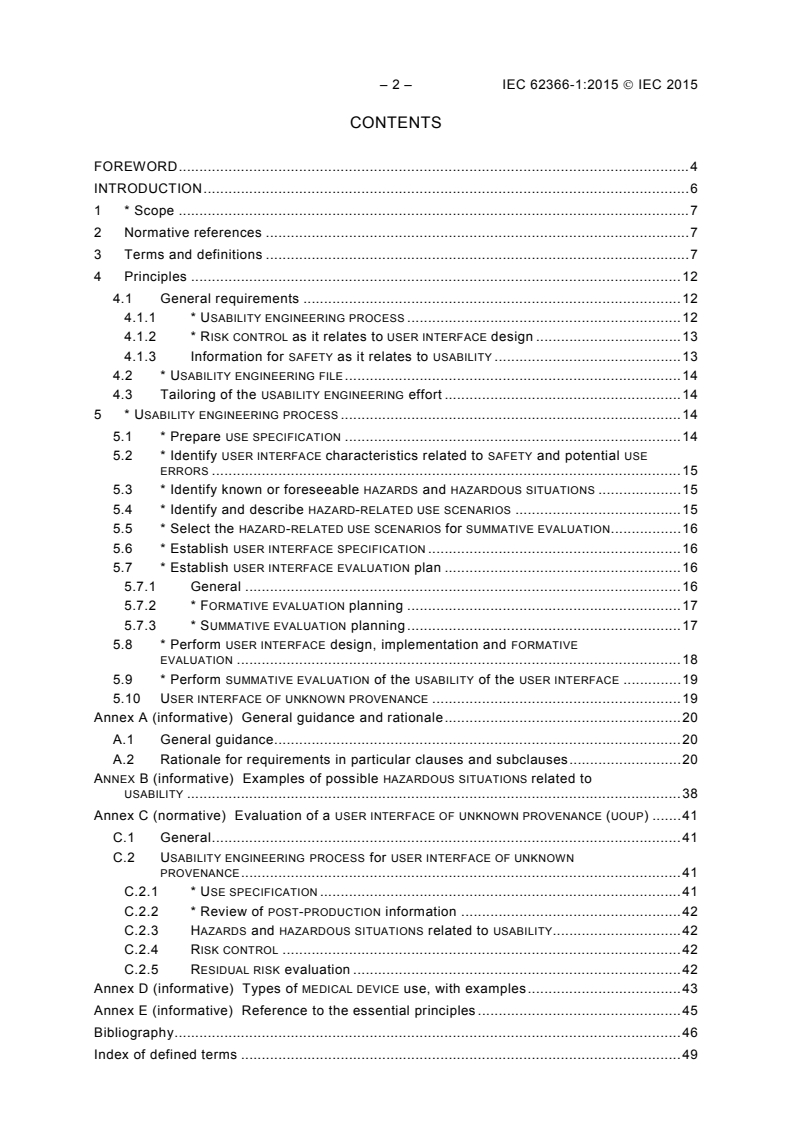
IEC 62366-1:2015 - Medical devices - Part 1: Application of usability engineering to medical devices Released:2/24/2015

IEC 62366-1:2015+AMD1:2020 CSV - Medical devices - Part 1: Application of usability engineering to medical devices Released:6/17/2020
Overview
IEC 62366-1:2015 is an international standard published by the International Electrotechnical Commission (IEC) that defines the process for applying usability engineering-also known as human factors engineering-to medical devices. The primary focus of this standard is to guide manufacturers in analyzing, specifying, developing, and evaluating the usability of medical device user interfaces, specifically as it relates to safety. Usability engineering aims to minimize risks arising from use errors and ensure that devices are safe and effective for all intended users, including healthcare professionals, lay users, and patients themselves.
Key Topics
- Usability Engineering Process: IEC 62366-1 outlines a systematic process for integrating usability engineering throughout the device lifecycle. This process includes identifying potential use errors, evaluating user interface designs, and implementing risk controls to address safety-related issues.
- Risk Management Integration: The standard reinforces the connection with ISO 14971, the global benchmark for risk management in medical devices, emphasizing that proper usability can significantly reduce user-related risks.
- User Interface (UI) Development: Guidance is provided on creating and evaluating user interfaces that are intuitive, easy to use, and minimize the likelihood of human error.
- Evaluation and Testing: The standard distinguishes between formative (iterative, design-stage) and summative (final, validation) usability evaluations, ensuring user interfaces are assessed both during and after development.
- Documentation: IEC 62366-1 requires manufacturers to maintain a Usability Engineering File that documents all activities, findings, and decisions related to usability throughout device development.
Applications
IEC 62366-1 is widely applicable to the development, testing, and regulatory approval of both hardware and software medical devices. Typical scenarios where this standard adds value include:
- Design of New Medical Devices: Ensuring new devices feature user interfaces that are safe, effective, and address the needs of both skilled and unskilled users.
- Device Modifications: Applying usability engineering principles when updating or modifying existing devices, especially when changes affect the user interface.
- User Interface Validation: Guiding manufacturers on performing required usability validation before bringing products to market to comply with regulatory requirements.
- Risk Analysis: Supporting comprehensive risk analysis activities, especially where risk control is achievable through user interface improvements.
- Post-market Surveillance: Informing processes for collecting and analyzing feedback from device users to identify unforeseen usability issues.
By embedding usability engineering into product development, manufacturers can reduce the likelihood of use errors, improve overall device safety, and enhance market acceptance.
Related Standards
- ISO 14971: Medical Devices - Application of Risk Management to Medical Devices. A cornerstone in medical device risk management, extensively referenced in IEC 62366-1 for integrating usability-related risk controls.
- IEC 62366-2: Once published, this complementary technical report will provide broader guidance on usability engineering for medical devices, covering attributes beyond safety such as user satisfaction and workflow efficiency.
- IEC 60601-1: Medical Electrical Equipment - General Requirements for Basic Safety and Essential Performance. Relevant when usability engineering impacts safety critical functions.
- ISO 9241-11: Ergonomics of Human-System Interaction - Guidance on Usability, providing definitions for key usability concepts integrated into IEC 62366-1.
Conclusion
By following IEC 62366-1:2015, medical device manufacturers can systematically develop devices with user interfaces that not only fulfill functional and regulatory requirements, but also safeguard users and patients through improved usability. Integrating usability engineering into risk management strategies promotes safety, effectiveness, and competitive advantage in the global medical device market.
Keywords: IEC 62366-1, usability engineering, human factors, medical devices, risk management, user interface, medical device safety, ISO 14971, regulatory compliance.
Relations
- Effective Date
- 05-Sep-2023
- Effective Date
- 05-Sep-2023
- Effective Date
- 25-Aug-2026
- Effective Date
- 25-Aug-2026
- Effective Date
- 25-Aug-2026
- Effective Date
- 25-Aug-2026
- Effective Date
- 25-Aug-2026
- Effective Date
- 25-Aug-2026
- Effective Date
- 25-Aug-2026
- Effective Date
- 25-Aug-2026
- Effective Date
- 25-Aug-2026
- Effective Date
- 25-Aug-2026
- Effective Date
- 25-Aug-2026
- Referred By
EN ISO 20789:2019 - Anaesthetic and respiratory equipment - Passive humidifiers (ISO 20789:2018) - Effective Date
- 25-Aug-2026
- Effective Date
- 25-Aug-2026
Buy Documents
IEC 62366-1:2015 - Medical devices - Part 1: Application of usability engineering to medical devices Released:2/24/2015
IEC 62366-1:2015+AMD1:2020 CSV - Medical devices - Part 1: Application of usability engineering to medical devices Released:6/17/2020
Related Packages
Get Certified
Connect with accredited certification bodies for this standard

BSI Group
BSI (British Standards Institution) is the business standards company that helps organizations make excellence a habit.

TÜV Rheinland
TÜV Rheinland is a leading international provider of technical services.

TÜV SÜD
TÜV SÜD is a trusted partner of choice for safety, security and sustainability solutions.
Sponsored listings
Frequently Asked Questions
IEC 62366-1:2015 is a standard published by the International Electrotechnical Commission (IEC). Its full title is "Medical devices - Part 1: Application of usability engineering to medical devices". This standard covers: IEC 62366-1:2015 specifies a process for a manufacturer to analyse, specify, develop and evaluate the usability of a medical device as it relates to safety. This usability engineering (human factors engineering) process permits the manufacturer to assess and mitigate risks associated with correct use and use errors, i.e., normal use. It can be used to identify but does not assess or mitigate risks associated with abnormal use. This first edition of IEC 62366-1, together with the first edition of IEC 62366-2 (not published yet), cancels and replaces the first edition of IEC 62366 published in 2007 and its Amendment 1:2014. Part 1 has been updated to include contemporary concepts of usability engineering, while also streamlining the process. It strengthens links to ISO 14971:2007 and the related methods of risk management as applied to safety related aspects of medical device user interfaces. Part 2, once published, will contain tutorial information to assist manufactures in complying with Part 1, as well as offering more detailed descriptions of usability engineering methods that can be applied more generally to medical devices that go beyond safety-related aspects of medical device user interfaces. The contents of the corrigendum of July 2016 have been included in this copy.
IEC 62366-1:2015 specifies a process for a manufacturer to analyse, specify, develop and evaluate the usability of a medical device as it relates to safety. This usability engineering (human factors engineering) process permits the manufacturer to assess and mitigate risks associated with correct use and use errors, i.e., normal use. It can be used to identify but does not assess or mitigate risks associated with abnormal use. This first edition of IEC 62366-1, together with the first edition of IEC 62366-2 (not published yet), cancels and replaces the first edition of IEC 62366 published in 2007 and its Amendment 1:2014. Part 1 has been updated to include contemporary concepts of usability engineering, while also streamlining the process. It strengthens links to ISO 14971:2007 and the related methods of risk management as applied to safety related aspects of medical device user interfaces. Part 2, once published, will contain tutorial information to assist manufactures in complying with Part 1, as well as offering more detailed descriptions of usability engineering methods that can be applied more generally to medical devices that go beyond safety-related aspects of medical device user interfaces. The contents of the corrigendum of July 2016 have been included in this copy.
IEC 62366-1:2015 is classified under the following ICS (International Classification for Standards) categories: 11.040.01 - Medical equipment in general. The ICS classification helps identify the subject area and facilitates finding related standards.
IEC 62366-1:2015 has the following relationships with other standards: It is inter standard links to IEC 62366:2007, IEC 62366:2007/AMD1:2014, EN ISO 20608:2018, EN ISO 14708-5:2022, EN ISO 80601-2-12:2020, EN ISO 10651-4:2023, EN ISO 21649:2023, EN ISO 80601-2-79:2024, EN ISO 18113-3:2024, EN ISO 80601-2-69:2020, EN ISO 11608-1:2022, EN ISO 80369-7:2021, EN ISO 5840-1:2021, EN ISO 20789:2019, EN ISO 11608-7:2017. Understanding these relationships helps ensure you are using the most current and applicable version of the standard.
IEC 62366-1:2015 is available in PDF format for immediate download after purchase. The document can be added to your cart and obtained through the secure checkout process. Digital delivery ensures instant access to the complete standard document.
Standards Content (Sample)
IEC 62366-1
Edition 1.0 2015-02
INTERNATIONAL
STANDARD
NORME
INTERNATIONALE
Medical devices –
Part 1: Application of usability engineering to medical devices
Dispositifs médicaux –
Partie 1: Application de l'ingénierie de l'aptitude à l'utilisation aux dispositifs
médicaux
All rights reserved. Unless otherwise specified, no part of this publication may be reproduced or utilized in any form
or by any means, electronic or mechanical, including photocopying and microfilm, without permission in writing from
either IEC or IEC's member National Committee in the country of the requester. If you have any questions about IEC
copyright or have an enquiry about obtaining additional rights to this publication, please contact the address below or
your local IEC member National Committee for further information.
Droits de reproduction réservés. Sauf indication contraire, aucune partie de cette publication ne peut être reproduite
ni utilisée sous quelque forme que ce soit et par aucun procédé, électronique ou mécanique, y compris la photocopie
et les microfilms, sans l'accord écrit de l'IEC ou du Comité national de l'IEC du pays du demandeur. Si vous avez des
questions sur le copyright de l'IEC ou si vous désirez obtenir des droits supplémentaires sur cette publication, utilisez
les coordonnées ci-après ou contactez le Comité national de l'IEC de votre pays de résidence.
IEC Central Office Tel.: +41 22 919 02 11
3, rue de Varembé Fax: +41 22 919 03 00
CH-1211 Geneva 20 info@iec.ch
Switzerland www.iec.ch
About the IEC
The International Electrotechnical Commission (IEC) is the leading global organization that prepares and publishes
International Standards for all electrical, electronic and related technologies.
About IEC publications
The technical content of IEC publications is kept under constant review by the IEC. Please make sure that you have the
latest edition, a corrigenda or an amendment might have been published.
IEC Catalogue - webstore.iec.ch/catalogue Electropedia - www.electropedia.org
The stand-alone application for consulting the entire The world's leading online dictionary of electronic and
bibliographical information on IEC International Standards, electrical terms containing more than 30 000 terms and
Technical Specifications, Technical Reports and other definitions in English and French, with equivalent terms in 15
documents. Available for PC, Mac OS, Android Tablets and additional languages. Also known as the International
iPad. Electrotechnical Vocabulary (IEV) online.
IEC publications search - www.iec.ch/searchpub IEC Glossary - std.iec.ch/glossary
The advanced search enables to find IEC publications by a More than 60 000 electrotechnical terminology entries in
variety of criteria (reference number, text, technical English and French extracted from the Terms and Definitions
committee,…). It also gives information on projects, replaced clause of IEC publications issued since 2002. Some entries
and withdrawn publications. have been collected from earlier publications of IEC TC 37,
77, 86 and CISPR.
IEC Just Published - webstore.iec.ch/justpublished
Stay up to date on all new IEC publications. Just Published IEC Customer Service Centre - webstore.iec.ch/csc
details all new publications released. Available online and If you wish to give us your feedback on this publication or
also once a month by email. need further assistance, please contact the Customer Service
Centre: csc@iec.ch.
A propos de l'IEC
La Commission Electrotechnique Internationale (IEC) est la première organisation mondiale qui élabore et publie des
Normes internationales pour tout ce qui a trait à l'électricité, à l'électronique et aux technologies apparentées.
A propos des publications IEC
Le contenu technique des publications IEC est constamment revu. Veuillez vous assurer que vous possédez l’édition la
plus récente, un corrigendum ou amendement peut avoir été publié.
Catalogue IEC - webstore.iec.ch/catalogue Electropedia - www.electropedia.org
Application autonome pour consulter tous les renseignements
Le premier dictionnaire en ligne de termes électroniques et
bibliographiques sur les Normes internationales,
électriques. Il contient plus de 30 000 termes et définitions en
Spécifications techniques, Rapports techniques et autres
anglais et en français, ainsi que les termes équivalents dans
documents de l'IEC. Disponible pour PC, Mac OS, tablettes
15 langues additionnelles. Egalement appelé Vocabulaire
Android et iPad.
Electrotechnique International (IEV) en ligne.
Recherche de publications IEC - www.iec.ch/searchpub
Glossaire IEC - std.iec.ch/glossary
Plus de 60 000 entrées terminologiques électrotechniques, en
La recherche avancée permet de trouver des publications IEC
en utilisant différents critères (numéro de référence, texte, anglais et en français, extraites des articles Termes et
comité d’études,…). Elle donne aussi des informations sur les Définitions des publications IEC parues depuis 2002. Plus
projets et les publications remplacées ou retirées. certaines entrées antérieures extraites des publications des
CE 37, 77, 86 et CISPR de l'IEC.
IEC Just Published - webstore.iec.ch/justpublished
Service Clients - webstore.iec.ch/csc
Restez informé sur les nouvelles publications IEC. Just
Published détaille les nouvelles publications parues. Si vous désirez nous donner des commentaires sur cette
Disponible en ligne et aussi une fois par mois par email. publication ou si vous avez des questions contactez-nous:
csc@iec.ch.
IEC 62366-1
Edition 1.0 2015-02
INTERNATIONAL
STANDARD
NORME
INTERNATIONALE
Medical devices –
Part 1: Application of usability engineering to medical devices
Dispositifs médicaux –
Partie 1: Application de l'ingénierie de l'aptitude à l'utilisation aux dispositifs
médicaux
INTERNATIONAL
ELECTROTECHNICAL
COMMISSION
COMMISSION
ELECTROTECHNIQUE
INTERNATIONALE
ICS 11.040 ISBN 978-2-8322-2281-2
– 2 – IEC 62366-1:2015 IEC 2015
CONTENTS
FOREWORD . 4
INTRODUCTION . 6
1 * Scope . 7
2 Normative references . 7
3 Terms and definitions . 7
4 Principles . 12
4.1 General requirements . 12
4.1.1 * USABILITY ENGINEERING PROCESS . 12
4.1.2 * RISK CONTROL as it relates to USER INTERFACE design . 13
4.1.3 Information for SAFETY as it relates to USABILITY . 13
4.2 * USABILITY ENGINEERING FILE . 14
4.3 Tailoring of the USABILITY ENGINEERING effort . 14
5 * USABILITY ENGINEERING PROCESS . 14
5.1 * Prepare USE SPECIFICATION . 14
5.2 * Identify USER INTERFACE characteristics related to SAFETY and potential USE
ERRORS . 15
5.3 * Identify known or foreseeable HAZARDS and HAZARDOUS SITUATIONS . 15
5.4 * Identify and describe HAZARD-RELATED USE SCENARIOS . 15
5.5 * Select the HAZARD-RELATED USE SCENARIOS for SUMMATIVE EVALUATION . 16
5.6 * Establish USER INTERFACE SPECIFICATION . 16
5.7 * Establish USER INTERFACE EVALUATION plan . 16
5.7.1 General . 16
5.7.2 * FORMATIVE EVALUATION planning . 17
5.7.3 * SUMMATIVE EVALUATION planning . 17
5.8 * Perform USER INTERFACE design, implementation and FORMATIVE
EVALUATION . 18
5.9 * Perform SUMMATIVE EVALUATION of the USABILITY of the USER INTERFACE . 19
5.10 USER INTERFACE OF UNKNOWN PROVENANCE . 19
Annex A (informative) General guidance and rationale . 20
A.1 General guidance . 20
A.2 Rationale for requirements in particular clauses and subclauses . 20
ANNEX B (informative) Examples of possible HAZARDOUS SITUATIONS related to
USABILITY . 38
Annex C (normative) Evaluation of a USER INTERFACE OF UNKNOWN PROVENANCE (UOUP) . 41
C.1 General . 41
C.2 USABILITY ENGINEERING PROCESS for USER INTERFACE OF UNKNOWN
PROVENANCE . 41
C.2.1 * USE SPECIFICATION . 41
C.2.2 * Review of POST-PRODUCTION information . 42
C.2.3 HAZARDS and HAZARDOUS SITUATIONS related to USABILITY. 42
C.2.4 RISK CONTROL . 42
C.2.5 RESIDUAL RISK evaluation . 42
Annex D (informative) Types of MEDICAL DEVICE use, with examples . 43
Annex E (informative) Reference to the essential principles . 45
Bibliography . 46
Index of defined terms . 49
Figure 1 – Relationship of the types of use . 8
Figure A.1 – Model of USER-MEDICAL DEVICE interaction . 24
Figure A.2 – Relationship of TASKS and functions within a USE SCENARIO . 25
Figure A.3 – Relationship of TASKS and functions and USE ERROR within a HAZARD-
RELATED USE SCENARIO . 26
Figure A.4 – The relationship between the RISK MANAGEMENT PROCESS
(ISO 14971:2007) and the USABILITY ENGINEERING PROCESS (IEC 62366-1) . 32
Figure D.1 – Interrelationships between the different types of MEDICAL DEVICE use, with
examples . 44
Table B.1 – Glossary of relevant RISK MANAGEMENT terms . 38
Table B.2 – Examples of HARM due to RISK caused by USE ERROR(S) or poor USABILITY
(1 of 3) . 38
Table E.1 – Correspondence between this document and the essential principles . 45
– 4 – IEC 62366-1:2015 © IEC 2015
INTERNATIONAL ELECTROTECHNICAL COMMISSION
____________
MEDICAL DEVICES –
Part 1: Application of usability engineering to medical devices
FOREWORD
1) The International Electrotechnical Commission (IEC) is a worldwide organization for standardization comprising
all national electrotechnical committees (IEC National Committees). The object of IEC is to promote
international co-operation on all questions concerning standardization in the electrical and electronic fields. To
this end and in addition to other activities, IEC publishes International Standards, Technical Specifications,
Technical Reports, Publicly Available Specifications (PAS) and Guides (hereafter referred to as “IEC
Publication(s)”). Their preparation is entrusted to technical committees; any IEC National Committee interested
in the subject dealt with may participate in this preparatory work. International, governmental and non-
governmental organizations liaising with the IEC also participate in this preparation. IEC collaborates closely
with the International Organization for Standardization (ISO) in accordance with conditions determined by
agreement between the two organizations.
2) The formal decisions or agreements of IEC on technical matters express, as nearly as possible, an international
consensus of opinion on the relevant subjects since each technical committee has representation from all
interested IEC National Committees.
3) IEC Publications have the form of recommendations for international use and are accepted by IEC National
Committees in that sense. While all reasonable efforts are made to ensure that the technical content of IEC
Publications is accurate, IEC cannot be held responsible for the way in which they are used or for any
misinterpretation by any end user.
4) In order to promote international uniformity, IEC National Committees undertake to apply IEC Publications
transparently to the maximum extent possible in their national and regional publications. Any divergence
between any IEC Publication and the corresponding national or regional publication shall be clearly indicated in
the latter.
5) IEC itself does not provide any attestation of conformity. Independent certification bodies provide conformity
assessment services and, in some areas, access to IEC marks of conformity. IEC is not responsible for any
services carried out by independent certification bodies.
6) All users should ensure that they have the latest edition of this publication.
7) No liability shall attach to IEC or its directors, employees, servants or agents including individual experts and
members of its technical committees and IEC National Committees for any personal injury, property damage or
other damage of any nature whatsoever, whether direct or indirect, or for costs (including legal fees) and
expenses arising out of the publication, use of, or reliance upon, this IEC Publication or any other IEC
Publications.
8) Attention is drawn to the Normative references cited in this publication. Use of the referenced publications is
indispensable for the correct application of this publication.
9) Attention is drawn to the possibility that some of the elements of this IEC Publication may be the subject of
patent rights. IEC shall not be held responsible for identifying any or all such patent rights.
International Standard IEC 62366-1 has been prepared by a joint working group of
subcommittee 62A: Common aspects of electrical medical equipment used in medical
practice, of IEC technical committee 62: Electrical medical equipment in medical practice, and
ISO technical committee 210: Quality management and corresponding general aspects for
MEDICAL DEVICES.
It is published as double logo standard.
This first edition of IEC 62366-1, together with the first edition of IEC 62366-2, cancels and
replaces the first edition of IEC 62366 published in 2007 and its Amendment 1 (2014).
Part 1 has been updated to include contemporary concepts of USABILITY ENGINEERING, while
also streamlining the process. It strengthens links to ISO 14971:2007 and the related methods
of RISK MANAGEMENT as applied to SAFETY related aspects of medical device user interfaces.
Part 2 contains tutorial information to assist manufactures in complying with Part 1, as well as
offering more detailed descriptions of USABILITY ENGINEERING methods that can be applied
more generally to MEDICAL DEVICES that go beyond safety-related aspects of MEDICAL DEVICE
USER INTERFACES.
The text of this standard is based on the following documents:
FDIS Report on voting
62A/977/FDIS 62A/988/RVD
Full information on the voting for the approval of this standard can be found in the report on
voting indicated in the above table. In ISO, the standard has been approved by 26 P-members
out of 26 having cast a vote.
This publication has been drafted in accordance with the ISO/IEC Directives, Part 2.
In this International Standard, the following print types are used:
– Requirements and definitions: roman type.
– Means to assess compliance: italic type.
– Informative material appearing outside of tables, such as notes, examples and references: in smaller type.
Normative text of tables is also in a smaller type
– TERMS DEFINED IN CLAUSE 3 OR AS NOTED: SMALL CAPITALS.
The requirements are followed by means to assess compliance.
In this standard, the conjunctive “or” is used as an “inclusive or” so a statement is true if any
combination of the conditions is true.
The verbal forms used in this standard conform to usage described in Annex H of the ISO/IEC
Directives, Part 2. For the purposes of this standard, the auxiliary verb:
– “shall” means that compliance with a requirement or a test is mandatory for compliance
with this standard;
– “should” means that compliance with a requirement or a test is recommended but is not
mandatory for compliance with this standard;
– “may” is used to describe a permissible way to achieve compliance with a requirement or
test.
Clauses and subclauses for which a rationale is provided in informative Annex A are marked
with an asterisk (*).
A list of all parts of the IEC 62366 series, published under the general title Medical devices,
can be found on the IEC website.
The committee has decided that the contents of this publication will remain unchanged until
the stability date indicated on the IEC web site under "http://webstore.iec.ch" in the data
related to the specific publication. At this date, the publication will be
– reconfirmed,
– withdrawn,
– replaced by a revised edition, or
– amended.
NOTE The attention of National Committees and Member Bodies is drawn to the fact that equipment
manufacturers and testing organizations may need a transitional period following publication of a new, amended or
revised IEC or ISO publication in which to make products in accordance with the new requirements and to equip
themselves for conducting new or revised tests. It is the recommendation of the committee that the content of this
publication be adopted for mandatory implementation nationally not earlier than 3 years from the date of
publication.
The contents of the corrigendum of July 2016 have been included in this copy.
– 6 – IEC 62366-1:2015 IEC 2015
INTRODUCTION
Medical practice is increasingly using MEDICAL DEVICES for observation and treatment of
PATIENTS. USE ERRORS caused by inadequate MEDICAL DEVICE USABILITY have become an
increasing cause for concern. Many of the MEDICAL DEVICES developed without applying a
USABILITY ENGINEERING (HUMAN FACTORS ENGINEERING) PROCESS are non-intuitive, difficult to
learn and difficult to use. As healthcare evolves, less skilled USERS including PATIENTS
themselves are now using MEDICAL DEVICES and MEDICAL DEVICES are becoming more
complicated. The design of the USER INTERFACE to achieve adequate USABILITY requires a
different PROCESS and skill set than that of the technical implementation of the USER
INTERFACE.
The USABILITY ENGINEERING PROCESS is intended to identify and minimise USE ERRORS and
thereby reduce use-associated RISKS. Some, but not all, forms of incorrect use are suited to
control by the MANUFACTURER. The USABILITY ENGINEERING PROCESS is related to the RISK
MANAGEMENT PROCESS as indicated in Figure A.4.
This International Standard describes a USABILITY ENGINEERING PROCESS to provide acceptable
RISK related to USABILITY of a MEDICAL DEVICE. It is intended to be useful not only for
MANUFACTURERS of MEDICAL DEVICES, but also for technical committees responsible for the
preparation of particular MEDICAL DEVICE standards.
This International Standard strictly focuses on applying the USABILITY ENGINEERING PROCESS to
optimize MEDICAL DEVICE USABILITY as it relates to SAFETY. The companion technical report
(IEC 62366-2 ) is comprehensive and has a broader focus. It focuses not only on USABILITY as
it relates to SAFETY, but also on how USABILITY relates to attributes such as TASK accuracy,
completeness and EFFICIENCY, and USER satisfaction.
NOTE SAFETY is freedom from unacceptable RISK. Unacceptable RISK can arise from USE ERROR, which can lead
to exposure to direct physical HAZARDS or loss or degradation of clinical functionality.
MANUFACTURERS can choose to implement a USABILITY ENGINEERING program focused narrowly
on SAFETY or more broadly on SAFETY and other attributes, such as those cited above. A
broader focus might also be useful to address specific USABILITY ENGINEERING expectations,
such as the need to confirm that USERS can successfully perform non-SAFETY-related TASKS. A
MANUFACTURER might also implement a broader program to realize the commercial benefits of
a MEDICAL DEVICE that not only is safe to use but also offers superior USABILITY.
—————————
IEC 62366-2, Medical devices – Part 2: Guidance on the application of usability engineering to medical devices
(in preparation).
MEDICAL DEVICES –
Part 1: Application of usability engineering to medical devices
1 * Scope
This part of IEC 62366 specifies a PROCESS for a MANUFACTURER to analyse, specify, develop
and evaluate the USABILITY of a MEDICAL DEVICE as it relates to SAFETY. This USABILITY
ENGINEERING (HUMAN FACTORS ENGINEERING) PROCESS permits the MANUFACTURER to assess
and mitigate RISKS associated with CORRECT USE and USE ERRORS, i.e., NORMAL USE. It can be
used to identify but does not assess or mitigate RISKS associated with ABNORMAL USE.
NOTE 1 SAFETY is freedom from unacceptable RISK. Unacceptable RISK can arise from USE ERROR, which can lead
to exposure to direct physical HAZARDS or loss or degradation of clinical functionality.
NOTE 2 Guidance on the application of USABILITY ENGINEERING to MEDICAL DEVICES is available in IEC 62366-2 ,
which addresses not only SAFETY but also aspects of USABILITY not related to SAFETY.
If the USABILITY ENGINEERING PROCESS detailed in this International Standard has been
complied with, then the USABILITY of a MEDICAL DEVICE as it relates to SAFETY is presumed to be
acceptable, unless there is OBJECTIVE EVIDENCE to the contrary.
NOTE 3 Such OBJECTIVE EVIDENCE can subsequently originate from POST-PRODUCTION surveillance.
2 Normative references
The following documents, in whole or in part, are normatively referenced in this document and
are indispensable for its application. For dated references, only the edition cited applies. For
undated references, the latest edition of the referenced document (including any
amendments) applies.
NOTE 1 The way in which these referenced documents are cited in normative requirements determines the extent
(in whole or in part) to which they apply.
NOTE 2 Informative references are listed in the bibliography beginning on page 46.
ISO 14971:2007, Medical devices – Application of risk management to medical devices
3 Terms and definitions
For the purpose of this document, the terms and definitions given in ISO 14971:2007 and the
following apply.
NOTE An index of defined terms is found beginning on page 49.
3.1
* ABNORMAL USE
conscious, intentional act or intentional omission of an act that is counter to or violates
NORMAL USE and is also beyond any further reasonable means of USER INTERFACE-related RISK
CONTROL by the MANUFACTURER
EXAMPLES Reckless use or sabotage or intentional disregard of information for SAFETY are such acts.
—————————
IEC 62366-2, Medical devices – Part 2: Guidance on the application of usability engineering to medical devices
(in preparation).
– 8 – IEC 62366-1:2015 IEC 2015
Note 1 to entry See also 4.1.3.
Note 2 to entry: An intended but erroneous action that is not ABNORMAL USE is considered a type of USE ERROR.
Note 3 to entry: ABNORMAL USE does not relieve the MANUFACTURER from considering non-USER INTERFACE-related
means of RISK CONTROL.
Note 4 to entry: Figure 1 shows the relationships of the types of use.
IEC
NOTE Figure D.1 contains additional detail
Figure 1 – Relationship of the types of use
3.2
ACCOMPANYING DOCUMENTATION
materials accompanying a MEDICAL DEVICE and containing information for the USER or those
accountable for the installation, use and maintenance of the MEDICAL DEVICE, particularly
regarding safe use
Note 1 to entry: The ACCOMPANYING DOCUMENTATION can consist of the instructions for use, technical description,
installation manual, quick reference guide, etc.
Note 2 to entry: ACCOMPANYING DOCUMENTATION is not necessarily a written or printed document but could involve
auditory, visual, or tactile materials and multiple media types.
Note 3 to entry: MEDICAL DEVICES that can be used safely without instructions for use are exempted from having
instructions for use by some authorities with jurisdiction.
[SOURCE: ISO 14971:2007, 2.1, modified – The term has been changed to refer to
‘documentation’ rather than ‘document’, and in the definition ‘document’ has been replaced by
‘material’, ‘OPERATOR’ has been deleted and notes to entry have been added.]
3.3
CORRECT USE
NORMAL USE without USE ERROR
Note 1 to entry: Deviation from instructions for use is only considered USE ERROR if it leads to a MEDICAL DEVICE
response that is different than intended by the MANUFACTURER or expected by the USER.
Note 2 to entry: Figure 1 shows the relationships of the types of use.
3.4
EFFECTIVENESS
accuracy and completeness with which USERS achieve specified goals
Note 1 to entry: This is a different concept than 'clinical effectiveness'.
[SOURCE: ISO 9241-11:1998, 3.2, modified – Added the note to entry.]
3.5
* EFFICIENCY
resources expended in relation to EFFECTIVENESS
[SOURCE: ISO 9241-11:1988, 3.3, modified – the term "EFFECTIVENESS" has replaced the
original phrase, which here constitutes the definition of 3.4 EFFECTIVENESS.
3.6
EXPECTED SERVICE LIFE
time period specified by the MANUFACTURER during which the MEDICAL DEVICE is expected to
remain safe for use (i.e. maintain basic SAFETY and essential performance)
Note 1 to entry: Maintenance can be necessary during the EXPECTED SERVICE LIFE.
[SOURCE: IEC 60601-1:2005 and IEC 60601-1:2005/AMD1:2012, 3.28, modified – In the
definition, ‘ME EQUIPMENT and ME SYSTEM’ have been replaced with ‘MEDICAL DEVICE’.]
3.7
FORMATIVE EVALUATION
USER INTERFACE EVALUATION conducted with the intent to explore USER INTERFACE design
strengths, weaknesses, and unanticipated USE ERRORS
Note 1 to entry: FORMATIVE EVALUATION is generally performed iteratively throughout the design and development
PROCESS, but prior to SUMMATIVE EVALUATION, to guide USER INTERFACE design as necessary.
3.8
HAZARD-RELATED USE SCENARIO
USE SCENARIO that could lead to a HAZARDOUS SITUATION or HARM
Note 1 to entry: A HAZARD-RELATED USE SCENARIO can often be linked to a potential USE ERROR.
Note 2 to entry: A HAZARD-RELATED USE SCENARIO is not related to a failure of the MEDICAL DEVICE, unless the
MEDICAL DEVICE failure was caused by a USE ERROR.
3.9
* NORMAL USE
operation, including routine inspection and adjustments by any USER, and stand-by, according
MEDICAL
to the instructions for use or in accordance with generally accepted practice for those
DEVICES provided without instructions for use
Note 1 to entry: NORMAL USE should not be confused with INTENDED USE. While both include the concept of use as
intended by the MANUFACTURER, INTENDED USE focuses on the medical purpose while NORMAL USE incorporates not
only the medical purpose, but maintenance, transport, etc. as well.
Note 2 to entry: USE ERROR can occur in NORMAL USE.
EDICAL DEVICES that can be used safely without instructions for use are exempted from having
Note 3 to entry: M
instructions for use by some authorities with jurisdiction.
Note 4 to entry: Figure 1 shows the relationships of the types of use.
[SOURCE: IEC 60601-1:2005, 3.71, modified – Notes 2, 3 and 4 to entry have been added,
and in the definition ‘OPERATOR’ has been replaced with ‘USER’ and the entire phrase after
"instructions for use" has been added.]
3.10
* PATIENT
living being (person) undergoing a medical, surgical or dental PROCEDURE
Note 1 to entry: A PATIENT can be a USER.
– 10 – IEC 62366-1:2015 IEC 2015
[SOURCE: IEC 60601-1:2005 and IEC 60601-1:2005/AMD1:2012, 3.76, modified – The
phrase ‘or animal’ has been deleted from the definition and "USER" has been substituted for
"operator" in the note to entry.]
3.11
* PRIMARY OPERATING FUNCTION
USER interaction that is related to the SAFETY of the MEDICAL DEVICE
function that involves
Note 1 to entry: Often a PRIMARY OPERATING FUNCTION is interacted with by a series of TASKS that can be broken
down into a series of USER interactions.
Note 2 to entry: The concept of SAFETY includes loss or degradation of performance resulting in an unacceptable
RISK to the PATIENT, including USE ERROR that prevents the USER from effectively using the MEDICAL DEVICE to
achieve its intended medical purpose. In IEC 60601-1, this is referred to as ‘essential performance’. .
3.12
RESPONSIBLE ORGANIZATION
entity accountable for the use and maintenance of a MEDICAL DEVICE or combination of MEDICAL
DEVICES
Note 1 to entry: The accountable entity can be, for example, a hospital, an individual clinician or a lay person. In
home use applications, the PATIENT, USER and RESPONSIBLE ORGANIZATION can be one and the same person.
Note 2 to entry: Education and training are included in "use."
[SOURCE: IEC 60601-1:2005, 3.101, modified – The reference in the definition to ‘an
ME EQUIPMENT or ME SYSTEM’ has been replaced with ‘a MEDICAL DEVICE OR COMBINATION OF
MEDICAL DEVICES’ and 'operator' has been replaced by 'USER' in the note to entry.]
3.13
SUMMATIVE EVALUATION
USER INTERFACE EVALUATION conducted at the end of the USER INTERFACE development with the
intent to obtain OBJECTIVE EVIDENCE that the USER INTERFACE can be used safely
Note 1 to entry: SUMMATIVE EVALUATION relates to validating the safe use of the USER INTERFACE.
3.14
TASK
one or more USER interactions with a MEDICAL DEVICE to achieve a desired result
Note 1 to entry: A TASK description should include the allocation of activities and operational steps between the
USER and the MEDICAL DEVICE.
Note 2 to entry: TASKS should not be described solely in terms of the functions or features provided by the
MEDICAL DEVICE.
3.15
UOUP
USER INTERFACE OF UNKNOWN PROVENANCE
USER INTERFACE or part of a USER INTERFACE of a MEDICAL DEVICE previously developed for
which adequate RECORDS of the USABILITY ENGINEERING PROCESS of this standard are not
available
Note 1 to entry: This note applies to the French version only.
3.16
* USABILITY
characteristic of the USER INTERFACE that facilitates use and thereby establishes
EFFECTIVENESS, EFFICIENCY and USER satisfaction in the intended USE ENVIRONMENT
Note 1 to entry: All aspects of USABILITY, including EFFECTIVENESS, EFFICIENCY and USER satisfaction, can either
increase or decrease SAFETY.
3.17
* USABILITY ENGINEERING
HUMAN FACTORS ENGINEERING
application of knowledge about human behaviour, abilities, limitations, and other
characteristics to the design of MEDICAL DEVICES (including software), systems and TASKS to
USABILITY
achieve adequate
Note 1 to entry: Achieving adequate USABILITY can result in acceptable RISK related to use.
3.18
USABILITY ENGINEERING FILE
*
set of RECORDS and other documents that are produced by the USABILITY ENGINEERING
PROCESS
3.19
USABILITY TEST
method for exploring or evaluating a USER INTERFACE with intended USERS within a specified
intended USE ENVIRONMENT
3.20
USE ENVIRONMENT
actual conditions and setting in which USERS interact with the MEDICAL DEVICE
Note 1 to entry: The conditions of use or attributes of the USE ENVIRONMENT can include hygienic requirements,
frequency of use, location, lighting, noise, temperature, mobility, and degree of internationalization.
3.21
* USE ERROR
USER action or lack of USER action while using the MEDICAL DEVICE that leads to a different
result than that intended by the MANUFACTURER or expected by the USER
Note 1 to entry: USE ERROR includes the inability of the USER to complete a TASK.
Note 2 to entry: USE ERRORS can result from a mismatch between the characteristics of the USER, USER
INTERFACE, TASK, or USE ENVIRONMENT.
Note 3 to entry: USERS might be aware or unaware that a USE ERROR has occurred.
Note 4 to entry: An unexpected physiological response of the PATIENT is not by itself considered USE ERROR.
Note 5 to entry: A malfunction of a MEDICAL DEVICE that causes an unexpected result is not considered a USE
ERROR.
Note 6 to entry: Figure 1 shows the relationships of the types of use.
3.22
* USE SCENARIO
specific sequence of TASKS performed by a specific USER in a specific USE ENVIRONMENT and
any resulting response of the MEDICAL DEVICE
3.23
* USE SPECIFICATION
APPLICATION SPECIFICATION
summary of the important characteristics related to the context of use of the MEDICAL DEVICE
Note 1 to entry: The intended medical indication, PATIENT population, part of the body or type of tissue interacted
with, USER PROFILE, USE ENVIRONMENT, and operating principle are typical elements of the USE SPECIFICATION.
Note 2 to entry: The summary of the MEDICAL DEVICE USE SPECIFICATION is referred to by some authorities having
jurisdiction as the ‘statement of intended use’.
Note 3 to entry: The USE SPECIFICATION is an input to determining the INTENDED USE of ISO 14971:2007.
– 12 – IEC 62366-1:2015 IEC 2015
3.24
* USER
person interacting with (i.e. operating or handling) the MEDICAL DEVICE
Note 1 to entry: There can be more than one USER of a MEDICAL DEVICE.
Note 2 to entry: Common USERS include clinicians, PATIENTS, cleaners, maintenance and service personnel.
3.25
USER GROUP
subset of intended USERS who are differentiated from other intended USERS by factors that are
likely to influence USABILITY, such as age, culture, expertise or type of interaction with a
MEDICAL DEVICE
3.26
* USER INTERFACE
means by which the USER and the MEDICAL DEVICE interact
Note 1 to entry: ACCOMPANYING DOCUMENTATION is considered part of the MEDICAL DEVICE AND ITS USER INTERFACE.
Note 2 to entry: USER INTERFACE includes all the elements of the MEDICAL DEVICE with which the USER interacts
including the physical aspects of the MEDICAL DEVICE as well as visual, auditory, tactile displays and is not limited
to a software interface.
Note 3 to entry: For the purposes of this standard, a system of MEDICAL DEVICES can be treated as a single USER
INTERFACE.
3.27
USER INTERFACE EVALUATION
PROCESS by which the MANUFACTURER explores or assesses the USER interactions with the
USER INTERFACE
Note 1 to entry: A USER INTERFACE EVALUATION may consist of one or more of the following techniques, amongst
others, USABILITY TESTS, expert reviews, heuristic analyses, design audits or a cognitive walk through.
Note 2 to entry: USER INTERFACE EVALUATION is frequently performed iteratively throughout the design and
development PROCESS (this is FORMATIVE EVALUATION).
Note 3 to entry: USER INTERFACE EVALUATION is a part of the activities involved in verifying and validating the
overall MEDICAL DEVICE design (this is SUMMATIVE EVALUATION).
3.28
* USER INTERFACE SPECIFICATION
collection of specifications that comprehensively and prospectively describe the USER
INTERFACE of a MEDICAL DEVICE
3.29
USER PROFILE
summary of the mental, physical and demographic traits of an intended USER GROUP, as well
as any special characteristics, such as occupational skills, job requirements and working
conditions, which can have a bearing on design decisions
4 Principles
4.1 General requirements
4.1.1 * USABILITY ENGINEERING PROCESS
The MANUFACTURER shall establish, document, implement and maintain a USABILITY
ENGINEERING PROCESS, as defined in Clause 5, to provide SAFETY for the PATIENT, USER and
others. The PROCESS shall address USER interactions with the MEDICAL DEVICE according to the
ACCOMPANYING DOCUMENTATION, including, but not limited to:
– * transport;
– * storage;
– installation;
– operation;
– maintenance and repair; and
– disposal.
USABILITY ENGINEERING activities for a MEDICAL DEVICE shall be planned, carried out, and
documented by personnel competent on the basis of appropriate education, training, skills or
experience.
Where a documented product realization PROCESS exists, such as that described in Clause 7
of ISO 13485:2003 [11], it shall incorporate the appropriate parts of or reference the USABILITY
ENGINEERING PROCESS.
NOTE 1 Subclause 6.2 of ISO 13485:2003 contains additional information relating to personnel competence.
A depiction of the interrelationship between the RISK MANAGEMENT PROCESS of ISO 14971:2007
and the USABILITY ENGINEERING PROCESS described in this standard is shown in Figure A.4.
The activities described in Clause 5, as shown Figure A.4, are described in a logical order,
but they may be carried out in a flexible order as appropriate.
Consider compliance with this subclause to exist when the requirements of this International
Standard have been fulfilled.
4.1.2 * RISK CONTROL as it relates to USER INTERFACE design
To reduce use-related RISK, the MANUFACTURER shall use one or more of the following options,
in the priority listed (as required by ISO 14971:2007, 6.2):
SAFETY by design;
a) inherent
b) protective measures in the MEDICAL DEVICE itself or in the manufacturing PROCESS;
SAFETY.
c) information for
NOTE Information for SAFETY can also be required by product standards and other sources.
Compliance is checked by inspection of the USABILITY ENGINEERING FILE.
4.1.3 Information for SAFETY as it relates to USABILITY
When, in accordance with the priorities of 4.1.2, information for SAFETY is used as a RISK
CONTROL measure, the MANUFACTURER shall subject this information to the USABILITY
ENGINEERING PROCESS to determine that the information
– is perceivable by,
– is understandable to, and
– supports CORRECT USE of the MEDICAL DEVICE by
USERS of the intended USER PROFILES in the context of the intended USE ENVIRONMENT.
NOTE 1 The relationship between USER perception, cognition and action is shown in Figure A.1.
NOTE 2 Examples of information for SAFETY are found in IEC 62366-2.
Conscious disregard of such information for SAFETY by the USER is considered to be an
intentional act or intentional omission of an act that is counter to or violates NORMAL USE and
– 14 – IEC 62366-1:2015 IEC 2015
is also beyond any further reasonable means of USER INTERFACE-related RISK CONTROL by the
MANUFACTURER (i.e. ABNORMAL USE).
Compliance is checked by inspection of the information for SAFETY and the USABILITY
ENGINEERING FILE.
4.2 * USABILITY ENGINEERING FILE
The results of the USABILITY ENGINEERING PROCESS shall be stored in the USABILITY
ENGINEERING FILE. The RECORDS and other documents that form the USABILITY ENGINEERING FILE
may form part of other documents and files.
EXAMPLE 1 MANUFACTURER’S product design file.
EXAMPLE 2 RISK MANAGEMENT FILE.
Compliance is checked by inspection of the USABILITY ENGINEERING FILE.
4.3 Tailoring of the USABILITY ENGINEERING effort
The level of effort and the choice of methods and tools used to perform the USABILITY
ENGINEERING PROCESS may vary based on:
a) the size and COMPLEXITY of the USER INTERFACE;
b) the SEVERITY of the HARM associated with the use of the MEDICAL DEVICE;
c) the extent or complexity of the USE SPECIFICATION;
d) the presence of USER INTERFACE OF UNKNOWN PROVENANCE; and
e) the extent of the modification to an existing MEDICAL DEVICE USER INTERFACE that had been
subjected to the USABILITY ENGINEERING PROCESS.
Compliance is checked by inspection of the USABILITY ENGINEERING FILE.
5 * USABILITY ENGINEERING PROCESS
5.1 * Prepare USE SPECIFICATION
The MANUFACTURER shall prepare a USE SPECIFICATION.
The USE SPECIFICATION shall include:
– * intended medical indication;
NOTE 1 This can include conditions(s) or disease(s) to be screened, monitored, treated, diagnosed, or
prevented.
– intended PATIENT population;
NOTE 2 This can include age group, weight range, health, or condition.
– intended part of the body or type of tissue applied to or interacted with;
– * intended USER PROFILE;
– * USE ENVIRONMENT; and
– * operating principle.
NOTE 3 The summary of the MEDICAL DEVICE USE SPECIFICATION is referred to by some authorities having
jurisdiction as the ‘statement of intended use’.
Compliance is checked by inspection of the USABILITY ENGINEERING FILE.
5.2 * Identify USER INTERFACE characteristics related to SAFETY and potential USE
ERRORS
The MANUFACTURER shall identify USER INTERFACE characteristics that could be related to
SAFETY as part of a RISK ANALYSIS performed according to ISO 14971:2007, 4.2. This
identification may also be performed using the tools and techniques from the USABILITY
ENGINEERING PROCESS. This identification shall include consideration of the PRIMARY
OPERATING FUNCTIONS that are provided in applicable particular MEDICAL DEVICE SAFETY
standards.
NOTE 1 ISO 14971:2007, C.2.29 to C.2.34 provides a list of questions that can be used to identify USER
INTERFACE characteristics that could impact SAFETY. The list of questions is not exhaustive.
Based on the identified USER INTERFACE characteristics and USE SPECIFICATION, the
MANUFACTURER shall identify the USE ERRORS that could occur and are related to the USER
INTERFACE. This identification may be accomplish
...
IEC 62366-1
Edition 1.1 2020-06
CONSOLIDATED VERSION
INTERNATIONAL
STANDARD
NORME
INTERNATIONALE
colour
inside
Medical devices –
Part 1: Application of usability engineering to medical devices
Dispositifs médicaux –
Partie 1: Application de l'ingénierie de l'aptitude à l'utilisation aux dispositifs
médicaux
All rights reserved. Unless otherwise specified, no part of this publication may be reproduced or utilized in any form
or by any means, electronic or mechanical, including photocopying and microfilm, without permission in writing from
either IEC or IEC's member National Committee in the country of the requester. If you have any questions about IEC
copyright or have an enquiry about obtaining additional rights to this publication, please contact the address below or
your local IEC member National Committee for further information.
Droits de reproduction réservés. Sauf indication contraire, aucune partie de cette publication ne peut être reproduite
ni utilisée sous quelque forme que ce soit et par aucun procédé, électronique ou mécanique, y compris la photocopie
et les microfilms, sans l'accord écrit de l'IEC ou du Comité national de l'IEC du pays du demandeur. Si vous avez des
questions sur le copyright de l'IEC ou si vous désirez obtenir des droits supplémentaires sur cette publication, utilisez
les coordonnées ci-après ou contactez le Comité national de l'IEC de votre pays de résidence.
IEC Central Office Tel.: +41 22 919 02 11
3, rue de Varembé info@iec.ch
CH-1211 Geneva 20 www.iec.ch
Switzerland
About the IEC
The International Electrotechnical Commission (IEC) is the leading global organization that prepares and publishes
International Standards for all electrical, electronic and related technologies.
About IEC publications
The technical content of IEC publications is kept under constant review by the IEC. Please make sure that you have the
latest edition, a corrigendum or an amendment might have been published.
IEC publications search - webstore.iec.ch/advsearchform Electropedia - www.electropedia.org
The advanced search enables to find IEC publications by a The world's leading online dictionary on electrotechnology,
variety of criteria (reference number, text, technical containing more than 22 000 terminological entries in English
committee,…). It also gives information on projects, replaced and French, with equivalent terms in 16 additional languages.
and withdrawn publications. Also known as the International Electrotechnical Vocabulary
(IEV) online.
IEC Just Published - webstore.iec.ch/justpublished
Stay up to date on all new IEC publications. Just Published IEC Glossary - std.iec.ch/glossary
details all new publications released. Available online and 67 000 electrotechnical terminology entries in English and
once a month by email. French extracted from the Terms and definitions clause of
IEC publications issued between 2002 and 2015. Some
IEC Customer Service Centre - webstore.iec.ch/csc entries have been collected from earlier publications of IEC
If you wish to give us your feedback on this publication or TC 37, 77, 86 and CISPR.
need further assistance, please contact the Customer Service
Centre: sales@iec.ch.
A propos de l'IEC
La Commission Electrotechnique Internationale (IEC) est la première organisation mondiale qui élabore et publie des
Normes internationales pour tout ce qui a trait à l'électricité, à l'électronique et aux technologies apparentées.
A propos des publications IEC
Le contenu technique des publications IEC est constamment revu. Veuillez vous assurer que vous possédez l’édition la
plus récente, un corrigendum ou amendement peut avoir été publié.
Recherche de publications IEC - Electropedia - www.electropedia.org
webstore.iec.ch/advsearchform Le premier dictionnaire d'électrotechnologie en ligne au
La recherche avancée permet de trouver des publications IEC monde, avec plus de 22 000 articles terminologiques en
en utilisant différents critères (numéro de référence, texte, anglais et en français, ainsi que les termes équivalents dans
comité d’études,…). Elle donne aussi des informations sur les 16 langues additionnelles. Egalement appelé Vocabulaire
projets et les publications remplacées ou retirées. Electrotechnique International (IEV) en ligne.
IEC Just Published - webstore.iec.ch/justpublished Glossaire IEC - std.iec.ch/glossary
Restez informé sur les nouvelles publications IEC. Just 67 000 entrées terminologiques électrotechniques, en anglais
Published détaille les nouvelles publications parues. et en français, extraites des articles Termes et définitions des
Disponible en ligne et une fois par mois par email. publications IEC parues entre 2002 et 2015. Plus certaines
entrées antérieures extraites des publications des CE 37, 77,
Service Clients - webstore.iec.ch/csc 86 et CISPR de l'IEC.
Si vous désirez nous donner des commentaires sur cette
publication ou si vous avez des questions contactez-nous:
sales@iec.ch.
IEC 62366-1
Edition 1.1 2020-06
CONSOLIDATED VERSION
INTERNATIONAL
STANDARD
NORME
INTERNATIONALE
colour
inside
Medical devices –
Part 1: Application of usability engineering to medical devices
Dispositifs médicaux –
Partie 1: Application de l'ingénierie de l'aptitude à l'utilisation aux dispositifs
médicaux
INTERNATIONAL
ELECTROTECHNICAL
COMMISSION
COMMISSION
ELECTROTECHNIQUE
INTERNATIONALE
ICS 11.040.01 ISBN 978-2-8322-8551-0
IEC 62366-1
Edition 1.1 2020-06
REDLINE VERSION
VERSION REDLINE
colour
inside
Medical devices –
Part 1: Application of usability engineering to medical devices
Dispositifs médicaux –
Partie 1: Application de l'ingénierie de l'aptitude à l'utilisation aux dispositifs
médicaux
– 2 – IEC 62366-1:2015+AMD1:2020 CSV
IEC 2020
CONTENTS
FOREWORD . 4
INTRODUCTION . 7
INTRODUCTION to Amendment 1 . 7
1 * Scope . 8
2 Normative references . 8
3 Terms and definitions . 8
4 Principles . 14
4.1 General requirements . 14
4.1.1 * USABILITY ENGINEERING PROCESS . 14
4.1.2 * RISK CONTROL as it relates to USER INTERFACE design . 14
4.1.3 Information for SAFETY as it relates to USABILITY . 15
4.2 * USABILITY ENGINEERING FILE . 15
4.3 Tailoring of the USABILITY ENGINEERING effort . 15
5 * USABILITY ENGINEERING PROCESS . 15
5.1 * Prepare USE SPECIFICATION . 15
5.2 * Identify USER INTERFACE characteristics related to SAFETY and potential USE
ERRORS . 16
5.3 * Identify known or foreseeable HAZARDS and HAZARDOUS SITUATIONS . 16
5.4 * Identify and describe HAZARD-RELATED USE SCENARIOS . 17
5.5 * Select the HAZARD-RELATED USE SCENARIOS for SUMMATIVE EVALUATION . 17
5.6 * Establish USER INTERFACE SPECIFICATION . 17
5.7 * Establish USER INTERFACE EVALUATION plan . 18
5.7.1 General . 18
5.7.2 * FORMATIVE EVALUATION planning . 19
5.7.3 * SUMMATIVE EVALUATION planning . 19
5.8 * Perform USER INTERFACE design, implementation and FORMATIVE
EVALUATION . 20
5.9 * Perform SUMMATIVE EVALUATION of the USABILITY of the USER INTERFACE . 20
5.10 USER INTERFACE OF UNKNOWN PROVENANCE . 21
Annex A (informative) General guidance and rationale . 22
A.1 General guidance . 22
A.2 Rationale for requirements in particular clauses and subclauses . 22
ANNEX B (informative) Examples of possible HAZARDOUS SITUATIONS related to
USABILITY . 44
Annex C (normative) Evaluation of a USER INTERFACE OF UNKNOWN PROVENANCE (UOUP) . 47
C.1 General . 47
C.2 USABILITY ENGINEERING PROCESS for USER INTERFACE OF UNKNOWN
PROVENANCE . 47
C.2.1 * USE SPECIFICATION . 47
C.2.2 * Review of POST-PRODUCTION information . 48
C.2.3 HAZARDS and HAZARDOUS SITUATIONS related to USABILITY. 48
C.2.4 RISK CONTROL . 48
C.2.5 RESIDUAL RISK evaluation . 48
Annex D (informative) Types of MEDICAL DEVICE use, with examples . 49
Annex E (informative) Reference to the essential principles . 52
E.1 Non-IVD MEDICAL DEVICES . 52
IEC 2020
E.2 IVD medical DEVICES . 53
Bibliography . 55
Index of defined terms . 59
Figure 1 – Relationship of the types of use . 9
Figure A.1 – Model of USER-MEDICAL DEVICE interaction . 26
Figure A.2 – Relationship of TASKS and functions within a USE SCENARIO . 27
Figure A.3 – Relationship of TASKS and functions and USE ERROR within a HAZARD-
RELATED USE SCENARIO . 28
Figure A.4 – The relationship between the RISK MANAGEMENT PROCESS
(ISO 14971:2007) and the USABILITY ENGINEERING PROCESS (IEC 62366-1) .
Figure A.4 – Types of use as described in this document and their relationship to the
concept of “reasonably foreseeable misuse” in ISO 14971 . 34
Figure A.5 – The relationship between the RISK MANAGEMENT PROCESS
(ISO 14971:2019) and the USABILITY ENGINEERING PROCESS (IEC 62366-1) . 37
Figure D.1 – Interrelationships between the different types of MEDICAL DEVICE use, with
examples . 51
Table B.1 – Glossary of relevant RISK MANAGEMENT terms . 44
Table B.2 – Examples of HARM due to RISK caused by USE ERROR(S) or poor USABILITY
(1 of 3) . 44
Table E.1 – Correspondence between this document and the essential principles . 53
Table E.2 – Correspondence between this document and the essential principles . 54
– 4 – IEC 62366-1:2015+AMD1:2020 CSV
IEC 2020
INTERNATIONAL ELECTROTECHNICAL COMMISSION
____________
MEDICAL DEVICES –
Part 1: Application of usability engineering to medical devices
FOREWORD
1) The International Electrotechnical Commission (IEC) is a worldwide organization for standardization comprising
all national electrotechnical committees (IEC National Committees). The object of IEC is to promote
international co-operation on all questions concerning standardization in the electrical and electronic fields. To
this end and in addition to other activities, IEC publishes International Standards, Technical Specifications,
Technical Reports, Publicly Available Specifications (PAS) and Guides (hereafter referred to as “IEC
Publication(s)”). Their preparation is entrusted to technical committees; any IEC National Committee interested
in the subject dealt with may participate in this preparatory work. International, governmental and non-
governmental organizations liaising with the IEC also participate in this preparation. IEC collaborates closely
with the International Organization for Standardization (ISO) in accordance with conditions determined by
agreement between the two organizations.
2) The formal decisions or agreements of IEC on technical matters express, as nearly as possible, an international
consensus of opinion on the relevant subjects since each technical committee has representation from all
interested IEC National Committees.
3) IEC Publications have the form of recommendations for international use and are accepted by IEC National
Committees in that sense. While all reasonable efforts are made to ensure that the technical content of IEC
Publications is accurate, IEC cannot be held responsible for the way in which they are used or for any
misinterpretation by any end user.
4) In order to promote international uniformity, IEC National Committees undertake to apply IEC Publications
transparently to the maximum extent possible in their national and regional publications. Any divergence
between any IEC Publication and the corresponding national or regional publication shall be clearly indicated in
the latter.
5) IEC itself does not provide any attestation of conformity. Independent certification bodies provide conformity
assessment services and, in some areas, access to IEC marks of conformity. IEC is not responsible for any
services carried out by independent certification bodies.
6) All users should ensure that they have the latest edition of this publication.
7) No liability shall attach to IEC or its directors, employees, servants or agents including individual experts and
members of its technical committees and IEC National Committees for any personal injury, property damage or
other damage of any nature whatsoever, whether direct or indirect, or for costs (including legal fees) and
expenses arising out of the publication, use of, or reliance upon, this IEC Publication or any other IEC
Publications.
8) Attention is drawn to the Normative references cited in this publication. Use of the referenced publications is
indispensable for the correct application of this publication.
9) Attention is drawn to the possibility that some of the elements of this IEC Publication may be the subject of
patent rights. IEC shall not be held responsible for identifying any or all such patent rights.
This consolidated version of the official IEC Standard and its amendment has been
prepared for user convenience.
IEC 62366-1 edition 1.1 contains the first edition (2015-02) [documents 62A/977/FDIS
and 62A/988/RVD] and its corrigendum (2016-07), and its amendment 1 (2020-06)
[documents 62A/1386/FDIS and 62A/1397/RVD].
In this Redline version, a vertical line in the margin shows where the technical content
is modified by amendment 1. Additions are in green text, deletions are in strikethrough
red text. A separate Final version with all changes accepted is available in this
publication.
IEC 2020
International Standard IEC 62366-1 has been prepared by a joint working group of
subcommittee 62A: Common aspects of electrical medical equipment used in medical
practice, of IEC technical committee 62: Electrical medical equipment in medical practice, and
ISO technical committee 210: Quality management and corresponding general aspects for
MEDICAL DEVICES.
It is published as double logo standard.
This first edition of IEC 62366-1, together with the first edition of IEC 62366-2, cancels and
replaces the first edition of IEC 62366 published in 2007 and its Amendment 1 (2014).
Part 1 has been updated to include contemporary concepts of USABILITY ENGINEERING, while
also streamlining the process. It strengthens links to ISO 14971:20072019 and the related
methods of RISK MANAGEMENT as applied to SAFETY related aspects of MEDICAL DEVICE USER
INTERFACES. Part 2 contains tutorial information to assist manufactures MANUFACTURERS in
complying with Part 1, as well as offering more detailed descriptions of USABILITY ENGINEERING
methods that can be applied more generally to MEDICAL DEVICES that go beyond safety-related
aspects of MEDICAL DEVICE USER INTERFACES.
This publication has been drafted in accordance with the ISO/IEC Directives, Part 2.
In this International Standard, the following print types are used:
– Requirements and definitions: roman type.
– Means to assess compliance: italic type.
– Informative material appearing outside of tables, such as notes, examples and references: in smaller type.
Normative text of tables is also in a smaller type
– TERMS DEFINED IN CLAUSE 3 OR AS NOTED: SMALL CAPITALS.
The requirements are followed by means to assess compliance.
In this standard, the conjunctive “or” is used as an “inclusive or” so a statement is true if any
combination of the conditions is true.
The verbal forms used in this standard conform to usage described in Annex H of the ISO/IEC
Directives, Part 2. For the purposes of this standard, the auxiliary verb:
– “shall” means that compliance with a requirement or a test is mandatory for compliance
with this standard;
– “should” means that compliance with a requirement or a test is recommended but is not
mandatory for compliance with this standard;
– “may” is used to describe a permissible way to achieve compliance with a requirement or
test.
Clauses and subclauses for which a rationale is provided in informative Annex A are marked
with an asterisk (*).
A list of all parts of the IEC 62366 series, published under the general title Medical devices,
can be found on the IEC website.
The committee has decided that the contents of the base publication and its amendment will
remain unchanged until the stability date indicated on the IEC web site under
"http://webstore.iec.ch" in the data related to the specific publication. At this date, the
publication will be
• reconfirmed,
• withdrawn,
• replaced by a revised edition, or
– 6 – IEC 62366-1:2015+AMD1:2020 CSV
IEC 2020
• amended.
NOTE The attention of National Committees and Member Bodies is drawn to the fact that equipment
manufacturers and testing organizations may need a transitional period following publication of a new, amended or
revised IEC or ISO publication in which to make products in accordance with the new requirements and to equip
themselves for conducting new or revised tests. It is the recommendation of the committee that the content of this
publication be adopted for mandatory implementation nationally not earlier than 3 years from the date of
publication.
IMPORTANT – The 'colour inside' logo on the cover page of this publication indicates
that it contains colours which are considered to be useful for the correct
understanding of its contents. Users should therefore print this document using a
colour printer.
IEC 2020
INTRODUCTION
Medical practice is increasingly using MEDICAL DEVICES for observation and treatment of
PATIENTS. USE ERRORS caused by inadequate MEDICAL DEVICE USABILITY have become an
increasing cause for concern. Many of the MEDICAL DEVICES developed without applying a
USABILITY ENGINEERING (HUMAN FACTORS ENGINEERING) PROCESS are non-intuitive, difficult to
learn and difficult to use. As healthcare evolves, less skilled USERS including PATIENTS
themselves are now using MEDICAL DEVICES and MEDICAL DEVICES are becoming more
complicated. The design of the USER INTERFACE to achieve adequate USABILITY requires a
different PROCESS and skill set than that of the technical implementation of the USER
INTERFACE.
The USABILITY ENGINEERING PROCESS is intended to identify and minimise USE ERRORS and
thereby reduce use-associated RISKS. Some, but not all, forms of incorrect use are suited to
control by the MANUFACTURER. The USABILITY ENGINEERING PROCESS is related to the RISK
MANAGEMENT PROCESS as indicated in Figure A.4 A.5.
This International Standard describes a USABILITY ENGINEERING PROCESS to provide acceptable
RISK related to USABILITY of a MEDICAL DEVICE. It is intended to be useful not only for
MANUFACTURERS of MEDICAL DEVICES, but also for technical committees responsible for the
preparation of particular MEDICAL DEVICE standards.
This International Standard strictly focuses on applying the USABILITY ENGINEERING PROCESS to
optimize MEDICAL DEVICE USABILITY as it relates to SAFETY. The companion technical report
(IEC 62366-2 ) is comprehensive and has a broader focus. It focuses not only on USABILITY as
it relates to SAFETY, but also on how USABILITY relates to attributes such as TASK accuracy,
completeness and EFFICIENCY, and USER satisfaction.
NOTE SAFETY is freedom from unacceptable RISK. Unacceptable RISK can arise from USE ERROR, which can lead
to exposure to direct physical HAZARDS or loss or degradation of clinical functionality performance.
MANUFACTURERS can choose to implement a USABILITY ENGINEERING program focused narrowly
on SAFETY or more broadly on SAFETY and other attributes, such as those cited above. A
broader focus might also be useful to address specific USABILITY ENGINEERING expectations,
such as the need to confirm that USERS can successfully perform non-SAFETY-related TASKS. A
MANUFACTURER might also implement a broader program to realize the commercial benefits
advantages of a MEDICAL DEVICE that not only is safe to use but also offers superior USABILITY.
INTRODUCTION to Amendment 1
The first edition of IEC 62366-1 was published in 2015. Since its publication, experts working
in the field have identified several inaccuracies that warrant correction. In total, 22 issues
were identified and presented to the National Committee members of IEC/SC 62A and to the
Member Bodies of ISO/TC 210. A majority of the members of both committees that stated a
position supported developing this amendment to address the identified issues while making
no fundamental changes to the USABILITY ENGINEERING PROCESS as originally conceived in
To assist the USER to implement the USABILITY ENGINEERING PROCESS, the technical report
IEC TR 62366-2 is available, which contains tutorial information to assist MANUFACTURERS in
MEDICAL DEVICES that goes
complying with this document, as well as more generally to design
beyond SAFETY-related aspects of USER INTERFACES and offers more detailed descriptions of
USABILITY ENGINEERING methods that can be applied.
—————————
IEC TR 62366-2:2016, Medical devices – Part 2: Guidance on the application of usability engineering to medical
devices (in preparation).
– 8 – IEC 62366-1:2015+AMD1:2020 CSV
IEC 2020
MEDICAL DEVICES –
Part 1: Application of usability engineering to medical devices
1 * Scope
This part of IEC 62366 specifies a PROCESS for a MANUFACTURER to analyse, specify, develop
and evaluate the USABILITY of a MEDICAL DEVICE as it relates to SAFETY. This USABILITY
ENGINEERING (HUMAN FACTORS ENGINEERING) PROCESS permits the MANUFACTURER to assess
and mitigate RISKS associated with NORMAL USE, i.e., CORRECT USE and USE ERRORS, i.e.,
NORMAL USE. It can be used to identify but does not assess or mitigate RISKS associated with
ABNORMAL USE.
NOTE 1 SAFETY is freedom from unacceptable RISK. Unacceptable RISK can arise from USE ERROR, which can lead
to exposure to direct physical HAZARDS or including loss or degradation of clinical functionality performance.
NOTE 2 Guidance on the application of USABILITY ENGINEERING to MEDICAL DEVICES is available in IEC 62366-2 ,
which addresses not only SAFETY but also aspects of USABILITY not related to SAFETY.
If the USABILITY ENGINEERING PROCESS detailed in this International Standard has been
complied with, then the USABILITY of a MEDICAL DEVICE as it relates to SAFETY is presumed to be
acceptable, unless there is OBJECTIVE EVIDENCE to the contrary.
NOTE 3 Such OBJECTIVE EVIDENCE can subsequently originate from POST-PRODUCTION surveillance.
2 Normative references
The following documents, in whole or in part, are normatively referenced in this document and
are indispensable for its application. For dated references, only the edition cited applies. For
undated references, the latest edition of the referenced document (including any
amendments) applies.
NOTE 1 The way in which these referenced documents are cited in normative requirements determines the extent
(in whole or in part) to which they apply.
NOTE 2 Informative references are listed in the bibliography beginning on page 55.
ISO 14971:20072019, Medical devices – Application of risk management to medical devices
3 Terms and definitions
For the purpose of this document, the terms and definitions given in ISO 14971:20072019 and
the following apply.
NOTE An index of defined terms is found beginning on page 59.
3.1
* ABNORMAL USE
conscious, intentional deliberate act or intentional deliberate omission of an act that is counter
to or violates NORMAL USE and is also beyond any further reasonable means of USER
INTERFACE-related RISK CONTROL by the MANUFACTURER
EXAMPLES Reckless use or sabotage or intentional deliberate disregard of information for SAFETY are such acts.
—————————
IEC TR 62366-2:2016, Medical devices – Part 2: Guidance on the application of usability engineering to medical
devices (in preparation).
IEC 2020
Note 1 to entry See also 4.1.3.
Note 2 to entry: An intended but erroneous action that is not ABNORMAL USE is considered a type of USE ERROR.
Note 3 to entry: ABNORMAL USE does not relieve the MANUFACTURER from considering non-USER INTERFACE-related
means of RISK CONTROL.
Note 4 to entry: Figure 1 shows the relationships of the types of use.
IEC
NOTE Figure D.1 contains additional detail
Figure 1 – Relationship of the types of use
3.2
ACCOMPANYING DOCUMENTATION
materials accompanying a MEDICAL DEVICE and containing information for the USER or those
accountable for the installation, use and maintenance of the MEDICAL DEVICE, particularly
regarding safe use
Note 1 to entry: The ACCOMPANYING DOCUMENTATION can consist of the instructions for use, technical description,
installation manual, quick reference guide, etc.
Note 2 to entry: ACCOMPANYING DOCUMENTATION is not necessarily a written or printed document but could involve
auditory, visual, or tactile materials and multiple media types.
Note 3 to entry: MEDICAL DEVICES that can be used safely without instructions for use are exempted from having
instructions for use by some authorities with jurisdiction.
[SOURCE: ISO 14971:2007, 2.1, modified – The term has been changed to refer to
‘documentation’ rather than ‘document’, and in the definition ‘document’ has been replaced by
‘material’, ‘OPERATOR’ has been deleted and notes to entry have been added.]
materials accompanying a MEDICAL DEVICE and containing information for the USER or those
accountable for the installation, use, maintenance, decommissioning and disposal of the
MEDICAL DEVICE, particularly regarding safe use
Note 1 to entry: The ACCOMPANYING DOCUMENTATION can consist of the instructions for use, technical description,
installation manual, quick reference guide, etc.
Note 2 to entry: ACCOMPANYING DOCUMENTATION is not necessarily a written or printed document but could involve
auditory, visual, or tactile materials and multiple media types.
Note 3 to entry: MEDICAL DEVICES that can be used safely without instructions for use are exempted from having
instructions for use by some authorities with jurisdiction.
[SOURCE: ISO 14971:2019, 3.1, modified – Note 3 to entry has been added.]
3.3
CORRECT USE
NORMAL USE without USE ERROR
– 10 – IEC 62366-1:2015+AMD1:2020 CSV
IEC 2020
Note 1 to entry: Deviation from instructions for use is only considered USE ERROR if it leads to a MEDICAL DEVICE
response that is different than intended by the MANUFACTURER or expected by the USER.
Note 2 to entry: Figure 1 shows the relationships of the types of use.
3.4
EFFECTIVENESS
accuracy and completeness with which USERS achieve specified goals
Note 1 to entry: This is a different concept than 'clinical effectiveness'.
[SOURCE: ISO 9241-11:1998, 3.2, modified – Added the note to entry.]
3.5
* EFFICIENCY
resources expended in relation to EFFECTIVENESS
[SOURCE: ISO 9241-11:1988, 3.3, modified – the term "EFFECTIVENESS" has replaced the
original phrase, which here constitutes the definition of 3.4 EFFECTIVENESS.
3.6
EXPECTED SERVICE LIFE
time period specified by the MANUFACTURER during which the MEDICAL DEVICE is expected to
remain safe for use (i.e. maintain basic SAFETY and essential performance)
Note 1 to entry: Maintenance can be necessary during the EXPECTED SERVICE LIFE.
[SOURCE: IEC 60601-1:2005 and IEC 60601-1:2005/AMD1:2012, 3.28, modified – In the
definition, ‘ME EQUIPMENT and ME SYSTEM’ have been replaced with ‘MEDICAL DEVICE’.]
3.7
FORMATIVE EVALUATION
USER INTERFACE EVALUATION conducted with the intent to explore USER INTERFACE design
strengths, weaknesses, and unanticipated USE ERRORS
Note 1 to entry: FORMATIVE EVALUATION is generally performed iteratively throughout the design and development
PROCESS, but prior to SUMMATIVE EVALUATION, to guide USER INTERFACE design as necessary.
3.8
HAZARD-RELATED USE SCENARIO
USE SCENARIO that could lead to a HAZARDOUS SITUATION or HARM
Note 1 to entry: A HAZARD-RELATED USE SCENARIO can often be linked to a potential USE ERROR.
Note 2 to entry: A HAZARD-RELATED USE SCENARIO is not related to a failure of the MEDICAL DEVICE, unless the
MEDICAL DEVICE failure was caused by a USE ERROR.
3.9
* NORMAL USE
operation, including routine inspection and adjustments by any USER, and stand-by, according
to the instructions for use or in accordance with generally accepted practice for those MEDICAL
DEVICES provided without instructions for use
Note 1 to entry: NORMAL USE should not be confused with INTENDED USE. While both include the concept of use as
intended by the MANUFACTURER, INTENDED USE focuses on the medical purpose while NORMAL USE incorporates not
only the medical purpose, but maintenance, transport, etc. as well.
Note 2 to entry: USE ERROR can occur in NORMAL USE.
Note 3 to entry: MEDICAL DEVICES that can be used safely without instructions for use are exempted from having
instructions for use by some authorities with jurisdiction.
Note 4 to entry: Figure 1 shows the relationships of the types of use.
IEC 2020
[SOURCE: IEC 60601-1:2005, 3.71, modified – Notes 2, 3 and 4 to entry have been added,
and in the definition ‘OPERATOR’ has been replaced with ‘USER’ and the entire phrase after
"instructions for use" has been added.]
3.10
* PATIENT
PROCEDURE
living being (person) undergoing a medical, surgical or dental
Note 1 to entry: A PATIENT can be a USER.
[SOURCE: IEC 60601-1:2005 and IEC 60601-1:2005/AMD1:2012, 3.76, modified – The
phrase ‘or animal’ has been deleted from the definition and "USER" has been substituted for
"operator" in the note to entry.]
3.11
* PRIMARY OPERATING FUNCTION
function that involves USER interaction that is related to the SAFETY of the MEDICAL DEVICE
Note 1 to entry: Often a PRIMARY OPERATING FUNCTION is interacted with by a series of TASKS that can be broken
down into a series of USER interactions.
Note 2 to entry: The concept of SAFETY includes loss or degradation of performance resulting in an unacceptable
RISK to the PATIENT, including USE ERROR that prevents the USER from effectively using the MEDICAL DEVICE to
achieve its intended medical purpose. In IEC 60601-1, this is referred to as ‘essential performance’. .
3.12
RESPONSIBLE ORGANIZATION
entity accountable for the use and maintenance of a MEDICAL DEVICE or combination of MEDICAL
DEVICES
Note 1 to entry: The accountable entity can be, for example, a hospital, an individual clinician or a lay person. In
home use applications, the PATIENT, USER and RESPONSIBLE ORGANIZATION can be one and the same person.
Note 2 to entry: Education and training are included in "use."
[SOURCE: IEC 60601-1:2005, 3.101, modified – The reference in the definition to ‘an
ME EQUIPMENT or ME SYSTEM’ has been replaced with ‘a MEDICAL DEVICE OR COMBINATION OF
MEDICAL DEVICES’ and 'operator' has been replaced by 'USER' in the note to entry.]
3.13
SUMMATIVE EVALUATION
USER INTERFACE EVALUATION conducted at the end of the USER INTERFACE development with the
intent to obtain OBJECTIVE EVIDENCE that the USER INTERFACE can be used safely
Note 1 to entry: SUMMATIVE EVALUATION relates to validating the safe use of the USER INTERFACE.
3.14
TASK
one or more USER interactions with a MEDICAL DEVICE to achieve a desired result
Note 1 to entry: A TASK description should include the allocation of activities and operational steps between the
USER and the MEDICAL DEVICE.
Note 2 to entry: TASKS should not be described solely in terms of the functions or features provided by the
MEDICAL DEVICE.
3.15
UOUP
USER INTERFACE OF UNKNOWN PROVENANCE
USER INTERFACE or part of a USER INTERFACE of a MEDICAL DEVICE previously developed for
which adequate RECORDS of the USABILITY ENGINEERING PROCESS of this standard are not
available
– 12 – IEC 62366-1:2015+AMD1:2020 CSV
IEC 2020
Note 1 to entry: This note applies to the French version only.
3.16
* USABILITY
characteristic of the USER INTERFACE that facilitates use and thereby establishes
EFFECTIVENESS, EFFICIENCY and USER satisfaction in the intended USE ENVIRONMENT
Note 1 to entry: All aspects of USABILITY, including EFFECTIVENESS, EFFICIENCY and USER satisfaction, can either
increase or decrease SAFETY.
3.17
* USABILITY ENGINEERING
HUMAN FACTORS ENGINEERING
application of knowledge about human behaviour, abilities, limitations, and other
characteristics to the design of MEDICAL DEVICES (including software), systems and TASKS to
achieve adequate USABILITY
Note 1 to entry: Achieving adequate USABILITY can result in acceptable RISK related to use.
3.18
* USABILITY ENGINEERING FILE
set of RECORDS and other documents that are produced by the USABILITY ENGINEERING
PROCESS
3.19
USABILITY TEST
method for exploring or evaluating a USER INTERFACE with intended USERS within a specified
intended USE ENVIRONMENT
3.20
USE ENVIRONMENT
actual conditions and setting in which USERS interact with the MEDICAL DEVICE
Note 1 to entry: The conditions of use or attributes of the USE ENVIRONMENT can include hygienic requirements,
frequency of use, location, lighting, noise, temperature, mobility, and degree of internationalization. Social
attributes such as team versus individual, chaotic versus calm, stress level and length of shift can also play a role.
3.21
* USE ERROR
USER action or lack of USER action while using the MEDICAL DEVICE that leads to a different
result than that intended by the MANUFACTURER or expected by the USER
Note 1 to entry: USE ERROR includes the inability of the USER to complete a TASK.
Note 2 to entry: USE ERRORS can result from a mismatch between the characteristics of the USER, USER
INTERFACE, TASK, or USE ENVIRONMENT.
Note 3 to entry: USERS might be aware or unaware that a USE ERROR has occurred.
Note 4 to entry: An unexpected physiological response of the PATIENT is not by itself considered USE ERROR.
Note 5 to entry: A malfunction of a MEDICAL DEVICE that causes an unexpected result is not considered a USE
ERROR.
Note 6 to entry: Figure 1 shows the relationships of the types of use.
3.22
* USE SCENARIO
specific sequence of TASKS performed by a specific USER in a specific USE ENVIRONMENT and
any resulting response of the MEDICAL DEVICE
IEC 2020
3.23
* USE SPECIFICATION
APPLICATION SPECIFICATION
summary of the important characteristics related to the context of use of the MEDICAL DEVICE
Note 1 to entry: The intended medical indication, PATIENT population, part of the body or type of tissue interacted
with, USER PROFILE, USE ENVIRONMENT, and operating principle are typical elements of the USE SPECIFICATION.
Note 2 to entry: The summary of the MEDICAL DEVICE USE SPECIFICATION is referred to by some authorities having
jurisdiction as the ‘statement of intended use’.
Note 3 to entry: The USE SPECIFICATION is an input to determining the INTENDED USE of ISO 14971:20072019.
3.24
* USER
person interacting with (i.e. operating or handling) the MEDICAL DEVICE
Note 1 to entry: There can be more than one USER of a MEDICAL DEVICE.
Note 2 to entry: Common USERS include clinicians, PATIENTS, cleaners, maintenance and service personnel.
3.25
USER GROUP
subset of intended USERS who are differentiated from other intended USERS by factors that are
likely to influence USABILITY, such as age, culture, expertise or type of their interactions with a
the MEDICAL DEVICE
NOTE 1 to entry: Attributes of USER GROUPS can include age, culture, expertise.
3.26
* USER INTERFACE
means by which the USER and the MEDICAL DEVICE interact
Note 1 to entry: ACCOMPANYING DOCUMENTATION is considered part of the MEDICAL DEVICE AND ITS USER INTERFACE.
Note 2 to entry: USER INTERFACE includes all the elements of the MEDICAL DEVICE with which the USER interacts
including the physical aspects of the MEDICAL DEVICE as well as visual, auditory, tactile displays and is not limited
to a software interface.
Note 3 to entry: For the purposes of this standard, a system of MEDICAL DEVICES can be treated as a single USER
INTERFACE.
3.27
USER INTERFACE EVALUATION
PROCESS by which the MANUFACTURER explores or assesses the USER interactions with the
USER INTERFACE
Note 1 to entry: A USER INTERFACE EVALUATION may consist of one or more of the following techniques, amongst
others, USABILITY TESTS, expert reviews, heuristic analyses, design audits or a cognitive walk through.
Note 2 to entry: USER INTERFACE EVALUATION is frequently performed iteratively throughout the design and
development PROCESS (this is FORMATIVE EVALUATION).
Note 3 to entry: USER INTERFACE EVALUATION is a part of the activities involved in verifying and validating the
overall MEDICAL DEVICE design (this is SUMMATIVE EVALUATION).
3.28
* USER INTERFACE SPECIFICATION
collection of specifications that comprehensively and prospectively describe the USER
INTERFACE of a MEDICAL DEVICE
– 14 – IEC 62366-1:2015+AMD1:2020 CSV
IEC 2020
3.29
USER PROFILE
summary of the mental, physical and demographic traits of an intended a USER GROUP, as well
as any special characteristics, such as occupational skills, job requirements and working
conditions knowledge, skills and abilities, which can have a bearing on design decisions
4 Principles
4.1 General requirements
4.1.1 * USABILITY ENGINEERING PROCESS
The MANUFACTURER shall establish, document, implement and maintain a USABILITY
ENGINEERING PROCESS, as defined in Clause 5, to provide SAFETY for the PATIENT, USER and
others. The PROCESS shall address USER interactions with the MEDICAL DEVICE according to the
ACCOMPANYING DOCUMENTATION, including, but not limited to:
– * transport;
– * storage;
– installation;
– operation;
– maintenance and repair; and
– disposal.
USABILITY ENGINEERING activities for a MEDICAL DEVICE shall be planned, carried out, and
documented by personnel competent on the basis of appropriate education, training, skills or
experience.
PROCESS exists, such as that described in Clause 7
Where a documented product realization
of ISO 13485:20032016 [11], it shall incorporate the appropriate parts of or reference the
USABILITY ENGINEERING PROCESS.
NOTE 1 Subclause 6.2 of ISO 13485:20032016 contains additional information relating to personnel competence.
A depiction of the interrelationship between the RISK MANAGEMENT PROCESS of
ISO 14971:20072016 and the USABILITY ENGINEERING PROCESS described in this standard is
shown in Figure A.4 A.5.
The activities described in Clause 5, as shown Figure A.4 A.5, are described in a logical
order, but they may be carried out iteratively or in a flexible order as appropriate.
Consider compliance with this subclause to exist when the requirements of this International
Standard have been fulfilled.
4.1.2 * RISK CONTROL as it relates to USER INTERFACE design
To reduce use-related RISK, the MANUFACTURER shall use one or more of the following options,
in the priority listed (as required by ISO 14971:2007, 6.2 ISO 14971:2019, 7.1):
a) inherent SAFETY by design inherently safe design and manufacture;
b) protective measures in the MEDICAL DEVICE itself or in the manufacturing PROCESS; and
c) information for SAFETY and, where appropriate, training to USERS.
NOTE Information for SAFETY can also be required by product standards and other sources.
Compliance is checked by inspection of the USABILITY ENGINEERING FILE.
IEC 2020
4.1.3 Information for SAFETY
...